



Abstract
Emerging research shows that the health and well-being of Indigenous women is increasingly jeopardized in areas close to oil extraction due to heightened violence and criminal behavior. Our empirical findings reveal how the oil industry has impacted one Indigenous reservation located in the Bakken region—an area experiencing a major “boom” in shale extraction activities. We find that sexual assault and violence against Indigenous women has increased due to three settler tactics: (1) gendered economic inequalities and tribal divisiveness entrenched by structural poverty and uneven oil-derived wealth distribution, (2) industrialized “man-camps” and “risky” behaviors associated with transient oil workers, and (3) confusing jurisdictional spatialities structured by overlapping tribal authority and federal law. Employing a Native feminist reading of Mbembé's necropolitics, we argue that the above tactics coalesce to form a spatial formation where Indigenous women are made vulnerable to death through the necropower of the settler state, and tribal governments are not able to criminally prosecute non-Native individuals involved in violent crimes on tribal lands. Multi-scalar pathways forward include support for Indigenous-led activism that enhances public awareness and efforts that protect the livelihoods and futures of all Indigenous peoples. The restoration of tribal sovereignty is also supported with the understanding that, unfortunately, this form of sovereignty continues to be highly circumscribed by the settler state.
Introduction
Jessica 1 was a 33-year-old woman from a Northern Great Plains tribe in the Bakken region of the United States who went missing in October 2017 (Keeler, 2018). She was a loving mother of four and was known as a smart endearing spirit by friends and loved ones. Her family had no idea where she had gone or what exactly had happened to her, but many feared that she had fallen victim to the region's rising violence and predators linked to the growing oil extraction economy. Due to jurisdictional confusions among other things, tribal police investigations into Jessica's disappearance were majorly delayed (Keeler, 2018). Eventually, the Bureau of Indian Affairs (BIA) took over the case. Tragically, however, after a traumatic 9-month search, Jessica's body was found in July 2018 in a truck submerged in a lake on her reservation.
Unfortunately, Jessica's disappearance and subsequent death can be linked to the missing and murdered Indigenous women and girls (MMIWG) phenomenon, an ongoing crisis which names systemic oppression, normalized violence, and the long-standing effects of colonialism as major contributors to the vulnerability and attrition of Indigenous women across the United States and Canada (Amnesty International, 2004; Deer, 2015; mmiwg-ffada.ca, 2019). Staggering statistics reveal the severity and pervasiveness of this issue: homicide is the third leading cause of death for American Indian and Alaskan women and girls between the ages of 10 and 24 (CDC.gov, 2016). Indigenous women are 1.7 times more likely than Anglo-American women to experience violence (Rosay, 2016), and on some reservations, Native women are murdered at a rate of more than 10 times the national average (Joseph, 2021). These statistics, and delayed actions to address them, demonstrate a crisis of epic proportions which Razack (2016: ii) has described is like, “watch[ing] … death unfold in slow motion.”
In many cases, extractive industries are tied to such violence because of the geographies of harm they introduce to resource-abundant areas (Gibson et al., 2017; mmiwg-ffada.ca, 2019; Murrey, 2015). The expansion of extraction projects, often aided by government development objectives, tax incentives, built infrastructure (Erickson and Achakulwisut, 2021), and also corporate resource power and tribal dependence on oil wealth, introduces transient workforces, environmental destruction, and economic insecurity to areas, leading to rapid increases of sexual assault, domestic violence, and sexual trafficking involving women and girls in Indigenous communities (Curley and Lister, 2020; Deer and Nagle, 2017; Morgan et al., 2021). These dynamics, coupled with flawed and often biased legal institutions (Deer, 2015), contribute to livelihood vulnerability for Indigenous women while diminishing culpability of people who harm them (Razack, 2000).
This article focuses on the Bakken region of the northwest United States and the “shale revolution” that has dramatically transformed the Northern Plains into one of the country's most important sources of crude oil. Since oil production began in 2007, many national geological and policy efforts have focused on building up the region's oil extraction capacity to satisfy domestic needs while reducing reliance on foreign energy sources (DOI, 2019). While the region has exploded in terms of oil activities, its record of gendered violence, particularly towards Indigenous women, has also grown. Thus, the article takes seriously the contingent yet very real relationship between national resource extraction and declining living conditions for Indigenous women. We argue that oil extraction activities are driven by political and economic forces which are organized and structured by settler colonial principles of patriarchy and racism. This has resulted in the gendered vulnerability of Indigenous women as an effect of uneven wealth distribution and reduced tribal cohesiveness, “man-camp” proliferation, and legal jurisdictional confusion. To develop this argument, we interpret Achilles Mbembé's articulation of necropolitics through a Native feminist theory lens to understand why Indigenous women are made to “let die” in a time of soaring wealth and economic development. We ask, what are the necropolitical settler tactics of oil extraction which make Indigenous women particularly vulnerable to violence and attrition? What are their economic, gendered, and jurisdictional spatialities in the Bakken region?
The paper proceeds as follows: the “Gendering and indigenizing necropolitics” section provides a gendered reading of necropolitics and, using Native feminist theory, locates settler colonialism as a main contributor to Indigenous women attrition. The “Extraction in the Bakken region” section contextualizes the Bakken region. The “Methods and methodology” section explains the methods and methodologies used in this project. Drawing on empirical findings, the “Tactics and spatialities of necropower” section demonstrates the economic, gendered, and jurisdictional spatialities of necropolitics in the Bakken region and how they bear down on Indigenous women. The “Conclusion” section provides finishing thoughts on what a necropolitical analysis can lend to MMIWG cases and provides some suggestions going forward.
Gendering and indigenizing necropolitics
Necropolitics and feminist interpretations
Necropolitics, according to Achilles Mbembé, refers to the persistence of exposure to death among certain populations that is determined by the sovereign power. In necropower, sovereignty is achieved through “…the generalized instrumentalization of human existence and the material destruction of human bodies and populations” (Mbembé, 2003: 14). Mbembé understands this instrumentalization to be the ultimate expression of sovereignty: “…to kill or to allow to live constitute the limits of sovereignty, its fundamental attributes. To exercise sovereignty is to exercise control over mortality and to define life as the deployment and manifestation of power” (Mbembé, 2003: 11–12). The concept emerged in opposition to Foucault's concept of biopower which was concerned with the positive biological tools that enable certain subjects to “let live,” primarily in western contexts ([2003] 1976). Mbembé, rather, focused on the inadequacy of biopower to explain the prevailing threat of death used as a governing tactic over populations in contemporary post-colonial societies. For these “savage” populations deemed a threat to the sovereign's power or authority, life is subjugated to the power of death (Rodríguez Madera, 2020) marking them “to die” in order for others “to live” (Mbembé, 2003; Quinan and Thiele, 2020).
Mbembé's analysis is instructive in that it demonstrates how the racialization of post-colonial populations through diverse institutionalized mechanisms (e.g. slavery and apartheid) moves them closer to death while allowing non-colonized subjects to live. However, he provides little thought on how necropolitics functions differently across gendered bodies with specific focus on women (Islekel, 2022; Threadcraft, 2017). Several feminist authors drawing on intersectional theory have further developed necropolitics to understand how the elimination of populations functions along axes of race but also gender, class, sexuality, and other identities of social difference. They reveal both the power relations that deliberately push women of color and gender non-binary people toward invisibility and death (Chung, 2020; Haritaworn et al., 2014; Islekel, 2022; Rodríguez Madera, 2020; Wright, 2011) and the logics and processes of (de)valuation that are built into the socio-political fabrics of North and South American societies.
Wright (2011) examines the growing disappearances and murders of women and girls in Juarez, Mexico, as linked to the feminization of labor in western export processing zones. According to them, the lack of action by police and state authorities to investigate these femicide cases of “public women”—women who broke societal norms and expectations to work outside the home in order to make a living—was justified because the tragedies represented a public cleaning of troublesome women, which “restor[ed] the moral and political balance of society” (Wright, 2011: 713). Threadcraft (2017) examines how the necropower of white supremacy intersects with the Black female body via institutional or domestic violence in North America. They note a hyperfocus on state power, police brutality, and Black men obfuscates the “death worlds”—zones of violence that operate in the service of “civilization” (Mbembé, 2019: 92)—of Black women who are often injured or moved closer to death in contexts of “unseen” violence such as in medical institutions or domestic violence cases. The deaths of Black women are generally justified and not met with widespread outcry because they happen outside of public view and are therefore not seen as a threat to the general public. Rodriguez Madera's (2020) work traces how necropower functions within trans-identified communities in Latin America through “everyday” interactions. Various societal structures—the home, school, or work—create death worlds for trans individuals where they commonly experience daily microagressions which aim to eliminate trans people either symbolically or literally because of their non-conforming sexual and gender identities. Here, the deaths of trans populations are legitimated because their sexual and gender identities deviate from societal norms.
These analyses are helpful because they illustrate multi-scalar “everyday” examples of injury or death through which women and non-binary individuals are made vulnerable in addition to demonstrating how necropolitical processes function along intersectional axes of power. However, these analyses remain largely incomplete as they do not examine the attrition of Indigenous women and largely fail to explain why these women are made to “let die” by sovereign figures (for an exception, see Zaragocin, 2019). Additionally, they do not consider how necropolitical processes, as linked to resource extraction and settler colonialism, may create death worlds through the perpetuation of patriarchal and racist ideals and diminishment of tribal self-determination. A Native feminist reading of necropolitics offers inroads into this new intellectual terrain.
Native feminisms and necropolitics
Native feminisms reveal the gendered, racialized, and sexual processes that are required to make and sustain colonial resource regimes and how those are experienced and embodied by Indigenous women (Arvin et al., 2013; Goeman, 2017; Goeman and Denetdal, 2009; Green, 2007; Zaragocin, 2019). They fuse together feminist critiques (centered on how patriarchal societies subordinate women) with anti-colonial ones (focused on how colonial processes deny the livelihoods and sovereignty of Indigenous nations) to examine how these entangled phenomena bear down on Indigenous women (Deer, 2015; Green, 2007; Smith, 2015) for the goal of resource and land acquisition. Two understandings are central to Native feminist theories: (1) the United States, Canada, Australia, and other countries are settler colonial nation states responsible for current and historical practices of land and resource dispossession, and (2) settler colonial logics are grounded in, and driven by, heteropatriarchy which permit ongoing racialized, gendered, and sexualized processes (Arvin et al., 2013; Barker, 2017; Morgensen, 2011). Primarily concerned with the “motive of elimination” and the dissolution of Native societies (Nunn, 2015; Wolfe, 2006), settler colonialism is defined as a “persistent social and political formation in which newcomers/colonizers/settlers come to a place, claim it as their own, and do whatever it takes to disappear the Indigenous peoples that are there” (Arvin et al., 2013: 12).
Mohawk scholar Simpson (2016) reinterprets this motive of elimination as the “sovereign death drive” to highlight the “gendered and murderous” facets of governance projects advanced or supported by the United States and Canada. These projects are anything but new; there is a long history of governmental projects finding ways to eliminate, hide, or “disappear” alternative and gendered forms of sovereignty that differ from the hetero-patriarchal settler state. Historically in many Indigenous nations, Indigenous women had more authority and power than settler colonial women. For example, Northern Plains tribal culture depended largely on women. Women were economically autonomous, owning and controlling the outputs of their horticulture activities in addition to the meats and hides men hunted. Descent was traced matrilineally, and women's independent economic status gave them political power in the affairs of the community (Kuhlmann, 1992). Therefore, in settler contexts, Indigenous women represented an alternative political order that needed to be eliminated. Simpson writes, “…[indigenous women] had to be killed, or, at the very least subjected because what they were signaling or symbolizing was a direct threat to settlement.” This is because, “An Indian women's body in settler regimes such as US,…Canada is loaded with meaning – signifying other political orders, land itself, of the dangerous possibility of reproducing Indian life and most dangerously…other sovereignties, other forms of political will” (15). The attrition or invisibilization of Indigenous women allowed the settler state to establish itself while challenging Indigenous political orders through dispossession and removal.
These logics of elimination and associated tactics continue into the present day in the Bakken region, as Indigenous peoples and their land are continuously threatened by settler appropriation for oil extraction purposes. In current times, settler violence is much more diffuse and state actions are not the only ones that uphold (deadly) sovereign power. Rather, the capacities of citizens contribute to violent regimes which can lead to outcomes such as MMIWG. As Simpson (2016: 5) writes, “states do not always have to kill, its citizens can do that for it.” Seen through this lens, the continuing MMIWG phenomenon becomes less of a mystery as gendered violence and death is consistent with the on-going project of dispossession that is sanctioned and carried out by the settler state and its citizens (Simpson, 2016).
How does the theoretical intermingling of Native feminisms and necropolitics advance radical geography? Such an endeavor builds on the tradition's radical critiques of social, political, and economic relations by placing the gender, racial, and sexual contours of the settler project in full view while underscoring patriarchy as a foundation of capitalism. It centers the (Indigenous) body and nature as sites that are implicated in extractive relations (Hausermann et al., 2020), which, together with labor and accumulation, drive elimination processes. Feminist scholarship on extraction brings an embodied perspective to radical geography (Murrey, 2015) and shows how women's suffering and vulnerability can drive organizing, resistance, and decolonizing efforts (Billo, 2020; Caretta and Zaragocin, 2020). Lastly, it understands the contemporary attrition of Indigenous peoples to be a highly territorialized project that regulates bodies but also spaces, thus further advancing radical geography through a feminist lens (see Zaragocin, 2019). We now turn to an examination of the Bakken region and how efforts to intensify oil extraction have threatened the livelihoods of Indigenous women.
Extraction in the Bakken region
Over the last 15 years, the Bakken shale formation has become one of the most important sites to American oil production and the global shale economy. Occupying ∼200,000 square miles within the Williston Basin (noaa.gov, 2016), the Bakken formation is made up of the largest contiguous deposits of oil and natural gas in the United States and covers a large portion of North Dakota, with smaller segments extending into Montana, Saskatchewan, and Manitoba (see Figure 1). With over 1.2 million barrels of crude oil produced each day (Hampton, 2022), successful oil production in the Bakken region has catapulted North Dakota into being the United States’ second largest producer of oil after Texas (Wells, 2022). Major companies such as Whiting Petroleum, Continental Resources, EOG Resources, Hess Corporation, and Stateoil operate almost 3000 oil wells (see Figure 2) which produce nearly 1/3 of total daily oil output (Conway and Caraher, 2016).
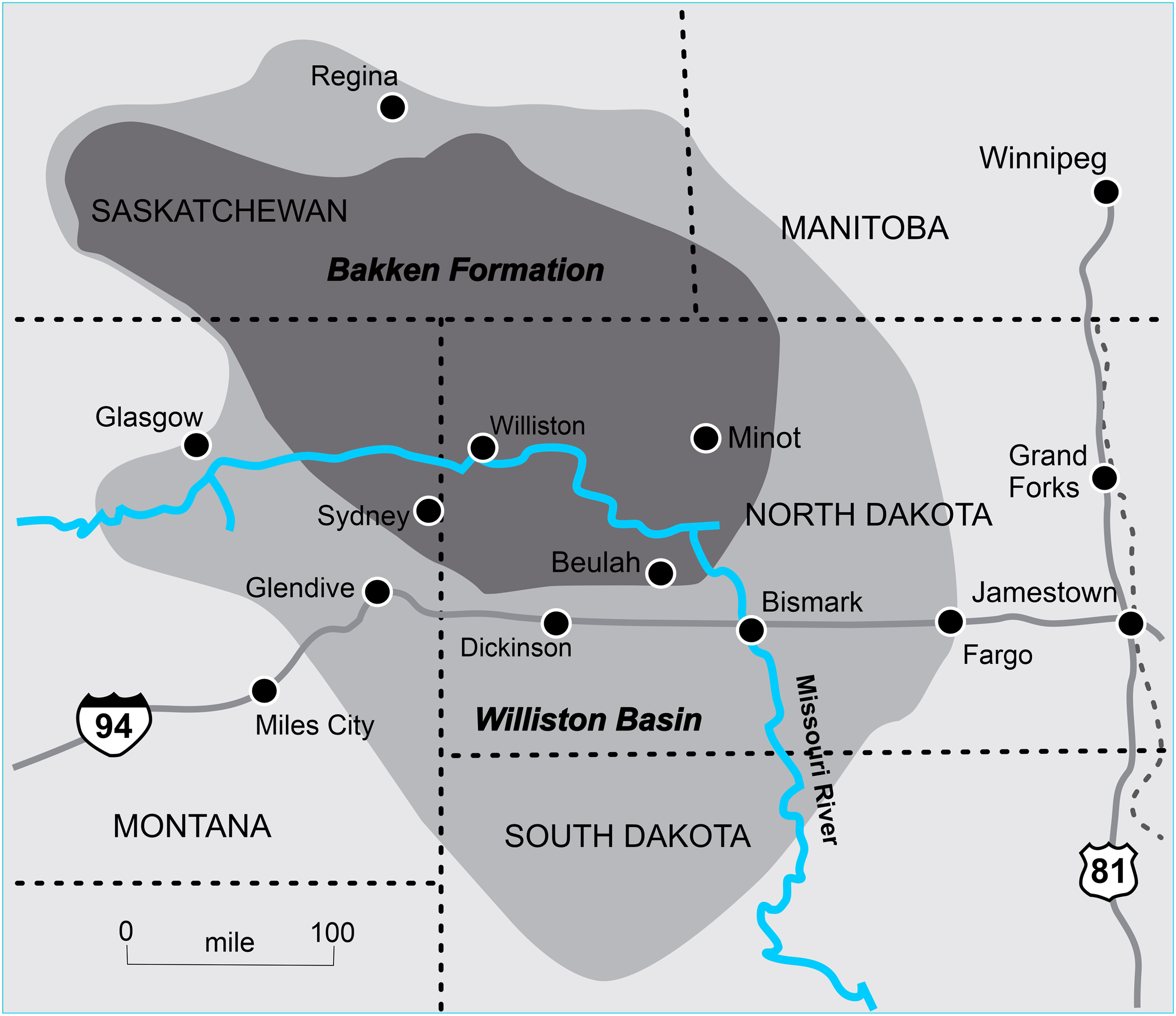
Map of the Bakken formation and surrounding area (adapted from US Bureau of Land Management and Bakken Resources Inc.).
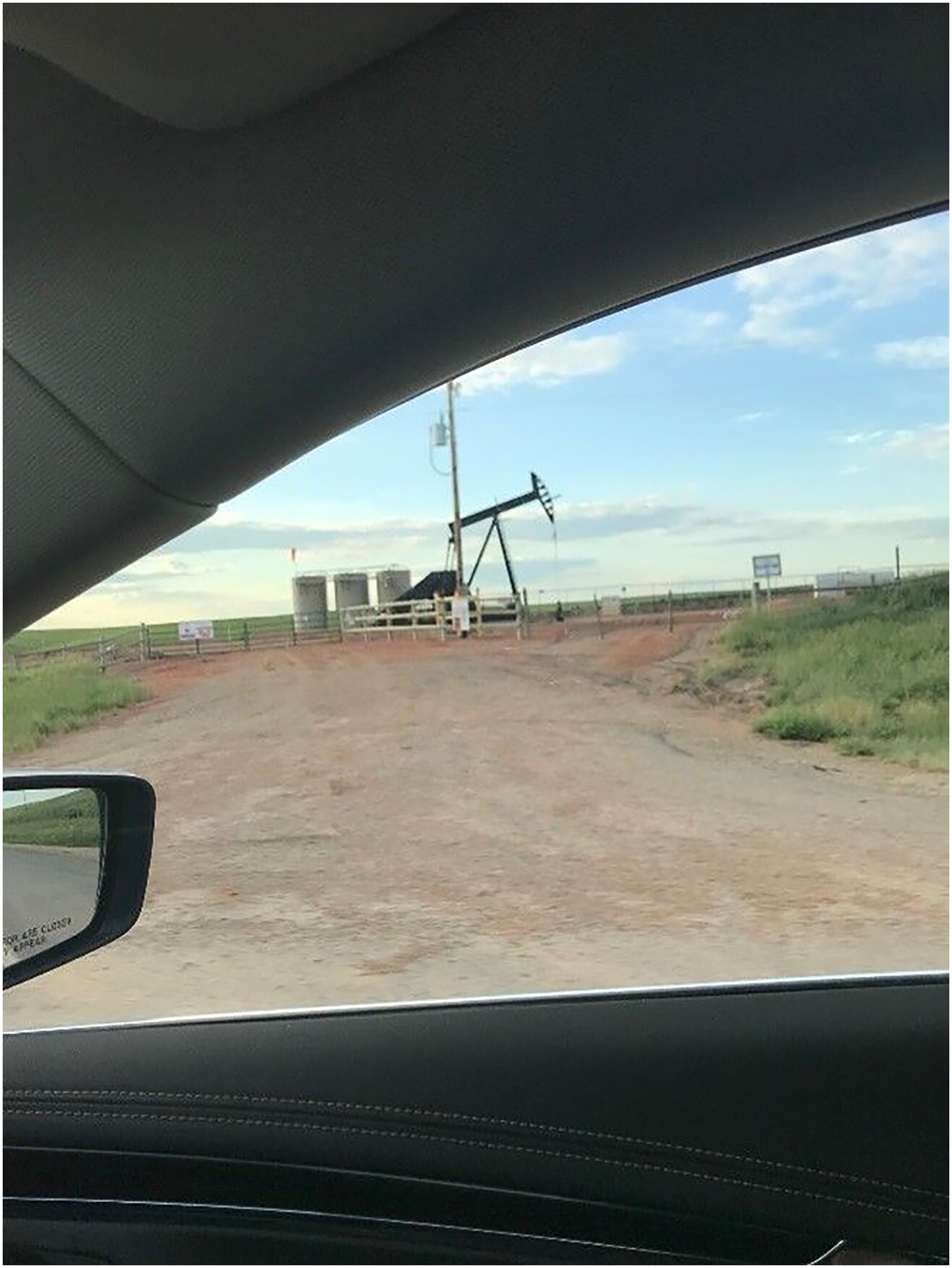
Oil rig, seen from car (copyright: Authors).
Recent technological breakthroughs in horizontal drilling techniques and multi-stage hydraulic “fracking” have facilitated the rapid extraction of oil and natural gas deposits embedded in “tight” subsurface layers of shale, sandstone, and dolomite (Fershee, 2012). These developments along with geopolitical goals have motivated US government agencies to locate and develop domestic oil sources. An updated resource assessment completed by the United States Geological Survey in 2013 revealed 7.4 billion barrels of “untapped” oil in the Bakken region which compelled the former Secretary of the Interior to publicly reiterate the government's objectives to reduce foreign energy dependence, develop domestic energy reserves, and “make informed decisions about the responsible development of these resources” (DOI, 2013). In 2012, Executive Order 13604 was passed which sought to improve the performance of federal permitting processes and reviews of infrastructure projects to expedite approvals related to projects like oil drilling. Such improved measures would be executed in a way that “ensur[es] the health, safety, and security of communities and the environment while supporting vital economic growth” (E.O. 13604, 2012). Despite public commitments to pursue “responsible” oil extraction without imposing social and environmental harm on local populations, the quest for energy independence and economic development has led to degrading socio-environmental conditions in Indigenous communities and particularly for women who reside in them.
A Northern Great Plains reservation 2 sits on a large portion of the Bakken shale formation, with segments of the shale present underneath and adjacent to tribal lands. Since 2008, tribes in the region have leased thousands of acres of land to oil corporations for extraction purposes (Deaton, 2021). In 2011, the former Chairman of a Northern Plains tribe described growing windfall earnings, and the tribal-company relationships underpinning them, as “sovereignty by the barrel,” because of their potential to usher in financial independence for the nation (Sontag and McDonald, 2020). However, this form of tribal sovereignty has been questioned (Fixico, 2012) as it is shaped by wider power relations mediating the subterranean sovereignty of the region (see Emel et al., 2011; Luning and Pijpers, 2017). Because of the Great Allotment Act passed in 1887, three land ownership categories characterize the Bakken region: tribal lands (owned collectively by tribes), individual allotments (owned by individual tribal members), and remaining allotments owned by non-Natives. Although tribes retain subsurface rights to their lands, companies who want to enter into lease agreements with tribes or their members must liaison with the Department of the Interior (DOI) because all Native minerals are managed “in trust” by the US government. The BIA—a US government entity—negotiates the terms of the lease agreements on behalf of communities, and the DOI ultimately approves them.
Oil companies achieve a strong form of resource sovereignty in the Bakken region due to three conditions: (1) the BIA has frequently negotiated low royalty rates for communities or has misadvised tribal members in company agreements (Deaton, 2021); (2) governmental entities, company representatives, and also tribal leaders have historically established typically low company tax rates as a way to attract private capital, generate tribal revenue, and meet domestic energy goals; and (3) differing tribal opinions on oil extraction have led to fractures among tribal members which are often exacerbated by company intimidation tactics and peer pressure (Interview, 2018; Crane-Murdoch, 2012). These factors bring forth a situation where tribes exercise sovereignty, but are also constrained by other forms of sovereignty, and face difficult decisions regarding the exploitation of their resources (Fixico, 2012).
As feminist studies show, bodily vulnerability accompanies resource sovereignty as “high-level” geopolitical forces are often felt on intimate scales such as the body (Smith, 2016) through the material effects of long-term extraction (Hausermann et al., 2020; Zaragocin, 2019). These dynamics can be observed in the Bakken region. Since oil extraction began, reports of violent crimes in the area rose 121% (Horwitz, 2014), leading to rates of violence and sexual assault against Indigenous women tripling (Deer and Nagle, 2017; Grisafi, 2019). Many point to growing regional migration patterns of people to oil-producing counties as being largely to blame for heightened violence against women (Pippert and Zimmer Schneider, 2018). The region has attracted thousands of workers—mostly non-Native men from across the United States—to fulfill well-paying jobs associated with drilling, fracking, and building oil and gas infrastructure (Caraher et al., 2017). The Bureau of Labor Statistics estimates that between 2007 and 2011, extractive industries employment grew 276%, increasing from 3857 to 14,499 workers (Ferree and Smith, 2013). The gender breakdown of related statistics is startling; census figures of North Dakota reveal men-identified extraction workers outnumber women workers by more than 10 to 1 (GrandForksHerald.com, 2015). Many of these workers engage in risky behaviors and activities that put a strain on or threaten Indigenous communities. Given these dynamics, to many, it is not a coincidence that the proliferation of the oil industry has paralleled increases in violent sexual crimes against women.
Methods and methodology
The genesis of this project began with initial conversations between both authors on the intersections of gender-based violence, extraction, and coloniality in the United States and Canada. Author A is a former graduate student affiliated with the tribe at the center of this research, while author B is a settler geography professor. The authors were both appalled by the rising numbers of MMIWG cases linked to extraction activities and the lack of public policies formulated to address such a crisis. They were also troubled by the dearth of research carried out by Indigenous researchers on this topic, particularly in the Bakken region (for exceptions, see Deer and Nagle, 2017; Tice, 2016). Research design was guided by a desire to construct a decolonizing Indigenous-led project where sovereignty is seen as a methodological issue (Baldy, 2018; Simpson, 2014) meaning that tribal members are in control of research representations of themselves and their voices.
We follow feminist, anti-colonial geographers in bringing attention to how power and privilege shape participant–researcher relationships and methodological and knowledge production techniques in “the field” (de Leeuw and Hunt, 2018; Hausermann and Adomako, 2022; Johnson et al., 2021; Katz, 1994; Neely and Nguse, 2015). We also uphold ideas about how intersectional identities inform researcher positionality and ultimately facilitate or constrain information collection and project processes and outcomes. These contributions helped us contend with the messy realities of conducting research in a highly charged environment. Author A, who collected the empirical data, is affiliated with the Northern Great Plains tribe; however, she did not grow up on the local reservation and was raised in a distant city. Her identity, as a college-educated “urban Indian,” triggered some initial personal anxieties around her Native “authenticity” and caused her to question whether she was appropriately positioned to pursue the project. Following Sultana (2007), these fears and tensions illustrate an insider–outsider dynamic where a researcher feels part of the community they are studying but is simultaneously aware of the power relations which position them outside of it. Author A's anxieties were calmed when a tribal interviewee addressed her concerns by saying, “Yeah but you are Native, and that's important that the narrative is coming from someone connected, rather than a non-Native” (Interview, 2018). This sentiment, and similar ones communicated by other tribal members, demonstrated a level of comfort and acceptance and a willingness to share stories with a researcher they trusted. However, despite a perceived shared identity, we recognize the extractive elements of “doing research” and the impossibility of stepping outside of the unequal power relations and colonial resonances of such endeavors (de Leeuw et al., 2012; Johnson et al., 2021). At the same time, we argue that scholarly projects on the violent effects of nature-intensive industries, and particularly those led by Indigenous peoples on their own communities, are necessary and such efforts require constant reflection so that oppressive relations are not reinforced or repeated.
In 2018, author A obtained written approval from the Institutional Review Board for the Protection of Human Subjects at the University of San Francisco (protocol 1059) to carry out the study. A total of 25 interviews were conducted using snowball sampling. The sensitivity of the topic and the uneven willingness of individuals to discuss such personal experiences contributed to a small sample size. However, small sample sizes, especially in research involving vulnerable populations affected by violence, are common and well-justified “…as the value of hearing from overlooked…populations outweighs any potential sacrifice in broad generalizability” (Hardesty et al., 2019: 4798). Author A interviewed Northern Great Plains tribal members who were spiritual and political leaders, residents, oil industry workers, and employees or retirees from various tribal government departments. They also interviewed tribal stay-at home parents, members who grew up on the reservation but had recently relocated, and tribal beneficiaries of oil royalties. Many interviewees had been personally affected by the disappearance of female loved ones. Interviews were also conducted with members from other Native tribes who had come to the reservation for employment. Informed consent was obtained from all interviewees.
In line with Indigenous methodologies (see Smith, 2012), a conversational method was employed during interviews (Kovach, 2021). This approach often requires more time and several visits when compared to highly structured interviews because participants reveal their personal, internal knowledge on their own terms. Because of this, it was common for participant visits to last for several hours. Tobacco, sage, or deer eye necklaces were offered to participants after each completed interview. These spiritual offerings are sacred to author A's affiliated tribes and their culture. Their distribution affirms that knowledge acquired through the research process will be used in a way that will empower the tribe. These physical offerings also symbolize researcher dedication to the study and care and respect for the stories being shared.
For participatory observations, author A attended community gatherings and spent time with a tribal family engaged in ongoing search efforts for a missing woman-identified relative. They also lived in motels which primarily housed oil workers and visited key sites such as local restaurants, shops, gas stations, and the central Wal-Mart. When completed, interviews were transcribed and loaded into NVIVO 12 along with author A's journal notes. Data analysis followed principles of grounded theory where emergent themes are first identified and coded, and theory is constructed out of the most applicable categories (Glaser and Strauss, 1967; Presser, 2005). As researchers, we acknowledge that Indigenous women are not a monolith and are positioned differently vis-à-vis the necropolitical dynamics of the Bakken. In this article, we have chosen to highlight a subset of experiences which reflect how the oil industry increases the vulnerability of some Native women and their families in the region. The opinions and analysis included here do not represent those of the tribe but are those of the authors only.
Tactics and spatialities of necropower
Structural poverty and uneven wealth emplaced by colonialism and extraction
A key necropolitical tactic advanced by the settler state in the Northern Great Plains is the emplacement of structural poverty and uneven wealth through years of forced land cessions, colonialism, and resource extraction (see Capossela, 2015; Fixico, 2012; Govaerts, 2016). This has weakened tribal self-determination leading to colonial entanglements which structure livelihood dependence on extractive industries (Curley, 2018; Curley and Lister, 2020). In the Bakken region, these dynamics have spurred uneven distribution of wealth among tribal members, resulting in gendered economic inequality and financial dependence with necropolitical effects for women.
Oil wealth distribution in the region is mediated by several factors. First, the material geographies of the Bakken formation itself and the imposed checkerboard pattern of Native and non-Native land allotments distributed across the region create spatially diffuse arrangements of large income differences. Not all tribal land physically sits on an oil reserve; therefore, many members are unable to claim oil royalties from private companies. For those that are, interviewees mentioned some tribal members receiving royalties of as much as $100,000 a month (Interview, 2018) and some even becoming “millionaires” (see Crane-Murdoch, 2012). Such windfall incomes are in stark contrast to what tribal members earned prior to the arrival of oil—incomes that were barely enough to cover necessities (Interview, 2018). Research shows that before the oil boom, tribal unemployment was ∼40% and the poverty rate was four times the national average (Crane-Murdoch, 2012). Though these rates have somewhat improved, many tribal members remain in an impoverished state and still experience economic hardship due to rising living costs. These uneven realities have engendered a high level of distrust among tribal members, mixed perspectives on extraction, and a breakdown of tribal cohesiveness.
Second, Native landowners’ inability to negotiate fair lease agreements with oil firms in addition to company corruption has exacerbated intertribal wealth disparities. Typically, Native landowners have little knowledge about market values of lands and lease rates. The BIA is charged with facilitating negotiations between tribes and companies, but some tribal members state the BIA has not “maximized” offers in their favor (Crane-Murdoch, 2012). Recent research shows that although market value for leasing rights falls between $300 and $1000 per acre, tribal members have been offered on average of about $50 per acre (Lustgarten, 2013) or as low as $15 (Tice, 2016). During interviews, it was common to hear of corrupt company actions such as oil firms establishing cheap, “lowball” lease deals with Indigenous landowners for drilling rights ultimately to then “flip” them for huge profits. These dynamics have resulted in extremely uneven royalty payments among and between tribal members causing some to question whether oil-derived wealth empowers tribal sovereignty and welfare or threatens tribal bonds and socio-environmental futures (Interview, 2018).
Growing wealth disparities and class distinctions linked to oil revenues lead to vulnerability for Indigenous women in two ways. First, tribal members who receive no oil royalties or those who need to supplement their low royalty payments often seek employment in, or adjacent to, the oil industry. Available options are highly gendered, which reflect the hegemonic masculinities of extraction-based labor markets (Schafft et al., 2019). Indigenous men may find high-paying employment as fieldworkers, machine operators, or truck drivers. Indigenous women unfortunately, are often limited to low-paying, precarious jobs in shops, restaurants, bars, and motels that service the industry. This puts them at a comparative disadvantage in wage distribution. Some women-identified interviewees mentioned that low pay combined with sky-rocketing prices for food, clothes, and personal items has caused them to turn to exotic dancing or part-time sex work to make ends meet (Interview, 2018). One woman-identified tribal member stated that sometimes, “women do not know what kind of jobs they are getting into. People promise them jobs but it turns out to be a trafficking situation” (Interview, 2018). These necro-political dynamics increase the chances of Indigenous women encountering stranger-perpetrated violence or even death.
Second, due to the challenges women face in gaining meaningful employment, women may become financially dependent on men which may make it harder for them to leave situations of interpersonal violence. Official tribal data on domestic violence rates is difficult to locate; however, several interviewees mentioned that intimate partner violence was prevalent. Research from the Bureau of Justice Statistics indicates that cases of intimate partner violence against women in the Bakken region rose by 33% between 2006 and 2012. While this number reflects instances of reported victimization against all women in the region and not only cases involving Indigenous women, given current trends, it provides a baseline understanding of what kind of danger Indigenous women may experience in the home. To these women, wealth disparities facilitate necropolitical forces because their financial independence is diminished and they must rely on potentially dangerous individuals to sustain their livelihoods.
Industrialized “man-camps”
“Man-camps” linked to industrialized, extractive industries in and around the Northern Great Plains region have intensified livelihood vulnerability for Indigenous women. Man-camps, which have long been associated with coloniality, land theft, and gender-based violence (Estes, 2019; Morgan et al., 2021), are pop-up communities that house mostly cismen workers and consist of trailers, sheds, and other forms of temporary housing near zones of extraction (Gibson et al., 2017; Joseph, 2021). In 2008, the Bakken oil sector expanded at an explosive rate, leading to a high demand for workers. Massive influxes of mostly white non-Native men arrived in search of employment. In the boomtown city of Williston, North Dakota for example, population estimates soared from ∼16,083 in 2010 to 27,096 in 2019 (Chambers, 2020).
Two types of man-camps were observed near and on the Northern Plains reservation during fieldwork: corporate and informal. Corporate is associated with workforce housing sponsored by a company, while informal man-camps are less structured encampments of RVs, tents, and even cars (see Figure 3). The necropolitical geographies of these hypermasculinized settler spaces are evident; man-camps are “hotbeds” of sexual violence (Parson and Ray, 2020), including rape, sexual assault (including minors), and sex trafficking. Martin et al. (2019) found that between 2006 and 2012 in an area of man-camps situated in the Bakken region, the rate of violent victimization, particularly of aggravated assault, increased by 70%. The researchers also found that homicide, non-negligent manslaughter, rape and sexual assault, robbery, and aggravated assault increased by 30%, where it declined by 4% in non-Bakken regions. Man-camps have become spaces for isolation, drugs, violence, and poor life choices (Grisafi, 2019). Many oil workers leave their families to work seasonally, are single, have high amounts of disposable income, and have no accountability to Native communities (Gibson et al., 2017; Pippert and Zimmer Schneider, 2018).
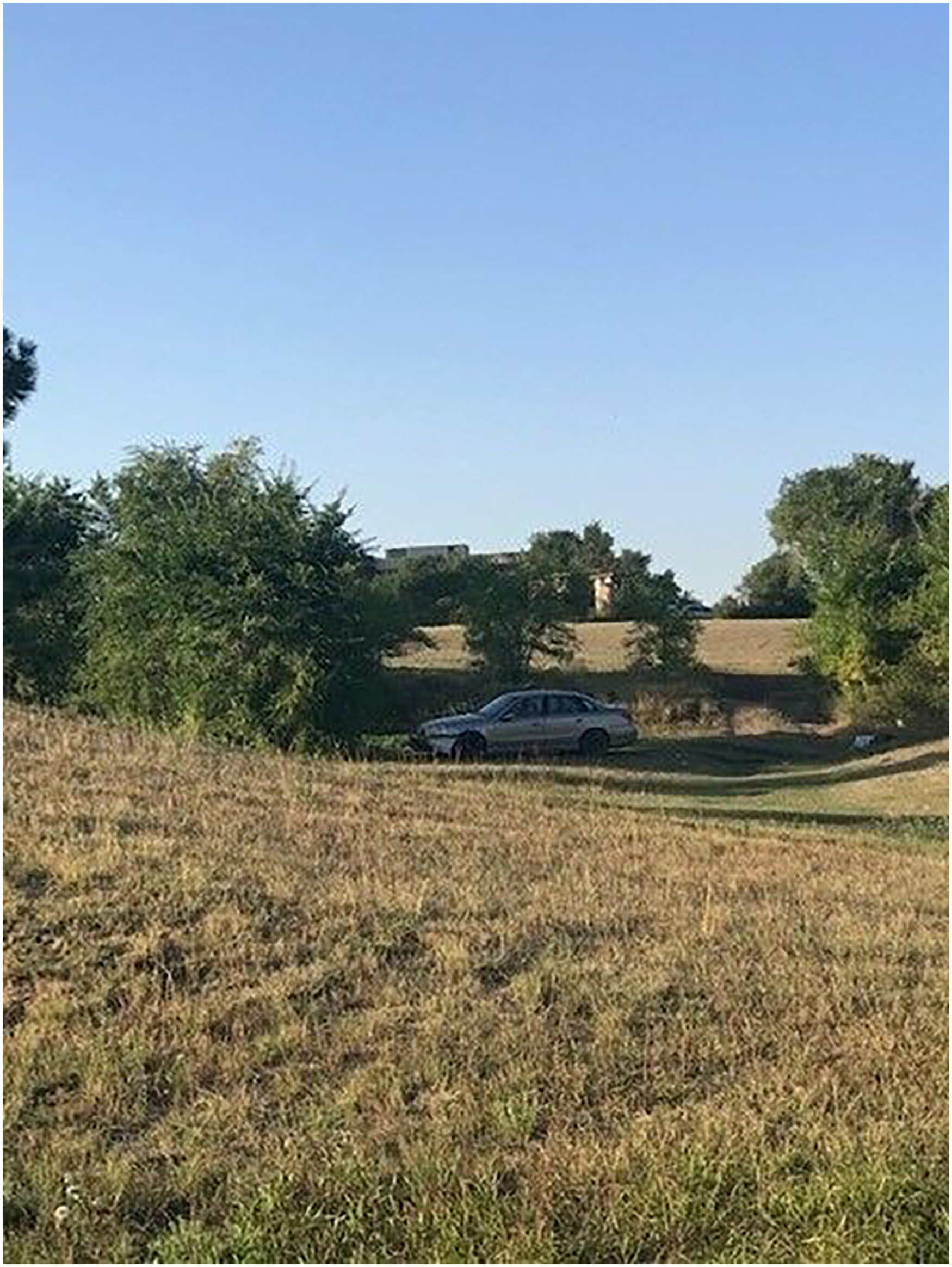
Car-living (informal housing) near an oil extraction site (copyright: Authors).
With the inundation of oil workers, Indigenous women's experiences of violence have increased. One tribal member explained how the influx of oil workers has changed social dynamics and distorted tribal responsibilities of men, making women more vulnerable. He explained to author A (who identifies as a woman), Man, when the oil hit and everything happened, you walked into some of the haunts, the places you'd been, and you’d walk into one bar and you don't recognize anybody in the bar, and you knew everybody in the bar [before]…There was a lot of shit going on where [non-Native males oil workers] weren't able to pick up any women on their own, so they were pack-hunting [for women]; in supermarkets, in bars. And what I mean by [pack-hunting] is that you’re here with me and we’re sitting here and a table of five or six guys are over there and they keep talking to you. [They’ll say] ‘Why are you with that guy? How come you’re doing that with that guy? You should be with us, you should come over to us.’ Of course…you are free to do whatever you want you know [as a woman]…But if you did decide to go…[I] couldn't as a man protect [you] because these punk kids are hanging around with five or six and [I’m] only one. That's not a good feeling.
In addition to disrupting gender responsibilities, the influx of oil workers has made young girls extremely vulnerable to sexual exploitation due to the high incomes of workers and long-standing poverty within the tribe. As one woman-identified tribal member explained, A lot of these [tribal] homes were in poverty and [young girls] looked at it like its easy money…There were young girls at a very young age that were trying to prostitute. Some of their friends would be like, ‘Hey we went to this party and there were all these older [non-Native oil workers] there’ and some of them were cute and they were giving them money and some of these young girls are thinking, ‘You know, my mom and dad don’t really have money but these guys are handing it out.’ [The young girls] don't realize the story behind [the money] and what they actually have to do to get that money.
Both these quotations speak to the social and cultural transformations engendered by the onset of oil dependence and the influx of settler oil workers on and near reservation lands. The workers take advantage of the vulnerability, desperation, and poverty sedimented by previous waves of extraction and dispossession. Man-camps are fundamental spaces to the settler necropolitics of the Bakken because they breed violence and harmful behaviors in which the lives of Indigenous women are entangled. As Simpson (2016) reminds us, violence and power are much more diffuse in settler colonialism. Therefore, man-camps can be read as sites where the settler states’ own citizens carry out necropolitical practices which move Indigenous life closer to death.
The necropolitical dangers of these spaces have led Native women to transform the ways they (and their children) physically move through tribal areas adjacent to man-camps. One mother explained, “A couple years ago there was a guy coming through and he was taking pictures of children, and it was scary. After that I told my daughter, ‘You can’t go and play today you have to stay at the house.’” Other Native women stated, when alone, they “always carry a flashlight” with them before entering their cars or they “run with pepper spray and a knife just to be safe.” One woman-identified respondent chillingly remarked that “When abductions of women [are] happening, you know not to park by vans” for fear of being pulled into one. The lack of federal response to the everyday violence Indigenous women face has forced them to devise personal strategies to manage risks on their own, problematically suggesting an individualistic approach to safety is necessary for them to be kept alive.
Jurisdictional conflicts between federal Indian law and US legal systems
The diminishment of tribal jurisdictional power and legal sovereignty is a final tactic used by the settler state to advance necropolitics in the Bakken region. Over time, the ability of tribal nations to serve their members and protect them from abusive power (and bodily dangers as linked to the oil industry) has been systemically stripped by the federal government (Deer, 2015; Finn et al., 2017). This reality is made possible because in settler colonialism, tribal sovereignty is subordinated to the political sovereignty of the ruling state. The concept of “sovereignty” itself is a European construct that has served as a coercive tool to legitimize geopolitical control over states and their territories (Alfred, 2006). As states such as the United States and Canada came to “recognize” tribes as “sovereign nations,” they did so within their liberal democratic structures where Indigenous peoples were seen as participants in the bounds of a nation state (Bauder and Mueller, 2023). This has given rise to a fundamental contradiction whereby tribal sovereignty can only be conceptualized within the terms out set by the settler colonial state.
This highly circumscribed and limited form of sovereignty is also sustained by the hetero-patriarchal nature of the settler state. Patriarchy is a fundamental part of settler colonialism in its aim to erase Indigenous identities and representation while bringing violence to Native women and girls through legitimized practices of gender oppression (Coulthard, 2014; Meissner and Whyte, 2017; Simpson, 2016). Patriarchy, white supremacy, racial discrimination, and state domination work in relation to one another to fuel capitalism and the continued dispossession of Indigenous peoples (Coulthard, 2014). Historically, settler laws overtly favored men and sought to erase Indigenous women through, for example, marriage laws in Canada which, up until 1985, stripped Native women of their Indian status if they married a non-Native man (Coulthard, 2014). Such laws, and similar policies in the United States, worked to diminish tribal sovereignty while dispossessing women and their families of Native land, inheritances, rights and benefits, and Indigenous identities.
Currently in the United States, settler laws promote gender oppression by removing tribal nations’ abilities to prosecute serious crimes against their members. For example, because of the Major Crimes Act (1885), the federal government retains jurisdictional oversight over major crimes such as murder and rape committed on all Native reservations. The Oliphant v. Suquamish Indian Tribe (1978) ruling dictates that Native tribes do not have inherent sovereignty to try non-Natives who commit crimes in Indian country because doing so would be “inconsistent with their [domestic dependent] status”’ (quoted in Grisafi, 2019: 518). Both these settler legal structures, in addition to biased and sexist tendencies of law enforcement, subordinate tribal sovereignty to settler power while reducing gender protection for Indigenous women. In the Bakken region, they enable conditions where culprits, likely connected to the oil industry, can function with impunity.
Today, the necropolitical tactics of the hetero-patriarchal state are demonstrated via the imposition of settler legal policies on tribal lands which has given rise to a puzzling maze of overlapping legal jurisdictional boundaries. On the Northern Great Plains reservation, the tribe has criminal jurisdiction only in contexts of crimes committed between tribal members or between other Native peoples but not in cases involving a Native victim and non-Native defendant; this remains under the purview of federal government authorities (Finn et al., 2017). Considering ∼96% of sexual violence experienced by Native American and Alaskan Native women has been perpetrated by non-Native individuals (NCAI, 2018), confusing jurisdictional arrangements spell out disastrous outcomes for Indigenous women. One woman-identified tribal officer described how by saying, Because the reservation is on [several] different counties, jurisdictional provisions prevent us from doing our job and convicting criminals. I remember one situation where we were called in for a dispute between a couple and I witnessed a physical altercation between both the woman and man. But the woman was left with a fractured jaw by a kick across the face, while the guy had a few scratches on him. The woman was an enrolled tribal member and the guy had told us that he was tribal as well. Turns out he lied and was non-tribal (as well as non-Native). We had to call and wait for state police to show up, which resulted in little to no assault conviction because of the differing stances on assault between jurisdictions. If I hadn’t made personal calls to several [state] deputies informing them of what I witnessed, nothing probably would have become of that case, but [because of her intervention] he was convicted of assault.
As the quotation shows, a lack of jurisdictional clarity causes major delays in the pursuit of gender-based violence cases. For example, in the case of Jessica (the Indigenous woman referenced at the beginning of this article), various law enforcement officers from tribal police, BIA, state, and the Federal Bureau of Investigation (FBI) were involved in the case, but none took full control of it for months due to unclear jurisdictional responsibilities and resources (DemocracyNow.org, 2018). The quotation also highlights the dilemma of federal authority apathy. Unfortunately, federal agents are commonly known for their inaction due to lack of case type experience, minimal remote area investigation resources, or personal choice (Amnesty International, 2004; IndianLaw.org, n.d.). Inherent biases and discrimination towards Indigenous women also drive inaction, with authorities refusing to pursue cases in a timely manner due to a victim's possible connection to substance use, sex work, or illegal activities (Amnesty International, 2004). Because of these and other factors, Indigenous women frequently do not report crimes committed against them to federal forces because agents lack culturally informed education and action (Deer, 2015).
This reality exposes two aspects of settler necropolitics. First, institutional inaction is a form of necropower in that it creates conditions where Indigenous women's lives are made vulnerable. Following Simpson (2016), this is a form of settler violence that animates the sovereign death drive because little is done by federal authorities when a crime is committed against Indigenous women, bringing them closer to death. Second, the obstruction of safety for Indigenous women is a result of the metapolitical authority of the United States overriding tribal legal structures (Rifkin, 2009), creating a context where tribal entities are not able to intervene in many crime cases against their members. The weakening of tribal jurisdictional power in addition to discriminatory practices inherent to the federal legal system creates necropolitical dynamics where federal law protection rarely applies to Indigenous women and girls or when it does, its confusing, paternalistic nature and uneven implementation work to further jeopardize their safety.
Conclusion
The purpose of this article was to demonstrate how state-sanctioned oil extraction is working to diminish the quality of life (and in some cases, the chances of life) for Indigenous women in the Bakken region. Our framework shows how necropower is extended through three settler tactics in the context of oil extraction. First, the emplacement of structural poverty and uneven wealth distribution has contributed to gendered economic inequalities and increased financial dependence which heightens Indigenous women's exposure to stranger and interpersonal violence. Second, the power relations of man-camps show how necropower is not only advanced by the sovereign state itself but, at times, is carried out by the sovereign's civilians. Third, tribal sovereignty diminishment contributes to the death worlds of Indigenous women because tribal sovereignty is circumscribed by the power of the settler state and often overwritten by settler authority. This leads to jurisdictional confusion and institutional inaction (undergirded by discrimination and racism) and makes future cases of violence against Indigenous women less likely to be reported.
Given the dangers of settler resource extraction and gender violence for Indigenous women, what pathways forward can be suggested? Solutions must be multi-scalar and involve the restoration of tribal sovereignty to address the crises of oil-linked gendered violence in the Bakken region. New studies on MMIWG from Arizona (Fox et al., 2022) and New Mexico (IAD, 2022), with involvement from Indigenous communities and researchers, reveal the importance of restoring inherent tribal civil and criminal jurisdiction to tribal governments which would ensure faster and potentially less biased legal responses. These efforts must also be accompanied by the strengthening of institutional capacity and readiness of tribal entities to exercise such authority. In March 2022, the Violence Against Women Act (VAWA) was reauthorized by the federal government. It includes a special section (VIII) on safety for Indian women. Importantly, it contains several changes that restore tribal sovereignty in terms of jurisdictional power by expanding tribal criminal jurisdiction over non-Natives who commit crimes such as, “assault of tribal justice personnel, child violence, domestic violence, obstruction of justice, sexual violence sex trafficking, [and] stalking…” (Congress.gov, 2022: n.p.) in Indian country.
Policy efforts that partially restore tribal jurisdictional sovereignty and direct broader public attention to the MMIWG phenomenon do, however, contain weaknesses. For instance, there is little indication that enhanced victim services (e.g. culturally appropriate counseling) will be made available to affected families and communities to address trauma stemming from disappearances. Further, no formal commitment to extended consultation with tribes has been made by federal authorities to continue developing culturally appropriate responses to cases of disappeared Native women and girls. Lastly, these policies remain grounded in settler institutions and logics (see Ybanez, 2008) which continue to aggrieve Indigenous populations. In this way, while the restoration of tribal sovereignty should be supported, we must be reminded that tribal sovereignty is largely shaped and circumscribed by the settler state which means that any effort to reestablish this power also instantiates settler power. This realization therefore points to a fundamental contradiction which lies at the heart of state-based solutions: reliance on federal institutions for the protection of Indigenous women is reliance on the same institutions of power which bring Indigenous women closer to death.
This realization necessitates attention to, and support for, Indigenous-led pathways forward to address gender-based violence in communities. Several initiatives are underway. To date, a centralized system tracking MMIWG cases across the United States and Canada does not exist. Since 2015, the Indigenous-led Sovereign Bodies Institute is filling this need. The organization crowdsources information on cases related to missing Indigenous women, girls, and two spirit people and maps the geographies of their disappearances (Lucchesi, 2019). It logs victim information related to name, tribal affiliation, geography, and details about the perpetrators and police or court responses. To uphold data sovereignty and respect for the families who have lost loved ones, the data is only made available to individuals and institutions who can prove they will use the information in a way that is consistent with Indigenous values (Sovereign-Bodies.org, 2022). Other Indigenous-led initiatives include the MMIWG legislative tracker by the National Indigenous Women's Resource Center which monitors emerging US MMIWG legislation at the state level and centralizes this information. These pathways forward, in addition to grassroots Indigenous-led marches, rallies, and vigils, remain important mechanisms in raising awareness about the continued crisis.
The above grassroots and policy examples must be met with efforts to enhance Indigenous livelihoods and the envisioning of safe and healthy futures. Solutions must have the goal of enhancing the flourishing of Indigenous cultures, lifeways, and healing for all Indigenous peoples. While this article did not address mounting violence against Indigenous men, boys, or two spirit people, it is worth noting that many of our respondents mentioned that any future solutions must include broadened protections for all Indigenous peoples because of the disproportionate risks of violence they face when compared to national averages. This research encourages future radical geography projects to analyze the spatialities of missing and murdered Indigenous peoples across all gender and sexual identities.
Footnotes
Acknowledgements
The authors express sincere gratitude to tribal members whose donated time made this research possible. Special thanks goes to Brian Dowd-Uribe and Emily Billo for reading previous versions of this article. We also thank editor Dr. Waquar Ahmed and 3 anonymous reviewers for their comments and guidance. Funding was provided by the International Studies Department and the Faculty Development Fund, University of San Francisco. We dedicate this publication to Marie's cousin “Taco” whose passing coincided with the writing of this article and whose many forms of assistance were integral to the completion of the project.
Declaration of conflicting interests
The authors declared no potential conflicts of interest with respect to the research, authorship, and/or publication of this article.
Funding
The authors disclosed receipt of the following financial support for the research, authorship, and/or publication of this article: This work was supported by the University of San Francisco (International Studies Department and Faculty Development Fund).
