



Abstract
The role of transportation in producing greenhouse gas emissions and other harmful pollutants has led governments across the globe to incorporate electric vehicles (EVs) at the centre of their climate action strategies. In turn, critical geographers have directed attention to the role of EVs in driving resource extractivism in geographies outside of the city and in enclosing urban space at the expense of infrastructures such as bus lanes, cycleways and walkable spaces. Less well charted, however, is the odd structure of class relations involved in the formation of new accumulation strategies, spaces and fixes capable of holding together, for a time at least, some of the tensions emerging from the chaotic unfolding of EVs and associated infrastructures in cities. In the following paper, I shine a light on the role of EV users in Dublin, Ireland, who pursue and forge novel cross-class alliances with automobile firms in an effort to promote EVs and cement private and commercial automobility as the core of the decarbonization agenda. I argue for the need to conceptualise the decarbonizing action of EV users as part of a wider class project intended to enrol wealthier users in a push to alter the city and produce uneven pathways of decarbonization.
Introduction
Dublin is in the midst of an intense period of socio-spatial restructuring associated with the expansion of various forms of so-called ‘decarbonizing’ technologies. This is similar to the kind of restructuring unfolding in Amsterdam (Mashhoodi and van der Blij, 2021), Beijing (Jin et al., 2020) and Norway (Sovacool et al., 2019a, 2019b). Local authorities, firms and residents are installing new infrastructure such as rooftop solar panels; some of the existing housing stock and many new housing developments are moving towards the use of air and ground source heat pumps; and there are now around 15,000 zero-emission vehicles using Dublin's streets (SIMI, 2022). 1 Less noticeable is another geography in formation, which supports the decarbonizing city via the installation of new digital infrastructures; the roll-out of maintenance and repair systems; and even the emergence of new socio-ecological transformations in and beyond the city aimed at securing a reliable and expanded flow of electricity (Bresnihan and Brodie, 2020; Dunlap, 2020). A ‘decarbonizing city’ might be taking shape in Dublin, but it emerges in relation to a wider and heavily contested arena of spatial transformation.
Efforts to respond to climate change go a long way to explain developments in Dublin and cities like it. The Irish political economy exists in the context of a wider European project, which in recent years has begun to develop new climate action initiatives, such as the European Union's ‘Fit for 55’ proposals, one element of which seeks to reduce net greenhouse gas emissions by at least 55% by 2030 (European Council and Council of the European Union, 2022). The Irish government has passed a Climate Act (Oireachtas, 2021) and a Climate Action Plan 2021 (DECC, 2021); Dublin City Council has adopted a Climate Action Plan 2019–2024 (Dublin City Council, 2019); and Codema, which refers to itself as ‘Dublin's Energy Agency’, has recently published an Energy Master Plan (Codema, 2021) as part of its remit to provide ‘energy and climate mitigation services to the four Dublin Local Authorities’ (Codema, 2022).
At the same time, it is important to view developments in Dublin in the context of a so-called ‘green industrial revolution’ (Clark and Cooke, 2015) led by capitalists in manufacturing sectors. Cloaked in the language of sustainability, obscuring their historical role in creating the climate problem, and enabling them to remain in the driving seat of the capitalist economy, the green industrial revolution entails new rounds of investment that, in turn, require re-configuring cities such as Dublin. The green industrial revolution, in myth or reality, demands that new geographies are established, that urban systems are re-formulated, so that extant processes of exploitation and capital accumulation are left untouched.
Against this general backdrop, the following paper focuses on the emergence of a new geography in Dublin oriented around facilitating the sale and use of electric vehicles (EVs). EVs have become the de facto standard for decarbonizing transportation in cities, as evidenced by the IPCC's (2022: 41) claim that ‘electric vehicles [EVs] powered by low emissions electricity offer the largest decarbonization potential for land-based transport’. The automobile sector, which employs at least 20 million workers around the world (Dicken, 2015) and constitutes on its own a $3 trillion industry (Carlier, 2022) is beginning to restructure around the production of EVs, even if a significant proportion of its sales continue to be internal combustion engines (ICE). 2 According to a report by Reuters (2022), automakers will have invested $1.2 trillion in EV production by 2030, in part as a response to new entrants such as Tesla but also due to the likelihood of stricter emissions standards, such as ‘Euro 7,’ which the European Commission (2022) claims will ‘drive the deployment of zero-emission vehicles’.
The shift toward EVs has attracted attention from geographers. For example, Henderson (2020) has argued that EV drivers – who he refers to as ‘kinetic elites’ (p. 1998; citing Birtchnell and Caletrío, 2013) – leverage the decarbonizing project to reproduce highly uneven, private, and hypermobile transport regimes. At a global scale, Henderson (2020) suggests that EV production and consumption ‘might escalate rather than reduce global resource and energy demand’ (p. 1993) by placing new demands on critical raw materials and electricity grids. At the urban level, he argues that EV drivers demand a city that undermines other, conceivably more sustainable forms of transport. Others such as Kester (2018) focus on the role of EV infrastructures in reshaping governmental practices regarding energy security. He posits that EV charge points merge the automobility and electricity systems, thus requiring new security practices to enable the circulation of energy and transport. Further contributions examine ‘niche-innovation’ and experimentation in transportation systems using the so-called ‘multi-level perspective (e.g. Berkeley et al., 2017; Geels, 2012, 2014).’
Hitherto, Marxist geographers have not paid enough attention to these sorts of developments. Yet, there are some significant contributions that signpost a type of approach that might provide effective explanation. While et al. (2004, 2010), for example, draw on Marxist literature on the politics of local economic development to elaborate upon efforts to produce ‘socio-ecological fixes’ to capitalism's social and environmental crisis tendencies. Their argument shines a light on the emergence of cross-class coalitions in specific localities and regions, which try to anchor so-called ‘sustainable’ innovations in cities while reproducing inequality and expanding the scope for capitalist accumulation to occur. As they suggest, the notion of a ‘sustainability fix’ draws upon the argument that ‘the geographical reproduction of the capitalist mode of production depends on uniting territorially-based class interests and factions behind a coherent line of action’ (While et al., 2004: 551). Geographical analyses of EVs in the decarbonizing city tend to play down the relations between EV drivers and automobile firms. In contrast, I argue that emphasizing the role of cross-class alliances in producing the decarbonizing city permits a type of analysis that calls attention to projects and plans that reflect a type of ‘eco-state restructuring’ (While et al., 2010: 77) that emerge from capitalism's need for socio-ecological fixes of this nature.
In the following paper, then, I draw on an analysis of qualitative fieldwork on the dynamics of Dublin's EV shift to theorise the uneasy and, at times, odd structure of class relations driving the decarbonizing city. I argue that capitalist enterprises – corporations such as Volkswagen or Nissan – cannot alone produce the complex geographies required to expand their accumulation prospects. Instead, they rely on developing and analysing an ongoing iterative arrangement with EV drivers, as well as numerous smaller firms. I therefore argue that automobile firms need to be understood as working with, drawing upon, and exploiting an implicit but effective alliance with EV drivers to restructure transport systems across cities like Dublin and thereby create new infrastructures such as charging points while establishing unique socio-cultural and institutional mixes. The rest of the paper has two main sections. I begin by elaborating on the argument that the expansion of EVs requires cross-class alliances. I then draw on my research findings to examine the chaotic experiences felt by EV users at charge points in Dublin and how they respond to the problems they encounter. I shed light on a range of creative and strategic actions EV users express to address infrastructural failures while shaping the city in their own image.
Data for this paper are based on primary research I conducted in 2021, following approval from the Faculty of Social Sciences Ethics Committee at Maynooth University (approval identification number 2417100). I decided to focus on EV users because they are actively engaging, and at times creating, the emerging geography of the decarbonizing city in Dublin. They experience and try to find solutions to infrastructural problems, for example, regarding charging points. They provide first-hand, direct accounts of what it is like to own and use an EV in Dublin. I used a combination of purposive and snowball sampling to conduct 39 semi-structured interviews with EV users who live and/or drive in Dublin. I standardized my interview guide depending on the respondent group, but I included space for context-specific questions depending on the experience and knowledge of interviewees. The initial stages of each interview shed light on drivers’ agency, while the latter sections attempted to identify how EV users understand and relate to the broader shift towards EVs. The respondents were aged between 30 and 70; 54% were men; and the vast majority were employed in the services sector. Some of the respondents (around 25%) were either core members or otherwise closely affiliated with Ireland's EV user lobbying group, the Irish Electric Vehicles Owners Association (IEVOA), which was formed in 2015 and aims to be ‘a community-driven lobby and membership group for EV owners on the island of Ireland’ (IEVOA, 2023b). I also conducted 23 interviews with representatives from Irish and international firms operating in and around the EV sector (e.g. automotive dealerships, charge point installation companies); and nine interviews with respondents from the public sector and regulatory bodies. Finally, my work draws upon analyses of policy and strategy documents published by the state regulator, the Commission for Regulation of Utilities, and the state-owned Electricity Supply Board (ESB), which plays a major role in Dublin's effort to decarbonize the city.
Conceptualizing the decarbonizing city
Decarbonization entails the novel reworking of cities in ways that tend to ‘work with (rather than against) the grain of existing inequalities’ (Bridge et al., 2013: 336). Urban decarbonizing projects are conceptualized as ‘new energy spaces’ (Bridge and Gailing, 2020), when they give rise to ‘novel combinations of energy systems and social relations across space – that is, a process of uneven development – rather than an interest in only certain energy technologies’ (p. 1038). New energy spaces can include new infrastructural arrangements such as EV charging stations; new sites of energy production and consumption; new loci of accumulation. They also yield what Hodson and Marvin (2010: 299) call ‘premium ecological enclaves’, which refers to the emergence of new bounded and divisible geographies in cities that demand ‘internalized ecological flows that attempt to guarantee strategic protections and further economic reproduction’.
Thus, rather than leading to a ‘just transition’ (Heffron and McCauley, 2018), there are signs that pathways to decarbonization will create new injustices, which is not surprising because international efforts since the 1990s to shift towards decarbonization have by design, ‘interact[ed] strategically with existing social power relations’ (Tyfield, 2014: 601; my emphasis) to maintain the status quo and enable existing constellations of capitalist accumulation to expand (see also: Rudolph, 2022). Crucially, as signposted by Corson et al. (2013: 4; see also MacDonald, 2013), decarbonizing efforts tend to generate a type of ‘green grabbing [which] encompasses not only physical land grabs, but also the privatization of rights to nature, the creation of new commodities and markets, green sanctions for otherwise declining forms of capital accumulation, and the disabling of institutions that could pose threats to these processes’.
Further concerns about decarbonizing efforts are highlighted by political ecologists and geographers. Low-carbon infrastructures entail a growing dependence on raw materials such as lithium and a surge in interest in creating new mining projects. In northern Portugal, for example, Barrroso agrarian communities are confronted with new mining projects – propped up by European Commission policies – that will ‘degrade, if not destroy, an area with rich biodiversity, cultural heritage and world-renowned agricultural practices’ (Dunlap and Riquito, 2023: 18). Further, Bustos-Gallardo et al. (2021) demonstrate how new demands on lithium production for batteries place social and ecological pressures in the Andes regions in South America, which produce ‘ecological contradictions (notably around water depletion) with potential to disrupt accumulation’ (p. 177) and create resource conflicts in the region. New questions are also emerging around the limited scale of current supply chains as evidenced by the International Energy Agency's [IEA] (2022: 49–50) claim that global EV battery demand will require 50 new lithium projects, 60 nickel mines and 17 cobalt developments by 2030. Thus, despite the hype and current ‘greenwashing’ practices on the part of automobile manufacturers, several scholars have suggested that, in fact, decarbonizing automobility is the ‘hardest case’ of low carbon transition (Geels et al., 2013: xiii, see also: Tyfield, 2013, 2014). Indeed, as Dunlap (2020) notes, a fundamental part of the difficulty is precisely that multiple sites along an expanding electricity grid will experience ‘intensifying socio-ecological harm and degradation via infrastructural colonization’ (p. 2; see also Kallianos et al., 2022; Dunlap, 2021). Decarbonizing the global north city can only occur via problematic ecological transformations elsewhere that ‘might escalate rather than reduce global resource and energy demand’ (Henderson, 2020: 1993).
Targets that encourage the production and sale of EVs have become a fundamental strategy in the global decarbonizing project. For mobility justice scholars (Henderson, 2020; Sheller, 2018), one key reason is that this array of technology reproduces the ‘system of automobility’ (Urry, 2004; see also Urry, 2011), which has dominated cities for over a century now. This system relies upon and reproduces: the central role of car manufacturing in industrial economies; the place of cars in driving individual consumption; the economic complexes that cars underpin (e.g. road-building, urban design, energy production and distribution); the private forms of mobility that cars produce; the mobile cultures that cars sustain; and the car's role in environmental resource-use (Urry, 2004: 26). Henderson (2020) has argued that efforts to promote EVs are designed to enrol wealthier users who make new claims over urban space designated for green projects in place of infrastructures such as cycleways, bus lanes, and walkable spaces. EV drivers should be viewed as ‘kinetic elites’ (Henderson, 2020: 1998). Kester (2018), moreover, argues that charging infrastructure merges automobility with electricity systems in new ways, which exert pressure on users, states and the private sector to deploy security practices to ‘strategically protect’ (as per Hodson and Marvin, 2010: 299) and stabilize the continuous circulation of energy and capital oriented around the decarbonizing of transportation. The EV infrastructure in every city constitutes a key part of the ‘new energy spaces’ (Bridge and Gailing, 2020) emerging in the shadow of climate change debates. In short, scholarship on the emergence of EVs provides numerous insights about what matters and what scenarios to expect.
However, what we have not seen enough of in the literature is evidence that this set of developments reflects the peculiar way that processes of capitalist accumulation draw upon and touch down in the city. We know that capitalism's ‘ability to overcome space is predicated on the production of space’ (Harvey, 1985: 149). We also know well that, on the one hand, capitalist accumulation depends upon durable relations in space – or a degree of structured coherence, which Harvey (1985: 146) defines as ‘regional spaces within which […] supply and demand (for commodities and labour power), production and realization, class struggle and accumulation, culture and lifestyle, hang together’ – while, on the other hand, it also needs and produces a vast and proliferating circulation of mobile capital. Because capital is a social relation on the move, it must circulate to deploy surplus capital and labour profitably, hence the creation of new loci of accumulation will threaten ‘the values already fixed in place elsewhere’ (Harvey, 2014: 152). The upshot is an ‘inconstant geography’ (Storper and Walker, 1989), which occurs by virtue of new accumulation drives that continuously transform the spaces of production and consumption. In turn, the contradiction between fixity and mobility in capitalism generates a politics of local economic development defined, in central part, by ‘local dependence’ (Cox and Mair, 1988, 1991), which is a major characteristic of urban life. Capital's inevitable mobility exerts stress on economic agents and compels them to defend their investments, for example, via scalar activity to produce political or economic action. One key outcome, charted extensively by Marxist geographers operating in the context of Fordism's decline, is the formation of cross-class alliances, which can (but do not necessarily need to) take the form of a regional class alliance (Harvey, 1985; see also Smith, 1984). Capitalism creates the conditions for such alliances to emerge because it places pressure on locally dependent economic agents to defend the circulation of capital in their locality or region. Workers, unions, business associations, and local government can agree to set aside some differences with a view to acting in concert to fortify the extant structured coherence or at least to strengthen the durability of their economy (Cox and Mair, 1988, 1991; see also Cox, 2010).
If most of the literature on cross-class alliances has tended to focus on defensive regional class alliances, which ‘have the sole function of warding off devaluation and displacing it geographically’ (Smith, 1984: 126, my emphasis; see also Jessop, 2006), my conceptualization of cross-class alliances sheds light on offensive projects that aim to create new flows of capital by enacting socio-spatial change in accordance with the demands of capital and emergent but contingently-located allies. Drawing on, and developing, Marxist geography, I propose analysing the role of cross-class alliances in the creation of a decarbonizing city. The inspiration for my work is the contribution of While et al. (2004, 2010), which demonstrates how the urban arena becomes a crucial site in the formation of ‘socio-ecological fixes’ to capitalism's social and environmental crisis tendencies. Their argument pivots on what they refer to as the ‘sustainability fix,’ which takes shape when the state responds to environmental pressures by selectively incorporating ‘ecological goals in [the] greening [of] urban governance [to] balance economic, social and environmental demands’ (While et al., 2004: 551). As they suggest, efforts to introduce such a fix emerge because ‘the geographical reproduction of the capitalist mode of production depends on uniting territorially-based class interests and factions behind a coherent line of action’ (While et al., 2004: 551). One result can even be the formation of projects of eco-state restructuring, which can include the establishment of new institutional and governance structures to help manage environment-economy tensions at a range of scales. My argument is that eco-state restructuring provokes the formation of cross-class alliances, which take shape in the context of ‘the politics of carbon control [which] has emerged alongside, or even replaced altogether, sustainable development as the principal discourse and rationality underpinning new modes of societal regulation’ (Jonas et al., 2011: 2542). Furthermore, such alliances need to emerge because capital cannot visualize and compute, nor make real, all of the socio-spatial changes required by projects of eco-state restructuring. A case in point concerns the present-day project of producing and consuming EVs. A crucial consideration is that responses to the climate change question, such as actions intended to decarbonize the city, must occur in the specific context of each locality. In this regard, and from the perspective of the automobile sector, cities must develop a general infrastructure that can facilitate sales of commodities such as EVs; but the specific form of that infrastructure will depend on place-specific conditions because each place has its own historical and geographical dynamic affecting matters such as planning policies, relations between firms and utilities, and so on. What lead automobile firms need is an explicit or implicit alliance with smaller-scale firms providing charging infrastructure and EV drivers who will act as individual, or collective, champions (or evangelists) for the adoption of this new commodity. What lead automobile firms need is local champions – whether charging point providers or EV owners – who can create or craft the place-specific infrastructure that will facilitate broader uptake and sales of EVs.
Shaping and contesting eco-state restructuring in Dublin
Dublin, like any city, is full of paradoxes. It has Europe's eighth-highest GDP by metropolitan region (Eurostat, 2019); is the fourth most attractive city for European investment (Ernst & Young, 2022); and the most popular European headquarters location for foreign investors (Shehadi, 2020). At the same time, socio-spatial inequalities mark the city. There is a significant housing and homelessness crisis (Hearne, 2014; Lima et al., 2022). Some areas such as Clondalkin or Ballymun rank highly on national indices of deprivation (Teljeur et al., 2016). In addition, the city is host to a spate of state-led neoliberal policy experimentations (Fraser et al., 2013; Lawton and Punch, 2014; Punch, 2005), which on the one hand, market Dublin as a ‘European city’ and orient it ‘towards the assumed tastes and desires of the emergent urban professional classes’ (Lawton and Punch, 2014: 865); and on the other, the state's urban renewal and restructuring programs have created deepening crises for working-class communities ‘in the shape of gentrification pressures, as well as… [in] the poverty of everyday life’ (Punch, 2005: 769). The project of decarbonizing the city therefore unfolds in a complex context.
With respect to Ireland's growing use of EVs, government policy has played a major role. In 2010, for example, the Irish government and ESB, the state-owned electricity firm, signed a Memorandum of Understanding with Nissan and Mitsubishi to create the EV sector in Ireland from scratch. As part of this broader strategy, a state regulator, the Commission for Regulation of Utilities (CRU), required that the ESB create Ireland's first EV charging network. This experiment, known as ‘the EV pilot project’, aimed to provide national scale coverage to test the impact of EVs on the electricity distribution system. It used low-voltage recharging points used by first-generation EVs. The infrastructure was free to use as part of the state's effort to encourage EV adoption. In 2019, a CRU decision paper gave ESB permission to commercialize the asset under a separate business entity, ecars, and introduce new pricing mechanisms. By this time, the EV sector had expanded, leading the government's climate action plan to set a target of 1 million EVs on the road by 2030.
Government policy boosted the expansion of EVs by providing €322.47 million in subsidies (PBO, 2022) to buyers under an EV grant scheme and an EV home charger grant scheme, as well as Vehicle Registration Tax relief for EV buyers. As with all subsidies, controversy has followed, although the case of EV subsidies is especially illuminating because EV buyers tend to be among Irish society's wealthiest members. As illustrated by Caulfield (2022), EV home charging infrastructures are situated primarily in wealthier neighbourhoods. Jennifer Whitmore, a TD (Member of the Irish Parliament), described the subsidies as ‘a major transfer of wealth to those who do not need it’ (Drennan, 2022). As shown in Table 1, 79% of grants were awarded to EV purchases costing more than €40,000. The average annual earnings for full-time employees in 2019 in Ireland is €48,946 (CSO, 2020).
EV grants awarded in Ireland from 2012 to 2022.
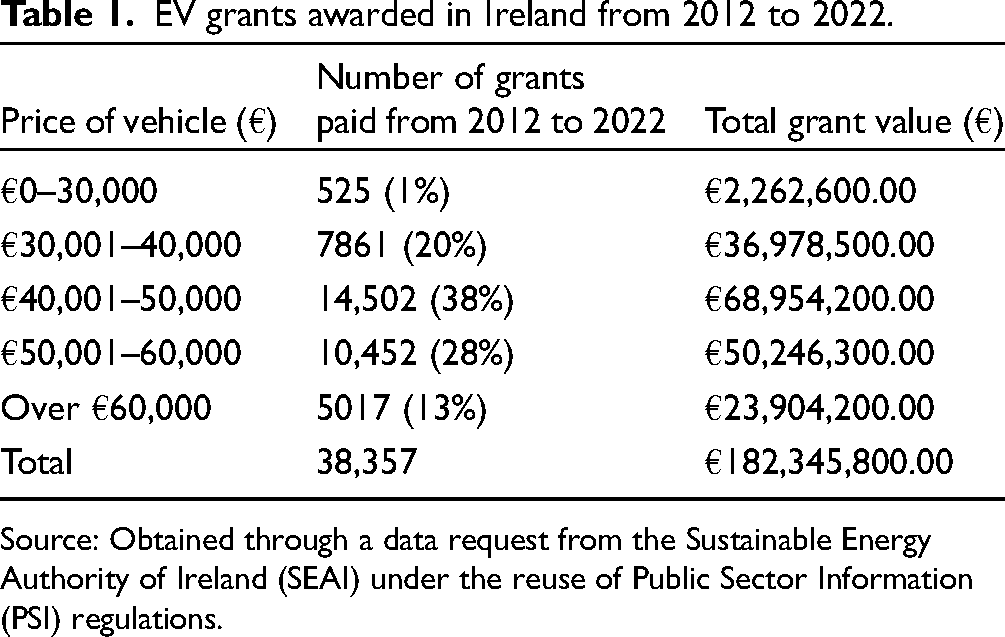
Source: Obtained through a data request from the Sustainable Energy Authority of Ireland (SEAI) under the reuse of Public Sector Information (PSI) regulations.
For champions of the EV sector, then, the last decade has been marked by steady growth and greater awareness of the role EVs could play in a broader effort to decarbonise Dublin and Ireland's transportation sector. But the shift toward EVs has produced new complexities; a new geography, a new infrastructure, and a new approach to mobility is required. For example, consider that, when the Irish government began to promote EVs in 2010, only two EV models were available to purchase; by 2016, there were six models; in 2022, there are at least 60 models available. The market has expanded; however, the infrastructure EV drivers require has not developed in a coordinated manner. This is not a feature in Ireland alone. One part of the issue here is that the EV sector has emerged in the context of struggles among automobile manufacturers and regulators to define how charging should occur. There are numerous standards and specifications. Individual corporations such as Tesla, alliances of Japanese firms, and regulators in the European Union have pursued their own standards. Re-fuelling an EV requires the use of a charging cable and a charging unit (at home, at work, or in public space). One of the first EV models sold in Ireland, the Renault Zoe, re-charged using an AC (Alternating Current) connector. Since then, most cars are re-charged using one of two broad DC (Direct Current) standards: CHAdeMO (a standard developed by an alliance of Japanese manufacturers) or CCS (Combined Charged System, which the EU has promoted). The upshot of all this in Ireland is that EV drivers have had to negotiate a confusing, complex and uneven charging infrastructure at home and away from home.
Another element here is that the emerging geography, the map, of Ireland's EV infrastructure (again, at home and away from home) is not the product of a coordinated effort on the part of the state or capital. As I have noted, the Irish state did try to promote EVs; it did form partnerships and alliances, for example with Nissan and Mitsubishi; and through its ownership of ESB, the state has played a key role in establishing many of the earliest charging points. However, its efforts overall still have not been directed at coordinating things to any great extent, which reflects the general neoliberal stance of Irish policymakers (Fraser et al., 2013). In effect, the approach has been to encourage firms to research and develop the charging infrastructure. It has fallen on Irish-owned firms such as EasyGo, international firms such as Ionity (a joint venture between BMW, Mercedes Benz, Ford, Volkswagen and Hyundai), and Tesla to create the map of EV chargers. Capital, not the state, makes the EV charging map. This lack of coordination – the absence of a state-led plan for how EV drivers will charge their vehicles and the reliance on firms to create the map of charging points – burdens EV drivers at the frontlines of the infrastructural shift in Dublin's transportation sector. My research has sought to understand what EV drivers make of this environment and what they do about it. I have three points to make.
(i) The burdens and technicalities of Dublin's inadequate EV infrastructure
In this sub-section, I shed light on the burdens drivers experience as they encounter an inadequate infrastructure. One key consideration relates to the inconstant nature of infrastructural arrangements driven by shifts in EV charging standards and specifications that appear against a backdrop of coercive laws of competition that compel charge point operators and automobile firms to innovate. Yet, also at issue are the burdens that emerge from the lack of coordination at the planning and policy level, which produces an incongruous geography that EV drivers negotiate and overcome through a range of creative and strategic actions. With regards to the different charging options, respondents in my research demonstrated significant awareness of the technicalities of operating an EV. If they owned a Nissan Leaf, for example, they could only use a DC (direct current) fast charger in a public charging point if the charging unit was not already charging a CCS vehicle, such as a Hyundai. Consider Respondent 4: …if I pull up to a fast charger, the way they’re configured at the moment, and if somebody is charging a Hyundai on CCS, I cannot charge up at the same time [because my car is charged using] CHAdeMO. So even though the fast charger has, like, three different plugs, and can charge two cars at a time, [it] can’t charge CCS and CHAdeMO at the same time. (Respondent 4)
For this respondent, then, everyday experience of using an EV is characterised by an ongoing battle to draw effectively upon the infrastructure. The result is a sense of frustration: …it's a bit stupid, I pull up and there's a [CCS-charged] Hyundai there and I can’t charge [my CHAdeMO-charged car] until [the Hyundai is] finished even though he's using a different connector. That's a bit frustrating (Respondent 4).
Complications associated with using a CHAdeMO vehicle are reduced by purchasing a car using CCS. Respondent 21, for example, discussed the potential benefits of her Kia Soul, which is charged using CCS, over her previous vehicle, a Nissan Leaf, which used CHAdeMO: I want to be able to look at my app and say “right, which [charging point] is cheapest at the moment?” and say, “that's grand, I’m going to charge there.” I know I couldn’t [doing this] with the [Nissan] Leaf, because the charge is a different charge port, it's a CHAdeMO, whereas now with the CCS [which charges her Kia Soul] I have more options now with it (Respondent 21).
The inadequacy of the infrastructure is drawn upon and negotiated by EV drivers. In some cases, as per Respondent 21 above, drivers look to upgrade their vehicles. In other cases, EV drivers learn to adjust to the circumstances. As Respondent 30 highlighted: … you’re unsure of chargers and stuff because there's different [options such as] CHAdeMO and there's the CCS and you kind of go “God, can my [car] take that?” And you’re not quite sure […] So there is that level of anxiety. But once you’re used to it, you don’t even think about that anymore. You just you know how it works. You just get on with it, you know (Respondent 30)?
If struggles among automobile manufacturers and regulators to define how charging should occur produce circumstances in which EV drivers in Dublin experience frustration and anxiety, using EVs also entails ongoing negotiations with the unplanned geography of charging locations. There will be logic to the locational decisions of firms such as EasyGo or Ionity; but none of the respondents in my research were satisfied. Indeed, for Respondent 2, the map of chargers was inexplicable: I don’t even know how they decided what places to put the chargers, it feels like a completely random decision. Like someone had a few marbles they threw them in the air, they landed on the map, put a mark there let's do this. There's no sense to it at all. (Respondent 2)
The infrastructure was criticized. Some retail parks, such as Liffey Valley, had not installed chargers; other places, however, had done so and some of them proved to be popular with EV drivers: There is a faster charger at the N7 here at Newlands Cross. It's a beautiful location. It's at a Topaz service station; and everyone who charges there always go to Topaz, gets a coffee, gets something else…. (Respondent 2)
In the process of negotiating the infrastructure, then, EV drivers learn about the charging map and develop mechanisms to handle things. Respondent 8, for example, discussed how he adapted his driving practices to take account of the uneven map of charging locations and what they offered: I’d phone up one place and they had said, “Yes, we do have chargers.” […] But it was very low power chargers. So, I knew that […] I’d only be getting a trickle, while I was there, so I needed to plan [to charge the car more] afterwards. But once you get there, and you discover that, then you can plan for any future visits. (Respondent 8)
For Respondent 27, adaptation was also about anticipating difficulties when charging. He noted that, when planning a trip, it would be a matter of hoping that, …there isn’t [sic] too many people in front of you. And it's that planning of, okay, what to charge in A. location but leaving enough in the battery that if A. location is either faulty, out of service, or is already, somebody's already charged at it, I can go to B. location down the road. And I still have enough charge. So, you’re not leaving it to the 1% left in the battery. (Respondent 27)
The evidence regarding EV drivers and their experience of the infrastructure affecting their lives demonstrates that driving an EV involves an ongoing engagement with an odd, uneven, and at times inadequate geography that fails to do enough if the Irish state's goal is to decarbonise this component of the transportation sector. From the perspective of capital, meanwhile, the complications charted above are barriers in the way of creating the conditions for accumulation in this area of the automobile sector. In short, the infrastructure must improve. In the interim, what's so striking about the Dublin case, as I now discuss, is the way EV drivers pursue actions that compensate for the inadequate infrastructure.
(ii) Fixing the (cultural) infrastructure
I argue in this sub-section of the paper that EV drivers develop, and encourage the adoption of, new practices to share the inadequate infrastructure they encounter. Whether through individual actions and conversations with other EV drivers, or via formal efforts channelled through the IEVOA, respondents in my research emphasized the centrality of developing a culture around EV use. Given what they encounter on a daily basis – given the burdens and inconveniences associated with using an EV; given the perceived ‘special’ position of EV drivers within the wider transportation landscape – EV drivers call for the expansion, and even the governance, of what they refer to as ‘EV charging etiquette.’
The core challenge, as I noted in the previous sub-section, is that EV drivers often struggle to find charging points they can use, when they need to use them. One risk is that, upon arriving at a location, they find there is ‘always someone plugged into’ (Respondent 2) it. Another is that… Sometimes you’d pull up beside a charger and somebody is on it, and they will completely ignore you. They will stare at their phone. And you only want to know how much longer are they going to be. But that's very rare. (Respondent 4)
‘Good’ etiquette can ameliorate the problem. Consider: …recently, I was coming home from Dundalk and I was at a local charger and as I came around I thought there was a car there, which happens so rarely and I was like “oh no, I am going to have to wait, like, 20 to 25 minutes to get on the charger” and the guy was walking away from the car and, very nicely, he came back over to me and said “I’m only going to be 10 minutes.” I’m like, “that's perfect” […] That wouldn’t be uncommon, a lot of that kind of camaraderie; and as I say, I think it's because people feel we’re pioneers and we’re kind of in a club. (Respondent 4)
Thus, an overriding element in the etiquette is politeness. It's about respect, decency; about encouraging drivers to share the network in a peaceful manner.
‘Good’ etiquette is also about caring for the infrastructure. Given the purported ‘pioneering’ spirit of EV driving, a culture is needed that encourages sharing of a limited, but special, resource; it is about promoting a sense that, because the specific commodity they use is supposed to ‘nicer for the environment’ (Respondent 1), they should be active and monitor the status of the infrastructure. In this case, ‘good’ etiquette involves interacting with the infrastructure and reporting technical faults or other problematic features. Consider: I've rung [a charge point operator] maybe twice as a gripe to say “there's people blocking it” [and] you can see on the app very clearly when they started charging […] you really got to work together, or it doesn't work. (Respondent 39)
Others highlighted the existence of charge points where ‘No one was taking care of it, so it was constantly broken, vandalized basically’ (Respondent 2). Perseverance is required, however, because one aspect of the infrastructure's inadequacy is the limited capacity of firms to understand the technicalities. For example, as noted by Respondent 2: You can see [evidence of the insufficient maintenance of EV charging infrastructure] when you call the helpline. There are a good few [who answer calls on the helpline] who are really into it and they understand and try to help you. But if you get the wrong guy [when reporting a problem], the reaction is “I’m going to send a technician there and mark [the charge point] as unusable.” But [I reply] “I need it now; I need it today. Just restart the bloody thing. […] I did it like 50 times now on this very unit so, I know much more about it than you do, even though you work for them, not me” [Calling the helpline] doesn't help; it actually makes it worse. Then you call back and you get another chap and suddenly, “yeah sure boom.” No consistency, no proper customer service… (Respondent 2)
If part of the cultural question involves engendering among EV drivers a sense of solidarity, politeness and care, another component is the constant challenge of engaging non-EV drivers. Although EV charge points are usually marked out with signs and coloured paint, EV drivers often find that non-EV cars are parked there and block access to the charger. Known as ‘ICE’ing’ (because of the ICE acronym for internal combustion engine), this practice is despised by EV drivers. IEVOA have advice about what EV drivers should do when they encounter ICE’ing: If a petrol / diesel car is parked at a charger, leave a message but not a nasty one! Assume ICEing is as a result of a lack of awareness, not ignorance. Not everyone knows what those blue boxes do, and signage tends to be inadequate at chargers (IEVOA, 2023a)
Arriving at a charge point to find the space has been ‘ICE’d’ generates significant tension: …it does frustrate me when you see, like, a normal car parked in an EV space and particularly in shopping centres that they just think, you know, “that space will do.” Even though [the parking space has been painted] bright green, it's EV only, and they still park their bloody BMW 5 Series in there. Although other people do actually go to town and actually report them, put stickers in the windows and stuff, and I get why they do it […] I've actually left my car behind them, so they can't get out […] you want to encourage, you want to do everything you can, to encourage people to move to electric cars. And by people abusing it, and not treating it right, someone will probably go “well, I'm going with this [non-EV car] because it's out of control. You know, I'll never be able to charge the damn thing and stuff like that.” I mean, clearly, we're going to go that way, it's all going to be EVs eventually. (Respondent 39)
From the perspective of capital, actions on the part of EV drivers to engender a new culture of EV use – a culture which also engages non-EV drivers, partly for the sake of encouraging ‘people to move to electric cars’ – help to create the conditions for accumulation to expand in this area of the automobile sector. A cultural infrastructure is required on top of improvements in the physical infrastructure. What's so striking about the Dublin case, then, is the way EV drivers implicitly work for, and ally themselves with, capital. They negotiate an infrastructure-in-the-making – an infrastructure that produces burdens and inconveniences that betray the representations of EV driving – and respond to it by trying to create a different (cultural) geography of the city; a cultural geography that celebrates the EV commodity and rubber-stamps the ‘green’ credentials of firms such as Volkswagen and Nissan. As I now move on to discuss, further evidence of this implicit alliance with capital can be found in attempts by EV drivers to intervene in debates and policy development regarding the charging infrastructure on which they rely.
(iii) Fixing the infrastructure, politically
If the evidence above suggests an implicit cross-class alliance between EV drivers and automobile capital, the evidence I use in this part of the paper suggests the existence of a more explicit alliance. The core issue concerns the IEVOA. In addition to offering advice to EV drivers and encouraging ‘good’ etiquette, IEVOA also has a lobbying arm which tries ‘to support and represent the needs of electric vehicle owners [by] liaising with government departments, local authorities, public charging network operators and other stakeholders to ensure that the necessary policy, incentives, and infrastructure is being put in place to support the ambitions for electric vehicle adoption laid out in the Climate Action Plan’ (IPRA, 2021). IEVOA is not shy in mentioning its close links with capital. As Respondent 1 noted, for example, IEVOA has a close relationship with Nissan: Nissan have been a really big advocate of electric vehicles in Ireland very early on. This is why I think for the last, well maybe not the last couple of years, but, the previous years they had something like 90% market share. Simply because they put the marketing money there. Their cars were affordable; they were supporting it and educating the salesforce, etc. They’ve been really good with it. They’ve been really good to [IEVOA]. For example, every year they’ve offered to host [IEVOA's] AGM. I mean not this year because we couldn’t have anything physical [due to COVID-19 public health restrictions] but all the previous years, we had it on their premises. And actually putting up money and supporting us in that way as well. So, they are really supporting that. (Respondent 1)
Further evidence emerges when IEVOA's lobbying or policy-shaping activities are examined. Connecting with While et al.'s (2010) focus on ‘eco-state restructuring’, I argue that capitalism in Ireland necessarily requires state intervention, such that any ‘ecological’ shift in Ireland's variety of capitalism also involves restructuring, or at least a ‘reorganisation of state powers, capacities, regulations and territorial structures around institutional pathways and strategic projects, which are […] viewed as less environmentally damaging than previous trajectories’ (While et al., 2010: 80). In this context, it is significant that IEVOA has called for a broad-based reorganization of state powers to encourage car drivers to adopt EVs, especially by developing the EV charging infrastructure. It has worked for capital by lobbying as a local organic association of EV drivers. It has tried to push the state to effectively expand the necessary infrastructure. Consider two points here.
First, one component of IEVOA's activities has been concerned with the decision (which I noted briefly at the outset of this section) in 2019 by the CRU to allow ESB, a semi-state utility company, to commercialize the public charging network and introduce pricing for what had been a free-to-use infrastructure. The state's shift away from providing a free-to-use infrastructure was a significant restructuring project. It was controversial. For Respondent 36, then: I don’t think the ESB have done a good job… I think they held back on repairing a whole load of chargers while they were waiting for the government to give them funding. They let all chargers fail and did not respond to requests for repairs. Then suddenly, they could afford all these new ones. (Respondent 36)
In evidence provided in 2017 to the Joint Committee on Communications, Climate Action and Environment, IEVOA secretary, Dave McCabe, argued that the public charging network should have been viewed ‘as a strategic asset in the adoption of electric vehicles and not simply a method of creating another fuelling network’ (Oireachtas, 2017). IEVOA did ‘not approve of the unregulated transfer of the public charging network to the ESB’, although it acknowledged that ‘there is a place for the commercialisation of public chargers. No driver expects to get his or her electricity for nothing’ (Oireachtas, 2017). In its 2017 submission to a public consultation regarding the ESB's EV pilot project, IEVOA also stated that ‘Premature commercialisation would seriously affect new EV take-up [because] many EVs are acquired because of perceived low running costs and the assistance at present, of free charging, is a clear incentive’ (IEVOA, 2016). As such, market instruments were not to be eschewed; rather, what IEVOA wanted was for the state to move slowly. What we can detect from IEVOA's interventions, then, is the group's anxiety over expanding the infrastructure: investments now might prove to be disastrous, hence the need for caution. Their objective was the same as capital's: expand the infrastructure and lay the foundations for further sales. Their local knowledge was mobilized to encourage what they hoped would be effective eco-state restructuring.
A second component of IEVOA's activities has focused on encouraging other forms of eco-state restructuring. For example, in a 2015 statement to the Joint Committee on Transport and Communications, the IEVOA called for a package of incentives to encourage EV sales, such as: allowing ‘electric vehicles free access to bus lanes;’ grants ‘towards the purchase and installation of an electric vehicle charger;’ changes to the tax code so EV users would ‘have free road tax when they purchase an electric car and zero emissions should lead to zero tax;’ and amendments to building regulations ‘for new homes to facilitate the installation of a 7 kW charge point in the initial build’ (Oireachtas, 2015). As such, for IEVOA, a wide range of the state's national and more local powers should have been restructured to encourage EV uptake. 3 What they have managed to do is draw upon their knowledge of the unplanned, chaotic, anxiety-inducing infrastructure they experience on a daily basis to demand a different geography is produced. They contest Ireland's eco-state restructuring. To the extent there is a ‘sustainability fix’ (While et al., 2004) that promotes decarbonization in Dublin and Ireland more generally, IEVOA stands out as a key intermediary and protagonist that tries to adjust the form and character of the fix in a way that will yield growth in the sales of EVs. Crucially, the fix should also be market-oriented: it is about encouraging tax breaks, financial incentives, and other special benefits for EV users. 4 It is also about selective state support for EV users, for example with regards to the use of the state's powers to alter building regulations. In short, IEVOA has pursued infrastructural and policy change intended to benefit EV drivers and capital. Volkswagen and Nissan could invest in Ireland (and everywhere else) to change or advocate for changing urban geographies to promote EV uptake; they do not, however, in part because they can be allied with, and provide support to, organic local associations of EV drivers.
Conclusion
Like many other cities, socio-spatial restructuring in Dublin today is wrapped up with the expansion of ‘decarbonizing’ technologies, with impacts on energy, housing and transportation. A ‘decarbonizing city’ – with close links to capitalism's purported ‘greening’ – is taking shape in Dublin. This paper focused on the emergence of a new geography in Dublin oriented around facilitating the sale and use of EVs. Drawing on Marxist literature on the politics of local economic development and efforts to produce ‘socio-ecological fixes’ to capitalism's social and environmental crisis tendencies, I argued that the emergence of EVs in Dublin requires the formation of a new infrastructure, which capitalist enterprises – corporations such as Volkswagen or Nissan – need but cannot produce. I therefore argued that automobile firms need to be understood as working with, drawing upon, and exploiting an implicit but effective alliance with EV drivers to fix inadequate infrastructures and thereby restructure transport systems across cities like Dublin. The challenge is to create a class project capable of rolling out new physical infrastructures, such as charging points, while establishing unique socio-cultural and institutional mixes, for example regarding the etiquette of owning and using these commodities. Volkswagen or Nissan are ambivalent about how the infrastructure is created in Dublin, Oslo or any other city. But they are dependent upon locality-specific actions occurring. In Dublin what they can find is a range of novel efforts on the part of EV drivers to engender and expand a culture of ‘good’ etiquette. They also find EV drivers investing time and energy to lobby the state with a view to creating a specific form of eco-state restructuring. The picture that emerges is a type of market-oriented class project intended to benefit users of EVs, while also inadvertently facilitating a speed up in the circulation of capital which benefits the automobile sector; the picture that emerges is a type of cross-class alliance between capital and EV drivers that pursues eco-state restructuring in Dublin's specific context. From the perspective of capital, a general infrastructure that can facilitate sales of EVs is required everywhere; but the shape and form of that infrastructure will depend on place-specific conditions. Automobile firms need alliances with EV drivers.
To conclude, I argue that one aspect of the hype around EVs today is not so much that they should be viewed as part of a ‘greenwashing’ campaign, although that is certainly a key element; rather, the turn to EVs encourages the mistaken belief that capital will manage to fix the climate problem. The portrayal of EVs as futuristic, innovative, and environmentally friendly is bound up with a narrative that, in fact, capital can and will lead the way toward a full and effective ‘sustainability fix.’ In Dublin, the only material benefit of EVs – that they have no tailpipe emissions of pollutants such as Nitrogen Oxides (NOx) and might therefore have less impact on the health of urban working-class communities living close to the city's main roads 5 – is drowned out by the constant drumbeat of calls for the EV charging infrastructure to improve, which stems from the unplanned and chaotic emergence of capitalism's turn toward these commodities. Other calls for improved public transport or radical investment in cycling infrastructure also struggle to be heard against the noise of EV champions and evangelists who continue to promote this problematic ‘system of automobility’ (Urry, 2004). As Henderson (2020: 2005) has noted, although ‘there is widespread political support to decarbonize away from fossil fuels and reduce transport emissions […] EVs appear to be the wrong way to do it’. My analysis of Dublin's shift toward EVs supports Henderson's argument.
Footnotes
Acknowledgements
I would like to thank Waquar Ahmed and the anonymous reviewers for their thoughtful and helpful comments on the original manuscript. I also thank the John and Pat Hume Doctoral Scholarship at Maynooth University for their generous support of my research.
Declaration of conflicting interests
The author declared no potential conflicts of interest with respect to the research, authorship, and/or publication of this article.
Funding
The author disclosed receipt of the following financial support for the research, authorship, and/or publication of this article: The author received financial support for the research via the John and Pat Hume Doctoral Scholarship.
Notes
Author Biography
Conchúr Ó Maonaigh is an urban geographer and Doctoral candidate in the Department of Geography, Maynooth University. His research focuses on the emergence of electric vehicles and associated infrastructure in Dublin, Ireland. Conchúr is a recipient of the John and Pat Hume Doctoral Scholarship.