




Abstract
The adverse effects of climate change are already apparent with action required to forestall a full blown climate catastrophe. Despite findings that social democratic welfare states – Denmark, Finland, Norway and Sweden – more proactively respond to climate change through environmental policies that complement public policies promoting economic and social security, even these eco-social welfare state environmental policies are unlikely to avert a climate catastrophe. To avert a catastrophe will require gaining public control over energy policy and countering the power and influence of fossil-extracting industries. In theory, this could be accomplished through existing policy instruments. In reality, it may require establishment of a post-capitalist eco-socialist state, the outlines of which remain uncertain even among leading eco-socialist scholars. To effect either of these paths will require public awareness and support for such action. To that end, we identify public discourses of climate change which reflect these two ways forward as well as four other means of responding to climate change: (1) individual responsibility; (2) local action; (3) technocratic solution; (4) public policy advocacy; (5) balancing power in society; and (6) establishing a post-capitalist society. Despite the latter two discourses being the most likely to support effective action, they are the most marginalized.
Let us not, however, flatter ourselves overmuch on account of our human victories over nature. For each such victory nature takes its revenge on us. Each victory, it is true, in the first place brings about the results we expected, but in the second and third places it has quite different, unforeseen effects which only too often cancel out the first.
Introduction
Climate change requires immediate governmental action as the Earth is ‘firmly on track towards an unlivable world’ (Intergovernmental Panel on Climate Change (IPCC), 2022). Although the scientific evidence showing humans contributing to climate change is overwhelming, nations differ in the intensity of their responses (Marquart-Pyatt et al., 2019; Spies-Butcher and Stebbing, 2016). The lack of effective policy action is concerning, as devastating climate changes will occur by century's end (Spies-Butcher and Stebbing, 2016).
There is an emerging literature concerned with the correspondence of different forms of the welfare state (Esping-Andersen, 1990) with climate change policy. While results are sometimes contradictory (see Galgóczi and Pochet, 2022) there is clear evidence that what Esping-Andersen terms social democratic welfare states (SDWS) are generally more proactive in addressing climate change than liberal welfare states (LWS). This tendency is apparent even though there is variation among these Nordic nations in their particular public policy approaches. We therefore, initially intended to explore how the political economy of welfare states provided a useful template against which linkages of national responses to climate change and the provision of economic and social security could be explained. Such an examination would identify how the material relations evident in these different welfare states created environmental policies as well as discourses supportive of these policies.
We found LWS exhibited the weakest responses to climate change and offered public discourses that depoliticized the issue. In contrast, SDWS had the strongest state responses to climate change accompanied by public discourses favouring public policy action. But even then, these eco-social welfare states' responses appeared inadequate for preventing a climate catastrophe. This led us to explore how the power relations and political structures found in capitalist societies – the domain of radical geographers (Harvey, 1993, 2007; Peake and Sheppard, 2014; Pickerill, 2016) – make effective responses to climate change unlikely. We concluded that since even eco-social welfare state environmental policies were unlikely to avert a climate catastrophe, what would be required is a systematic attempt to gain public control over the energy sector through existing policy instruments. Failing this, and considering capitalism's relentless drive for growth, capital accumulation and profit making, the establishment of post-capitalist eco-socialist states would be required. Such actions however, would require public understanding and support. Discourses – ‘a historically contingent social system that produces knowledge and meaning’ (Adams, 2017) – capture the essence of such understandings. We identify six such discourses of climate change.
In this article we therefore consider how the structures and processes of existing welfare states are related to societal responses to climate change and accompanying societal discourses. Since public discourses both reflect and maintain responses to climate change, there is value in making these discourses explicit. Once made explicit, examination can be made of their relative dominance in national jurisdictions and means of strengthening those likely to be effective in addressing climate change. We show the value of this approach by applying it to the Canadian scene, allowing readers to consider the relevance of this approach to their own jurisdictions.
Background
We provide a brief background about national responses to climate change and their relation to general approaches to the provision of economic and social security through public policy. While the Nordic SDWS states are clearly the most proactive, even their actions appear unlikely to avert a climate catastrophe.
The climate crisis
The changes in Earth's climate over the past century have damaged its ecosystems (Australia Academy of Science (AAS), 2021). ‘Climate’ refers to long-term weather conditions and their interrelationships with oceans, land surfaces and ice sheets while ‘climate change’ is the alteration in these features over time. ‘Climate crisis’ refers to the profound effects on Earth's environment resulting from climate change while ‘climate catastrophe’ is the tipping point at which temperatures rapidly increase, abrupt and irreversible climate change occurs, and large-scale singularities threaten human existence (Climate Emergency Institute, 2022).
Climate change is due to increases in the two primary greenhouse gases of carbon dioxide and methane which reduce the flow of Earth's heat received from the sun back into space. The trapping of these gases creates a ‘greenhouse effect’ that warms Earth's surface (AAS, 2021). Use of fossil fuels, clearing forests, crop fertilization, storing waste in landfills, raising livestock and producing industrial products are also causing increases in these and other greenhouse gases such as nitrous oxide, and others (United States Environmental Protection Agency (USEPA), 2016). If emissions continue to grow, by 2100, the temperature of Earth's surface will warm by 4 °C as compared to mid-19th century temperatures (AAS, 2021).
Climate change is already adversely impacting ecosystems, coastal systems, fire regimes, food and water security, health, infrastructure and human security (European Commission, 2022). The increases in frequency and intensity of extreme weather events since the mid-20th century are causing droughts and floods (USEPA, 2016). Droughts harm food production and flooding leads to disease spread and damage to ecosystems. The National Oceanic and Atmospheric Administration (2019) states: ‘Climate change impacts are seen through every aspect of the world we live in’. Madagascar is on the brink of climate-induced famine and Bangladesh is experiencing floods at an unprecedented rate (United Nations, 2021).
Nations differ in the intensity of their responses to these threats which are linked to long-standing economic and political structures and processes that provide economic and social security to citizens (Zimmermann and Graziano, 2020). This basket of public policies has come to be known as the welfare state.
Welfare states and environmental policy
Esping-Andersen's (1990) three welfare state regimes are the social democratic (SDWS), conservative (CWS) and liberal (LWS) to which other researchers have added a fourth, the Latin (Saint-Arnaud and Bernard, 2003). The SDWS (Finland, Sweden, Denmark and Norway) emphasize universal welfare rights and provide generous benefits and entitlements. Their political and social history is one of political dominance by social democratic parties of the left, a result of political organization initiated by industrial workers and farmers that later came to include the middle class (Esping-Andersen, 1985).
The CWS (e.g. Belgium, France, Germany, Netherlands and Switzerland) also offers generous benefits through social insurance plans based on employment status. Emphasis is on supporting the primary wage earner, usually male. Their political and social history is one of political dominance by Christian Democratic parties where traditional Church concerns with maintaining the family merges with conservative upholding of status differences. These tendencies sometimes manifest in corporatist approaches (e.g. Germany) where business interests are major influences or Statist approaches (e.g. France) where the state plays a key role in provision of citizen security (Pontusson, 2005).
LWS (Australia, Canada, Ireland, New Zealand, the UK and USA) provide modest benefits and the state usually provides assistance only when the market fails to meet citizens’ most basic needs. Their political and social history is one of dominance by business interests resulting in the population relying on the employment marketplace rather than the state for economic and social security. These LWS provides the least economic and social security to citizens.
Effective public policy solutions to climate change include investing in renewable energy sources and reducing the heavy dependence on fossil fuels (NOAA, 2019). SDWS climate change policies are more robust than those of LWS and the ‘eco-social’ perspective explains this by linking both sets of processes as being embedded in their form of the welfare state (Gough, 2016, 2020). Specifically, the Nordic nations combine higher energy taxes with lower public income taxes, and use the energy taxes to fund social spending. The main taxation focus has shifted from labour to the fossil fuel industry; social spending is now prioritized (Roth and Laan, 2020). Details concerning the Nordic approach are available (Bird, 2017; Johnson, 2020).
For Spies-Butcher and Stebbing (2016), social, economic, and environmental policies are interrelated and part of a broad agenda of creating a healthy society. Zimmermann and Graziano (2020) provide empirical support for this view finding that the four SDWS constitute their own distinct cluster of nations among 27 European nations by performing above average on sets of eco-social indicators (environmental health, ecosystem vitality and domestic material consumption) and social indicators (income inequality, unemployment rate and long-term unemployment). The authors suggest that the concept of decommodification – the ability to live a decent life independent of one's position in the employment market – may be the common link between eco- and social-action, but conclude: ‘What hence remains to be studied are the conditions and the mechanisms that have to occur for high eco-social performances to be achieved in terms of eco-social trajectories which may be conducive to sustainable welfare states’ (18).
Similar findings are reported by Koch and Fritz (2014) who find SDWS clustering higher on welfare (income inequality, social spending) and ecology indicators (use of renewable resources, CO2 and ecological footprint per capita, and green taxes) than LWS. But there is increasing doubt that even current eco-social welfare state actions are enough to avert climate catastrophe.
The SDWS-Climate Change Policies link is compelling, but there are anomalies: the UK is a capitalist country strongly influenced by neoliberalism and apparently more effective than would be expected. Switzerland also appears to be effective even with its strong capitalist economy, yet shaped by strong democracy at the local level. Even then, many argue that even these actions are inadequate and that public control of the energy sector and/or post-capitalist eco-socialist states are required (Albritton, 2019; Cole, 2020; Croeser, 2020). To do either, however, requires creating awareness of the importance of public control over the energy sector and/or a post-capitalist society, no mean feat in modern-day capitalist societies (Fisher, 2009).
Current study
We first consider the linkages between welfare states and environmental policy by exploring how governing authorities, influenced by economic processes, implement environmental policies. We apply the Marxist concepts of base and superstructure. Marx (1859/1978) terms the structures and processes of the economic system and the relations it generates as the base of capitalist society. The relations of production in its present form in Canada create the reliance upon fossil fuels and profit-generating by the fuel and energy sector. Marx uses the term superstructure for the political, legal, and ideological edifice that is built upon these relations and comes to institutionalize and justify these relations. In this case, superstructure refers to the lack of public policy responses to climate change and the discourses justifying this inaction.
We explore how these concepts play out using Canada as an example of a LWS where dominance by the business sector in general and the fossil extraction sector in particular shapes environmental policy and public discourses around climate change. We go on to question whether any capitalist welfare state can avert a climate change catastrophe.
Methodology
Our critical case study is informed by a critical social research perspective whereby environmental policy responses to climate change are a manifestation of the economic and political structures and processes of modern nations. Harvey (1990) describes critical social research as situating social phenomena within dominant social structures perpetuated by political and economic power and legitimated through ideological messaging. As discussed by Harvey (1990), the case study researcher ‘deliberately selects, for detailed empirical analysis, a case that provides a specific focus for analysis of myth or contradiction’ (153). In this case, we explored existing environmental policies and climate change discourses in Canada and linked these to what is known about the economics and politics of the welfare state and modern capitalism.
We used Google ScholarTM to identify academic literature relating environmental policy to the welfare state by searching terms of ‘climate change and welfare states’, ‘climate change and political economy’, ‘climate change and capitalism’, ‘climate change and neoliberalism’ and ‘climate change and eco-socialism’. Martin-Martin et al. (2018) show that Google ScholarTM yields significantly more citations than ScopusTM, WoS Core CollectionTM and Web of ScienceTM in the coverage of academic literature in humanities and social sciences. We then searched the terms ‘climate change and discourses’ and ‘climate change and public attitudes’. We used GoogleTM to collect environmental policy documents from the nations we examined.
Findings
Welfare states and environmental policy
We used the Climate Change Performance Index (CCPI) developed by Germanwatch as a tool for comparing nations’ climate protection efforts and progress (Burck et al. 2022). The framework of standardized criteria collectively account for over 90% of global greenhouse gas emissions. Publicly available online, the CCPI has been used by advocacy and institutional groups to assess successes and shortcomings in progress towards addressing the climate crisis. While a simple measure per capita carbon footprint may also be useful, this measure by itself would not make explicit the wide range of indicators of climate-change related policies that are in play, an aspect which makes the CCPI set of indicators useful.
As expected, there are differences in environmental policy between SDWS and LWS and Table 1 shows how SDWS and LWS perform on objective measures of responses to climate change. However, the CCPI report itself does not rank any nation 1–3 on most indicators as: ‘No country is doing enough to prevent dangerous climate change’. While the UK ranks well in overall scores, it has been chastised as being ‘too slow’ to respond to climate change; government minister Jacob Rees-Mogg recently declared that he supported ‘exploiting every last cubic inch of gas from the North Sea’ (Horten, 2022).
SDWS versus LWS rankings in climate change performance, 2021.
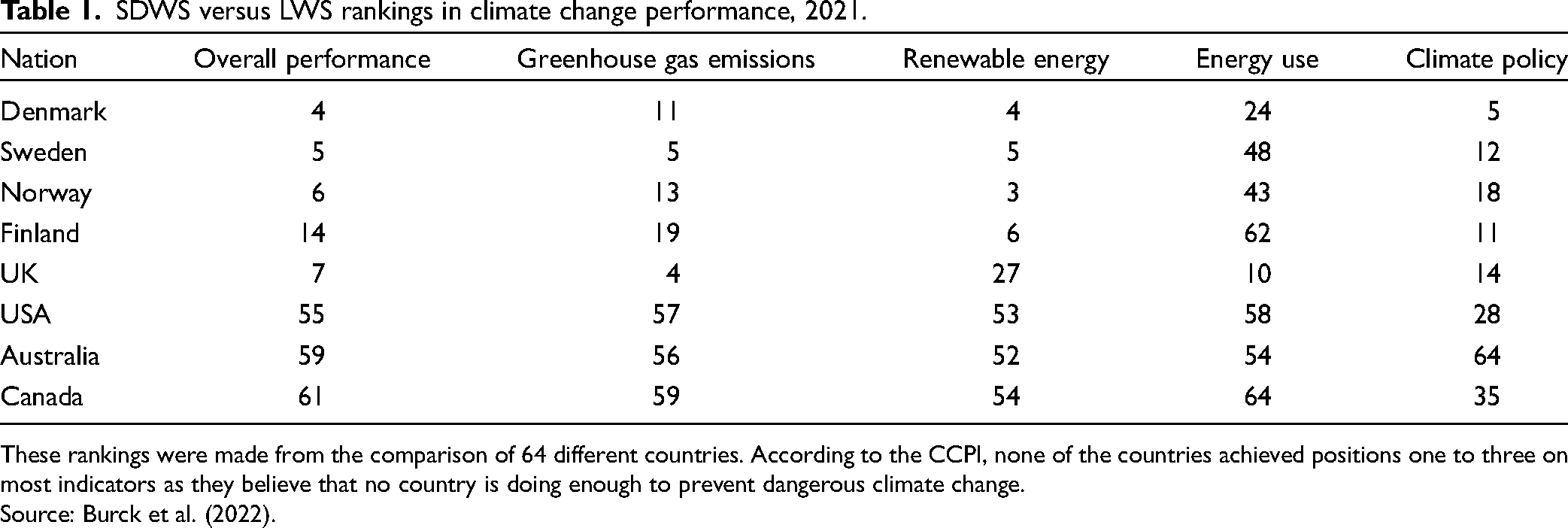
These rankings were made from the comparison of 64 different countries. According to the CCPI, none of the countries achieved positions one to three on most indicators as they believe that no country is doing enough to prevent dangerous climate change.
Source: Burck et al. (2022).
SDWS rank favourably on all measures, with the exception of energy use, a reflection perhaps of their high latitude geographies. In contrast, the LWS generally rank poorly. The CCPI uses a combination of both quantitative and qualitative data to assess a country's overall performance with 80% of national performance scores based on quantitative data from internationally recognized institutions and the other 20% based on qualitative data originating from the CCPI's own assessment of the country's national and international climate policy (Burck et al., 2022).
There are some exceptions to the welfare state typology for explaining national positions on climate change; for example, the UK. Generally however, the relationship holds. Yet while Norway presents itself in the top 6 of the most climate-oriented countries, there remains debate as to whether the state is truly progressive with regards to the environment, as the country has recently indulged in billions of dollars’ worth of new oil and gas resources (Rowell, 2022). In any event, eco-social welfare states as presently constituted may not provide a solution to the climate crisis.
Welfare states and public discourses on climate change
Marx (1859/1978) recognized the material basis of production and distribution within a society (the base) shapes accompanying understandings or consciousness of these processes (the superstructure). Grabb (2007) terms these understandings as resulting from the ideological structures (mass media, education and science, etc.) that control ideas and knowledge which justify the base. Both Marx's and Grabb's analyses suggest popular discourses concerning climate change and response result from existing economic and political structures and processes driving environmental policies. These discourses then go on to justify, and maintain these policies.
There are many ways of theorizing the relationship between the base and superstructure relevant to the issues raised in this article (Ervin, 2020). While Marx saw base and superstructure as an evolving process constantly in motion, we can at any one point in time consider their present states. We find Smith's (1984) fundamentalist thesis to be useful where it is argued that the superstructure is fundamentally caused by the economic relations of the base. There is certainly good evidence for this regarding the current situation where control and extraction of Canada's energy resources and its environmental laws and regulations shape ideologies held by the public towards climate change (see especially Carroll and Sapinski, 2018, on how the 1% shape Canadian economic discourse in general and the eight chapters in Carroll (2021a) that document corporate influence over popular, mainstream and social media, and academic discourse towards energy policy in particular).
The internal relatedness thesis goes on to argue that base and superstructure are part of an interlocking network where each component evolves in relation to the other but are not determined as in the fundamentalist thesis (Smith 1984). The former view argues one cannot separate the two, while the latter version suggests the ability to identify causes and effects. Indeed, Smith's statement: ‘To say that the various organs of the body form a complex interlocking whole does not prohibit us from also saying that it is the heart that causes the blood to flow’ (947) certainly allows us to separate base and superstructure in the present situation. In this case, we have the existing economic base driving the superstructure of environmental policies and public discourses. Vidal et al. (2015) term this ‘soft determinism’ but conclude that the two way interaction is marked by asymmetry such that they agree with Runciman (2007) that Marx's grand-theoretic proposition that ‘the strongest evolutionary force driving human history is economic rather than ideological or political’. The link between base and superstructure therefore is not completely determinant such that at any point in time these links can be broken. Indeed, this is the goal of environmental activists in general and eco-socialist advocates in particular who wish to create new ways of thinking and acting upon the climate crisis.
To date most work on climate change discourses have focussed on whether climate change is accepted as happening, and in the case of its acceptance, whether it is caused by human activity. Weingart et al. (2000) found that from 1980 to 1995 in Germany, the dominant discourses in scientific publications, legislative debates and the media moved from: (1) Man-made climate change? The discovery of anthropogenic impacts on the climate; to (2) politicization and scientific closure; to (3) institutionalization and diversification of scientific advice.
Häussler et al. (2016) identified four frames in legislative debates in the UK, USA, Germany and Switzerland. The first was accepting the primary arguments of the IPCC: (a) climate change is occurring; (b) it is a problem; (c) caused by human activity; and (d) requires public policy responses. The second frame is similar to the first but adds negative impacts of climate change such as deglaciation, increases of extreme weather events and natural disasters, rises in sea levels leading to coastal and island flooding, water shortages, the shortage of water for drinking and agriculture. It is also concerned with adverse consequences for the ecosystem, the economy and society.
The third frame believes that climate change is occurring but is not particularly problematic with responses not seen as urgent. The fourth frame is skeptical. Either climate change is not occurring or if it is, it is not caused by human activity. Not surprisingly, they found that opinions expressed in legislative debates were more varied in the USA than the UK, Germany and Switzerland with a greater exposition of frame 4 in the USA. In most nations, public opinion is clearly placed within frames 1 and 2: the majority of the public believes that climate change is real, caused by human activity, and requires responses.
Regarding some specific attitudes towards climate change, Marquart-Pyatt et al. (2019) found form of the welfare state is related to citizens’ energy-related attitudes and opinions on climate change. Their analysis of 17 European countries found SDWS and CWS have higher percentages of individuals in favour of green energy policy and energy-efficient behaviours than LWS. These differences were modest however. Within nations, political placement on the left of the left-right continuum added additional support for state-mediated environmental policy. In the USA, for example, Democratic voters report greater concern for environmental impacts than Republicans (Marquart-Pyatt et al., 2019). They conclude ‘political orientation and environmental values, beliefs, and attitudes are consistent predictors of support for green energy policies’ (3).
Canadians’ beliefs towards climate change and climate change responses
Canadians by and large accept the reality of climate change and believe it is caused by human activity (Colleto, 2021; Environics and David Suzuki Foundation, 2014). Ninety-three percent believe the earth is warming with 69% saying there is conclusive or solid evidence and 24% saying there is some evidence (Colleto, 2021). Most Canadians support some form of environmental policy to address climate change with 66% wanting governments to do more. Primary endorsed methods are rules and regulation mandating reductions in emissions, subsidies to encourage low carbon technologies and carbon pricing. However, 49% also believe that Canada should continue to develop its oil and gas reserves.
Even then, 42% of Quebeckers and 59% of other Canadians feel ‘Even if they try, governments won’t be able to reduce carbon emissions significantly in the next decade’ (Climate Access, 2021) and 84% of Canadians said they had little confidence that meaningful progress against climate change will result from the 2021 COP26 Conference (Angus Reid Institute, 2021). This should not be surprising as Canada consistently received failing grades in its environmental policies designed to stem climate change by numerous environmental organizations (Climate Action Network, 2013). Recently, the Federal Environmental Commissioner condemned the government for lack of action (Zimonjic, 2021). Indeed, the most recent plan announced by the Canadian government has been panned as assuming decades, not years, exist to solve the climate crisis (Langshaw-Power, 2022).
At the same time as their providing a plan to ‘reduce emissions across the entire economy to reach our emissions reduction target of 40–45% below 2005 levels by 2030 and put us on a path to achieve net-zero emissions by 2050’, the Canadian government announced a major offshore oil project in Newfoundland even as the United Nations latest report called new fossil fuel projects ‘madness’ (Ballinwall, 2022). Canada is one of the largest state subsidizers of the fossil fuel industry (Olive, 2022).
To date then, research has looked at broad discourses of climate change and attitudes towards individual action and environmental policy. There has been no exploration of acceptance of political economy discourses on responses to climate change that take into account issues of power and influence in society and how these might be embedded into economic and political systems. There certainly has been no study of support for an eco-socialist state. To spur such research we lay out six discourses which cover a wider range of potential discourses on climate change. As noted, Canadians’ and others’ acceptance of these discourses has not been examined.
A typology of public discourses concerning the climate crisis
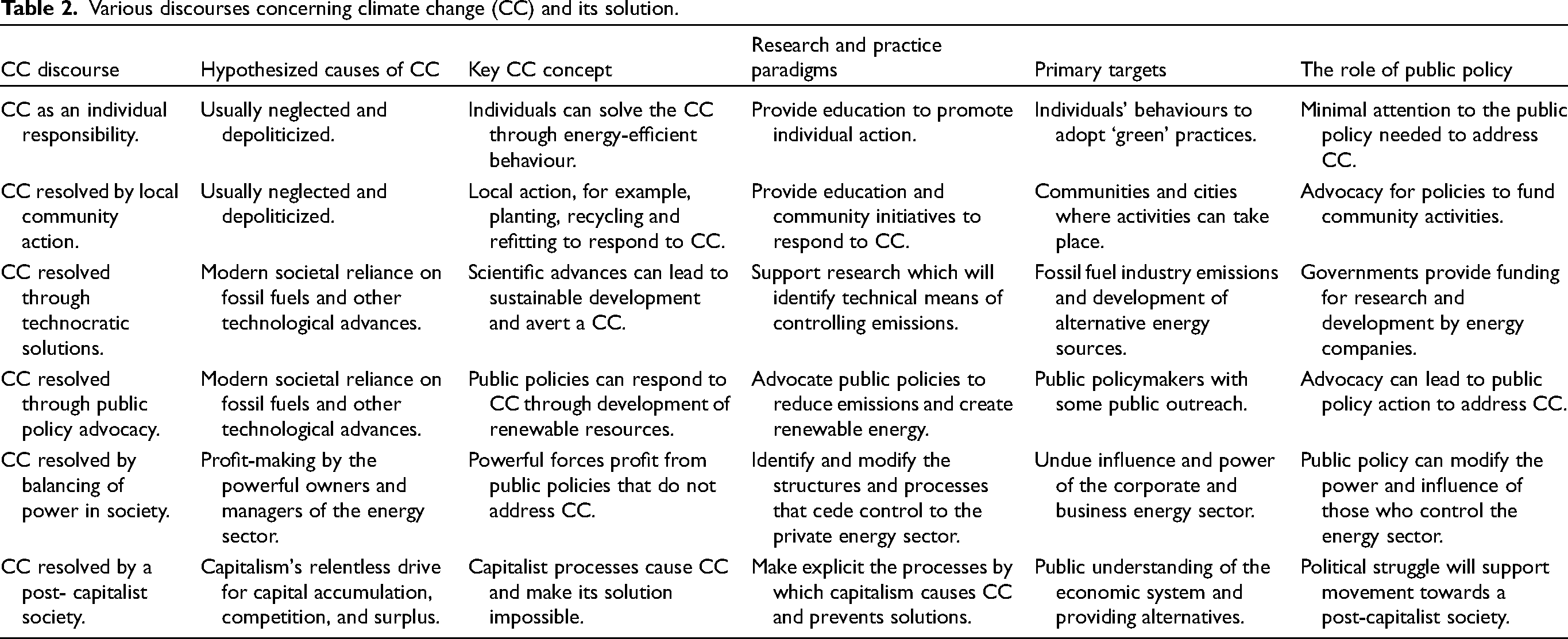
We identify, based on our reading of the academic and popular literature, six discourses of climate change organized around (a) hypothesized causes of climate change; (b) key concept; (c) dominant research and practice paradigms; (d) primary targets;and (e) the role of public policy and how these play out in Canada (see Table 2 and Raphael (2011) and Mendly-Zambo and Raphael (2019) for other instances of this process). The first two are individualized and locally-based responses to climate change, while the third suggests technocratic solutions and the fourth the importance of public policy advocacy. The fifth and sixth consider issues of power and influence, with the latter indicting the capitalist economic system. We recognize these discourses may coexist such that an individual, jurisdiction, or even nation may endorse differing and even contradictory discourses of climate change. The coexisting of discourses may make the reaching of consensus for effective responses difficult within a jurisdiction.
Various discourses concerning climate change (CC) and its solution.
Climate change resolved through individual action
Climate change as an individual responsibility discourse focuses on personal behaviours and their impact on the environment. Campaigns call for actions such as recycling, carpooling, purchasing electric vehicles and tree planting on one's property to reduce the effects of climate change, thereby suggesting that the global climate crisis can be remedied through individual actions. In Canada these have included Environmental Defence's Get Involved – 11 Actions You Can Take to Fight Climate Change campaign extolling actions such as (1)Walk, cycle, or take transit instead of driving; (2) Limit your consumption; (3) Reduce your food waste; (4) Use less energy at home; (5) Limit your air travel; (6) Give your home an energy retrofit; (7) If you have to drive, consider an Electric Vehicle or Plug In Hybrid; (8) Use renewable energy; and (9) Eat less meat and more plant based foods. The last two flow into discourses presented below: (10) Ask your political representatives to do more to fight climate change and (11) Vote for the environment (Kitchin, 2018).
This discourse says little about the sources of climate change and represents a depoliticized approach to climate action consistent with the theme of individualism running through liberal and neoliberal-influenced societies (Gough, 2016). Marquart-Pyatt et al.'s (2019) finding that those in LWS were more likely to favour purchasing energy-efficient appliances may ‘reflect their political preferences of the individual good over the public good and minimizing government intervention’ (Marquart-Pyatt et al., 2019). Its onus on the individual fails to allocate responsibility to the state, thereby absolving governments from taking action.
Climate change resolved through local action
Here, community organizations engage in activities such as tree-planting, recycling drives and relief efforts for already impacted jurisdictions. Local communities can work with municipal authorities to reduce energy use through local planning. Higher levels of governments may encourage and fund these activities and the following two examples are taken from the Canadian government's Climate Action and Awareness Fund (2022) website.
The Clean Foundation's Clean Climate Action School project in Nova Scotia teaches students the ABCs of climate change. The program explores practical ways students can help fight climate change by learning how to: (a) create less waste; (b) use less energy; and (c) build a better future by instilling environmental awareness; (d) creating a desire for climate change action; and (e) identifying potential career choices in climate change. The Little Green Thumbs Garden-Based Climate Education in Saskatchewan is an indoor gardening program for students in grades 3 to 6. It teaches children how to grow their own food, carry out healthy eating, and to care for the environment.
There are also numerous municipality based initiatives working to reduce energy usage, promote green spaces and reduce consumption in Canada. Some examples are the Climate Change Adaptation Community of Practice (2022), the Federation of Canadian Municipalities (2022) Integrating Climate Considerations: Community Planning Project (2022) and the Community Climate Action Initiative in Toronto (2022). These well-intentioned initiatives are unlikely to make a real dent in the drivers of climate change and, like the individual action discourse above, may create a false sense of dealing effectively with climate change.
These efforts can depoliticize climate change as the emphasis placed on local and municipal responses diverts attention from broader societal causes and the need for higher-level governmental responses to climate change. The public comes to focus on apparently practical, yet inadequate solutions, and absolve higher levels of the state from responsibility and action.
Climate change resolved through technocratic solutions
This discourse sees solutions to the climate crisis centred on technological solutions – frequently carried out by the fossil fuel industry itself. The main aspects of this are (1) modified sustainable economic growth; (2) large role for technological development as a provider of solutions for environmental problems; (3) environmental solutions can co-exist with existing social and political structures; and (4) Anthropocentrism and a commitment to intra-generational and inter-generational equity (Bryant and Bailey, 1997: 20).
In Canada, there is a proliferation of organizations, agencies and think tanks all ostensibly devoted to facilitating technological solutions to address climate change. Three examples are Canadian Climate Institute (2022), Climate Change Network (2022) and Centre for Climate Change Research in Toronto (2022), among many others. A consortium of university researchers’ proposed actions – virtually all of which are technocratic – are contained in the report Acting on Climate Change: Solutions from Canadian Scholars (Sustainable Canada Dialogues, 2015). The words ‘capitalism’ and ‘socialism’ do not appear once in the 58 page text. ‘Politics’ and ‘economics’ also do not appear in the text, but are in some reference titles.
Wainwright and Mann (2020), among others (Lowy, 2007, 2015, 2018) conclude that this concept of ‘green capitalism’ is unlikely to address what needs to be done. Wainwright and Mann argue that such an approach would need to be global in nature and require capitalism to have a ‘planetary manager, a Keynesian world state’ (126). But efforts to date show that elites are unwilling to do so, such that ‘the only apparent capitalist solution to climate change is presently impossible’ (126).
Climate change resolved through public policy advocacy
This discourse speaks to how climate change can be placed on the political agenda of governing authorities. Climate change is recognized as a threat; however the extent of public policy to respond varies widely. These efforts are more likely to be grounded in civil society organizations than scientific institutes. Examples of such organizations in Canada are Greenpeace (2022), David Suzuki Foundation (2022), Ecology Action Centre (2022) and Ecojustice (2022).
Despite these efforts, Canada's climate change policies have been labelled as ‘one eye shut’ since it is growing oil and gas production at the same time it expresses support for the Paris commitments (Carter and Dordi, 2021). The federal government – despite statements and some action on the climate crisis – has been accused of not being committed to phasing-out fossil fuel production (Carter and Dordi, 2021), and as noted earlier, receives a dismal ranking of its environmental policies.
The main issue with this discourse is its failure to acknowledge the underlying sources of climate change which in Canada and many other nations are rooted in the power and resources of the corporate sector in general and fossil fuel industry in particular (Carroll, 2021a). Such imbalances prevent effective environmental policies from being implemented, yet climate change advocates continue to see the state as a neutral mediator that objectively considers research findings and then works to attain the optimal benefits to society. Advocates act within a policy model of pluralism that (a) holds that society consists of interests groups vying to gain government attention to achieve their policy goals; (b) in democratic societies all groups have an equal opportunity to influence public policy; and (c) the state evaluates arguments on their merit and makes decisions to favour society as a whole (Bryant, 2016).
This discourse as well as institutionalist approaches towards environmental policy (e.g. Vatn, 2007), therefore, see the State as part of the solution to climate change through its enacting appropriate and effective environmental policies (Bryant, 2015). This clearly is not the case in responding to climate change as Canadian governments appear to be under the influence of the corporate energy sector. The next two discourses – embedded within a political economy approach – explain this failure by directing attention to how economic interests dominate environmental policy.
Climate change resolved by balancing power in society
Political economy discourses views climate change as a result of economic, political and social processes shaped by imbalances of influence and power amongst social actors (Bryant, 2015). These discourses move beyond previously mentioned discourses to consider how the influence of specific societal sectors, such as the corporate and business sector, shape public policy in general and environmental policy in particular. In the specific context of the climate crisis, it is the fossil fuel industry – and other associated corporations – that benefit from environmental policies that do not address the root causes of climate change.
William Carroll's Corporate Mapping Project documents the ‘corporate stranglehold’ the Canadian fossil fuel industry holds over environmental politics in Canada (Carroll, 2020). This comes about through a variety of processes that include economic power, political influence and cultural influence (Carroll, 2021a). In addition to the fossil fuel industry's direct influence upon the economy, politics and culture, its interlocking relationships with numerous elements of the corporate structure such as the manufacturing sector, banks and the media assures its views on climate change will dominate environmental policy and public discourse.
Carbon-capital corporations and associated think tanks create a ‘soft’ denial regime that acknowledges climate change while protecting the continued flow of profit to fossil fuel and related companies (Carroll, 2021b: 19). The corporate and business sector works to maintain the perception that the climate crisis is being adequately responded to even as oil and gas lobby groups dominate Canadian policy (Buck, 2021). As an example of their influence, in the first year of the COVID-19 pandemic, fossil fuel industries and associations met with government officials 1224 times, or more than 4.5 times per working day (Carter and Dordi, 2021). Therefore, current Canadian government policy such as the Net Zero Framework, with its strikingly inadequate target of net-zero emissions by 2050, diverts public and policy attention away from the more fundamental issue: that effective and lasting climate change mitigation requires an end to the fossil fuel sector (Buck, 2021).
The fossil fuel industry distorts the conversation around this issue by privileging the interests of those who own and control capital, thereby protecting profit making (Carroll, 2021b). They propose policies ‘that appear as credible responses to the scientific consensus but do not harm big carbon’ (Carroll, et al., 2021: 171). This political economy analysis moves beyond other discourses to argue that proactive climate change policies require opposing the power of the corporate and business sector through political and social action.
This solution goes beyond the apolitical ‘technocratic’ remedies provided by think tanks and other governmental agencies that coincide with the conventional wisdom of the dominant structures of power (Carroll, 2021b). Instead, critical views are incorporated that oppose conventional narratives and call for political reform. Guidelines for such action at various levels: (a) everyday life; (b) local community; (c) institutions; (d) sub-national; (e) national; and (f) transnational are available (Carroll, 2021c). These include: reclaiming public institutions, divestment, science and technology for the people, implementing the Leap Manifesto in Canada and the Green New Deal in the USA and building Trade Unions for Energy Democracy. Interestingly, most of those working within this discourse, like those in the following discourse, can be considered as ‘watermelons’, green (environmentalists) on the outside, but red (socialist) on the inside (Rutherford, 2018).
Many operating within this discourse therefore, appear to have an implicit envisioned future of an eco-social welfare state, yet their recommendations for action are very similar to those calling for an eco-socialist state, the difference being that the latter are more willing to explicitly state that the economic system which created the crisis is incapable of resolving it.
Climate change resolved by a post-capitalist economy
This final discourse sees effective responses to climate change and averting a climate catastrophe as not possible under the existing economic system of capitalism, thereby recognizing the necessity of moving towards a post-capitalist society (Albritton, 2019; Baer, 2017; Singh, 2021).
Albert (2022) identifies three broad principles of an eco-socialist state that all eco-socialists of all stripes would agree upon: (1) the priority of use-value over exchange-value; (2) collective ownership and planning to shape and constrain markets; and (3) contraction and convergence in consumption levels between the global north and south.
Yet, while there is general agreement among eco-socialists that capitalism is incapable of dealing with the climate crisis and averting a climate catastrophe, there is rather less agreement as to what an eco-socialist state would actually look like and the means of attaining it. Here we agree with Meiville (2022) that what is needed is humility, an acceptance that we cannot be sure of what socialism will look like and that on the way towards it we will make mistakes. But we also agree with Meiville that socialism ‘would give an infinitely greater likelihood of sustaining a habitable world than more of the same system that got us here’ (161). Wainwright and Mann (2020) reflect this uncertainty in their calling for a post-capitalist ‘Climate X’ future. In contrast, Klein (2021) lays out an ambitious future vision of an eco-socialist state.
For prominent eco-socialist Löwy, the capitalist economic system cannot provide an equitable and sustainable future as it requires continued maximization of capital accumulation or profit, regardless of ecological or social impacts (Löwy, 2018). Eco-socialism rejects the exploitation of the environment and the labour force and, instead, prioritizes society's authentic needs that foster well-being over consumerism. Eco-socialism refuses the capitalist's definition of ‘progress’ – defined by market growth, – in favour of ‘non-monetary criteria’. What are the means by which eco-socialism – in all its forms – is said to provide solutions to not only the climate crisis but the intertwined economic crises that are becoming more frequent? Carroll (2021c) terms these solutions non-reformist reforms.
Despite their strong anti-capitalist arguments, Lowy and many other eco-socialists frequently call for rather modest measures such as the promotion of free public transportation, opposing ultra-liberal debt adjustment policies by the IMF and World Bank, protection of public health from air, water and food pollution, and a reduction in work time. More aggressive action is suggested by advocates of divestment movements, robust carbon taxes, nationalization of energy industries and massive public investments in clean energy sources (Carroll, 2021c).
Carroll (2021c) suggests that such non-reformist reforms do not constitute a full blown project of system change but can set the stage for deeper transformation. The Green New Deal in the USA and the Leap Manifesto in Canada (2015) are frameworks for far-reaching environmental policies that would:
Nationalize the fossil fuel industry and the industries that depend on fossil fuels for the purpose of phasing them out; Launch a national emergency program to jump-start energy conservation programs, renewable power projects, electrified mass transportation and sustainable agriculture; and Institute a federal public-works program, similar to FDR's 1930s depression programs, to retrain and employ workers from fossil fuel-dependent industries to build a new sustainable economy with high wages and benefits.
Interestingly, these proposals emanate from those who are firmly in the eco-socialist camp, yet their intentions are generally muted. Non-reformist reforms are therefore, steps towards system change, which avoid co-optation by disturbing the capitalist status quo in ways that build popular power (Gorz, 1967). These suggestions explicitly agree with Meiville (2022) about the need for a ‘rupture’ between the capitalist present and the socialist future. Shaunghnessy (2022) outlines immediate steps that would begin the process of delivering radical change at all governmental levels.
Unlike some (e.g. Bookchin, 2022; Clark, 2022) communitarian anarchists who downplay the role of the state in countering climate change, we agree with Parenti (2015) that: ‘The state is a crucial ecology making institution within the metabolism of capitalism’ and ‘For Left politics to be effective movements, especially in the face of the climate crisis, they must come up with strategies that engage and attempt to transform the state’. (843).
The current situation illustrates what Bryant and Bailey (1997) call the paradox of the function of the state: ‘In effect, there is an inherent, continuing potential for conflict between the state's roles as developer, and as protector and steward of the natural environment on which its existence ultimately depends’ (52–53). An eco-socialist state would resolve this paradox by nationalizing energy companies and shifting their activities from fossil-extraction towards renewable wind, hydro and solar energy. Carroll (2021c) argues these can occur through the concept of Energy Democracy which originated in Europe and has been endorsed by Trade Unions for Energy Democracy, to which the Canadian Labour Congress belongs. Key actions include:
Universal access and social justice: ending energy poverty while reducing energy consumption and prioritizing the needs of communities, households and marginalized people; Renewable, sustainable and local energy: shifting to renewables by leaving fossil fuels in the ground, divesting from fossil fuels and investing public funds in local renewable energy systems to create thriving communities; Public and social ownership: bringing energy production under democratic control, within new forms of public ownership by municipalities, citizens’ collectives and workers; Fair play and creation of green jobs: building renewable energy through fairly paid, unionized jobs; and Democratic control and participation: empowering citizens and workers to participate in energy policy by democratizing governance and instituting complete transparency.
Carroll (2021c) sees this process challenging capitalist hegemony: ‘Energy democracy will thus need to be developed in concert with other non-reformist reforms in the workplace, in finance and cultural production, and in the state, in a war of position that adds up to a project of democratic eco-socialism’ (493).
In Canada and elsewhere, this would mean the nationalization of the fossil-fuel industry, the imposition of participatory budgeting at the local level and election of ‘left’ parties committed to the promotion of equitable distribution of economic and social resources. This will require not only a balancing of power between the public and fossil-extracting corporations but between the public and corporations in general. Unfortunately, at this juncture in time, we see no political party in Canada willing to take such a position. The best hope for this will require either of the ostensibly left political parties in Canada, the New Democratic Party (NDP) or the Green Party adopting explicitly eco-socialist views.
In summary, the last discourse sees the relentless drive of capitalism for capital accumulation and its stranglehold on environmental policies will lead to a climate catastrophe (Klein, 2014). This reality is summed up by Mark Fisher's (2009) restating ‘It's easier to imagine the end of the world than the end of capitalism’ (1). This eco-socialist discourse is increasingly becoming mainstream; Swedish activist Greta Thunberg's (2018) states: ‘If solutions within this system are so difficult to find then maybe we should change the system itself’.
Discussion
The role of discourses in policy and system change
Discourses are only one small part of transformation of a state but an important one. True transformation will require a massive workers’ movement opposing the powers that sustain the capitalist economic system. While discourses result from the material bases of society – in this case the current mechanisms that constitute fossil-fuel extraction by profit-driven corporations – they come to delineate the acceptable ‘systems of thoughts composed of ideas, attitudes, courses of actions, beliefs and practices’ around an issue (Lessa 2006: 285). Without the questioning of these dominant climate change discourses, attempts to build a mass-based movement to move towards an eco-social welfare state or eco-socialist state, whereby the state would shift the material processes of fossil extraction causing the crisis, will be difficult.
Eco-socialism
In this paper, we define an ecosocialist state as a system run by institutions of the state which prevent concentrations of power amongst private interests, such as the Fossil Fuel giants, and instead provides an expansion of democracy to the public so that the working class is able to govern themselves (a stark contrast to the socialism of the Soviet and the current Chinese eras). As Löwy (2018) states: The core of eco-socialism is the concept of democratic ecological planning, wherein the population itself, not ‘the market’ or a Politburo, make the main decisions about the economy. Thereby, by extension, eco-socialism is the suppression of economic sectors run by private control that currently pollute the environment and transforming these sectors to produce more eco-friendly resources based on the popular vote of the working class. We believe that a necessary first step is nationalizing the fossil fuel and related industries and placing them in the service of controlling climate change. While it is possible in theory that the state mandating a transformation of those companies into renewable energy generators would help solve the climate crisis, we do not believe the profit-making imperative that drives the private sector fossil fuel industry makes this likely.
In Canada, calls for a post-capitalist eco-socialist state are increasing. Carroll (2021b) cites Mario Candeias's notion of ‘green socialism’ that moves not only from fossil capitalism but from capitalism itself by bringing under public control, energy, water and other utilities, expanding public sector services, adopting principles of economic democracy, redistributing wealth and socializing investment.
Naomi Klein's (2014) best-selling book This Changes Everything: Capitalism versus the Climate suggests the climate crisis can create a ‘collective narrative about how to protect humanity from the ravages of a savagely unjust economic system and a destabilized climate system’ (8). The Leap Manifesto was issued in 2015 by a coalition of Canadian environmentalists, Indigenous, labour, and faith leaders, authors and artists as a call to action to confront the climate crisis. It was seen by some as an implicit call for a post-capitalist society (Aivalis, 2016). It states: ‘The time for energy democracy has come: We believe not just in changes to our energy sources, but that wherever possible communities should collectively control these new energy systems’.
More explicitly, the former Green Party of Canada leadership candidate, Dimitri Lascaris, launched Green Left Canada which has as its goal: ‘Replacing exploitative capitalist economic systems with ecosocialist solutions is the primary objective of our political activities’. Its platform moves well beyond advocacy for environmental policies (Green Left Canada, 2022): Our existing economy not only puts profit before people and guarantees spiraling inequality, but it is also the root cause of the ecological emergency. Economy and ecology are inextricably intertwined. To mend our relationship with the earth, we must wrest power from private corporations and bring the economy under democratic control so that it meets human needs without exceeding the limits of our planet. The vision of Just Green Wellbeing outlined here provides the foundation on which our blueprint for ‘Responding to the Ecological Emergency’ rests.
The environment and the working class
It may be that the environment as an issue will not be enough to motivate working class Canadians to demand a systematic change to Canada's economy and/or a eco-socialist state. It has been suggested that the labour movement in the form of unions frequently advocate for policies that support the extraction industries, but there is evidence of increasing convergence between the views of unions and environmentalists on the need to reduce reliance on fossil fuels (Brecher and Labor Network for Sustainability, 2013; Cooling et al., 2015). Moreover, the increasing crises in income and wealth distribution, housing and the labour market could lead to the linking of these struggles by average Canadians – or in Marxist parlance, the working class – against the capitalist class. A variety of actions to both support this discourse shift as well as struggles against the capitalist class have been suggested (Engel-Di Mauro, 2022; Sweeney, 2020).
In Canada, calls for an eco-socialist response to climate change (Albritton, 2019; Baer, 2020; Bond, 2021) are proceeding in step with calls for a post-capitalist economy (Aivalis, 2021; Jackson, 2021). These calls may be favourably received as Canadians show a generally positive disposition towards socialist solutions as illustrated by a 2019 poll where 58% of Canadians had a positive view of socialism, with only 40% holding negative opinions (Baneres, 2019). There is also growing support for economic transformation. In 2021, 53% of respondents supported the radical transformation of the economy and 35% supported shifting away from a capitalist model (Innovative Research Group, 2021). An older poll in 2005 found 49% of Canadians wanted petroleum resources nationalized while 43% said they wanted that for gas companies (CBC News, 2005).
These trends indicate growing recognition by the public that the capitalist economic model is unable to meet societal needs. However, the unwillingness of any political party – especially the NDP – to question Canadian capitalism and its effects upon health is a significant barrier to progress (Lexier, 2021). And finally, solving the climate crisis will also involve coordination of activities among nation states, a point emphasized by Wainwright and Mann (2020).
Conclusion
Most of the six discourses we identify – including climate change being addressed through public policy advocacy – have been denounced as ‘depoliticizing’ the climate crisis and the importance of responding to it (Berglez and Olausson, 2014; Swyngedouw, 2019). These discourses: ‘[D]o not challenge the singular Cause of climate change—the capitalist system’ (Berglez and Olausson, 2014: 68). Promoting technical solutions to the climate crisis through the four discourses of individual action, public education, community outreach and local action, technocratic solutions and advocacy for public policy – have created a new growth industry of sustainability which Mulvihill and Bruzzone (2018) decry as a ‘social fantasy’: Indeed, a global intellectual and professional technocracy has spurred a frantic search for “smart”, “sustainable”, “resilient”, and/or “adaptive” socio-ecological management and seeks out the socio-ecological qualities of eco-development, retrofitting, inclusive governance, the making of new inter-species eco-topes, geo-engineering, and technologically innovative—but fundamentally market-conforming—eco-design in the making of a “good” Anthropocene… Under the banner of radical techno-managerial restructuring, the focus is now squarely on how to “change” so that nothing really has to change! (Swyngedouw, 2019: 253–254).
The eco-social welfare state approach – illustrated by the fifth discourse controlling corporate power – suggests lagging LWS nations move towards the policies of SDWS. This in itself seems unlikely because of the power and influence favouring the corporate sector in general and the fossil fuel industry in particular. While social and political movements could be developed to combat the power of the corporate and business sector and its manifestation in the fossil-fuel industry, success would require a paradigmatic shift away from dominant ideologies where policy is focused on profit and market expansion rather than human wellbeing.
But the question remains, are even these reforms possible under the capitalist economic system with its never-ending drive for accumulation and profit making? Montbiot (2022) argues: ‘Only a demand for system change, directly confronting the power driving us to planetary destruction, has the potential to match the scale of the problem and to inspire and mobilise the millions of people required to generate effective action’. Increasingly, environmentalists such as Naomi Klein (2014) and Greta Thunberg (2022) are challenging an economic system that relies on processes of capital accumulation and unregulated economic growth. Eco-socialism aims to redefine the current free-market economic model to one of promoting economic democracy in addition to political democracy. Ways to both a post-fossil and post-capitalist society have been proposed (Carroll, 2021c; Jackson, 2021; Wright, 2021).
For either to occur – an eco-social welfare state or an eco-socialist state – citizens’ attitudes must come to recognize the need for such action. Shifting discourses created by existing power relations is not an easy task, though the ground may be shifting as evidenced by the increasing popularity of books and articles by eco-socialists. While Nordic SDWS offer the most extensive environmental responses, even these actions may not avert a climate catastrophe. If this is the case, then Carroll's (2021c) argument for system change is correct: Unless we are able to replace corporate power with a participatory-democratic alternative that meets people's needs while healing the Earth, capitalism's ecocidal logic will continue to determine the contours of our lives. And the climate crisis will continue to spin out of control—to our common peril. The stakes are high; the time is short (496).
Footnotes
Declaration of conflicting interests
The authors declared no potential conflicts of interest with respect to the research, authorship and/or publication of this article.
Funding
The authors received no financial support for the research, authorship and/or publication of this article.
