




Abstract
Despite its vast mineral wealth and tremendous industrial potential, the Indian state of Odisha remains under-industrialized after some two decades of aggressive liberalization reform. A particularly striking example of industrial failure concerns the POSCO-Odisha project. Abandoned in 2017 following fierce local opposition, it has since been revived under a new proprietorship, reigniting grassroots resistance. Using a relation of local dependence framework, the paper explores the role of scalar politics in conflict over land, dispossession, and development. The paper points to the practical implications, both for industry and grassroots movements, in resolving and overcoming such struggles.
Keywords
Introduction: Background & context
Odisha is a resource-rich state on India's Bay of Bengal coast. 1 Despite its vast mineral wealth, however, it remains one of India's poorest, most unequal, and least industrialized states. 2 Promises that an aggressive approach to industrial sector liberalization after the early 2000s have born little fruit some two decades on. 3
One particularly striking example of Odisha's failed industrial strategy involves the Pohang Steel Company of South Korea (POSCO) who, in the spring of 2005, signed a $12 billion dollar memorandum of understanding (MOU) with the state Government of Odisha. 4 Based on 2001 census figures for the three districts slated to bear the most direct impact, it was estimated by the drafters of the agreement that as many as 22,000 total individuals would be displaced to make way for the integrated steel plant and port unit. Subsequent investigations conducted by Mining Zone Peoples’ Solidarity Group (MZPSG, 2010) found that the mine areas earmarked for POSCO would be located in the Khandadhar region, in the neighboring districts of Keonjhar and Sundergarh (see Figure 1), impacting an additional population of between 10,000 and 15,000 with displacement and/or loss of livelihood.
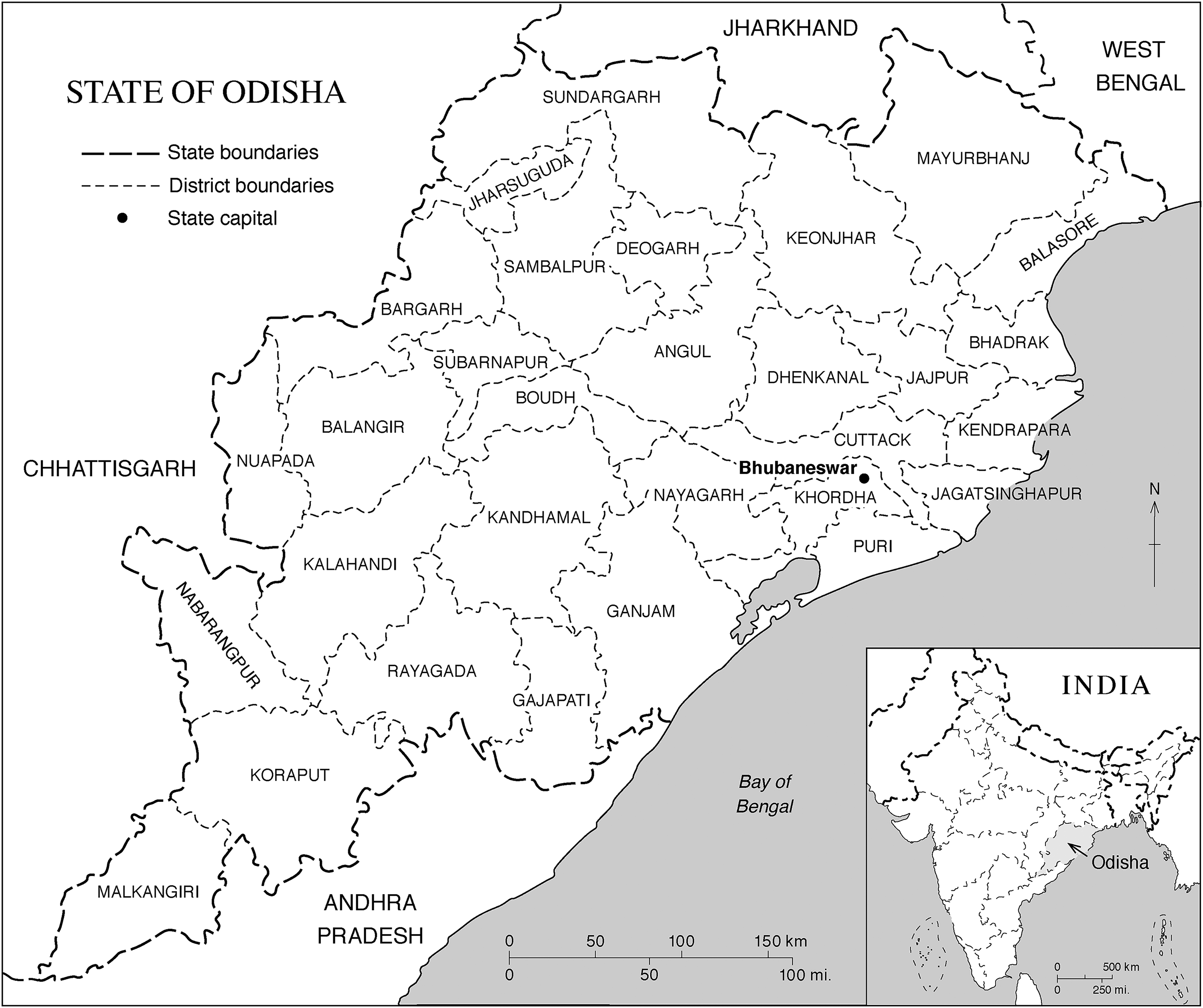
District-wise map of the Indian state of Odisha. The districts of Keonjhar and Sundargarh are indicated in the northern portion of the map, bordering the state of Jharkhand. The eastern coastal district of Jagatsinghapur, where POSCO's plant and port facilities were slated to be built, is indicated just east of Bhubaneswar (bold lettering), Odisha's state capital.
The MOU goes on to state that the Government of Odisha had agreed to grant prospecting licenses and captive mining leases for as much as a billion tonnes of iron ore: 600 million tonnes of which would be designated for use at the plant site in Jagatsinghapur, with the remaining 400 million tonnes designated for POSCO's steel plants in South Korea. 5
Capitalist industrialization and the politics of scale: The POSCO-Odisha case
Cox (1998) draws a distinction between what he calls spaces of dependence and spaces of engagement. Where the former refer to “those more-or-less localized social relations upon which we depend for the realization of essential interests and for which there are no substitutes elsewhere,” the latter constitute the “space in which the politics of securing a space of dependence unfolds.” This frame, one which foregrounds material relations of local dependence, offers a powerful tool for understanding the POSCO-Odisha story.
On the one hand, we have a group of people who depend on a particular area of land for their livelihood. These spaces constitute not only the vines, fields, and shorelines where agricultural goods are produced, but also the villages, shops, and shrines, etc. that surround and support the (re)production of these commodities; the local social-economy more broadly constituted. And so, while there is an inherent immobility to the spatial character of these dependency relations (for which there are no substitutes), Cox reminds us that spaces of dependence are also “inserted in broader sets of relationships of a more global character” which “constantly threaten to undermine or dissolve them” (Ibid.). This includes not only individuals, but also firms or agents of the state, which “organize in order to secure the conditions for the continued existence of their spaces of dependence” (Ibid., emphasis my own). 6
And so it was in early 2006, when one of the first major acts of resistance took place, as district administration officials were prevented from seizing land earmarked for POSCO's plant and port facilities by local groups of concerned citizens, organized under the banner POSCO Pratirodh Sangram Samiti (PPSS, or the Anti-POSCO People's Movement) (Iqbal, 2011). Not long after, when government officers returned to discuss the land transfer process with community leaders, and ultimately set it in motion, they were again refused entry.
Unable to penetrate these local spaces—or, perhaps more aptly put, unable to displace pre-existing relations of local dependence—POSCO, with the support of state officials, then set about contracting “middlemen” (influential insiders) to convince village and community members to endorse the project and, if they happened to own any land, to sell it in exchange for cash. In this way, POSCO was able to successfully construct local networks of association “as a means through which to realize its [own] interests” (Cox, 1998). Many local smallholders of land were also told they would be given jobs once the plant was established, implying that, by making way for the plant, one would ensure family income and employment for future generations. In the years that followed, POSCO successfully acquired some 1700 acres stretching across two districts, while the Industrial Development Corporation of Odisha (IDCO, the “land transfer” arm of the state) acquired an additional 1000 acres for the project. 7
In order to combat what were, by comparison, the practically unlimited resources of POSCO and the state government (emboldened by favorable iron ore spot prices on the international market), activists based in the Odisha state capital, Bhubaneswar, had little choice but to establish and expand their own networks of association, work they intensified after 2010. These networks of association, however, would be fundamentally different from those enlisted by POSCO. Indeed, influential insiders are, by definition, locally embedded (influential by virtue of their relations with and within the local). Resistance activists meanwhile had to construct networks of association that “jumped scale,” that is, transcended the local to become both locally and extra-locally embedded; thereby generating spaces of engagement outside those dominated by POSCO and the Odisha state government.
Support was found in the form of a loose but overlapping network of civil society organizations and individuals based primarily in South Korea, the US, and Western Europe, and pivoting primarily around their mutual relationships with groups of India-based activists affiliated with the broader anti-POSCO movement (Balaton-Chrimes, 2015). The mobilizations and campaigns they organized, which in some cases involved direct action demonstrations and protests, primarily took the form of formalized research, the publication of comprehensive reports, and the soliciting of non-material support from influential actors and intergovernmental organizations (in particular the UN and the OECD) in an effort to exert pressure on POSCO and the Government of Odisha (IHRC and ESCR-Net, 2013).
Reports of these mobilizations and campaigns continued to circulate and gain attention in influential circles, both within India and abroad, and in October 2013, eight Special Rapporteurs from the UN called on POSCO to halt the project amid “grave human rights concerns” (UNOHCHR, 2013). 8 The Rapporteurs argued that the project must not proceed without sufficient guarantee the rights of locals were being respected and, claimed further that the Government of the Republic of Korea (RoK) had a responsibility to “take measures to ensure that businesses based in its territory do not adversely impact human rights when operating abroad” (Ibid.). This call was followed-up in May 2014, when five of the Special Rapporteurs engaged the “Special Procedures” function of the UN Human Rights Council to require the Government of South Korea to respond to questioning about how it was holding POSCO accountable for human rights violations in India (Permanent Mission of the Republic of Korea to the UN, 2014).
Still, despite what were largely indirect consequences—such as the facilitating of connections for activists based in Bhubaneswar with organizers and activists located abroad—global civil society pressure had a little direct effect on POSCO's activities, beyond requiring they respond to allegations of human rights violations (Balaton-Chrimes, 2015). POSCO responded in predictable fashion by denying any culpability whatsoever, and counter-claiming that the allegations were the work “anti-industrialists” based in India (CFA, 2012; POSCO-India, 2020). Appeals to the UN to pursue claims against the governments of India and South Korea in 2014 were bolstered later that year by a transnational media campaign in major cities like London, New York, and Seoul, where protests and demonstration rallies were also held. While such efforts were not, on their own, sufficient to change decision-making by Indian governments, they did serve to amplify international attention and, eventually, draw POSCO into the OECD's National Contact Point (NCP) process. 9
Those interested in the particularities of the OECD NCP process, in this case, are encouraged to refer to the excellent Balaton-Chrimes (2015) report. Important to note is that the complainants were realistic about their expectations for the process, recognizing it was not only unlikely the Korean NCP would accept the charges, but further that, because the NCP guidelines are principally about “collaborative problem solving,” it was also unlikely the project would be halted outright. The chief objective then was to leverage the high-profile character of the NCP process itself, to expand international networks of solidarity, and, most importantly, influence the opinion of international financiers against the POSCO project. From the perspective of the complainants, a best-case scenario would see an OECD fact-finding mission lend credibility to their allegations of human rights abuses.
Despite the complainant's hopes for a coordinated response from the NCPs, however, one was not forthcoming. Unable to reach a consensus, on 11 May 2014, the case was officially rejected on the grounds that, in the opinion of the Korean NCP, the complaint was “related to the administrative activities of the provincial government of India rather than business activities of POSCO India” (OECD-Watch, 2012). Further, though a “review assessment panel” and associated dialogue were requested in the wake of the decisions, neither came to pass, leading Balaton-Chrimes (2015) to conclude that, at the end of the day, “the OECD NCP had no tangible outcome for the affected communities in Odisha.” The only unequivocal success cited by the complainants was the fact that the process confirmed minority shareholders do indeed have obligations regarding (i) human rights “due diligence,” and (ii) the exercising of leverage to “prevent or mitigate” adverse human rights impacts (Ibid.).
Grievance mechanisms as spaces of engagement
How then should one interpret the impact of transnational grievance mechanisms in light of the above? On the one hand, the special procedures function at the UNHCR was found to have had a little direct material impact on subsequent actions taken by POSCO (let alone those taken by governments in India and South Korea), as was the case with the NCP process at the OECD. On the other hand, however, it is clear that the very act of involving institutions like the UN and the OECD (quite apart from the many civil society organizations based in Europe, the US, and South Korea that also contributed material support) brought an international spotlight to the POSCO conflict that, in many ways, made the anti-POSCO movement impossible for POSCO and the Government of Odisha to ignore.
This does not mean we should over-emphasize the role these institutions played. But it also means their significance cannot be so easily dismissed. Indeed, to the degree that these institutions and their associated grievance mechanisms came up short, they did so because they are, by their very nature, flawed and limited (owing largely to the structural position they occupy within global capitalism), not altogether useless (as the aggrieved complainants, we should remember, originally pointed out). So while we must recognize that these organizations are unlikely to do anything to break with the world system of states and capital transaction flows, it is precisely because they play such a pivotal role within the international state system that the grievance mechanisms they provide—albeit inherently flawed and practically limited—can, at the very least, amplify international scrutiny and, at most, compel transnational corporations, along with the pension funds/brokerage firms that support them, to abandon dispossession-causing projects altogether (no matter how unlikely this latter outcome might seem). In fact, this is precisely what happened in the POSCO case.
Out with the old, in with the new
The account I have provided here is a necessarily abbreviated one. Left out are the many legal challenges POSCO and the Government of Odisha had to navigate (including allegations of preferential treatment) (Bisoi, 2008; Hindustan Times, 2010a, 2010b), as well as an executive order issued in January 2015, requiring all Indian states to auction, rather than negotiate, mine leases in the granting of mineral concessions. Unsurprisingly, the Government of Odisha sought repeatedly to pressure India's central government to exempt POSCO from the order, though such efforts were ultimately unsuccessful (Business Standard, 2015a, 2015b).
On 18 March 2017, Odisha Industries Minister Debi Prasad Mishra explained to reporters that his office had received a letter from POSCO-India requesting the Government of Odisha take back the 2700 acres it had previously allotted, and subsequently acquired, for the company's integrated steel plant (The Economic Times, 2017a). The very next day, Coal and Power Minister Piyush Goyal proclaimed: “There are more and more opportunities in India and if one company chooses to pull out, others will come in.” A month later, it was reported that JSW Steel Ltd, the third largest steel company in India, was eyeing the recently vacated POSCO land for a steel project of its own (New Indian Express, 2017). “We are interested to set up a 10-mtpa steel plant in Odisha. I discussed the matter with the Chief Secretary,” JSW chief Sajjan Jindal explained. When pressed on the question of whether or not JSW intended to set up its proposed plant on the land originally “acquired” for the POSCO project, Jindal replied that they were “examining locations in different places,” and that the site at Paradip “is one of the possibilities” (Ibid.).
As one would expect, local land defenders wasted no time reorganizing. Taking to the press, a local spokesperson penned a letter detailed the state government's intentions to sign a new MOU, this time with JSW, for a 10-mta steel mill and a 900-MW power plant valued at Rs. 50,000 crore (∼$7 billion USD), along with an additional Rs. 2000 crore (∼$28 million USD) to set up a captive port on the Odisha coast at Jatadhari Muhan, near Paradip where (as many had pointed out during the POSCO case) one of the country's largest ports already exists (Paikray, 2017). The letter refers to the forceful seizure of 2700 acres by IDCO in 2011, and quotes from the Right to Fair Compensation and Transparency in Land Acquisition, Rehabilitation, and Resettlement Act: “Land acquired and possession taken over but not utilized within a period of five years from the date of possession shall in all cases revert back to the original land owner.”
Paikray goes on to point out the Government of Odisha's failure to recognize individual and community rights over forest lands under the Scheduled Tribes and Other Traditional Forest Dwellers (Recognition of Forest Rights) Act (FRA) of 2006 and adds that a petition has been filed with the Kolkata bench of the National Green Tribunal (NGT), requesting that the Odisha government be prevented from transferring this contested land to IDCO. He notes further that a call has been issued to activists and that they are determined to re-occupy their land and reconstruct their betel vines if their demands are not met. The demands included: (i) an immediate end to boundary wall construction at the site and privileged access to common lands which local communities depend on for their livelihoods; (ii) the urgent processing of individual and community forest rights claims to the land, rather than its transference to a state land bank; and (iii) the withdrawal of all false and fabricated criminal charges against community activists (Ibid.).
In an impressive display of willful blindness (not to mention selective amnesia), by the fall of 2018, the business press was eagerly reporting that 2900 acres had been allotted to JSW Steel for its proposed mega plant at Paradip (Bisoyi, 2018; Dash, 2018; The Pioneer, 2018). While the allotment was confirmed by industries secretary Sanjeev Chopra, he declined to clarify to interviewers whether or not the land was indeed the same as that had originally been earmarked to POSCO more than a decade earlier. Sources from IDCO said the company was still in the process of getting environmental and forest clearances for the project, though the state's High-Level Clearance Authority (HLCA) 10 had already approved the project more than a year prior.
Today, with renewed violent conflict escalating rapidly in the small towns of Jaghatsingpur, 11 the details of the project are much clearer. Gone is the South Korean steel giant POSCO, and in its place has come to JSW Utkal Steel (a wholly owned subsidiary of Sajjan Jindal's JSW Steel), with plans to develop a 13.2-mta integrated plant project (Mishra, 2022; see also Menon, 2022). What remains are the people who continue to organize, resist, and fight for their land, and who continue their call for “pana (betel), meena (fish), and dhana (paddy),” (Mishra, 2022) just as they have since the spring of 2005 when the original MOU was signed.
Concluding considerations
What makes JSW, the business press, and the state government of Odisha so confident this time around is difficult to say. One supposes though that the logic of liberalization (which can be crudely defined as a set of principles that seek to both justify and structure economic activity in favor of accumulation over development/redistribution) is hard at work. One also supposes they would have little interest in an analysis of their predicament from the perspective of relations of local dependence. And yet, they would be wise to take heed, particularly in the light of the above-written. Namely, that relations of local dependence are both spatial and multi-scalar and, when they brush up against other dependencies (be they pre-existing or aspirational), they give rise to spaces of engagement, where outcomes are necessarily contingent (not pre-determined) no matter how unfavorable the odds might appear.
Further, through the building out and expanding of association networks, resistance movements can construct and operate within spaces of engagement where firms or governments hold comparatively less dominance/influence. This opens the possibility that firms or governments can be forced/compelled to moderate their goals, demands, or behavior (which is to say, modify their claims on a pre-existing set of relations of local dependence) by other agents (e.g. intergovernmental organizations like the UN or the OECD) who have their own spheres of dominance/influence. More importantly, even in cases where multinational firms are reluctant to modify their demands, spaces of engagement also include the realm of legal proceedings, state-center political conflict, and more, which can have the crucial effect of delaying dispossession-causing operations, adding yet further pressure on the firm to modify demands, and increasing (however incrementally) the likelihood that the project will be abandoned altogether (until the next firm comes knocking).
What are the practical political implications of the foregoing discussion? Whether capitalist or worker, farmer or peasant, interests are geographically circumscribed (both localized and locally dependent). But capital is mobile, and this mobility can threaten the ability of people to meet their own needs locally. At such a juncture, industry and the state could come together and work with local people, accommodating collective interests to the mutual benefit of all; a cross-class coalition. But oftentimes, when capitalist industrialization threatens people's ability to meet their own needs locally, cross-class coalitions are foregone (if they are considered at all), leading to local forms of resistance. What the case of POSCO in Odisha tells us is that the success of that resistance is dependent on the extent to which it can engage politically at multiple geographical scales.
Footnotes
Declaration of conflicting interests
The authors declared no potential conflicts of interest with respect to the research, authorship, and/or publication of this article.
Funding
The authors received no financial support for the research, authorship, and/or publication of this article.