




Abstract
The 2003 invasion of Iraq, led by the US Coalition forces, is amongst the most politically and culturally significant events of the twenty-first century. Much research across disciplines has been dedicated to explaining the War, with a significant body of work in the social sciences illuminating the role of oil in fuelling war and ongoing instabilities in the region. Less attention has been paid, however, to the ways that resource conflicts in Iraq expand beyond physical militarized clashes, bleeding into social and cultural realms that are purportedly unconnected to oil. This paper attends to a particularly significant one of these realms: the passive and active destruction of the material cultural heritage of Iraq and the immaterial social, cultural, and political consequences of this on the Iraqi people, including the violent colonial ecologies of plunder-based conflict curation. Using a critical, multidisciplinary array of secondary sources, this paper links oil, conflict, and culture against a (neo)colonial backdrop to illustrate that Operation Iraqi Freedom was a resource war that targeted not only natural but also cultural resources, leading to the parallel extraction and displacement of oil and heritage. Reframing the Iraq War through the lens of culture reveals how the conflict and following instability dispossessed the Iraqi people of their autonomy and capacity for political mobilization, with the broader purpose of establishing a stable regime of extraction to mitigate the demands of resource dependency. This analysis presents a new reading and conceptualization of oil, and a broader understanding of how resource dependency creates holistic spheres of violence and dispossession that work to reproduce and reinforce colonial and imperial power relations.
Introduction
As the climate consequences of natural resource usage increase, so too does the contentiousness of our global dependence on these finite energy sources. Perhaps no natural resource is more hotly contested than oil, which has been linked to war, displacement and political instability. But while research on the oil-conflict relationship is robust, its insights centre largely on the tangible armed conflicts associated with oil, failing to adequately identify or explicate the social and cultural instabilities associated with ‘resource wars’ in places of oil extraction, transport and use. This paper takes a closer look at the conflicts and dispossessions related to oil with the aim of clarifying the link between oil and conflict, and casting light on the unexpected social, political and cultural damages associated with it.
Using a political ecological approach to resource-related conflict, I conduct a close analysis of the Iraq War, and the cultural consequences of this resource conflict. Specifically, I analyze the connections between oil, conflict and culture to demonstrate the ways that battles for oil control and energy dominance motivated the widespread extraction and destruction of Iraqi cultural heritage by the US and its allies. Drawing on the tenets of dependency theory, I illustrate how resource dependence creates conditions for intense, exploitative extraction of not only oil, but also vital cultural and political resources. In so doing, I present an analytical framework of passive and active destruction, as well as the concept of conflict curation. Together, I use these analytical tools to disentangle the various forms of cultural destruction perpetuated by the strategic action and inaction of US and coalition forces, as well as the material, socio-cultural and political impacts of this aggression. In reframing the events of the Iraq War in relation to oil and culture, I find that the destruction of heritage carried out during the conflict was at the core of a military strategy to dismantle the Iraqi people's capacity for sovereignty and resistance, in order to constructing a stable regime of extraction. The case of Iraq thus demonstrates that oil dependence creates holistic spheres of violence and dispossession wich, through extraction, deepen colonial inequalities and power imbalances.
This paper draws on a combination of secondary sources, including literature in political ecology, anthropology, archaeology, criminology, critical heritage studies, security studies, postcolonial theory, art and law. From this range of literature, I place particular emphasis especially on the critical work of Iraqi scholars engaged in on-the-ground research in Iraq, especially Zainab Bahrani and Mehiyar Kathem, to represent the Iraq War in as grounded and organic a manner as possible.
Resources & conflict: existing literature
Scholarship in the social sciences, and in the field of political ecology in particular, has demonstrated that conflict is associated with many natural resources, including oil, natural gas, timber and diamonds (Downey et al., 2010; Le Billon, 2005, 2008; Peluso and Watts, 2001). Traditionally, this phenomenon has been explained using the ‘resource curse’ theory, an approach that argues that a reliance on oil exports for a large proportion of a country's GDP causes economic weakness, leading to social and political fragmentation, and, ultimately, conflict (Collier, 2000; Le Billon, 2001, 2005; Ross, 1999). This concept is based on statistical surveys of GDP, which find that resource abundance is correlated with poor economic performance in many countries. Resource curse literature approach dedicates a significant amount of attention to the role of resource scarcity, economic competition and non-state violence (Collier, 2000; Le Billon, 2005; Ross, 1999) and is generally limited to explaining only physical armed conflict at sites of extraction (Le Billon, 2001).
More recent scholarship, however, complicates resource curse theories, noting that many nations whose GDP flows primarily from natural resource extraction and exports, such as Canada and Botswana, do not suffer the violent instability and conflict supposedly provoked by the curse (Haber and Menaldo, 2011; Le Billon, 2005). Additionally, modern geographers have recognized that conflict follows oil and other natural resources beyond extraction and throughout the resource commodity chain, and further have found that this conflict is brought about not only by economic factors but also broader socio-political trends (Baviskar, 2003; Jhaveri, 2004; Watts, 2003). The use of a single measure of economic performance and the narrow focus on individual nations thus oversimplifies the complexity of natural resources, and fails to situate resource usage in broader socio-political contexts (Le Billon, 2005; Turner, 2004). As a resuly, current scholarship in the critical study of natural resources has seen the decline of the resource curse theory in favour of broader understandings of natural resource development and usage, which aim to situate resource-related conflict in wider social and political landscapes (Baviskar, 2003; Hall, 2013; Jhaveri, 2004).
The study of conflict in natural resources has moved away from differentiating natural resources, and towards the recognition that many non-renewable resources share particular patterns of conflict, violence, and exploitation (Le Billon, 2005, 2008). Geographical, anthropological and sociological examinations of diamonds, tar sands, minerals, natural gas and even historical resources such as furs demonstrate that these industries are a part of the same larger social and political patterns of land acquisition, resource dispossession and differential access (Hall, 2013; Harris, 2004; Parson and Ray, 2018). These similarities enable research such as the current oil conflict analysis to approach specific natural resources through a broader theoretical model of dispossession and inequality.
Le Billon's analysis of conflict diamonds (2008) provides a holistic theoretical framework to understand resource-related conflict. This approach positions resource-related conflict as the product of dependence and vulnerability. In this view, resource-related conflict is produced by political economy and materiality of resource production, consumption and governance. These processes create spaces of peripheralization and uneven development, in which diverse forms of conflict flourish (Baviskar, 2003; Bridge, 2009; Le Billon, 2007; Watts, 2003). While focused on diamonds specifically, Le Billon's work makes use of material, spatial and political analyses which are relevant to the study of any natural resource. The current paper draws on this framework to analyze how the materiality and spatiality of the oil industry creates zones of inequality and conflict at sites of extraction, transit and use of oil.
Politicizing oil conflicts
Much of the political ecological research on oil conflict takes the form of fine-grained analyses of individual instances of oil-related conflict, but more recent work situates oil conflicts in macro-level political processes. As Baviskar (2003) argues, conflicts like the Iraq War are part of a larger geopolitical system aiming to construct ‘stable regimes of extraction’ to ensure smooth flow of oil to Western powers. These ‘stable regimes’ are constructed at the expense of the colonized, postcolonized, or neocolonized nations involved in the production and movement of oil.
The politicization of oil conflict, as seen in the work of Le Billon, Watts and Peluso, demonstrates that armed conflict is one of a host of forms of conflicts employed by dominant Western world powers to systematically dispossess and disadvantage vital oil locations that are ‘closed’ to Western oil consumption (Foster, 2018; Le Billon, 2001; Peluso and Watts, 2001). These conflicts, which include, but are not limited to, military confrontation, oppressive governance regimes, and cultural exploitation, place affected nations in an unequal power relationship with more powerful nations (Foster, 2018). Dominant countries like the United States and Britain can then take advantage of this power inequality to pry open these ‘closed’ regions and access their oil (Foster, 2018; Ribot and Peluso, 2003; Watts, 2003).
Embedding oil conflict in broader geopolitical processes hence reveals the important role resource-related conflicts play in producing and maintaining unequal global power structures. The broader patterns of power inequalities underlying oil also make clear that the oil industry is a neo-colonial process which produces and reinforces colonial and imperial power relations. This recognition has led scholars like Nixon, Pasternak and Hall to pay attention to the ‘thick’ geographical and historical contexts of individual sites of conflict. For example, an analysis of the history of the Iraq war reveals that the nation was an entirely colonial construction; the geographical boundaries of the protectorate divided existing provinces and ethnic groups to include specific oil-rich regions, for later exploitation by British petroleum companies (Dodge, 2003). Sensitivity to the colonial context of conflicts establishes oil conflict, and indeed the oil industry itself, as a colonial continuity.
The cultural turn: Art & war
An increased focus on the coloniality of natural resources like oil necessitates considering resources as cultural, as well as natural objects. Baviskar emphasizes that a ‘natural resource is meaningful only through the wider networks of cultural politics in which it is embedded’, making the material and symbolic dimensions of oil-related conflict ‘inseparable’ from one another (2003: 5051). Cultural approaches to natural resource struggles highlight the way oil is produced by, and in turn reproduces, particular identities, interests and discourses (Nixon, 2011). This work illustrates the ways in which the biophysical characteristics of oil are mediated by social and cultural relations (Baviskar, 2003; Bridge, 2009). In this view, physical–cultural interaction is what produces oil-related conflict. Thus, the processes of producing, distributing and accessing oil are always cultural, and by extension, the conflicts which emerge from the inequalities involved in these processes are necessarily cultural struggles as well as material ones. Recognizing the more intangible cultural clashes and contestations which occur alongside the more visible conflicts caused by oil is key to positioning oil conflicts in the broader sociopolitical and sociocultural context of the twenty-first century.
Within this movement to quantify and qualify the social-cultural impacts of resource conflict, there exists a growing body of work exploring the entanglements of art and war, which is particularly relevant to the current paper. This scholarship attempts to understand art crime under conditions of war, with a sensitivity towards plunder, looting and war trophies. Much of the literature in this area revolves around criminological and legal treatises that map contemporary black markets and illicit trade networks (Bowman, 2008; Campbell, 2013; Casey, 2015; Lane et al., 2008). Many of these works conceptualize war as a risk factor for the expansion and diversification of criminal networks and trafficking, and the resultant damage to heritage (Charney, 2016; Davis, 2011; Kersel, 2016; Mackenzie et al., 2020). Adjacent to this literature, a burgeoning school of thought also theorizes plunder and looting, often through the lens of conflict (Apaydin, 2020; Hicks, 2020; Tompkins, 2018). Due to its unprecedented cultural consequences, many of these analyses centre the Iraq War, and more recently, Syria, to demonstrate the impacts of instability, active combat and looting on cultural heritage (Casey, 2015; Marrone, 2017; McCalister, 2005).
Conceptually, scholars in this area tend to position art and antiquities as collateral victims of conflict. A notable exception is Ingram’s (2019) geopolitical analysis of the Iraq War and art, which flips such passive conceptualizations on their head, instead arguing for ‘art as a way of rethinking one of the most contentious and consequential geopolitical events of recent decades’ (47). By positioning ‘artworks as evental assemblages’, Ingram (ibid.) uses art as a medium to interpret the multifaceted impacts of conflict. Interdisciplinary work in the arts (Mathur, 2008) follows the same method to understand the colonial and imperial facets of war. In this paper, I follow this theoretical framework, replacing the ‘sustained consideration of diverse artworks and exhibitions’, with the consideration of heritage, artefacts and antiquities (Ingram, 2019: 47).
I hence draw on a range of critical scholarship ranging from natural resource conflict to cultural understandings of art and war. These bodies of work have remained largely disparate, with the latter failing to capture specific cultural aspects of resource war and the latter failing to make the connection between art and oil. I bridge this gap by integrating Ingram's conceptualization of art, the findings on looting afforded by antiquities researchers, and theories of resource dependence and extraction to present a conceptualization of oil, conflict and culture that has been ‘underappreciated in existing literature’, especially political geography and geopolitics (Ingram, 2019: 412).
Sea of oil, land of antiquities: A genealogy of oil, conflict and culture in Iraq
The region now known as Iraq is one of the longest continuously settled places in human history. As a result, the material heritage of the region has been an integral part of Iraqi society, culture, and politics for centuries. Political usage of heritage stretches back at least as far back as the Abbasid Era, when rulers mimicked ancient Assyrian and Sumerian architecture and city planning to legitimate the newly Islamic civilization (Bahrani, 2003). Oil was not added to this politically volatile formula, however, until British presence in the region in the nineteenth century. At the time a part of the Ottoman Empire, Iraq drew British interest for its strategic location, which had the potential to become an unrestricted passageway to India, if occupied. This plan changed drastically in the mid-nineteenth century, when prospectors from the Anglo-Persian Oil Company (which later became British Petroleum), a British national corporation, ‘discovered’ rich oilfields in the Mesopotamian region, and, along with them, the ruins of Babylon and Assyria (Mathur; Foster et al., 2005; Malley, 2008).
The simultaneous ‘discovery’ of petroleum and Biblical sites changed the course of political and intellectual life in Europe. Americans had already recognized the importance of oil and controlled most of the fuel on the market, while the British struggled to satisfy rapidly increasing national demand and avoid the threat of American energy domination (Mathur, 2008). At the same time, the Empire reached its zenith, and the academy and political elites sought scientific evidence to justify the Victorian ‘civilizing’ mission and colonial expansion. In sum, oil was vital to the physical infrastructure of Empire, and antiquities and artefacts were pivotal to its social and scientific infrastructure (Bohrer, 2003; Gibson, 2008; Malley, 2008). Thus, by the start of the twentieth century, control of Mesopotamian oilfields became ‘a first class war aim’, (Paul, 2002: 1) with the motivation for artefacts following close behind (Bernhardsson, 1999, 2005).
Mapping Mesopotamia: The mandate era
To this end, the British launched multiple invasions, eventually capturing Baghdad in 1917, after more than three years of steady attacks (Dodge, 2003). Following this victory, the British established the ‘Mandate of Iraq’, a new nation whose borders were deliberately drawn to include the most oil-rich areas of the region as well as the ancient sites of Sumer, Akkad, Babylonia and Assyria; existing ethnic and religious groups and regional divisions were ignored (Mathur, 2008; McNabb, 2016). Hence, the Mandate was established as a resource colony for the British, marking the start of the systematic extraction of both oil and antiquities. Immediately after the establishment of the Mandate, the Anglo-Persian Oil Company began the construction of refineries and plants. Simultaneously, a Directorate of Antiquities was established to manage archaeological excavations, and a national museum hastily erected, with Gertrude Bell, a British explorer, collector, intelligence agent and diplomat, appointed its Director. It is thus evident that, from the very beginning of Western presence in the region, oil and antiquities flowed out of Iraq and into Europe alongside one another. 1 In the same manner, they jointly motivated conflict in the region.
The significance of Mandate Iraq as a resource colony was immense. The region became one of the two major energy sources for Britain and its allies (the other being Iran, where oil extraction was similarly controlled by the Anglo-Persian Oil Company) that upheld the massive infrastructure of Empire (Odell, 1968). The importance of the ancient sites, too, cannot be overstated; the findings from Mesopotamia almost singlehandedly fuelled the birth and expansion of archaeology as a discipline, filled European museums and became a major aspect of the political and social consciousness of twentieth-century Europe (Bernhardsson, 2005; Bohrer, 2003; Kathem and Kareem Ali, 2021; Mathur, 2008). Much of this came to an abrupt stop, however, with the anticolonial Iraqi Nationalist movement of the 1960s, which overthrew British protectorate rule and saw attempts to reclaim both oil extraction projects and archaeological excavations to serve the pan-Arab, pan-Islamic political and social context of the newly independent regime.
Culture & conflict after independence
In the governments that followed, political agendas maintained the close tie between oil and culture, promoting control over the extraction and usage of both resources, and periodically devolving into conflicts to maintain this control. The most notable of these upheavals was Iraq's invasion of Kuwait, under Saddam Hussein's rule, and the resulting Gulf War in the 1990s, which entailed explicit linkages between oil access and cultural destruction. Following a drawn-out, costly war with Iran, Saddam Hussein set his sights on Kuwait, an emirate with rich oilfields that could replenish the diminished coffers of Iraq and provide additional political power. A key strategy of the invasion was the intentional obliteration of Kuwait's cultural patrimony and archives ‘to erase its history and identity with the aim of annexing it as Iraq's nineteenth province’ (Montgomery, 2017: 161). To achieve this end, Iraqi forces ‘seized thousands of Kuwait's finest cultural objects’, sent ‘truckloads of cultural loot back to Baghdad’, and torched what they could not take with them (Montgomery, 2017: 159). The resulting US-led counterattack, known as the first Gulf War, ousted Saddam Hussein's forces from Kuwait and in the process caused serious damage to at least three major archaeological sites in Iraq, including the famed Ziggurat of Ur, through targeted bombing (Lindhagen, 2018).
The above genealogy of oil-conflict-culture relations in Iraq thus demonstrates that the three have been closely tied since the pre-Mandate era. It further illustrates that oil-related conflict takes the form of ‘“resource wars’, that is, overt military action to secure access to oil-rich areas. These wars are generally waged during moments of economic uncertainty or weakness on the part of the aggressor, where the need and value of oil increases enough to justify military action. This type of armed conflict is tied to sites of extraction due to the material restrictions of oil as a natural resource, whereby the locations in which oil naturally originates cannot be controlled, and the places in which it occurs are not necessarily the places where oil is used (Jones, 2018). The surest way to overcome this limitation is for oil consumers to gain direct or indirect physical control over oil land, something most commonly achieved through military action. It is for this reason that sites of extraction often become battlefields in larger wars, just as Iraq's oilfields became hotspots, first in the British takeover, and more recently the ‘war on terror’ (Baviskar, 2003). It is as a consequence of these military interventions that the culture, and specifically material culture, of a region becomes absorbed into conflict. As both the Mandate era and the Gulf War illustrate, cultural heritage is closely tied to politics and identity. As a result, it was taken up as a key part of the strategic politics of occupation. In this sense, oil became the end, and culture the means, to wage resource war. The volatile formula of oil, culture and conflict grew increasingly unstable as the twentieth century progressed, culminating in a major explosion in the new millennium—the Iraq War.
Operation Iraqi oil: The Iraq War
Nearly two decades after the initial invasion, it is no longer a controversial statement that the Iraq War was about oil. While purported as a mission to liberate the Iraqi people from dictatorial rule, suppress terrorism and protect the free world from imminent nuclear attack military officials and world leaders have since admitted that Operation Iraqi Freedom was ‘largely about oil’. (Foster, 2018: 41; Jhaveri, 2004; Osley, 2015; Sayle et al., 2019). The original narrative legitimating the Iraq war glossed over the fact that Iraq is the ‘heart of the oil region’, with the fifth largest proven oil reserves in the world (Foster, 2018: 41). The ‘official’ version of events also ignored that, at the time of the invasion, the United States faced the ‘most serious energy shortage’ since the 1970s, a crisis that policy makers emphasized could only be solved by ‘opening up’ the oilfields of Iraq and Iran (Foster, 2018: 43). As former US Deputy Defense Secretary Paul Wolfowitz stated, ‘economically…[the US] had no choice [but to invade] Iraq. The country floats on a sea of oil’. (Bohne, 2004).
Oil guided nearly all US military moves. The first action undertaken by US and coalition forces was the seizure of major Iraqi oilfields and refineries, which were soon after given over to American and British petroleum companies, who began massive extraction projects (Foster, 2018). Additionally, while the US support of a Shia regime was supposedly meant to counter the extremist Sunni tilt of Saddam Hussein's government, in actuality this political campaign enabled American access to Iraq's richest oilfields, which are concentrated in the Shia-majority regions in the south of Iraq (Foster, 2018). The invasion constituted a ‘re-colonialisation of Iraq’, (Kathem, 2019: 164) with serious consequences for the stability of the region.
The invasion devastated Iraq. The country was previously a stable nation with well-established infrastructure, strong educational institutions, well-funded health and social services and scientific and technological innovations; the invasion thoroughly decimated all of this, levelling entire cities to the ground. Still, initial views of the war were optimistic, with predictions that the transitionary Iraqi government, handpicked by US and British officials, could take power and stabilize the nation, thus securing a smooth oil supply to Western nations. Foreign politicians, however, failed to take into account the scale of instability their forces had caused (Foster, 2018; Sayle et al., 2019). The complete destruction of infrastructure, as well as the mass dismantling of the Iraqi government and defence forces caused by US forces in Operation Iraqi Freedom precluded any rebuilding efforts. Further, the Shia regime, which had already been extremist, became intensely oppressive of the Sunni minority, who responded with increased insurgency (Sayle et al., 2019). Hence, the initial armed conflict of Operation Iraqi Freedom caused a ‘domino effect’ of violence, and soon Iraq was embroiled in a civil war, replete with sectarian violence and ethnic cleansing. As the conflict escalated, US and Allied armed forces remained on the ground in Iraq until 2011, determined to secure Iraqi oilfields and refinery plants (Foster, 2018).
‘The crime of the century’: The plunder of Mesopotamia
The Iraq War provides a remarkably clear depiction of the ways resource dependence combines with social, economic and political pressures in oil-related conflict. For consumers like the United States, oil is not only material fuel for infrastructure and economy, but also the basis for crucial political ties, such as US alliances with Saudi Arabia and the UAE, or British colonial power in the Middle East. In other words, oil is a vital element in maintaining the global power and hegemony of the Western powers, and oil shortages are a threat to this political domination (Kathem, 2019). In this context, the Iraq War was an attempt to make resource capitalism safe ‘in an unstable region where most of the world's oil is concentrated’ (Doran, 2012; Kathem, 2019: 169). This required ‘the transformation of Iraq's political but also cultural geography’, (Kathem, 2019: 169) which is why the material culture of Iraq, and importantly, its destruction and removal, became a key feature of the neocolonial occupation.
The sheer scale of damage and extraction of heritage caused by the Iraq War remains unprecedented. While pre-invasion Iraqi governments had always placed high importance on cultural heritage and ensured the preservation and protection of hundreds of thousands of priceless artefacts even in times of war (Mathur, 2008; Rothfield, 2009), things changed drastically with the US invasion. US and Allied forces directly and indirectly caused immense and irreparable damage to Iraqi heritage, both in the short and long term. This damage falls into two main categories: (1) passive destruction and (2) active destruction. The framework of passive/active is used here to classify and interpret the various forms of cultural damage caused by different parties during the war, with a focus on US government and troops.
Plunder and absence: passive destruction
Passive destruction is defined as inaction on the part of the US and its allies, both on the level of strategy and planning and on-the-ground combat. The rich history of the region makes ‘essentially all of modern Iraq an archaeological site’ (Mathur, 2008: 126), which led archaeologists and experts to raise concerns about the protection of heritage prior to the invasion. In the days leading up to the invasion, US leaders, too, appeared concerned about this; the State Department, Department of Defense and the Pentagon commissioned extensive archaeological reports and assessments outlining the importance of protecting Iraq's cultural heritage, listing the most vital archaeological sites, predicting threats and proposing strategies for protection and preservation of as much cultural heritage as possible (Bahrani, 2003; Brodie et al., 2006; Kathem, 2019; Mathur, 2008; Rothfield, 2009). This flurry of protective action assured experts that steps would be taken to preserve and protect the heritage of the country. But on the dawn of the invasion, not a single site in Iraq was protected.
Leaving archaeological sites and museums unprotected exposed them to ‘the unchecked violence and frenzy of looters’ (Mathur, 2008: 129). In a single day, the Iraq National Museum, which held arguably the most important archaeological collection in the world (Brodie et al., 2006; Reichel, 2013), was systematically plundered by ‘a combination of professionals…and amateurs’, with the former targeting the most valuable items while the latter ‘indiscriminately smashed and grabbed whatever they could’. (Mathur, 2008: 129). At least 170,000 objects, collectively worth billions of dollars, were stolen or destroyed (PBS 2003). Similar scenes played out at other museums, archives and archaeological sites across the nation. The main site of Babylon and the Nebuchadnezzar and Hammurabi Museums were looted; the Museum Office, which contained priceless archaeological archives, was ‘burned and destroyed’; and the National Library and House of Manuscripts were plundered and burnt, leading to the loss or destruction of more than one million books (Brodie et al., 2006). Many archaeological sites were completely destroyed by looters in search of goods, and countless artefacts were smashed or lost in the process.
I conceptualize this destruction as passive because it occurred not through any actions on the part of US and Allied invaders, but rather through strategic inaction. Remaining passive in conditions of combat and threat to heritage allowed extensive damage to unfold. This put US and coalition forces in contravention of the Geneva and Hague conventions, which make the protection of cultural heritage the responsibility of foreign powers during military occupations (Drumbl, 2019; Cunliffe et al., 2018; McBride, 2018; Rothfield, 2009). In spite of this, no charges have been brought against the US or its Allies, due to the intense debate around the intentionality of the destruction. Scholars and experts have attributed this variously to an absence of planning, bureaucratic failure, incompetence or on-the-ground mistakes (Kathem, 2019; Rothfield, 2009). Former Secretary of Defense Donald Rumsfeld seemed to confirm this when fielding questions about passive plunder, saying, ‘Stuff happens. Freedom's untidy…Is it possible that there were that many vases in the whole country?’ (Mathur, 2008: 129). As indicated in this analysis of passive destruction, however, the comprehensive reports commissioned by the Department of Defense ensured US forces knew exactly how many vases there were in Iraq, and exactly where they were located (Mathur, 2008; Rothfield, 2009). Further, protection of the vases would have required minimum effort and resources; as deputy director of the Iraq National Museum Nabhal Amin stated in the aftermath, ‘just one tank and two soldiers’, (Mathur, 2008: 129) were needed to prevent the plunder. Indeed, troops were available to fulfil this duty; but on the morning of the invasion, all available troops were directed to bolster forces protecting the southern oilfields (Foster, 2018; Rothfield, 2009).
Helicopters & war trophies: Active destruction
While the inaction of the US forces against looters and criminal groups was damaging enough, the active decisions and behaviour of strategists and troops on the ground were even more devastating. Perhaps the most significant of these acts was military construction: US and Allied forces built large military bases directly upon the ancient ruins of Babylon, Kish, Ur and Samarra, as well as other sites. Babylon was selected by forces to be the site of Camp Alpha, the south-central headquarters of the forces, for its symbolism as ‘a trophy of war’ (Kathem and Kareem Ali, 2021: 836; Mathur, 2008). The construction, handled by US military contractor Kellogg, Brown and Root was deeply, intensely damaging (Kathem, 2019; Kathem and Kareem Ali, 2021). The Camp was organized around a main helicopter pad, which was ‘bulldozed into the very heart of the site’, damaging the ancient amphitheatre and Nebuchadnezzar's palace (Bahrani, 2006). Parking lots and barracks were built by flattening archaeological mounds and digging trenches through monuments, including the main temple that made up the Ziggurat complex (Bahrani, 2008a; Kathem and Kareem Ali, 2021). Reports estimate that the ‘total area of Babylon impact[ed] by Coalition digging activities was roughly 30,000 sqm…an area that would require 60 years for a large team to excavate scientifically’ (Kathem, 2019: 170).
More damage was caused through everyday activity on the site. The use of ‘helipads, tanks and heavy equipment’, led to widespread contamination of ‘large swaths of the site’ as industrial waste, rotor wash, fuel leakages, and the use of gravel and chemically treated products caused irreparable environmental and archaeological degradation (Kathem and Kareem Ali, 2021: 836; Mathur, 2008). Soldiers treated the site with carelessness at best, and malevolence at worst; many areas were extensively graffitied, ancient monuments were ‘insensitively renamed’, and troops broke and removed sections of the site (Kathem and Kareem Ali, 2021; Mathur, 2008). As a military base, Babylon was also involved in combat activity. This led to the collapse of structures and walls ‘as a result of shootings, bombings and helicopter landings’, (Bahrani, 2008a). Active combat also disturbed the terrain, uprooting buried objects and exposing them to damage. With all actions accounted for, the US State Department reports that US-Polish militaries altered (i.e., damaged) 259,645 square metres of Babylon. Hence, the damage was pervasive and, in many ways, immeasurable. Amongst the bases, the Babylon site is the most well-documented, but evidence suggests the other ancient sites suffered similar damage (Kathem, 2019; Kathem and Kareem Ali, 2021).
US and Allied forces were also involved in actively looting and plundering various archaeological sites and museums. On an individual level, troops frequently sought out ‘souvenirs’ from military bases and places through which they passed. During operations, it was common for soldiers to take cultural objects from areas they seized, including Saddam Hussein's palace. This looting was so widespread that US-Polish military forces set up a ‘bazaar’ outside the main gates of Babylon, ‘where fake and original artefacts were openly available for sale’. On a wider, official level, operation objectives commonly targeted Iraqi heritage in acts of ‘direct pillaging’. Targets of military plunder included Iraq's Jewish Archives and Ba’ath Archives, both of which were ‘rescued’ by troops and removed from Iraq, and have yet to return (Rothfield; Kathem, 2019). Many of the plundered items can now be ‘found in private homes and museums in the US and other countries’ (Kathem and Kareem Ali, 2021: 837).
This active destruction proves even more challenging to defend than passive destruction, given that it is rather difficult to accidentally build a military base on Babylon. It is evident that military actions towards Iraqi heritage were more than administrative oversights or individual-level ‘bad apple’ behaviour, but rather a form of cultural dispossession actively and enthusiastically facilitated by US and allied occupiers (Bahrani, 2008b, 2003; Kathem, 2019).
Instability & insurgency: Long-term passive & active destruction
The damage wreaked by US and Allied forces was not limited to the period of the Iraq War; rather, it caused significant long-term damages to heritage that unfolded following the invasion and continue today. These tend to be a combination of passive and active forces of destruction.
The illicit trade in Iraqi heritage
The most significant of these is the massive black market in Iraqi heritage. Looted Iraqi antiquities flooded onto the black market in the wake of the invasion, and continue to constitute a large portion of the illicit trade today (Campbell, 2013; Kersel, 2016). This supply of looted items can be traced back to the social, political and economic fragmentation that resulted from the invasion, and was compounded by the destabilizing actions of US and coalition forces in the years that followed. These conditions led to the emergence of organized crime groups, who developed sophisticated looting and illicit trade operations (McCalister, 2005). The operation of such groups was made possible by the instability and perceived illegitimacy of the sectarian government put in place by US forces, which precluded effective law enforcement against crime and non-state actors. In this conflicted environment, organized crime groups filled a power vacuum and emerged as active participants in armed conflict and illicit trade.
Organized crime groups rely on subsistence diggers: impoverished and unemployed locals, often farmers, who excavate and sell artefacts ‘to support [their] traditional subsistence lifestyle’ (Barker, 2018; Marrone, 2017; Polner, 2019; Staley, 1993: 349). These individuals sell findings to local middlemen or organized crime groups, earning a ‘tiny fraction as low as 1%’, of the international value of this loot (Brodie, 1998: 1, cited in Polner, 2019). This practice, too, emerged in the devastation of the invasion, which destroyed businesses and fertile farmland. Compounded by the lack of economic rebuilding by coalition forces, this resulted in extremely high rates of unemployment, driving many to sell their own culture to survive (Hardy, 2014; Marrone, 2017). Because organized crime and subsistence looting are the direct consequence of the instability caused by US and Coalition military and government action, they constitute a form of active destruction.
Institutional & state dysfunctionalism
The ‘state dysfunctionalism’ of post-2003 Iraq led to corruption and competition within a weak state government that further damaged heritage (Kathem, 2019). The ‘Muhasa'sa’, a quota-based system that US forces put in place to equitably distribute power between competing political groups led to the ‘ethnic and religious fracture’ of state politics, including, importantly, the management of cultural heritage. This sectarianization has led to corruption and office-holding, resulting in widespread mismanagement of heritage sites, an inability to adequately protect heritage, and, in some cases, destruction and violence. Because US and Coalition forces deliberately dismantled the cultural infrastructure of pre-2003 Iraq and replaced it with dysfunctional systems like Muhasa'sa, these consequences, too, constitute an active destruction of Iraq's heritage.
One important aspect of state dysfunctionalism, however, is passive. In the years following the Iraq war, no aid, support or funding has been offered in support of Iraq's heritage by US and Allied forces, in spite of their role in its destruction (Hussein and Khalid, 2018; Kathem, 2019; Kathem and Kareem Ali, 2021). Rather, the majority of heritage work in Iraq has been conducted by external researchers from the US, UK and other Euro-American nations, who have focused on continued excavation and removal of artefacts, even in conditions of conflict. This inaction has precluded the strengthening or improvement of heritage infrastructure systems, in a continuation of the passive destruction that began with the invasion.
ISIS and insurgency
Perhaps the most significant post-war consequence for Iraqi culture, and certainly one which has received the most attention, is the destruction of heritage by ISIS, the self-appointed ‘Islamic State’ of Iraq and Syria. Following the withdrawal of US troops from Iraq in 2011, ISIS quickly emerged as a serious threat to the people of Iraq and Syria. Since its inception, ISIS has ‘made theatrical use of cultural property’, destroying and defacing mosques, churches, cemeteries and ancient sites, as well as manuscripts, sculptures and objects (Montgomery, 2017; Turku, 2017: 38). Among the foremost victims of ISIS have been Assyrian sites and sculptures and the ancient sites of Nineveh and Nimrud (Montgomery, 2017; Turku, 2017). This destruction has supposedly been in service of a religious fanaticism aimed at destroying all evidence of ‘disbelief’. In actuality, however, the destruction of heritage fuels a lucrative, highly-organized trade in looted objects. As multiple studies have revealed, ‘ISIS destroys ancient historical sites only after seizing and removing everything of value’ (Montgomery, 2017: 173). In many cases of apparent destruction, ISIS militants have been seen loading thousands of items onto trucks, destroying only those which are too large to trade on the black market (Turku, 2017). Hence, ISIS is a massive supplier for the illicit antiquities market.
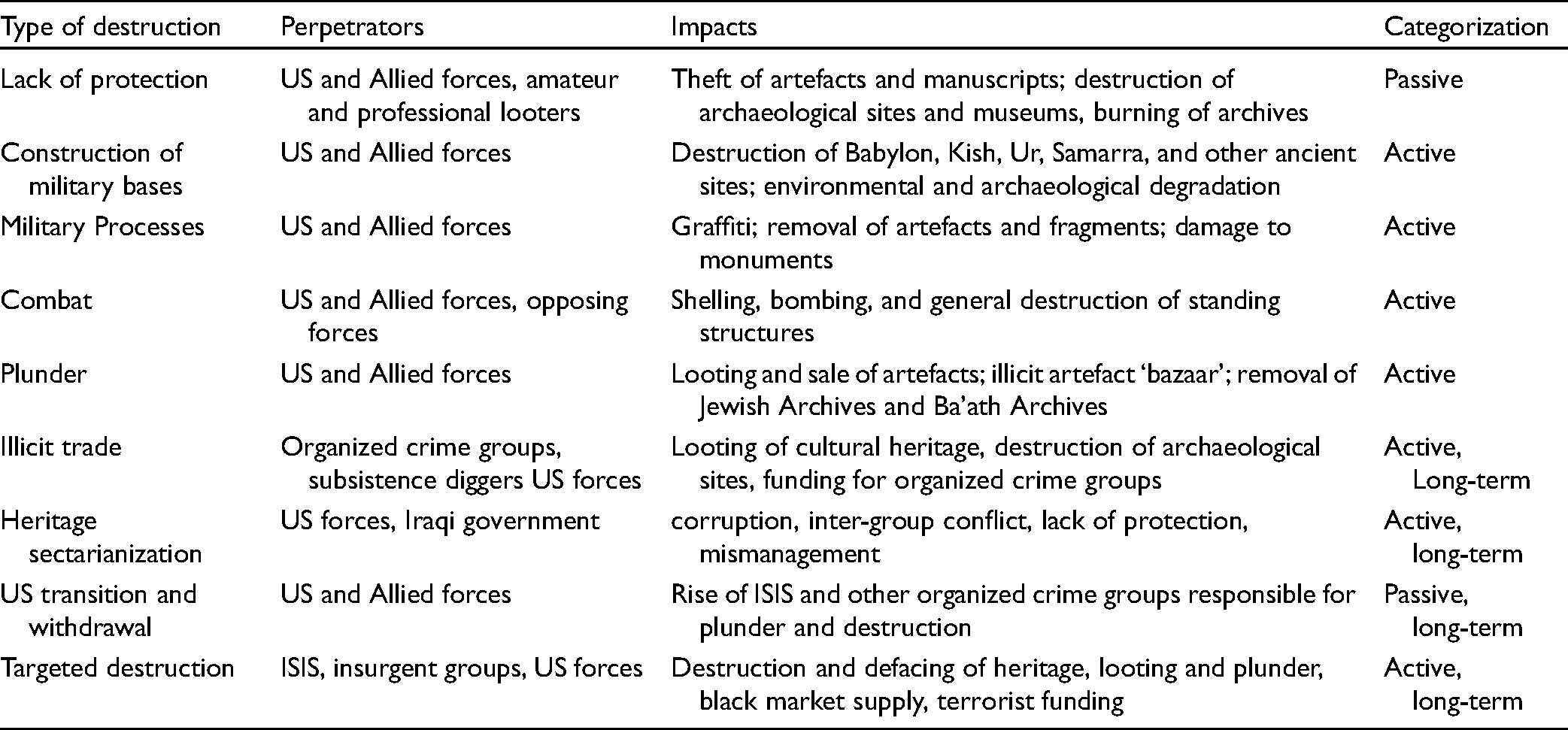
It is vital to note that the emergence of ISIS was itself the result of US action during the Iraq War, and the later withdrawal. Following US and Allied invasion, the US appointed a transitionary government of Shia Muslims, which led to alienation, marginalization and violence against the Sunni minority. 2 Among these ‘state-perpetrated’ injustices was the mass incarceration of Sunnis, which was a ‘causal factor in the initial emergence’ of ISIS (Revkin, 2018: 55). When, years later, the US withdrew from Iraq, leaving behind no peacekeeping forces or long-term authority, the complete absence of any stabilizing forces created a dangerous power vacuum, which ISIS filled. In this sense, responsibility for ISIS militancy can be attributed to the United States and its allies. So, while the damage done by ISIS itself is active destruction, it is also, indirectly, the result of US inaction in the protection and stabilization of Iraq, meaning it is also a form of passive destruction. Table 1 summarizes these types of active and passive destruction, their perpetrators, and their impacts.
Classification of passive & active destruction.
Conflict curation: From battlefield to museum
In assessing destruction and loss, it is vital to consider not only where the heritage is being removed and how, but also where it is removed to. Looted artefacts and destroyed fragments of monuments are displaced to museums, universities and private collections in the United States, Canada, the UK and Europe as part of an ‘exodus of cultural heritage from conflict areas and impoverished countries to wealthy countries’ (Campbell, 2013: 115). The physical removal of artefacts from their indigenous location distances their cultural histories, and allows aggressors—in this case, Americans and Europeans—to use the objects to craft narratives that legitimize colonial and imperial domination. This is a phenomenon I term ‘conflict curation’; the curation of a particular type of material culture through war. In this practice, armed conflict directly destroys and displaces cultural heritage, and that heritage is then seized by those waging the war and redirected to museums and collections to tell a particular story about the conflict, and the people under attack. In conflict curation, war supplies cultural objects, as well as the ideologies that guide the arrangement and display of those objects.
In the case of Iraqi antiquities, displacing items from the battlefield to sterile, staged museum galleries in Europe and North America sanitizes and ‘whitewashes’ their bloody origins. Along the way, Iraqi culture is appropriated and reframed according to a European gaze (Kathem and Kareem Ali, 2021). Most often, this includes the rebranding of Iraqi heritage as ‘Mesopotamian’, ‘an “inconsistent, ever-shifting signifier whose inchoate, polymorphous nature” [reflects] the changing demands…of the West’ (Mathur, 2008: 127). Objects are displayed with museum plaques that emphasize Mesopotamia's biblical importance, and thus conveniently overwrite the strong Islamic history of the Mesopotamian region. This once more distances the objects from the conflict that brought them to their display cases. Importantly, this curatorial practice also undermines the Iraqi peoples’ patrimonial claims; if these objects are Christian, then the West has a more legitimate claim to them than the Muslims in the Middle East (Mathur, 2008). Paradoxically, this discourse makes Iraqi objects ‘Western’, even as the Iraqi people and the country itself are denounced as foreign, Arab and Eastern. In distancing culture from its rightful inheritors, and the US-backed conflict they are suffering, this curation produces a ‘sweat-free, soft-focus’ cultural imaginary of Mesopotamia ‘that appears at once effortless and untouched’ (Nixon, 2011: 184), and, crucially, belongs to the US and its Allies, not the Iraqi people. Hence, the very real processes of cultural dispossession and extraction which drive the trade in these objects are obscured.
In these ways, conflict curation manufactures a particular ‘ecology of looking’. Coined by Richard Nixon, this concept describes how racialized and ethnically coded spaces are reinscribed and reframed through the white gaze, using exotifying imagineries of the other to reinforce racial divisions and discourses of domination. The way Iraqi heritage is acquired, displayed and described in Euro-American museums and institutions thus produces certain exotified imaginaries of ancient Mesopotamia. This exotification is used as a mechanism to Other the Iraqi people, while also reframing their cultural heritage in a universalistic, European lens. This separation of ‘Iraq’ from ‘Iraqi-origin objects’ allows the continuation of negative perceptions and stereotypes regarding Arabs and Muslims in the Middle East that indirectly legitimates US and Allied domination.
Conflict curation is a form of ‘slow violence’ that accompanies natural resource extraction; a process of ‘displacement without moving’, that removes the ‘life-sustaining features’, in this case cultural heritage, from Iraq (Nixon, 2011:19). This violence amounts to displacement of those affected. While US forces may have ‘liberated’ Iraqis to freely remain on their land, the material objects which gave Iraq its ‘placedness’ have been pulled out from beneath their feet. Hence, the displacement of Iraqi heritage has also displaced the people of Iraq, albeit indirectly. This indirect displacement also has the capacity to transform into direct displacement, due to the cultural politics of ‘proving’ land claims. Material cultural heritage, in the form of remains of settlements and archaeological artefacts, is often used as scientific and cultural proof of historical settlement, and the removal of this strong ‘evidence’ of settlement deprives Iraqi people of the proof they need to prove their right to live on the land (Gori, 2013). Thus, this cultural loss effectively erases centuries, and in some cases millennia of inhabitation, making the Iraqi people incredibly vulnerable to land grabbing, forced eviction and other forms of violent displacement that are common in resource extraction projects as well as conflict, both of which are ongoing in Iraq.
This analysis of destruction and curation during and following the Iraq War illustrates that resource conflict is not a self-contained entity, but rather a holistic regime of removal, dispossession and exploitation where resource extraction co-occurs with particular forms of cultural extraction. The framework of passive and active destruction presented here has utility beyond the Iraqi context; similar patterns of military action and inaction have led to the degradation and displacement of heritage from surrounding regions, including Afghanistan, Syria and Palestine (Almohamad, 2021; Sela, 2018; Stein, 2015). Conflict curation, too, is a concept that helps to explain the ties between cultural dispossession and museums and the art market, a connection common in colonial as well as post- and neo-colonial artefact collection (Amineddoleh, 2013; Hicks, 2020).
In the case of the Iraq War, it is evident that the oil war in Iraq enabled the extraction of oil, but also opened up the region to cultural extraction. In this way oil extraction serves as the start of a ripple effect of related social, cultural and economic conflicts. Thus, the oil-conflict-culture linkage established in the Mandate era continues today. As Le Billon's (2001, 2005) work shows, however, there is nothing inherently evil about oil or its extraction processes which cause conflict; why, then, is oil tied to cultural dispossession? Answering this question requires a return to the material entanglements of oil dependence and access, which casts light on political intentionality and objectives in cultural extraction and destruction.
Inscribing intentionality: dependency theory
To understand the broader patterns of power that motivate resource conflict, we must attend to the broader patterns of power that motivate resource conflict requires understanding the uneven relationship between the United States and Iraq. Dependency theory holds that resources tend to flow from disadvantaged ‘peripheral’ countries to wealthy ‘core’ countries (So, 1990). Wealthier core countries are able to take advantage of peripheral nations’ poverty and weakness to exploit their resources. This unequal system stems from the power imbalances established in the colonial period, during which nations like Britain and France systematically targeted and exploited the resources of places like India, China, North Africa and the Middle East (Larrain, 1989). These inequalities persist through formal and informal post- and neocolonial relations, which enable the continued exploitation of these regions by modern ‘core’ countries like the United States, Britain and European nations (Larrain, 1989; Naylor et al., 2018).
Iraq's history as a resource colony makes it a peripheral country, while the colonial and imperial profit and dominance of the US makes it a core country. Hence, an unequal power relationship exists between the two nations, and it is this inequality that the United States took advantage of in 2003. While Iraq had seen made great strides since independence, its postcolonial status could not match an entire coalition of core nations; thus, US, American and coalition forces were able to re-colonize the country. Once more establishing Iraq as a resource colony gave the US and its allies control of all of Iraq's resources, the most crucial of which was, of course, its oil. At the same time, the occupation opened channels for the extraction of other resources, such as cultural heritage. And if oil extraction promotes unequal energy relations and exploitation, then the loss of history and identity, in the same manner, promotes unequal social and cultural relations. The holistic devastation of Iraq's colonial takeover ultimately pushed the country further to the periphery and deepened its dependence on the US. Thus, in the contemporary global system, oil is the driving force behind many kinds of dispossessions and inequalities. The role of oil in these imbalances demonstrates how resource industries ‘[produce] geographies of enclosure and exclusion’ (Bridge, 2009: 1236) that systematically disadvantage certain groups of people.
Paradoxically, while peripheral countries are dependent on core countries, core countries are also heavily dependent on the former, as they require their resources to function (Larrain, 1989). It is to offset the risk of this pervasive dependence that core countries actively dispossess and disadvantage peripheral countries. In this way, core countries maintain the superiority that allows them to exploit peripheral resources, which in turn reinforces their power in a cycle of deprivation and domination. This was illustrated by the Iraq War; the energy shortage of the early 2000s made the US politically, economically and infrastructurally vulnerable, hence posing a serious threat to US wealth and power. The invasion of Iraq was intended to neutralize this threat by opening up a new source of oil to compensate for the energy shortage.
Gaining access to Iraq's oilfields was not as simple as it had once been, however. Since its independence, Iraq maintained strong nationalist politics, including a protected oil economy. The politics of this state were, and continue to be, tied up in the heritage of the people. As Zainab Bahrani writes, ‘the ancient monuments and thousands of archaeological sites’ are so deeply connected to Iraq that, ‘for an Iraqi, a conception of the land without them is simply impossible’ (2003: 14). This is politically significant because ‘people's sense of communal identity is defined in relation to a shared culture and history’, (ibid.). It is for this reason that archaeology has such a long history of political usage in Iraq, and why it was such an integral part of Iraq's anti-colonial struggles throughout the twentieth century (Bahrani, 2003; Mathur, 2008; Rothfield, 2009). The Iraqi people repeatedly called upon their shared material history to unite disparate ethnic and religious groups, assert their sovereignty and maintain political power and autonomy (Mathur, 2008; Rothfield, 2009). In this way, archaeology held a powerful symbolic position in Iraqi society which helped guard the nation against foreign intervention. A politically independent Iraq state, which, freed from the disadvantaging relations of dependency, would no longer need to supply oil to the US and its allies.
Here, then, is the crux of the matter; to maintain its power, the US required a smooth supply of oil; securing this supply required the occupation of Iraq; and this recolonization required the elimination of the autonomous Iraqi state. This chain of events paints an altogether different picture of cultural loss—one where Iraq is an energy threat, and the passive and active destruction of heritage a means of neutralizing it by pre-emptively removing unifying cultural elements of resistance and mobilization. The lack of protection offered to archaeological sites and museums and resulting plunder, then, was allowed because ‘looting itself would…complement what US occupation policy had initiated, namely, to wipe clean Iraq of its past’ (Kathem, 2019: 170). In the same vein, the direct destruction and plunder by US and allied forces was an additional attempt to ‘erase the local populations and their histories’, (Bahrani, 2016: 113) while simultaneously appropriating these histories to reinforce the dominance of imperial and colonial regimes. As Bahrani (2003, 2008a, 2008b, 2017) and Kathem (2019) argue, the destruction of heritage, both during and after the invasion, is not only a collateral consequence of occupation, but in fact a crucial component of it. Hence, cultural dispossession was ‘part of a concerted policy of political, social, and historical erasure…preventing potential Iraqi attempts to rebuild itself based on its own heritage and development’, to ensure a new, neo-liberal future as a stable, dependent resource colony for the occupiers (Kathem, 2019: 169–170; Wozniak, 2021). In sum, the destruction of heritage was a method to create a stable regime of extraction.
Conclusions: The metaphor of oil
This paper demonstrates the cultural consequences of oil dependence and extraction. The analysis of cultural destruction during and after the Iraq War illustrates the severity of the cultural consequences of resource conflict, and more importantly, the strategic nature of both passive and active destruction. The case of Iraq further shows how one form of extraction leads to and promotes other forms; in this case, the extraction of oil from Iraq to the West was mirrored by displacement of cultural heritage, as exemplified by the conflict curation of Iraqi artefacts. It is evident that this is not a new trend, with Operation Iraqi Freedom an eerie echo of Iraq's resource colony status under the Mandate. Many scholars have pointed to the deep colonial roots of natural resource extraction and resource conflict, conceptualizing it as ‘petroimperialism’ (Jhaveri, 2004). The extraction in Iraq, however, demonstrates that the US invasion and occupation was not only imperial but in fact an explicit re-colonization of the country which almost exactly replicated the extraction of oil and artefacts that occurred during the first colonization of the nation by the British. I thus take these critiques a step forward to argue that the Iraq War can be conceptualized as ‘petrocolonialism’. This framework allows us to go beyond assessments of oil to elucidate the myriad social, cultural and economic dispossessions that accompany it.
Petrocolonization itself results from the global culture of oil dependence, or ‘petroculture’ (Wilson et al., 2017), and the cultural destruction of Iraq can be understood as part of a (not entirely successful) ‘petrocultural project’. This project attempted to use oil to drown out indigenous Iraqi culture, replacing traditional community, cultural practice and subsistence with a government, economy, culture and identity organized wholly around petroleum. In other words, the ‘placedness’ of Iraq was to be erased, and the nation refashioned in the image of the colonial-imperial commodity of oil. In this way, Iraq would be pulled into a ‘petro-modernity’,
More fundamentally, what I hope to demonstrate through this analysis is that oil is never just oil. The material commodity of fuel cannot, and must not, be separated from the conflict, dispossessions and histories that violently enable its flow throughout the modern world, and the ongoing material and immaterial consequences of these. Here, I follow Lisa Lowe's (2015) proposition of treating commodities as metaphors for underlying colonial processes and argue that oil must be treated as a metaphor for a whole suite of colonial and neocolonial processes, including resource extraction, armed conflict, cultural destruction, looting, socio-political fragmentation, land grabbing, resource dependence, ecological devastation, inequality and difference. Within the space of this metaphor, cultural dimensions such as heritage become a dispositif to unpack how culture is ‘bound up with geopolitics in complex, evental, ways’ (Ingram, 2019: 47).
In treating Iraq as a metaphorical site through which to clarify oil-conflict-culture relations, I seek to break the biophysical mold through which oil is defined and described, and instead position oil as a socially, culturally and politically constructed and contested object. In this way, I position oil itself as a site of conflict and colonial dispossession. The lessons in contemporary imperialism and colonialism to be learned from the Iraq War are manifold, but the one this paper aims to impart is that oil produces profound inequalities and devastating destruction that spill out into social, cultural and political realms that may at first appear disconnected from petroleum. The illustration of how oil seeps into cultural spaces to destroy heritage draws a more theoretically holistic understanding of oil as violence. By broadening and complicating existing cultural understandings of natural resource conflict, this analysis contributes to a more critically informed reckoning of oil dependence and its consequences.
Footnotes
Declaration of Conflicting Interests
The authors declared no potential conflicts of interest with respect to the research, authorship and/or publication of this article.
Funding
The authors received no financial support for the research, authorship and/or publication of this article.
