



Abstract
The history and geography of intellectual neglect of Marxism are the history and geography of Marxism itself. Scholars of different political persuasions and from different regions of the world, including some ‘Marxists’, have pointed to its various deficiencies ever since its origin. But is Marxism really as bad as it is made out to be? In this short article, I argue that it absolutely is not. I discuss my view of Marxism, including Marxist geography. The latter examines economy, politics, culture and nature/body from the vantage-point of space, place, scale and human transformation of nature. I also discuss what difference Marxism has made to my own agenda of abstract and concrete research. For me, Marxism fundamentally comprises ideas of Marx and Engels, and revolutionary Marxist socialists of the 20th century (Lenin, Luxemburg and Trotsky), and those who have critically developed their thinking. I discuss four major areas of Marxism: philosophy (dialectical and materialist views of society and nature), social theory, or historical materialism, (geographical) political economy, and theory of communist practice. Marxism treats class, including in its capitalist form, as the causally most important social relation which explains how human beings live their lives. Class relations, and capitalism, structure gender and racial oppression which in turn influence class relations at a concrete level, and which are behind the geographical organization of society. The main goal of Marxism is not to produce ideas for the sake of ideas. It is rather to arm the exploited masses with adequate ideas that describe, explain and critique the world from their standpoint, so they can engage in the fight to produce an alternative social-spatial arrangement, i.e. a democratic and classless society which is ecologically healthier and which avoids geographically uneven development intra-nationally and internationally.
The history and geography of the deliberate intellectual neglect of Marxism are the history and geography of Marxism itself. Obituaries of Marxism regularly appear in the media and academia. Since its multinational origin in the 1840s, erudite scholars of different countries, including some who are associated with Marxism, have pointed to its various deficiencies.
On the various ‘deficiencies’ of Marxism, there is a massive literature, both by Marxists and by anti-Marxists (Domhoff, 2005; Eagleton, 2011; Kolakowski, 2005; Lenin, 1908). I will mention a few. Marxism is a form of determinism. It not only denies agency to people and places. It also reduces cultural and political processes to economics. Marxism's dialectical viewpoint is vuseless. Marxism's adherence to labour theory of value is an un-necessary and unscientific distraction. Marxism exaggerates the pace of the ousting of small-scale production by large-scale production and therefore plays down the tenacity of small-scale producers/production. Marxism is obsessed with commodity production and commodity exchange, and under-emphasizes dispossession and unequal coercive economic interactions. Capitalism is much less crisis-prone than Marxists think it is; and to the extent that crisis happens, it is mainly because of over-accumulation/over-production and/or under-consumption, so Marx's theory of the crisis as the crisis of profitability rooted in the rising organic composition of capital is an empirically un-verifiable idea. Marxism is excessively focussed on class and the working class, ignoring gender and racial oppression as well as the struggles of oppressed groups. Marxism fails to pay sufficient attention to nature and to spatial and scalar organization of society. Marxism is Euro-centric and has limited relevance to the Global South.
In addition, Marxism falsely explains society's problems in terms of the economic processes rather than the political processes, including the state. In a democracy, the will of the majority removes the ground for the class struggle that Marxism advocates for and for the same reason. Marxists are wrong when they say that the state is an organ of class rule, and they are wrong as well when they reject strategic alliances with the so-called progressive sections of the bourgeoisie. Marxism's political vision is inherently anti-democratic and statist, and against human nature. It makes a fetish of the revolutionary road to socialism, when socialism can be achieved by a pure pursuit of gradualist reforms (‘the movement is everything and the ultimate aim is nothing’ of Bernstein). Its view of revolution as an uninterrupted (permanent) process where the revolution against pre-capitalist relations and imperialism grows over to become an anti-capitalist and socialist world revolution is adventurous and impractical.
Given all these and many other so-called deficiencies, it is not surprising that Marxism is constantly under attack. In fact, some people make a career by refuting it and/or by severely critiquing it (without completely being dissociated from it). Is Marxism really as bad as it is made out to be? In this short article, I discuss my view of Marxism, including Marxist geography, or geographical Marxism. I also discuss what difference Marxism has made to my own analysis of society.
What is Marxism, and what is Marxist geography? 1
I see Marxism mainly as the ideas of MELLT: Marx and Engels, and revolutionary Marxist socialists of the 20th century (Lenin, Luxemburg and Trotsky). Their ideas have been fruitfully developed by other thinkers (Gramsci, Mandel, CLR James, etc.). When Marxism examines the four pillars of society – economy, politics, culture and nature/body – from the vantage point of space, place, scale and human transformation of nature, we have Marxist geography. Geography and Marxism enrich each other.
Marxism covers four major areas: philosophy (dialectics and materialism), social theory (or historical materialism), 2 political economy, and theory of communist practice. For me, the Marxist tradition, including geographical Marxism, is defined by the following commitments.
Marxism is, first of all, committed to a philosophical viewpoint that takes seriously the materiality of human life, 3 and dialectics of space-society-nature relations. 4 Armed with this philosophy, the Marxist scientific study begins with (a) the structure of social relations (particularly of relations of production), which set up (b) certain mechanisms (=ways of acting); these mechanisms in turn produce (c) certain (geographically varying) effects which are (d) objectively and subjectively experienced by people in different places. Marxism treats class, including in its capitalist form, as the causally most important social relation which explains how human beings generally live their lives. Class and capitalism are behind the geographical organization of society; and their actual functioning and effects are also spatial, scalar and place-specific.
Marxism emphasizes two major contradictions. One is between the development of productive forces, including spatial organization of society and nature, and the capitalist social relations of production and exchange. Another is between the national-scale framework of the capitalist state and global-scale character of the capitalist economy (or between territorial logics and capitalist logics, in Harvey's (2003: 27–28) words). These contradictions, along with the contradiction in class interests of the two main classes, form the context in which class struggle operates in the geographical space. Neither capitalism, nor the nation-state and state-like global institutions, whose main task is to reproduce capitalism, can meet the fundamental needs of the common people so they must be replaced by socialism. The main goal of Marxism is not to produce ideas for the sake of ideas. It is rather to produce ideas that explain and critique the world as well as thoughts about it, with the purpose of raising the class consciousness of common people (workers, petty producers, students and specially oppressed groups), so ideas can act as a material force. The aim of Marxist explanatory critique and critical explanation is to remove the obstacles to the transformation of the world. Marxism seeks to arm ordinary people with adequate ideas so they can engage in the fight to produce a democratic and classless society that is ecologically sane and that can avoid geographically uneven development intra-nationally and internationally. These points will be elaborated on below.
The economic core of Marxism
The core of Marxism is the economic (or political-economic), which refers to the combination of development of productive forces, and social relations of production and exchange. By interacting with one another and transforming nature, people produce things that they need. But this production happens under exploitative class relations. Marxism examines different types of class society, including, especially, capitalism. Capitalism is a complex dialectic of relations of property, exchange, production and (surplus) value (Das, 2017a). More specifically, the totality of capitalism is constituted by relations of (a) commodity production, which is the realm of (b) labour exploitation, which operates in relation to, and alongside, (c) exchange and financialization, (d) class differentiation (i.e. the tendency towards proletarianization) among commodity producers, (e) primitive accumulation in its modern forms, and which, in its advanced stage, develops into (f) imperialism. These six moments, or aspects, of capitalism are associated with the production of spatial organization of society and with the social transformation of nature.
Capitalism is a system where everything, including people's manual and mental ability to work, is a commodity or subject to commodification and where wealth appears in the form of commodities. Capitalist commodity production can be described by using the expanded formula for the capital circuit: M–C (MP + LP)–P–C′–M′, where M = money; C = commodities; MP = means of production, including land, raw materials and energy, and machines/instruments, plus any normal amount of wastage; LP = labour power; P = production; C′ = new commodities produced; and M′ = M plus surplus value, which includes profit-on-production, rent, interest, tax, and revenue. Capitalists invest money (M) to buy commodities (MP and LP) to be used in the production process (P), in which a new commodity (C′) is produced that is sold for more money (M′) than invested, as C′ has more value than in MP and LP combined. A part of M′ is reinvested in the subsequent cycle of production. The expanded formula is useful to understand capitalism from a spatial angle. For example, economic globalization can be understood as globalization of each part of the capital circuit (M/M′, LP, MP, etc.). Similarly, capitalist economy in a country, a city or a sub-national region can be understood by examining how the circuit works there.
In capitalism, productive resources are controlled by a few for profit, and more value is extracted from labouring men, women and children than they receive in the form of wage compensation. In other words, they are exploited. MP simply transfers its value to C′. It is living labour that adds fresh value – it produces more value than is embodied in it – which is why M becomes M′. Marx explains exploitation by saying that: ‘The fact that half a day's labour is necessary to keep the labourer alive during 24 h, does not in any way prevent him [or her] from working a whole day’ (Marx, 1977: 300). The rate of exploitation of labouring people is raised in two main ways: appropriation of absolute surplus value (where people produce more by working very long hours) and appropriation of relative surplus value (where people produce more every hour by using productivity-raising technology). In specific parts of the capitalist system, geographical relocation of production to low-cost locations, and imports of cheaper products consumed by an average worker, can contribute to increased exploitation.
Capitalism is characterized by a constant tendency towards an increasing level of accumulation (the rise in the sum of constant and variable capital invested in production), technical change and production of the reserve army (Harvey, 2006/1982; Mandel, 1978; Marx, 1977: chapter 25). When the rate of accumulation rises and labour market tightens (the reserve army shrinks), wages may increase. But the rise in wages is stopped as soon as it adversely affects the normal rate of profit. The reserve army is the lever of wage determination. The rise in wages is also stopped with the help of the state's economic and disciplinary policies. There is also a permanent tendency in capitalism towards periodic economic crisis with declining average rate of profit, causing falling investment and increased unemployment and poverty. 5 Given all this, there are limits to the extent to which public action and people's struggles can bring significant long-term improvements. To counter falling profitability, capitalists resort to austerity (neoliberalism), various methods of increasing exploitation and the switch of capital to non-productive sectors (e.g. financial speculation).
As well, in its advanced form, capitalism has an inherent tendency towards the development of monopolies (hegemony of financial capital) and therefore towards imperialism (Callinicos, 2009; Harvey, 2005; Lenin, 1916; Wood, 2003). Marx and Engels, however, did not have much to say about imperialism, although they did talk about colonialism (Anderson, 2016). Imperialism, to me, is the global-scale class relation between the competing big businesses of advanced countries (e.g. MNCs) supported by their militarily powerful states, and workers and small-scale producers of less developed countries, a relation that is mediated by the ruling class and the state in the latter countries. Competition among the big companies based in advanced countries for access to the resources, markets and labour in different countries of the South leads to these countries being a chess-board for imperialists and for inter-imperialist rivalry, which is why there is always a threat of war. In spite of the criss-crossing movement of capital across the world, imperialism is an empirical fact. Imperialism leads to the super-exploitation and political subjugation of the masses in the South to the benefit of the big businesses in imperialist countries (Amin, 2018; Patnaik and Patnaik, 2016; Smith, 2016). So Harvey (2017: 69) is incorrect to say that imperialism is not a useful concept anymore and that ‘The historical draining of wealth from East to West for more than two centuries…has largely been reversed over the last thirty years’.
The political ‘shell’ of Marxism
In Marxism, economic processes interact with non-economic processes, but they influence non-economic processes more than they are influenced by the latter. Non-economic processes include the state and class struggle, as well as other forms of contestation.
The state's fundamental role is to protect exploitative property relations by subjugating the masses (Lenin, 1918). The state does this by the threat, or actual use, of coercion. And, it also uses consent-making mechanisms (Gramsci, 1971). A cheap way of manufacturing consent (bourgeois hegemony) is giving limited and reversible material concessions and using various ideological mechanisms (education, media, family, etc.). Another method is the façade of the democratic form that the capitalist state takes under ‘normal’ conditions: capitalist democracy produces consent to the system by creating illusions of political freedom. These illusions of democracy crumble, and fascistic forces rise with deepening capitalist crisis and rising inequality.
Marxism considers human agency seriously especially in its class form, even if the class agency is exercised under the historical and geographical conditions that people (as classes and class-strata) do not choose. The emancipation of the working class must be a project of multiscalar self-emancipation. Marxism recognizes that class struggle exists both in its spontaneous (trade union and reform-oriented) form as well as class struggle proper (which is against wage-slavery itself), and that there is a need for trade unionist consciousness to develop into class consciousness proper. To be a Marxist, it is not enough to recognize class relations and class struggle. An additional step is necessary: one has to extend the recognition of the class struggle to the recognition of the need for political hegemony of the proletariat expressed in the form of a transitional workers’ state to be established in a revolutionary process.
Revolution is necessary because the ruling class will not surrender its control over natural and produced resources and the means of production (e.g. farms, factories, vaccine labs, call centres and mines) and over state power in any other way, nor are significant durable improvements in people's condition possible. Harvey (2019) is mistaken to say that it is possible to ‘manage this capitalist system ... so that it becomes less and less dependent upon profitability and ... it delivers the use values to the whole of the world's population’. 6 Revolution also changes people's consciousness and prepares them to manage the new cooperative society.
Revolution requires objective and subjective conditions. The propensity towards revolution is negatively associated with economic prosperity, including of the masses. It is positively associated with the numerical mass of the proletariat, the level of its concentration spatially (in cities) and sectorally (in large-scale enterprises), the level of class consciousness and the level of organized action (Das, 2019). All these conditions develop in a geographically uneven manner. Revolution requires struggle at multiple scales, including, especially, the international scale.
Class struggle of the workers against the property-owning classes must lead to the political hegemony of the proletariat, which constitutes the transition to the abolition of all classes and which is to replace the current dictatorship of the bourgeoisie. In capitalism, the majority (workers) are not only alienated or separated from productive resources, the workplace, process of production, and value-product and surplus value. They are also fundamentally separated from the coercive power of the state power, which is more or less the power of capital in cities and large-scale landowners in rural areas. Marxist critique of capitalism is not enough. The political force of capital that concentrated in its state and supported by bourgeois ideology must meet with the counter-force of the masses assisted by Marxism in a revolutionary process.
The revolutionary process must go on until all class relations are abolished nationally and globally, pointing to the importance of the permanent revolution, an idea that generally does not appear in academic Marxist thinking, including in geography. 7 Nationalization of property overseen by a new state that is democratic towards the masses and coercive towards overthrown classes is the necessary step, but it is not enough for socialism to come.
Marxism explores the obstacles to the establishment of a socialist society. It rejects the rigid boundary between reform and revolution (Luxemburg, 1910). It advocates for struggle for: a) democratic rights of the majority, including of oppressed groups, and b) economic-ecological improvements in their lives, c) as a part of the fight to conquer capitalist state power. Because of its place in the structure of capitalist class relations (it is exploited and subjugated), the working class is potentially the most consistent fighter for socialism and will use its state power to begin to expropriate the capitalist and large-scale landowners and to eventually abolish all forms of class relation, including capitalism, in order to establish a society that is democratic in the workplaces and in political and cultural spheres.
The cultural moment of Marxism
It is through the cultural sphere that people become conscious of their class relations and their relations with nature, and conflicts in society. How people think about themselves and the wider society and about the state influences their politics.
Marxism takes seriously special oppression of women, including the issues surrounding privatized social reproduction and the burden of domestic labour on women and children (see Brown, 2013; Gimenez, 2018; Vogel, 2014). Kollontai (1977: 252) says, in capitalism, ‘The woman who is wife, mother and worker has to expend every ounce of energy to fulfil these roles. … Woman staggers beneath the weight of this triple load. She suffers, her face is always wet with tears. Life has never been easy for woman’. Marxism also considers seriously oppression based on racism and other such relations (Anderson, 2016; Fields, 1990).
All workers are subjected to capitalist exploitation and, increasingly, to varying degrees of attacks on their democratic rights and tyranny. However, the socially oppressed workers – those who are subjected to discrimination and inferiorization by the capitalist system based on race, indigeneity, sexual orientation, caste, gender, ethnicity, religion, sub-nationalism, and nationalism, etc. -- suffer more than other workers. Social oppression is dominantly (if not exclusively) rooted in the class nature of society. On the one hand: the division of the masses on the basis of cultural identity is carefully crafted by the ruling class to produce two effects: it justifies the super-exploitation of the oppressed groups (when they are denied the average rate of compensation), and it weakens the masses politically inhibiting their united struggle against the ruling class and its state. On the other hand: in their everyday life situation structurally imposed by the capitalist system, common people have to compete for dwindling job opportunities with decent wages and increasingly limited government welfare, and this generates animosity among them which takes the form of conflicts between identity groups. As well, reformist actions of their leaders and of opinion-makers such as academics who play up identity politics to ignore class politics also contribute to relations of oppression among common people and to their inclination for identity politics. So, while there are politically advanced layers within the working class who possess class-political and democratic consciousness, and while the proletariat has a tendency to be revolutionary over the long term, millions of actually existing proletarians can be chauvinistic, narrow-minded, conservative, patriarchal, racist, Islamophobic and even fascistic, just as they are reformists and electoralists.
The oppressed groups face structural violence, which is expressed as their inability to meet their bodily and cultural needs because of capitalism and its state. They face physical violence including from the police and the army. They face symbolic/discursive violence too. They also engage in resistance, which may have a degree of autonomy vis a vis class struggles or which may express class struggles in a mediated and ‘distorted’ manner. Social oppression is an important fact of life, as are struggles against it. Yet, in Marxism, the basic division of society is the class division and not the one between blacks and whites or women and men or lower and upper castes, and so on, and the most crucial struggle is the struggle of working-class men and women of different social-cultural backgrounds against their exploiters and the capitalist state (Das, 2020b). The most fundamental form of power is class power which is tightly ‘linked to’ state power. And these forms of power, at a concrete level, reinforce power relations between races, genders, nationalities and so on, so much so that in their everyday life marginalized groups often experience class exploitation and special oppression simultaneously. For its durable and significant success, the struggle against special oppression has to be a part of the struggle against class exploitation. Marxism is opposed to any politics of special oppression which is conducted with the purpose of undermining class politics.
The ecological footprint on, and geography's difference to, Marxism
The structure of capitalist social relations gives rise to specific mechanisms in the ecological world such as commodification of nature, the use of nature for accumulation-for-its-sake, and private control over nature, which are destroying the material substratum of life (Das, 2018). Marxism sees nature (and human body) as having been integrated into capitalist relations of production and exchange (and indeed financial speculation). It is capital and its state that decide the exchange value (price) of elements of nature (trees, water, etc.), so an under-valuation of nature potentially increases profits for capital as a whole, although the process harms society's common natural basis (Burkett and Foster, 2017). Even conservation measures by the state are commodified and subjected to a profit motive. The fast pace of accumulation of money (quick turnover time) outstrips the rate at which nature (trees, soil, groundwater, etc.) regenerates itself. This suggests that capital's time and nature's time (like body's time) are out of sync. It is not Marxism that is anti-nature. It is the nature of capitalism itself that is fundamentally anti-nature. The lives of working-class people and petty producers are adversely affected not just by the capitalist appropriation of value from them but also by capitalist transformation of nature that causes massive environmental problems, including toxic workplaces and living places. So the demand for a sustainable environment and healthy body is a class demand because it is a demand by, and in the interest of, the exploited classes (Das, 2018).
Marxism takes seriously society's geographical (spatial and scalar) dimension. Capital-labour and intra-capitalist relations (and imperialism) set up mechanisms (e.g. technical change, exploitation) which are, more or less, a-spatial and relatively abstract, but the actual or concrete ways in which these relations and mechanisms work out and produce effects on people vary across space and scales. Capitalist accumulation processes and class struggles are geographically specific and have geographical forms. However, geographical forms of social (class) relations and mechanisms do not have primacy over class relations (Das, 2017b). Class relations do.
All class societies produce their unique spatial organizations. In capitalism, capital has a need to annihilate space by time to reduce the cost of movement of commodities. To annihilate space, there has to be a production of space which requires that some capital be sunk in space (in the form of immobile built environment, including means of transportation). But this process – capital immobility – can impede further accumulation (Harvey, 1985).
The space that capital produces is geographically uneven. This is caused in part by the fact that there is a tendency towards concentration of productive forces and capital accumulation in specific cities/regions (at time t1), while there is also a tendency towards dispersal (at time t2). So, correspondingly, there is a geography of differentiation and equalization, and a consequent see-saw movement of capital (Harvey, 2006/1982; Smith, 2008/1984). But sub-national regions and cities (and national spaces) are not only unequally developed under capitalism in the above sense. There is also uneven and combined development (UCD) which (Trotsky, 2008: 5) explains thus: ‘From the universal law of unevenness thus derives another law’ which is ‘the law of combined development – by which we mean a drawing together of the different stages of the journey, a combining of the separate steps, an amalgam of archaic with more contemporary forms’. Trotsky's approach is slightly inadequate, however. It has to be modified: inside a less developed country, there are inherited archaic social relations which coexist with developed capitalist areas, as Trotsky says; but it is also the case that inside a country (especially, in the South), one region may have capitalist relations in their lower form of development, and another region may have capitalist relations in their higher form. 8 UCD, unfortunately, has been neglected by Marxists in Geography and outside (cf. Bond and Desai, 2006). I return to it below.
A given place (e.g. Toronto or Tehran) – its economy, culture, politics and ecology – must be understood in its relation to multiple scales. A multiscalar approach to society is crucial, within which the international scale is ultimately the most important. Marxism considers social processes and struggles, from the vantage point of the world economy. The latter is to be seen ‘not as a sum of national parts but as a mighty and independent reality’ (Trotsky, 1931). Given the globally-operating law of value (including its effects such as the impact of the artillery of cheaper products), no country, rich or poor, is independent of the world economy. All countries depend on each other through the geographical movement of money, commodities and labour. International competitiveness of particular countries depends on their own productivity of labour relative to that elsewhere. One political implication of this Marxist economic geographical principle is that the project of ‘socialism in one country’, let alone municipal (local-scale) socialism, is very un-Marxist and indeed reactionary.
Implications of Marxist theory for my abstract and concrete research
Theorizing class and capitalism
Marxism has informed my theoretical and empirical work. It has enabled me to conceptualize class and capitalism in specific ways some of which I have already indicated (Das, 2017a). Class and capitalism, for me, exist at multiple levels of generality. Fundamentally as a relation of differential control over property and of appropriation of surplus-product, class exists both ‘trans-historically’ and in the context of capitalism. Likewise, capitalism exists in more general terms as a complex dialectic of relations of property, exchange, and production of (surplus) value, where production relations are conceptualized in terms of formal and real subsumptions of wage-labour under capital. And capitalism exists at a more concrete level where it is characterized by a greater or lower level of the development of productive forces (i.e. more developed capitalism, and less developed capitalism, or peripheral capitalism).
Following primitive accumulation, capitalism evolves in two stages. In the first stage (formal subsumption of labour), capital appropriates surplus value in its absolute form, on the basis of long hours (and one may add, ‘low’ real wages). During this stage, productivity-raising technical change does not happen in any systematic way. In response to the struggle against long hours, capital resorts to technical change which produces surplus value in its relative form (Marx calls this real subsumption of labour). Marx sometimes erroneously assumes that the transition from formal to real subsumption takes place spontaneously. In fact, where a large reserve army exists, this makes the class struggle against formal subsumption rather difficult, prolonging the transition to real subsumption. Formal subsumption of labour is the most general form of capitalism. Like primitive accumulation, formal subsumption is also an ongoing process. This perspective has an implication for understanding uneven development as we will see.
The capitalist economic system as a whole is constituted by six moments as I have already mentioned. For me, the main contradiction in contemporary capitalism remains the one between capital and labour, and not between the so-called dispossessor and the dispossessed as in Harvey's mistaken and chaotic concept of accumulation by dispossession (ABD), which dilutes the primacy of production of value and relation of production (class relation) (Das, 2017c). The current academic obsession with the so-called ABD is mistaken.
My theoretical work on the state sees it as a part of class theory: the state is internally related to class relations and to capitalism. The state and the capitalist class are two arms of the same body of social relation (i.e. the capitalist class relation). Just like class/capitalism, the state is also analyzed at multiple levels of generality (e.g. class, capitalism, and capitalism in a specific time and place). Seen in relation to Marx's capital circuit (M–C–M′), the state has definite economic functions. The state also has forms which refer to its liberal-democratic and authoritarian/Bonapartist forms as well as to the territorial and scalar division of labour within the state (the latter partly explains geographical unevenness of state's interventions). State functions and forms are generally in support of capitalist relations and accumulation projects/strategies. I reject the idea that state's pro-worker functions are primarily constrained by ‘capitalist sulking’ which includes investment strike and (threatened) spatial mobility of capital. To me: the state cannot serve the interests of the masses because of its necessarily capitalist class character.
Marxism has allowed me to understand how and why it is that: class politics includes, but is more than, economic struggle conducted by trade unions and rank-and-file committees. I have argued for a move from a largely voluntaristic and social-democratic focus on labour agency as constructing geographical landscape, as in the so-called labour geography, advanced by Herod (1997) and others, to an alternative approach. At the centre of this alternative approach is the irreconcilable economic and political conflict between capital and labour (Das, 2012a). The aim of class politics is not to create (or modify) the geography of capitalism but to transcend it. This has two implications. The study of, and advocacy for, workers’ agency that creates/modifies the geography of capitalism is bourgeois geography of workers’ agency. The study of, and advocacy for, workers’ agency that seeks to transcend the geography of capitalism is Marxist geography of workers’ agency.
Political economy of (uneven and combined) development
Marxism has informed my analysis of the Global South (Das and Fasenfest, 2018). Given the massive reserve army in the South, partly created by imperialism, the struggle against formal subsumption is not effective enough to force capital to deploy real subsumption. The ongoing drain of surplus (via unequal exchange) by imperialism deprives the South of the capital needed for investment in machinery and improved raw materials. In other words, and in terms of Marx's own theory in Capital, the South can be seen as a site of blocked transition to real subsumption. The capitalist class relation is dominant in the South, but this is a backward form of capitalism in the sense of formal subsumption of labour generally associated with low labour productivity. The South indeed suffers not only from capitalism but also from its incomplete development (as well as from economic, cultural and political legacies of colonialism). Of course, all this does not mean that there is no technical change in the South. There is. But real subsumption generally exists as islands (for further details, see Das, 2017a: chapter 8), and there are definite obstacles to the transition to real subsumption.
Countries of the South are not to be merely seen as having less income and more absolute poverty than advanced countries. Instead, their economic conditions, including poverty, must be fundamentally seen in terms of class relations, i.e. as countries that have suffered from: aborted democratic revolutions, including agrarian revolutions against feudal(-type) relations; aborted national (or anti-imperialist) revolutions; and aborted or failed anti-capitalist revolutions. The capitalism of the South is deeply impacted by imperialism, and it coexists in a social formation which may contain not only economic and cultural remnants of feudalism but also commodity production based on relations other than wage-labour, as well as indigenous-collective relations of production. So the capitalism in the South is not exactly like that of advanced countries.
Marxism has allowed me to examine the class nature of neoliberalism and how neoliberalism impacts labour conditions, including of women and children, in India. I see neoliberalism not as the restoration of class power as such (because at no point in time was capitalist class power destroyed) but as a transformation of class and spatial relations, whereby the meagre gains that the masses had obtained through their struggle and under the direct and indirect impact of 1917 revolution, are being taken away. Neoliberalism, like pre-neoliberalism, is indeed a form of capitalism. Neoliberalism is more than a state policy. It is much rather a ‘policy’ of capital, mediated and implemented by the state connected to each of the parts of the capitalist circuit, even though it is not immune to the political struggles of the masses. Neoliberalism has definite attributes some of which are more general and others are specific to countries such as India.
I have examined workers’ exploitation in industrialized farm activities centred on export-oriented production of high-value goods (‘new agriculture’) which occurs in ways in which capitalist relations are mediated by social-cultural difference, and by the specificities of nature-dependent labour process. Workers, including migrants, are subjected not only to exploitation. They are also subjected to super-exploitation in the sense that their wages fall below the cost of their maintenance (reproduction). I also make an attempt to connect ecological metabolic rift to what I call ‘labour metabolic rift’ (LMR): in LMR, labour receives much less than it gives to capital, and this has adverse effects on labouring bodies.
Questions surrounding geographically uneven development (GUD) are central to my Marxism. But the theory of uneven development is unevenly developed. Let me offer a few points on this (for details, see Das, 2012b; 2017a; 2020: chapter 3).
GUD is only partly about where capital investment occurs and about the see-saw movement of capital which Harvey has admirably examined. What is uneven, however, is not just the development of the physical properties of capital (built environments, etc.). Capitalism is fundamentally a social relationship between capital and labour (i.e. class relationship), which exhibits geographical variation. This must be taken into account in a much more rigorous way than the Harvey type approach allows. GUD must be examined at multiple levels of generality: class, capitalism-in-general, capitalism at a given stage of development, and indeed, capitalism in a given time and place. An adequate theory of spatial unevenness or GUD must examine how capitalism's general tendencies/mechanisms (including its tendency towards annihilation of space) interact with social relations and availability/use of natural and cultural resources in specific places. GUD must be seen as a geography of the concrete effects of six moments (general tendencies) of the totality of capitalist relations that I have already mentioned. More specifically, GUD must be analyzed as the geography of accumulation by coercive dispossession and accumulation by class differentiation (of small-scale producers and those with access to commons), and as the geography of accumulation by economic exploitation (of proletarians and semi-proletarians). GUD must be seen as the geography of (non-linear) transition from pre-capitalist to formal subsumption of wage-labour, and then, to real subsumption of wage-labour; this is partly why uneven development must be seen as uneven and combined development. GUD must be seen not only as the geography of the relative importance of different forms of primary exploitation (appropriation of absolute or relative surplus value), but also of secondary exploitation, which is the exploitation of direct producers by mercantile and financial capital. GUD must be seen as a product of the dialectics of both urbanization of capital (that Harvey is right to stress) and ruralization of capital. My ongoing research on industrialization under neoliberal capitalism in India explores how ‘the transplantation of large-scale industry to the rural districts’ (Lenin, 1899) produces not only new forms of social/class inequalities but also GUD centred on city-regions (cities and their surrounding rural areas, some of which are near the city or are more remotely located). Employing city-region as a spatial vantage point undermines the division between city-based and rural-based approaches to economy in the analysis of capitalist economy, including GUD. It can also shed light on the potential for workers-peasant alliance in class politics. There is a political and social geography of GUD: it is a product of the geography of (a) the effects of capitalist interventions of the state, including austerity, and (b) various reformist community-based economic-social activities in civil society. GUD also reflects spatial variation in people's contestation of dispossession and various forms of exploitation, and, in turn, may geographically weaken and fragment people's struggles. Uneven development within a country, and especially, within a peripheral country, is a product of imperialism and world economy, which of course shapes uneven development between countries. Uneven development internationally and within a country is partly a product of the fact that different countries and different city-regions inside a country are unevenly connected to, and impacted by, the world economy.
State-society/economy relations, and politics of the left and politics of the right in India
Abstract Marxist state theory enables my analysis of the post-colonial state in India in terms of the state's social basis in the dominant proprietary classes of cities and villages and lower-class struggles as well as state's territorial and liberal-democratic forms. I also examine the relative autonomy that exists on the part of the highly educated state managers (i.e. top-level officials and politicians) who are a relatively independent source of oppression of common people. The nature of India's peripheral capitalism, including the fact that exploitation is based on long hours and ‘low’ wages (formal subsumption), especially, in villages and small towns, and a massive amount of poverty and inequality, constitute a major obstacle to the state acting even in a minimally democratic manner outside of the ritual of voting for one of the representatives of capitalist and landowning classes once in a few years.
Poor men and women are not merely a suffering mass; they are not mere victims of ‘grand’ processes such as the capitalist state action or capitalist development. As workers and/or petty producers, they do fight for their rights against property-owning classes and the state. One form of movement is the Maoist movement in India. I acknowledge that this has produced some benefits for the poor. But I have also been critical of the movement's theory of society and its Stalinist two-stage politics: it aims to bring about a better, more democratic form of capitalism now, and think about socialism in future. I have also been critical of the state repression of this movement, which has produced a ‘state of exception’, a ‘legal lawlessness’, in parts of India since the 1970s.
When capitalist crisis deepens thus increasing people's miseries (low wages, unemployment, dispossession, etc.) and when the state, managed by various bourgeois parties, fails to meet the needs of the masses, the ruling class and its political parties resort to fascistic politics by making use of plebian layers with backward consciousness, to divert their attention from the failures of the state and of capital to meet their needs, and to weaken and disorganize them. Fascistic tendencies are deepening in India which is considered to be the largest democracy of the world (as they are elsewhere) (Das, 2020c). The turn to fascistic politics coexists with the politics of the ‘mainstream’ Left. While it has led many struggles, the existing Left is too weak, theoretically and strategically, to take on fascistic politics. There is need for a ‘new’ Left, one that is rooted in the entire tradition of classical Marxism (MELLT) and that acts in a non-sectarian way and that takes seriously the fight for democratic rights of women, low castes, religious minorities and other oppressed groups as a part of its fight against domestic and foreign capitalists, large landowners, and the state, with the aim to establish a socialist society in India, South Asia, and globally (Das, 2019).
Conclusion
Ollman (1978:225), the influential Marxist philosopher who is connected to Marxist geography via his influence on the early David Harvey, the father of Marxist geography, said this a long time ago: ‘Though many have criticized Marxism as one-sided because of its emphasis on economic processes, Marxism is really our only all-sided analysis of capitalism as a whole system’. Marxism is indeed the most powerful body of thought with an extremely rich vocabulary (see Figure 1). Marxism says that: class relations, especially of capitalism, and the capitalist state, are the fundamental objectively existing causes of people's suffering. Capitalism and its state cannot be made to work to eliminate that suffering. So the working-class men and women of different racial and ethnic groups and nationalities, politically fighting in a united way at multiple scales, need to establish a transitional state under their democratic control, by overthrowing the capitalist system in an uninterrupted process, in order to begin to construct a new society. This is a society without wage-slavery, where there is democracy in every sphere of life and where working people acquire control over the means of production, including the natural conditions and geographical built environment, and use them to produce the things to meet their material and cultural needs. The ultimate aim is to create a society without class or the state.
Ideas (ultimately) reflect interests. There are ideas that support socialism (Marxist ideas), and there are ideas that support existing class relations (bourgeois ideas or bourgeois-landlord ideas) (Lenin, 1901). That is why if anyone (e.g. Harvey, 2019) says that ‘capital right now is too big to fail’ and that ‘we cannot afford any kind of sustained attack upon capital accumulation’, they are certainly not talking as Marxists. Marxism is critical of not only conservatism and liberalism but also social democracy, Stalinism and nationalism (both third world type and imperialist). Marxism is also opposed to identity politics which is partly informed by (post-structuralist) philosophical idealism that is opposed to Marxist materialism and dialectics. In short, Marxism is ruthlessly critical of ideas the objective effect of which is to serve as the justification for the continuation of capitalism in slightly modified forms. Marxism suggests that: to change the world, including its geography, we have to understand it critically and scientifically, and we can better understand the world from the perspective of politically changing the world at its roots. Marxism's dialectical approach ‘includes in its comprehension and affirmative recognition of the existing state of things, at the same time also, the recognition of the negation of that state’, so it ‘is in its essence critical and revolutionary’ (Marx, 1977: 103). It is important therefore that there be a renewal of the commitment to a dialectical and materialist Marxism, including in its geographical version, that remains focused on class relations and capitalist production and exchange, and on the political task of socialist revolution that is multiscalar and ultimately global.
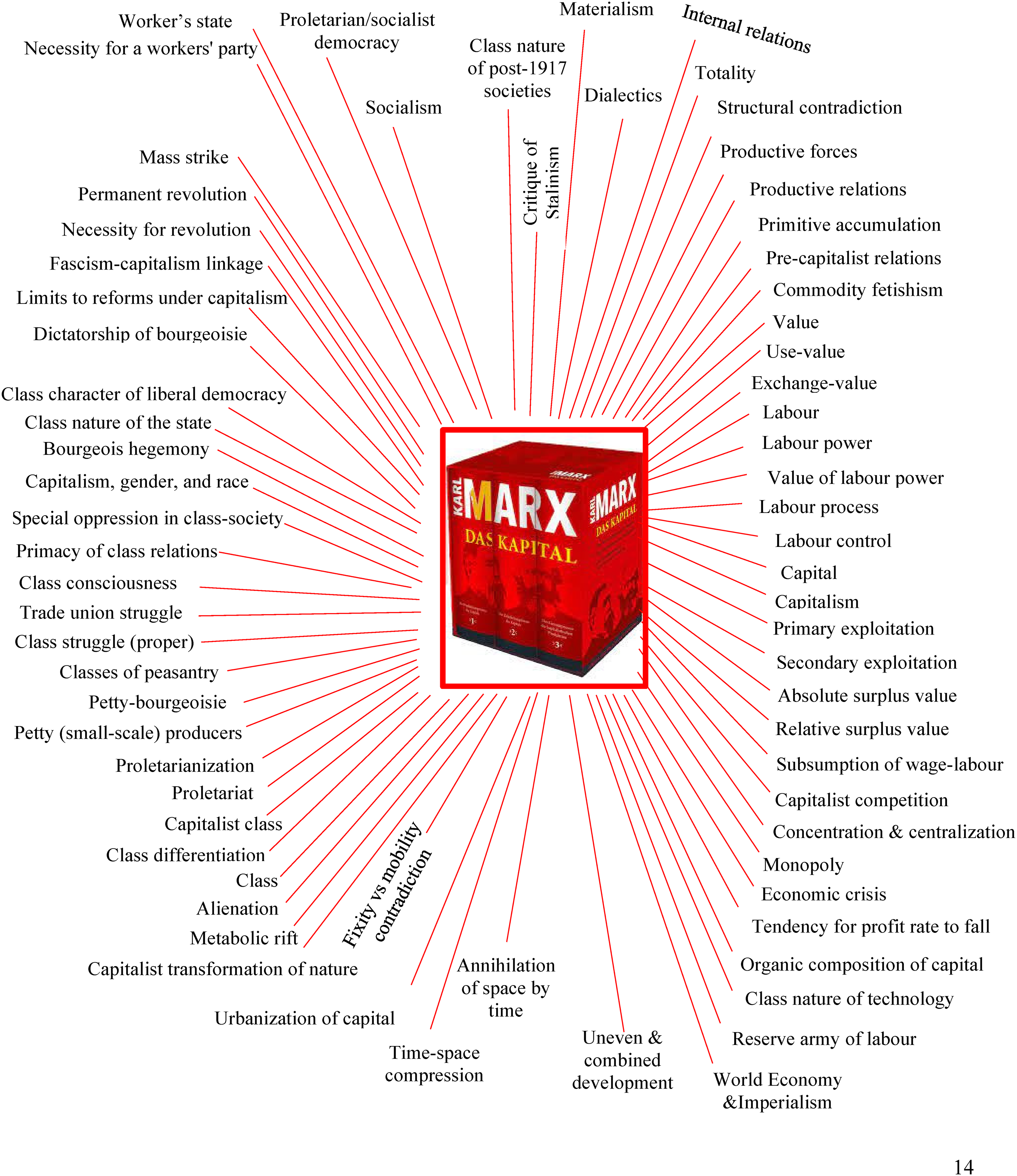
Marxism is ‘omnipotent because it is true’: Marxism's keywords.
Footnotes
Declaration of Conflicting Interests
The author(s) declared no potential conflicts of interest with respect to the research, authorship, and/or publication of this article.
Funding
The author(s) received no financial support for the research, authorship and/or publication of this article.