



Abstract
Marxism is a large and diverse body of thought that has weathered many storms over the last 150 years. While its explanatory and political relevance to today's world is enormous, Marxism lacks mass appeal and largely resides in universities (notably, the social sciences and humanities). While this is, in one sense, a sign of defeat, in another sense it's been productive insofar as it's offered exponents space and time to make sense of capitalism's ever-changing configurations. This article homes-in on classical Marxism and its enduring importance as a tool of analysis and political thinking. It focuses on the author's attempts to understand how the biophysical world is entrained in the dynamics of capital accumulation, especially during the period of neoliberal political economy that began around 35 years ago. Marxist geographers continue to offer important insights into capitalism in a more-than-capitalist world that is, nonetheless, utterly dominated by the contradictory logics of growth, economic competition, endless technological innovation, uneven development, accumulation by dispossession and crisis. For me, classical Marxism's attention to capitalism as an expansive ‘totality’ is critical, obliging us to attend to how different places, people and political projects are brought into a single, if exceedingly complex, universe. The article reflects on how the embrace of classical Marxism necessarily folds the professional into the personal, though in ways that inevitably highlight some of the contradictions that Marx and Engels identified. It's to be hoped that a new and talented generation of Marxist geographers will continue the work initiated 50 years ago by David Harvey and others. The article suggests that a key research frontier for Marxist geography is normative: what sorts of political visions and proposals will gain traction in a variegated yet tightly connected world where capitalism is so manifestly dangerous for people and planet?
Marxism is a mode of analysis geared, ultimately, to the taming or (better still) supercession of the capitalist way of living. Because capitalism is relentlessly dynamic so too, necessarily, is Marxism. Since Marx died in 1883, it's grown considerably in size, scope and sophistication, attracting some of the finest minds of successive generations. Marxists have sought to apply and extend Marx's (and Engels’) profound insights to an ever-changing world. But Marxism's evolution has often been tortured: many things said and done in its name have sharply divided Marxists, while endless bullets and missiles have been launched into the Marxist camp from the outside. Today, compared with its late 19th and early 20th century origins, Marxism is resolutely academic: it survives (and still occasionally thrives) in the social sciences and humanities. There's no longer an associated political programme – call it socialism, call it communism – that captures the hearts and minds of the billions of people who today sell their capacity to work in return for a wage. For Marxists, this is a strange state of affairs. After all, the world is more capitalist than ever, and in ways that (one surmises) ought to sow the seeds of serious reform, if not a set of regional or continental-scale revolutions. As Walter Benjamin famously remarked, capitalism is a storm that lays waste to people and planet in the name of ‘progress’. Marxism is key to understanding why the storm does not abate and why – at the present time – we lack the political tools to stop it in its formidable tracks (never mind shelter from it).
My own contributions to academic Marxism have been very small indeed (two handfuls of articles and chapters from 1995 onwards, plus a Marxisant co-authored book about ‘labour geography’). 1 But I’m very pleased to have made them, drawing on the (often brilliant) work of many others. The Marxism that has commanded my attention is ‘classical’: that is, it sticks close to the spirit and the letter of Marx's original writings (compare this with much of the Western Marxist canon, or the ‘analytical Marxism’ that emerged in the 1980s and 90s). This version of Marxism has hugely expanded my professional and personal horizons. It continues to act as an analytical compass, even though I haven't published much that advances Marxist thought for a while now.
I first encountered classical Marxism (not yet knowing its difference from other modalities of Marxism) when a second year Geography undergraduate at Oxford University. That academic session (1987–8), David Harvey joined the School of Geography from Johns Hopkins University. Not long after, Erik Swyngedouw was appointed (later to be a colleague of mine at Manchester University). Harvey taught Capital volume 1, and Erik delivered a lecture series about theories of ‘international development’ (where he discussed V. I. Lenin and Rosa Luxemburg, among others). These classes were formative. That year I bought one of my first ‘serious’ academic books, Smith’s (1984) Uneven Development (it cost £5, quite a lot at the time). Though I did not yet understand that much about Marxism, I knew that I wanted (even needed) to understand it. I tried to read Smith's book, along with Harvey's brace of ‘city books’ (Consciousness and the urban experience and The urbanization of capital [1985a; 1985b]). A tenacious reader, I would go over these and other texts (e.g. by Ray Hudson, Doreen Massey, Dick Peet, Richard Walker and Michael Watts) again and again in the final 12 months of my degree programme. Harvey’s (1989a) The condition of postmodernity was published as I was graduating, along with his first ‘greatest hits’ book The urban experience (1989b). I purchased both. Later, I began to read some of Marx's original texts, while trying to understand something of the formidable body of Marxist work (classical and post-classical) that had grown before and after the second world war. The experience was variously rewarding, tiring and befuddling. When I wasn't confused (a frequent occurrence), 2 it allowed me not only to better understand the world I inhabited, but to understand how that world had left an indelible mark on me and my family. In short, (classical) Marxism has done far more for me than I could ever have done for it. But if my writing and teaching have in some small way helped to keep the Marxist flame alight in our largely post- and anti-Marxist times, then so much the better.
So what exactly does classical Marxism offer us? There's far too much to say, so let me summarise it as follows: it offers an understanding of capitalism as a promiscuous, dynamic and contradictory totality. Capitalism is an historical creation, emergent in Western Europe a few centuries ago. What Marx, Engels and subsequent classical Marxists bequeathed us is a set of concepts that illuminate why capitalism is: (i) compelled to grow over time and across space in search of new profit-making opportunities; (ii) generative of endless change, even as its basic ‘rules’ remain invariant; and (iii) dysfunctional by virtue of elemental antimonies within its ‘operating hardware’. These venerable concepts include use value, exchange value, value, commodity fetishism, the forces of production, the social relations of production, capital circulation, real abstraction, dialectics, the ‘unity of opposites’, crises of accumulation, labour power and mode of production. Used together as a coherent (though by no means finished) theory, the concepts allow one to see how changes in seemingly disparate places and elements of modern life are, in fact, part of a rather repetitious story that Marx began to tell over 150 years ago. The enduring elements of that story matter every bit as much as the changing details. For instance, the rise of so-called ‘financialisation’ since the mid-1980s is readily explicable in terms of Marx's basic theory, even if it was hard for anyone to predict the exact timing and sheer scale of the turn to finance-based profit-seeking after the ‘de-regulation’ of the Reagan-Thatcher years. This is why Marx, though long dead, remains relevant today.
For me, it was (and still is) the open-ended yet ‘totalising’ aspirations of Marxism that appeal(ed). As the ‘cultural Left’ grew in strength through the 1980s and 90 s, these aspirations were often looked upon dimly. The rebuttal – for instance, David Harvey's response to critics of The Condition (1992) – was that it's capitalism that's unduly totalising not the Marxists seeking to keep track of its fluid geography and temporality. Capitalism is not so much an ‘economic system’ as a way of life: it takes hold of people, places and the non-human world via the ostensibly ‘free’ agency of entrepreneurs and governments. As Eagleton (2003: 19) so aptly put it, “In its hunt for profit, it will travel any distance, endure any hardship, shack up with the most obnoxious of companions … and cheerfully betray its next of kin”. It was around this time that I began to read Harvey, Smith and Marx more seriously. It was a journey undertaken in the Department of Geography at the University of British Columbia. I had long had a fascination with Canada, in part because of a love of the outdoors (hailing from a town called Bury, I had walked and had run a great deal in the Pennine hills in the north of England when younger). It helped a lot that I secured a graduate scholarship. Though many of my graduate peers in Vancouver (e.g. Alison Blunt, Bruce Braun, David Demeritt, Robyn Dowling and Matt Sparke) were not as fixated on Marxism as I was, I nonetheless soldiered on (feeling somewhat ‘behind the times’ in so doing). I discovered great works from the 1970s and 80 s in disciplines like philosophy, sociology and history that helped me better understand classical Marxism (e.g. by Chris Arthur, Diane Elson, Joseph McCarney and Bertell Ollman). I discovered helpful newer works by Moishe Postone, Derek Sayer, Werner Bonefeld and the Canadian sociologist Murray E. G. Smith. The writings of Alex Callinicos and Terry Eagleton also loomed large. At the same time, important new Marxist voices emerged in Geography (such as Julie Graham, George Henderson, Andrew Herod, Don Mitchell and Jamie Peck). Though he was writing a very ecumenical (‘post-prefixed’) book during my time at UBC (Geographical Imaginations, 1994), my masters (and then doctoral) thesis advisor Derek Gregory was a source of good counsel when I got stuck. My two theses were overly ambitious and not terribly good. But they allowed me to talk about everything from urban aesthetics to deforestation to the entrenchment of neoliberal individualism. Capitalism is not everything (though it seems these days to be everywhere), and so Marxism's value is to be absolutely necessary if definitely not sufficient. 3
Of course, many people would question the ‘necessity’ of Marxism, especially outside the social sciences and humanities. This is why high-quality research by Marxists in Geography and other disciplines matters. While concepts and evidence cannot on their own change the world, they can profoundly inform the practices that do enact change. For me, a major area of focus has been capitalism and the biophysical world. This focus spanned my years as a lecturer at Liverpool University (1995–2000) and my first decade at Manchester University (2000–10). As a child, I was very affected by the talk of possible ‘nuclear holocaust’, the image of the ‘ozone hole’, claims about ‘over-population’ and images of oil pouring out of stricken super-tankers. By the time I knew a fair bit about Marxism, I was puzzled as to why there was no coherent and comprehensive account of the role of ‘nature’ in processes of capital accumulation. To be sure, there were bits and pieces but nothing substantial or comprehensive. Harvey's notion of filling-in some ‘empty boxes’ in Marx's unfinished critique of political economy had stayed with me from the late 1980s. With the aid of new works by Elmar Altvater, Ted Benton, Paul Burkett, Reiner Grundman and James O’Connor, I began to explore how far Neil Smith's counter-intuitive idea of the ‘production of nature’ could properly encompass the contradictions of capitalism-nature dynamics. As with everything in capitalism, these dynamics are both representational (pertaining to how the non-human world is depicted, categorised and assigned value) and material (pertaining to physical relations, transformations and unintended consequences). I wanted to retain the ‘materialism’ of Marx, yet acknowledge the contingency of representation (usually figured by Marxists as ‘ideology’, then later as ‘discourse’ once post-modern, post-structural and post-colonial ideas caught on). 4
As I was pursuing my interest, the first United Nations Earth Summit came and went, and talk of ‘the greenhouse effect’ became more serious in scientific circles. The Amazon basin began to assume iconic status in environmental politics, even as the 1990s saw a marked expansion of capitalism in the former communist bloc, a nominally communist China and a set of other ‘developing nations’. At this time, ‘global environmental management lite’ was the answer to the economy-ecology contradiction via various United Nations frameworks and directives. Carbon trading took-off, after a fashion, and was one of several ‘market-based solutions’ being promoted. (We’re not much further down the track 30 years later, and yet the biophysical impacts of capital accumulation since the first UN Rio meeting have increased by orders of magnitude).
By the early years of the new millennium, activists and academic Leftists began to use the term ‘neoliberalism’ to designate the world that had emerged out of the capitalist crises of the 1970s and 80 s. By then the ‘anti-capitalist’ protests in Seattle and elsewhere had made headlines and offered hope that there was an alternative, or at least the prospect of applying a hand-brake to ‘free-market’ globalisation. In Geography, Adam Tickell and Jamie Peck were important analysts and critics of this brave (read troubling) new world. Marxists are wont to distinguish the invariant ‘laws of capital’ from the contingent ‘social formations’ they produce within and between different countries and continents. What, I asked, is the relationship between the neoliberal form of capitalism and the biophysical world? Can we generate a set of theoretical expectations spinning-out of Marx's dialectical presentation of capitalism, supplemented with plenary insights from the work of Karl Polanyi (a notable critic of 19th century ‘liberal capitalism’, whose work has been rediscovered this last 15 years). And how might these expectations speak to empirical studies of various ‘moments’ and sites in the dynamics of capital-nature relations in a world of uneven neoliberalization? Addressing these questions was, for me at least, a compelling project and it produced a string of journal articles, chapters and commentaries. A couple have since proven to be influential, for better or worse (in truth, they should have been stronger and I should have stuck at the task much longer than I did). This work shows how Marxism evolves in constant dialogue between theory and the unfolding realities of political economy and ecology in a more-than-capitalist world. It is (though not necessarily in my hands) a versatile framework of analysis.
One of the important things that classical Marxism does is make you track the ‘logics’ at work across seemingly disparate arenas of life. You’re forced to look for unities where perhaps in the past you saw distinctions. This is not at all to say that capitalism makes everything in its image (though it probably would if it truly could). Instead, it's to say that flows of capital transgress boundaries and conjoin hitherto separate things in a systemic (if contradictory) way. Analytically, the theoretical and empirical task then becomes to track the connections as capital expands into new arenas, as it has done with the valuation and governance of ‘nature’ since the mid-1990s in particular. My several articles about neoliberalism and the physical environment were initial attempts to spell-out some of those emerging connections. Marxism has helped me to think very systematically without, I hope, being close-minded. It's an open and relational form of systematicity that has to reckon with a more-than-capitalist world. 5
Excitingly, I was far from alone in my endeavour to explore the capitalism-nature-neoliberalism connection. It tells you something about the explanatory power of Marxism – classical and otherwise – that even during a decade when many declared it ‘dead’ (the 1990s, after the fall of the ‘iron curtain’), a new and talented generation of Marxist (or at least Marxisant) geographers emerged. They included Karen Bakker, Neil Brenner, Vinay Gidwani, Julie Guthman, Nik Heynen, Matt Huber, Maria Kaika, Mazen Labban, Rebecca Lave, Alex Loftus, Becky Mansfield, Andy Merrifield, Jason Moore, Scott Prudham, James McCarthy, Morgan Robertson, Paul Robbins, Joel Wainwright, Melissa Wright, and Gill Hart (initially trained as an economist). 6 The ‘return’ (even ‘revenge’) of Marx has been announced more than once since ‘the battle for Seattle’. Yet, as I noted above, it's fair to say that Marxism – as a live body of cognitive and normative analysis – today exists largely in Western universities rather than in the world at large. This may not seem like much of a return, let alone a revenge. The masters of the capitalist universe are scarcely quaking in their boots. Even the global financial crisis of 2007–8 did little to topple professional economics from its perch in favour of neo-Keynesian or some other form of Left political economy.
But for all that academics get criticised for being ‘irrelevant’ and reverting to the ivory tower, it's important to recall how precious the freedom to think, analyse and publish is. While the average Marxist geographer is definitely not one of Gramsci's organic intellectuals, 7 the work that David Harvey continues to do, and that of younger geographers like Geoff Mann, ensures that there's a serious intellectual resource to-hand if and when opportunity knocks. Importantly, over the last 35 years, this resource has been greatly enriched through dialogue with currents of post-colonial, feminist, anti-racist, indigenous and green thought. Happily, Marxism in various forms remains alive and well in several disciplines and inter-disciplines, including international relations, cultural studies, labour studies and sociology (though definitely not economics or business studies). This is something of an achievement, for which many people take credit. Marxism in the academy could have gone the way of Marxism in the wider world. It would be well-nigh invisible today had not a cohort of people, and journals like Capital & Class, Monthly Review, New Left Review, Historical Materialism (founded in 1997) and Rethinking Marxism (founded in 1998), kept the field moving forward in the face of criticism, scepticism and disinterest
It's very obvious to me that we need this Marxist intellectual resource to be taken seriously outside universities – by activists, by citizens, by aspiring political leaders and by at least some sections of business. 8 Never has capitalism been as large or complex as it today, generating a litany of problems it encounters as either costs or investment opportunities, depending. The fact that we now casually talk of the arrival of the Anthropocene is serious cause for concern. As Mann and Wainwright (2019) sagely note, “here in the Global North we often act as if our future will be a warmer version of today: liberal capitalism, plus flood insurance, minus coral reefs”. They continue: “That future is a fantasy. It already has a probability close to zero”. I’d wager that his last comment is right. Yet, at present – and terrifyingly – the juggernaut of compound capitalist growth seems to be absolutely unstoppable. Neoliberal capitalism is discredited but dominant: it’s at once hegemonic and immune to its many vociferous critics worldwide. 9 As Zizek (2011) observed a decade ago, “Opposition to the system can no longer articulate itself in the form of a realistic alternative …”. Morbid symptoms abound in our plutocratic age. Nationalistic and localist populism has sprung-up among a great many people “… who have felt trapped by their own impotence for too long, with nobody available to blame but themselves” (Davies, 2015: xvii). Huge environmental incidents are now routine, though there's no international ‘green movement’ to speak of (despite the decades-long work of many prominent NGOs like Greenpeace). 10 A global ‘green new deal’ may perhaps emerge to save capitalism from itself, though even that will involve serious conflict with (and within) the world of big capitalist owners and shareholders. There's every possibility that capitalism will survive while things get very bad indeed for people and planet (Buck, 2007). In the meantime, those of us working in universities should use our (admittedly very) modest power as researchers, teachers and (occasionally) contributors to public debate to show how and why Marxism (still) matters. We have the capacity to educate and advocate, and to a high standard that avoids saloon bar polemics and sloppy reasoning. In a world of rampant disinformation, endless spin, bad-faith reasoning and demagoguery, this matters very much.
Having said a lot about how Marxism has shaped my professional life, let me venture some more personal reflections. Hindsight is a wonderful thing and often produces ‘just so’ stories about the past. In truth, I don't presume to really know what drew me to devote several years of my life to thinking, and writing, about Marxism. But it probably has a lot to do with the sharp sense, developed early on, of who I was and where I was from. Like millions of others in the UK, I was a working class boy (and, Britain still being very hierarchical in the 1970s, I very much knew it). I was raised in one of the former cotton manufacturing towns arrayed around the original ‘workshop of the world’ (otherwise known as the 19th century ‘shock city’), Manchester. I had a comfortable, if humble, upbringing. My paternal grandparents were ‘respectable working class’ people and had both laboured in cotton mills for decades. My father, a mill workers’ son, had passed the entrance exam and attended the local grammar school. However, my mum's paternal grandparents had owned factories that made one of the many components required to weave textiles (namely, shuttles). The factories had been sold and the money dwindled away in the hands of my grandfather through the 1950s and 60s.
When UK interest rates sky rocketed in 1978, my parents could no longer afford our small but newish house. It didn't help that my dad resigned his job as a life assurance salesman to return to his first occupation as a musical entertainer. My mum did odd jobs. We moved 2.5 miles away from our neighbourhood (an altogether different universe for an 11 year old) to a village called Summerseat, straddling the Irwell River (which flowed ten miles downstream into central Manchester). It was a serious shock to the system that occurred during Britain's ‘winter of discontent’. Not only was I removed from familiarity and friends. The village, set in a steep-sided valley, was in a bad way: the large Joshua Hoyle & Co. cotton mill that had created almost all the jobs in Summerseat had closed its doors in 1977 (one hundred and one years after opening). Ten rows of purpose built 19th century working class houses for shop-floor employees were largely empty, boarded-up and graffiti-ridden. My parents had managed to buy a better quality stone-built house in a single terrace row formerly occupied by supervisors employed in the local factory. But the house was nonetheless dark, cold, damp and chaotically decorated. Across the railway line immediately in front of the house was the local sewerage works. At the end of the street was an open refuse tip that, these days, would be considered a health and safety disaster zone. The smells that sometimes wafted into our house were pretty bad. I snuck into the cold, dark mill one day to find lots of machinery, tools, puddles, detritus and broken windows. I lacked any real means of making sense of this new milieu. I overcame the friction of distance courtesy of the new bike my parents bought me that Christmas. I pedalled back to my old neighbourhood as much as I reasonably could before eventually (and inevitably) cutting ties once I joined the local high school in September 1979.
Summerseat is now a fairly gentrified place, not least because a motorway was built just above it connecting Manchester with Rawtenstall (further up the Irwell Valley). The old sandstone mill was converted into luxury apartments some time ago, 11 and the railway line now shuttles families north and south on weekend heritage trains restored by enthusiasts. The same can be said of nearby Ramsbottom, a larger 19th century cotton and paper manufacturing town where many of my high school friends lived (and still live). Manchester was a very depressing city in the 1980s when, taking British Rail diesel trains from Bury station, I first visited it regularly as a teenager (in order to watch Manchester City FC play football). Yet it's famously enjoyed a renaissance since the late 1990s, at least in the CBD (so too Liverpool, where I used to live). None of these changes are explicable without reference to the dynamics of British and global capitalism, and the way that national and local governments sought to manage them. It's creative destruction writ-large in a former industrial region. (Doreen Massey's metaphor of ‘layers of dis/investment’ remains very apropo, as does her relational sense of place and region). Had I not encountered Marxism, or attended university, I would probably never have really grasped how my history and geography were made under conditions not of my choosing. To be able to later publish about the grand forces structuring these conditions was, of course, a thrill for someone from my background. 12
The moral of this story is that if Marxism isn't relevant to you personally, well, it probably isn't Marxism (or else you are failing to properly grasp its central messages). 13 It allows a non-reductive understanding of the concrete and the abstract, the local and the global, the particular and the general. You don't have to attain Marx's ‘luminous summit’ to appreciate this (I slowly clambered up one or two hillsides and still managed to see a great deal). For me, the most rewarding experiences have brought the personal and the professional together. For some years, I taught a masters module about David Harvey's Marxism and, largely indirectly, thereby about Marx's key writings. With usually small class numbers (5–10), I had an opportunity to teach students in-depth about capitalism, its spatio-temporality and its relation to the biophysical world. Some became Marxists during and after their PhD studies (such as Tom Purcell, now at King's College). To instruct students like him down the road from where Engels once lived, where Marx had spent time, and where the industrial revolution had largely begun was geographically fitting. 14
It was also fitting that I once got to visit the world's largest (former) communist country (in 2007, many years after ‘the fall’). The rather touristy image of myself and Erik Swyngedouw in front of a Marx-Engels statue is not as straightforward as it seems. To the left, out of the frame, was a man slumped on a park bench, clearly drunk (on vodka?) in the middle of the day in the remote rural town we were passing through Figure 1. The symbolism was irresistible. Was this a small sign of the legacy of the post-communist ‘shock therapy’ unleashed on Russians? Or was it a hangover of the communist-era culture that told Russians not to hope for more than the apparatchiks offered them? Of course, I will never know. But the communist experiment in Russia and elsewhere reminds us that well-founded critique (of capitalism) and noble dreams (of a better world) can turn into a ‘cure’ just as bad as the original disease.
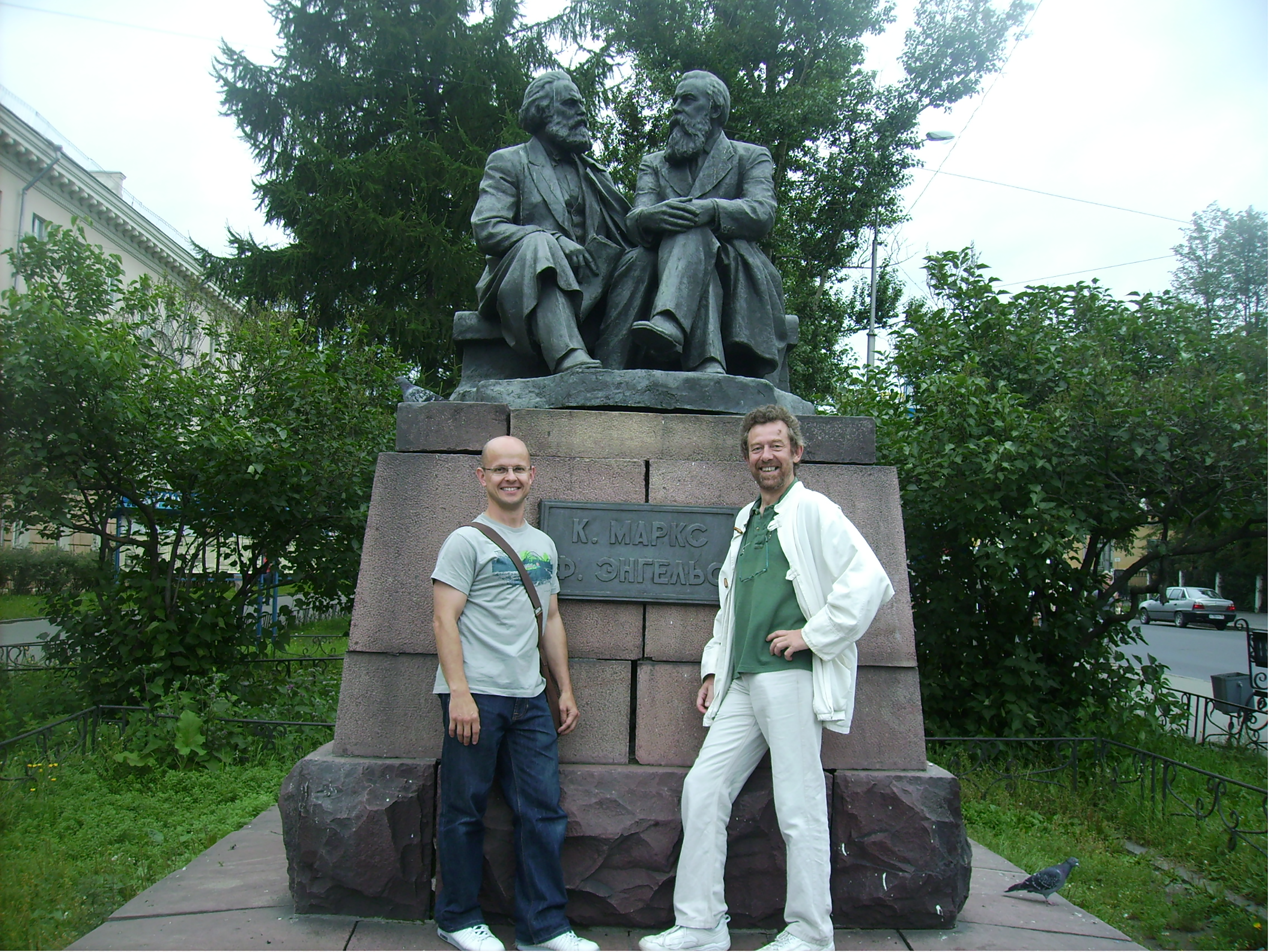
Noel and Erik Swyngedouw in front of a statue of Marx and Engels in small town Russia, north of St Petersburg (2007). Many such statues had been removed during the Yeltsin era, though this one was in fine condition. The smiling faces belied the sombre experience of touring rural areas in this post-communist state. Ordinary Russians seemed somehow to be sad, unfriendly and defeated. What was worse: ‘free-market’ capitalism (aka the fire-sale of public goods from 1990 onwards via corrupt politicians) or the authoritarian communism that Mikhail Gorbachev had sought to reform? It was difficult to know.
One of the problems of present-day capitalism is that it's so pervasive it's hard to imagine viable alternatives: it has an ‘imperial’ character (Brand and Wissen, 2021). If the motley crew of present-day Marxist geographers were to somehow coordinate their efforts, they would do well to focus on the means and ends of ‘radical reformism’ or ‘realistic revolution’. How do material and imaginative geographies constrain and enable the creation of a world less wracked with disease, death and destruction? What proposals and ideals will inspire progressive change on a divided and dangerous planet? What geographies of freedom, democracy and wealth should we hope for? Perhaps we need a more normative, more programmatic, more strategically-minded Marxist geography after decades of excelling at explanation and critique. This would dovetail with university leaders’ current penchant for research ‘impact and engagement’, subversively so. Some in Geography are already striding in that direction, 15 even though the prospects for progressive change are currently limited in the extreme.
Glib utopianism is not what's called for. But, equally, our thinking cannot be too hemmed-in by current realities in an era when capitalism's maniacal addiction to growth is pitching us all into frightening new territory. I used to visit Prague a lot (it's one of my favourite cities, with a rich history of religious and political struggle). As the former political dissident, and later Czech President, Vaclav Havel once said, “Hope is definitely not the same thing as optimism. It's not the conviction that something will turn out well, but the certainty that something makes sense, regardless of how it turns out” (1986: np). The Marxist critique of capitalism certainly makes a lot of sense to me, though I’m far less hopeful about the future than I used to be.
Footnotes
Declaration of Conflicting Interests
The author(s) declared no potential conflicts of interest with respect to the research, authorship, and/or publication of this article.
Funding
The author(s) received no financial support for the research, authorship and/or publication of this article.
