



Abstract
This paper considers some of what it means to work with, and within the limits to, Marxism. I make reference to two sets of inquiries where Marxism matters but remains at the margins of things. My focus will be on human cognition and digital life. To balance things, I then highlight some issues where Marxism is much more to the fore, specifically what I loosely refer to as "foodscapes." Finally, I conclude the essay with some further personal comments on my engagement with Marxism. Throughout, I want to give some expression to the sensation of walking a fine line between remaining committed to the conclusion that capitalist social relations are an enormous problem for human society but finding also that Marxism does not provide enough of the analytical equipment to answer how we should move beyond it. At the same time, I try to offer reflections on critical intellectual thought and action as a tentative and iterative experience, rather than an engagement framed by the security that one can find enough of what’s needed in Marxism.
Introduction: Basslines
When I began writing this essay, I had a 3-hr mix from 2011 by DJ Loxy playing in the background. I play it when I need some familiar and comforting music. Loxy, one of the best mixers of drum and bass music, has put together and distributed to the web (for free) hundreds of hours of his artistry. The music he mixes is full of grumbly and growling basslines with rolling, threatening beats interspersed with glimpses of symphonic light. It’s a futuristic sound, like a sci-fi soundtrack. I absolutely love this particular mix. It’s been with me for a decade: Through periods of heartache, hard work, travel, study, intense focus, and daydreaming.
I mention all this because Loxy’s mix catalogue—the peculiar names he gives them; the wild set of sounds combined; the blend of 20th-century Jamaican influences and soul breakbeats with 21st-century music technologies and influences; the fact they’ve been released for free; the artistic efforts of hundreds of dispersed music producers who made the tracks he blends together; the weird cultural economy of a marginal, yet thriving and innovative music scene—highlights one of the challenges of working with Marxism today. I find that Marxism matters, and it helps, when trying to understand numerous aspects of the world. But there are silences. I’m struck by the fact that the music and the related cultural economy brought together and enlivened in a Loxy mix could invite a Marxist analysis. Such an effort might (it’s hard to say, because to my knowledge no one has tried) yield some interesting insights. However, for the most part, drum and bass music—that is, the artists making the standout tracks, the DJs who have helped stitch together its “world,” and the “punters” or “headz” who bubble and bounce inside clubs and raves—takes shape under the radar of Marxist analysis and Marxism as an intellectual approach. There are, in short, limits to Marxism.
In the rest of this essay, I want to consider some of what it means to work with, and within the limits to, Marxism today. I have two main sections. In the first section, I make reference to two sets of inquiries—to spare the reader, neither of these involve drum and bass music—where Marxism matters but remains at the margins of things. My focus will be on human cognition (the “brains” referenced in the title) and digital life (the “bits and bytes”). To balance things, I then highlight some issues where Marxism is much more to the fore, specifically what I loosely refer to as "foodscapes" (this, then, is about the “burgers”). Finally, I conclude the essay with some further personal comments on my engagement with Marxism. Throughout, I want to give some expression to the sensation of walking a fine line between remaining committed to the conclusion that capitalist social relations are an enormous problem for human society but finding also that Marxism does not provide enough of the analytical equipment to answer how we should move beyond it. At the same time, I want to offer reflections on critical intellectual thought and action as a tentative, iterative, and (to be self-critical, a) skittish experience, rather than (as I suspect might be the case for more confident contributors to this special issue) an engagement framed by the security that one can find enough of what’s needed in Marxism.
Brains, bits, and bytes: Marxism in the margins
One of the privileges of receiving a salary to teach and conduct research is having time to pursue critical intellectual inquiry regarding entirely new issues. In the last few years, I have taken advantage of this privilege to develop my understanding of how the human brain has developed. My main guide has been Tomasello (2014 -2019), with other authors consulted at various stages. Tomasello’s core argument, if I can cut to the chase, is that humans have evolved via cooperation. Cognition, morality, and ontogeny are all shaped by the human need to work with others to solve problems. No cooperation, no humanity (what an argument for socialism!).
I have approached this body of work with a broad question in mind about the importance of space in the development of human cognition. I do so in response to Marxist geography, which makes the case for always thinking about the spatial dimensions and dynamics of capitalist social relations while calling for alternative and non-capitalist geographical arrangements that can deliver a better life for all. A more abstract point of Marxist geography, at least as I understand it, is that it pays to think about the spatial dimensions and dynamics of all social relations. Capitalists are geographical agents, for sure. But we all are, each in our own way and under the specific and sometimes more general constraints we each encounter. Connected to these prompts, my query about cognition is informed by my interest in understanding why capitalism persists. Given its crisis-prone tendencies and its failings, why are we not getting rid of it? Is there something about human cognition and our relationship with space that we have not been asking but should be trying to understand? In short, then, Marxism has been in the mix as I conduct these inquiries. But in my “findings,” as it were, Marxism has been at the margins. A brief illustration will need to suffice.
Beyond the way space figures in the “change in ecology [which] led to some new forms of collaboration, which required for their coordination new forms of cooperative communication” (Tomasello, 2014: 31), space is a fundamental element in the situations and contexts in which modern humans developed “collective intentionality.” Collective intentionality is most significant, Tomasello argues, because it involves forms of advanced cognition and communication practiced only by modern humans. Space matters here because humans confront an environment, an ecology, that must be negotiated or, at the very least, navigated. Gestures, language, an agreement on concepts (how they should be transmitted and how an understanding of their meaning should be developed), and concomitant practices permitted humans to establish collective intentionality and subsequently create spaces in which they could survive and indeed expand. The “inordinately important role of space in human cognition” (p. 65) makes sense because humans necessarily engage a (potentially dangerous) space of contingencies that must always be tackled at the same time as any other developmental questions are addressed. No spatiality, no sociality, no humanity (what an argument for the virtues of geography!).
But note how distant the imagined geography at play here is from what Marxism (or Marxist geography) proposes. Of course, there is the obvious absence of capitalist social relations; however, more crucially, there is also an absence of Marxian dialectical reasoning in the construction of Tomasello’s arguments. On the one hand, so what? Intellectual inquiry is broader than Marxism. On the other hand, however, it is striking that contradictions (between the need for collective intentionality, say, and wider group cohesion) do not figure in the explanation, or indeed in Tomasello’s framework for inquiry. My tentative take on this is that collective intentionality emerges to establish ways of handling multiple, sometimes simultaneous and overlapping chance occurrences (confronting wild animals, eating the wrong berries, catching a fish). The outside world will be ordered; structures matter, patterns exist, and relatively permeable ideas need to be shared and understood. Yet, the cooperative skills that humans develop ultimately come from the need to engage the contingent world. What this might mean for contemporary society and its challenges I cannot (yet; or may ever be able to) say. What I can point out, however, is the (ghostly) presence of Marxism in my probing into these issues. Whether the issue is drum and bass music, as I noted in the Introduction, or human development, as I have noted here, it can feel as if working with Marxism should involve working only with Marxism. All I want to emphasize is the limits to such a perspective. For me, at least, it makes sense to accept that the Marxist toolkit, so to speak, can stay at the margins in some critical intellectual endeavors. That said, I am happy to be corrected.
To raise a second example where Marxism has been at the margins probably risks producing a few more controversies. My tentative probing around the issues explored by Tomasello involves pre-historic, never mind pre-capitalist, life. In contrast, my discussion now engages central aspects of contemporary digital life—that is, the world of bits and bytes. It is well known that digital aspects of contemporary life are demanding a lot of attention today. Scholars from across the social sciences and humanities have made numerous contributions. Geographers have also chipped in. Perspectives vary, of course, but it is quite hard to find truly insightful Marxist scholarship on digital life. For example, although Žižek (2018) argues that “the struggle for [the web’s] control is the struggle today” (p. 104), his call for occupying the “digital grid” (p. 105) relies on what he refers to as “‘elitist’ specialized groups which, acting in a purely ‘technical’ way, undermine the functioning of state control and regulation” (p. 106) via digital life. Nice idea, but such an effort would be a miraculous feat of technical, not to mention social and geographical, coordination given the nature of today’s digital world. We confront a distributed, complex digital infrastructure quite unlike the infrastructure Trotsky found in 1917. Moreover, even if “elitist specialized groups” in one or a group of places or countries were to identify ways of taking over “the grid,” they would confront numerous other “specialized groups” working for authoritarian regimes, say, or criminal groups that need and will want to maintain digital infrastructure for their own purposes. Žižek’s proposition is naïve.
Consider also Morozov’s (2019) view, which comes closer to capturing the complexity at issue today but misses the point about how digital life alters the fundamentals of capitalism. He argues that features such as digital services—we might think about proliferating big data architectures, persistent algorithmic presence, and peculiar labor market arrangements—are “novelties of today’s global capitalism [but] one would be hard-pressed to conclude that the proliferation of data-intensive digital commodities and services fundamentally alters the terms and dynamics of capital accumulation” (p. 40). If digital life deserves to be a focal point for Marxist analysis without any significant need to think too differently about what’s going on, then a lot of today’s actions should be quite easily explained from a Marxist standpoint. I have yet to find a good example.
In my view, and contra Morozov, the reason for this absence is that recent digital developments really do present a challenge to Marxist analysis. The core issue is about recognizing that, particularly in the last decade, the total number of “alive” internet-connected digital devices has exploded across the world. The “landscape” of apps and services has twisted and turned, with standout features including the extensive adoption of encrypted communications, cryptocurrencies, and the widely agreed novelty of mass social media (qua surveillance) technologies. Underneath, or perhaps within, all this action are new automated and quasi-autonomous decision-making systems establishing regions of technical cognition with limited human input (Hayles, 2017). How this challenges Marxist analyses of capitalism has to do with a crucial upshot of this period: an increase in unpredictability and uncertainty. One way to come to terms with this uncertainty is to recognize that the “chance of space,” which geographer Massey (2005: 111–117) conceptualized as a fundamental feature in the production and emergence of life, swells. Against this backdrop, my query is how lively are the contradictions of capitalism or, for that matter, are they actually better conceived as dormant or merely latent? I wonder whether Marx would have been able to conceive a capitalist mode of production like the one we confront. Capitalists still accumulate based on the exploitation of workers across complex and shifting global production networks (although “networks” quite unlike those Marx encountered, given how they take shape in relation to diverse national contexts—South Korea, Taiwan, Mexico—that hardly registered on mid-19th-century maps of industrial activity). But capitalists also engage and find ways to profit from the activities of billions of other digital subjects (“dispossessed prosumers,” as Ettlinger [2019] aptly conceptualizes them) pursuing unanticipated, even chaotic, actions across and within bizarre and hard-to-pin-down digital ecologies. As such, just who are the workers now and how can they develop a class consciousness capable of engaging the constellations of contingencies (and contradictions?) to create a post-capitalist world? To my knowledge, Marxist scholarship on digital life has not provided good enough answers. 1
One problem to consider here lies with the emphasis Marxism places on thinking dialectically about capitalism at a historical moment when the order of things, which in theory should give rise to contradictions, now produces overwhelming contingencies and chaos. To reiterate, capitalists still find ways to profit amidst the chaos. Workers are still exploited. But the extent to which we can conceive of contradictions between these two classes having the force they are supposed to have seems markedly reduced now. We occupy a planet of unpredictability that requires a form of geographical analysis capable of focusing on the chance of capitalism and the chance, too, of an alternative (or set of alternatives) emerging from within it. When it comes to digital life, Marxism prompts questions and analytical focal points (growing inequality, for sure; labor and activism; the need for analysis of the ways in which capitalists establish the digital infrastructure geographically), but my tentative view—“tentative” because we remain at an early stage in the development of digital life—is that contributions from a Marxist standpoint still lie at the margins of things. Or, to put it more diplomatically, insofar as I have tried to analyze and think critically about digital life, I should like to stress that not enough of the most thoughtful contributions have yet been made by Marxists (although see Thatcher et al., 2016). There is a gap, at least: maybe it will be filled by someone who can adeptly harness a Marxist analysis of capitalism’s contingent emergence today.
Burgers: Marxism to the fore
So far, I have emphasized interests—regarding basslines, brains, bits, and bytes—where Marxism has been a bit of a let-down. I would now like to consider some issues where I think Marxism works a lot better. To continue with some alliterative playfulness, let me suggest this section of the essay should be about “burgers.”
Thinking about and studying the geographical arrangements and flows needed to feed people—loosely, “foodscapes”—has been my main focus for almost two decades now. From South Africa to Ireland and Mexico, I have tried to write and publish research that grapples with agrarian change and rurality in the context of wider but connected political and economic developments. To label my interests here as a matter of burgers might be a bit of a stretch; yet, as a shorthand for the wider economy of producing an ever-expanding array of ultra-processed foodstuffs, burgers highlight some of the focal points for foodscapes research where Marxism enables a lot.
Perhaps the most significant consideration here is McMichael,9’s (2009, 2012) scholarship. His approach argues that paying attention to the arrangements and flows underpinning the growth of ultra-processed foodstuffs should require emphasizing the power and significance of what he refers to as a “corporate food regime.” Rolling out ultra-processed food—“teaching the world to snack” (Monteiro et al., 2010) on chocolate bars or burgers rather than, say, fresh fruit—has become a key strategy in the capitalist food economy. It reflects a pervasive mentality that profits should trump public health (Moodie et al., 2013)—that neoliberal orthopraxy in the food economy is acceptable, so long as shareholders are happy (Glasgow and Schrecker, 2016). Per McMichael, moreover, arranging a world to ensure ultra-processed foodstuffs are consumed requires mobilizing a wide range of flows that stitch places together via problematic bi- and multi-lateral trade deals that work for (and reflect the continued input from) food sector corporations. The result is a contemporary foodscape that stuffs some and starves others (Patel, 2007), while capital is accumulated and re-invested to reproduce and expand production networks and infrastructures with minimal democratic scrutiny or oversight, despite occasional public health initiatives (a sugar tax here or a new labelling system on packaging there) (e.g. Nestle, 2013) that illustrate the corporate sector’s capacity to enact its power (even if food firms sometimes appear to lose).
Approaching these issues with Marxist concepts and emphases in mind has helped me understand what is going on. There is, for example, certainly an emphasis in Marxism on tracking what capitalists are doing—on asking what sort of world they want to produce and how their imaginaries and plans are contested and resisted. I have tried to embrace this approach by noting recently how the digital scene matters in the food economy (e.g. Fraser, 2019). Consider how developments around so-called precision agriculture or “smart farming’ connect with projects downstream in the retail sector and upstream in research and development labs to yield novel data grabbing practices. Initiatives of this ilk overlap and conceivably amplify capitalist agriculture’s expansion, which in turn requires land grabs, land dispossession, and agrarian transformation (with new bifurcated agrarian scenes taking shape all over the world [see Akram-Lodhi, 2007], as non-traditional agricultural exports markets are developed). Per Weis (2010), such data/land grabbing projects can be interpreted as a response to the “chronic” and “accelerating biophysical contradictions of industrial capitalist agriculture.” As such, efforts to establish new or adjust (even, as in today’s language, “regenerate”) extant agrarian landscapes reflect the difficulties and tensions emerging from widespread unsustainable practices in the capitalist food economy. A world for burgers is a capitalist nightmare endured violently by animals and by people, especially peasant producers, who stand in the way. It is also a world enrolling digital technologies to produce new practices and products that profitably yield opportunities to promote and market ultra-processed foodstuffs, thereby completing the loop, increasing the turnover of capital, and reinforcing the corporate food regime.
Per my tentative conclusions about the role of contingencies in digital life more broadly, I argue it is important to approach the digital dynamics of contemporary foodscapes with an awareness that the force of contradictions might not need to play such a central role in Marxian-style interpretations of today’s developments. Further, hitherto I have not found Marxist contributions to be the most insightful when trying to construct a framework for understanding and writing about these specific issues. Yet, unlike my tentative conclusions regarding the literature on digital life, I find that Marxism still provides clear guidance about what is taking place in the food economy as a whole. In a sense, it comes down to the difference between what becomes necessary to comprehend when trying to understand what a firm such as Snapchat does to make a profit, versus what becomes necessary when trying to understand the actions of John Deere or Nestle. The former firm is emblematic of the strange new world of capitalist action, whereas the latter two (although, like so many other “legacy” actors in the capitalist economy, they also have digital strategies) are entrenched players within the corporate food regime and well-accustomed to pursuing profits in the wider context of agrarian changes involving dispossession, displacement, and ecological transformation and destruction.
Conclusion: My Marxism
I have used the preceding materials to provide some sense of my (strained) relationship with Marxism. I work with, and within the limits to, Marxism as I try to figure out the world and how to change it. It was wanting to change the world that sparked my interest in Marxism. I grew up in Greenock, a shipbuilding town in the west of Scotland. My parents had professional jobs—there were numerous so-called “middle-class” influences (BBC Radio 4, broadsheet newspapers)—but we lived in the middle of a struggling working-class area, and there was nothing middle class about my primary and secondary schools. The town felt like it was being closed down. I recall seeing images on the news of bombed-out Beirut and thinking it looked like the houses at the bottom of the road. It was a rough place to live where so many of the ills of capitalist life were vividly on display. In this context, I was exposed to revolutionary socialist politics from the age of 12 by my older brother, a Trotskyist activist. A revolution was supposed to be around the corner. Capitalism’s contradictions had rarely been so apparent. There was optimism, despite the endurance of Thatcher’s project. I joined a revolutionary socialist party aged 16 or 17, but I was too young (too immature, frankly) for it all. In truth, too, the hedonism of rave culture took precedence for me at that time. Life for me was about the “rave-o-lution” (Figure 1).
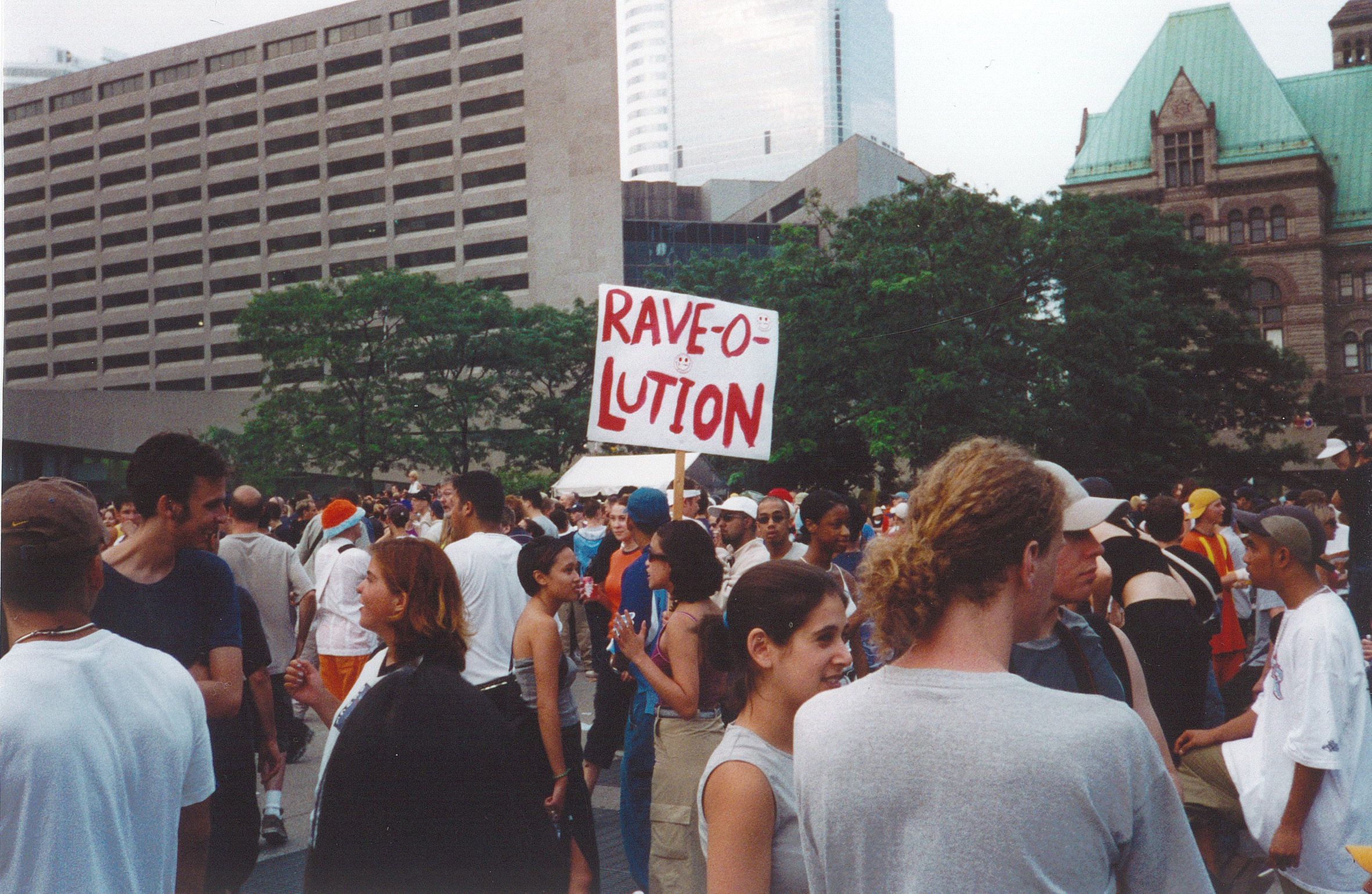
Freedom to dance protest, Toronto, 1 August 2000 (author’s image).
In 1994, a close shave with knife violence made me think seriously about attending university. I was 21 years old when I began studying a year later. I was not a great student. But a spark lit when I discovered David Harvey’s (and other) Marxist geographical scholarship in my fourth and final year. Within this body of work was a set of concepts and arguments that could be mobilized to get rid of capitalism—and thinking geographically was central to the project. I found that much of this work resembled the socialist literature my brother had been bringing into the house, but it was more evocative and intriguing (I also realize now that it was more “academic,” the conceptual framework was sharper, and it was better-written, edited, peer-reviewed, etc.). With extraordinary good fortune, I managed to become a “grad” student in 1999 at Ohio State University (OSU). I hoped to engage Marxist literature in greater depth. I was a vocal and confident student. The OSU graduate experience suited me to a tee. University in Scotland was not about speaking up: students laughed at anyone who found the issues to be interesting. At OSU, it was good to be intrigued. A grad student should be puzzled, provoked; your professors were there to prod you, to push and pull you.
Two professors became (and continue to be) major influences on my thinking. Kevin Cox worked with the Marxism I had begun to enjoy so much, while Nancy Ettlinger’s feminist and post-structural perspectives exposed me to additional and challenging ways of thinking about the world. Crucially, both of them—in course materials, seminars, and discussions in their offices—engaged questions that mattered to me, given my background. At issue were themes such as deindustrialization, economic restructuring, the emergence of globalization, new economic geographical formations, and the ills of capitalism and oppression more generally. These had been some of the forces and changes that combined to shape my hometown. I could picture—almost taste—how so many of the conceptual issues that moved Kevin and Nancy played out on the ground. The spaces of my formative years (shipyards closing, electronics firms arriving from the US, unemployment, violence) were alive when I tried to understand what academic geography should be about.
Questions about Marxism, raised in different ways by working with Kevin and Nancy, have continued to be a lively feature of my intellectual development after leaving OSU in 2006. As I hope to have demonstrated in earlier sections of this essay, to the extent I embrace Marxism, I do so without the confidence that might be required. I also work with Marxism without the sense of surety I once had (also, to be sure, without the skill I see displayed by so many of my peers). I remember strongly believing in 1999 that capitalism would not last beyond 2020. It might be that my confidence reflected a lack of understanding. Alternatively, maybe capitalists are better at what they do than I gave them credit for. But I was not wrong about the need for an alternative: capitalist accumulation is dangerous, violent, and unjust. The material inequalities—so starkly highlighted as I write by the fact there are now eight people on the planet with fortunes worth $100 billion, while another two billion people are “food insecure”—are a stain on humanity’s cooperative impulses and abilities. We need to change things. The question is how we do so. The Trotskyist proposition, which Žižek still argues for, and as my brother tried so hard to advance during his period of activism, seems so unrealistic given the constellations of contingencies with which political action must now engage. There is also the narrower and more concrete factor of global society’s inter-penetration to consider. Socialism in one country might once have seemed viable (maybe it was, objectively), but today it seems to me that a planetary alternative is what we need. How to build such an alternative is a question Marxists should be asking, but Marxism seems like it is insufficient to finding (enough of) the right answers. A new planetary politics to engage and overcome uneven geographical development, one which begins by addressing the needs of the two billion food insecure people—a population with numerous other urgent material demands—is up for grabs. Yet, such a politics, and the analysis that must accompany it, cannot be too dogmatic or rigid. Marxism enables critical intellectuals to ask pertinent questions about this type of politics; it’s just that its limits, to wrap things up, and to reiterate, require drawing on additional inputs.
Footnotes
Declaration of Conflicting Interests
The author(s) declared no potential conflicts of interest with respect to the research, authorship, and/or publication of this article.
Funding
The author(s) received no financial support for the research, authorship, and/or publication of this article.

Note
Author Biography