



Abstract
This study explores the use of portfolios in preparing aspiring principals in Sweden. Forty postgraduate students used portfolios to document course content, reflections, and observations, assessed on themes like leadership, governance, and quality monitoring. Analysis showed strong foundational knowledge but limited development in reflection and practical application. Gender comparisons revealed minimal differences overall, though men reflected more on leadership, while women focused on resource management. The findings highlight portfolios’ value as both assessment and reflective tools, suggesting a need to enhance curriculum elements that support deeper reflection and real-world application in leadership education.
Introduction
Leadership preparation for learning to become a principal in an educational setting is a priority in many countries (Heffernan & Longmuir, 2020). Aspiring principals, who often start as teachers and then progress to the principal or head teacher, either directly or through middle leadership roles (Bush, 2018). Education for aspiring principals can be viewed as anticipatory socialisation, which prepares individuals with principal aspirations to transition from previous teacher roles to leadership positions in the school organisation. Grant (2024) claims that in professional learning for leadership, more attention should be given to the dimensions of professional and organisational socialisation to avoid so-called, “sink or swim” leadership. Anticipatory socialisation may result from both conscious and unconscious learning experiences during pre-service preparation for becoming a principal (Male, 2004). Gurr (2015) emphasises that effective leadership development involves understanding the multifaceted role of school leaders. This diverse role and set of activities undertaken by a school leader are described using various terms in different countries, ranging from administration and management to leadership. In recent years, the concept of educational leadership has been used more frequently (Bush, 2020). A portfolio as a tool for leadership preparation and development offers both recording and reflecting, as discussed by Slepcevic-Zach and Stock (2018) in relation to the commonly used e-portfolio approach. Mukin et al. (2024), commenting on portfolio use in Indonesia, note that whilst portfolios enhance reflective awareness, they do depend on effective clear instruction, understanding of purpose and known assessment approaches.
In Sweden, government policy has increasingly focused on strengthening professional development for principals, in terms of preparatory programmes as well as continuous professional learning and development (Government Offices of Sweden, 2021; SOU 2017:35, Skolkommissionen, 2017; SOU 2018:17, Utredningen om lärares och rektorers professionella utveckling, 2018). The Swedish National Principal Training Programmes are available for individuals who assume roles as principals, preschool principals, or deputy principals (Brauckmann et al., 2020). Some appointed principals may have prior experience as teacher leaders, deputy principals, or substitute principals, while some participants enter the mandatory national principal training programmes without prior leadership training or experience (Ärlestig et al., 2016; Brauckmann et al., 2020). The pre-service preparation programmes of interest in this paper are a central national initiative to address retention and recruitment for principals in Sweden. Still the programmes are not mandatory for teachers to become principals, at least not yet. This was last reviewed in a Swedish official report (SOU 2018:17, Utredningen om lärares och rektorers professionella utveckling, 2018) and includes improved working conditions, including the nomenclature of all school leaders, development opportunities, and pre-service assistance.
Notably, there are no specific educational prerequisites for individuals aspiring to become school principals in Sweden. Instead, the mandatory principal training is undertaken only upon assuming the role of a principal. The recruitment training aims to fortify school leadership responsibilities, minimise turnover, and enhance recruitment by improving conditions. It also enhances the skills of future school staff with management responsibilities. The Swedish Pre-Service Preparation Programmes for Aspiring Principals is designed to provide licenced preschool teachers and educators, including primary teachers, with the necessary tools for aspiring to become principals. The programmes focus on governance, leadership, and quality assurance, covering four thematic areas: preschool and school governance, the principal’s role and leadership, the core activities of a principal, and the preschool and school as a local organisation. The programmes span an academic year, involving 4 two-day residential sessions interspersed with independent studies. Various methods, including lectures, literature seminars, and structured reflections, are employed, and participants are assessed through a portfolio aligned with the learning objectives. The course aims to impart both theoretical and practical insights into school leadership.
The use of a portfolio as a tool is seen in the specific programme as important for the participants to learn to describe the complexity of the principal’s profession, reflect on their instructional/pedagogical role, and demonstrate knowledge of governing principles for preschools and schools. Quality assurance is also a key focus, facilitated by tools such as the “double log” for recording reflections and learnings from lectures and literature, aiding in portfolio development. The learning objectives in the course are to describe the complexity of the principal’s profession and its manifestation in daily responsibilities, reflect on the principal’s role as an instructional/pedagogical leader and manager based on its significance to the assignment, demonstrate knowledge of the governing principles of preschools and schools as both organisations and institutions, and exhibit knowledge of and reflect on quality assurance as a strategy for school development. In higher education, methods of learning and assessment may be based on traditional instruments and approaches that make the learner more of a passive learner than an active one (Ayers et al., 2020).
Portfolio, as a method for assessment, allows the participant to be more active in their learning process whereas portfolio-based learning is a reflective practice and provides an instrument that offers a balance between theory and practice. Portfolios could be effective tools both for assessment and as a reflective pedagogical tool for sustainable leadership (Ayers et al., 2020) and change. Portfolios, as tools for knowledge transfer, can effectively support organisational change, particularly in contexts focused on school development. Reflection within portfolios becomes more meaningful when it leads to actual change within the organisation. As Storgaard and Frederiksen (2023) argue, leadership development must balance autonomy and responsibility, while being rooted in local conditions and democratic values. In this light, portfolios can serve as tangible evidence of a leader’s ability to translate knowledge into practice—thus facilitating meaningful and context-sensitive knowledge transfer. Feder and Cramer (2025) also noted that portfolios increase reflective writing. Commenting on new assessment approaches, Meylani (2024) notes that these offer flexibility to students in their reflection on experiences, often linked to technological integration and real-world situations. Ghamrawi et al. (2024) see portfolios as evidence of teachers’ engagement in leadership practices, illustrating their development and ongoing commitment to professional growth. Although there is evident that the use of portfolios benefits improvement of educational leadership, research on this matter is slim (Feder & Cramer, 2025).
The aim of this study is to understand and assess the use of portfolios for leadership preparation, assessment and knowledge transfer in a pre-service programme for aspiring principals. Our study was guided by the following questions:
In what ways do portfolios capture and document the learning experiences of aspiring school leaders during their preparation programme?
How do portfolios reflect participants’ development in key areas of school leadership, including management, administration, and instructional leadership?
To what extent do portfolios support the transfer of leadership knowledge and skills from the preparation programme to practical application in participants’ professional roles?
Previous Research
The previous research presented is a map of existing research on the use of portfolios in educational leadership development. A systematic search was conducted using the databases University of Nottingham and Google Scholar. The search included key terms such as portfolio use in education, portfolios and leadership development, and portfolio evaluation, initially yielding 245 results published between 2000 and 2024. After reviewing abstracts and narrowing the focus to studies related to school leadership, 46 relevant articles remained, including two published in Swedish journals. One challenge in the search process was that the databases did not clearly distinguish between portfolio as collections of skills or attributes and portfolio as documentation of reflection, knowledge development, and application in leadership contexts (cf. Candrasari et al. 2023; Landry et al., 2010; Marinković, 2023). Particular attention was therefore given to studies examining the use and evaluation of portfolios as developmental tools either prior to or following leadership appointments.
This overview presents findings on the use of portfolios in leadership development and preparation and portfolio as a tool for knowledge transfer.
The Use of Portfolio in Leadership Development
Malone et al. (2021) explore the use of epistemic communities in leadership development for underperforming schools in Texas. They emphasise the importance of consensus on purposes, codes, and language as fundamental for collaborative improvement efforts among teacher leaders within or across schools. Their analysis, based on records (effectively portfolios) and participant interviews, reveals reporting on classroom observations, individual skill development, teaching approaches, broader strategies, and reflections related to agreed outcomes. However, the term “portfolio” is absent from their discussion, suggesting that evidence and terminology for problem identification, analysis, reflection by individuals or groups, and observed application, remain diverse and require review.
In contrast, Cappelletti and Sajon (2022) demonstrate systematisation through portfolios. They propose portfolio as a structured framework for observing and reporting practice, as well as evidence for reflecting on topics, approaches, and situational changes. Their reflective process evaluates the level of reflection, contextual situations for innovation and change, the role of principals as change leaders, portfolio-building capacity, and research understanding. Additionally, Van Tartwijk et al. (2007) identify factors influencing portfolio success, including alignment between portfolio purpose and content, the educational context, support from teachers, students, and educational leaders, and the availability of adequate infrastructure.
The Use of Portfolios in Principal Preparation
An earlier report by Wildy and Wallace (1998) had investigated the early use of portfolios in leadership development, identifying three key tensions. The purpose of portfolios varied between serving as a course content record and fulfilling diaristic functions. However, there was often a lack of understanding regarding the distinction between description and reflection. Additionally, portfolios were perceived differently—sometimes as an accountability tool in both public and private contexts. Wildy and Wallace (1998) summarised the various uses of portfolios as “evidence of improvement,” “an organizer,” “a record of achievement,” and “a collection of work samples” (p. 137). They argued that the difference between viewing the portfolio as a process versus a product needed broader recognition. In the current investigation we attempted to judge the extent to which portfolio records simply noted salient learning (process) or moved on to offer reflection and development (product).
Gurr (2015), reporting on the International Successful School Principalship Project, encompasses in their work that school leaders influence student and school outcomes through interventions in teaching and learning, capacity building, and broader contextual considerations. He argues that a portfolio-based approach to leadership involves constructing networks, collaborations, and partnerships, while also utilising accountability and evaluation for evidence-informed improvement. This model applies to all leadership roles within schools. Gurr outlines how portfolios, serving as collections of materials and modes of knowledge transfer, fulfil these objectives. High expectations, pragmatic leadership approaches, distribution of leadership responsibilities, and core skills (such as setting direction, developing people, leading change, and enhancing teaching and learning) contribute to sustained success. These aspects are fundamental to both course structures and subsequent assessments.
Portfolios may require self-evaluation or mentor assessment linked to course aims and content. Storgaard and Frederiksen (2023) argue that leadership development should align with institutional needs. In the Danish context, this involves balancing autonomy and accountability. They argue that leaders must be aware of their freedom of action within a national reporting system while understanding local and national context needs. Portfolios, as vehicles for reflection, provide evidence for potential leaders.
Research indicates that effective portfolio development requires structural guidance. Nickerson et al. (2019), for example, in their work with 310 school psychologists, introduced a structure over a 2-year course. This structure included considerations related to the transfer of training, trainee characteristics, training design, and work environment. A similar approach was applied in the guidance for portfolio use in the investigated course.
Problems related to portfolio assessment have been identified through research in various leadership development contexts. Buttram et al. (2016) highlight the impact of the accountability and policy environment in which individuals operate, influencing their potential responses. Vyortkina (2023) points out challenges related to time constraints, consistency in assessment, and the potential misuse of data and evidence. The author adds that portfolio use could be improved by the following:
Advising and guiding students in portfolio development.
Clarifying portfolio expectations.
Establishing effective evaluation and feedback mechanisms.
Involving practising school administrators and representatives from state and national agencies.
Providing training for both faculty and students.
Implementing peer review processes for portfolios.
There is also growing interest in electronic support for portfolio use. Boggan and Harper (2023) highlight the advantages of electronic systems, including maintaining a comprehensive evidential record, ease of recording, and efficient circulation during assessment. Babaee et al. (2021) outline the benefits of software structures that facilitate evidence collection, reflection, and practical implications related to various topics. Additionally, Goertzen et al. (2016) delve into e-portfolio use and software structures that promote introspection and self-reflection.
In a Swedish study conducted by Ayers et al. (2020), the use of portfolios and “pod” as reflective pedagogical tools for developing sustainability leadership, were examined. The results indicated that these pedagogical tools encourage generative dialogue between students and staff. They also offer benefits such as collaboration, self-awareness, understanding of multiple perspectives, and the creation of self-directed graduates. However, students have reported some challenges related to mental and emotional well-being, possibly due to the perceived “constrictive” nature of guided pedagogical tools. In another Swedish study (Bäckström et al., 2024), portfolios were used as tools for development, data collection, and collaborative learning and played a crucial role in their research process.
In a study from India, Britania and Chua (2021) surveyed portfolio uses as part of distance learning leadership education with 145 postgraduate teachers. They concluded that relationships built on knowledge, skills, motivation, and the personality of mentors or course leaders affected portfolio preparation, recording, and use: “The teachers practised learning transfer modes like overlooks, replicates, integrates, and innovates. The teacher-respondents during the distance learning often experienced challenges as to work environment, modalities, the opportunity to transfer, technical competency, and teacher’s readiness” (p. 124).
This progression in portfolio use may be differently named, but it underpins the possibilities of assessment and evaluation. Meadows and Dyal (1999), in a review of the evaluation of administrators in Montgomery, AL, U.S.A., found that they were valued by graduates and their supervisors as “a culminating experience in the educational leadership programmes [that] assists prospective administrators in the areas of performance appraisal, professional growth, and career planning” (p. 312). Within the South African context, Chikoko et al. (2011) found that assessment of guided portfolios, associated with the Advanced Certificate courses, promoted change and enhanced teaching and learning in schools.
Hackmann and Alsbury (2005) systematise the assessment of the use of portfolios by relating evaluation to a standards-based framework. They claim that portfolios use should include both artifacts (evidence of articles, activities, materials), and attestations (evaluative comments provided during experiences). They also seek evidence of knowledge development, reflection, and the application of findings, Johnston and Thomas (2005) outline the content of a principal’s leadership course as facilitating a vision and culture of learning supported by appropriate professional development within an understanding of context, community, and resource organisation. Their analysis of portfolios content by inspection identified both content and progression in following the course.
Portfolios as a Tool for Knowledge Transfer and Leadership Development
Preparation for leadership based on knowledge transfer is being judged by school and student performance (McCarthy, 2015; Nir & Hameiri, 2014). This may be related to leadership style, contextual issues, and the level of leader understanding of knowledge and awareness of modes of transfer. Portfolios can be a means of knowledge assimilation through records, but also a basis for reflection and subsequent action. Zydziunaite et al. (2021) stress the importance of leader awareness of the threefold process of transferring, expanding, and creating knowledge whatever the subject area, and Cliffe et al. (2018) look at the necessity for knowledge transfer training for senior leadership teams if this sort of change is to become a whole-school reality.
Nordholm (2016) highlights that, while structures such as the portfolios records, facilitate knowledge transfer, as in note-making records, they can also limit contextual awareness and adaptation when no attempt is made to prompt reflection and application. Rai (2022) emphasises the importance of communication coherence in promoting understanding and applying shared findings in educational settings, an aspect of learning with a potential for development in portfolios recording. Slaughter and Kirsch (2006) previously explored portfolios use in training, emphasising the effectiveness of regular use in close mentoring situations. Portfolios used for personal or professional development purposes were particularly effective when the portfolios owner had a close working relationship with their mentor or hierarchical manager.
For portfolios to be effective in leadership development, several conditions must be met. These include clearly defined goals and assessment criteria, opportunities for self-assessment and peer feedback, regular input from mentors, and alignment with the values of the organisation (Chikoko et al., 2011). Gurr (2015) emphasises that portfolios can demonstrate how leaders build networks, collaborate, and use evaluation for improvement—key components of knowledge transfer in educational leadership.
Research further highlights that institutional structures may hinder the effective use of portfolios (Nordholm, 2016), and that clear guidance and a shared language are essential for their success (Nickerson et al., 2019; Vyortkina, 2023). Mentorship plays a crucial role in strengthening both reflection and documentation (Slaughter & Kirsch, 2006). Moreover, assessment of portfolios should encompass purpose, content, reflection, self-assessment, and flexibility (Mak, 2022). Hastings et al. (2015) found that 75% of a post-graduate cohort thought portfolios reflected accomplishment, experiential learning, skills and accountability, and a best practice of learning.
Methodology
This study investigates how portfolios work contributed to the learning outcomes of a pre-service leadership programme conducted in Sweden. The programme targeted a diverse group of teachers and preschool teachers from various regions and school types, aiming to strengthen their leadership capacity and professional identity. Out of an initial cohort of 53 participants, 43 completed the programme, and 40 submitted portfolios for assessment. To explore these aspects, a thematic analysis was applied, guided by the framework of Braun and Clarke (2006). This approach enabled a systematic examination of the portfolios in relation to predefined course themes, while also considering the influence of contextual and individual factors on participants’ responses.
Data Collection
Data gathering occurred over the two semesters when the pre-service preparation programme was provided, spanning from August 2021 to May 2022, for a single cohort group (n = 53). A portion of the participants (n = 10) withdrew early from the programmes, citing reasons such as personal issues or heavy professional workloads. Consequently, the research population comprised 43 remaining participants and 40 portfolios were eventually submitted for assessment to the course team. All participants were teachers or preschool teachers in different types of schools as shown in Table 2. Eleven of the participants already had undertaken some form of leadership development or management course or. Four people were assistant principals at the start of the programme. There were mainly female (79%) participants and fewer males (21%) in this cohort. Contextual differences may have arisen because participants came from eight different counties in Sweden with varying local arrangements. Views may have been affected by age and prior experience with 47% aged 41 to 50 years of age closely followed by 33% in the 31 to 40-year group.
Analysis
The analysis was conducted with an deductive thematical analysis approach (Braun & Clarke, 2006) where each portfolio section was initially read, and re-read, to ascertain whether the item under discussion was focused on leadership, management, or administration, and then examined phrase by phrase to determine the response to course content topics and to note whether this showed knowledge (factual), the development of knowledge (conceptual), reflection on the ideas, and the application of reflection in leadership contexts. Each portfolio was scored according to the course topic area and a note was made of evidence of specified course reading and wider reading to support topic understanding.
To ensure that there was consistency in analysis, the work of the principal researcher was checked by double reading of five pilot portfolios. The course assessment of use was based on each participant’s record of learning related to principal professional security and professional identity, leading and leadership, governance, and quality monitoring and development. The inherent problems in this subjective approach had been investigated by Lundberg et al. (2023) who argue that because of the double subjectivity between author and reader, there is a need for greater precision in understanding and interpreting any terms used. They point to the ways in which context and self-reference are used in interpretation and subsequent communicability of perceived results (p. 4523). The use of portfolio preparation guidance, the similarity of learning context with lectures, recommended reading and reflection on practice led to similar structures and this, together with portfolio analysis by a single researcher, would lead to a more objective analysis of the work of this cohort of students.
Knowledge transfer is employed as a theoretical lens to explore how the portfolio, used as an assessment tool within the pre-service leadership programme, facilitates the application of acquired knowledge in practical school development contexts. This conceptual framework enables an understanding of how theoretical insights and reflective practices are translated into practical application that support organisational learning and improvement in schools. In our work we have looked at 40 portfolios, not for assessment but to ascertain the evidence they provide about knowledge transfer in a pre-service programme for leadership development. Knowledge transfer is seen in this study as a multi-dimensional process where knowledge is applied in new contexts, aligned with different goals, and assessed in relation to the specific learning environment (Nordholm, 2016; Yellon & Ford, 1999). It is shaped by cognitive, social, and institutional factors, and is enhanced through situated learning practices such as coaching, reflection, and problem-based learning (Brown et al., 1989; Lave, 1988).
Findings
The findings presented in this section address the central aim of the study: to understand and assess the use of portfolios for leadership preparation, assessment, and knowledge transfer within a pre-service programme for aspiring principals. The findings are organised to demonstrate how the portfolio functioned as both a reflective and evaluative instrument, and how it supported the ongoing development and enactment of leadership competencies in real-world educational settings. Furthermore, the findings examine the extent to which portfolios facilitate the transfer of leadership knowledge and skills from the theoretical framework of the programme to practical application in participants’ professional roles.
Leadership Learning and Knowledge Transfer
Across the portfolios, we also noticed that there was a further sequential pattern of knowledge acquisition, development, reflection, and application, based on knowledge transfer theory (Britania & Chua, 2021; Cappelletti & Sajon, 2022; Gilbert & Cordey-Hayes, 1996; Hung, 2013). Course effectiveness may be reflected in the data shown in Table 1.
Percentage Portfolios Showing Knowledge Transfer Progress by Topic (n = 40).
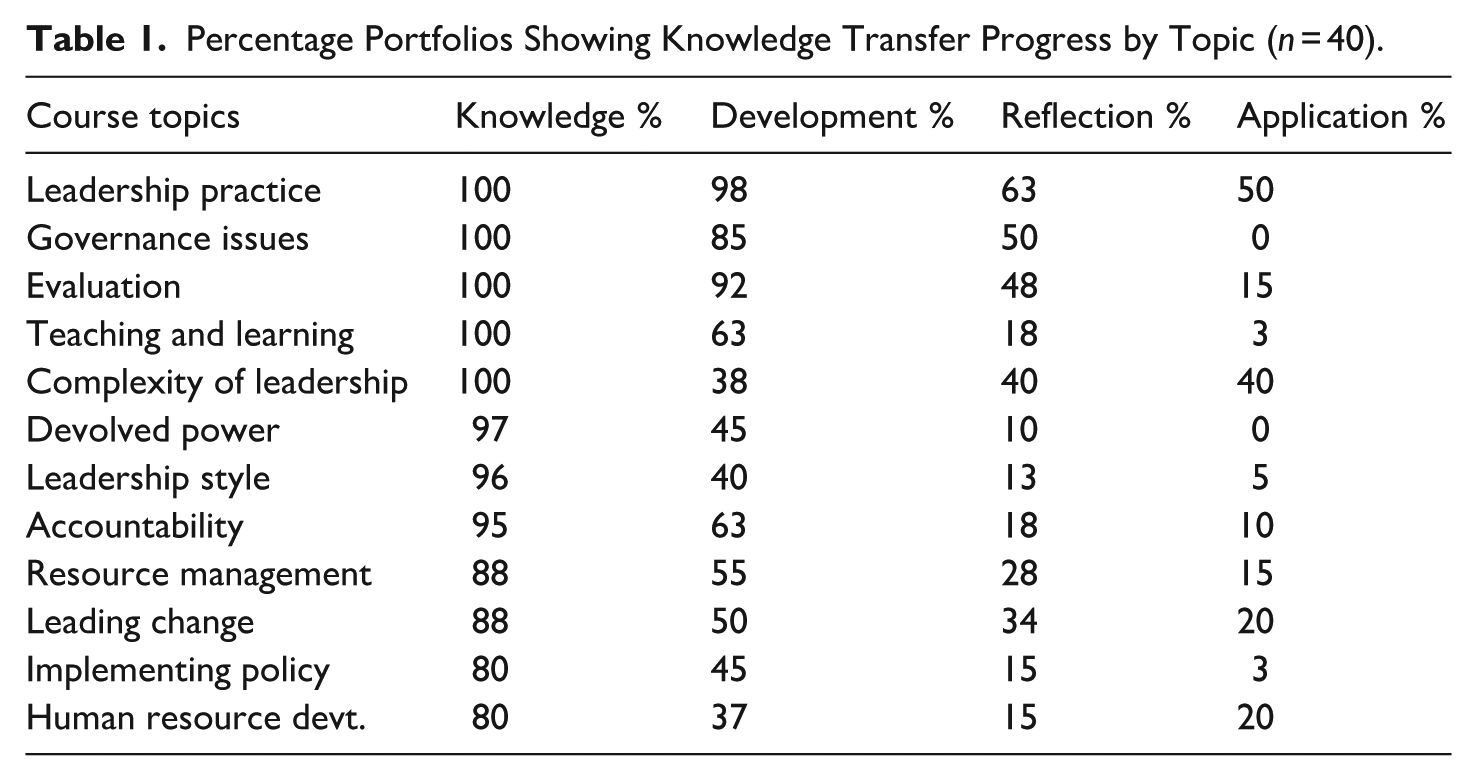
From this data participants concentrated on the conceptualisation of issues connected with leadership and governance, mirrored by teaching and learning and its evaluation, whilst there was less concern with the more practical issues of style and distribution of practice, and accountability for policy and practice. These potential leaders appeared to have fewer concerns with change and its implications for policy, resources, and human development. This might have mirrored course coverage and emphasis or, from the written evidence, suggest that these were major issues faced in the observation periods of the course when students were work shadowing.
There were other issues of leadership considered in detail by some students stimulated by events in observation periods, or extension reading. These are outlined in Table 2. Given the small numbers involved in any group, reliable comment was questionable but male leaders appear to be less concerned with shared leadership than female colleagues, female respondents were markedly more concerned with outlining absence/violation issues and noticing knowledge transfer issues. Role-related responses indicated that middle leaders were more aware of absence/violation issues than senior leaders who were more ready to discuss transformational leadership and knowledge transfer theory. Pre-school responses showed concerns with violations issues, and cultural and instructional leadership all reflecting local issues. Secondary school respondents showed greater concern with instructional leadership and associated knowledge transfer, but they were less aware of issues connected with pressures arising from absence and cross-pressures—this might have reflected higher levels of shared leadership or suggested less role concern with administrative matters.
Percentage Portfolios With Further Consideration of Specific Issues Arising From Observation or Extension Reading (n = 40).
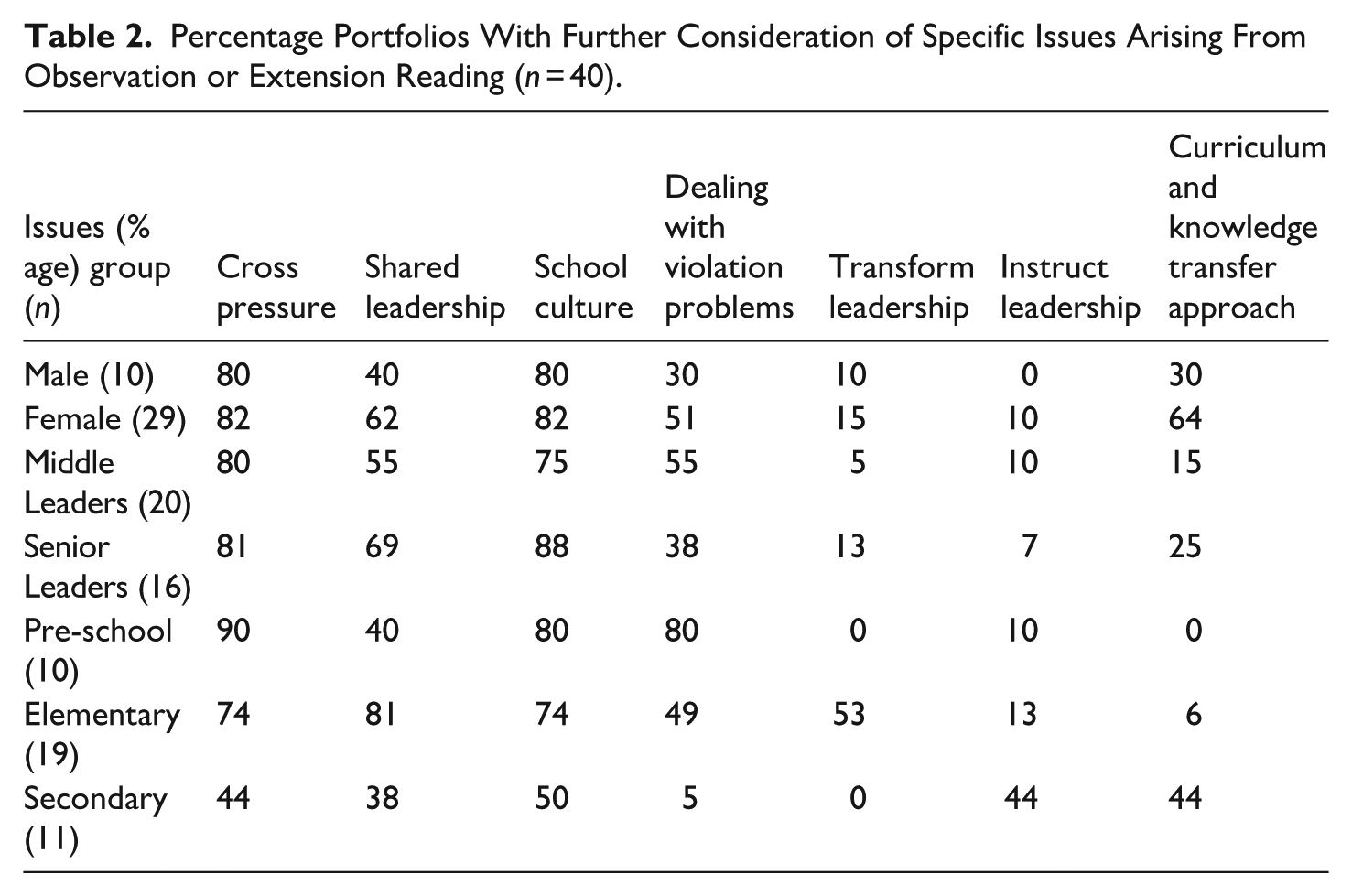
About three-quarters of the portfolios relate the discussion of pressures, culture, and shared leadership to the major topic of leadership practice and complexity, with supporting quotations from course, and occasionally, other reading. The consideration of absence and rule violations arose in every case from in-school observations; knowledge transfer comment was in every case, linked to group and individual professional development, whilst transformational and instructional leadership were generally development phase concerns with course content work on leadership style.
Given the overall small sample size, and the disparity of gender group size (29 female and ten male), and with double the participants from the elementary sector (22 compared with 10 pre-school and 11 from secondary groups), there is limited value in overall comparative comment. However, few (3 of 29) females compared with (8 of 10) males followed through consideration of the application of leadership ideas, for example, One example of a male response:
In order to succeed in engaging everyone in improvement work, principals had to work to create a culture that facilitated work with continuous improvement. It was also important to map out what “wisdom” the team lacks to make sure to find this competence in some way, for example through education or employment (Secondary, Senior Leader).
A female responded on the same question, “A principal who takes into account both transformative versus transactive can succeed better in achieving the goals of the business and developing the school” (Elementary, Team Leader).
Past and current experience might have influenced the responses from differing sectors. Senior leaders were more likely to have extended development of leadership ideas (13 of 16) compared with their middle leadership colleagues (11 of 20), and pre-school colleagues (4 of 10) appeared less likely to have developed ideas than their other colleagues (secondary 8 of 11, and elementary 16 of 19). A Pre-school team leaders expressed her accordingly, “Limit the number of goals, rules and requirements for feedback and ensure that those that exist are appropriate and, if possible, designed in dialogue with the employees concerned” (Female, Team Leader).
An Elementary principal concluded here responsibility:
I am responsible for the school’s finances, that the budget is kept, while I am also ultimately responsible for the students’ goal fulfilment. In order for some students to achieve the goals, I can believe that more staff are needed, but then the budget is exceeded (Female, Principal).
A Secondary team-leader cites a researcher in the field for an example of cross-pressure:
The cross-pressure that Gunnar Berg defines (Blossing, 2020) is not unique to the principalship, it is found in several areas in schools and in our society, but what is remarkable, is the often-conflicting parameters of the profession. Berg describes the principals cross-pressure as the combined pressure of demands and expectations from both the surrounding society and the internal organisation (Male, Team-leader).
For our purposes of evaluating the effectiveness of only 40 portfolios as both a record and an opportunity for development and reflection, indicative trends reflected the impact of context and experience of the participants. There was little difference between the portfolio content, or transfer progression, of gender groups, in the knowledge and development stages of transfer. Males were more likely to have reflected and considered the application of their knowledge especially in leadership and contextual matters, and tended to have dealt more fully with especially in change management. Female respondents showed a greater level of reflection and application for all aspects of material and human resource use. Affective factors were possibly role or sector related.
Although both role groups showed a similar high knowledge level for leadership issues, possibly course lecture and text-related, the senior leaders showed a greater level of concern with reflection and application in all matters except in the application of resource use. Experience was a possible explanation for this difference—policy matters predominate for senior leaders, whilst the practicality of obtaining and using resources impacted more highly on middle leader concerns.
The portfolios also showed differences according to the education sector from which experience and observation had been drawn. Pre-school and elementary respondents were less concerned with aspects of leadership style than their secondary colleagues, and these groups offered a more limited development of all topics.
The Reflection and Perception of the Leadership Role
To ascertain the way in which participants had perceived their potential role change, the content of all portfolios was analysed to see how the course programme had influenced the perceptions of leadership or whether the emphasis was on aspects of management or administration. The results are shown in Figure 1.
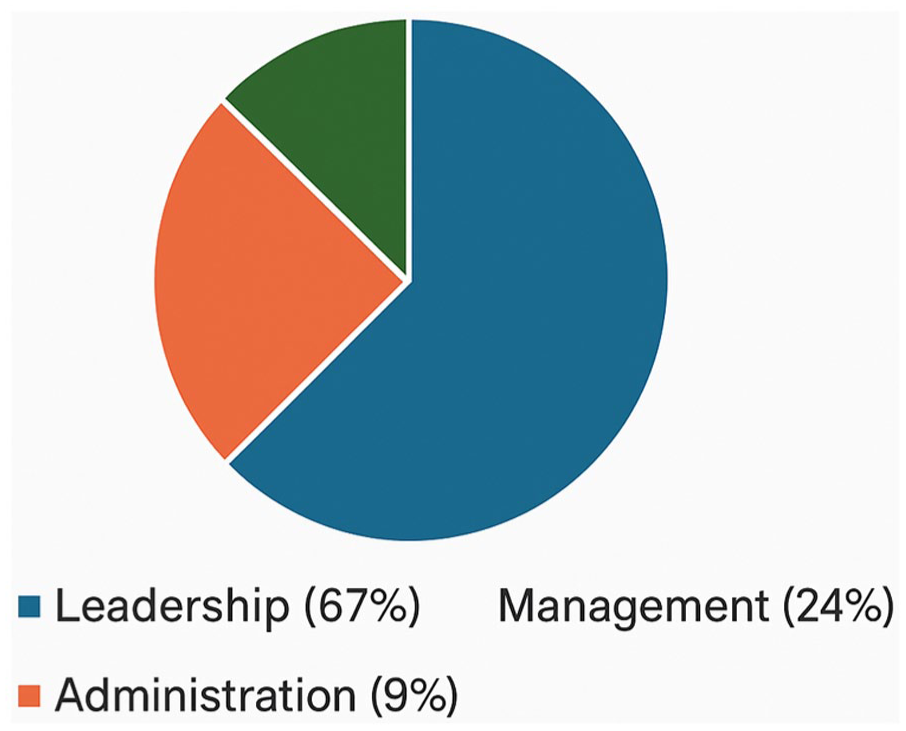
Percentage focus of comments.
Unsurprisingly for a leadership course, most comments (67%) were related to theoretical consideration of leadership issues. For example, one participant noted, “The role of the after-school centre as a social glue and the mission it has according to the curriculum are all too often overshadowed by the stronger institution of the school” (Female, Elementary, Senior Leader).
Almost a quarter (24%) considered the management of such issues, for example, “You are expected to manage the budget and staff salaries but also the purchase of materials and here it is important to have knowledge and insight into the municipality’s procurement agreements, which can further complicate the role of economist” (Male, Secondary, Senior Leader).
A smaller group (9%) dealt with the administration of the issues that had been identified. One participant explained:
Are the words difficult? How do you explain “safe” to a 6-year-old who does not have Swedish as a first language and who did not feel safe while growing up? Once we have collected the data—how do we do the analysis (Female, Pre- School, Senior Leader).
This ratio of focus (6 leadership:2 management:1 administration) showed little variation according to gender, sector, or role. This might have reflected participant expectations, or it might have been be a “natural” ratio given the nature of student background. Deviations from the norm were recognised in ten portfolios with leadership comments being strongest for one of the secondary female school leaders (93% of comments) and the strongest level of comment on administration by a secondary male subject leader (43%), possibly reflecting their current professional involvement.
Discussion
This discussion interprets the findings in relation to the study’s aim of understanding and assessing the use of portfolios for leadership preparation, assessment, and knowledge transfer in a pre-service programme for aspiring school leaders. The discussion is guided by three central questions: how portfolios capture and document the learning experiences of participants; how they reflect the development of key competencies in school leadership, including management, administration, and instructional leadership; and to what extent portfolios support the transfer of leadership knowledge and skills from the preparation programme to practical application in professional practice. By addressing these questions, the discussion highlights the implications of portfolio use for both individual learning and the broader development of leadership capacity within educational settings. Drawing on the analysis of 40 portfolios, the discussion explores how these documents serve as both a record and an assessment of participants’ learning, highlighting strengths in foundational knowledge and areas for further development, such as reflective practice and practical application. The findings are considered in relation to existing research and theoretical perspectives on portfolio use in leadership education, with particular attention to the challenges and opportunities portfolios present for bridging theory and practice. In doing so, the discussion aims to clarify the value and limitations of portfolios as instruments for leadership development and to suggest directions for enhancing their effectiveness in future programmes.
Portfolios as a Tool for Leadership Preparation and Assessment
This study focused on the use of portfolios for leadership preparation and assessment in a pre-service course for aspiring principals and on their value as a record of learning. Although this analysis has been built on submissions by a small group of 40, the inspection of these documents offers evidence of course content and effectiveness such that grading is possible. This was undertaken by course leaders and based on elements of responses to a concluding section in each leadership development portfolio based on professional identity, leadership, governance, and evaluation. Judgement was based on evidence for the progression of knowledge, development, reflection, and application shown in each section according to the course framework, lectures, texts, and extension reading. In short, the portfolios provide evidence of the level of leadership development because of taught course content, experiential reflection and extension activities undertaken by each individual. This suggests that the portfolios reflect their prior experience as found by Landry et al. (2010), considering knowledge transfer, and Liebowitz and Porter (2022), in a study of leadership and school outcomes in Oregon, U.S.A.
This intensive consideration of a limited number of portfolios shows that the portfolios record students’ learning across various dimensions of their coursework. They were prepared for portfolio use in taught sessions and had discussed the potential content, presentation, and reflective elements of portfolio construction. The analysis indicates that students have a solid foundational knowledge across all course topics and have used this to a varying extent to record and reflect on their learning.
There is a notable drop when evidence is sought for the development of ideas and even more so when considering aspects of reflection and application (Zubizarreta, 2004). This disparity in the examined portfolios highlights areas for potential improvement in the curriculum of the course, such as enhancing reflective practices and providing more opportunities for collective practical application to ensure a more comprehensive learning experience that bridges theory and practice effectively. In line with Ayers et al. (2020) the analysis of these portfolios shows a lack of practical applications, and fuller and firmer guidance may assist students to move more readily from recording to reflecting and assessment methods could look for such evidence.
Much recent research into portfolio use, variously as an instrument and a record for learning, a means of personal and professional development through peer or staff reviews procedures, and a means of assessment, are linked with the use of e-portfolios. The 40 documents examined for this leadership development course have been used in this way, but the evidence suggests that however recorded, increasing university portfolio use requires (López-Crespo, 2021; Rowley & Bennett, 2016):
A. Clearly outlined and understood objectives.
B. Initial and continuing guidance with mentoring, peer review, and open discussion of arising issues.
C. Clearly outlined and applied assessment processes and criteria.
We wished to see how far portfolios offer a method to support assessment of progress. The results show that these are met through the students’ documentation of their learning experiences in their portfolios and how given analysis aligns with each course objective. The portfolios reveal the complexity of the principal’s profession by highlighting the significant focus on leadership issues, which accounted for 67% of the comments. Observation and comments reflect the students’ awareness of the multifaceted nature of leadership and the practical challenges involved. Detailed discussions on resource management, accountability, and governance issues further underscore the diverse responsibilities that principals navigate daily, illustrating understanding of the complexities inherent in the principal’s role. The results of this study are in line with Tochel et al. (2009), and Gurr (2015), and the current cohort show that the portfolio can be an effective tool in leadership preparation when it comes to reflection on the complex role of school leader and leadership development.
Additionally, the portfolios emphasise the principal’s role as an instructional leader, particularly through secondary respondents’ comments on teaching and learning. This indicates that students recognise the importance of guiding educational practices and managing instructional quality. Despite a lower emphasis on teaching and learning, the reflections show an engagement with pedagogical leadership. Moreover, the analysis shows students’ strong theoretical grasp of governance principles, reflected in high knowledge scores on policy implementation and accountability, and their understanding of quality assurance through evaluations. These insights highlight their awareness of continuous improvement and the importance of quality assurance in school development. Portfolio in leadership development should align with institutional needs by balancing autonomy and accountability, understanding local and national needs, and achieving democratic freedoms in a competitive environment (Storgaard & Frederiksen, 2023). As Storgaard and Frederiksen (2023) emphasise that portfolios serve as a reflective tool that provides evidence of potential leaders’ ability to achieve this balance in the Danish context but could also be applied in the Swedish context of leadership preparation for aspiring principals.
The process of knowledge transfer may be enhanced by portfolio use. In this analysis topics which have been the focus of taught sessions (e.g., cross-pressure and school culture in Table 2) and subsequent reinforcement activity, offer effective knowledge transfer for new situations. Liljenberg and Wrethander (2023), show how reinforcement comes through “a systematic approach, supportive tools and forcing moments” (p. 30).
Conclusion
In the introduction of this paper with references to Gurr (2015), we emphasise that effective leadership development required a deep understanding of the multifaceted nature of the school leader’s role. Within this context, portfolios have emerged as valuable tools for both recording and reflecting on leadership development. Thys complexity is reflected in the varied terminology used internationally—ranging from administration and management to leadership itself—highlighting the evolving expectations placed on school leaders. As Slepcevic-Zach and Stock (2018) discuss, particularly in relation to e-portfolios, these tools enable aspiring leaders to document their learning, engage in critical self-reflection, and demonstrate growth across multiple dimensions of their professional practice. The findings of this study support these perspectives, showing that portfolios not only provide evidence of knowledge acquisition and skill development but also encouraged deeper reflection on the complex and context-dependent nature of school leadership. This dual function of portfolios—as both a record and a reflective instrument—aligned with current trends in leadership preparation, where the emphasis was increasingly placed on holistic, practice-oriented, and evidence-based approaches to developing effective educational leaders. Looking at the broader implications of this portfolio analysis, it indicated a strong theoretical understanding of leadership issues among students, with varied emphasis on practical application and reflection based on their roles and experiences. The knowledge transfer process, while robust in the initial stages, showed limited practical application, highlighting potential areas for curriculum enhancement to better integrate theoretical knowledge with practical skills and to incorporate more refinement of leadership observation. The portfolio analysis suggested that outcomes aligned well with the course objectives, demonstrating that students had developed a comprehensive understanding of the principal’s complex role, instructional leadership, governing principles, and quality assurance mechanisms. Although the data suggested that students had strong theoretical knowledge, there is room for enhancing practical application and reflective practices to meet the course objectives more robustly. The portfolio as an instrument for reflection in leadership preparation needs to be recognised (cf. Wildy & Wallace, 1998) and further investigated as a valuable tool for assessment (cf. Vyortkina, 2023).
Footnotes
Acknowledgements
The authors have no acknowledgements to declare.

Ethical considerations
The research was conducted in accordance with established ethical guidelines for educational research, including principles of voluntary participation, confidentiality, and the right to withdraw at any time. Ethical approval was obtained through institutional procedures in line with national research ethics standards.
Consent to participate
All participants provided written informed consent prior to their involvement in the study.
Funding
The authors received no financial support for the research, authorship, and/or publication of this article.
Declaration of Conflicting Interests
The authors declared no potential conflicts of interest with respect to the research, authorship, and/or publication of this article.
Data Availability Statement
The data that support the findings of this study are not publicly available due to confidentiality agreements and ethical considerations related to participant privacy.