




Abstract
I examined the effect of school leaders’ charisma on a teacher’s readiness for change mediated through the teacher’s perspective-taking—a social cognitive trait of seeing another’s viewpoint. Study participants were 1,195 teachers working in 95 state elementary schools in the Israeli public-school system at the outset of a large-scale organizational change termed “New Horizon”—a top-down reform that includes changes in teachers’ work and professional development, and in principals’ discretion and autonomy. Using multilevel structural equation modeling, results indicated significant positive relationships between charismatic school leaders and a teacher’s readiness for change through the effects of his/her perspective-taking.
Introduction
Teachers are considered central agents of school reforms. Their attitudes, concerns, reactions and beliefs toward change are deemed critical to implementing reforms and to their success (e.g., Byrne & Prendergast, 2020; Wang et al., 2020). Specifically, their readiness for change is an internal factor that must be considered when implementing an externally or internally initiated reform, particularly during the first stages of implementation or during the planning of its implementation (Byrne & Prendergast, 2020). If these attitudes of readiness are ignored, implementation of the plan for change may be delayed or interrupted (Roos & Nilsson, 2020; Weiner, 2020). Therefore, there is a need to create a readiness for change prior to resistance and the enactment of negative behaviors (Armenakis & Harris, 2002; Weiner, 2020). Understanding the conditions that are conducive to individual readiness for organizational change can be useful for designing a more successful change implementation (Beasley et al., 2021; Weiner, 2020), and to support the change initiative in its postimplementation stage (Byrne & Prendergast, 2020; Haqq et al., 2021; Oreg & Berson, 2011).
Although many studies have been conducted with the aim of predicting attitudes toward change (e.g., Asbari et al., 2021; Byrne & Prendergast, 2020; Fugate, 2012; Oreg & Berson, 2011; Rafferty & Minbashian, 2019), little is known about the predictors affecting a teacher’s positive attitudes toward, or their readiness for change (e.g., Kirrane et al., 2017; Rafferty & Minbashian, 2019; Weiner, 2020), specifically in the educational system (e.g., Ittner et al., 2019; Wang et al., 2020). Here, I examine the effect of principals’ charismatic leadership style on a teacher’s readiness for change through his/her cognitive process of perspective-taking.
Previous research has emphasized links between leaders’ characteristics and readiness for change (Asbari et al., 2021; Ittner et al., 2019), such as leadership style (von Treuer et al., 2018) or leader–member exchange (Banguntopo, 2018), and relationships between principals’ emotional experience and readiness for change during curriculum reform (Ittner et al., 2019). Despite the rationale associating leadership and readiness for change, there have been only a few empirical studies linking these topics in the educational system (Da’as, 2021; Ittner et al., 2019), and there is still a gap in the literature examining the effect of leaders on positive attitudes toward change at the individual level (Da’as, 2021; Ittner et al., 2019; Khyzhniak & Viktorenko, 2021). In the present study, the role of leadership in predicting a readiness for change at the individual teacher level as mediated by that teacher’s perspective-taking was examined. Perspective-taking refers to the “active cognitive process of imagining the world from another’s vantage point or imagining oneself in another’s shoes to understand their visual viewpoint, thoughts, motivations, intentions, and/or emotions” (Ku et al., 2015, p. 79). Herein, I propose that formal leaders’ charismatic leadership will be especially relevant in affecting a teacher’s perspective-taking as it applies to the main stakeholders in his or her environment (e.g., principal, teacher, supervisor, parent), which in turn will positively affect his/her readiness for change (Figure 1).

The research model.
Charismatic leaders motivate and inspire followers by providing a vision, displaying confidence and positive emotions, and having strong convictions in their beliefs and ideals (e.g., Conger & Kanungo, 1998). Although researchers have conducted a wide range of studies on charismatic leadership during change (e.g., Nohe et al., 2013), the current research expands upon our understanding of how perceived charisma affects individual teachers’ positive attitudes toward change. The main focus in the current study is on how school leaders’ charisma affects an individual teacher’s readiness for change through its effect on that teacher’s personal cognitive attributes, that is, perspective-taking (Figure 1). Previous research has emphasized that charismatic leaders increase accessibility of their followers’ private self-concepts (Paul et al., 2011), that is, their knowledge about themselves (van Knippenberg et al., 2004), and their moral emotions (Sy et al., 2018).
Perspective-taking has gained momentum as a research topic in recent years (e.g., Parker et al., 2008), but little attention has been paid to it in research focusing on cognitive processes constituting positive attitudes and behaviors (e.g., Da’as, 2020; Gärtner, 2013), specifically in the context of educational change. Perspective-taking is important in enhancing the quality of relationships and connections among individuals (Williams, 2012), and in facilitating knowledge integration in an organization (Litchfield & Gentry, 2010). In this regard, perspective-taking may also be relevant in times of change, when understanding the other side’s perspectives and opinions is important (Da’as, 2020); in particular, understanding the motives behind others’ behaviors and attitudes is essential during change (Oreg & Berson, 2011).
Thus, within the fields of educational change research, the proposed theoretical model might identify potentially powerful teacher- and leader-related variables that contribute to explaining a teacher’s readiness for change, enabling successful change implementation and leadership intervention. Furthermore, examining factors affecting a teacher’s readiness for change answers calls to extend research into the antecedents of readiness for change (Rafferty & Minbashian, 2019), and in particular, personal attributes (cognitive and emotional) (Oreg & Berson, 2019).
Charismatic Leadership
Charismatic leaders are characterized by “their ability to formulate and articulate an inspirational vision” and “their behaviors and actions that foster an impression that they and their mission are extraordinary” (Conger et al., 2000, p. 748). They affect their followers’ motivation by creating and designing an inspiring vision of the future (Bass, 1997), and by communicating strategic goals, statements of purpose, idealistic values and beliefs (Berson & Avolio, 2004). They affect their followers’ confidence in achieving missions, as well as their needs, and motivate them to accomplish tasks (Berson & Avolio, 2004; Conger & Kanungo, 1998). They link their followers’ self-concepts to organizational goals, they alter how their followers perceive the nature of work, and they guide them to form a collective identity (Shamir et al., 1993).
Antonakis et al. (2011), Keyes (2002), and Conger (1999) found that followers’ perceptions of their leader’s charisma through their leader’s actions serve to validate that leader’s charisma. This means that the outcomes of charismatic leadership depend on how much charisma the followers attribute to their leader (Antonakis, 2012; Conger & Kanungo, 1998). Thus, perceived charisma relates to desirable outcomes, such as cooperation among followers (De Cremer & van Knippenberg, 2002), followers’ commitment to change (Nohe et al., 2013) and in the case of principals, school outcomes of organizational learning (Berson et al., 2015).
A leader’s charisma is related to a trusting relationship among team members (Dirks & Ferrin, 2002) and a shared school vision (Berson et al., 2015); it produces a school culture characterized by support and success (Ozgenel, 2020), affects a teacher’s cognitive attributes (Da’as, 2020), positively influences openness to change and provides behavioral support for change (Men et al., 2020), and can foster a high level of individual and team performance (Berson et al., 2015; Nohe et al., 2013).
Perspective-Taking
Perspective-taking is defined as “the process of imagining the world from another’s vantage point” (Galinsky et al., 2005, p. 110). In particular, it is the ability to deduce someone else’s abilities, expectations, viewpoints, feelings, and possible reactions (Yip & Schweitzer, 2019). In the current research, I use Parker and Axtell’s (2001) definition of perspective-taking, which emphasizes the relationship between the perspective-taker and others and considers empathy and positive attribution as two dimensions of this process. Empathy means identifying with the emotions of a target or understanding her or his experiences. Positive attribution relates to behaviors and outcomes; it is the recognition of the role of external circumstances when things go wrong for the target, and of the role of the target’s own characteristics (e.g., hard work, ability) when things go right (Parker & Axtell, 2001).
Perspective-taking affects evaluations of others (Suedfeld, 2010). It has been shown to improve negotiation skills (Galinsky & Mussweiler, 2001), moral development and reasoning (Parker & Axtell, 2001). Moreover, it can reduce attribution error (i.e., a predisposition to attribute others’ behavior to dispositional characteristics, rather than situational causes that are external to the individual; Hooper et al., 2015) and stereotyping (Galinsky & Moskowitz, 2000); it is related to citizenship behaviors (e.g., Facteau et al., 2000), and is considered an important mechanism for diversity in group creativity (Hoever et al., 2012).
Perspective-taking has also been found to be related to cognitive complexity (Suedfeld, 2010), that is, the ability to think in a multidimensional way (Da’as et al., 2022), and the quality of social interactions between supervisor and subordinate (Moates et al., 2007). It can overcome egocentrism and enable building satisfying relationships with others (Davis et al., 1996). Moreover, perspective-taking skills might prevent angry responses to provocation (Mohr et al., 2007).
In the context of diverse schools, perspective-taking was found to predict aspects of culturally responsive teaching (Abacioglu et al., 2020). When teachers considered students’ perspectives, they better understood the students’ needs and adjusted their instruction and curricula to suit those needs (McAllister & Irvine, 2002). Research has argued that positive relationships and perspective-taking decrease the number of conflicts arising from misunderstandings, and enable schools to cope with uncertain situations, environmental changes, and reforms (Arar, 2019). Lack of perspective-taking has implications for school processes as well, such as negative effects on team integration and teamwork tasks (Levi & Askay, 2020), and increasing prejudice toward others (Todd & Burgmer, 2013). Furthermore, empathy among staff members, feelings of optimism and hope, and positive perspectives are of primary importance in promoting reliance on the school in times of crisis (Shani & Somech, 2019). Van Bodegraven (2015) examined veteran teachers’ experiences with school reform and changes in classroom practices; she found that empathy with students, among other factors (e.g., self-assessment, self-confidence, initiative, adaptability), was essential to the successful implementation of school reforms.
The Context of the Study
This research was conducted in the Israeli public-school system at the outset of a large-scale organizational change termed “New Horizon”; this is a top-down reform to be implemented in all elementary and secondary schools in Israel, following an agreement signed by the Ministry of Education, the Ministry of Finance and the Teachers’ Union. Implementation of this reform is obligatory, but the schools and their principals have some freedom in terms of how it will be done, based on their idiosyncratic perspectives.
The aims of this reform are to (1) promote individual teaching–learning processes, increase student achievements and narrow educational gaps, especially in view of the fact that Israeli students’ academic achievements remain among the lowest for industrialized countries, and students’ educational gaps are among the widest (BenDavid-Hadar, 2016); (2) effect changes in principals’ discretion, autonomy and accountability, and provide opportunities for teacher promotion at the higher levels of professional development; (3) effect changes in teachers’ roles—work hours, salaries and teaching, that is, restructure the teachers’ workload to include whole-class frontal teaching, teaching small groups of students, and non-teaching hours for teachers’ other job responsibilities, such as carrying out various school-related activities (preparation and marking of papers, meetings with parents or experts); (4) reinforce the teaching staff’s development, including a new salary ladder that raises salaries for teachers and new teachers, and raise their status through a modified promotion ladder that includes higher ranks for professional development (Da’as, 2021, 2020; Israeli Ministry of Education, 2012; Shaked & Schechter, 2017).
Researchers have argued that organizational change is a source of pressure for workers, related to reactions such as denial, stress, resistance to change, low commitment, and cynicism (Oreg & Berson, 2011). In general, policymakers assume that teachers will accept reform and adjust their practices to its guidelines, but this is not the case (Shaked & Schechter, 2017). Reaction to change is one of the internal factors that needs to be considered by school principals when implementing an externally initiated reform (Oreg & Berson, 2011), because it may delay or disrupt the reform’s implementation (Kotter, 1995).
When the New Horizon reform was initiated, teachers’ responses varied from strong support (i.e., acceptance) to fierce resistance (Da’as, 2021). How school leaders can affect teachers’ perspective-taking in this context is therefore important, because school principals are considered a central agent during change. In the initial stages of the New Horizon reform, school principals had to deal with many teachers’ fierce opposition (Shaked & Schechter, 2017).
Furthermore, in the Israeli context, before the reform was enacted, Ministry of Education stakeholders, school supervisors and representatives of the Teachers’ Union visited the schools and discussed the reform with the teachers; principals also discussed the reform with the teachers. Thus, in this context, it is relevant to examine a teacher’s perspective-taking vis-á-vis relevant stakeholders, and his/her ability to see the other’s viewpoint, as an antecedent of readiness for change.
Research in the context of this reform found that principals’ cognitive skills promoted affective trust among the teaching staff, which positively related to teachers’ job satisfaction during the first year of implementing the reform. In addition, the teachers’ satisfaction was negatively related to absenteeism (Da’as, 2021). Such cognitive skills included communication, learning skills and critical thinking, and affective trust related to a “feeling of emotional security, relying on faith in the interaction” (Lu, 2014, p. 382). In a qualitative study, 59 Israeli school principals were surveyed to determine how they mediate between the demands of a national reform policy and teachers’ attitudes and needs. It was found that school principals mobilize the teachers toward the reform, and mobilize the reform toward the teachers (Shaked & Schechter, 2017).
Readiness for Change
Lewin (1951) proposed a three-stage model of organizational change: unfreezing, moving, and refreezing. Based on this model, researchers have described a set of actions to be taken by change agents to reduce resistance and move organizations and individuals through these three stages (e.g., Moates et al., 2007). The current study will concentrate only on the unfreezing stage and on antecedent processes that may promote a teacher’s readiness for change. Unfreezing occurs where something is already “frozen,” and may be achieved by creating a readiness for change (Armenakis & Bedeian, 1999). In the unfreezing stage, leaders should evaluate the change and make plans; this involves recognizing a problem, identifying the need for change, and mobilizing others to see the need for change while creating a sense of urgency (Armenakis, & Bedeian, 1999; Kotter, 1995). In this regard, I argue that charismatic leaders can lead teacher readiness and affect teachers’ cognition and emotions, that is, perspective-taking. Charismatic leaders make events meaningful for followers by motivating and inspiring them “to perform above and beyond the call of duty” (House et al., 1991, p. 364).
The current research adopts Holt et al.’s (2007) conceptualization of an individual’s readiness for change. Whereas change activities are initiated and carried out by individuals within organizations, Holt et al. (2007) define readiness for change as a multidimensional construct consisting of four dimensions of employees’ beliefs: (a) change self-efficacy—employees are capable of implementing the proposed change, (b) appropriateness—the proposed change is appropriate for the organization, (c) management support—the leaders are committed to the proposed change, and (d) personal valence—the proposed change is beneficial to the organization’s members (Holt et al., 2007, p. 232).
Armenakis and Harris (2002) argued that individuals must believe that something needs to change in order to be motivated to change, and have confidence in their ability to succeed (Bandura, 1986). Mei Kin et al. (2018) concluded that in the beginning stage of a change, teachers who believe in the need for change and in their skills and abilities to effect the change develop positive feelings about the change. Teachers’ positivity then enables them to take the initiative to perform the new task with confidence.
Regarding the suitability of the change, individuals may disagree with it, find it unsuitable for the school and resist it. The perception of a change being appropriate for the organization was found to mediate the relationship between communication (perceived adequacy of the communication received about the change) and intent to resist change (McKay et al., 2013). Further, individuals who perceive their leader as trustworthy and supportive are more willing to support and accept a change (Coyle-Shapiro & Morrow, 2003; Eby et al., 2000; Vakola, 2014).
Readiness is considered to be one of the most important factors in employees’ initial support for change initiatives (Holt et al., 2007; Vakola, 2014; Weiner, 2020). When an organization exhibits a high readiness for change, its members are more invested in the change effort (Kirrane et al., 2017) and are more persistent when encountering obstacles or setbacks, all of which contribute to more successful change implementation (Armenakis & Harris, 2002). Readiness for change has a strong impact on the many decisions involved in a change process, such as planning, implementation, and communication (Vakola, 2013), and can facilitate an organization’s effort by reducing resistance to change (Vakola, 2014).
Research on the predictors of readiness for change found, for example, that perceived management support for change and employees’ psychological capital (hope, efficacy, resilience and optimism) affect readiness for change (Kirrane et al., 2017). Bouckenooghe et al. (2009) identified factors related to the process (how the change is managed, communication, participation) and factors related to climate (e.g., organizational levels of trust in leadership) as two categories of antecedents of readiness for change. Another study suggested psychological factors, including openness to change, which may be a condition for readiness for that change (M. Choi, 2011). Rafferty and Minbashian (2019) found that cognitive beliefs about change (e.g., the perception that the change will be personally advantageous for an individual) and positive emotions concerning that change were significantly associated with change readiness.
In contrast, Kelchtermans (1993) found that alterations in the teaching environment due to school reform will damage teachers’ perceptions of self and their subjective viewpoints, thereby affecting their professional development. The teachers will therefore act to defend themselves, through micropolitics (Kelchtermans, 2007). Micropolitics is “the complex power relations in schools: the way people influence others to defend themselves against others or to proactively influence them” (Kelchtermans, 1993, p. 454).
Bui (2013) examined teachers’ micropolitics during school change—how teachers make sense of the way in which the change is led—and determined whether this influences the change process. He argued that teachers felt that their professional development was being affected by the change in tasks, and the way in which they made sense of this could determine the change process; teachers’ micropolitics always played out as an inseparable interaction with leadership. Oplatka (2010) argued that one of the reasons for teachers to resist change is inconsistency of the change with their professional values and expertise, a situation that may lead to negative reactions to the proposed changes in the school.
Charisma is an enigmatic ability which enables the leader not only to garner subordinates’ attention but also to effectively, clearly and intensively communicate desired values and assumptions (e.g., Schein, 2010). Charismatic leaders can affect and increase accessibility of their followers’ private self-concepts (Paul et al., 2001), thus I argue that charismatic leaders may affect teachers’ reactions and beliefs toward the change.
The Relationship Between Charismatic Leadership and a Teacher’s Perspective-Taking
Charismatic leaders present strong convictions in their beliefs and ideals, exhibit confidence and positive emotions, and possess an imaginative vision; it is through these traits that they inspire followers (e.g., Conger & Kanungo, 1998; Shamir et al., 1993). Charismatic leaders make skillful use of communication and actions—including rhetoric, symbolism, and appeals to values—to elicit specific emotions in others and to direct those emotions to align with their goals (Antonakis et al., 2016; Sy et al., 2018).
Charismatic leaders also affect their followers’ personal identification with them (Conger & Kanungo, 1998) and their social identification with the work team, and they affect followers’ self-concepts (e.g., Oreg & Berson, 2015). They exude confidence in the goals of the organization and encourage their followers to form a collective identity (Shamir et al., 1993). They increase followers’ trust (Nohe & Michaelis, 2016), communicate with them, and in particular, charismatic school principals positively affect the school’s shared vision and school learning (Berson et al., 2015). Vision is considered one of the basic elements in times of change (Kotter, 2012).
Kohles et al. (2012) further stated that having a vision that is implemented by followers can enhance commitment, job satisfaction, and supervisors’ performance ratings. It has also been argued that creating a vision of a future situation will increase organizational readiness for change by increasing organizational members’ perception of that change as being needed, important, or worthwhile to the organization, i.e., their perception of the change’s valence (Weiner, 2009). J. Choi (2006) proposed that “charismatic leaders engage in empathic behavior by being sensitive to their followers’ needs and emotions, sharing their emotions, and helping them realize their objectives” (p. 28).
Based on this, I argue that a charismatic school leader will affect a teacher’s cognitive attributes such that he/she will show positive attribution and empathy toward other stakeholders in the environment; in other words, these principals’ influence on their teachers will be reflected in the way a teacher perceives the stakeholders in his/her environment. This is because leaders’ actions often give meaning to, and even transcend followers’ views of their work environment (Oreg & Berson, 2015). Thus, I argue that
Perspective-Taking and Readiness for Change
To the best of my knowledge, a teacher’s perspective-taking has never been examined in the context of attitudes toward change. The little research that has been done considered positive attitudes, feelings or emotions, focusing, for example, on employees’ ability to cope with, or their personal attitude toward the change (e.g., Baumeister et al., 2006). In a study of 132 employees from a wide cross-section of United States organizations that explored which attitudes and behaviors have implications for positive organizational change, it was found that employees’ psychological capital (a core factor consisting of hope, efficacy, optimism, and resilience) was related to their positive emotions; in turn, these positive emotions were related positively to attitudes of engagement and organizational citizenship behaviors, and negatively to cynicism and workplace-deviant behaviors (Avey et al., 2008). Such positive emotions may help employees deal with organizational change by allowing them to maintain an open-minded approach to problem solving and adjust their behaviors to the new work (Baumeister et al., 2006). Weiner (2009) argued that the more organizational members value the change, the more they will want to implement it, and to be engaged in the actions involved in its implementation. Another study, looking at Israeli educational reform, found that the cognitive abilities of communication, and affective/emotional relationships are related to the cognitive process of participation in decision making during implementation of the reform (Da’as, 2021).
I argue that a teacher’s perspective-taking will be positively related to that teacher’s readiness for change. The teacher will understand and accept these stakeholders’ experiences through positive attribution. This, in turn, will affect the teacher’s attitudes and has implications for the teacher’s belief in, and evaluation and perception of the proposed change, leading him or her to value this change from a positive viewpoint and be ready for it. Thus,
Charismatic School Leaders and a Teacher’s Readiness for Change: The Mediating Role of a Teacher’s Perspective-Taking
The indirect effects of leaders’ characteristics on readiness for change have been discussed in the literature (e.g., Metwally et al., 2019). An organizational culture of effectiveness was found to partially mediate the relationship between ethical leadership and employees’ increased readiness for change in public organizations, based on 270 direct reports from middle and lower managers (Metwally et al., 2019). The effects of vision on readiness for change were found to be mediated by empowerment and trust in the leader in four business organizations (Haque et al., 2020). Psychological capital partially mediated the relationship between management support and employees’ readiness for change in a public sector organization undergoing a change initiative (Kirrane et al., 2017), with positive psychological capital being characterized by hope, self-efficacy, resilience, and optimism (Luthans et al., 2007). A learning organizational culture was found to be a “partial mediator” in the relationship between transformational leadership and readiness for change in a study of 330 administrative staff members of three educational ministries in Yemen (Al Tahitah, 2019). In another study, organizational culture (corporate values and behavioral norms, e.g., information flow and involvement) was found to mediate the relationship between leaders’ change-promoting behavior (e.g., developing a clear vision, creating a sense of the urgency of the change) and readiness for change (Adil, 2014). However, to my knowledge, there have been no studies examining the indirect effects of leaders’ charisma on a teacher’s readiness for change, mediated by the latter’s perspective-taking. Research has found that leaders’ charisma affects stakeholders’ (parents and superintendents) satisfaction through an effect on trust among teachers and a learning climate (Berson et al., 2015). Men et al. (2020) found that employee trust partially mediates the positive impact of charismatic executive leadership communication on employee change outcomes (e.g., employee openness to change and behavioral support for change). Charismatic executive leadership communication was related to communications about vision, passion, and care and support (Men et al., 2020).
In the context of organizational change, Nohe et al. (2013) found that when individual followers perceive their leaders as charismatic, they become more committed to change, and team leaders are perceived as more charismatic when they engage in change-promoting behaviors. In other words, change-promoting behaviors facilitate team performance through individual followers’ perception of charisma and their commitment to change (Nohe et al., 2013). This explains the association between leaders’ change-promoting behaviors and team performance. Thus, I argue that
Methods
Procedure and Participants
Teachers (N = 1,195) from 95 state elementary schools from all over Israel (except the southern district, for security reasons) participated in this study; 79.5% of them were Jewish schools and 20.5% were Arab schools. Schools were randomly selected from a list compiled by the Ministry of Education. To avoid common source bias, one group of school teachers (N = 590) completed questionnaires related to their perspective-taking and readiness for change. Because the research aimed to examine the effect of perspective-taking on readiness for change at the individual level, the same group of teachers rated these variables. The other teachers (N = 605) completed a questionnaire on charismatic leadership.
Teachers were randomly selected from within these schools to reach a minimum 30% of the teaching staff at each school. School principals provided data on their seniority. The mean age of the teachers was 40.66 years (SD = 8.91). Their mean tenure at the school was 10.17 years (SD = 8.23); 73% of the teachers had B.A. degrees and 12% had M.A. degrees. The study was approved by the Chief Scientist of the Ministry of Education.
When school staff members were informed of the new reform and the new conditions of the reform, teachers throughout the country had myriad responses, ranging from strong support (e.g., acceptance) to fierce resistance (Da’as, 2021). Thus, it was at this anticipatory stage of the change process (Fugate, 2012) that the present research was conducted. The diversity of teacher responses made this the perfect time for research assistants to enter schools and begin collecting the research data.
Measures
Charismatic Leadership
Twelve items from the multifactor leadership questionnaire (MLQ; Form 5X; Bass & Avolio, 1997) were used to measure charismatic leadership (see Supplemental Appendix). These items comprised the dimensions of inspirational motivation and idealized influence. Teachers rated each item on a 5-point frequency scale ranging from 1 “not at all” to 5 “frequently, if not always.” Confirmatory factor analysis (CFA) performed to verify the structure of the measure showed that all items loaded significantly on an overall dimension; the fit index of the CFA (comparative fit index [CFI]) = .95; root mean square error of approximation (RMSEA = .06. Aggregation was examined, using the rWG statistic (James et al., 1993; Newman & Sin, 2020) and by calculating the intraclass coefficients ICC1 and ICC2 (Bliese et al., 2019). Mean rWG values was found to be .83 for charismatic leaders, ICC1 was .26 and ICC2 was .59. These results justified aggregating to the school level as recommended by Bliese et al. (2019) and James et al. (1993).
Perspective-Taking
Six items from a questionnaire developed by Parker and Axtell (2001) were used to measure teacher’s perspective-taking. This scale was validated for the educational context in previous research (Da’as, 2020). The scale was comprised of two dimensions: empathy (3 items) and positive attribution (3 items) (see Supplemental Appendix). Empathy with people who are relevant to the school setting refers to the extent to which teachers empathize with them, for example, by being concerned and understanding their problems, or experiencing pleasure in their achievements. The second dimension of perspective-taking concerned making positive attributions about behaviors and outcomes.
The question was: “Please think about one of the main stakeholders related to your school (principal, teacher, supervisor, parent, etc.) [these suggested stakeholders are considered the main stakeholders in the school setting; teachers will deal mainly with them in implementing the reform]. To what extent do you agree with each of the following [items]?” CFA showed adequate validity (CFI = .99, RMSEA = .04).
Readiness for Change
A questionnaire developed by Holt et al. (2007) was used, containing 25 items capturing 4 dimensions (see Supplemental Appendix). The questionnaire was adapted to the school setting (the main question concerned the expected change due to the New Horizon program). These dimensions were related to the influence of individuals’ beliefs in: (a) change-specific efficacy—6 items; (b) appropriateness—10 items; (c) management support—6 items; (d) personal valence—3 items; Teachers rated the items on a 5-point Likert scale, from 1 “agree to a small degree” to 5 “agree to a large degree.” A CFA was conducted and showed adequate validity (CFI = .91, RMSEA = .08).
Control Variables
The effects of principals’ seniority and teachers’ years in school were considered controls in the current research. These variables have been shown to be potentially relevant to school processes and teachers’ perceptions (e.g., Da’as et al., 2022; Schechter & Ganon-Shilon, 2015).
Analytical Procedure
The proposed multilevel model was tested using multilevel structural equation modeling (ML-SEM) in the Mplus program (Muthén & Muthén, 1998). Data collection followed a hierarchical structure in which individual responses were nested within schools. This analysis sought to determine whether process at the school level affect teacher-level outcomes. This kind of model (Figure 1) is described as a 2–1–1 multilevel mediation model (Preacher et al., 2010), with the perspective-taking data (Level 1) mediating the linkage between principals’ charismatic leadership (Level 2) and readiness for change (Level 1).
Mediation was examined by the bootstrap resampling procedure recommended by Igartua and Hayes (2021) and Preacher et al. (2010), with a non-zero confidence interval indicating that mediation exists.
Results
Cronbach’s alpha values, means, standard deviations, and correlations for the study variables are reported in Table 1.
Cronbach’s Alpha, Means, Standard Deviations (SD), and Correlations for the Study Variables.
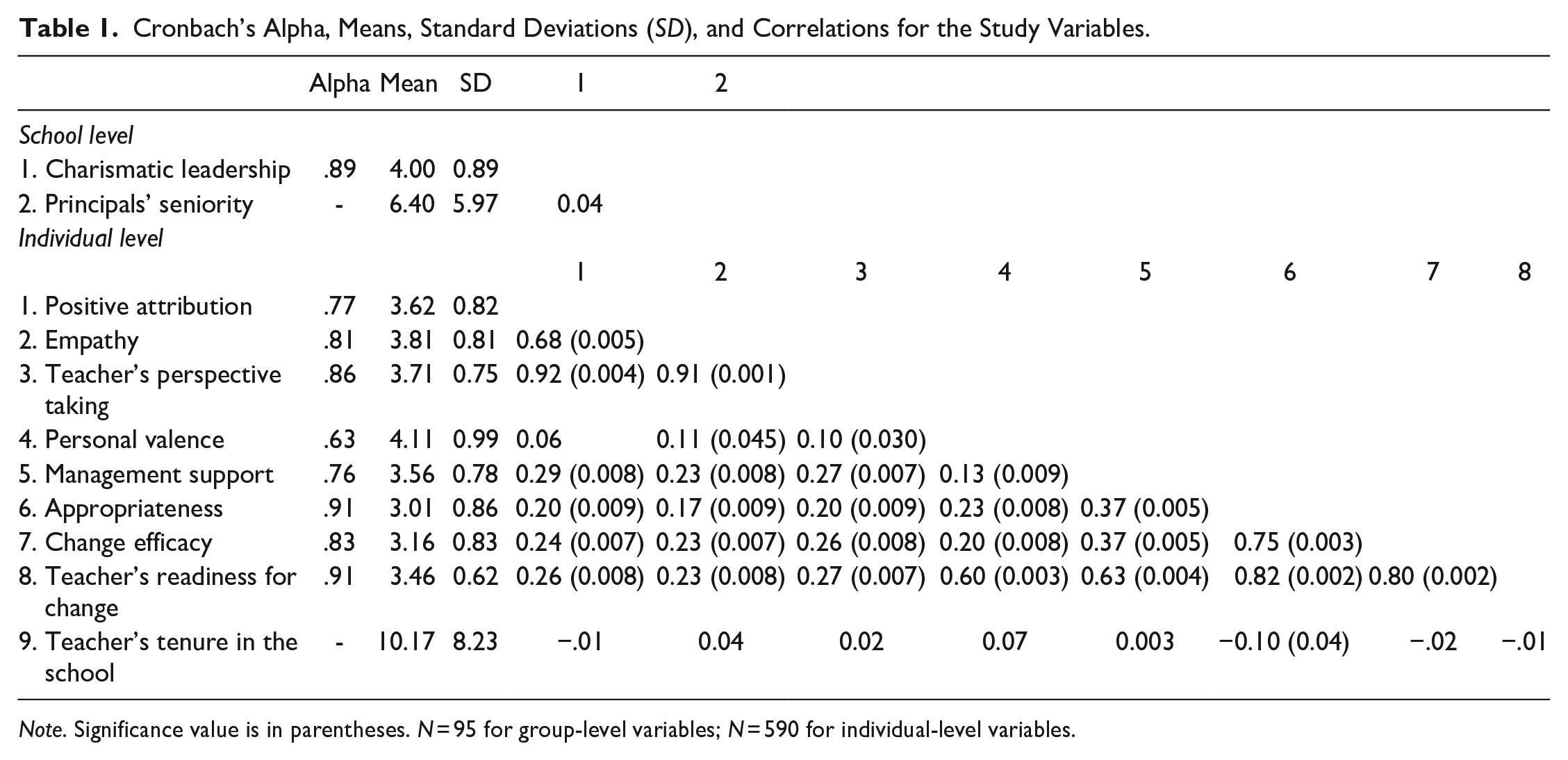
Note. Significance value is in parentheses. N = 95 for group-level variables; N = 590 for individual-level variables.
At the individual level, there was a positive relationship between a teacher’s readiness for change and that teacher’s perspective-taking.
Hypothesis Tests
The results indicated a good fit between the model (Figure 2) and the data, with all fit indices >.90 (CFI = .948, RMSEA = .05; Tucker–Lewis Index = .92). The relationship between charismatic leadership and a teacher’s perspective-taking was significantly positive (γ = .32, p < .001). Thus, hypothesis 1 was confirmed. The relationship between a teacher’s perspective-taking and that teacher’s readiness for change was significantly positive (γ = .27, p < .001), confirming hypothesis 2.
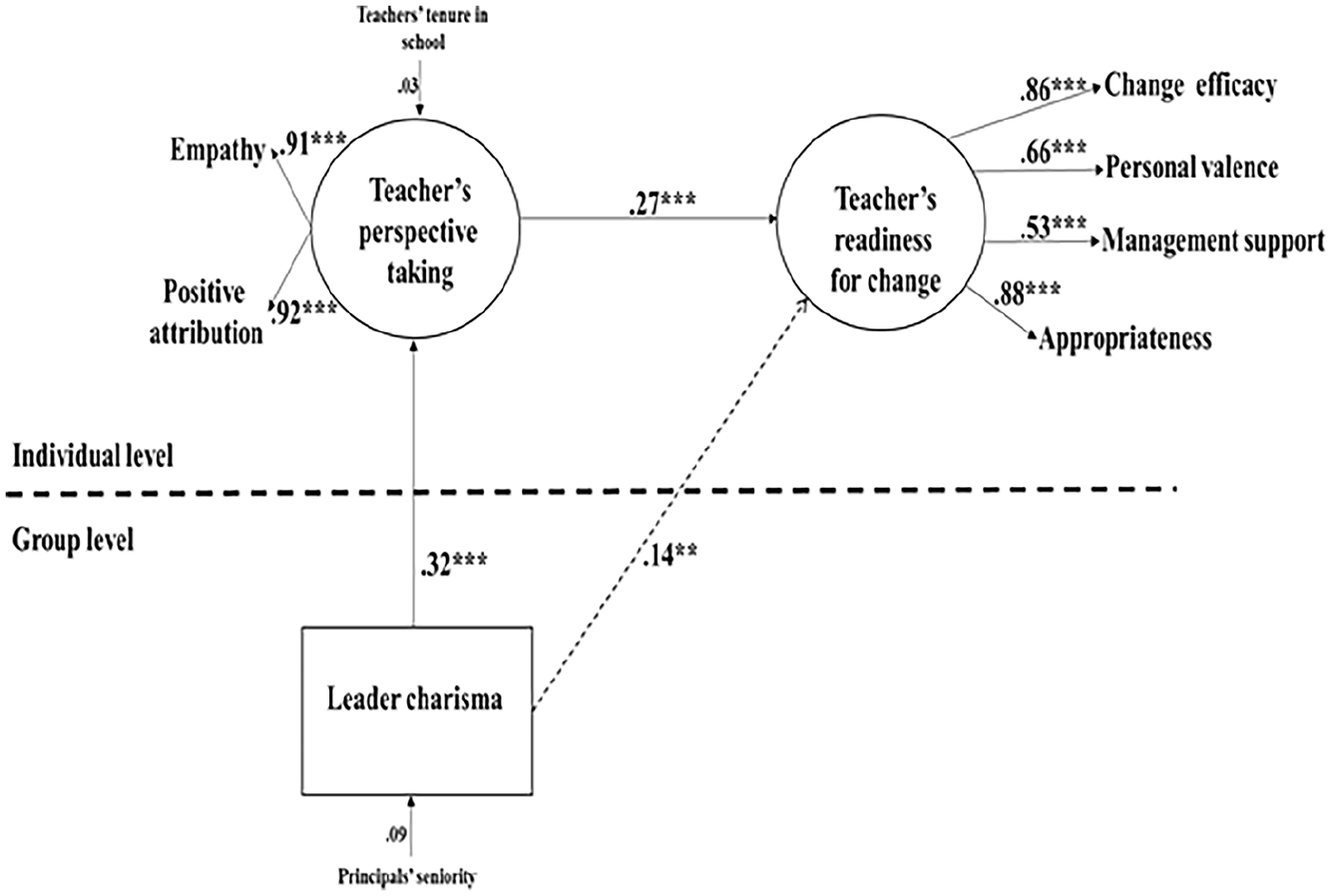
Results of the hypothesized model. **p < .01; ***p < .001.
Indirect Effects
Regarding hypothesis 3, which focused on the indirect effect of charismatic leadership on a teacher’s readiness for change through its effect on that teacher’s perspective-taking, the indirect effect was positively significant (.08; p < .01), with a non-zero confidence interval; 99.5% confidence interval (lower 0.5% and upper 0.5%) ranged between .07 and .21. Thus, mediation exists according to the criteria of Preacher et al. (2010). This is a partial mediation because a significant relationship was found between charismatic leadership and a teacher’s readiness for change (Figure 2).
Discussion
I examined a theoretical model through which leaders’ charisma can eventually weave its influence on a teacher’s readiness for change through its effects on the individual teacher’s perspective-taking with stakeholders. The research model integrates topics from relatively diverse domains, including leadership, cognitive attributes, and organizational change. Below, I further elucidate these domains to clarify contributions and implications for theory.
Theoretical Implications
First, the results demonstrate the effect of charismatic leadership in the context of change in the school setting. School principals need to be charismatic in the first stage of a reform to positively affect a teacher’s readiness for change. When a teacher perceives the principal as charismatic, as inspirational with a clearly communicated vision, he/she becomes confident (Shamir et al., 1993), a collective identity is formed, and the teacher tends to be more open to perspective-taking with stakeholders in the environment, thus affecting his/her readiness for change. In this regard, the effect of school principals’ charisma is reflected in their ability to affect the individual’s cognitive process; this is an innovative finding in the theory of charismatic leadership (Conger & Kanungo, 1998; Shamir et al., 1993).
Second, despite previous research suggesting that dispositional characteristics, such as openness to change, self-esteem, self-efficacy, locus of control, sense of confidence, and positive motivational states, are antecedents of positive attitudes to change (e.g., Oreg et al., 2011; Weiner, 2020), the current research adds another cognitive attribute of teachers that serves as an antecedent to their readiness for change in the context of Israeli educational reform. In particular, an organization’s inability to provide for an effective unfreezing process before attempting to implement a change often results in failed implementation (Lewin, 1951).
Findings supported the claim that a teacher’s perspective-taking promotes a readiness for change. Perspective-taking, which is also related to a teacher’s ability to see and use different perspectives and evaluate the environment through various dimensions (Da’as et al., 2022; Suedfeld, 2010), positively affects a teacher’s belief in being ready for the change. The innovation lies in the ability of empathy and positive attribution to affect one’s belief in a change. Specifically, understanding the other’s side, considering it with positive attribution which takes into consideration the other’s circumstances, and seeing the other’s side from his/her different viewpoint, also positively affect a teacher’s belief toward becoming ready for, and accepting the change. This also adds to Weiner (2020) who emphasized the importance of socio-cognitive and motivation theories, highlighting “how greater organizational readiness could result in more effective change implementation” (p. 5), in explaining antecedents to readiness for change.
The importance of perspective-taking lies in its positive effect on communication (Gasiorek & Ebesu Hubbard, 2017); in actively considering others’ thoughts, interests, and concerns, egocentric biases in judgment can potentially be overcome (Epley et al., 2006) and helping to build effective relations (Ng et al., 2021). Further, Parker et al. (2008) argued that both the content and consequences of perspective-taking can involve cognition, motivation, and emotions. All of these implications of perspective-taking enable the teacher to be more involved in the process of change implementation, and as found in the present study, to be ready to change.
A third theoretical contribution consists of clarifying the process by which charismatic leaders impact an outcome at the individual level. This result is in line with a few studies on individual outcomes, such as task performance (e.g., LePine et al., 2016). Leaders utilize their charismatic inspiration to positively influence a teacher’s positive attributions and empathy in ways that increase his or her willingness to prepare for change. Furthermore, as partial mediation was found, there was a direct relationship between school leaders’ charisma and a teacher’s readiness for change, and this emphasizes the power of charismatic leadership during times of change and its effect on teacher readiness.
Limitations and Directions for Future Research
The current study has several limitations. First, it was conducted only in elementary schools. Although these schools reflect homogeneous organizations, future research might examine this research model in other contexts and cultures.
Second, the current study focuses only on a teacher’s perspective-taking, but perspective-taking has been examined in different domains, for example, a teacher’s perspective-taking as it relates to students’ viewpoints and how this affects student learning and outcomes (Juvonen, 2006). Future research could examine other domains, such as perspective-taking with respect to a specific reform or perspective-taking by school principals and its effects on leader behaviors and school processes, or relations between perspective-taking and other staff processes during change, such as learning processes.
Third, Parker and Axtell (2001) focused on perspective-taking relative to one target. However, in schools, interactions often involve more than one target. Moreover, Parker and Axtell (2001) focused on the immediate manifestations of perspective-taking, assuming that it had occurred when respondents reported empathy and positive attributions. Thus, future research should examine the effect of situational and dispositional responses on perspective-taking, or as moderator variables between perspective-taking and readiness for change. Such responses might be affected by time pressure (Epley et al., 2006), which may decrease perspective-taking, or accountability toward tasks. In organizations, greater flexibility in role orientation (i.e., a greater sense of accountability for tasks outside an employee’s immediate responsibilities) was found to be associated with increased perspective-taking toward suppliers (Parker & Axtell, 2001). Future research might examine motivational antecedents to perspective-taking, for example, the nature of the interpersonal relationship between the perspective-taker and the target, such as pro-social motivations (i.e., the desire to help others, Grant & Berry, 2011). Future research should also examine other factors affecting the relationship between leaders and readiness for change, such as collaboration or other organizational processes.
Fourth, I theorized and examined charismatic leadership’s effect on perspective-taking and readiness for change; however, the potential importance of other styles of leadership cannot be ruled out. For example, intellectual stimulation (Bass & Avolio, 1997), which has been theoretically associated with creativity, innovation, and the meaningfulness of work (Peng et al., 2016), may also play an important role in reform implementation. Another leadership characteristic that is essential in implementing school reforms is systems thinking (Shaked & Schechter, 2018). The systems thinking approach “advocates addressing any given issue as a whole, with an emphasis on interrelationships between its components rather than the components themselves” (Shaked & Schechter, 2018, p. 260). Other leadership styles to be considered are combination behaviors, such as instructional and charismatic leadership. School principals can be charismatic and at the same time improve school learning processes through pedagogical and instructional approaches, as well as through their and their teachers’ professional development (Qadach et al., 2020). Future research might therefore examine other types of leadership with respect to individual outcomes and attitudes during change.
Practical Implications
First, school principals can increase their awareness of the need to adopt a charismatic style to succeed in promoting a teacher’s readiness during the first stage of change implementation. The effect of charismatic leaders is also prominent in promoting a teacher’s perspective-taking with the main stakeholders in his/her environment, which is important for building effective school relations and communication with the staff (Da’as, 2020), and as found in the present study, for promoting a teacher’s readiness for change. Thus, school principals need to be inspirational, effective, and better communicate the change, enabling the creation of positive attitudes toward that change; the teacher and the school will then be perceived as capable of implementing it, as it is deemed appropriate for the school, thereby reducing teacher resistance and negative reactions to its implementation. In general, it is important to determine just how ready for change teachers are before organizational changes are implemented.
Second, these findings are important for policymakers at the Ministry of Education and for school superintendents, both responsible for training new principals or providing advancement courses for working ones. The educational system could benefit from selecting and training principals to exhibit a leadership style that helps facilitate readiness among the teaching staff. Leadership programs often focus on training leaders to formulate and communicate vision statements (Avolio, 1999). A more specific program might be designed to train leaders to craft visions that are tailored to promote a readiness for change. For example, through their vision, leaders may be able to help employees learn the strategic goals (Gillen, 2000), which in turn could help foster their perspective-taking and their readiness. As stated by Hallinger (2006): “Leadership that makes a difference creates not only an inspiring moral purpose for the school community, but also the management structures and processes that enable the vision to take hold and thrive in practice” (pp. 1–2).
Finally, the Israeli educational reform aims to improve students’ achievements and teachers’ development, as well as their professional status. To successfully implement change processes and participate in them, a teacher has to believe that he/she is ready for the new reform, and to be a perspective-taker with an emphasis on empathy and positive attribution toward stakeholders in his/her environment.
In line with numerous other studies that have shown the managerial advantages of charismatic leadership, this study suggests that these also include specific advantages in leading change. In particular, the charismatic leader is considered a central agent during change, who can affect teachers’ perspective-taking in the initial stages of the reform, and deal with teachers’ often fierce opposition by promoting their readiness for change.
Supplemental Material
sj-docx-1-jrl-10.1177_19427751231153036 – Supplemental material for Understanding How Charismatic School Leaders Affect a Teacher’s Readiness for Change: The Role of Perspective-Taking
Supplemental material, sj-docx-1-jrl-10.1177_19427751231153036 for Understanding How Charismatic School Leaders Affect a Teacher’s Readiness for Change: The Role of Perspective-Taking by Rima’a Da’as in Journal of Research on Leadership Education
Footnotes
Declaration of Conflicting Interests
The author declared no potential conflicts of interest with respect to the research, authorship, and/or publication of this article.
Funding
The author received no financial support for the research, authorship, and/or publication of this article.

Supplemental Material
Supplemental material for this article is available online.
Author Biography
References
Supplementary Material
Please find the following supplemental material available below.
For Open Access articles published under a Creative Commons License, all supplemental material carries the same license as the article it is associated with.
For non-Open Access articles published, all supplemental material carries a non-exclusive license, and permission requests for re-use of supplemental material or any part of supplemental material shall be sent directly to the copyright owner as specified in the copyright notice associated with the article.
