



Abstract
Children who have a parent that serves or who has served in one of the uniformed services live in nearly every zip code across the United States. These children and youth experience unique stressors related to their parents’ service that can impact their performance and behavior at school. School nurses in partnership with school staff can lead the provision of a holistic approach in helping these students cope with a parent’s service, especially during times the parent is away from the home for a prolonged period of time, following injury or a more tragic event.
Keywords
Introduction
School nurses are integral in ensuring that children’s physical and emotional health is attended to in the educational setting. Yet, there is little written to guide them as they interact with military-connected students, who experience unique stressors due to their parent’s uniformed service. This article will provide contextual information that can assist school nurses in knowing who these children and youth are, the unique life experiences that can affect their performance at school, and improve their awareness of military culture so they can provide military-informed care for these children.
Military-connected children (MCS) are the children of the men and women who serve in active or reserve status or in the National Guard and live in nearly every zip code across the United States. Their presence is not limited to the communities that surround military installations. For example, in North Carolina, MCS live in 93 of the 100 counties of the state, far beyond the five counties that surround the active duty installations in the state (North Carolina Department of Public Instruction, n.d.). MCS include those who have a parent serving in one of the uniformed services who are either on active duty, full-time status or in one of the Reserve Components who frequently move between full-time and part-time duty status. Some children of active-duty military members attend schools on military installations that are run by the Department of Defense Educational Activity; however, the vast majority attend public, charter, or private schools in the community. Children of members of the Reserve Components, including the National Guard, typically attend schools in their local community where they live on a more permanent basis. There are differences between the uniformed services and the armed forces (Table 1) as well as differences in the ability to access federal resources such as healthcare and child care, depending upon active or reserve status (Kapp & Torreon, 2021). The term “uniformed services” can be viewed as an umbrella term when discussing all eight of the services while the term armed forces (more commonly viewed as the military) refers to the five uniformed services who fall under the guidance and direction of the Department of Defense. Details about the composition of the uniformed services are outlined in various sections of the U.S. Code (Office of the Law Revision Counsel, n.d.). The duty status of the parent’s service in one of these eight uniformed services effects the type and range of benefits and services the family is permitted to access. For example, active-duty service members have full access to all services on the installation, such as healthcare, child care and youth activities such as sport teams. Those in Reserve status can access some, but not all services on an installation, if they live close enough to take advantage of them.
Uniformed Services in Order of Precedence
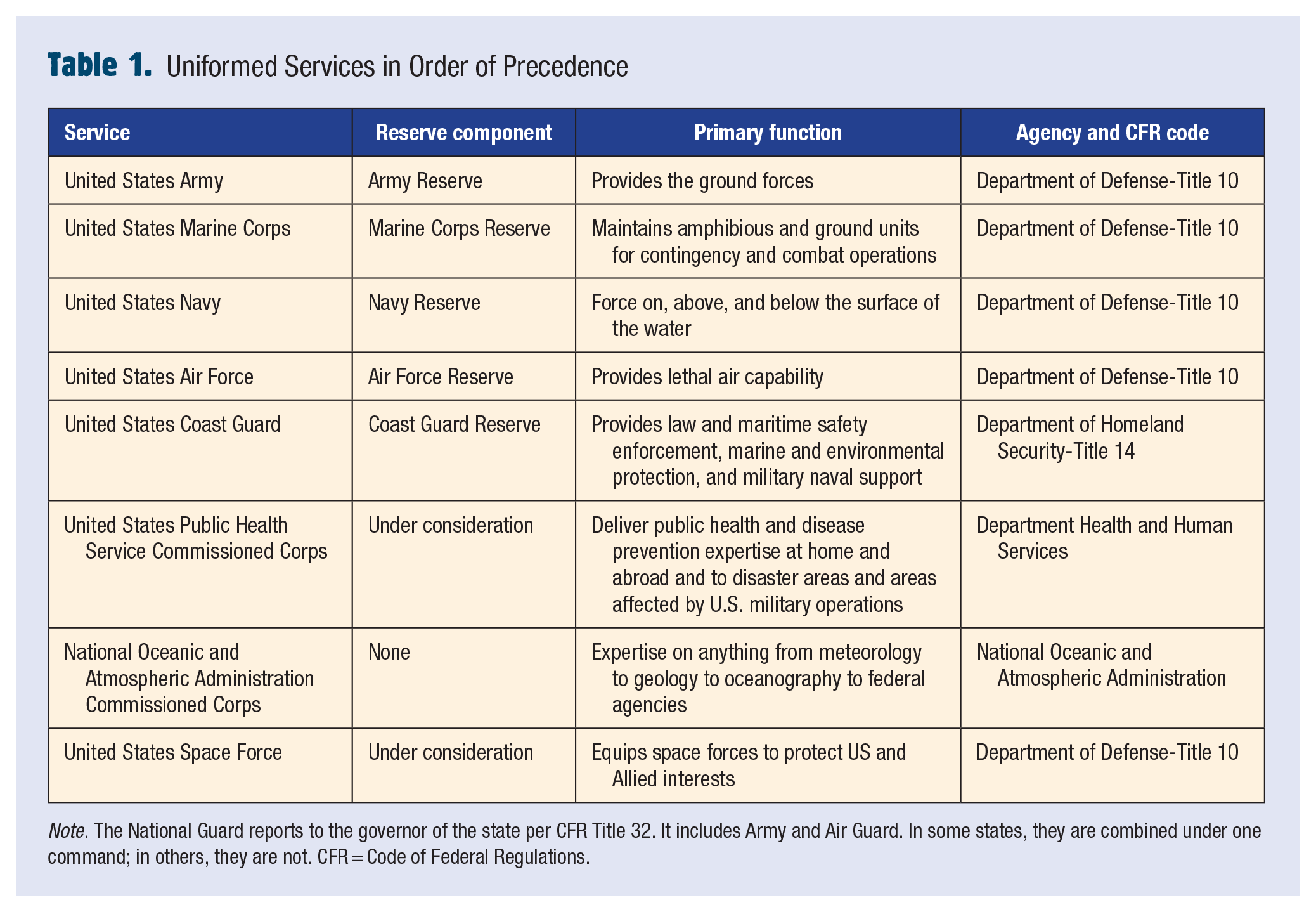
Note. The National Guard reports to the governor of the state per CFR Title 32. It includes Army and Air Guard. In some states, they are combined under one command; in others, they are not. CFR = Code of Federal Regulations.
It became possible to identify the active duty MCS in schools with the passage of the 2015 Every Student Succeeds Act that created the Military Student Identifier (MSI). In 2020, this law was expanded to include children of those who serve in a part-time duty status in the National Guard or one of the Reserve Components (National Defense Authorization Act, 2020). According to the Act, all military-connected parents can voluntarily identify their child as an MCS via the MSI—which is intended to permit educators and parents to personalize the child’s school experience, to be aware of student school performance, and to intervene early when problems occur (Every Student Succeeds Act, 2015). However, there is a lag in providing equal attention to children of members of the Reserve Components and National Guard via use of the MSI as the Code of Federal Regulations has not yet incorporated the 2020 change in law (Susan Lukas, personal communication, April 18, 2024).
Unique Military-Connected Stressors
The provision of military-informed care includes understanding the unique stressors, both the positive as well as potentially negative ones that military families experience (Borah et al., 2022). There are benefits to being a military child, including role modeling of patriotism and service to country by the entire family. Children and youth of active-duty members experience numerous other cultures both in this country and around the world due to frequent moves. These children are exposed to other languages, food, and educational systems. Some have referred to them as Third Culture Kids (TCKs; Cottrell, 2002), with one of the downsides being these children feel like they are “from everywhere and nowhere” (Bosh, 2020).
MCS, particularly those with a parent on active duty, have access to many support and safety-net services designed to help them cope with the downsides of this phenomenon. These services often stem from federal policies such as the MSI which were developed to recognize and mitigate some of the stresses secondary to the parent’s military service. The vast majority of families of active-duty service members live on military installations or in the communities that surround them, which means the local school systems are typically well-versed on the stresses of military life and are aware of the resources available to support the family.
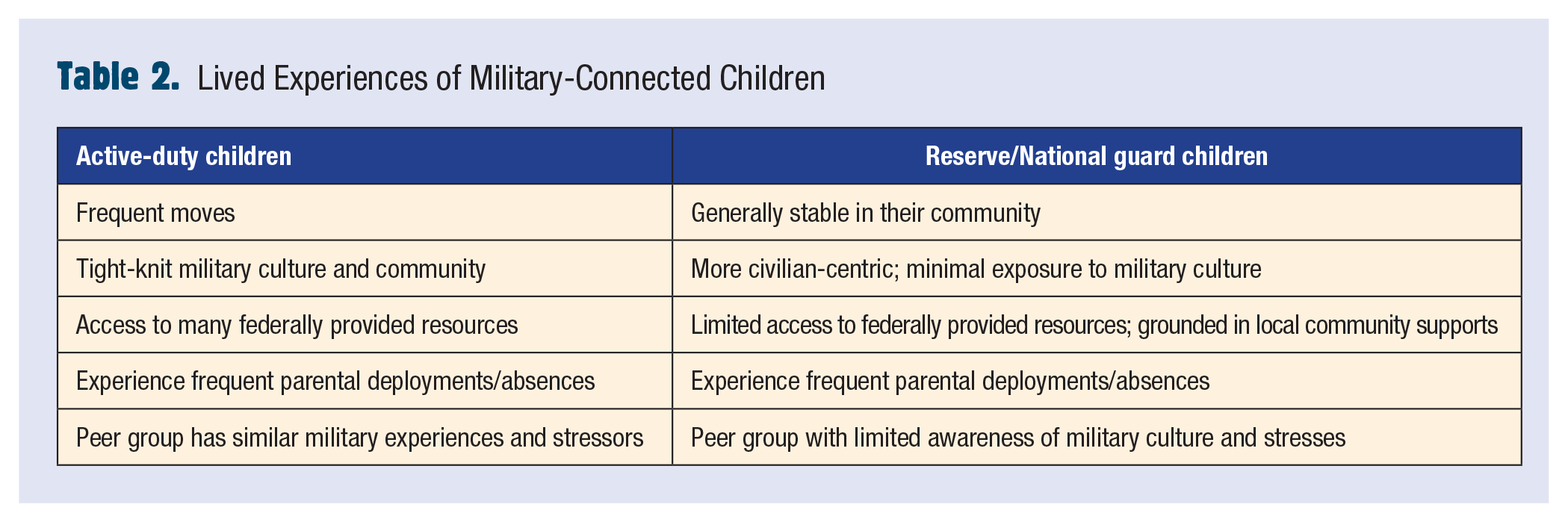
Every child, regardless of type of parent’s military service, experiences the stress of a parent’s absence from home, whether they are gone for training or for a deployment (Table 2). They may also be the only child in their school who is military-connected (Chandra et al., 2010). Unfortunately, there is much less information about the effects of parental deployment on the children of those serving in the Reserve Component or National Guard than on those of active duty (Veri et al., 2021). While children of those in one of the Reserve Components or National Guard do not have the stress of frequent family moves due to changes in military assignments, they do worry about the well-being of the absent parent and experience stresses in changes in family roles and responsibilities. Given that the 2020 law expanding the MSI to these children has not been fully codified, they may not even be identified as being a MCS by their school district. This may lead to inequities in care provided to children of one of the Reserve Component/National Guard service members. School staff working in school systems geographically distant from a military installation may be unaware of the resources available to them or for the MCS that could be helpful in supporting a child during a parent’s deployment or time away from home for training.
Lived Experiences of Military-Connected Children
Supports for Military-Connected Children
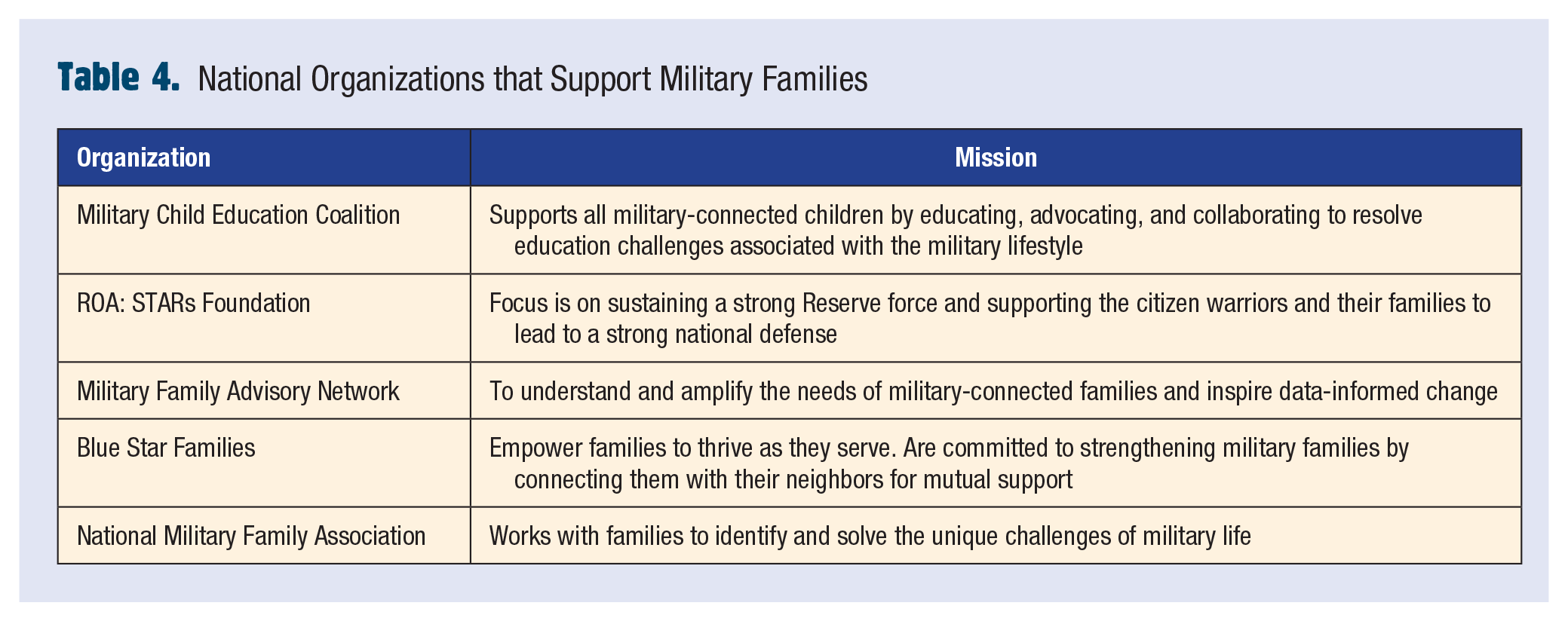
There have been intentional efforts by the Defense Department to provide support for MCS—whether they attend Department of Defense Educational Activity schools or those in the surrounding community. One such program is the School Liaison Program which provides staff who are the installation-centric subject matter expert on PreK–12 education. School liaisons are located on almost every active-duty installation and are the main point of contact for family, local education agencies (school districts), and installation leadership on education-related matters. They are experienced professionals who support, advise, and build partnerships with the civilian and military communities to help address common education challenges of military families. Some common areas of support are transitions, parental absences (e.g., deployment or temporary duty assignments), and educator professional development on the military lifestyle and its impact on students. School liaisons are also the primary point of contact for Department of Defense’s Child and Youth Behavioral Military Family Life Counselors (CYB-MFLC). CYB-MFLC are located in schools around the world and provide short-term non-medical counseling to active-duty dependents to include activated Reserve Components. CYB-MFLCs are available to school staff to assist them in working with MCS (Table 3). There are also numerous Military Support Organizations who provide support and work toward policy improvements for these children and their families (Table 4).
Department of Defense Educational Support Personnel
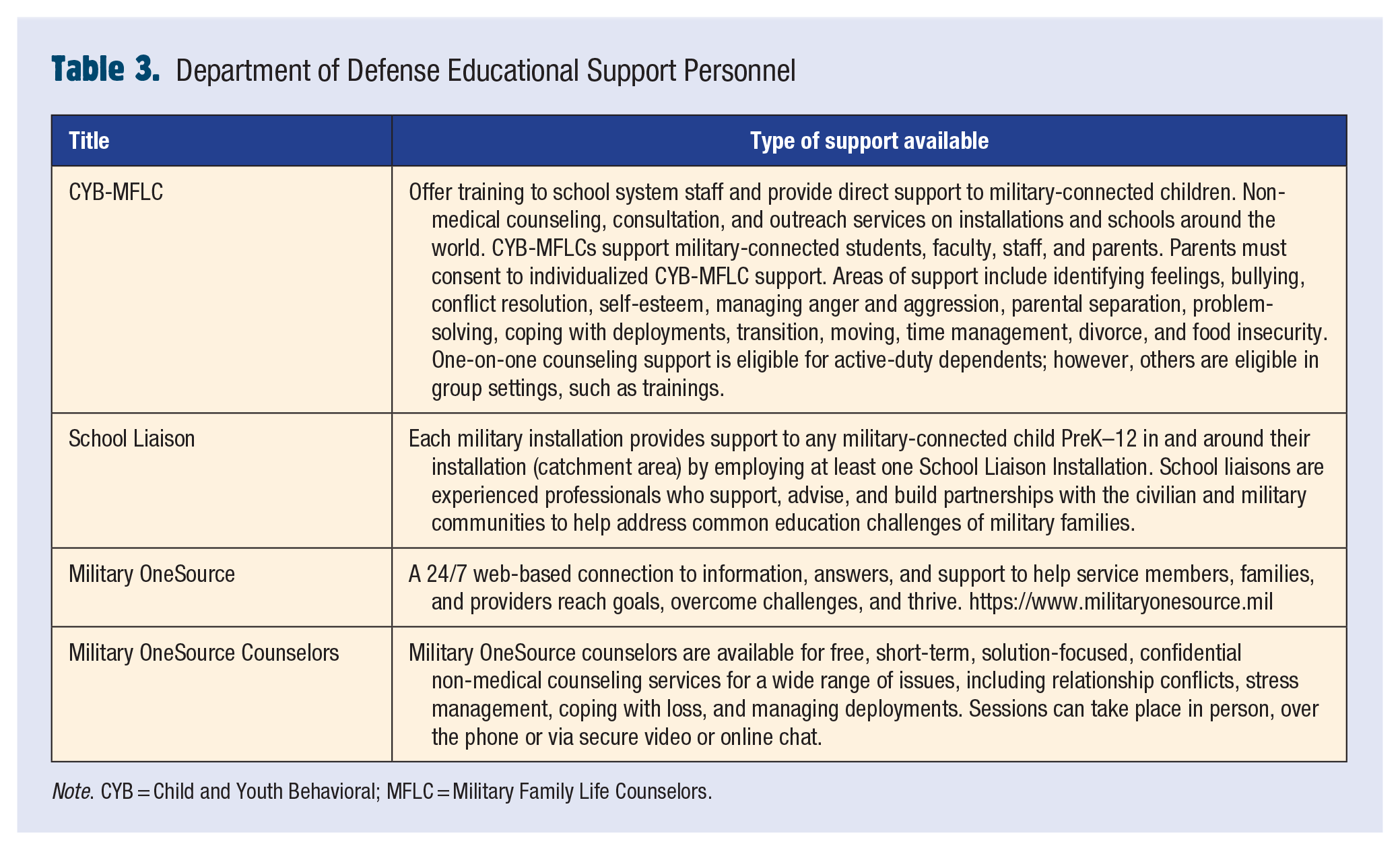
Note. CYB = Child and Youth Behavioral; MFLC = Military Family Life Counselors.
National Organizations that Support Military Families
Role of the School Nurse
The school nurse’s role in working specifically with MCS has not been well-defined or thoroughly explored in the literature. However, the school nurse’s role in serving the students representing many special populations in order to pursue equitable health outcomes is well documented. In 2021, the Future of Nursing Report emphasized the positive impact of school nurses on student’s clinical and social needs (National Academies of Sciences, Engineering, and Medicine, 2021). The NASN has not yet adopted a position statement, developed standards of care, or published a fact sheet or tool kit to guide the school nurses’ specific approach to the care of military-connected children. This gap highlights the need for resources and support for school nurses for this unique school population. However, the School Nursing Practice Framework (2024) is a tool the professional school nurse can utilize when evaluating their role with all special populations in their school. Utilizing the framework’s principles of care coordination, quality improvement, leadership, and community/public health, the school nurse can develop and grow their impact on the military-connected student.
The Framework (2024) recognizes the complex and overlapping nature of the school nurse role. As school nurses learn about the unique needs of MCS, quality improvement should focus on the nurse ensuring routine assessment and collection of MSI status or assist in uncovering an unidentified military connection. During an established method of annual review for student health needs, school nurses can be early identifiers of health conditions and social determinants of health (Galemore, 2023). If an established annual method does not exist, school nurses can exercise their role of leadership to advocate for strategies that will include identifying a student’s current or past military connection.
Beyond initial data collection, as the singular healthcare provider and coordinator in the education setting, the school nurse serves as the first-line professional to intercept MCS experiencing physical or mental distress. The school nurse possesses the judgment to routinely assess and recognize children and youth experiencing physical, mental, social, and environmental changes that impact school success and well-being. Frequently seen as a trusted individual in the school building, school nurses develop trusting relationships with students following repetitive psychosomatic complaints that may reveal developing anxiety, depression, or poor health behaviors related to unique military stressors (Ellertsson et al., 2017). School nurses also serve as the bridge between the health room to educator-led school teams. The school nurse must work with school staff as part of a multi-tiered system of support team who collaborate to ensure equity for MCS in reaching their educational goals while learning to be resilient in the face of numerous stressors (Bobo et al., 2023).
According to an unpublished study of school nurses in North Carolina, school nurses are generally aware of students’ military connection via the MSI but continue to demonstrate gaps in knowledge regarding resources for the military-connected child, especially those children with parents serving in a part-time status in one of the Reserve Components/National Guard (Wilmoth et al., 2023). With the current unavailability of national professional guidance for school nurses in working with MCS, several regional tools are available as guidance for the school nurse working to improve their practice in serving a military-connected child. In 2024, North Carolina included a chapter in their NC School Nurse Program Handbook which can be used as a model for school nurses working to better meet the needs of the MCS population.
A toolkit was produced by Oye et al. (2012) in conjunction with the Massachusetts General Hospital to increase awareness and support of MCS. While it is unclear if this toolkit continues to be updated, the tool kit includes general guidance related to assessment and referral of the MCS. Finally, a pocket card titled “I Serve 2” has been created that may serve as a readily available resource for the nurse, especially for those remote from military installations (Rossiter et al., 2018). A copy of the pocket card is included at the end of this issue as a tear-off clinical resource. School nurses are also encouraged to contact the School Liaison on the military installation nearest them for additional resources that may be of assistance, even those working in remote parts of the country. They can be located via a simple web search using the name of the nearest installation plus use of the term “school liaison.” The school nurse is encouraged to use these resources in their school community to champion for the wellness needs for all military-connected children in their area.
Conclusion
School nurses have a critical role in identifying and working with MCS and in ensuring they receive the emotional and mental health supports they need, especially when a parent is deployed or more tragically, if they are injured or die. Partnering with school counselors, teachers, and administrators will ensure that a holistic approach is used in working with these students and their parents. There is the need to more formally define the role of the school nurse in working with this population and to provide widely accessible evidence-based practice guidelines. Much more needs to be understood about effects of deployment on all military-connected children, not just those with a parent on active duty. Every child of the 1% of Americans who volunteer to serve our country deserve the best-informed care that we can provide.
Footnotes
Funding
The authors disclosed receipt of the following financial support for the research, authorship, and/or publication of this article: The authors would like to thank the school liaisons who work globally to support military-connected children and their families and thank the Army Nurse Corps Association that provided funding support to Dr. Wilmoth for a portion of this project.

Margaret served for 35 years in the Army Reserve and has been actively engaged in advocacy for the military-connected child for some time. She is co-developer of the I Serve 2 pocketcard and a member of the Military/Veterans Health Expert Panel, American Academy of Nursing. She is also the grandparent to several military-connected children.
Mary Elaine served as a school nurse in a variety of locations for over 15 years before joining Craven Community College as faculty. Living and working in a military-centric community led to her work and passion for caring for military-connected students. Her leader role within the North Carolina Association of School Nurses gave her the opportunity to advocate for the role school nurse in working with school-based team on behalf of these children and their family.