



Abstract

It is my honor to introduce the next editor of the NASN School Nurse—Catherine Yonkaitis, DNP, RN, NCSN, PHNA-BC. In NASN’s announcement of Cathy’s appointment, highlights of her career were celebrated, which in addition to school nursing, include acute care roles (i.e., intensive care unit [ICU] clinical nurse III, nurse care manager, education specialist) and nursing education roles both at the University of Connecticut (where she received her BSN and MSN degrees) and at the University of Illinois Chicago (UIC) where she received her Doctor of Nursing Practice (DNP) degree in Advanced Population Health Nursing. In 2008, Cathy moved to her current academic role, joining the faculty at UIC as the director of the school nurse certification program which she led for 10 years.
Cathy has been a leader both within her affiliate and NASN and will be completing her 4-year term on NASN’s Board of Directors this month as the director from Illinois. Her expertise and dedication have been recognized through several awards. In 2019, Cathy received the prestigious NASN President’s Recognition Award for co-editing the third edition of NASN’s School Nursing: A Comprehensive Text; and in 2022, her outstanding work as a writing team member for the fourth edition of School Nursing: Scope and Standards of Practice also earned her the NASN Recognition Award. Cathy began serving on the journal’s Editorial Panel in January 2017 and then transitioned to serving on the Editorial Advisory Board in January 2020. Since 2017, she has authored or been a co-author to more than a dozen articles for the journal, recruited authors, and generated several ideas such as the pharmacology series on rescue medications and the current series titled “Legal Issues 101.” In addition to the NASN School Nurse, Cathy’s works have been published in the Journal of School Nursing, the American Journal of Maternal Child Nursing, the Journal of Nursing Education, Home Healthcare Now, and the American Nurse Journal. No doubt about it, I leave you in good hands, and I invited Cathy to share more about her passion for the role of editor by answering a few questions.
As a newly minted nurse, I worked in various positions including the ICU to develop an expertise at keeping people alive. I also worked in various hospital-based jobs, but after just a few years I realized two things: I was a pretty good teacher, and I had a passion for quality of life not quantity of life. This realization is what led me to a position in hospital education and then to my master’s degree in primary community care nursing. Most are surprised to find that my thesis focused on caregivers of older adults! With my master’s in hand, I went to work in the community as a care manager. I worked with a social work partner as part of a state-run program to keep older adults in their homes (rather than place them in a nursing home), a job I thoroughly enjoyed. A move from Connecticut to Illinois for our family found me at home until one day I saw a call for substitute nurses on a clipboard, on the counter where I was signing my daughter out of school.
The rest, as they say, is history. Shortly after applying, I started as a substitute school nurse in my children’s school district. As a substitute, I spent time working with students and staff from preschool to Grade 8. Eventually, I took a position in one of our district’s Pre-K/Kindergarten centers and came to truly enjoy working with 3- to 6-year-olds and their families. Seeing the impact of early intervention and a team approach to learning cemented my desire to work as a school nurse.
My background in higher education and my own desire to become certified as a school nurse led me to UIC where I was eventually recruited to join the faculty and lead the same certificate program I had attended. Now, 15 years later, I am a Clinical Associate Professor and Director of the Advanced Population DNP program at UIC.
Accordingly, my focus has shifted a bit from providing direct support to students, families, and staff to finding ways to support school nursing practice. Since moving to an academic position, I have worked to
TIME! School nurses have the best job! As NASN’s (2016) Framework for 21st Century School Nursing Practice depicts, our practice spans from direct care to coordinated care to the care of the entire school community. These practice opportunities also present challenges on where to use our time and effort. Many school nurses have shared with me that there never seems to be enough time to investigate the best way or new ways to do their jobs. What I hope we at NASN do, through the content we produce (journals, texts, position statements, clinical guidelines, toolkits, podcasts, conferences, etc.), is provide quick and easy access to the evidence in order to help school nurses do their job.
Cindy, on behalf of all of our NASN members, I want to express our thanks. What you have done, moving what was once a newsletter to a clinical practice journal, is nothing short of amazing. You will be missed, and if you don’t mind me saying, you are leaving some big shoes to fill! See Photo 1.
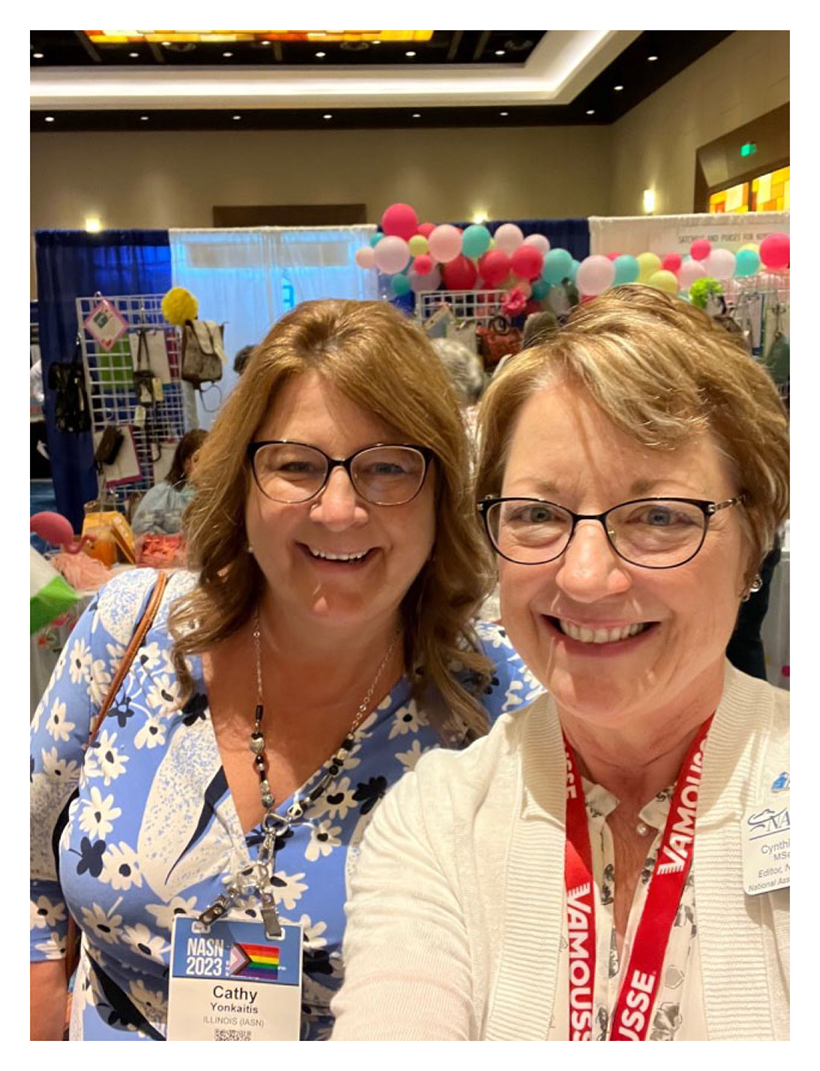
Incoming (Cathy) and Retiring (Cindy) Editors of the NASN School Nurse
Looking forward, I want to find out what else members might be looking for from this journal—NASN School Nurse. I would like to engage more practicing school nurses to contribute articles to the journal. So much good work is happening across the country, we need to share it! To support this idea, I plan to explore how we might create virtual writing groups. Another idea I have is to invite authors from our interdisciplinary partners to publish in the journal. Just think of what we might learn from a special education teacher, a physical therapist, or a speech language pathologist that would inform our practice? I do have a few other ideas percolating but I think I will keep those to myself for now!
As we start this new year and as I begin as the next editor of the NASN School Nurse journal, I want to pledge to give my all to continue in the great tradition you started Cindy. I hope that with each issue readers continue to come away with new knowledge to put into practice. I encourage readers to reach out to me with ideas or questions.
Your editors,