



Abstract
School nurses who are considering a terminal degree in nursing have two options, a Doctor of Nursing Practice (DNP) or a Doctor of Philosophy in Nursing (PhD). There are several factors for school nurses to consider when determining which terminal degree is best suited for them. This article focuses on the relevance of a DNP degree to school nursing, by first reviewing the evolution of DNP programs and then pivoting to discussions by three school nurses on why they chose this terminal degree and the projects completed during their courses of study. A main focus of a DNP project is to gather, analyze, synthesize, and translate research into practice, often operationalized as quality improvement (QI) in clinical settings. School nurses, practicing independently from other healthcare professionals while often managing large workloads, stand to benefit from obtaining or working with a nurse prepared at this level.
Keywords
The nursing profession has a long, storied history of practice in a variety of settings and with a diverse composition of experience, licensure, and level and type of degree. Thus, individuals considering a nursing career are afforded a variety of options, both at the entry level and for those pursuing a terminal degree.
Evolution and Description of DNP Programs
Two decades ago, the primary pathway for advancing nursing practice and science was through a nurse researcher, or PhD-prepared nurse (Meleis & Dracup, 2005). But as advanced nursing practice has continued to evolve within the discipline of nursing, so has the acceptance of a Doctor of Nursing Practice (DNP)-prepared nurse. As most of the public continue to associate a doctorate education with a nurse practitioner (NP) or certified nurse anesthetist (CRNA), there are misunderstandings regarding the opportunities for DNP-prepared nurses who are not NPs or CRNAs (American Association of Colleges of Nursing [AACN], 2022b). The nursing perspective, thus, risks being left out of critical intersectoral conversations regarding the directions of and strategies for population and school health (Bekemeier et al., 2021).
In 2004, the AACN examined doctoral nursing degree programs and declared that research- and practice-focused programs are distinctly different, stating thereafter that two types of nursing doctorates, research-focused (PhD) and practice-focused (DNP), “may coexist within the same education unit” (p. 3). Thus, the practice-focused degree officially became known as the Doctor of Nursing Practice. Prior to this, there were several practice degrees available with differing credentials which led to much confusion and debate (Reid Ponte & Nicholas, 2015).
Both the PhD and the DNP programs, while distinctly different, share rigorous and demanding expectations: a scholarly approach to the discipline and a commitment to the advancement of the nursing profession (AACN, 2006). Practice-focused doctoral programs, however, focus on integrative practice experiences and intense practice immersion experiences. Rather than a knowledge-generating research effort essential to PhD pursuits, the student in a practice-focused program generally carries out a final DNP project, which is an integral part of the practice experience.
The DNP was historically perceived as the educational endpoint for advanced practice registered nurses seeking to become NPs, nurse anesthetists, clinical nurse specialists, and nurse midwives, equating their practice with other terminally degreed practice disciplines, such as medical doctors and physical therapists (McCauley et al., 2020; Smith et al., 2021). However, as advanced nursing practice has continued to evolve with the discipline of nursing, the DNP degree has also become an option.
Application of DNP in Population Health Settings
Although the concept of a doctoral degree in nursing leadership has been around since the early 1980s, there has been limited support, knowledge, and awareness of the usefulness of such a degree within public/population health settings, such as school nursing. In 2017, Bergren indicated that school nursing is grounded in population health, and the true value of school nursing is in taking a leadership role in health promotion and illness prevention. By employing a historical and reflective perspective, Bergren concluded that school nurses must recognize themselves as leaders to effect meaningful change in health systems and health policies that improve child, family, and community health. One way of doing this is for school nurses to pursue higher education, and Bergren noted that The Institute of Medicine’s (2011) report on the Future of Nursing has had a visible positive impact on the number of school nurses pursuing doctoral degrees.
The ongoing debate over what makes a DNP-prepared nurse different from other nurses with advanced education may be partly responsible for why the number of school nurses with a doctoral degree has remained relatively flat, approximately 1%, from 2011 to 2020 (Broussard & White, 2014; Morse et al., 2022). The authors believe that a DNP-prepared nurse adds a great deal of value to school nursing practice in general, but particularly to the role school nurses play in focusing on population health, quality improvement, leadership, advocacy, and policy. All of which are very important skills to promote the advancement of school nurse leaders.
The Role of the DNP in School Nursing: Three Perspectives
In December 2022, a new NASN SchoolNurseNet discussion board community was created for DNP-prepared school nurses and those interested in a DNP degree (NASN, n.d.). A new member posed the following question to the online discussion group: “How does a DNP fit into school nursing?” Three group members shared perspectives by responding to the question and were encouraged by the discussion board moderator to collaborate in authoring this article to educate school nurses and others on the relevance of a DNP degree to school nursing practice. Below are their perspectives.
Shanyn A Toulouse, DNP, MEd, RN, NCSN
What an interesting question, and one I am not sure that I really could have answered prior to beginning my own DNP work. The primary focus of the DNP-level nurse is to gather, analyze, synthesize, and translate research into practice. Much of DNP work is quality improvement (QI), which is one of five key principles of the National Association of School Nurses (NASN, 2016) Framework for 21st Century School Nursing Practice™. We know that QI has a very important role in day-to-day nursing practice. I believe that all school nurses do QI without even realizing it. For example, if a school nurse creates a new form or process, then realizes a revision would improve some part of the form or process . . . that’s a QI type of project. Of course, there are formal, evidence-based QI tools and processes that industry professionals use such as the Institute for Healthcare Improvement, and many of these tools are easy to implement, making QI work that much more replicable, reliable, translatable, and publishable. While this type of work (QI) is important in any clinical setting, the isolating nature of our profession makes the dissemination (sharing, publishing, reading) of QI and other research work more important. Also, partnerships with our PhD school nurse colleagues are powerful and can elevate the work. Strong partnerships facilitate the creation of formal research studies that colleagues will then gather, analyze, synthesize, and use.
If someone is considering an advanced degree and is not sure whether a DNP program or a PhD program is a better fit, think about the type of work you like to do. If you are more of a short-term, quick-fire, pilot program, quality improvement person, a DNP could be a good fit for you. If you like designing research studies, interacting with research review boards, performing statistical analysis, sticking with projects long term, or are considering a relationship with a college or university, a PhD may be a better fit. Of course, there are elements of all of this in both DNP and PhD programs, and talking with colleagues who have gone through both of these types of programs can help someone sort out which is a good fit for you. My QI project for my DNP degree focused on student screenings and was titled, “Improving the Diffusion of New Vision Screening Protocols Among School Nurses” (Toulouse & Hoyt, 2023). The aim of this QI was to facilitate the adoption of the 2021 Massachusetts Vision Screening Protocols by offering online education and technical assistance intended to improve school nurses’ knowledge, confidence, and change in vision screening and referral practices. Results showed that online education and tailored technical assistance promoted the adoption of new clinical guidelines and enhanced school nurse knowledge and confidence in vision screening and referral practices (Figure 1).
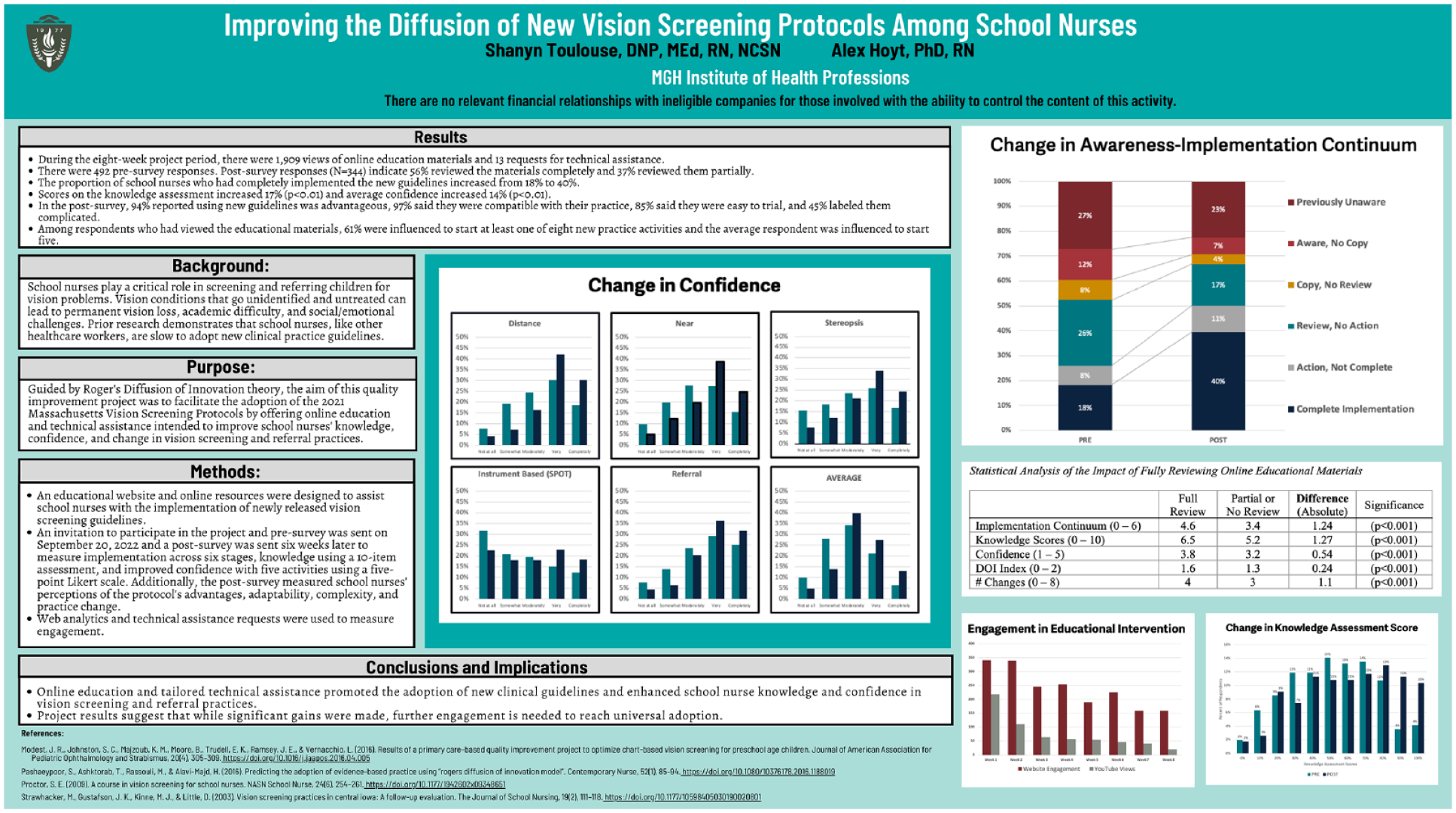
Toulouse DNP Project Poster
Loree LaChance, DNP, MHA, RN, NCSN
I was one of those people who conducted QI without realizing it. Many recognize the inconsistencies within school nursing across the country and strive to adopt standardization within the specialty. My experiences and exposures to nursing in five different states solidified that viewpoint.
The DNP program offered the chance to examine my personal practice and reflect on the essential areas most applicable to advancing school nursing policy and advocacy. Each level of education—BSN–MSN–DNP—added a different layer and higher level from which to view my school nursing practice. I am a vocal school nursing advocate for injustice and change, not satisfied with the status quo. I also developed the ability to compare and contrast my school nursing practice with corresponding inpatient and outpatient practices common in acute care settings. This DNP’s systems-level approach elevated my conversations across disciplines and gave me the tools to implement evidence-based processes. Through my doctoral work, I learned to gather and evaluate data and evidence, craft it into comparable educational scenarios, and help both school nurses and their education counterparts understand how health, wellness, policy, and society are applicable to their missions. My DNP journey gave me the tools to help others understand I was not trying to change their mission but enhance it. My QI project for my DNP focused on asthma and was titled, “School Nurse’s Perceptions of Telemedicine Collaboration with Primary Care Providers [PCPs] for Asthma Management” (LaChance, 2021). Results indicated that the use and perceived value of telemedicine in school health asthma management was high, with the likelihood of engaging with PCPs for telemedicine-based asthma case management in the future.
Katherine Park DNP, RN, NCSN
When I obtained a master’s degree in nursing, I thought I had finished my education. However, a few years later, I started feeling that pull to take my learning as far as I could. As everyone can attest, the field of school nursing has grown exponentially and becomes increasingly more complex with each passing year. To meet such high demands, we nurses need to rise to these challenges. I was surprised by the intense amount of work needed to obtain a DNP compared with an MSN or BSN. The classes I took during my 3-year journey pushed me to new heights of thinking and crystallized my ability to work with and within multilayered systems.
During my DNP program, I learned to think much more globally, and I was able to create a systems-level change for how my district handles chronic health concerns such as type 1 diabetes (T1D). My DNP project focused on T1D and was titled “Improving Management of Type 1 Diabetes Through a School Nurse-Led Parent Support Event” (Park, 2021). The project provided parents with an opportunity to meet other similar parents through a series of three informative meetings which included support services and specialized speakers. The district had previously identified expressed needs and interests by parents for this type of support but had yet to implement a program. Results showed that 100% of parent participants verbalized learning two new ways to communicate with their child’s school nurse (Figure 2). I also began work on district protocols and processes for obtaining/retaining nurses and substitute nurses. A DNP means you are not just learning how to fix a problem, or responding to things as they come up, but rather you learn to prevent the problem from occurring at all.
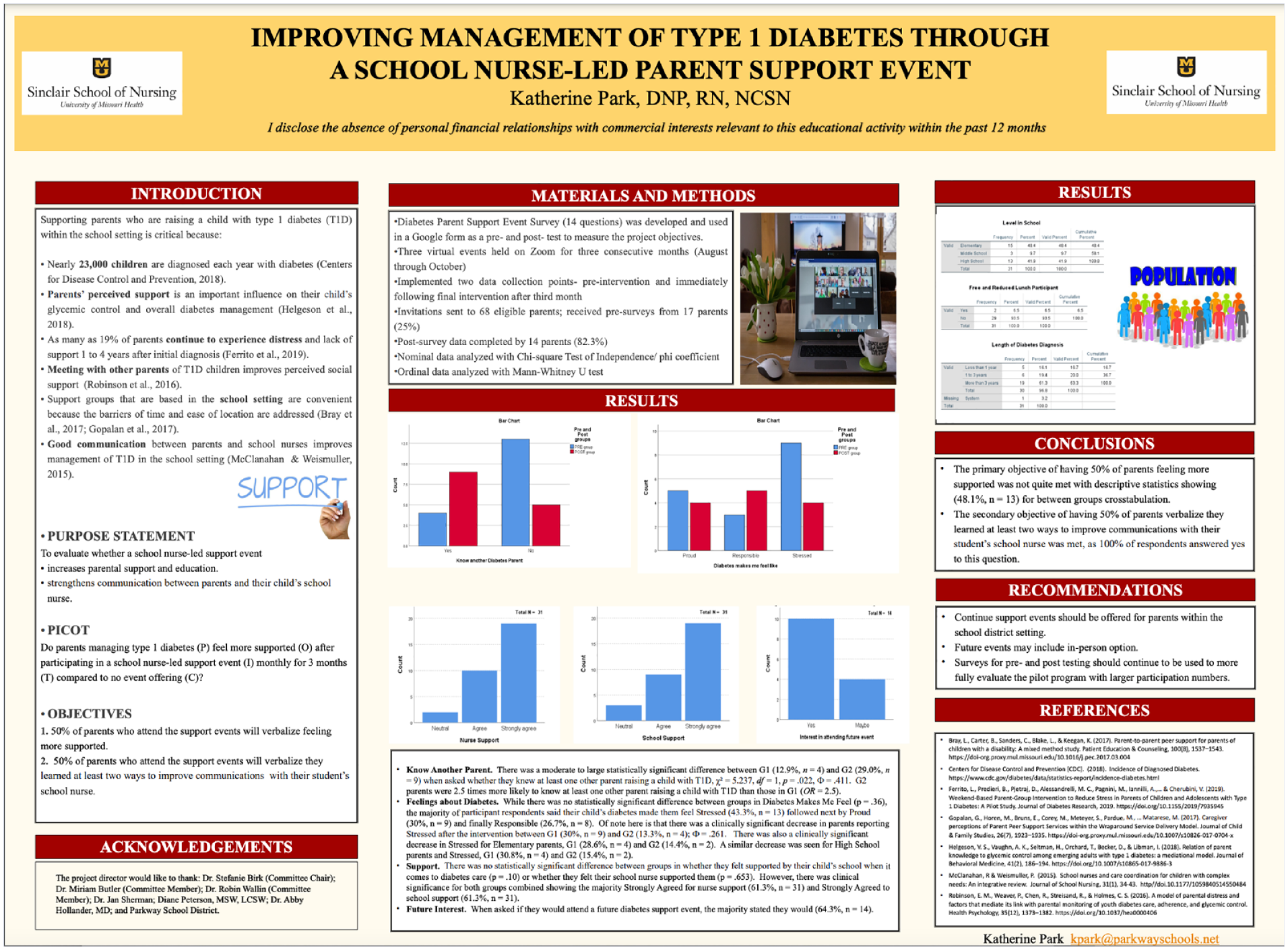
Park DNP Project Poster
Since obtaining my DNP two years ago, I recently had the opportunity to serve as an interim health services director for a few months. I found I spent the majority of my time dealing with timecard errors, staffing, and personnel issues and not with student health, education, or program improvements. Thus, I struggle as I carve out my own niche, as it feels like I am in uncharted territory. I have been asked frequently when I will be leaving, or why I am still staying as a school nurse. The assumption is that no one with an advanced degree would ever want to be or stay in school health and school nursing. The truth is, I have been contemplating a move into a teaching role at one of our area nursing schools. However, I am also torn because I feel I can continue to make valuable contributions to the role I am already in (school nursing) and am disappointed that some colleagues do not see that same value. This implies that they think that school nursing only demands nurses with minimal training/degrees.
The Future of DNPs in School Health
Through QI projects and the relentless pursuit to ask “why,” a DNP-prepared nurse’s expertise is translating evidence into practice, and their value is improved school health outcomes. DNP-prepared nurses are leaders, elevating the skills of all school nurses while serving as implementation specialists for evidence-based practice. Furthermore, a DNP placed in schools is well positioned to partner with others who conduct research and advocate for student health. A school nurse with a DNP is proficient in seeing the big picture and providing population-level care within school health settings.
Program options for nurses pursuing advanced education have risen steadily over the past several years. In June 2022, the AACN reported 407 DNP programs in all 50 States and the District of Columbia (AACN, 2022a). A fact sheet further detailing the growth of programs across the country can be found here: https://www.aacnnursing.org/News-Information/Fact-Sheets/DNP-Fact-Sheet.
Finally, if you are considering an advanced nursing education and you are curious about a DNP degree, the Essentials of Doctoral Education for Advanced Practice Nursing (AACN, 2021) and nursing programs are in the process of adopting these new essentials. Another excellent resource is the online AACN (2023) DNP “Find a Program” search tool that can be found on the AACN website here: https://www.aacnnursing.org/DNP/Program-Directory. This online tool allows you to search many programs offering varied and flexible options that accommodate anyone’s needs. Whether in-person, hybrid, online, full-time, or part-time, you will surely find something that works for you.
Footnotes
Acknowledgements
The authors would like to express their gratitude to Dr. Martha Dewey Bergren for posting the question to the National Association of School Nurses (NASN) DNP discussion group and for her encouragement and support in writing this article.

Dr. LaChance earned her DNP in Leadership in 2021 from the University of Texas at Austin. She is a former school nurse with 19 years of experience in Illinois and Texas as both a campus nurse and also a district nursing director. She currently works in school health advocacy and continuing education development.
Dr. Park earned her DNP in Nursing Leadership from the University of Missouri-Columbia. She is a school nurse with 21 years of experience in preK-12 schools and has also served as Interim Health Services Director for her district.
Dr. Toulouse began her career in school nursing in 2005 managing a School Health Office for 12 years. She has served as the Northeast Regional School Nurse Consultant in Massachusetts since 2016 providing support, technical assistance, and professional development to school nurses across the Commonwealth. She earned her DNP in Executive Leadership at MGH Institute of Health Professions in Boston, Massachusetts.