




Abstract
Climate change is associated with global health emergencies. School-age children are particularly susceptible to the health effects associated with climate change. School nurses are uniquely positioned to address children’s climate-associated illnesses. This article is the first in a series of articles that aims to inform existing knowledge gaps, raise awareness among school nurses, and equip school nurses with the skills they need to protect the health of school-age children. This series of articles will briefly discuss different aspects of the Impact of Climate Change on Human Health diagram, which was created by the Centers for Disease Control and Prevention.
Keywords
The current geological epoch, referred to as the Anthropocene, is marked by substantial biophysical changes in the environment (Crutzen, 2002; Steffen et al., 2018). These include the melting of polar ice resulting in sea level rise, droughts and floods due to changing precipitation patterns, as well as increased intensity and frequency of severe weather, such as heat waves (Crutzen, 2002; Steffen et al., 2018). Climate change shifts weather patterns over a long-term trend. Weather events associated with a changing climate have been described as “discrete episodes of extreme weather or unusual climate conditions, often associated with deleterious impacts on society or natural systems, defined using some metric to characterize either the meteorological characteristics of the event or the consequent impacts” (Stott et al., 2016).
Climate change is associated with global health emergencies. Children, older adults, and people below the poverty line are particularly susceptible to the health effects associated with climate change (Sorensen et al., 2023; Stott et al., 2016). Climate change presents a considerable risk to the health of school-age children because they are rapidly changing physically, emotionally, and socially (Stott et al., 2016). For instance, school-age children with asthma are at risk of adverse health outcomes when exposed to wildfire smoke during recess (Centers for Disease Control and Prevention [CDC], 2022; Sorensen et al., 2023). Also, school-age children can be impacted by exposure to mold in schools or homes affected from flooding, increasing the possibility of various respiratory disorders (Casas et al., 2017). In addition, school-age children are susceptible to ambient heat since they have a high surface area-to-mass ratio and are at increased risk of heat stress, electrolyte imbalance, dehydration, and renal dysfunction (Uibel et al., 2022).
Climate and Health Program
The CDC (2022) developed the Impact of Climate Change on Human Health diagram. This diagram presents multiple climate-associated illnesses that impact health (Figure 1). The diagram includes heat-related illnesses, extreme weather, poor air quality, vector-borne diseases, food- and water-borne illnesses, environmental allergies, mental health and stress-related disorders, and destruction of the environment.
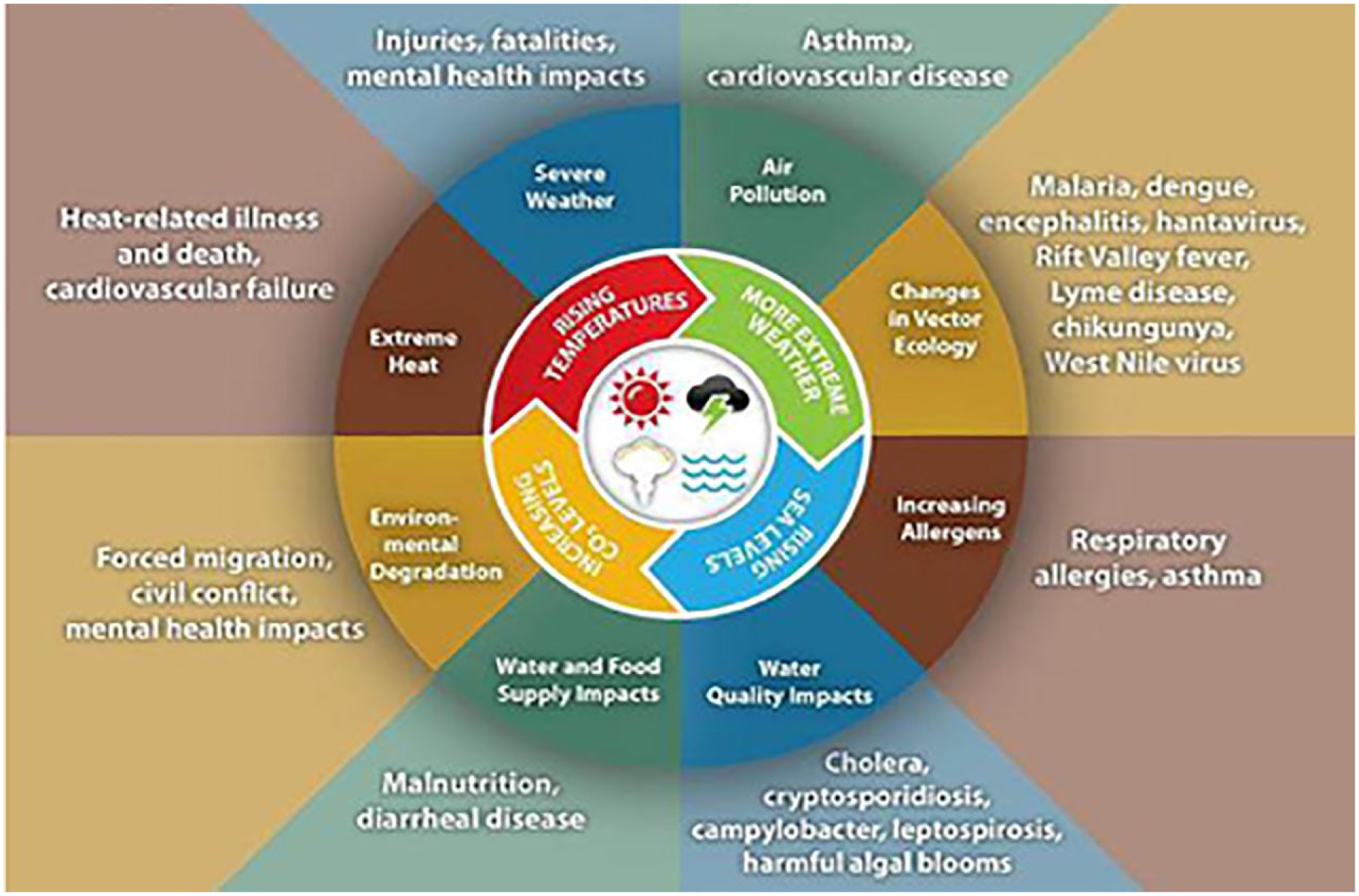
Impact of Climate Change on Human Health Diagram
The Role of the School Nurse
School nurses are ideally situated to identify health conditions, prescription drugs, and additional determinants of health that make school-age children more susceptible to climate-associated illnesses and tailor care plans accordingly (National Association of School Nurses [NASN], 2021; Oerther et al., 2022; Reiner & Haas-Howard, 2022; Sorensen et al., 2023). In addition, school nurses may be instrumental in determining social and environmental conditions that make school-age children more susceptible to the health impacts of climate change (NASN, 2021; Reiner & Haas-Howard, 2022). For instance, school nurses could advocate for and describe the health benefits of improved air quality for children with asthma who may be exposed to wildfire smoke at school. Finally, school nurses can explain ways climate-susceptible school-age children can decrease climate-associated health risks. For example, school nurses can educate parents on pest-related diseases like Alpha-gal syndrome (galactose-α-1,3-galactose), allergies, unintentional injuries, and overall poor mental health associated with climate change (CDC, 2022; Oerther et al., 2022; Sorensen et al., 2023).
The perspectives of school nurses are also crucial for developing climate-related policies, coalitions, and educational training at local and global levels (NASN, 2021; Reiner & Haas-Howard, 2022). For instance, school nurses can inform elected officials about climate-associated illnesses; they can write opinion editorials for newspapers and give expert testimony to support legislative bills that address climate-associated illnesses. School nurses can work to form coalitions at the local level to develop comprehensive programs to mitigate the effects of climate-associated illnesses for school-age children. School nurses can partner with health departments to bolster surveillance and reporting of climate-associated illnesses and assist with preparing schools for natural disasters. In addition, school nurses can advocate that pediatric curricula and training include information related to climate-associated illnesses in school-age children.
Conclusion
School nurses are uniquely positioned to address school-age children’s climate-associated illnesses. This article is the first in a series of articles to inform existing knowledge gaps, raise awareness among school nurses, and equip them with the skills they need to protect the health of school-age children. This series of articles will discuss different aspects of the Impact of Climate Change on the Human Health diagram. Future topics will include heat-related illnesses, extreme weather, poor air quality, vector-borne diseases, food- and water-borne illnesses, environmental allergies, mental health, stress-related disorders, and destruction of the environment.
Footnotes
Acknowledgements
I would like to thank Margaret W. Bultas, PhD, RN, CNE, CNL, CPNP-PC, for her encouragement and support on this article.

Oerther is a faculty member at Saint Louis University School of Nursing and teaches in the Undergraduate and Pre-licensure Nursing Program. She is a nurse researcher committed to improving children’s health, particularly among families living in rural communities. She continues to practice disaster nursing in the community.