



Abstract

Keywords
A 49-year-old female with a history of polysubstance use was found unconscious. Drug screen was positive for cocaine, opioids, and fentanyl. Upon awakening, she did not recall the 24 hours prior to her presentation. She had profound anterograde amnesia with no other focal deficits. Lumbar puncture and electroencephalography were unremarkable. Brain MRI revealed restricted diffusion in both hippocampi with associated T2-weighted-Fluid-Attenuated Inversion Recovery (FLAIR) hyperintensities (Figure 1). Three weeks into admission, she developed parkinsonism progressing to akinetic mutism. Repeat MRI showed resolution of the bilateral hippocampal findings with development of diffuse T2-FLAIR white matter hyperintensities consistent with delayed leukoencephalopathy (Figure 1). She had minimal response to medical management and is currently in long-term care. Magnetic resonance imaging (MRI) brain without contrast revealed bilateral hippocampal hyperintensity on T2- Fluid-Attenuated Inversion Recovery (FLAIR; A) and diffusion-weighted imaging (DWI) sequences (B) with corresponding hypointensity in the apparent diffusion coefficient (ADC) sequence (C). Follow-up imaging revealed resolution of hippocampal signal changes with diffuse white matter hyperintensities on T2-FLAIR (D) and DWI (E) with corresponding hypointensity in the ADC sequence (F).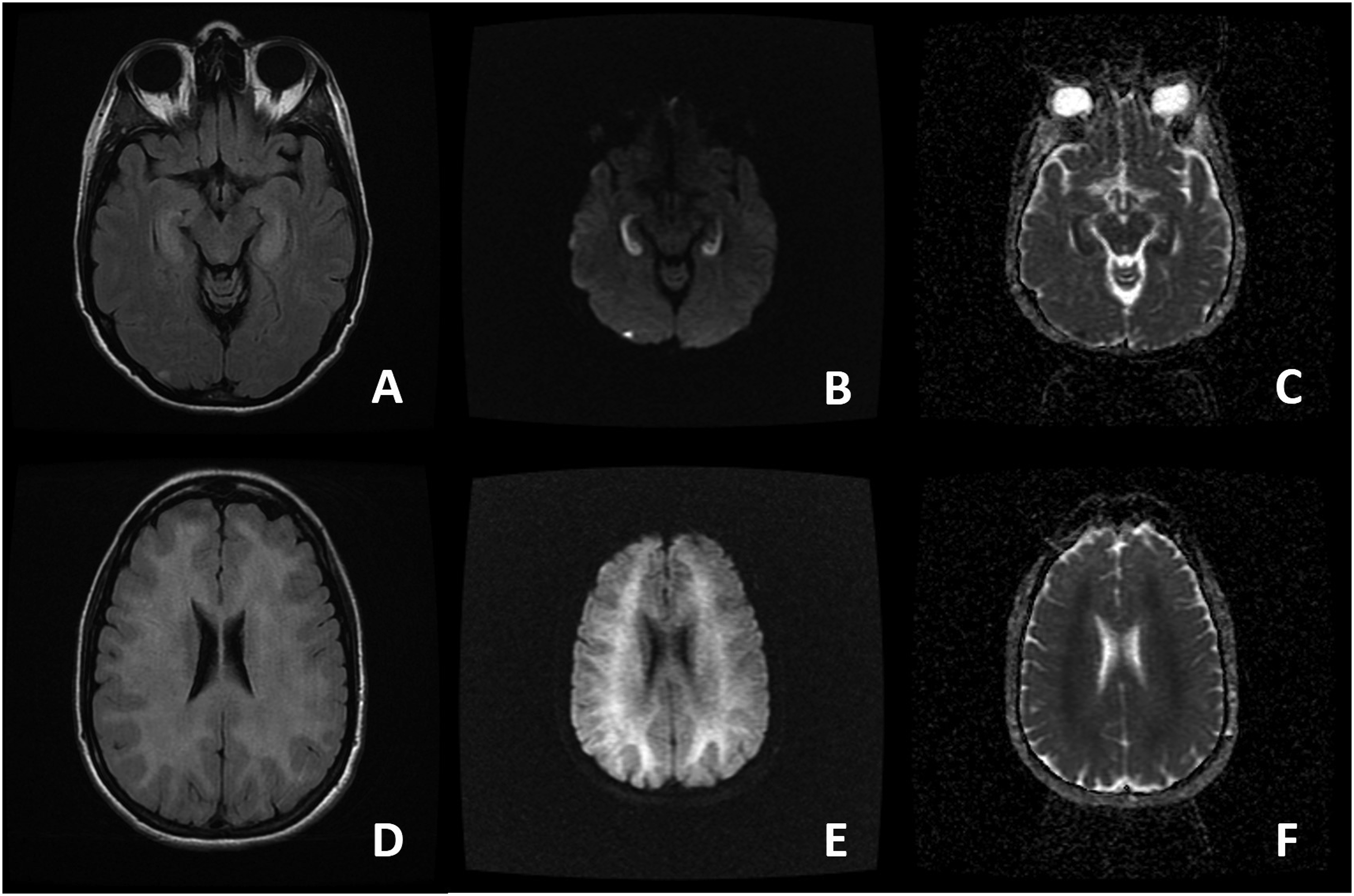
Over forty cases of an acute amnestic syndrome with bilateral hippocampal imaging changes in the context of opioid use have been reported, recently termed opioid-associated amnestic syndrome (OAS). 1 Neuroimaging findings often resolve within days to weeks of the inciting event making diagnosis challenging in this vulnerable population. 1 We report the second case of a diffuse leukoencephalopathy occurring within weeks of confirmed OAS 2 as recently defined by Barash et al. 1 In this case, as with many cases of OAS, one cannot rule out the confounding effect of hypoxia as a cause. 3 It is currently unknown how commonly OAS progresses in this manner given the scarcity of reported cases. Prognosis should remain guarded until patients with OAS have been stable for at least one month following presentation based on two recent cases. Further study of OAS is warranted.
Footnotes
Declaration of Conflicting Interests
The author(s) declared no potential conflicts of interest with respect to the research, authorship, and/or publication of this article.
Funding
The author(s) received no financial support for the research, authorship, and/or publication of this article.
