




Abstract
This paper explores an episode from a post-qualitative doctoral study on university students’ interest in and commitment to allyship. Using Maggie MacLure’s ideas around ‘Glow’ – those unanticipated, compelling, affective moments in research that open up research enquiry – it explores a moment of discomfort and the insights that arose from it. This emerged when the same group of student allies expressed their ideas about allyship in sharply contrasting ways in individual ‘moving’ interviews and in a workshop. This contrast was puzzling and unsettling, more like an icy, spiky ‘glitter’ than a warm glow. The paper uses the metaphor of the snow globe to describe the meandering pathways opened up by this event, as an illustration of attending to affective moments that disrupt and go beyond traditional practices of research. This article, as a whole, responds to the challenge that post-qualitative inquiry can act as a filter that divides who is ‘in the know’ in research communities and offers a novice researcher’s reflections on the trials and possibilities of attempting such an inquiry.
Introduction
This paper explores an unexpected moment, a flicker of insight buried in discomfort, that arose during encounters with my participants as part of my doctoral study. This feeling began as a flutter, but swelled into a wrenching and almost gnawing sensation, as if desperate to escape and make its home on a page, or within an ear. In this paper, I will draw specifically on this moment of discomfort that glowed/throbbed painfully in my study. Through my reading of the literature on post-qualitative inquiry, especially the works of Maggie MacLure on ‘Glow’ (2023), I had become attuned to the presence of such affective sensations and as items worthy of attention within the research process. Such a moment arose during the ‘fieldwork period’ of my doctoral study which aimed to understand the complexities of the social phenomena of allyship among students at a UK higher education institution. This process, however, was not warmly illuminating (a common misconception of ‘Glow’ (MacLure, 2023) and something perhaps I too was guilty of assuming), but rather proved to be uncomfortable, cutting, glinting/glittering and sharp. The exploration of these experiences here, I hope, will add to conversations on some of the challenges in doing post-qualitative inquiry. I take a closer look at MacLure’s ideas around ‘Glow’ with the intention of demonstrating how I tried to make sense of it and how it functioned in my study. This article is thus also a tracing of my novice researcher’s experiences and sense-making of post-qualitative inquiry. I attempt to do this via the (somewhat imperfect) metaphor of the snow globe. Naturally, this article does not offer a ‘method’, but it follows the traces of my developing insight, being led as much by intuition and sensation, as rationality and curiosity. This paper thus also shares an experience of attempting to break away from convention while still learning the ropes as a doctoral researcher; a delicate and risky balancing act on a tightrope stretched between the weight of tradition and the pull of emergent, uncharted ways of knowing. I hope that sharing this process may be useful for other students navigating the double precarity of post-qualitative inquiry and doctoral studies.
Post-qualitative Inquiry as an Embodied Practice – Not a Method
Post-qualitative inquiry was a term I began to hear in my department during my master’s study. Researchers I admired spoke about the successes and also challenges they had encountered when exploring post-qualitative ideas and the ways they had used such concepts. I found myself curious about whether a post-qualitative approach might work for my study. I was drawn to its bold embrace of radical uncertainty and its understanding of the world as entangled. This sparked my interest about what this approach to research could reveal about my topic of allyship (Wolgemuth et al., 2021).
I learnt that post-qualitative inquiry as propounded by thinkers such as St Pierre, MacLure and Lather (among others) is situated within the broader frameworks of new materialism and the ontological ‘turn’ (Gerrard et al., 2017). Put simply, post-qualitative inquiry attempts to shift the focus from traditional epistemological foci (how we know things, what knowledge is), to rethinking ontological concerns (what is the nature of our being and reality) (St Pierre, 2014). In doing so, it allows for experimentation with theories, methodologies and methods (Wolgemuth et al., 2021). Post-qualitative inquiry also leans into insights from posthumanism which entertains the idea of matter (human or otherwise) as being active and having agency, and as not dependent on human interpretation to possess meaning (Aagaard, 2022). Its philosophical underpinning rejects itself as a ‘methodology’; instead, it offers itself as more of a ‘genre’, providing a way of thinking and doing, being responsive and being led by concepts, events and a sense of curiosity and wonder, over the following of established methodological approaches (Kuecker, 2020). In this way, post-qualitative inquiry challenges key aspects of the research process – from how the objects of inquiry are determined; how data is produced; what ‘data’ is; coding as a practice of meaning-making; and the formal conventions of academic writing for publication or other forms including dissertations/theses (Taylor, 2016). This embarkment for ‘new’ ways of knowing and understanding asks us to embrace the messiness of inquiry, and to be open to risk and possibility (Bivens, 2020), challenging the notion that conventional academic writing/reading/knowledge can/should be neatly packaged and produced, ready for consumption (Myers et al., 2017).
As I discovered during my research training, academic methods of inquiry in the social sciences largely prescribe linear, systematic approaches to collecting data, notwithstanding pockets of radical experimentation over the years. Empirical evidence remains the bedrock for exploring reality although the ‘empirical’ tends to be confined to a narrow and recognisable (often measurable) set of features. However, like others who have critiqued the over-privileging of conventional research methods in academia (Honan, 2007), as a doctoral student, I had to consciously ‘untrain’ myself from my research education to be open to this new way of thinking and doing (Myers et al., 2017). Inevitably, I was concerned that examiners and the wider research community would expect well-established, conventional methods, followed by coded thematic or discourse analysis, which are more easily presentable as ‘rigorous’ and thus as desirable modes of engaging with social phenomena. Such ‘method’ has often been seen as the key to evaluating the robustness of knowledge produced (Lather, 1991). However, as Deleuze (1983) notes, ‘thought does not need a method’ (p. 110) and research is recognisably driven by thought of different kinds – logical, dialogic, speculative, etc. The critique from post-qualitative quarters (just one in a longer history of non-linear, non-representational approaches) is that obedience to routine and replication of methods cemented in academic tradition can shut down thought, confining it to repetition rather than a means of creating original insight/knowledge. Method can, unwittingly or otherwise, become a way of limiting experimentation, creation and originality (Deleuze, 1994). Such replication of method also ‘disciplines’ and can shut down alternatives from marginalised/indigenous perspectives (McKittrick, 2020).
With all this in mind, but without a ‘textbook’ or step-by-step guide of how one ‘does’ post-qualitative inquiry, and of what makes a study distinctly post-qualitative, I was stuck. I was cautious about what defined post-qualitative inquiry, highly aware that it was not just a quirky qualitative inquiry, or something experimental for the sake of it, and that simply adding in new materialist concepts or a philosophical reference would not make it post-qualitative (Kuecker, 2020). I was also wary of sharp critiques that post-qualitative inquiry could be an identity signalling who was ‘in’ or ‘outside’ this club (Wolgemuth et al., 2021). Such trenchant debates made me seek out others’ experiences of engaging with post-qualitative forms of inquiry where I found the persistent advice to ‘read theory’. Aagaard (2022) describes this devotion of time to reading as one of the key challenges of qualitative inquiry. And yet, ‘If we [and our students] don’t read the theoretical and philosophical literature, we have nothing much to think with during analysis except normalized discourses that seldom explain the way things are’ (St Pierre, 2011, p. 614, as cited in Mazzei, 2021). Thus, this ‘labor’ (Kuecker, 2020) of engaging in reading and thinking to excavate/recognise normalised practices of research itself became a starting point for the development of my project.
Exploring Allyship in UK HE
Before I explore the occasion of discomfort with which I started this article, I will briefly contextualise my study and trace developments up to that point. This inquiry aimed to explore the idea of ‘allyship’ among self-identified allies in a UK higher education institution (HEI). I wanted to arrive at a nuanced understanding of allyship, its manifestations and the accompanying structural/institutional challenges and opportunities. Research on social justice has traditionally used the term ‘ally’ to define majority individuals’ efforts to advance the interests of marginalised groups (Salter & Migliaccio, 2019). I was interested in how allyship functioned in spaces like universities, largely perceived as breeding progressives and activist thinkers. Allyship is also, nearly entirely in research literature, viewed through a human-centred lens (where meaning is attributed through human understanding). In challenging this, post-humanism invites us to reconsider how interconnected elements shape the world/reality (beyond the human-centred world view). It presents the ontological perspective that reality is not just shaped by humans or even just by what is known or knowable to humans (Braidotti, 2017). This is valuable as it expands a narrow understanding of agencies, dependencies and entanglements that make up the world beyond just the human (Barad, 2007). Using post-qualitative approaches, I wished to look beyond just human interactions that engender allyship, to the spaces, objects, emotions and embodied experiences within an HEI that bring about or compromise allyship.
At the core of the process of designing my research encounters was reading, a sense of curiosity and a desire to retain some sense of playfulness towards my subject. Post-qualitative thinkers observe how we must live with the theories, not just read and write with them. Thus, it felt important to consider the roles played by several actors including myself, in the assemblage of the institution and how we are entangled/knotted by/already embedded in the ideas I was exploring. Thus, reading, thinking and responding with curiosity to literature became a way to engage with theory and a starting point for my project. The design appeared less linear and more rhizomatic, with different phases of collecting data, building on from one another, interconnecting and expanding as my ideas grew. It involved archival study, gauging the mood on allyship through posterboards on university campus, moving interviews, a group workshop with student allies and a staff collaborative inquiry session. I note here that the use of such diverse methods does not make the project post-qualitative. In fact, several authors (like St Pierre, 2021) advocate against the use of ‘method’ at all, to stay true to this form of inquiry. Others like Nordstrom (2018) and MacLure are more interested in how methods or processes can be made to work in ways that are post-qualitative. As MacLure (2023) notes: I think it’s probably not important whether you call them methods, or resources, or maybe techniques or exercises. I do think you need some. . . protocols, I suppose, for bringing forth the unpredictable.... I think you need methods, but they need to be bespoke methods—ones that you fashion for yourself in the middle of things. ...You need methods that are ‘ambulant’, ...that follow the contours of what you’re examining, ... But you do need to have some sense of method, even if it unfolds from—must unfold from—ongoing, immanent immersion in the field (p. 217).
As a novice researcher, this felt like a promising place to start. In addition, there was also a pragmatic reason for continuing to use some ‘methods’ as I found labels such as methods, interview and workshop useful to signpost to funders, probationary panels and ethics committees what is being ‘done’ – the ‘protocols’ of undertaking research. However, my use of these protocols I hoped was very much in the spirit of post-qualitative inquiry.
The Moment of Wonder: Glowing or Glittering?
The moment of discomfort emerged across the moving interviews and the collective workshop. Both encounters featured the same group of self-selected student allies. But their language and demeanour varied quite dramatically, despite these encounters being not more than two weeks apart. Even within the workshop, the words, gestures and collage created did not align perfectly with each other. These differences perplexed me, drew me in and excited, confused and frustrated me. Contrasts in data or behaviours are not unique to post-qualitative approaches. However, the quiet, personally reflective walking interviews did not presage the extent of disaffection/critique about the institution which emerged in the workshop. It felt as if two very different sides of allyship and how they come to be constituted had been revealed, one that was sometimes rooted in a gentler, reflective, personal practice, and at other times built through collective feelings of frustration and confrontation. All of this was not articulated in eloquent language but had to be pieced together in the sense-making that followed.
At first, this experience of conflicting emotions and senses felt confusing and painful. The sensations of a wondrous glittering, like blinding light bouncing off shards of glass, unfolded and grew as I explored how the different methods must have allowed for different experiences/sensations to be revealed. It raised questions about just how much the structure of the two encounters – methods/modes/contexts (single moving interview, focused group workshop) – influenced what becomes visible for researchers to analyse/explore. The different methods seemed to co-compose what was felt, sensed or known. It opened up considerations about the nature of ‘data collection’ in research, our almost fetishised attachment to the idea of words as data, the slippery nature of such data and the narrowness of how we tend to define ‘empirical’, all of which I had imbibed through my doctoral training and socialisation into the culture of academic research. This reflection later connected with other readings which query ‘what does method want?’ (MacLure, 2017), looking critically at method/methodology and their role in research as a core preoccupation of post-qualitative inquiry.
For a long time, the doubts these discrepancies raised about my own judgements about the participants (formed from the first encounter) and of the reliability of ‘data’ severely undermined any sense of certainty/mastery I felt over the process. Making sense of these perplexing experiences became a slow and painful process, but I could not turn away from this gnawing emotion. Much later, the contrast in the two encounters led me to understand allyship itself as arising out of assemblages, rather than existing independently of contexts/histories/spaces; I also learnt that it is not easy for allies to articulate all of the facets of allyship within a project that itself nestled within the institutional space. These realisations around allyship and around research itself were elusive, slow to emerge and something that was sensed gradually, through being attuned and responsive to my bodily affective responses. These insights felt hard-won and valuable to me as a doctoral researcher, navigating what was a predominantly traditional research landscape in a risky manner.
What was it about these different encounters which allowed such intensities to shimmer into being for me? As MacLure (2010) says, ‘Glow’ may reveal itself in different ways – as glimmer or as itch; that embodied and affective feeling or moment where ‘a fieldnote fragment or video image – starts to glimmer, gathering our attention’. (p. 282). This sensation is often quickly followed by a pause, a pause where ideas and connections begin to form. We may reflect on our own experiences or find connections from things we’ve seen or read. Alongside the pause, speeds shift as we may find ourselves wanting to talk and discuss this moment, making connections audibly as well as internally. Such a sensation of ‘glow’ is the process of generating thought from spotting a moment, as well as an embodied experience, creating feeling and physical reactions within the body (St Pierre, 2017).
Since its conceptualisation, MacLure (2023) has revealed her discomfort with the way ‘Glow’ is sometimes read as meaning something more romantic, and individualised, interpreted as ‘data are what appeals to me’ (p. 218) rather than as glow emerging under certain conditions, as part of certain assemblages, and which may disappear or not be intelligible under other conditions. My own experience of making sense of it had been slow and painstaking, and there was little that felt warm or illuminating as the word ‘glow’ may suggest. As I reflected on these feelings, it seemed that my experience resonated better with the word ‘Glitter’ as a way of encapsulating the feelings of itch/discomfort/wonder. To clarify, I am not suggesting that ‘glitter’ is an alternative to the idea of Glow, but how this was a process that highlighted to me, how the rather different sensations that may not normally be assumed by the word ‘glow’ are also about Glow (the concept).
To me, glitter felt as if it still held the essence of the moment of wonder, of being drawn towards something eye-catching. Glitter, which can also be easily overlooked as frivolous, something that sparkles and catches the eye only when catching the light (Coleman, 2020). Glitter is unpredictable too, and one can’t control where it goes. It refuses to be obedient when one tries to put it away. Glitter isn’t always harmless, it carries a sharp edge, a hidden risk, such as the way shattered glass can catch the light, glittering even as it threatens to cut. Thus, I tried to find le mot juste to better reflect my experience of that sense of awe/wonder/glow.
Inside the Snow Globe
If post-qualitative inquiry invites us to rethink how we generate knowledge, then our very means of describing this process must also be open to disruption, play/experimentation and movement. To better understand the processes as I experienced them, I offer the sometimes imperfect metaphor of a snow globe. It is, admittedly, a poetic representation of my research experience, but it also presents a conceptual tool/device that mirrors the affective, unpredictable and multi-layered nature of discovering the ‘glow’ moment during my study. In this imagined snow globe, I envision specks of glitter, which at times lay dormant and at others, swirled around the figure within. This metaphor felt reflective of the research process, where different phases/methods/protocols of collecting data would allow for glittering moments to appear and disappear. Just as my knowledge/understanding of allyship shifted with each method, the snow globe mirrored how knowledge is always in motion, re-forming with each shake and swirl. Playing with the ideas of ‘glitter’ and the snow globe helped me develop my thinking further. I use the snow globe as a device which allows me to explain the glittering possibilities of each moment in my research, the affective sensations I experienced, as I too feel caught up in the swirl of glittering snow, in awe of what could be revealed.
In inviting you, the reader, to look into the snow globe with me, I ask that you see not only through my eyes, but feel the affective stirrings of my body, to notice how these moments of contrast between the moving interviews and collective workshop came into view; of how the words of participants did not match what their hands were creating. This moment did not simply appear, but unfurled, swirling and settling, within my thinking-feeling body, revealing provocations around method/design and the nature of what we call ‘data’. I will describe the glittering moments that built to this understanding through four stages: ‘the glimmer – designing the research’, ‘the shake – the fieldwork’, ‘the swirl – analysis’ and ‘the settle – writing’ (Image 1). The snow globe. An astronaut figurine illuminated by sparkling glitter.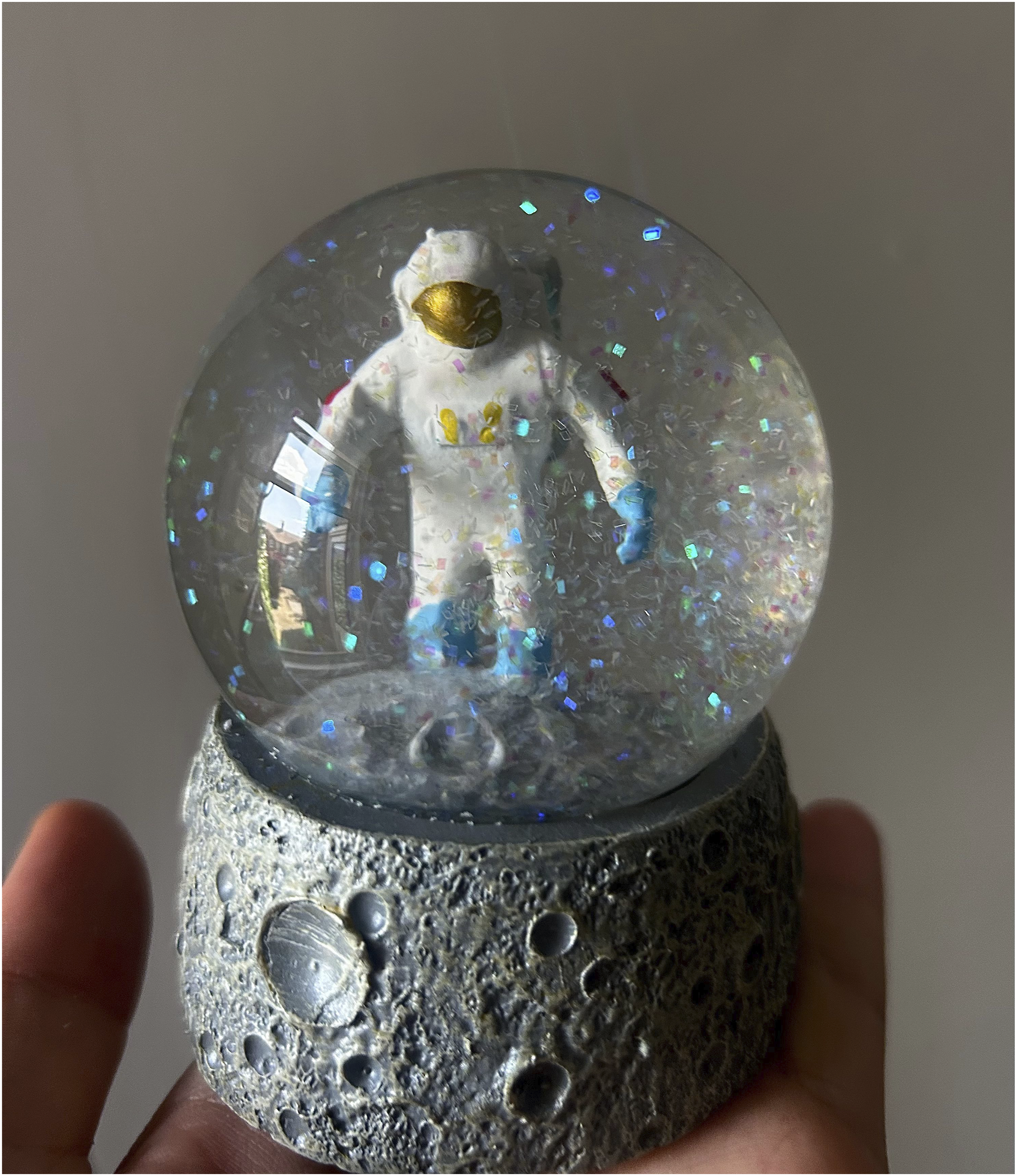
The Glimmer – Designing the Research
At first, the snow globe sits still, untouched and unshaken. In its foundations, a figurine is cemented to the base, with glitter layering around its feet and the ground. The light dances from the glitter flecks inside, laying dormant but still, something sparkles, hinting at a world within. Such sparkles are only visible from certain angles and easily overlooked if not staring within. My hand is part of this moment, feeling the weight and chill of the glass.
Appreciating the intricacies of the snow globe led me to similarities with the process of designing a research project. The figurine may represent my object of study, and the environment within the snow globe and their entanglements within the space they inhabit. I am also part of this assemblage and the way I interact with the globe, the cold of the glass in my hand and my awareness of its fragility is symbolic of my role as a researcher when studying social phenomena. With the glitter settled on the ground of the snow globe, I am aware that new understandings may lie ahead. But I am also aware that my research could unsettle/shake up both what I think I see and my own understandings and assumptions. This perplexing understanding of my own role was key to developing my research approach. Of course, the snow globe metaphor ultimately breaks down and becomes problematic, as do all metaphors (Lakoff and Johnson, 2008) – for instance, as a post-qualitative researcher, I do not subscribe to taking a distant, god-view of the world I study; even as a researcher, I do not really have the power to ‘shake up’ the institution; and the world being researched cannot be treated as a self-contained bubble immune to outside influence, etc. But I persist with this flawed metaphor for what it offers as a way of communicating my research journey.
In designing encounters with allies, I was uncertain about how to approach the topic of allyship. Traditional interviews feel formal, often located in a quiet room with researchers and participants perhaps sitting across a table. This can feel intense, awkward and even intrusive. How can I be not just the person shaking the snow globe and watching its disturbance, but also feel the swirls of movement that were evoked from its shaking (fieldwork)? Given the potential sensitivities of studying a topic such as allyship, 1 and in thinking with post-humanist theories, I became interested in developing a ‘moving around’ style of interview because places can evoke powerful human emotions. When places are inhabited, they become embedded with the kinds of stories, myths and legends that can stimulate, refresh or disturb and unnerve their inhibitors (Reynolds, 2007). Evans and Jones (2011) highlight how attitudes and ideas about a specific location can come to light when the discussion occurs in that space, as memories and sensations provoke different thoughts. And it seemed that moving around would also provide a dynamism to a normally static method – an ‘ambulant’ method, rather literally. Thus, my moving interviews were born.
This felt like a way of looking at the snow globe, perhaps holding it in one direction before the light. But I was aware that different movements and different ways of doing would provoke different formations of snow and glitter from the snow globe. I was curious to see how different kinds of encounters with the students may offer/provoke new or different perspectives. From my post-qualitative readings, I was increasingly interested in the ways creative expression can reveal insights on hard-to-articulate issues. Thus, after the moving interviews, I organised a group workshop. The aim of the workshop was to use the creative mode of a collage about allyship within a particular HEI. I wondered if such non-prescriptive, experimental methods (St Pierre, 2021) could serve to draw in participants and allow them to express a range of issues that are not always easy to discuss. Collaging as a form of inquiry, for instance, requires little ‘training’ and presents the possibility of examining and inventing ways to represent experiences (Coleman, 2020). It is both an artful and conceptual practice which allows for experiences to be shared through layering materials and ideas, juxtaposing and composing and being playful and experimental (Flint et al., 2025). Disturbing ideas of how to do research and thus discouraging participants from offering what they think is desired by the researcher could open the study to the many and multiple ways knowledge can be produced (Flint, Guyotte, Coogler, 2025).
While my choice and design of methods/protocols was precisely to elicit different aspects of allyship, the sharp contrast in the participants themselves, their language and demeanour was unanticipated and felt like a misstep, as if I had tripped over something I had not seen. I felt conflicted by this ‘strangeness’ of my participants, even misaligned by it, provoking doubt/uncertainty about the whole research process. I have now come to understand post-qualitative inquiry’s effort to move beyond traditional methodological frameworks and the consequences of embracing open inquiry as unpredictable (St Pierre, 2021). While the draw of predetermined (rather than ambulant) methodology can be its offer of certainty and perhaps a greater sense of control, this can potentially hinder the discovering of new insights (St Pierre, 2019). This unpredictability felt risky. In designing the research process, I was encouraging myself to go beyond my more traditional qualitative training and be open to such risk, creating the conditions to allow the glittering moments to reveal themselves. We could say that this research project was developed by peering within the globe and considering ways of experimenting with method and process and staying with the uncertainties of what seemed to be emerging.
The Shake – Fieldwork
And suddenly – movement! My hands grip the globe, and the slightest twist of my wrist causes the globe’s contents to flip. I can hold it up to the light, bring it closer to my eye. Inside swirls glitter and possibilities but the foundations of the scene remain the same. What is new, is the glitter and shimmerings catching the light.
Before and during the interviews, I walked miles around campus and found myself taking notice of tiny details I had often overlooked in the spaces. The discussions felt familiar, and conversational, and explored a range of emotional aspects of allyship. Our flitting and moving around different spaces gave a platform for ‘in-the-moment’ thoughts. This added richness to the stories, experiences and ideas that were shared with me. The interviews showed a quiet commitment, with empathetic and reflective tones. There was a sense that a great deal of emotion was driving their allyship commitments. A deep ethics of care, reflection and dedication was apparent in the ideas and experiences of allyship; it was a conscious, thought-out practice, all-consuming, not a reactive one. Their allyship was shaped by their relationships with others, their hopes for desired futures and the feelings that linked these ideas.
I was interested in how such ideas may be expressed creatively, as well as allow the participants to talk collectively rather than individually; to see what they shared in common when talking to each other, and not just me. My plans for the workshop were for us to collectively design a collage based on experiences of allyship within the university. Before the workshop, I collected different materials to allow students diverse opportunities to illustrate their ideas. I selected magazines/newspapers/posters/prints from a range of genres and contexts, providing scissors, pens and glue for reconstructed ideas to be depicted. As the workshop task was linked to experiences in the institution, I collected a range of campus photos and merchandise. This aimed to allow location-specific imagery to be involved in the collage, providing a visual to the feelings around the spaces discussed in the moving interviews.
Through the collage, participants expressed their ideas and experiences in new and unanticipated ways. It was interesting to see how, despite initially being unfamiliar with each other, the creative task and the discussions it generated on race bound the individuals together. Discussions about race can be difficult and uncomfortable, but being able to use images and generate examples, using collaging as a method to share ideas and views, and as a vehicle for this discussion felt powerful. It felt like a process of learning, sharing and celebrating our different experiences too.
The students’ initial creations were focused around what allyship looked and felt like – through finding relevant images, cutting and reshaping photos and text to highlight specific actions associated with allyship. Such visualisations revealed a similarity to what was discussed in the interviews. The visual element allowed for further understanding of the emotions associated with the practice of allyship: for example, actions associated with protest overlapped words and images showing resistance and social movements, while some of the reflective elements of allyship were placed beside more nature-based visualisations, highlighting a more earth-connected, embodied and mindful practice. As the workshop developed, and the students began to include images and materials specific to the university, the sensations in the room, the collective feeling, shifted. What emerged, to my surprise, was something more confrontational, angry and deeply cynical, particularly in relation to the university’s perceived commitment to allyship. This was at some distance from the energy of the interviews. This darker mood was not expressed through words, but knowing scoffs, quiet laughter, nods of agreement and eye rolling. The collective frustration was contagious. However, the conversation for most of the workshop focused on their weekend plans, how their day had gone and even a lengthy discussion on what we all planned to have for dinner. At times we were focused on the task, and in others, erupting in laughter (often in relation to the very typical student meal choices). Even in discussing the creation at the end, the students did not justify or explain their more rebellious actions such as re-inscribing on an image, pro-Palestine graffiti which had been previously erased from walls or manipulating text to suggest that higher education sector was ‘broken’. There was an unspoken consensus in the air, a shared understanding around the institution that did not require articulation. The discrepancy between what was said and what was shown added to my confusion about what exactly I was seeing, hearing and sensing. The glitter began its presencing.
The Swirl – Analysis
As I watch the glittering flakes dance, patterns forming and dissolving, some pieces float quickly, others linger, and at times, I begin to sense meaning in the way they move and settle. Other formations remain a mystery.
After these encounters, I spent time familiarising myself with the ‘data’, thinking with theory and navigating how to make sense of what I had experienced. While the analysis of the moving interviews involved spending time with the interview transcripts, noting intriguing moments of speech and where on campus they occurred, in the analysis of the workshop ‘data’, I made the decision to not focus on the spoken discussions in the workshop but engage in a more speculative inquiry of the collage itself. This decision was based on a number of reasons: firstly, the rich literature within post-qualitative inquiry which supports how creative mediums can allow for ideas around ‘hard to articulate’ concepts, as well as the silence of a ‘collective knowing’ where talk about the institution was sparse. Instead, their creations revealed the depth of their shared critique. This collective feeling felt entirely different to the affective sensations I felt in the moving interviews, which offered more ‘polite’ reflections and personal stories of allyship. For the purposes of this section, I offer below, a small selection of quotes from interviews and sections of the collage that reveal different ideas and emotions around allyship.
In the moving interviews, there was a sense that allyship was driven by empathy: I mean some things will be to do with like... some form of personal connection. But usually it’s just, ‘Oh that's shit, I don’t like when other people suffer’. I feel other people’s things quite deeply. I think sometimes you can be a better ally when you do have some sort of tangential experience to it because you're approaching it with your authentic experience rather than… I don’t know… like it's all, it’s all authentic, if you actually care (Tilly).
In this quote, we see Tilly’s ideas about motivations for allyship develop as they speak. Initially, this is related to a personal connection, perhaps having experience of some form of discrimination themselves or knowing someone who has been discriminated. They are not making a leap of imagination to connect with another’s experience of discrimination/marginalisation – there is some ‘authentic’ experience to draw upon. However, they then shift to point out that all actions are authentic if they are guided by an ethics of care. While a shared vulnerability can play a part, it may not automatically make one more caring of others. Tilly’s quote suggests that it may be caring about others that can allow one to tap into empathy and thus draw on one’s own experiences. At its core, allyship is driven by care for another.
This ethics of care was also presented by Sophia: I think seeing my friends and people around me struggle with things and even like just looking back at myself when I was younger and like wishing I had certain opportunities or certain people to like talk to, that kind of motivates me because I know other people will be in the same position. I want to create that community that I wish was there before… and make sure people get as much support as possible (Sophia).
In Sophia’s reflections on the drive for being an ally, she reflects on care for others, as well as her own memories. She describes experiences of exclusion or missed opportunities and how she wants to work to prevent that experience for others. We could say she enacts a type of prefigurative politics (Leach, 2013) where she behaves in ways that model the change she wants to see in the world. Rather than just advocating for a better future, she is attempting to be that change in the spaces she inhabits.
I was quite captivated during these conversations by the ethics and level of care these students had expressed. This was not just in the words they used, but also in the way they expressed themselves. Tilly was very determined in their speech, with steady eye contact and energetic hand gestures, and we walked around the campus space at a purposive pace. However, with Sophia, her personal insights felt more vulnerable, she spoke slowly, taking pauses to think and reflect, choosing to linger in areas longer and taking moments to think and sit during our discussion.
However, this ethics of care was presented quite differently in the workshop (Image 2). The collage. Image has been edited to include the pseudonym ‘REU’.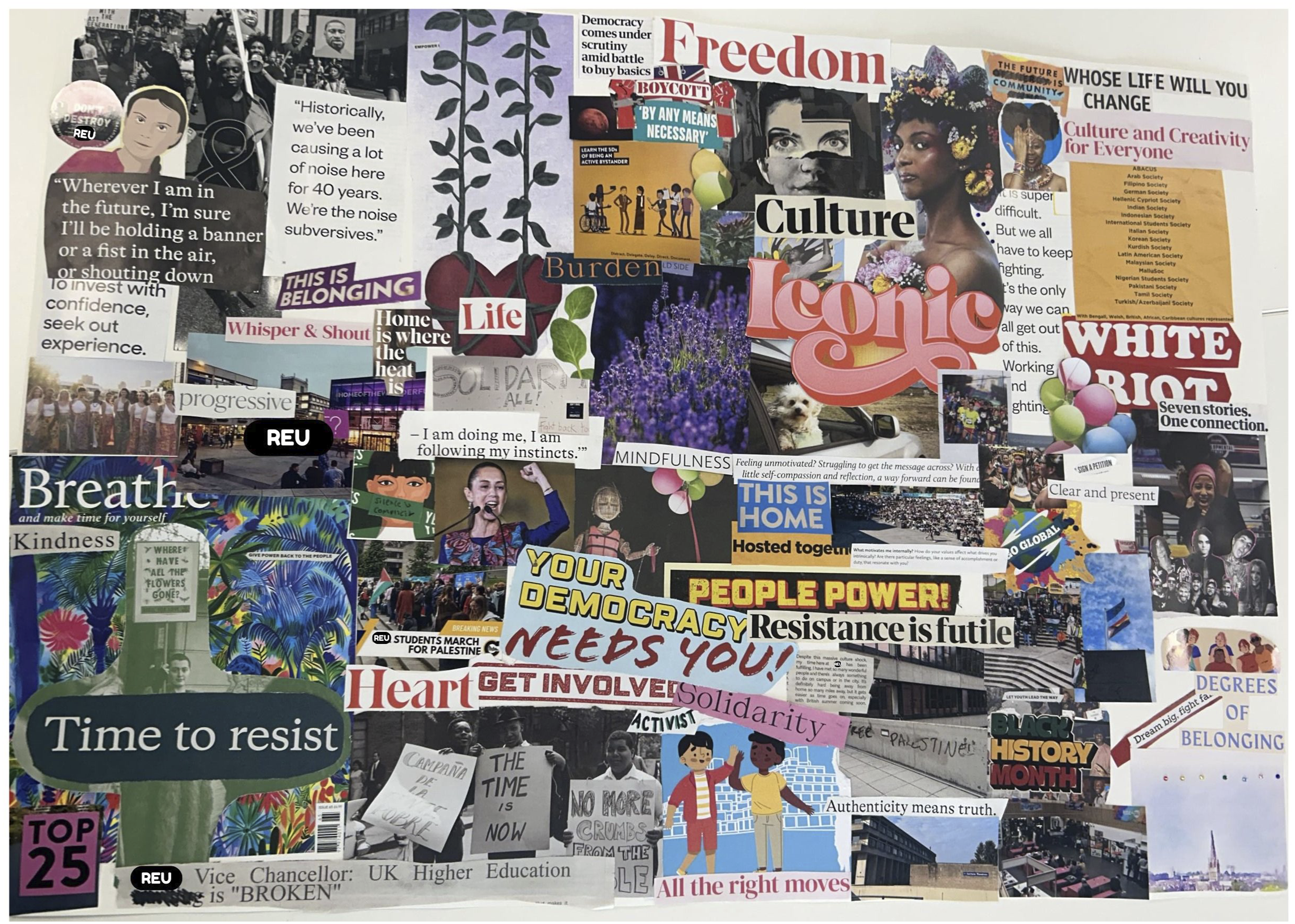
The collage at first glance provides an interesting insight into some of the roles and responsibilities of allies – phrases presented say: ‘get involved’, ‘solidarity’, ‘activist’, ‘boycott’, ‘sign a petition’, ‘clear and present’. It had images of individuals from a range of movements, cultural backgrounds and from different points in history. It shared imagery from both local and global places. Here, their depictions of allyship are active and temporal, reaching out across time and space, embedded in history, as well as in desires for the future (Image 3).
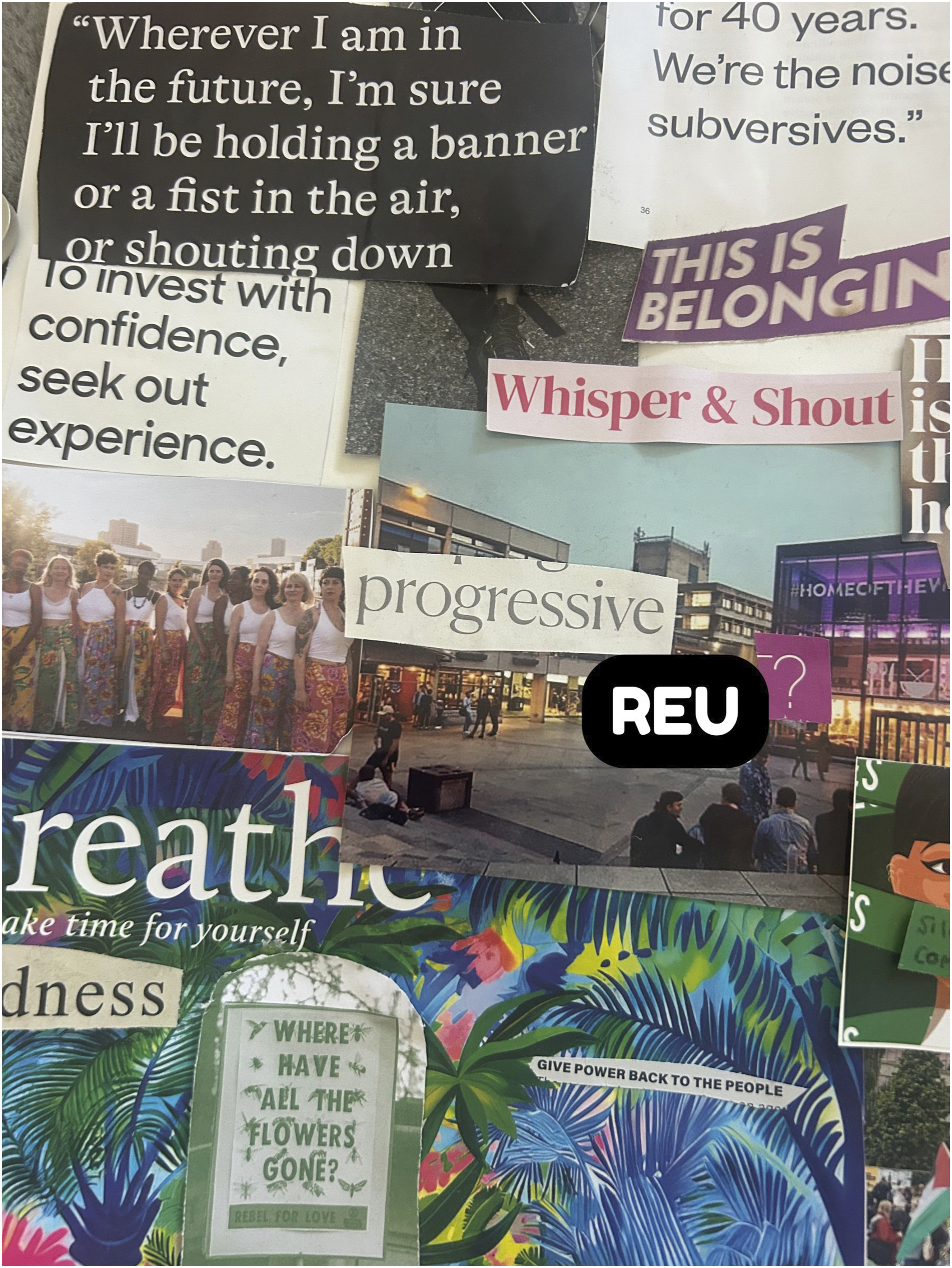
The text ‘Seven Stories. One connection’ could have multiple interpretations. Potentially, it reflects how students from different backgrounds come together at university and that university experience connects them together. Alternatively, it could be about allyship – how allyship has the potential to bring people from different contexts together, and how they are connected in the fight for an equal and just society. This sense of coming together is reflected in the quote ‘the future is community’ which has been manipulated through crossing out other text, and in the quote ‘culture and creativity for everyone’. The quote in the context of the board and its location with the surrounding images may indicate that allyship is important because everyone should be able to express their culture and live their life freely, and that allyship works towards this possibility. Only through taking a community-focused approach, appreciating everyone who makes up that collective, will allyship be possible. We are reminded of the level of impact the participants afford to these allyship actions: ‘Whose life will you change?’ is a reminder that the participants perceive allyship to have life-changing potential, and this promise could drive allyship practice. Allyship is a conscious effort to challenge and dismantle such behaviours and cultures for everyone to feel equally welcome. However, another quote ‘degrees of belonging’ (as seen in the bottom right of Image 2) may indicate that not all students feel they belong equally in the space as others (Image 4).
This sense of disquiet/scepticism is revealed in the image of a communal campus space foregrounded with the mismatched
2
text asking: ‘progressive REU?’. The student has taken the time to find the letters and cut and paste them together in a manner reminiscent of a ransom note to create this slogan. The idea of progressive REU being a statement placed over a promotional image of the university, followed by a question mark, may indicate scepticism around the ways in which (all?) universities think of, and, market themselves. It is critical of how a university may position itself as progressive to attract students, faculty and donors who are in turn attracted to inclusivity, innovation and anti-discriminatory values; and of how it may even persuade itself that it is a progressive institution. In a competitive institutional landscape, showcasing a progressive identity helps signal a desirable commitment to addressing social and global issues, such as sustainability, equity and social justice, which could resonate with prospective students and parents. This promotional context is also emphasised in the inclusion of the text ‘top 25’ (as seen in the bottom left corner of Image 2), highlighting the importance of league tables for universities. In the student’s creation of the image, the question mark may indicate that despite the promotional discourse, this is not reflective of their experience of campus life (Image 5). Section of collage. Section of collage. Section of collage.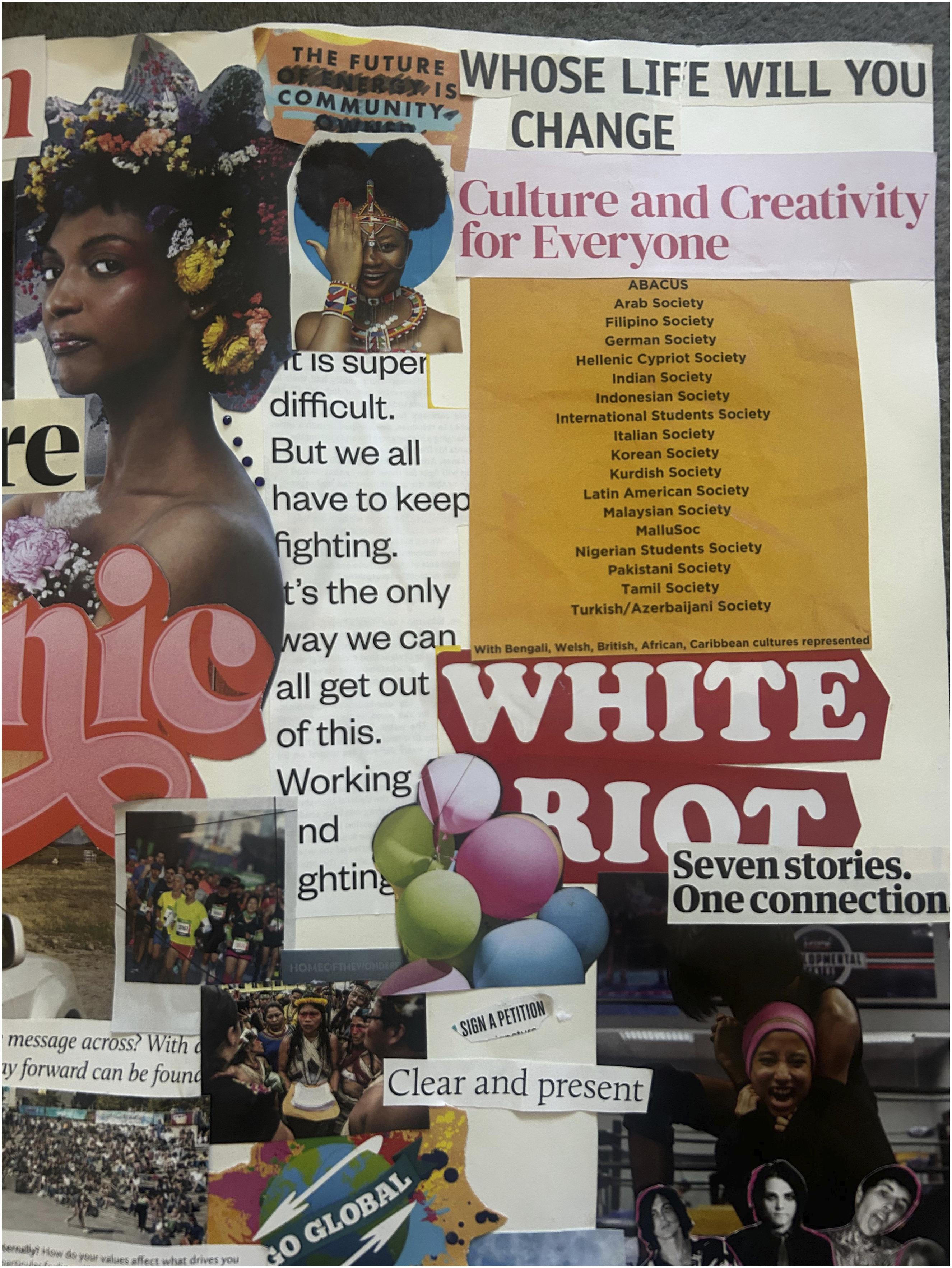
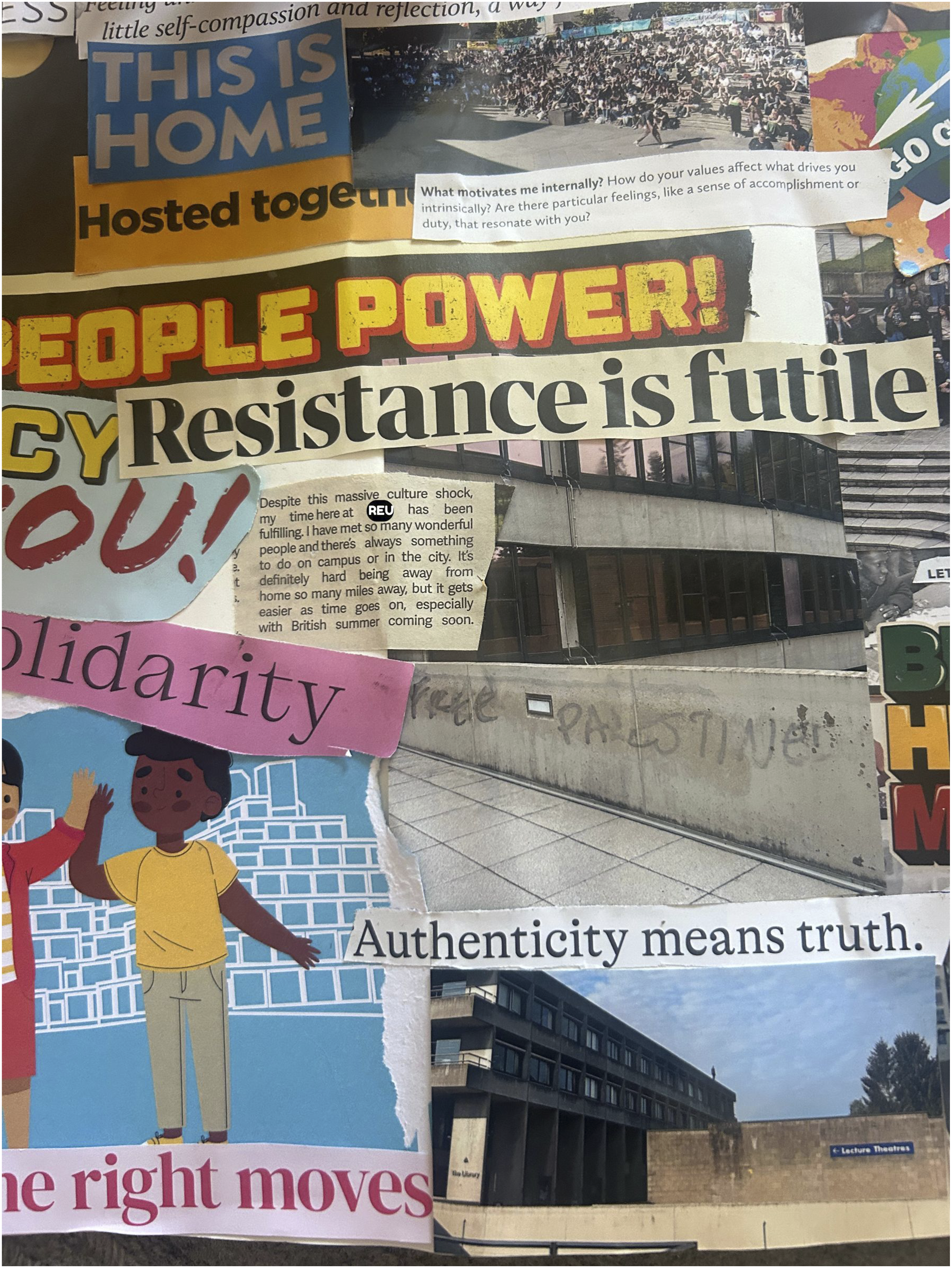
Part of the students’ unease with the university claiming itself to be progressive may be because many of its actions appear performative and nongenuine. This is particularly potent when the text (authenticity means truth) has been placed beneath an image where ‘Free Palestine’ has been reinscribed, marking the exact space where it had previously been erased by the management. The authenticity quote suggests our actions as allies or as ‘progressives’, must be as a result of action for change that mirrors the rhetoric. This text openly questions how institutions can be authentic in their actions.
From the analysis of both encounters with students, the direction of the glittering swirl finally begins to form a pattern. As a researcher, I felt caught up in the swirl, as well as in trying to make sense of its pattern. I spent time examining the many discrepancies within the collage workshop experience asking why the participants had mainly commented on the image as a whole, rather than wanting to explain specific elements. Perhaps this was a subtle wish to sink into anonymity, or maybe the entire creation as a whole was more interesting for them to discuss. Perhaps it was too awkward to articulate their complex emotions about the university at large or perhaps there was fear about what could happen if they spoke their words aloud while being recorded. Whatever the reason, the lack of precise words to match and explain the images left me speculating about what had happened and how to make sense of it all. This moment also highlighted the poverty of data or analysis if it only relied on verbalised material as a sufficient ‘data-set’ to interpret, as very little would have been revealed from our conversations alone.
In looking at the collage we had created, the laughter-filled workshop and memories of their polite, gentle and eloquent interviews contrasted sharply with some of their confrontational and cynical creations in the collage as well as the sounds/noises and bodily gestures that had accompanied the making of them. In sticking with this spiky, glittering discomfort, insights into the complexities of allyship within the institution began to take shape.
The Settle – Writing
Finally, the snow lands. Not in the same way it started, but in a way that makes a new kind of sense. The landscape is reshaped, and now others can peer in, tilt it in their own hands, and see what you see.
What was emerging was only intelligible through taking note of bodily sensations in response to ‘data’, being aware and growing conscious of the affective disturbances that lingered. Focussing not just on the data but also on the affective senses I experienced allowed me to begin to make sense of the wonders I was finding. It involved turning over these insights in my mind, the discomfort, surprise or anticipation and engaging fully rather than shutting out these feelings. Writing through/about this affect allowed me to play with, ponder and speculate on the meaning of these encounters – and to allow them to shift, shine and settle.
In looking at these two snapshots of allyship from the same participant group, it seems that different methods do have the potential to provoke distinct and diverse thoughts among participants by offering them alternative modes of expression and exploration. Writing, as a form of inquiry itself (St Pierre, 2018), allowed for me to understand this dynamic further, and to make sense of it through utilising the snow globe as a metaphor. It is clear that using unconventional approaches to ‘method’ and to ‘data’, such as moving interviews and collective collage-making, provided a unique, layered understanding of allyship. These methods have captured not only what students say about allyship but also how they feel it, embody it and critique its presence/absence within institutional spaces. Using creative materials allowed for explorations not always possible through words, conveying nuanced emotions and experiences. This approach seemed to surface deeper insights by bypassing linguistic constraints/barriers and tapping into more intuitive forms of expression.
By juxtaposing the different affects and revelations surrounding the two encounters, a multi-faceted image of allyship emerges – one that reveals the tensions between personal commitment and institutional realities, and of speaking about these tensions within an institutional set-up. The moving interviews captured the raw, emotional motivations behind allyship, while the collage reflected more of the environment that shapes, supports or hinders these efforts. These differences highlight the value of different methods or encounters and how they bring to the surface, aspects of social and individual life in different ways. This helped surface how allyship is assembled and displayed through individual, collective, material and spatial elements. However, the difference between the moving interviews and the workshop was not just the content, but also in the atmosphere, and the energies, emotions and memories that were able to be surfaced. Each ‘method’ as a form of inquiry opened up different conditions of possibility for allyship to come into view. The methods themselves are not neutral but integral to how the empirical comes to be in/through research. They co-composed what was felt, what could be sensed.
In this way, the researcher, the participants and the devices used to make meaning were entangled in the process and played a role in the way perspectives on allyship (or indeed other phenomena) can be revealed. These two lessons – that both allyship and meaning-making in research arise from specific assemblages or conditions – were a slow realisation that emerged from following awkward, painful and inexplicable feelings of glitter/glow. In understanding one the other also came into view.
Capturing the Glitter
These understandings began to slowly accumulate and develop during the fieldwork and then into the analysis and writing phases. Identifying such movements in research can be tricky, as such glittering moments can be hard to pin down beyond the embodied sensations and painful gut feelings that come with them. Staying with these feelings allowed me to understand and share them through the snow globe metaphor, breaking down the process, in the hope that it may encourage other researchers in recognising similar moments. Heeding MacLure’s warnings about the concept of ‘glow’, of how it can be romanticised (MacLure, 2023), allowed me to recognise the painstaking glittering aspect of glow, as a better way of expressing the sharpness and discomfort. Discovering/creating the metaphor and adapting the language was not easy, though once developed, it became impossible not to share. The negative embodied sensations associated with finding this moment were unexpected and allowed me to engage meaningfully with post-qualitative inquiry and question my own relationship and assumptions around method. This glittering moment about allyship, and my relationship to data, continues to stir both intrigue and uncertainty within me. It is a shimmer that, unlike the snow globe, resists settling. In sharing it here, I hope to scatter some of that glitter your way too, the kind that sticks unexpectedly, catches the light and, once released, is impossible to contain.
Footnotes
Declaration of Conflicting Interests
The authors declared no potential conflicts of interest with respect to the research, authorship, and/or publication of this article.
Funding
The authors disclosed receipt of the following financial support for the research, authorship, and/or publication of this article: This work was supported by South East Network for Social Science ES/P00072X/1.
Ethical Considerations
This study was approved by the University of East Anglia, School of Education and Lifelong Learning Research Ethics Committee (approval no. ETH2223-2279) on October 3rd 2023.
Consent to Participate
Respondents gave signed consent before interviews and workshop, and reviewed transcripts prior to analysis.
Consent for Publication
Consent to publish anonymised data was obtained from participants.

Data Availability Statement
Permissions for public data sharing were not obtained from participants.