




Abstract
In this short essay, we remember Norman Denzin, the “father of qualitative inquiry,” through performative and autoethnographic registers, modalities that sit within the Denzin-cemented streams of qualitative inquiry. We incorporate a rich array of words from leading scholars in autoethnography, performance, and narrative inquiry on Norman’s influence, leadership, and allyship. Finally, we weave a tapestry from Norman’s impact on us as people and scholars, intertwined with memories of our relationships with our own fathers, and draw out a multi-vocal call to action to carry his laughing, loving, and vibrant legacy forward.
Part 1: What He Means to So Many
Norman. Father of qualitative inquiry (Sarina Shing-Ling Chen, 2022, xviii).
Gentle giant (Helen Salmon, qtd. in Todd, 2023).
The Dalia Lama as critical scholar dressed like an unmade bed (Sophie Tamas, 2022, p. 105).
Fine angry angel (Bud Goodall, 2010).
Dear boss (Claudio Moreira, 2022, p. 107).
Sweet soul of a man (Michael Giardina, 2022, p. 10).
A denizen of dreams (Sophie Tamas, 2022, p. 105).
“I seek a new genealogy,” Denzin (2022) told us, “I seek ethnographic texts turned into performance events…” (p. 447), and this call snakes its way through so much of our work—together and separately—since each of us was introduced to Norman and his work. Life is a performance, after all, and Norman invited the joyful, longing, and complicated into all aspects of academic life. He didn’t just support performance and performative writing in qualitative inquiry—or those of us who do it—he saw us and celebrated us. He helped us theorize the ways in which that performativity enriched and extended the theoretical, methodological, and ethical work we are all committed to. Through his own writings and those he invited, amplified, and encouraged, Norman’s influence helped map, define, and defend performance and performative territory in the academy. This combination of activist work, leadership, and allyship, as well as intellectual and writerly barrier-breaking, is the rarest of gems. Norman’s ethos and tireless mentorship modeled what some Australian Indigenous scholars call “eldership, not leadership” (Crouch et al., 2023), a powerful differentiation. Eldership, by its nature, holds deep commitments to those who it seeks to benefit, and to the culture and knowledge matrix itself that it seeks to maintain and preserve. Elders nurture new elders, listen to the spirit, and sees trouble-makers as teachers. Elders welcome all, not just a majority. In Part 1 of this essay, we introduce heartful and humorous reflections on Norman Denzin as he appeared in his peripatetic way: not moving geographically maybe, but in constant thought-in-the-act motion (Manning & Massumi, 2014), action-oriented and active as a body, activist and philosopher in one in his scholarship and mentorship.
The Big Man
This big man Norm
this big white man Norm
held space but did not take up room.
Did not take up DECLARATIVE space like
like so many do, I mean…
Everything about him was solid—his presence, his ideas, his convictions too.
That midwestern open hearted vibe, side of barbeque that I’m missing.
Truly.
None of it should have been as dear
as deep
as true
As somehow it just
Was through and through. . .
Birkenstocks and Benny Goodman’s Shoes
I (Stacy) am standing in the hallway outside of a presentation at an SSSI meeting in Kansas City talking to Norman about jazz. I ask Norman if he’s a Billie Holiday or an Ella Fitzgerald fan.
Norman says, Ella all the way. Have you been to the Kansas City Jazz Museum?
No. Should I?
You must go. It’s in the historic 18 th & Vine Jazz District. Just wonderful. A terrific collection—they even have a pair of Benny Goodman’s shoes.
Not patent leather Birkenstocks, are they?
Norman laughs his booming, infectious laugh. No! Brown suede wingtips.
I can see him now laughing, smiling, sharing an easy moment of connection—he, the “famous” father of qualitative research and me, the eager to learn graduate student.
I’m a Billie Holiday girl all the way. I do like Ella, but I love Billie. Though when I think of Norman then—now—I hear Ella sing.
The Bike with the Pink Tires
In The Bike with the Pink Tires—On Global Science Getaways, Safe Spaces, and Benefitting from Confusions—Anne Beate Reinersten (2014) opens her essay with an email sent to her by Norman: The building is called the Armory and you can go to the southeastern entrance. The campus area is a fairly easy grid so you’ll find your way. I’ll wait for you in my room 209. Outside is the bike that you can use during your stay. The last scholar who used it is from Chile. It has pink tires. I have the keys to the lock with me (p. 668).
Norman welcomed Reinersten to campus and into this home space, inviting her into his room, into his love of soft jazz, his circle of colleagues, and his delightful email correspondence. And he gave her wheels—a ride to and through her inquiry into open science economies and what she calls “otherplace learning” (p. 669).
The bicycle with the pink tires leans against the Armory building after her stay, and Norman writes to her, sharing news of snow accumulating on the seat in the winter and rain in the spring. Long after her time in Urbana, Norman’s words and work give her ideas flight (Figure 1). Photo of Norman from Reinersten’s The Bike with the Pink Tires (2014, p. 669), reprinted with permission.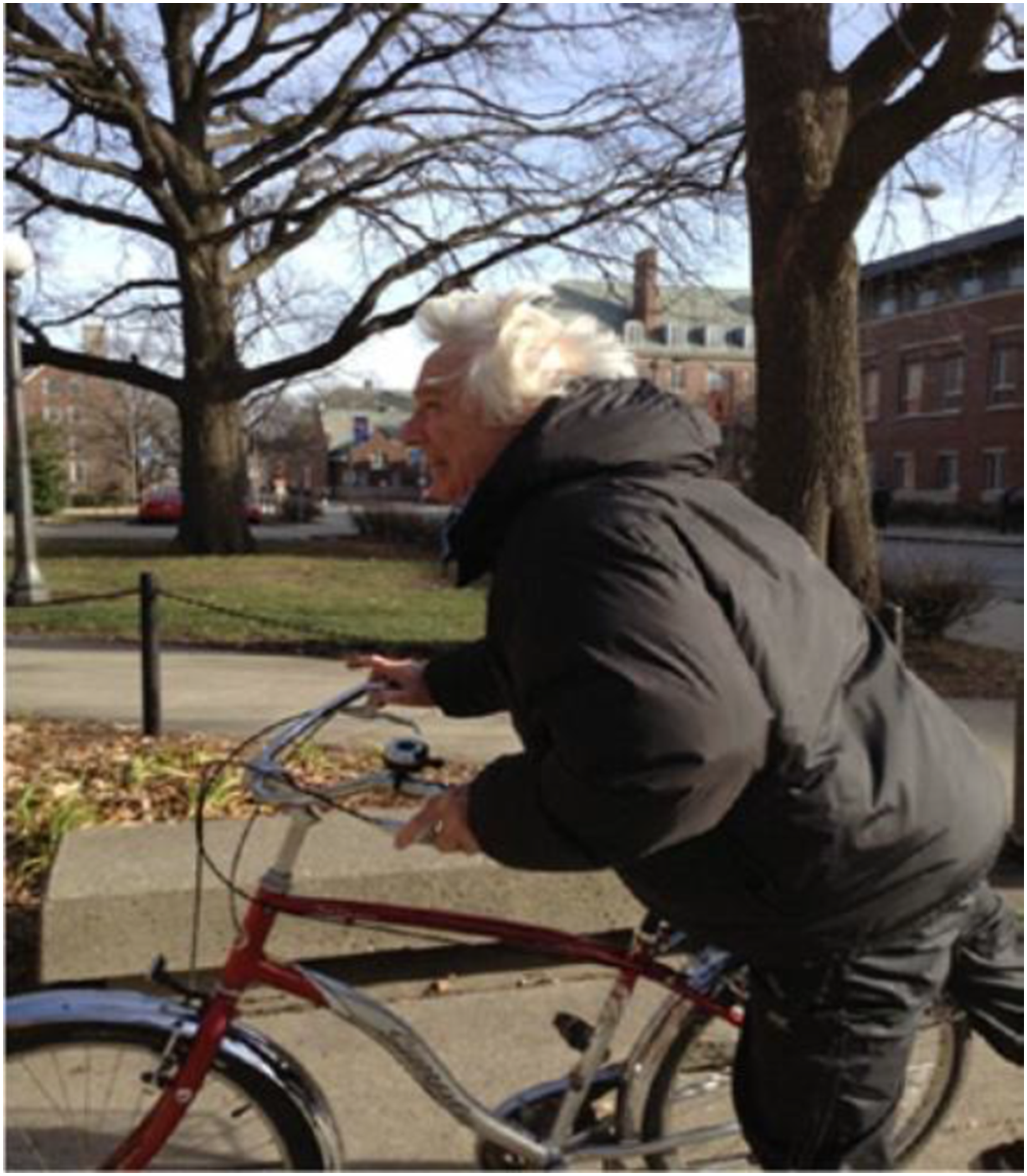
Norman wrote to so many of us from room 209. He answered the phone with jazz playing in the background.
His words and work
gave us keys to the lock.
He gave us all
bicycles with pink tires.
This essay sits within (and is influenced by) the performative turn in qualitative research, an epistemological evolution, and then legacy, that Norman Denzin helped shape, defend, and supercharge. Using poetry, hymn, narrative, and performance registers, here we seek to model (and echo) Denzin’s own rhetorical style that had such a profound influence on those who read him and those who heard him share his work at the International Congress of Qualitative Inquiry (ICQI). That community, as touched on here, provided a sense of home, family, and validation that went beyond scholarly reassurance and extended into courage about who we were as people, about the “so what” of scholarly activism, and shone a light on the ways in which being wholly ourselves could bring all of those threads together.
For those of us (like Dan) who weren’t there in the early days of ICQI, many of us used to wonder what relationship ICQI had with the sociological theory and practice of symbolic interactionism and how it led into the foundation of the ICQI as a home for qualitative research (Norman’s first publication on symbolic interactionism seems to be 1969 (Denzin, 1969) but was followed by much more work in this area throughout the 1970s and beyond). Norman’s contribution began here with blending the taken-for-granted basics of symbolic interactionism and combining them with what was then largely considered its irreconcilably different methodological opposite, ethnomethodology. Norman was interested, at this intersection, not only in the theoretical complementarity of them but also the possibilities for expanding methodology, a dual interest that continued for the rest of his career. In addition, for Denzin, “Both perspectives posit a link between the person and social structure that rests on the role of symbols and common meanings” (p. 922), and this attention, too, became and enduring one for him.
Not content to just work independently in this area, Norman, Peter Hall, Gregory and Gladys Stone, Carl Couch, Harvey Farberman, David Maines, Bill Yoels, Robert Perinbanayagam, Jim Cain, Joan Huber, Nicholas Mullins, Herbert Blumer, Manford Kuhn, and many others helped establish the SSSI (Society for the Study of Symbolic Interactionism) in the early to mid-1970s (Denzin, 1997), which somehow “evolved from a small, alienated, local group of outsiders to a large, stable, integrated, international group of respected scholars” (Saxton, 1997). Here are Norman’s words on the founding of SSSI: A product of chance occurrences, meetings of particular bodies in particular social moments, distant mother and father figures (Mead, Blumer) hovering in the background, charismatic figures haunted by the achievements of others, their peers. Disillusioned, damaged, disenfranchised souls, dreaming selves, fluttering like moths against an evening porch light, seeking recognition and a safe harbor to be who they dreamed of being (Saxton, 1997, p. 108).
The SSSI’s activities and vision led to the establishment of the International Congress of Qualitative Inquiry in 2005. But beyond its structural contribution, the SSSI also laid the foundational values and interactional ethos of what became the ICQI worldwide community: actively working against the dominance of white Western scholarship in academia, of greater equity and representation of subaltern and non-dominant geographical and cultural participants in the community and at the conference, and respect for all forms of difference including gender, sexuality, ability, race, and more.
Part 2: Fathers
Cargo Shorts
Norman was born in 1941, the same year as my (Stacy’s) Dad. Norman missed the Vietnam War draft, thanks to knees damaged by years of playing football (Denzin, 2013, p. 389); my Dad’s post as a Navy medic took him to Japan and he returned home after a single tour.
Dad didn’t speak much about his time in the service, though when he died last year, just a few months after Norman, the military honors at his funeral felt right. He would have been proud.
It’s strange to think of Dad and Norman together, though I’m not sure why. I guess because Dad was Dad and Norman was, well, Norman—but also another kind of father figure.
They did have some things in common—Iowa roots. Sharp wit. Sparkling eyes. Booming laugh. And cargo shorts. Norman wore them all year round, bending to the cold by adding a pair of socks to his shorts and Birkenstock combination. My dad conceded his go-to comfort wear of jeans in the winter, though when it was just barely warm enough—say 38 or 40 degrees—dad would announce with much fanfare that he thought it was time to pull out the shorts. He’d disappear into the bedroom and return with the cargos on, harbinger of spring and heralding the warm summer months to come and to evenings and weekends spent outside.
I like thinking of Dad and Norman here, together, wearing their cargo shorts and welcoming spring.
It feels like you are near.
Such an air of spring about it
Cargo shorts and Birks somewhere
Begin to sing about it
There’s no love song finer (adapted from Porter, 1944).
Big Daddies
My (Dan’s) Daddy, he was big like Norm, well like Norm was before he lost all the weight.
My Dad was like Norm, and he used to tell a story that
when they went to the adoption agency to meet me, and they brought me in that room
all six months of me—wide eyed and smiling desperate “pick me” smiles—
I went to him and
I just fell asleep on his big soft belly. Well.
Now that’s the kinda Dad you want, at least when you’re 6 months old.
And Eddie Harris liked his barbeque too—liked everything that was bad but good
but bad for you:
fried chicken, BBQ ribs, macaroni and cheese, grits, mashed potatoes,
cornbread, hot steak chili, pickled hot dogs, and collard greens.
He said, It’s southern cookin’, it’s poor folks food, its soul food…you call it whatever you wanna call it but—
don’t call me late for dinner!
My Dad was a West Texas boy who knew his food
and then he had to lose all his weight like Norm,
and it was a sad day for him and his kin cuz he said (with no amount of fanfare I might add)
that if he couldn’t have his food he didn’t want to live.
Now my dad Eddie didn’t start a conference, or
establish new disciplines or paradigms or programs or pathways, but I’ll tell ya,
Eddie and Norm were something like
brothers and we sure do need more brothers today.
And not virtual ones either, just
flesh and bones, shorts and shirts, in the body right here and now brothers looking out for
good chances and good food for good friends and for those two?
Everybody was a friend.
Everybody.
We were children in the 1970s—running through firefly front lawns while our Dads tended BBQs and joked over fences with neighbors, their working day worries humming below the melody. Thinking now of Norman, crowded around a pub table with that merry band of SSSI outsiders (Saxton, 1997) and malcontents (Couch, 1997), we wonder if our Dads might have fit in there. Certainly, they would have enjoyed it. And years later, the charismatic “father figure: Norman appeared in our lives.” Of the founding of SSSI (Denzin, 1997) writes: “Each individual is the consequence, the product of chance occurrences, the meeting of a certain body with the body of another, the merger of these bodies with a certain social milieu, a certain. . . father, peer group, and social world” (108). And we continue, hoping to follow Norman’s example—humbly and by increments—sharing our words, performances, and work with the sustaining community that is ICQI.
Part 3: ELEGY to the Singing Cowboy
(to be sung, like a hymn)
Dear Family
We are experiencing a
crisis-level lack of HEROES, don’t ya know.
Where warriors like Norman
stand big of stature but smaaaaall of ego.
Where loud laughter
ricochets around the Union rooms
like little boy arrows and slingshots.
And dreams
ricochet round our memories, oh…
Echoes of Norm’s attack on toxic nostalgia and the
ignorant norms of our yesterdays,
always,
with rigorous reform and love as the goal.
Norm was a force
of more-than-human love
he rode that horse
of Nature-culture, always more than one.
More than gender more than race
more than
more than
more than grace….
Action is needed….
if a
change is gonna come.
He said,
Action is needed. If a change is gonna come.
So:
Where are the big guns in short pants
at midwestern barbeques now?
Who are the humble door-openers for newcomers
all the babies
out-of-placers who so badly need a home today?
See, holding space in one place means holding space for all—time. Place. Action.
He did it so well.
So.
Where are the short-form “Yes!” emails from academic giants to little guys like me?
Another crazy idea turned material through the great YES of giant Norman.
In this time of too many no’s,
too many cancel culture blows,
too many terri-
tor-
ial-
isations.
Of too many fears, too many tears and heartbreaking re-
al-
i-
sations.
In Norman’s name let us resist:
too much adherence to self-serving rules,
too many gatekeepers and institutional mules.
too much career(ism) and not enough love….
Not enough love
not enough love.
In Norman’s name let us pray:
There is someone starting a big blue-sky dreaming Midwest conference
on new paradigms with down home cooking, up there, right now, today.
Let us say:
Maybe it’s us.
Maybe it’s us, maybe it’s US?
It’s time to step up.
It seems Norman has really left the building.
Let us say yes like Norman.
Let us laugh loudly like Norman.
Let us hold space like Norman.
Let us be brave like Norman.
Let us show up.
Let us throw down.
Let us say yes and yes. And YES again.
To love to love to love one another
In Norman’s name.
Starting here, starting now, and for all time, amen.
Amen.
Footnotes
Declaration of Conflicting Interests
The authors declared no potential conflicts of interest with respect to the research, authorship, and/or publication of this article.
Funding
The authors received no financial support for the research, authorship, and/or publication of this article.
Author Biographies
 . Harris is the editor of the book series Creativity, Education and the Arts (Palgrave) and has authored, co-authored, or edited 22 books and over 150 chapters and articles as well as plays, films, and spoken word performances. Their research focuses on creativity studies, cultural, sexual and gender diversities, and on performance and activism.