




Abstract
Mirror Theatre (MT) is a not-for-profit theatre company that has been devising participatory theatre around social issues since the early 1990s. In this chapter, we propose that because of participants’ active involvement in discussion and dramatic portrayals, MT offers an example of Playbuilding as Participatory Action Research. This article provides (a) a theoretical discussion linking playbuilding to PAR, (b) examples of current MT projects, and (c) supporting data from participants, including a rationale for an expanded definition of PAR. URLs of performances are provided and viewing is recommended in order to obtain a thick description of the performance phase in action.
Keywords
Participatory Theatre
Mirror Theatre (MT), a not-for-profit social issues theatre company, has been devising participatory theatre since the early 1990s. Originally focusing on safe and caring schools in Alberta as outreach projects, an applied theatre (Prentki & Preston, 2009) professor, Joe Norris, and his students at the University of Alberta toured the province both as class projects and extracurricular activities. In 2009, with Norris’ move to Brock University, the focus shifted to ‘inreach’ (Norris, 2015, p. 135). Collaborations were expanded to include topics such as workplace violence, first-year university experiences, mental health, and experiential learning placements (Norris, 2022). MT’s early work is documented in Playbuilding as Qualitative Research (Norris, 2009/2016) with some of the later projects discussed in Playbuilding as Arts-Based Research (Norris, 2024).
Joining Csanya (2017), Grandi (2022) and others MT contends that participatory theatre could be considered a specialized form of PAR as ‘the forum phase presents the audience with an opportunity to become actively involved in the performance and to try to alter the outcome of the story’ (Wrentschur, 2021, p. 637). Further, MT’s playbuilding projects could be considered a form of PAR as in both the devising and dissemination stages, participants analyse behaviours and beliefs through discussions and dramatic portrayals. This article provides (a) a theoretical discussion linking playbuilding to PAR, (b) examples of current MT projects, (c) a rationale for an expanded definition of PAR, and (d) supporting data from participants.
Devising Rehearsals
There is always a participatory component of MT’s performance/workshops as audience members are invited to respond to the prepared pieces either from their seats and/or partake in theatrical explorations on stage. Taking a dialogic pedagogical stance, cast members create what Rohd (1998) calls, ‘activating scene[s]… where audiences get ...pulled into the drama of it… and …want to effect change in what they see’ (p. 97). This underpins how the cast members dramatize the data (Saldaña, 2003). MT’s scenes operate as problem-based learning (Duch et al., 2001) or ‘collective problem-solving’ (Quinlan, 2010, p. 120) as they do ‘not show what to do…, rather they …ask[s] what can be done’ (Rohd, 1998, p. 97).
The devising is also participatory, taking three overlapping stages. The first is data generation. Here Actor/Researcher/Teachers (A/R/Tors) conduct external and/or internal research on the topic chosen. Through storytelling (Reason & Hawkins, 1988), they amass a collection of lived experiences that relate to the topic and, through discussions, identify themes. Using these stories and themes as starting points, they then enter the second overlapping stage, breaking off into smaller groups to devise vignettes. They present each other their metaphorical scenes (See Scene 1 – Better? at https://mirrortheatre.ca/performance/challenging-the-myths-stories-from-the-outside-and-from-the-inside-of-a-womens-shelter/) and plausible scenarios (See Scene 3 – Packing Memories at (https://mirrortheatre.ca/performance/understanding-person-centered-care/), analysing both the style employed and the emergent meanings that come from both their devising and their observations of what one’s peers have created. Rehearsals go through a series of hermeneutic spirals (Brooker et al., 2001; Grondin, 2015; Motahari, 2008; Paterson & Higgs, 2005) as new scenes lead to greater analysis with those new insights providing additional scene ideas. The ideas are summarized on file cards (See Photo 1 – File Cards) and sorted into folders labelled: • Scene Ideas • Rehearsed (Devised) Scenes • Quickies (short scenes and/or phrases) • Themes/Issues • Metaphors • Props/Costumes/Music needs • External Resources • Potential Titles • Keepers File cards. (a) File Cards in placed on the floor, (b) 6 people sitting in on chairs circling the cards, (c) 5 wlistening to this person speak.
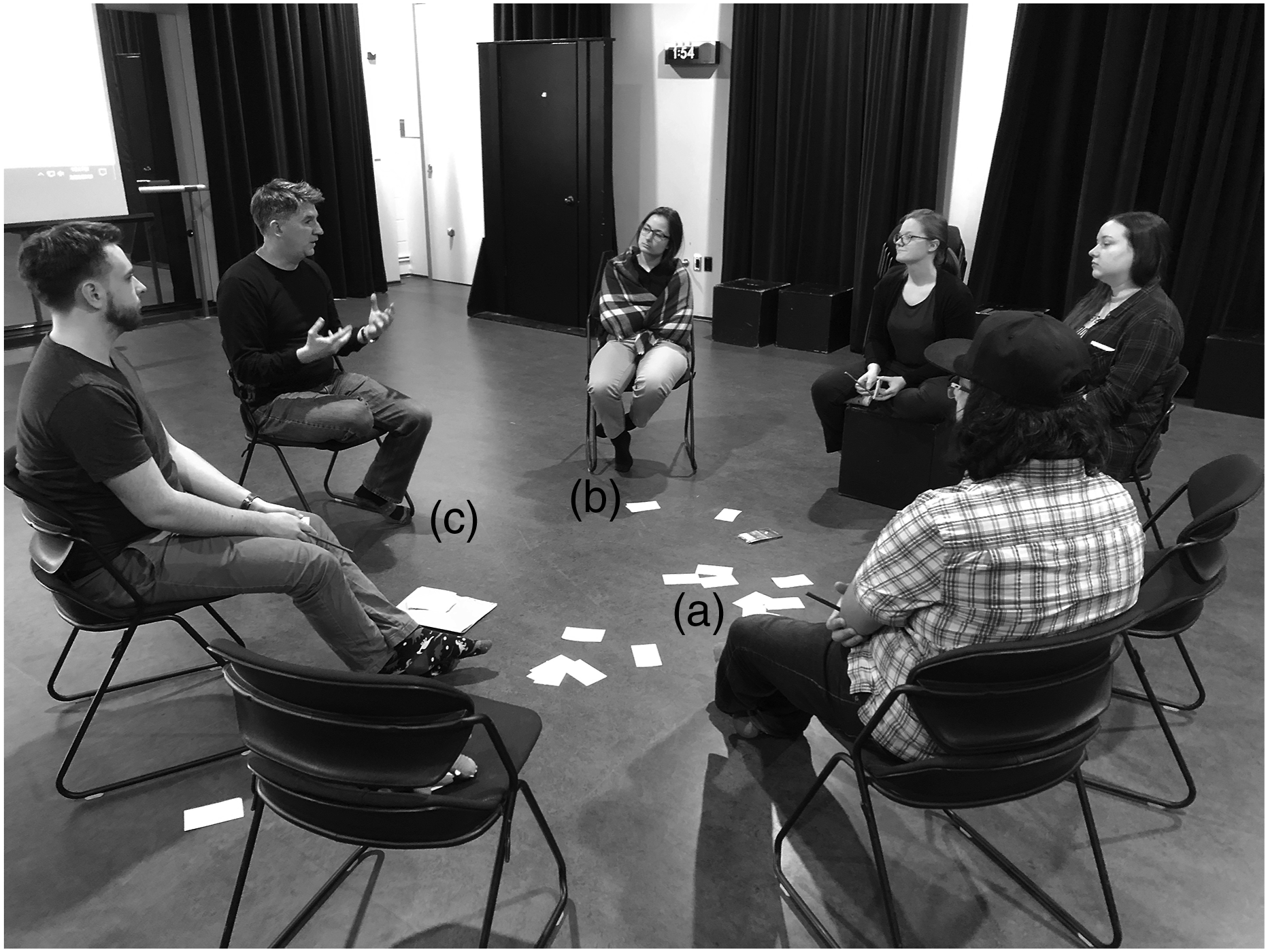
(Norris, 2024, p. 109).
With recent technological advances, scenes in progress are often recorded on smart phones and revisited for refinements in content style and delivery. ‘And the end of all our exploring; Will be to arrive where we started; And know the place for the first time’ (Eliot, 1943, p. 27). Through these ‘simulated-actuals’ (Norris, 2020a, p. 63) ‘people come to know of the world as they interact with it every day’ (Burns et al., 2012, p. 2), albeit through the somewhat safer distance provided by role play.
Beyond a means of devising scenes to perform for others, rehearsals are also an end in themselves. Whether rehearsals are referred to as a form of ‘participatory action research’ (Brydon‐Miller & Maguire, 2009), a ‘collaborative inquiry’ (Walton, 2011), or a ‘critical friends group’ (Kuh, 2016; Moore & Carter-Hicks, 2014), the A/R/T/ors learn and change throughout the devising process. They think things through dramatically. ‘This sensemaking combines simultaneous action and adaptive reflection as people navigate their way through real-life situations in order to survive, learn, and in some case thrive’ (Burns et al., 2012, p. 2).
Their stories, however, are more than mere reporting. According to Bolton and Delderfield, We need to throw out a sense that reflection is merely self-indulgent. Narcissus fell in love with his own reflection: This is self-indulgence. Reflective practice is not narcissistic because rather than falling in love with our own beauty, we bravely face the discomfort and uncertainty of attempting to perceive how things are. We seek to uncover dark corners by asking difficult questions (2018, p. 21).
Casts of MT use the mirror to re-examine themselves and the world around them. As a result of these collective reflections, they will change. One of the most difficult aspects of the collective process to achieve is to tell one’s story while being open to the diverse stories of others... Yes, our stories have merit, but they cannot remain stagnant. In Play building, we revisit them not merely to affirm them but to question them as well. A lecture or performance that preaches preset ideas can be deadly, creating in one’s audience resistance rather than a state of listening. If Playbuilding is to be dialectic, then many stories will change when they encounter the stories of others. We cannot expect audiences to enter into transformative pedagogy if we don’t practice and model it… There will be times when one goes through a self-indulgent phase. This is natural and to be expected. We are intricately tied up in the stories we tell ourselves. The danger is to remain there (Norris, 2009/2016, p. 58–59).
The final section, ‘A/R/Tor Reflections’ provides comments on how the A/R/Tors perceived changes in themselves as a result of being involved in the play building process.
Participatory Workshops
In the third stage, MT casts take their collection of scenes to the metaphorical ‘streets’, providing workshops to community agencies, university classes, school assemblies, hospitals, and academic conferences. The problem-based simulations (Anderson & Lawton, 2004) ask the audiences to rewrite the scenarios with the belief that ‘effective learning comes through the process of trying to change things’ (Burns et al., 2012, p. 2), in the case of playbuilding, through simulated-actuals. The workshops are what Ortiz Aragon & Brydon-Miller (2021) could consider ‘Learning through (and for) action’ (p. 564).
Martin (2013) extends the definition of playbuilding as participatory action research to that of professional development. He believes that ‘positioning playbuilding as a form of participatory action research in a professional development context challenges the notion of the professional development provider or facilitator as an expert’ (p. 5). While he starts with ‘a broad question and looked to the participants to shape the direction’ (p. 5), MT starts with activating scenes inviting audiences to interact with the content themselves or through the A/R/Tors serving as proxies. Both Martin and MT, however, do position participants as co-conspirators (Barone, 1990) who add their own insights to the event/topic. Rather than employing traditional didactic dissemination approaches, playbuilding is dialogic.
Building upon the works of Boal (1979) and other applied theatre practitioners (Prentki & Preston, 2009), the workshop uses a variety of techniques (Norris et al., 2024) including (a) remote control (to pause a scene for discussions, to rewind it to redo, and/or fast-forward to examine possible consequences, (b) out-scenes (that happen later with the same and/or different characters), (c) hot seating (where a character is asked questions by the audience), (d) inner-dialogue (here an action is frozen and characters give their thoughts and/or the audience provides possibilities), and (e) voices for/voices against a decision (where two other participants stand on either side of a character giving reason to do or not to do something – (See Photo 2), among others to translate ideas into possible actions (Hobbs et al., 20221). Articulating these can assist the action research community by providing ‘new methods that were contextually relevant throughout the emerging process’ (Brydon-Miller & Ortiz Aragón, 2018, p. 24). MT asks its audiences to (re)story what was presented, inviting change both in themselves and their live audiences as they reflect on scenarios (similar to case studies). They ask, ‘what if…’ in search of ‘concrete utopias’ (Barone, 1990, p. 311) or plausible actions that they may take in the future. Ontologically, playbuilding is transtemporal as A/R/Tors and audience members, in present-time, re-examine previous actions, and pre-live future hypothetical ones. Playbuilding is a reflexive rehearsal (Norris, 2016) for life (Courtney, 1980) in the somewhat safer spaces that drama can provide. Reasons for/against. (a) Person in middle of two other people with arms outreached to each side, leaning left, like a tug-of-war, (b) Person on the left holds the person in the middle' wrist pulling left, (c) Person on the right holds the person in the middle' wrist pulling right.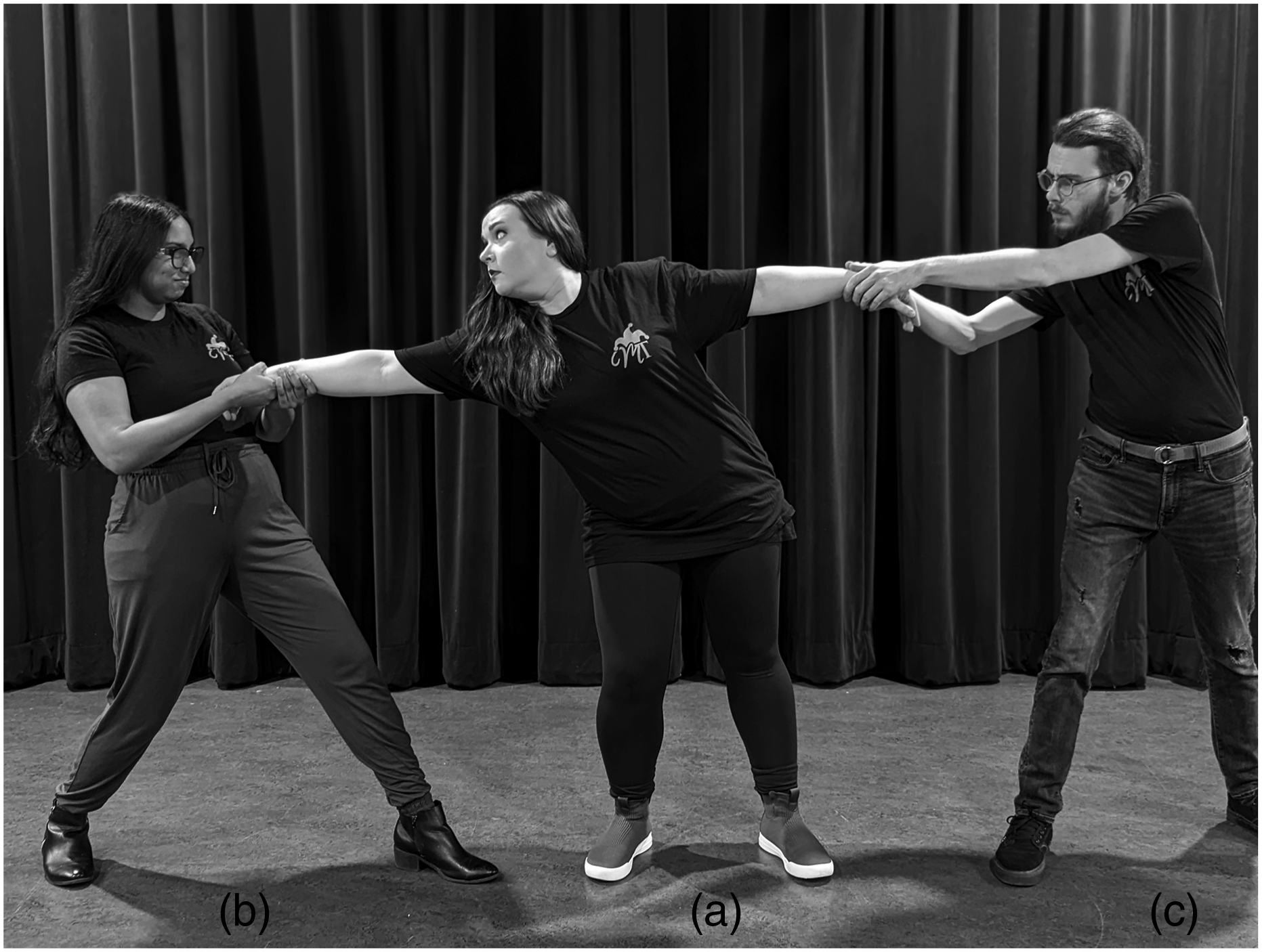
Projects
We have chosen four examples from MT’s current work to justify our claim that playbuilding is indeed a theatrical form of PAR. We also highlight ‘How are we trying to influence the world through participatory AR and qualitative research’ (Special Issue Call) in both the devising of scenes and through dialogic engagements with our audiences. While specific authors are acknowledged for each section, this article is a fully collaborative effort; each section was influenced by us all. They are sequenced in the order that the projects were devised.
Addressing Academic Integrity in University and ESL Settings
(https://mirrortheatre.ca/performance/common-knowledge-video/).
(https://mirrortheatre.ca/performance/you-be-the-judge/).
Joe Norris and Michael M. Metz.
In 2009, Joe was approached by the Academic Integrity Officer, Troy Brooks, with a request to devise some scenes that focus on the ‘integrity’ dimension of cheating. He was convinced that MT’s approach could provide much more than customary rules and regulations forms of delivery. He joined the cast providing stories and outlining issues to form a foundation upon which to dramatize the data for live performances and later for video. (https://mirrortheatre.ca/performance/common-knowledge-video/).
The devising was built upon both Troy’s information and the lived experiences of the A/R/Tors, who were mostly undergraduate students. Illustratively, an A/R/Tor had difficulty in comprehending that one could plagiarize oneself. Her confusion formed the foundation of both versions of the scene, Can You Plagiarize Yourself? One depicted her interested in understanding and the other, her being resistant. The spirals of scene construction helped elucidate the concept for her, cast and later, for MT’s audiences. Participatory action research can be a working/thinking through concepts through simulated-actuals.
The workshops themselves were also forms of participatory action research for all involved. The live version of Common Knowledge?, an improvisational semi-scripted play, was devised to be performed in a predetermined sequence followed by a participatory workshop. Collectively, the vignettes would provide a range of issues from which audiences would choose what scenes they would like to explore further. Such an approach gave the audience members choice, initiating participation with minimal risk.
During the workshop at the Annual International Conference of the Centre for Academic Integrity (Norris & Mirror Theatre, 2011) audience members of mostly university instructors added their own stories, with ‘being offered bribes’ a major one. This new information was incorporated into the second iteration of Common Knowledge? (Norris & Mirror Theatre, 2012). Because it was participatory, the event both informed and was informed by its audiences.
Originally, Common Knowledge? was recorded as one complete video of a live performance (https://mirrortheatre.ca/performance/common-knowledge-live/) but later edited into segments that addressed various issues. While the complete session was successful, it was deemed too long for Troy’s presentations to classes. Breaking it into segments would enable Troy to present what he deemed relevant. Part of MT’s action research is also about making refinements to its delivery methods. The adage, ‘know your audience’ is apropos for participatory action research. Common Knowledge? was later remounted and recorded in a studio as live performances do not always translate well into video formats.
James Papple from Brock University’s ESL Services was aware of Common Knowledge? and he and Eldon Friesen, requested that MT create a new series for their ‘speaking skills’ classes as they believed the workshop would also assist in skill development. This version eventually titled, You Be the Judge, had a completely new cast with Michael M. Metz being one of its A/R/Tors. This project serves as an example of a spiral where the initial project was revisited and transformed by a new group for its own slightly different purposes. Both projects are the subject of a monograph of the Arts-Based Educational Research SIG’s SpringerBriefs Series of the American Educational Research Association (Norris et al., 2025).
I (Michael M. Metz) had my first introduction to MT as a first-year undergraduate student, hen we spent a number of weeks collaborating in the creation of You Be the Judge. The new scenes were comprised of information provided by James, Eldon, and Joe as well as our own experiences of academic integrity. I recount my experiences as an A/R/Tor who worked with audiences in performance/workshops of You Be the Judge between 2015 and 2017. Through these reflections, I maintain that this form of action research is a dialogic form of participatory pedagogy that invites our audiences/participants (consumers) to join us in becoming co-producers of knowledge (Freire, 1986).
The workshops for You Be the Judge were structured to maximize participation and dialogue from the audience. Joe, as facilitator, would often start by showing a scene (either performed live by A/R/Tors or on video). We then would transition into some form of conversation about the scene. For example, we would often perform Failure is NOT an Option (Scene 2 - https://mirrortheatre.ca/performance/you-be-the-judge/). Here a character is given the opportunity to cheat, and in her imagination confronts the external pressures to succeed from her parents. Next we would break into facilitated small groups for a short discussion (See Photo 3). Small group discussion. (a) Person facing 3 people who are on other side of a table, (b) Person on left talking to the group of 4.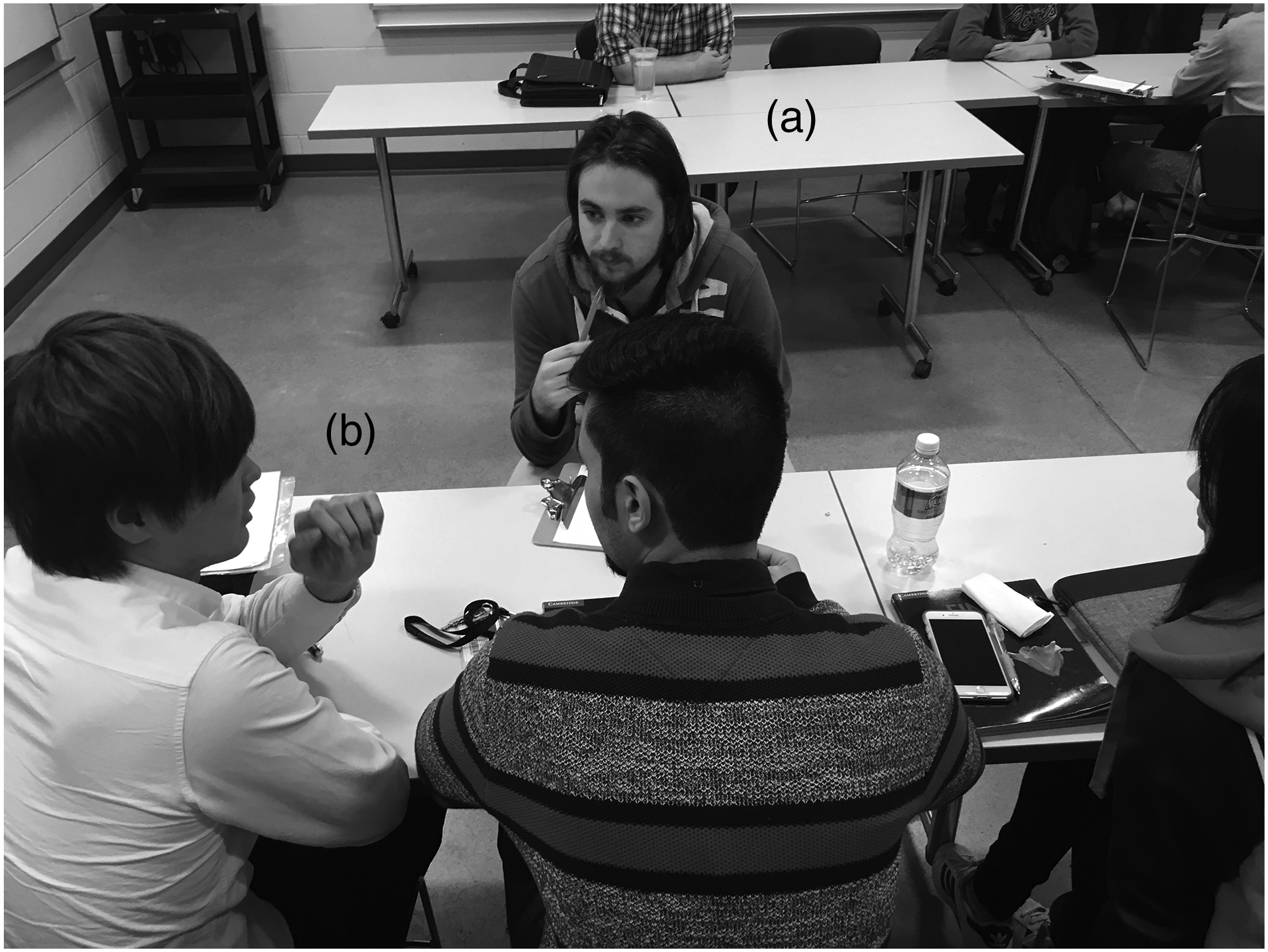
Often students would reflect on the pressures that they too experienced from their parents. I remember keenly how some would say that, as international students, they felt especially pressured because of how much money their parents have spent for them to come to school in Canada. Failure, for them, was really not an option. The conversation then became less about cheating and more about why we cheat in the first place. Through this dialogue, the pedagogical learning becomes clear: the integrity of academic integrity does not necessarily mean policing students’ written work, but it is gaining an understanding of the pressures that influence us to make choices. PAR does not necessarily mean achieving one’s goals; sometimes goals themselves change with a greater understanding of the complexities of the issue. Students in the workshop wrote and/or dictated what they might say to their parents about the pressures they felt, if given the opportunity.
Reflecting on this project nearly ten years later, I see how the conversation around academic integrity created action for the participants in the workshop, and also for myself. PAR should have a dialogic aspect, informing all participants. I now work as a part-time sessional instructor in a university drama department. In the last two years, I have had to attend multiple academic integrity hearings where I have suspected that written work may have been a case of academic misconduct. I find it interesting to now be on the ‘other side’ of the conversation around academic integrity, and how my participation in this work has actively contributed to how I approach potential academic misconduct. For example, I refrain from viewing academic integrity and cases of misconduct as punitive, although I believe they are predominantly seen as such. I remember in one instance, I was asked if I wanted to take additional marks off a student’s grade, in addition to the zero they received on a paper. Having known the student did well otherwise in my class, and to my knowledge had no other instances of this happening, I rejected the suggestion, as I did not believe further punitive measures would lead to any learning. Rather, I advocated that the student should take free courses on topics that they expressed led them to cheat: time management and writing skills. Had I not participated in You Be the Judge, I don’t think I would have come to the same resolutions. Change can happen well after an intervention/instruction and was my case with of You Be the Judge.
A Bigger Band: PAR and Person-Centred Care
(https://mirrortheatre.ca/performance/understanding-person-centered-care/).
Kevin Hobbs, Michael M. Metz, Bernadette Kahnert.
Person-Centred Care (PCC) is a philosophical approach to healthcare that prioritizes the holistic needs of the individual being treated for a medical ailment rather than the ailment itself. Further to that, however, PCC widens its scope of care to the needs of all the individual’s caregivers, including family, friends, and medical personnel. (Calisi et al., 2016; Santana et al., 2018). The bandwidth of care increases when individuals, ‘interpret information in the light of his/her own learning and then share this with the other team members using collaborative skills’ (Hall et al., 2007, p. 70). While not perfectly commensurate with PCC, Participatory Action Research has some parallels, as seen in Rohleder et al.’s (2021) multi-layered description of PAR: ‘Participation can take the form of just sharing information with research participants, consulting with experts by experience, collaboratively deciding on and agreeing to action steps, doing activities collaboratively, or supporting independent initiatives’ (p. 3). In both these models of collaborative inquiry, we are all research participants seeking ways forward, and all experts in our own fields-of-knowledge.
It was from this dual sense of collaboration that MT embarked on a research project about person-centred care (Hobbs, 2019), focusing specifically on the challenges and triumphs that might be found in the experiences of people who care for individuals with dementia or traumatic brain injury. These experiences were uncovered through an analysis of transcripts from a number of focus-group interviews with family and healthcare workers.
The eventual development of the play Understanding Person-Centred Care: Finding Dignity Within the Shadows, was guided by the objective to create a series of theatrical scenes for educational workshops, giving caregivers an opportunity to reflect on their own experiences and to express their own problem-solving methods that address shared challenges. Working with the view that all caregiver participants are co-researchers and experts, the play was built as ‘a framework of activities that enables them to systematically accomplish these tasks’ (Stringer, 2008, p. 15). The tasks being dialogic problem-solving.
In the previous section, Joe and Michael briefly outlined MT’s Participatory Action devising process for a full project. In this section, we will turn our attention to the details of two scenes in our person-centred care play, and how it is used in the context of PAR.
The scene, ‘Communication on Bath Day’, introduces a common scenario in long-term facilities that house people in cognitive decline. A basic concept of the scene is that a person with dementia refuses to take a bath when asked by the nurse. After the refusal, the nurse calls the son of the patient and learns that his father never took baths and was more accustomed to taking showers. Later, the nurse provides the patient a choice of a bath or shower and the patient then agrees to take a shower. In this short scene, PCC is shown through the healthcare provider working with the patient and family member to ensure that proper care is being provided (i.e. hygienic practices were being followed) and that the patient is comfortable with their form of care (i.e. taking a shower instead of a bath). PCC works to allow an open dialogue between patient, healthcare workers, and family, to guarantee the highest quality of care is being provided (Kenny, 2008).
When presenting this scene in an educational workshop, audience/participants commented on the sensibility of working with family members, but often noted the difficulty connecting with family members. Indeed, there are many family members who are simply absent in the care of patients. It seemed that the inquiry process stalled when the notion of distant relatives was present; however, we still encourage participants to look beyond the barriers and find creative solutions.
Alternatively, we also present a scene called ‘The Rowdy Bunch’ (See Photo 4), in which male friends are visiting a patient in a healthcare facility. When asked to lower their voices by a female nurse, they respond with sexist comments. The rowdy bunch. (a) Two people on the left facing each other and having a conversation, (b) 4 people (in shadow) behind a shadow screen kidding around.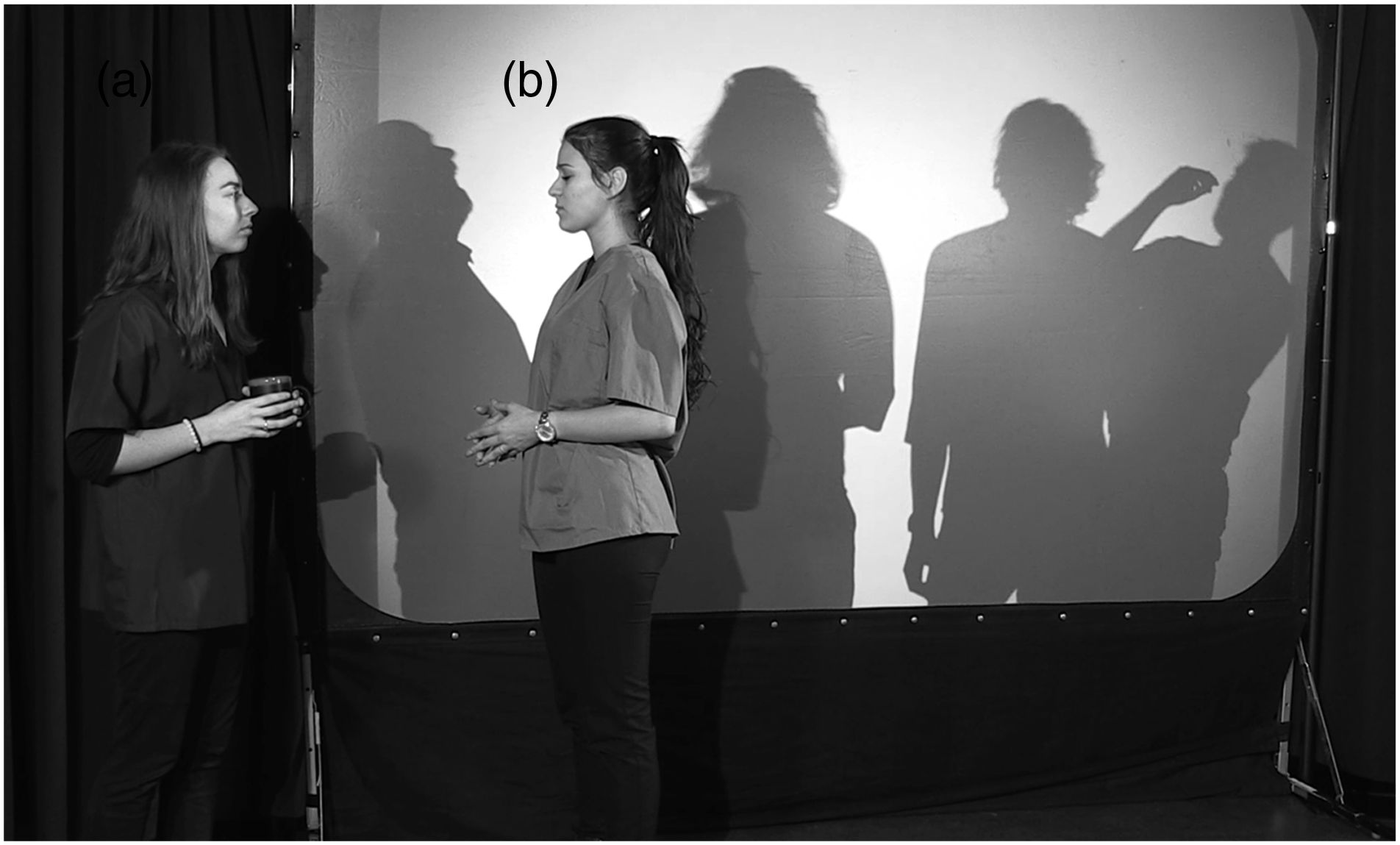
During a workshop with health care workers, ‘The Rowdy Bunch’ was deconstructed using a technique called ‘out-scenes’, in which participants imagined what could happen after the encounter. In this exploration, a participant entered the roleplay and decided that one of the ‘friends’ would be summoned to the facility’s administration office and threated with a visitation ban. When the participant, in role, was hot-seated about this, they stated that these were the facility’s rules. No other solutions to the problem of inappropriate visitor behaviour were considered. From the roleplay, it was concluded that a strict adherence to the rules themselves can exacerbate problems.
In both workshop examples, we noted that real-life responses to the posed problems of the theatre scenes tended to silo individuals who might be involved with the care of the patient. Sometimes family and friends don’t wish to be involved in a patient’s care (for whatever reason), and sometimes family and friends are prevented from involvement (due to strict rules and regulations). The comments in the transcripts of the interviews with health care workers and family members support our workshop discoveries. These results are the opposite of person-centred care. As PCC strives to find idealized solutions that benefit all parties involved in the care of an individual.
Attempts to widen the scope of healthcare support and the voices involved in research are faced with impediments. Angelini et al. (2021) state that implementing person-centred care in a health department setting meets resistance but ultimately there is ‘an overall reduction over time, indicating an increased readiness for change’ (p. 8). Keddie (2021), when elaborating on her experience introducing Youth Participatory Action Research (YPAR) in a school context, says that the outcomes ‘become instrumentalized and controlled’ (p. 382) when operating under the weight of a hierarchical school system, and Bleijenbergh (2018) shares a moment when her dean called her PAR research ‘methodologically not sound’ (p. 133). There is still lots of work before Person-Centred Care and PAR are widely embraced in their respective professions, but we believe that continuous efforts will increase the acceptance of community voice in the worlds of both health and research.
Early Warning Signs of Heart Disease-Heart DIS-Ease PlaY
(https://mirrortheatre.ca/performance/heartistic-journeys/).
Sheila O’Keefe-McCarthy and Kevin Hobbs.
The He-ART-istic Journeys-Heart DIS-ease PlaY is an example of a PAR project that translated the narratives of 23 individuals’ experiences living with heart disease into an applied theatre dialogic workshop to educate prelicensure nursing, medical, and allied health professionals. The Heart DIS-Ease PLaY invites the learner into 10 unique activating scenes that dramatize the internal and external journeys of individuals coming to the realization that early warning symptoms can lead to the development of cardiovascular disease. By actively unpacking and understanding this lived experience through workshops (previously discussed in this article as PAR in an education context), the next leaders in healthcare can engage in reflective practice. By creating a playful space to reflectively process – emotionally and cognitively – issues that impact and subsequently may influence how practitioners make assessments and treatment decisions can be the catalyst for transformative learning (O’Keefe-McCarthy et al., 2020; O’Keefe-McCarthy et al., 2022). Participants in these workshops engage in what Kemmis and McTaggart (2005) call Action Science, ‘the study of practice in organizational settings as a source of new understandings and improved practice’ (p. 561).
This level of reflective practice provides a concrete way to create movement for social change by engaging in evocative un-learning. Through the use of PAR and arts-based forms of education this serves to challenge and dis-rupt often uncontested biomedical knowledge [shifting to a more human experiential-related knowledge] about heart disease (O’Keefe-McCarthy et al., 2022). Ritterbusch (2019) notes that within education institutions, methodologically ‘oriented PAR curricula and service-learning frameworks run the risk of creating unilateral, semester-long relationships with communities in which the timing of interactions and contact is dictated by class schedules rather than by the daily and enduring urgency of injustice’ (p. 1301). Ritterbusch then reassures those who seek to use PAR as an educational tool by introducing into the discussion PAR researcher Caitlin Cahill and education philosopher Paulo Freire with the following: ‘Both Cahill and Freire remind us to rethink the subjects of conscientização not as students, professors and community members separately, but as a collective of individuals that work consistently, over time, to reach mutually established social justice milestones’ (p. 1302). For us, as both researchers and educators our dialogic approach to all of our work, including the He-ART-istic Journeys-Heart DIS-ease PlaY, situates us as co-investigators alongside workshop learners.
The Heart DIS-ease PlaY offers a process to challenge uncontested explicit or implicit biases that often become our blind reference points in rendering health care. Using PAR the Heart DIS-ease PlaY is a purposeful invitation. An invitation to be reflexive and interrupt or rather disrupt our assumptions, misunderstandings, and constructed knowledge(s) that may negatively harm many or positively privilege few within health care; this is imperative if health equity is to be realized.
For example, the play itself offers disruptions. In the scene, Advice, a person is given a litany of suggested life-style changes by a number of individuals (See Photo 5). One person suggests an Apple watch, to which the character responds, ‘I can’t afford that!’, bringing socio-economic status and class into the mix. Hot-seating the character about the litany itself and/or specific suggestions can expand our understandings of the impact of a diagnosis. All participants are invited into such a theatrical analysis. A litany of suggestions. (a) Person holding a series of file cards, looking up in a pondering expression.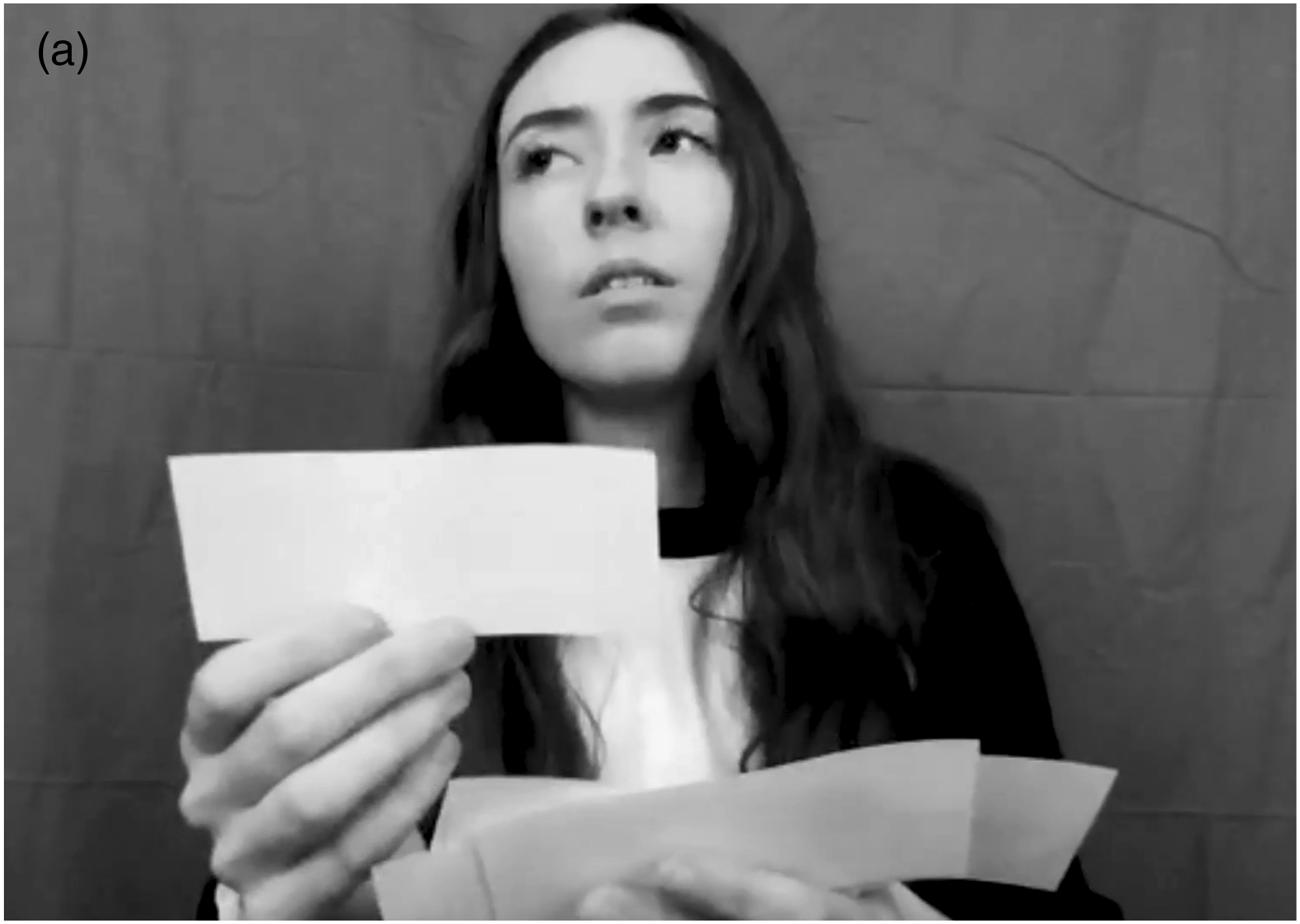
Using PAR as a vehicle to create social change incorporating applied theatre to engage in meaningful reflexive practice can be transformative for the A/R/Tors and their audiences. An educational opportunity such as this demonstrates how to become accountable for social change and to do the inner work required. We do this by asking difficult and disturbing questions. It is by being reflexive in our learning that we can dive deeper and actively listen, shifting our view from an individualistic one to the co-creation of knowledge that has the power and potential to change entrenched perspectives and influence social change. The distance of a roleplay can help one ease into self-reflexivity.
Disruptions and Accountability: Safety in PAR
https://mirrortheatre.ca/performance/haunting-our-biases/.
Nadia Ganesh, Valerie Michaelson, Kevin Hobbs.
One project that we have taken to the metaphorical ‘streets’ in university classroom settings relates to implicit bias. Health sciences students were learning about the harmful ways that implicit biases shape, privilege, and oppress health outcomes in Canadian contexts (e.g. Gran-Ruaz et al., 2022; Singh et al., 2023). Students were dissatisfied with simply learning about the problem and requested tools to help them become change-makers in the health system. In response, our team developed the program that eventually became ‘Haunting our Biases’.
In this project, we invite participants to become more self-aware and reflexive about their implicit biases. Elsewhere, we have described this kind of invitation for self-exploration as a ‘haunting’ (Norris, 2004. p. 14) that can leave a ‘lasting impression that can evoke self-reflexive actions and behaviours’ (Hobbs et al., 2021, p. 1). We present theatrical scenes that are simulations of real-life scenarios that draw attention to systemic bias and discrimination. We then facilitate conversations that invite deep multidimensional reflections on the scenes and invite participants to imagine ways of transforming the scenarios to centre accountability and justice.
The reflective and reflexive engagement with participants, we argue, is a form of PAR. Audience members – participants – become coinvestigators into possible solutions to the problems embedded in the scenarios. This form of training on implicit bias is unique because we are skirting approaches that involve dictating the right and wrong answers to a solution. We have received consistently strong positive feedback about the power of these workshops (Norris et al., 2024). Yet, we have also become acutely aware of the emotional toll that this material can take. In this section, we reflect on what we have learned about accountability for the safety and growth of the workshop participants.
We co developed nine scenes using Mirror Theatre’s playbuilding process. Each scene was designed to raise questions as opposed to answering questions. We then videotaped these scenes and created a teaching module that can be found online: https://ecampusontario.pressbooks.pub/implicitbiastraining/ (Hobbs et al., 2022). We also developed a workshop that can be presented in person to applied health sciences classes.
For many participants, this workshop is uncomfortable. In social justice education, ‘discomfort’ is recognized as pedagogically valuable (Boler, 1999; Taylor, 2015; Zembylas, 2015). It can encourage participants to move out of their comfort zones, challenge their own assumptions/pre-formed ideas, and engage with new thoughts and ideas. ‘This approach is grounded in the assumption that discomforting feelings are important in challenging dominant beliefs, social habits and normative practices that sustain social inequities and they create openings for individual and social transformation’ (Zembylas, 2015, p. 163).
Part of our reflexive journey has been around deepening our understanding of our own accountability to workshop participants within the intersectional complexities of discomfort. As a result, we have deeply and consistently reflected on how to create spaces that are attentive to the well-being of all of our participants. We have been challenged to understand that, while we have received positive reports of safety from some participants, we cannot assume that safety looks the same for everyone in the room, especially for participants from marginalized populations (AWARE LA, nd).
The authors have all been involved in the leadership of this project. One is a Woman-of-Colour and the other two are White (one woman, one man). Attention to our own social identities has been important as we lead this work, and also as we reflect on accountability in our own leadership. We each have different life experiences of bias and privilege due to ascribed characteristics such as race and gender that relate to power. It has required humility, constant self-reflection, and conversations within our group to recognize that regardless of good intentions, we can still make assumptions, reinforce stereotypes, and cause harm unintentionally/unconsciously. We have developed a process of accountability that continues to grow with us as we develop this project. We are grateful for the resources and leaders that we have consulted along this journey (e.g. AWARE LA, nd; Joseph et al., 2021).
Let us explain more specifically how we have taken actionable measures to achieve accountability. First, we have come to understand the importance of a trauma-informed approach to participatory action research in areas that are uncomfortable and potentially harmful, such as discrimination (Goessling, 2020; McGee et al., 2023). A trauma-informed approach is attentive to the pervasive nature of trauma in society broadly. We begin with the assumption that there are participants in our workshop who carry trauma that we have no way of knowing about. To the best of our abilities, we create environments of healing and safety with the intention of not retraumatizing (Goessling, 2020; McGee et al., 2023). One of our first priorities is the right of refusal to participate. We are transparent about the nature of our workshop and the potential topics that may emerge. Because we partake in dialogic engagements with participants, we never know exactly what one workshop will look/sound/feel like before it happens. We put supports in place before the workshop so that there is a safety plan for participants if they need support after the workshop. We begin each workshop with an accountability and care community agreement that we co-create with audience members. In this agreement, we acknowledge the difficulty of the content, and that we all come at this topic from different positions of power and privilege and from different personal experiences and family histories. While some participants may find the content new, others may have been touched by the content personally or through their own family or cultural histories. We discuss care for oneself and care for each other, and we present the goal of becoming reflexive practitioners (Bolton, 2010; Taplay et al., 2021), an essential dimension to PAR, which can require transformative learning and unlearning. We request that participants be sensitive as others share ideas and that they do not dispute lived experiences that may be shared. We encourage all participants, including ourselves, to be aware of our own privileges and to refrain from interrupting other participants or speaking on their behalf. We also remind all participants that because we have not had an experience ourselves does not mean that it doesn’t exist or is not a real experience for others (Sensoy & DiAngelo, 2017). We invite contributions from all participants and hold time and space to acknowledge all further ideas and input into this community agreement, recognizing that we all have responsibility for the environment that is created. Finally, we remind participants that the intention behind this workshop is to understand how bias operates as a health threat and to invite accountability. If at any point participants realize that participation in the workshop is contrary to their own well-being, we invite them to please stop. If this is people’s experience, we point them to context-specific resources from which they can immediately access help.
We have not always had such a robust safety plan and we are not proud of this in our work. We acknowledge that it is pedagogically and ethically appropriate to evoke discomfort in participants as long as it is addressed in appropriate ways (Kumashiro, 2002). This is important. We are grateful for the insightful and courageous participants who have drawn our attention to what safety truly looks like and does not look like for them and honour their contributions to this safety plan. In our thinking about a ‘pedagogy of discomfort’, it has been important for us to reflect on how we thought that we were creating safer spaces without truly understanding and honouring the complexity of safety in participatory spaces. One of the most important ‘actions’ we have taken from our participatory action research is to honour the safety of our participants and ourselves, and continuously be attentive to holding spaces ethically for this work. Similar to how each individual will have their own threshold for tolerance (Wagner, 1976), each D/A/R/Tor will have their own individual thresholds for factors that influence safety (see Norris, 2024) depending on the contexts of each workshop. As such, each safety plan will be shaped by the individuals participating or facilitating and the individual contexts central to each workshop.
Our work has left us with lingering questions on the appropriateness of pushing and challenging our participants broadly and how we are responsive to specific groups of participants. What cues should we look for that indicate that participants are in danger of being harmed? When can shutting down conversations lead to missed pedagogical opportunities versus when are we responsible and accountable to shutdown conversations in order to protect safety?
And is discomfort always an ethical pedagogical strategy, especially under the umbrella of a trauma-informed approach (Goessling, 2020; McGee et al., 2023)? While we believe strongly in the importance and power of this PAR work to stop implicit bias and discrimination in classroom settings, these questions rightly haunt us as we try to lead our participants to places of disruption, healing, and transformation while at the same time not doing harm.
Data
Data from Audience
Action as the Primary Indicator of Efficacy in PAR Reconsidered
Traditionally, action research consisted of a series of planning/acting/observing/reflecting spirals (Kemmis & McTaggart, 1988) where each reflection stage could lead to a new spiral with a new plan for action. According to Tulinius and Hølge-Hazelton (2011), ‘In the spiral of action research all participants are expected to work together towards a continuously developing fulfillment of the aims of the project. The data collection is supposed to lead to critical reflection, strategy development, and implementation in cycles, actively involving all participants and researchers’ (p. 42). Within this schematic, all participants are involved in all stages and ‘implementation’ seems to be the desired goal.
Initially, in keeping with the traditional model, we perceived that change could be a matter of degree with action being at one end of a continuum and awareness at the other with change in disposition and planned actions being between them:
Increased Awareness ↔ Change in Disposition ↔ Planned Action ↔ Actions Taken.
However, as analysis of the data below progressed, we found that each stage had merit, challenging the hierarchical structure with action as the primary indicator of change. With MT’s programs, each participant takes away their own insights to implement when and where they deem appropriate. Beyes & Steyaert (2011) ‘recommend viewing artistic endeavors as acts of intervention which reframe, disturb, or alter current configurations of world-making’ (p. 112). In describing their two ‘site-specific artistic interventions’ (p. 105), they encourage us ‘to re-assess and re-imagine questions of conceptual politics that view action research as world-making’ (p. 101). Their work culminates in public disturbances with action left up to those who experienced the events. The events themselves were the end points. The ‘outcomes’ method is not the only way of determining efficacy of participatory research as predetermined actions may not always be the ultimate goal or even desired.
If participatory research is to be democratic, providing participants with control, predetermining outcomes could be considered antithetical. Should it not be up to the participants to determine when, where, and how implementation is appropriate? Norris (2000) provides a narrative of reading a story where the protagonist used humour to diffuse a potential teacher/student conflict and how a few years later he returned to it, creating his own way of using humour. An action was not even planned, but, rather, it emerged. Norris’s story, as well as Metz’s, told earlier, found contextual situations in which they could apply their stories’ wisdom.
Building upon Habermas (1971), Aoki (2005) labels three curriculum inquiry orientations as (a) the empirical analytic, (b) the situational interpretive and (c) the critical theoretical. If we were to apply these orientations in the analysis of action research, the traditional plan/act/observe/analyse spiral would be empirical analytic. The emergent and contextual design like Norris’s and Metz’s stories with the participants deciding when, where, and how would be situational interpretive, and those ‘forg[ing] new paths forward in creating opportunities for positive change in our organizations and communities’ (Ortiz Aragón & Brydon-Miller (2021, p. 570), would be critical theoretical. Early forms of action research seemed to overly emphasize the empirical analytic.
Pragmatically, it also may not be possible to determine long-term effects of short-term interventions. Quinlan (2010) employed a follow-up interview model to determine if action took place after a participatory theatre workshop that examined workplace bullying with Continuing Care Assistants. One month following the forum, the participants reported in the interviews that the workshop and forum enabled them to see the formative seeds of a situation that might lead to bullying and take steps to circumvent it before it happens (p. 130).
The traditional spiral design was also not possible with MT’s projects as its work is short-term and participants attended the sessions for personal pedagogical purposes. Being tracked over a long period of time in a research project was not MT’s audiences’ initial intent and obtaining such participation would prove difficult to accomplish. MT’s goal is to provide evocative performances that foster “action for social change” (Ortiz Aragón & Brydon-Miller, 2021, p. 564), with implementation left up to the participants to apply in their own contexts. Like Quinlan, MT planted ‘seeds’ that it calls ‘haunting memories’. Mirror Theatre hopes that all leave with haunting memories of the scenes and conversations. Henderson (1992) encourages reflective practitioners to look for ‘unbounded questions’ that will never be answered but always addressed when one teaches. Questions like, ‘What do I do to foster student creativity and what do I do that inhibits it?’ and ‘How do I misuse and abuse my power?’ are unbounded questions than can and do guide daily practice. We encourage audiences and readers to generate their own questions as derived from our text (Norris, 2004, p. 14).
Longitudinal Data
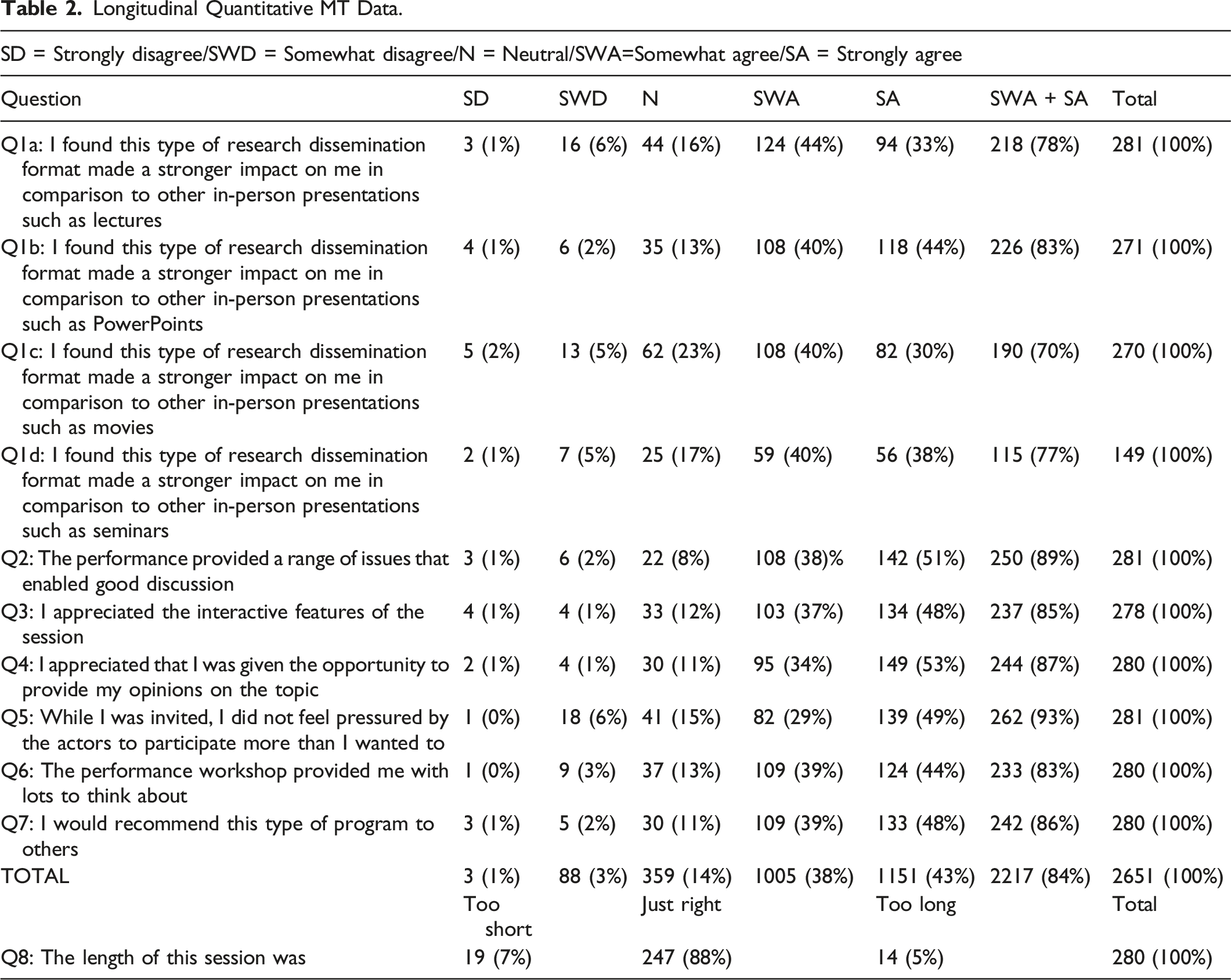
Given that long-term follow-up research was determined to be unfeasible, MT chose other research methods to determine the efficacy and impact of its participatory performance/workshops. A quantitative and qualitative questionnaire was distributed to audiences immediately or shortly after the approximately two-hour sessions. The Likert scale Question #6, ‘The performance workshop provided me with lots to think about’, suggests that they may continue to bring the conversation forward with 96% of the responses ranging from Neutral to Strongly Agree. Their responses provide strong evidence that addresses Ortiz Aragón and Brydon-Miller’s question, ‘How was action used in this experience to generate learning and provoke change?’ (2021, p. 567).
Action is not the only indicator of change. Determining what personal connections participants made is another. In addition to the numerical data, responses to qualitative questions provided specific details about the connections made.
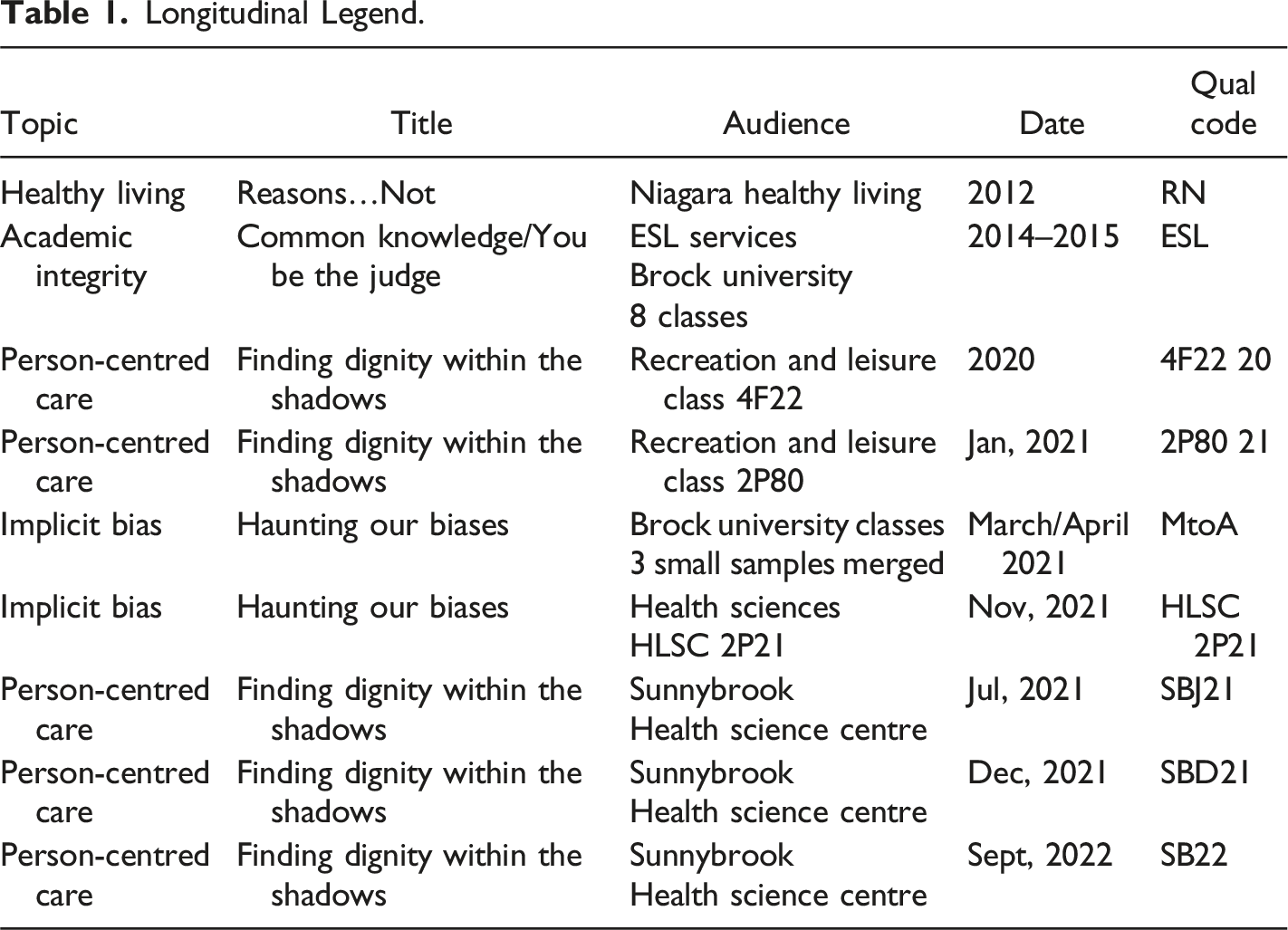
Longitudinal Legend.
Increased Awareness
Some participants reported that they made connections between the issues and themselves. They became more aware of how gender is read, the role of facial expressions when communicating, various dimensions of academic integrity, and the importance of listening. Such awarenesses, while not planned actions, can influence how one may behave in the future. • Yes. How I as a female can be interpreted by others around me. (HLSC 2P21) • Yes, I did, I was thinking about my facial expressions/body language looks like when I communicated with others. (4F22 20) • The program shows few circumstances I have never seen. (ESL) • It really reinforced the power and importance of listening to others, not only to what they say, but how they say it and maybe even the unsaid: what is implied. (2P80 21)
Change in Disposition
In addition to an increased awareness, some indicated a change in attitude as a result of the performance/workshops. Questioning one’s assumptions, being cognizant of how one labels others, and applying one’s insights on body language to their work all indicate that change has taken place. • This program did help open my eyes to my own personal biases, and made me realize how I shouldn’t just assume certain things about individuals. (HLSC 2P21) • I definitely did, many people label clients as aggressive or other negative terms and I kind of looked at this in a different perspective as to why the client is behaving in such ways. (MtoA) • Definitely my work life because of how it is more relatable to body language and group work! (MtoA)
Such changes in disposition can underpin actions in a variety of situations and may be a stronger indication of change than a one-off action that may not lead to permanent change. As a result, we rejected and challenged our continuum framework that ends with predetermined actions.
Planned Actions
While not the ‘gold standard’ in determining the efficacy of MT's work, reporting actions does have its place/value. Although audience members could indicate that they were open to follow-up interviews, none volunteered, leaving no information about actions that they may have taken later. They did, however, report that some actions were intended. Responses to question # 13 indicated that some were planning changes such as ‘taking the stairs at work, focusing on a person’s strengths, and delving deeper into a patient’s back story’. All indicate that specific actions were planned due to participation in the workshops. • Yes, it helped me consciously to find alternative ways to exercise – stairs etc. (RN) • I reconsidered how I approach caring for someone based on the knowledge I am provided by them. Reframing my view in a more positive light and focusing on their strengths first. Also addressing the root causes of why they are feeling that way and validating them. (2P80 21) • I focused more on work and how my students interact with patients. It can be hard to articulate to them proper methods of socializing with a patient. I think this would be a great tool to present to them so they can act out a situation before having to do it in ‘real life’. (SB22) • Yes. I could rethink about responsibility and priorities… do not leave an assignment for the last minute. (ESL)
While these indicate planned changes, it should also be noted that one participant also commented on how simulated-actuals would be valuable in preparing ‘my students’ for ‘real life’. As Burns et al. (2012) claim ‘Action is a way of knowing because life itself is conducted through action – people come to know of the world as they interact with it every day’ (p. (2) and participatory theatre is one such way people can learn through interaction in the somewhat safer space of role play.
Question #14, ‘Based upon the performance/workshop, what might you start doing, stop doing, continue or increase doing?’ was designed to determine if insights from the performance/workshops could assist in future actions by using the ‘“Stop, Start, Continue” (SSC) method’ (Burden, 2016, p. 51; and Norris, 2020b). Three categories of planned action were imbedded in the question itself, to stop a behaviour that one now considers undesirable, to start one that is now considered useful and/or continue or increase something that one is already doing. Molden (2014) articulates how ‘the mere exposure to socially relevant stimuli can facilitate, or prime, a host of impressions, judgments, goals, and actions, often even outside of people’s intention or awareness’ (p. 1). The SSC method not only assists participants in articulating what they might do but also may be a form of priming, increasing its likelihood to occur due to its articulation.
It was found that the participants, in a number of cases, indicated interpersonal and intrapersonal aspects to their stop, start, and continue planned actions. These became major themes.
Interpersonal
According to Buber (1958) one’s relationship with the world is ‘twofold’ (p. 5). It can place all things as ‘object[s]’ (p. 5) – an I-It relationship or one in which ‘Relation is Mutual. My Thou affects me, as I affect it’ (p. 15) – an I-Thou one. A number of responses could be considered a desire to have an ‘ethics of care’ (Noddings, 2015, p. 72) towards another, an I-Thou one. Being cognizant of how one labels others, asking questions of others, and being aware of the assumptions one makes, indicate that some participants aimed to improve their interpersonal relationships professionally and/or personally.
Stop • Based on the workshop, I will provide more opportunities for clients to share THEIR experience and feelings, and stop assuming. (2P80 21) • Not put labels on patients or anyone for that matter. (SBJ21)
Start • After participating in the workshop I will start paying more attention to the tone of my voice while talking with patients. (SBJ21) • I will start reading more to paraphrase better. (ESL) • Start asking more questions when introducing myself to others. (HLSC 2P21)
Continue/Increase • I will continue to be mindful of the tone and choice of words when interactions with others. (4F22) • I will continue to use language that is not derogatory to patients, let them tell me their story about who they are and why. (4F22 20) • I will continue to speak my opinions. My thoughts during the group discussion really sparked some really good conversations, and the performance encouraged me to stop making assumptions. How a person acts or what they look like upfront may not be how they really are. You can’t write someone off based on your assumptions of them. (HLSC 2P21) Part of an ethics of caring is how one communicates with another and some also articulated how they might attend to the technical aspects of communication such as choice of words, the tone one takes, and how one paraphrases.
Intrapersonal
Questioning one’s values, debriefing, reflecting before acting, are all strong indicators of reflective practitioners who not only wished ‘to discover which specific areas of practices we [they] need to improve’ but also examined their ‘personal, beliefs, theories, values-in-use’ (Bolton & Delderfield, 2018, p. 7). Those involved in the healthy living at work program reported personal commitments to exercise and diet.
Stop • Remind myself to not make assumptions as you don’t know someone’s story. (SBJ21) • I might slow down and interpret scenarios from a wider lens ensuring to encompass the predispositions and experiences of everyone involved and not just relying on my own values. (HLSC 2P21) • Stop making excuses not to exercise. (RN)
Start • I might start more debrief time, be more positive, realize that our profession is unique and to cherish it. (4F22 20) • One thing I may start doing is evaluating body language more on a deeper aspect in the same way that was done in the workshop. (MtoA) • I will be taking more time to step back and reflect before taking action. (2P80 21) • Push for more onsite fitness. (RN)
Continue • I will continue being increasingly more self-aware. I will stop feeling self-conscious when asking clarification questions. I will start being more proactive in situations to support the client/patient/resident even if it means stepping outside of my comfort zone. (MtoA) • I will continue to reflect on my own biases and acknowledge how it might affect the people I interact with. (HLSC 2P21) • Continue with personal fitness and better manage portions. (RN)
Some responded to more than one category [in brackets] • Start asking experienced people for guidance [Interpersonal Action]. Stop doubting my instinct [Intrapersonal]. Continue researching other tools [Intrapersonal Action]. (4F22 20) • For me: Stop doing = learn how to work with team [Interpersonal Action]. Stop doing: Copying [Interpersonal Action]. Continue = work hard [Intrapersonal Action]. (ESL) and others reported that while they found the program valuable to help better understand past experiences and/or assist their peers, they did not indicate that they planned to bring anything into future action. • Not personally (as I already think in this manner), however, I do think my colleagues/team could greatly benefit [Continue]. (SB22) • I would keep doing everything I do the same. I feel like everything about this program was only educational and shouldn’t really play that much a role in our lives; simply only to inform us on everyday things that are going around in this specific field [Continue, it didn’t affect them; almost like a continue]. (HLSC 2P21) • No, but I had opportunities to debrief which have been beneficial in past scenarios [Continue]. (4F22 20)
Longitudinal Quantitative MT Data.
A/R/Tor Reflections
Similar to the participants, the A/R/Tors also reflected on their beliefs and actions as part of the playbuilding process. Since contact information existed for the A/R/Tors, follow-up questionnaires could be and were distributed to them to determine the impact. A/R/Tors were asked a few question two of which are relevant for this article: (1) ‘How do you think you would use what you learned in the future, that is, the impact it will have on interpersonal relationships that require collaborative processes in your personal and professional life?’ and (2) Do you believe that your experiences in MT have given you agency in your life in general? How?
Four themes emerged from audience responses to these questions in regard to how participation in MT impacted their (1) confidence, (2) general actions taken, (3) educational approach, and (4) collaborative development. These became our major themes. However, we also noticed that A/R/Tors described being impacted and changed as a result of their participation in MT through increased awareness, changes in disposition, planned actions, and/or actions taken, with each stage having its own merit emerging in a non-linear pattern. The stage of change, as described by each A/R/Tor in their responses, is described [in brackets] to showcase how these stages can emerge in any order and how each stage is equally important and beneficial.
Confidence
• DSB – I have learned that I have the ability to instigate change simply because I have a perspective to share, and that perspective is valid. MT has empowered me to understand that my voice and person is compelling, indispensable, and valid [Change in disposition]. • AR – Knowing my worth and being a part of seeing the benefits of my achievements in Mirror Theatre has given me agency both within the company and my life in general [Increased awareness and Change in disposition]. • KN – I believe that being in Mirror Theatre gave me confidence because it was one of my first opportunities to ‘flex’ my theatrical muscles and that was a stepping stone for the rest of my studies [Change in disposition]. • NG – Mirror Theatre has provided me with support to gain self confidence and trust my abilities and ideas [Change in disposition]. I now have more confidence to contribute to collaborative process, without feeling as though I am not ‘good enough’, within my personal and professional life [Planned Action]. • BK – I do not feel like I can simply sit and allow things to happen without somehow getting involved. [Change in disposition] I find that I am questioning how I approach certain subjects now and am constantly thinking about different perspectives [Action taken].
Finding confidence deeply impacted A/R/Tors by increasing their awareness (knowing one’s worth), changes in disposition (perceiving their perspective to be valid), planned actions (contributing to collaborative processes in personal/professional life), and/or actions taken (questioning how one approaches different perspectives); each stage is clearly valuable to the personal growth and professional development of A/R/Tors. Participation in the research was transformative, making it PAR.
Indeed, determining and improving action is not the sole indicator of the value of MT’s work, however, many A/R/Tors have noted that there were changes in their intrapersonal/interpersonal planned or already taken actions/behaviour as a result of their participation in MT.
General Action’s Taken
• BK – In my personal life, I see myself using the teachings [of MT] as a way to further my understanding of the individual. I always say that I cannot truly get angry at someone because I do not know their reasonings for what they have done [Action taken]. • LD – Personally, it has impacted how I communicate and view my current relationships and ideologies [Increased awareness/Change in disposition]. I am working on speaking up, but I am a very anxious person… this tension is something that I have been working through in MT. My passion to stand up for injustice vs. my social anxiety [Action taken]. • AR – Mirror Theatre’s impact on me has been life changing. I have learned its core values of care and acceptance, inquiry and reflection, and most importantly, playfulness [Increased awareness] and use them in both my personal and professional life [Action taken].
Thus, regardless of one’s position on the importance of planned actions/actions taken (vs. increased awareness or change in disposition), the data suggests that participation in MT has resulted in change at each stage among various A/R/Tors. Conducive with MT’s educational workshops, many A/R/Tors have planned to or already work as educators. Similarly, many A/R/Tors described incorporating the values and practices that they learned in MT in their pedagogical approach.
Pedagogical Approach
• LD – I have learned about the importance of creating a safe and brave community space [Increased awareness], which I hope to create in my classroom/creative space [Planned Action]. • BK – I am on a path to becoming a Drama teacher and would love to bring Devised/Forum/Applied Theatre techniques into the classroom. [Planned Action]. • MM – I have always believed that Mirror Theatre is perfectly situated for educators. As a new educator myself, I feel like I have already been able to take so much of what I have learned and apply it to my practice [Action]. • AR – When teaching or leading a team about something I care about, I practice active listening, acceptance, and invite others’ opinions to also cultivate a safe space [Planned Action].
Here, some A/R/Tors described how embracing the values of MT (e.g. developing a safe community and active listening) affected their planned actions and/or actions taken while teaching. Many either plan to or have already incorporated playbuilding aspects into their classrooms.
Given MT’s collaborative dynamic throughout the devising and workshopping processes, many A/R/Tors also described learning and growing as a result of their participation in MT through reflection, changes in disposition, planned actions, and/or actions taken in regard to collaboration.
Collaborative Development
• BK – Nothing is done in isolation. We cannot create our work in isolation, and we will never arrive at an answer to the issues we present alone. We need one another. That is an extremely powerful message that I believe should be taught as soon as possible to people. [Increased awareness] • KN – Listen. Really listen [Increased awareness]. Be ready to say yes (within reason) to opportunities and being ‘scared’ isn’t always a bad thing. [Increased awareness]. • LD – Personally, it has impacted how I communicate and view my current relationships and ideologies [Increased awareness/Change in disposition]. • MM – I also think MT teaches you how to collaborate and work as a collective… I’ve learned to welcome ideas from everyone, to build stories with each other. [Increased awareness/Change in disposition].
Each A/R/Tor described growth in their collaborative development because of their participation, either through increased reflection, a change in disposition, or a combination of these stages. One A/R/Tor [AS] described how ‘My experience in Mirror Theatre has helped me to better understand the human condition and to look at myself and my relationships [Increased awareness]’. This increased awareness and change in disposition can produce considerable change beyond potential temporary changes in one’s actions; once again, our data highlights how increased awareness and changes in disposition are just as valuable in PAR as planned actions or actions taken.
Overall, our data supports the notion that playbuilding is a form of participatory action research that promotes deep reflexivity (i.e. increased awareness/change in disposition), may result in changes within one’s planned action/action taken for A/R/Tors and audiences alike, and that growth at each stage of the process is instrumental in creating and promoting change. Indeed, to recognize ‘How are we trying to influence the world through participatory AR and qualitative research’ (Special Issue Call) and achieve this through action, we must first look in the ‘mirror’ and be willing to change ourselves. As Burns et al. (2012) claim, ‘Effective learning cannot be abstracted from action. We take action as a result of our learning, and we learn from our action. This is why action research is so important’ (p. 2).
Footnotes
Declaration of conflicting interests
The authors declared no potential conflicts of interest with respect to the research, authorship, and/or publication of this article.
Funding
The authors disclosed receipt of the following financial support for the research, authorship, and/or publication of this article: eCampus Ontario (Implicit Bias Training for the Applied Health Sciences), Social Sciences and Humanities Research Council Insight Development Grant (Reuniting form and content: Generating, mediating), Sunnybrook Practice-based Research and Innovation Seed Grant Program (Enhancing Person Centered Approaches to Responsive).
