



Abstract
This paper examines the ways that artful inquiry affords qualitative research students newly creative and embodied opportunities to understand and engage with subjectivity and bias—important concepts in the field of qualitative inquiry. Moving beyond the inadequacy of traditional teaching practices, such as student-generated written subjectivity statements, we share here an artful methodological approach using paper dolls to disrupt conventional engagements with these concepts. Inspired by Donna Haraway’s emphasis on layer(ing)s of subjectivity and Karen Barad’s discussion of cutting together-apart as a creative process, we draw from collaging in/as research to offer this paper doll activity as a constructive and disruptive way to invite students to consider themselves as complex, messy, and inevitable aspects of the research process.
The Beginning
*ding* “Oh, wait, April. I’ve got an email from a Qual I student. Wait just a second.”
Stephanie put her paper dolls down to focus on the laptop. We had both begun to play and think with paper dolls as a means of artfully pushing students to inquire into their subjectivities and biases. “Okay. No problem.” April continued working with her paper dolls on the desk in front of her as she waited.
Stephanie scanned the email and involuntarily chuckled.
April laughed in response and asked, “What’s funny?”
Shaking her head, Stephanie replied, “Not funny, just part of teaching introductory qualitative research classes.”
Gesturing to the laptop screen, Stephanie read from the email: “Dr Shelton, I’ve done the readings and watched the videos, but I still think there has to be a way to decrease bias, get rid of subjectivity, and increase objectivity.”
April sighed and replied, “Yeah. That was me once. It’s just how we’re trained to think about research, you know?”
Stephanie nodded and with a tight smile responded, “Yes. I know.”
Both returning to our paper dolls, we smiled in anticipation of the ways that this form of artful inquiry would support students’ considerations of these concerns in new and disruptive ways.
This paper engages in artful inquiry to examine new ways for qualitative research students to understand and engage with subjectivity, bias, and objectivity—important concepts in qualitative research—differently. We are both qualitative scholars who have taught and co-taught research courses, and we consistently find that students struggle with what subjectivity is, why it matters, and how to do it. A contributing factor to this uncertainty is their struggle to break with more traditional understandings of what counts as research and the modes through which they might conduct high-quality research. Our teaching experiences have highlighted how consistently students (mis)understand subjectivity (and bias as an element of subjectivity) as a problem to be solved by objectivity. Given how ingrained these conventional and reductive notions are, we recognize the inadequacy of current common teaching practices, such as subjectivity statements, to address these concerns.
The activity upon which this paper is based started with us exploring, for ourselves, how we might disrupt conventional, linear ways of conceptualizing and contextualizing subjectivity and bias. Long-held practices common in qualitative scholarship, such as writing subjectivity statements, have not pushed students with whom we work to reconceptualize these tenets in consistently complex ways. “Perhaps words are insufficient,” we thought. We turned to artful engagements with collaging to consider how we might make the invisible both visible and tangible. As we worked and thought through collaging, we realized that paper dolls were a powerful metaphor and strategy to interrogate the self within research practices. In working with the dolls, we opened fissures that didactic practices had not afforded and that disrupted our own engagements with these concepts. Having found the artful work powerful for us, we invited Stephanie’s students, enrolled in an introductory doctoral-level qualitative research course, to engage with us.
In this paper, after an overview of subjectivity and bias in qualitative research, we share those artful efforts to disrupt conventional approaches to these concepts. Inspired by Haraway’s (1988; 2016) emphasis on layers of subjectivity and Barad’s (2014; 2015) discussion of cutting together-apart as a creative process, we share our and students’ thinking with/through collaging in/as research, to offer paper dolls as a constructive and disruptive way to invite students to consider themselves as multifaceted, complexly layered elements of the research process. This effort underscored that when students engage with subjectivities and bias in thoughtful, nuanced, and material ways, they are better situated to design and conduct research that is ethical, meaningful, and generative.
Moving Beyond Words with Artful Inquiry: The “Dilemma” of Subjectivity and Bias
We have both taught research methods courses for years, across undergraduate and graduate levels, including recently co-teaching an introductory-level qualitative research course that emphasized the necessity of meaningful approaches for students to think critically about subjectivities and bias. Stephanie is a queer white lesbian woman who is an associate professor of qualitative research; April is a Black cishetero woman who is a doctoral candidate earning a degree in qualitative methods. As we have engaged in our own qualitative inquiries and supported students’ efforts to do so, we have come to appreciate the challenges, inconsistencies, and seeming impossibilities of navigating subjectivity and bias as essential to understanding and doing qualitative research (e.g., Breuer & Roth, 2003; Mehra, 2002; Peshkin, 1988; Pope & Shelton, 2024; Siegesmund, 2008). Subjectivity, broadly defined, refers to “an individual’s beliefs, biases, preconceptions, and positions that influence how they make sense of and engage with the world around them,” both within and beyond research (Roulston & Shelton, 2015, p. 333). Bias is an element of subjectivity historically framed as a scholar being “prejudiced” or unfairly drawing conclusions within/from the research process (Schwandt, 1997, p. 147). As we both have taught qualitative methods, we have found that students regularly conflate the two (Roulston & Shelton, 2015). They are, respectively, and collectively, understood as “a problem to be eradicated” (Roulston & Shelton, 2015, p. 333), which situates all aspects of who a researcher is as obstacles to high-quality research. As the student’s opening email and April’s response reflect, there is an acculturated default within qualitative inquiry that researchers will work to erase themselves—as meddling and messy distractions—from the research process. A major aspect of the challenge to change this thinking, which we discuss later, is that conventional efforts to equip students to think of subjectivity and bias in nuanced ways often rely on flattened, exclusively writing-based efforts to engage in ineffable and complex concepts, which we found that our artful inquiry with paper dolls helped to address.
Learning to Examine Subjectivity and Bias
Stephanie’s involuntary chuckle at the email, and at all of these ongoing efforts, is because erasing the self from research is not only impossible but also irresponsible. Despite the common stance that subjectivity and bias are inherently bad, Guba and Lincoln’s (1989) discussion established early on the degrees to which research is constructed by researchers, and how important researchers’ values and positionings are to understanding research processes and products. Peshkin’s (1988) groundbreaking discussion offered an exploration of different “researcher I” subjectivities, which has served as a foundational text in innumerable qualitative methods courses and the basis of written subjectivity statements serving as a common qualitative practice (Pope & Shelton, 2024; Roulston & Shelton, 2015).
Preissle (2008) explained that subjectivity statements are “a summary of who researchers are in relation to what and whom they are studying” (p. 844). These statements are an active rejection of the stance that research can and should be objective, instead centering researchers not as passive conduits or hindrances but as integral parts of research processes. Within the field, these statements, typically short written declarations, are useful and important, but they are insufficient. Because subjectivity statements often work less as interrogations of self in relation to research and instead as efforts to confess “potentially hidden [...aspects of] a researcher’s knowledge of self” (Roulston & Shelton, 2015, p. 333). Again and again, semester after semester, we have found that subjectivity statements become “a confession of wrongdoing to seemingly apologize for leaking humanity into scholarship” (Shelton, 2024, p. 3).
Given the insufficiency of longstanding practices and continuations of emails like the one in the opening, what do students and we do? Perhaps a core issue is that qualitative research has adopted a tradition of putting into writing concepts for which words are simply insufficient. Artful inquiries, however, open new possibilities and offer researchers “methods to engage […] issues that might be difficult to articulate in words” (Gerstenblatt, 2013, p. 306). We realized, in exploring our own artful efforts, that there needed to be new ways to consider these topics in in-depth and meaningful ways thereby encouraging new modes of doing and thinking.
What To Do? Artful Inquiries Into Subjectivities and Ourselves
Solely writing about subjectivities and biases is insufficient because written explorations reduce complex, multidimensional, and sometimes contradictory aspects of ourselves into what we might fit exclusively into words, and often just a paragraph. Leavy notes that one of the most important aspects of art is that it elicits unfiltered multifaceted reactions that are “visceral, emotional, and psychological, before [they are] intellectual” (2017, p. 3). Artful inquiries are already situated within the “polarized” and “antithetical” historical divides between objectivity and subjectivity that trouble qualitative inquiry (p. 3), and artistic expression offers means to navigate between and among the seemingly contradictory spaces of the creative and the academic, constructing new spaces and opportunities to negotiate subjectivity and bias more meaningfully and in-depthly. Garoian (2013) emphasized that artful approaches to learning and research create “expansion and extension of my cultural space[s] interconnecting” with self and others, working “to contextualize and distinguish the particularities” within and beyond ourselves (p. 6). Subjectivity and bias are not unidimensional and straightforward concepts, so reducing examinations to a few lines of writing is illogical and ineffective.
As we thought practically about how artful explorations of subjectivity would work and what those efforts might look like, we were informed by the contributions of others who had similarly worked to explicitly tie students’ learning and artmaking in qualitative research, in efforts to encourage students to think deeply about their methodological practices through artful inquiries. Though there are limited discussions, and none directly connect to our own efforts, these scholars’ discussions were invaluable. For example, we appreciated Bogumil et al.’s (2017) use of art as a pedagogical tool to tie reflexivity to artistic expression. Related, Skukauskaite et al. (2022) highlighted how art helps student learning to transcend traditional pedagogical and methodological practices and consider researcher reflexivity more in-depthly, and Coleman and Osgood (2019) emphasized the new and nuanced opportunities afforded through artmaking in workshops centering research ethics.
Inspired by these and other scholars’ pedagogical efforts, we thought with Haraway (1988), whose work has been foundational to theorizing and expanding understandings of both subjectivity and artful interrogations. Haraway notes that subjectivity and bias are “‘embodied’ accounts” that require meticulous work to peel and explore “every layer of the onion” of ourselves and our research projects if we are to move beyond the contentious and unhelpful “bias versus objectivity” dichotomy (p. 578). Laptop keyboards, pens, and pencils are simply not enough to communicate the lived and messy aspects of subjectivities. Haraway pushes scholars to explore “how meanings and bodies get made […] in order to build meanings and bodies that have a chance” for new research possibilities (p. 580). This emphasis on embodiment and creativity resonates throughout artful inquiry, as scholars consider the self “not just [as] arm and leg, but head and heart” (Garoian, 2013, p. 25). Scholars across disciplines underscore new possibilities afforded through artful inquiry that empower students to engage in longstanding qualitative concepts anew. These discussions include social justice-oriented research through dance (Lowery, 2024; Ylönen, 2003), reflexive activities through multiple artmaking practices (Flint & Wang, 2024), interviewing through performative movement (Ezzy, 2010), and understanding researcher identity through collaging (Li, 2023), and we hope to add to these explorations here.
Layering, Cutting, and Playing
We work to enact Haraway’s demand of examining subjectivity and bias as embodied layers, while negotiating the additional challenge of serving students in an introductory research methods course. The discussion that follows is based on our efforts to integrate artful inquiry into students’ considerations of subjectivity and bias during Stephanie’s online asynchronous introductory qualitative research class. Other artful approaches that we might have adopted to support students’ and our own efforts did not work well with students scattered across the United States and only meeting asynchronously through videos and discussion boards. We needed a personalizable and easily accessible artful approach.
Embodied Layers
What might those look like, and how might they work, exclusively online? How might they be manageable in terms of students’ circumstances, and affordable relative to necessary art supplies and technology? As we continued to think about doing artful inquiry with Haraway, we noted that Haraway (1988; 2016), in troubling notions of objectivity and subjectivity, theorized with Barad’s (2007) emphasis that these connections and layers “do not produce absolute separations” to be bifurcated in the name of scholarship (2014, p. 168). Instead, emphasizing the “infinite multiplicity” of the layer(ing)s, individually and collectively, they are “cut together-apart” in “infinitely rich,” creative, “never finished” ways (p. 169).
Barad underscored the degrees to which we are all “a patchwork. Made of disparate parts,” but cautioned that those parts are not remnants of some former “original wholeness” (2015, p. 406); instead, we have always been composed of parts and pieces (see Shelton & Flint, 2019 for related discussion). This, we thought, was a reason that examining subjectivity and bias was so challenging—students and we, as instructors, had treated the concepts as static things that might be conveyed and then fixed in subjectivity statements, and given our considerations of other artful endeavors and our own play, we recognized instead a new opportunity to (re)imagine subjectivity as a constantly dynamic collaging of selves, contexts, and concepts. The means to communicate such concepts became necessarily different from conventional strategies. There were/are constant cuts being made, as we trim(med) away old versions of ourselves and clip(ped) out new reflections of/on us. Barad’s discussion of “cutting together-apart” emphasizes that cutting and trimming are necessary if we hope to (re)assemble and understand in new ways (2015, p. 406).
Embodied Layers. Cutting. (Re)Assembling
This new conceptualization of subjectivities, drawing on adjacent literature on artful inquiries while offering new approaches, demanded that subjectivity be an active process that students and we do, not a statement/thing that they and we simply produce. Importantly, borrowing from both Haraway (2016) and Barad (2015), this “extension of subjectivities” was one that should be “in play,” that is, playful (Haraway, 2016, p. 129). For too long, we realized, subjectivities had been dismissed, rejected, and threatened as problems, leaving absolutely no joy or playfulness in researchers’ efforts to consider them.
Embodied Layers. Cutting. (Re)Assembling. Playfulness. Joy
Combining these multiple concepts pushed us to arrive at an artful approach through which students and we explored researcher subjectivities: paper dolls.
Artful Play With Paper Dolls
Building from the literature that had already informed our efforts, we wondered how/if others had considered artful play with paper dolls in relation to aspects of qualitative methodologies. We found that there were instances when paper dolls were used metaphorically (e.g., Watharow & Wayland, 2024) and when children were offered paper dolls as a play option (Mäkinen et al., 2024), but we discovered none related to what we planned. Venturing into new spaces/practices, we began first by playing ourselves (see Figure 1). We found, printed, and cut out various paper dolls from a range of sources, including https://Etsy.com, online paper doll forums, and Victorian paper doll sites, working to represent/embody ourselves in these paper layers. As we did so, and as we discuss in more detail later, we found limited representations of queer and people of color, and thus there was no one set of paper dolls that allowed us to layer ourselves. We had to cobble together multiple resources, multiple images, just to obtain individual layers that approximated what we hoped to convey. Stephanie’s (Left) and April’s (Right) Paper Dolls From Initial Play.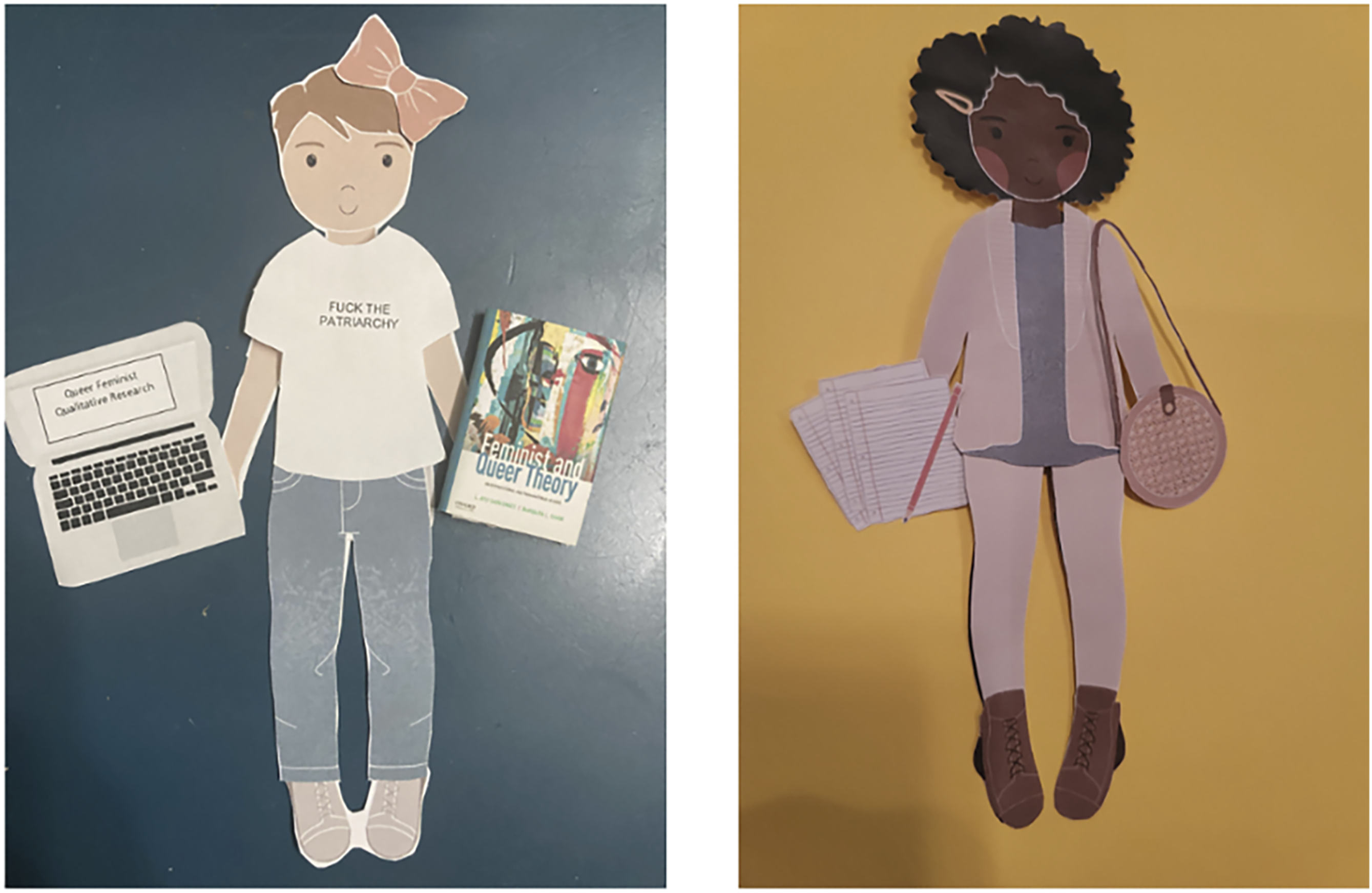
Our play meant making intentional cuts, as Barad (2015) had described, and then layering them, as Haraway (1988) had emphasized, with our choices on the top of one another to dress and accessorize the dolls. Stephanie, for example, placed a bow on her (boy) doll’s head to suggest the juxtaposition of masculinity and femininity while holding a book on feminist and queer theory and wearing a t-shirt reading, “Fuck the Patriarchy.” April ensured that her doll’s hair reflected her own (an ongoing challenge) and that the doll held both a purse as a personal item and sheets of paper to indicate her research. These layers, we agreed, were connected to collaging, and so we turned to artful engagements with collaging as a way to ground our paper dolls within qualitative inquiry.
Collage is often situated within post-theories, including post-theorists Haraway and Barad who had already shaped our thinking (Scotti & Chilton, 2017), and—just as we were doing—it is an approach marked by selecting images, cutting them to fit the intended purpose, and then attaching them to the intended surface (Butler-Kisber, 2008; Chilton & Scotti, 2014). Collages feature “diverse images [that] are brought into unity” for an “elevated” purpose (Scotti & Chilton, 2017, p. 356). The process is also deeply contextualized by the artist, the purpose, and materials, with the effect being to recontextualize meanings through the combined images (McLeod & Keunzli, 2011; Scotti & Chilton, 2017). Connected to the research process, collaging when informed by Haraway and Barad, often produces “shifting interplay of multiple additional meanings, challeng[ing] the idea of objectivity” and highlighting instead the creator’s subjectivities (Scotti & Chilton, 2017, p. 358; see also Gerstenblatt, 2013).
The Process of Layering Researcher Identity and Subjectivities
With firm footing offered by Barad, Haraway, and collaging scholarship, we invited students to begin to play through art and artfully, so that the connections, juxtapositions, and layers regularly centered in subjectivity statements became newly enacted, visualized, and embodied through dolls. In what follows, we share examples from that play from a student in Stephanie’s introductory doctoral-level qualitative methods course who consented to have their dolls included, as well as our own efforts. As the point of the paper dolls was to explicitly examine layerings of self within the research process, the students and we had guiding instructions and prompts in the course syllabus, which are included in the examples that follow. Using these provocations, we and the students each built at least five layers of/for our dolls, and then afterward reflected on the process, our choices, and our products through a writing activity on a class-wide collaborative online bulletin board where Stephanie posed questions related to the assignment. Students used the virtual bulletin board to post responses, images, post-it notes, and memes. As we did not want our own play and reflections to disrupt students’ efforts in any way, we communicated via personal texts and emails to respond to the same prompts provided to students.
Before the Layering Began
We selected a variety of paper dolls, mainly from artists on https://Etsy.com, offering diversities in skin tones, hair styles, gender expressions, accessories, settings, etc. (see Figure 2 for some examples). Students and we could choose from these files, select their/our own, and/or mix and match. Additionally, because we did not want the online students prevented from fully engaging due to resources, students also had the option to play with the dolls digitally instead. Examples of Paper Doll Template Choices.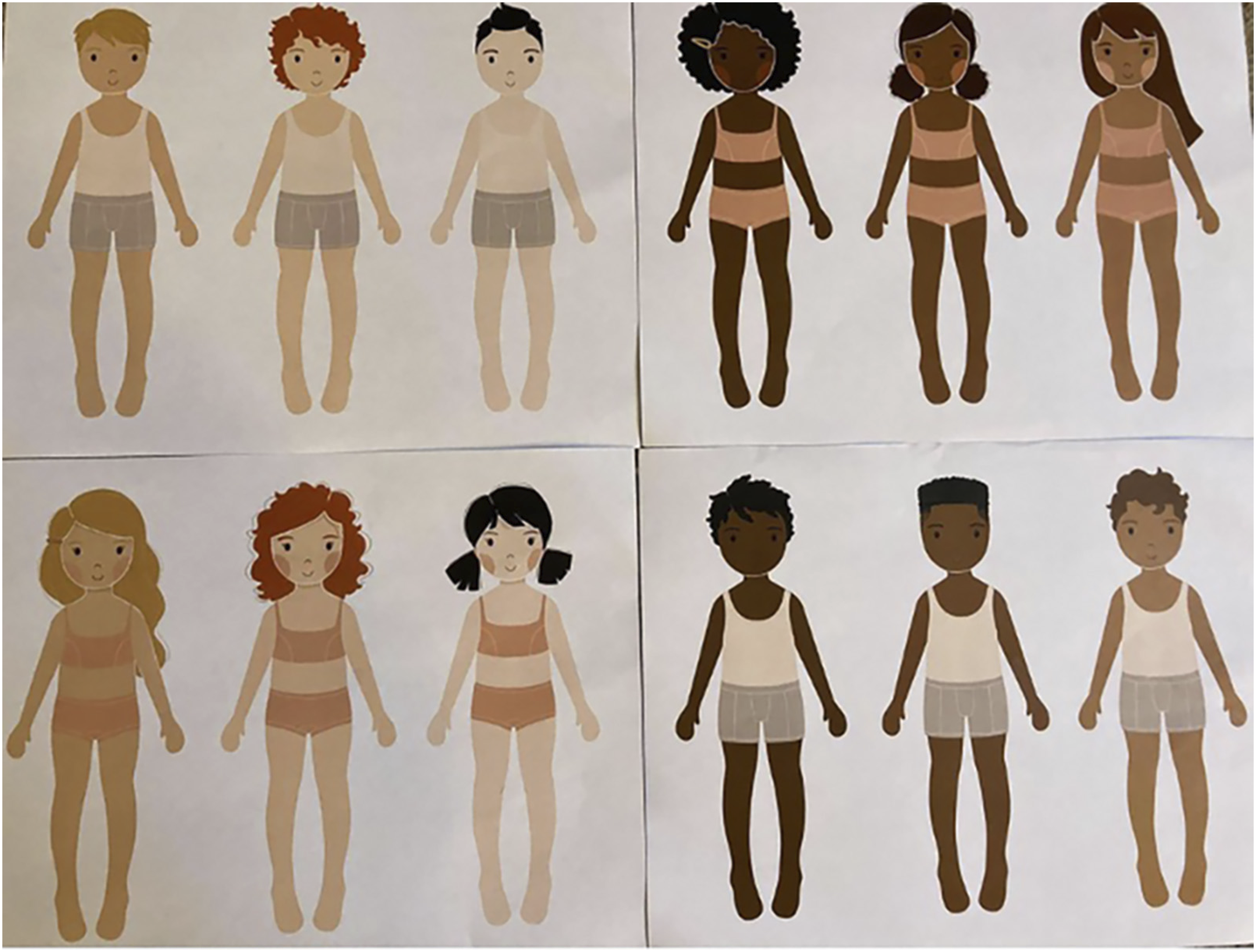
This stage was unexpectedly challenging, as we found that the vast majority of paper dolls were white girls and women who conveyed conventional feminine gender norms. For example, April struggled, even after we found Black dolls that she liked, with the dolls’ hairstyles, as few of the dolls featured natural hair. She ultimately resorted to cutting the hair from one doll and adding it to another as a solution. Relative to gender norms, nearly all girls/women had long hair, wardrobes of floral, flowy dresses, and feminized accessories such as lipstick cases and mirrors. As a queer woman who often presents masculinely, Stephanie was frustrated that there were no girl/women dolls that were not overtly feminine, and she ended up using “boy” dolls for her layers and combining multiple doll sets to find appropriate objects for her dolls. These challenges pushed us to play and create in unexpected but nuanced ways, with artful efforts to select, cut, and dress/accessorize the dolls, explicitly pushing students and us to visually represent our identities, within and beyond research settings, in ways the play sets had not intended and that were atypical when composing on subjectivities and identities.
The First Layer
The first layer was, from the syllabus, “create a paper doll that represents you as the person you are at home, at your most comfortable and relaxed.” In the example below, we share Stephanie’s and a student’s first layer, with Stephanie opting for the literal paper dolls and the student using a digital option (see Figure 3). Stephanie’s (Left) First Paper Doll Layer in Paper. Student’s (Right) First Paper Doll Layer Digitally.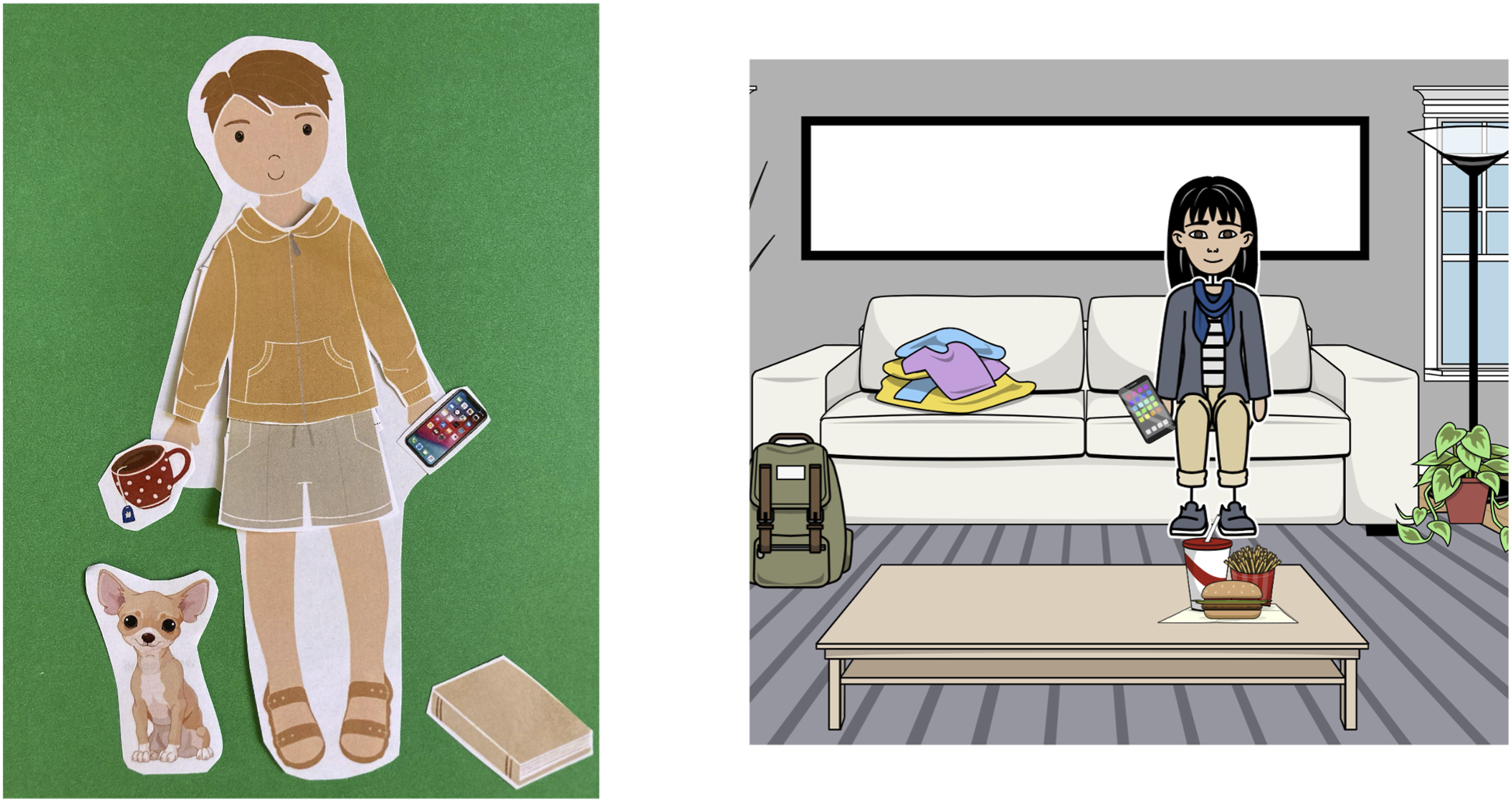
There were notable similarities across the various dolls that students and we produced. Regardless of whether we chose to enact our artful interrogations through printing, cutting, and layering paper, or selecting, dragging, and layering digitally, most of us chose cozy surroundings, accompanied by pets, favorite foods, and drinks, with peripheral representations of academia (such as books and bookbags). Our cuts, clicks, and choices offered means to craft artful representations of ourselves within a specific context.
The Second Layer
The second layer went “on the top of the first layer” and offered “a representation of yourself when you’re with family and/or friends.” The images below are Stephanie’s (on the left) and a student’s (on the right) second layers on the top of their first ones.
What was most interesting about this layer was how consistently the collaging of personal and academic objects came into tension. Stephanie’s doll, to accentuate the rural location where her mother lived, included a chicken standing on the initial book, while the student used the first layer’s bookbag to conceal messy clothes from family and friends (see Figure 4). Similarly, other students’ dolls conveyed how they cared for children and prepared family meals. Our artful representations afforded opportunities to consider our layered selves as multifaceted, within/beyond qualitative inquiry. Stephanie’s (Left) Second Layer and Student’s (Right) Second Layer.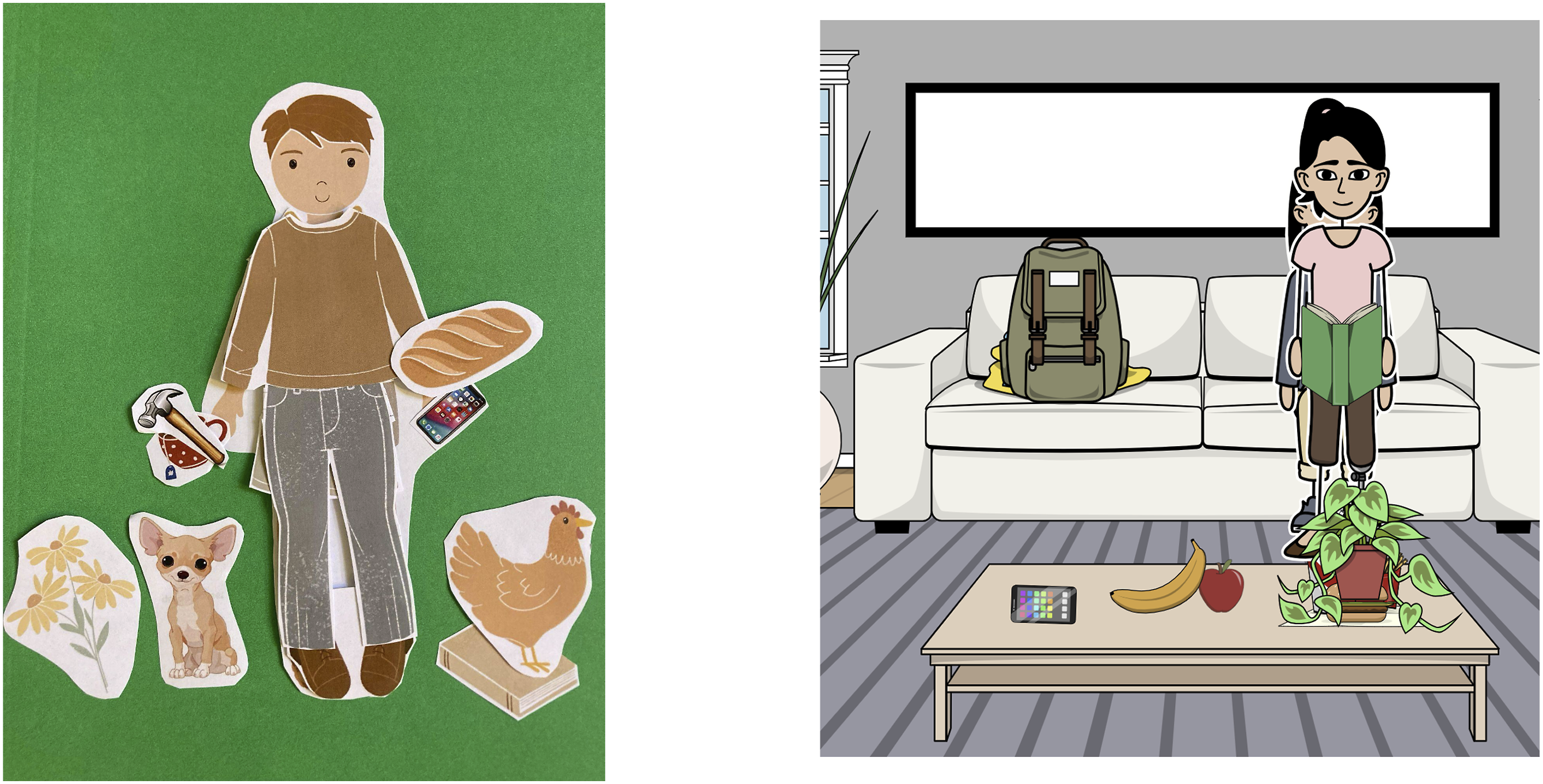
The Third Layer
The third layer went “on the top of the two previous layers” and offered “a representation of yourself as you think people see you. This might be positive, negative, or both, including […] elements such as racialized and/or gendered identities […] that shape others’ assumptions” (see Figure 5). Stephanie’s (Left) Third Layer and Student’s (Right) Third Layer.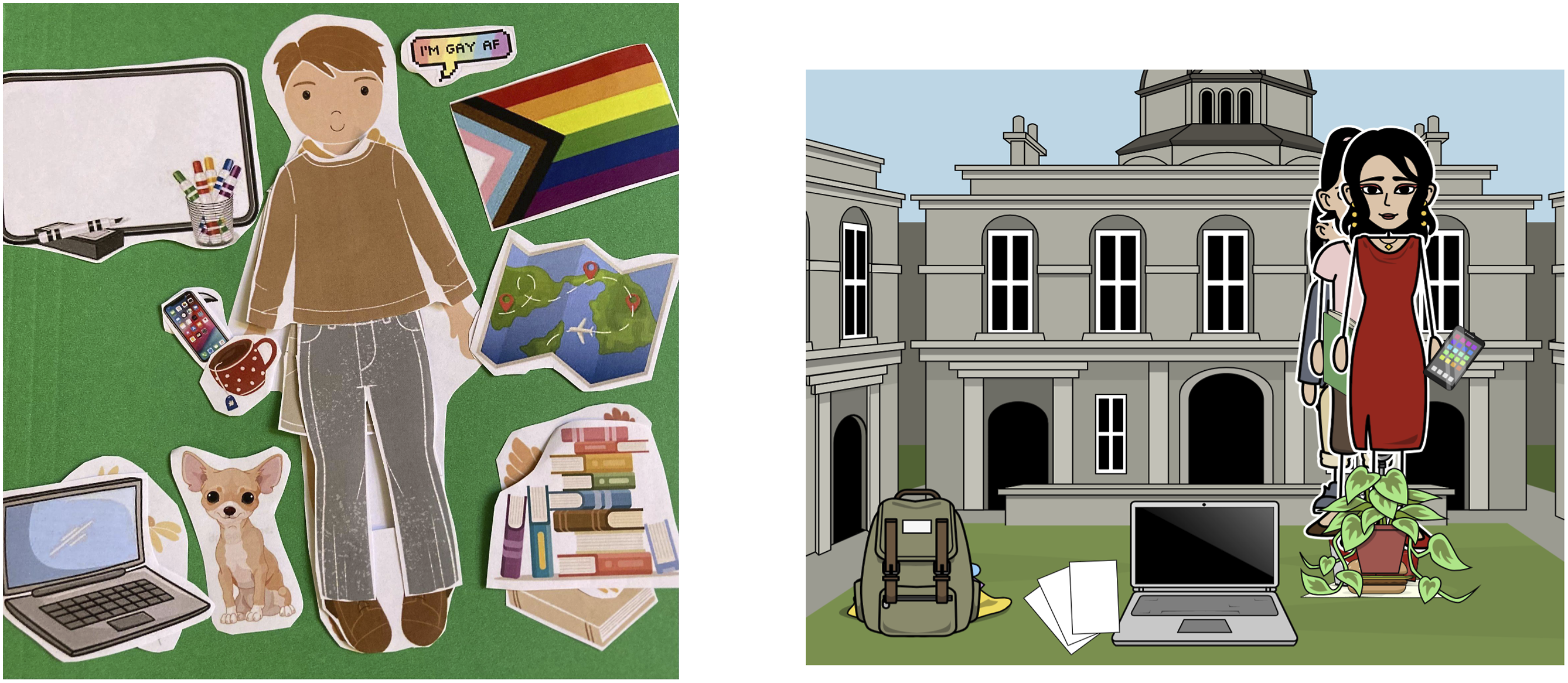
As before, this layer used clothing and objects to conceal elements of previous representations, and interestingly, the artful self-inquiry pushed students to supersede other items with representations of higher education. The embodied collaging provided layerings of self alongside books, laptops, and university buildings that accentuated academic identities existing adjacent to personal ones, in ways that writing simply had not.
The Fourth Layer
This layer again went on the top of the previous ones and asked for “a representation of yourself as you hope/want people to see you as a professional and scholar.” Examples given in the instructions included how students or we might want peers and supervisors to see us at work or a conference (see Figure 6). Student’s Fourth Layer.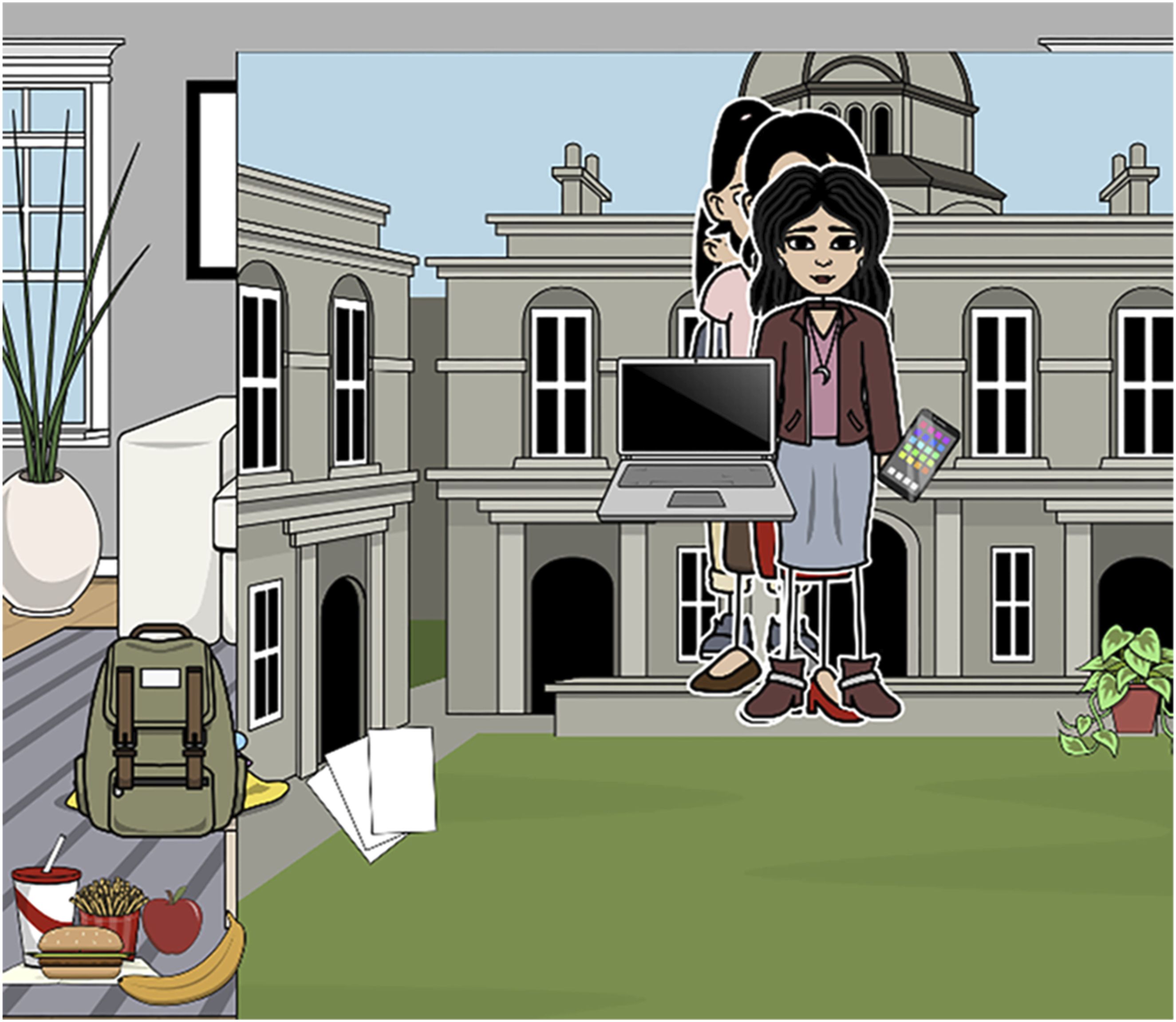
Many individuals’ layers remained the same as or similar to the previous one, often with the previous academic elements and professional clothing either remaining in the forefront or being moved to more prominent places. Many students and we noted that between the entanglements of self, family, friends, and others’ perceptions, we wanted to be known professionally—perhaps surprisingly—as a combination of private and public versions of ourselves. The student’s artful representation featured in Figure 6 offered a more nuanced representation of this concept than most. The university backdrop now overlapped with the previous couch setting, and there were meaningful layers of personal and professional elements chosen. The student noted in the online bulletin board afterward, “I want people to see me as human, with personal and professional sides.” Other students highlighted the comment, with one commenting, “YES!!! CO-SIGN THIS!”. Artful inquiry provided spaces for students to explore their subjectivities and represent scholarly/personal identities in nuanced and overlapping ways.
The Fifth (and Final) Layer
The final layer was “a representation of your researcher self, including how you anticipate and/or hope that research participants will see you.”
As before, there was an amalgamation of personal and professional, with students emphasizing that they hoped that participants would see them as people and not as detached researchers, and with participants often appearing as diverse and empowered co-researchers in the scenes (see Figure 7). Many students conveyed confidence in this final layer, such as the wink and hand-on-the-hip pose in Figure 7. However, this layer was also unquestionably the messiest. Student’s Fifth Layer.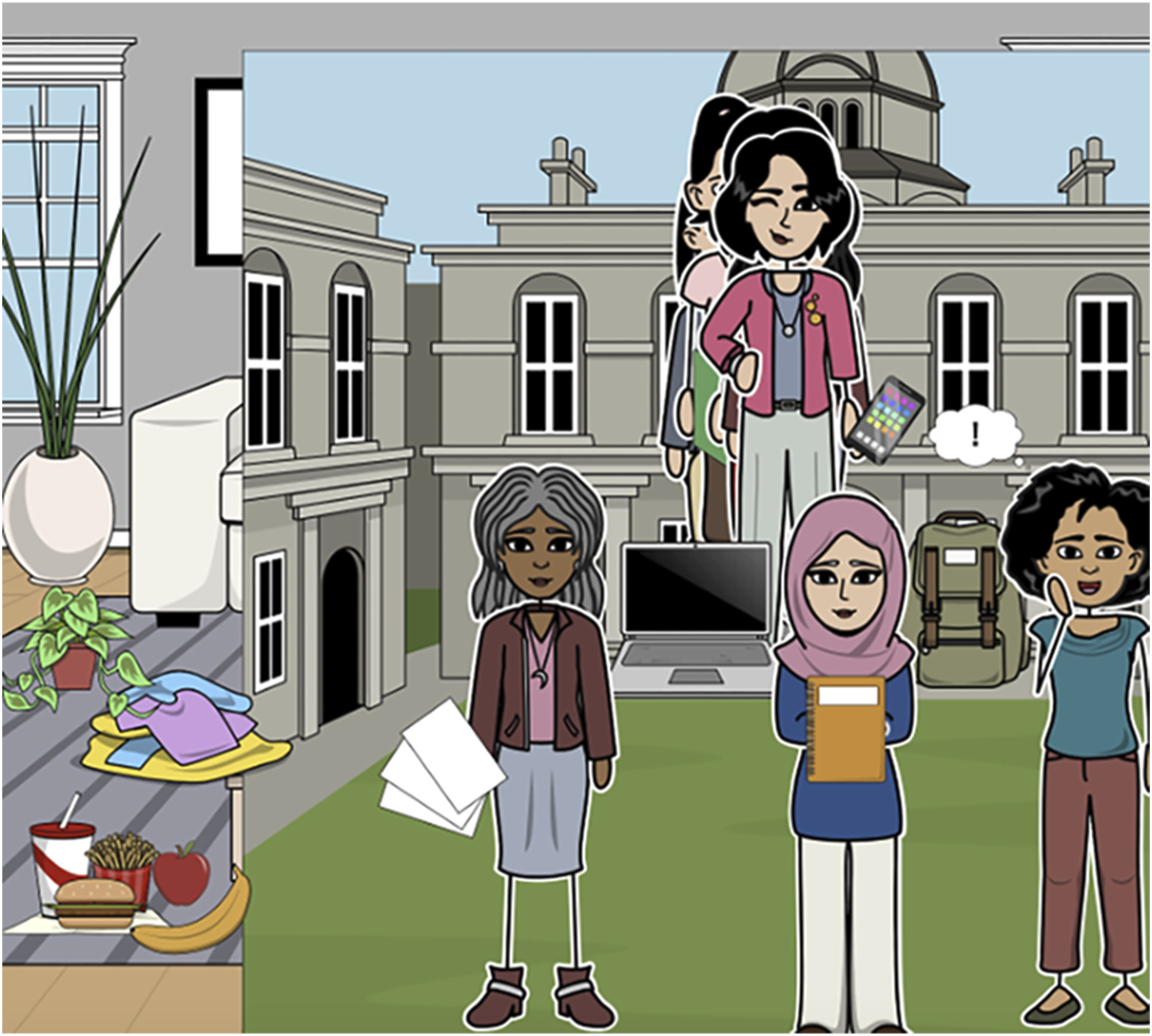
April, for example, found that the layering prevented the individual representations from being visible, and so she elected to fan them out instead (see Figure 8). As April noted in an email, “They’re all me, after all. Just different versions. I don’t want any of them covered up.” April’s Five Layers Fanned out for Visibility.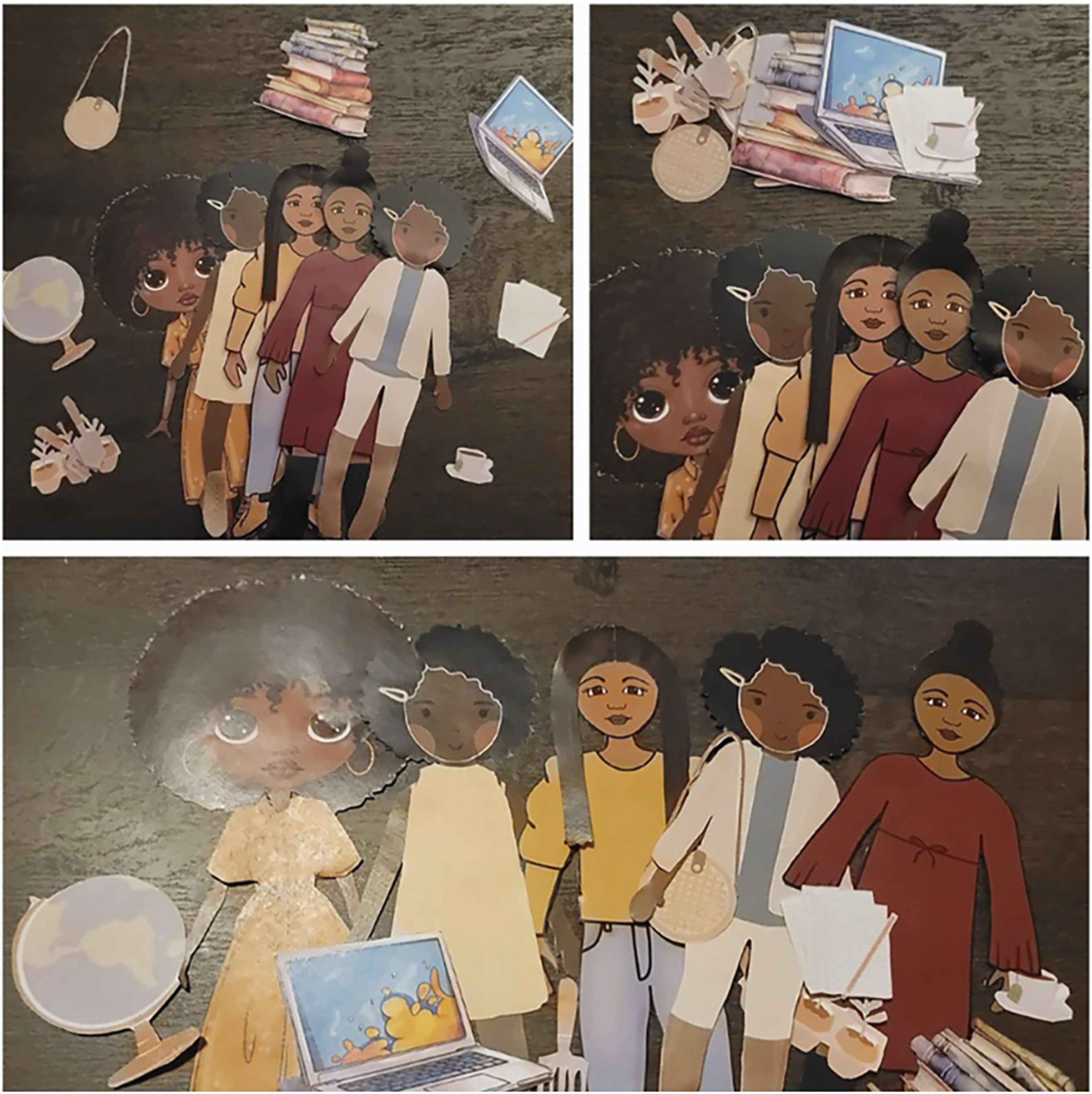
Another student expressed surprise at how messy her layers got. She wrote, “I honestly didn’t expect this at all. I’m kind of boring, you know? I didn’t figure that there’d be much for me to do in this assignment at the beginning. But by the end I was struggling to even get the different clothes and items to lay down flat. I didn’t realize there were that many versions of me” (see Figure 9). Student’s Five Layers that were Surprisingly Messy.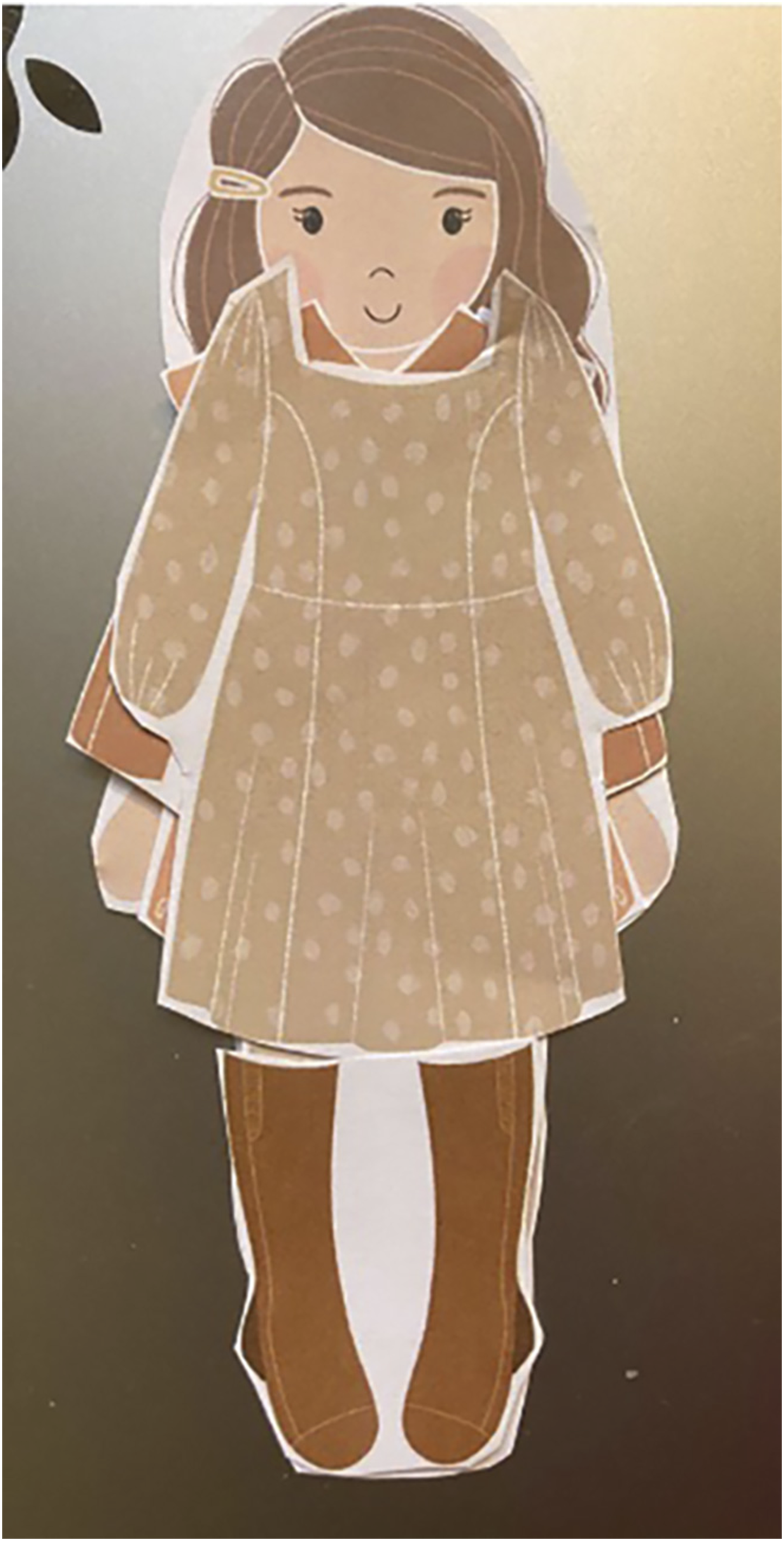
Over the five layers, students and we found ourselves meticulously trimming hairstyles, shoes, items, and backgrounds for each version of our dolls. Some students and April changed which doll that they used for each layer (see Figure 8), due to different dolls’ features better representing specific versions of themselves, while other students and Stephanie kept the same doll as a base and layered on new clothes and accessories to (re)make them anew. The artful interrogations of subjectivity, bias, and identity pushed us and students in ways that writing conventional subjectivity statements never had. We were no longer flat, one-dimensional researchers in paragraph form; we were messy, jumbled, colorful pieces of selves that stretched across the personal and professional, and across the entire research process.
So What Does This Mean for Subjectivity and Bias?
As noted earlier, subjectivity statements are the standard approach in qualitative inquiry to push researchers to examine themselves in relation to the research. While the statements are certainly useful, their typical brevity of word length offers insufficient opportunities for in-depth examinations, and they do little to push against entrenched commitments to objectivity in research. Haraway (1988) notes that asking students to critique and even dismantle “the problem of objectivity” exclusively through language can simply duplicate the very issues being addressed (p. 576). Instead, our artful inquiry through paper dolls emphasized for us that it is time to examine long-entrenched concepts such as subjectivity in new and embodied ways.
The agency, the playfulness, even the literal cutting, and (re)creating that are atypical in more traditional approaches, are strengthened through artful engagements. Scotti and Chilton (2017) emphasize that artful approaches to research “embrace transparency and reflexivity,” and particularly with collages—or in our case, paper dolls––researchers layer “together disparate stories and research findings to piece together a narrative” of new understandings of self within and beyond research (p. 359; see also Yardley, 2008). Students and we were genuinely surprised at how nuanced that this artful inquiry helped us examine ourselves. As one student remarked, “The process forced a true, self-examination of all of our subjectivities. We had to come to terms with and experience reflection in an honest and multi-layered capacity.” Another student layered their comment on the top of this one and responded, “Designing the paper dolls was a process of self-examination. The dolls were mirrors to who I am and why/how I choose to represent each layer.” Another shared, “I seriously had to think about who I was in each role, and realized that there was SO MUCH OVERLAP across them. They’re allllllll in my research, too.” Students responded with affirming “THIS,” and “Retweet THIS.” The artful inquiry expanded upon conventional practices and pushed students’ thinking about these concepts in useful, important, embodied, and lived ways.
We want to clarify that we do not seek to replace written interrogations of subjectivity and bias with the paper dolls or any activity. Instead, asking students to play and create in their artful representations of multiple selves through multiple layers accentuated to them and to us the many choices that are omnipresent throughout the research process, including while writing. Subjectivity, and bias as part of it, is inevitable. Positioning students to be, as Haraway (1988) frames it, at war with themselves in a futile quest to slay subjectivities armed only with words serves no one and nothing. Davis and Butler-Kisber (1999) remarked on layering images and ideas in artful research inquiry. [This process], functioning as a form of analytic memo, exercises the kinds of non-linear and preconscious modes of thinking that are needed to facilitate contextualizing forms of analysis [including of the self], potentially bringing tacit understandings about the researcher, the participants, and the context to the surface in insightful, useful, and different ways (p. 4).
Each slice of the paper, each folded tab to hold a layer in place, invited new discoveries of self and of what it means to do research and be a researcher.
Cutting. Layering. Stretching. (Re)Assembling. Being. Joy
This play was “quite practical,” as it pushed students and us to make “embodied discoveries” that literally entwined our various identities, experiences, and positionalities (Scotti & Chilton, 2017, p. 360). Rather than conventional and problematic tendencies to approach subjectivity as a checklist, a researcher confessional, or a step in achieving objectivity, the paper dolls made subjectivity intimate, constant, complex, overlapping, and tangible, stretching across the personal and professional. This mode of artful inquiry offered students and us new and “lively languages” that helped us to “actively intertwine in the production” of both old and new: engaging with the longstanding concepts of identities and subjectivities, and doing so in ways that open new “fields of possible bodies and meanings” within qualitative research (Haraway, 1988, p. 596).
Footnotes
Declaration of Conflicting Interests
The author(s) declared no potential conflicts of interest with respect to the research, authorship, and/or publication of this article.
Funding
The author(s) received no financial support for the research, authorship, and/or publication of this article.
