




Abstract
Within this article, the often-used phrase of Special Educational Needs (SENs) is examined by pivoting upon three points of analysis. These being: its history, its definition, and its possible futures. This analysis reveals the hidden deceit contained within the lexicon, history, and the present performative acts of SEN. It is argued that SEN is haunted by the ghost of extant discourse and practices, namely, those of special needs. To move forward and to actually support children labelled with SEN, it is argued that extant discourses and practices must be allowed to pass into history, that a rights discourse should displace the ableist discourse of needs and that governments, all over the world, should listen to, hear, and act upon the voices of those labelled as SEN.
Keywords
Three Little Words: An Introduction
Maybe it’s a curse, or maybe a cure . . . ⋅ . . How can something so small be so big?
Three little words change everything (Bloomfield, 2024, p. 1).
According to the British government, children and adults labelled as having a SEN have learning disabilities which make it more difficult to learn than others of the same age. Such learning disabilities normally fall under the areas of communication and interaction; cognition and learning; social, mental, and emotional health; and sensory and/or physical needs (Department for Education DfE, 2014).
SEN as a concept, word, and thing appears revetted to a Moorean certainty, welded to a Cartesian mindset and it has a certain stamp of incontestability about it (Mion, 2022; Seigel, 2021). This paper interrogates the certainty of SEN by pivoting around three points of analysis. These being: history, definition, and possible futures. My aim is to challenge the seemingly unchallengeable shaligram of SEN that dominates politics, policy, and practice in many parts of the world today (Hodkinson, 2024; Hodkinson & Williams- Brown, 2023). In this paper, I want to argue that SEN as a concept and in its performance is one which is riven with hidden deceits. At its origin, SEN was articulated by joint and fractures, which rotated around a “geographical, geopolitical, and topological” pivot that of “educational” (Fischer, 2023, p. 13). This articulation, though, was broken, breached, split and fragmented in its manufacture as the extant concept “special\needs,” had a history and by its present presence in performative acts, danced in and out of joint, finding only a stable structure betwixt and between large and complex contemporary worlds, namely, those of special and mainstream education (Fischer, 2023). As a concept, Warnock 1 (DES, 1978) may have allowed a new world to open but only to a certain degree. This world though opened to exclude as its articulation of separations presented but did not presence as movement and flow, however, limited (Miller, 2011) tremored the structure and meaning so locating SEN as a difference in the system of place and space (Fu, 1992). As Derrida and Spivak (1974, p. 132) relate, “The fundamental traits of human language are often to be found behind the screen of words.”
Pivot One: History—The Haunting of SEN
“The Warnock Report in 1978 . . . introduced the idea of special educational need” (www.parliament.uk, 2024).
“[Warnock Report] special educational needs used for the first time” (Williams, 2009, p. 202).
A history of the early employment of SEN in the literature base.
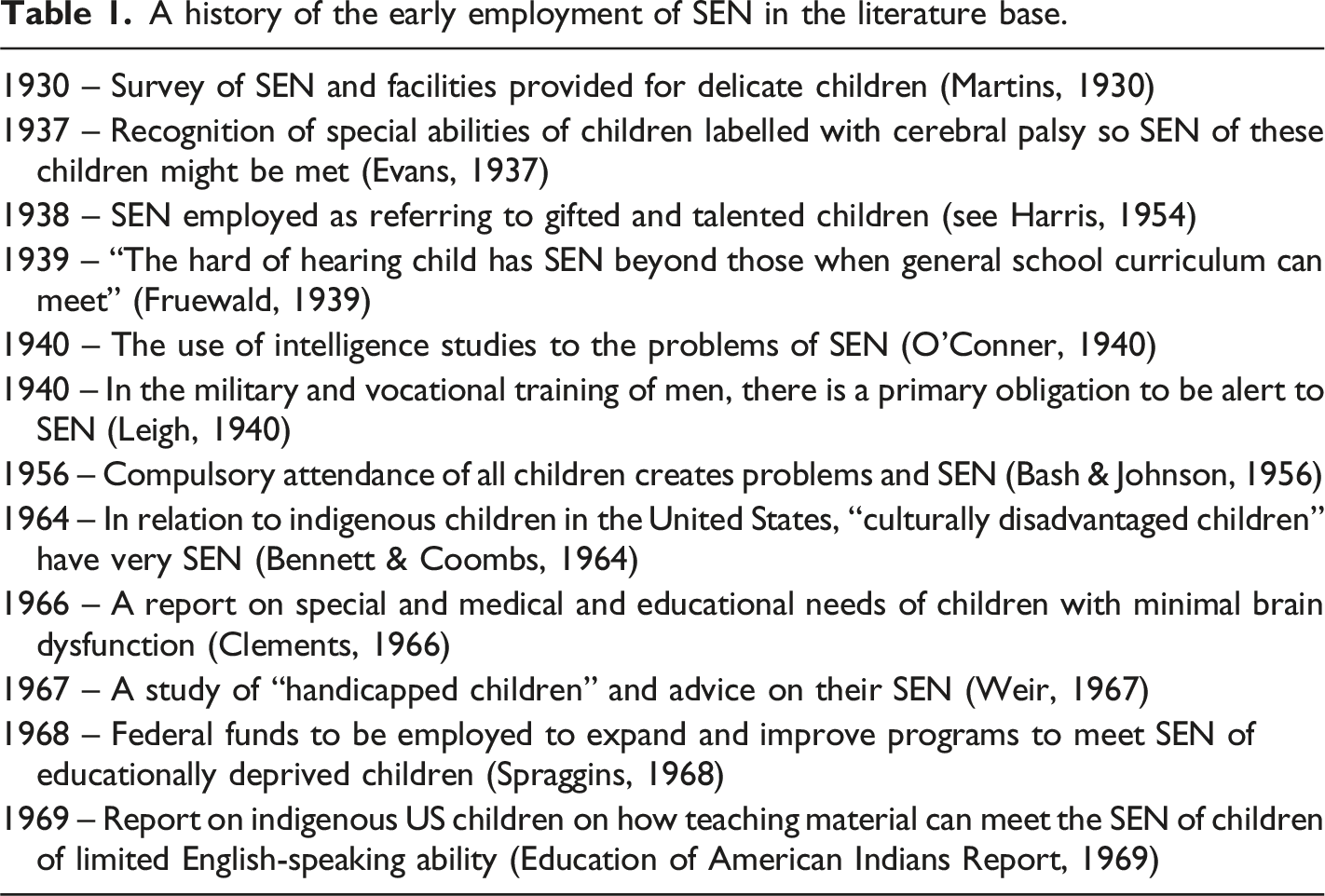
It would appear, then, that the Warnock Committee jointed into a movement of SEN that had seemingly appeared in the United Kingdom (UK) in the 1960s but was one that was based in a United States system of special education whose originary may be found in the 1930s (Guilford & Upton, 1982). The priori and protocols of Warnock’s SEN were set therefore within a historical sedimentation which massively determined the system (Derrida, 1987). Thus, at the kernel of Warnock’s, SEN was an acquired vocabulary which was a remainder par excellence which anchored into an extant doctrine’s apparatus and strategies (Derrida, 1994/2006). History, here, introduced “ruin at the heart of the most utterly new” (Derrida. 1997, p. 66) and so deprived SEN’s educational of a future, and indeed, it “deprived a future of itself” (Derrida, 1994/2006, p. 145).
SEN, in the UK, then, did not have a singular point of creation, that of the Warnock Report, but rather by resting on plays of representation it no longer had a simple beginning (Derrida & Spivak, 1974). SEN, therefore, had form, and it is a parasitical phrase that has a history. There is a haunting at work here as a parasitic revenant, reverential to a history, paid homage only to medicalization and marginalization. SEN’s origin therefore had a double temporality as its identity process lay dormant in a historical sedimentation where educational as pedagogical was lost in a performative signifying process of frozen cultural identification (Bhabba, 2004). Ghosting here becomes important, as educational was materialized between and into special needs. It was a mise en abyme. Here, in this moment, a great circle was completed, as the revenant ghost ghosted the territory back to itself. For the Warnock Committee, adoption of the term SEN was not a leap of faith, but only an animated backward leap (Derrida, 1987). From its very conception, SEN, therefore, was unable to function optimally as acting as this priori it came only from itself (Gaston & Machlacha, 2011). It thus folded and refolded an old topos as the invagination of educational created a hidden deceit at the heart of the operation of SEN. Educational thus jointed and pivoted around a history that fabricated, and quickly reassimilated the present presence as it contaminated all around it (Royle, 2003). As this over coding signifier, SEN created checkpoints of categorizations “irradiating in all directions” as it worked to foreclose all possibilities of cohabitation in a new\old world controlled and codified by just three little words (Butler & Athanasiou, 2013, p. 115).
Pivot Two: SEN Defining a Definition?
There can be no doubt that since the 1970s, SEN has become a high-status term and an orthodoxy of education in Britain and worldwide (Hodkinson, 2024). Indeed, for most individuals, who take part in this community, the meanings and rules of the game seem familiar (Garcia-Valdecasas, 2023). However, for others, SEN might be observed as a pejorative and difficult term, one based upon segregative practices, which is poorly defined and the subject of considerable debate (Lamb, 2009). SEN, as a term, requires that two distinct places are mobilized, those of “special needs” and “educational” and in doing so seemingly creates a passage to a third space (Bhabba, 2004). In this third space, SEN is an unheimlich term because it names something familiar but at the same time strange (Gaston & Machlacha, 2011). This homoplastic idiom, bound together countless moments of disconnectedness which were based upon faulty suppositions (Seigel, 2021). As I shall show later, it twisted words away from their normal usage and herded people “under falsely, unifying rubrics” as it invented “collective identities for large numbers of individuals who are actually quite diverse” (Bhabba, 2004, p. xxiii). These three little words therefore are a formula that may be read in two opposing ways and as such “the epistemological air leaks out of [its] balloon” (Siegel, 2021, p. 1111). Following Said (2003, p. xxii), it seems “incumbent” to “complicate, dismantle, and displace this reductive formulae,” with its “potent kind of thought” that herds people back to a historical sedimentation stratified by layers of ideological thought. Through such a displacement of the normal employment of SEN, the intention here is to put pressure on the reading and operation of this term and to thus expose its hidden deceit.
De-specializing the Ghost in the Special
“This town, is coming like a ghost town Why must the youth fight against themselves? This town, is coming like a ghost town Government leaving the youth on the shelf This town, is coming like a ghost town . . . Can't go on no more The people getting angry . . . Too much fighting on the dance floor” (The Specials- UK Ska band2)
From its early employment in England, SEN drew criticism. As Guilford (1971) accounts, cannot all children be special? Indeed, for Warnock (DES, 1978), special did not relate to a small group of children. Rather it was thought that one in five children would experience an SEN during their childhood. This process of enunciation therefore introduced a split, an abyss, within SEN’s vocabulary where its articulations oscillated around two seemingly irreconcilable concepts (Derrida, 1987). Special here, captured difference within a “zone of indifference, where inside and outside [did] not exclude each other but rather blur with each other” (Agamben, 2005, p. 23). At the kernel of SEN’s definition, there lies then a presumptive claim, as special is not special but is really rather ordinary (Colivia, 2019). Special, in its employment here, is out of line with reality (Derrida, 2005).
Moreover, special’s originary came from “special needs.” As such, SEN’s mechanisms and articulation were locked into the classical logic of past histories (Derrida, 1987). In its opening and shutting, it allowed the multi-pliable to cohabit where the old, as foreign body as ghost, was introduced into the new (Derrida, 1997). It is of interest to note here that a 2003 survey rated “special” fourth in a list of offensive terms behind those of “spastic” and “retarded” (Gernsbacher et al., 2016). In addition, others have stated that we should avoid euphemisms for disability, such as special as it is patronizing, inappropriate, and condescending (Gernsbacher et al., 2016). Special then lies within a family of words of possible views and not a single position (Farrell, 2005). It is a truth-claim based on a well-founded belief that was unfounded (Wittgenstein, 1969). As such, this recurrent theme passed itself off as the truth (Abdalkafor, 2015). Special then locked educational into need. In this topological structure however incompatible it seemed, the employment of special condemned SEN as contradiction and as a deceit (Derrida, 1997). This lexeme’s usage created a double exception as its mechanism opened a double exclusion and a double capture between educational and the articulation of needs (Agamben, 1998). As special placed to one side its Latin heritage—to gaze outwards—it gazed only inwards on itself. In this non-consensual cartography, it made a performative promise which only “restored old places of legitimization, sanction and censorship” as it concatenated a promise that said everything but said nothing (Derrida, 2005, p. 40).
In toto, SEN’s special introduced a ghost, a foreign body as an enemy as special, became a password, a master skeleton key, to “open all doors, decipher all texts, and keep their chain [of] articulations under surveillance” (Derrida, 1987, p. 12), As such SEN began the “struggle between the historical, teleological, and mythical time and narrative tradition” of SEN and special needs (Bhabha, 2004, p. 51). The battle lines drawn, the mechanism locked, meant that parents of children labelled as SEN would now face the ghost. The fight was now on to own this dancefloor.
An Education on Educational
For some, educational relates directly “to teaching and learning” (Lamb, 2009, p. 208). However, educational may also be considered a super category which was employed within SEN to devalue and negatively label children (Lamb, 2009). Within SEN, educational became transplanted between special and need. As a word, it became the fulcrum, the pivot point of SEN. Educational here then had narrative priori which created invitations to play and practice (Pont, N.D). However, in this incarnation, SEN’s discourse was formulated within a mechanism of power (Bhabha, 2004). As a term therefore, educational must be read through in three ways. As a “word, a concept, and a thing” (Derrida, 1987, p. 19). As a concept, it was neither inside nor outside special and need but as accessory, it was welcomed at their border (Derrida, 1987). Educational was then subject to a quiet coup, where special needs assimilated the educational. The brutality of this event multiplied it but commenced by enclosing it by twisting this word’s proper articulations out of shape (Agamben, 2005). In this sense, the opening of this new third space opened an abyss between application and reality where educational became an unsteady element of this new language (Bhabha, 2004). While there was familiarity in this word, the reality was that educational became both contraband and graft. As contraband, it was nothing more than a passe partout as the organizational innovativeness of the language became compromised (Derrida & Spivak, 1974). As this thing folded and unfolded between the two fragments of special and needs, although as a word it was “traceable to a common etymological route, [It became] systematically and morphologically distinct” (Agamben, 1998, p. 11). Thus, the realities and practices of SEN lacerated educational as concept, rather than working together they pulled against each other.
In this third space, in the median, the dialectic was mediated and medicated. SEN was enslaved in the hollow knuckle of this ceremonial mechanism which articulated a separated connectedness. Operating between the two opposites of special and needs, educational was thus forced to participate on unequal terms. It was allowed to touch the two edges but the ambiguity of participation was divisive (Derrida, 1987). Educational as thing, therefore, became hidden as an illusion in a third dimension, where a mimetic frame contained the ontological sign as similitude (Bhabha, 2004). Educational as this trope became a shifting, splitting, jointing, and breaking force which forced a third space into being; being both outside and inside the concept, the word, but not the thing. It was naught but a service and operation of power, detection, reception, and projection (Bhabha, 2004). Let me explain this separated connectedness a little more.
Educational projected as protection through SEN became damaging for those involved (Ahad et al., 2022). Indeed, 40 years of SEN, in England, did not lead to a radical change in practice but only inculcated a system that was subject to fault lines (Ahad et al., 2022; Hodkinson, 2023a, 2023b). This concept’s connectedness then was broken, fractured because there was little change in the way trainee teachers were prepared to educate children labelled with SEN (Winter, 2006). Ofsted (2003) commented that teachers were being asked to lead children with significant learning needs without enough learning. The irony here should not be lost as educational, in this third space, did not actually stretch to the teachers themselves. As the mechanism of SEN operated therefore it continued to separate out rather than include. Furthermore, in seeking to educate all children in England, children labelled as SEN have constantly been subjected to “off rolling.” This process has observed schools, who are graded on good exam results, taking “problematic and challenging” children of the school roll (Lamb, 2019). Indeed, it is the case that a child labelled as SEN is seven times more likely to be excluded from school than other children (Murphy, 2021). So, as educational jointed special and needs together, it separated and articulated them back into segregative practice. This word, this concept, and this thing became twisted between subject and object; it was muddled up, complicated, and became part of the problem (Derrida, 1987). Educational here as the median, the mean term, became mean, as it tangled with the two edges of special and needs. In this expected/unexpected juxtaposition it became a jointing/splitting force that jointed into a structure of opposition and a dialectic of distrust (Derrida, 1987). Educational, as a thing, unlocked a killing field where the new cultural practices were bolted onto extant historical narratives and old battle grounds (Agamben, 2005). The foreclosure and rejection of this foundational signifier resulted in it moving away from its originary meanings. Educational thus became a break that connects (Gaston & Maclachan, 2011).
In drawing this line of argument to a close, we may observe that SEN includes two absolutely heterogeneous words, special and needs. A third term, that of educational, was introduced to cross the abyss and to heal over the gaping wounds of historical practice. As a concept, a word, and a thing, educational here though was not a healing process as it did not\could not\would not provide a strong bridge, so as to enable thinking and practice to pass from the bank of segregated practice to the other bank of inclusive education. This bridge, if it was created at all, thus separated but did not connect. It became a bridge of sorrows over a valley of tears (Serres, 2015). Educational was subsumed into SEN and it allowed only limited controlled and regulated movement. As children began to emerge from this abyss, it became clear that educational as a subject and processes, as a word, concept, and thing had split the signifier and faded the pedagogical as such the performative, became “agnostically articulated” (Bhabha, 2004, p. 429).
Needs (or Rights?)
Warnock, (1978, p. 6) was under no illusion of how difficult a concept need was within SEN. She acknowledged that it was a “crude notion” with cumbersome language that covered a wide spectrum. Despite these misgivings Warnock (2005) believed that to discuss a child’s needs rather than their disabilities was beneficial. Others, though, have criticized this concept, as, like special beforehand, cannot everybody have unique individual needs? (Norwich, 2009). Furthermore, as need articulated here meant differing from a perceived normality (Norwich, 2009), this language actually constructed and maintained exclusionary practice (Runswick-Cole & Hodge, 2009). Whatever may be said about the usefulness, or otherwise, of this concept, it has led to agreed meanings and ways of doing things. Despite such agreed meaning, it is useful to re-historicize the emergence of SEN and interrogate its inside space. Need, as articulated in SEN, commenced by producing a discourse which introduced extant discourses and practices. The revenant ghost here acted as a supplement and like a virus it infected everything in its path (Royle, 2003). Going forward, the employment of this word therefore resolved to follow a history and system. Caught up in these extant frameworks, extant theories, extant expectations, past experiences, and language, the new thus became enslaved by the old, and it became its prisoner (Popper, 1970). Need therefore was employed to force the acceptance of SEN. It was not just the acquiescence to a system of beliefs that held importance but also the acquisition of its old/new identity. As this belief system rendered its subjects submissive to this knowledge (Abdalkafor, 2015), the logos became inseparable from its material reality and practices. One could never forge new ideas or new policies of SEN, as one could not control this concept’s comings and goings because it began by coming back to itself (Derrida, 1994/2006). The conception of need here was a “mortifying job” (Zizek, 2008, p. vii.) as the mechanism of SEN central automata had pre-established the rules of engagement.
What could though have been, if the historical ontology and belief systems of need had been shut down? What could such thinking offer us about the relationship, between educational, special, and need; between the reality and the possible (Derrida, 2005). In moving away from this new/old belief system with its rhetoric formed within the traditional individualistic, psycho medical model (Vehmas, 2010) where the “cultural knowledge… adds to but does not add up” (Bhabha, 2004, p. 231). To play with needs etymology, verb, and noun—need here becomes a necessary requisite to overcome distress. To remove distress of an SEN system that has harmed children, need should be subtracted and consigned to history. What is actually needed in reality is an understanding that need must become a right that is enshrined in law to a high quality inclusive education. SEN, therefore, needs a reorganisation. By introducing right, the struggle between the “historical, teleological… and narrative traditionalism” (Bhabha, 2004, p. 47) of special needs would end the “unresolved dialectic between constituting power and constitutive power” (Agamben, 1998. p.41). For the disabled people’s movement, the dialectical revisionism of educational rights over needs might lead to the provision and practice of educational in SEN as the high quality provision of education (Runswick-Cole & Hodge, 2009, p. 291.).
Pivot Three: Conclusions: Possible Futures?
“Let’s accept provisionally the hypothesis that all is going badly in the world today is but a measure of the gap between an empirical reality and a regulating ideal” (Derrida, 1994/2006, p.164).
To be specific, we know levels of SEN in England are rising as are appeals against its systems and processes. It seems we should ask ourselves, therefore, how large does this group need to be before the special becomes ordinary? SEN is “going badly” as its present presence is presumptive as there has not been any significant training of teachers, funding is inadequate, the voice of parents and children has not been comprehensively listened to, and it is still the case that access to high quality education for all children is observed as just a need and not a right. This gap between reality and ideal is not simply a limitation of the subject knowledge but more of a death drive (Zizek, 2009). Warnock herself knew the limitations of SEN, in that she articulated it was not a unified group. It does appear then that this world has been harming us with top-down policies and “previous failures [have] worked to preserve the system” (Taleb, 2013, p. 5). Paradoxically, many social policies, in this world, have ended up not helping but have harmed the very people they were designed to support. It appears that Taleb’s (2013, p. 76) statement is correct that “the greatest and most robust contribution to knowledge consists of what we think is wrong . . . [we need] subtractive epistemology.”
What SEN has become “under the surface” is “exploitation under the appearance of rights and democracy” (Ranciere, 2006, p. 87). Special needs, in its second coming as SEN, is a representation of the sacramental order and is the order maleficence with extant ideas and discourses closing down spaces where educational could actually provide quality high class education (Baudrillard, 1994). What we need to move forward is to subtract out these presuppositions and move beyond our cognitive locality and beyond experiences (Colivia, 2019). Imagine, for instance, if Warnock had subtracted out extant discourses and practices and started with a blank piece of paper (Farrell, 2005). What if she had rejected general assumptions that could not actually be justified (Farrell 2005). She might actually have sown the seeds to escape the grip of the special need’s world (Farrell, 2005). By subtracting out the enigma of special needs, she could have added to this world by beginning to fill the “crack, cleavage, and abyss” and heal all the old wounds (Derrida, 1987, p. 32.). By introducing a counter signifying semiotic, educational as the migrant barbarian marauding between the frontiers could have pillaged, ransomed, integrated, and reterritorialize this old\new world (Deleuze & Guattari, 1987). By unsettling the extant borders of special and needs, it could have troubled inside and outside of this concept creating leakage and destabilization (Royle, 2002). If educational had thus been empowered as education, it could have worked to end categorization and the checkpoints that foreclosed and introduced the possibility of cohabitation (Butler & Athanasiou, 2013). In this world, the middle, the median would not be mean, and it would not just be the average but a place where things pick up speed (Deleuze & Guattari, 1987).
SEN was introduced to assign the extant deficit categories to the past (Norwich, 2009). However, in this revolution, there was no revelation but only an infinite regression (Coliva, 2019). Educational, as this mutation, left nothing outside itself (Derrida, 2005). As Serres accounts, “To really change a place, we must escape from the judicial grasp that defines and eliminates it from [the] deciding authority” (Serres, 2015, p. 55). Simply subtracting educational from the term SEN will not work, and it will not stop categorization or abolish notions of need that have subsumed those labelled with SEN into abnormality (Lamb, 2009). The grip of the old world is too strong. For a future to be possible, we must break out of special needs frameworks, and its “vicious cycle” (H M Government, 2022, p. 11). Extant attitudes and values must be challenged. Those labelled as SEN realities must be listened to and heard as it is these discourses of the past that can help us to fix the future (Thompson & Wilkinson, 2023). A new teleology must be established, one based upon the human rights not ableist discourses one whose future allows the extant discourse of special needs to die away. What matters here is the trajectory, the pathway, the crossing, in a word the experience, not rules or technical norms for supervising and experimenting, we must “break away, break through” (Derrida, 2005, p. 137). By starting from a solid evidence base, one acquired over 40 years in England and elsewhere, by truly hearing the testimonies of children and parents labelled as SEN, those who have fought the revenant ghost, we could produce a different yet entirely coherent set of discourses and practices than those that operated in the past (Coliva, 2019). By splitting, not joining educational, we can move it away, produce independent attitudes, intricate strategies ones that take account of reality (Bhabha, 2004), and produce new knowledge that refines the shapes and voids of the abyss (Latour, 2011). By placing pupils and their parents at the center, we can join the ontological and practical worlds of SEN. A world which presently divides and splits children, labelling them with deficit categories, could be changed forever.
Footnotes
Declaration of Conflicting Interests
The author(s) declared no potential conflicts of interest with respect to the research, authorship, and/or publication of this article.
Funding
The author(s) received no financial support for the research, authorship, and/or publication of this article.
