




Abstract
My research looks into collaborative learning and co-creativity in educational contexts. This paper presents my research trajectory towards inclusional-dialogic perception, discernment, and expression. I understand this phenomenon as thinking from presence: a natural inquiry process that is immersive, dialogic, and inherently embodied; a creative dialogue between self and habitat. I combine Natural Inclusionality and dialogism as my philosophical foundations. Importantly, I extend the notion of thinking from presence to the research inquiry itself, broadening the scope of scientific explorations of experience. Thus, the inquiry becomes a dance in between extraspection (outward perception) and introspection (inward sensing), brought together in an empathic second perspective. The natural inclusional approach entails a move away from the logic and language of definition into the logic and language of flow. This article discusses how fluid logic has shaped my research approach and my writing, with three emergent features. First, the inquiry and its documentation constitute an open-ended and serendipitous dialogue with the phenomena in focus. Second, research analysis and writing moves away from the predominance of the textual, recognizing that the translation of the experience into language is not an unavoidable necessity. It also underlines the significance of the visual and poetic expression of philosophy, methods, and findings, fusing science and art into partnership. Third, the disseminative writing is immersive. It openly brings forth an interplay between subjective and objective. My own lived, personal experience of the researched phenomena is a central layer of experiential meaning making, affording contemplative insight. Centering my research approach around the notion of thinking from presence is not a purely epistemological issue. It speaks to the nature of reality and captures the overarching desire to contribute to a deeper human understanding of the self in the context of its natural neighborhood.
We all walk in mysteries. We do not know what is stirring in the atmosphere that surrounds us, nor how it is connected with our own spirit. So much is certain – that at times we can put out the feelers of or soul beyond its bodily limits; and a presentiment, an actual insight… is accorded to it.” (Goethe)
In this paper, I discuss a dialogic-inclusional approach to scientific inquiry, discernment, and writing. I cannot unpack the practices of research writing without introducing the key characteristics of the research approach, or without looking at my own research journey—especially the way research data have prompted me to challenge my initial understandings of research design.
Returning to the Human Sensorium
My broad research field is the psychology of education, with expertise is observational research and classroom ethnography. Mapping the relationship between social interaction and learning, my early work studied spoken classroom discourse as the medium of shared knowledge building and collaborative creativity. I took a traditional third-person perspective, looking at the phenomena “from the outside,” as a detached observer’. A surprising departure from this linguistic focus was instigated by the research data. During the analysis of students’ video-recorded creative collaborations, I often got immersed in kinesics (Birdwhistell, 1970), looking at gestures, body language, physical attunement, and embodied other-orientation (see Figure 1). The body language of mutual other-orientation.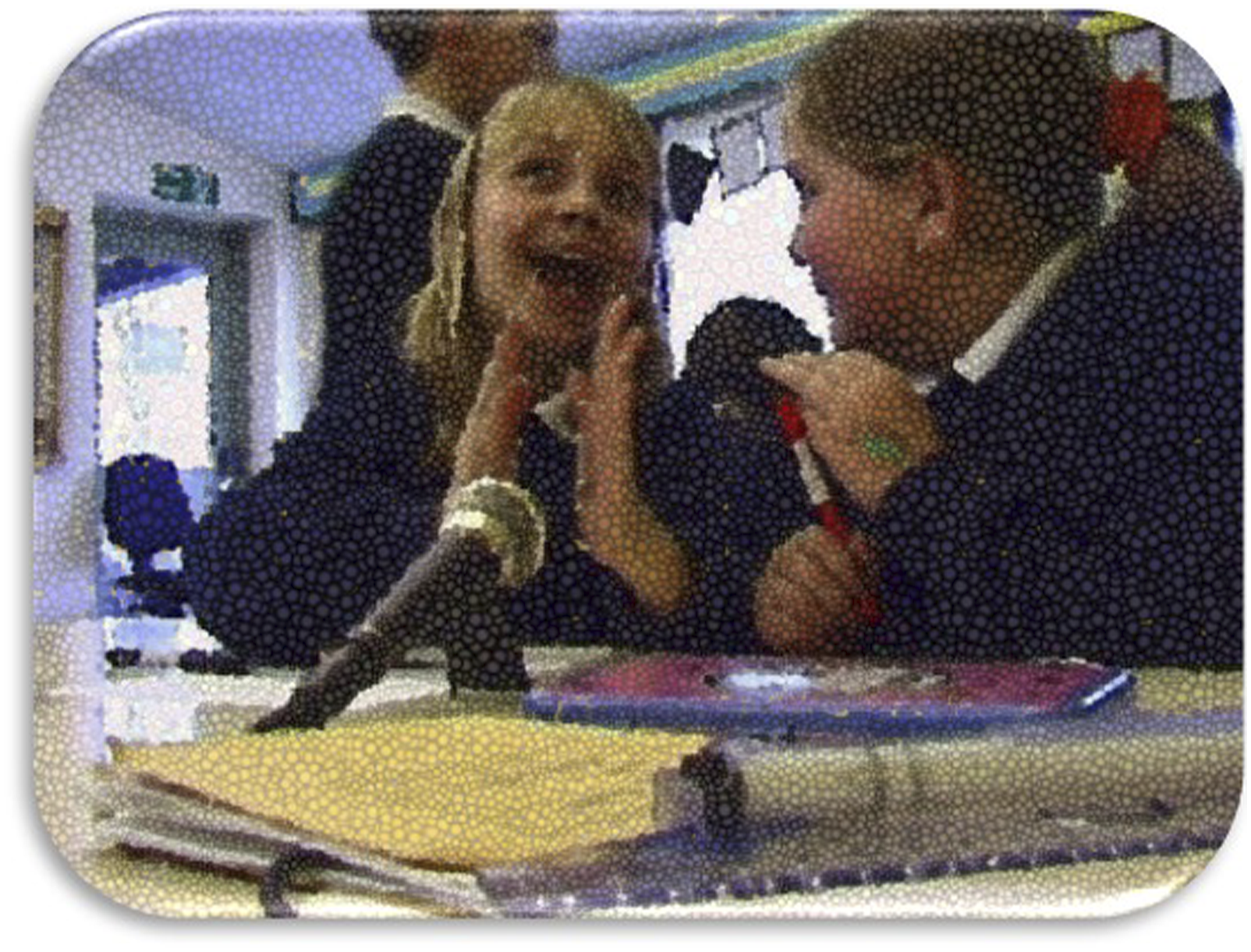
I sensed that these aspects of the collaboration were foundational in students’ shared creativity. Whilst there was no real scope for researching this at the time, I was curious to understand how creative intersubjectivities emerge through or manifest in such rich, embodied forms of synchrony and mutual other-orientation.
There was a corresponding shift in my theoretization towards embodied cognitive science, phenomenology, and natural sciences. My subsequent research in music education encapsulates this shift, whereby I studied the creative music pedagogy of Klara Kokas (Vass, 2018, 2019; Vass & Deszpot, 2015, 2016). The Kokas pedagogy was designed as an experiential extension of the world-renown Kodaly method. There is a recognition in this pedagogy that it is through the body one truly absorbs and learns in a way that their musical knowledge can be applied creatively, deliberately, and authentically (Kokas, 1999). There is something special about this pedagogy in the way it targets students’ somatic, experiential understanding of classical music. See, for example, the images in Figure 2, which capture primary students’ vivid, lived encounters with music and with others. Musical encounters in the Kokas sessions.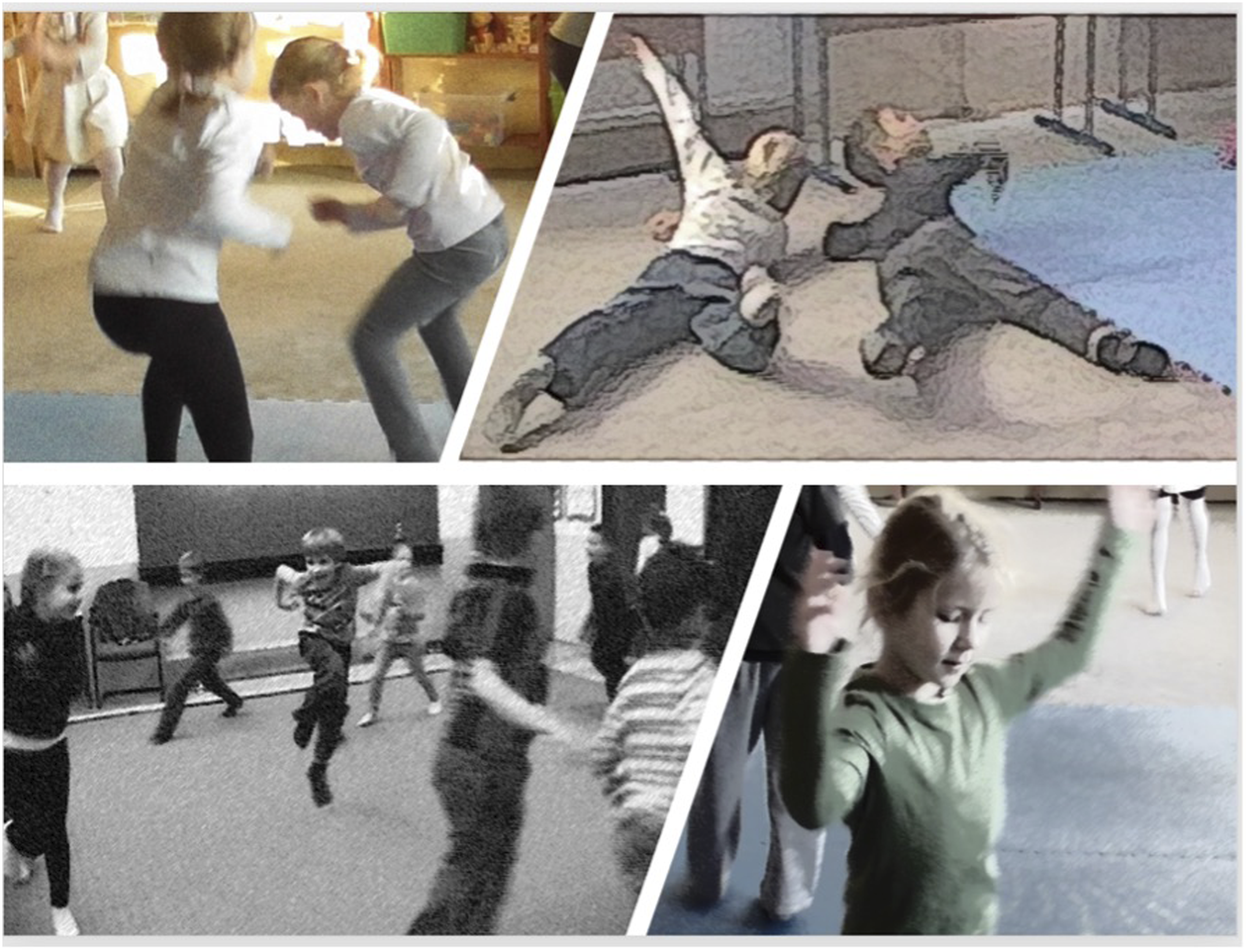
My research in primary school music classes intensified my focus on the embodied self. Nevertheless, it was through my work in higher education (Liszt Academy of Music) that I started to shift from the third-person perspective I adopted in my observational research, and moved towards inward sensing as part of the methodological design. The Master’s students were budding musicians who understood their craft well. The educational provocation of their immersive Kokas sessions was to depart from a language-based modality that they were used to, to go beyond the science of music and soften the focus on their technical expertise of a musical instrument. (For a detailed discussion of this research context see Vass, 2019, 2018). Video-recordings of the immersive musical encounters offered rich content for the qualitative analysis of collective movement (as in Pásztor, 2016, 2003). Figure 3 shows a collection of still images. These are snapshots of imaginative, often wild and rampageous, collective being and becoming, manifest in the movement improvisations of these higher education students. Collective musical encounters in the higher education context.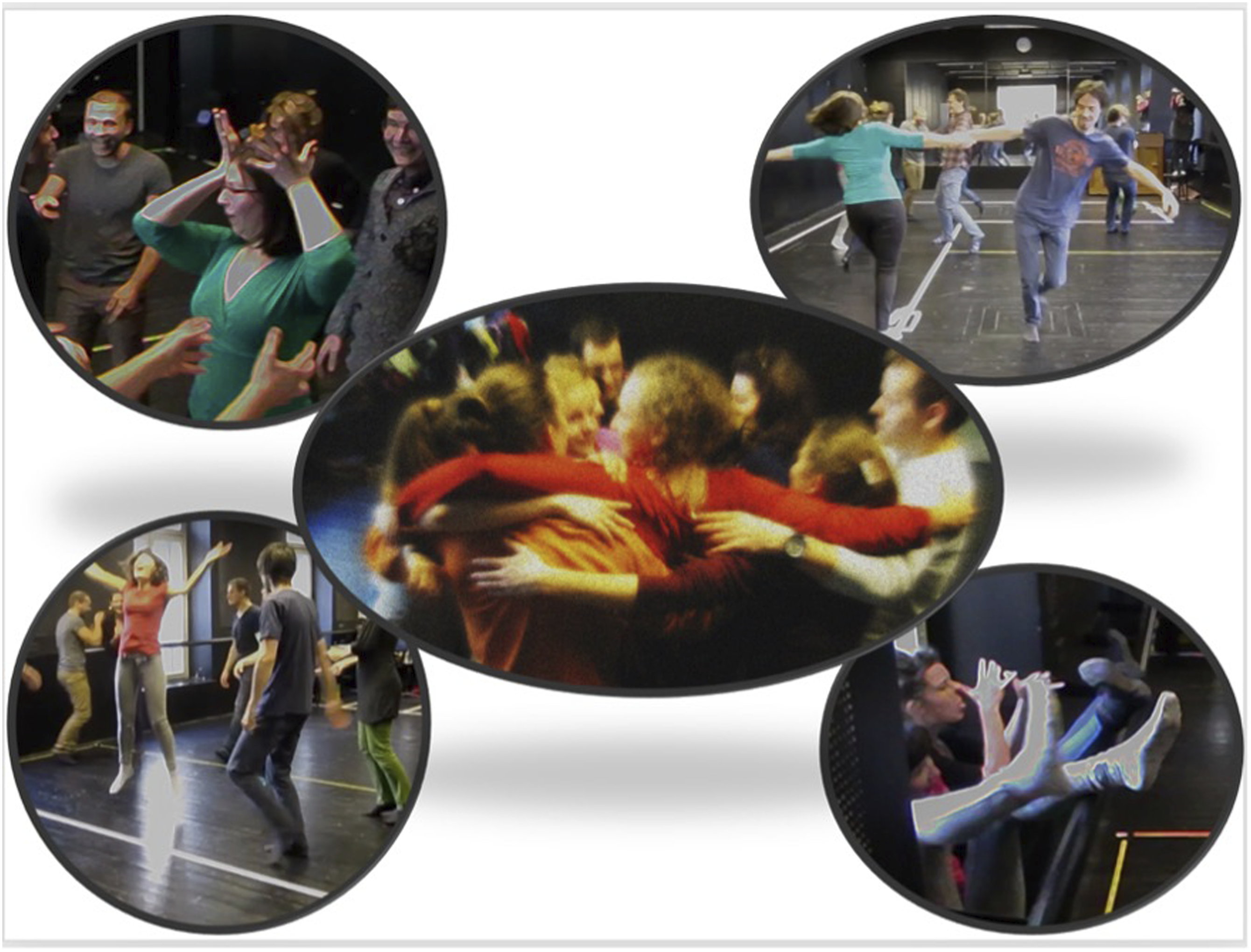
As Ilona’s reflections reveal, the students often saw these unique musical encounters as constituting musical and pedagogical learning and teaching. Their powerful poetic insights had a significant role in the evolution of my research approach. “There are things that are better expressed through a story, through words. Others can only be captured by our hands, our muscles. And there are things we can visualise to ourselves. I am glad that these different channels could get closer to each other, and could combine to work more efficiently in us, with us. Perhaps this is a secret which goes beyond music: this inner, hidden stream leading us to the deepest vaults of our humanity, and forming the continuity between poets, musician-friends, painters and children, from person to person.” (Ilona – Master’s student, from Vass & Deszpot, 2016)
The availability of this rich self-reflective data in the Higher Education context was a turning point. I started to use this introspective content as a counterpoint to my (the researcher’s) own introspective work, developing a research approach that combines both. I link this approach to the notion of thinking from presence: a natural inquiry process that is immersive, dialogic, and inherently embodied. My own research trajectory documents how Western education and science often work against the natural orientation of the self towards thinking from presence (Vass, 2018). My aspiration is to challenge this; to re-imagine classroom-based teaching and learning as embodied, co-creative, receptive-responsive dialogue. The embodied aesthetics of the self is most transparent in contexts of human experience tied to the physical; where the moving, interacting, receiving, and responding body takes a central role (Anttila, 2007; Vass, 2018). Nonetheless, these considerations go beyond arts education or sports psychology in their relevance. I extend this challenge to educational practice and educational science in general, and apply the notion of thinking from presence to educational research inquiry. 1
Changing Perception: From Definitive Logic to Fluid Logic
As noted earlier, my theorizations have evolved in synergy with my engagement with research data. For my research on the Kokas music pedagogy, I turned to Natural Inclusionality (Rayner, 2017, 2022) and rediscovered the phenomenological roots of dialogic theory (e.g., Bakhtin, 1986; Buber, 1958 or Merleau-Ponty, 1968). Indeed, these thinkers realized that the lived mutuality of dialogue is at the very heart of the human experience. Bakhtin saw the self in perpetual, mutually receptive-responsive dialogue with its physical, social, or cultural environment. The knowledge and experience of the “other” is fundamental in this shared—but not assimilative—journey towards complexity, serving mutual enrichment (Bakhtin, 1986, 1990). Encounters with alterity give rise to dialogic tension and creative ruptures as new ideas and understandings emerge. This dialogic expansion is marked by moments of resolve. It is nevertheless perpetual and infinite, without a predetermined point of ultimate closure (Moate & Vass, 2023). I illustrate this description with the following drawing (Figure 4). “Spiral space” by Roy Reynolds, permission for reproduction granted.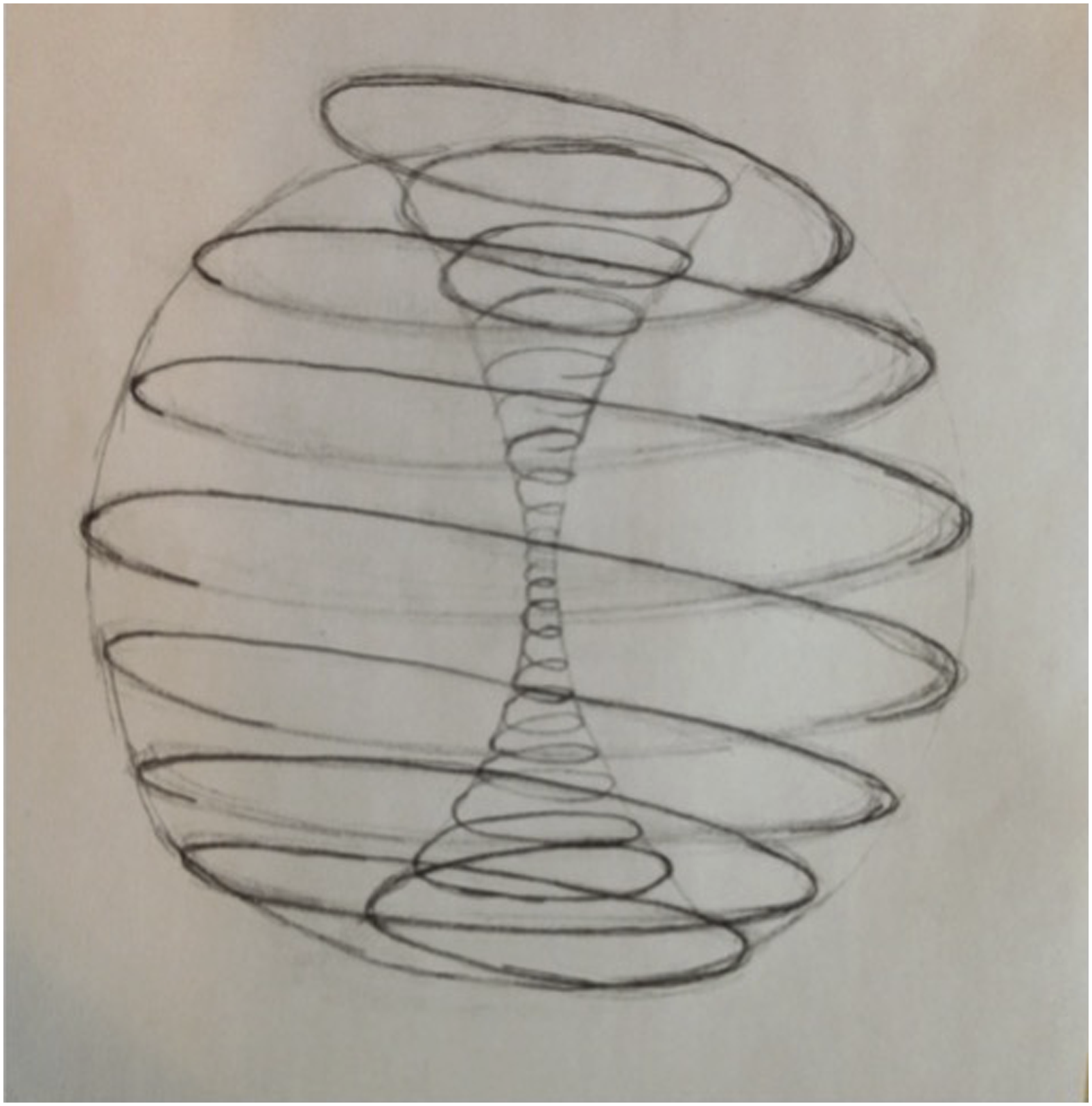
This is the snapshot image of a dynamic vortex. It resembles the geometrical shape of a torus with spirals of indwelling and out-dwelling around a receptive core center—a central receptive point. The circulation is multi-directional, although the snapshot depicts the evolving, expansive dialogic relations from one specific perspective at one point in time. Using the Natural Inclusional framing, one can describe dialogic encounters as a perpetual dance around the fluid center that builds on tension to initiate movement outwards and inwards. The inward moving spiral invites the presence in, to the center, bringing new insight.
The shared space of mutual resonance—or, in the Buberian depiction, the space of the in between—is essential for substantive dialogue or learning (Wegerif, 2018). It is therefore fundamental to understand how this space opens and expands. Such efforts in dialogic research have largely been focused on talk as the tool for collectively developing a given form of expertise (Vass et al., 2014; White, 2014). In contrast to this, research on artistic collaborations offers rich insight into visceral, sensorial co-creativity, aptly described as empathetic attunement (Seddon, 2004), collective entrainment (Clayton, 2007), or group flow (Sawyer, 2007). These depictions are congruent with what Bakhtin refers to as polyphonic discourse (1981), where confluences emerge as a consequence, and not as the driving principle or imposition (Vass, 2019). Whether it is through movement, sound, or talk, dialogic encounters can be understood as “always containing both the old and the new and being forever in motion due to the strengthening or fading of forces…” (Holdus, 2019, p. 249).
Albeit from different disciplinary orientations, NI and dialogic theory are excellent philosophical partners (Moate & Vass, 2023). They also show confluence with the second wave of cognitive science (Gallagher, 2017; Gallagher & Zahavi, 2008; Johnson, 2008, 2017) with its rich explorations of the embodied aesthetics of the mind. Natural Inclusionality (Rayner, 2017) sees Bakhtin’s dialogic ideals as natural phenomena that are constitutive to ecological sustainability. The Natural Inclusional (NI) approach sees evolution as a natural attunement and co-creative dialogue between self and habitat. Building on the notion of receptive-responsive relationships, it reformulates evolution as habitat making (sustainability of the fitting) and not a competitive adaptation process (survival of the fittest) (Vass, 2019). This receptive-responsive essence of the natural world underpins healthy relationships within thriving communities (Rayner & Jarvilehto, 2008). It is the source of continuity between distinct entities, rather than a connection of discrete or separate bodies. Thus, whilst Natural Inclusionality recognizes that natural boundaries do exist, it shows them as intrinsically dynamic and fluid. It offers an inspirational alternative to the binary logic that we are culturally conditioned to, proposing natural continuity instead. Boundaries, therefore, do not isolate but afford mutual inclusivity. In confluence, the dialogic perspective sees inside-outside as inseparable and boundaries as a place of encounter not separation (Vass & Rayner, 2022). What these two philosophical orientations (dialogicality & NI) therefore share is the understanding of these fluid, permeable boundaries as a source of mutual enrichment (Moate & Vass, 2023).
These considerations have ontological and epistemological significance. They speak to our perceptions of the nature of reality: the way we experience ourselves as embedded in or dislocated from our physical, natural, or social context. They help grasp the somatically constituted essence of discernment and negate the categorical divide between insideness and outsideness of experience. Taking this further, thinking from presence and empathic, feeling awareness should be at the core of a new model of scientific inquiry and discernment, built into our repertoire of pedagogical and scientific practice. This constitutes what can be referred to as the second person perspective as a scientific mode of inquiry and core pedagogical toolkit. Our reopening to the self and to the world does require such second person perspective: the artful combination of outward perception and inward sensing. If so, our mode of inquiry should not be narrowed down to one or the other. Our analysis does not necessarily require the bracketing of subjective experience either. From an observational point of view, we can look and describe what things “look like” or appear to be, but we can also look at our own experiences of those things.
But how does one translate these ideals into research practice? How do we communicate the insights arising from a second perspective orientation? What does this fluidity mean when it comes to a more fully embodied writing? How can we express this in our language, and in all modes of expression?
Changing Expression: From the Language of Definitive Logic to the Language of Fluid Logic
Educational science has long been critical of the binary logic—and binary language—of abstract rationality (Bruner, 1986). The societal, economic, and environmental crises of recent times have magnified the urgency to break down the pervasive conceptual boundaries and binary definitions of objectivistic perception (Vass & Rayner, 2022).
Here is an example of such binary definitions, arising from a well-intended, but narrow objectivistic perception. I found this passage when visiting the Sydney Observatory (Australia), placed next to a telescope on display: “We all require artificial aids to experience the sky as it really is. We are blind to the faintest stars and cannot hear the hiss of radio emission from galaxies. We cannot feel the heat of a distant star nor sense the magnetic fields that guide wisps of interstellar gas. Our natural senses fail us all in our quest to understand the universe.”(Sydney Observatory)
Whilst informative, this description emulates the binary logic and abstract-minded attitude that denigrates the senses, and conceptualizes them as “barriers” to understanding the nature of reality. Recognizing (and functioning with) only the basement level of senses, the abstract-rational language of this description shows very little understanding of the true sensory cosmology available to humanity, dismissing the rich Aboriginal native science of its geographical context. In contrast to this decontextualised and rather dislocated account, the following rewrite provides a natural inclusional version of the telescope description: “We can only become aware of ourselves and our natural surroundings through our sensory experience: What we can’t sense the presence of, we can’t be aware of. One of the great discoveries of humankind is that there are ways in which we can extend the depth and scope of our sensory experience beyond what we are born with by means of inventions like microscopes and telescopes that bring us closer up to what would otherwise be too small or too distant to detect. We enable ourselves to see the faintest stars and hear the hiss of radio emission from galaxies. We can detect the heat of a distant start and be aware of the magnetic fields that guide wisps of interstellar gas. But none of this would be possible without the blessing of our innate senses in the first place. And even without these inventions, we should never underestimate or dismiss what those senses can tell us about the nature of reality if we use them fully” (Alan Rayner, personal communication, 2019)
This natural inclusional rewrite does not define or categorize. Instead, it characterizes and describes, capturing the continuity (and creative dialogue) between our senses and our intellect, between our mind and body, or between our body and the cultural tools and artefacts that we have created to extend our human capacities. The language of the rewrite negates the rigid self-exception reflected in the original version, and orients the reader towards self-inclusion instead. Further elaboration on the distinction between self-exception and self-inclusion is offered in the following short video: https://www.youtube.com/watch?v=Mmk5cNTVXTY.
Serendipity and Narrative Knots
I have been experimenting with these ideas in my higher education research. Identifying with the qualitative tradition, the aim of my research has been to offer a personal interpretation of the phenomena of interest (embodied musical affinity, co-creativity, creative presence, etc.). The goal has been “not veridical representation so much as stimulation of further reflection” (Stake, 1995, p. 42). Extending this qualitative agenda, I also worked to re-value subjective, lived experience, which has become the starting point in my scientific inquiry and articulation. The inquiring self became the center of receptive presence, in co-creative dialogue with its context. In what follows, I will discuss some key features of research inquiry and research writing arising from these considerations.
First, the process of discernment and writing was intentionally open-ended; therefore, uncertainty needed be embraced. Drawing parallels between the pedagogical phenomena, I researched and the way I researched these, I learnt to understand that contingency was constitutive in both. In the pedagogy, I was researching the teacher’s role is that of a catalyst. Such non-impositional pedagogy brings uncertainty. Whilst contingent moments of sagacity are not guaranteed, they are nevertheless vital to manifest the transformative potentials of this pedagogy. As Glaveanu reminds us (2021), “serendipity involves the encounter between chance happenings and the prepared mind.” Yet, serendipity is not simply a personal but a relational experience, emerging from one’s interaction with their environment (Beghetto, 2023). Similarly, contingency was a feature of my research and dissemination process. Preparedness and keen perception has been vital in bringing serendipitous moments into full emergence. Such moments may have shone through the movement expressions of my research participants. Conversely, they may have been hidden from “view,” only made accessible through the shared reflection I witnessed and participated in as a researcher. Seeking out and making sense of these moments of occurrence was the key challenge.
As a researcher, I immersed myself in the researched context in-situ. Whilst the camera I was holding recorded the unfolding events, I allowed myself to dive into the music-movement experiences, and have my own encounters with the music and with others. I was moving, and the camera was moving with me. I collated and shared my personal reflections with the participants. Later on, I relived these experiences during data analysis. My goal was to make myself the center of receptive presence and, in doing so, “evolve into a writer who can be a witness to her/his own process and intentions” (Ingalls, 2014, p. 159). This resonates with the practices described by Rebecca Ingalls, who builds on the philosophy and language of yogic practice in order to “propose a pedagogy that invites students to see their way toward an embodied practice of research, one that helps them to acknowledge and negotiate generic constraints, seek innovation and accept uncertainty in their research-based writing” (ibid, p. 141).
Immersion in the research data required lengthier blocks of time, peeling away the layers of experience, but also looking into the intricate relationships and complexities of meaning from different perspectives. I sat with the data long enough for patterns to emerge, learning to dwell in the space of my own research inquiry. Sitting with uncertainty comfortably—managing the condition of not knowing, and turning it into an opportunity (Beghetto, 2023) or an ally (Busch, 2020) —are key strategies in such creative sense making.
The generated insights—as documented in the articles written—do not constitute definitive endpoints or ultimate closure. Similarly, this current paper should only be seen as a momentary “narrative knot” (Bakthin, 1981) in the dialogic expansion of my own research—with themes and voices “crossing paths to follow in the future” (Holdus, 2019, p. 244). The perpetuality of the co-creative dialogue between self and habitat (or research writer and researched phenomena) is in keeping with the natural inclusional foundations.
I associate this creative process of scientific discernment and research writing with Kairos time: a perception of time that abandons the impositions of the Chronos “clock-time” and instead embraces a more fluid temporality. The fluid temporality of creative ideation goes against the “clock-time” of Chronos and sits more comfortably with our experiences of Kairos moments. The distinction of two perceptions of time, Kairos, and Chronos, is captured in this free poem by Josephine Moate (Figure 5, reproduced with the author’s permission). Conceptualizations of time (by Josephine Moate, reproduced with permission).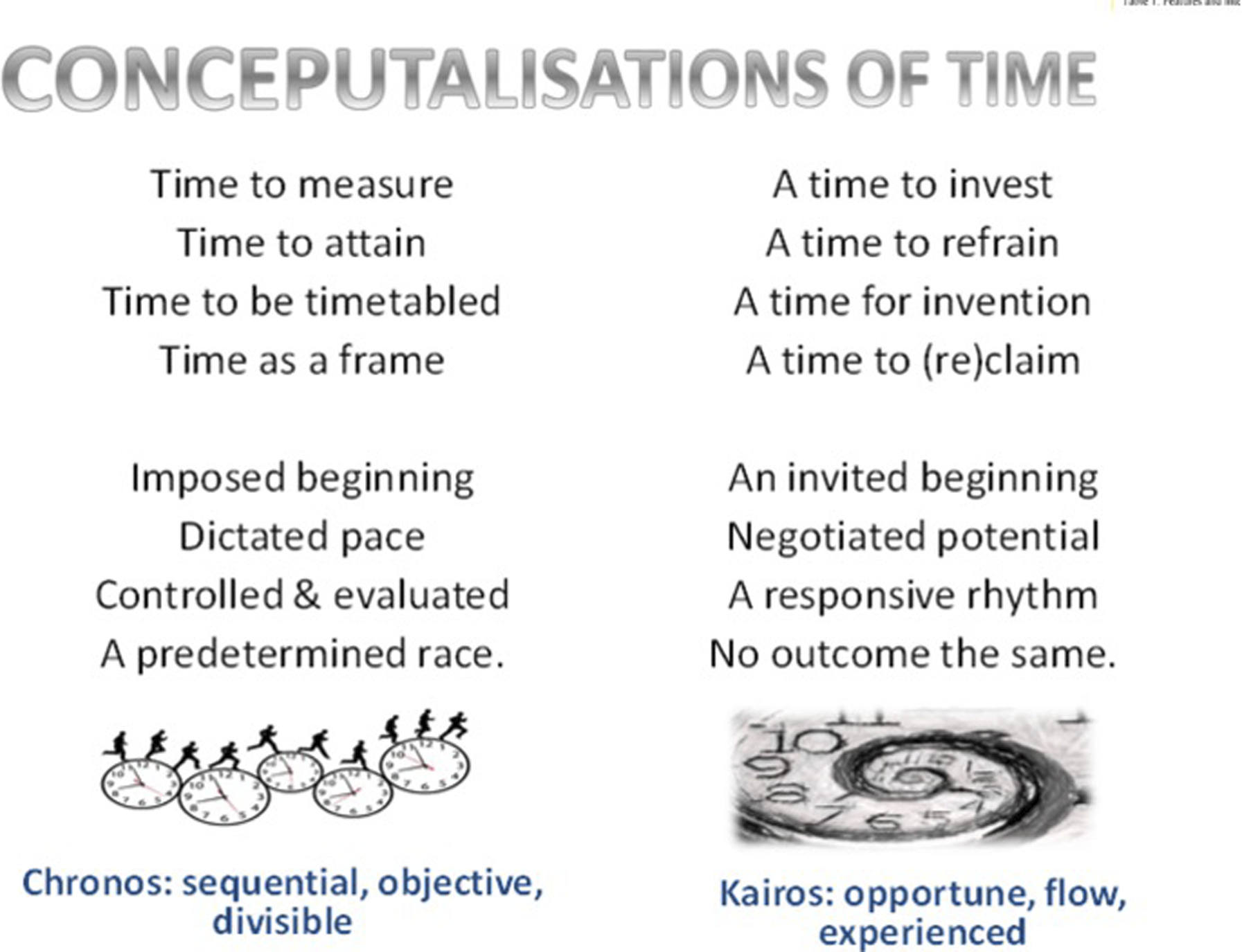
Dance Between Insideness and Outsideness
In keeping with natural attunement, working with the tension and/or confluence between insideness and outsideness is central to the research process and its articulation. In Figure 6, I am looking at my participants and they are also looking at me. The photo on the left was taken by a co-researcher, the one on the right is a snapshot extracted from my own video-recordings. These photos juxtapose as well as bring into confluence the insideness and outsideness of the observational research experience. Continuity between researcher and researched.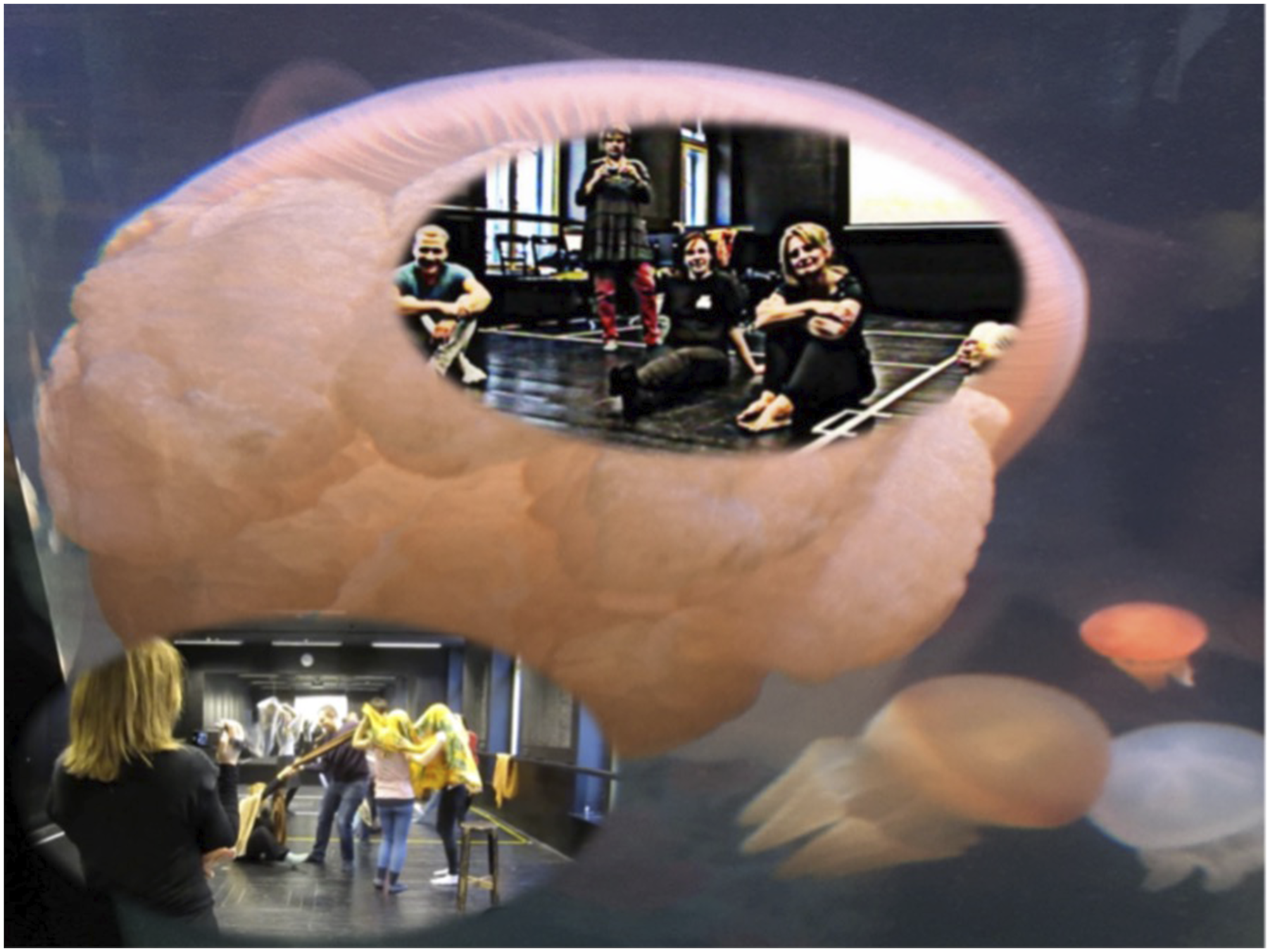
The camera records musically inspired movement, and it also records our shared reflections on this (as captured in the photo on the right), including my own verbalized introspections shared with the cohort. The recorded action and reflection—along with the musical pieces captured in these—can be looked at using an external—third person—viewpoint. More importantly though, they also provide content for continued contemplative investigation. I therefore bring together the looking in with the looking out and reopen to the continuity that exists between researcher and the researched.
There is a shift in orientation when we combine the perspectives of the spectator and the participant or move between these two roles as researchers. Whilst the hierarchical culture of objectivistic science puts the spectator in a dominant, distanced position, a dialogic-inclusional approach to research design rebalances this relationship and puts the participants in charge. But what is even more important is the phenomenological move. The first-person (inward-looking) perspective is neither excluded, nor relegated to some peripheral purpose. It becomes the starting point for the researcher to operate from. The normative of the third—person perspective is removed, and the focus of inquiry is turned inwards, to initiate the dance between inner and outer orientation for the participants and the researcher alike. For example, the following inward-sensing reflections, documenting my own experience, have become part of the complex dissemination: “I felt as if I was in a ‘vurstli’ [a village fair or a small amusement park]. I saw a lion tamer, I saw a ringmaster, I saw animals being trained to do circus tricks. There were relationships forming. I saw a giant, inflatable blow up doll swaying back and forth in the wind. There were stalls where you could shoot or throw at a target. I saw people chasing each other, and I possibly saw people shooting at targets and winning prizes. Yes, I was in a village fair.” (Researcher’s shared reflection – Session 1, Bartók, Concerto for Orchestra, Intermezzo interrotto)
So how does such introspective content get used in writing and dissemination? The first-person orientation encapsulates empathic presence and feeling awareness—juxtaposed with the sense of objectivity and detachment associated with the third-person perspective. Research participation and scientific discernment thus constitute a receptive-responsive dialogue between reflection and action, or between introspection and extraspection. Figure 7
2
shows my attempts to bring together the looking in with the looking out, acknowledging the continuity that exists between these different dimensions. Research as a receptive-responsive dialogue.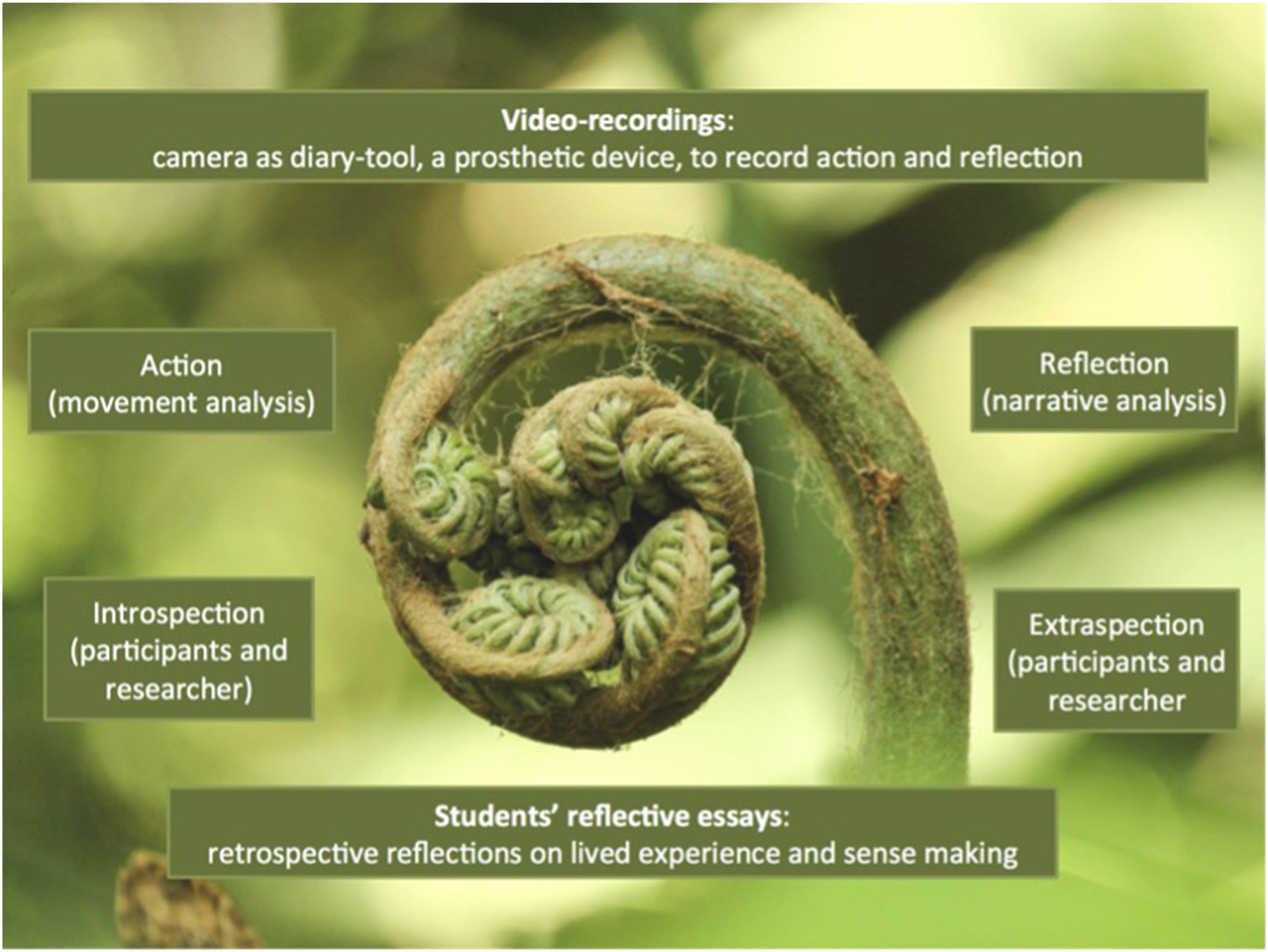
These complex relationships are reflected in my writing, which incorporates my own lived experiences in the research context. But this is not simply auto-ethnography, foregrounding experience as a method of meaning making. It is clearly not traditional classroom-observational dissemination either, written from an “objective” third-person perspective. Whilst I do not abandon looking at the phenomena of interest from an outsider’s perspective, this is intertwined with my first-person perspective accounts of these: moving from thinking about towards thinking with through thinking from within. Thus, I expand my field of awareness by cultivating and centering the mode of thinking from presence, which then forms alliance with third-person outsider perspective. “They go together as compatible, reinforcing, co-creative lenses of discernment” (Roy Reynolds, personal communication, 2021). The painting in Figure 8 speaks to this union: Beyond a curtain of fire and containing wall of earthy bricks is a vista through air and across water to a bejewelled eternity, a curved, inductive, inner space within a ring, a loving Zero. The ring is shared between swans, male and female reflections brought together, each at One with the Other. Imagining beyond confrontation. Rejoining polarities. Denying Neither. Embodying Both. Engagement (oil painting on canvas by Alan Rayner, 2001; reproduced with permission).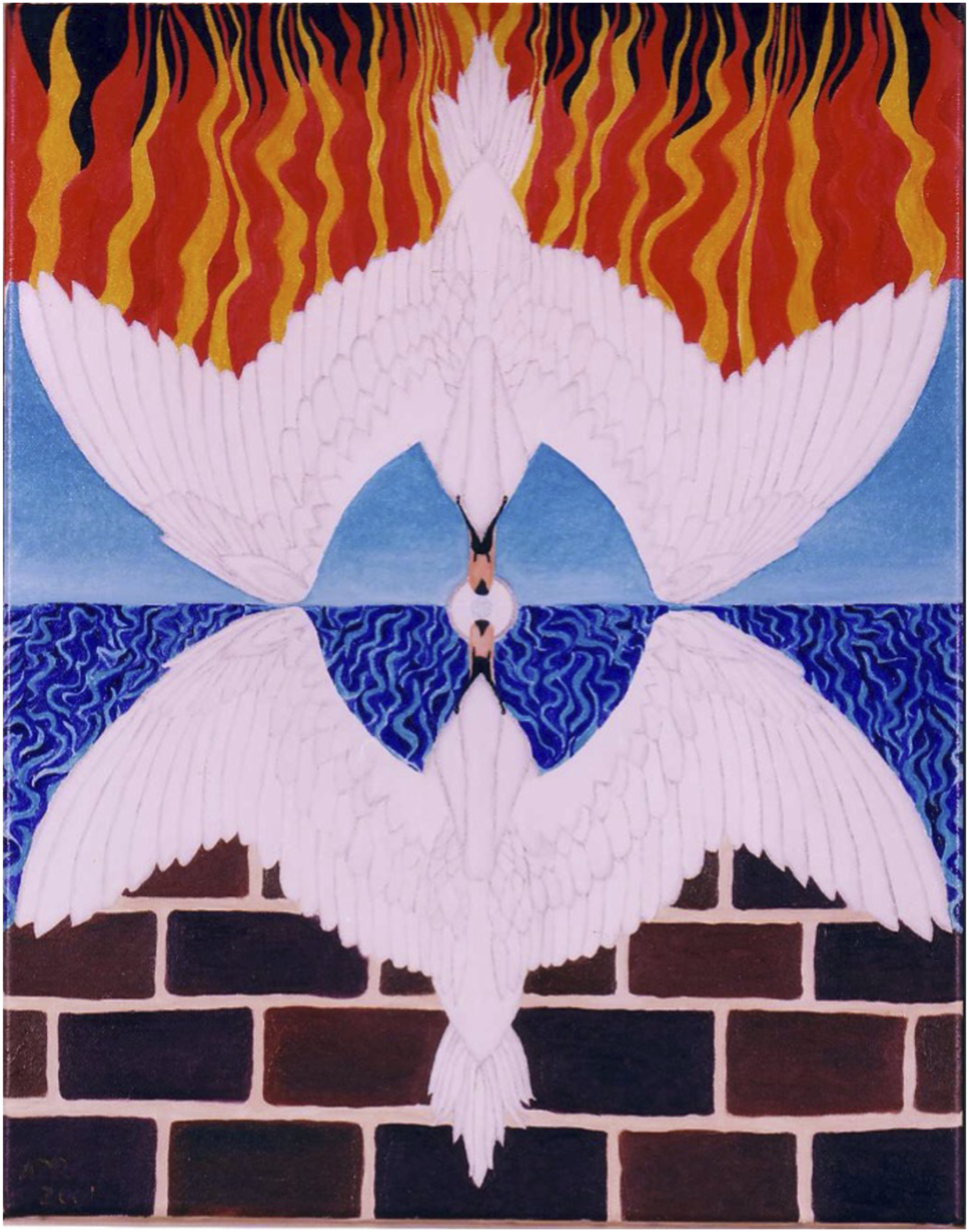
I use my own center of receptivity to attempt to bring all perspectives into convergence and illuminate the fluid relations of discernment through this rich overlay of multiple perspectives, coming together and flowing through my center of receptivity, and being evoked by this center. In doing so, the writing must be more than a series of snapshots recorded by an outside observer. It must instead capture the continuous dynamic within what I am observing and what I am, myself, included in. In keeping with the dialogic ontology of creative practices (e.g., Glăveanu & Beghetto, 2017), maintaining difference (e.g., the polyphony of different perspectives) is necessary in this creative inquiry. Holding tension is the key to the dialogic opening and insight.
In the following, I present illustration for this, from a particular music-movement session. My own felt experience of the session (which I also shared with the group in the reflection phase) was cathartic. Whilst working with the camera and recording the action, I also allowed myself to enter into a dialogue with the music. Responding to the pulsating musical features, I turned into a sea-creature, a translucent jellyfish, swimming in deep, dark waters, swimming towards the light, towards the bright surface. The water was blue, crystal clear, pleasant, and calm. The sense of floating in the waves was transcendental and peaceful. Yet, there was something poignantly sad about this experience as well. The feeling of sadness, I observed, arose from the complete solitude of this creature I imagined myself to be. With no other living beings around, it was an experience of solitary floating in the musical waters. It is possible that my immersion in sensory musical dialogue, coupled with the inward focus, brought along some uniquely deep insights about the research process. To me, it signifies the researcher’s solitude and isolation from the unique collective immersion they are witnessing; and the necessity to be at least partially distanced.
I offered my own felt experience when stories and insights were shared by the participants. Our sharing led to the realization that the delicate, pulsating musical features of the music evoked deep existential encounters that were convergent. The participants (and myself) were enacting, observing, experiencing variations to the same theme, converging around what I referred to as “Life’s pulsating musical energy.” Figure 9 shows how I attempted to capture these convergences visually in research writing and dissemination. The themes are represented as overlapping bubbles in the image on the left hand side, whilst snapshots from corresponding body-movements are presented on the right hand side. My own story and embodied presence is signaled as orienting towards but fully converging into these (bottom left corner). (a) and (b) Life’s pulsating musical energy.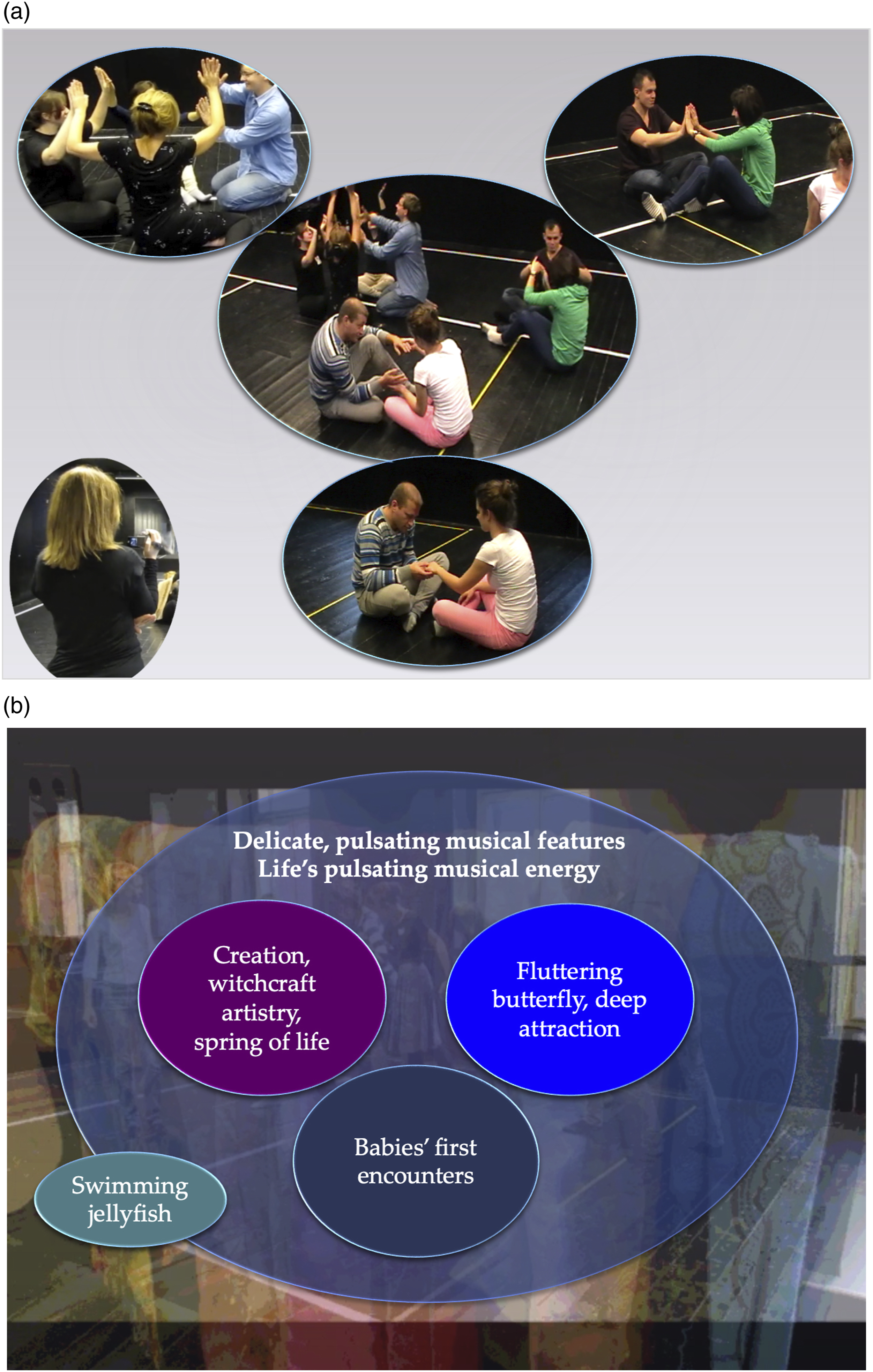
Inviting Stillness—Cultivating Inward Sensing
In my efforts to marry extraspection and introspection, the most useful approach I found was to strategically return to the self as a center of receptive presence and cultivate a rigorous practice of first-person inquiry first and foremost. Starting out in my journey with an expertise in traditional third-person perspective observations, this shift has been tremendously enriching. Thinking from presence is not something I associated with doing research in the past, conditioned to a culture of objectivity that overlooks contemplative methods of scientific inquiry. In this lopsided culture, contemplative science feels like a liberating expedition—note the Latin root expeditio implying the “freeing” of the “feet”—whereby we are “extricating ourselves from a place in which our feet are stuck” (Wallace, 2009, p. 6). In spiritual terms, the challenge is to stay within in contemplative space and speak of what is arising right there. The painting “Radiant Receptivity” in Figure 10 speaks to me of this orientation: Radiant receptivity (painting by Alan Rayner, 2020; reproduced with permission).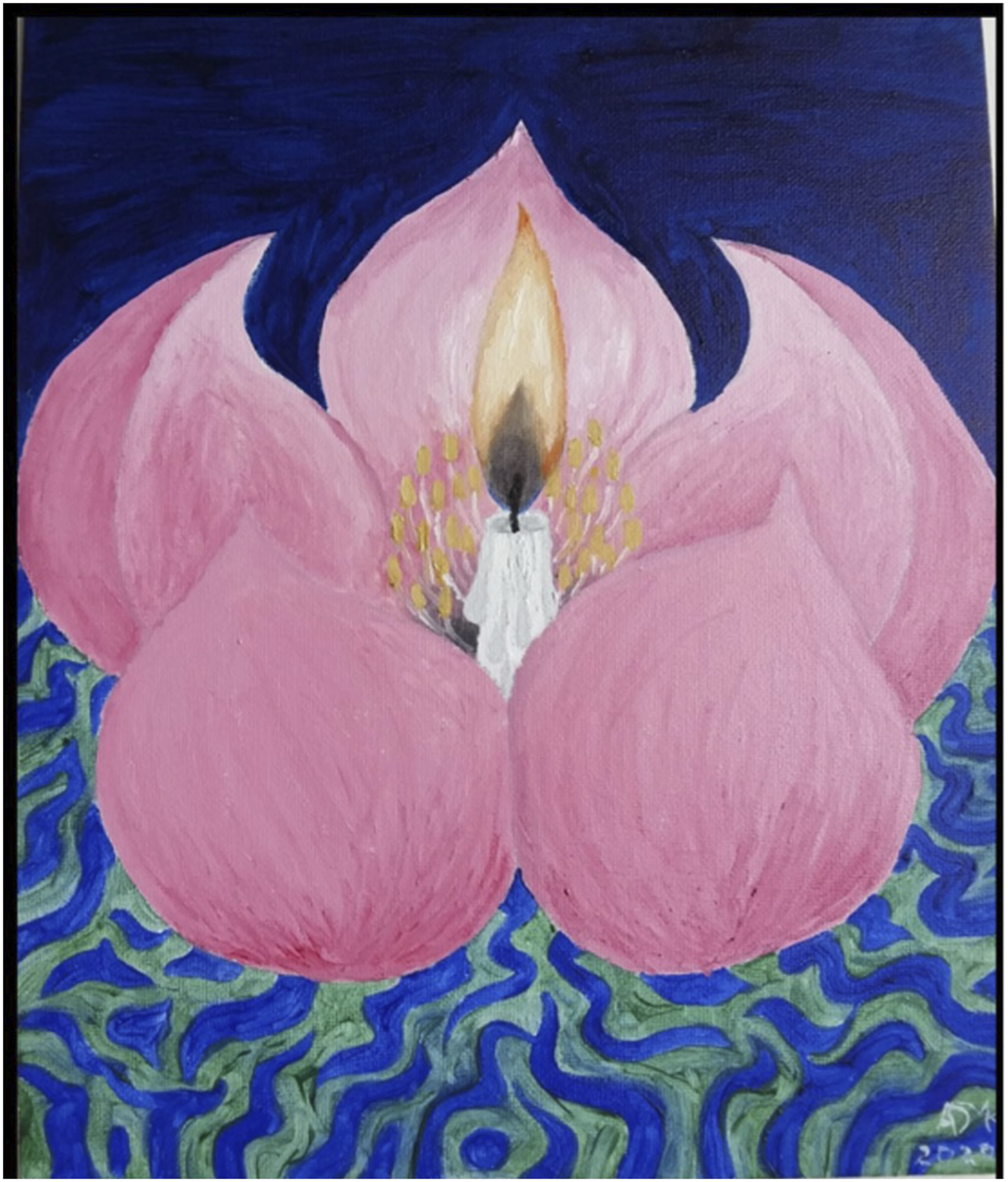
Perpetually returning to the self as the center of receptivity, there is a union of stillness and motion (or tension and release) that fuels creative sense making and expression.
Shifting from Definitive Language Towards Multimodal, Fluid Expression
In my recent writing, I have often found language limiting as a mode of expression due to the inherently non-textual, visceral nature of thinking from presence. How does the embodied, experienced, lived logic of imagination translate into words, and how does language limit or enable us in capturing all this? A related challenge with an open-ended inquiry is the abundance coupled with complexity: the organic, emergent, expansive web of insights. Following from this, I have gravitated towards diverse modes of communication that are non-linear and which overcome the trappings of the language-based modality, recognizing that the translation of lived experience into language is not an unavoidable necessity. There is strong emphasis on the visualization of philosophy (Figure 4), research design (Figure 7), and findings (Figure 11). In Figure 7, for example, I used the image of a koru (silver fern spiral) to introduce the complex route towards comprehensive perception which builds on a multi-directional dialogue between different perspectives and positions. In Figure 6, the inward pulsating dance between inward sensing and outward observations is visualized with two photographs that are embedded in an image of underwater sea world, with jellyfish floating by, reminding me of my most cathartic encounter of this receptive-responsive dance. Summary of key experiential themes (from Vass, 2019).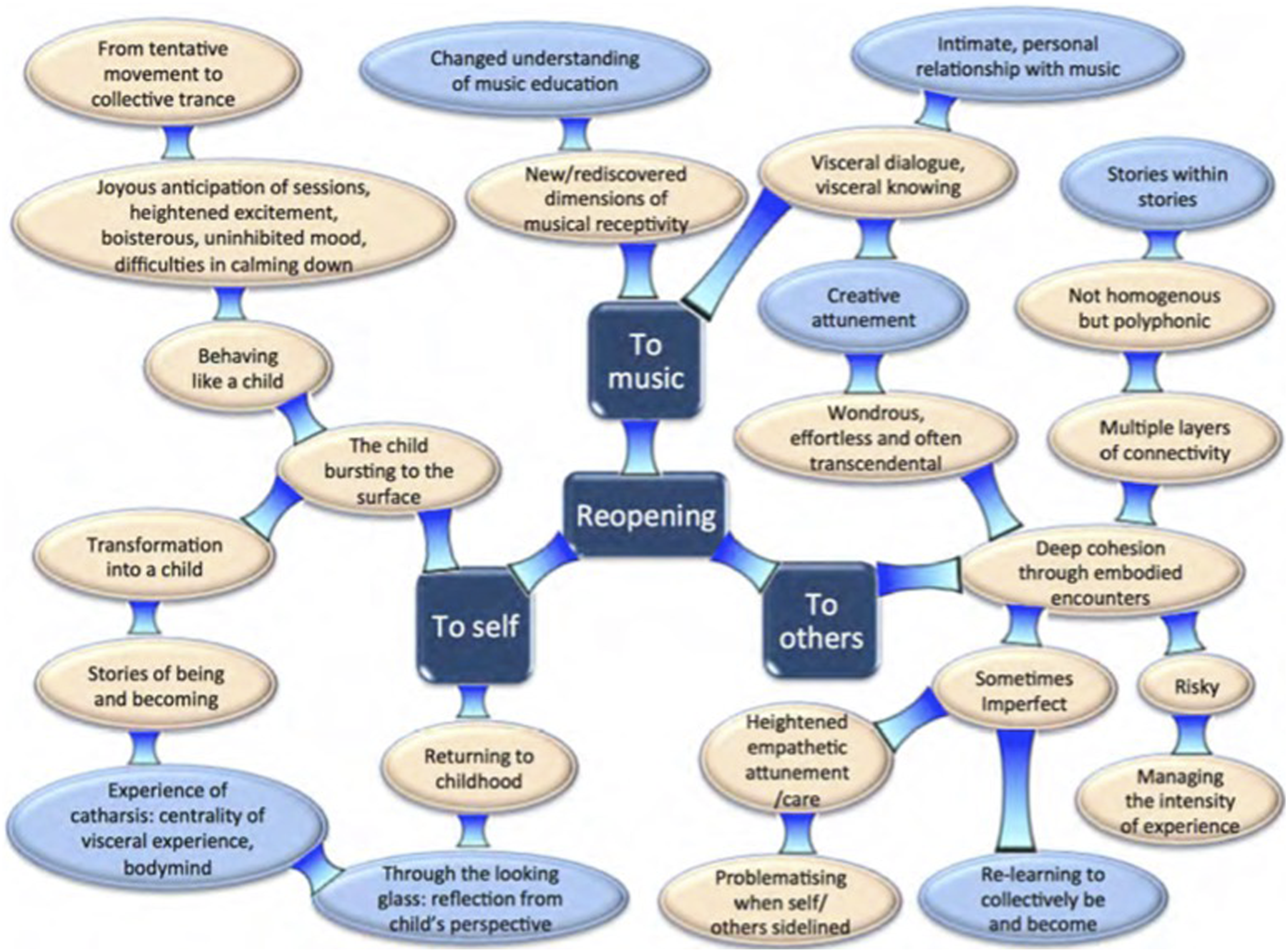
Even when language is used to express insight, findings can be presented in a non-linear, organic fashion, carefully eliminating any verbal or visual trappings of a purely objectivistic perspective. See, for example, Figure 11, presenting a “tree” of key emergent themes. Instead of the abstract geometry of straight lines and pointed arrows denoting connections between discrete points with firm boundaries, I chose soft curvy lines to imply continuity. I also used natural spherical shapes, to reflect the fluid geometry of nature with its flowing, continuous use of shapes and lines (Figure 11):
My research writing fuses science with poetry and visual art, contributing to the dissemination of scientific understanding. Through art I can go beyond the superficial knowledge and praxis of intellectually constituted thought and language. As Rayner (personal communication, 2019) points out, even with the best intentions to go beyond the objectivistic mindset, our conditioned use of language can trap us regardless: “The problem of trying to define things is that the language of objectivity is, by its very nature, definitive language. And, by its very nature, it presents nature as if it is a photographic snapshot…. language that objectifies by standing outside and taking a snapshot of what it is observing….” Therefore, we need to scrutinize and refine our language so that we can avoid the entrapment of definitive, objectifying, categorical thought, and give way to fluid logic. This is a process of loosening up the language but at the same time finding clarity and precision in our expression. Poetic language, or non-textual articulation of research through visual arts, serves these purposes well. Through these artistic modalities, our logic becomes the fluid logic of imagination, or perceptual logic. Art is therefore an expression of science. In my writing, I am conscious about the inherent biases in language and make efforts to find the kind of linguistic or non-textual expression that adequately represents my true meaning. This is where poetry and art comes in, enabling me to return to my imagination, intuition, and sensing to convey various kinds of understandings. Poetry and art enable the analytic brain to express itself artistically. I am closing this narrative with a haiku by Kenneth Masters. ‘Practice and perceive? Mind-stuck intellect struggles- ‘Openness’, holding, Sees.’ (Kenneth Masters, 2018)
Footnotes
Acknowledgments
The research orientation presented in this manuscript was inspired, guided, and refined through informal as well as more structured conversations with Alan Rayner and Roy Reynolds, for which I am infinitely grateful. Please find video-recordings of three such conversations at: https://www.youtube.com/watch?v=AxiQ2du3va8 (Natural Inclusionality as a mode of inquiry); https://youtu.be/GiuU1pzSlv8 (Natural Inclusionality: Methods and methodologies) and  (Highlights—Resurgence from crisis through awareness of Natural Inclusion). I would also like to thank the following colleagues for granting me permission to reproduce their work in this manuscript: poetry and paintings by Alan Rayner, drawing by Roy Reynolds, poetry by Ken Masters, and poetry by Josephine Moate.
Declaration of Conflicting Interests
The author(s) declared no potential conflicts of interest with respect to the research, authorship, and/or publication of this article.
Funding
The author(s) received no financial support for the research, authorship, and/or publication of this article.