




Abstract
Writing qualitatively is an immersive experience divergent to other forms of research writing. It is an active construction of reality characterized by integration of the socio-cultural context and in-depth analysis of data viewed through the lens of the writer’s own experience of the phenomenon. However, these characteristics prove challenging and qualitative researchers are often at a loss on how to document their findings. Most studies provide a broad sweep of qualitative writing with few explicit examples in practice which further confounds researchers. Consequently, researchers find qualitative writing exacting and intimidating and tend to present their findings objectively with either scarce or excessive reference to the research paradigm, thwarting the full transformative potential of qualitative research. Drawing on my experience as an interpretive phenomenologist, I present the writing cul-de-sacs and alleys I navigated to illustrate my becoming as a qualitative writer. Specifically, I highlight three distinct strategies to write it right, qualitatively. To maximize findings, the writing style should conceptually align with the research philosophy. Textual cohesion and a multi-dimensional view of social reality can be generated through a mixed-genre writing approach. Finally, making the “I” meaningful by incorporating the researcher’s experiences into the text affords a deepened understanding of the phenomenon. Tenaciously navigating cul-de-sacs in writing and finding solutions to exit no through roads, and walking those shadowy alleys of theoretical constraints, stylistic impositions, and tight word space endow a concrete visibility to the otherwise blurry aspects of life.
Writing well, a high-stakes endeavor in academia, is critical for publication. Highlighting research methods, convincing readers of the validity of conclusions, and opening up new ways of knowing and doing by evocatively communicating moments of insight gleaned from interpretation of data are intrinsic to both quantitative and qualitative research. However, it is challenging to “bring to words the multiple, often serendipitous, and ever changing experiences that represent researching” (Ely et al., 1997, p. 377). This claim poignantly sums up the complexity and elusiveness of research writing. Have you ever experienced the futility of walking down cul-de-sacs and alleys and feeling you are going nowhere? Lost and walking around in circles with no side streets or sign posts to signal your destination? Well, that’s how qualitative writers feel as they discourse through their texts. But one needs to be lost to be found, navigate cul-de-sacs and alleys to reach a specific writing destination. Writing validates the self, your journey, your knowing, and thus validates life. Research writing is a powerful communicative tool inviting readers to be active participants in the discovery process by drawing on their own knowledge and examining assertions and interpretations presented (Black et al., 1986). How one writes is inextricably connected to the type of content and knowledge claims embodied in a text (Cloutier, 2016), with lack of writing clarity undermining a study’s impact and contribution to the field (Feldman, 2003). As such, research writing holds significant sway over how findings are constructed, disseminated, and accepted.
While both positivist and non-positivist modes of enquiry are common, reporting the latter emerges as an onerous task, likely due to its reliance on “mere text” (Jonsen et al., 2018, p. 31) to interpret data and substantiate claims. In contrast, documenting quantitative studies is relatively straight forward since psychometric reliability scores such as Cronbach’s alpha, inter-rater reliability, parallel form reliability, and item-total correlation are employed as “built-in safeguards for warranting claims” (Barley, 2006, p. 19). Qualitative writing is also more demanding as it is concerned with articulating the meaning of nebulous phenomena as opposed to quantitative which is limited to what is observable (Saldana, 2018). Evidence indicates that qualitative writing is an active construction of reality characterized by the integration of the socio-cultural context and in-depth analysis of data viewed through the lens of the writer’s own experience of the phenomenon (Corbin & Strauss, 2008; Jonsen et al., 2018; Saldana, 2015, 2018). Qualitative approaches ranging from ethnographic narratives to phenomenological interviews, ontological observations, and case studies require refreshing, flexible, and energetic writing strategies to investigate lived experiences and maximize the full potential of findings (Jonsen et al., 2018; Saldana, 2015; Tracy, 2013). Despite the unique nature of qualitative writing, extant literature only provides a broad sweep of qualitative writing with few explicit examples in practice. Additionally, although there is unanimous agreement that “thick descriptions” are a core requisite of qualitative writing (Denzin & Lincoln, 2005; Geertz, 1973; Goldberg & Allen, 2015; Hengst et al., 2015; Leeds-Hurwitz, 2019; Lincoln & Guba, 1985; Loblay et al., 2021; Ponterotto, 2006), Wolcott (2012) asks: “how much description is enough to earn the accolade ‘thick description’?” (p. 3). Owing to these issues, writers are left floundering in the dark, and qualitative writing has become more of a “mopping up” (Richardson, 1994, p. 516) operation post research. Thus, the aim of this paper is to explore what it means to write qualitatively and propose some suggestions to strengthen writing.
I begin by briefly summarizing my doctoral thesis followed by a scrutiny of the cul-de-sacs and alleys I navigated as an interpretive phenomenologist. I then delineate three actionable strategies to write it right, qualitatively, increasing the likelihood of a manuscript being accepted for publication. These strategies include congruence between the writing style and research philosophy, adopting a mixed-genre writing approach, and integrating the researcher’s experiences into the text.
Overview of My Thesis
I recently completed a PhD in Education. Impelled by the research question: What does it mean to write a hybrid text as a student nurse writer? my project, Genre Mixing in Undergraduate Nursing Texts, focused on undergraduate nursing students and their academic literacy needs. Heidegger’s form of interpretive hermeneutics was the theoretical framework that underpinned my study. Hermeneutics pivots around being-in-the-world and using language to interact with other entities and spark meaning realization (Heidegger, 1978). In the hermeneutic tradition, language is viewed as a valuable resource that offers infinite possibilities for growth, guiding individuals from being to becoming, from the actuality to the possibility of being (Heidegger, 1978). I selected hermeneutics as my research paradigm because it resonated with the aim of my study and supported my phenomenological enquiry of students’ literacy practices as they dwelt in the world of nursing. Interviews and written texts served as my data sources. The former comprised nursing students’ and tutors’ account of engaging with a specific mixed-genre nursing assignment, a reflection essay, and the writing benefits and challenges encountered. The latter was a small corpus of reflection essays written by the same sample of students interviewed. Interviews were analyzed hermeneutically, while textual data was subjected to a systemic functional linguistic analysis. Main findings reiterated that despite its excessive writing demands, genre mixing is most apposite to the writing needs of nursing students. A significant outcome of my study was the proposal of an approach to literacy instruction, an approach that is embedded in disciplinary epistemologies, contextualized to writing situations and nuanced to specific genres.
What follows is a portrayal of the writing issues I experienced while writing my thesis.
My Struggle With Qualitative Writing
The data analysis section constitutes a substantial part of the thesis. Kohler (2016) points out that it necessitates stringing together “a chain of evidence” (p. 413) and creating “a coherent storyline that readers can easily comprehend” (p. 413). Consequently, Kohler maintains that crafting the findings section is one of the most gruelling tasks in qualitative writing. My acute struggle with navigating my way down the data analysis alley of my thesis lends credence to Kohler’s statement. I was drowning in data and did not know how to get started. Every avenue I explored seemed to lead me down a blind alley. In the words of Saldana (2018), “I had a plot but no storyline” (p. 2). Being conceptually governed by hermeneutics, I realized that my findings had to be communicated in a phenomenological tone and thus made a considerable effort to discover my “writerly space” (van Manen, 2015, p. 1). I immersed myself in what van Manen (2015) alludes to as “the textorium” (p. 3), a writerly space cloaked in darkness, and endeavored to write as an interpretive phenomenologist.
First, I attended to my philosophical grounding. Goldberg and Allen (2015) emphasize that the theoretical framework occupies a prominent place in the qualitative research process and must be entwined into the research design, the framing of the study, and interpretation of data. Bearing this in mind, I sought to make a tight connection between my data analysis and hermeneutics. My first draft of writing as a phenomenologist left much to be desired. As evident from Figure 1, the research philosophy overshadowed my findings. As a result, the value of my finding and what it meant for nurse education remained obscure. Theoretical issues.
My writing predicament was that I lacked a proper scaffold on which to model my writing. While there is a sizable amount of literature on qualitative research, examples and practical advice on how to write in an epistemological tone are scarce. I discovered that most articles on qualitative writing take the form of a discussion paper with insufficient reference to tone and the type of language to be used. With regard to theory, LaRossa (2012) reports that in his capacity as a deputy editor of a major journal, he found theorizing was conspicuously absent in most articles submitted. Similar to LaRossa’s observation, the sample qualitative theses that I read, either had no theorizing or the theoretical framework failed to flow on from the methodology chapter and showcase the data analysis. This rendered the data analysis section a dispassionate, factual documentary of findings, a positivist trait. Hence, I was groping in the dark with little supporting literature to shape my thought processes. How then was I to align my concrete findings with the highly abstract aspects of hermeneutics? How do I expatiate my findings in a phenomenological tone? These issues made the writing up of my data analysis exacting and intimidating. As can be seen in Figure 1, the narration of my findings appears to be obtuse and disconnected, instead of the seamless interpretive representation of the embodied reality of being a student nurse that I was aiming for.
Disheartened, I labored over my writing and revised my draft such that my findings were still landscaped against the theoretical framework, but without the hermeneutic overload. This meant that I had to strip my text of its excessive phenomenological cushioning and technical jargon. Resultantly, I was able to successfully spotlight my finding while still retaining a phenomenological flavor in my writing (Figure 2). A glimmer.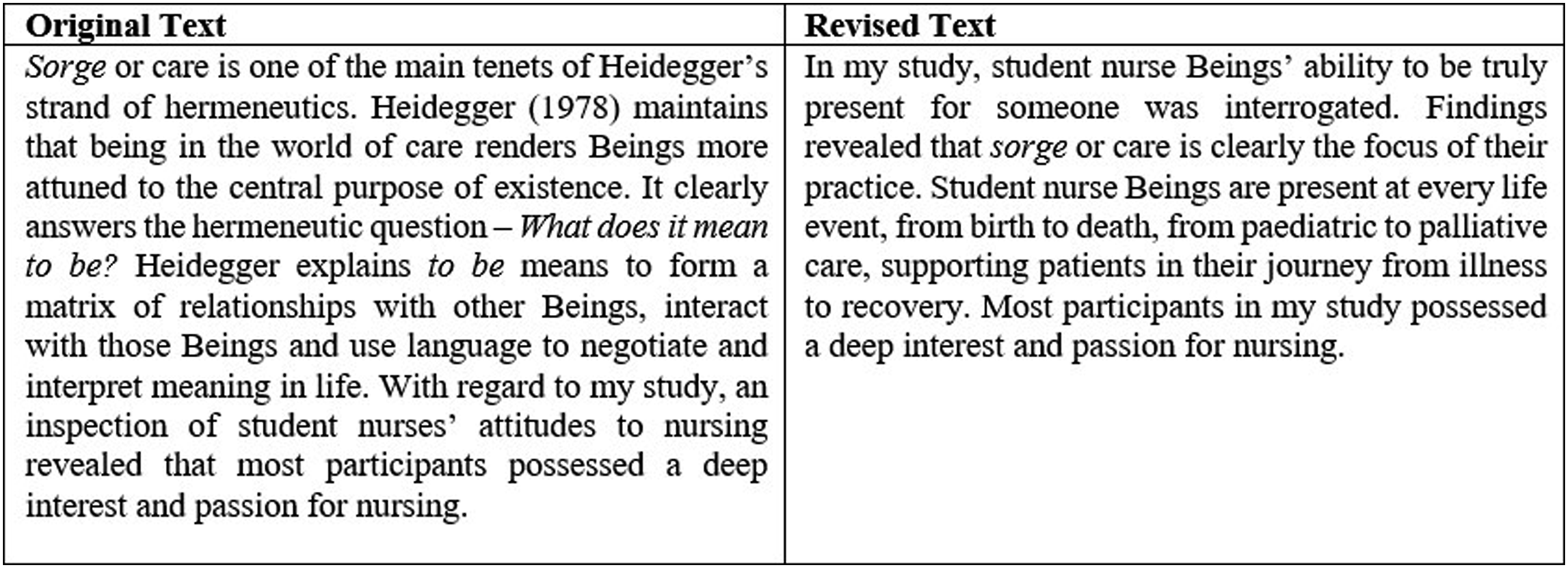
Next, I worked on extracting and expressing the meaning imbued in my data. Data analysis is the process of rigorously disassembling data, synthesizing, redefining, and reconstructing it into new formulations of meaning (Ely et al., 1997; Saldana, 2015; Vagle, 2016). In light of this evidence, I was aware that I had to engage in more interpretive work. Although draft 2 now presented the finding in line with the research theory, it was still bereft of meaning. What did the finding mean for the student nurses involved? Which nursing qualities does the finding pertain to? In order to be realistic and impactful, the analysis must be a judicious mix of presenting and interpreting data (Golden-Biddle & Locke, 2007; Sandelowski, 1998). However, my analysis ran the risk of degenerating into a superficial, descriptive account of findings. Thus, I reworked my draft and reconsidered what the finding meant from the participants’ perspective and the role they play as student nurses. From Figure 3, it is obvious that there is more depth to my analysis for it now delves into patient safety and the essential service that student nurses render as holistic care givers. More meaning.
Nevertheless, I felt I had reached a dead end for my finding seemed one sided with no evidence of self-immersion in the analysis. Tuning into self is the essence of qualitative writing (Cloutier, 2016; Ely et al., 1997; Jonsen et al., 2018; Saldana, 2015, 2018; Wolcott, 2012). Saldana (2018) advises that being a qualitative researcher is opening of self to the ebb and flow of life and seeing oneself in every case study. It is “dwelling deeply in your own presence” (p. 6) and knowing and understanding yourself to such an extent that “it scares the hell out of you” (p. 6). Saldana’s advice made me examine my own investment in the research process. My previous drafts now appeared bland, lifeless. Undoubtedly, I was holding back, trying to play it safe. As I phenomenologically waded through my data, I understood that personal and emotional investment animates and strengthens a text. Empowered by this knowledge, I re-imagined my dual role as a literacy advisor and researcher and wrote myself into the text as a nexus (Figure 4) to understand the identity of nursing students and the breadth and depth of their literacy requirements. The nexus.
In reviewing and revising my draft further, I noticed evidence of “quotitis” (Hopwood, 2020), or excessive quoting. In general, quotes breathe life into findings (Goldberg & Allen, 2015). There are two types of quotes that enhance the quality of analysis—power quotes and proof quotes. Pratt (2009) discloses that power quotes are captivating items of data that are explanatory in function, whereas proof quotes are multiple participant quotes used to affirm each power quote. Nonetheless, in a bid to preserve the purity of my raw data, I was constantly travelling down quotitis alley, that is, overusing power and proof quotes in my text (Figure 5). Avoiding quotitis.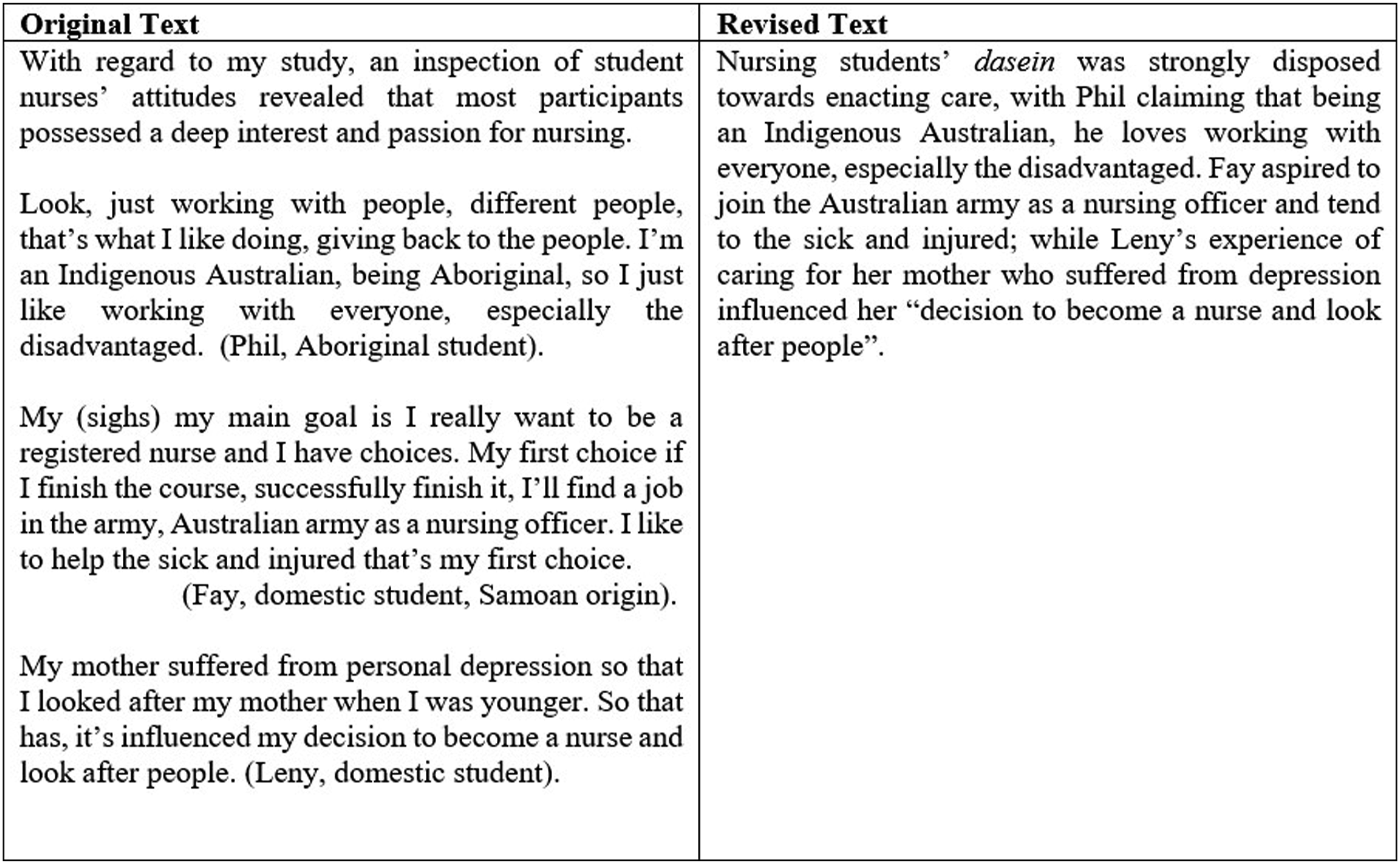
Goldberg and Allen (2015) state that a well-written findings section contains a fully developed theme that stands independently followed by a few quotes to demonstrate assertions. On the other hand, an inadequate findings section is infiltrated with excessive quoting and “more likely to leave readers bored, than beguiled” (Wolcott, 2012, p. 6). To avoid quotitis, in addition to minimizing the number of direct quotes used, I paraphrased some of my participant responses where appropriate and presented my findings as a narrative of student nurses’ lived experiences (Figure 5).
Another issue I grappled with when writing my thesis was the term “findings.” To me, the term “findings” signalled objectivity and failed to capture the passion and urgency of my knowledge claims. This motivated a further perusal of hermeneutic literature. Evidence revealed that “subject-object and subject-subject relationships do not occur in a vacuum but in a world vibrating with meanings” (Dahlberg et al., 2008, p. 172). The words “vibrating with meanings” were in accord with my analysis. In my study, the life world of nursing students too was constantly vibrating with meanings as they attempt to make sense of assessments, engage with clinical practice, and interact with family. My analysis centered on these vibrations of meaning and their effect on the academic performance of students. Additionally, being submersed in my data, other aspects of significance resounded within me. These include: what it means to function as a student nurse attending to illnesses and death, addressing assessment criteria, meeting deadlines, and family obligations. I interwove all these reverberations of meaning into my analysis to provide a rich, detailed narration of the phenomena studied. Consequently, instead of the term “findings,” I used the term “meaning vibrations” to refer to the urgent pulsations of meaning that emerged from my study. On discovering myself as a writer, I was able to proceed with crafting the rest of my thesis.
Three useful strategies that I learned in the course of writing my thesis are discussed below.
Alignment Between Writing Style and Research Philosophy
The researcher’s world view or philosophy underlying a study acts as an analytic search light which lays bare the lived experiences in all its nuances. It offers researchers the latitude to tunnel through and examine vast amounts of data from different ways of knowing the world. The analogy of a lens is often used to refer to a study’s epistemic underpinning (Collins & Stockton, 2018; Ely et al., 1997; Flinders & Mills, 1993; Saldana, 2015; Stenius et al., 2017). Saldana (2015) reports that a lens coincides with a person’s age, gender, cultural, and economic background or occupation. He also puts forward the notion of a filter which encompasses an individual’s attitude, ethics, experiences, and assumptions of the world. Additionally, an angle denotes diverse cultural, emotional, and objective perceptions of life. Together, these three elements frame a sophisticated, dynamic, multilayered view of the world (Saldana, 2015). Likewise, Ely et al. (1997) assert that a theoretical lens sharpens, angles, and illuminates what “might otherwise be a blurred stream of perception” (p. 230). The evidence presented underlines the razor sharp focus that an epistemological stance affords. However, a number of researchers have lamented the epistemic paucity in research (Drisko, 2005; Goldberg & Allen, 2015; Green, 2014; Jonsen et al., 2018; Wolcott, 2012). The main reasons for this paucity are disagreement over the role of theory and its influence over a study (Goldberg & Allen, 2015), and uncertainty and confusion surrounding the terms “theory,” “conceptual framework,” and “epistemology” (Collins & Stockton, 2018; Green, 2014; Sweet & Davis, 2020).
Since epistemology is akin to a lens as noted above, it stands to reason that each individual brings a different set of lens to the research process. There are myriad ways of viewing the world, prompting the declaration: “one person’s epistemological trash is another person’s epistemological treasure” (Saldana, 2015, p. 49). What is crucial is to choose prudently from the wide spectrum of epistemological treasure available and ensure congruence between the writing style and theory. Style pertains to the prevailing tone in a body of work. Saldana (2020) intimates that style carries the whole qualitative text and has bearing on how the story is narrated and textured. “Styles of writing are neither fixed nor neutral but reflect the historically shifting domination of particular schools or paradigms” (Richardson, 2000, p. 5). Compatibility between the writing style and theory is achieved when every aspect of the research process is mapped to the overarching paradigm.
Often, a study is foregrounded by vague references to the paradigm which include: “this descriptive study,” “in this interpretive investigation,” or “a grounded theory design” with scant attention to conceptual theory. Such references relegate theory to a cursory item to be checked off, a hurdle to overcome when pursuing a degree or publication (Wolcott, 2012). To make writing meaningful, the philosophical foundation must be fleshed out in sufficient detail and inform writing choices. For instance, if grounded theory developed by Glaser and Strauss is the theoretical underpinning, the type of grounded theory selected needs to be explicitly articulated. According to Whitehead and Disler (2020), four dissonant strands of grounded theory proposed by Glaser, Strauss, Corbin, and Charmaz exist with each strand rooted in distinct modes of data analysis and generation of new theory. This means each strand would also have its own set of writing conventions that needs to be complied with. Correspondingly, while thick descriptions are the goal of all qualitative writing, the type of description hinges on the thrust of the theory. In terms of writing style, descriptive phenomenology warrants a more exhaustive description of the web of relationships and moments of consciousness associated with an experience. Typical research questions are formulated using the question word “what”-“what are the experiences of …?” In comparison, driven by the questions “how” and “why,” interpretive phenomenology calls for a careful exploration and detailing of being-in-the-world and the role of language in fuelling meaning. Paying heed to the alignment between writing style and philosophical positioning accentuates the trustworthiness and integrity of the study.
In relation to my PhD thesis, my writing dead end could be attributed to misalignment between my research disposition and writing style. Initially, I was satisfied with my writing because I had an entire chapter devoted to my interpretive stance with a credible rationale for my methodological decisions. However, as I progressed with my thesis, I felt I was ineffectual in advancing a plausible, persuasive argument for my core conclusions. A hitherto unidentifiable “something” was preventing me from expanding my range of vision leading to the production of a barren text. It was only as I scrutinized the literature on qualitative research that it dawned on me that the undefinable “something” was dearth of theory. Apart from my methodology chapter, there was no trace of my conceptual leaning. Ely et al. (1997) suggest that in addition to reviewing the philosophical foundation at the start of the thesis, it needs to be integrated into the discussion of findings. In writing up my thesis, failure to ground my findings in my research philosophy sent me lurching down a blind alley with no way out. Philosophical darkness stifled my ability to phenomenologically “see” the life world of my participants and unearth meaning from it. As explicated in the section My Struggle With Qualitative Writing, I then labored over my drafts till my writing was saturated in hermeneutics elevating it from “a passive, positivist form of cognitive understanding to an active, dynamic form of interpretive understanding” (D’Souza, 2018, p. 200). Thus, congruence between the writing style and the research philosophy validates meaning vibrations.
Although theory determines the writing style, a text must not be weighed down by theory. Wolcott (2012) cautions “theory ought to be useful, not simply for show” (p. 6). Equally vocal are Collins and Stockton (2018) in denouncing theoretical heavy handedness which “prevent the salience and importance of data from coming through” (p. 9). It must be noted that in some situations, to fully interrogate a phenomenon, multiple modes of thought may be required. Jackson and Mazzei (2012) justify their use of six different theories in their study, claiming “we not only read the data with Derrida, Spivak, Foucault, Butler, Deleuze and Barad looking over our shoulder, but we also read with each of us looking over the other’s shoulder” (p. 138). Stylistically, integrating epistemology into a thesis—be it single or multiple—is a profound intellectual exercise. Measured and considered use of theory coupled with the right writing rhetoric would give research a qualitative depth and richness.
A Mixed-Genre Writing Approach
The right writing rhetoric accommodates a hybrid or mixed-genre writing approach. Emanating from systemic functional linguistics, hybrid writing is based on the notion of language as a social semiotic. According to Halliday (1996, 2003), language use is optimized in social contexts, for depending on the context of language use, individuals are able to make appropriate linguistic choices and mediate meaning on three levels: ideational, interpersonal, and textual. Halliday (1996) explains that ideation relates to what the text is about manifested through the field or register choices such as participants (nouns), processes (verbs), and circumstances (adverbs and prepositional phrases). Interpersonal meaning conveyed through the tenor of the text refers to the social relations between participants in a text and highlights why the text means what it does. The final level of meaning—textual—articulated through the mode of the text is concerned with how lexical and grammatical units are configured in a text (Halliday, 1996). Martin (1992, 2001) expands on Halliday’s social semiotic theory by proposing an additional level of context, “genre,” to investigate how field, tenor, and mode are interwoven into a text. A genre is “a staged, goal oriented, social process” (Martin et al., 1987, p. 59). Put simply, a genre is a functional linguistic tool that helps fulfil the purpose of a text. It is to the functionality of genre that I turn to, to explain how meaning can be activated in qualitative writing.
A literature review on genre pedagogy confirms that the notion of genres has evolved from “mind forg’d manacles” (Kress, 1987, p. 36) to free mixing or “the functional integration of two or more genres into one” (Guo-wei, 2010, p. 85). Dimock (2007) reiterates that mixed genres are genres “afloat in the same pool, with generic particles released by cross-currents, filtering into one another and coalescing in different ways” (p. 1381). During the process of coalescence, the genres flexibly and volatilely bend and fuse together to enact the overall discursive function of the text (Bhatia, 2004, 2016; Guo-wei, 2010). No field is more deserving of genre mixing than qualitative writing with its vast range of theoretical, methodological, structural, lexical, and grammatical expectations. The flexibility and tactical freedom of genre mixing cannot be emphasized enough, yet its potential has seldom been tapped into in qualitative reporting.
Genre mixing is a naturalistic way of writing. Paltridge (2014) lists expositions, recounts, descriptions, and procedures as the most common written genres. To effectively document the outcomes of an investigation, synchronous with the epistemological slant, qualitative researchers need to blend a number of genres to create a precise and trustworthy manifestation of reality. For instance, Saldana (2020) establishes that the genres associated with a case study are a description of the characteristics of the case, reflective interview based accounts of the case, and representative vignettes of the case interacting with other entities derived from participant observation. Poetic representations of interview data and dramatic constructions of autoethnographic texts with “strong imagery, fleshed-out characters, unusual phrasings … subtexts, the flashback, the flashforward, tone shifts, synecdoche, dialogue, and interior monologue” (Richardson, 2000, p. 11) are other examples of mixed research genres. To escape “genre straitjackets” (Avital et al., 2017, p. 241) and write with greater fluency, Avital et al. advocate employing “new or unconventional forms of communicating” (p. 241). Rather than a mono-generic form of writing, they argue for the adoption of alternative genres on the basis that the hybrid actions that constitute research writing—putting forward propositions, using formal language, introducing philosophical and other voices, writing up the literature review, findings, and discussion—require hybrid ways of writing. Alternate genres heighten cognition and facilitate “unconventional forms of contemplating, conceiving, experiencing and communicating research” (Avital et al., 2017, p. 241). Although Avital et al. use the term “alternate genres,” its connection to genre mixing is palpable. A mixed-genre writing approach paves the way for the shifting of gears in writing, and eloquently, boldly, and energetically transmitting knowledge.
However, a striking feature of genre mixing is that it has no prescribed writing tools to construct a text, making it an opaque endeavor. Ideational, interpersonal, and textual devices are used creatively on an “as needed basis” with the objective of telling an emotive and inspiring story. Departing from conventional writing forms and experimenting with different genres enable writers to recalibrate thoughts and transit smoothly from the introduction, to the problem statement, epistemology, research design, findings, discussion, and conclusion. Indeed, Avital et al. (2017) purport that veering off “the beaten track” (p. 244) unleashes writing restrictions and introduces new practices. Jonsen et al. (2018) prize writing ingenuity and the ability to ignite new insights through imagination and taking “some brave abductive leaps” (p. 33). Taking brave abductive leaps implies daring to be different by exploring cul-de-sacs and alleys—engaging in free writing, blending genres, making appropriate lexico-grammatic choices, and writing with energy.
The section My Struggle With Qualitative Writing traces the brave abductive leaps that I attempted after some preliminary genre disorientation. My genre disorientation stemmed from deploying the linguistic toolkit of a mono-genre to construct a hybrid text. Ironically, even though I was researching the hybrid writing practices of student nurses, I was negligent in applying the essential meanings that emerged from my own study to my writing. I was erroneously operating under the misconceived notion that every text is mono-generic when in reality, each text enacts different communicative goals and thus may subsume many genres. In my thesis writing journey, I resembled a traveller walking down back streets shrouded in the impenetrable darkness of hybrid genres, trapped in the debris of collapsing textual boundaries, lexical density, and complex syntactical structures, voiced through the frustrating sounds of silence in my text—vacuous words, distorted writing.
Genre awareness motivated me to read through drafts of my writing and identify my communicative purpose. For instance, in the discussion of findings, my communicative goal was to enunciate my findings through the lens of hermeneutics. This involved introducing my theme, including supporting participant quotes, reflecting on the lived experience and interpreting meaning. These language functions are best served by the genres of description, recount, explanation, and analysis. Prior insists “genres should not be understood as templates but as always partly prefabricated, partly improvised and re-purposed” (Prior, 2009, p. 17). Hence, I re-purposed my knowledge of genres and structurally re-organized my text by fusing the genres of description, recount, explanation, and analysis, carefully and creatively selecting rhetoric options and authoritatively positioning myself in the text. To borrow Saldana’s words, “I deliberately inflected and varied my pitch throughout sentences for variety. I emphasised selected words with volume or tempo to give them their due significance” (Saldana, 2020, p. 26). Mixing genres helped me rhetorically mold the text to match the writing situation, demonstrating its versatility in optimizing textual cohesion and generating a multi-dimensional view of social reality.
Incorporating Researcher Experiences
Molding the text to the writing situation predicates making the “I” meaningful. This is done by fully and candidly incorporating the researcher’s experiences into the text. “The write up of research is an act of persuasion” (Saldana, 2015, p. 61), shattering preconceived beliefs, proffering original and often revolutionary forms of thought, and convincing readers to a point of view. An inherent characteristic of persuasion is truth about self and a transparent discovery of meaning. It mandates becoming “hooked and high on your data” (Saldana, 2018, p. 5) and opening up self to the shortcomings of society, as well as examining and acknowledging personal failures (Saldana, 2018). Qualitative writing thus relies on writer stance to project a deepened understanding of life.
Stance established through first person pronouns permits writer intrusion into the text. Using personal pronouns, qualitative writers can not only portray their own identity but also concretely explain how they made an original contribution to knowledge (Hyland, 2001). Personalized discourse also fulfils pragmatic functions such as phasing information in a text, delineating methods used, and recognizing funding bodies and institutions (Harwood, 2005). Illustrating how the researcher has “gotten his or her hands dirty, and hung around a while” (Jonsen et al., 2018, p. 48) clearly answers the research question from multiple angles. Even so, Van Maanen (2010) observes that ethnographers seldom document how they traversed from field notes to research texts. To avert this oversight, Wegener (2014) espouses reflexivity, reflection on biases, and preferences, by entering into dialogue with self and imagined others. In dialoguing with data, Wegener drew on Phineas, a character from Byatt’s The Biographer’s Tale, to manipulate her ethnographic data on educational innovation into meaningful themes. She holds that “we are part of the life we study” (p. 356). The fictional Phineas helped her take a fresh look at her data by ruthlessly interrogating herself and the experiences that shaped the research process. Not all of us are fortunate enough to have a fictional character to authorize the unveiling of our inner most self, but the potential for reflexivity, to create “paths of truth” (p. 352) by exploiting our research experiences, lies dormant in each of us.
Regardless, the move toward a more impersonal stance is noticed in research articles (Hyland & Jiang, 2016), with the passive voice superseding the active when reporting research methodology (Sughrua, 2011). Richardson (1990) specifies that a research article steeped in writer stance is usually considered academically inferior to an objective assemblage of facts, but to him, it is “literarily major because it helps you find your frame, tone, narrative stance, metaphors and audience” (p. 49). In my own thesis, Genre-mixing in Undergraduate Nursing Texts, at first, lack of reflexivity took me down exit less roads where inundated by participant experiences, I was merely providing a one-dimensional view of what it meant to be a student nurse writer. However, being lost in participant experiences sparked reflexive engagement with the data, opened up new frames of reference, and helped me find my writing coordinates. Reflexivity allowed me to skillfully knit myself into the fabric of the text with relevance to the phenomenon of interest, and position myself “in space and standpoint, and in context and contrast” (Saldana, 2018, p. 6) which rejuvenated my thinking and crystallized meaning. In particular, a confessional style of narration leveraged my thoughts and legitimized the constrainers that repress the academic performance of nursing students. Saldana (2020) cites researcher failings as the fulcrum of interpretation in confessional narratives. My narrative was suffused with questions, intrusive ideas, missed opportunities, neglect of theory, and struggle with style, genre, and stance. In short, I wrote darkly about my role as a researcher and literacy advisor, but this very darkness helped me discourse, negotiate, and navigate treacherous writing terrain, and reach my research destination. To complement my prose, I packaged snippets of my experiences by means of figures and tables which visually attested to the veracity of students dwelling in the life world. Charts, diagrams, and tables nullify a “regimented vision of prose” (Wolcott, 2012, p. 4) and enable researchers “think spatially, work through their charts and diagrams in order literally to ‘see’ their studies” (p. 4). Moreover, to fluently communicate the impact of my phenomenological encounters with nursing students, I used riveting headings to voice the meaning vibrations that surfaced from my data analysis. Typically, headings should be “self-explanatory, not text-dependent” (Wolcott, 2012, p. 5). In my thesis, telling headings, such as It’s a hybrid!, A different creature, In jail, Too hot, To mix or not?, and Empowering and challenging, relayed a story on their own, rhetorically actioned the tempo of my narration, and anchored it in reality. Overall, reflecting on my experiences flipped my thinking about academic literacy and the assessment ecology in tertiary education. Contextually situated examples initiated back and forth movement between the identity of student nurses, their cultural background and concomitant writing practices, and my own teaching experiences, to iterate the need for a new perspective on literacy instruction. Meshing researcher experiences into writing thus expedites “reflexive growth, transformation, and reinvention of the world and yourself as a qualitative researcher, if not a human being” (Saldana, 2018, p. 5).
Towards a New Writing Phenomenology
Much of what defines us as human emerges from how we experience the world and make sense of it. Exploring every cul-de-sac and alley in the life world, being open to, construed of, and consummately construing new representations of meaning, is the ultimate goal of qualitative research. To extrapolate research findings into more latitudinous themes, writing should also be reflective of this philosophy. Tenaciously navigating cul-de-sacs in writing and finding solutions to exit no through roads, and walking those shadowy alleys of theoretical constraints, stylistic impositions, and tight word space endow a concrete visibility to the otherwise blurry aspects of life. However, most qualitative researchers balk at methodological dead ends and tonal impasses, and get lost in the back streets of written genres. Boldly traversing every cul-de-sac and writing alley with vitality, imagination, and optimism transforms qualitative writing from “simply … coding, mapping, and piecing things together into coherent texts” (Wegener, 2014, p. 352) to a robust, convincing portrayal of multiple realities.
Cul-de-sacs and alleys are fertile grounds for innovation and profound revelation. Nonetheless, revelation is not a sudden occurrence, a burst of sunlight. It is a gradual accumulation of knowledge as the researcher chisels away at data, crafting it into a powerful theoretical narrative. “To craft words that can shake up comes from having one’s own world shaken” (Yoo, 2021, p. 195). So too is getting lost in cul-de-sacs and alleys. It makes the discovery process more meaningful. Abandoning the well-trod path and moving into “the expansiveness of the unknown” (Yoo, 2021, p. 196) unlock the “mystery of the immaterial parts of the self, which lies neither here nor there, but everywhere, and is not black and white but nuanced and poles apart” (p. 196). While there are no tangible, rhetorical road maps to discover the dichotomous forms of being, researchers can cover ground by tightly aligning writing style to the research philosophy, mixing genres, and reflecting on experiences. These three discursive tools grant researchers the plasticity to pique interest in the problematic under study, amplify pace by unveiling data, add excitement and dramatic tension by analyzing deviant cases and conflicting perspectives, relate findings to consequential implications, and wrap up their narratives with an intense, epistemological account of human experiences.
A common element that precipitates coordination between style, genre, and stance is theory. Of necessity, style must cohere with the overarching theory to make cognitive and affective sense. Wide reading and attending hands-on workshops on implementing research designs into practice will expose novice researchers to varied epistemologies which they can utilize to style their discourse. From a teaching perspective, introducing other modalities of thought in undergraduate research subjects and continuing to ensconce them in postgraduate studies would help novice researchers and doctoral students proceed with their research in a safe and informed manner (D’Souza, 2018). Importantly, promoting an understanding of language “as competing discourses, competing ways of giving meaning and of organizing the world” (Richardson, 2000, p. 8) makes language a means of renaissance. This understanding frees writers from linguistic prisons provoking them to cross textual boundaries, romance different genres, find their own style and personal footprint, and dispel a myopic vision of the world, offering the promise of renewal, hope, and life.
Footnotes
Declaration of conflicting interests
The author(s) declared no potential conflicts of interest with respect to the research, authorship, and/or publication of this article.
Funding
The author(s) received no financial support for the research, authorship, and/or publication of this article.
