




Abstract
Today’s qualitative research may take place in complicated ethnographic fields, which situate researchers near difficult experiences at an individual, community, environmental or political level. The current academic climate frequently ignores the emotional impact of doing research under challenging circumstances. The overarching culture in higher education is one that carries taboos around ‘what is’ and ‘what is not’ expected from the researcher. The general expectation is for researchers to ‘neutralize’ themselves from the research topic rather than personally relate to it. Under the cultural belief of sustaining ‘scholarly composure’ the affective and emotional impact of fieldwork is often left on the margins of recognition. This paper explores the value of autoethnography as a creative-relational approach to promote spaces in which researchers feel safe enough to process fieldwork experiences through debriefing sessions. This is a courageous effort that calls for a transformative ethico-onto-epistemological shift in the academy. One that opens-up ways of ‘knowing and being’ that are not entirely about an outcome-based pursuit but about growth and change that materializes through relationality.
Background
Qualitative research may take place in complicated, sometimes disruptive ethnographic fields (Kemmis, 2013). As qualitative researchers, we often situate ourselves near difficult experiences at different levels; an individual, environmental or community-political level. Several authors have reported on how researchers deal with these challenges.
At an individual level, we may find nurse researchers who aim to improve care while digging emotionally with patients (McCallum et al., 2020) or mental health professionals who deal with power dynamics that speak of forms of injustice (epistemic, gender, ethnic and others) (Bondi & Fewell, 2016). Secondly, in the environmental domain there are colleagues immersed in shared disaster explorations or advocate-researchers who witness this crisis (Nutmman-Shwartz, 2016). And thirdly, in a community-political layer we may find researchers who work with children exposed to violence in Serbia (Donnelly et al., 2005), those who engage with refugee adolescents in Pakistan (Yazdani et al., 2016) or those exploring the impact of displacement and violence in Peru (Azevedo & Delacroix, 2017; Theidon, 2004). This is just a limited overview of how as researchers we can find ourselves nearby processes that often exceed any individual capacity to contain or make sense of them.
It is in some of these complex and diverse research environments that researchers are required to reflect on how to best maintain boundaries, rapport or deal with emerging friendships (Dickson-Swift et al., 2007). We may feel privileged, vulnerable, grateful, isolated or guilty (Johnson & Clarke, 2003). We may face dilemmas related to where or how to represent the so-called ‘evidence’ (de Andrade & Angelova, 2020) or how to integrate the emotional impact of fieldwork within our research process (Coles et al., 2014). Kumar & Cavarallo (2018) state that all these potential impacts from fieldwork feed into and shape the research process. This inevitably influences how researchers write about or design a study, how relationships are established with participants, the research group, and/or the research process itself.
There are well-known strategies to address some of these challenges. The more conventional plans to deal with researcher’s personal challenges while working in the field include scheduling adequate supervision (Johnson & Clarke, 2003), incorporating a ‘well-being’ procedure in the research design, using institutional resources or reaching out to counselling services when needed (Kumar & Cavarallo, 2018). Dickson-Swift et al. (2007) reported the practice of using informal support networks (colleagues, friends and family members) as spaces in which researchers can debrief their experience throughout the research process. Additionally, it is common to find institutional initiatives such as protocols developed by ethical committees (Kumar & Cavarallo, 2018), self-care spaces for doctoral researchers, or professional mentoring programs (Coles et al., 2014), as well as free access to mental health services offered by the institution (Dickson-Swift et al., 2006).
The ‘Finite Game’ in the Academy
It is undeniable that we do find individual, institutional and informal (Johnson & Clarke, 2003; Dickson-Swift et al., 2007) strategies to support researchers’ ongoing challenging fieldwork. However, thinking with Rodríguez-Dorans et al. (2021) and Harré et al. (2017), life in the academy is still dominated by the ‘finite game’, a culture with set rules, expectations, procedures and processes. Which, among other things, as Holman Jones and Pruyn (2017) claim, undermines the affective investments of the researcher, along with the impact of this on the research process itself and the knowledge produced.
Vincett (2018) argues that the academy often ignores questions about the emotional impact of doing research. Although variations exist within institutions, departments and fields of knowledge, the overarching culture in research environments is one that carries taboos around ‘what is’ and ‘what is not’ expected or possible from the research subject. There are set ideas about the value of telling one’s own story or the personal connections this may have with a research project. Giroux (2010) points out that under the belief in sustaining ‘scholarly composure’, the overemphasis on caution related to ‘intense’ personal attachment, the need to prove ‘value’ through high impact journal publications, or the overly unchecked competition (Darder, 2012), the academy is shaped in a socially stratified order. An order that locates subjects and processes that align well with the principles and expectations of the ‘finite game’ of the (neoliberal) academy at the top while leaving research subjects and processes that don’t align well at the margins of recognition.
This becomes crucial in the contemporary academy because these ‘set rules/expectations’ from the ‘finite game’ produce research subjects who are discouraged from speaking to, working with, or opening-up to their affective investments in a particular research theme or process. Either by a lack of guidance related to how to promote spaces or initiatives that trigger conversations as such, or by a culture that doesn’t support affective investments as something legitimate for knowledge production processes. The risk in the ‘finite game’ is the re-production of researchers and research process which don’t have a preserved place and/or space to bring these affective investments, and secondly the blockage in the circulation of productive curiosities.
St. Pierre (2021) would claim that an academy like this is condemned to remain within the confines of its known ‘categories’. These issues become important for any field of knowledge and/or methodological approach at any given time (Vincett, 2018). As humans, we cannot be fully absent, and no one escapes the latent affective impact that challenging fieldwork may bring.
This paper experiments with autoethnography as a creative-relational approach to promote spaces in which researchers process their fieldwork experiences through debriefing sessions. We consider this a courageous effort to build relational practices instead of detaching procedures and support research communities to start conversations about ‘things that felt like something’. It is a strategy that allows researchers to imagine different questions and insights about their own locations. A move towards an aspect of what Harré et al. (2017) would refer to as the ‘infinite game’ in the academy. A ‘game’ focusing on the processual, invitational and collaborative, offering special attention to the human and nonhuman to (re)create our institutions.
It is through these movements that we will try to encompass creative becoming’s, advocating for collectively expressing an ethico-onto-epistemological appreciation for the (more-than) interpersonal resonances between multiple elements interacting (Deleuze et al., 2013). The task of this ethico-onto-epistemological shift is then to demand a paying ‘attention to’ and not ‘turning away from’ the potential elements which arise through what relating does.
Between Debriefing, Autoethnography and a Creative-Relational Approach
Debriefing sessions can be understood as an opportunity to meet with others and have a facilitated discussion space for a limited amount of time. More specifically in health and educational settings, it has been acknowledged as a strategy to reduce work-related stress. Gunasingam et al. (2015) argue that sharing experiences is an antidote to burnout. Keene et al. (2010) frame debriefing sessions as primarily attending to the emotional responses of people since in conventional health-care systems these affective responses are not prioritized content. Similarly, Sick et al. (2018) state that debriefing sessions invite participants to jump from individual tasks (e.g. introduce themselves or how they arrive at the given space) to shared discussions and/or feedback (e.g. in smaller groups, talk about their experience). At its core is the idea of interpersonal-interprofessional collaboration to process experience and benefit working practice alongside their personal lives.
There are multiple ways in which debriefing sessions can be facilitated. In our series of experiments, we use insights from autoethnography to shape a specific debriefing strategy.
Autoethnography is understood as a qualitative approach that offers nuanced, complex and specific knowledge about particular lives and relationships rather than general information about large groups of people (Adams et al., 2015). Although autoethnography is not a ‘new’ approach, it is still considered an ‘emerging’ methodology (Ellis et al., 2011), and quite contrary to dominant academic expectations, it highlights how identities, feelings and relationships influence our projects, including the way we represent our ‘findings’.
This approach is essentially relational, fostering interactions between the past, present, and future, between researchers, participants, or colleagues, between writers, readers, and audience (s), or between lived experience and theory (Holman Jones, 2016). This way of working with autoethnography becomes an always creative process, interested in the ‘how’ of an experience – how the intensities and affective waves of those relating events folded or unfolded into multiple directions (Gale & Wyatt, 2017).
It is in this process of experimenting with debriefing sessions through an autoethnographic approach that we aim to promote a creative-relational alternative for processing fieldwork experiences. Wyatt (2019) refers to the creative-relational as one that doesn’t seek to pin down or capture experiences into something fixed. It is instead focused on doing justice to the fluidity of a process (es). Therefore, an encounter is not intended to be understood as a thing or static entity but as a relation that is felt, sensed, that leaves a mark somewhere, that evokes something, and that has an impact. “The creative-relational is therefore what characterizes a process of becoming that takes it, the animal, the human, us, beyond ourselves, into the other, into becoming-other, into the more-than” (Wyatt, 2019 p. 42).
The Context
This paper is informed by work developed within the academy. More specifically it gathers the experience from three events in which our experiment was run, which will be outlined briefly in the upcoming section.
The first event took place in April 2022. Around 20 scholars from different parts of the world gathered at the University of Stellenbosch to reflect on the topic of doing fieldwork in challenging circumstances. The aim was to exchange knowledge through collaborative sessions and reflect on how we can use participatory research to a) work with people living in challenging life circumstances and b) how to deal with our own vulnerabilities as researchers (Hannes et al., 2023). In this context, we facilitated debriefing sessions at the end of each working day, usually for 8–10 people. We used autoethnographic prompts to guide the process, inviting participants (including main & co-authors) to both individual and shared writing exercises.
The second experience occurred in January 2023 during the European Congress of Qualitative Inquiry (ECQI) held at the University of Portsmouth. In this setting, I (Leandro) delivered the workshop ‘Using collaborative autoethnography as a debriefing strategy to process fieldwork experiences’. Here, after a brief theoretical overview, a total of four participants were invited to engage in autoethnographic provocations, which were then followed by an open discussion.
And finally, the third event materialized in March 2023 as part of a Doctoral Seminar ‘Using autoethnography as a debriefing strategy: supporting researchers to process fieldwork experiences’ at the Centre for Sociological Research in KU Leuven. This was delivered in-person for a group of academics (master students, PhD researchers, post-docs and senior researchers). In this seminar I (main author) provided an overview of my PhD project which was then followed by several invitations to both individual and collaborative autoethnographic writing prompts to process personal experiences of the attendees.
Contributors in these three events came from diverse fields. This included (but was not limited to) health-care specialists, cultural studies scholars, visual artists, community-based social scientists, art-based researchers, social geographers, or psychotherapists, and all of them participated in at least one debriefing session or workshop offered.
In these three settings, we experimented with autoethnography as a debriefing strategy and how this may look like – process wise. The experiment was guided by the question – ow does the process of autoethnographic debriefing unfold and what sort of impact does it evoke? We outline the specifics of the context to provide an overview of the time-space configuration, the multiplicity of voices involved, the complex geographical locations, and how all these more-or-less multifaceted elements produce something as we relate with them. It is not the purpose of this paper to demonstrate what happens in one context or another. Neither to pin down a specific experience, participant or theme. This paper shows how a creative-relational approach may be rolled out in practice, as one that puts relating and processes first. The context as a creative-relational field is interested in ‘how the process felt’ (Wyatt, 2019), then and now, taking those relating events as something that cannot be fully grasped nor contained.
The Autoethnographic Approach
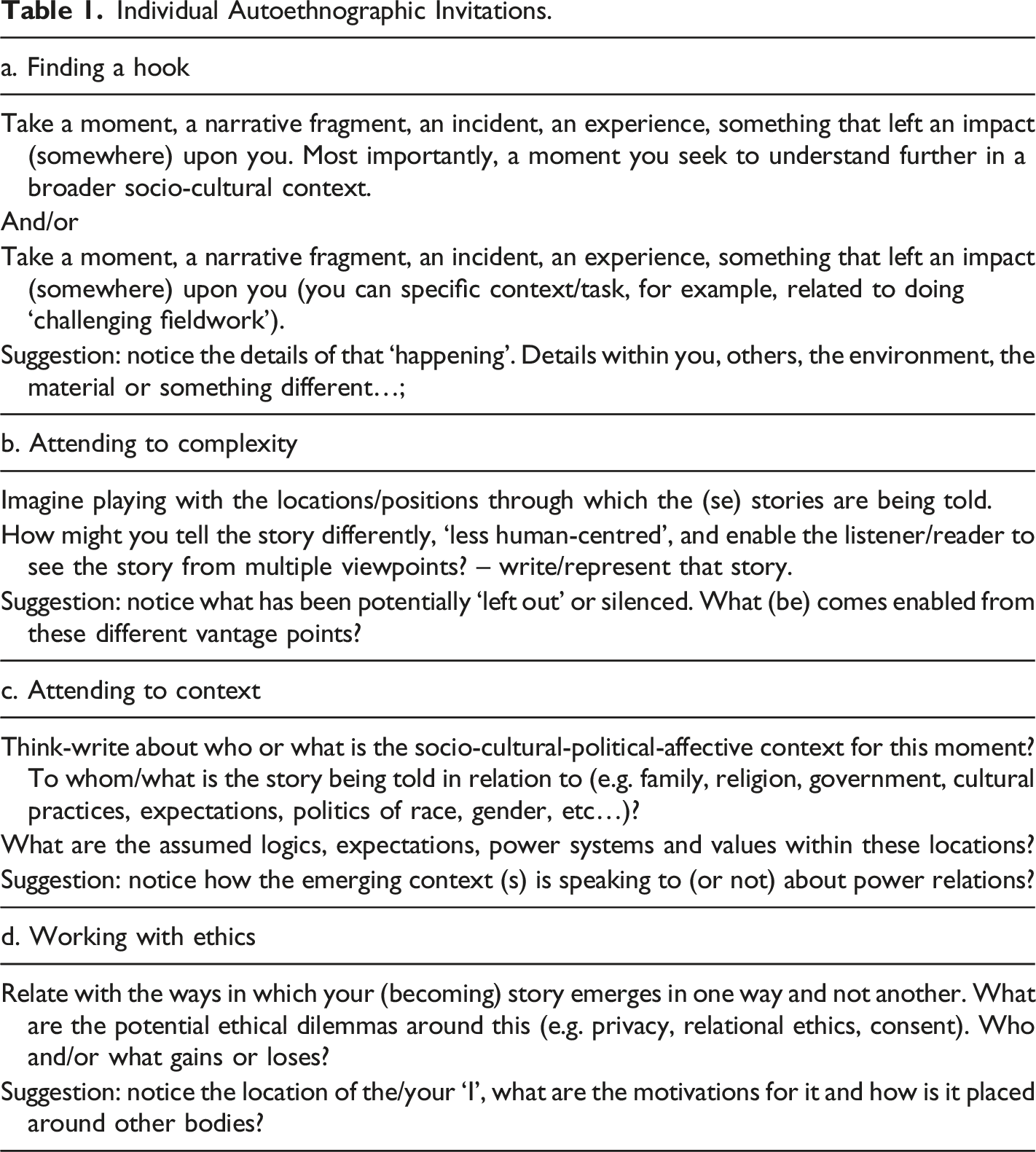
The autoethnographic prompts used in both events emerged from the contributions of Alexander (2013), Jackson and Mazzei (2008), and Gale and Wyatt (2017). We took their insights and used them to operationalize a specific debriefing strategy for the settings described above.
From Alexander (2013), we gathered his invitation to recall a ‘kernel moment’. He refers to this as an experience that may have changed the course of our lives somehow, a transformative occurrence. The ‘kernel moment’ is then worked through, engaging with the variables integral to it. With Gale and Wyatt (2017), we found inspiration to problematize the possibilities of autoethnographic accounts, particularly through provocations that disturb the often coherent and rational subject. We were driven to think about how ‘collaborative wondering’ may lead us to look for more complex stories and disrupt well-established histories, categories and narratives. From Jackson and Mazzei (2008), it became clear that the prompts we needed to develop were not necessarily anchored on the self as being reflexive. But instead, how to bring invitations that allowed participants to deconstruct the ‘I’ and work with it tentatively. In doing so, ethical questions arise about the stories being told and those being silenced, as well as power-authority dynamics around why one account is told and not another.
Individual Autoethnographic Invitations.
Collaborative Autoethnographic Invitations.
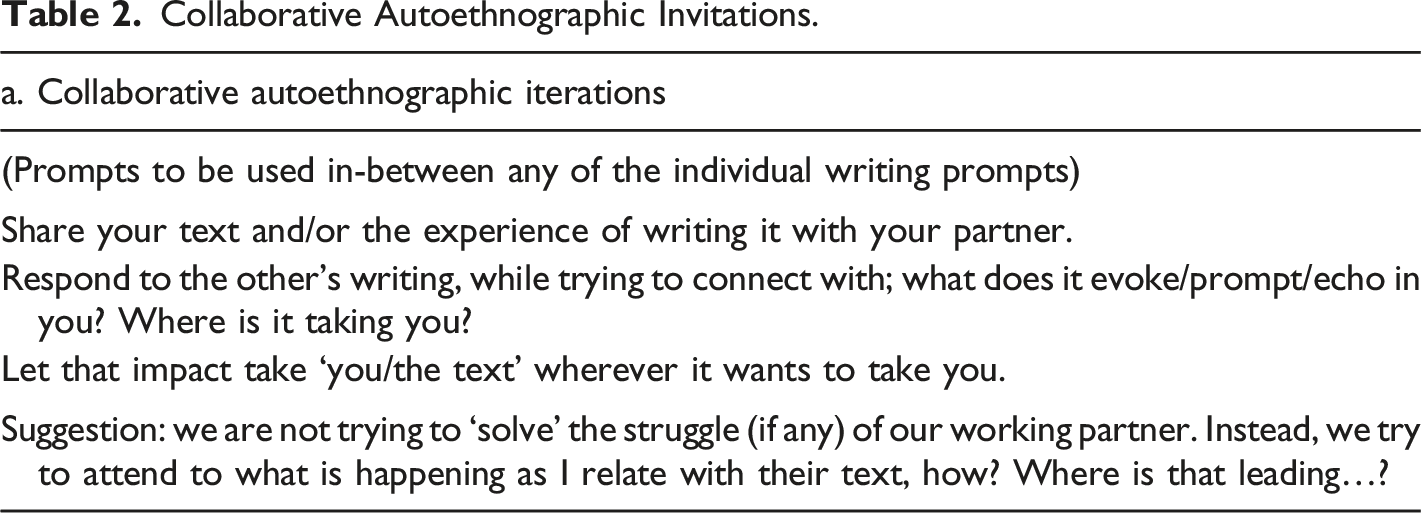
The overarching procedure in these experimental workshops had four moments for each session. An introduction allowed ‘participants’ to briefly share how they were arriving at the space (and present themselves if necessary). We also used this time to present autoethnography and why we experiment with it as a debriefing strategy.
We then engaged with individual autoethnographic prompts. Here, ‘participants’ were invited to work through a) finding a hook (see Table 1) as an opening to their individual writing. And depending on the amount of time available for the session, contributors may also work on b) attending to complexity, c) attending to context or d) working with ethics.
Next, ‘participants’ were introduced to the collaborative prompts (see Table 2), and these iterations were usually developed in pairs or trios, depending on the number of people involved. The final moment of the session was often used as an overarching debriefing time to share key takeaways and get an overview of how the session was experienced.
Ideally, each debriefing lasted 1 hour, 30 minutes. This appeared to be long enough to engage with more than one autoethnographic invitation. In these experiments, we allowed 10 minutes for introduction, at least 25 minutes for individual autoethnographic writing, at least 25 minutes for collaborative autoethnographic writing, and 20 minutes for a collective debriefing discussion.
These timings and iterations between individual and collaborative accounts are not set in stone. However, a core feature is to offer participants a chance to experiment no less than one iteration between ‘solo’ and ‘collaborative’ autoethnographic writing.
Writing With a Composite Character as an Analytical Strategy
From the three experiments described above, we collected personal notes and fragments of autoethnographic accounts, both of ourselves as authors of this paper and those from ‘participants’ who wished to share their writing openly for the purpose of advancing our thinking, both on how the process unfolds and what it does to participants.
For this text, we will write autoethnographically, Adams et al. (2015) argue that it is almost impossible to separate doing any kind of autoethnography from writing autoethnography, which is why we seek to remain close to the lived moments ‘in the workshop’ instead of interpreting a reflexive analysis as if it’s something that comes separately. To do so, we will follow the storyline of the main author and that ‘I’ will be the entry point. I (Leandro), will engage with my writing, grounding myself in the experience of being there-then and now-here in the workshop. I’ll write autoethnographically, which means that I’ll follow the thread of a personal story (a kernel moment) that came up for me repeatedly in these three events in which I was both a facilitator and a participant. I’ll follow a story related to fieldwork I engaged with in 2012, in the eastern-side district of Manchay in the city of Lima, Peru.
Simultaneously, I acknowledge that every ‘participant’ from these events brought stories that spoke to their unique life-research experience. I will make sense of these accounts through storytelling and the use of a composite character (Adams et al., 2015). To achieve this, I use Sam, a fictional and complex figure who encompasses different aspects of the participants that I worked with. Every ‘quote’ from Sam throughout the text is a direct response or contribution from a participant in either event which helps me navigate the experience of how an autoethnographic debriefing session might look and feel like.
Sam is also introduced for ethical reasons, mainly to protect the privacy and identities of those colleagues who were part of these events. It also enables a process that feels ‘experience near’ (Bondi & Fewell, 2016), yet is not a direct emulation of any single life-participant. Adams et al. (2015) refer to the use of composite characters as an alternative to masking participants identities and creating a single, general story about an experience. By engaging with accounts as such, it is difficult for any reader to identify an individual subject.
This work between-the-two (Sam and I) is a way of relating to the complex assemblage of participants, processes, locations, time-space arrangements, themes evoked and broader elements. By acknowledging the entangled nature of reality this awakens unique ethical responses that demand a form of agency that is materialized through ‘doing and being’ (Barad, 2007). I write with a composite character to attend the ethical responsibilities that merge as ‘this world’, through this text become something. From this ethico-onto-epistemological perspective it is a matter of accountability for what materializes, for what this text comes to be and which ‘agential cuts’ are made.
This becoming writing has involved some configuration on my part, through which I’ve seen myself reading and writing, looking into my notes and writing, scrolling through participants accounts and writing, and reading feedback on early drafts and writing. I acknowledge that the text presented here is only one way of telling the story of these events and is by no means a generalizable truth. This work is opened to be contested and rethink what matters and what is excluded from mattering (Barad, 2007).
In what follows, let yourself be taken by the experience of these workshops on a journey that sits somewhere between Stellenbosch University, the ECQI in Portsmouth, and the Doctoral Seminar in KU Leuven, exploring the writing then and now as well as the potential material, bodily and relational components evoked. A first invitation “Take a moment, a narrative fragment, an incident, an experience, something that left an impact (somewhere) upon you. Most importantly, a moment you seek to understand further in a broader socio-cultural context”.
It is Sam and I, sitting face-to-face. We are the only ones in the room.
I notice I keep repeating to myself, ‘It’s only the two of us’ with a bittersweet sense. I am aware that the workshop wasn’t very attractive to others. Is it that this type of alternative approach demands something often seen as irrelevant? At the same time, I notice my excitement. ‘One is more-than enough’ I say to myself while remembering Gale and Wyatt’s (2017) claim about the infinite possibilities an encounter might bring and that the work between-the-two is always more than just ‘us’.
We start writing for 15 minutes. I write with my left hand. As usual with a black dry-ink pen, being a lefty has made me overly conscious of not staining the paper. This pen does the job, and I focus on leaning the white sheet slightly; I feel how my body crawls over the page. A few tentative words later, I raise my hand, pause, raise my neck and head, un-crawl, and continue. The rhythm is there.
I’m interrupted by the sound of a stomping pen. Sam writes emphatically. You can feel the vibrations running through the space that separates us. I can see one hand over the sheet of paper, stretching the upper margin of it, fingers wide open and one sharp word after the other. Sam’s hand doesn’t seem to be sliding through the sheet, as I had previously felt my left hand do so. Sam’s hand seems to be more like marching across the page; every word is pounding over the desk. I am distracted and wonder what Sam could be writing about. ‘It feels so personal’, Sam announced as the 15 minutes ran out. I ask gently, ‘would you like us to share our writing or how it felt to write? We can then respond to each other’s texts’. ‘I don’t think I dealt with the trauma of my fieldwork’, ‘I can sense there is something constantly blocking me’, ‘I feel like crying out what I saw at the hospital’.
Sam stares at the ground and then slowly finds the already well-written page from which these words come. I try to catch Sam’s eye, not too obviously, not too forcefully, but gently, just to suggest that I’m there if needed. I know and don’t know what Sam might be feeling, remembering or working out. Stewart (2008) refers to affects as ‘becoming known’ through intensity and texture, not as a matter of meaning or representation but their potential – where their impact might go or lead us.
It is this intensity that has an impact. It brings one scene to mind as if it had been pulled out of ‘me’ to work it out between-the-two. I remember arriving every Tuesday to Manchay, a district on the eastern side of Lima, the desert-like capital city in which I was born and raised. For a few months in 2012, I spent every Tuesday walking through the sandy hills of Manchay. I worked with a community that was geographically very close to my home and yet felt so distant. The General Electric (or alike) fridge from my comfy family house in these sandy hills became an industrial truck wheel, opened in half, laid down on the floor and filled with blocks of ice. Beer ‘Cristal’ and cans of milk were the inevitable contents. The multichannel modems (DirecTV or alike) were replaced by thick cables, assembled by the community, running through the dunes, and getting lost in the golden-like horizon in search of an informal connection for Cable TV. The well-paved roads nicely flatten, and thick, yellow-coloured lines became a sandy-rocky road, a dune-like road, with tentative white lines made from regular chalk.
Back in the workshop room. Sam reminds me, ‘Leandro, the emotional labour of the researcher requires further clarification and debriefing’ ‘are we ready to respond or take these experiences into our written work?’
I couldn’t agree more. There was so much already happening in the relational encounter with this community in Manchay, and yet everything was narrowed down to a thematic analysis informed by the topics underpinning a test, The Object Relations Test. I wish there would’ve been a way to integrate my fieldnotes and the complex entanglements these encounters were raising. At that time, in 2012, my project was already on the margins, in an environment where, out of 38 students, this was the only qualitative study. The first qualitative study ever done at my local university. When I found the courage to ask what I could do with my fieldnotes and reflections on power, differences, identities, culture (and more), I found ‘there is no space for those notes on your research; just keep them as your side journal—you are not Leandro on the field, you are a researcher’. This appears so distant from Whitehead’s (2009) call for a new kind of ethnography, one that takes seriously the investments of the affected researcher in the field.
Sam’s question seems to speculate on the fact that in this environment, the one we are invested in – the academy – the culture remains one that constantly runs away from the ‘emotional’ world and whatever that may bring to the written work. ‘It’s not true that you can be neutral; you do form a bond!’ Sam declares fuming.
I share this. The intensity reverberates. I hear it as a striking scream; it moves me. My body vibrates to the sound and to the stomp-like or march-like rhythm of this commandment. It is Sam, it is me, and much-more than just us there-and-then. A second invitation “Imagine playing with the locations / positions through which the(se) stories are being told. How might you tell the story differently? What has been potentially left out or silenced? enable the listener/reader to see the story from multiple viewpoints?”
This intensity, moving somewhere between-the-two of us back-then and here-now, seems to run beyond a linear timescale. I’m not keen on naming ‘what it is’, as I believe it would be insufficient. Massumi (1995) thinks of affect as a chance to get close to the indefinable or unprecise forces that animate everyday life, as something that operates independently of the human.
I see Sam across the wooden desk that separates us. I find myself thinking how each of us there brings so much of our ‘worlds’, the one already paginated by the ‘I’. The ‘I’ that gives us some anchoring base, some illusion of ‘stability’, of a coherent story, of pinning down what became available through language. The I of as Grioux (2010) refers to ‘the undisputed researcher’ from the neoliberal academic machine. The one facing potentially difficult fieldwork circumstances, but it’s expected to write a stable narrative as if nothing had happened during the process of relating to our/their inquiry. And yet, there is more. There is always so much that remains unpaginated, running independently of/from the confines of our tentative ‘self’, exceeding ourselves – but happening, doing something.
I am transported again to this event (s) in Manchay. I engage with how I often felt like a stranger in a land only 10 minutes away from my upper-middle-class family home. I arrived in Manchay driving my car, a second-hand 1998 black Honda Civic, to a place where rarely anyone had one. At that time, what I felt in this complex setting didn’t seem to matter much – at least not for the research process and academic environment.
On this hill, with rudimentary homes made of cardboard standing at each side, a vast field of sand stretched between the row of houses, creating a valley-like scene with infinite possibilities. You could find local kids using this vast field as a football pitch. Without shoes, a ball that hasn’t seen air in years, but the joy is there. The kid’s joy is there, running for each ball as if it meant qualifying for a World Cup. I am affected by their joy; I smile and feel like jumping into the field, crossing the imaginary ‘white line’ made of stones, into that vast field where ‘things’ seem to become something different. We, the adults, are gathered a few metres away, standing in a circle. The locals speak Quechua, but I can’t understand a word of it. I am sure it has happened before, but that day, on my way back home while driving my manual Honda Civic and navigating the sandy, golden-like hills of Manchay, I felt deeply in touch with a sense of loss. I couldn’t stop wondering why there was no trace of Quechua, the native language of my land, in me or my parents. The language my grandmother used to speak had been systematically vanished.
My alarm goes off, announcing our 15 minutes to write are gone. Once again, I offer Sam, ‘would you like us to share our writing or how it felt to write? – We can then respond to each other’s texts. Sam discloses ‘This idea of what vanishes echoes in me. Secrets from the past that fester, something so hard to shake, because it is gone but not really gone. Shame, layers of it. Built around, on top of, and alongside. I wonder what sort of struggles continue. ‘It acts even today’ I reply. Sam echoes,—‘It acts even today’. ‘In my most recent research, I experienced significant racial tension. Being situated in a country steeped in racial divide, I had a feeling of not being equal, of not being enough’. ‘I wonder if there is some sort of escape. To these things that fester in you, in me, in us, our context, and our histories?’
Autoethnography as a debriefing strategy allows participants to go in-depth into themes or hooks that come up through the session (s). This is not only for individual understanding but, most importantly, to connect with content, experiences and knowledge that until then remained outside of one’s range of vision. At least, it posits questions about narratives that felt static, well-known and rehearsed. The act of debriefing with or between ‘others’ promotes an animated relationship between stories and the theories that each participant inhabits. Much like Holman Jones (2016) argues, each story iteration is brought to ask, critique, or explain the nuances of events happening in a socio-cultural realm.
Sam stares at me. I am caught in that awkward, noiseless moment. I’m trying to figure out what I-we may need here to answer some of those questions. I feel the risky, unsettled sensation of staying with it, this experience, or whatever it is. I feel the unsettled sensation of being affected by the multiple themes running between Sam and I. The recent racial tension, the loss, the violence, the shame, the joy and more. They, that, or it is haunting us somewhere, speaking of the uniqueness of them for a particular story, and yet, not a single story – it connects with the infinite echoes each of these elements find in collective histories. Most importantly, as Berlant and Greenwald (2012) state, the affective impact has to do with ‘what will happen next’ with this becoming-event as it resonates with other collective experiences and fantasies. I raise my eyes, look at Sam again, and answer, ‘I think there is no way out, is it? ‘What if the only way out is in?’—I reply. Sam takes a moment and stares at me to reply ‘I have thought on those questions so many times, trying to figure out possible explanations. But one especially haunts me, I am ultimately scared!’
Tami Spry (2016) would argue that once a story is laid out ‘out there’, the individual subject is surrendered to the always unsettled, partial state of becoming something different. It is about how the mere fact of existence is already invested in co-dependence, in a relationality exceeding any singular component, entangled with other subjects, discourse, context, theory, bodies and more. Sam announces, ‘her story, his story, their story, my story, our story, x story…’ ‘when asked for our story, we only give the beginning, a part of it, until that moment in time.' ‘When telling our story, it reshapes and shifts into a new story and intersects with those from our audience’. ‘Stories are shapeshifters within time, and storytellers are the transporters across and between dimensions.
It is through this event, holding a debriefing space between-the-two, that we enable, like Holman Jones (2016) argues a way into stories to understand, theorize, and change our cultures and ourselves. The more complex and multiple our stories become, the greater our understanding becomes. It is this work between-the-two that opens up possibilities to work differently with issues of inequality, injustices, identities, cultures and the affective entanglements within or alongside them. This potential develops by sustaining work between-the-two, as a collective endeavour, or, as Bittinger et al. (2021) frame it, by a becoming intimacy. One that pushes the confined spaces that exist in the academy and the ways in which knowledge processes are produced. Becoming intimacy (Bittinger et al., 2021) as an active pursuit of epistemic justice that disrupts power structures ingrained in academic culture. A third invitation “lets gather for the remaining time and share our key takeaways, questions or an overview of how we lived or felt the session”.
As our workshop comes to an end, Sam and I still have a few minutes to openly discuss our experience here. ‘What is the difference between autoethnography and other creative writing or autobiographical methods?’—Sam introduces
I notice how, as I hear that question, I distance myself from the writing body there-then and feel the appearing presence of those others whose work I follow. It seems like this work between-the-two now has plenty of other presences. I respond to Sam’s questions while thinking about Gale and Wyatt (2017), Alexander (2013), or Spry (2016). Autoethnography is work that situates itself in the tensions between the self and culture, problematizing the relationality between them. In doing so, we get in touch with other worlds that were until then (potentially) unknown. Autoethnography (always) seeks scholarly dialogues, sometimes, to unsettle the comfortable confines of the ‘I’ and culture. And of course, it is writing that makes you feel; it evokes something. I could continue, but I decide to stop there and check in with Sam. It feels necessary. Sam announces, ‘That makes sense; I notice I wanted to wear my (thinking) hat only. But then again, if I want to promote entanglements and I own multiple identities, perhaps others do too’. ‘Sometimes it feels easy, sometimes not. Sometimes it feels heavy, full of fear, anger, concerns, pain (and more)—and yet there is always something useful in acknowledging that this experience, whatever I’m feeling, whatever troubles me may also be felt by an us’.
Autoethnography is usually referred to as a practice that requires reflecting on one’s own experience to understand something broader. Adams et al. (2015) refer to it as looking at past experiences thoughtfully and repeatedly, and as we do so, something a new (might) become apparent. Using autoethnography as a debriefing strategy challenges some conventional principles of autoethnography. On one hand, a debriefing space sets the scene for collaborative work to happen; the ‘auto’ becomes something multiple that is never done alone, solely, but always in co-presences.
Just as I finish this ‘theoretical’ input, Sam jumps in: ‘I think that although autoethnography is often seen as too centred on the self or immersed in a self-revelation, I think this workshop highlights how autoethnography feels more like a ‘deflecting’ experience from the self. I, as I write, am only an entry point into other worlds.’
This hint from Sam feels special. This work between-the-two is indeed also a ‘deflecting’ experience from our well-contained selves. It is the relating experience, the affective intensities coming into place. They open new directions to think about our immersion as qualitative researchers as well as those of others and the social realms that surround us.
This deflecting element highlights a methodological strength of autoethnography as a debriefing strategy. It keeps the inquiry alive. Once the exploration feels too narrowed down on one lens, on one spectrum of light, it might be time to deflect again and see where that leads the process. It allows us to navigate stories different from our own or at least place questions about the core ‘beliefs’ that sustain our well-built social order.
Discussion and Conclusions
The use of autoethnography as a debriefing strategy awakens the foundations for a transformative ethico-onto-epistemology in the academy. This happens by embracing a way of ‘knowing and being’ that is not entirely about an outcome-based pursuit, but about growth and change that becomes materialized through relationality. The ‘finite game’ in the academy locates higher education systems under the form of a profit and outcome-based logic. This is instrumental for certain practices and disciplines, which knowingly or not feed into this logic. However, in this paper, we advocate for a shift to this logic by focusing on the person behind the student/researcher/academic label and attending tentatively their worlding-affective entanglements.
In doing so, this transformative practice adds to transdisciplinary, situated and accountable productions/processes of scientific knowledge. A production that speaks to a direct material engagement, a practice of intra-acting (Barad, 2007) with the world as a part of a dynamic web of inter-relations that never stops re-configuring.
Autoethnography as a debriefing strategy therefore speaks to movements in social-sciences and public health research that situate the affected, invested researcher as a key component in a research process. We’ve performed an ethico-onto-epistemic ‘doing and being’ capable of contesting the dominant culture in the academy which shapes what is expected/possible (or not) from the research subject. Especially principles related to the value of telling one’s story, the personal connections one may have with a research project or as Giroux (2010) claims the implicit-explicit rule of sustaining ‘scholarly composure’. Here, autoethnography as a debriefing strategy takes an unsettled researcher as key, particularly how from those embodied, affected investments we can produce equally legitimate knowledge.
Strategies like this call for a re-conceptualization of the onto-epistemological underpinnings related to what and/or how we work with the affective impacts of researchers and research processes. The risks in the current ‘finite game’ in the academy are that it offers more credibility to knowledge that speaks to the stable, coherent, rational subject-researcher while simultaneously giving less credibility to the affected, never-stable researcher and research process. At stake is the fact that these multiple affective responses ‘construct’ the things we write about, think about, read about, or publish about. A lack of affective investment is not the problem, Massumi (1995) would claim that these are already happening through an agency of their own. The issue is where and how we look at it, how we ‘relate with reality’.
This becomes not an individual endeavour, or issue, neither related to qualitative nor quantitative research groups, but a concern that cuts across the essence of academic culture, practice and identities. An interesting recommendation would be to integrate this practice as a normal component of the research trajectory. Particularly under the idea of bringing interprofessional and interpersonal agents from different knowledge fields together to explore what an experience like this could do for a research group and/or individual.
In times of socio-political tensions, environmental emergencies, or migration crises rising on smaller or larger scales across the globe, as researchers, we are already undoubtedly touched somehow by them. Either through our work or through how our personal-historical identities, stories, cultural heritage, expectations, citizenship status and more relate to these complex happenings. Autoethnography as a debriefing strategy promotes creative-relational encounters in the academy as a concrete action facilitating ‘hands-on’ experience to posit questions and insights about how we are produced alongside all those intersecting elements. It is work that always encourages generative processes. With Wyatt (2019) in mind, creative-relational processes posit ‘a personal that is dynamic, hyphenated, late, collective, and provisional’ (p. 51), which is always created in and through relating.
Although some of the critiques of autoethnography refer to it as a practice too immersed in the self (Jackson & Mazzei, 2008), in this text, Sam, as a representation of participants, refers to it as a ‘deflecting’ experience, or at least as one that offers chances to see the world from different viewpoints, including how the personal is compromised alongside institutional, social, or political dynamics. Thinking with Jones and Pruyn (2018), this may highlight how approaches like this focusing on ‘personal experiences’ within cultures are enlarged and/or constrained by relations of power. As such, researchers must inevitably point out the politics of their positioning, acknowledging the privileges and/or marginalization of their experiences as well as their responsibility to address them fairly and ethically, throughout the research process itself.
We must emphasize that although proposals like these can add to broader conversations about prejudices and injustices attached to mental health & wellbeing, they should not be framed as therapeutic support. The events outlined for this paper do not focus on an individual’s story, struggle or experience, but it is instead aiming to promote a culture-practice that is interested in the process. Interested in what relating does. The dominant culture of the ‘finite game’ in the academy promotes cultural expectations for a stable, coherent, rational researcher. While in approaches like the one proposed in this text, we focus on how the never-stable, messy-like elements of researcher and research process might feel or look like, aspects that are not conventionally part of the expectations in research nor in education.
An interesting area to explore is associated with who or what kind of individuals within academic communities would be most suitable to develop this kind of initiatives. Here, I (Leandro) need to acknowledge that I’ve been testing this practice as someone who has trained and worked as a psychotherapist for over 10 years in both individual and group settings. This doesn’t mean that only psychotherapists are able to facilitate these types of sessions, but we do think it requires some interpersonal abilities, particularly related to listening and responding skills. For instance, it could be worth considering Lee and Prior’s (2013) insights around the process of developing listening skills and how it often involves learning to undo our habitual attitudes towards listening rather than learning ‘to do’ anything in particular.
Creative-relational approaches such as the one exemplified here take as their departure point ‘relating and processing’ first, instead of prioritizing an outcome-based or unaffected research (er) procedure. The ‘processing of’ experience (s) allows gentle openings from potentially static, impersonal, and not-felt positions to creative, affected, invested and transformative research subjects and processes. As we further embrace proposals like this, we might move towards more egalitarianism, solidarity and epistemic breadth in the academy. It is key to allow subjects to at least imagine different questions about their own locations, promoting the encounter of difference and diversity in them, others, and the material-discursive around.
Footnotes
Declaration of Conflicting Interests
The author(s) declared no potential conflicts of interest with respect to the research, authorship, and/or publication of this article.
Funding
The author(s) received no financial support for the research, authorship, and/or publication of this article.
