




Abstract
In this article, I combine an experiential account of creative conference disruptions with conceptual ideas for inclusive formats in researcher–activist gatherings. Decelerated storytelling sessions to “miss out” on conventional conference flows were facilitated around the wood burner of a shepherd’s hut at the European Congress of Qualitative Inquiry (ECQI) 2019 in Edinburgh. Installed as a conference fringe with a counter-temporality, the Welcome Hut entered the program as a “game changer”: a novel pathway for abstract submission offered by ECQI. New ideas to structure events of qualitative research are expressed in order to respond to the challenges for organizers, delegates, and overall conference coherence arising when a major event for nonmainstreamed inquiry grows in scale, popularity, and ambition. As a result of their success, conferences that promise qualitative nonstandardization face the ambiguities that come with growing delegate numbers. I reflect on conference formats that enable rather than disable activist spaces and temporalities. Researcher–activists are invited to explore their personal agency in order to make space for utopian imagination, to allow time for rhythmic contestation, and to experiment with alternative ways to gather, within temporal conference commons. Inclusive pluritemporalities in academia then do not have to remain a privilege for the lucky few.
The Large-Scale Conference Without a Fringe
Conferences as Activist Platforms?
Conferences are often considered indispensable gatherings in the struggle for belonging to academia. Scholarly literature provides an interdisciplinary array of studies on conferences, such as categorizing them as ambitious showcases for prestige (Bourdieu, 1998) and highlighting issues with accessibility through the field of critical event studies (Finkel et al., 2019). One can question the rationale of networking as empowerment through which the format of academic conferencing is promoted and frequently justified. Not all academics have personal and professional circumstances to perform the ideal of highly interactional and able-bodied mobilities exempt from caring responsibilities (Taylor & Lahad, 2018). As conference formats diversify and motivations for attendance become more complex to study, conference ethnographies have received their own research platforms. Multiple facets of conference microcosms are presented in the academic blog Conference Inference seeking to “illuminate academic conferences as complex ecosystems” (Henderson & Burford, 2019). In this same blog, a recent post describes the activist potential of conferences by referring to the European Congress of Qualitative Inquiry (ECQI) 2019 in Edinburgh. The delegate Karamatsouki (2019) writes:
although I have attended a number of conferences before, what I hadn’t realized until my participation in this particular congress was that conferences can create a platform for speaking and writing about what is actually happening in the world […] whichever role we play in a conference, as attendees, as presenters, as organizers, or in any other role, we cannot hide in ivory towers isolated from the rest of the world.
While this emancipatory and transformative potential of conferences as platforms for activism is an important emerging research angle, I would like to combine it with awareness of the ways in which academic conferences are also a product of the institutions and value systems that house them. I argue that a social science lens on activist conferencing needs to address this subtle dimension of commodification, which researchers can grow accustomed to. There could be the risk of merely providing a fashionable theme for events on social justice, not events as activism. The emergence of more and more activism-themed conferences is an opportunity to challenge the corporate event character of academic gatherings profoundly and explicitly. Page (2020) has addressed the hidden ways through which academic researchers become both the consumers and the “consumed” because of dominant marketizations in education. In order to build activist platforms that challenge standardizations, it is necessary to disentangle researchers’ complicity with exclusive and exclusionary networking:
Like business executives and politicians, academics form part of the super-mobile population of the global north. Their freedom to travel, which entails a freedom from certain local obligations, is not always voluntary but part and parcel of professional expectations and is subject to peer and managerial evaluation. (Parker & Weik, 2014, p. 161)
Academia promotes a self-image of freedom and a career vision of choice and emancipation. At the same time, less official social media narratives of conferencing point at existential limbo, precarities, and solitary sacrifices. A wide range of publications have started to discuss this neoliberal academy. Rather than define the term in an abstract way, my article applies an existential angle where neoliberalism becomes a subjective experience pervading major parts of researchers’ life worlds, encompassing both their professional and private spaces. In this absence of personal sanctuary, the struggle for meaning can then be linked to emotional responses such as shame and profound alienation. Neoliberal temporalities contain and bind the subjectivity of the researcher within audited activities, distant from intrinsic life choices based on personal value systems. The scarcity of resting times and safe shelter spaces is then retrospectively justified through personal failure: “Existential shame is a byproduct of an outcomes-oriented temporality” (Shahjahan, 2019, p. 9).
Situating neoliberalism on an existential dimension opens up a reshuffled space to catch one’s breath. The existential temporality then provides a source of hope in what can become a professional on-call duty of perpetual fatigue, populated by those who “have lost confidence in the workability of visions beyond the existing social order” (Wright, 2007, p. 32). With a lack of positively framed support structures in academia, the blurred definition of the term neoliberalism provides a unifying orientation based on a widely shared assumption that academics have to fight against something, even if this something may be too big to describe and define in simple terms. At the same time, herein also lies the problem with neoliberalism as the major frame of reference for emancipation. Academics may fatigue by pressuring themselves to counter political and economic, hence structural dysfunctions, without accepting with kindness to themselves how deeply everyone is inevitably enmeshed in such systems that support solitary and individualistic knowledge production.
One can try to move away from such structures through consciousness that “human freedom involves our capacity to pause between stimulus and response and, in that pause, to choose the one response toward which we wish to throw our weight” (May, 1975, p. 100). Existential temporalities are fueled by the belief that a profoundly disillusioned researcher can still throw the own existential weight elsewhere than in the auditing neoliberal machineries of stimulus-response. New questions arise: do conferences that use neoliberal academia as their major frame of reference automatically become networks of transformative activism? Or does the focus on all-encompassing neoliberalism paralyze action and make the initial problem even bigger? It may be necessary to move beyond exhausting/exhausted frames of reference.
My own observations from ECQI shared below seek to point at certain ambivalences in order to challenge some of the entanglements with neoliberalism. I seek to highlight how conferences can be, in parallel ways, experienced by different people in the same venue, a platform for activism just as they can be commodified sites of tactical purchases rather than societal struggle, replete with rituals that celebrate the trade with often employer-imposed CV ornaments. They can function as events where exclusion, exclusivity, and invisibility are normalized (Nicolson, 2017). Major “alternative” events like ECQI cannot miraculously rise above and transform a generalized atmosphere of pressure, which currently accompanies many researchers’ experience. It is necessary to reflect at what scale alternative events can provide the often missing space for nonthreatening networking, which reduces fatigue, noise, and alienation for less visible participants with hidden barriers to networking (Walters, 2019). Hospitality for activist research in a profoundly neoliberal setting implies building safe environments. At the start of the reflection process for novel conference formats, one can nurture the idea to host an academic encounter as a radically inclusive gesture of welcome.
I draw on existing literature about large-scale conferences to situate one angle of my ECQI experience: attending an activist event where the pressure emanating from the university system cannot be ignored. ECQI 2019 had not been a conference without fringe, but still it was difficult to withdraw from its massification. One fellow conference delegate summed this perception up in the following words: “It was so inspiring. But when the conference was over, I just felt like rolled over by a train.” I discuss the challenges emanating from such a conference format by privileging the perspective of Early Career Researchers (ECRs). ECRs often internalize this feeling of post-conference exhaustion, as the expectation on them is to catch the academic express train running. Shahjahan (2019) has analyzed in detail how such temporal “constraints become individualized, ultimately leading to existential turmoil, and finally, how temporal norms are experienced via shame logics heterogeneously for those who can/not fit such temporal norms” (p. 5). It is necessary to integrate the lived experience of those who frequently feel run over, besides all those researcher–activists who feel confident enough to constantly run fast enough to catch the next scheduled academic express. Adopting this position also invites future conference organizers to sketch out novel conference visions starting from the lived realities of ECRs. Many graduate schools finance student-led events for postgraduate cohort building where only a small percentage of senior faculty staff will attend. More experimental and disruptive event models that enact social justice rather than talk about it through keynote rank dissemination can invite senior academics to play and move around with their own roles in hierarchical systems. Hence, attunement to ECR struggles becomes the enabling factor for the visibility of novel ideas that will allow to restructure research collaborations in the flexible time zones of real life uncertainties, not in the accelerations of perfectionism.
The Invisible Laws of Large-Scale Conferencing: An Early Career Perspective
A tweet on academic Twitter that accumulated over 1700 likes exposes contradictions for gaining visibility in academia: “ECRs paying £400 to present a 15 min paper to less than 20 people in a small room because they think it will help them get their work out there & improve their career prospects” (Thatcher, 2019). ECRs coming to a conference are under pressure to secure a return on investment. Situated in UK academia, where a 3-year PhD degree implies the payment of fee installments of ~£4,327 (yearly home and European rate at the University of Edinburgh) to ~£22,200 (yearly international rate at the University of Edinburgh), the ability to purchase a full package of international conference attendance and therefore play by the abovementioned laws of academic visibility is reserved to a selected group of economically potent early career entrants. It is already well before the midconference optional evening dinner that delegate groups are divided into those who can afford to participate in the full platform and those who will calculate which bite-size snippet of the full-package networking cake they can afford themselves to taste. In the standardized conference format permeated by neoliberal ideologies, the conference “treat” becomes an event that requires full commitment and sacrifice. A fringe at such a conference would risk invisibility. There is little wish to take things slower, even when the fatigue progresses, as the aim of attending is to be part of the flow and gain access to mobility through surfing on the waves of unspoken but constantly enacted laws of vertical academia. ECRs who have not yet acquired conference literacy, an essential skill for efficiently navigating through the overwhelming schedules, might feel like entering a marathon. The paradox of large-scale conferencing: while there is little point in looking for a conference fringe as the overall aim is to make the most of such an ambitious spotlight format, there is also very little chance for the individual to gain outstanding visibility as almost all researchers try to leave their legacy in similar ways. It is a visibility lottery through academia’s unchallenged allocation of a miniscule slot. A conference, advertised as an empowering peer group gathering, might instead be experienced as a casting show in which ECRs do not get to sing their own song. As an ECR standing or shaking at the gates of paradoxes and struggling with issues of belonging, the question might arise up to which point the large-scale format can be a gateway toward self-directed, meaning-centered career aspirations in research:
… academics need to go to conferences and conference organisers need academics to pay and present. This means that most of the delegates will be presenting, as a condition of their funding from their employers, which in turn means that conferences almost always grow in size and provide less and less congenial arrangements for sustained discussion. It is normal now that a presentation be completed in 15 or 20 min, and that an overspill of delegates who do not even get their 15 min of fame be catered for with poster sessions. So too do the large professional conferences run multiple tracks, effectively guaranteeing that the less well known, or those presenting on heterodox topics, will have an embarrassingly small audience. For the presenter, it is then virtually impossible to say anything much to an audience who will almost certainly not have read anything in advance. Papers hence become brief and bland, simply to ensure their digestibility in such inhospitable contexts. And that is just as well, because given the necessity to attend a lot of conferences and to present a paper there to get your expenses reimbursed, most delegates probably do not have a lot of groundbreaking findings or arguments to report anyway. If one were to design an event that minimised the possibilities of sustained and concentrated attention on a particular topic, the large multi-stream academic conference would be it. (Parker & Weik, 2014, p. 175)
While large parts of the academic world seem to play by the rules of a hierarchical game, ECQI announces alternatives in research. Yet the ways in which these novel ways of doing research are then assembled in a massive conferencing format ask for further and more disruptive experimentations in future gatherings. While ECQI 2019’s pricing policy included reductions like early bird and student discounts, the attendance costs of the main conference were between £225 and £325, excluding optional preconference workshops and conference dinner and excluding travel and accommodation in one of the UK’s most expensive cities. On the one hand, it felt as if ECQI was situated below the average conference fees in the category of 300+ delegates hosted at a very competitive campus location figuring among the most prestigious in the UK. On the other hand, it is only thanks to the privilege to invest in a certain entrance fee that one acquired access to ECQI’s activist platform. In this article, my aim is not to focus on a radically horizontal format of academic conferencing without fees and other barriers to conference participation. The array of exclusionary conference tales, such as based on geographical and cultural distance, linguistic category, and carbon footprint guilt are theorized elsewhere (Nicolson, 2017). With this article, I seek to confront entanglements with nonactivist realities in UK knowledge economies and then work through their contradictions in order to challenge activist efforts embedded in expensive large-scale conferencing. The text will explore how it might be possible to dwell constructively in a third locality, an interstice and hub between vertical and horizontal, instead of having to make two-dimensional choices in what are at the very least three-dimensional (vertical, horizontal, and in-between) realities for activist academia.
The Game Changer
This ‘game changer’ takes place in an outdoor space installed next to the conference venue. Participants experience a tiny house shepherd’s hut and have the opportunity to discuss around its wood fire stove. This sanctuary space next to the conference action allows a time-out to reflect on conference contributions with other delegates in a quiet atmosphere. Based on 8 years experience using the mobile shed in social work, counselling and education, the idea of the ‘Welcome Hut’ will be conceptualised as a civic shelter disrupting the public sphere through the arts of hospitality. As a site of experiential learning, participants investigate the spatial dimensions of care and the role of setting in qualitative inquiry. (ECQI Edinburgh, 2019; see also Figure 1)
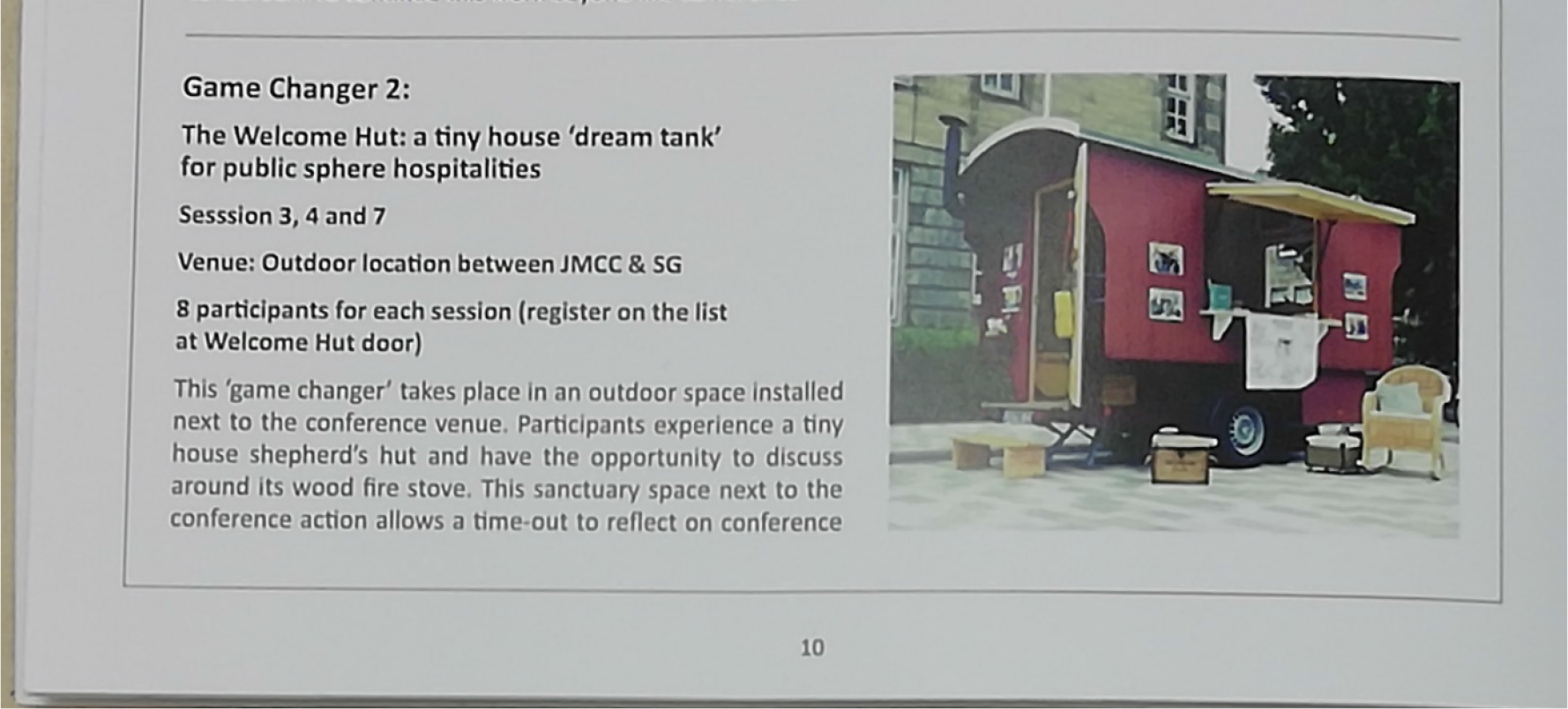
Gamechanger description from the conference program.
The Welcome Hut, a mobile “tiny house” that I had designed as a practice model for public pedagogy in community settings in 2010, had been used at conferences before ECQI. A workshop or presentation is frequently combined with extended drop-in presences during events (Figure 2). The hut is installed outdoors and a short walk away from the coffee break and sign-up reception desks (Figure 3) and still usually attracts a significant number of visitors. From a quantitative perspective, ECQI had provided a very low number of visitors. During an event with more than 350 registered delegates, only 19 conference guests decided to enter the hut. As the hut was installed in between the conference center, student residences, and a walking path, the passing residential students, staff, and dog walkers outnumbered the individuals affiliated with ECQI in expressing interest for the unusual sight of a mobile shed installed on campus. Out of the 19 delegates entering, 15 came to sit for a while around the wood fire. Another busy 10–15 delegates looked from the street into the hut, mostly on the way to a panel they wanted to attend. Each day, at least a hundred delegates regularly passed the footpath at a distance of approximately 10 meters to the hut on their way from one conference building to the other. Three game changer workshop slots had been advertised in the program for each of the conference days. The first session had four participants. On the second day, no participant had signed up. On the last morning, two delegates attended the workshop. All other visitors attended in an improvised way, outside of the advertised hours. The biggest group (eight delegates) entered the hut off the conference timetable, in the unoccupied hours after the last panel and before the conference dinner. This was when the lights had already been switched off, but the hut’s wood burner was still in use. Mobile phone torches provided the lighting in that unscheduled off-grid session without electric supplies.
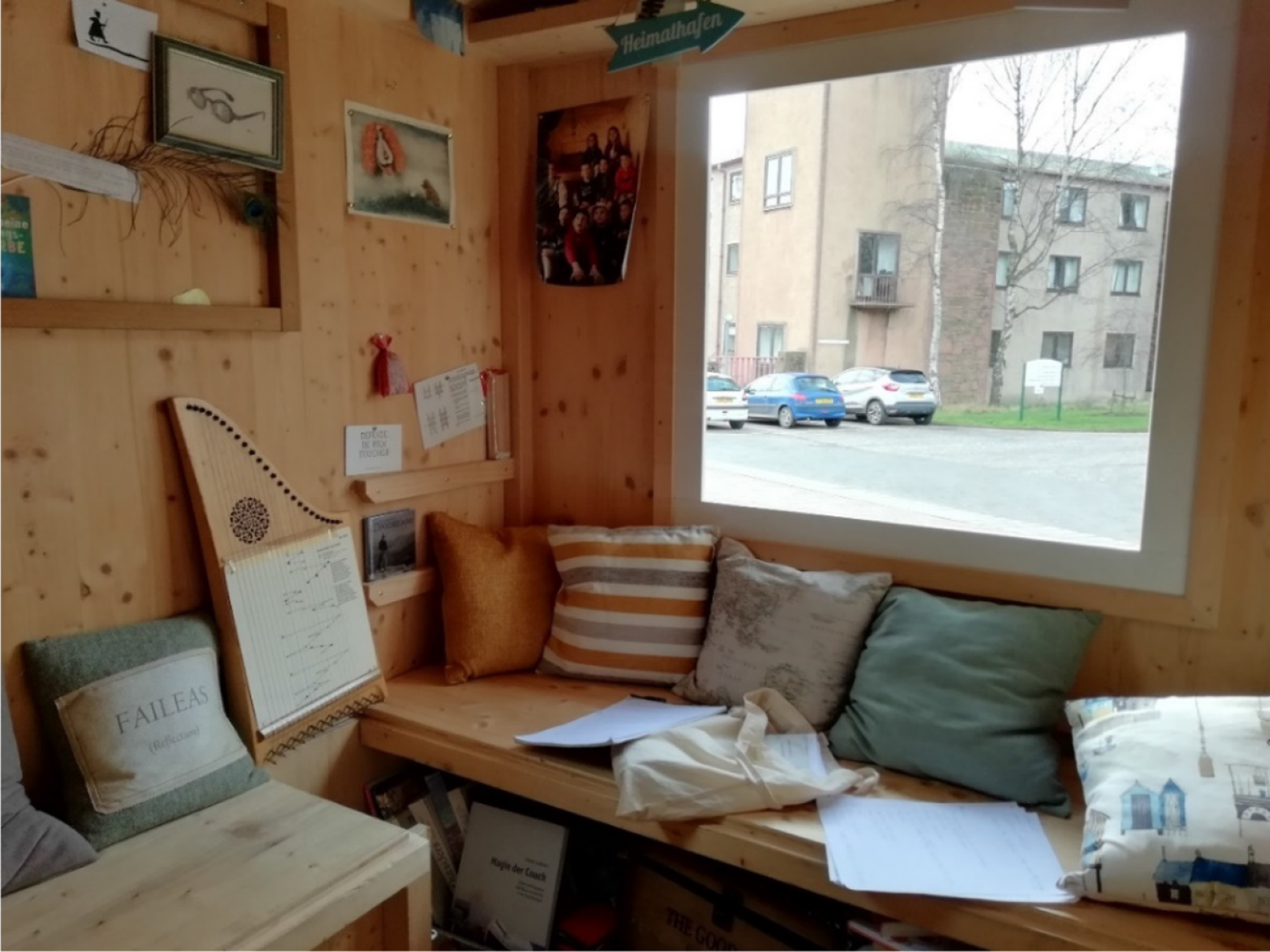
From inside out.
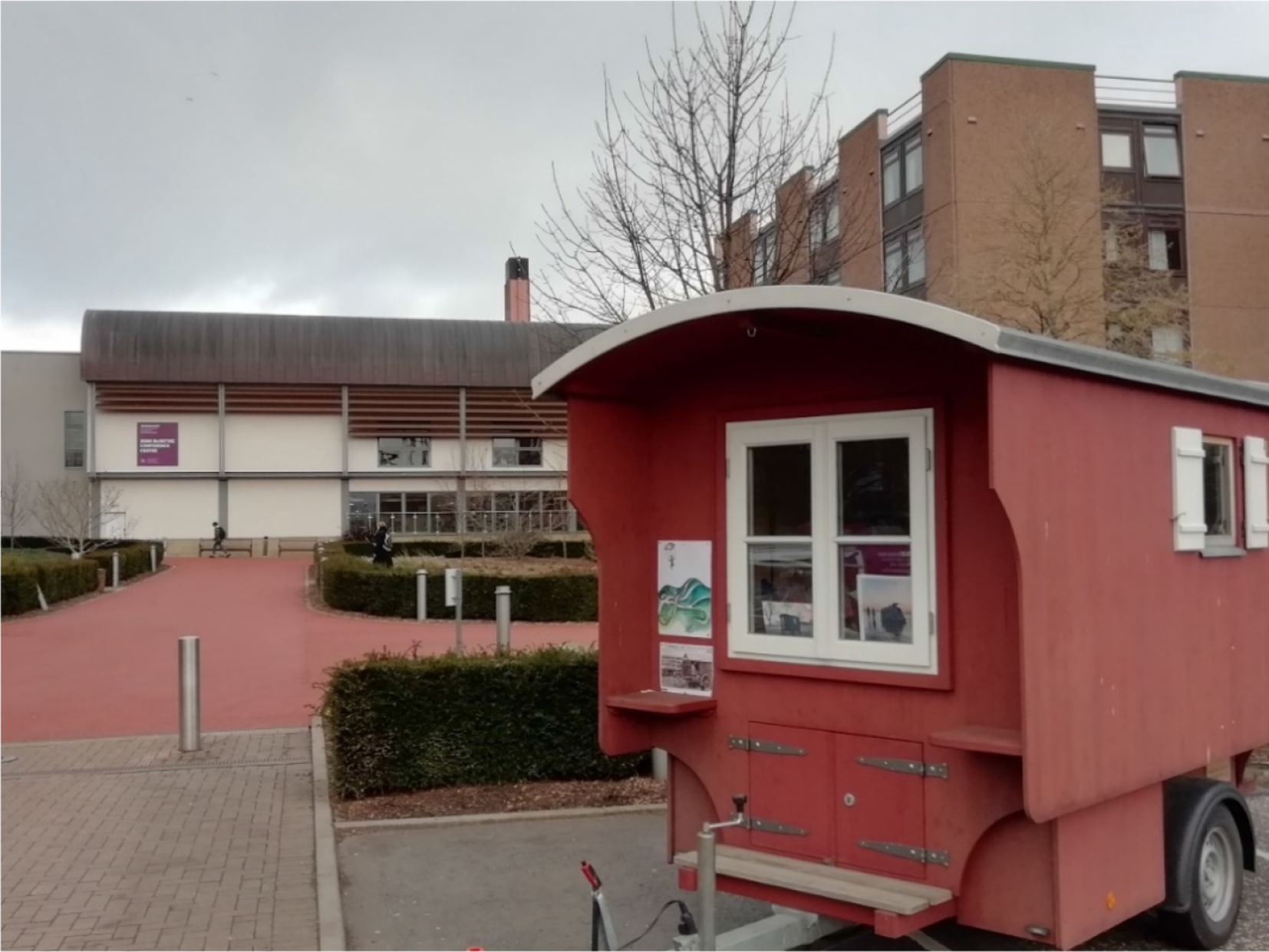
Conference and fringe.
The Counter-Conference as a Fringe
The Privilege of Being the Host for “Missing Out”
The word privilege shall be given two meanings within this experiential account. First, I felt privileged to receive the trust of the conference organizers and subsequently of the visitors to accept and acknowledge this fringe locality. Listening to delegates’ daydreaming and reflections on how to take time in the academy had been a rewarding and mutually inspiring task in the small-scale game changer encounters. The second meaning of privilege relates to awareness of certain privileges, which made it easier for me to disrupt conference anonymity and pressures in this specific way. These privileges, taken for granted, would frame my temporal experiment in terms of individual achievement and resilience, whereas it will be argued that only a shared temporal resistance can activate a collective reaction in inclusive ways. It is necessary to identify accelerated temporalities and pressures in academia as a call for more than the self-promotional ability to surf on conference waves. It is suggested here that my individual experiment should only be seen as an initial stage for making alternatives emerge, a solitary first attempt at rejecting silent temporal coping strategies in the academy.
My own attitude toward the use of time at busy events shifted, thanks to the unexpected encounters that took place while facilitating my game changer panel. On a personal level, the experiment allowed me to test if I could resist the overall format of quantity at a large-scale conference and have time on my side to reframe academic networking at my own pace and deliberately miss out more than I usually would. I dropped the initial plans I had made to attend one panel at each slot (there were around 12 parallel venues, three times a day). I finally made it to two out of nine possible panel slots over 3 days. I opted for quiet to digest all that I had taken in. I refrained from my usual panel-hopping and instead developed an observer role. Seeing the many attendees rush back and forth between the two conference sites allowed me a self-distancing perspective on academic pace and on my own career. I remembered two previous conferences with 300+ delegates that I had attended, but without my Welcome Hut conference fringe. Back then, the major driver for optimized attendance was the feeling not to miss out: “Maybe there was going to be this one theoretical revelation in panel X, or I could finally meet with that speaker in workshop Y.” My journey during these conferences was set in advance and I had to pave my way through a massive quantity of data to preselect abstracts for parallel sessions. My conference clock was always ticking, rare was the unexpected delight of immersive flow. Looking back, I recall that panel-hopping or panel-binging then led to panel-fatigue: sitting exhausted in 15–30 min snippets without time to process ideas in what increasingly felt like a cognitive information overload, an experience of temporal alienation (Alhadeff-Jones, 2017).
My time during the three ECQI conference days was then mainly spent inside the hut. A key moment emerged when I decided to just sit by myself in the hut when no delegate had signed up for the scheduled game changer workshop on the second day. Seeing a wealth of panel opportunities around me, I was clearly tempted to perform a (rather incoherent) role of part-time game changer facilitator inside the hut, and then secretly cramming as many 20-min slot presentations inside my own “free” time. When there were no registrations for my panel on the second day, I could have rushed to another session but then decided to stay in the hut venue where my workshop would have taken place. In that canceled session where I was the only attendee, suddenly another conference delegate approached the hut. I invited that person into the hut and we had an inspiring conversation away from the rhythmic flow of 20-min panel snippets. I was not as alone as I thought with that other temporality. The visitor had been looking for a quiet sanctuary to prepare before the own presentation.
Overall, those who entered the hut during the 3 days did sit down in mutual attunement and shared a moment of stillness (Figure 4). The tiny house did not become a mass attraction, but it had attracted the asynchronous, ephemeral presence and flux of dialog rooted in the moment. The fringe unfolds its beauty when allowed to dance to a different song. I learned that societally engrained patterns of temporal formatting require time, space, and sometimes a “void” in order to be transformed. The conference was not about chasing something, pressed by time, but about moving toward temporal improvisation, allowing the arts of welcoming whatever might emerge when time-cramming is not the modus operandi. Largely unnoticed, we cultivated the arts and crafts of “meaningful time.”

Encounters.
Who Can Afford to Miss Out at a Conference?
The angle of my ECQI game changer was informed by the existential precarity of self-funded Early Career Research, which I had personally experienced. It was only through a range of exceptional conditions that I was able to attend ECQI in this distinctly different role. Only 1day before the deadline for ECQI 2019 abstract submissions, I had received a scholarship for my PhD research at the University of Edinburgh. Having spent the previous 2 years trying to return into research after almost a decade in community education, it would have been financially impossible to invest the conference fees without institutional support such as a PhD scholarship. Suddenly, my abstract writing for a decelerated game changer, just a few hours after my successful funding interview, received a surge in confidence by the unprecedented perspective of a stable monthly installment coming from within academia. As a self-funded researcher, I would have been much less inclined to apply for “missing out” at a conference for which I would still have to pay attendance and travel. In my new PhD role, my university instead supported me with £100 toward registration costs from the school’s PhD student conference allowance. Additionally, I was able to register for free for a postgraduate course about “Time, Place and Belonging” run by a passionate lecturer in the Edinburgh College of Art. It was the reading list of this course that allowed me to investigate a critical perspective towards my own privileges and individual performance of time activism.
I could have thought about the conference experiment as a success. It was certainly an achievement to have found my own, exceptional time slot in this event, where many attendees were only given 20 min in front of a sparse audience spread over the many parallel sessions. My hut had been very visible during the event. Delegates from my university remembered having seen the hut, even as I met them several weeks or months after the conference. But more importantly than having prime visibility, I had been able to facilitate profound and meaningful encounters beyond career networking. I had optimized my personal agency to make conferences less anonymous for myself and others. As chair of this novel type of hut panel, I was invited to submit a report and present it at a future ECQI conference, increasing chances to find funding for similar ideas. The game changer had worked to my advantage. Missing out at a conference actually felt like getting the most out of it. But in this paradox lies the experiment’s biggest flaw.
The ambiguities around the notion of a “slow university” have been widely discussed in the literature (O’Neill et al., 2014). Creating a format that leads to individual CV rewards had not been my intention, but it could now be identified as an attractive byproduct. Scholars and time activists point at the paradox of the superficial success with Slow. If situated only in the remit of personal development, it
suggests that slowing down is mainly a way to be a more efficient and effective scholar, with slow scholarship directed towards the same aims as fast scholarship but offering a superior way of getting there. This is what Carl HONORÉ […] calls “the delicious paradox of slow” that when we slow down we end up working better and faster: “The best way to get ahead in our very fast world is to slow down.” Is the purpose of slowing down to turn us into more effective, if happier, “knowledge workers,” the shock troops of neoliberalism? My hope had been for something to disrupt rather than reproduce the dominant definition of progress. (Mendick, 2014)
The feelings and observations that arose from my time activism experiment invited me to take a closer look at temporal injustice, discrimination, and temporal privileges (Huebener, 2015). After the experiment, I looked around campus and increasingly asked myself: Who can afford to think about time? Who is privileged enough to slow down the own rat race? Many of my own factors of privilege allowed my time activism experiment to take place as a solitary performance and cover up more structural dysfunctions. I had the privilege of choice to opt out at any time. I paid £ 280 to miss out at a conference, but it did not lead to a “slow transformation ” for academia. If I had really been given an unprecedented chance for temporal shifts in academia, why did it feel more like I was buying my way into perpetuating an illusion?
Yet, stepping out of the functionalist conference timing left me with a visceral experience. I had gathered insights of the extent to which the scientific world is structured around individualistic short-termism (Boulding, 1978) and difficulties of stepping out of it. In a knowledge economy that is dependent on innovations (or at least on the rhetoric coming from them), individual and solitary disruptions would be much quicker, more efficient, and more easily communicable than a collective, systemic overhaul. It feels as if the neoliberal pressures on immediate publishable results could have rewarded my shortsighted performance. I could have continued to narrate a fairytale. I had come to enter an academy that is allowed to be critical without theoretical obstacles, but the catch is to be as immediately productive as possible:
the normalization of the mega-project in the corporate university today necessarily mitigates against the patient work and effort that the ethic of sticking with, tarrying over, and abiding by over the longue durée demands. As Les Back and Shamser Sinha (2018: 13) write in relation to their own experience of being involved in one such project, one of the effects is that researchers perennially feel ‘in a hurry to reach the finishing line of the next “work package.” ' (Jazeel, 2019, p. 16)
Hence, the experiment did not dig deeper to provide a solution that would be relevant to a larger group of conference delegates. Many questions still remained: how did my project change the game, which game exactly and for whom? If temporal injustice exists, the lullaby of feeling like a pioneer for temporal change is only workable among like-minded, privileged peers conditioned to pave their way in individualistic formats and who do not expect any deviation from the dominant temporal order.
From Individual Temporal Resilience to Collective Temporal Resistance
Temporal activism then implies resistance beyond temporal privilege, luxury, and judgment. Framing the issues of accelerated academia in disconnected binaries runs the risk of perpetuating a reductionist dualism: between those who can afford to miss out and those obliged to run to the 20-min panel; between those who champion the cause for temporal innovation and those dominated by time. Temporal capital and agency differs across class and culture, and new intersecting perspectives have to be situated on a complex continuum rather than in polarities: “For the working class, slowness is read as rigidity; for the middle class, it is read as mobility” (Mendick, 2014). Sharma (2014, p. 6) argues:
The temporal operates as a form of social power and a type of social difference where bodies are differently valued and made productive for capital in a myriad of distinct ways. For example, everyone might be sick and tired, exploited and exhausted by the machinations of capitalism, but this fatigue feels radically different depending on who you are and how you labor.
It is necessary to allow temporal pluralism. Sharma (2014), in her call for temporal insurgency, suggests that “this contingency is experienced differentially and relationally” (p. 12). The researcher lifeworld perceived as a relational ecology opening to community does not have to be colonized by time. The fluidity and motion of temporalities are a chance for societal shifts because a more inclusive
willingness of its members to modify their own modes of time – to understand social time reckoning as multiple and provisional rather than singular and absolute – is key to the fostering of respectful, productive social arrangements. Multitemporality, by its very nature, must be a provisional form of time. (Huebener, 2015, p. 69)
Slowness, stasis, and acceleration can all coexist in order to give recognition to ambiguous, nonlinear, and multiply connected ways of engagement. Ultimately, the arts of temporal insurgency imply that different temporalities can relate to each other, tune into each other rather than sit in their own temporal comfort zone. As I presented a deliberately disconnected outdoors game changer, I missed many of the exceptional and disruptive microformats and engaging contributions taking place indoors at ECQI. The continuously opened art room at the reception area was one such invitation that showed me that my Welcome Hut had featured quite separately and missed out on many possible conference hall–conference fringe relationalities.
The Fringe at a Conference: Relational Disruption
The Qualitative in the Quantitative: Questions of Refuge
Alternative formats of conferencing are often well documented. In one example, a group of curriculum practitioners and researchers in Canada rented a school bus. The School Bus Symposium carried the “intention of disrupting and re-imagining traditional conference spaces […] through an experiential journey” (McLarnon et al., 2016). Journeying poetically together in such ways provides rare and radically refreshing inter-temporal support. Having attended more than seven academic conferences since my own return into research, I observe a common pattern: innovations in conference formatting are often assigned to a novel kind of interactive site, a novel time slot, or a risky keynote to represent such findings, but the overall supra-structure of the event does not easily allow novel and disruptive flows. The conference as a platform and its macro-organization could be by itself an activist statement in its own right.
There is a legitimate question if my own micro-scale dream tank game changer could be more meaningfully situated in a conference of quantitative inquiry, rather than the annual gathering of the family of arts-based scholars. There is an ambiguous presence of dominant quantitative elements in qualitative conferences. The absence of a “pure” version of qualitative networking as experienced at ECQI 2019 can then also be a call to find novel ways to sneak qualitative formats into quantitative conferences. This engagement to communicate with the “other” is a concern in diverse fields: “it is not enough to be able to communicate one’s own research to one’s own social work community. It would also be vital to communicate its relevance or scientific value to those outside of it and in other faculties” (Matthies, 2013, p. 153). Cultivating relational activism as a format for embracing alterity can then be interpreted as a dialogical provocation to embed qualitative inquiry in the utopia of collaboratively explored pluritemporalities. Different mobile and vagabond ECQI micro-formats could potentially invest a visible fringe presence at large-scale conferences of other traditions of inquiry. The narratives that have emerged during my ECQI game changer with those visiting the hut also point at the necessity to work in depth within the qualitative field. What appears important is the construction of temporal shelter through gestures of hospitality. How can we then collectively make the supra-structure of qualitative conferences more hospitable to engage long-term belongings and experimental commitments to pluritemporalities?
Going Downhill in Vertical Academia: Towards a More Playful Conference Vision
Trying to take on the neoliberal giant individually does not necessarily change the game, but certainly carries the risk of existential fatigue. Individual utopia and experimental curiosity might be echoed by the silence expressed when trying to create collective networks inside an individually assessed macro-system. This silence speaks volumes and the roots of reluctance have to be the starting point for concrete suggestions. A major shift is necessary about what we value and look for at conferences. If knowledge workers miss cultures of empathy and solidarity, individuals may silently wish to join forces to slow down the run for professional networking, toward more existential peer and co-care. This implies mental independence from a system that rewards linear efficiency:
Despite the violence of the dominant temporality mirror, we strive so hard to maintain temporal continuity and futurity (of ourselves and others, including our institutions). Instead, are we willing to embrace ‘discontinuities’ in academic work? For instance, we need to ask: why is it that we’re comfortable with temporal discontinuities in our body time, sleep time, and/or family time, yet cannot live with the discontinuity of our ‘academic work’ time? (Shahjahan, 2019, p. 19)
A hub toward collectively mediated cultures of existential care can be an exchange of future-oriented imagination: “If one is mentally out of breath all the time from dealing with the present, there is no energy left for imagining the future” (Boulding, 1978, p. 7). It is time to step back from what we believe is the “mastery” of and control through our individual resilience and accept disquietingly less productive times that may challenge priorities :
The unstated temporal order is about a moral use of time oriented around being productive and not disrupting the productivity of others. A temporal insurgency needs to affect the productivity of the 1 percent, 5 percent, 10 percent, 15 percent, 20 percent. How does one trespass the temporal order? (Sharma, 2014, p. 11)
Researcher–activists critique the vertical directionalities of academia “as disembodied spirits without any needs or tethers apart from cognitive stimulation through an ‘upward’ career trajectory” (Parker & Weik, 2014, p. 174). We can then learn to experiment with downward rather than upward conferencing, which implies sacrificing on certain comforts in order to “touch base.” We can value other things about conferences than the rituals of status, achievement, and convenience we have become accustomed to. Some memorable conference experiences took place in community centers: A funding turn toward public engagement in the applied sciences invited some academic organizers to fundamentally rearrange their priorities. Community spirit, more than infrastructure, does not have to stay an option, but can be a new event anchor. Improvised conference catering in social centers can provide the type of unsettling, unhabitual hospitality that might be necessary to prevent conference inertia. In my Welcome Hut conference tours since ECQI 2019, I have been able to observe a sacralized culture around the prestigious choice of conference venues. I have been stunned by mentalities among delegates who travel across the globe with the expectation to find perfect, familiar logistics rather than alterity and novelty , demanding exactly the same—mostly westernized—conference routine like at home. Place-based approaches to conferencing are sometimes contained in the token afternoon slot of local guided tours. There is a bittersweet comfort in international academic formatting of privilege. Surprise, wonder, amazement, and inspiration are triggered through a profound disruption through cultural, spatial, temporal, and narrative deviation from the consumer-friendly conference “package.” As a game changer facilitator, it felt at times as if I only had 5 min to entertain busy delegates with my curiosity hut: “Ok, show me your tiny disruption. But don’t make me late for the next keynote!” What parts of the familiar format are we then ready to give up for more unsettled-unsettling networking? The idea to resituate headliner slots carries hope for transformation in times of widespread nonbelonging and higher education picket lines. A purpose of conferencing could then be to move from the veneration of the keynote speech to learning to adjust and fine-tune the volume of conference spaces to existential whisper.
Between exhausting activism and vertical research hierarchies, there is space and time for an interstice of agency. If energy is invested into possibilities for shared imagination, this existential sphere can help to re-sculpture the academic condition. I wonder how many academics would prefer standardized events if they were invited into conference that surprise and unsettle through novel gestures of belonging. Such an alternative is very rarely part of the conferencing merchandise in large-scale events. One cannot simply opt in or opt out on the academic menu with multiple courses. This existential spice first needs to be created in a collectively negotiated recipe. This is a quest to be shared widely. Each person feeling limited in academia’s temporally structured warehouse can then act upon questions existentially urgent enough to trespass the individualistic silence of academia: how much time would I be willing to dedicate to a temporal conference commons to build a sense of meaningful community? This pluritemporal micro-infrastructure can then slowly build up to bring activist–researchers together. Such a site for unoccupied temporalities can come out of solitary conference sheds, huts, hide-aways, but it will also connect to other real and imaginary fringe locations in its very own pace.
Footnotes
Declaration of Conflicting Interests
The author(s) declared no potential conflicts of interest with respect to the research, authorship, and/or publication of this article.
Funding
The author(s) disclosed receipt of the following financial support for the research, authorship,and/or publication of this article: This work was completed during a PhD scholarship funded by the SCDE Attainment Challenge Project.

Author Biography