




Abstract
In the relative comfort of my UK living room, a passive spectator of TV news, I watch fleeting images of appalling suffering and devastation emanating from the war in Syria. The coverage of the bombing of Aleppo (2015) is heart-rending. I turn to art in response, to slow the disappearance of visual images and to counter my sense of remove. This begins as self-activism, drawing/painting-as-inquiry, in combination with journal writing. As the work progresses, portraits burst out of the sketchbook and claim space to speak for themselves, demanding a place in the wider world, their own artivism. What they communicate to each viewer will vary—a commentary on war, on a country’s response to migration, or a call to action for what might be different? The inquiry moves through personal and cultural layers of a creative process to question what art does, and what it fails to do, in the context of this project and activism. Art’s potential, through the acts of looking and making, to affect is central to the sequence of encounters (connections and disconnections), which are examined here.
Introduction
“... the picture is transformed into an internal vision that takes on a life of its own. Once this border is created the status of the picture is changed from being an object of observation to an agent of haunting” (Assmann, 2011, p. 217).
These images from Syria have crossed a borderland, entered into me, evoked so many emotions. I need to do something. I join thousands of other people in London for a protest march and rally against UK involvement in the bombing (December 2015). I want to say something, but I am incoherent, in a wordless place. Art has always been a language I have turned to, in order to process experience and discover what it is I need to express. And so, an idea begins to form. At the same time, I question my motivations for starting this process. I am not living in a war zone. I am not Syrian. I can only comment from outside, the responses of a distant witness to the harrowing carnage. Is it right that I should do this? The reality of the lived experience is filtered before it reaches me—the individuals caught up in such horrors are re-presented through the cameras and words of the journalist-reporters, and transmitted to me through a screen in a distant country, far removed from the realities of life in a war zone. I record the news programs, freeze the screen and take photos—another filter—faces—children, women, men, young and old, emerging from the carnage, blooded from the destruction of repeated bombing and besieged. I take my pens, a sketchbook, and begin to draw.
The Portrait
Portraits have always been political. For thousands of years, before the advent of photography, the portrait in painting, drawing, or sculpture was the method through which the appearance of someone was recorded. Historically it was individuals of importance, wealth, or influence who were the subject of such works. Their images were constructed to convey certain attributes, be it their power, their beauty, their virtue, or their knowledge. Over time, art began to take the lives of ordinary people as subject, and in contemporary art practice there are many examples of artists who use such portraits, photographic or painted, as a form of political-cultural testimony and commentary.
The portrait can have a powerful affective impact. Looking directly, the face engages both artist and viewer. So much is communicated through our gaze. The capacity for inter-connection in capturing a likeness is so strong as once to have engendered the belief that the camera could steal a person’s soul. “Fears of [such] a magical or dangerous image,” Fishman (2003, p. 67) suggests, cause individuals and organizations to censor the affective power of distressing images. Distressing images in general, not just portraits, may be moderated, hidden, or avoided to protect ourselves and others from the emotions and thoughts they evoke. Our capacities to assimilate what we see is screened. We become inured to those uncensored images which may have shocked us initially. And in our visual and information saturated lives, where shifts in content (and platforms) are ever changing, being surrounded by images, does not equate with noticing, really looking, or retaining the memory of what we have seen. And if we do remember, we may not connect the image to the lived events that it documents (Sontag, 2003).
And yet the painted portrait encompasses much more than a simple record of an individual’s existence, a physical object to place in context, to mitigate against forgetting. Schama (2004, p. 9) opens his essays on painting, with the phrase “art begins with resistance to loss”. The act of painting a portrait is different to taking a photograph in that it requires a more sustained process of looking and embodied activity. Berger (1976), reflecting on the experience of drawing a portrait of his dead father, writes of the power of the painted or drawn image to still time and, in doing so, to bring a deep, emotionally re-vitalizing connection with his subject. Similarly, in Loew’s (2013) reflections upon sculpting the head of his father (who died when Loew was 4 years old), the physical experience of working in clay, returned him to the sense of being a child, exploring his father’s actual face. It reconnected him, not only to his own profound loss, but to finding himself within his father with a new embodied understanding and compassion for what his father might have experienced, whilst being transported to a Nazi death camp.
Perhaps then rather than resisting loss, art in general—and the portrait in particular—gives us a way to connect more deeply with others, to connect with the presence of loss, and with human tragedies, suffering, and experience, that is, to act as memory work—if we allow ourselves the space and time to really see.
Distance and Closeness
I am collecting faces. So many children. It is overwhelming. I choose my first images—an older man, emerging from the dark, gray from the rubble. His eyes sightless. And a baby bloodied and bruised, eyes looking up beseeching. Then I am caught up in the drawing, scrutinizing the photograph, translating what I see into line and color. I draw the faces, small, intimate in size. The pages begin to fill. But there is too much white background. I paint around them in black. All the empty space will be black.
Art as a mode of inquiry (Bochner & Ellis, 2003; McNiff, 1998, 2011) connects us with our sensory, embodied experiencing which has the potential to open us to new meanings and ways of knowing (Allen, 1995). In the process of drawing, attention becomes both focused and receptive and the flow of time altered (Csikszentmihalyi, 1996). Bennett (2005, p. 66) quotes the artist Silvia Vélez, who speaks of the need to “slow down” to “reactivate affective viewing of extreme images” that one may be “disinclined to see”.
In drawing, I become lost in time, absorbed in how the pen flows across the paper, the marks, the colors, the intensity of looking. The sketchbook is filling up, the images spilling out onto the pages. Suddenly I see myself, as if from the outside, caught up in concerns of how (and whether) the lines and colors resonate with each other and merge, to create a fluid and coherent translation of the photo. A surge of awareness jolts and floods through me. I have lost sight of what I am seeing. These are blood stains on a face, the face of a wounded child. Immersed in the sensory elements of drawing, I have become emotionally detached from the subject I am actually portraying. I feel myself to be in danger of what Sartre terms the “crime of painting suffering, in a spirit of research” (Sartre, 1966, pp. 61-62). The flow halts. I feel shame.
In Pensky’s (2004, p. 179) discussion of Walter Benjamin’s dialectical-image, he talks of the need for images to be “rescued from esthetic concerns and to be endowed with a shocking, politically affective power”. The ethical balance seems impossible to achieve, when the image also needs to work esthetically, in order to apprehend and engage the viewer. The dialectical-image embodies this tension, but is able through its affect to invoke or bring to the fore thought and historical experience, which might otherwise be forgotten or suppressed.
My internal unease severs my connection with drawing and redirects me back to writing. The interplay between the visual and written reflections on my experience is going to be essential to keep me on track, grounded, and alert to the inherent conflicts in what I am doing. I return also to reading, and to the images with a new commitment.
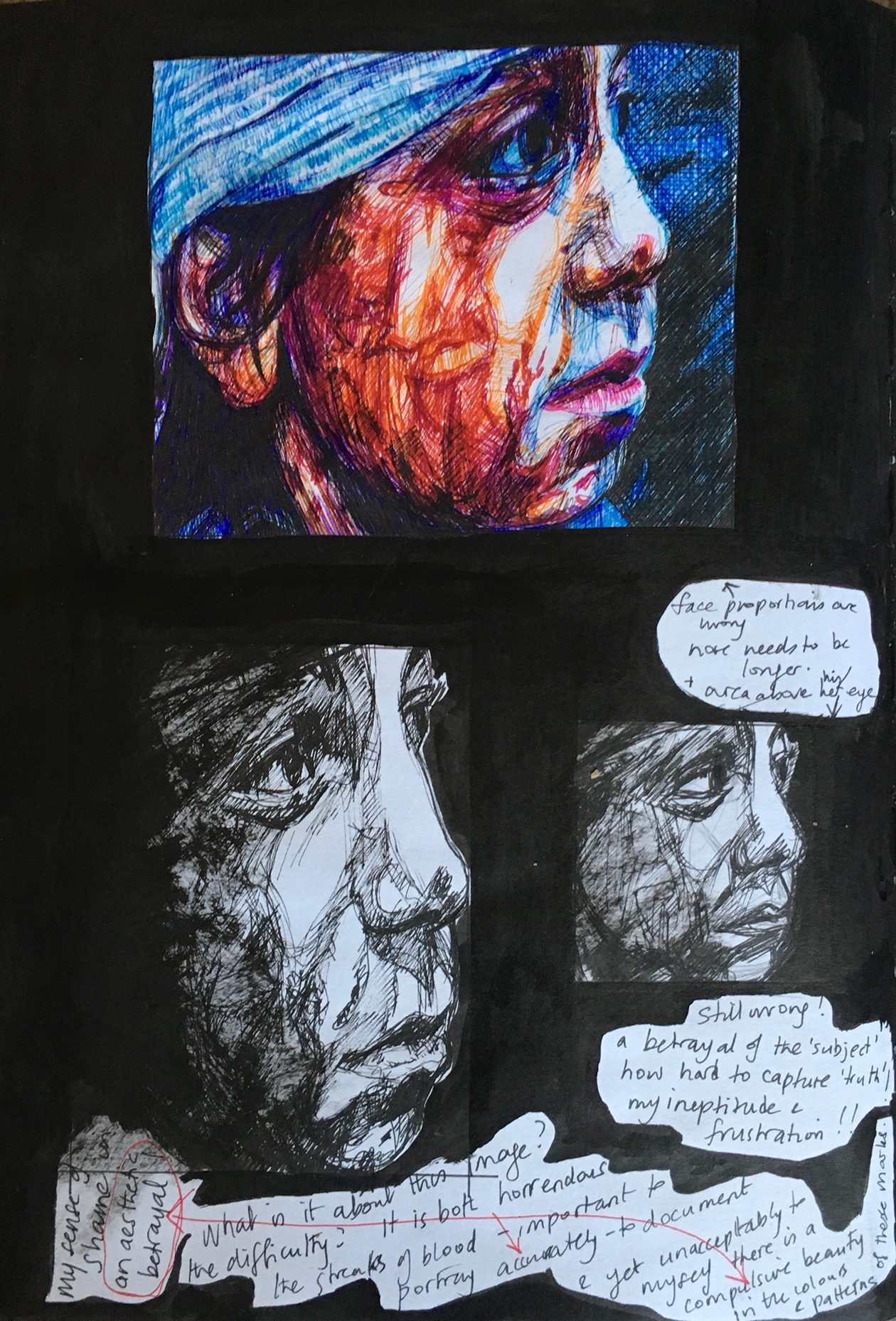
It’s always been much easier to capture a true likeness when I have known the person well—features absorbed subconsciously through familiarity. I just can’t get this child’s face right.
So, I try the drawing three times.
Do they become more of a person-to-me in this process?
Our recognition of unfamiliar faces is very poor compared to those of familiar people (Burton & Jenkins, 2011).
I think about the word
Form
I’m struggling with ideas about the individual and the many. I read a quote in a Marlene Dumas catalog, that “faces come to us one by one” (Coelewij et al., 2014), and that our need to relate to the individual prevents us from seeing the many. Is this so? I am thinking about Rothko’s (2006 [1951]) ideas that large paintings are more intimate, the physicality of them enveloping, pulling the viewer in. The faces may come to us one by one, but in a large work, they could also be many.
Pens give way to gouache in the sketchbook. Freer somehow, more visceral. I drip paint across the pages like blood, blurring features with a covering of pastel like the dust debris from collapsed buildings. Then it is no longer enough to keep these faces in a book that can be closed—they are demanding to be out there, to come out of the sketchbook. They want to be larger—acrylic paintings—positioned together in rows on a canvas, a community of selves. They will fill a wall. A painting is different to a photograph; how much of myself am I pouring in with each brushstroke?
Empathic Vision: Mirroring and Dialogue with Images
Peter Fuller (1988) describes the surface of a painting as a face-like structure with which the artist communicates in ways linked to early experience with their primary caregiver.
I am aware, drawing one of the small portraits in my sketchbook, that I have a strong physical response to the image as it begins to materialize on the paper. If every portrait is to some extent a self-portrait, as many artists say—then we see something of ourselves, of our common humanity, in what we create. There’s something different about this moment. It’s like a felt-knowing of what this portrait needs. It’s deep and sensory. It’s somehow beyond the immediate sight of what’s meeting the eye; beyond the touch of pen on paper.
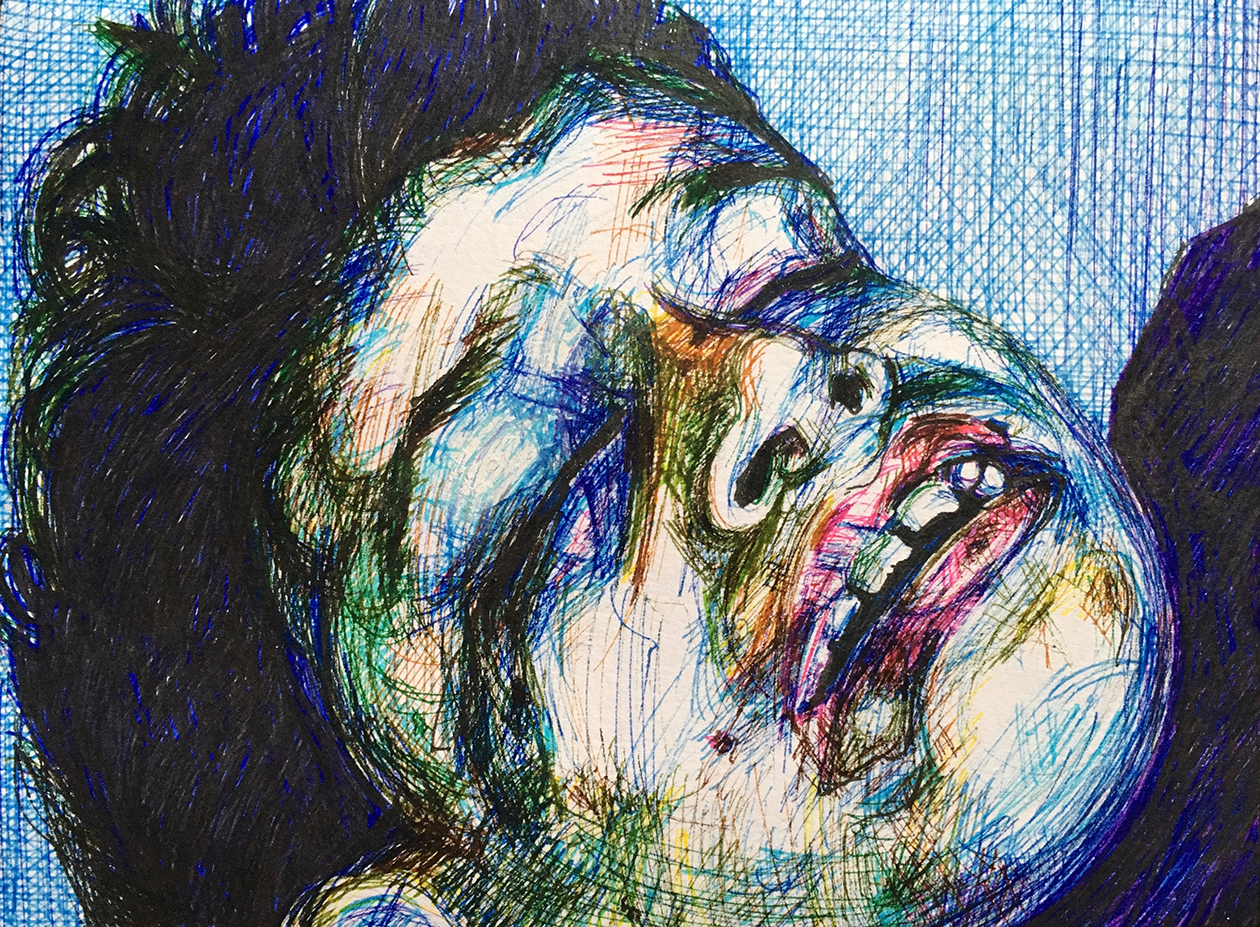
I find myself thinking about the importance of a lightness of touch with the pen, as I start to draw—I feel that gentleness is needed. I feel a great tenderness and become—as if—the child’s mother loving stroking his forehead.
Dissanayake (2000) would call this an evocative resonance, empathy arising from art’s “shaping of sensation” (Dewey, 2005). Could this be comparable to the innate intersubjectivity (Trevarthen, 1998) in the mutuality of caregiver–infant interactions?
Is art transforming my raw experience into something that can be processed symbolically, just as the mirroring gaze of the parent allows the child to become a self?
Art’s right hemisphere activities might link automatically with the right brain to right brain communication that underpins early attunement (Schore, 2001).
I’m painting the larger portraits now, paper stretched on boards, facing me on my easel. Like Berger, like Loew, the faces are coming to life—staring back at me.
John Berger, in a letter to Christie (2017), describes the portrait as a “creature of confrontation, a meeting” (p. 112). He goes on to say, that the intensity of the artist’s looking, when making the image, is a two-way process, where at a certain level the artist becomes aware of “an equally intense energy coming towards [her]him, through the appearance of what it is [s]he is scrutinizing” (p. 59).
I feel this. The painting becomes a you, whom I bring to life. Or is it the other way around? You return my gaze and it becomes a reciprocal encounter.
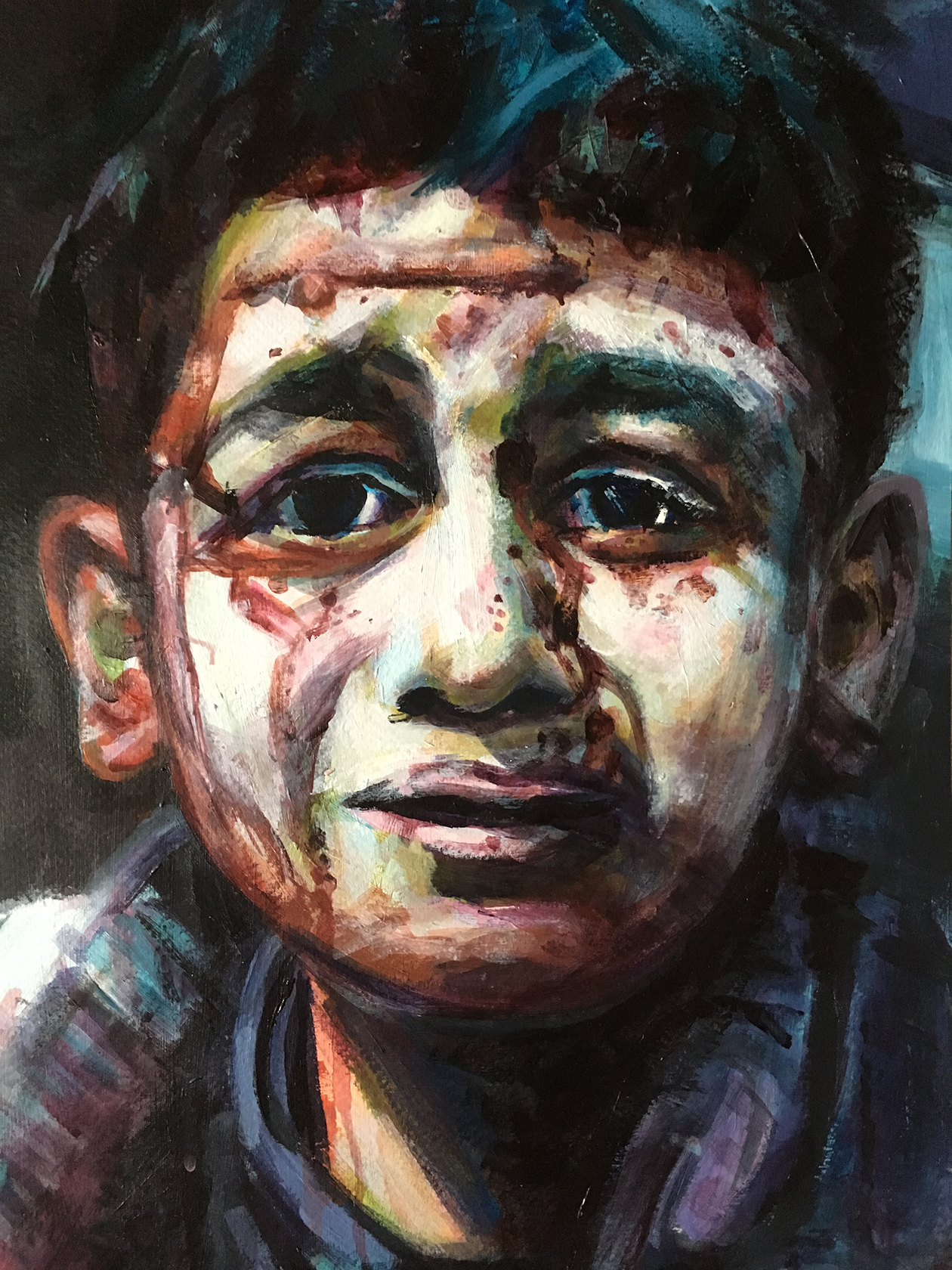
Your eyes gaze into mine. The portrait is finished and it has released you from the paper—more real. You have no words but somehow you tell me you have seen too much. Do you accuse, plead, or look beyond me, inward? Numbed, each day living alongside death? I want to look away, but I know I must return your gaze—I struggle with my embarrassment at the comfort that distances us, with my shame and guilt, the sense that I have no right to have portrayed you.
This encounter is as much with myself as with the portraits, one in which I see myself feeling and responding, and shame re-emerges.
Tomkins and Karon (1992) link shame, as affect, to the behavior of averting looking at the other person and being unable to return their gaze. Whilst shame may be harmful to social connection, it can also be an asset in empathic understanding. LaCapra (2001) proposes the concept of empathic unsettlement, where we are aware of our distance from a subject for which we feel empathy.
We are inhabiting this space in-between, in our encounter. I appreciate the paradox that some distance might be necessary to enable my authentic engagement. Through art-making, I reach into and beyond myself, but this in-between space is like my black-painted backgrounds: dark, unknown, perhaps empty, and un-navigable; a chasm between cultures, between life circumstance, between safety and danger; between art and the real events.
Different Languages, Different Worlds
There are unbreachable gaps between our descriptions of the world and the actual world, between idea and action, between image and word, between the experience of different individuals and cultures, and the extent to which they can be known, shared or communicated.
I know, in my role as a counselor, the power of empathy to bridge differences. Through painting, I have entered into a different way of connecting with what I have witnessed on my TV. I am constituted differently as a result. But on another level, the work feels like a failure. I am deluding myself. It is a shallow betrayal of you who have suffered these experiences. The roles of artist, or inquirer, seem irrelevant compared to that of the real political activist. What have I been doing here? I feel that I, and this work, lack any legitimacy or integrity. What right have I to have appropriated your images into my visual and narrative re-presentation? This work can only ever be a reflection on my experience of seeing you across chasms of disconnect.
Visual art, according to Deleuze, 1972 cited in Bennett (2005, p. 7), offers us an encountered sign which is felt, rather than recognized or perceived through cognition, forcing us to engage and acting as a catalyst for deeper inquiry. Artivism pushes at the edges, brings to the fore confusing thoughts and feelings, touches a nerve, pokes at the need to struggle on. Artivism, connecting art and activism: “using creativity to raise awareness and mobilize the spectator” (http://artivism.online n.d.).
I show the sketchbook and portraits to colleagues. I see they respond with emotion. I wonder if I can try to incorporate viewers’ responses actively into the very essence of the work, and whether this will reduce the chasm, make the encounters closer, and say something more publicly about social justice, and restore some validity to the project.
Re-Forming and De-Facing
“It is painful to be suddenly aware that one must kill a part of what one has created to give full life to a piece” (Rothko, 2006, p. 26).
Art involves destruction as well as creativity (McNiff, 1998, 2011).
I reassess the artwork. Are there ways in which the paintings can communicate the experience of their subjects more effectively, affectively, opening up connections?
Bourriaud (1998) theorizes relational esthetics as art practice, where art becomes the production of encounters between people, rather than between viewer and object. It is based on inter-human experiences and social exchange, where alternate ways of relating within a social context can be modeled.
Early on, I had an idea for a final piece of work, fixing the portraits to canvas in a grid and then splattering, spilling, and dragging paint across them to draw attention to the destruction and human cost of war. I envisaged exhibiting this publicly, hoping it would act as a visceral communication of the impact of war, and as an affective political critique. Artivism as awareness raising. But could the process be more interactive? A video, or a performance piece, which would engage the spectator as witness and participant-respondent, to my laying-waste of the images? Or is this just unthinkable?
Fishman (2003) talks of images perpetrating a communicative ambush on the viewer—the antithesis of Bourriaud’s tenet that the encounter is to prompt new models of sociability and “moments of constructed conviviality” (p.44).
The work stops. Conceptually I appreciate this idea has coherence. I talk about it with surface conviction. I say that I just need to organize a suitable space and some technical support. But having lived with these enlivened portrait-selves, for so long, another part of me is telling me “No!” So, I procrastinate, resistant. Months pass.
The portraits are complete. I have the sky and planes (bombers) yet to do. They’ll be in flight over the faces in rows below. I’ll hang the paintings vertically on a large sheet of canvas and then begin the most visceral, most difficult bit—using paint to de-face the whole work, to decimate like war—to drip, to splatter, to obliterate. Can I do it? I feel my resistance. Even at the level of images, this so hard to action. I identify the portraits I like best, my favorites, and think about where I might place them so they are best protected. Imagine, to feel this strongly just with paintings! I see a two-channel video, in an exhibition at the Imperial War Museum in London, (Age of Terror, Art since 9/11, October 2017—May 2018), where one screen is of the artist (Hrair Sarkissan) wielding a sledgehammer and on the adjacent wall another screen shows a beautiful detailed replica model he had made of his childhood home in Syria, which gradually implodes and collapses. It is called “Homesick.” I start on a large sketch, A1 size, a model to test.
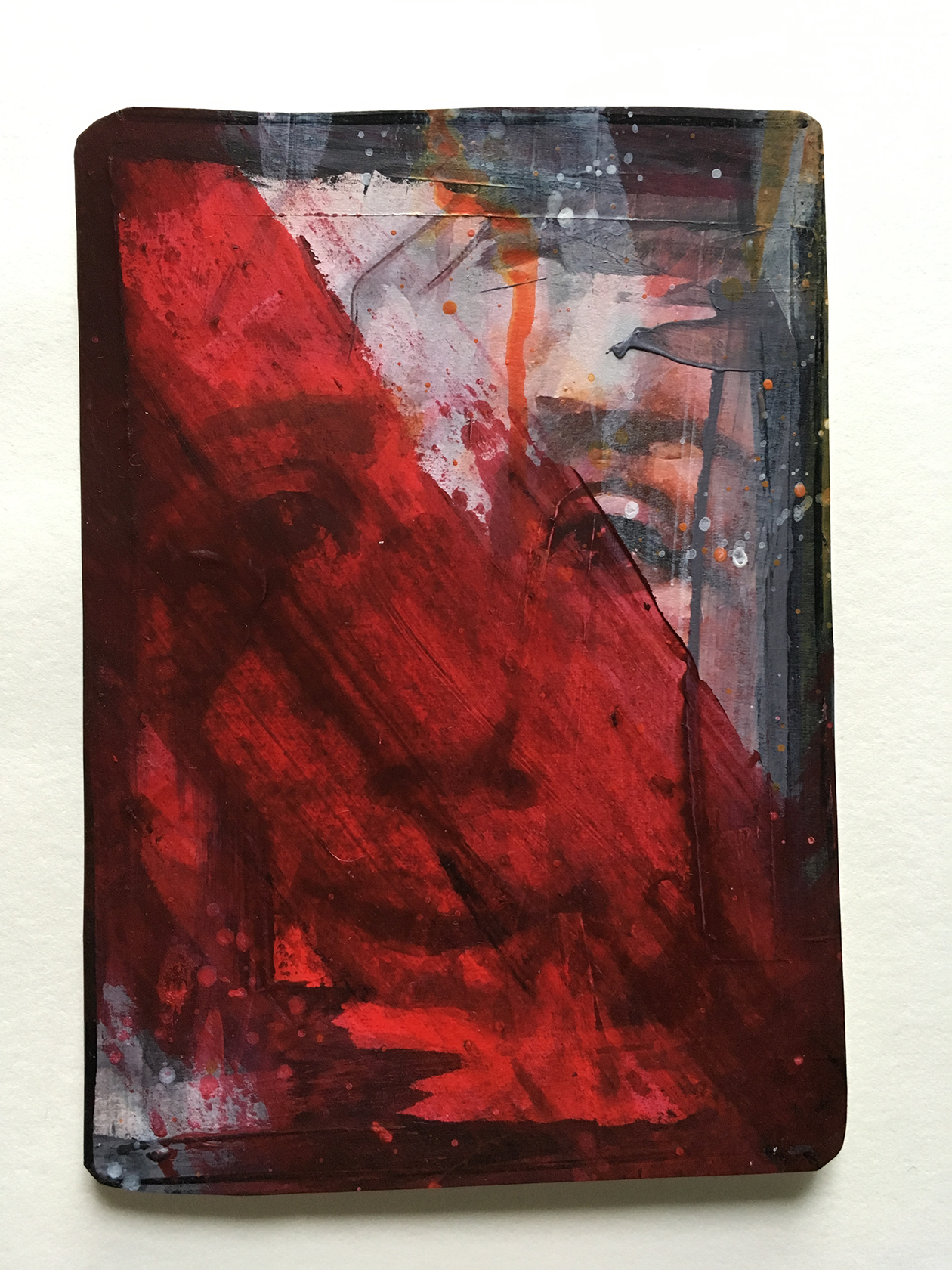
I’ve made some small photocopies of the portraits. The disquieting voice is silent/silenced and the first stages seem easier than I imagined. I glue the portraits in place. I paint the background and planes. I dust the faces with a light covering of white, like they’ve just emerged from the rubble, after the buildings have been bombed and collapsed. The sharpness of their features fade. I didn’t realize until recently that the concrete dust was toxic. I leave it overnight. The next day will be harder.
I splash paint and drip it across the whole picture. I’m not sure it’s working. I brace myself. I take the card and the red paint and, without thinking too much, I drag it across the faces. It’s too garish, too obvious. The color is wrong and the whole composition no longer holds together. I know I can’t save it. I try though, almost desperate now, adding a deeper color as overlay. I register the disappointment, the 2 days of work that have gone into this. I take my scissors and look for what I can salvage.
I forced myself not to think (or feel) as I dragged the red paint across the portraits, but even as I was doing this I knew that this element of destruction had pushed it too far. Why did I allow myself to act against myself? I abandon the work and the idea. It’s hard to face what I have done. I feel despondent; the life of the whole project is in the balance.
Parallel Processes: Art, Trauma, Cultural History
“The struggle to represent trauma, to others and to oneself, involves the struggle between knowing and not-knowing, between facing memories and resistance to facing memories that are buried deeply within the mind of the individual or society. The struggle necessarily fluctuates in intensity, with opposing forces alternating in their dominance over one another.” (Laub & Podell, 1995, p. 1000)
Have I used You as a cipher of victimhood—become an inadvertent colonizer, through misguided intentions? I imagine your mother coming across my painting, with the bombers overhead, and in recognizing You, becomes re-traumatized. And yet a composite would lose the individuality which stirred empathic responses in myself and in others. The intention to honor, that the portraits be a memory-work about the barbarism of war, appears ill-conceived. Adorno (1962) talked of the impossibility of art confronting such horrors, without somehow becoming complicit, and yet affirmed the imperative to continue to try. Ultimately the work fails. Morally do I abandon it or somehow struggle on, in the belief that there is something that needs to be expressed, communicated—some memory work—both for myself as an individual and more publicly?
The experience of trauma is a fragmented one, calling into question survival, remembering and forgetting and the impossibility of both. Herman (1994) identifies the different parallel positions occupied by individuals in real-life trauma.
I am a witness, horrified, shocked, unable to find words, and wanting to speak out; a bystander—taking flight from knowing, out of impotence and shame, retreating to a dissociated distance where esthetic concerns and ideas separate me from a felt connection with what I am portraying; a vicarious voyeur; even a persecutor appropriating your image, destroying what existed, and replicating a wider historical appropriation (Barr, 2012).
In the failure of this last painting, I am faced with the question of what next. Shall I retreat to the private space of a sketchbook, or into a new project—into silence and forgetting, or find some other way to keep the work alive and visible?
Re-View: What Did Art “Do”?
Finley (2008) contends that art-based research should be activist, that it is a political and moral enterprise. She goes on to say, “artful representations have the capacity to provoke both reflective dialog and meaningful action and thereby to change the world in positive ways that contribute to progressive, participatory, and ethical social action” (p. 75). The political has run through the whole of this project. The world is not changed through its creation, but the smaller everyday actions and the raised awareness can be catalysts for a flow of change to emerge. Images and words could never meet the real experiences that prompted the work. This art-as-inquiry project has taken place in such liminal spaces, between private and public, in dialog between internal and external, in a borderland where new relational connections and gaps become apparent and re-imaginings can take place.
Leavy (2015) suggests that the cultivation of empathy is one of the greatest strengths of art-based research methods. Creating, paying attention through looking, translated into making, permits entry into an immersive, affective encounter with the subject. I experienced an intense embodied intersubjectivity in the act of drawing and painting the portraits—at times paralleling a maternal–infant attachment, tender and protective; at times shaming, in facing the chasm of difference in life circumstance and culture. If there is some truth in this creative action, then the images, as experienced by another viewer, will have power to affect, to grab attention, to provoke thought, and create the foundation for empathic vision (Bennett, 2005).
There are moral questions in responding to traumas of others. The suffering is communicated as secondary or tertiary witnessing, appropriated in filtered encounters by a distant viewer. Engaging with this ethical conflict in the art-making process means acknowledging the disconnect, the empathic unsettlement (LaCapra, 2001). Destruction, dissolution, and uncertainty are fundamental to creativity, and have played a powerful part in bringing this project to life. Bishop (2004) counter-poses the ideals of relational esthetics, with relational antagonism, a practice of socially-engaged art, which takes account of discomfort and nonidentification, along with the inherent nature of “conflict, division and instability” in our cultures (p. 65). Art as affect has the potential to create empathic vision based on “feeling for another that entails an encounter with something irreducible and different, often inaccessible” (Bennett, 2005, p. 10). The recognition of the divisions is uncomfortable, but also can provide the motive for political action.
It seems to me that both art-making and the image, as object, are activists in this process. The image burrows in and becomes an agent of haunting (Assmann, 2011). My engagement with this project has been sustained over 4 years so far, and when I look at the portraits and sketchbooks I recognize them as open archives, tracings of feelings, layers of processing, of witnessing and warning, still in flux, that provoke new thoughts and re-actions. They are memorials, not as containers into which we can evacuate the grief, despair, and horror from our minds—freeing ourselves to forget—but as vital agents of memory.
I place the painted portraits in rows on my studio floor. It feels right, like some sort of reparation. I no longer believe I need a video, a defacement, to finish this work. My work on the portraits is complete—they are children staring out, having emerged from the rubble, from the bombs and the chemical attacks. They are alive and demanding that we remember.
Their next move is to claim more public space……
I presented the portraits at the European Congress of Qualitative Inquiry conference in Edinburgh in February 2019. They were more confident than I. They looked out to the audience from the projector screen. Face-to-face encounters. My words seemed secondary, inadequate, and unformed in comparison, still becoming. I am still thinking about what it is that art does in inquiry, how it connects with activism, and about its potential to evoke and engage. A friend, who is also a painter, said they, the portraits, should go out on tour. Maybe they will……
A few days after I had returned to work after the conference, I received an email. It said:
I was (still am) very moved by your work. Even when your words have now faded, your art stays and keeps coming back. Especially the eyes.
I am at the moment researching on hostile environments through a psychosocial lens and have created some images too. It is hard these days to invite empathetic responses towards any immigrants - but I hope that art can move people and open them up to the painful realities that so many, including myself, endure. Your work has given a little more hope! (N. Fang, personal communication, February 18, 2019).
Footnotes
Author’s Note
‘Let the atrocious images haunt us’ is taken from Sontag, 2003 (see reference list).
Declaration of Conflicting Interests
The author(s) declared no potential conflicts of interest with respect to the research, authorship, and/or publication of this article.
Funding
The author(s) received no financial support for the research, authorship, and/or publication of this article.
