




Abstract
This paper reflects on the question of whether, and how, Fundamental British Values (FBVs) may affect the practice of home education in the UK. Fundamental British Values were introduced into the national curriculum in 2014, for state administered schools and preschools which have since been required to demonstrate that FBVs are embedded in the practice of the setting. Home educators, on the other hand, are not obliged to follow the national curriculum meaning that the effect of FBVs on such alternative education is not obvious. However, this paper draws attention to the wider environment of home education by considering FBVs as the product of three particular spheres of contemporary discourse as they interrelate and influence each other. These are the affordances of identity in a postinternational era, expressions of Foucauldian governmentality in terms of self-surveillance and management, and the developmental paradigm. Fundamental British Values, alongside the concept of parenting and the materialization of a particular social morality, are considered as the inescapably emergent products of the un/reason created by the overlapping of these discourses. Their convergence, in turn, creates a weight of logic from which FBVs exert influence over the practice and judgment of alternative forms of education.
Introduction
Talk of shared values that would serve as both the mark and obligation of the British citizen began in the aftermath of the London bombings of 2005 (generally known as the 7/7 attacks). The idea of cross-cultural values that held together the diversity of British citizenry became part of the political rhetoric which followed the attacks and addressed the fears of segregation, crime, and religious conflict to which they gave rise (Beck, 2008). These values, referred to by then Labour Prime Minister Tony Blair, were “belief in democracy, the rule of law, tolerance, equal treatment for all, respect for this country and its shared heritage” (Blair, 2006 quoted by Woodward, 2006). Eight years later, and in the wake of reported plots that Islamists were taking over state schools in Birmingham (generally known as the Trojan Horse affair), another prime minister, this time Conservative David Cameron, referred to much the same set of ideals as being FBVs (Cameron, 2014). As before, these values were put forward as the common ground which could cut across ethnic, religious, and cultural difference to underlie and mark out British identity. Both Blair’s call to heritage and Cameron’s invocation of the “fundamental” can be read as a political/historical reaching back to some kind of basic and binding authenticity about “Britishness.”
Following David Cameron’s reiteration, FBVs were swiftly taken up by the Department of Education (2014, p. 5) who cited them as “democracy, the rule of law, individual liberty, and mutual respect and tolerance of those with different faiths”. By 2015, OFSTED had incorporated the active promotion of these values in both schools (OFSTED, 2016, p. 42) and early years settings (HM Govt , 2015) as being requisite to gaining an “outstanding” assessment in its inspections.
While eyebrows and more have been raised at the designation of these values as particularly British, there is widespread acceptance that schools are good places in which to impart values to children. The position of “spiritual, moral, social and cultural development” (OFSTED, 2016, p. 35) is firmly established on the UK educational agenda. Fundamental British Values fall under the social heading of this quartet, with OFSTED criteria requiring that pupils demonstrate:
acceptance and engagement with the fundamental British values of democracy, the rule of law, individual liberty and mutual respect and tolerance of those with different faiths and beliefs; they develop and demonstrate skills and attitudes that will allow them to participate fully in and contribute positively to life in modern Britain.
While the national curriculum covers all state maintained preschool, primary and secondary schools, it does not apply to independent schools, academies, or children being educated at home (Gov.uk, 2017). That home education is not State regulated in the UK is the subject of frequent government consultations and reviews and is often criticized politically, academically, and popularly (e.g., Badman, 2009; Monk, 2009; Soley, 2017). However, a lack of regulation does not necessarily imply a lack of influence. This paper considers the potential impact of FBV on understandings of, and attitudes toward, home education and reflects on how and why FBV may affect the practice of home education.
In what follows, I examine three interwoven and mutually influencing spheres of prominent discourse with the intention of exploring the emergence of FBV and their place in our thinking about education, including home education. The spheres of thought under consideration are the following: first, affordances of political identity in a postinternational world; second, understandings of self-regulation and discipline through Foucault’s notion of governmentality; and third, the developmental paradigm as a means for understanding the political place of childhood in society. In doing so, I draw on the model proposed by Jakubowicz (2011) in which three master concepts (in his case, cosmopolitanism, social and cultural capital) create a triangle of interconnecting, and sometimes competing, explanatory purchase through which he is able to consider the “space” of democratic inclusion. In this paper, I argue that the three prominent discourses examined produce between them a “repertoire of values” in the Bourdieuen mold which in turn give rise to further entailments of thinking. These I explore, within this context, as being FBV, parenting and a particular turn of social morality. From this combination, again, emerges a particular perspective on home education which holds the potential to impact on both its (un)popular image and its practice.
Figure 1 illustrates the three master discourses under discussion and the emergence of particular lines of thinking created through their intersections. Jakubowicz (2011) identifies a competition of understanding in the intersections of his master concepts. Here, however, the overlapping of accepted ideas is seen to create a mutual propping up of thought; the production of an apparent logic through which further entailments emerge. Although the representation infers spatiality, and “spaces” is the term used by Jakubowicz, through my interpretation “space” is something of a misnomer. Instead, these intersections are already packed with a weight of meaning which drive toward inevitable conclusions. Home education in the center emerges, necessarily, as a site of suspicion and mistrust; a place of potential or actual disruption in which the dominant discourses cited need to be re-asserted for order to be regained. The schematic presentation is used not to belie the complexities of argument in this area but to highlight how the appraisal of home education through this prism of values (rather than, for example, through an evaluation of evidence) leaves little room for reasonable maneuver. As discourses interconnect, there emerges an inevitability of un/reason that powerfully acts to direct the argument and confer its conclusions.
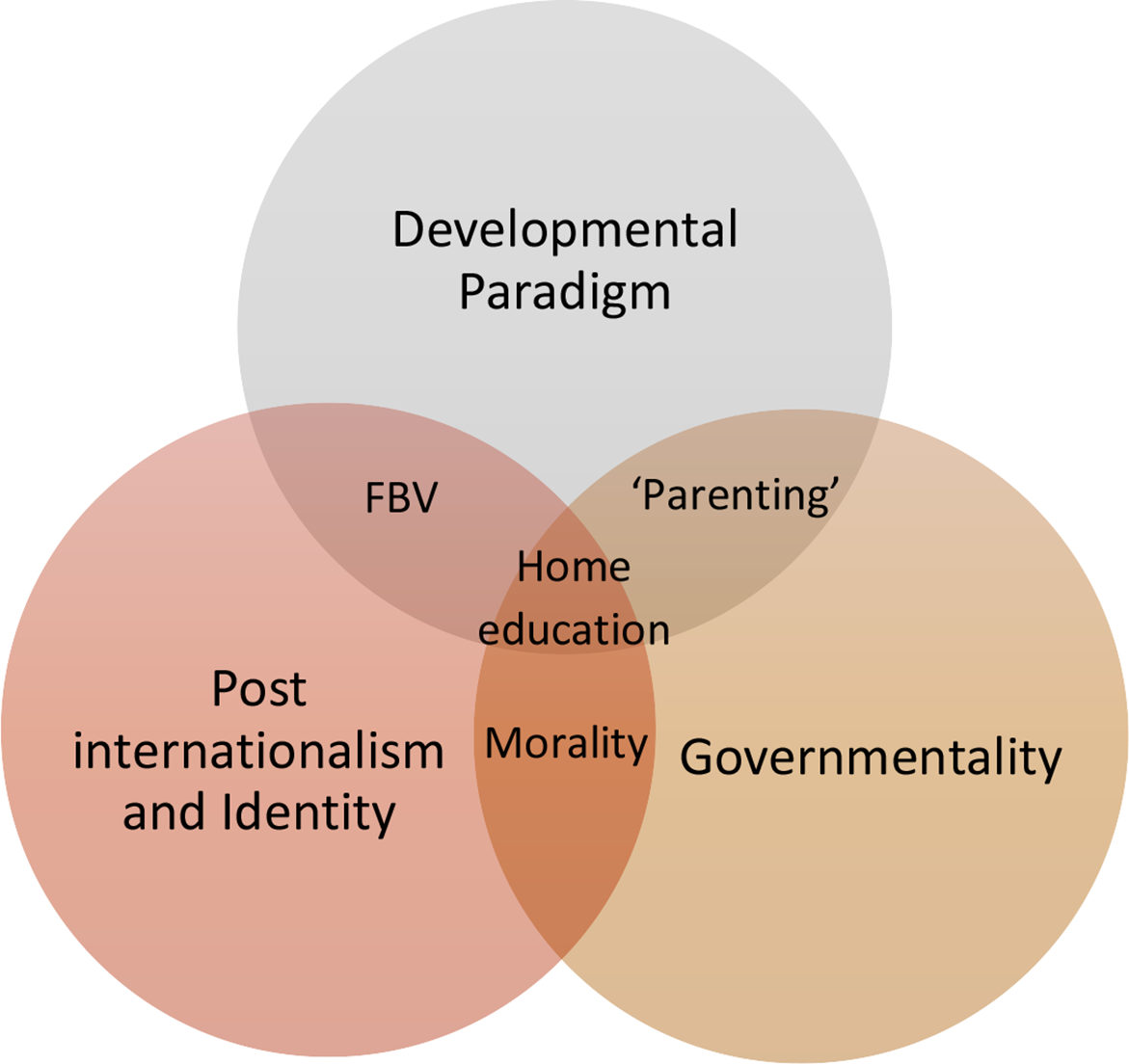
Intersecting discourses and their emerging repertoires of value.
Postinternational Identity
We live, as the Chinese curse would have it, in interesting times; times of change and unpredictability, marked by political upheavals and riven with uncertainties, and we live these times at unprecedented speed and reach. Events happen fast and news of them travels almost simultaneously; goods and people are not far behind; actions have far reaching consequences and we are constantly, as individuals and as collectives, being urged to form opinions, take up stances, and commit to actions. The emphasis on speed and reaction lies in accordance with ideas of progress; the direction of travel being in “opening up” as opposed to “closing down”/“regressing” to slower, more inward looking perspectives (Stronach, 2010). In this fast paced, global world, who we are, what we should do, where our interests lie, and where our loyalties belong seem to be continually open questions. Uncertainties of identity and belonging centered around the question of “where do we end and they begin?” (Booth, 2007, p. 134) are slippery, continual, and charged.
For centuries, international relations have been understood as the interaction of nation states through the medium of global politics. However, as Ferguson and Mansbach (2004) argue, such a picture is fast becoming inadequate. The nation state arose as a deployment of power through dimensions of time and space, history, and geography (Boyarin, 1994). The national claim to unity has been staked to a common past and a shared territory; avowals, possibly illusory and certainly employed to political ends, yet strongly enough felt to create “imagined communities.” From these communities, shared affinity and loyalty has been raised, often with great conviction, even within populations who might have very little depth to their mutual political or social interest on the local or individual level (Anderson, 1983). However, through the strength of these intertwining forces, it has been possible for the world to operate as if the nation state and its citizenry represents “an effective boundary against time and space” (Boyarin, 1994, p. 14) rather than being itself an artifact of that same time and space.
In the 21st century however, the once straightforward combination of territory and heritage directing a lifelong identity (or at least the rhetorics of such) has, as argued by Ferguson and Mansbach (2004), been exposed in all its over simplifications. Technological and political changes mean that information exchange has proliferated, geographical boundaries have become more porous, populations less static; connections at every level of social and political life have multiplied. The impact of time and space has shifted, and with these changes, the terms of belonging have altered too. Rather than preordained allegiance to a lifelong national identity, Ferguson and Mansbach (2004) describe ongoing processes of fission and fusion which bind together and divide populations and groups within populations without regard to the borders of nations. Boundaries are no longer pregiven but are instead constantly being eroded, pulled down, renegotiated, and redrawn (Beck, 2002). Technology abetted globalization pulls together the geographically distant through networks of economic advantage, political interest, and shared cultural and religious affinity. Simultaneously, processes of fission divide units of self-identification into smaller and smaller groupings, specializing authority and concentrating loyalty. The result is a web of interests and allegiances, often conflicting, operating through the dynamics of multiple identities founded on citizenship, history, culture, religion, locality, politics, economic interest, and social advantage, as well as nationality. Opposing forces of localization and globalization compete with each other to block straightforward solutions to matters of differently configured collective interests; interests which nation states continue to attempt to hold together. Such fluctuating allegiances mark the erosion of both the bonding capital that holds factions together and the bridging capital that allows groups to connect with one another (Putnam, 2007). The result is depressed levels of social cohesion such that states which might once have felt assured of the identity of their populace are now “forced to bargain over and share citizens’ loyalties with other authorities” (Ferguson & Mansbach, 2004, p. 22).
So, identity has become inherently less stable, more uncertain; a shifting factor in a maze of reality and fear where interconnected, transnational calamities play out whether in the form of financial meltdown, political upheaval, military action, mass migration, displaced populations, or terrorist atrocity. The idea that a nation can steer its course “as if all it had to control were the people inside it” (Boyarin, 1994, p. 14) is no longer tenable. Instead, issues of affinity, interest, loyalty, and identity, whether collective or individual, need to be constantly reframed and reconsidered. The result is that, in any given situation, there are no convenient delineations to show who is “inside” and who is “outside,” no certainties of prejudgment based on a static configuration of identity. Shifting loyalties and fluid identities mean that political positioning “comes to depend on the issue at hand and the identity hierarchies in place” at any given moment of crisis (Ferguson & Mansbach, 2004, p. 22).
Perhaps, the starkest and most disturbing illustration of the confusion over who is on the inside and who on the outside comes from examples of “home grown terror.” As Croft and Moore argue, there is a particularly chilling element “to British citizens acting as a ‘fifth column’ in ‘our’ midst” (Croft & Moore, 2010, p. 828), and cite the example of Mohammed Siddique Khan, one of the leaders of the 7/7 attacks in London in 2005. Khan, of Pakistani parentage, grew up in Leeds, went to school and university in the UK, worked as a classroom assistant, was married with a child, a devout Muslim and respected member of the community, but also a terrorist recruit, a jihadist, and ultimately a suicide bomber. In his martyr’s testimony, found after the attacks he helped mastermind had killed 56 people including himself, he railed against the British government and declared his extremist loyalties in a broad Yorkshire accent. In such an example, loyalty, affinity, and personal interest seem to disorder each other with violent unpredictability so that identity makes little sense even if it can, in some way, be conferred.
The straightforward adjunct to know your enemy seems to be slipping from our grasp but it is not just our enemies that we need to know but also our friends and ourselves. The invocation of “we” has become a matter of not just personal identification but also of political importance precisely as it has become a matter of increasing complexity.
Governmentality
In considering how discipline and control operate within modern societies, Foucault (1995) stretches out the understanding of power beyond the overt and coercive measures which the state demands through the rule of law. Contemporary power is cast as a collective asset that operates around and through a population in the form of common understanding, in the sway of ideas, and in the demarcations of the normal and the deviant in our own minds. Power operates through people, through the acquiescence to, and upholding of, culture, society, and social grouping (Guibernau, 2013). The regulation of society relies not so much on the coercive and deliberate forces of the state but on the compliance gained through the shaping of individuals and through their self-maintenance as “the good citizen, good family member, good worker, and good student” (Popkewitz, 2000, p. 159).
Here, “good” is defined by the mutually shaping needs of both individual and state. Foucualt’s “governmentality” encapsulates the fusion of interests between state and individual; a process in which the techniques of self dovetail with the techniques of domination so that “the modern sovereign state and the modern autonomous individual codetermine each other’s emergence” (Lemke, 2002, p. 50, 51). The citizen thus produced is one who obeys the law, participates in society’s enterprises (the labor market, consumerism, formal education, and party politics), conducts a responsible lifestyle in terms of caring for themselves and their families in socially acceptable ways, including taking responsibility for their own health, living, and future.
The ideals of this “normal” are reflected through social policy; matters of child care, parenting, family life, and education being particularly pertinent here, but run further into the production of normativity as “common sense” and “obvious” (Garwood, 2016). Furthermore, participation in “normal” life takes place on a voluntary basis so that the good citizen is self-organized, self-disciplined, and self-motivated in her or his civic participation. The ease and effectiveness of this merger is achieved through the control of reason which produces the image of the “reasonable citizen”; a persona to which all parties can refer and aspire and around which are shaped the desirable characteristics, life histories, and “needs” of individuals.
In this merging of the free-thinking individual’s capacity for self-control and the economic and political needs of the state, the school plays a special role. State education historically intertwines the purposes of social administration and pedagogy in the desire to create common political destinies for its rising citizens. The promulgation of the “good” citizen is therefore deeply embedded in formal education; school a prime site, pedagogy a main tool, for this work (Popkewitz, 2000). In terms of Foucault’s governmentality, the school functions to embed in both its pupils and the populace at large, particular values that, in the merry-go-round of reason, will uphold the state and steer society in the ways of self-regulating righteousness.
Viewed from this perspective, the problem posed by the alternative of home education is not that some children may underachieve academically or be denied a certain kind of social life nor that there might be unknown threats to their welfare if they are not educated or routinely monitored by the State (although these are all frequently deployed arguments). Rather, the problem is that school represents a chief means of social administration and those who do not spend their early years in schools may be formed, socially and politically, by other forces and in other ways to become adults who are “other” than the reasonable and regulated citizens whose lives are mutually intertwined with the machineries of the state.
Whether home education really does transgress the politically sanctioned model of the reasonable is open to debate (Pattison, 2017). Similarly, there are no guarantees that those who have been subject to a school education will hold that shape on either a temporary or permanent basis as examples like that of Mohammed Siddique Khan make clear (Croft & Moore, 2010). However, if the position of the school within Popkewitz’s argument is accepted, then there is a threat of transgression which needs to be recognized. This is precisely the view put forward in statements such as the following from Neil Basu, a deputy assistant commissioner at the Metropolitan Police as reported for The Times:
Segregated, isolated communities, unregulated education and home schooling are a breeding ground for extremists and future terrorists.
While there is no evidential support for Basu’s claim (Charles-Warner, 2017; Pattison, 2020), alternative education, by its very designation, stands outside or at least perilously close to the border of social acceptability when it comes to the creation of common political purpose. However, to assume that school can only influence those that pass through its gates is to miss the depths of Foucault’s governmentality. The real power of this form of control lies in its ability to regulate from a distance through techniques of socially enforced and self-motivated discipline. Governmentality does not rely on the immediacy of coercive measures or on direct techniques of persuasion. Instead, it exerts its power through the control of reason, the establishment of what is seen as right, moral, and “good.” The absence of some children from the classroom therefore in no way automatically places those children beyond the regulation of society. Well clear of the tangible boundaries of the school, the long arm of social judgment continues to extend its reach, not only to the rising generation but also to those who care for them. Included in these are those parents who have already attempted to extricate their off-spring from the immediacy of the state’s grasp by educating them outside school.
The Developmental Paradigm
I now turn to the third master discourse of consideration, the developmental paradigm. Developmental psychology and the developmental paradigm it underpins has become the principal (and for a lot of the time, the only) lens through which the Western world views childhood and children. Developmental psychology has made “the child” an object of scientific study and, in doing so, has both created and legitimized the understanding of children through the scientifically sanctioned means of classification, measurement, and experiment (Prout, 2008).
By way of developmental psychology and its privileged scientific status, childhood has been normalized into a trajectory that takes the new born baby into adult maturity in a passage which is standardized and quantifiable and from which deviance can be recognized (Burman, 2008). It is a form of understanding not restricted to the physical and cognitive aspects of childhood, but one which has also made its mark on the development of children as social and emotional beings (Rogers & Rogers, 1998). By virtue of its application to multiple aspects of children’s lives, the developmental paradigm is the organizing principle of everyday and common sense theorizing about children as much as it is the framework for scientific theory.
This privileging of the developmental paradigm is so entrenched in our understanding that it is almost unquestionable; for most of us, most of the time, it simply does not make sense to think of children in terms other than as developing beings journeying along a preordained path toward the goal of adult maturity. As such, the developmental paradigm makes a pertinent example of Foucault’s control of reason; its framing of childhood presents as a “natural” given rather than a cultural interpretation. The political and social implications of its perspective fall from common view making society’s response to children appear to be instigated by childhood alone (Burman, 2008). The evoking of the natural as the foundational force in child development universalizes the state of childhood, allowing for generalization across populations and histories. In turn, particular affordances of childhood can be raised to the status of “needs”; things that children must have in order to follow the “natural” trajectory of their development. From this stance of apparent objectivity, the developmental paradigm exerts its formidable influence over what is best for children; an influence threaded through social and educational reasoning and directly into prescribing how families (particularly mothers) need to provide for and behave toward their children (Burman, 2008).
Such is the strength of its influence that the developmental paradigm cuts across apparently different stances on childhood; its authority is as much employed in arguments supporting alternative provision as it is in their mainstream counterparts (Pattison, 2016). For example, Gray (2013), an unschooling advocate, has argued that children “need” a particular level of autonomy and freedom in order to develop as “natural” learners. The claim underpins his arguments in favor of a particular style of child rearing and education. While competing stances may postulate different childhood practices, their source remains common. The natural child is a universal child who is, and always will be, in need of certain conditions, certain affordances. Thus, the claims of developmental psychology, the invocation of the scientific and the natural, carry with them enormous political portent as they thread their way through thinking about children (Pattison, 2017).
The reach and influence of developmental psychology has firmly established that children are at least as much “becomings” as they are “beings” and are to be understood in terms of what they will be, as well as, or even more than, what they currently are. This stance foregrounds the importance of early experience and education for later life, and emphasizes optimal “outcomes” to the state of childhood. It justifies childhood as a definable period devoted to the shaping of the future adult, citizen, worker (Cannella, 1999). In turn, this makes possible a model of investment in children. Just as in economics, an investment signifies that money spent now will yield some greater return in the future so investing in children with the “right” kind of early experiences is seen as paying dividends, to both themselves and wider society, later. For example, investment in early learning experiences will pay dividends in later schooling success, in health, in social inclusion, in gender equality, and in crime reduction (Dahlberg & Moss, 2004). This kind of thinking presents a model of social and educational investment in children which equally lends itself to the political; early political investment in children will pay dividends, to both themselves and society, through their later political conformity.
Having laid out these three major areas of discourse, I now want to argue that their intersections create and legitimate other ideas which we currently see flourishing in society. First, I examine FBV as a reasonable extension and logical entailment of the interweaving of ideas about political identity and child development. I then look at the further extensions of “parenting” and social morality as similarly being augmentations of these metadiscourses. Finally, I draw these three ideas together to consider their impact on home education and home educators in the UK.
Fundamental British Values
Where the developmental paradigm and the political importances of postinternational identity intersect, it is an inevitability of logic that a responding political pedagogy should enter the school curriculum. This is a move with considerable precedent. It is generally and widely accepted that schools have a right, if not a duty, to impart certain values to the young and this acceptance finds practical articulation through the National Curriculum and in particular through personal, social, health, and economic education. Prompted by the perceived needs of society, subjects ranging from the environment to personal health are commonly addressed in this way, linking knowledge, social concern, and values (Bigger & Brown, 2012). Examples are the need to recycle or to alter dietary habits or to reduce smoking. In such cases, the promulgation of morality and values is as pertinent (if not more so) than that of knowledge (Reiss, 1996 in Halstead & Taylor, 1996). The current crises of postinternational identity manifests as such a social concern and a question of values. Thus, the anxieties of the state and its need to create and secure new forms of solidarity (Healy, 2016) find outlet through education; particularly, the powerful role of the state in curriculum decision making.
One potential approach here is to focus on the radicalization of youth, as demonstrated through the Prevent program. This tactic concentrates on the individual and on intervention with those deemed to be vulnerable to radicalization. Sieckelink, with over 10 years’ experience in the field, describes this vulnerability as a “deranged quest for identity” driven by familiar questions associated with youth; “what is my role in life, where do I belong, what does really matter to me?” (Sieckelinck, 2016, p. 5). This existentialist crisis, he identifies as a precondition of radicalization. It is an approach which fits the arguments of fission, fusion, and multiple identities put forward by Ferguson and Mansbach (2004) as well as, since the work of Eriksson (1968), accepted theories of Western adolescence. Uncertainty of identity constitutes a vulnerability; that vulnerability is an opening for radicalization to take place. It is also a moment of possible pedagogical intervention, where other answers to these questions might be supplied.
However, a logical entailment of the intersection of the search for identity and the developmental paradigm is to preempt the point of crises. To inculcate, or at least begin to cultivate, a strong sense of self and collective identity in the young can be seen as a political investment akin to the other investments, educational, social, and personal that drive the narrative of education (Dahlberg & Moss, 2004). Just as investing in the science education of the young will defend society against oncoming scientific disaster (global warming, environmental devastation, shortages of medical skills), investing in the political identity of the young will assuage the crises of terrorist recruitment and home grown enlistment into radical causes. Beginning with the very young is a common sense of the developmental paradigm and one which, from within its own terms, maximizes the chances of success.
Overtly, FBVs are an attempt to outline and produce a common political solidarity; a solidarity which nationality can no longer confer with certainty (Goodhart, 2017) yet the need for which, in these times of threat, is pressing. Fundamental British Values make explicit the identifying features of citizenry—no longer a passport or birth certificate but a way of life and values marked by allegiance to the law and democracy, to personal autonomy, and to maintaining the collective peace through prescribed mechanisms of toleration. On a less explicit agenda, these values play into the control of knowledge and reason through constructions of what is rational and right and it is these same structures of rationality that give FBVs a logic and credence such that they may be seen as a duty of education, rather than an overt political choice.
Parenting
In the intersection of the developmental paradigm and the powerful dissemination of common sense through the mechanisms of governmentality lies fertile ground for the notion of parenting to take hold. “Parenting” is a term with a spectacular rise in importance across popular and political agendas over the last 20 years or so (Furedi, 2008). Its ascendancy as a key concept in the lives of children highlights an important shift in thinking from being to doing. To be a parent is a tie of kinship whose meaning is found within that relational connection. To parent as a verb is an activity, a series of things which parents do (Suissa, 2006). Positioned between governmentality and developmental psychology, “parenting” demonstrates an operation of power exerted through ideas about what it means “to grow up normal.”
Viewed through the developmental paradigm, parents are incredibly important people, not just for the here and now of their children’s lives, but critically also for their futures. Through the developmental lens, parents and what they do or do not do for their children are the most important and determining feature of children’s lives. This is so to the extent that “parents are now understood by policy makers, parenting experts, and parents themselves – as ‘God-like’, and wholly deterministic in an individual child’s development and future” (Lee et al., 2014, p. 26). This belief in the importance of parents has given rise to parents as a policy concern and “parenting” as an area of important professional expertise. Parents need to get their role right; they need to take responsibility for the “outcomes” of their children’s childhood; they will be judged through the choices they make on behalf of their children within a neo-liberal framework in which the cost and benefit of actions is calculated as a rationale for choice (Jensen, 2018).
As the “being” of parenthood is replaced by a technological model of “doing,” how well a parent performs in their task can be judged, according to set criteria, by an expert in the field who understands the rights and wrongs of parenting. So, what might have been primarily understood as a personal relationship judged, if it is to be judged at all, by the parties involved, is now an instrumental one which can be assessed and deemed satisfactory or unsatisfactory, not by those who are party to it, but by others who have the expertise to survey and evaluate it.
In this model, “good” parents can be recognized by the way they do certain things; how they feed, educate, play with, talk to, protect, and discipline their children. The establishment of the responsibility of parenting, through the developmental paradigm, is an essential part of building up the notion of good and bad, successful and unsuccessful parenting. This responsibility is made clear through the simple exposition that parents are first and essential educators of their children (Desforges & Abouchaar, 2003). This seemingly innocuous statement underpins the construction that within the paradigm of progressive development parents are the agents of state administration. The assumption that good parenting will lead to the desired outcomes for children completes the cycle in which parents are held deterministically responsible for both their children’s successes and their transgressions.
An agenda of aims set by the state and its instruments controls the terms of reason by which the meaning of “good” is established. Just as Popkewitz describes the political shaping of the self-regulating, self-motivated citizen harnessed to the work of the state, “parenting” is linked to children’s successful outcomes in terms of particular social and political aims. Good parenting is that which leads to successful schooling, conformity of behavior and to the demonstration of approved beliefs and ambitions (Chambers, 2012). To Popkewitz’s list of “the good citizen, good family member, good worker, and good student” (Popkewitz, 2000, p. 159) can be added “the good parent.”
The importance of “parenting” is an idea that is heavily and overtly leaned on in social policy, indeed it is the subject of policy itself. In 2011, the coalition government trialed parenting classes for all parents under the justification that:
Parenting classes … give parents the skills to manage challenging situations, give their children clear and firm boundaries and help them learn the consequences of their actions. This strengthens families and means children are better behaved, more respectful and can achieve more at school.
The reference to school achievement is an important one, signifying as it does the overlap perceived between care and education, home life and school. The responsibility of parents for their children’s educational achievement is part of this. A feature of the parental role is to ensure that the education that their children receive in school is successful; a message often repeated not only in policy but also in popular formats. Books such as Dr Dominic Wyse’s “essential guide” to helping your child succeed in school (Wyse, 2007) and headlines such as The Mail’s “Good parenting is more important than good schooling in determining your child’s academic results, says new research” (Clark, 2012) drum home the accepted message.
This control of reason around the parent/child relationship ensures that concerns of culture, society or economy, and expressive or personal considerations such as emotions, health, religion, and personality are removed from importance in understanding family life. Instead, the practices and behavior of parents regarding all manner of routine aspects of child rearing from feeding and sleeping to playing and educating are judged as matters of individual efficacy (MacVarish, 2016). Parents are accountable for their children and therefore, by extension, for the society those children will go on to build.
Morality
Dean (2010), in his exposition of Foucauldian governmentality, argues that the duality of governance, as both the government of the state and the government of the self, fuse into an “intensely moral activity” Dean (2010, p. 19). Morality of the self is that which makes individuals answerable for their actions, while the morality of the state lies in the presumption of knowledge on how its citizens should behave; of “what constitutes good, virtuous, appropriate, responsible conduct of individuals and collectives” (Dean, 2010, p. 19). This presumption of knowledge endows on the state a mandate both to effectively guard its citizenry and to provide an education appropriate to the masses. Not only does this signify an immense moral burden, it also signifies an immense licence to shape morality—a license not granted to other institutions in our society which also purvey values: families, religious communities, children’s organizations, friendship groups, or any of the other informal or voluntary organizations which play a part in children’s lives. The state names its citizens life goals and tells them how to accomplish these within state provided means; of the citizen is merely asked compliance. .
Good parents, therefore, are those who succeed, or appear to be succeeding, in securing their children’s success in state defined education and engineering their smooth transition into responsible citizenship through the inculcation of state led values. “Good parenting” casts the role of the parent as the conduit of state requisites, creating a kind of intragovernmentality in which the mandates of the state diffuse through personal relationships, shaping them as successful or unsuccessful, good or bad, according to state criteria and measurement. The fusing of political aspirations with the means of pursuing them as an ethical enterprise means, as Lee et al. (2014) argue, that “good” is not confined to the rights or wrongs of decisions regarding children, as judged by some ostensibly objective criteria. Instead, “good” is also imbued with a moral correctness. It is a matter of morality that parents conform to the prevailing conception of what is “good” in child rearing through their compliance to the edicts of the state.
The prevailing beliefs, which have already harnessed parents to the role of preparing children for the needs of formal schooling and citizenship, can now easily absorb the further understanding that “good” parents are those who inculcate in their children and who make it easy for schools to inculcate in their children, FBV. Part of the judgment of successful parenting thereby becomes tied to the promulgation of these particular values with the “good” parent made complicit in the political shaping of their own children as the “right” kind of national citizens.
Where parents have eschewed the intervention of the state as the administrator of morality, their own individual burden of responsibility must be augmented in compensation. Parents who chose to home educate must be sensible of the tremendous moral as well as pedagogical burden which they take on. This burden is a frequently drawn upon narrative of media and other sources whose portrayal of home education is frequently couched in terms of “let-down children” as the victims of poor parental choices (e.g., Hill, 2015 and others). The recent report on home education from the Children’s Commissioner similarly uses moralistic and alarmist language as the “problem” of home education is described and the greater oversight of children who “end up being home educated” (Longfield, 2019, p. 18) is recommended.
Longfield distinguishes between parents who are home educating for “for all the right reasons” Longfield (2019, p. 16) and those who are not. The efficacy of home educating parents is bound up with the morality of what constitutes good and poor motivation for the choice. Thus, parents will be assessed by criteria to which they may not be party or their own “good” reasons may be evaluated as poor ones; their failure in any such assessment is a moral condemnation as well as an educational one. In such a context, FBVs become a(nother) criteria by which pursuers of the alternative can be judged through their adherence to, or transgression from, the statutes of the reasonable, the righteous, and the “good.”
Common Sense and Crisis in Home Education
This analysis of the emergence, practice, and the implications of FBVs has sought to uncover the elements of thought that have contributed to their inception and to the consequences they may have on home education. Moving in from metaframeworks of thought concerning developmental psychology, relations between individuals, communities, and the state and the postinternational search for identity has led to the location of FBV, parenting, and morality at the intersections of these paradigms. The final drawing together now falls on the consequences of this playing out of common sense and current crises for home educators.
While there is no requirement for home educators to refer to or use the national curriculum, there is a requirement (perhaps even more so than other parents) to demonstrate that they are “good” parents, morally committed to criteria of social righteousness as well as being capable of the technological job of bringing up and educating children. Home educating parents have long been perceived, at least in some circles, as “poor” parents who actively deny their children some of the educational and social goods of childhood (Rothermel, 2015). Recent inputs from public figures like Longfield and Basu fuel the evaluation of home education as a moral choice whether this be linked to radicalization and the inculcation of unsuitable minority beliefs or to the potential abuse, isolation and neglect of “invisible” children. The implications of this moral stance have made “risk” a pertinent prism through which to evaluate all examples of home education (Myers & Bhopal, 2018). As these researchers point out, such risk assessments are made in conjunction with issues like class, lifestyle, and religion. Minority home educators are perceived as higher risk, with the position of Muslim home educators being particularly sensitive through the postulated links with radicalization.
The “common sense” unsuitability of many parents to educate their own children has been echoed in both chambers of parliament. The example of Barry Sheerman MP, speaking in the House of Commons in 2014, illustrates the power of the normal in assessing categories of risk:
I am really worried about home schooling. In my constituency and others, I find a lax attitude to home schooling, and the ease with which people can say a child is being home schooled is dangerous territory. When it was confined to a small number of middle-class families who thought their child might be bullied at school and needed that home support, it was perhaps something we could tolerate, but I always thought that we ought to know where every child is in this country …
I am also worried that people from a strong faith background are choosing to use home schooling. …I believe that we should know what children are being taught and how they are being taught.
Sheerman’s reference to “middle class” acceptability and the dangers of “strong faith” play into models of parenting based on idealized mainstream families—adjectives to which we might add white, nuclear, quasi-Christian, conventionally educated, and regularly employed; the “good” families of Popkewitz’s examination of governmentality. Not only do these form the ideals of acceptable families, we actually know very little in research terms about other parenting models or ethnic minority parents (Chambers, 2012). In the absence of knowledge, populist doubts continue to prevail over minority groups where “distinctions are often interpreted as shortcomings or deviations from a white nuclear-family norm” (Chambers, 2012, p. 69). Such deviations lead directly to speculation over how parents from such groups may be linked to poor educational, social, and now political, outcomes.
As FBVs become incorporated into school education, so they are likely to become part of what is understood as “good parenting”; a common sense view of the normal and moral presented by political and popular forces. “Poor” parenting gives a common sense, politically sanctioned and popularly encouraged reason to intervene in families and to condemn the education children may be receiving at home. Indeed, the invocation of morality means that such intervention and condemnation must take place—it would be unethical to do otherwise. It is interesting that the kind of tolerance promoted by FBV itself is unlikely to stand in the way of such forces. As Catherine Ross, professor of Law at George Washington University, put the argument against fundamentalist Christian home educators in the United States:
Respect for difference should not be confused with approval for approaches that would splinter us into countless warring groups. Hence an argument that tolerance for diverse views and values is a foundational principle does not conflict with the notion that the state can and should limit the ability of intolerant homeschoolers to inculcate hostility to difference in their children—at least during the portion of the day they claim to devote to satisfying the compulsory schooling requirement.
Intolerance of home education need not interfere with the self-appointed goal of embracing diversity; instead, the shield of morality and the dictates of common sense can override the hard work of understanding each other in an age of difficult uncertainty.
The UK has struggled with the growing popularity of home education; the media, politicians, and popular sources drawing attention to the internal composition of the movement rather than the external forces which might have fed and be continuing to fuel its rise. From hippies to extremists, home education is a problem to do with those who practice it rather than an expression of the ideas and educational realities of its context. Insinuations of home education as a terrorist breeding ground play into the notion of a “dangerous territory” internal yet separate, a fifth column, that must be policed through regulation, monitoring, and public awareness; the vital discourses of good citizenry and appropriate parenting. Fundamental British Values are part of these discourses, building the case against home education.
Between the differences we say we tolerate and the ones we say we cannot (must not, should not), there lies a pyramid of reason built from paradigms of thought readily at each other’s disposal: developmental science, the nation state, the delineation of the normal, the marking out of responsibility, the righteous, and the moral. Fundamental British Values are not just the deployment of State politics through education but a much larger playing out of power, one in which the other is constructed bit by bit from the day to day deployment of common sense and common morality. In chasing the demons of the 21st century, word must somewhere be turned to flesh, decisions must be made, and accusations laid. We pass down through layers of reason and the concomitant deployment of judgment that logic brings, yet the weight of our own thinking may be doing no more than setting down the rules for the next systems of violence (Foucault, 1995).
Footnotes
Declaration of Conflicting Interests
The author(s) declared no potential conflicts of interest with respect to the research, authorship, and/or publication of this article.
Funding
The author(s) received no financial support for the research, authorship, and/or publication of this article.
Author Biography