



Abstract
This study examines how the evolving conditions of the COVID-19 pandemic shaped audience expectations of journalism in Austria. Traditionally defined by roles such as Informer and Watchdog, journalists adapted to new roles during the crisis, including Collaborator with health officials, Science Communicator, and Fact-Checker. Drawing on data from three waves of the Austrian Corona Panel Project with approximately 1,500 participants per wave, we analyze audience expectations of nine journalistic roles. Our findings show strong support for emerging roles like the Fact Checker and Science Communicator, highlighting the demand for accurate information and scientific clarity. However, audience expectations fluctuated significantly over time, reflecting shifts in public trust and the diminishing rally-around-the-flag effect. These results underscore the volatility and context-dependency of audience demands during crises, emphasizing the need for journalism to remain adaptable in rapidly changing environments.
Introduction
The COVID-19 pandemic has profoundly reshaped the landscape of global communication, hurtling journalism into the spotlight as an essential institution amidst an unprecedented health crisis. As the virus spread rapidly across the globe, audiences turned to news outlets for timely updates as well as accurate, reliable, and actionable information (Perreault and Perreault 2021; Quandt and Wahl-Jorgensen 2021). This heightened demand underscored a critical expectation: that journalists would rise to the occasion and enact roles that meet the ever-shifting demands of their audiences (Hanusch and Banjac 2018; Skovsgaard et al. 2024) such as to contextualize complex science (Wicke and Taddicken 2021), critically weigh government COVID-19 measures or lack thereof (Skovsgaard et al. 2024), and provide fact-checking for flaring misinformation (Cushion et al. 2022).
In the first months of the COVID-19 pandemic, many countries exhibited an initial rally-around-the-flag effect in which societal trust increased not only toward the government and political institutions but also sharply toward science (see Baekgaard et al. 2020; Kritzinger et al. 2021; Mede and Schäfer 2022) and the media (e.g., Newman et al. 2022; Van Aelst et al. 2021), influencing health risk perceptions and pandemic-related behaviors (Pennycook et al. 2022). Journalists globally also participated in the rally by easing watchdog mentalities and adopting themes of collective action and collaboration with government officials and expert sources (Arafat and Porlezza 2023; Bhatti et al. 2022; Hallin et al. 2023).
While journalistic role performance provides a sense of journalism’s response to crises, few studies have questioned how audience expectations of journalism shift during crises. Traditionally, journalists and audiences align in their normative expectations of journalism and its role as a democratic institution, often demanding objectivity, analysis, and explanation (Fawzi and Mothes 2020; Loosen et al. 2020). However, audience evaluations of journalism’s performance significantly clash with these expectations, prompting that societies are underwhelmed by journalism’s performance (Vos et al. 2019; Willnat et al. 2019), especially for those with low media trust (see Fawzi and Mothes 2020). In a crisis, these expectation–evaluation discrepancies can widen as individuals adapt to acute changes in their environments and incorporate multiple factors to inform their expectations of journalists while consuming news (e.g., Skovsgaard et al. 2024). More specifically, this study aims to explain how audiences expect journalism to perform in a crisis based on journalist role orientations (Hanitzsch and Vos 2018), and how media trust and use, political attitudes, and crisis perceptions, in particular, affected these expectations.
Against this background, we use three waves of an online panel survey to study influences on audience expectations toward a set of nine distinct journalistic roles measured during the pandemic in Austria. While seven of the roles are established (i.e., Hanitzsch et al. 2019), two were developed for the purpose of this study, and all were conceptually adapted to the specific context of the pandemic. We first explore how aggregate expectations changed over time, and observe distinct shifts in audience expectations for some of the roles that mirror shifts in public trust toward other democratic institutions during the pandemic. We then use unique panel data to examine how various indicators influence shifts in expectations across three waves during the first year of the pandemic. Our findings reveal dynamic shifts in audience expectations of journalism, driven by trust in institutions, political orientations, and health risk perceptions. Key trends include rising demand for critical oversight through the Watchdog role as trust in government waned, alongside strong support for fact-checking and science communication among audiences with high media and science trust. These insights underscore the evolving public demands placed on journalism during crises. We contextualize these results by addressing the assumed normativity and stability of expectations toward journalism.
Changing Roles of Journalism in Times of Crises
We approach journalism as a central social institution in modern societies that shares a close relationship with liberal democracy in the Western context (Fawzi 2019). As an institution, journalism represents “an ordered aggregate of shared norms and informal rules” (Sparrow 2006: 155) that ensures that journalism fulfills its societal responsibilities. From a discursive institutionalist perspective, such norms and values are constructed by the discourse around and about journalism. By validating, perpetuating, and contesting its defining features, a range of different actors engage in the discursive constructions of journalism’s institutional core (Hanitzsch and Vos 2017). Journalists are key actors, who internalize institutional affordances as part of their journalistic role orientations and enact them in their daily work – but, audiences also play a significant role. By placing distinct expectations on journalism and its performance, audiences engage as “discursive agents” and negotiate journalistic values, ultimately contributing to the shape of journalism’s position in society. In this sense, media users are among the “various actors inside and outside of journalism [that] compete to construct, reiterate, and even challenge the boundaries of acceptable journalistic practices”; this is the case when they explicitly express their expectations and engage in a form of “metajournalistic discourse” (Carlson 2016: 349). Expectations, however, also implicitly guide how users navigate mediated spaces – for instance, through their sharing and approval behavior on social media (e.g., Banjac 2022). This makes understanding audience expectations – and in particular possible deviations from the view of the field itself (see Tsfati et al. 2006) – an important endeavor (Wilhelm and Detel 2024).
One of the most important roles, arguably reflecting the primary function of journalism – also during crises – is the Informer role. This role involves providing relevant information to raise public awareness of ongoing events (Fawzi and Mothes 2020; Standaert et al. 2021). The Informer is closely linked to the concept of impartiality, focusing on delivering relevant information without an inherent “journalistic voice” (Mellado 2015: 599). During routine periods, this information should meet citizens’ needs, such as enabling them to make informed choices at the polling booth (Ferree et al. 2002). In a crisis context like COVID-19, the Informer is exemplified by journalists providing the necessary basis for informed opinion-building and decision-making (e.g., about individuals’ health measures), such as reporting the number of positive cases and COVID-related deaths (Mesmer et al. 2024). The uncertainty of the pandemic likely increased the demand for information among audiences – while also raising the risk that an overabundance of information could be perceived as overwhelming (see Betakova et al. 2025).
Beyond the purely informational dimension, analytical-deliberative roles reflect a more active function of journalism (Hanitzsch and Vos 2017). These roles aim at equipping citizens with arguments and perspectives that facilitate public deliberation (Ferree et al. 2002). In this vein, the Analyst involves journalism that not only reports current events but also provides in-depth analysis and places these events in broader contexts. During the pandemic, this role was arguably evident in journalistic coverage that offered forecasts on the virus’s spread and assessed its broader impacts, such as the strain on the economy (Hallin et al. 2023). Audiences were likely to expect journalists to provide guidance in making sense of complex developments and interpreting conflicting expert opinions. Both the Informer and Analysts’ tasks have also been discussed in relation to the Service role (Hallin et al. 2023; Zhao et al. 2023). The Service role seeks to provide helpful tips and advice to audiences and, adhering to a market-driven logic (Hallin et al. 2023), may have aligned with audiences’ expectations for practical, actionable guidance during the pandemic.
The Mobilizer role seeks to actively engage audiences in participation, for example in politics, empowering them to take part in societal decisions and their implementation (Hanitzsch and Vos 2017). In times of crisis, journalists understood such calls to action as motivating people to protect their own and others’ health and encouraging civic-minded behaviors like assisting vulnerable populations (Klemm et al. 2019), which might be mirrored in audience expectations. Adjacently, the Missionary is thought to promote particular values, ideologies, and ideals. However, what these ideals are is not generally predetermined, as they emerge from the individual and their worldview (Hanitzsch and Vos 2018). In this sense, the role can involve a wide range of normative commitments – but the specific content of these values is secondary. What defines the role is the interventionist impulse itself; that is, journalists’ willingness to actively intervene in public discourse (Hanitzsch 2007). During a global health crisis, for instance, audiences might expect journalism to foster social cohesion by promoting protective behaviors through norm-related or solidarity-based cues.
Another central responsibility of journalism is related to democracy’s checks-and-balances in the Watchdog role. This role, deeply ingrained in Western journalism culture and endorsed by most political journalists (Standaert et al. 2021; Weaver et al. 2019), positions journalism as the “fourth estate.” As the fourth estate, journalism is tasked with holding those in power accountable and monitoring their actions. In the pandemic, however, this conflicts with the “rally-around-the-flag” effect, which encourages unified support for the government to facilitate crisis resolution (e.g., Kritzinger et al. 2021). Research indicates that audience expectations for Watchdog journalism were initially low (Skovsgaard et al. 2024), possibly indicating that journalism should rather collaborate with officials to facilitate health-protecting measures. On the other end of the spectrum, the Collaborator focuses on building support for the actions and policies of governments and other authorities, such as endorsing official measures aimed at managing the virus during the pandemic (Arafat and Porlezza 2023). Such support can extend to journalists taking on an inspector-like role, exposing and morally judging instances where members of the public violated COVID-19 regulations (Vobič 2022). Audiences with high trust in government may have expected journalists to take a more collaborative stance, supporting official efforts while placing less emphasis on critical scrutiny.
Lastly, the Entertainer may hold particular relevance during crises such as a pandemic amid rising, stress-induced news avoidance (Schäfer et al. 2023). The Entertainer appeals to daily life through relatable news coverage (Hanitzsch and Vos 2018), infused with yellow press reporting styles that rely on personalization and emotionalization (Hallin et al. 2023). While entertainment can be seen as a potential distraction from – or even nuisance to – a substantial and fact-based political information (Reinemann et al. 2012) or a decline in its quality (Van Aelst et al. 2017), it can also help alleviate stress and anxiety by offering audiences a “mental break” from the constant stream of alarming news during a crisis. In times of social isolation, entertaining media experiences can foster a sense of emotional connection, crucial for sustaining public resilience.
A final set of journalistic roles, relevant to the COVID-19 pandemic, but not yet part of the traditional role orientations in journalism research, includes the Science Communicator and the Fact Checker. These roles gained significance in response to the unique context of the pandemic, where public discussion, policy, and deliberation heavily involved interaction with scientific experts (Eberl et al. 2021; Wormer 2020). At the same time, this period was marked by what some have termed an “infodemic” of misinformation (e.g., Zarocostas 2020). The Science Communicator, sometimes described as the Conduit role of journalism (see Fahy and Nisbet 2011), translates information from experts to non-specialist publics in their reporting (Nicolaisen 2022). While this shares some commonalities with other roles that focus on the effective distribution of information, the Science Communicator responds to specific epistemic challenges – such as communicating the provisional nature of knowledge – for which audiences hold distinct expectations (Wicke and Taddicken 2021). The Fact Checker aims to identify and correct false information and claims by means of thorough verification (Koliska and Roberts 2024). While fact-checking has also been institutionalized outside of media outlets (Graves 2018), the aim of countering misinformation is increasingly becoming one of the most important roles for traditional journalists (Hanitzsch 2025) where fact-checking processes and rules are being codified in newsrooms. While the Fact Checker shares core normative principles such as accuracy and impartiality with other roles, its focus on verifying existing information rather than distributing new information makes it distinct.
In sum, these nine roles – Informer, Analyst, Mobilizer, Missionary, Watchdog, Collaborator, Entertainer, Science Communicator, and Fact Checker – capture a dynamic and essential cross-section of journalistic functions during times of crisis. While journalism may encompass a broader spectrum of roles, especially in unprecedented situations like the COVID-19 pandemic, they provide a valuable framework for understanding changing audiences’ expectations of journalism during the pandemic, and how these expectations were shaped by their attitudes and perceptions over time. Although long-term studies show that the roles of professional journalists remain relatively stable over time (Willnat et al. 2024), audiences’ orientations toward journalism and the media may be more fluid. While the values of the field are deeply ingrained in journalists’ daily work, leading them to constantly validate and reinforce these principles, audiences interact with journalism less frequently and less actively. As a result, their expectations can shift based on various and often situational factors, such as government support, media trust, and political attitudes (e.g., Riedl and Eberl 2022; Vos et al. 2019). While certain journalistic roles allow for more specific assumptions regarding whether their perceived importance changed in the context of a global health crisis, the existing body of evidence does not support the formulation of clear expectations for other roles – which may nonetheless be crucial for understanding the socio-political context during the pandemic. Therefore, we pose an initial exploratory research question:
Understanding Audience Expectations Toward Journalism
Previous research has explored the relationship between audience characteristics and their expectations of journalism, emphasizing the importance of subgroups with differing views. During a crisis, some individual-level factors are expected to remain stable, while others may be more susceptible to change.
Sociodemographic Factors and Audience Expectations
Sociodemographic characteristics, such as educational level, age, and gender, can impact audiences’ expectations of journalism. Older audiences tend to prioritize journalism’s watchdog role (Heider et al. 2005; Vos et al. 2019), while more educated individuals have higher expectations for functions such as providing information and analysis (Loosen et al. 2020). Gender plays a relatively smaller role, primarily influencing expectations of adversarial journalism (Loosen et al. 2020; Willnat et al. 2019). Qualitative research shows that intersections of class, race, and gender can further shape audience expectations, adding complexity to how different sociodemographic attributes affect media trust and demands (Banjac 2022). During the COVID-19 pandemic, these factors likely influenced how different groups interpreted and responded to journalistic coverage, bearing significant implications for pandemic-related perceptions and health-related behaviors (Abdenour et al. 2021; Adam et al. 2023).
Media-Related Factors and Audience Expectations
Media variables, such as individuals’ frequency of news exposure, the composition of their news diets (e.g., broadsheets, tabloids, public service, or commercial television), also play a pivotal role in audience expectations of journalism, as “audience expectations are shaped by what they see journalists actually doing” (Vos et al. 2019: 1023). Traditional media consumption generally correlates positively with various role expectations (van der Wurff and Schönbach 2014; Willnat et al. 2019), suggesting increased news consumption elevates audience expectations of journalism. However, a closer examination of media diets reveals variations, for example, frequent consumers of broadsheet newspapers are less likely to emphasize journalism’s Entertainer role, while those who engage with tabloids and commercial television tend to prioritize it (Riedl and Eberl 2022).
Audience expectations, furthermore, are related not only by the type of news consumed, but also by individuals’ attitudes toward the media – particularly their level of trust in it. Media credibility, for instance, has been shown to predict expectations that journalists should fulfill interpretive roles, such as those of Analyst and Watchdog, which involve analyzing information and holding those in power accountable (Nah and Chung 2012). Conversely, lower media trust is associated with expectations for a more passive, observational role, reflecting a diminished belief in journalism’s ability to provide meaningful analysis and oversight (Riedl and Eberl 2022).
Beyond direct studies of audience expectations, related concepts such as media trust and the nature of news content provide important contextual insights. Related to the fact that public and private media are argued to play different, meaningful functions in democracies (see Lohmann and Riedl 2019), scholarship has also noted significant divergences between the news coverage they produce. For example, public broadcasters in Western democracies played an important role during the pandemic by alleviating divides in media trust and by facilitating the acceptance of health behaviors through the provision of reliable information (e.g., Adam et al. 2023; Cushion et al. 2022). More generally, past research shows that broadsheets and other quality news outlets generally offer more scientific and evidence-based reporting on health issues compared to tabloids, which often provide less rigorous information (Mach et al. 2021; McCaw et al. 2014). Meanwhile, tabloid consumption and social media use in Austria, in particular, have been associated with the spread of COVID-19-related conspiracy beliefs (Lebernegg et al. 2025). While evidence about news content, reporting practices, and general media effects does not directly capture audience expectations, it highlights the informational contexts in which such expectations are both formed and actively sought.
In summary, it is reasonable to argue that the type of media consumed and the overall trust in news during the COVID-19 pandemic significantly influenced audience expectations of journalism. Different segments of the population likely valued these roles – such as informing, analyzing, or providing reassurance – in varying ways, depending on their trust in journalism and their (potentially shifting) media use patterns in times of crisis.
Political Attitudes, Crisis Perceptions, and Audience Expectations
More recent literature argues that audience expectations toward journalism are more strongly tied to political attitudes and perceptions than previously thought – particularly regarding specific journalistic roles – and are shaped by factors such as individuals’ ideological orientation, their views on the state of democracy, and their trust or distrust in elite institutions or the current government (Fawzi and Mothes 2020; Riedl and Eberl 2022). For example, the expectation for journalists to serve as Watchdogs, holding governments accountable, persists even during crises (Kalogeropoulos et al. 2024). However, these expectations often vary based on political alignment. Individuals opposed to the ruling government are likely to view the fulfillment of the Watchdog as inadequate, while supporters may find it overly critical and prefer journalism that collaborates with authorities (Heiselberg and Rønlev 2025; Skovsgaard et al. 2024).
As ideological positions tend to be stable, it can be posited that individuals’ responses to journalistic coverage of the pandemic will reflect these pre-existing orientations. While far right and populist right tend to discount the importance and expect little of most journalistic roles altogether (Fawzi and Mothes 2020), conservative audiences may be inclined to downplay journalism’s adversarial functions, favoring a more compliant approach (Nah and Chung 2012). In contrast, liberal audiences may demand a more proactive stance from journalists, emphasizing the need for accountability and mobilization (Vos et al. 2019). Moderates could exhibit a preference for journalism that remains apolitical and market-oriented (Loosen et al. 2020). Whether these relationships also hold in a crisis context remains to be seen.
While existing research directly connects political orientation with audience expectations of journalism, broader findings on trust in institutions, crisis perceptions, and related conspiracy beliefs can also inform our understanding of these expectations. For example, although the COVID-19 pandemic initially led to a rally-around-the-flag effect – temporarily boosting trust in various institutions (Mede and Schäfer 2022) – public perceptions became highly reactive to its developments, and skepticism soon resurfaced, especially among individuals critical of governmental and mainstream COVID-19 narratives (Kritzinger et al. 2021). This renewed skepticism was linked to varying levels of trust in government and scientific institutions and was further associated with misperceptions about the health risks posed by COVID-19, including the tendency to downplay or deny them (Hughes et al. 2022). Related conspiracy beliefs notably shaped public health perceptions, behaviors, and informational needs during the pandemic (Bol et al. 2021; Schraff 2021). Although these studies do not directly address audience expectations of journalism, such distrust and rejection of official narratives likely influenced how certain groups perceived journalism’s roles – potentially diminishing expectations that journalism should act as an Informer, Analyst, Science Communicator, or Fact Checker.
In conclusion, different segments of the population – whether based on sociodemographic, media use, political attitudes, or crisis perceptions – are expected to value distinct journalistic roles. While prior research allows us to formulate specific expectations regarding which predictors may be associated with certain journalistic role perceptions, it remains uncertain to assess their relative impact under the historically unique and dynamic conditions of a global health crisis. Therefore, we pose a second exploratory research question:
Case: The COVID-19 Pandemic in Austria
Austria presents an instructive case for examining audience expectations of journalism during times of crisis owing to its media system characteristics, political landscape, and the volatility of its pandemic response. While typically classified within the democratic–corporatist model – characterized by strong public service broadcasting and professional journalistic norms – Austria also exhibits features of the polarized pluralist model, especially in terms of comparatively low media ethics standards and politicized media governance (Brüggemann et al. 2014; Hallin and Mancini 2004).
During the pandemic, Austria’s crisis response was marked by extreme shifts: it was among the first European countries to adopt sweeping containment measures in March 2020, as captured by the Oxford COVID-19 Government Response Stringency Index, but relaxed these more quickly than most by the summer. This brief reprieve was followed by renewed, strict “lockdowns” in November 2020 and again in winter 2020/21 (Hale et al. 2021). While the government responses were initially met with broad cross-partisan support, the radical-right opposition (Freedom Party) soon adopted a vocal COVID-skeptic stance, contributing to increasing political polarization. This polarization fed into public debates over government overreach, scientific authority, and the role of the media in crisis communication (Eberl et al. 2021; Kritzinger et al. 2021).
Data and Methods
We use data from the Austrian Corona Panel Project, publicly available via the Austrian Social Science Data Archive. Respondents from an online access panel (certified under ISO 20252) were selected based on age, gender, Gender × Age, region (province), educational level, and municipality size. Around 1,500 respondents were interviewed at regular intervals from March 2020 onwards, with fresh respondents recruited in each wave to compensate for drop-outs (Kittel et al. 2020, 2021).
We focus on respondents who took part in Waves 3, 11, and 19 of the panel survey but add information from surrounding waves to approximate missing values for independent variables. 1 Wave 3 was conducted between 10 and 16 April 2020, during the early phase of the pandemic when the rally-around-the-flag effect was at its peak and pandemic threat assessment was high. In contrast, Wave 11 was fielded between 12 and 17 June 2020, a period marked by the lifting of containment measures and a growing misconception that public life might soon return to “normal.” Finally, Wave 19 was fielded between 15 and 22 January 2021, during the third “lockdown” in Austria and after the largest surge in infections since the beginning of the pandemic.
Dependent Variables
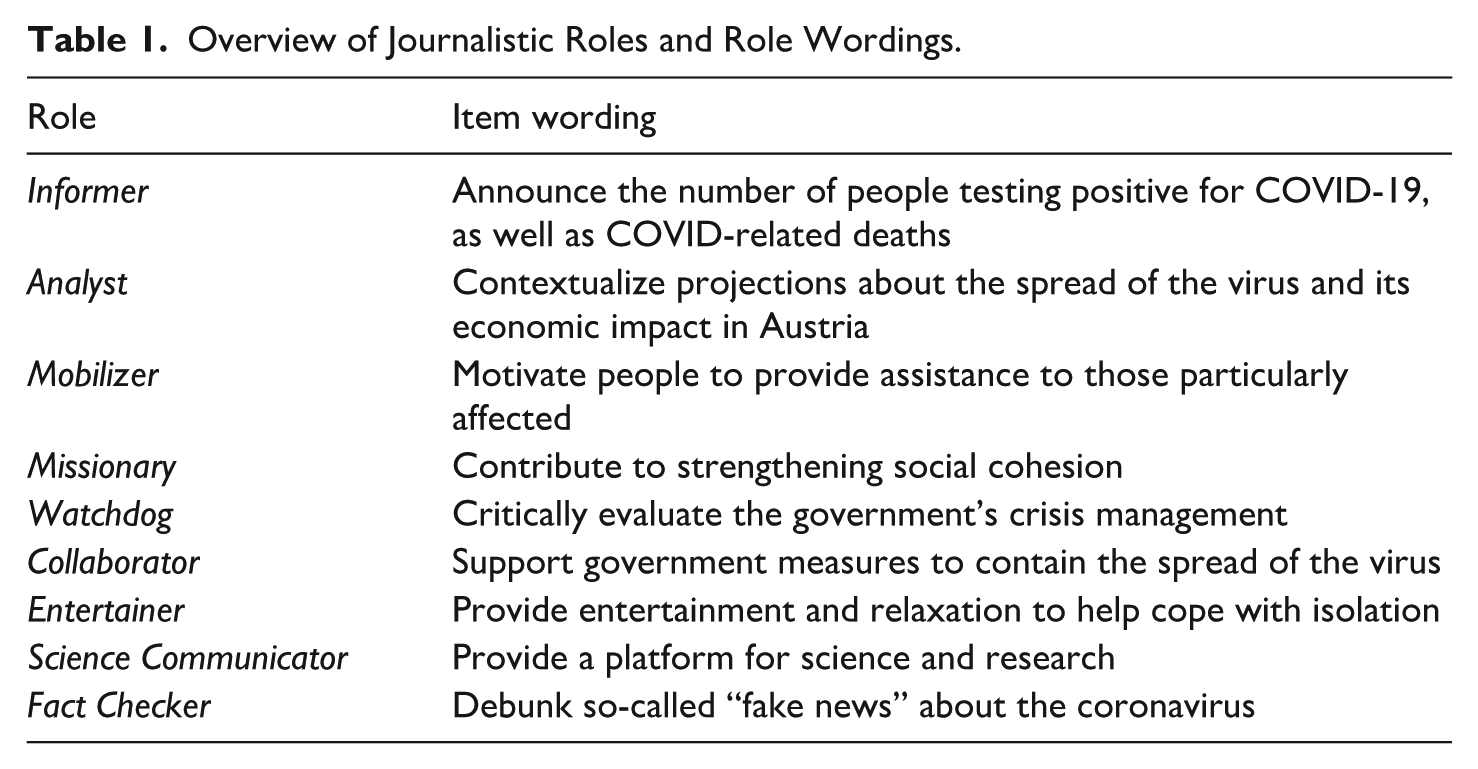
These three waves contained a novel battery to measure audience expectations toward journalism during the pandemic. The item wordings are loosely inspired by items used in the second wave of the Worlds of Journalism Study (Hanitzsch et al. 2019) and adapted to fit the COVID-19 pandemic context. Expectations toward the nine journalistic roles – Informer, Analyst, Mobilizer, Missionary, Watchdog, Collaborator, Entertainer, Science Communicator, and Fact Checker – were operationalized as a single question item, 2 and measured on scale from 1 (“extremely important”) to 5 (“unimportant”) (see Table 1 for translated item wordings). The values were reverse-coded and standardized to a 0–1 scale for interpretability.
Overview of Journalistic Roles and Role Wordings.
Independent Variables
The first set of independent variables corresponds to key sociodemographic variables, such as gender (0/1; 1 = “male”), level of formal education (0/1; having a university-qualifying degree) and age (16–75).
For media parameters, we first ask how often participants read about political events during the previous week in different types of news sources on a scale from “several times a day” (= 5) to “not at all” (= 1). The individual news outlets were grouped into three categories: (1) quality news (i.e., different broadsheet newspapers or the public broadcaster), (2) commercial news (i.e., different tabloids or commercial television broadcasts), and (3) social media platforms. For each respondent, we selected the media outlet they used most frequently in each category and recorded its corresponding usage frequency value. To measure trust in the media, we relied on a proxy measure available in the survey. Specifically, we used a regularly fielded item capturing trust in Austria’s public broadcaster Österreichischer Rundfunk (ORF), which forms part of a broader battery on trust in political and societal institutions. Responses were recorded on an eleven-point scale ranging from “no trust at all” (= 0) to “a lot of trust” (= 10). 3
Participants were asked about their political attitudes in a set of political parameters, such as ideology (“left” = 0 to “right” = 10). To capture ideological extremism, we first centered the scale around the midpoint (5; moderate), taking the absolute distance from the center, and then squared this value. This results in a measure ranging from 0 (moderate) to 25 (left and right extreme). As trust in institutions played an integral role in forming COVID-19 perceptions and related behaviors, trust in government and science as democratic institutions was also measured (“no trust at all” = 0 to “much trust” = 10).
The final set of parameters accounted for attitudes toward the COVID-19 crisis. Participants were asked about their support for government containment measures to address the novel coronavirus in terms of the adequacy (“not at all adequate” = 1 to “too extreme” = 5) and effectiveness of the policies (“not effective at all” = 1 to “very effective” = 5). Adequacy was folded, then combined with effectiveness of policies, and averaged to form an index suggesting support for government measures (Cronbach’s α = .73). Conspiracy beliefs were measured using the level of agreement with four statements (e.g., “the coronavirus is a bioweapon intentionally designed to harm humans”; “certain that this is false” = 1 to “certain that this is true” = 5; Cronbach’s α = .90), and individuals were asked for their personal health risk perceptions (“very low” = 1 to “very high” = 5).
Analysis
We start by descriptively examining how expectations for each of the nine roles shifted in the aggregate across the three waves. Then, we conduct two separate sets of Ordinary Least Squares (OLS) regression analyses. The first analyses are static cross-sectional models for each role that use pooled data across all three waves to identify overall factors associated with audience expectations during the first year of the pandemic. In the second set, dynamic models were employed to explain shifts in expectations between the waves. For this, wherever possible, we transformed the dependent and independent variables to measure change from one wave to the next (i.e., Wave 1 to Wave 2; Wave 2 to Wave 3). 4 To ensure consistency in interpretation, all variables were standardized to a 0–1 scale.
Results
Overall, audiences maintained moderately high expectations toward all nine of the journalistic roles with some expectations forming linear trends, while others followed a “v-shaped” pattern over time, peaking during periods of acute crisis and declining when the situation appeared more stable (see Figure 1). Beginning with the service roles (Hallin et al., 2023), the Informer – responsible for sharing pandemic metrics like infection rates and death counts – and the Analyst – offering forecasts and assessments of the pandemic’s trajectory – received the lowest levels of support (M = 0.67, standard deviation [SD] = 0.26 and M = 0.68, SD = 0.23, respectively). Notably, support for the Informer declined steadily over the year, while the Analyst re-stabilized after an initial decrease. Social action and participation roles – the Mobilizer, which encourages public involvement, and the Missionary, which fosters social cohesion – garnered slightly higher support (M = 0.72, SD = 0.22 and M = 0.72, SD = 0.23, respectively). The interventionist and facilitator roles saw divergent trends: support for the Watchdog, emphasizing government scrutiny, steadily increased (M = 0.72, SD = 0.23), while support for the Collaborator, encouraging public compliance with government actions, sharply declined (M = 0.71, SD = 0.25). The Entertainer did not receive markedly different support than the other roles (M = 0.69, SD = 0.23). Finally, the Science Communicator (M = 0.75, SD = 0.22) and the Fact Checker (M = 0.81, SD = 0.24) emerged as the most prominent roles throughout the pandemic.
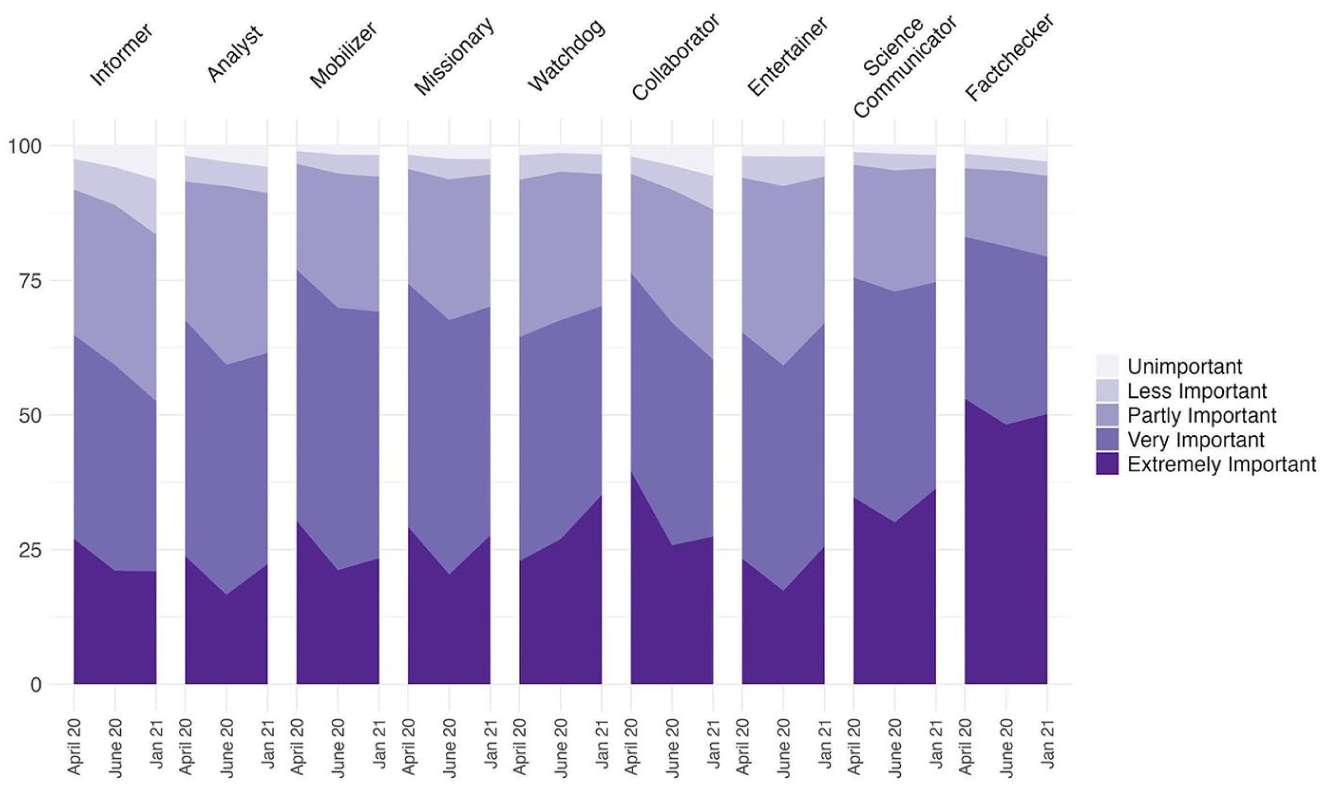
Changes in the importance of journalistic roles over time.
Correlates of Audience Expectations in Times of Crisis
To understand audience expectations toward journalists and how media, political, and crisis-related attitudes shaped these expectations during the first year of the pandemic, we first ran a pooled regression model over all three waves (see Figure 2 below and Table A1 in the Supplemental Material). Starting with sociodemographic factors, we observe limited patterns. Older respondents show higher support for the Missionary, Science Communicator, and both the Watchdog and Collaborator roles. Education also shows minimal influence, although respondents with higher levels of education tend to have greater expectations for the Watchdog and Science Communicator roles, whereas those with lower education levels exhibit higher expectations for the Mobilizer and Entertainer roles. Lastly, female respondents consistently report lower expectations for all journalistic roles.
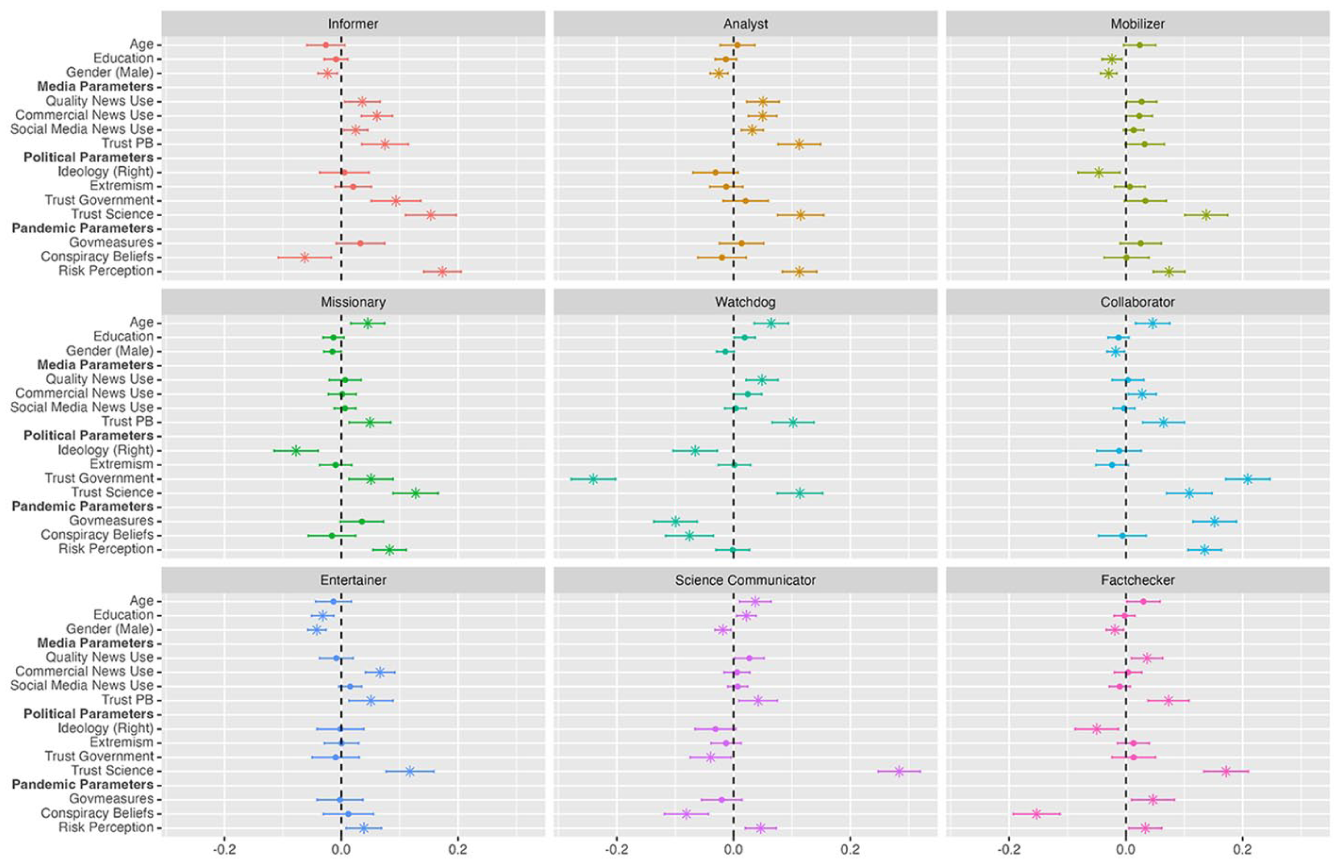
Static model of predictors of audience expectations toward journalists in times of crises (OLS).
For media-related variables, results showed that participants who consume political news – irrespective of the news source – have notably high and consistent expectations toward the primary functions of journalism, such as the Informer concerning information related to caseloads and deaths, and the Analyst. Other types of news consumption aligned with theoretical expectations in that commercial news consumers expected more Entertainment, while quality news consumers desired more Watchdog coverage of the government’s handling of the crisis, Science Communication, and Fact Checking against misinformation. Trust in the public broadcaster – our proxy measure for media trust – positively correlates with all the audience expectations excluding the Mobilizer, which barely misses statistical significance and is among the most robust predictors of audience expectations in our models.
When it comes to political attitudes, individuals with right-leaning views generally rated several journalistic roles less favorably. They showed low regard for the Mobilizer, where journalists encourage protection of vulnerable groups; Missionary, which advocates for social cohesion; the Watchdog, which ensures checks and balances; and the Fact Checker. Notably, ideological extremism did not have any significant impact on these attitudes. In contrast, trust in government was associated with higher expectations for roles like the Informer, Missionary, and especially the Collaborator, suggesting a preference for journalism that aligns with government efforts and community support. Greater trust in government corresponded with lower favorability toward the Watchdog and Science Communicator roles. This could imply that individuals with high trust in government viewed these roles as potentially disruptive or overly critical, especially given the central role of government messaging during the pandemic response. Lastly, trust in science emerged as a consistently positive and significant predictor across all roles, underscoring journalism’s critical role as a conduit for science communication during the crisis even beyond the role of the Science Communicator.
The final set of variables examined crisis-specific attitudes and perceptions. Similar to trust in government, support for government measures addressing COVID-19 was associated with a clear divide: those supporting containment measures showed lower support for the Watchdog, and higher expectations for the Collaborator and the Fact Checker. Additionally, belief in COVID-19 conspiracies was positively correlated with support for the Entertainer, and negatively correlated with support for Informer, Science Communicator, and Fact Checker. However, belief in conspiracy theories does not correlate with higher expectations for checks and balances. This may be because individuals view journalists as part of the conspiracy and therefore unsuitable to fulfill the Watchdog role. Finally, individuals with higher perceptions of personal risk strongly supported nearly all journalistic roles, except for the Fact Checker, which narrowly missed conventional levels of statistical significance, and the Watchdog. This may reflect more of an alignment with government efforts to curb the virus rather than a rejection of the Watchdog’s normative role to provide checks and balances.
While the static model offers a foundational understanding of the correlations between sociodemographic, media, political, and crisis parameters with audience expectations, it does not consider how these relationships evolved over time. To address this, we turn to the dynamic models that focus on changes between waves. By examining how shifts in attitudes and beliefs correspond to changes in expectations, the dynamic models provide a more nuanced view of how public perceptions of journalistic roles adapt in response to the evolving context of the expectations in times of crisis (see Figure 3 below and Table A2 in the Supplemental Material).
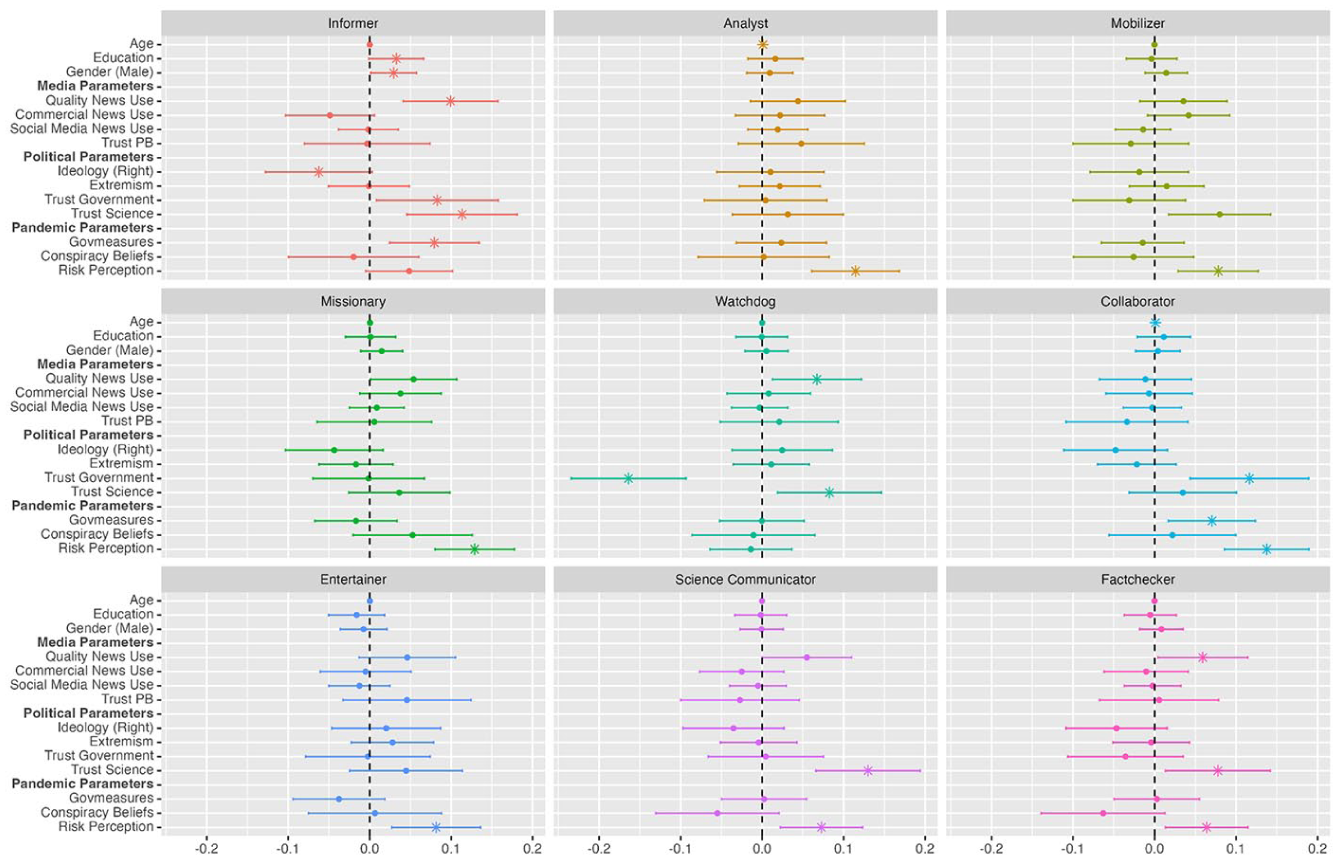
Dynamic model of predictors of audience expectations toward journalists in times of crises (OLS).
First, the Informer, who has lost importance over the course of the crisis, seems to have lost its appeal among lower educated and female respondents. Further shifts coincide with respondents who shifted toward the right, decreased quality news consumption, lost trust in government and science, and lowered their support of government measures. While there is some indication that the importance of the Informer also lost its importance among audiences that increased their commercial news consumption, effects fail to reach conventional levels of statistical significance.
Changes in the importance of roles that have a pronounced “v-shape” over the first year of the pandemic (see Figure 1), such as the Analyst, Missionary and Entertainer – which decreased in importance during the “calm” summer (i.e., June 2020) and increased again during the third “lockdown” – seem to have been driven by changes in the personal health risk perceptions of respondents, as well as older individuals in the case of the Analyst. Thus, respondents who perceived an increasing personal health risk expressed a growing demand for reporting that forecasted the viral spread and economic impacts in Austria, fostered social cohesion, and provided entertainment to cope with isolation. While the previous analysis has shown that the Mobilizer is perceived as more important by left-leaning audiences, those trusting in science, and those at higher perceived health risk, the decrease in importance of the Mobilizer over time seems best explained by decreasing perceived personal health risk, decreasing trust in science, and increasing conspiracy beliefs.
Notably, increased support for the Watchdog over the first year of the pandemic appears to be driven by two distinct groups: (i) those who consume more quality news and place greater trust in science and (ii) those who have lost trust in government. Importantly, this shift does not stem from changes in support for government measures. This indicates that the rising support for the Watchdog is not primarily a response to skepticism regarding COVID-19 mitigation efforts or distrust of mainstream narratives about the pandemic. Instead, it highlights a growing demand for enhanced government oversight among individuals who are critical of government actions, alongside a separate group that increasingly trusts the solutions and insights provided by scientists and researchers. This dual dynamic suggests a nuanced landscape of public perception, where calls for accountability coexist with a commitment to scientific expertise.
Conversely, the significant decline in support for the Collaborator role appears to be driven by four key factors: (i) age, (ii) decreasing trust in government, (iii) diminishing support for government measures, and (iv) reduced perceptions of the COVID-19 health risks. Together, these factors indicate a broader shift in public sentiment, where trust in institutions and the perceived urgency of the pandemic – possibly owing to age indicating higher vulnerability – directly influence expectations of journalism in promoting cooperation with the government authorities in times of crisis.
Finally, the more nuanced roles of Science Communicator and Fact Checker share largely similar drivers: namely, trust in science and higher personal health risk perceptions. This may indicate audiences who wanted a larger platform for scientific expertise and verification of potential misinformation. Expectations for the Fact Checker were also spurred by quality news use, suggesting audience-maintained expectations for correct information – a similar tendency that is also observed for the Science Communicator.
To test the robustness of our findings, we performed additional analyses using alternative imputation methods and model specifications. Full details are provided in Figure B1 and Tables B1–B5 in the Supplemental Material.
Discussion and Conclusion
As the most recent global health crisis, the COVID-19 pandemic had a profound effect on audiences’ attitudes toward various societal institutions, but fundamentally and perhaps most consequentially the media (Hallin et al. 2023). The media – and in particular journalistic media – was the primary means by which audiences came to understand and react to the pandemic (Pennycook et al. 2022). To examine audience expectations toward journalism in a crisis, understanding journalism as a discursive institution allows us to assess how journalists and audiences negotiate journalism’s place in society and its boundaries (Hanitzsch and Vos 2017). Our study investigated how audience expectations toward journalism evolved during the first year of the COVID-19 pandemic in Austria and has identified individual-level factors contributing to these shifts.
Our longitudinal data reveal two intertwined patterns. First, six roles – the Analyst, Missionary, Mobilizer, Entertainer, Science Communicator, and Fact Checker – follow a “v-shaped” cycle: public support peaked during acute phases of the pandemic, receded when the situation seemed under control, and rose again during the third country-wide lockdown. This cycle suggests that audiences recalibrate their needs – explanation, cohesion, participation, relief, and expert guidance – with the urgency of the crisis.
Second, three roles resist that cycle and their trajectories sharpen when viewed through audience characteristics. Support for the Informer eroded steadily, a pattern best explained by declining news use and possibly growing information fatigue as pandemic-related reporting became normalized, as described in other studies (e.g., Wiedicke et al. 2023). By contrast, support for the Watchdog rose while the Collaborator fell, mirroring the waning “rally-around-the-flag” effect as the initial shock of the pandemic was gradually overcome. Political attitudes influence this dynamic: respondents who have lost trust in the government, disagree with the containment measures, and perceive low health risks from the virus reject the Collaborator. The increasing support for the Watchdog, however, is driven both by decreasing trust in the government, increasing support for science, and an increase in quality news use. These opposing movements underscore the conceptual tension between collaboration and scrutiny highlighted by Skovsgaard et al. (2024). At the crisis’s outset, high government trust and a pronounced crisis mentality encouraged some audiences to treat journalism as an ally of public health authorities, but within months, the same audiences recalibrated to demand journalism’s normative oversight mandate; a function that may have felt unfitting in the emergent phase of the pandemic (Heiselberg and Rønlev 2025). In that sense, the public acted as a “discursive agent” (Hanitzsch and Vos 2017), aiming to (re-)shape journalism’s societal role from facilitation back to scrutiny when the crisis normalized.
While earlier research has shown that audience expectations are influenced by citizens’ perceptions of institutions beyond journalism, especially political ones (Riedl and Eberl 2022), our study highlights that perceptions of other institutions, such as – in this specific crisis context – science and research, can also play a crucial role. The consistently high expectations for the Fact Checker and Science Communicator point to an emerging layer of specialized authority that newsrooms are expected to supply during crises. Fact-checking counters high-stakes mis- and disinformation (Levy et al. 2021), while science communication satisfies a need for comprehension of rapidly evolving knowledge – sentiments documented in other crises such as climate change (Maier et al. 2016; Nicolaisen 2022). This underscores the need for journalism to reflect on its established – though potentially shifting – ties to institutions, while forging new ones when addressing developing crises. At the same time, it reveals the inherent limits of journalism’s ability to maintain an effective relationship with audiences independently.
Finally, our dynamic models also confirm that shifts in perceived health risk are the most consistent driver of the “v-shaped” dynamics. Expectations for many roles dipped in the 2020 summer lull with lower risk salience (June 2020). As the infection rates surged again, growing risk salience reversed the trend (i.e., January 2021). Journalism’s relevance in prolonged crises, therefore, hinges on two factors: (i) its ability to track – and rapidly adapt to – changes in external threat environments and (ii) its ability to respond to the public’s trust landscape, which remains closely tied to the enduring normative expectation that journalism serves as a Watchdog, even in crises.
As with any research, our study has limitations. First, it focuses exclusively on expectations of journalistic roles without assessing how audiences judged performance. Expectations provide insight into normative beliefs about journalism, yet they do not reveal whether people felt those expectations were met. This choice reflects space constraints in an interdisciplinary omnibus survey. Future work should pair expectation items with performance evaluations (see Fawzi and Mothes 2020).
Second, also in other respects, our measurement strategy was necessarily selective. We operationalized only nine journalistic roles, used a single-item proxy for media trust, and gauged news diets through coarse aggregate frequency indicators. These confine our conclusions to a restricted set of constructs. While more recent research has challenged long-held assumptions about the limited validity of single-item measures (Allen et al. 2022), future studies should aim to validate findings in the field of audience expectations of journalism by employing multi-item scales – particularly for constructs such as trust – and by disaggregating media exposure to better capture the nuances of the relationships reported here. This also applies to our measurement of role expectations. While single-item role measures may yield relatively consistent interpretations among journalists who share a professional worldview, this assumption is less tenable for audience respondents. This is particularly true for roles like the Missionary, where the pandemic-specific “tailoring” introduced a normative dimension that could have been interpreted in different ways. Qualitative research could offer valuable insights into the meanings audiences ascribe to expectations of journalistic roles.
Third, the findings derive from Austria: a country whose media, political, and pandemic contexts are distinctive. These characteristics likely shaped how, for example, institutional trust, media use, and political contestation influenced audience expectations of journalism – and may have produced dynamics that differ from those in other national settings. Conversely, global crises such as the COVID-19 pandemic can create moments of convergence across otherwise diverse media systems. In the early stages, the acute demand for reliable information and orientation may have aligned audience expectations across countries, even where structural media conditions vary (Van Aelst et al. 2021). It is therefore plausible that some of the shifts observed in our study – such as the temporary rise of collaborative expectations or the growing salience of science communication and fact-checking – reflect more generalizable audience responses to systemic uncertainty. Nonetheless, to assess the scope conditions and external validity of these findings, comparative research is needed.
Overall, our findings portray audience expectations of journalism as context-dependent and highly volatile in the short term, with shifting demands aligning with broader societal changes. This volatility, especially when compared to the relative stability of journalists’ roles (Willnat et al. 2024), can be theoretically explained by journalists’ ongoing processes of appropriating and (re)creating professional norms through their daily work (Hanitzsch and Vos 2017), whereas audiences might engage with journalism more sporadically and superficially. Assuming that changes to journalism’s institutional logic require sustained momentum in a consistent direction, the volatility of audience expectations thus also points to the limits of their ability to effectively shift journalism’s boundaries.
Lastly, our findings raise questions about how audiences interpret journalistic roles and norms and how such interpretations diverge from institutional and scholarly understandings. While audiences may abstractly support a wide range of journalistic roles (Loosen et al. 2020; Vos et al. 2019), their evaluations can differ significantly when faced with what the enactment of certain roles might mean in a specific case and context. Abstract institutional roles can be interpreted in various ways, and specific measurements can reveal that audiences may have an even less coherent understanding of how media performance adhering to various roles appears in practice than media practitioners (and journalism scholars) may hold. Collectively, our study highlights the delicate challenge of balancing diverse audience expectations and institutional demands in dynamic times while ensuring that journalism remains true to its democratic role in future global and national crises.
Supplemental Material
sj-docx-1-hij-10.1177_19401612251375203 – Supplemental material for Rally and Recalibrate: Political Dynamics of Audience Expectations of Journalism During Times of Crisis
Supplemental material, sj-docx-1-hij-10.1177_19401612251375203 for Rally and Recalibrate: Political Dynamics of Audience Expectations of Journalism During Times of Crisis by Claire Roney, Daniel Wiesner, Andreas A. Riedl and Jakob-Moritz Eberl in The International Journal of Press/Politics
Footnotes
Acknowledgements
We would like to thank Kim Andersen and other participants at the 10th Annual Conference of the International Journal of Press/Politics for their valuable comments on the first draft presentation of this study. Finally, we thank the anonymous reviewers whose constructive feedback during the publication process encouraged us to critically reflect on and further strengthen this manuscript.

Funding
The authors disclosed receipt of the following financial support for the research, authorship, and/or publication of this article: The data collection of the Austrian Corona Panel Project was made possible by the COVID-19 Rapid Response Grant EI-COV20-006 of the Wiener Wissenschafts- und Technologiefonds, financial support from the Rectorate of the University of Vienna, and funding by the FWF Austrian Science Fund (P33907). Further funding from the Austrian Social Survey (SSÖ), the Vienna Chamber of Labour (Arbeiterkammer Wien), the Federation of Austrian Industries (Industriellenvereinigung), and the Austrian Academy of Sciences (ÖAW) is gratefully acknowledged. In addition, three survey waves have been funded by the “Work and Corona Project” which is financed by the digifonds of the Vienna Chamber of Labor.
Declaration of Conflicting Interests
The authors declared no potential conflicts of interest with respect to the research, authorship, and/or publication of this article.
Supplemental Material
Supplemental material for this article is available online.
Notes
Author Biographies
References
Supplementary Material
Please find the following supplemental material available below.
For Open Access articles published under a Creative Commons License, all supplemental material carries the same license as the article it is associated with.
For non-Open Access articles published, all supplemental material carries a non-exclusive license, and permission requests for re-use of supplemental material or any part of supplemental material shall be sent directly to the copyright owner as specified in the copyright notice associated with the article.
