



Abstract
This article explores the interactions between journalistic actors and emerging open-source intelligence and investigation (OSINT) communities. It employs qualitative content analysis of discourse from two OSINT communities surrounding three events following the Russian invasion of Ukraine in 2022, which received substantial coverage in news media. OSINT practices are rapidly becoming a mainstay of the contemporary political process by allowing ordinary citizens to verify information shared through digital platforms, which is traditionally the societal task assigned to journalism. In doing so, they provide a timely factual baseline for opinion formation and political decision-making. This research explores the role constellations resulting from this shift in verification duties from journalistic actors to amateur online communities on digital platforms and maps the fundamental dynamics involved in OSINT. We analyze how information is received and processed in OSINT communities, how digital platforms facilitate the fact-checking process, and how journalism and OSINT interact. Based on our findings, we develop a theoretical framework that distinguishes between the input, throughput, and output phases of OSINT. Our model contributes to a baseline understanding of the crucial and novel partnership between citizens and journalists on digital platforms.
Introduction
Journalism has traditionally played a central role in facilitating political interaction. Alarmed by attempts at manipulative control over information, the political theorist Hannah Arendt described journalism’s function as one of stabilization, that is, providing “our bearings in the real world” by filtering, verifying, and condensing factual information before making it available to serve as the foundation for political discourse (Arendt, 1967/2006: 253). Political life, she argued, depends on the ability to distinguish “between fact and fiction (i.e., the reality of experience) and [. . .] between true and false (i.e., the standards of thought)” (Arendt, 1951/2017: 622). In this reading, maintaining the ability to make this distinction has always been an uphill battle since lying or disinformation, that is, the deceitful misrepresentation of facts, possesses an inherent advantage over truthful communication due to its a priori knowledge of audiences’ preferences, fears, and weaknesses (Arendt, 1971/1972).
The rise of digital platforms as intermediaries of (political) information and discourse challenges the journalistic prerogative of verifying common knowledge. The proliferation of platforms poses a twofold threat to established ways of political interaction and journalism’s role of verification. First, citizens connected to smart devices provide a constant near-live feed of events. This exceeds the capacity of even the most well-funded and equipped journalistic institutions to discern valid from false information, upending established roles and responsibilities. Second, the content algorithms’ orientation to audiences’ preferences allows malicious actors to weaponize digital communication platforms to spread mis- and disinformation by drawing on platforms’ amplification of controversial or divisive content.
Digital platforms, however, have also provided space for new verification actors to disassemble and contest falsehoods using novel strategies, tools, and collaborations (Hermida 2012). Among them are citizen-led initiatives practicing open-source intelligence and investigation (OSINT 1 ), which means verifying information and assembling narratives through the combinatorial processing of freely available data (Fuller and Weizman 2021). OSINT communities, often tens of thousands strong, take on the substantial task of processing, and validating open information to enable journalistic output 2 and archiving findings to support future reference, including during legal proceedings 3 (Murray et al. 2022). There is a large variety of OSINT practitioners in the digital public sphere—including units dedicated to parsing open sources within established news media, for example, the NYT’s Visual Investigations Team, new mission-driven investigative journalistic outlets subscribing to open sources practices, such as Bellingcat, and various amateur communities. However, our knowledge of their utilization of digital platforms and interactions with journalism throughout their verification processes is limited.
This study explores the interactions between OSINT communities and journalistic actors based on a qualitative content analysis of the discussions on the Discord servers of two prominent OSINT communities, Bellingcat and Project Owl, around three key events during the Russo-Ukrainian War. We focused on the early phase of the Russian invasion of Ukraine in 2022 (the world’s first “networked war” 4 ) due to the massive online surplus of first-hand accounts, documentation, and war recordings, in combination with strategic political communication, that inevitably increases the risk of false information spreading and, thus, the necessity of verification (Horbyk 2022; Khaldarova and Pantti 2016). While conflict leads to increased press coverage and OSINT activity, 5 it does not necessarily change how OSINT communities function. Instead, it generates well-defined episodes of activity involving all actors relevant to our analysis.
This research has three main contributions. First, we give a detailed insight into the working processes and routines of OSINT communities in their attempt to process and verify information during high-profile events. This helps to understand how digital platforms enable and complicate verification efforts in a digital public sphere. Second, we shed light on interactions between OSINT communities and other actors, including journalistic media. Third, we develop a theoretical model of the new division of epistemic labor between OSINT communities, private platform providers, and journalism. The results of this study allow us to imagine new collaborative forms of epistemic labor and how verification practices on digital platforms can battle the flood of unverified information. Based on these contributions, we propose themes for further research into this highly relevant topic.
OSINT Communities in the Digital Public Sphere
To situate OSINT communities in the context of a “networked public sphere” (Benkler 2006: 212) and better understand the role of digital platforms in enabling their activity, we adopt Keane’s (2011) concept of monitory democracy and the Dynamic Intermediation Model (D(X)IM; Ohme et al. 2022) as a conceptual lens. Monitory democracy derives from the concept of representative democracy. It is “defined by the rapid growth of many different kinds of extra-parliamentary, power-scrutinising mechanisms” (Keane 2011: 212) in society, such as NGOs, government watchdogs, or civic groups. New media technologies and digital networks are central in establishing such institutions, enabling them to continuously disrupt private and public spaces and uncover scandals or more severe violations, such as war crimes.
Traditionally, journalism had the supremacy to inform in its monitorial role (Christians et al. 2009: 139–57). It allowed citizens to monitor institutions and authorities (Esser and Neuberger 2019; Schudson 1998). However, due to the rise of digital platforms, journalistic actors can be bypassed by other actors in the public exchange of information (Bruns 2008, 2018). In the D(X)IM (Ohme et al. 2022), the role of journalistic actors on digital platforms is understood to intermediate communicative relationships between a speaker and a recipient, for example, as a moderator or verifier, who checks the source’s information and forwards it to recipients after verification. In this model, the structure of the networked public sphere (Benkler 2006; Friemel and Neuberger 2021) also allows for an immediate role change in platform communication: Previously, the “monitorial citizen” (Schudson 1998) monitored journalistic information; today, it is journalism that monitors what citizens do on digital platforms. As a recipient in one communicative act, citizens can become the source of information in a second instance. This results in dynamic role changes of epistemic actors on digital platforms and, thus, a recipient–source reversal.
With journalism lacking the resources to collect and validate the abundance of digital information efficiently, OSINT communities increasingly fulfill the monitory role traditionally attributed to journalism (Camaj 2021). Consequently, non-journalistic and citizen-based communities become part of the verification processes that count as core disciplines of journalism and underpin journalism’s epistemic authority (Zelizer 2004). The role of OSINT actors and their interactions with journalism on digital platforms must be re-examined.
Crowds and Journalism
Theoretically, we can describe the practice of OSINT communities in relation to other models of crowd–journalism interactions. We argue that community-led OSINT communities are a novel practice enabled by digital platforms. Aitamurto (2016, 2017), for example, proposes a gradient of community-based knowledge-finding methods in journalism ranging from no to complete journalistic control over the involvement of citizens in the knowledge process. On this scale, commons-based peer production without journalistic leadership (e.g., Wikipedia) and crowdsourcing, where the journalist “decides when, where, and how crowdsourcing happens” (Aitamurto 2017: 186; Lewis and Usher 2013) form opposite ends. Participatory and citizen-journalistic practices (Allan 2013; Nip 2006) lie between the poles. From an organizational perspective, self-organized online audiences and epistemic communities, such as OSINT communities, are predominantly independent of professional journalism and resemble commons-based peer production.
Some scholars classify OSINT as a subcategory of investigative journalism (Hauter 2021; McMahon 2021), whereas others locate community-driven OSINT relationally to journalism, describing it as “infusing [journalism with] open-source logics” (Müller and Wiik 2021: 12). This view sees journalism and OSINT as having “fluid boundaries” that frequently overlap and converge in the long term (Kotišová and Van Der Velden 2023; Reese and Chen 2022: 7), for example, journalists partaking in OSINT practices as well as professional journalism outlets having departments dedicated to OSINT, such as the NYT’s Visual Investigations team. Interviews with citizen OSINT analysts (Cochrane 2022; Reese and Chen 2022) and the organizers of more formalized OSINT collectives, such as Bellingcat and Syrian Archives (Müller and Wiik 2021), show that OSINT communities distance themselves from journalism by pointing to procedural differences as well as participating in different parts of knowledge production. OSINT communities take pride in their “[l]ogic of open-source methodology” (Reese and Chen 2022: 11), that is, the utterly transparent validation process—something they emphasize traditional journalism falls short of (Müller and Wiik 2021: 10, 14–15). Their openness and thorough analysis of different sources distinguish OSINT communities from conventional journalistic practices. Nonetheless, OSINT practitioners see the value of journalism in making the then-verified information about events available to the greater public by acting as “gate opener[s]” (Cochrane 2022: 37, 45; Müller and Wiik 2021: 18). OSINT outlets, such as Bellingcat, boasting a growing skill set and increasing professionalization tendencies, have evolved from commons-based peer production to citizen-journalistic organizations that collaborate with journalistic actors and publish the results of their OSINT practices through their own channels. In this sense, Bellingcat “occup[ies] an important niche space in this information ecosystem by acting as a verifier and interpreter of information for journalists, while professionalizing those techniques and promoting them to news consumers [. . .]” (Reese and Chen 2022: 9). However, the willingness to collaborate with journalistic outlets varies between OSINT communities (Cochrane 2022: 35; Reese and Chen 2022: 9), and interactions with journalistic actors and content throughout OSINT communities’ information verification processes have rarely been the subject of research.
Research Questions
To improve our understanding of the role constellation of OSINT communities and journalistic actors and how digital platform technologies enable these, we trace the communicative processes of OSINT and journalistic actors on digital platforms. For this reason, we conceptualize the public sphere as a process comparable to a dynamic network (Friemel and Neuberger 2021). Instead of modeling the entire process, we focus on three different phases—input, throughput, and output—in the communicative process of verification by OSINT communities (Neidhardt 1994). We interpret these as capturing the ways: (1) issues and opinions of a multitude of actors are collected (input), (2) processed—that is, negotiated, discarded, discussed, and reshaped—in the throughput-phase, and (3) passed on to the public as opinion or consensus (output). We further pay particular attention to how digital platforms shape the communication process by setting the institutional order, that is, how they mediate knowledge creation (Ohme et al. 2022). Equipped with this theoretical framework, we ask:
RQ1 How do OSINT communities rely on digital platforms to connect and coordinate in the digital public sphere?
RQ2 How do OSINT communities interact with journalistic actors and content on digital platforms?
Method
We followed an instrumental approach to case selection to explore in-depth how OSINT communities draw on digital platforms to facilitate their practice and interactions with journalistic actors (Stake 1995). We selected two of the largest online OSINT communities with varying forms of crowd-based knowledge production (Aitamurto 2017): (1) Project Owl (>31.000 6 members; PO) is a major OSINT community that grew organically from a gathering of likeminded users and resembles commons-based peer production; and (2) Bellingcat (>11,000 members; BC) is hosted by an organization resembling a professionalized citizen journalism approach to crowd knowledge production that frequently collaborates with new media. 7
PO and BC provide dedicated spaces for their communities to interact on Discord, a platform provider. They share a strong sense of community and purpose around conducting research and dismantling narratives spread through social or traditional media. Their membership is multinational and politically diverse, though there is a general tendency toward an apolitical and unbiased observer role. 5 Despite some high-level analytics about geographic location, the membership is anonymous. What differentiates the two communities is their institutional context. PO is a non-commercial grassroots community that was initiated in 2018 and underwent multiple name and management changes. It is discoverable and accessible, with its administrator describing it as “the first point of contact for the greater OSINT community.” 8 A Bellingcat staff member created the BC server as an educational and collaborative space. Its original aim was to “[teach] more and more people how to do open-source.” 9 Selecting two communities with shared aims but different contexts (fully community-owned vs aligned with a journalistic organization) provided a contrast that allowed us to investigate the self-organization of OSINT communities on digital platforms and their interactions with journalism.
Within the case study approach, we investigated the role of digital platforms and OSINT communities’ interactions with journalism using qualitative content analysis of the OSINT communities’ designated Discord servers, which we understood as windows into their central communication and verification space. We determined three narratively disputed and controversially debated events during the early stages of the Russian invasion of Ukraine in 2022 that had invoked OSINT practices, which, in turn, had been picked up and reported on by different journalistic outlets (Table 1). By choosing events for which we had access to both the journalistic output and the corresponding discussions on the community platform, we could trace the OSINT process on the Discord servers, covering the input, throughput, and output of information. In summary, our methodological approach involved (1) identifying the target communities, (2) identifying cases of journalism–OSINT interaction, (3) delineating relevant timeframes, (4) iterative collaborative qualitative coding of discussion threads in each of the communities, and (5) interpreting the findings.
Analyzed Events.
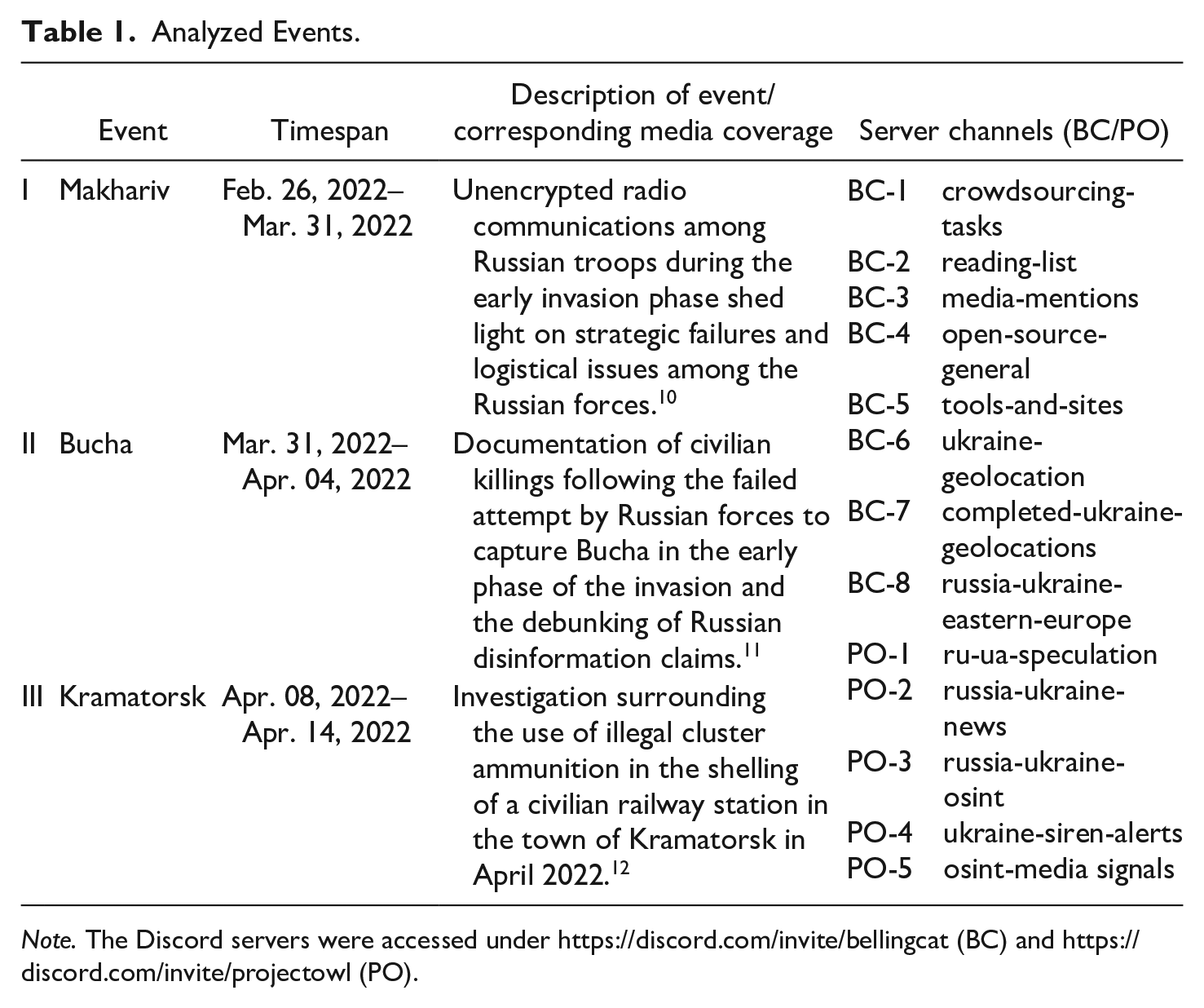
Note. The Discord servers were accessed under https://discord.com/invite/bellingcat (BC) and https://discord.com/invite/projectowl (PO).
Data Source
Discord is a social platform originally popularized in the gaming community, which offers various community governance mechanisms, such as customized bots, a granular channel structure and invitation-only private communities. It has expanded to host numerous other “online-first” communities, including on topics such as cryptocurrency or politics (Robinson 2022). Discord’s extensive “auto-moderation” and scripting features allow communities to self-govern even large member counts without excessive demands for personnel. Despite being promoted as a community-centric experience, Discord communities called “servers” are organized according to a strict top-down structure along the “owner-administrator-moderator-user hierarchy” (Robinson 2022: 6). Both Discord servers in this analysis were open to the public during data collection between May and July 2022. The message history of the channels deemed relevant during the periods was exported to PDF and subsequently loaded into the MaxQDA environment for collaborative coding by two of the three authors. 13 Figure 1 shows an example of the PO server’s Discord interface and channel structure.
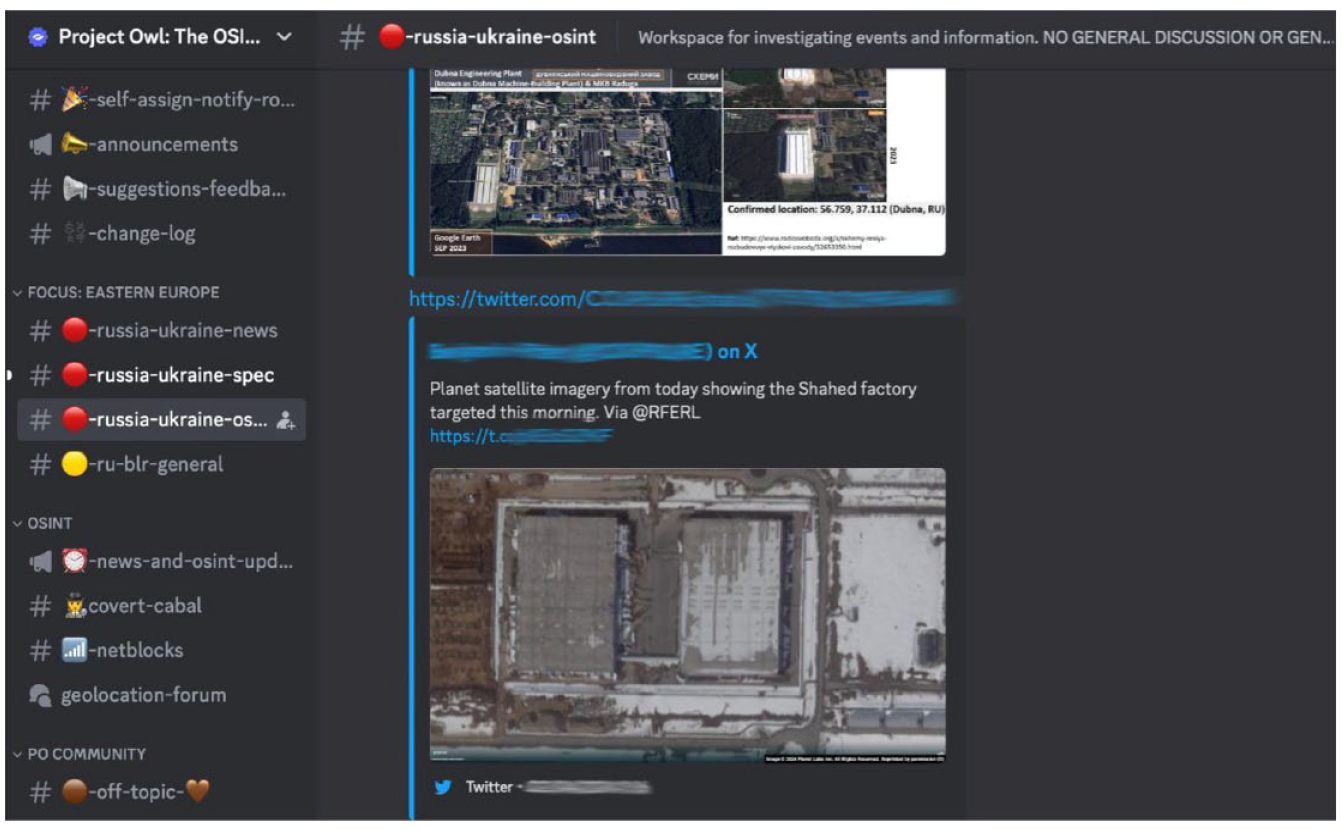
Screenshot of the PO Discord server.
Analysis
The qualitative content analysis of the respective OSINT communities’ discussions followed the “directed content analysis” approach (Hsieh and Shannon 2005), that is, building a theory-driven coding scheme and further refining it during multiple rounds of coding and subsequent discussion. The coding scheme rested on the assumption that OSINT communities on digital social media platforms, such as Discord, operate as funnels for information by collecting, processing, and validating “scraps of information” about a given event, which can then be “compiled into systems, including narrative structures” by journalistic actors (Fuller and Weizman 2021: 5). The analyzed events were discussed in both communities and were explicitly mentioned in the corresponding media coverage (Table 1). We assumed that studying the discourse among OSINT actors in situ, without researcher intervention, would result in data representing the “activity” of OSINT practice. This qualitative research aimed to identify (1) how OSINT communities self-organize using digital platforms and (2) how they interact with journalists and journalistic content on digital platforms.
In the initial analysis phase, overarching codes were determined to capture the temporal phases of information flow based on an existing understanding of communicative interaction between journalistic actors and the public in digital spaces. Then, a set period (during the last week of March 2022) was coded by two researchers using exploratory “activity coding”, a technique that involves applying codes corresponding to the gerunds of the processes and activities taking place in the data, for example, discussing, investigating, and geolocating (Saldaña 2013: 96). The resulting codes were assigned to the theoretical input, throughput, output, and institutional order stages and compared among the researchers. After collaboratively refining the coding scheme by iterative axial coding (Saldaña 2013: 218) and reducing the broad descriptive codes into salient themes until agreement was reached, a final coding scheme (see Supplemental Information file, Appendix A) was applied to discussions surrounding the three events during the specified timeframes (Table 1) across both communities. The emergent findings were collaboratively interpreted and discussed.
Results
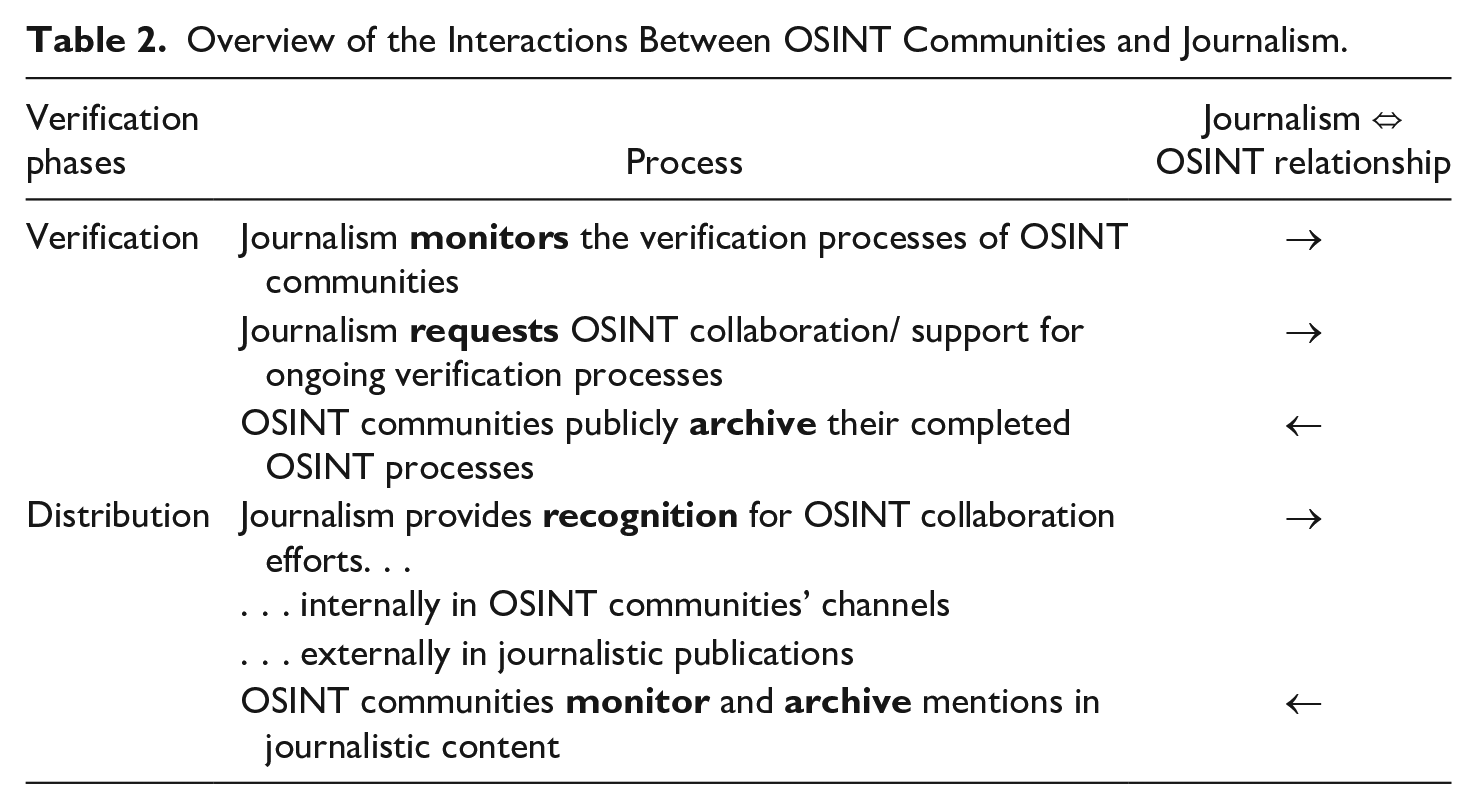
The following section deals with the emergent themes relevant to how OSINT communities rely on digital platforms to connect and coordinate in the digital public sphere (RQ1) and how they interact with journalistic actors and content on digital platforms (RQ2). Based on the central themes that emerged from the data (summarized in Table 2), we propose an exploratory model of the dynamic interactions that integrates our findings with our understanding of OSINT communities and journalism as verifying actors in the networked digital public sphere.
Overview of the Interactions Between OSINT Communities and Journalism.
Digital Platforms as Informational Ecosystems
The results suggest that digital platforms, in this case Discord, are both the where and the how of OSINT communities (RQ1). They are integral to how (1) information flows throughout the OSINT verification process and (2) how OSINT communities self-organize.
Information Flows
Digital platforms (Discord) enabled a heightened informational interconnectedness with other digital platforms and actors in all stages of the OSINT verification process. Focusing on the informational input, the sources leveraged by both communities during the OSINT cycle varied highly—with the thematically dedicated channels on the server serving as chronological registers of inflowing information. Members introduced audiovisual content to the server from social media, including Twitter, Telegram, and YouTube, as well as from government websites and other web resources. Depending on the context of the source (e.g., a social media personality’s reputation or websites known for spreading disinformation), such introductions were directly annotated or commented to include additional information, for example, disclaimers about the source’s trustworthiness or requests for OSINT services such as geolocation. There also seemed to be a consensus among community members that information surfacing on Twitter and in private Telegram channels was unfiltered or raw and required cautionary treatment. Then, the community (or, in some instances, the automatic moderation system on the PO server) attached additional context to the incoming information. Content, for example, satellite imagery, was also occasionally introduced directly without accompanying information about the source. The embedding of content from other digital platforms, primarily social media, into a contextualized stream of inflowing information was the main form of input in the observed OSINT communities.
At other points, chains of platforms were used to live stream content, for example, using the gaming-related platform Twitch to distribute real-time analogue radio cuttings to the community while simultaneously translating the ongoing situation. One user introduced such content with the description: “live radio interception and translation sounds like a dead body cleanup operation is in place by the Russians” (BC user; I. event). Personal sources, that is, community members claiming to be in direct contact with individuals in Ukraine whose information was relayed to the community, also featured among data sources in both communities. One user, for example, claimed a Ukrainian soldier had “sen[t] a bunch of unseen combat footage” (PO user; II. event). However, content frequently flowed through an external platform before being processed by the OSINT communities in this analysis.
During the OSINT process (throughput), information from the various sources was combined or assembled by drawing on the functionality of external platforms or services, such as Google Maps, to obtain satellite imagery for geolocation. External productivity apps, such as Google Sheets or Trello, were also used to organize, coordinate, and track specific OSINT processes. In contrast, some services, such as automated translation, were built directly into the Discord infrastructure. In the case of live streaming radio cuttings (I. event), where the knowledge required to analyze the existing material was not commonly available among the community members, other external OSINT communities were incorporated to assist with the processing. Another functionality was automatically translating non-English content into English through an external translation service. This frequently used feature illustrates how Discord OSINT communities sit at the center of a configuration of platforms that serve as sources or services.
External validation concerning the output of completed OSINT verification processes through digital platforms was also purposefully set up in some instances of the OSINT communities, with users being prompted to submit finalized geolocation output to a map service operated by BC and the Centre for Information Resilience, another OSINT outlet, that aimed to “map, document and verify significant incidents during the conflict in Ukraine” and make the output available publicly (BC staff member; I. event). Furthermore, community members on both servers retrieved information from and made changes to Wikipedia, which emerged as a space of contested information during the analysis. One user, for example, claimed they were “monitoring pages [and had, d]efinitely removed my fair share of ‘funny’ sources” (BC user; III. event).
Governance Structure
The digital platform’s architecture (here Discord) offered a novel way of enhancing communal-driven governance with a technological dimension. However, it is essential to note that the OSINT communities in this study exhibited different governance systems. Whereas the BC Discord server existed as a supplement to the core investigative group with a hierarchical structure of ownership and moderation from staff members (Robinson 2022: 6), the PO server was organized as a community-owned space and followed a promotion structure, where established and respected members were given recognized status or responsibilities. 5 Nonetheless, both communities exhibited community involvement, where members contributed their ideas to the management of the Discord server, for example, by filling out a survey on suggested improvements. The close topical alignment of the two communities also meant that users tended to multihome on both and introduce suggestions from one to the other, for example, one user claimed that “a good blueprint [for the server] is how [PO] is organised” (BC user; I. event). Since the same digital platform (Discord) hosted both communities, users could rapidly switch back and forth between them.
One technological governance functionality leveraged by both groups was a granular channel structure (Table 1). This included setting up channels to cover relevant ongoing events or geographies of interest (e.g., the invasion of Ukraine) and a division into functional areas of OSINT (e.g., signal analysis or geolocation), general discussion or educational and formative content. Further, automatic community broadcasts maintained channel hygiene, for example, reminding users to avoid cluttering practice-oriented channels with chatter. The community-driven PO server also made extensive use of the gaming-related auto-moderation tools offered by Discord, such as the automatic flagging of problematic content introduced to a channel: “[source] has a history of biased, misleading or outright false reporting. While the information presented may be correct, it’s good to know your sources!” (PO bot; I.–III. event).
The terms of service of the Discord platform itself represented a governance factor that lay beyond the control of server administrators, limiting content shareable through the platform, including “gore, excessive violence, or animal harm,” content in violation of “intellectual property or other rights,” content that involved “hacking, cracking, or [. . .] stolen goods” and “false or misleading information (otherwise known as misinformation).” The OSINT communities showed flexibility to bypass restrictions, with one user suggesting to “not send [data] through the server” since “[a]nything obtained through hacking isn’t allowed” and to instead “DM it to them preferably” (BC user, II. event). By allowing users to communicate privately and select which aspects of their communication are openly observable, digital platforms enable different verification routines according to the type of content introduced.
OSINT Communities’ Interactions with Journalistic Actors and Content
The novel interactions between OSINT communities and conventional journalism throughout the knowledge verification process in the digital public sphere (RQ2) identified in our analysis are summarized in Table 2.
Monitoring
The central dynamic unfolding between OSINT communities and journalistic actors was monitoring. The OSINT process involved monitoring sources, such as Telegram channels, government websites, analogue radio signals, journalistic outlets, or even personal acquaintances, for potentially relevant information requiring validation. One user explained to a newcomer that “people [. . .] scan/monitor social media, media and telegram channels then anything that shows civilian harm or anything questionable, it gets geolocated (sometimes a group effort) and [. . .] staff mark it on the map” (BC user; III. event). After establishing the need for processing, an individual or a group of community members (potentially involving assistance from other OSINT communities) validated the information. Finally, the output was publicly archived for internal or external observers. This process reveals much about the inner workings of the OSINT process, which does not conclude apart from incrementally adding a validated piece of information to the community archive under the assumption of being (potentially) monitored, that is, being picked up by journalistic or legal actors for further action.
Furthermore, regarding our second research question, OSINT communities also explicitly established their monitoring practices of journalistic actors by discussing and critiquing journalistic media, for example, for the uncensored sharing of explicit imagery about incidents involving civilians (BC; II. event). Additionally, media coverage based on OSINT was collected and stored in separate channels (“media mentions,” BC), suggesting continuous monitoring of the media by the community and an acknowledgment from the OSINT community of being continuously monitored itself.
Archiving
Whereas monitoring can be understood as the interaction between OSINT communities and journalists observing one another, the archiving interaction refers to two temporally independent interactions: (1) OSINT communities routinely document and archive their OSINT processes that (2) can later be retrieved by journalists and other, for example legal, actors. A community member questioned whether the output of OSINT processes was merely for journalistic usage or whether it could be “used in legal institutions to prosecute for war crimes” (BC user, I. event). In response to this question, a BC staff member and server moderator confirmed that “open-source info has been used to secure convictions in the past” (BC moderator; I. event). A pre-disposition for archiving the output of the OSINT process is evident in the servers’ respective channel structures, which in both instances included dedicated channels for finalized OSINT analyses, for example, “completed Ukraine geolocation” in the case of BC. These channels functioned as caches for information to be picked up and processed by external parties and storage for future reference. Similarly, external services, such as the crowdsourced map service, are attempts to document OSINT investigations comprehensibly for actors inside and outside the OSINT community.
Requests
Despite most relations between the two OSINT communities and journalism in our study relying on observing each other’s verification processes, we discovered explicit collaborations in which users either revealed themselves as journalists or claimed to be in close contact with them. In one case, the user claimed that “[Associated Press] contacted me with some questions” (PO user, I. event) regarding radio signal processing, providing an example of indirect collaboration. Direct collaboration was also evident where (allegedly) journalistic actors registered on the servers. Another user stated they were “writing an article on [. . .] missile[s] used [. . .] in Kramatorsk” (PO user, III. event) and required further input on the type of ammunition used in this event. These examples show how journalistic actors can request and access OSINT practices in their verification processes directly or mediated through OSINT community members.
Recognition
The recognition of community efforts by external parties played another important role in explaining community members’ motivation. In one example of community acknowledgment, a journalist posted a piece of news published in the NYT based on OSINT input back into the channel and commented “thanks everyone in here” (PO user; journalist; I. event), to which community members returned their thanks for their recognition and acknowledgment: “Huge thanks to you. Awesome story and fantastic work!” (PO user; I. event). One member further discussed this relationship on BC, commenting that “NYT used material from [PO] in the article they wrote about the radio communication” (BC user; I. event). While, in the first case, the collaborative effort between the OSINT communities and journalistic actors was explicitly referenced and acknowledged by the journalist in the respective Discord channel, the general sharing and archiving of media pieces mentioning OSINT communities’ practices in channels dedicated to investigations or “media-mentions” implicitly served to recognize and document OSINT communities’ contribution to knowledge generation. This self-understanding of being part of the epistemic process and contributing to a greater cause that enjoys prestige and recognition in the general public partly explains the motivation for engaging in OSINT. As one user put it: “if it needs investigation or debunking then it gets jumped on” (BC user; III. event).
Exploratory Model of the Dynamic Interactions between OSINT Communities and Journalism
The analysis of two OSINT communities presented in this article revealed a range of interactions between novel journalistic-aligned actors and journalists as well as OSINT-native governance and organization structure that are visualized in Figure 2 based on the D(X)IM from Ohme et al. (2022).
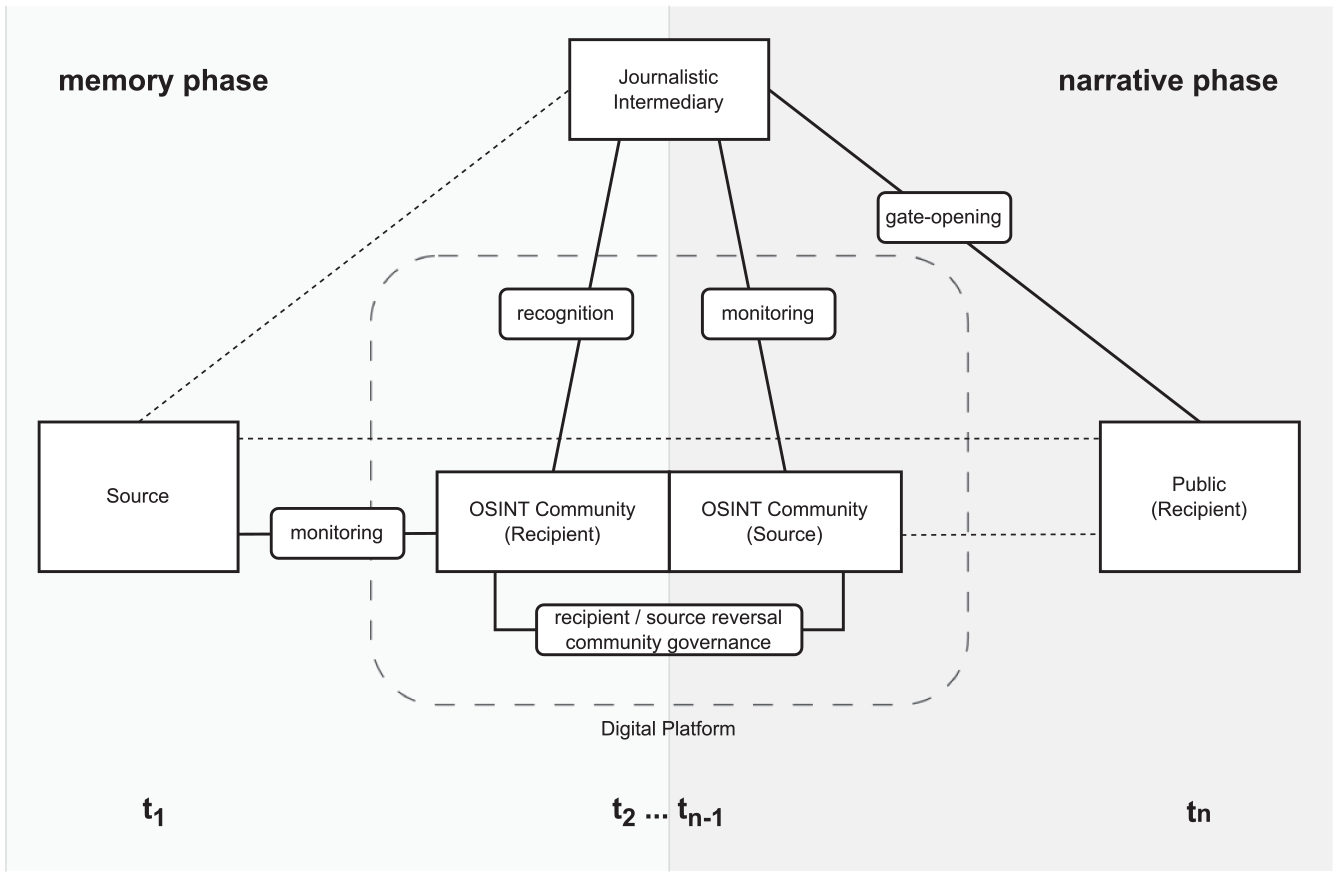
Model of the dynamic interactions between journalism and OSINT communities on digital platforms.
The graphic shows a memory or archival phase (left) and a narrative phase (right). It maps the stylized flow of information from capturing an event at time point t1 through its verification by the OSINT community at tn−1 to the final individual recipient in the public sphere at tn. The undirected solid edges indicate a dynamic relationship (rounded rectangles) between the actors (rectangles). We assume that the journalistic intermediaries are not necessarily directly accessing or verifying the original source at t1 (the left end of the visualization) due to the overload of unfiltered or contested information. Further, the public recipients (at the right end of the visualization) are probably not accessing OSINT communities directly since they are unlikely to be members there, though both paths are technically feasible, which is visualized by the dotted edges; hence, the straight lines in the figure depict the realistic information flow. Instead, public recipients receive validated information framed by established journalistic outlets, for example, through news, a function closer to “gate-opening” than “gate-keeping” (Müller and Wiik 2021). Recognitions of community efforts, such as pieces of news acknowledging OSINT sources or official requests for collaboration from authenticated journalistic actors, for example, the NYT or AP, motivate individuals to participate in the OSINT process. The graphic further highlights the recipient–source reversal (Ohme et al. 2022), which stipulates that on digital platforms an entity can be the recipient of information at time point tn and the source thereof at tn+1. Once the OSINT process, that is, the verification and validation of information, is completed during the memory phase, the community becomes a source of validated information during the narrative phase.
Two key insights emerge from this graphical analysis of the dynamics between OSINT communities, journalistic actors, and public recipients:
First, monitoring plays a central role in enabling this flow of information, starting from monitoring unverified and contested sources of information by OSINT communities using a range of technological and platform-specific affordances to assist them. The OSINT process achieves its output by archiving the results under the assumption of being monitored. The centrality of monitoring supports the idea of a revitalized and universal form of societal verification during events of public interest enabled by digital platform technologies (Brandtzaeg et al. 2016; Hermida 2012).
Second, recipient–source reversal, a key dynamic of journalistic intermediation according to Ohme et al. (2022), is central to explaining the activity performed by OSINT communities, which oscillate between their roles of monitor (during informational input) and being monitored (during informational output). Thus, static role definitions are not well suited to describe information flows in the platform economy since actors dynamically shift between roles. Verification processes in OSINT communities terminate under the implicit assumption that other actors could use verified information further. This shows how the institutional order of digital platforms creates new dynamics in epistemic workforces online.
Discussion
Digital platforms facilitate both the spreading of disinformation and its debunking. The increasing abundance of open information combined with journalists’ lack of resources to verify it led to the emergence of verification collectives on digital platforms, such as OSINT communities, which combat disinformation and participate in the digital epistemic process. How OSINT communities interact with journalistic media is central to understanding how shared and mutually accessible knowledge is established in the digital public sphere. Our analysis provides insights into the location of OSINT communities on Discord in a broader ecosystem of digital platforms and into the key interactions between OSINT communities and journalistic actors.
In response to the first research question, we argue that digital platforms are part of the fabric of the epistemic process in today’s networked public sphere. We found that Discord, and by extension other digital communication platforms, provide the infrastructure (the space and the functionality) for OSINT communities to facilitate the input, throughput and output of information by connecting to other digital platforms to ingest, transform, and share content; and that community and algorithmic governance were used in combination, meaning the platform itself can be considered both the space for OSINT to take place and an actor in the process itself. In other words, digital platforms are both the where and the how of OSINT communities. This duality has two implications: (1) digital platforms allow amateur communities to coordinate and provide them with the automation tools to handle vast amounts of data, and (2) power over the knowledge process is distributed among numerous actors (corporate, journalistic, and citizens). By establishing the digital infrastructure for OSINT communities providers of digital platforms attain a public role.
OSINT communities, organized on Discord, occupy an intermediary position in the OSINT process, sitting at the center of distal digital platforms and sources. Geographically dispersed, anonymous community members are neither the initial collectors of information nor responsible for their public dissemination. Instead, they rely on others, such as journalistic actors or umbrella organizations like Bellingcat, to collate and publish findings for public consumption. The focus of OSINT communities during the Russo-Ukrainian War remains the verification and processing of information (see also Cochrane 2022; Reese and Chen 2022).
In the analyzed OSINT communities, we observed few direct connections between the journalistic intermediary or ultimate recipient (the public) and the source. Instead, OSINT communities provided epistemic work by functioning as a form of knowledge middleware, whose key enabling dynamic is monitoring, both of the source by the OSINT community and of the community by journalistic intermediaries, a finding reflecting the concept of a “monitory democracy” (Keane 2011). Oscillating between the recipient (the monitor, t1) and the source of information (the monitored, t2 – tn−1), OSINT communities perform a fundamental role by iteratively validating and archiving contested information, thereby sorting the flood of unverified information in the digital public sphere. The assumption of being constantly monitored is evident in the structure and organization of the Discord servers, 5 where completed verifications (e.g., geolocation of imagery) culminated in a case being moved to an archival thread. Only when this information is retrieved or requested by a (citizen) journalistic intermediary and further contextualized in journalistic output does the OSINT process progress from the memory to the narrative phase and reach its conclusion (tn).
Therefore, we argue in response to RQ2 that the interactions between journalists and OSINT communities on digital platforms amount to a new division of epistemic labor in the digital public sphere mainly driven by co-monitoring throughout the knowledge process. Within the Discord chat protocols we analyzed, some explicit collaborations between journalistic actors and OSINT communities resembled conventional journalistic crowdsourcing practices, where journalists approached the communities for assistance in specific tasks of the knowledge production process (Aitamurto 2017). Others were less directed, pointing to what Reese and Chen (2022: 2) describe as the “form[ation of a] [. . .] loose partnership in the service of shared values.” Nonetheless, journalistic publications relying on OSINT information were shared in the OSINT communities and established a sense of recognition among the community. This could explain the individuals’ motivation to participate in the OSINT process (Belghith et al. 2022; Cochrane 2022; Müller and Wiik 2021).
Limitation and Research Agenda
It is necessary to consider the research design’s limitations linked to its exploratory focus. We could only identify the interactions between journalistic actors and OSINT communities that were explicitly referenced and discussed on the analyzed Discord servers. In other words, we captured the interactions from the perspective of the OSINT communities. We also did not address the easily conceived issue of misinformation being deliberately introduced and distributed through OSINT communities, whereas we observed consequential actions being taken, for example, the automatic flagging of content stemming from sources that had distributed problematic content in the past. Further research should focus on the journalistic side of the OSINT process to corroborate the discovered interactions and gain deeper insight into the verification process. Our findings provide the initial categories for future qualitative and quantitative analyses of OSINT communities. In addition to interviews with journalistic actors, trace data and records of community discourse are readily available for quantitative analysis. The temporal dimension inherent in these data is particularly salient in understanding the evolution of today’s processes of knowledge production in the digital public sphere and how digital platforms shape them.
Further, the presented approach is limited by the unique historical context of the collected data. The early phase of the Russian invasion of Ukraine in 2022 was chosen as a timeframe for data collection because it sparked widespread interest in OSINT communities, leading to increased activity across the two studied Discord servers. 3 We hypothesized that due to the mutual attention of traditional media and OSINT communities on the three events, they qualified as “most likely cases” of OSINT–journalism interaction. We found evidence suggesting that OSINT communities also consider themselves further implicated with legal institutions. This finding aligns with the literature proposing that OSINT’s role in legal processes is increasing and will continue to do so as all conflicts turn into the “networked” kind 2 (Murray et al. 2022). Thus, future research should explore the triangular relationship between OSINT, journalism and legal institutions (Kotišová and Van Der Velden 2023).
Similarly, we also discovered community building driven by community members and citizen journalistic actors (in the case of Bellingcat), raising the question of how OSINT communities of practice (Wenger 1998) are established and operate. With literature showing that the initiation of novice practitioners into OSINT practice and their training and skill development are factors in achieving a critical mass of OSINT practitioners to parse and validate new information as it emerges (Belghith et al. 2022), this aspect should be further explored.
Our review of the literature on OSINT and analysis found that the epistemic OSINT process relies on and is embedded in a range of proprietary (and commercially driven) digital platforms, each further embedded geographically in a legal and cultural system and operating according to their terms of service and often opaque rules and logic. Algorithmic governance of content on social media platforms forms an obvious obstacle to comprehensive data validation since a complete picture cannot be guaranteed, and deletions or censorship are frequently left unjustified. Furthermore, OSINT communities rely on a digital platform infrastructure of their own (e.g., Discord). Despite responsibilities being allocated along a flat hierarchy within the communities, the cascade of power is strictly vertical because informational archives might be expunged by moderators, server owners, or the platform providers themselves. Embeddedness in multiple platform orders leaves the threat of ephemerality hanging over the OSINT process (United Nations 2022). Future research could investigate whether the affordances of existing platforms fully serve OSINT communities and how OSINT communities innovate and create their own platforms.
Conclusion
Our study traced how OSINT communities on Discord relate to journalistic intermediaries. We argued that the rise of digital platforms and smart devices led to the proliferation and emancipation of information. This necessitates a new division of labor between journalism and OSINT communities to stabilize the epistemic foundation of what Arendt called our bearings in the world. OSINT communities are insightful examples of how ideas consigned to history, such as societal verification, are re-enabled and re-necessitated through platform technology. This provides a redemptive perspective on platforms in contrast to a prevailing “digital pessimism” (cf. Miller and Vaccari 2020) in the scholarship surrounding digital political processes. Recognizing the role played by OSINT communities and studying their characteristics and relationships with established institutions, such as journalism, is an important gateway into the inner mechanisms of the digital public sphere.
Supplemental Material
sj-pdf-1-hij-10.1177_19401612241271230 – Supplemental material for A Common Effort: New Divisions of Labor Between Journalism and OSINT Communities on Digital Platforms
Supplemental material, sj-pdf-1-hij-10.1177_19401612241271230 for A Common Effort: New Divisions of Labor Between Journalism and OSINT Communities on Digital Platforms by Timothy Charlton, Anna-Theresa Mayer and Jakob Ohme in The International Journal of Press/Politics
Footnotes
Author Contributions
The authors confirmed their contribution to the article as follows: study conception and design: T.C. and A.-T.M.; data collection: T.C. and A.-T.M.; analysis and interpretation of results: T.C., A.-T.M., and J.O.; draft manuscript preparation: T.C., A.-T.M., and J.O. All authors reviewed the results and approved the final version of the manuscript.
Declaration of Conflicting Interests
The author(s) declared no potential conflicts of interest with respect to the research, authorship, and/or publication of this article.
Funding
The author(s) received no financial support for the research, authorship, and/or publication of this article.
Ethics Considerations
Research data collection and analysis were conducted at the Weizenbaum Institute for the Networked Society during 2022. Ethical approval was not required since no new data were collected from human participants. Collected secondary data were publicly available, not personally identifiable and under no expectation of privacy.

Supplemental Material
Supplemental material for this article is available online.
Notes
Author Biographies
References
Supplementary Material
Please find the following supplemental material available below.
For Open Access articles published under a Creative Commons License, all supplemental material carries the same license as the article it is associated with.
For non-Open Access articles published, all supplemental material carries a non-exclusive license, and permission requests for re-use of supplemental material or any part of supplemental material shall be sent directly to the copyright owner as specified in the copyright notice associated with the article.
