



Abstract
Findings on whether voters like or dislike targeted campaign messages have been contradictory. I argue that voters react differently depending on how precisely the targeted messages are tailored to them, and tailoring can potentially become “too much.” I corroborate this claim with the results of a factorial survey experiment among a representative sample of the German voting population (N = 3,217), which was conducted in the summer of 2021. Taking a novel approach, I measured the effects of close political targeting by asking respondents to rate campaign messages with varying degrees of tailoring. The analysis revealed a backlash effect, which is especially pronounced by men getting ads tailored to their gender. Voters appreciate messages that are moderately tailored to them but dislike highly tailored messages. This holds both for implicitly tailored messages and those that explicitly acknowledge the use of personal data. These results indicate that voters seem to recognize excessively tailored messages and manipulating them is difficult. These findings have important implications for the modern election campaigning’s effects on political behavior and its regulation.
Introduction
Targeting political messages to voters and tailoring the content of the messages to them has become a commonplace practice in elections across the globe. In (often exaggerated) claims, parties are expected to use highly personal data to craft specific messages to persuade voters in campaigns, which are assumed to influence elections (Dommett et al. 2024: 1). In this article, I refer to the campaign strategies of sending a specific message to a target group as targeting and to adapting the content of the targeted message to the target group as tailoring 1 (see similar definitions by Fowler et al. 2021; Holman et al. 2015). 2 Findings on the effects of political tailoring and targeting have been contradictory, and the two concepts are often not disentangled. Some studies show that tailoring and/or targeting increases the success of political messages (e.g., Haenschen and Jennings 2019; Holman et al. 2015; Robison et al. 2021; Weber and Thornton 2012; Zarouali et al. 2022). Others have found limited or null effects (Berinsky et al. 2020; Hersh and Schaffner 2013). Research has demonstrated that citizens often do not like to be targeted due to privacy concerns (Boerman et al. 2021; Dobber et al. 2019b), which can decrease trust in democracy (Matthes et al. 2022). Thus, while tailoring and/or targeting are often assumed to give political actors an advantage, there are potential backlash effects.
It is relatively easy for political actors to tailor their ads based on a single targeting criterion. However, recent research by Dommett et al. 2024 has gathered qualitative evidence that crafting multiple messages for very small audience is “hugely labor intensive” (p. 87) for parties and that they “cannot create multiple fine-grained messages for all [their] voters” (p. 91). In this article, I focus on voters’ perspectives of tailoring and take a novel approach to measure in which degree targeted messages are tailored to voters. Is it even worthwhile for parties to adapt the content of their messages to specific voters by using multiple targeting criteria, or is there a risk of “too much” tailoring? I hypothesize that voters react differently depending on how closely the targeted messages are tailored to them, and that close tailoring leads to a backlash effect.
To test my hypothesis, I conducted a pre-registered factorial survey experiment among a representative sample of the German voting population (N = 3,217). In the experiment, each respondent was asked to rate different targeted messages that varied in how closely the content was tailored to them. The results confirmed that there is indeed a backlash effect with highly tailored messages. Tailoring the message to voters to a lower degree increased the message’s success. However, when messages were tailored according to many criteria, their success rate decreased and was even significantly lower than generic messages. The backlash is most substantive for male respondents receiving ads that were tailored to their gender. These findings suggest that parties cannot easily manipulate voters by producing overly tailored messages designed to target very specific groups; voters seem to disregard messages that are highly tailored. This was true regardless of whether the respondents were informed of the tailoring or not.
These findings are important because tailoring can have significant normative implications for democracies. On the one hand, tailoring messages to voters can make political messages more interesting to them. I show that this is the case if the targeted message is tailored to a lower degree. Yet, targeted campaign messages might also have negative effects on voters. Data-based targeting requires collecting personal data about voters, and that practice has been heavily criticized. Additionally, targeted messages can be biased, exposing particular voters to selected parts of the campaign message. This is especially important if one keeps in mind that parties might misuse this power and could be able to manipulate voters’ perceptions by spreading misleading messages to some target groups (Bodó et al. 2017; Zuiderveen Borgesius et al. 2018). This research demonstrates that most voters seem to be aware of this threat.
This article has important contributions for the literature on political communication. First, I show that we need to conceptualize and measure tailoring more carefully. Empirical studies need to not only distinguish between tailored and nontailored messages (see e.g., Chu et al. 2023; Hersh and Schaffner 2013; Hirsch et al. 2023; Holman et al. 2015), but also the degree of how much an ad is tailored to a receiver matters. Second, I show empirically that adapting a message to one characteristic of a respondent can have a positive effect, but highly tailored messages provoke a backlash effect. This backlash effect is particularly strong if male respondents are targeted with ads tailored to their gender, that is, there seem to be some targeting criteria where the backlash is particularly strong. Third, I contribute to the scientific discussion about whether and under which conditions campaigns matter (see e.g., Brady et al. 2006; Coppock et al. 2020; Huber and Arceneaux 2007; Kalla and Broockman 2018). While there is no consensus yet, Kalla and Broockman (2018) find that positive effects are most possible in those campaigns that invest heavily in targeting persuadable voters and send them tailored messages that overlap with their preferences. My findings suggest that this is only true if the messages are not tailored too much.
Tailored Advertising in Election Campaigns
The goal of most parties during electoral campaigns is to reach potential, convince undecided and mobilize existing voters to vote for them (Ansolabehere and Iyengar 1994; Goldstein and Ridout 2004; Schmitt-Beck and Farrell 2002). I thus label a tailored message as successful if it increases the likelihood that its recipient will vote for the message’s sender.
Effects of tailored and targeted messages on voters have been increasingly discussed in the media (Baldwin-Philippi 2020) and among lawmakers (Council of the EU 2024; Dobber et al. 2019a; Richardson et al. 2020). An important part of targeting/tailoring research has focused on the strategies parties use (see e.g., Anstead 2017; Karlsen 2011; Kruschinski and Bene 2022; Ortega 2022; Stückelberger and Koedam 2022). Studies of those strategies’ effects on voters are mixed and a lot of insights have been derived based on the US case. However, insights are also critical in multiparty systems, since voters can be cross-pressured by many parties (Gidron 2022; Dassonneville 2023), which might make targeting more effective.
Tailoring a targeted message’s content can have a twofold effect on the receiver’s electoral behavior. First, we could expect receivers to be more interested in such messages, since they have been individualized to reflect the voters’ demographics, place of residence, or issue preferences. This is important because the quantity of campaign material that voters receive has increased tremendously during recent decades (Norris 2000: 137ff), which can provoke anxiety and information overload (Bawden and Robinson 2008). Furthermore, classical linkages, such as party identification and class-based voting, have declined, and consequently, there is a growing number of late deciders and volatile voters who pay close attention to campaigns (Dalton et al. 2000: 37ff; Johann et al. 2018). Indeed, it has been shown that targeting increases political interest (Matthes et al. 2022) and that voters are more likely to memorize advertisements that appeal to a group to which they belong to (Kam et al. 2017).
Political actors can tailor their targeted messages to influence the predispositions that receivers prioritize in their voting behavior (Hillygus and Shields 2008). One tailoring strategy is to selectively emphasize different issues to various target groups, thereby maximizing the party’s influence on each group’s voters while avoiding certain downsides (Downs 1957: 135). Targeted advertisements can also be tailored with group-appeals based on the socio-demographic characteristics of the target group (Kefford et al. 2023). This enables parties to associate themselves with the group to which a voter belongs, which can influence voting behavior (Berinsky et al. 2020; Herrnson et al. 2003; Huber et al. 2024; Thau 2021). In general, parties are expected to collect vast amounts of highly personal information and are expected to use them in a highly sophisticated way (Dommett et al. 2024: 1).
Marketing and psychological research has demonstrated targeting’s effectiveness in advertising (see e.g., Aguirre et al. 2015; Matz et al. 2017; Van den Broeck et al. 2020), and initial studies suggest that the same positive effect results from tailoring political advertisements. These studies investigated the effect of tailoring targeted messages based on gender (Holman et al. 2015), religion (Weber and Thornton 2012), working class appeals (Robison et al. 2021), personality traits (Zarouali et al. 2022), and issues (Chu et al. 2023; Endres 2020).
Second, we could also expect receivers to be skeptical about tailored messages, which is referred to as a “paradox” (Aguirre et al. 2015; Boerman et al. 2017, 2021). When respondents are directly asked for their opinion about targeting, most had negative attitudes (Boerman et al. 2021), particularly in political contexts (Baum et al. 2019). While these negative opinions could abate over time as users become accustomed to targeting, and more transparency measures are introduced (Van den Broeck et al. 2020), it is also important to investigate the effects of confronting voters with targeted advertisements that are actually tailored to them (Boerman et al. 2017, 2021). In such an investigation, Hersh and Schaffner (2013) found that voters rarely prefer group-tailored messages to generic ones and also showed several null effects. Since they also found negative effects for mistargeted messages (i.e., when respondents receive messages tailored to a group to which they do not belong), they concluded that “it would rarely be worthwhile for a candidate to offer targeted messages instead of general messages” (p. 527). A similar conclusion was drawn by Berinsky et al. (2020), who found that racial signals have limited effects on candidate support among Black voters, but carry a substantial risk of backlash among White voters. Most recently, Hirsch et al. (2023) have found that a high issue fit does not influence persuasion knowledge and thus attitudes or behavior.
To summarize, existing studies of tailored message content have not reached a consensus, variously concluding that the net effect on the recipients’ voting behavior was positive, null, or negative.
The Effect of Highly Tailored Campaign Messages
The inconsistent results regarding the success of tailored political messages so far derive from studies that differentiate only between tailored and generic messages. However, parties can (and do) target the content of their campaign messages by combining multiple criteria, such as political preferences and sociodemographic information. For example, studies tested the effects of appeals tailored to gun owners, born-again Christians (Hersh and Schaffner 2013), or women (Holman et al. 2015) as compared to generic messages. However, parties can also tailor their messages to female gun owners or male born-again Christians.
There is evidence that political campaigns utilize such multifaceted targeting. For example, in the 2021 German election campaign, 36% of the spending on political advertisements on Facebook and Instagram run by German political parties and their top candidates targeted at least two different criteria (see Figure 1), combining the criteria age, gender, location, or interests. According to the interviews of German campaign managers by Dommett et al. (2024: 90–92), most German parties use these targeting categories to then (try to) tailor these ads to various different criteria at once.
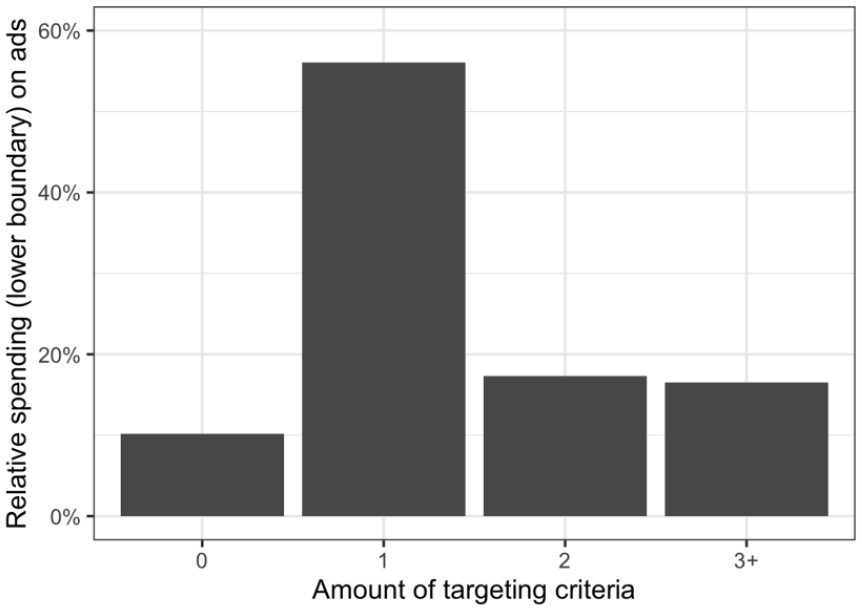
Spending by amount of targeting criteria.
I suggest that the inconsistent results of the abovementioned studies is explained by the fact that they vary in how closely the messages were tailored to the receiver—that is, they vary in their tailoring degree. I employ the concept of Boerman et al. (2017: 365), 3 who argue that the tailoring degree can vary by the type of personal data and the amount of information used to tailor the content of the targeted message. For example, the type of personal data Hersh and Schaffner (2013: who found null or inconsistent weak positive results) used in their study is quite specific and personal (e.g., gun user, born-again Christian). In contrast, gender tailoring as used by Holman et al. (2015: who found positive effects) is less personal. In this study, I measure the degree of tailoring by manipulating the number of targeting criteria used to tailor the messages; targeted campaign messages can thus be tailored in a low or high degree.
This makes it possible to propose a nonlinear relationship of tailoring on the success of targeted messages. For this relationship, I have several (alternative) expectations. A stylized version of my expectations is shown in Figure 2. The x-axis represents the degree of tailoring. The more the characteristics of the respondent and the content of the message overlap, the higher the degree of tailoring. The outcome (success of the message) is shown on the y-axis.
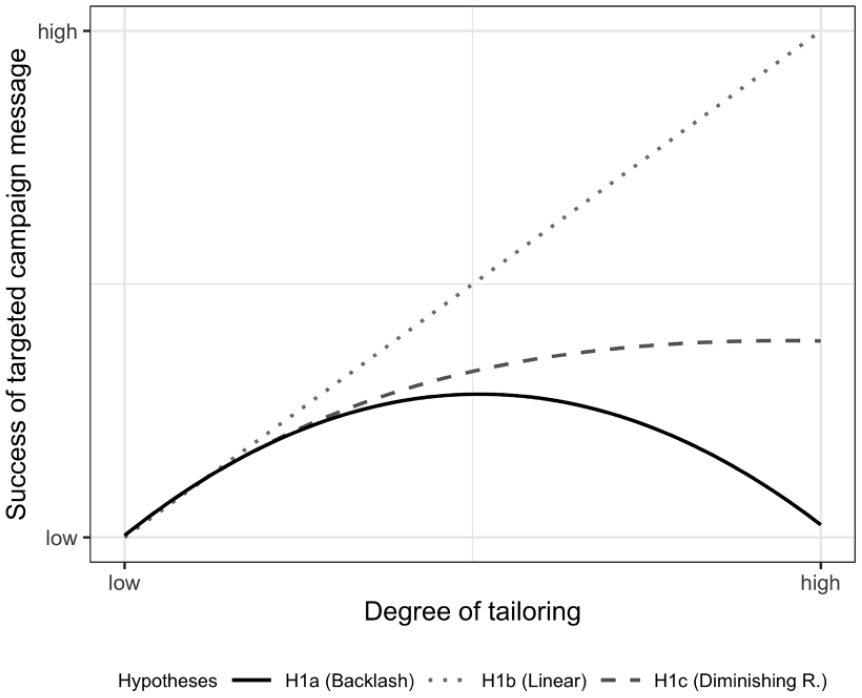
Graphical display of hypotheses 1a–1c.
Based on the abovementioned literature, I argue that tailoring messages to voters according to one criterion should make them more interesting and thus more successful than generic messages. Since they are based on little personal information, there is little risk of backlash. Therefore, tailoring the message in a low degree should be more successful than a generic campaign message.
However, increasing the degree of tailoring by increasing the amount of information used in formulating the message might not be worthwhile. I argue that highly tailored political messages might in fact be less successful due to a backlash effect. The backlash may be expected because adapting the message too precisely to the voter might be perceived as manipulation 4 (Bodó et al. 2017; Hersh and Schaffner 2013). As Fernandez-Vazquez (2019) has shown experimentally, voters are more skeptical about popular party statements, because they perceive them as less credible. Also, voters are more likely to believe messages that confirm their beliefs about parties than unexpected ones (Ansolabehere and Iyengar 1994). Therefore, if voters receive messages that are highly tailored to them, they may question whether the content truly represents the party’s position, suspecting the party of crafting the message solely to persuade them.
Building on this, I argue that increasing the amount of information used to tailor a message is not worthwhile. A message with a single tailored criterion (e.g., gender) should already be interesting to the recipient. Adding an additional tailored criterion (such as combining gender with location), the increase in information becomes less valuable. With this higher degree of tailoring, voters are more likely to notice that they are being targeted and may feel manipulated. Hence, I expect that for highly tailored campaign messages, adding a further tailored criterion constitutes a turning point at which negative associations begin to outweigh positive ones, and voters will penalize parties that pass that turning point. This could be the reason that studies have produced inconsistent results about the success of targeting strategies; their tests lie before or after that turning point. 5 To summarize, I expect that:
Hypothesis 1a (Backlash effect) With a high degree of tailoring, the impact of each additional tailored criterion on the success of a campaign message gets negative.
I aim to contrast this expectation with two alternative predictions for targeting effects. First, it directly contradicts the common “naïve” expectation that when it comes to tailoring, more is better. That is, the more the message’s content reflects the voter’s characteristics, the more interesting the voter will find it. This expectation seems widespread among the media and some parties (see e.g., Anstead 2017; Dommett et al. 2024 and evidence in Figure 1). According to this view, each additional tailoring criteria adds to the success of a campaign message. This leads to the following alternative hypothesis:
Hypothesis 1b (Linear) There is a positive linear relationship between the degree of tailoring and the success of campaign messages.
As the second alternative, one might predict that increasing the degree of tailoring will yield diminishing returns. This means that while a highly tailored message’s positive effects will still exceed the negative ones, each additional tailored criterion’s positive effect will be less than that of the previous one. The risk of negative effects will simultaneously increase.
Hypothesis 1c (Diminishing returns) The higher the degree of tailoring, the more the positive impact of each additional tailored criterion on the success of a campaign message decreases.
In arguing for hypotheses H1a and H1c, I assumed that voters notice when messages have been highly tailored to them and as a result dislike those messages. However, voters might not always recognize the tailoring, but noticing is a necessary condition to react to it (Binder et al. 2022; Dobber et al. 2019b). Currently, the European Union is developing “new rules on transparency and targeting of political advertising” (Council of the EU 2024), and more and more Social Network Sites (SNS) are introducing transparency mechanisms. Before pre-registering the experiment, there has been relatively little and mixed evidence on how users react to the (increasing) transparency mechanisms in political advertisements (Boerman et al. 2021; Kim et al. 2019; Kruikemeier et al. 2016). Based on these results, I have expected that implicitly tailored messages are more successful than explicitly tailored messages (H2) and that explicit tailoring intensifies the backlash effect, since explicitly informing voters of the tailoring will make them more keenly aware of potential manipulation (H3). Since the pre-registration, several studies have shown that transparency and disclosure statements are often not recognized (Jost et al. 2023) and do not make a message more or less effective (Binder et al. 2022; Dobber et al. 2023), which is why this is not a main focus of this article. I also find no difference, which I report in subsubsection A.4.1 in the Supplemental material Appendix.
Research Design
To test the hypotheses stated above, I estimated the effect of tailoring on the success of a targeted campaign message by conducting a factorial survey experiment 6 among a representative sample of the German voting population (N = 3,217). I showed respondents five messages that differed in their degree and explicitness of tailoring and asked them how much they liked the message and how likely they were to vote for the sending party. 7 Campaign effects are most adequately tested with experimental methods (Arceneaux 2010), but external validity is a concern (Goldstein and Ridout 2004). Hence, the messages shown in the survey were designed to mimic actual campaign messages seen on posters or social media.
I employ the categorization of Kruschinski and Haller (2017) to distinguish three targeting dimensions: geographical targeting, targeting groups with shared characteristics (sociodemographic targeting), and targeting based on individual attitudes, behaviors, and values (opinion targeting). Each of these dimensions consists of different potential targeting criteria for messages (see Table 1).
Dimensions and Criteria of Targeting and Tailoring.
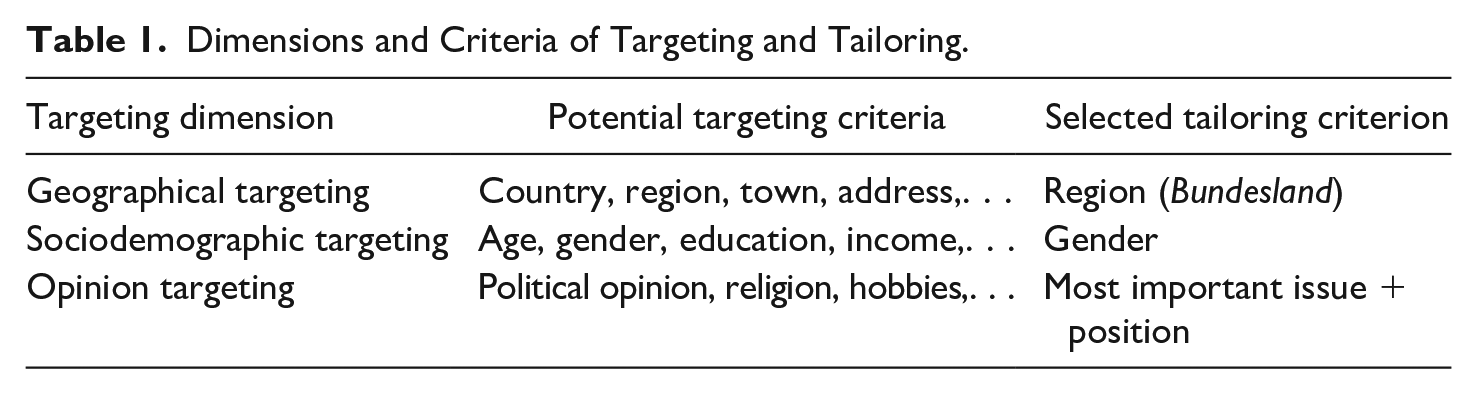
With external validity in mind, I selected one criterion per targeting dimension (region, gender, most important issue + position, see Table 1). These criteria are often used in European party communications and are common targeting criteria on SNS. As a reference point, I again used the 4,201 advertisements publicized during the 4 weeks before the 2021 general election by Germany’s six largest political parties and their top candidates on Facebook or Instagram (see note of Figure 1, Meta Platforms 2022). Among those advertisements, 63% were targeted to a sublocation within Germany, 12% were targeted based on gender, and 10% were targeted according to the interests and behaviors of the users.
These three criteria were furthermore selected because the experimental design required that all messages can be tailored on all dimensions using text. For example, manipulating a message to tailor to men or women is quite straightforward. 8 For other characteristics, tailoring the messages’ text was more reasonable for some groups (e.g., young and old people) than for others (e.g., middle-aged people). Finally, I selected criteria that were relatively similar in their sensitivity, as I only manipulate the amount of information to manipulate the tailoring degree of a message (Boerman et al. 2017; Leon et al. 2013). In addition to these three criteria (which can either be tailored (1) or not (0)), the messages could also be tailored either explicitly (1) or implicitly (0). Hence, the experiment incorporated a 2 × 2 × 2 × 2 full factorial design 9 with 16 experimental groups, see Table 2.
Overview of Experimental Conditions.
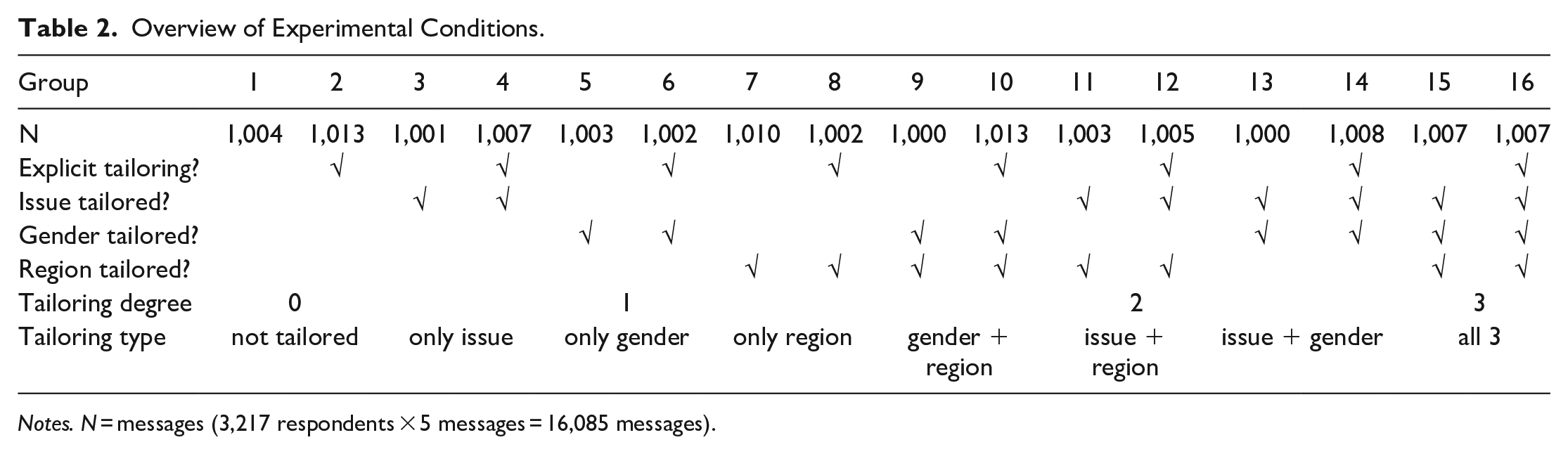
Notes. N = messages (3,217 respondents × 5 messages = 16,085 messages).
Respondents were introduced to the experiment by learning that they would see different political messages from a hypothetical political party for the national election campaign. 10 Then, five out of sixteen possible messages were randomly selected and shown in a random order to the respondents. The content of the messages was linked to the respondent based on pretreatment questions (see Figure 3). The main slogan of the message differed depending on whether the issue was tailored or not, by showing either a nonpolicy or a tailored policy statement. The subtitle of the message differed depending on whether the message was tailored or not to gender and region by the addition of a direct, text-based group-based appeal (Dolinsky 2023). 11 Lastly, based on the explicit tailoring dimension, the vignettes varied if there was a tailoring disclaimer below the message (see Figure A.2 in the Supplemental material Appendix).
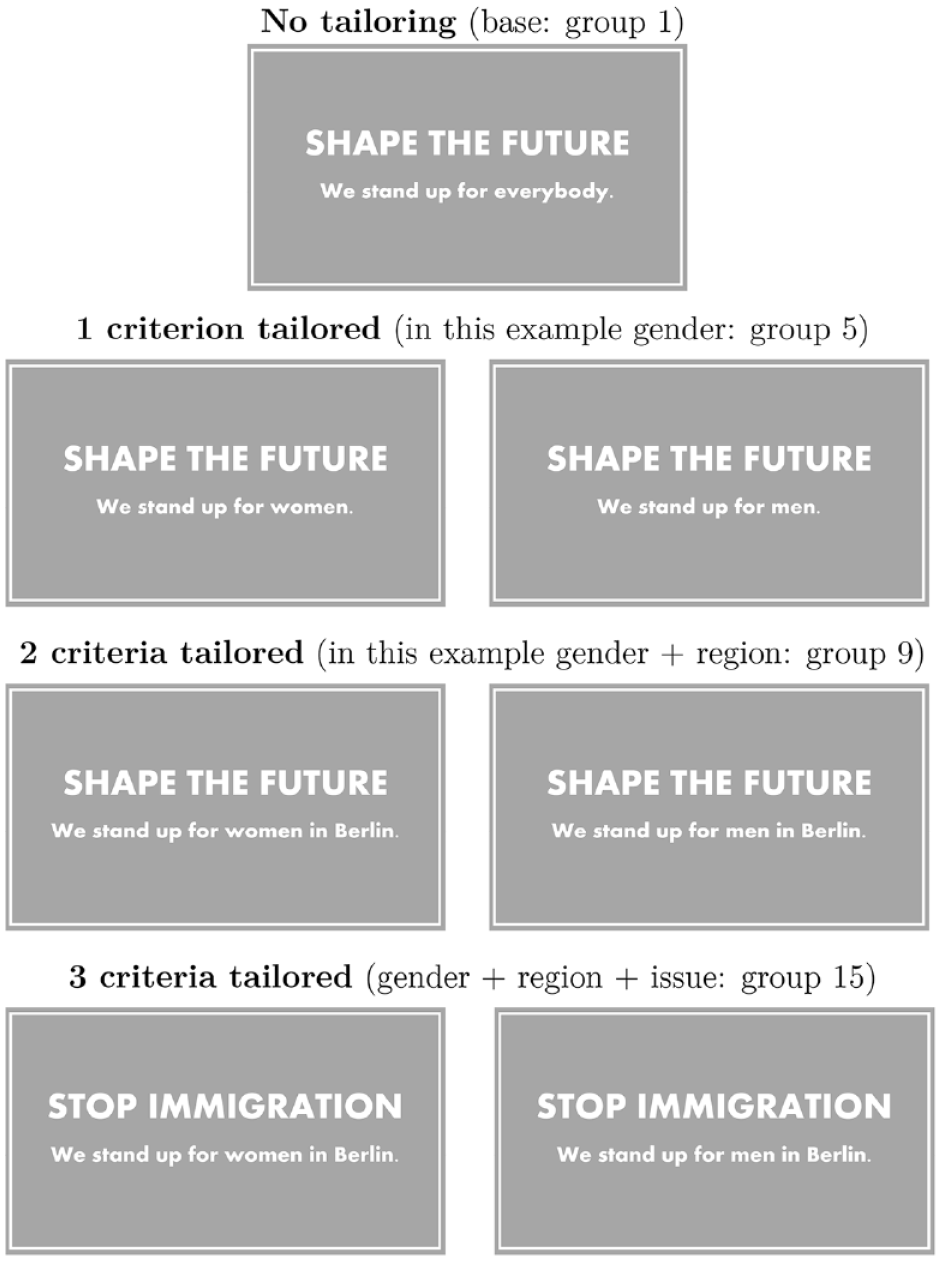
Example messages.
Data and Methods
Research has shown that contextual factors such as the electoral system, party system, and legislation play a role in how parties use targeting strategies in advanced democracies (Dommett et al. 2024), and thus how voters might react to tailored messages. Also, as Dommett et al. (2024: 1) put it, we need “less focus on US practices,” “to engage in a more empirically grounded discussion of the impact of [data-driven campaigning] on democracy.” As a contribution to this appeal, I select Germany as a representative case to study the effect for tailoring in European multiparty parliamentary systems. Multiparty systems offer various possibilities to tailor messages to various voter groups, as voters can be cross-pressured between several parties (Dassonneville 2023; Gidron 2022). Also, the German mixed electoral system combines elements of proportional representation and majority voting, which makes it more representative to both types of electoral systems. It has been shown that German parties are neither the most sophisticated nor the most basic in terms of their targeting techniques and mostly rely on broad sociodemographic and geographic information (Dommett et al. 2024; Kefford et al. 2023; Kruschinski and Haller 2017). Also, the legislation in Germany is based on the legislation in the European Union (Dobber et al. 2019a; Kruschinski and Haller 2017) and thus representative for many European countries. It has to be noted though that German citizens are quite skeptical toward personal data collection (Kozyreva et al. 2021), and other European citizens where data are more widely available (such as in the Scandinavian countries) attitudes might be more positive (Dommett et al. 2024: 199).
The factorial survey experiment was conducted as a Computer-Assisted Web Interview from July 29 to August 11, 2021 in Germany. 12 The sample of participants was obtained from the survey company respondi AG with an initial pool of online panel respondents. Respondents were German citizens aged 18–69, who live in Germany. 3,224 completed interviews from a sample nationally representative of the German population according to age, gender, region (Bundesländer), and education with cross-quotas on gender and age were delivered. Because tailoring was used for binary gender only, diverse respondents were excluded, which led to 3,217 respondents who were used in the analysis. Each respondent rated five different messages, so 16,085 messages were rated in total.
The outcome of interest was the success of the campaign message, which was measured using two dependent variables (DV). After seeing each message, the respondents were asked how likely they were on a 0–10 scale to vote for the sending party (DV: PTV). Then, they rated the messages on a 0–10 like-dislike scale (DV: like). The two dependent variables are highly correlated (r = 0.87). See subsection A.3 in the Supplemental material Appendix for descriptive overview and balance checks of all variables.
The primary explanatory variable tailoring degree was ordinal and was created using the three manipulated tailoring criteria (gender, region, issue, see Table 2). Having four levels, it measures whether the message was tailored according to one, two, three, or no criteria. The “no tailoring” category was the reference group in the models; it can be considered as a control group since the message was not linked to any of the respondents’ characteristics and remained the same for all respondents. In the sensitivity analysis, I made use of a tailoring type variable instead, which additionally captured the criteria to which the message was tailored (see Table 2). Additionally, an explanatory explicit variable was used, which indicated whether the message was tailored implicitly (0) or explicitly (1).
I used linear models as both dependent variables were continuous. As respondents rated several messages, I added fixed effects and clustered standard errors for respondents (within subjects design). For both dependent variables, I calculated three models. In model 1, the tailoring degree index was used to calculate the effect of tailoring on a message’s success (H1a–c). The predicted values of the coefficients will be compared with the stylized version in Figure 2 and tested for significant contrasts using pairwise comparison. The dichotomous explicit tailoring variable was added (model 2) and interacted (model 3) as a control (and test H2 and H3, see subsubsection A.4.1 in the Supplemental material Appendix).
Results
Is there a risk of “too much” tailoring? To assess this question, I plotted the predicted values of the respondents’ propensity to vote for the sending party (PTV, right panel) and liking the message (left panel) for each level of the tailoring degree variable in Figure 4. If a message is tailored to one criterion compared to not being tailored at all, the predicted values of liking the message increase significantly (0.3 steps on the 0–10 scale). Interestingly, tailoring the message to one criterion compared to not being tailored at all does not change the propensity to vote for the sending party. These mixed findings speak to those studies that tested no tailoring versus tailored to one criterion, which produce either positive or null results of tailoring (see above, e.g., Hersh and Schaffner 2013; Holman et al. 2015).
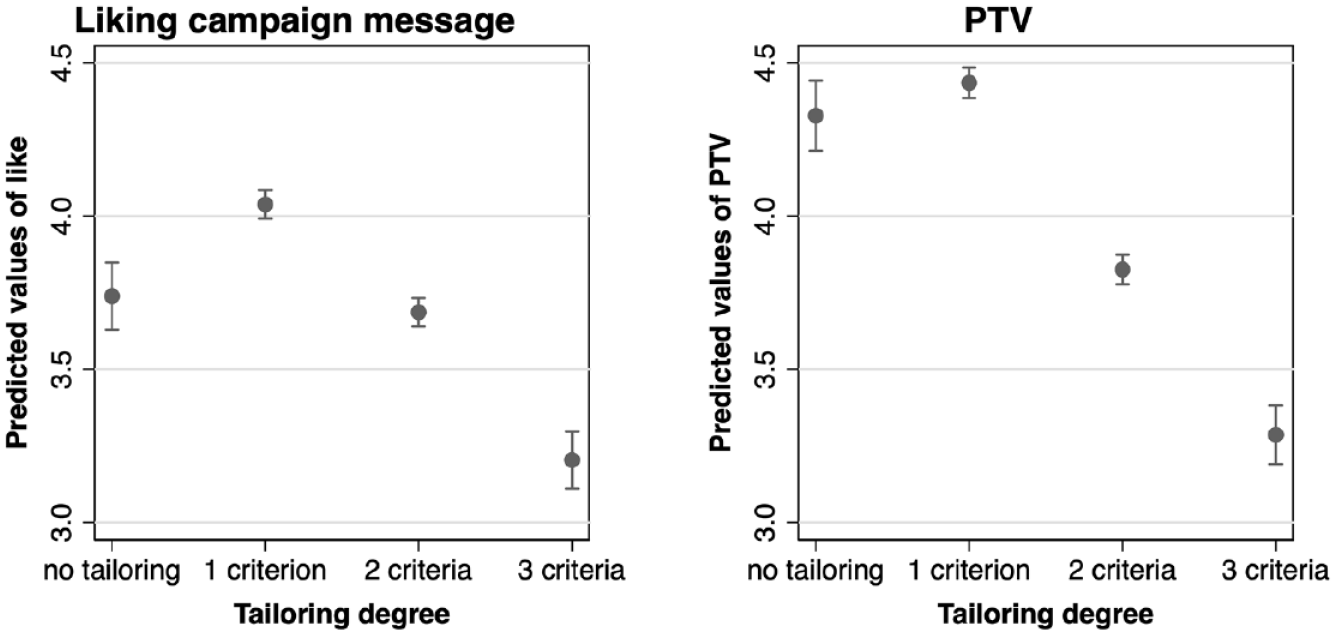
Predicted values of liking the message and PTV by tailoring degree.
However, this is only part of the story. Is it worthwhile to tailor the content of the message even more? We now take the predicted probabilities of tailoring a message to one criterion as a reference point. As Figure 4 shows, the success decreases if the message is tailored to a higher degree (i.e., to two or three criteria). There is a significant decrease of liking the campaign message and PTV if the messages are tailored to two criteria compared to the ones tailored to only one criterion. If a message is tailored to three criteria, there is a significant decrease in like and PTV compared with one or two criteria and with no tailoring. For example, the shift from no tailoring to tailoring to three criteria significantly reduces the propensity to vote for the party by one step on the 0–10 scale.
There is thus evidence for the backlash effect as proposed in hypothesis 1a, whereas there is no evidence for the contrary hypotheses 1b and 1c. Tailoring might be successful if used in a lower degree, but respondents seem to punish sending parties if their messages are tailored to too many criteria. This result is robust to whether or not the respondents saw a statement below the ad which told them explicitly that the ad was tailored to them (see subsubsection A.4.1) and is not driven by ordering, learning or fatigue effects (see subsubsection A.5.2 in the Supplemental material Appendix).
Sensitivity Analysis
In the preceding analysis, I pooled observations to calculate an additive tailoring index (tailoring degree), which rests on the assumption that the effects are similar across different tailoring criteria. To test how this affects my results, I calculated the effects for each tailoring type (see last row of of Table 2) separately. Additionally, as men and women might react differently to gender tailoring, I show the differences separately for all respondents, men and women in this sensitivity analysis. The results for these models are shown in Table A.8 in the Supplemental material Appendix.
I selectively plotted the differences in the predicted values of like and PTV by tailoring type and gender in Figure 5. Focusing on the top panels A(Like) and B(PTV) first, the differences for those comparisons that do not include gender tailoring in 1 or 2 criteria are plotted. For 1 vs 0 criteria, it shows that tailoring the ad to only the issue has a positive effect on both dependent variables, and tailoring the ad to only the region has a positive effect on like, but no effect on PTV. For 2 versus 1 criteria, it shows that adding an issue to an ad that only is tailored to a region has a positive effect; while adding a region to an ad that only talks about an issue has a negative (PTV) or no (like) effect. This shows that the “turning point” is dependent on which criteria is added to which one and further studies should explore this. Lastly, if all 3 criteria are tailored, there is a clear backlash effect for both men and women.
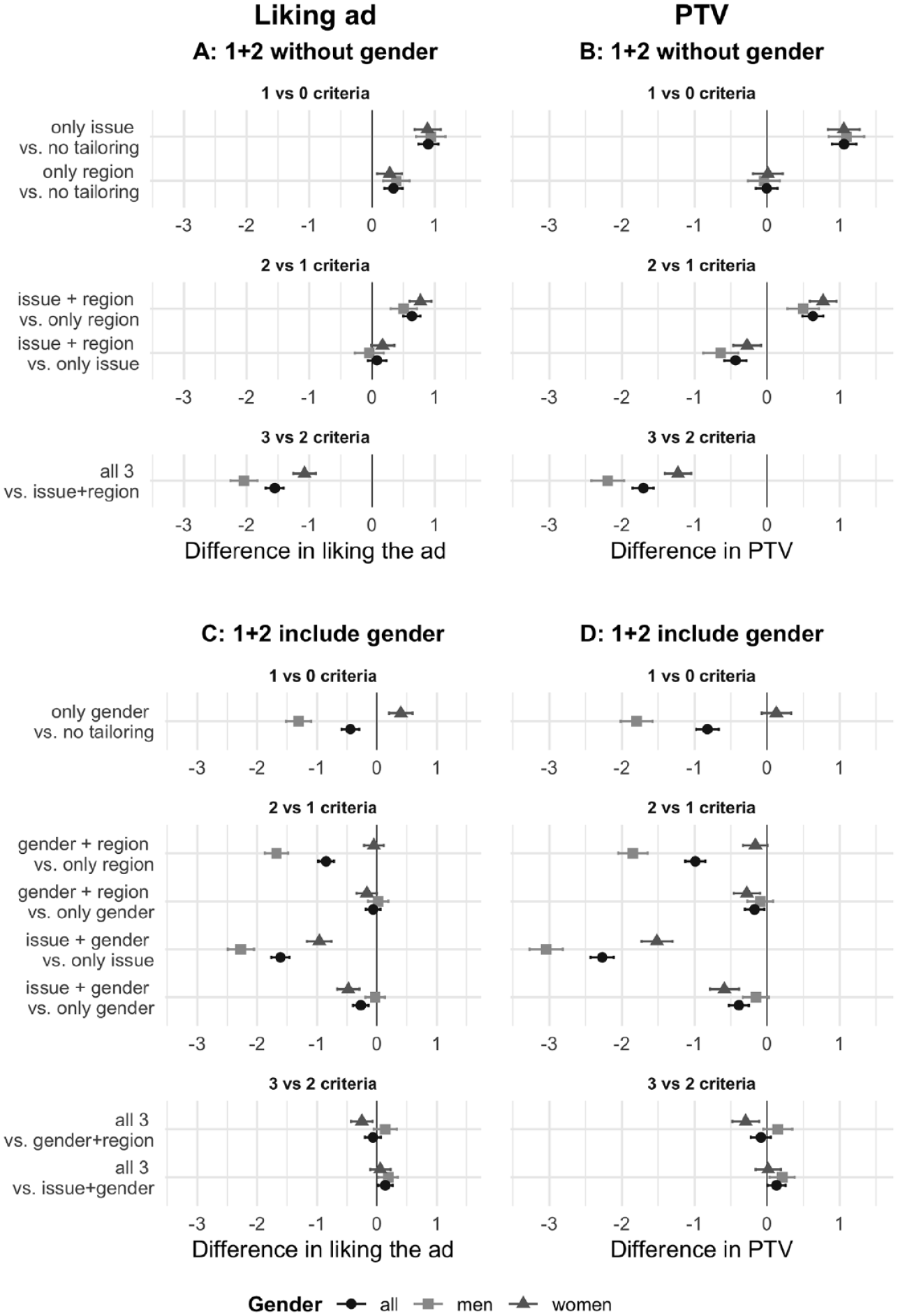
Differences in predicted values of like and PTV by tailoring type and gender.
I now focus on panels C(Like) and D(PTV), which plot those differences of the comparisons that do include gender tailoring in 1 or 2 criteria. Here, we see clear gender differences. The first facet (1 vs. 0 criteria) shows that while women react very similar to gender tailoring as to regional and issue tailoring (like is significantly positive, PTV has no significant effect), men react very negatively to gender tailoring. The effect for men is so substantive that even the contrast for all respondents is significantly negative. These gender differences are also apparent when comparing 1 vs. 2 and 2 vs. 3 criteria. Men react much more negative than women if gender tailoring is added to another aspect (only issue, only region). Still, both men and women clearly show a backlash effect (H1a): with a higher degree of tailoring, the impact of additional tailored criteria becomes negative.
Men’s negative reaction to gender tailoring could be due to the fact that advertising-specific policies that support men is much less common than for women. At the same time, in the actual campaign advertisements by German parties and their top candidates, which I referenced earlier (see note of Figure 1), targeting men is as common as targeting women (both 6% of all advertisements). I assume that in these cases, the tailoring was done with more implicit group-appeals (for definitions see Dolinsky 2023: 2). Additionally, these results could be due to a social desirability bias, as gender equality is highly lauded in Germany. 13 Therefore, gender tailoring clearly works differently for men. Future research should be mindful when stating the (positive) effects for “gender tailoring” while testing it solely on women.
Nevertheless, these sensitivity analyses show that the backlash observed in the main results is present for all respondents in all tailoring options that focus on the combination of issue and regional tailoring. It is additionally present for women if the tailoring includes gender, whereas for men, the punishment of tailored messages is always present (without an increase first) when the tailoring criterion is gender. Hence, the primary message of this article, that tailoring on many different criteria at once is not worthwhile but actually harms a message’s success, is corroborated in all types of the tested tailoring combinations. 14
Discussion and Conclusion
While tailored and targeted political messages are on the rise, we know little about their effects, with existing studies often producing conflicting results. In this article, I examined voter reactions to the tailoring of targeted messages, arguing that tailoring has both positive effects and the potential for backlash. Based on a factorial survey experiment, I showed that respondents like tailored messages more than generic ones, but this effect reverses when tailoring passes a turning point, becoming “too much.” This is true for both implicitly and explicitly tailored messages. While there is a particularly high backlash by male respondents getting messages tailored to their gender, the backlash is present for all respondents.
Contributions
This article contributes to the literature in several ways. First, I conceptualize and measure tailoring in a more nuanced way than has previously been done. While empirical research so far has distinguished tailored from nontailored messages (Chu et al. 2023; Endres 2020; Holman et al. 2015; Robison et al. 2021; Weber and Thornton 2012; Zarouali et al. 2022), parties can tailor the content of their campaign messages to various criteria at once. Based on marketing and communication literature (Aguirre et al. 2015; Boerman et al. 2017), I demonstrated that the effects of tailoring clearly differ when the degree of tailoring is manipulated.
Second, I show that using the more nuanced tailoring degree as measurement is important because highly tailored messages provoke a backlash effect. While the initial effect of tailoring is positive in most models, the success of a message decreases with higher degrees of tailoring. It seems, then, that voters appreciate the positive effects of tailoring messages to them in a low degree, such as providing more relevant information. However, recipients seem to recognize that highly tailored messages might be manipulative, and they turn away from party messages once the tailoring becomes “too much.” This is particularly the case if male respondents are targeted with messages tailored to their gender.
Third, I contribute to the scientific discussion of whether campaigns actually matter (Brady et al. 2006; Huber and Arceneaux 2007; Kalla and Broockman 2018). As Kalla and Broockman (2018) conclude, while campaign effects are often zero, they are most likely if campaigns identify specific groups of voters and send them specific tailored messages based on their preferences. I contribute to this finding and show that the individual effect of messages is often nuanced and differs depending on how much the ads are tailored toward the receiver.
For practitioners, this study shows that it does not seem worthwhile for political actors to invest resources in tailoring their messages too closely to their recipients. While a certain degree of tailoring increases a message’s success, there is a turning point after which voters become wary of the sending parties. Recent qualitative evidence has found that some practitioners have already learned this the hard way by receiving backlash on their tailored campaign ads and concluded that “one big thing that I’ve learned [. . .] is that there is a thing as too targeted, too segmented.” (Dommett et al. 2024: p. 87) and that fairly broad demographic categories are “typically very useful and very effective at everything you need to do. So why would you go further?” (Dommett et al. 2024: 88). In addition, the results about explicit tailoring show that adding transparency mechanisms does not alter the message’s success. Therefore, political parties need not feel threatened by the current debate about increased regulations of political advertising and targeting.
I thus have shown that it is important to base our scientific judgments of whether tailored ads “work” on studies that vary tailoring in various steps. That being said, this study was the first (to the best of my knowledge) in developing a survey experiment to test the impact of tailoring degree on ad success. Therefore, the limitations and findings of this study open up a research agenda to broaden our knowledge on this matter.
Limitations and Paths for Future Research
There are various avenues to extend this line of research in the future. First, future survey experiments can replicate and extend the current study. It is crucial to investigate perceived manipulation as the proposed mechanism behind voters penalizing highly tailored messages. While this mechanism was not directly tested (nor preregistered) in the current study, the experimental set-up is most suitable for this manipulation mechanism compared to the privacy or ambiguity mechanism. 15 Anecdotal evidence from a pretest confirms this, as several respondents noted that the ads were “manipulative,” “one-sided,” “lies and deception,” and “not credible,” but speak against the privacy or ambiguity mechanism. 16 The privacy mechanism could be investigated further through mediation analysis and using less overt tailoring methods. To directly test the ambiguity mechanism, future experiments could include messages that are as specific but less tailored.
Connected to this caveat is the neglect of party labels in the experiment. It is plausible to suggest that the manipulation mechanism proposed above might operate differently when real party labels are used because respondents do not approach hypothetical parties with preconceptions. Respondents might have employed certain tailoring criteria, such as gender tailoring, to infer the hypothetical party’s ideology, given the absence of other party cues. Consequently, replicating the experiment with party cues would offer future research additional avenues to unravel the factors contributing to voters penalizing parties that send highly tailored messages.
While I selected the three tailoring criteria with external validity and feasibility in mind, future survey experiments should vary the tailoring degree not only by the number of tailoring criteria but also by the type (and sensitivity) of personal data that is used (Boerman et al. 2017), for example, using different sociodemographic characteristics or more fine-grained geographical units (see Table 1 for suggestions). This should be combined with a control variable on group identities, that is, how attached the respondent is to the group that is used for tailoring.
There is a need to test if the findings hold in a comparative analysis across countries. Germany is an apt case to test the effect of tailoring messages by political parties in European multi-party parliamentarian systems. However, respondents from other countries might respond more positively or negatively to tailored messages, because Germans are particularly concerned about their privacy (Kozyreva et al. 2021), and the parties’ level of sophistication differs when using targeting techniques (Kefford et al. 2023).
Second, the puzzling effect of tailoring a message to gender in this study shows a need to develop new experimental designs that specifically test the differences in tailoring messages to different genders. I propose an experimental design where tailoring is less obvious, such as tailoring the message with implicit group-appeals (e.g., by including a photo showing men in the background instead of adding the word “men” to the message (see Dolinsky 2023: 2)).
Third, while I found the backlash effect of highly tailored ads in a survey experiment, it is important to replicate these results in observational data and/or a field experiment in a real campaign to gain further confidence in the findings.
Summary
To summarize, my findings leave us with a relatively positive stance in the normative debate about whether tailored messages are a threat to democracy. Voters seem capable of differentiating among different levels of tailoring and appreciate the positive aspects of tailoring, such as relevant information for them specifically. However, voters also seem to recognize the point at which tailoring goes too far and can also recognize the potential for manipulation.
Supplemental Material
sj-pdf-1-hij-10.1177_19401612241263192 – Supplemental material for How Much Tailoring Is too Much? Voter Backlash on Highly Tailored Campaign Messages
Supplemental material, sj-pdf-1-hij-10.1177_19401612241263192 for How Much Tailoring Is too Much? Voter Backlash on Highly Tailored Campaign Messages by Christina Gahn in The International Journal of Press/Politics
Research Data
sj-zip-2-hij-10.1177_19401612241263192 – Supplemental material for How Much Tailoring Is too Much? Voter Backlash on Highly Tailored Campaign Messages
Supplemental material, sj-zip-2-hij-10.1177_19401612241263192 for How Much Tailoring Is too Much? Voter Backlash on Highly Tailored Campaign Messages by Christina Gahn in The International Journal of Press/Politics
Footnotes
Acknowledgements
I thank Thomas M. Meyer for the generous resources and continuous support for this project. Also, I would like to thank Lisa Zehnter, Jóhanna Ýr Bjarnadóttir, Nicolai Berk, Tristan Klingelhöfer, Werner Krause, Anselm Hager, Markus Wagner and Florian Foos for their helpful comments on various previous versions of this manuscript. I want to thank all participants of the BGSS and EPSIP colloquia at the Humboldt Universität zu Berlin, and the 2022 MPSA and EPSA conferences as well as the anonymous reviewers for their valuable feedback and suggestions.
Declaration of Conflicting Interests
The author declared no potential conflicts of interest with respect to the research, authorship, and/or publication of this article.
Funding
The author disclosed receipt of the following financial support for the research, authorship, and/or publication of this article: Thank you to the Faculty of Social Sciences at the University of Vienna for financial support for proofreading the final manuscript.

Supplemental Material
Supplemental material for this article is available online.
Notes
Author Biography
References
Supplementary Material
Please find the following supplemental material available below.
For Open Access articles published under a Creative Commons License, all supplemental material carries the same license as the article it is associated with.
For non-Open Access articles published, all supplemental material carries a non-exclusive license, and permission requests for re-use of supplemental material or any part of supplemental material shall be sent directly to the copyright owner as specified in the copyright notice associated with the article.
