



Abstract
The expanding political role of Big Tech(nology) corporations has triggered concerns about the role of the media in holding corporate power to account. This study provides a comprehensive understanding of role dynamics between journalists and lobbyists toward the agenda for Big Tech’s responsibilities. Based on semi-structured interviews with European journalists (n = 15) and lobbyists representing large technology corporations (n = 15), we use professional role perceptions as a heuristic for examining the relationship of both actor groups in tandem. Journalists, who report an overlap of audience-focused with passive watchdog role ideals geared toward legislative accountability, interact with lobbyists, who assert a more concrete and active role perception. Journalists cautiously appropriate their normative watchdog role in accordance with the ideals of detachment and balance to maintain their own media legitimacy and access to an oligopolistic information environment. Remaining strategically sovereign over information, lobbyists perceive a strong mandate to establish Big Tech as a relevant stakeholder in the agenda on their regulatory accountability, but in mid of a perceived techlash, the majority of corporations avoid public attention. Both actor groups’ limited and off-the-record interaction reflects a defensive corporate stance, keeping their negotiation of Big Tech’s accountability off-stage. The technological and regulatory complexity of the information environment might render these corporations unfit for soft regulation by news media. We discuss implications for their co-dependence in the context of fast technological advancement and disruption of (corporate) mediatization processes.
Introduction
Recent years have witnessed growing concerns regarding the accountability of Big Tech(nology corporations) 1 in our societies (Napoli 2021a; Zuboff 2019). In their function as a fourth estate (Schultz 1998), the media critically scrutinize powerful actors (Bovens et al. 2014) and ideally build agendas around Big Tech’s accountability. While Big Tech’s legislative responsibilities challenge the European Union’s political agenda (Rone 2021), their extensive corporate lobbying activities toward European institutions (Bitonti and Harris 2017; Bank et al., 2021) render these corporations active actors with unprecedented power shaping this agenda. Given the intricate “tango” (Gans 1979) danced by globally operating tech giants (like Google, Facebook, and Microsoft) and the media (Neilson and Balasingham 2022), a growing body of research is concerned about journalists’ capacity to effectively scrutinize Big Tech (Napoli 2021a; Schwinges et al. 2023) and shape the agenda on their sociopolitical responsibilities in society (Jacobs and Schillemans 2016; Napoli 2021b).
Investigating the relationship between journalism and corporate lobbying is thus part and parcel of a comprehensive investigation into journalism–source relationships. Changes in media coverage on Big Tech over time (Schwinges et al. 2023) and increasing lobbying power (Popiel 2018) prompt us to zoom into these relationship dynamics. Despite the inextricable relationship between both actor groups (De Bruycker and Beyers 2019; McGrath 2007), previous studies have focused on one actor group at a time (see, e.g., Davidson and Rowe 2016; Donsbach 2008; Koch and Schulz-Knappe 2021; Lock and Jacobs 2023). We, however, argue that within a wider networked Fourth Estate (Benkler 2011), role perceptions driving these relationship dynamics are formed in relation to other actors in the media landscape (Hanitzsch and Vos 2017).
This article focuses on agenda-building dynamics between journalists and lobbyists within a networked Fourth Estate (Benkler 2011). Professional roles (Donsbach 2008; Koch and Schulz-Knappe 2021) are employed as a heuristic for examining how both actors relate to each other in the process of building the agenda regarding Big Tech (Cobb and Elder 1971). We discuss empirical evidence from semi-structured qualitative interviews with European journalists routinely covering Big Tech (n = 15) at both national and European levels, on the one hand, and lobbyists working in the technology sector (n = 15), also engaging in corporate advocacy work at both national and European levels, on the other. Our unique focus on both actor groups reveals intricate and relational roles embraced by both actor groups and highlights their disruptive potential to corporate mediatization, thus positioning the relationship of journalism and lobbying as pertinent for understanding Big Tech’s accountability agenda. Our findings extend beyond Big Tech and are pertinent to journalism’s role and accountability in a rapidly evolving digital era dominated by oligopolistic structures of powerful transnational corporations. These insights are critical for technological governance (Napoli 2021b), the integrity and autonomy of the media (Ferrucci and Eldridge II 2022), and a healthy democracy in the European Union and beyond.
Building the Agenda on Corporate Accountability
This study investigates the relationship between journalists and lobbyists in putting Big Tech’s accountability on the agenda. We understand accountability as a relational concept itself, describing “a relationship between an actor and a forum, in which the actor has an obligation to explain and to justify his or her conduct, the forum can pose questions and pass judgment, and the actor may face consequences” (Bovens 2007: 447). Journalists and corporate actors are thus entangled in a close relationship to hold these corporations accountable, either communicatively in form of corporate information disclosure and transparent stakeholder engagement when technological opacity prevails (Napoli 2021a) or consequentially in form of regulatory sanctions. Unlike legislative regulators, the media lacks formal mechanisms to impose sanctions in the aftermath. Nevertheless, as corporate mediatization advances (Ihlen and Pallas 2014), media coverage can profoundly impact how stakeholders perceive corporate reputation (McCombs 2005). In turn, the media’s crucial role in managing relationships of lobbyists with policymakers has rendered corporate interests particularly well represented in the media (Binderkrantz et al. 2015), while enabling public scrutiny (Ihlen and Heath 2018).
Agenda building, a perspective sporadically applied to watchdog or accountability journalism (Denham 2010), offers a framework to comprehend how journalists and corporate strategic actors advocate for specific elements of corporate accountability, aiming to shift issues from their agendas to those of policymakers (Cobb and Elder 1971). The intricate tango (Gans 1979, p. 116) between the media and their subject of scrutiny is a well-explored concept. Scholars have extensively discussed the journalistic reliance on “information subsidies” (Gandy 1982) to highlight specific “issues of public concern” (Weaver and Elliott 1985: 88) but advocate reexamining the link between the press and lobbyists to better capture the evolving media landscape (Kim and McCluskey 2015; McGrath 2007). This is particularly pertinent in understanding the intricate power dynamics in today’s complex and opaque information environment (Denham 2010; Napoli 2021a). Amid the challenge of regulatory accountability keeping pace with technological innovations (Helberger 2020; Taylor 2021), the interplay between news media as an alternative accountability mechanism and corporations as subjects of scrutiny and emerging news actors (Corporate Observatory Europe 2021; Dutton and Dubois 2015) is peculiar. Agendas are a continual negotiation between the media and their sources of information (Reich 2006), often shaped by a collective process of merging and clashing media and corporate agendas (Denham 2010).
Building on the traditional critical-monitorial function of the media as the Fourth Estate (Schultz 1998), Benkler (2011) introduced the concept of an expanded networked Fourth Estate. In this networked, pluralistic notion, a new set of collaborative news actors is introduced, ranging from an increasing audience orientation toward citizens as a Fifth Estate (Dutton and Dubois 2015) to technologies that “fill the role that in the 20th century we associated with the free press” (Benkler 2011). As the European Union deliberates on substantial policy measures to regulate the unparalleled influence of Big Tech in society, there has been an unmatched increase in lobbying activities by these corporations (Bank et al., 2021), positioning lobbyists as notable but often less visible players in the networked discourse on Big Tech’s accountability. Lobbyists’ power to shape public opinion formation via the media is predicated upon, among other factors, their newsworthiness as elite actors (Galtung and Ruge 1965) and public affairs activities related to but also reaching beyond tech policy (Popiel 2018). Thus, the concept of an expanded networked Fourth Estate proves indispensable for understanding the complex relational dynamics between both actor groups, emphasizing lobbyists as collaborative news actors and their pivotal role in shaping agendas.
Considering this more collaborative approach, we introduce professional roles as a key element of understanding the relationship between journalists and lobbyists representing large technology corporations in co-constructing the agenda on Big Tech’s accountability. This focus provides a lens to examine the perceptions, motivations, strategies, and interactions shaping the agenda on Big Tech’s accountability—particularly crucial as the nature of their relationship innately connects to the quality and independence of journalism (Neilson and Balasingham 2022).
Professional Roles in the Agenda-Building Process
We use professional role theory as a theoretical lens to uncover relationship dynamics between Big Tech and the media. Role perceptions, that is, perceived expectations of a role in society, inform how professionals execute their role (Mellado 2020) and are indicative of professional legitimacy (Hanitzsch and Vos 2017). These role perceptions are nested within and are a crucial driver of the relationship between the media and other actors (Shoemaker and Reese 1996).
Looking at the actor group of journalists, previous evidence supports the strong embrace of a detached watchdog role (i.e., passive scrutiny of those in power) toward corporations (Starkman 2014; Strauß 2022). In the digital era, journalists need to navigate technological and transnational regulatory complexities (Napoli 2021a) despite often being found to lack expertise (Damstra and De Swert 2021), unwilling to challenge the neoliberal paradigm (Usher 2017), and accepting of the ubiquity of tech power (Creech and Maddox 2022). In news coverage on Big Tech, the watchdog role has emerged through a diverse and changing set of practices over the years (Schwinges et al. 2023), indicating that driving role ideals remain dynamic and ambiguous.
Professional roles are inherently relational to reference groups (Hanitzsch and Vos 2017), and so lobbyists become the second focal point of this study. Lobbyists represent corporate interests and pursue political influence (De Bruycker 2017), increasingly also via the media due to its expanding role in engaging policymakers (Trapp and Laursen 2017). Previous studies have uncovered a diverse set of different role perceptions that guide lobbying practice, ranging from assisting policymaking and bridging society and politics (Davidson and Rowe 2016) to aligning different interests as mediators or advisors (Koch and Schulz-Knappe 2021). 2 Lobbying, a profession often mired in controversies over its societal role (Lock and Seele 2016), faces heightened scrutiny, particularly in the context of the “techlash” experienced by social media companies (Weiss-Blatt 2021). This shift toward a tech-dystopian outlook prompts professionals in the industry to reassess their role understanding, especially concerning sociopolitical issues like corporate data collection, privacy concerns, and consumer autonomy (Zuboff 2019). This process might involve adapting existing moral standards to renegotiate legitimacy and enhance accountability to the public (Falasca and Helgesson 2021; Taylor 2021).
Against the backdrop of globally operating corporations in virtually all aspects of contemporary life, both actor groups may exhibit heterogeneity that leaves concrete beliefs and practices driving their relationship dynamics rather ambiguous, understudied, and a challenged normative position. Examining role perceptions is thus a first step to understand the relationship between both actor groups:
In the networked Fourth Estate influenced by media’s reliance on corporations and their technology (Benkler 2011; Neilson and Balasingham 2022), the collaboration between journalists and public affairs practitioners plays a crucial role in shaping the agenda. These relationship dynamics may vary based on distinct roles, with journalists navigating a delicate balance between pushing for investigative autonomy (Napoli 2021a) and being pulled into collaborative efforts due to considerable corporate opinion power that shape our dominant understanding of the Silicon Valley and beyond (Helberger 2020). We ask:
Method and Materials
We conducted semi-structured qualitative in-depth interviews with journalists (n = 15) and lobbyists (n = 15) working in the European Union. Sensitizing concepts were used to organize the semi-structured interview guide into three parts (see Supplemental Information File). We connected questions about interviewee’s role perceptions (RQ1) and relationship to one another (RQ2) with an in-depth reconstruction of the “biography” (Reich 2006) of one news article authored by the journalist or policy issue overseen by the lobbyist, respectively. For the purpose of this study, we used these reconstruction elements to make role perception and practices more tangible. Especially in context of normative societal roles that are not always met in practice, this allowed us to avoid pitfalls and social desirability bias usually posed by self-reports (Ryfe 2020). More specifically, we asked interviewees on how they conceptualized their professional roles, perceived societal contributions and purposes, and normative expectations and responsibilities. Further, we inquired into the frequency and nature of the (perceived) relationship between journalism and lobbying.
Sample
This study focuses on the European Union policy process, specifically examining professionals from both actor groups involved in Big Tech matters, guiding our sampling approach. For both actor groups, we sampled organizations in countries according to their economic and political importance for the public debate on Big Tech’s accountability in society: for example, Germany as a forerunner in regulating technology corporations, and Ireland and the Benelux states as a host of European corporate headquarters of some large technology firms. This includes a focus on Brussels, where major legal regulatory policy files are currently discussed. While it is not this study’s objective to delve into a cross-national comparison, our country selection allows to uncover the relationship between the media and transnationally operating corporations within the complex European policy landscape.
We followed a purposive and snowball sampling strategy to identify two specialist target groups spanning a large variety of professionals along types of media, types of organizations, range of distribution (print and online), (trans)national audience, departments, as well as socio-demographics (see Table 1). Constructing a potential interviewee pool involved analyzing technology-related news coverage and contacting authors. In total, we reached out to 105 journalists, with 15 journalists working for national and European outlets agreeing to participate (14% response rate).
Sampling Overview.
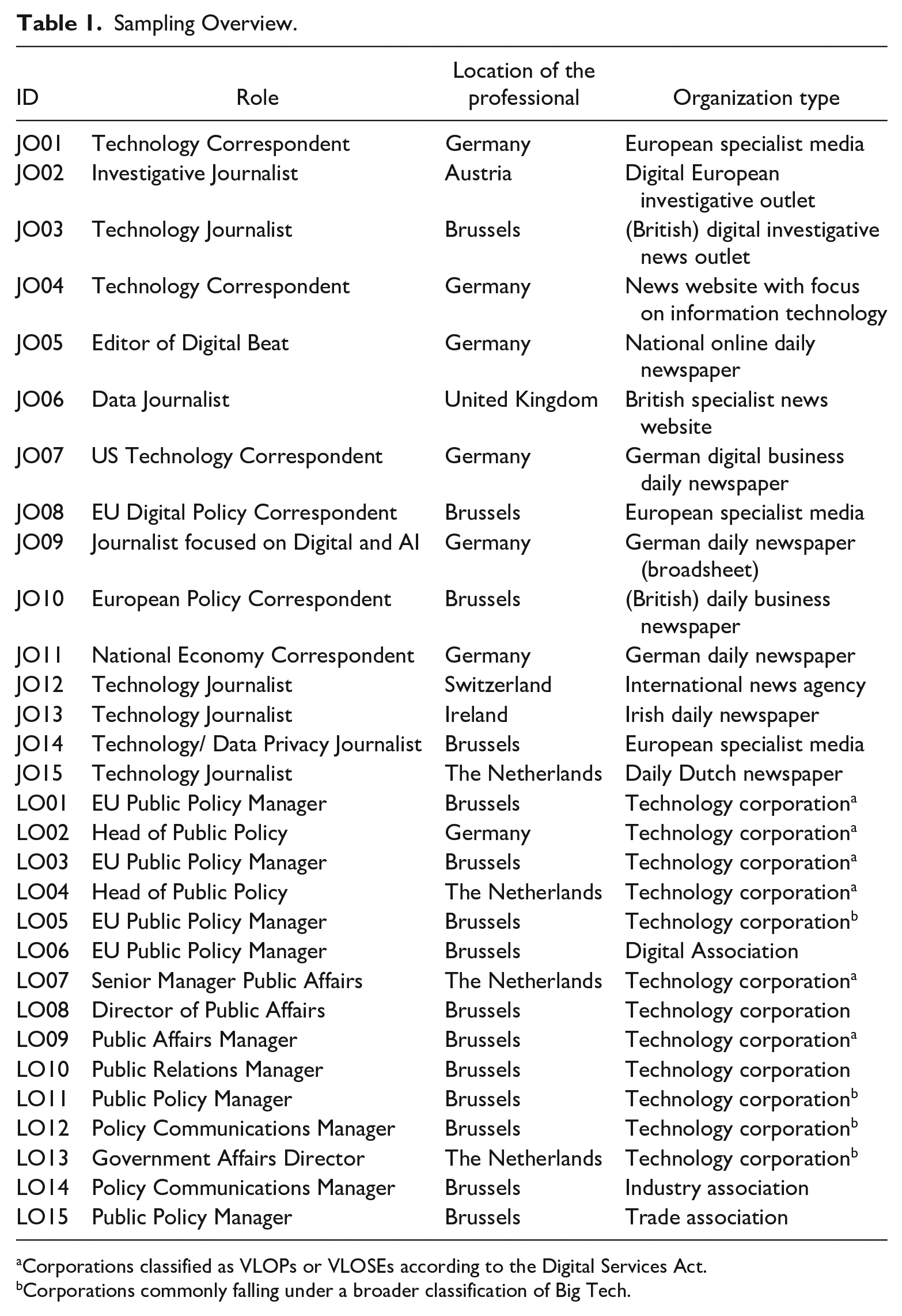
Corporations classified as VLOPs or VLOSEs according to the Digital Services Act.
Corporations commonly falling under a broader classification of Big Tech.
Our second target group comprised lobbyists working for large, globally operating technology corporations, and industry/trade associations representing these corporations. We didn’t strictly adhere to a nomenclature for sampled companies. Although we acknowledge variations in business models and offerings among those commonly labeled “Big Tech,” their comparable status and financial investments in European lobbying are noted (Popiel 2018). We approached respondents who had experience working for large technology companies frequently featured in debates around the regulation of technology corporations, data privacy, artificial intelligence, and the role of social media in democracies. Utilizing publicly available information, we contacted 123 lobbyists and ultimately interviewed 15 practitioners working on national and majorly European Union level (12% response rate).
Both target groups were relatively small, necessitating a broad description of the sample to protect participant anonymity. We faced a rather small response rate in both actor groups due to concerns about privacy, time constraints, and potential negative representation. Prior to the interview, participants were informed about their rights and signed an informed consent form. Most interviews, conducted between August and November 2022, took place via videotelephony platforms, either in English or German, lasting between thirty-five and ninety-nine minutes, with an average duration of fifty-five minutes (fifty-eight minutes) for journalists (lobbyists). All interviews were recorded and transcribed, and quotations used in this paper were submitted to interviewees for factual accuracy.
Data Analysis
We employed a systematic and iterative thematic approach to data analysis (Clarke and Braun 2013), complemented by steps outlined by Gioia et al. (2013) to ensure scholarly rigor. This meant that prior literature knowledge guided our analysis to a limited extent, but an inductive reading of the transcripts allowed for themes to emerge. After a first thorough read of the transcripts, we used Atlas.ti as an organizational instrument to assign open codes. Ninety-nine first-order codes provided a first broad categorization and followed informant-centric terminology. In a second order analysis, we entered back into a more theoretical realm and identified thirty-three second-order categories that still considered the informant knowledgeable to explain their perceptions (Gioia et al. 2013). In a third step, we further aggregated second-order concepts into sixteen “aggregate dimensions” based on evaluative conclusions. Here, we abandoned the informant-centric perceptual lens and evaluated how these findings contribute to our understanding of the role of media and lobbying in holding Big Tech accountable. Exemplary quotes will be presented to illustrate our results, with additional quotes available in the supplementary information file.
Findings
Analyzing interview data from both journalists and lobbyists provides a unique tandem approach, revealing concurrent themes among the two professions and their role dynamics. See Figure 1 as an exemplary data structure that formed the basis for our analysis (refer to the Supplemental Information File for full data structure). In the following, we demonstrate insights from journalists and lobbyists in parallel.
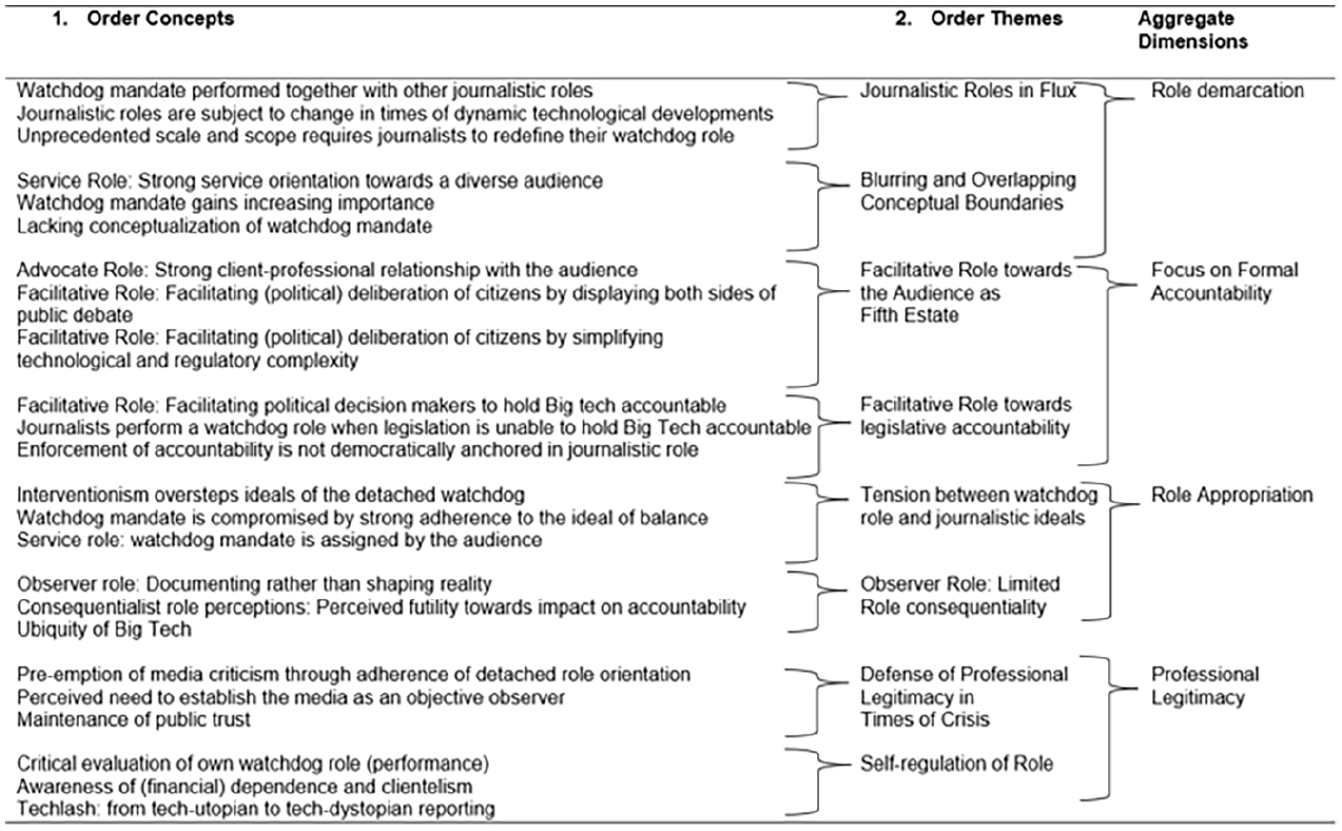
Data structure resulting from interviews with journalists (RQ1).
Role Perceptions (RQ1)
Broadly, role perceptions of both journalists and lobbyists (RQ1) pertain to differences in their respective role demarcation, a prominent focus on formal accountability mechanisms, an appropriation of role perceptions, and efforts to maintain legitimacy (see Figure 2).
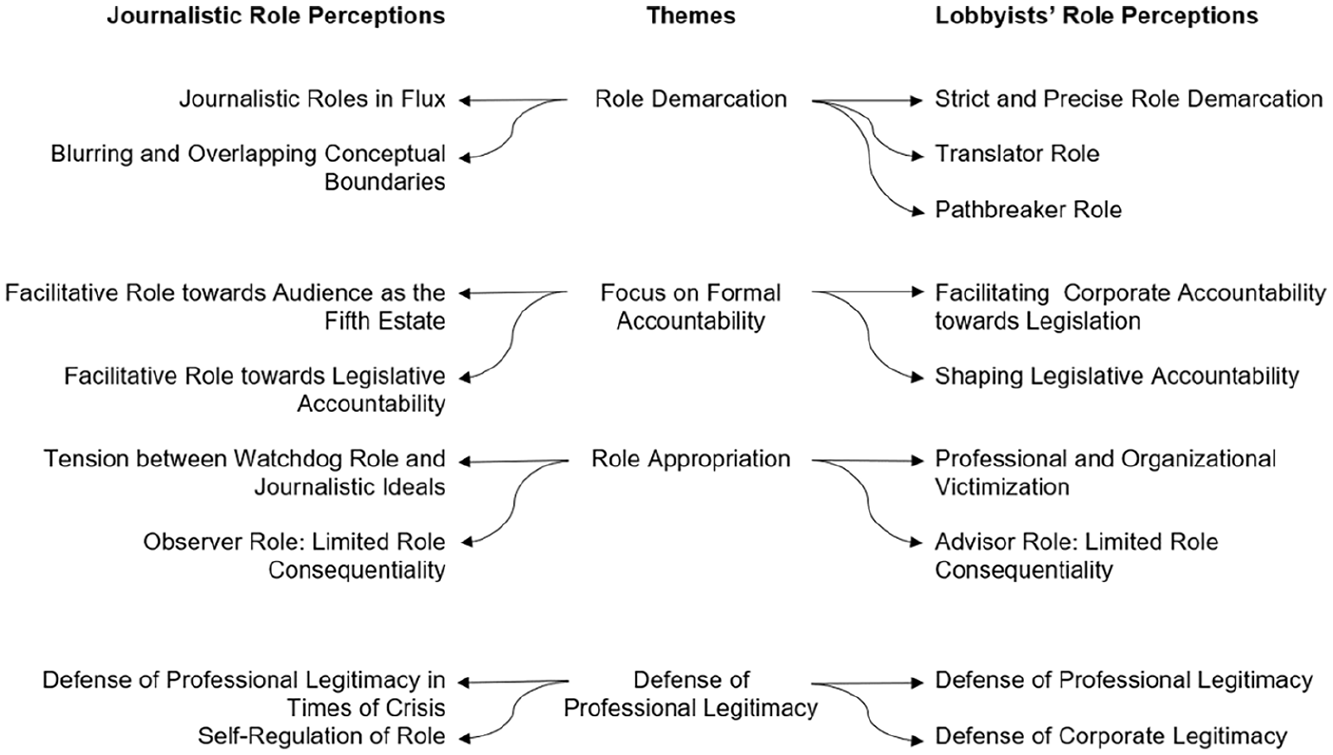
Role perceptions of journalists and lobbyists (RQ1).
Role Demarcation
Journalists are not unanimous in picking up the watchdog role label, hesitant to call their work “proper watchdog journalism” (JO13). The ideals and practices of the watchdog role are performed alongside other journalistic roles and undergo changes during dynamic technological developments:
So in an ideal world, we’re all watchdogs all day. We’re just watching and holding everybody accountable. But you also have other roles. (JO15)
Given Big Tech’s unprecedented status, journalists must redefine their role to hold these corporations to emerging, higher standards (JO12). Amid conceptual role boundary overlaps, journalists grapple with aligning journalistic ideals of providing information, informing citizens, and monitoring elites with concrete practices:
I don’t know if I write about the new privacy rules of TikTok, for example. Is that watchdog journalism or is that just helping parents to know your daughter or your son is on TikTok? (JO15)
The blending of watchdog journalism with audience-focused roles on one side of the tandem sharply contrasts with the clear and rigid role distinctions observed among lobbyists. This “pretty strict division of labor” (LO03) still allows for close interactions among both professional orientations (LO01) and clearly defines the “the classic PA work” (LO06).
Lobbyists perceive two concrete roles. As translators, professionals see their role as translating technologically and regulatory complex realities into accessible language (LO14) and actionable legislation/regulation (LO09). Resembling a boundary spanner (Aldrich and Herker 1977), one professional (LO07) likens their role to an antenna, connecting the inner workings of the corporation with its environment. Similar to journalists, lobbyists also reported to face the unprecedented societal involvement of the corporations they worked for. In the role of a pathbreaker, they defined their role as assisting corporations to find and define their societal role toward policymakers (LO13), providing practical direction to the legal assumption of corporate responsibilities (LO04), and navigating the “gray zones” (LO14) within a complex public sphere.
In conclusion, the exploration of role demarcation underscores the meeting point between both actor groups, revealing significant disparities in the clarity and definition of the role ideals and expectations guiding their actions. Notably, a pronounced distinction emerges in the extent to which each group prioritizes audiences, users, and consumers, as also seen in the next theme.
Focus on Formal Accountability
Both actor groups exhibit a strong facilitative role toward formal accountability processes. Journalists exhibit a strong service orientation toward the audience, assuming a facilitative advocate role in fostering (political) deliberation among responsible citizens (JO04) and presenting a critical public debate: “it’s also not for me to decide. Sometimes I just have to reflect on what the arguments of both sides are and then the reader can make his or her own mind up” (JO01). In this facilitative advocacy, the audience is entrusted with holding Big Tech accountable, supported by the journalist who questions the watchdog role’s significance if not heeded: “What’s your role as a watchdog if nobody cares about you if you bark” (JO15)? Second, journalists see their facilitative role extending to enabling legislative accountability by assisting political decision-makers. However, they acknowledge that enforcing Big Tech’s accountability lies outside the democratic scope of the journalistic watchdog role, emphasizing a supportive function (JO06).
It comes as no surprise that lobbyists also largely focus on formal accountability as anchored in the law. Professionals articulated a dual role: first, facilitating corporate accountability toward legislation, described as “getting from an abstract rule and turning that into implementation” (LO01), posing an unprecedented challenge due to Big Tech’s scale and scope (LO02). Second, professionals embraced an expert role in shaping legislative accountability by elucidating corporate positions to policymakers (LO05), fostering “balanced decision-making” (LO13), and fulfilling their democratic role of ensuring government politicians have crucial information (LO07).
To summarize, this theme showed that the understanding of accountability in both actor groups was restricted to corporate compliance with legislation. While journalists formulated a predominantly passive role, providing little space to help citizens navigate the topic’s complexities, lobbyists perceived a more active and guiding role orientation in shaping Big Tech’s accountability.
Role Appropriation
This theme may offer an explanation as to why both actor groups did not formulate a more active role. Journalists perceived their watchdog role to stand in tension to the ideals of balance and detachment, and a more interventionist orientation seemed to overstep these ideals:
If in a personal capacity, I think crypto currencies, crypto assets, I think they’re terrible. [. . .] But as a journalist, I don’t project that attitude into the writing. What I am prepared to do is foreground the evidence that has made me feel that way. (JO06)
Simultaneously, journalists perceived an observer role with limited consequentiality: “So to really think that [they] could now hold Google responsible seems a bit daring to [them]” (JO11). Reasons for this perceived futility was the pervasive power of Big Tech, as neither journalists as watchdogs nor politicians were seen to become independent from Big Tech’s platforms, products, or services: “of course [. . .] I google” (JO05). These perceived limitations prompted some journalists to outright reject the watchdog label or tentatively acknowledge that this role was “limited to ten questions” (JO13).
On the side of lobbyists, public distrust toward their corporations was faced with professional and organizational victimization. Professionals unanimously spoke of negative perceptions of their role (LO03), accusations of being a “bad lobbyist” (LO02), and skepticism of “even the fact that you were approaching the media or trying to change the public discourse” (LO01). While these negative connotations were rejected (LO08), lobbyists experienced a compromise of their role and expressed the need to “be so careful” (LO01). This led professionals to formulate the role of an advisor in the policy process (LO02, LO06, LO13). Meanwhile, they agreed that oftentimes, people would “think that companies have more power than they do” (LO13), but eventually, it would not be “[the company’s] decision to make” (LO02).
In sum, our interviews revealed how lobbyists aim to provide active guidance in the navigation of technological and regulatory complexities while journalists appropriated their watchdog function in alignment with journalistic ideals, leaving audiences to navigate technological and regulatory complexities themselves.
Defense of Professional Legitimacy
Both actor groups expressed concerns about their professional legitimacy. Journalists situated their role within current debates on the media’s legitimacy and trust (Newman et al. 2021). Reflecting on instances where the media had adopted a more supportive role toward Big Tech, some journalists admitted embarrassment and embraced a self-critical stance for having overlooked significant developments (JO15, JO02). Journalists emphasized the risk of corporate clientelism in the tech industry (JO13), highlighting the importance of maintaining credibility with the audience by upholding journalistic standards (JO04). Consequently, journalists self-regulated their role, adhering strictly to journalistic ideals of balance and detachment.
Similarly, lobbyists defended their legitimacy on organizational and professional levels. Referring to a “bad perception of big tech lobbying” (LO06), they described their role as “a cornerstone of democracy,” especially since their work would shape “civil society as a whole” (LO15) and their engagement with policymakers would mean they are talking to “the user base, essentially the people who are using [their] employer as platforms” (LO03). Emphasizing moral and pragmatic legitimacy, lobbyists underscored the public interest in their work, transparency in their lobbying activities, and the regulation of their profession (LO05, LO15).
In conclusion, journalists strive to address the media’s legitimacy crisis by prioritizing credibility and upholding journalistic standards, while lobbyists defend their legitimacy through emphasizing their role in corporate interest representation and shaping civil society. Overall, professionals in both groups prioritize the societal standing of their own professions over holding technology corporations accountable.
Relationship Dynamics (RQ2)
Sticking with the tango metaphor often used in literature to discuss journalist-source relationships (Gans 1979), the interaction between both actor groups (RQ2) takes place as a dance off-stage, where information access sets the rhythm, a strategic relationship management among both actor groups, all above resulting in both journalists and lobbyists refusing to claim the lead (see Figure 3).
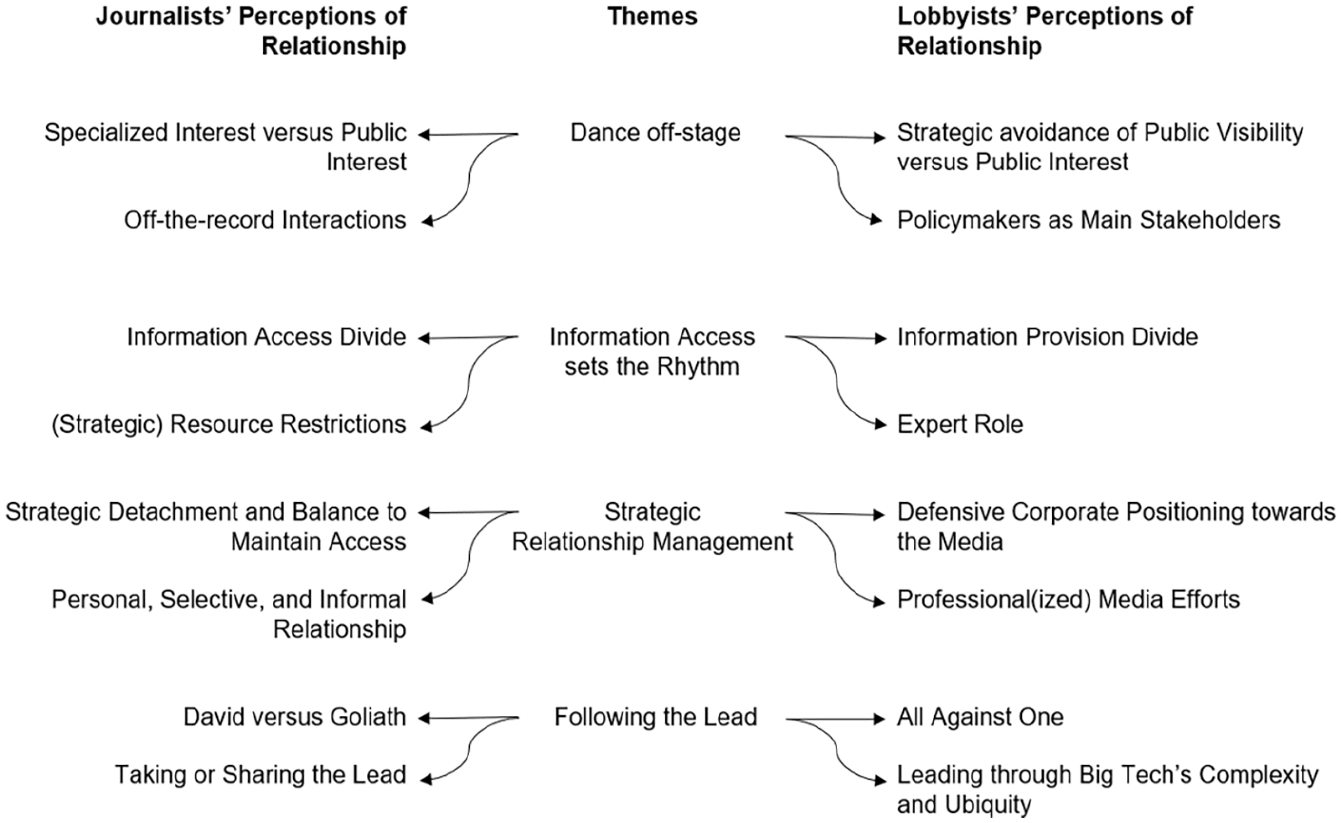
Perceived relationship of journalists and lobbyists (RQ2).
Dance Off-Stage
Interaction among both actor groups takes place off-stage. Journalists agreed that Big Tech’s pervasiveness warranted public interest in general, and news stories would “often lead [. . .] to front page stories because it is a battle of giants” (JO10). However, especially the regulatory accountability of technology corporations was deemed of specialized interest, due to it being “a really difficult topic” (JO01) with “often a lot of new terms that journalists also have to understand” (JO07). Public knowledge and interest in specific details was considered low:
I think if you did a survey around Europe about who knows that this big content moderation law is coming up [. . .], I think people wouldn’t even know what the DSA [Digital Services Act] is. (JO14)
Another aspect that drove this public negotiation of accountability into the closet and stripped news stories off their “human face” (JO02) was the inability to take “off stage” reporting without “great lighting, no cameras” (JO02) on-the-record. Even if speaking to lobbyists on-the-record, lobbyists could “only give you the company line, which is something that somebody in Silicon Valley sends over,” without “much leeway in how they translated it” (JO02). Due to a strict role demarcation of corporate lobbying roles, interaction with lobbyists was often described as taking place informally and unofficially.
Lobbyists confirmed a predominantly off-the-record relationship. A rigid role demarcation, involving “strict rules in terms of when [they] can or cannot talk to the media as a policy person” (LO03), was emphasized. Despite asserting that the public is not a stakeholder (LO02, PA05), professionals admitted to occasionally circumventing this strict role division to provide substantive knowledge to journalists. Broader public visibility was strategically avoided, reasoned with the topic being “too abstract, too legalistic too far away from the actual customer day-to-day experience” (LO01) and the preference to communicate policy goals rather via trade associations with “bigger likeability” (LO04).
In conclusion, technological and regulatory complexities, public distrust, and simply Big Tech’s oftentimes transnationally organized hierarchical structures push a public negotiation of their accountability off-stage. Their on-stage performance leaves an incomplete picture, while their interaction behind the curtains evades public scrutiny and accountability.
Information Access Sets the Rhythm
We found grave differences based on the geographical location of media outlets. Journalists based in Brussels reported frequent points of contacts with lobbyists, whereas journalists working for national news media predominantly stood in contact with Big Tech through their public relations activities only. Additionally, journalists contrasted the transnational ubiquity of Big Tech (JO12) that provided journalists with “a lot of ground to cover” (JO08) with their limited and strategic use of financial resources (JO07), always with future access to sources in mind: “you won’t waste it because by wasting it’ll be more much more difficult for you to access them in future, you know?”(JO13). Journalists navigated a complex information environment shaped by a lack of transparency, and attended industry events, monitoring public records, and engaging in direct communication with lobbyists to gather accurate and up-to-date information (JO02, JO08).
In turn, lobbyists confirmed the accessibility divide among Brussels-based professionals who reported frequent meetings with journalists (LO06) in their network (LO07) and “in a community of people that are working on the same topic” (LO15). In an expert role, information was provided to journalists as “the media is already talking about the law, so we want to at least make sure that they have the background” (LO01). The media were seen as a medium to reach policymakers (LO03) who exhibited a “lack of expertise” (LO09) on technologically complex policy files, and thus as a means to establish lobbyists as experts (LO10) and “the party to talk to” (LO07). However, lobbyists strategically created an informal and exclusive “network of people” (LO07) they wanted to work with and, in more media-facing roles, positioned themselves as the exclusive contact authorized to engage with journalists (LO12, LO10).
All in all, our interviews showed how information access determined the rhythm of both actor groups in the tango around Big Tech’s accountability. On one side, insights revealed a journalistic dependence on information access; on the other side, a strategic information sovereignty of lobbyists.
Strategic Relationship Management
Journalists were found to strategically manage their relationships. Worried about future access to corporate sources (JO13), journalists reported to use a detached style in their reporting in order to maintain access and position (JO13). This dependency was described to be “reality,” whereas in an “ideal world, it shouldn’t be” (JO06) and would put the journalist in “fear” (JO13). In Brussels, the relationship among journalists and lobbyists was described as a personal, selective, informal often times long-lasting “partnership” (JO11, JO12). Journalists reported that it would be “a lot about chasing documents and knowing when is the next step, when you can ask for the documents at the right time to the right person” (JO08), especially to uncover leaked documents (JO02) or background information on policy files (JO03).
While lobbyists confirmed a “decent relationship” (LO01) with journalists, our interviews revealed a strategic avoidance of media attention: “I would be honest in saying that oftentimes we’re trying not to attract media attention” (LO03). Reputational threats against the well-known corporate players in the industry (LO09) and the strict role division making on-the-record interactions with journalists a “fireable offense” (LO03) were named reasons for corporate media efforts to focus on staying off-stage. The media efforts showed a high degree of professionalization, as lobbyists knew “how the news cycle works” (LO14) and would “need the media, so we need to work with the media and our role is to provide them” (LO14).
In summary, the relationship between both actor groups was approached strategically, with journalists leveraging insider knowledge to acquire information beyond the company line and lobbyists demonstrating professional media knowledge and strategic efforts to use the media to their advantage.
Following the Lead
Neither actor group outwardly claimed power over the other. Journalists perceived a David versus Goliath scenario and showed to be puzzled by the disproportionate amount of news coverage on Big Tech as a whole, a predominant focus on “what does this mean for Big Tech?” (JO03), and a majority of reporting taking place “on the home turf of the tech companies” (JO02). Public interest in Big Tech rendered the largest corporations in the tech sector newsworthy and news coverage inevitable: “if we don’t do it, 300 others will. So no one will forget Apple just because [news outlet] doesn’t write about it” (JO05). Nevertheless, once gained access to information that went beyond “the company line” (JO02), journalists perpetuated this oligopolistic interest representation. Divided on their ability of taking the lead, they contrasted their dependence on expert information access (JO03) with their “huge impact on the way that shareholders would perceive these companies or the way the general public would perceive these companies” (JO10). This ability to shape citizens’ behavior was seen to provide a “mixed picture” (JO10) as “sometimes you [would] see headlines about damning things that these companies do. But, you know, Apple is selling every quarter” (JO10).
In the meantime, lobbyists saw critical scrutiny as “totally legitimate” (LO01), as
there’s a really important role for them to play because like when companies step out of bounds, if the regulator hasn’t sort of caught them, like there’s a role for the media to hold companies accountable. (LO03)
Media engagement was described as a “cost benefit analysis” (LO03) and professionals denied strategic advantages: “a big problem there is indeed, that the other side often has less money to have an equal voice. That is somewhat mitigated by the fact that nobody really wants to hear from the big guys” (LO12).
All in all, this theme revealed how neither actor group claims to take the lead in their relationship. Proud of their societal mandate, journalists perceive an underdog position toward tech giants, while lobbyists perceive vulnerability as goliaths in the tech industry.
“Brussels Bubble” Versus National Media
Some noteworthy differences, while not a key part of the analysis, emerged in the analysis. Emerging themes are crucially defined by the work location of the professional (Brussels versus elsewhere) and the target audience of the journalistic outlet (specialist and European versus generalist and national). The close relationship dynamics within a specialist “Brussels bubble” (JO14, LO06, LO05, LO11) and “community of people that are working on the same topic” (LO15) indicated a certain camp feeling among both actor groups and involved journalists strategically cultivating informal relationships with their sources. Journalists took an active role (JO02) and utilized lobbyists as experts and off-the-record sources of information (JO02, JO08, JO10, JO14), pushing beyond the company line. However, this relationship dynamic remains opaque and lacks transparency. Outside this bubble, a tamer watchdog role perception prevailed (JO12, JO01, JO06), and journalists relied on transparent and on-the-record sources of information actively provided by corporations (JO01, JO05, JO11), while lobbyists did not necessarily push for a presence on the national generalist media agenda (LO01, LO02) and instead pulled their corporations out of public attention.
Discussion
Our study examined role perceptions as a heuristic to explore the relationship of journalists and lobbyists in a unique tandem. Insights highlight the complex, evolving—and at times starkly differing—roles perceived by journalists and lobbyists that shape their dynamics in putting Big Tech’s accountability on the agenda.
A strong divergence in role perceptions lies in their prioritization of audiences. Journalists increasingly combine ideals with other audience-focused roles, aligning with the shift toward solutions-oriented journalism that empowers audiences to engage as civic actors in democratic processes (Thier and Namkoong 2023). While both actor groups perceive an active role in shaping the agenda on Big Tech’s legislative accountability, both journalists and lobbyists perceive this to be of specialized interest only. Journalists view their role primarily as facilitative, aiming to trigger or amplify corporate accountability (Jacobs and Schillemans 2016). However, they hesitated to extend beyond their critical monitorial role and offer active guidance toward solutions (Thier and Namkoong 2023). This detached role leaves policymakers and the public to navigate technological and regulatory complexities without active assistance, pushing reliance on corporations to shape the narrative of Big Tech’s accountability. Lobbyists, avoiding public accountability, primarily focus on policymakers and assert an influential role in determining the extent to which corporate transparency should be integrated into corporate accountability. This mutual hesitancy may signal a shared reluctance to delve into robust accountability reporting, potentially impacting corporate transparency and public awareness of Big Tech’s responsibilities.
The reluctance to embrace public accountability is reflected in the concealed interaction dynamics and restricted information accessibility, limiting the media’s capacity to propel Big Tech’s accountability onto the agenda. Restricted and off-the-record interaction with the media hinders a transparent understanding and public participation of corporations in the discourse around their responsibilities. Striving to display a balanced public debate, Big Tech is perceived as particularly newsworthy and important stakeholders, pulling journalists to include them as sources wherever possible. Lobbyists wield control over substantive information, and when granted access, journalists, albeit critically evaluating the provided information, rely on these opportunities, viewing these as rare glimpses behind the scenes. Despite a shift toward a more pluralistic accountability mechanism (Dutton and Dubois 2015), citizens still heavily rely on the monitorial role of news media as a Fourth Estate (Schultz 1998) and the media’s access to this complex information environment. A pattern of interest representation biased toward large business interests (Binderkrantz et al., 2015) is perpetuated through the relationship dynamics between the two actor groups. This opaque relationship may result in an agenda that depicts a distorted representation of these companies, potentially compromising media impartiality and eroding public trust, ultimately undermining democratic principles reliant on an informed citizenry (Benkler 2011).
Further, a perceived climate of distrust following digital transformation, corporate misconduct, and accusations of fake news seemed to be hanging over both actor groups like a sword of Damocles. The overlap in journalistic roles necessitates professionals to adapt existing moral standards, redefining their legitimate role in a society influenced by a decline of trust in social institutions (Flew 2019; Taylor 2021). Newly emerging, powerful actors in the media landscape put the societal role of journalism on shaky ground, beginning a re-evaluation of the traditional understanding of journalistic roles. Also, lobbyists engaged in a defense of their own professional legitimacy due to a rather tech-dystopian public climate (Weiss-Blatt 2021). In contrast to journalists, however, they formulated a strict, concrete, and active role in shaping the policy agenda. Rather than taking risks in the form of a more interventionist or publicly visible role performance, professionals reported to appropriate their role perceptions to—before anything else—carefully maintain their own professional legitimacy.
All in all, our study reinforces established concepts from prior research on journalist-source relationships in agenda-building processes (Schwinges et al. 2023; Starkman 2014; Strauß 2022). However, revisited in this unique context, we find hints of a new phase in journalism, potentially disrupting processes of (corporate) mediatization (Ihlen and Pallas 2014). Big Tech seemingly strategically adjusts to media logic by generally pushing media attention away but easily pulling attention when in corporate interest. Meanwhile, regulatory changes, heightened albeit detached scrutiny, and perceived techlashes push corporations to pull strings from off-stage, challenging corporate control over the agenda. The changing technological landscape, shifting audience behaviors, and challenges to the media’s legitimacy force journalists to embrace new forms of practices and reconsider their role in an increasingly complex and interconnected media ecosystem. We must consider how journalists can effectively navigate an oligopolistic information environment dominated by a few major technology corporations whose existence is so closely intertwined with the journalistic institution (Neilson and Balasingham 2022).
Limitations and Future Research
We did not systematically sample for a cross-national comparison, and our sample is Western Europe centric and lacks insights from Southern and Eastern European countries. As an initial exploration, divergent emerging themes across contexts prompt a need for a more systematic cross-national investigation. Due to rather inaccessible and specialized target groups, a non-response bias might complicate the generalization of findings to nonrespondents. While we guaranteed anonymity and checked reported ideals against the reconstruction of particular news stories or policy files, social desirability bias may have swayed statements within both actor groups toward normative ideals within their challenged professional domain (Alvesson 2003; Flew 2019).
Ultimately, both actor groups navigate a dynamic environment shaped by opaque interest representation that evades public accountability. The impact of regulatory measures like the Digital Markets Act and Digital Services Act on adapting European democracy to the digital age is yet to unfold and may also strengthen the media’s agenda on Big Tech accountability.
In conclusion, both actor groups step on their own toes, bringing a partnership in building the agenda on Big Tech’s accountability out of rhythm. Amidst the expanding political influence of Big Tech, evolving nature of technology, regulation, and mediatization dynamics, this study highlights the need for further investigations of effective mechanisms to hold Big Tech accountable.
Supplemental Material
sj-docx-1-hij-10.1177_19401612241242401 – Supplemental material for Stepping on Toes? Role Dynamics between Journalists and Lobbyists Regarding Big Tech’s Accountability Agenda
Supplemental material, sj-docx-1-hij-10.1177_19401612241242401 for Stepping on Toes? Role Dynamics between Journalists and Lobbyists Regarding Big Tech’s Accountability Agenda by Alexandra Schwinges, Irina Lock, Toni G. L. A. van der Meer and Rens Vliegenthart in The International Journal of Press/Politics
Footnotes
Declaration of Conflicting Interests
The author(s) declared no potential conflicts of interest with respect to the research, authorship, and/or publication of this article.
Funding
The author(s) received no financial support for the research, authorship, and/or publication of this article.

Supplemental Material
Supplemental material for this article is available online.
Notes
Author Biographies
References
Supplementary Material
Please find the following supplemental material available below.
For Open Access articles published under a Creative Commons License, all supplemental material carries the same license as the article it is associated with.
For non-Open Access articles published, all supplemental material carries a non-exclusive license, and permission requests for re-use of supplemental material or any part of supplemental material shall be sent directly to the copyright owner as specified in the copyright notice associated with the article.
