



Abstract
This paper investigates the Instagram self-presentation of Italian party leaders Giorgia Meloni and Matteo Renzi. Building on the notion that circumstances are crucial to the construction of the self through digital photography, we argue that the two leaders strategically use setting and accompaniment to navigate the demands of their populist self-presentation as “ordinary super leaders”: exceptional celebrity-like personae whose lives remain nonetheless close to those of their constituents. To make our case, we analyze a corpus of images featuring the two leaders posted on their Instagram profiles during 2020 (266 for Meloni and 158 for Renzi). Our findings suggest that Meloni and Renzi alternate and remix celebrity practices of exclusivity, exceptionalism, and everydayness in an attempt to come across as simultaneously extraordinary and ordinary, aspirational and relatable. Inspired by Meyrowitz’s “middle region politics,” we propose the notion of middle region populism to describe how populist leaders leverage the affordances of an image-centric social media platform and the vernacular of internet celebrity to curate an online presence in which they pose as exceptionally charismatic yet ordinary and relatable.
Over the last decade, populist leaders of all political brands have effectively used social media to circumvent traditional media elites and establish “direct” relationships with their publics of followers–constituents (Bartlett et al. 2011; Engesser et al. 2017a). Many such leaders have social media followings comparable to those of celebrities and oftentimes perform celebrity-like personae that borrow the vernacular of mainstream media celebrities and social media influencers (Ekman and Widholm 2017; Lalancette and Raynauld 2017). The celebrity practices (Marwick and boyd 2011) adopted by politicians are a prime site to explore the visual politics of populism and account for two seemingly contradictory aspects of the populist political style (Moffitt 2022): the claim that the leader is “one of the people” and the parallel claim that the leader embodies “the will of the people” because of their extraordinary charisma (Casullo and Colalongo 2022).
In this paper, we explore the Instagram self-presentation of Italian party leaders Giorgia Meloni and Matteo Renzi and identify some of the strategies that populist leaders devise to navigate this tension. Building on the notion that the circumstances of a representation (Kress and van Leeuwen 1996) are crucial to the construction of the self through digital photography (Koliska and Roberts 2021), we argue that Meloni and Renzi strategically use setting and accompaniment to pose as “super leaders” whose lives are nonetheless ordinary like those of their constituents (Mazzoni and Mincigrucci 2021). Taking inspiration from Meyrowitz’s (1986) veteran work on the mediatization of celebrity, we show that Meloni and Renzi construct their digital personas as simultaneously extraordinary and ordinary by alternating and remixing the repertoires of the “everyday” and the “superstar” celebrity politician (Wood et al. 2016), with most of their self-presentation taking place in the middle region between the two.
To make our case, we rely on an analysis of the locations depicted in Meloni’s and Renzi’s pictures and the people that accompany them. In particular, we seek to answer the following research questions: Where are Meloni’s and Renzi’s Instagram images set (circumstances of location) and who is in those pictures with them (circumstances of accompaniment)? How do circumstances support the self-presentation of these leaders as ordinary citizens or extraordinary politicians?
The rest of the paper is structured as follows. In the literature review, we introduce the notion of celebrity as practice (Marwick and boyd 2011) and populism as a political style (Moffitt and Tormey 2014), linking them to Meyrowitz’s (1986) pivotal work on the “middle region” between the Goffmanian frontstage and backstage. Thereafter, we discuss the “elective affinity” between populism and social media (Gerbaudo 2018; Hopster 2021), suggesting that Instagram’s platform vernacular (Gibbs et al. 2015) and the modalities to achieve fame therein (Abidin 2018) represent key affordances that enable politicians to perform their celebrity on a spectrum between “everyday” and “superstar” leadership styles (Wood et al. 2016). After situating these theories in the Italian context and introducing our case study, we present our methods, which involve a content analysis of the six main genres of self-presentation shared by Meloni and Renzi on their Instagram profiles in 2020 followed by a social semiotic close reading of images based on Kress and van Leeuwen’s (1996) established methodology. After summarizing our findings, we discuss their implications, suggesting that Renzi and Meloni do not simply alternate between exceptionalism and everydayness, but also mix performative elements from both styles of internet celebrity. We dub this phenomenon middle region populism and suggest that politicians adopt hybrid modes of self-presentation to navigate the duality inherent to the ideal type of the ordinary super leader.
Literature Review
Celebrity, Politics, and the Populist Political Style
Our theoretical framework is inspired by Meyrowitz’s (1986) veteran work on the impact of “electronic media” (i.e., radio and television) on social behavior, especially its application to the self-presentation of highly visible politicians. Noticing the dramatic changes to celebrity culture during the 1970s and 1980s, with audiences craving intimate relationships with their idols and celebrities strategically disclosing details of their private lives (Gamson 1994), Meyrowitz argues for the emergence of a “middle region” between the Goffmanian frontstage and backstage. The middle region is described as a performative space where the constant scrutiny of “the camera eye and the microphone ear” require celebrities to mix frontstage and backstage behavior, putting pressure on the credibility of both performances. Specifically focusing on the performance of political celebrity, Meyrowitz (1977) claims that the frontstage solemnity expected from elected officials may be hard to reconcile with their backstage personae as, for example, loving parents and partners. Summarizing these challenges with the notion of “middle region politics,” he concludes that the rise of “electronic journalism” severely limited politicians’ ability to effectively convey their desired self-images.
Against this background, we adopt an understanding of celebrity as performance. We explicitly draw from Marwick and boyd’s (2011) early investigation of celebrity on Twitter and their notion of “celebrity as practice,” defined as the construction of a persona whose life can be witnessed and consumed by the public through performances of intimacy, authenticity, and access. Marwick and boyd argue that the widespread adoption of technologies of content creation (e.g., smartphone cameras) and distribution (e.g., social media platforms) have remodeled the production of celebrity, blurring the line between the practices of the very famous and those of “regular” people. Accordingly, they suggest an understanding of fame as a continuum rather than a binary division between the “haves” and “have-nots.” This is not to say that social media has democratized fame. As discussed in a later piece by Marwick (2015), accruing a large following remains contingent on the ability to emulate the iconography of mainstream celebrity culture through the constant documentation of conspicuous consumption.
Building on similar premises and her ethnographic work in the influencer industry, Abidin (2018) proposes a definition of “internet celebrity” as someone who attains high visibility through deliberate performances of the self that are considered worthy of attention by an online audience. Abidin further argues that most internet celebrities are appreciated for exhibiting one (or a combination) of four qualities: exclusivity, exoticism, exceptionalism, and everydayness. Linking these qualities to different forms of Bourdieusian capital (respectively: economic, cultural, technical, and social), Abidin concludes that internet celebrities leverage such qualities to captivate the audience and convert their attention into material gains.
We acknowledge that this is one among many possible understandings of celebrity (see Turner 2013). Examples include Dyer’s (1979) notion that celebrities should be studied as semiotic systems akin to cultural texts, Gamson’s (1994) definition of celebrity as the process through which cultural industries transform an individual into a commodity, or Rojek’s (2001) view of celebrity as the discursive attribution of “fame” to an individual through the media. In light of our focus on the individual performance of celebrity rather than its cultural production or discursive attribution, we find Marwick and boyd’s (2011) conceptualization most suitable for our case study.
The framework of celebrity as practice is compatible with two notions that are pivotal to our investigation: celebrity politics and the populist political style. Following Street (2004), we understand celebrity politics as a performative repertoire that (prospective) officeholders borrow from celebrity culture and selectively use to boost their visibility. We interpret celebrity politics as an incarnation of the populist political style, which we define after Moffitt and Tomery (2014) as the construction of a seemingly “direct” relationship between “the leader” and “the people” through recurring tropes, especially anti-elitism, the performance of crisis, and the claim to ordinariness. Strategically leveraging these tropes, the leader presents himself as an exceptional individual uniquely capable of interpreting the will of the people and that should, therefore, be granted unmediated power to fix societal malaise (Padoan 2017). Once again, we acknowledge the merits of alternative theorizations, especially Laclau’s (2005) definition of populism as a political logic and Mudde and Kaltwasser’s (2017) understanding of populism as a thin ideology. Nonetheless, we see Moffitt and Tormey’s (2014) approach as best suited to investigate the overlap between celebrity and populism on social media because of its specific focus on the performative repertoires adopted by politicians.
Taking these theories as our premises, we now move on to discuss their specific application to performances of political celebrity in digital spheres.
Instagram’s Vernacular and the Populist Affordances of Social Media
Social media campaigning is often credited for the remarkable electoral success obtained by populist leaders in recent years (Engesser et al. 2017b). As pointed out by Gerbaudo (2018), the mass networking capabilities of social media platforms represent particularly efficient conduits for the circulation of populist tropes. Directly building on this notion, Hopster (2021) suggests that the elective affinity between populism and social media can be explained in terms of affordances: how objects (e.g., a social media platform) enable and constrain the actions of an agent (e.g., a political leader; see Davis 2020). Specifically, Hopster argues that the alliance of interests between social media companies and populist movements materializes in four “populist affordances”: the ability to circumvent editorial filters, the algorithmic amplification of sensational claims, the possibility to sense “the will of the people” in real time, and a communicative structure that incentivizes short and emotional messages.
While Hopster’s (2021) framework is based on an analysis of Facebook and Twitter, the notion that social media platforms encourage a populist style of communication also applies to Instagram, a platform with more than a billion active monthly users (Leaver et al. 2020) and widely adopted for political campaigning (Zummo 2020). As argued by Zulli and Towner (2021), Instagram-specific norms of expression such as liveness, authenticity, and emotionality influence the production and reception of political images on the platform. Liveness refers to the “you could be here” style infusing social photography in general and the mediated portrait in particular (Zappavigna 2016). Authenticity refers to the notion that social media posts offer “objective” verification that something actually happened (external authenticity) or an accurate representation of the inner world of the person that posted it (internal authenticity; Shifman 2018). Emotionality refers to the cultivation of an imagined intimacy between a celebrity and their followers (Abidin 2015).
The performance of populism on Instagram is also influenced by the image-centric communicative structure of the platform, foregrounding aspects of the populist political style that most resemble Instagram’s platform vernacular (Gibbs et al. 2015). Ibrahim (2015) describes Instagram’s vernacular as dominated by a “poetic of everyday life” that assumes the gaze of others and commodifies the self through constant visual documentation. Similarly, Tiidenberg (2020) uses “Instagrammable” as a normative metaphor describing the enjoyable, inspiring, and jealousy-inducing lifestyle typically performed by Instagram users (p. 68). Instagrammable modes of self-expression include the above-discussed display of extraordinary wealth, exotic lifestyle, exceptional individual qualities, or everyday relatability as a means to achieve fame (Abidin 2018; Marwick 2015). Overall, while the short writing style of Twitter may have an elective affinity with the informal register and feeling of urgency typical of populist rhetoric (e.g., Maurer and Diehl 2020), Instagram’s image-based vernacular may be a suitable conduit for a populist performance of internet celebrity predicated on the documentation of the leader’s everyday life.
Operationalizing the “Ordinary Super Leader”
In a recent piece investigating the representation of Matteo Salvini in gossip magazines, Mazzoni and Mincigrucci (2021) describe his public persona as an “ordinary super leader.” In their view, Salvini successfully alternates between performances that promote an image of himself as a leader uniquely capable of interpreting the will of the people and performances of ordinariness that position him close to his constituents (see also Padoan 2017). Mazzoni and Mincigrucci build on Wood et al.’s (2016) twin ideal types of the “superstar” and the “everyday” celebrity politician. While the superstar celebrity politician relies on tropes of exclusivity and exceptionality, the everyday celebrity politician adopts an ordinary self-presentation to pose as one of the people.
Taking inspiration from the evocative notion of the ordinary super leader, we argue that superstar and everyday performances of political celebrity represent opposite ends of a spectrum of celebrity practices that politicians strategically perform. Our re-interpretation of Wood et al.’s (2016) ideal types has two implications. First, it points to the possibility of intermediate practices of political celebrity that are not exclusively “everyday” or “superstar,” but actually mix the two repertoires and therefore exist in the middle region between them (Meyrowitz 1986). Second, it gestures toward the possibility of using a hybrid performative repertoire to defuse the pressure of middle region politics (Meyrowitz 1977) and negotiate the potentially contradictory aspects of the ordinary super leader persona. Indeed, several studies from across the world (Abidin 2017; Lalancette and Cormack 2020; Mendonça and Caetano 2020) highlight the crucial role of hybrid modes of self-presentation for politicians seeking to pass as exceptional yet relatable.
Operationalizing the above, we suggest that circumstances of location and circumstances of accompaniment are crucial to the visual politics of populism (Moffitt 2022), representing key semiotic tools through which politicians alternate between superstar and everyday modes of self-presentation. Following Kress and van Leeuwen (1996), we define circumstances of location as the settings where politicians are photographed, such as their private home, their office in Parliament, or the stage of a political rally. Setting is broadly considered to be pivotal to self-construction on Instagram (Koliska and Roberts 2021; Schwartz and Halegoua 2015). Studies focusing on political campaigning frequently use setting as an indicator of privatization and personalization of politics (e.g., Filimonov et al. 2016; Pineda et al. 2022). Drawing again on Kress and van Leeuwen (1996), we define circumstances of accompaniment as the people with whom politicians are photographed, such as their family members, their colleagues, or mainstream media celebrities. Accompaniment has also been treated as a key variable to unpack the Instagram self-presentation of politicians (Beta and Neyazi 2022; Ekman and Widholm 2017). Perhaps most comprehensively, Steffan’s (2020) study of pictures posted by candidates from six Western countries operationalizes the frames of “the ideal candidate” and of “the populist campaigner” (Grabe and Bucy 2009) through several variables centering accompaniment, including the presence/absence of elected officials, family members, media celebrities, and approving audiences. Ultimately, “where” and “with whom” are important elements in the deliberate strategies of visual self-presentation adopted by politicians across contexts (Aiello and Parry 2019, Chapter 6).
Meloni and Renzi: Italian Digital Populism Beyond Salvini
The populist political style is deeply rooted in the Italian political system. Veteran tropes introduced in the early decades after WWII—disdain for professional politicians, use of football (soccer) allegiance for electoral gains, Northerner ethno-regionalist grievances toward Southerners—remain widely popular to this day (see Tarchi 2018). Celebrity politics as an incarnation of the populist political style was popularized in the Italian context by media tycoon and four-time Prime Minister Silvio Berlusconi in the early 1990s. Berlusconi famously used the expertise and media exposure afforded by his private TV network Mediaset to construct a celebrity-like persona that granted him broad public appeal and, in turn, unprecedented electoral success (Orsina 2014). His celebrity practices covered the full range between “superstar” and “everyday” (Fedel 2003; Mazzoleni 2008). On the one hand, Berlusconi legitimized his involvement in politics via reference to his business acumen (exceptionalism) and the display of the conspicuous wealth accumulated through his business empire (exclusivity). On the other hand, Berlusconi emphasized his closeness to the average citizen through an informal communication register and moments of selective self-disclosure (everydayness) (see Mancini 2011). Ultimately, Berlusconi presented himself as a common Italian man that happened to live in wealth because of his extraordinary entrepreneurial abilities and, therefore, should be trusted to govern the country.
A new generation of political leaders follows in the footsteps of Berlusconi and other historically successful populist leaders, adopting and updating their tropes in what Mazzoleni and Bracciale (2018) describe as “an overflow of populist discourse into the domestic conventional political discourse” (p. 2). Among them, Matteo Salvini is by far the most investigated. Leader of Lega Nord since 2013, Salvini obtained remarkable electoral successes through aggressive campaigning on social media (Albertazzi et al. 2018) and a rebranding of the party’s ideology away from its ethno-regionalist origins toward a neo-nationalist ethos (Conti et al. 2020). Updating Berlusconi’s media-dependent populism for the digital era, Salvini uses selfies (Starita and Trillò 2021), food porn (Stagi et al. 2022; Starita 2022), and other vernacular social media genres to come across as an ordinary yet exceptional super leader. Given the abundance of literature addressing Salvini’s public persona, we chose to focus on two different leaders to uncover potentially undetected aspects of Italy’s “endemic” digital populism (Mazzoleni and Bracciale 2018): Giorgia Meloni and Matteo Renzi.
Giorgia Meloni is Italy’s current Prime Minister and leader of the far-right party Fratelli d’Italia (Brothers of Italy). Her charismatic leadership was cultivated through decades of militancy within the Italian far right and parliamentary experience in the Berlusconi-led right-leaning coalitions (Nadeau 2018). Among the founders of Fratelli d’Italia in 2012, Meloni took the leadership of the party in 2014 in an open primary where she had no rival on the ballot (Baldini et al. 2023). Capitalizing on the recent instability of the party system (Chiaramonte 2023) and the anti-establishment sentiment that grew during the coronavirus disease 2019 pandemic (Pietrucci 2023), Meloni led a right-wing coalition to electoral success in September 2022, becoming Italy’s first female Prime Minster.
Meloni’s Fratelli d’Italia is widely considered to be a populist radical right party (Mudde 2007) in light of its commitment to nationalism, authoritarianism, and (until recently) Euro-skepticism (Donà 2022; Taggart and Pirro 2021). Heavily infused with the far-right motifs of nativism and outgroup antagonism (Caiani et al. 2012), Meloni’s rhetoric frames an ethnically defined national “us” as threatened by globalizing forces such as transnational market integration, the emancipation of sexual minorities, and migratory flows. Accordingly, her political agenda includes protectionist economic measures to insulate Italian products from foreign competition, reactionary policies in the fields of family and reproductive rights, and a broader focus on preserving national identity and traditions against the negative effects of “illegal immigration” (Baldini et al. 2023).
Matteo Renzi was Italy’s Prime Minister between 2014 and 2016 and is currently the leader of the centrist party Italia Viva (Italy Alive). Despite a decade-long career within the ranks of Partito Democratico (Democratic Party), Renzi gained popularity on the national scene in the early 2010s by presenting himself as an outsider and advocating for radical change in the Italian political class. Earning for himself the nickname of “rottamatore” (the scrapper), Renzi climbed the party hierarchy until becoming national secretary in late 2013. Soon thereafter, Renzi ousted senior party member and sitting Prime Minister Enrico Letta, becoming Italy’s youngest Prime Minster in February 2014 at the age of 39 (Pasquino 2016). After a rocky term in office that ended with a failed constitutional reform in 2016 (Ceccarini and Bordignon 2017), Renzi retained his position as Partito Democratico’s leader until September 2019, when he announced the creation of his new centrist political party Italia Viva.
Renzi is an example of what Bracciale and Martella (2017, 2023) define as “soft populist”: a leader who uses populist tropes such as personalization and the appeal to the people to further a centrist agenda and push political adversaries to the margins of the political system. Renzi’s personality-based leadership is frequently mentioned as one of the factors that recently undermined Partito Democratico’s internal structure and external credibility (Ventura 2018). His populism has been compared to that of Berlusconi because of the frequent recourse to anti-political and post-ideological arguments alongside a self-presentation styled after business executives (Bordignon 2014; Castaldo and Verzichielli 2020).
Taking stock of the above, we suggest that Meloni and Renzi represent two relevant yet under-investigated case studies to explore how leaders occupying different positions on the political spectrum perform political celebrity and the populist political style in digital spheres.
Methods
To select our sample, we retrieved metadata (date of publication, URL) through the Python-based package Instaloader (instaloader.github.io) for the posts published on Giorgia Meloni’s (@giorgiameloni) and Matteo Renzi’s (@matteorenzi) Instagram accounts during 2020 (Jan. 1–Dec. 31). We manually retrieved all still images published by the two politicians using the extracted URLs, resulting in an initial dataset of 1,464 images: 1,070 for Meloni and 394 for Renzi. Thereafter, we excluded images that did not feature the relevant leader (e.g., memes, screenshots of online newspapers), as well as images presenting elements of post-production other than filtering. For example, images where the background was digitally replaced with a solid color background and complemented with a text overlay (e.g., images resembling analog electoral posters) were not included in the dataset. The resulting dataset comprises 266 images of Meloni and 158 images of Renzi.
We then moved to the first step of our analysis: a quantitative coding of the images based on the main genres of self-presentation adopted by the two leaders. We understand genres after Orlikowski and Yates (1994) as recognizable categories of expression that share elements of form, content, and interpretative expectations. Inspired by previous research categorizing the social media self-presentation of politicians (Ekman and Widholm 2017; Zummo 2020) and a preliminary survey of our dataset, we devised a codebook of six photographic genres based on where the images are set and who is in the frame with the protagonist (see Kress and Van Leeuwen 1996: 72). Descriptions of the six genres are available in Table 1. These genres are located along a spectrum of “everyday” forms of self-presentation portraying the politician in a seemingly private situation such as solo evening jog to “superstar” forms of self-presentation that depict the politician during highly public performances.
Coding Scheme With Definitions and Examples.
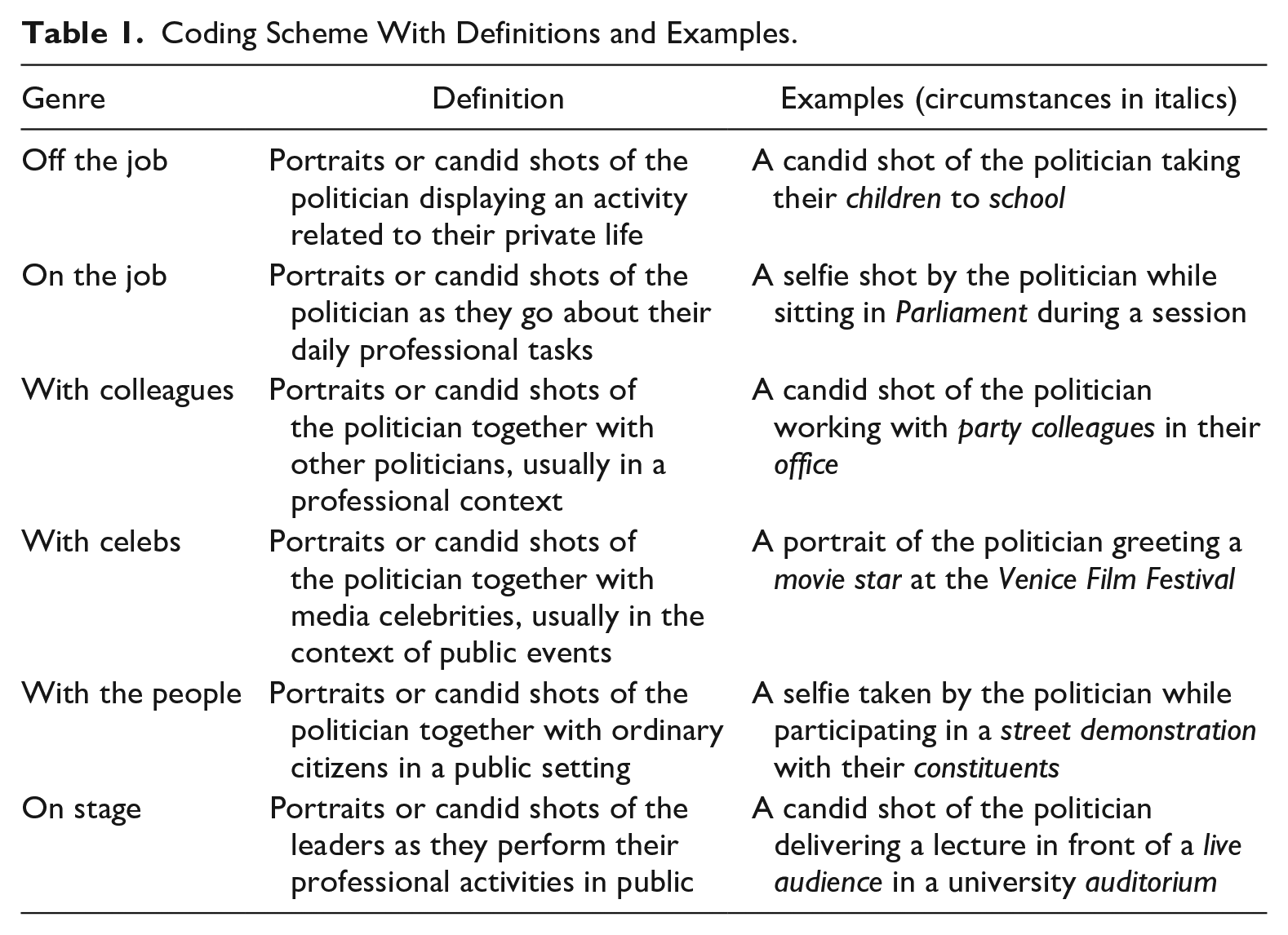
While the corpus features cases of overlap between the categories, we treated the genres as mutually exclusive, coding each image as belonging to only one genre. After a pilot phase, the two authors conducted an intercoder reliability test on a sample of 50 images from the corpus, passing Krippendorf’s alpha threshold for exploratory studies (α = 0.794). Thereafter, the full sample was coded by the authors. Once we completed the coding, we measured the independence of the two subsets through Pearson’s chi-square test with simulated p-value and identified unique features of the two subsets using Fisher’s exact test corrected for multiple testing using the Benjamini–Hochberg false discovery rate procedure.
We then moved to the core of our analysis: a qualitative reading of the images based on Kress and van Leeuwen’s (1996) veteran framework for visual analysis. Given the focus of this study on circumstances of location and accompaniment, we devoted particular attention to and drafted extensive notes on the places in which the images are set and the people that pose with the protagonists. We also generated schematic notes on the attributive, symbolic, and transactional processes represented in our corpus. We interpreted the portraits (see Maes 2019) in our dataset as analytical or symbolic processes in which the politician is the “carrier” of some “possessive” or “symbolic attributes” (Kress and Van Leeuwen 1996: 87–109). Hence, a portrait of Meloni wearing a chef apron while holding a pizza was annotated for possessive attributes such as clothing (“chef apron”) and for symbolic attributes such as food symbolizing national traditions (“pizza—tradition”). We interpreted the candid shots (see Palmer 2011) in our dataset as narrative processes in which the politician is the “actor” performing a transactional or non-transactional action (Kress and Van Leeuwen 1996: 59–72). For example, we annotated a picture of Renzi speaking into a microphone to a crowd for the action being performed (“speaking”) and the object on which it is performed (“crowd”).
Analysis
Quantitative Summary
Meloni’s and Renzi’s self-presentation on Instagram balances the tension between exceptionalism and everydayness inherent to their populist political style. As revealed by Pearson’s chi-square test with simulated p value, the two politicians use a different mix of self-presentation genres in their negotiation of this tension (χ2 = 96.121, p = .0005). Fisher’s exact test revealed that Meloni is more likely to pose in a private setting, with such portraits constituting almost half of the pictures in her subset of the data (p < .0001). Conversely, Renzi prefers a more formal self-presentation located on a literal stage, for example while speaking behind a podium during rallies and conferences (p < .0001). For a summary of the quantitative analysis, see Table 2.
Results of the Quantitative Coding.
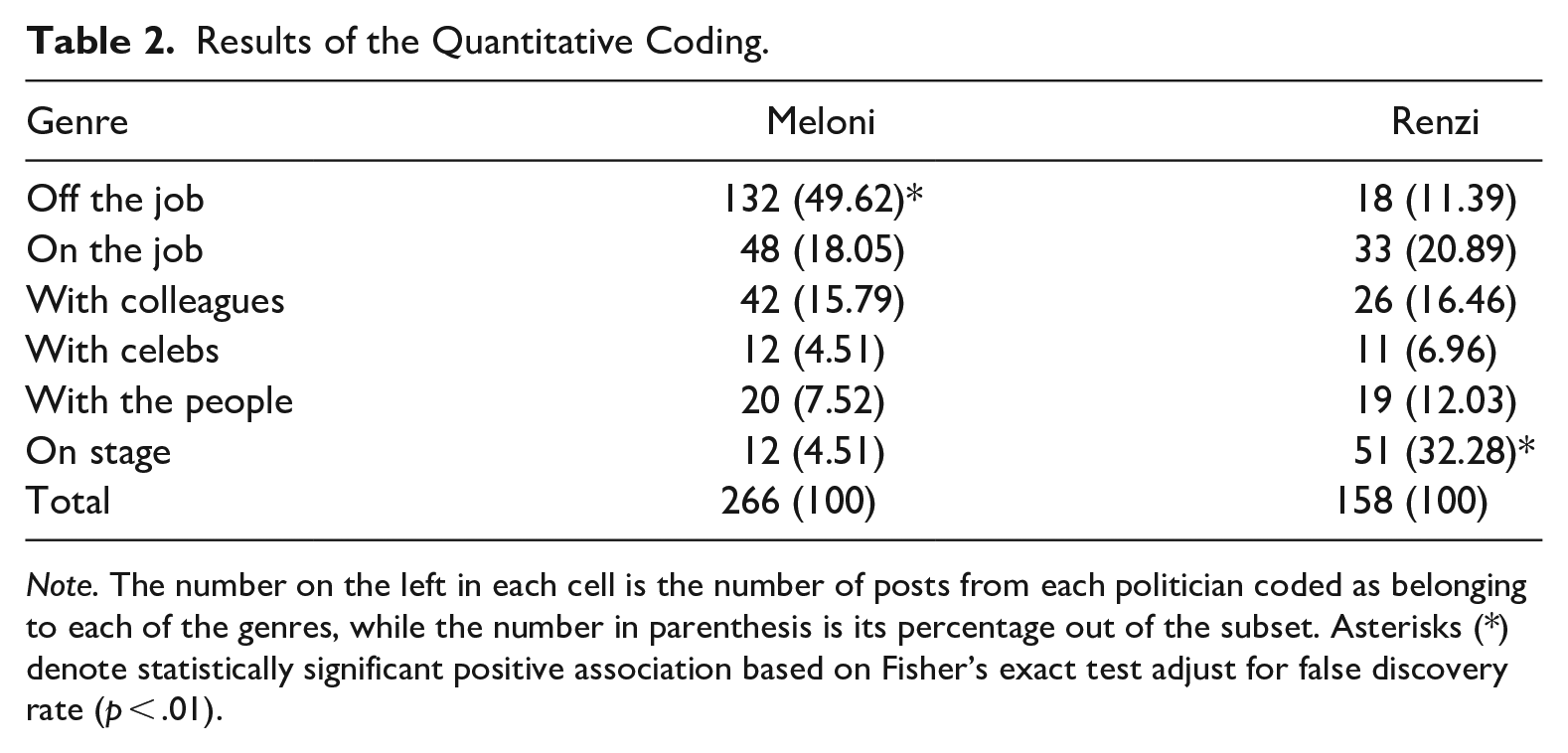
Note. The number on the left in each cell is the number of posts from each politician coded as belonging to each of the genres, while the number in parenthesis is its percentage out of the subset. Asterisks (*) denote statistically significant positive association based on Fisher’s exact test adjust for false discovery rate (p < .01).
Qualitative Analysis
The results of our quantitative analysis revealed two broad trends in our data. First, Meloni’s performance of political celebrity is tilted toward the “everyday” end of the spectrum, while Renzi’s celebrity persona leans heavily on “superstar” performances of the self. Second and despite this divergence, both politicians mix the two repertoires in roughly half of their images, adopting genres that fall in the middle region between the two ideal types. In what follows, we map the similarities and differences between the specific style adopted by the two politicians in each of the six genres.
Off the Job
We begin our qualitative analysis from the “everyday” end of the spectrum with the genre we dubbed Off the job. These images offer sneak peeks into the private lives of the two politicians, depicting them performing leisure activities in their spare time (Figure 1). While Meloni uses this genre of self-presentation statistically more often than Renzi, the two adopt similarly gendered tropes of “everyday” self-presentation as average Italians. Meloni’s Off the job images are predominantly set in a domestic environment and, in a majority of cases, depict her playing with her (at the time) three-year-old daughter (top-left). Other incarnations of the genre show her posing with her cats (top-middle) or proudly displaying traditionally Italian food products (top-right). Renzi’s images in this genre mostly depict him jogging in Florence (top-left). Other examples include selfies with his wife while on break between work events (top-middle) or speaking with other members of his family in the privacy of their home (top-right).
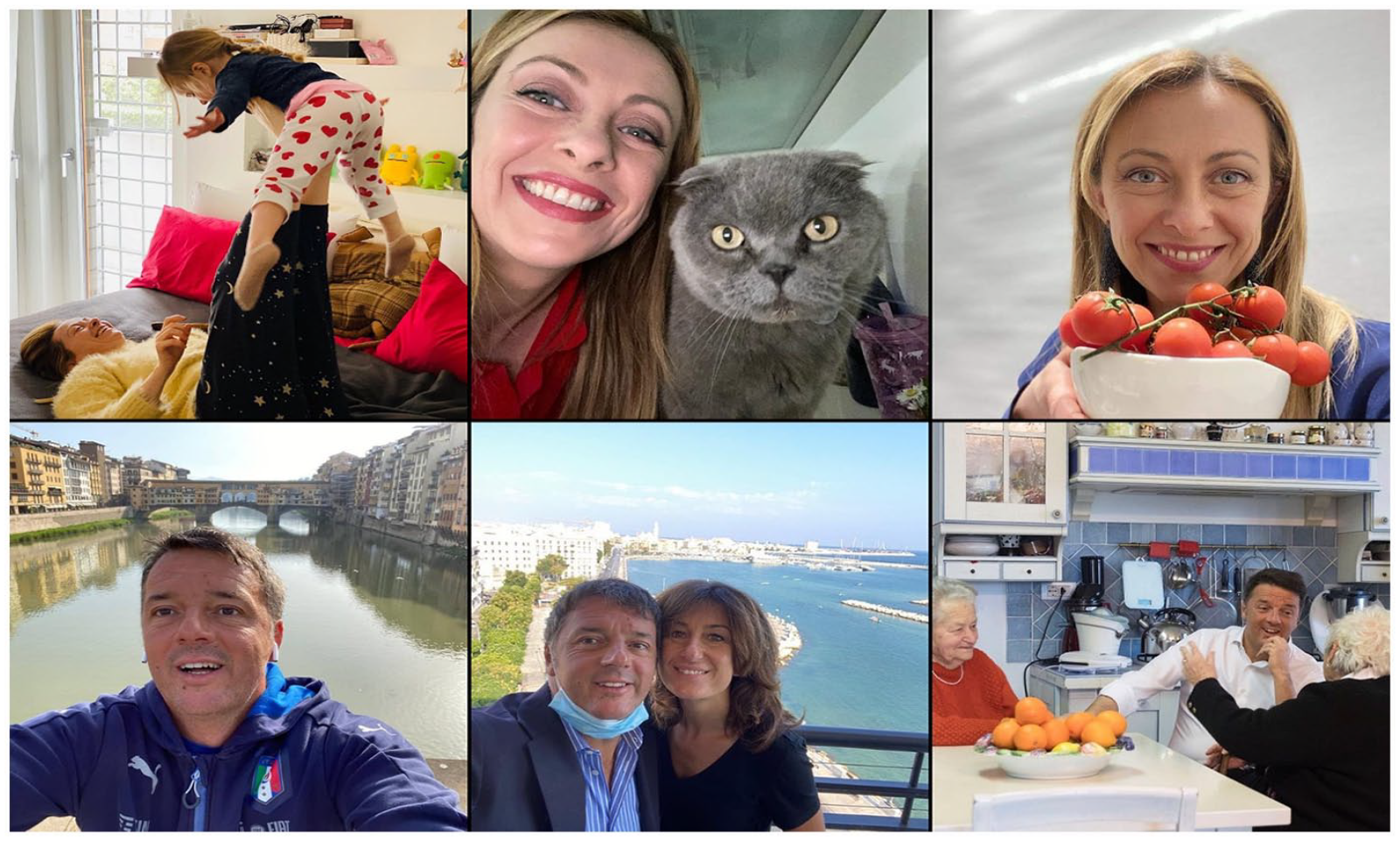
Iconic examples from the Off the job genre.
The images in this genre showcase the audience who the politicians “really are” when they are not on the job and away from TV cameras. Crucially, who they “really are” appears to be rather ordinary. According to the photographs, Meloni is, above all, a loving mother who plays with her child and preserves her privacy by never showing her face on social media. She is a happy cat owner and a proud consumer of certified Italian products like “Pachino” cherry tomatoes. Renzi is an Italian middle-aged man who enjoys jogging while wearing the official merchandize of the national football team and knows how to appreciate downtime with his family.
On the Job
The images in the On the job genre show the two politicians undertaking ordinary professional tasks (Figure 2). Within the scope of this genre, the politicians employed a similar set of tropes. These include images of themselves working at their desks (left), shots documenting their presence on the Parliament’s floor (middle), and selfies before or after a TV interview (right). Meloni’s subset also features several images of herself commuting by train to campaign events. While divergences between the two are subtle, the relative prevalence of selfies from Meloni’s subset and of candid shots taken during parliamentary speeches from Renzi suggests that the former adopts a comparatively informal approach to the genre.
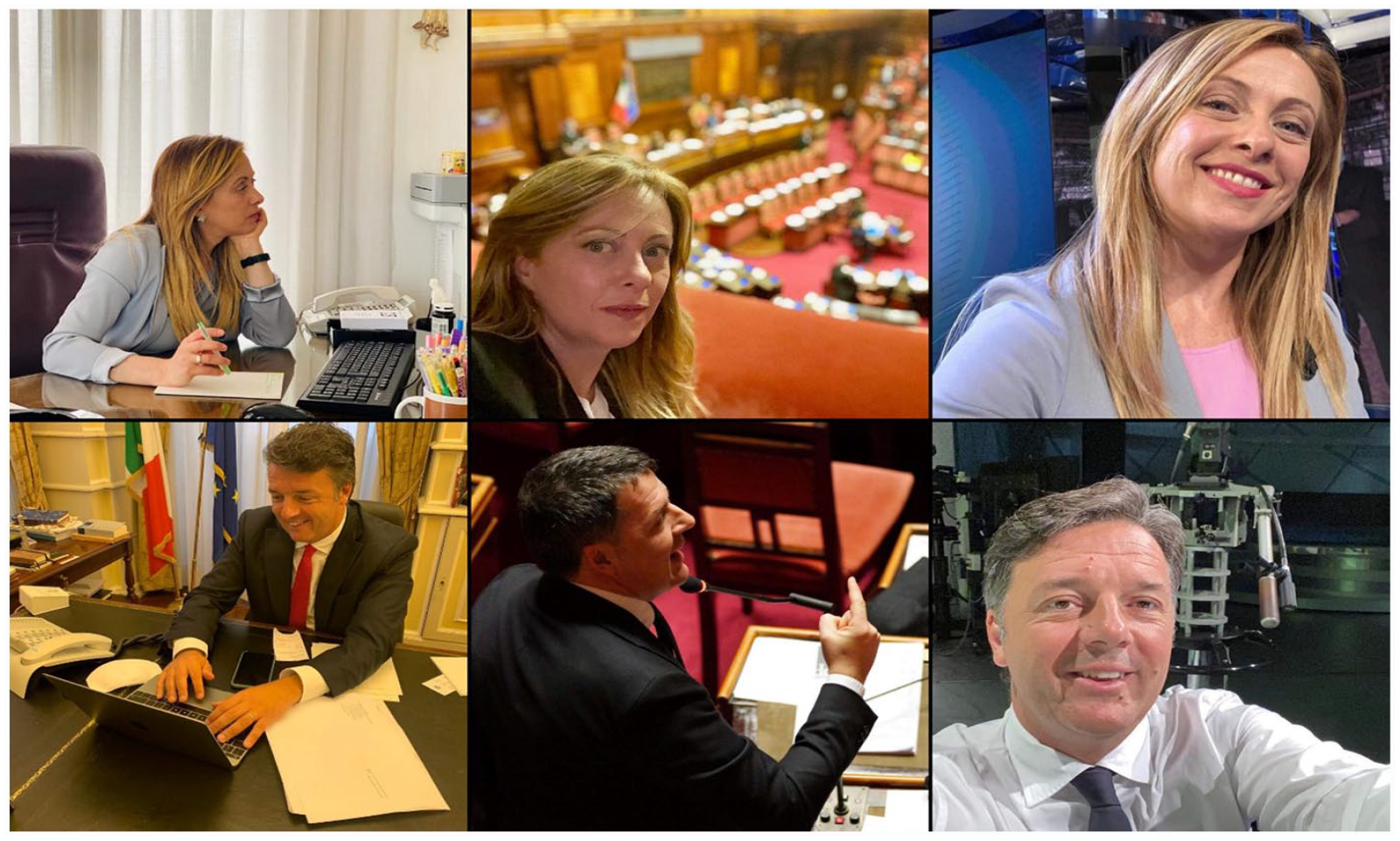
Iconic examples from the On the job genre.
These images show the “behind the scenes” aspects of the extraordinary life of highly visible politicians, bringing together elements of ordinariness and exceptionality. The Parliament, where Renzi’s and Meloni’s offices are located and where they perform the most fundamental part of their job as politicians, is far from an ordinary workplace. However, both leaders pose while working at their computers, surrounded by colored markers, stacks of paper, and old-fashioned landline phones in a scene that is likely to be familiar to constituents working office jobs. TV appearances are also far from ordinary job activities. However, snapping a selfie from the workplace to show others what one is up to is a rather common practice of self-documentation likely to resonate with social media audiences. Ultimately, these images expose the mundane aspects of the politicians’ day-to-day jobs while also displaying their extraordinary setting.
With Colleagues
The With colleagues genre features the politician posing in the company of other elected officials or prospective officeholders, usually during public events (Figure 3). Once again, the two politicians adopt relatively similar tropes within the scope of this genre. Both of them post images of themselves in the company of junior members of their respective parties or with leaders of political parties that are closely allied with theirs. These images are usually shot during closed-door leadership meetings or stakeholder events (left) or public events such as campaign rallies (middle). In a smaller number of cases, these images are shot on the campaign trail (right) and complemented with captions in which the two leaders endorse junior colleagues.
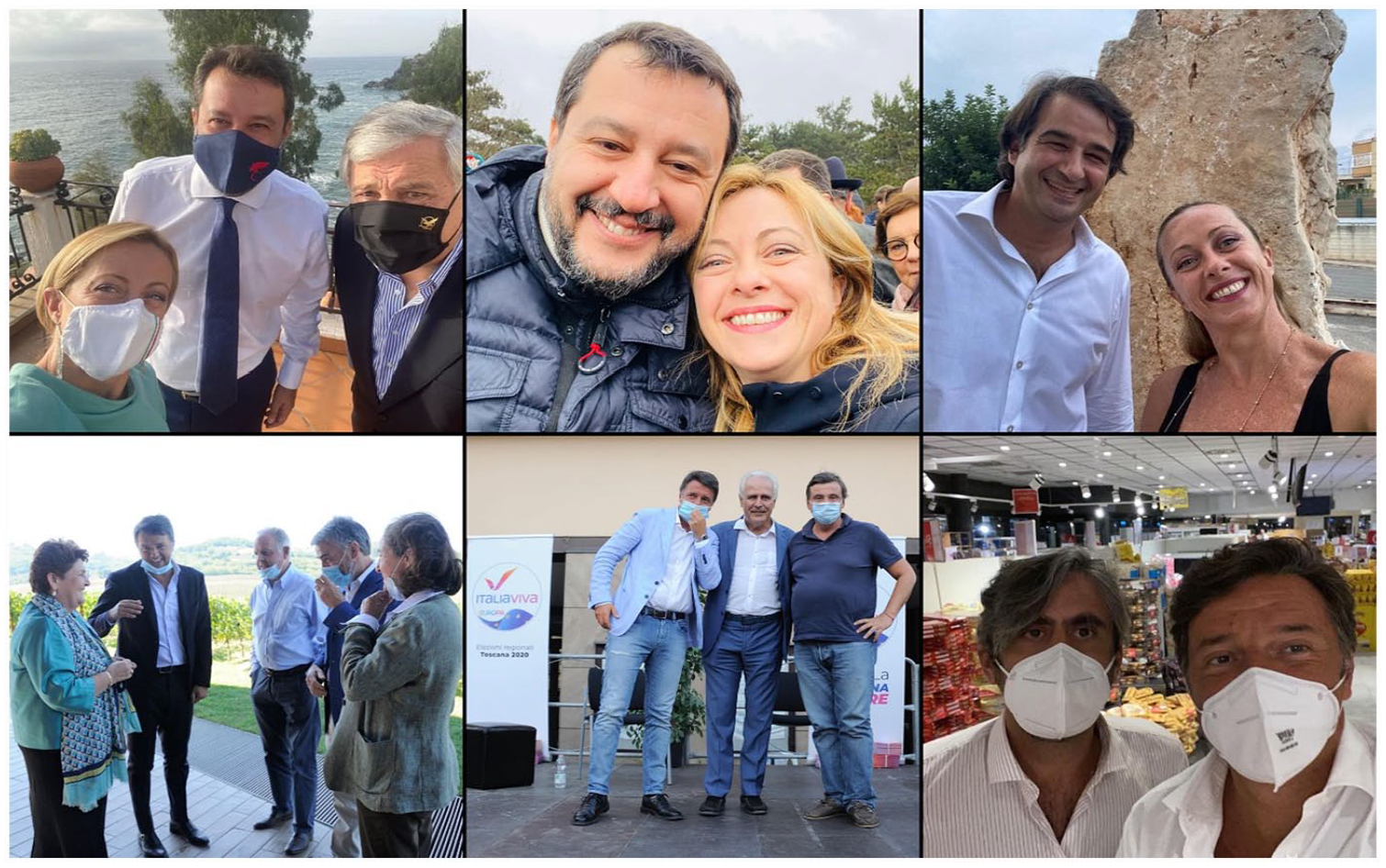
Iconic examples from the With colleagues genre.
The genre portrays aspects of the daily job of both leaders that are simultaneously frontstage and backstage, ordinary and extraordinary. Taking pictures with colleagues is a rather mundane social media practice that, however, is elevated into the realm of exclusivity because of the context in which they are shot, enhancing the social media visibility of the people involved for electoral gains. With these “spontaneous” shots, Meloni and Renzi seem to invite their followers to join them and their colleagues as things are happening while they perform their extraordinary work activities.
With Celebs
The With celebs genre shows Meloni and Renzi in the company of highly visible figures who are not politicians (Figure 4). The genre includes images of politicians in formal settings such as TV studios or institutional events where the press is present. In the images, the two are represented in the company of activists with remarkable media success such as Gino Strada (bottom-left), Paralympic athletes like Andrea Devicenzi (top-left), TV hosts like Mario Giordano (top-middle) and Massimo Giletti (bottom-middle), acclaimed figures from the film industry like Pier Francesco Pingitore (top-right), and Ennio Morricone and Quentin Tarantino (bottom-right).
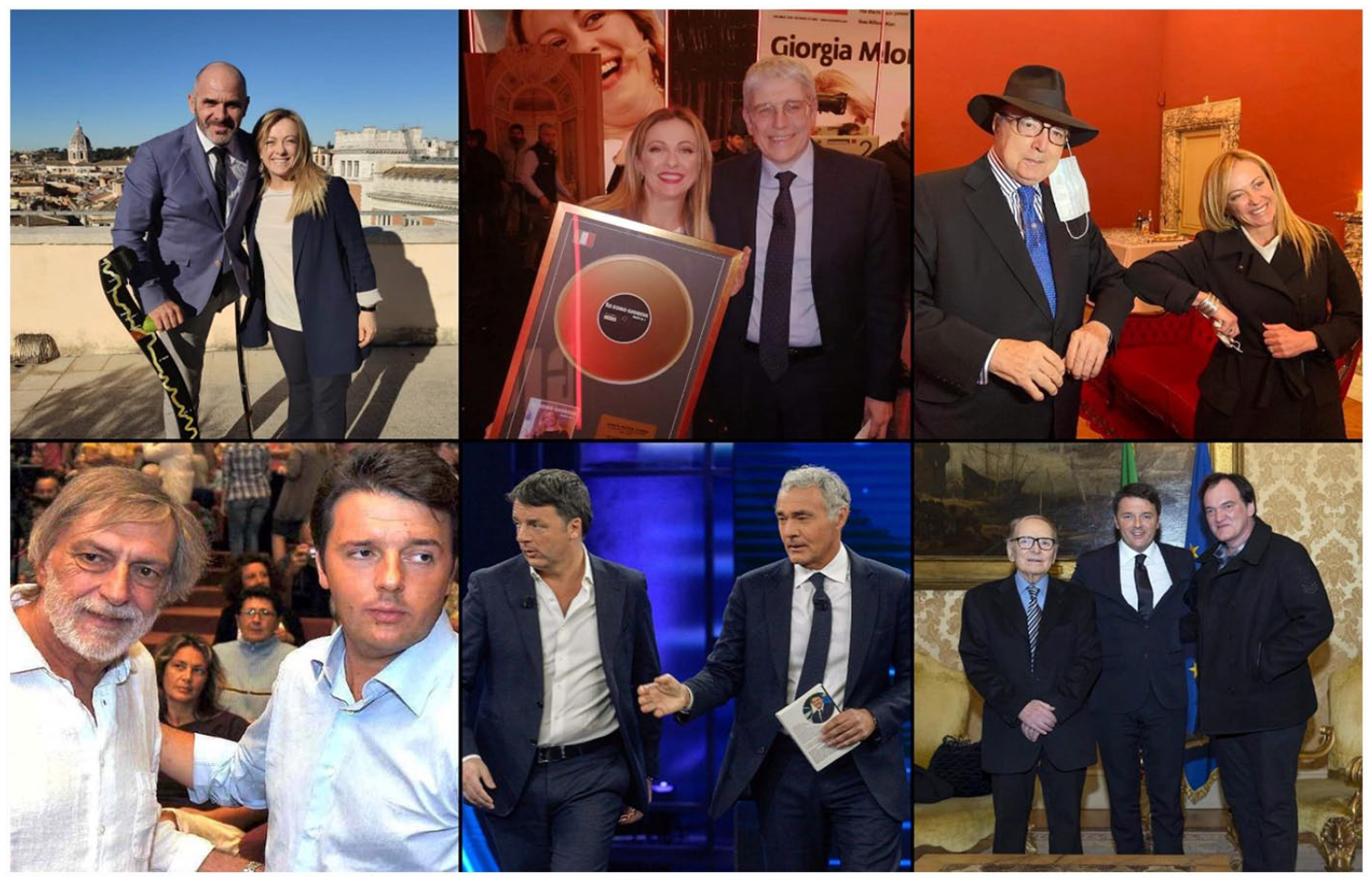
Iconic examples from the With celebs genre.
The genre affirms the extraordinariness of the two leaders by presenting them as peers of legacy media celebrities. For example, Meloni’s picture with TV host Mario Giordano depicts the two hugging each other in a gesture of affectionate comradery. The image is shot after an interview in which Giordano awarded Meloni with a mock-up of a Gold Record, ironizing on the social media popularity of the remix of one of her speeches in the style of techno music. Similarly, Renzi’s image with war surgeon and human rights activist Gino Strada is captioned with words of appreciation for Strada’s expertise and work ethic as well as an expression of support for his potential appointment to the commissary for healthcare in the Southern Italian region of Calabria.
With the People
The With the People genre features politicians posing with their constituents during public events, special visits, or casual encounters on the street (Figure 5). The images in this genre include shots of the politicians greeting people during an official visit to their workplace (left), selfies with small groups of individuals on the street or on the way in and out of their public appearances (middle), as well as images of the leaders surrounded by an adoring crowd during a public event (right).
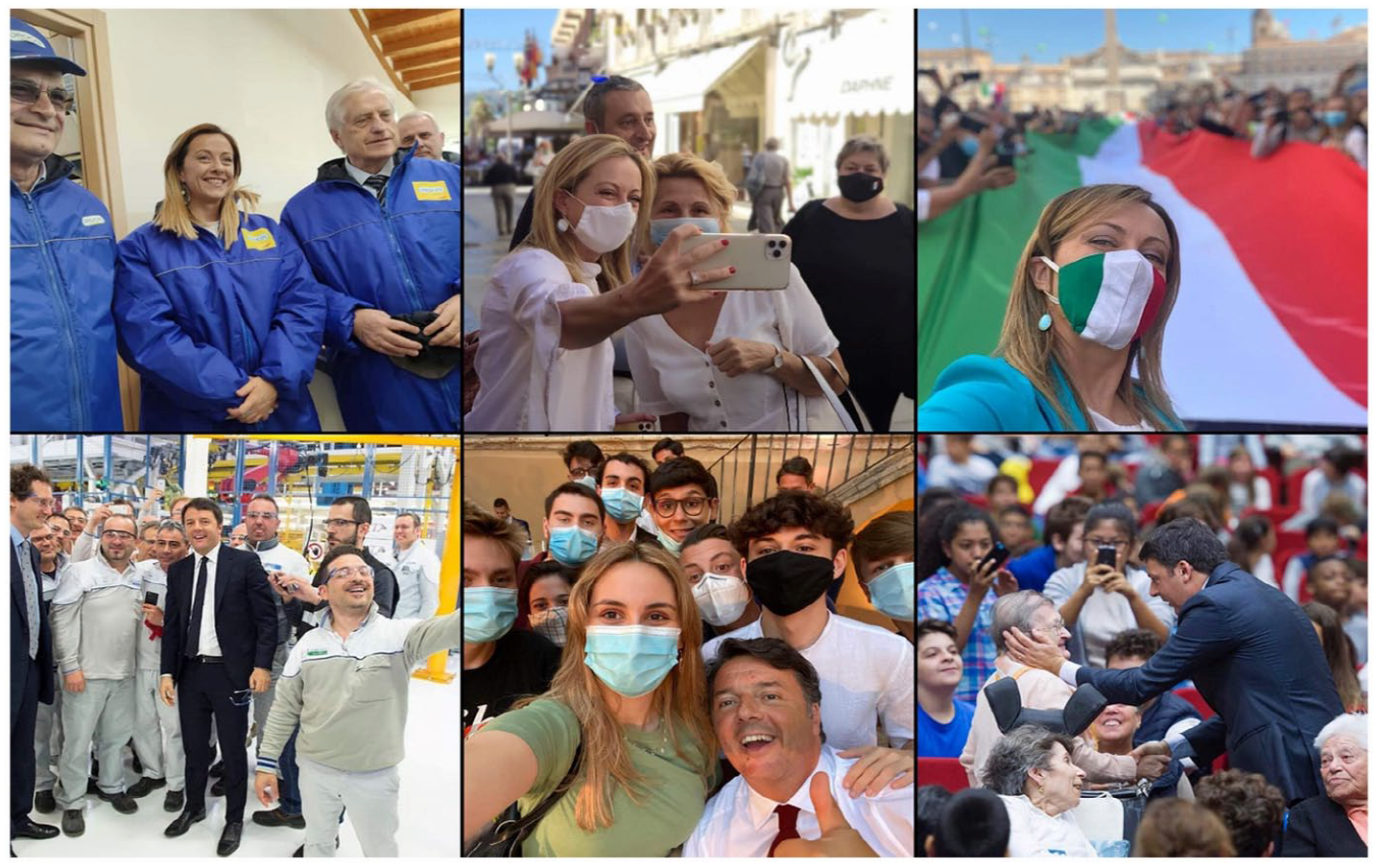
Iconic examples from the With the people genre.
Even though the images present the two leaders as approachable and relatable, the genre stresses their exceptionality as charismatic figures enjoying a high degree of fame. Meloni’s selfie with her constituents during a protest (top-right) suggests a willingness to participate in direct action like any common citizen. Similarly, Renzi’s selfie with the teenagers attending the presentation of his book (bottom-middle) displays a particularly informal register, gesturing toward a light-hearted aspect of Renzi’s persona. However, the relationship between the protagonist and the other people represented in the genre is never one of parity. The excited workers posing next to them for official pictures, the individuals asking them for a selfie together, and the anonymous crowds present at their rallies symbolically underscore their extraordinary visibility and fame.
On Stage
The On stage genre is located on the “superstar” end of the spectrum and features politicians standing on a literal stage during a public event such as a rally or public lecture (see Figure 6). As outlined in our quantitative analysis, Renzi was statistically more likely to post such pictures, while Meloni made scant use of this genre (under 5% of her subsample). Aside from setting, the core feature of this genre for both leaders is the presence of a live audience. Renzi’s images tend to be shot from a distance and adopt camera angles ensuring that the audience is represented in the frame. The few examples in Meloni’s subset tend to be closer frontal shots that do not feature the audience, leaving its presence implied by other cues such as the glance of the leader, the presence of a podium with a microphone, and the stage itself.
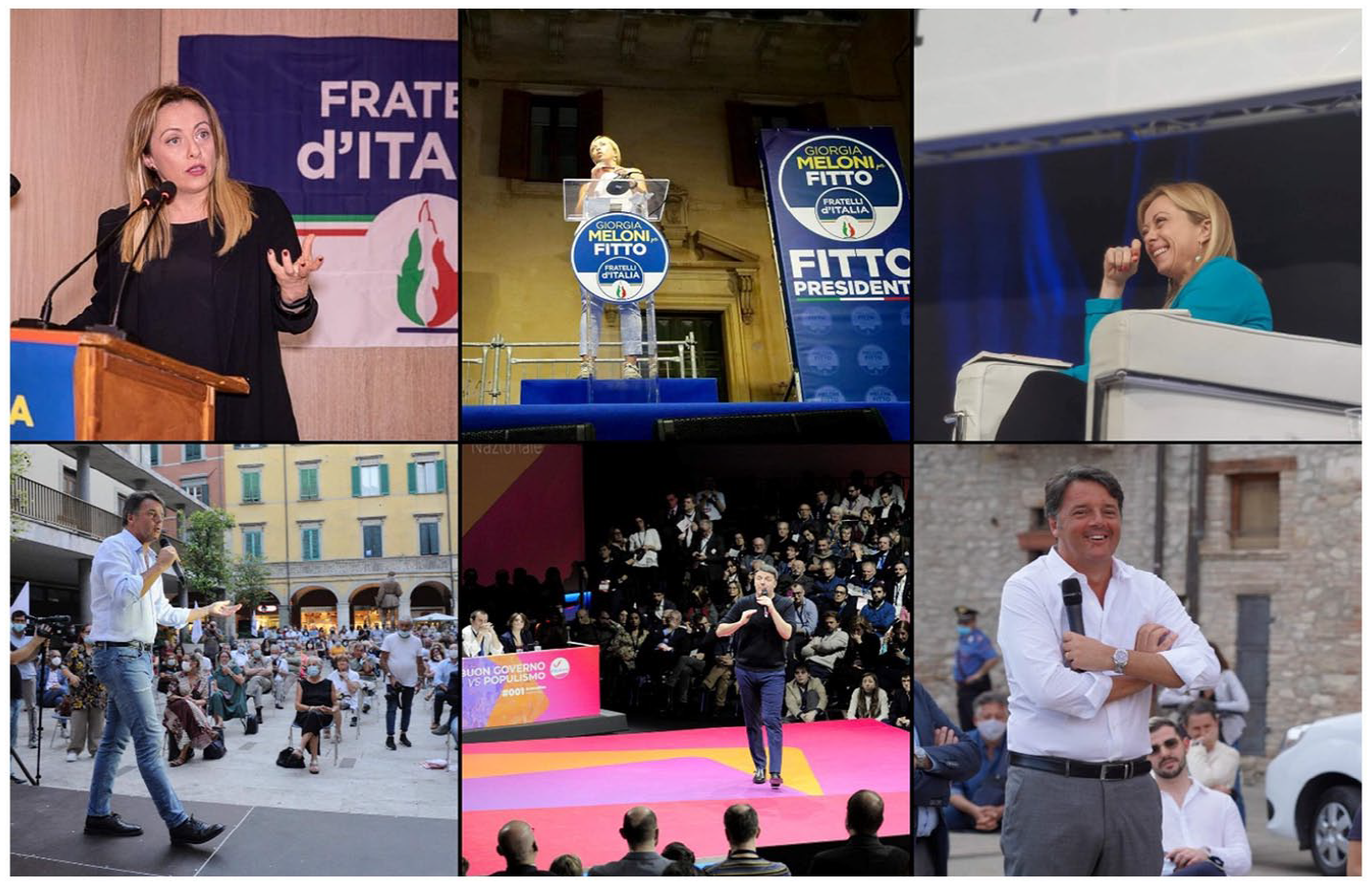
Iconic examples from the On stage genre.
The genre features the politicians offering the viewer a “frontstage” performance of the self. These images emphasize the celebrity status of the two leaders and the asymmetrical relationship between them and the audience, passivized as simple listeners or fully omitted from the representation.
Discussion and Conclusions
This study sought to map the Instagram celebrity practices of party leaders Giorgia Meloni and Matteo Renzi on a spectrum ranging from “everyday” to “superstar.” Our quantitative analysis indicates that Meloni is significantly more likely to stage her pictures in a private context while Renzi is significantly more likely to post images on stage. In this sense, Meloni’s digital populism relies more squarely on a self-presentation as an “everyday” celebrity politician, while Renzi tends to adopt the “superstar” mode of celebrity politics (Wood et al. 2016). Nonetheless, the celebrity-like self-presentation of both politicians covers the full spectrum, with roughly half of their images adopting genres that fall somewhere between the two.
While recognizing that the specificity of our case study does not allow for broad generalizations, we propose two observations as the main contributions of this study. First, we point out that the affordance-based elective affinity between populism and social media observed by Gerbaudo (2018) and Hopster (2021) has platform-specific manifestations. In the case of Instagram, our findings suggest that populist leaders adopt the platform’s visual vernacular, replicating platform-specific modes of achieving fame to construct celebrity-like personae whose lives can be constantly followed and consumed by an audience of potential constituents. As outlined in our findings, Meloni’s and Renzi’s “everyday” shots set in their home (Off the job) or in their private office (On the job) construct seemingly “intimate” relationships with their audiences (emotionality) by showing who the two politicians “really are” (internal authenticity). Relatedly, their posts featuring friendly poses with other politicians (With colleagues) or mainstream media celebrities (With celebs) provide a visual testimony of what happens behind the scenes of their “exclusive” job (external authenticity). Finally, images representing them with adoring crowds (With the people) or while delivering public speeches (On stage) affirm their “superstar” status, inviting the viewer to imagine themselves as part of the public witnessing their appearances (liveness).
Second, we see these performances as instrumental to the navigation of the tension between everydayness and exceptionalism that characterizes the political celebrity of the ordinary super leader (Mazzoni and Mincigrucci 2021). Much like social media influencers (Whitmer 2021), populist politicians are caught in the contradictory need to be simultaneously extraordinary and ordinary, aspirational and relatable, highly polished and authentic. Our findings show that Meloni and Renzi approach this challenge by alternating and remixing frontstage and backstage repertoires, resulting in a performance of the self that is markedly “middle region.” Building on these insights, we propose middle region populism as a new theoretical notion to describe how populist politicians embrace the duality of the middle region and harness it to curate an online presence in which they can be exceptionally charismatic and, at the same time, ordinary and relatable. This effect is achieved through the careful mix of mundane images granting access to the leader’s private life, “Instagrammable” modes of self-presentation underscoring the aspirational character of the leader’s persona, as well as seemingly banal shots that acquire salience because of their exceptional circumstances of location or accompaniment. Ultimately, middle region populism leverages the affordances, logics, and tropes of image-centric social media platforms to construct the leader as “one of the people” and, at the same time, a uniquely charismatic individual who should be granted exceptional political power.
Middle region populism adds nuance to established theorizations of celebrity politics (Street 2004; Wood et al. 2016) and strengthens the new ideal type of the ordinary super leader (Mazzoni and Mincigrucci 2021) in three ways. First, it highlights the crucial role of platform-specific vernaculars (Gibbs et al. 2015) and affordances (Davis 2020) for the performance of political celebrity in digital spheres. Connectedly, it maps the relationships between the tropes adopted by populist leaders on image-centric social media (Beta and Neyazi 2022; Stagi et al. 2022; Starita and Trillò 2021) and integrates them in a coherent overarching framework. Finally, it leverages Kress and van Leeuwen’s (1996) social semiotic toolbox to offer an analytical framework that can be applied to study the visual politics of populism (Moffitt 2022) in other political contexts.
We hope that future research will corroborate our findings and overcome some of the limitations in the scope and contextual detail of our study. For what concerns scope, we encourage future investigations mapping the digital self-presentation and celebrity practices of a wider number of populist politicians from across the political spectrum to shed light on the possible links between political ideology and how the populist political style is performed. Such studies could also be cross-national in character, thus adding local sociopolitical factors as possible explanatory variables for the observed similarities and differences between political leaders. We also suggest that a focus on gender can help others zoom in and capture nuances that our methodology could not detect. Such research could perform a more granular analysis that highlights how performances of middle region populism that we coded as belonging to the same genre (e.g., Off the job) converge or diverge according to gendered templates of self-expression on social media.
Most importantly, we hope that future studies will take up some of the theoretical and methodological paths laid out in this article. Despite its limited character, our case study offers an empirically sound analysis of the celebrity-like self-presentation of two prominent Italian political leaders. In doing so, we create a fruitful theoretical dialogue between the adjacent but only occasionally overlapping fields of celebrity politics and digital populism. We also present a replicable model to analyze the visual self-presentation of politicians on social media, emphasizing the crucial role that circumstances play therein. Overall, our case study indicates that populist leaders leverage the affordances and vernacular of image-centric social media platforms to navigate the tension inherent to their personae as ordinary super leaders. Taking stock of the above, we argue that investigating the internet celebrity of politicians is crucial to achieving a comprehensive understanding of populism in the digital age.
Footnotes
Acknowledgements
We wish to express our gratitude to the three anonymous reviewers and editor-in-chief Cristian Vaccari for their insightful comments on our manuscript. We also thank our colleague Blake Hallinan for their feedback and assistance throughout the development of this paper.
Declaration of Conflicting Interests
The author(s) declared no potential conflicts of interest with respect to the research, authorship, and/or publication of this article.
Funding
The author(s) received no financial support for the research, authorship, and/or publication of this article.
