



Abstract
Twitter enables an online public sphere for social movement actors, news organizations, and others to frame climate change and the climate movement. In this paper, we analyze five million English tweets posted from 2018 to 2021 demonstrating how peaks in Twitter activity relate to key events and how the framing of the climate strike discourse has evolved over the past three years. We also collected over 30,000 news articles from major news sources in English-speaking countries (Australia, Canada, United States, United Kingdom) to demonstrate how climate movement actors and media differ in their framing of this issue, attention to policy solutions, attribution of blame, and efforts to mobilize citizens to act on this issue. News outlets tend to report on global politicians’ (in)action toward climate policy, the consequences of climate change, and industry's response to the climate crisis. Differently, climate movement actors on Twitter advocate for political actions and policy changes as well as addressing the social justice issues surrounding climate change. We also revealed that conversations around the climate movement on Twitter are highly politicized, with a substantial number of tweets targeting politicians, partisans, and country actors. These findings contribute to our understanding of how people use social media to frame political issues and collective action, in comparison to the traditional mainstream news outlets.
Keywords
Introduction
The global climate crisis is a wicked problem (Incropera 2016), yet few governments have taken the drastic and swift action necessary to mitigate its effects. This inaction has led to global strikes and demands for action from politicians, corporations, and older generations. Communication, online or offline, aids in disseminating information and mobilizing resources, which are crucial to successful social movements (Joyce 2010). Social media platforms have transformed political participation by offering agency and a voice to otherwise marginalized groups, with new voices on climate change becoming increasingly publicized, amplified, and important (Boulianne et al. 2020; Lee et al. 2020). Social media have also become critical in bridging online conversations to in-person protests, such as March for Science and People's Climate March (Fisher 2019), as well as mobilization by youth-led organizations like Fridays for Future. These voices compete with mainstream media in framing climate change and the climate movement.
More research is needed to understand how climate strikes are discussed, how discourse evolves in the digital space, and how major actors in the current media system frame the climate movement differently. To examine this, we analyzed over five million tweets that use climate strike-related hashtags from August 1, 2018, to January 31, 2021, in the United States. We found that climate strike frames on Twitter predominantly raise awareness of the consequences of climate change and call for policy and political actions. These frames burst during the global climate strikes, the COVID-19 pandemic, and the 2020 US presidential election. We also compared mainstream news coverage and tweets posted by climate movement actors. News organizations reported on global politicians or specific countries’ (in)action toward climate policy, global leader meetings, or conflicts between countries. Other news articles highlighted the consequences of climate change such as wildfires and attributed responsibility to industry for the climate crisis. Tweets from climate movement actors focused on calls for climate action with specific policy or political outcomes. This group also highlighted climate consequences to inform and sound the alarm. Finally, we found that climate strike discourse is political and confrontational, with a substantial number of tweets targeting politicians, partisans, and country actors.
Although news coverage of social movements often falls into a predictable protest paradigm, where media coverage stigmatizes collection action efforts (McLeod and Hertog 1999), our findings show that in the context of the climate movement, global news media discuss the responsibility of global politicians and leaders to act, which may legitimize the policy changes that climate movement actors advocate for on Twitter. These findings advance our understanding of framing and social movement theory by showing the temporal patterns of climate strike discourse. Finally, we demonstrate how researchers can use computational methods to study large-scale language datasets to understand the patterns of public discourse.
Literature Review
Framing the US Climate Movement and Key Events
Framing is the use of specific messages tailored toward audiences and mediums to communicate what an issue is, who is responsible, and what should be done (Iyengar 1996). Frames applied to climate change include public accountability and governance, morality and ethics, and certainty or uncertainty of science, among others (Nisbet and Newman 2015). Framing is often used to analyze environmental and climate communication (Comfort and Park 2018), although much research focuses on news media portrayals or the resulting media effects on audiences and public engagement (Schäfer and O’Neill 2017), yet few studies examine how actors within the climate movement use framing.
Although news media are important in mediating dialogue between social movements and political elites, biases in coverage and framing of issues and events can influence public perceptions. Within American mainstream news media, climate change is more often framed through economics, ideology, and uncertainty (Stecula and Merkley 2019), whereas climate change framing by everyday users on Twitter is likely to be polarized based on political affiliations and geographic locations (Jang and Hart 2015). News media are also often reluctant to criticize capitalism due to fear of alienating advertisers and favoring the existing status quo (Smith et al. 2001). Media framing of social protests can also influence public opinion and governmental responses (Ophir et al. 2021). Kilgo and Harlow (2019) argue that the environment movement tends to receive preferential treatment from the media, but in their study of news coverage of the Dakota Access Pipeline, these protests were framed in a delegitimizing way, like the delegitimizing coverage of anti-Black racism.
In social movements, framing the type of actions needed, how to mobilize toward these actions, and planning when and where the action will take place, involves communication and input from several actors. The sum of these different framing initiatives composes a discourse (Ferree and Merrill 2000). Frames are strategically used by actors within social movements to make sense of situations, attribute blame, identify solutions, and motivate participation (della Porta and Parks 2014; Snow and Benford 1992). Our paper highlights the temporal patterns of how frames evolved. Over time, social movements tend to become more institutionalized and coalesce around a specific set of political demands (Clemens and Minkoff 2007; Rootes 2004). Typically, this transformation is studied over decades, but we propose a similar evolutionary process in relation to the use of social media in the context of collective action. The stages of digital media use in protest cascades are as follows, described in more detail by Hussain and Howard (2013: 49): “a preparation phase; an ignition phase; a protest phase; an international buy-in phase; a climax phase; and finally, a follow-on information.”
Our study analyzes Twitter discourse in the United States from 2018 to 2021 to examine whether this discourse demonstrates distinct phases, especially because critical events may attract the public's attention to the movement. We chose to geographically bound tweets to the United States because this period included a midterm and presidential election, and elections offer critical opportunities for social movements to influence the discourse on their issue and political outcomes (Heaney 2013). As climate change has become a politized issue in the United States, the way it is framed has a significant impact on how individuals or groups support or are motivated to act (Bolsen et al. 2019). In addition, we explore how the COVID-19 pandemic influenced Twitter discourse about the climate movement.
Situating framing analysis under the evolutionary process allows us to address a gap in applying framing theories to study environment communication. Abundant scholarship has examined the framing of climate change (Schäfer and Schlichting 2014). Yet, few have produced a holistic view of how the modern climate movement frames differ across time, until recently. Scholars showed that in the German context, calls for mobilization burst in September and November 2019 during the second organized global climate strike, but after the COVID-19 pandemic began in 2020, thematic coverage of climate change, that is, focus on “goals, measures, or demands of the supporters or opponents of Fridays For Future movement (FFF) and contain an exchange of arguments for or against climate protection,” emerged and became the dominant frame (Haßler et al. 2021, p. 9). Our paper joins this small but growing effort to study the nuance of climate strike frames by analyzing how the public frames the climate movement on Twitter and how the frames evolved over time. Thus, we propose our first research question as:
RQ1: How is climate strike discourse framed on Twitter and how has this discourse evolved over time?
Climate Movement and Various Actors in the Hybrid Media System
The media ecology today not only consists of traditionally dominant actors such as politicians, journalists, and academics but also their non-elite counterparts like average social media users, grassroots campaigners, and activists (Chadwick 2013). And while not exclusively comprised of youth, the climate strike movement is a youth-led and youth-powered social movement. Among the various actors, this research compares mainstream news sources and climate movement actors. By climate movement actors, we refer to individuals who use their Twitter accounts to advocate for climate action, including youth activists and youth-led organizations, as well as scientists, academics, writers, grassroots campaigners, climate nonprofits and climate policy lobbyists. As online discourse is an essential part of the vox populi, climate movement actors should be primarily conceptualized as news producers in the hybrid media system (Breindl 2016).
Among these various actors in the hybrid media system, those who manage to bring their viewpoints to the public and mobilize people for support occupy the leading position in public debates. At the same time, those who stay silent fail to gain public attention and mobilize public support, and their interests are likely to be neglected and marginalized in the public sphere—which induces increased competition for public attention and support (Geiß et al. 2017). However, interacting with news media does not guarantee that social movement actors follow dominant journalism practices, such as how journalists frame issues, which leads to ambivalent relationships and discrepancies in how issues are framed. Specifically, there is a trade-off between social movement actors’ desires to release themselves from mainstream media's dominance and reliance on media influence to reach a broad public to bring about change (Breindl 2016). Social issues such as the climate crisis involve an increasing number of individuals, activists, and political organizations who promote their issues above or against other issues in the public sphere (Koopmans 2004). Frame practices, among all kinds of strategic attempts, are used by these actors to shape the narrative about an issue movement or a particular struggle (Zald 1996).
Within the protest paradigm, there is a historical tension between marginalized groups protesting (such as youth) and how news media cover these events, as mainstream media tend to portray social movement actors as deviant, threatening or impotent, and challenging the status quo (Kilgo and Harlow 2019; Lee 2014). Social media are used by social movement actors as a mobilization tool to bridge online mobilization and physical gatherings (Gerbaudo 2012) and to gain visibility from journalists and the public (Bergmann and Ossewaarde 2020). For instance, activist Greta Thunberg, the leader of Fridays for Future, used social media channels Twitter and Instagram to frame messages and motivate action, and these posts were widely circulated, liked, and commented upon (Lozano-Díaz and Fernández-Prados 2021; Molder et al. 2021). These global climate strikes reflect a hybrid trend in the current information flow, in which climate movement actors take advantage of social media tools to connect with news media resources to further voice their concerns to global audiences (Bergmann and Ossewaarde 2020).
Examining the nuances of frame practices among different actors enhances our understanding of how different voices constitute the hybrid nature of social movements. Different actors may share a similar list of frame practices but hold different emphases and priorities over time. Much research has examined framing contents between elites and ordinary people (Kligler-Vilenchik and Thorson 2016), and framing features on climate issues used by nongovernmental organizations on Facebook (Vu et al. 2020). Because systematic research into the nuances of frames used by activists and major news organizations remains scarce, this leads us to examine the following research question:
RQ2: How do the two different groups, climate movement actors and mainstream news media frame the climate movement differently?
Who is Targeted in the Climate Movement Discourse?
Some social movement actors frame their discourse around targets, using positive or blaming sentiment. Movement discourse that incorporates positive sentiment toward targets is often oriented toward identity development, with targets of cultural and institutional transformation, such as the women's and LGBTQ + movements (Rucht 1988). Movements that are oriented toward external targets (e.g., law or the state) are instrumental or strategy-based, such as the environmental and climate movements, and attempt to influence policy (Van Dyke et al. 2005). The use of a target, especially in online discourse, may also help garner people's attention toward the movement's goals, which thus might increase the chance of recruiting and mobilizing more individuals into the movement.
Within social movements, the use of responsibility attribution through master frames is intentional, as it allows collective actors to assign blame to entities for the problems they are trying to solve (Snow and Benford 1992). Actors within the climate movement often target responsibility toward those deemed to be “most responsible” for emissions or held accountable for inaction and lack of policy, including political actors, governments, and global players (Boulianne et al. 2020). Those that profit from the continued burning of fossil fuels, which tend to be global corporations and industries, also frequently appear as targets of blame.
Mainstream media, on the other hand, has had a long, antagonistic relationship with social movements, favoring political agents’ proposals for addressing climate change and excluding ordinary citizens from mediated discourse (Carvalho 2010). However, a review of climate change framing by mainstream media found that frames which reduce engagement with climate action (such as economic harms of climate mitigation or climate uncertainty) have declined, and frames that support climate action (such as the economic benefits of climate action) are on the rise (Stecula and Merkley 2019).
This research examines who is targeted in climate movement discourse, comparing mainstream media and climate movement actors. As this study examines millions of tweets, we observe who is mentioned within discourse because the very presence of political actors can illuminate the polarizing nature of the discourse (Chinn et al. 2020; Stecula and Merkley 2019). This information can also be used as a building block toward more in-depth future analysis to understand how these various actors are used within discourse. Integrating framing, hybrid media system, and social movement theories, we propose the below research questions to advance our understanding of how various actors discuss targets of climate movement:
RQ3: Who are the targeted entities in the climate strike discourse on Twitter?
RQ4: How do targeted entities differ between social movement actors on Twitter and mainstream news media?
Data and Methods
Data
Twitter Discourse
This paper examines discourse on Twitter for several reasons. Although Twitter does not represent the entire social media landscape (van Dijick 2013), it is a popular platform for individuals to seek and discuss scientific issues (Anderson and Huntington 2017) and is a place where climate change discourse occurs online. Using Twitter data allows researchers to evaluate public opinion across time and space, due to the availability of timestamps and geographic coordinates, as well as the ease of mining textual data (Dahal et al. 2019). One in five American adults use Twitter, send over 500 million tweets daily, and users are younger, more highly educated, and wealthier than the general public (Hughes and Wojcik 2019; Statista 2021). Like other social media platforms, Twitter allows individuals to amplify their voices without passing through gatekeeping functions inherent to traditional forms of media (Hestres and Hopke 2017) and has reduced barriers for collective action, as it facilitates communication across diverse networks. Although using Twitter alone does not lead to revolutions, it is argued to have played a significant role in mobilizing modern social movements (Murthy 2018; Tufekci 2017).
To collect tweets about climate strike discourse overall, we followed practices of using hashtags to identify discursive communities around a particular topic (Jost et al. 2018). Drawing from climate strike studies (Boulianne et al. 2020; Haßler et al. 2021; Lozano-Díaz and Fernández-Prados 2021), we developed 33 hashtags related to climate strike (see Supplementary Information File Appendix I). Then, we used a third-party data platform Synthesio to collect English tweets, if the tweet contained at least one preselected hashtag and were posted by US users from August 2018 to January 2021 (N = 5,532,021). Synthesio returns data in a structured format, including content-level information such as the tweet content, user-level information such as the Twitter handle and the geolocation information of a user, and the time stamp (Chen et al. 2022). These data were collected to answer RQ1, which examines Twitter discourse as a whole and uses the Latent Dirichlet allocation topic modeling method to analyze the topics.
Activist and Mainstream News Media Coverage
To answer RQ2, we filtered our Twitter dataset to the discourse of specific actors to compare their framing of climate strikes with news media in the United States and beyond. To do so, we compiled a list of climate movement actor Twitter handles (n = 85, see Supplementary Information File Appendix II) and filtered our US Twitter discourse dataset to select all tweets that were posted by actors based in the US. This US-based climate movement actors’ Twitter dataset contains 27,235 tweets. Our aim in selecting these movement actors was to be as inclusive as possible, as the mainstream environmental movement has historically been a white, settler space, even though BIPOC activists and communities of color have long led protests of climate injustices (Curnow and Helferty 2018).
Next, we collected all the news media stories about climate change in general (including climate strike) from major English-speaking news outlets in United States, United Kingdom, Canada, and Australia using the Media Cloud, an open-source platform collecting the URLs of millions of online news stories published in multiple languages. We did not limit our news collection from US sources because climate strike and climate change are a global phenomenon and the US public consume news coverage about this issue not just from US news outlets. Therefore, we also extended our news media dataset to other English-speaking countries which helps depict US Twitter discussions in the global media landscape. The search terms we used to collect news stories from the Media Cloud are climate change, global warming, climate emergency, climate crisis, climate strike, climate protest, and climate march. Like our Twitter data collection, Media Cloud captured all digital news stories from target sources through the application of the Boolean operator “OR” if the body content mentions at least one abovementioned phrase. Media Cloud gathered digital presence (URLs) of these news outlets and then we applied a third-party scraper Zyte to parse all URLs. We chose the news outlets from each respective country according to the source from the Digital News Report 2020 (Newman et al. 2020) as having the highest market share (e.g., weekly usage) (see Supplementary Information File Appendix III for details about how we selected our sources). In total, we retrieved 31,174 URLs of relevant news stories that were published from August 2018 to January 2021. After removing invalid URLs (n = 505) that were no longer accessible, 30,669 news stories were included and used for analyses.
Methods for Analyzing Twitter and News Discourse
Topic Modeling to Identify Major Frames of Climate Strike and Their Evolution
Topic modeling refers to identifying topics that best describe a set of documents. We applied an unsupervised topic model algorithm Latent Dirichlet Allocation (LDA; see Blei et al. 2003) on the news media and Twitter datasets separately. To interpret what each topic means, two trained researchers annotated each topic by reading the top-ranked tokens and the high-relevant documents (i.e., tweets or news stories) to generate the initial name and description for each topic. Then the two researchers held discussions to consolidate and merge conceptually adjacent topics to final frames. The identified major frames from the Twitter discourse and their comparison to frames in the news content provide the answers to RQ1 and RQ2.
In LDA models, each document is represented as a distribution of topics, and each topic is represented as a distribution of words (Blei et al. 2003). We used the Python package genism for implementing LDA models. Topics in our case are identified at either tweet level or news story level. In preparation for modeling, we first cleaned our data by removing hyperlinks, stop words, punctuations, and (if tweet data) hashtags, and the word “RT” which is added at the beginning of each tweet to represent a retweet. We then filtered out words that occurred less than five times in the entire dataset to eliminate rare words. Finally, we converted our texts to lowercase for standardization.
We adopted a data-driven iterative approach to select the proper number of topics by running several candidate models with varying topic numbers. Before performing topic modeling, we sampled 200 tweets for each day throughout the entire timeframe. Following the substantive search approach (Bonilla and Grimmer 2013), we applied a different range of topics to adjust the granularity of the resulting models. Subsequently, the resulting models are compared based on model diagnostics such as coherence score (Syed and Spruit 2017), defined as a metric comparing the semantic similarity of the most prominent words over each topic. To answer RQ1, the entire Twitter dataset was tested with a range of topics {5, 10, 20, 25, 50, 75, 100}. To answer RQ2, the activists Twitter dataset were tested with a K range of 2–20 (with one-step increments), and the same K range was applied to model the overall news media dataset. To unpack the differences in the themes between domestic and global news outlets, we divided the overall news media dataset into two subgroups: US news dataset and global (English-speaking) news dataset. We searched the optimal K in a range from 2 to 50 with one-step increments. In our semantic coherence tests, we chose k = 100 for our entire dataset, k = 18 for our news media dataset, k = 8 for the activists Twitter dataset, k = 40 for the US news media dataset, and k = 14 for the global news dataset as the semantic coherence of three datasets scored highest.
NLP to Identify Major Entities in Climate Strike Discourse
To identify the major entities in tweets and news media coverage to answer RQ3 and RQ4, we used a pretrained model from the Python package spaCy. The models trained and distributed through spaCy are pretrained on an existing Named Entity Recognition (NER) task dataset. The trained model can locate and classify 18 different types of entities mentioned in unstructured text. In our study, we are interested in identifying three types of entity classes that were dominantly targeted in the climate change discussion: NORP (nationalities or religious or political groups), ORG (companies, agencies, institutions, etc.), and PERSON (people, including fictional figures). The model classifies each word in the text with a particular entity label. Then, it groups adjacent words that have the same entity label as a single entity. After the initial named entity, recognition was completed on the dataset, we cleaned the retrieved data by merging significant entities (e.g., “American” and “Americans” were merged into a single “Americans” entity) and forcing certain entities that were mislabeled as ORGs to be labeled as PERSONs (e.g., “Trump” was often labeled as an ORG, but we forced the entity to be recognized as a PERSON instead).
Results
Themes and Evolution of Climate Strike Discourse on Twitter
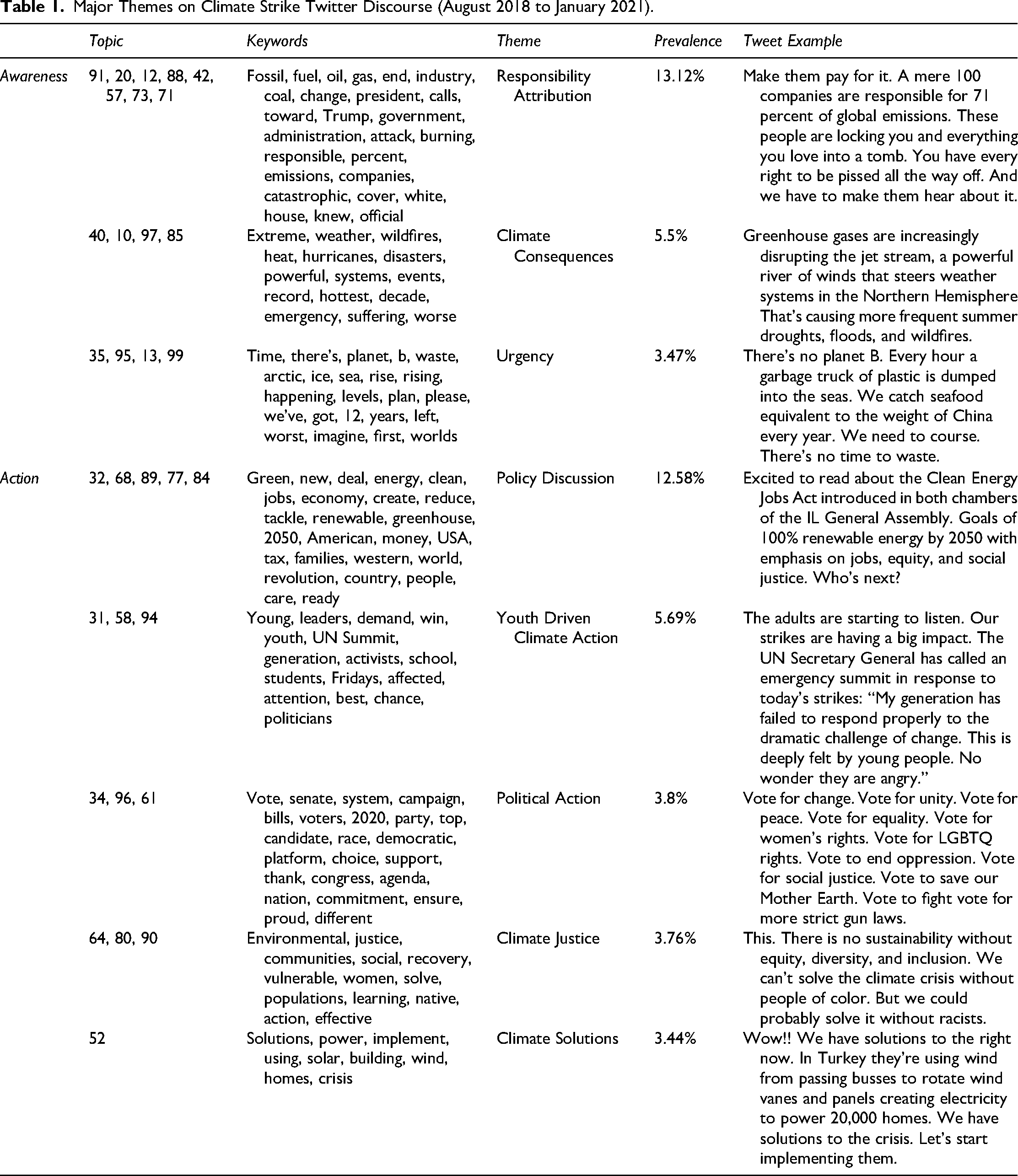
To answer our first research question (RQ1) about how climate strike discourse is framed within Twitter discourse overall, we found that there are eight major themes along with the theme of Awareness and Action. Table 1 presents these major themes, the computational topics under each frame, related keywords belonging to each topic, and the prevalence of each theme across all our tweets. In terms of raising awareness, the major themes include (1) attributing responsibility to various actors and targets such as politicians and industries, (2) highlighting climate consequences such as sea-level rise and rising temperature, and (3) raising awareness of the urgency of the issue. In terms of calling for action, the major themes include (1) calling for policy changes directed at resolving climate change, (2) highlighting action taken by youth activists, such as participating in the school strikes, convening at the UN Climate Summit, (3) calling for political action such as voting or elected certain candidates, (4) discussing the justice issues of climate strike such as pointing out how climate change might affect intersectionality issues in our society, and (5) offering climate solutions such as using wind and solar power.
Major Themes on Climate Strike Twitter Discourse (August 2018 to January 2021).
Like other social movements, climate strike discourse experienced temporal changes in what themes appear more frequently surrounding the major social events from the global climate strike youth movements to the COVID-19 pandemic, the US 2020 election, and the inauguration of Joe Biden in January 2021. Figure 1 presents the evolution of each major theme we presented in Table 1. Attributing Responsibility (third panel, orange line) and Policy Discussion (second panel, orange line) are the most frequently discussed themes. These two themes also experienced more bursts across the three-year span. For instance, the theme of Policy Discussion experienced bursts in the Twitter discourse around Greta Thunberg's first climate school strike in August 2018 and the first global climate strike movement in March 2019. Policy Discussion and Attributing Responsibility also experienced bursts when the United States started to get into pandemic lockdown around April 2020. Attributing Responsibility increased toward the 2020 US election time. We also provided the temporal changes of themes in our news media dataset in Supplementary Information File Appendix IV.
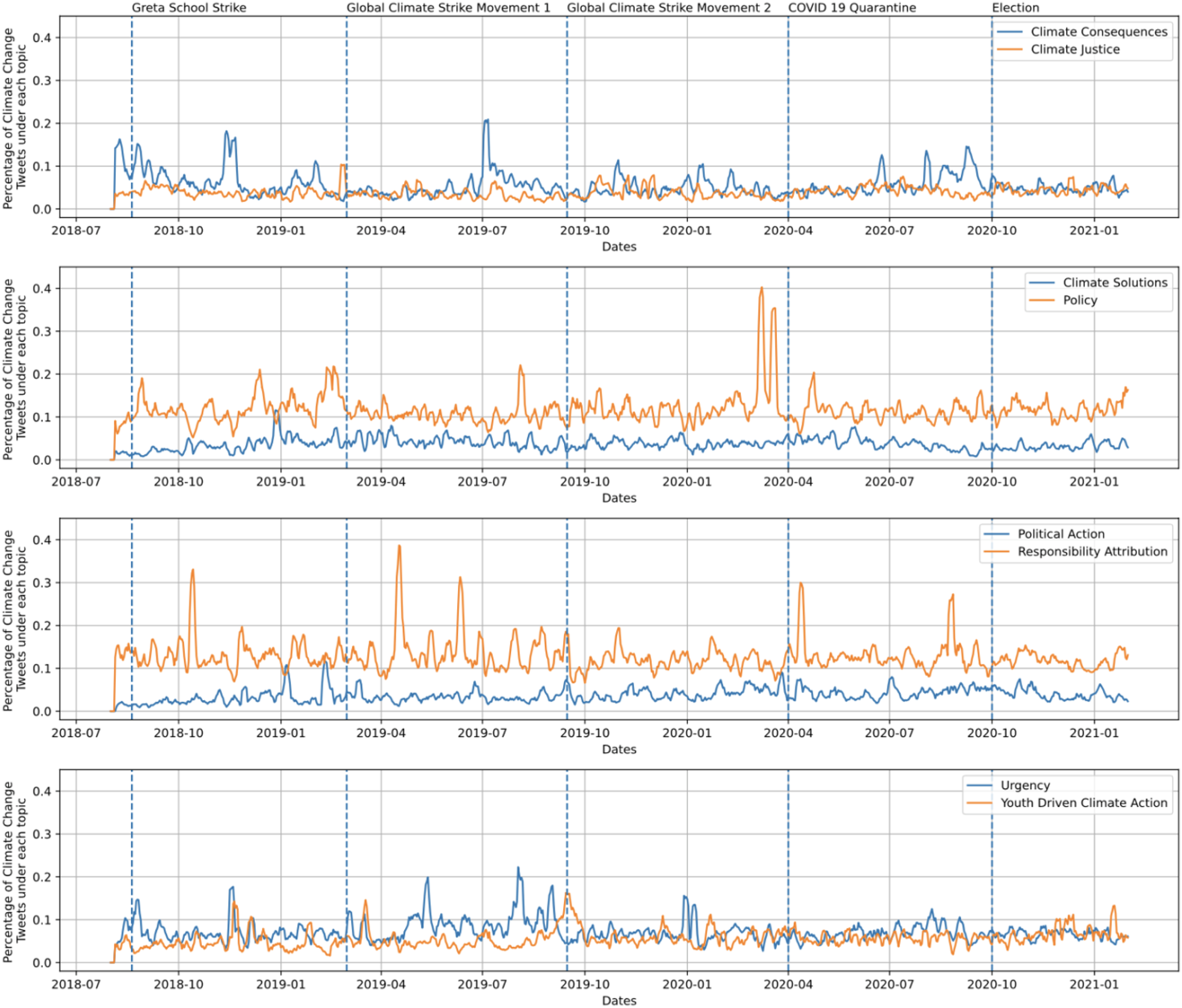
Evolution of major themes on climate strike on twitter (August 2018 to January 2021). Note: The vertical lines in the figure represented major events. The Greta School Strike happened around August 2018. The first global climate strike movement referred to the strike happened in March 2019 that around 1.6 million participants from over 125 countries joined the school strike for climate movement. The second global climate strike movement referred to the Global Week for Future, which was before the United Nations Climate Summit. These protests took place in 150 counties. For more information about these critical events for the climate social movement, see: https://en.wikipedia.org/wiki/September_2019_climate_strikes. The COVID19 quarantine in the figure referred to the COVID19 outbreaks happened in the United States in March 2020 as well as in other places in the world.
Comparing Climate Strike Discourse Framing Between Climate Movement Actors and Mainstream News Media
To answer RQ2, which asks how different actors frame the climate movement differently, we compared the discourse between movement actors’ tweets and media stories from major news outlets. Table 2 presented the major themes discussed by major news outlets in the United States, global news outlets in English-speaking countries, and climate movement actors on Twitter. We found that US news organizations focused coverage on (1) US political discussion such as partisan debates and elections and (2) consequences of climate change, such as disasters surrounding wildfires and water issues. Other topics included policymaking discussions surrounding proposals for new bills, laws, and taxes, the role of industry focused on energy production and fossil fuels, discussions of the role of media and social media, popular culture and politics, and higher education. Few (3.7%) US news stories mentioned climate protests.
Comparing the Climate Discourse Between Climate Movement Actors and Major News Media.
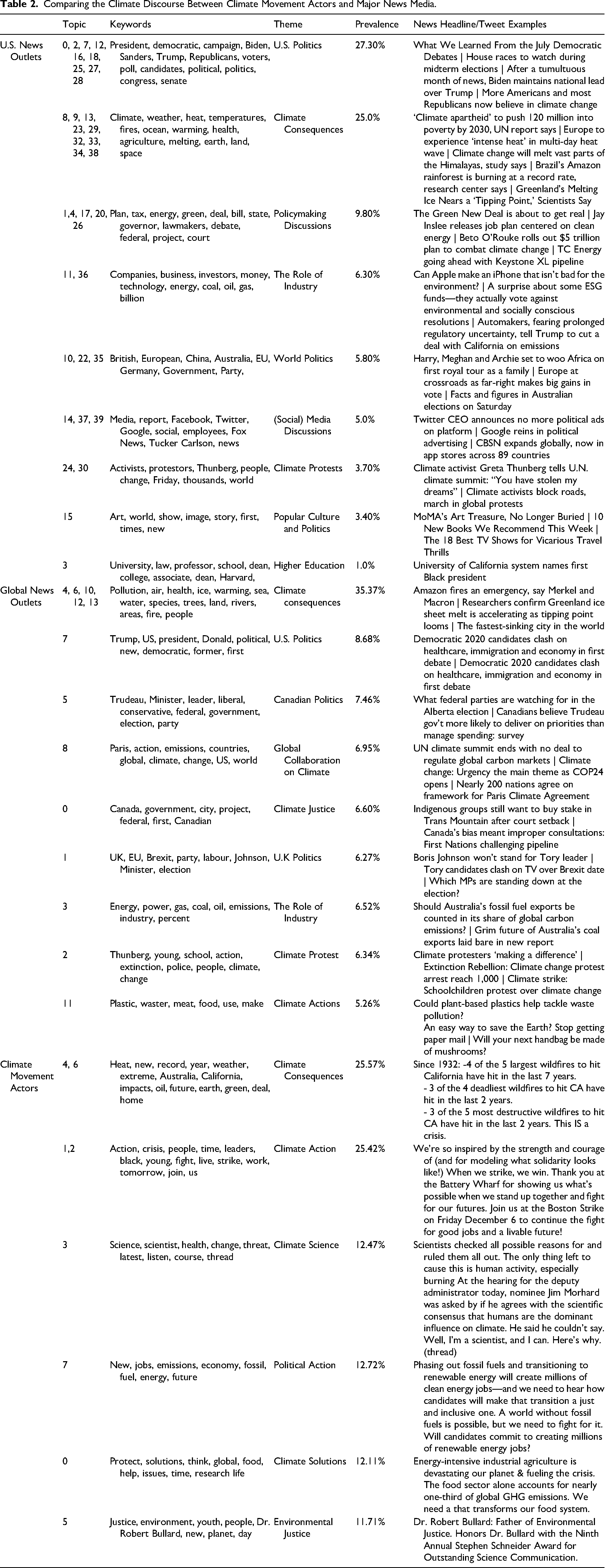
Global news coverage similarly focused on the consequences of climate change and US politics, while also extending to cover domestic United Kingdom and Canadian politics, global climate collaborations such as the Paris Agreement, and the role of industry. Differently, global news coverage more often covered climate protests, as well as climate justice issues and individual climate actions. Notably, there was a lack of policymaking discussion in wider global coverage. Compared to past reviews (Chinn et al. 2020; Stecula and Merkley 2019) that studied the framing of climate change by mainstream media, we found that coverage of global and national climate politics dominated frames from 2018 to 2020, signaling an important shift from uncertainty and economic framing to more policy and action-oriented coverage.
Differently, the climate movement actors focused more on (1) highlighting climate solutions, (2) discussing climate consequences linked to disasters and extreme weather events, (3) praising collective action taken by various groups, (4) specific political actions needed including tweeting at specific politicians to act, (5) education and climate science, and (6) providing information about environmental justice.
Major Targets Mentioned on the Twitter Versus in the Mainstream Media Climate Discourse
To answer RQ3, we examined the major targets (i.e., entities) Twitter users mentioned in their climate strike discourse from August 2018 to January 2021. Figure 2 presented three panels, each referring to a type of entity that is frequently mentioned by the tweets. The top panel represents the nationalities, or religious or political groups (NORP) that were mentioned most frequently. We observe Democrats, Americans, and Republicans are the major targets in the Twitter climate discourse, suggesting the politicization and confrontational nature of the climate movement. Country actors such as Australian, European, Canadian, and Danish were also mentioned frequently, demonstrating climate strike as a global movement not only in offline protests but also in digital spaces where different country stakeholders participated and mobilized.
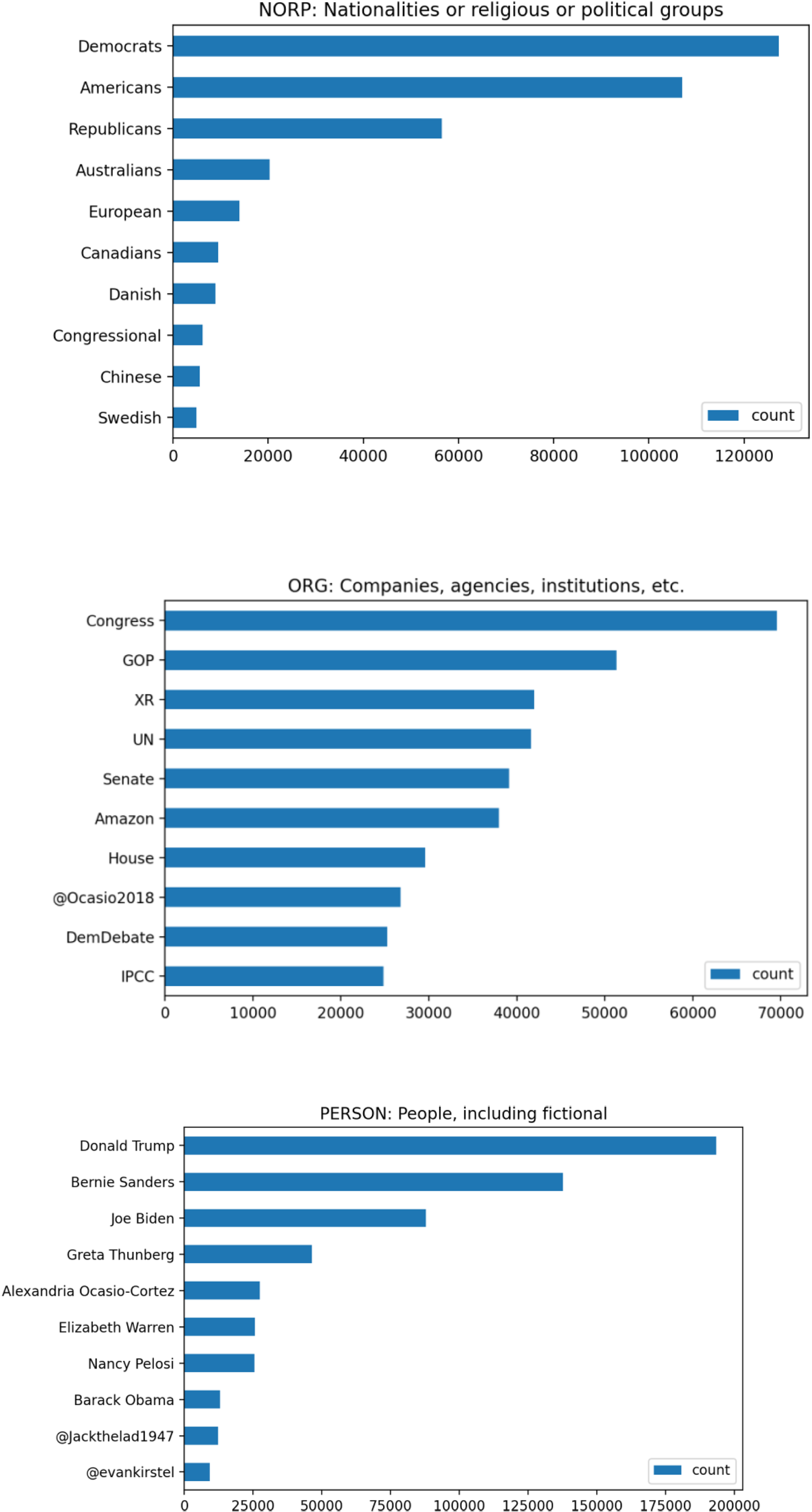
Major targets discussed by Twitter users (August 2018 to January 2021).
The middle panel represented the organizational entity (ORG). We see that the frequently mentioned ORGs include Congress, GOP, XR, UN, the US Senate, and Amazon, which differ from the major organization influencers studied in Lozano-Diaz and Fernandez-Prados (2021) research such as UNICEF and Greenpeace. The bottom panel showed the individuals (PERSON) targets in the climate discourse. For instance, we see mainly see US politicians such as Donald Trump, Bernie Sanders, Joe Biden, and Elizabeth Warren, and youth climate activists such as Greta Thunberg.
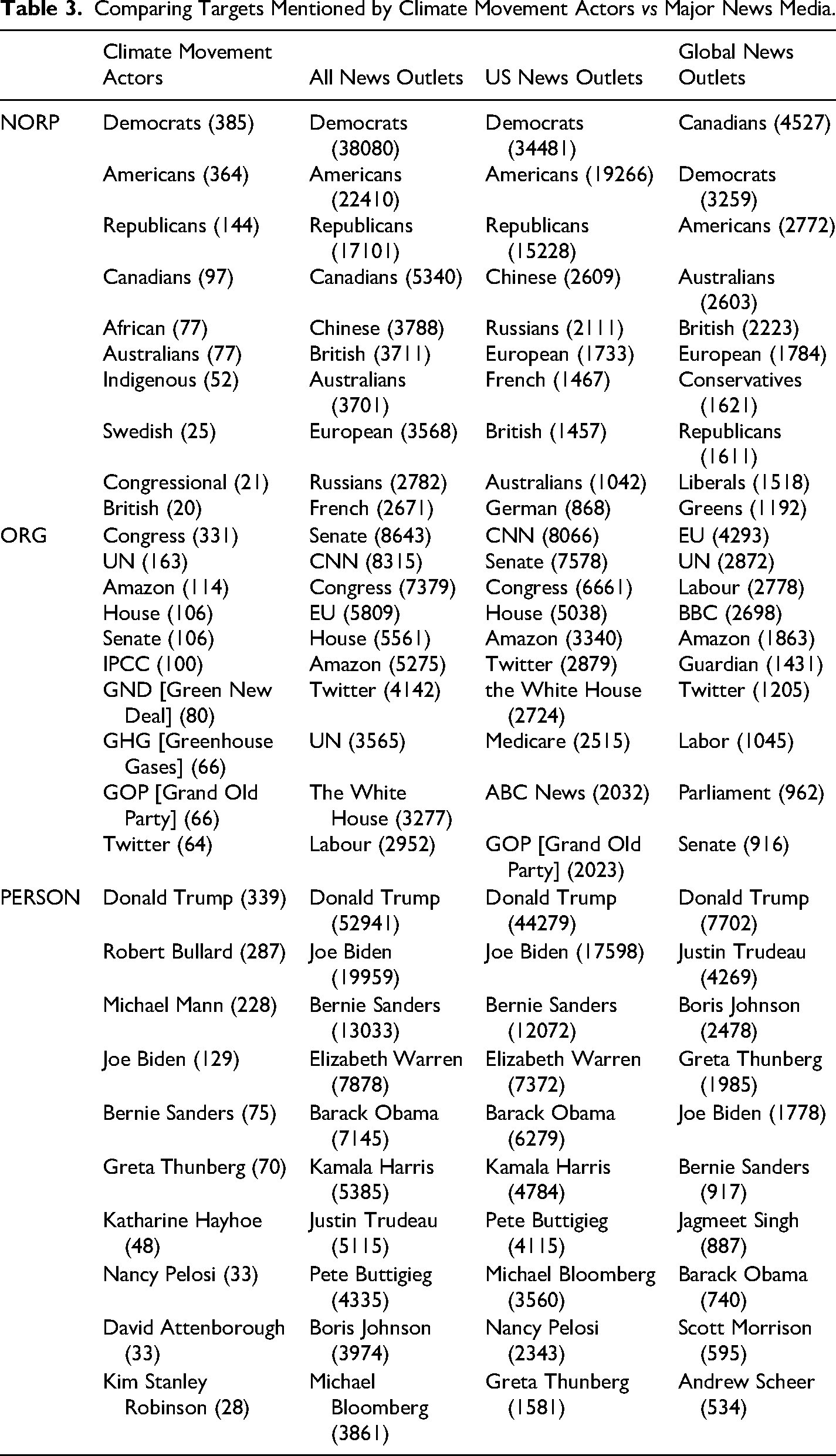
Our last research question calls for investigations looking into the differences of targeted entities between youth activists on Twitter and major news outlets. We first compared the most frequent targets mentioned by climate movement actors versus the overall mainstream news media, see the first two columns in Table 3. We found a similarity in terms of the major NORP targets where both activists and the mainstream outlets target partisans (e.g., Democrats, Republicans) and country actors (e.g., Americans, Canadians) in the discourse. The differences come in terms of the ORG and PERSON targets. Although mainstream news media primarily focused on targeting political (e.g., Donald Trump) and social media organizations (Twitter), activists focused on youth activists (e.g., Greta Thunberg) and climate change organizations (e.g., IPCC). These patterns of similarity and dissimilarity were largely replicated via robustness checks (see the last two columns in Table 3) when we broke down the target analysis of US news sources from other countries.
Comparing Targets Mentioned by Climate Movement Actors vs Major News Media.
Discussion and Conclusion
Contribution to Studying Framing of Climate Strike
Although there is an abundance of research on climate change framing in traditional media (Schäfer and Schlichting 2014), recently scholars are applying framing theories to examine the climate movement on social media (Boulianne et al. 2020; Haßler et al. 2021; Molder et al. 2021; von Zabern and Tulloch 2021). Our paper joins this small but growing research by identifying eight major frames that were prevalent on Twitter, such as awareness of the consequences of climate change, extending from an environmental focus to include social justice and future generations, and calls for politicians to take responsibility and make policy changes. Grounded in this literature, our paper took two steps further. First, we investigated how the climate movement is framed on Twitter and we analyzed the evolution of frames over time against the backdrop of critical events. Second, we took a comparative approach to examine how two critical players, news media outlets and climate movement actors, differ in how they frame climate change.
The Life Cycles of the Climate Strike Discourse
Our findings bring new knowledge to how climate strike discourse is framed on Twitter and how frames are contingent upon the major social events (e.g., election, pandemic, global youth strikes). We outlined Hussain and Howard’s (2013) description of how digital media is used at various stages of a protest cascade as well as existing research about the rise of social movement activity during elections (Heaney 2013). We offer more nuance to this description by analyzing the bursts of discourse frames on social media attached to the three-year-long climate strikes, finding that frames about policy changes and responsibility attributions were discussed much more frequently throughout the three-year time span compared to other frames. These two themes especially skyrocketed during the global strike movements, pandemic lockdowns, and the US election. Similar bursts are documented by studies of the climate strike in Germany (Haßler et al. 2021) and on TikTok (Hautea et al. 2021). Likewise, we see a rise in “policy discussions” in the periods where there are offline protest events. The increase in frames about policy discussions and responsibility attribution after the pandemic lockdown echoes recent work that documents the Friday for Future movement in Germany, where scholars found that the COVID-19 pandemic reduced calls for protest and increased discussion about thematic coverage (Haßler et al. 2021, Figure 6).
From Climate Science to Policies and Responsibilities
Although the existing public opinion of climate change research focuses on surveying people's concerns about climate science (Brulle et al. 2012), the temporal patterns of Twitter discourse illustrate a potential shift in public opinion from discussing science to calling for policy changes and targeting politicians. This echoes a shift in recent decades in the broader climate movement discourse from individual responsibility for global warming to demands for societal, collective, and policy level action (Ludwig 2020).
Addressing the Knowledge Gap in Comparing Climate Movement Actors Versus Traditional News Outlets in the (Climate) Social Movement
In this paper, we compared framing practices by climate movement actors and major news media. Results revealed that these two actor groups adopted different framing strategies. News outlets emphasized the political implications of climate change and highlighted how climate issues would influence the economy and industry. In comparison, movement actors focused on action-oriented mobilization, specifically political actions such as voting and climate actions such as engaging in climate strikes. This observation indicates that various actors in the hybrid media system may frame debated issues like climate strikes by selectively sharing content that is cognitively congruent with their beliefs, hoping their framing will be dominant (Aruguete and Calvo 2018). Besides, we observed that movement actors promoted a call-to-action frame in their discourse while news outlets in return covered actions by protesters. This conceptually reciprocal framing practice further supports our previous observation on the action-oriented emphasis among the framing practices by climate movement actors and journalists. This comparison provides implications for how we study protests in a hybrid media system where new actors and traditional players interact. Although we are not able to examine the causal relationship between how news outlets and activists influence each other's framing of the climate movement, we see a shift in the focus of mainstream media's framing since late 2018 from discussing the uncertainty and economic consequences of climate change (Stecula and Merkley 2019) to highlighting the global and national politics and policies around climate change. This shift could be a result of social movement actors calling for policy actions and targeting responsibilities in the digital space.
The Politicization and Confrontational Nature of Climate Discourse in the Digital Space
Our findings on the targeted entities in Twitter discourse highlight climate strikes as a politicizing and confrontational movement. We observed a clear pattern that politicians or country actors were mentioned more frequently compared to other organizations or companies over the past three years. Global country actors such as China, Canada, and Australia were also discussed frequently. These findings echo existing literature that stresses climate change as a controversial and highly politicized issue (Chinn et al. 2020) where politicians and partisans are confronted in the discourse. Although politicians were mentioned frequently in the discourse, specific policies and bills were rarely discussed except for the Green New Deal. Most of the time, the discourse was just a name call, echoing Thorson and Wang’s (2020) argument that public attention to climate on Twitter might just be flashes of action rather than committed participation. Second, when considering US political cycles and policy windows, it is likely that the climate movement was building up to the 2020 US presidential election to elect Joe Biden and enact his administration's policies on climate change and renewable energy in 2021. The mentioning of country actors also reflected the climate strike as a global movement where naming country actors as responsible might fuel nationalist attitudes on climate change.
Our findings about the PERSON entities show how digital media can give new voices a platform to challenge traditionally dominant voices. Although certain political elites are still heavily discussed in climate movement discourse, our findings show that youth climate activist Greta Thunberg is one of the top ten most mentioned PERSON entity, which signals the growing voice of youth in the climate movement. Research shows that traditional news media's coverage of young people's climate strikes and support for the Green New Deal continues to fall into a predictable protest paradigm where coverage can delegitimize, undermine, and “other” young people (Morris 2021; von Zabern and Tulloch 2021). Considering this, our study examines Twitter data because social media platforms can somewhat bypass gatekeeping functions and the protest paradigm of traditional media, allowing activists to express themselves using their own words and have greater control in the framing of the message. On the other hand, some argue that Twitter still incorporates many gatekeeping functions that dictate whose voice is amplified, whereas the difference between mainstream media and social media is that these decisions are based on algorithms instead of editorial preferences. Thunberg may be the only youth climate activist who dominates the attention of climate movement discourse because she has risen to the same celebrity level as other political elites.
Harnessing Computational Methods for Analyzing Large-Scale Climate Strike Discourse
This paper is an interdisciplinary work between authors from communication and computer science. We showed how researchers can harness a variety of computational text analysis methods in Natural Language Processing to generate new knowledge about the frames, evolution, and major targets in the climate strike movement on digital and mainstream media. These computational methods are especially helpful as many social movements cross borders and platforms, and thus generate enormous discourse data. Computational communication is a rising area in communication where a growing number of scholars have applied and designed computational tools, from text analysis to computer vision (Bucy and Joo 2021).
We also want to emphasize the role of domain knowledge in interpreting and applying computational models. Echoing van Atteveldt and Peng (2018), big data are not always good data and computational methods need human validation. We conducted a variety of human validation throughout the computational process. For instance, to decide the optimal number of topics from our LDA model, we not only examined the statistical criterion such as the coherence of model performance but communication scholars on our team also read the output (keywords and tweets) of different model sizes to decide what model generates more meaningful interpretation.
Future Work
The exploration between news coverage of the climate crisis and social media (youth) activism is just at the beginning. With the impact of climate change becoming more urgent and uneven, our research hopes to pose several questions for future examination. For instance, future scholarship can deploy message experiments on social media platforms to examine the causal relationship between news media coverage and people's intention to participate in climate strike discussions on digital platforms and in offline protests. Another exciting future research area is to study international press coverage of climate strikes on social media platforms in other languages beyond English and thus to investigate how climate strike discussions are similar and different from one country to another. This comparative approach to global protests will inform global policymaking strategies to protect our future planet. Finally, scholars can conduct qualitative content analysis to expand our understanding of how the targets identified by the Named Entity Recognition are discussed with what sentiments and framing in the climate discourse.
Supplemental Material
sj-docx-1-hij-10.1177_19401612221106405 - Supplemental material for How Climate Movement Actors and News Media Frame Climate Change and Strike: Evidence from Analyzing Twitter and News Media Discourse from 2018 to 2021
Supplemental material, sj-docx-1-hij-10.1177_19401612221106405 for How Climate Movement Actors and News Media Frame Climate Change and Strike: Evidence from Analyzing Twitter and News Media Discourse from 2018 to 2021 by Kaiping Chen, Amanda L. Molder, Zening Duan, Shelley Boulianne, Christopher Eckart, Prince Mallari and Diyi Yang in The International Journal of Press/Politics
Footnotes
Acknowledgments
Chen, Molder, and Duan contributed equally to this paper. Kaiping Chen would like to thank the support for this research provided by the University of Wisconsin Madison Office of the Vice Chancellor for Research and Graduate Education with funding from the Wisconsin Alumni Research Foundation. The authors would like to highlight Zening Duan's assistance in helping prepare the large-scale Twitter data collection, computational text analyses, and replication scripts. The authors would like to thank Yepeng Jin for collecting the news media dataset. Finally, the authors would like to thank Dr. Sijia Yang for providing access to Synthesio data, with support from the Office of the Vice Chancellor for Research and Graduate Education at the University of Wisconsin–Madison and funding from the Wisconsin Alumni Research Foundation.
Declaration of Conflicting Interests
The author(s) declared no potential conflicts of interest with respect to the research, authorship, and/or publication of this article.
Funding
The author(s) received no financial support for the research, authorship, and/or publication of this article.

Supplemental Material
Supplemental material for this article is available online.
Author Biographies
References
Supplementary Material
Please find the following supplemental material available below.
For Open Access articles published under a Creative Commons License, all supplemental material carries the same license as the article it is associated with.
For non-Open Access articles published, all supplemental material carries a non-exclusive license, and permission requests for re-use of supplemental material or any part of supplemental material shall be sent directly to the copyright owner as specified in the copyright notice associated with the article.
