



Abstract
On July 17, 2021, the CDU's chancellor candidate Armin Laschet was photographed laughing during a speech by the German Federal President in the flood-stricken city of Erftstadt. The photographic images caused an uproar and contributed to the CDU's defeat in the September 23 election. The paper analyzes why these images resonated with such damaging effects. Theoretically, it sets the analysis on the background of the moralization and personalization of politics and argues that photography, with its ability to capture behavior at a distance, plays a prominent role in these processes. While this condition explains why an image of a laughing politician can generate such indignation in the first place, the paper discusses how this effect was amplified in the case of Laschet by a range of contextual features: (a) the timing of the images in the middle of an election period where politicians come under intense scrutiny; (b) their appearance in a crisis situation (the German flooding disaster) where politicians are surrounded by other role expectations than in routine periods; (3) Laschet's new, insecure position as leader of the CDU; (d) his history of scandals and poor political judgment; and (e) the frivolous and boisterous manner of his laughter. At a general theoretical level, the paper's insights caution us to avoid prima facie conclusions about the autonomous power of photographs. Instead, they encourage analytical sensitivity to the importance of timing and context as explanatory elements in our understanding of photographic exposés.
Introduction
On July 17, 2021, the German Federal President Frank-Walter Steinmeier arrived in the city of Erftstadt to address the victims of the flooding disaster that had been ravaging the regions of Rheinland-Pfalz and Nordrhein-Westfalen over the summer, leaving almost 200 dead in the worst natural disaster in Germany since 1962. Accompanying Steinmeier was the Minister President of Nordrhein-Westfalen, Armin Laschet. Some six months earlier, Laschet had also been elected leader of the CDU (the Christian Democratic Union of Germany) and was now campaigning in that capacity to become Angela Merkel's successor as chancellor at the September 23 German national elections. At this point, Laschet and the CDU were cashing in on Merkel's popularity, enjoying a long-predicted lead in the polls. Then something snapped. Standing in the background, several meters behind Steinmeier delivering a somber speech in front of the press, Laschet had apparently lost track of the serious nature of the social and political situation he was in, visibly laughing and having lively banter with the people standing next to him. While Laschet may have thought himself to be out of view, the prying eyes of the press cameras at the scene would soon shatter that illusion and produce one of the most devastating photographic exposés in recent political history.
The reaction was as immediate as it was predictable. Already at 19:26 on the same day, Laschet was forced by the barrage of negative reactions to issue an apology on Twitter. But at that point, the damage had already been done, or rather, it was constantly being done as the photographic images (both still photographs and video recordings) of the laughing Armin Laschet kept circulating through the public sphere in their original form as well as in countless memefied versions. In just five weeks, from July 19, two days after the photographic exposé, to August 23, voter support for the CDU dropped from 29 percent to 23 percent (Insa-Consulere 2021), reversing the CDU's and Laschet's momentum and handing it instead to the SPD (the Social Democratic Party of Germany) and its chancellor candidate, Olaf Scholz, who would maintain it until the September 23 election. While we should be instinctively cautious about mono-causal explanations and the oft-cited “power of photography” (Domke et al. 2002), there is little doubt that the images had a significant impact on the election outcome. Commenting on the election result some two months after the exposé, German political scientist Claus Leggewie (cited in Gierke 2021) even went so far as to say that the images had “broken” Laschet's campaign. The goal of the paper is not to test this claim about the cause and effect on the election result. Rather, it seeks to understand why the images mattered and resonated the way they did. After all, being unable to suppress inappropriate laughter is an almost mundane human experience. What is interesting and puzzling in the case of Laschet is the contrast between an act that may appear relatively harmless in isolation and the wide-ranging political consequences it ended up having for him.
In pursuing this analysis, I view the resonance of the Armin Laschet images as symptomatic of the moralization and personalization of politics (Thompson 2005, 2011). The documentary truth-claim of photographs and their ability to capture action at a distance are a key form of intervention in this broader process. In the current situation, these features are amplified by an increasing importance of visual information (Geise et al. 2021; Harcup and O’Neill 2017) and by audience-driven participation on social media platforms (Bennett and Livingston 2018; Bruns 2007), which tend to foreground the visual. While these conditions may help explain why a laughing politician can generate such indignation in the first place, the paper argues that this effect was amplified by a range of contextual features: (a) the timing of the images in the middle of an election period where politicians come under intense scrutiny; (b) their appearance in a crisis situation (the flooding disaster) where politicians face a different set of role expectations than in routine periods; (3) Laschet's new, insecure position as leader of the CDU; (d) his history of political scandals and poor judgment; and (e) the frivolous and boisterous nature of his laughter. While the paper's scope is naturally limited by its single case character, I believe that the essence of its arguments can be extended. At the most general level, they caution us to avoid prima facie conclusions about the autonomous power of photographs. The content of the Laschet images certainly mattered, but only in a constitutive interplay with contextual factors such as timing and public renown. Combining attention to what is in the photograph with what is outside out of it is a necessary starting point as we try to deepen our understanding of photographic exposés.
At a broader level, the paper's focus on the photographic exposé offers a two-sided contribution to the study of political communication. While there is now a sizable body of work on political scandals (e.g., Allern et al. 2012; Barbiero 2020; Dziuda and Howell 2021; Jimenez 2004; Thompson 2000), it only pays fleeting attention to the role of photographic images in these processes. More broadly, visual politics is by no means a new field. Research has looked at the way political advertising (Goldstein and Ridout 2004; Noggle and Kaid 2000), politicians’ facial expressions (Peng 2018; Sülflow and Maurer 2019), and politicians’ visual appearance in political debates (Druckman 2003; Grabe and Bucy 2009) affect voters. Recently, and in particular, in this journal, attention has shifted to politicians’ strategies of self-presentation on new media platforms such as Instagram and Facebook (Farkas and Bene 2021; Lindholm et al. 2021; Mendonça and Caetano 2021; Miltner and Baym, 2015; Peng 2021). Both of these strands focus on intended and managed media strategies and performances. While intended and managed visual performances can also draw moralizing criticisms, such claims are likely to be more pronounced and potentially scandalizing in the case of unintended photographic exposés such as that of Armin Laschet and, even more recently, the leaked photographs of British Prime Minister Boris Johnson participating in a Christmas quiz during COVID-19 lockdown in December 2020. This particular form of visual representation of politicians remains little explored and theorized in the literature.
Why and How Do Photographic Images Matter for Politicians?
It is widely acknowledged that the last 50 years have seen a gradual weakening of class-based and ideology-driven voting behavior in Western democracies. With a growing middle-class, profound changes in production, and the accentuation of value and identity politics, the traditional connection between class, profession, and place, on the one hand, and party preference on the other, has loosened to an extent where voters are now more volatile and less committed to a specific ideological package (Fieldhouse et al. 2020). According to Thompson (2005: 46), the result is a situation where voter assessments of politicians’ trustworthiness and personal character become increasingly important elements in political choice. This trend is supported by longitudinal research on political scandals. Drawing on data from the Nordic countries, Allern et al. (2012: 36), for example, document how scandals concerning politicians’ unacceptable personal behavior (e.g., sexual affairs, traffic offenses, and alcohol abuse) have come to account for an increasing proportion of the universe of political scandals in the 1980–2009 period. This personalization and moralization of political life connects with a parallel historical trend of declining trust in authority and institutions (Bennett and Livingston 2018; Inglehart 1977) where the public has increasingly asserted its “right to know” (Schudson 2015) what goes on behind the political scene.
The personal, as a result, is now a key asset in the quest for political power (Enli and Skogerbø 2013; Lindholm et al. 2021; Van Aelst et al. 2012). The participation of politicians in talk shows and entertainment formats and invitations to “see” their private lives on Facebook and Instagram reflects how this dimension has acquired prominence in today's political environments. This situation is profoundly double-sided. On the one hand, it is democratizing in the sense that the distance between voters and politicians have shrunk to create new forms of intimacy (Meyrowitz 1977; Stanyer 2013). On the other hand, this opening up of private space also imposes on the politician a new level of moral critique of character and personality, where, as Thompson (2005: 42) notes, “an indiscreet act, an ill-judged remark or an unwarranted disclosure can have disastrous consequences.” Drawing on Pierre Bourdieu's notion of “capital,” Thompson (2000) considers such disclosures to be acutely dangerous because they erode the politician's symbolic capital, that is, his or her public reputation.
These insights are an important backdrop as we try to understand the link between photography and politics. As noted by Lilleker (2019) and Marland (2012), the affective power of photographs and other forms of visual material can serve to build or strengthen desired public views and perceptions of parties and politicians. Ideally, visual representations can help bolster audience perceptions of positive character traits such as “strength,” “honesty,” “empathy,” and “trustworthiness.” In a communication environment saturated by huge amounts of complex information and where many voters are not deeply interested in or knowledgeable about politics, such visual representations can function as a kind of shortcut to assess the character essence of the politician (Lilleker 2019: 46). But while images can promote a positive narrative around the politician, they also have the capacity to destroy or pollute it if the information they contain is perceived to document a significant deviation from broadly accepted norms about appropriate behavior. The politician has limited control over this process. The visibility of politicians in today's mediatized societies and the blurring of the boundary between private and public (Thompson 2005, 2011) indicates a major power shift in the relationship between citizens and politicians. Today's public sphere, Thompson (2011: 63) writes, is “a largely uncontrollable space, in the sense that once words and actions appear in this space it is very difficult to control what happens to them.” Politicians are constantly seen and judged but have limited capacities to decisively affect how their words and actions are interpreted and acted on by the audience. Meyrowitz (1977: 306) was already onto this new condition several decades ago when he noted how politicians increasingly find themselves “commenting on information already available rather than making new statements to the press.” The systematic scrutiny of all aspects of the politician's life produces a flurry of new “knowledge” that demands continuous evaluation and reaction.
Of course, political reputations can also be affected by spoken or written words. The non-verbal communication of photographic images differs in at least two ways. First, as Barthes (1981) has noted, photography has a documentary truth-claim that makes it difficult to refute the information it provides: It is simply less susceptible to defensive reactions like “I did not mean it that way,” and “My words were taken out of context.” Second, because photography can document situations from a distance, it has a unique ability to capture what Goffman (1959) has called back-stage and Meyrowitz (1977), following Goffman, middle-region behavior. The camera, Meyrowitz (1977: 304) writes, thus “invades the politician's life like a spy … It watches him sweat, sees him grimace at his own ill-phrased remark or succumb to emotions. The camera destroys all distance between audience and performer.”
Back-stage and middle-region behavior is typically contrasted with front-stage behavior (Goffman 1959; Meyrowitz 1977). In this paper, I understand front-stage behavior to refer to situations where the politician performs a distinctly formal political role (speaking at an election rally, participating in political debates, etc.) in a publicly visible space. Seen through a political lens, back-stage behavior may, as I see it, cover at least two dimensions: the purely private and homely space of the politician as well as situations where he or she takes part in confidential political talks and negotiations behind closed doors. What is shared across these two types is that the politician can have a reasonable expectation not to be “seen” unless he or she actively invites it. The middle-region suggested by Meyrowitz (1977) is more complex because it contains elements of both front and back stage. Meyrowitz himself mentions talk shows with politicians that mimic an intimate space and where private matters are discussed, shows of affection for your family in public space, or access to watch politicians “behind the scenes” as forms of middle-region politics. I find it useful, especially with the case of Armin Laschet in mind, to add to these examples situations where politicians may be at “at work” but find themselves outside or in the periphery of a main political or official event. This may create a sense of being unwatched. However, as I have already remarked, the camera's ability to annul physical distance makes such perceptions illusory.
With these formulations in mind, it may be suggested that photography's potential to negatively affect the moral reputation and standing of politicians is most pronounced when it captures back-stage or middle-region behavior not intended for public consumption (the mid-right and lower-right cells in Table 1). It is in this (partly) unguarded space that contradictions with publicly nurtured images are most likely to occur and where, for that reason, moralizing critiques from the receiving audiences emerge in their most potent and damaging form (Thompson 2005). Unintended photographic exposés of back-stage or middle-region behavior can be made in at least two ways: by photo or citizen journalists who document behavior from the “distance” (as in the case of Laschet) or, in the current period of portable personal documentation devices, through leaked photographic images taken by insiders (as in the case of Boris Johnson's Christmas party quiz during COVID-19 lockdown).
A Typology of Politician-Images.
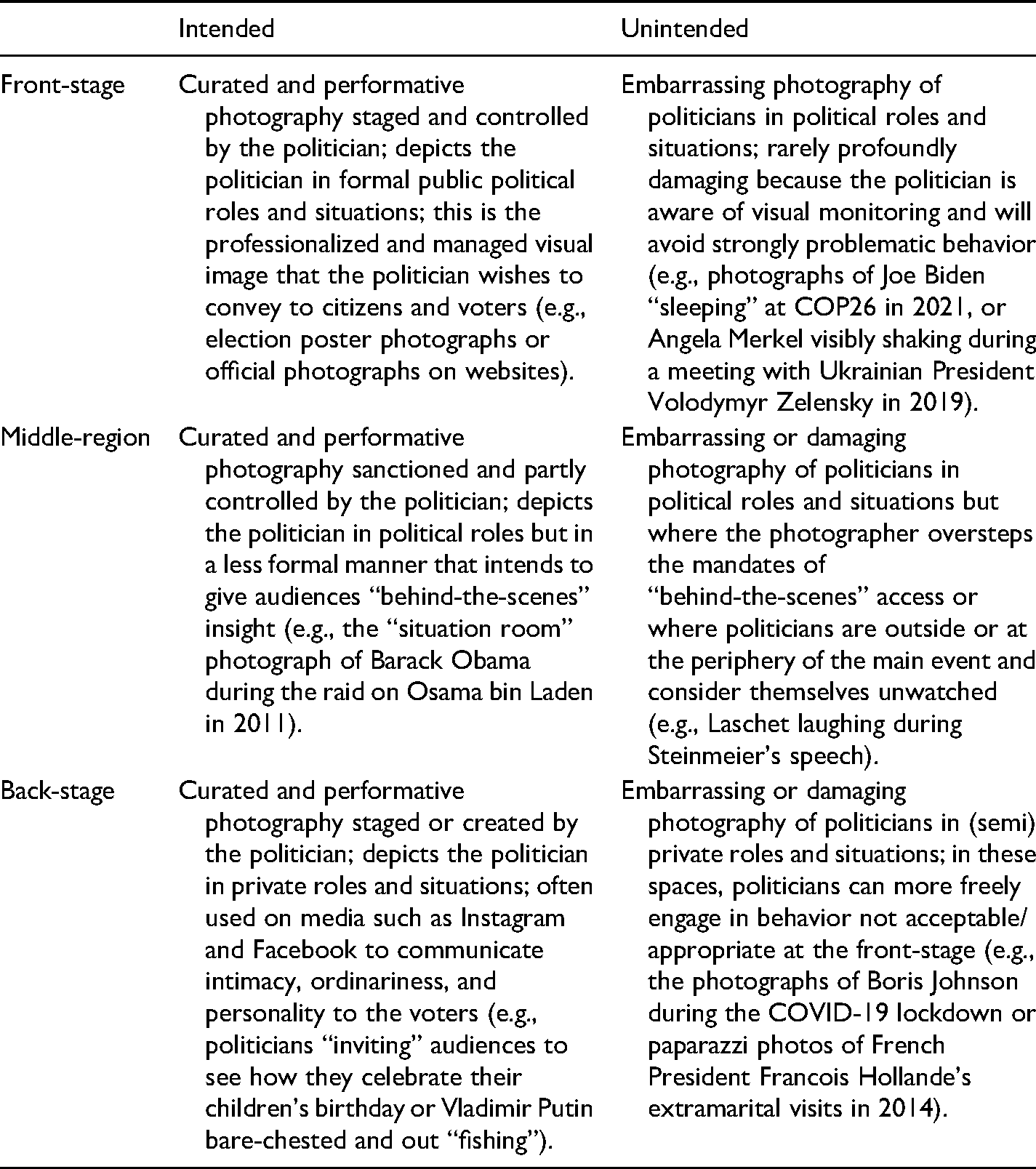
While it is reasonable to say that the potential for photographic scandalization is most acute in the mid-right and lower-right cells of the table, this is always just that: a potential (Domke et al. 2002). Resonance, in other words, is never automatic or determined. Rather, as argued by McDonnell et al. (2017) in their general theory on resonance, resonance occurs mainly when the object (in the context of the present paper, a photographic image) is simultaneously novel and legible for the receiving audience. They also note how resonance is a creative, interactional process that happens when audiences can use the object to plot lines of action and address real-world issues. Such an agency-oriented, interactional framework does not mean that we should lose track of the broader, structural conditions I outlined above; instead, it motivates a sensitivity to the importance of context and timing when we try to understand the resonance of particular photographic images of politicians. We may distinguish between two levels of context: one pertaining to the event or situation in which the politician is photographed, and one relating to the history and already existing public perceptions of that politician. As suggested by Domke et al. (2002), visual information is no different from other forms of information in that it is always received and interpreted through schemas or frames held at the individual and collective levels. If we first consider the situational context of the photograph, schemas may affect interpretation as they indicate what is expected and permissible in a specific situation. Every situational role that a politician can partake in (a speech in parliament, a press conference, etc.) has its own set of codes and prescriptions that shape the interpretation of behavior among the receiving audience (Goffman 1959; Miltner and Baym 2015). Finally, politicians are never blank slates when they appear in a photographic image. They carry with them into it a history of already established public narratives and assessments of who they are. These understandings inform the interpretive processing of the image and plot out the particular trajectories it can follow.
The importance of unintended back-stage and middle-region photographic images of politicians has deep roots, as I outlined above. The disrupted (Bennett and Livingston 2018) and social media organized public spheres that we now live in do, however, add new important dynamics to the process. First, the erosion of journalistic authority (Nielsen 2016) and the rise of citizen journalists (Dahlgren 2016) mean that moralizing photographs can now emerge from multiple points and are no longer the preserve of the professional photojournalist. Second, the social media ecology transforms the way the audience can partake in the interpretive process around political events (Bruns 2007). In the case of photographic images, this often happens in the form of memes that build on the original photograph but change or amplify its meaning by inserting it into new contexts, adding new elements to it, etc. (Bayerl and Stoynov 2016; Boudana et al. 2017). While these characteristics do not create scandalization and moralization in and of themselves, they can amplify their impact by ensuring rapid and widespread circulation and, not least, by enabling circulation to occur in a way that allows everyone to participate in the meaning formation around the photograph by liking, retweeting, and recontextualizing it. Third, because social media such as Facebook and Instagram are visually oriented and dependent platforms (Farkas and Bene 2021; Geise et al. 2021; Lalancette and Raynauld 2019), photographic and other visual information is likely to be particularly shareable and attractive within these domains.
Data and Analytical Strategy
What I have until this point referred to as the Armin Laschet photographic images are, in reality, a constellation of different sources and forms of visual documentation. Probably the most widely circulated still photograph is the one taken by Marius Becker (see below). In this photograph, Laschet is seen laughing with his tongue sticking out between his teeth. The laughing occurred after an exchange with a group of people standing next to him. In late 2021, media reported that the source of laughter had been an exchange between Armin Laschet and District Administrator Frank Rock. Apparently, Laschet jokingly criticized Rock for only addressing the Federal President as “Mr. Steinmeier,” while Rock replied that he was surprised to see that the Federal President was just as short as Armin Laschet (Geyer and Voogt 2021). Laschet's laughing was also caught on many video recordings made by news stations present at the scene. These exist in several versions and cuts on YouTube and other platforms. A longer sequence of 20.46 min, which documents events both prior to and after the laughing incident, can be viewed on the website of Der Spiegel (2021) in high-quality resolution. The laughing incident occurs around 2.45 min into this recording.
As can be seen in the video recordings, the scene takes place at a fire station in Erftstadt, a city of ∼50.000 citizens in the region of Nordrhein-Westfalen. Armin Laschet stands inside the fire station garage while Federal President Frank-Walter Steinmeier delivers a speech to the waiting press corps in front of the building, ∼5–10 m from where Laschet stands. As noted earlier, Laschet accompanied Steinmeier in his capacity as Minister President of Nordrhein-Westfalen. In the videos, Laschet is seen standing with a group of others in the background to Steinmeier's right. To Steinmeier's left, a group of aid workers are standing in front of a rescue vehicle. In Marius Becker's still photograph, the aid workers are not visible, just as Laschet's placement in relation to Steinmeier is not clear. The analysis that follows is based on the entire assemblage of visual material from the meeting. Looking at debates on Twitter and Facebook, commentators referred to both the still and video recorded images. This is not surprising because seen in isolation, there is nothing problematic about a politician laughing as we see it in Marius Becker's photograph. What creates its moralizing potential is, as I discuss in more detail below, the context and the fact that the laughing occurs while Steinmeier is speaking to the press just a few meters away. This broader reading of the mise-en-scène is only possible to achieve if we consider the entire assemblage of photographic documentation from Erftstadt.
The analysis builds on a political science-oriented adaptation of social semiotics (Kress and Van Leeuwen 2020). A social semiotic approach to the visual is interested in representation (what is in the photograph?) and composition (how are things and people in the photograph related to each other?) and, not least, in how photographs are interpreted by the receiving audience (Caple 2013; Harrison 2003; Kress and Van Leeuwen 2020). All these elements are necessary inclusions because they affect each other. A photograph does not mean anything (and cannot, therefore, have political effects) unless those who see it (the general public, journalists and editors, politicians, interest organizations, etc.) impute values and emotions to it. As I have tried to argue in the theoretical section, these interpretations are never random but organized around already existing knowledge, information, and discourse available in the public sphere. Such an understanding is particularly important for the political analysis of photographs because it alerts us to the way photographs can become key symbolic sites where societal values and ideologies are mobilized and sometimes clash (Andén-Papadopoulos 2008; Miltner and Baym 2015). Reversely, critical reactions to photographs cannot be isolated from their content. Put differently, content and composition can be more or less powerful and more or less evocative of emotional and indignant responses (Hansen 2015; Hariman and Lucaites 2007; Olesen 2018). In the coming analysis, I attempt to balance the discussion so that it provides insight into both the content/composition and interpretation/reception elements of the images of the laughing Armin Laschet.
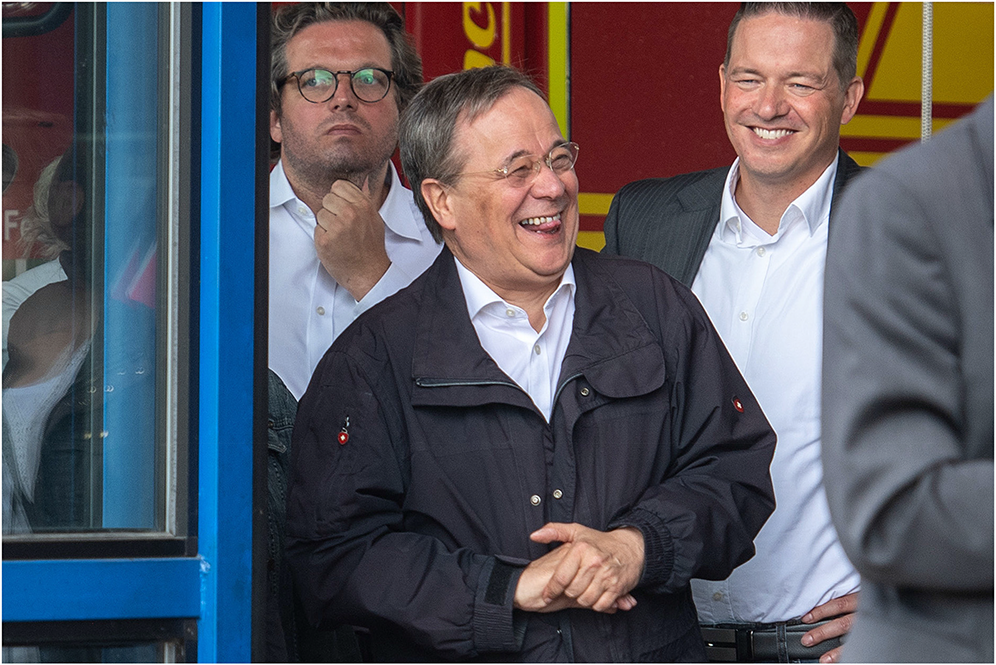
Marius Becker/Picture Alliance/Ritzau Scanpix (reprinted with permission).
Context and Role Expectations
Laughter is one of the most complex and multi-faceted expressions of human emotion. The Russian film critic Rostislav Yurenev once wrote how “laughter can be joyful and sad, kind and irate, clever and silly, proud and warm-hearted, indulgent and fawning, contemptuous and scared, offensive and encouraging …” (quoted in Propp 2009: 11). While Yurenev's list is much longer, the quote conveys the countless ways in which laughter can be used and understood in human communication settings. This view is supported by psychological research on emotions, which shows how laughter is highly variable and context dependent (Curran et al. 2018). It is also consistent with a micro-sociological perspective that emphasizes how individuals try to control social situations through the various gestic and emotional signals they transmit to other individuals with whom they share the situation (Goffman 1959). If we apply these insights to the case of Armin Laschet, it becomes readily apparent that his offense was not the laughter per se but rather the social situation in which it occurred. However, this rather banal observation is not sufficient to explain the indignant reaction that followed. A closer look at the video recordings (Der Spiegel 2021), for example, show how the aid workers strategically placed behind Steinmeier for the photo opportunity are also smiling and joking among themselves. In other words, despite the seriousness of the situation, smiling and laughing was not problematic in and of itself. What made Laschet's laughing inappropriate was the specific expectations associated with his public role.
Laschet's role and identity in the visual scene was a dual one: as a still functioning Minister President of Nordrhein-Westfalen and as the CDU's chancellor candidate for the national elections on September 23. In situations of crisis, disaster, and funerals, political roles are imbued with new sets of expectations that require leading politicians to act with composure and dignity on behalf of the entire community they represent (Ansell et al. 2014; Miltner and Baym 2015). In the case of Laschet, such expectations were amplified by the fact that his presence in Erftstadt was inextricably linked with that of Federal President Frank-Walter Steinmeier. In Germany, the Federal President holds little formal power but is expected to play an integrative role and to initiate debates on public matters (Sörensen 2016). The speech presented by Steinmeier at the press conference on the seventh reflected this role, held as it was with a serious, somber demeanor, lamenting the loss of lives and property in the region. Laughing within such a setting with all its associated, unwritten expectations about appropriate behavior for a politician in a time of crisis was what ultimately turned the images of Laschet into a devastating exposé rather than just an innocent misstep or even an expression of humanness and personality, as might have been the primary interpretive line for the smiling rescue personnel standing just a few meters away from him. For Armin Laschet, the indictment was a radically different one: Rather than demonstrating sympathy and solidarity with the flooding victims as he was expected to do, he had “proved” a glaring lack of empathy and an almost childish, self-centered inability to read social situations and act in accordance with established norms about appropriate behavior.
The moralizing force of these conditions was only exacerbated by the fact that the exposé occurred during the height of an election campaign where media and citizens subject politicians to particularly intense scrutiny (Walgrave and Van Aelst 2006). Usually, politicians seem able to benefit from crisis situations precisely because these allow them to take an all-embracing, solidary, and common values-oriented stance that raises them above the world of mundane political bickering and constant media scrutiny (Ansell et al. 2014). Laschet not only squandered this opportunity, but his laughing also catapulted him out of this safe zone and made him acutely vulnerable to moralizing charges, which had a particularly damaging sting in the high-intensity political climate of the election campaign. These came from the citizenry and the media as well as from political opponents who were not blind to the political advantages of the situation. The general secretary of the CDU's main competitors for the chancellor's seat, the left-center SPD, Lars Klingbeil, thus referred to Laschet's behavior as “lacking in decency and appalling,” following it up with a strong moralizing blow to the chin: “They say that people's character shows in times of crisis” (quoted in the Associated Press 2021). While leading politicians can accrue political capital from acting appropriately in a crisis, these situations also carry their own set of risks in societies concerned, as I discussed in the theoretical section, with the moral character of politicians. With the photographic exposé, Klingbeil and the SPD were able to at least temporarily turn the election contest away from already well-known political differences in economic, climate, and migration policy and onto a new terrain where issues such as “decency” and “character” would take center stage.
Weak Symbolic Capital
Not every politician is equally vulnerable to these types of charges. Laschet, it seemed, did not have much symbolic capital to weather the attacks. First, as noted earlier, he had been elected leader of the CDU only about six months prior to the laughing incident. This happened in a close contest with Friedrich Merz, billed as a conservative candidate, with Laschet seen as offering continuity to the centrist, moderate line of Angela Merkel. However, according to Hendrik Wieduwilt, a prominent media commentator, Laschet was never the “candidate of the heart” in the CDU and did not arrive into the leadership role on a wave of strong sympathy and legitimacy (quoted in Deutschland Funk 2021). In fact, both Merz and Laschet were fighting over a position that was originally intended for someone else: Annegret Kramp-Karrenbauer. Kramp-Karrenbauer was Angela Merkel's preferred choice as her successor at the head of the CDU and the chancellor's seat when she decided to leave the helm in 2018. However, Kramp-Karrenbauer surprisingly stepped down in February 2020, leaving a critical power vacuum within the party. It is telling that in the ensuing battle for leadership, Merkel never directly supported the candidacy of Armin Laschet.
What is more, Laschet's role as the primary candidate for chancellor was challenged and made insecure by polls showing remarkably low public support (12%) for his candidacy. Instead, conservative-centrist Germans seemed to prefer the leader of the Bavarian CSU, Markus Söder (43%) (DW 2021). The CSU is only active in Bavaria but has traditionally worked closely with the CDU in what is referred to as the Union. At the level of national politics, however, the chancellor candidate usually comes from the CDU. This was finally confirmed in April when the board of the CDU decided to back Laschet's candidacy, forcing Söder to abandon his ambitions for the chancellorship (Tagesschau 2021). While he eventually prevailed in both the internal election in the CDU and subsequently in the challenge from Söder, Laschet nevertheless entered the campaign trail on a platform of relatively weak symbolic support.
Second, Laschet's insecure position at the head of the CDU at least partly reflected his involvement in a series of smaller scandals and bad political judgments in preceding years. In 2020, during his tenure as Minister President of Nordrhein-Westfalen, he was widely criticized for not taking the coronavirus seriously enough, advocating for a loosening of restrictions until a huge outbreak at a regional slaughterhouse forced him to backtrack (this skeptical position came under fire again in February 2021 when he challenged the cautious approach to the coronavirus adopted by the Merkel administration). Corona also damaged his reputation on another front. During early 2020, Laschet was instrumental in ordering facemasks for the region from the fashion and textile company Van Laack. The deal, which ran into more than forty million Euros, was done without a tender and apparently brokered by Laschet's son, Johannes Laschet, who works as a fashion blogger and influencer and has professional links with Van Laack. The information, which emerged in late 2020, propelled into a scandal despite Laschet's insistence that his son had only wanted to help in a difficult situation. Face mask manufacturers who were not approached by the regional government accused Laschet of nepotism, while regional politicians from the rival SPD questioned his ethics (Goldmann 2020).
Even earlier, in 2015, Laschet was the focal point in another scandal about exam grades given during his time as a visiting professor at the technical university of Aachen. Apparently, the exam papers and their grades had been misplaced or lost. The controversy arose because Laschet apparently had tried to solve the issue by recreating the grades from his notes and recollections, and it later appeared that students who had not even handed in an exam were given grades while some who had did not receive a grade. The scandal forced Laschet to resign from his long-term association with RWTH Aachen University amidst claims from political opponents that his actions made him unfit to hold office (Frigelj 2015).
In sum, this array of conditions, his short time at the head of the CDU, his lack of public support, and his history of scandals and misjudgments made him particularly vulnerable to the moralization of the laughing scene. Of course, this is not to say that this would not also have happened to another politician in the same situation and with the same role expectations surrounding him or her. It does, however, follow from the theory of moralization and personalization that a politician with low amounts of symbolic capital will command fewer resources to resist moralizing charges about inappropriate behavior. It is also consistent with theories on frame fit and resonance, which posit that events that can easily be located within existing interpretive frameworks and plotted onto potential lines of action are more likely to inspire audience reactions. Laschet's small cache of leadership legitimacy, his somewhat burdened moral stature, and the fact that during a time of both disaster and election, voters, journalists, and commentators are particularly vigilant about the behavior of politicians made the laughing image profoundly and immediately resonant among Germans.
Image Content and Composition
While the contextual and timing related conditions and factors that I have analyzed above facilitated the extraordinary moralizing resonance of the laughing images, the actual content, and composition of the Laschet images also contributed to the effect. Laschet's laughter stood out because of its boisterous and almost frivolous character. With his tongue slightly out and his body moving giddily around, this was definitely not the ceremonious or respectful laughter that might have been more readily accepted in the situation. These features, and especially the protruding tongue, were widely replicated in the memes inspired by the images. Laschet's laughter, in other words, effectively created the maximum contrast to the crisis situation in general and Steinmeier's speech in particular, which was held with a “face” (Goffman 1959) that corresponded to the seriousness of the flooding disaster. This is also where the power of photography over other forms of information and communication comes most clearly to the fore. If Laschet's laughter had not been captured on camera but merely orally relayed to the public by bystanders, it would not only have been easier to defuse the situation through counter-claims such as “I did not laugh in a disrespectful way,” “people exaggerate the situation,” and “I was actually just smiling at someone,” but also more or less impossible to convey the expression of emotion that was so vividly and matter-of-factly documented by the cameras. With the visual documentation out there, there was no way for Laschet to escape the excruciating and damaging details of what had happened in Erftstadt.
While, on the surface of it, we might speculate that the fact that Laschet was “only” laughing in the background of the scene was a mitigating circumstance, the effect might well have been the reverse. The very notion of the political scandal and exposé builds on the assumption that politicians behave differently behind the scenes. Advanced democracies are organized around the idea that political back-stage behavior is often morally and legally dubious and that the primary role of watchdog journalists is to disclose such behavior and effect sanctions and reform (Keane 2018; Schudson 2015; Thompson 2000). There is an entire folk narrative about politicians concerned with “secrets,” “backroom deals,” “sleaze,” etc. that occurs outside the public gaze (Flinders 2012). This narrative goes hand in hand with the moralization of politics, which expects immoral behavior to mainly take place in the back-stage or middle region, while in the front-stage region, politicians are highly aware of how to strategically put on the right “face” (Goffman 1959). In this way, the fact that Laschet was laughing in the background, apparently not thinking about or momentarily forgetting about the fact that this region was by no means invisible to the photographic eye, served as a kind of confirmation of the Proteus-like, shape-shifting character of the politician who when unseen (or thinks himself or herself unseen as in the case of Laschet) has no respect or real concern for the voters and citizens they are supposed to represent and work for.
Memes and Social Media Circulation
The resonance of visual information in today's media environment is facilitated by communication platforms such as Facebook, Twitter, Instagram, and YouTube, all of which prioritize image-borne information. On these platforms, the laughing images were widely recirculated and turned into debate starters about the moral character of Armin Laschet and his candidacy. On Twitter, for example, the #LaschetLacht (Laschet laughs) hashtag has organized an enormous amount of critical commentary since the publication of the images. What is noteworthy about many of these comments in light of the earlier discussion on Laschet's weak symbolic capital is how the #LaschetLacht hashtag typically appeared in a constellation with other hashtags such as #LaschetLuegt (Laschet lies), which ties the laughing incident into a broader narrative about Laschet's dubious moral character. The damage done by the image was further evidenced by the fact that the specific #LaschetLacht hashtag also occurred together with more general hashtags such as #LaschetVerhindern (Stop Laschet) and #LaschetDarfNichtKanzlerWerden (Laschet ought not to be chancellor).
The commentary within these hashtags was organized around both Marius Becker's still photograph and the various video recordings available from the scene. What is interesting, however, from a visual perspective, is the way these documentary images spurred a range of new images that reflected on the originals in various ways. In this meme cluster (Olesen 2018), we find photoshops where Laschet is seen together with other laughing politicians, cartoons that juxtapose Laschet's carefree attitude with the heroic efforts of aid workers and nurses during the flooding disaster, fake campaign posters calling Laschet unelectable and anti-social, Laschet with a clown's nose, and countless others. The rapid memefication of the laughing images not only testified to the way political commentary today is increasingly carried in visual formats adapted to social media platforms but also, in a more particular sense, to the symbolic openness and translatability of the images. On the one hand, they could be read, as discussed earlier, as the revelation of a self-centered and cynical politician out of sync with “real” people and their “real” problems as several memes do. On the other, they could be latched on to more specific concerns. The dominant theme in the Laschet meme cluster connected the images to the issue of climate policy where Laschet has been known to take a cautious and conservative stance. This link was relatively easy to make as the flooding disaster itself was seen by many as a symptom of irreversible climate change. Most of the memes accordingly used the laughter scene to expose Laschet's unwillingness to appropriately address the problem, coupling, for example, the laughter image with a caption saying: “Climate crisis? I can only laugh.” Even if the memefication of the Laschet images had its own visual dynamics, the observations about symbolic openness and translatability also underline the broader theoretical point made earlier that resonance occurs primarily when the “object” can be connected with and read into active tropes, narratives, and thematic concerns in the public sphere and among the electorate.
Conclusion
The paper has analyzed the resonance and politically damaging effects of the images that caught Armin Laschet laughing during a visit by the German Federal President to the flood-stricken city of Erftstadt on July 17, 2021. After the photographic exposé, the CDU and Armin Laschet gradually lost their edge in the battle for the chancellor's seat, which was eventually won by Olaf Scholz and the SPD. The paper has sought to explain the resonance of the images on the theoretical background of a general moralization and personalization of political life. With its ability to capture action at a distance and bring back-stage and middle-region behavior into the public spotlight, photography plays an important role in these dynamics. Laschet's laughter was thus widely condemned as a lack of empathy with the victims of the flooding disaster. For many, it was a shocking example of an egotistical, self-centered politician out of touch with the real-world problems of ordinary citizens.
While it is likely that images such as these would always have negative effects on a politician, three sets of conditions amplified the damage in the case of Armin Laschet. First, the images appeared in an election setting where the actions of politicians are under particularly intense scrutiny. They were also publicized in a period of disaster where politicians are expected to act with compassion and dignity. Second, Laschet was vulnerable to moralizing critiques because of his relatively new and uncertain role at the helm of the CDU. It was quite evident, for example, that he never enjoyed broad popular support among the party's base. Furthermore, Laschet had entered the election with relatively weak symbolic capital because of his association with a number of smaller scandals and misjudgments. Third, it was not unimportant how Laschet laughed. Laughter can express a wide variety of emotions that affect its interpretation among the audience. The almost frivolous and boisterous nature of Laschet's laughter made it easy to connect it with existing narratives about self-centered and insensitive politicians as well as with Laschet's history of mistakes and poor judgment. The expressive character of the laughter scene and the public availability of frames and narratives thus facilitated the rapid formation of a critical meme cluster across social media platforms.
Since the paper is based on a single case study, its generalization potential is obviously somewhat limited and its findings in need of further testing and exploration. I do think, nonetheless, that some of its main theoretical points could find application beyond the present study. At an overall level, the paper has sought to advance an analysis of photographic exposés that is sensitive to timing and context. Such an approach is important as it mitigates against simple and tautological observations where the resonance of an image is explained with reference to the image itself. This is not to say that images cannot be more or less powerful in their content, composition, etc. In fact, as I have argued above, it mattered how Laschet laughed. The point is, rather, that these characteristics would not have had the same impact in the absence of a conducive context. In the case of Armin Laschet, the timing of the image (election period and a flooding disaster) and his weak symbolic capital combined to create a particularly receptive critical space for the interpretation of the images. If we extend the empirical vision beyond the case of Laschet, it might be argued in the same vein that the impact of the Christmas-quiz-during-lockdown photographs of Boris Johnson leaked in December 2021 were particularly impactful because Johnson was already experiencing declining support and because the photographs supported an existing public narrative about political elites not playing by the rules that they ask everyone else to follow.
This is an important insight as there are reasons to expect photographic exposés to play an increasingly prominent role in our public spheres. The process of moralization and personalization of politicians, which has deep sociological roots, in these years combines with an emerging cancel culture where every misstep is recorded and turned against the perpetrator. With its capacity to transcend the borders between front-stage, middle-region, and back-stage domains and its strong documentary truth claim, the camera will remain a primary driver of such dynamics. This role is further enhanced by the way photographic and other visual information is particularly compatible with the exchange, shareability, and circulation affordances on social media platforms such as Instagram, YouTube, Twitter, and Facebook.
Footnotes
Acknowledgments
I thank the journal's anonymous reviewers for their very useful comments on the paper. I also wish to thank colleagues at the Visual Culture Research Group, University of Klagenfurt, for their ideas and suggestions at the paper's earliest stage.
Declaration of Conflicting Interests
The author declared no potential conflicts of interest with respect to the research, authorship, and/or publication of this article.
Funding
The author received no financial support for the research, authorship, and/or publication of this article.
