



Abstract
Conflict framing is key in political communication. Politicians use conflict framing in their online messages (e.g., criticizing other politicians) and journalists in their political coverage (e.g., reporting on political tensions). Conflicts can take a variety of forms and can provoke different reactions. However, the literature still lacks a systematic and theoretically-grounded conceptual framework that accounts for the multi-dimensionality of political conflict frames. Based on literature from political epistemology, political communication, and related fields such as psychology, we present four conceptual dimensions of political conflicts: (1) the style (civil/uncivil); (2) the subject (personal/substantive); (3) whether it is about underlying moral/epistemic principles or not (deep/superficial conflict); and (4) whether it concerns a normative or factual issue. Results of a content analysis of newspaper articles and politicians’ tweets confirm the usage of these conflict dimensions in the Netherlands during a non-election period. Interestingly, most of the conflicts are civil, substantive, and do not highlight deep fundamental clashes. In light of the current societal concerns about the lack of respect in political debates and the deepening of our political divides, these findings can be considered encouraging.
In recent years, politicians have adopted social media to communicate their viewpoints to the electorate and to compete with political elites (Ekman and Widholm 2015). As the clash of political beliefs is seen as a core element of politics, and debating incompatible views is one of politicians’ main tasks (Schattschneider 1960), politicians’ online messages are often framed in terms of conflict with other politicians, parties, or views (Auter and Fine 2016). Politicians themselves use social media to directly attack one another or to emphasize fundamental political tensions. Journalists adopt conflict frames when covering politics too (Schuck et al. 2016): they report on political conflict in their news articles to represent political reality, and showcase contrasting viewpoints. Journalists often believe it helps them to remain objective and critical (Bartholomé et al. 2015).
From a normative perspective, conflict has both positive and negative implications for democracy. According to deliberative democracy, the emphasis on conflict in the media seems valuable as debate about conflicting views is beneficial for democratic decision-making: through disagreement and discussions, decisions are made that are justifiable and acceptable to the people bound by them (Gutmann and Thompson 2004: 22). However, while political disagreement is inherent to politics, scholars worry that not all disagreements equally contribute to the well-functioning of democracy, especially when they are uncivil (Mutz and Reeves 2005), and that by highlighting incompatibilities between viewpoints polarization is fostered (Van Aelst et al. 2017).
Empirical studies examining how conflict framing influences citizens report diverging findings. On the positive side, studies show that conflict informs and mobilizes citizens (Schuck et al. 2016). On the negative side, research uncovered that endless fighting can demobilize (Krupnikov 2011), and increase cynicism (Mutz and Reeves 2005; Thorson et al. 2012). These contrasting findings may be explained by the fact that conflict, so far, has mainly been studied as a unified concept, yet conflicts can take a variety of forms. By examining what kinds of conflicts exists, we inform future endeavors to disentangle the effects of different kind of conflict frames and assess their democratic quality.
The contribution of this study is two-fold. First, it enriches conflict-framing theory by unraveling and combining different dimensions of conflict that apply to journalistic and elite framing. While some studies did aim to disentangle the effects of specific conflicts by differentiating between one or two sub-dimensions of conflict (e.g., Bartholomé et al. 2018; Fridkin and Kenney 2008), a comprehensive framework, that accounts for the multi-dimensionality of conflict based on theoretical scrutiny, that is not geared to journalistic framing only (Bartholomé et al. 2018), and that discusses how different conflict characteristics relate to one another, is still missing. To do so, we draw on distinctions from political epistemology and political communication. Philosophers have discussed the concept of disagreement extensively (e.g., Frances 2014; Kappel 2018) and their insights provide a more nuanced and complete picture of how conflicts can vary. While civil or substantive conflicts might foster reasonable debate among citizens (Landemore 2013), if these types of conflicts concern a longstanding entrenched political divide, they may hamper people from engaging in a fruitful discussion (De Ridder 2021). Yet, deep conflicts have not been sufficiently accounted for in conflict framing literature, though perceptions among the public of political gridlocks may foster affective polarization (McLaughlin 2016).
Second, we examine the conceptual dimensions of conflict framing within journalistic communication and, most importantly, direct communication by politicians on social media. The conflict frame is often studied as a journalistic news frame, yet social media offer politicians opportunities to control their messages without the interference of journalists, and the frames put forward by politicians also have an important influence on citizen's opinions and attitudes (Chong and Druckman 2007). Hence, to understand the usage of different conflict frames, we believe it is crucial to test how well our framework applies to both traditional, as well as social media. More specifically, we conducted a content analysis of two related samples: Dutch newspaper articles and tweets.
Understanding Conflict Framing
Framing is a widely discussed concept in both political and communication science. Multiple definitions exist, the most prominent one referring to a process in which an actor emphasizes certain elements of a perceived reality over others in their (news) messages to foster a certain interpretation or moral evaluation of that reality (Entman 1993: 52). De Vreese (2005) offers a less strict definition and defines a frame as “an emphasis in salience of different aspects of a topic” (p. 53). While its usage is heavily contested (e.g., Cacciatore et al. 2016), framing still offers a prominent approach to study media content and effects. One of the most frequently applied types is the conflict frame. This is not surprising, given that frames result from conflicts between collective and individual social and media actors (Vliegenthart and Van Zoonen 2011: 107). If those conflicting elements are emphasized, a conflict frame is present (De Vreese et al. 2001: 109). It highlights opposition between individuals, groups, or institutions in aims, values, and goals (Putnam 2006). Importantly, a conflict frame is a type of generic frame which means that it is not tied to a specific topic but instead transcends themes (De Vreese et al. 2001). The adopted conceptualization of (conflict) framing in this paper is deliberately broad, as we try to provide a comprehensive account of (types of) conflicts that occur in elite and media communication. While conflict framing does not have to be political, we focus on disagreement between political actors. Specifically, we consider multi-sided disagreement, for instance, if a journalist discusses incompatible political views, as well as one-sided confrontation, for instance when a political actor says something negative or critical about the opponent (Lengauer et al. 2012). We differentiate between strategic and journalistic framing (Hänggli and Kriesi 2010; Lecheler and Vreese 2019). Conflict framing in the media typically involves journalists’ presentation of competing viewpoints. Journalists are not part of the conflict and instead reflect on or actively construe conflict. With strategic framing, in contrast, only one viewpoint tends to be presented, the one that is put forward by the political actor who communicates the message. Consequently, conflict framing in politicians’ strategic messaging may come in the form of one-sided criticism.
A review of the literature reveals four prominent dimensions of political conflict frames. We have identified these dimensions by focusing on theories that clarify how people and politicians can disagree with each other. We left dimensions out that are not empirically observable. 1 Moreover, since the conflict frame is generic, we focus on overarching dimensions that can be applied to any kind of topic. Our framework is largely based on literature from political epistemology and communication, but we have also considered conceptualizations of conflict in related fields (e.g., interpersonal conflict), and find that there is sufficient overlap between dimensions, signaling that our distinctions grasp the fundamental dimensions of conflict.
According to political communication literature, there are two dimensions of conflicts: first, the style of the conflict (i.e., civil or uncivil) and, second, the target of the conflict (i.e., personal or substantive; Brooks and Geer 2007; Mutz and Reeves 2005). The latter distinction is often found in studies on interpersonal conflict that differentiate between conflicts over issues/tasks and disagreements that arise due to personal animosity between people (Bruk-Lee et al. 2013). Furthermore, in political epistemology, two other dimensions feature prominently: the extent to which we are fundamentally divided on issues. This means whether the disagreement takes places within a common framework of epistemic and moral presuppositions (i.e., superficial conflict) or not (i.e., deep conflict; Kappel 2018); and whether the disagreement concerns factual matters, or normative ideals and values (Frances 2014). Similar conceptualizations can be found outside the political realm. In the literature on interpersonal conflict, scholars differentiate between fact-based (diverging appraisals of reality), interest-based (incompatible preferences), and value-based conflict (different ideas on what's right and wrong based on other moral foundations; Drake and Donohue 1996). We will elaborate on each dimension in more detail below.
Dimensions of Political Conflict Frames
Style of Conflict
Uncivil versus civil conflict
Conflicts vary in their style. Political conflicts can take place in a civil manner, where each party listens to the other, shows respect, justifies its beliefs, and is willing to reevaluate them when faced with reasonable counterarguments (Steenbergen et al. 2003). From a deliberative democracy perspective, civil conflict is essential for democracy as it enables citizens to understand societal problems and to cast an informed vote, and thus legitimizing political decision-making (Gutmann and Thompson 2004; Landemore 2013). 2 However, political debates are also often characterized by uncivil communication (Otto et al. 2020). Goovaerts and Marien (2020: 2) define political incivility as a violation of the social norms of conversation, or specifically, as “politicians’ use of impolite, rude or disrespectful language”. Incivility can be directed towards other politicians or policies and ideas (Brooks and Geer 2007; Goovaerts and Marien 2020). Examples of incivility include insulting language, name-calling, exaggeration, or digital “shouting” (Gervais 2015: 171). While incivility seems more straightforward when an individual politician is attacked, statements about substantive matters can also come across as uncivil, for instance, by disrespecting the positions of political adversaries (e.g., “That's a ridiculous policy proposal!”). Importantly, incivility can be used in combination with any type of content characteristic we will discuss below, and a (un)civil conflict is thus not a standalone frame (see for examples Table 1 or Table 1A from the Supplementary Information File).
Operationalization of the Conflict Dimensions.
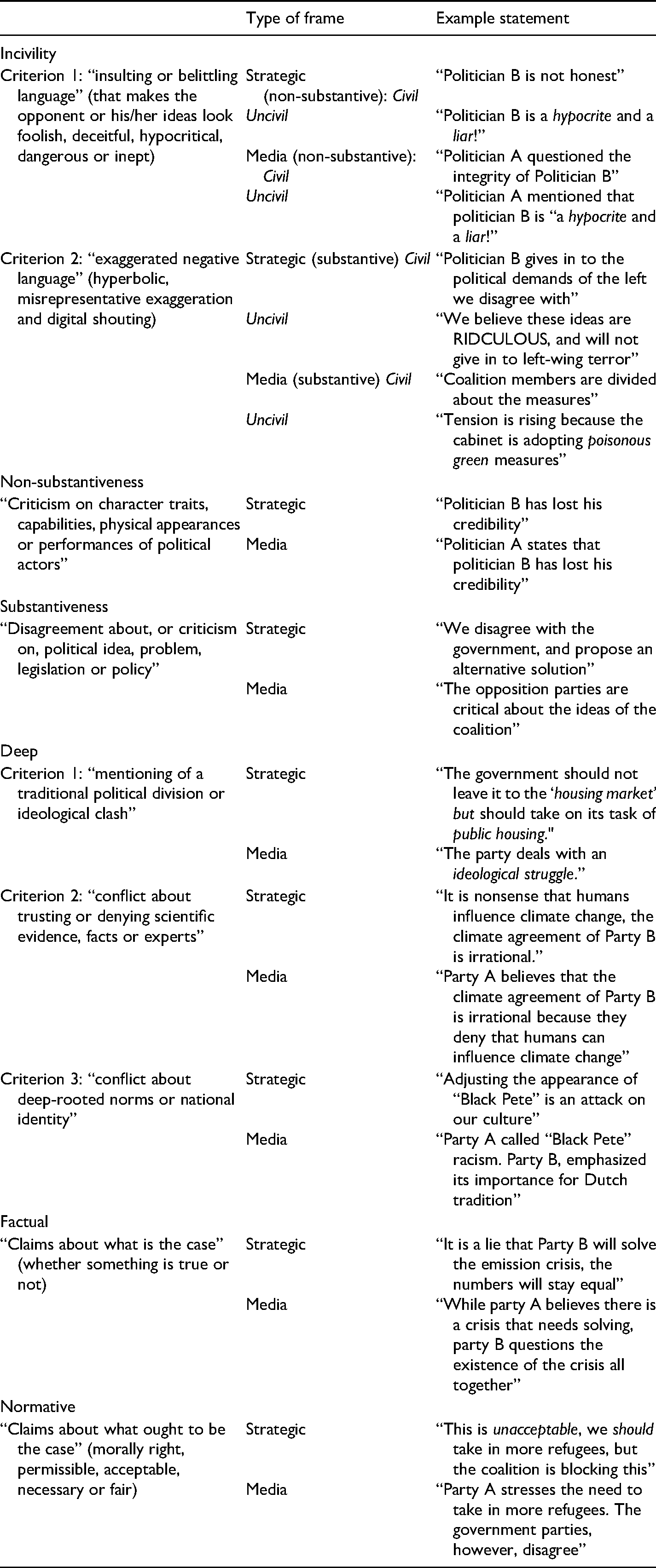
It should be noted that classifying something as closer or further apart from civil discourse is subjective and dependent on context and time. Yet, earlier studies have shown that we can identify incivility when we are confronted with it (Otto et al. 2020; Sobieraj and Berry 2011). For this study, as we deal with short social media messages and newspaper items, we rely on the binary distinction between civil and uncivil conflict.
Content of Conflict
Substantive versus non-substantive conflicts
Substance also matters. Political conflict can concern disagreement about substantive political issues, but also less substantive matters. One of the key developments in political discourse has been “personalization”, the increasing focus on individual politicians and competencies (Van Santen and Van Zoonen 2010: 46). This also transfers to political conflict. Politicians increasingly critique each other's personality traits or misdeeds instead of views (Auter and Fine 2016). If conflict is about political ideas, issues or policies it can be classified as a substantive conflict frame but if one political actor attacks another on personal matters this can be understood as a non-substantive conflict frame (Bartholomé et al. 2018). We explicitly refer to the term ‘non-substantive’ here and not ‘personal’, as the subject of a critique is not necessarily a person. A political party, the coalition/opposition, or institutions can also be criticized, for instance, by being called ‘untrustworthy’ (Auter and Fine 2016). Importantly, the substantive and non-substantive conflict frames can also co-exist in one statement, for instance, if both the character and the views of a politician are criticized (e.g., “You are a liar, there is no climate crisis!”). This means that the non-substantive attack does not cease to exist, even though the conflict is also substantive.
Subdimensions of substantive conflict
Political epistemologists construe disagreement as two (or more) parties holding incompatible doxastic attitudes towards a proposition. For instance, one person believes that minimum wage should be raised while the other does not (Matheson 2015). This definition presupposes that a substantive proposition is under discussion, which means that the distinctions drawn by epistemologists should be considered as subdimensions of the substantive conflict frame. We do not further classify non-substantive attacks, except when the discrediting of someone's personality or actions is accompanied by an explanation, and thus combined with a substantive conflict frame, the subdimensions apply. The literature differentiates between (1) superficial or deep disagreement, and (2) normative or factual disagreement.
Deep disagreement
Philosophers distinguish between superficial and deep disagreements. Deep disagreements are about fundamental epistemic or moral principles (De Ridder 2021; Kappel 2018). An epistemic principle tells us how to form our beliefs, or what evidence or experts we should rely on. People do not only disagree about the issue itself, but also about how to gather evidence about the issue, for example, by relying either on scientific evidence, personal experience, or religion. Deep disagreements can be difficult, if not impossible to resolve because people hold different ideas on how to solve them and hence have trouble recognizing their opponents’ ideas as rational contributions to the discussion. Scholars argue that political discussions have increasingly become concerned with the epistemic status of facts and experts (Van Aelst et al. 2017). De Ridder (2021) points out that deep disagreements can also revolve around conflicting moral principles or conflicting prioritization of those principles (e.g., libertarians have different views on equality or individual freedom than socialists). Consequently, people may come to see the reasoning of others not only as irrational but also as immoral, which further complicates the discussion.
In deep disagreements, a policy dispute around, for example, immigration is connected to longstanding and entrenched political divides between left and right, conservatives and liberals, or religious and non-religious views (De Ridder 2021). While it is possible to have a deep disagreement about one policy issue, deep disagreements often tend to involve several related issues: if you disagree with someone about immigration, you are likely to also disagree on the importance of the nation-state and the causes of economic inequality. More extreme cases of deep disagreement take shape in the form of conspiracy theories, where one group believes that the others are systematically being deceived and that their perception about politics or history is fundamentally wrong (Ranalli 2018).
Superficial, or ordinary, disagreements, in contrast, concern isolated issues and they tend to be rationally resolvable because they take place in a common normative and/or epistemic framework. This means that the actors involved in a superficial conflict tend to either share core moral values or have a similar understanding of what counts as reliable evidence (De Ridder 2021). This is not to say that superficial disagreements are always easy to solve, but while they can still concern complex and uncertain issues, the disputants agree on how to approach the issue. So, for example, when politicians have a conflict about housing shortages, they may suggest very different approaches to solve the issue, but they do have a common understanding that people need a home and they recognize that further scientific investigation into the effects of the different approaches could settle the disagreement.
Factual and normative disagreement
Finally, the philosophical literature distinguishes between disagreement about normative questions, about what ought to be the case, and factual questions, about what is the case (Frances 2014). The majority of political conflicts concern normative issues. Political parties generally disagree because they have conflicting ideas about what the right, fair, or morally permissible decisions are in a certain situation. However, political conflict can also involve factual matters, examples include whether a policy is effective, or what the causes are of social problems (Frances 2014). Although information is abundant, politicians can still disagree about facts as the relevant facts and evidence may be mixed (e.g., unclarity whether the death penalty deters violent crime). Importantly, the difference between normative and factual disagreement is independent of the earlier distinction between deep and superficial disagreements. Both factual and normative disagreements can be deep and superficial (See Supplementary Information File Table 1A for examples).
Exploring the Use of Conflict Frames
To explore the usage of the conflicts, this study focuses on the conflict frames adopted by journalists in news articles and by politicians on Twitter. Conflict framing has often been studied as a mediated phenomenon: how journalists report on disagreement between political actors (e.g., Schuck et al. 2016). Importantly, we also need to account for the frames in the direct communication of politicians because they influence citizens’ opinion and attitudes (Chong and Druckman 2007). Both political elites and journalists are important actors in the news frame-building process. They mimic but also alter each other frames (Chong and Druckman 2007). The type of frames political actors and journalists adopt may vary because they do not always have the same incentives to adopt a conflict frame or are not constrained by similar professional and ethical rules (Ekman and Widholm 2015). For instance, whereas journalists report on conflicting views to meet journalistic criteria of critical and balanced reporting (Bartholomé et al. 2015), politicians’ main aim is to advertise their views by discrediting those of the opponent (Auter and Fine 2016). Politician's communication is examined using Twitter because it is often used by politicians (Ekman and Widholm 2015; Jacobs and Spierings 2016), and tweets tend to have a broad reach: they get frequently picked up by the mass media and are thus also visible to citizens who do not use Twitter (Ekman and Widholm, 2015). Moreover, Twitter appears to be suited to political discussions and conflict as it offers many possibilities for interaction. We pose:
Furthermore, we examine politicians' tweets more in detail by exploring whether the conflict dimensions differ across parties. This is important as existing research on conflict framing suggests that parties vary in the extent to which they adopt an attack message in their political campaigns (see e.g., Valli and Nai 2020), yet we know little about politicians’ conflict framing in non-election period and how the different manifestations of conflicts are used across parties. Research on negative campaigns in the US shows that candidates from challenger parties are more likely to attack their opponent than candidates from incumbent parties since politicians from an underdog position have more to gain from these attacks (Auter and Fine 2016). In a multiparty context, opposition parties are expected to use more conflict framing than the parties in government because it is their role to criticize the government (Haselmayer 2019; Russmann 2017). Additionally, as a key communication strategy of populist parties is to challenge the status quo, and to put an in-group in opposition to different outgroups (e.g., ordinary citizens vs. the corrupt elite), their messages tend to be more antagonistic than those of mainstream parties (Engesser et al. 2017; Hameleers 2018). Besides, as populist parties increasingly challenge the views and reliability of experts (Hameleers 2018), they may use more deep conflict frames.
Methods
Sample
This study focuses on the Netherlands, which is a suitable case for analyzing (online) political conflicts because its political system features a broad range of political parties, and Dutch politicians are very active online (Jacobs and Spierings 2016). Furthermore, in a multiparty system, each party (and politician) has multiple political opponents whom to disagree with and to attack. At the same time, to govern, parties also need each other to form coalitions, and conflicts may therefore be less sharp than in more polarized contexts.
To analyze the presence of conflict frames we conducted a quantitative content analysis of Dutch political news articles and tweets by Members of Parliament (MPs) and their respective political parties. 3 The news articles come from four major newspapers, two quality (NRC Handelsblad; De Volkskrant) and two popular newspapers (De Telegraaf; Algemeen Dagblad). The articles were retrieved from the digital archive NexisUni. Articles had to contain a minimum of one reference to a political party in the headline or lead and one more time in the remainder of the article to be selected. We focus on offline news articles only, as a great deal of the news content that is spread online is also present in print (Ghersetti 2014). The tweets of Dutch MP's and national political parties were collected by relying on the online tool Coosto (www.coosto.nl). This tool provides a complete archive of the tweets of Dutch political actors (Kruikemeier et al. 2018). We collected the tweets of all political parties (N = 906) and of all the members of parliament who are active on Twitter (147 members; N = 5412).
The research period covers 8 weeks divided over 4 months during the parliamentary year 2019–2020 (November 10–23, 2019; February 11–24, June 17–30, and September 10–23, 2020). We selected all the articles and tweets in this period that met the criteria. The sampling strategy aimed to include many variations in conflict, and therefore we focused on different periods during the year. The final sample consists of 6300 tweets and 482 articles.
Coding Procedure
We developed a codebook to measure the conflict dimensions (See Table 1). Coders, first, had to indicate whether an article or tweet contained a conflict frame: (1) two or more opposing/conflicting perspectives on a problem (2) any conflict or disagreement; (3) a personal attack; and (4) explicit criticism (Schuck et al. 2016).
For the items with a conflict frame, the frame was analyzed in more detail. For this step, the unit of analysis for articles changed. Coders had to assess for each article whether multiple conflicts were mentioned and if so, these conflicts were treated as a separate unit of analysis. Differences between conflicts were based on whether they relate to different topics or involve different actors. In total, this resulted in 550 conflicts in 482 articles.
The first dimension, incivility, was assessed by two indicators which were based on (Gervais 2015). We follow the first category of incivility of Gervais (2015) which relates to the presence of insulting/belittling language (yes/no). For Gervais’ (2015) second category, extremizing and inflammatory language, we altered the question wording during the coding process to “exaggerated negative language” (yes/no), as the question was initially not well understood by the coders. The general idea remained similar: coders assessed whether the statements “exaggerate in a misrepresentative fashion the behavior and views of a target” (Gervais 2015: 172). Gervais’ (2015) third category, histrionics (e.g., the use of uppercase letters/exclamation marks), was added to the second category as we expected this not to be present very often and because the coders already perceived this as a form of exaggeration. Finally, we added a third category (3) perceived incivility (not, a little bit, or very uncivil). Negativity and incivility are often in the eye of the beholder (Sigelman and Kugler 2003), and we therefore added a question on how coders perceived the conflict. This item was recoded as uncivil for both somewhat and very uncivil (1) and the rest as civil (0). If either one of the incivility items of Gervais (2015) was present and/or it was perceived as uncivil, the item was coded as uncivil. It is important to emphasize that incivility was considered for statements reported or paraphrased (mostly in newspaper coverage) as well as for direct claims (mostly on Twitter; see Table 1)
For the second dimension substantiveness (Bartholomé et al. 2018), coders specified whether the tweet concerned disagreement or criticism on non-substantive matters. A variable was created that indicates the presence (1) or absence (0) of a non-substantive conflict frame. Absence of a non-substantive conflict implies that a substantive conflict was present.
If the conflict was substantive, deep and factual/normative disagreement were coded. Deep disagreement was assessed with three indicators according to an iterative process. Both theories and an initial exploration of political news and tweets by political actors informed the first operationalization. The questions were refined throughout the coding process to ensure that deep disagreements were captured when present. As deep disagreements typically revolve around fundamental political clashes coders had to indicate (1) whether a political division or ideological clash was mentioned. A list of political clashes was provided and complemented during the coding process. As deep disagreements often concern a conflict over fundamental epistemic principles, coders assessed (2) whether the conflict was about trusting or denying scientific evidence, facts or experts. Coders considered (3) whether the disagreement concerned deep-rooted norms or national identity. If one of the indicators was present, the item was labeled ‘deep’ (1) and otherwise as ‘superficial’ (0).
Finally, coders had to analyze whether the conflict concerned facts or normative claims, or both. Not all conflicts were classified as either factual or normative, for instance when there was a reference to a conflict but not explained why (e.g., “the party voted against our motion”). Two dichotomous variables were developed that indicate the presence (0 = no; 1 = yes) of factual and normative conflict.
Coding was performed by three native coders with knowledge of Dutch politics. The coding of a member of the research team served as the gold standard. The coders followed intensive training sessions: they got acquainted with the codebook, coded examples, and refined the codebook. In the first round of coding, differences were discussed to reach complete agreement and the codebook was expanded with more detailed instructions. In a second round, significant discrepancies between one coder and the reliability coder were resolved by discussing the discrepancies and adding additional decision rules to the codebook. The intercoder reliability test of around 12% of the data indicates that the coders reached sufficient agreement for most items (see Supplementary Information File, Table A2; Krippendorff 2004). For normative conflict, the alpha is just above the critical threshold (0.60). This is not uncommon for highly skewed dichotomous variables because the reliability scores of such variables tend to be particularly sensitive to disagreement among coders. While most items are clearly normative and contain words that express this (e.g., necessary/unfair), the items that included a more implicit opinion were not in all cases consistently coded by the different coders. Hence, some of these implicit normative conflicts might have been overlooked. As the level of agreement still allows for drawing tentative conclusions, we consider it informative to discuss our findings related to normative conflict. However, exact numbers need to be interpreted with caution.
Independent Variables
Additionally, several other binary explanatory variables were included: whether the party(member) is part of the government, a left-wing populist actor (i.e., SP), or a right-wing populist actor (i.e., PVV or FvD). For the categorization of the populist parties, we relied on the classification by ‘PopuList’ (Rooduijn et al. 2019).
Results
Usage of Conflict Dimensions
Figure 1 shows the proportion of the different dimensions in the tweets and newspaper articles with a conflict frame: 25% of the tweets and 67% of the news articles contained a conflict frame, and the figure thus shows how the conflict dimensions are used within these samples (for the nested percentages of the dimensions in the full sample see Supplementary Information File, Table A3). We will also discuss how often different dimensions occur together.
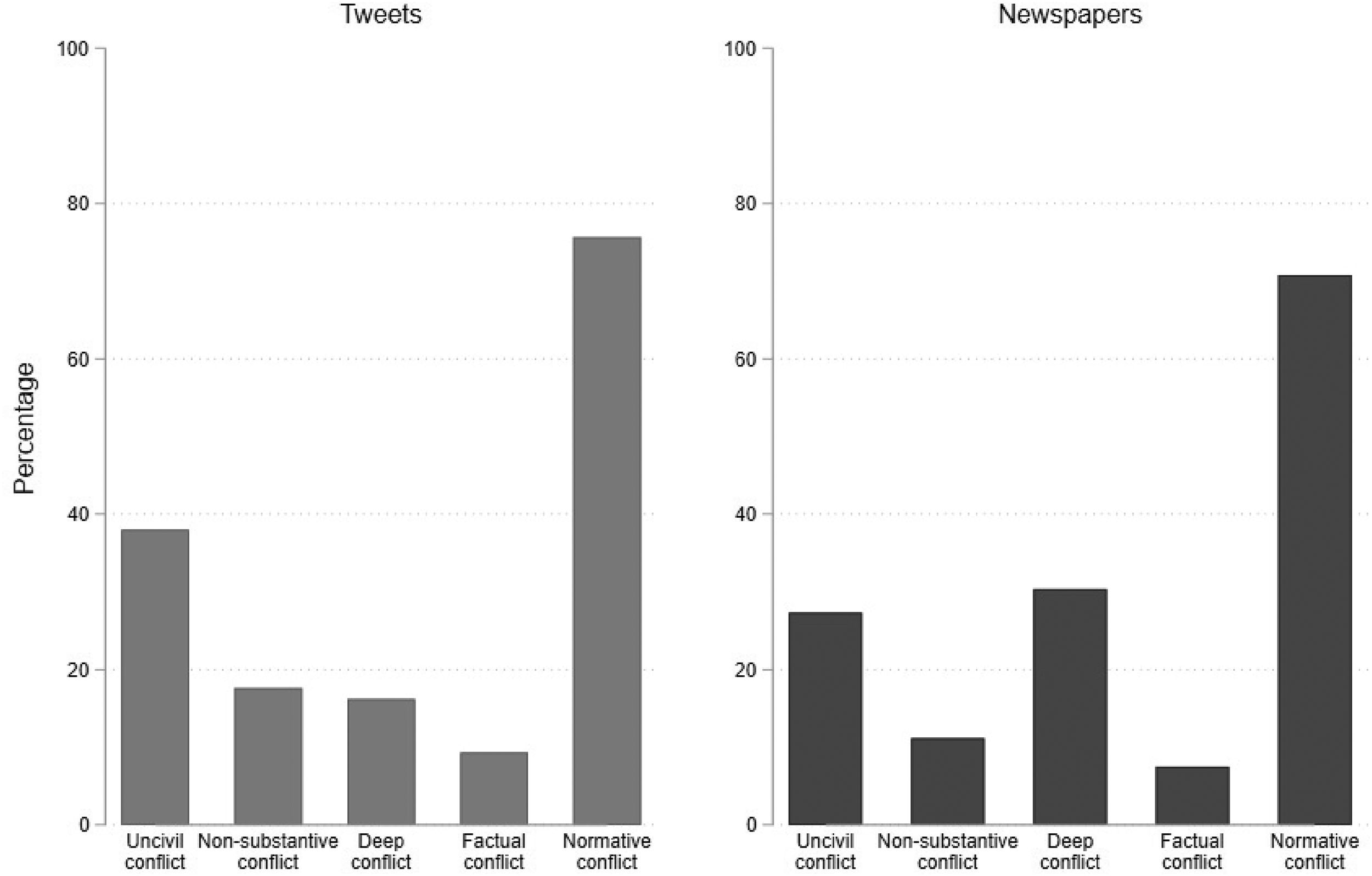
Percentage of the conflict frames. Note. The figure shows the proportion of the dimensions for the sample of the data with a conflict frame. The percentages include both cases where the dimensions occur in isolation or combination with other dimensions.
First, all political conflict frame dimensions are present in both types of media. Most conflict frames concern a substantive issue. Only 18% of the tweets and 11% of the news articles contain a non-substantive attack. Moreover, the non-substantive attacks are often combined with a substantive conflict frame: 68% of all non-substantive attacks co-occur with a substantive conflict frame. Hence, if politicians attack the personality of a politician, they often also provide a substantive reason for this attack or discuss how they disagree with the views of that politician.
Most conflicts are also civil, 38% of the tweets and 27% of the conflicts in newspapers are uncivil. Both incivility and non-substantive attacks tend to be connected, of all the non-substantive attacks in the sample 80% is uncivil. Yet, also substantive conflicts, which are not combined with a non-substantive attack, are found to be uncivil (27%). While more common, the use of incivility is thus not limited to personal attacks.
Besides, 16% of the conflicts in tweets and 30% of the conflicts in newspapers are deep, which shows that it is important to distinguish between superficial and deep conflict. Also, deep disagreements tend to be more often uncivil (42%), than superficial conflicts (31%). Finally, normative conflict is a lot more common than the occurrence of factual disagreements, 76% of the tweets are normative and 71% of the conflicts in news articles, and only around 9% of the tweets and 8% of the articles are factual. Moreover, of the rather small occurrences of factual conflicts, 34% is also normative, so manifestations of pure factual conflicts frames are rare.
Comparing Usage Among Political Actors in Tweets
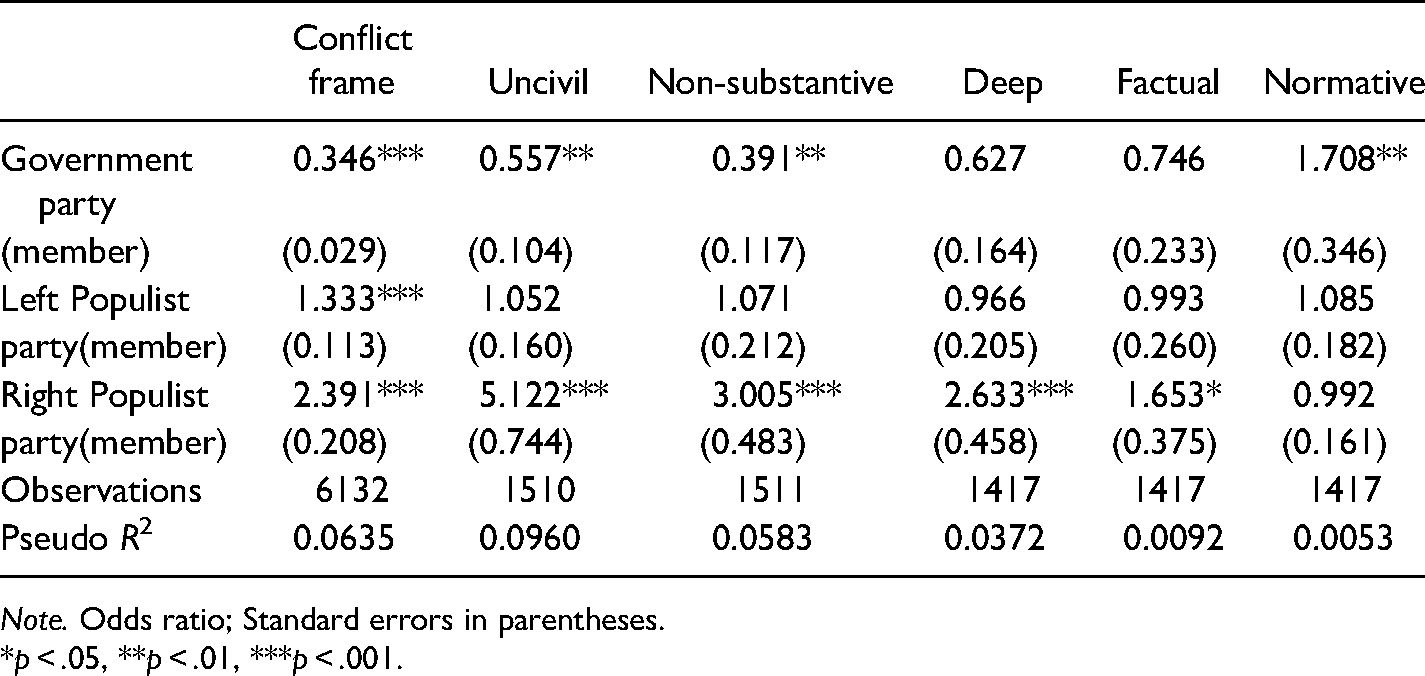
In the next step, and to answer our second research question, we limited the analyses to tweets to explore which political actors are more likely to use the different conflict framing dimensions, see Table 2 for the results (See Supplementary Information File for separated analyses for parties and politicians).
Binary Logistic Regression for the Conflict Framing Dimensions in Tweets.
Note. Odds ratio; Standard errors in parentheses.
*p < .05, **p < .01, ***p < .001.
As visible from Table 2, the odds of a conflict frame being present in a tweet from a government party(member) is 65% lower compared to opposition parties. We find similar negative odds ratios for uncivil (OR = 0.557, p < .01) and non-substantive conflict (OR = 0.391, p < .01). This means that government parties, or respective politicians, are less likely to adopt a conflict frame in their tweets, and if they do, these conflicts are more often civil and substantive than the tweets of opposition political actors. 4 These results confirm that opposition parties and their members more frequently challenge the status quo, whereas government political actors need to secure it. 5
Furthermore, both left- and right-wing populist parties tend to adopt a conflict frame more often than mainstream politicians. Moreover, there are significant positive associations with being (a member) of a populist right-wing party and using a conflict frame that is uncivil, non-substantive, deep, and factual. To understand the large odds ratios properly we present the predicted probabilities of the different dimensions for right-wing populist versus mainstream parties in Figure 2. The figure shows that the predicted probability of deep disagreement is 28% for right-wing populist parties and 13% for mainstream politicians. A key element of populist communication is emphasizing opposition between the ordinary citizens and the other (e.g., the elite), and questioning the epistemic status of experts or facts, and it is therefore not surprising that populist parties highlight deep disagreement more often.
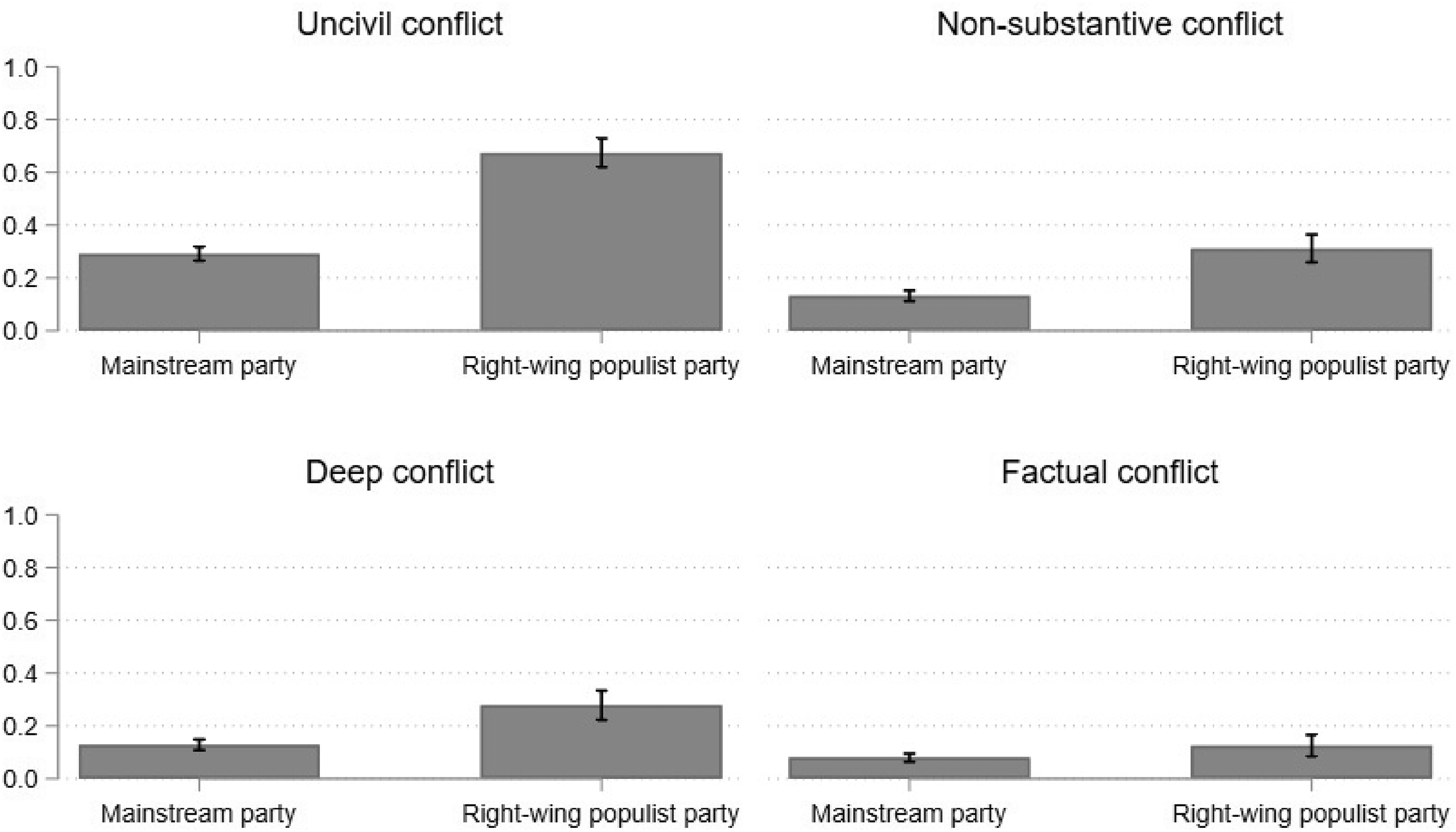
Predicted probabilities conflict framing for mainstream versus right-wing populist party(members).
Conclusion
This study aimed to provide a conceptual framework of different dimensions of political conflict frames. The results show the relative presence of the conceptualized dimensions, how they relate to one another, and indicate differential usage of conflict frames among politicians.
First, we found that most of the conflicts are civil. While social media are expected to provide politicians with unlimited opportunities to criticize opponents harshly (Ott 2017), we find that politicians mostly use social media to disagree in more respectful ways. Uncivil disagreement travels across the political spectrum, but is mainly associated with opposition parties, and specifically right-wing populist parties. Populism is characterized by strong attacks on the elite (Engesser et al. 2017) and these attacks seem to go hand in hand with an uncivil tone. The context of this study, a multi-party system during routine periods, likely influenced the level of incivility that was found. Although there is not much comparative research on incivility in political debate across countries, especially in the US, rudeness and hostility seem to be more common, with former president Trump as a key example (Walter 2021). Moreover, incivility is more likely during election campaigns when competition is heated (Bartholomé et al. 2018).
Furthermore, following others, we found that non-substantive conflicts are not common. Auter and Fine (2016), for instance, show that most attacks by politicians on Facebook are issue-based rather than personal. It seems that politicians need to primarily show how their ideas differ from their opponents and diminishing the credibility of the opponent is of secondary importance. However, personal attacks occur more often during elections compared to routine periods both on social media (Gross and Johnson 2016) and in (online) newspapers (Bartholomé et al. 2018), and we focused on routine periods specifically.
We also found that conflicts emphasize deep political divides or concern fundamental epistemic principles (i.e., what counts as empirical evidence). These frames are most often used by right-wing populist parties. These types of disagreements were discussed in earlier research as constituting one of the most pressing issues in our current political landscape (Van Aelst et al. 2017). According to the ideal of deliberative democracy, decision-making should rest on the deliberation of different political views (Gutmann and Thompson 2004). The problem with deep disagreements, however, is that it is difficult for discussants to engage in a reasonable exchange of views, because they see the other's way of thinking as invalid, unreasonable, or even as plain ‘stupid’ (De Ridder 2021: 12). In this way, deep disagreements jeopardize the deliberative process. Hence, it is encouraging that we found only a limited presence of deep disagreements.
Finally, a great deal of the disagreement in newspaper articles and tweets concerns views on how things ought to be, and only a smaller part of the conflicts concern facts. This is not surprising, since diverging preferences and interests are defining features of democracy (Schattschneider 1960). Emphasizing or justifying policy positions is necessary for convincing citizens of their importance. Facts, in contrast, often form the foundation of a debate (i.e., politicians use facts to back up normative statements), but are, to a lesser extent, subject to debate. The limited presence of factual conflict online may also be context-dependent and could be more common in, for instance, the US, where partizanship is often connected to which facts you believe (Hannon 2021).
This study has some limitations. First, we examined our conceptual framework in one context. While we believe our conceptual dimensions can be used in future research to compare the usage of conflicts across different media and political systems, due to the iterative process of coding and refining the codebook the questions that help identify deep disagreement may be slightly geared to the Dutch context. These questions, therefore, may need to be fine-tuned if used in different contexts to grasp context-dependent deep conflicts. Further, it was challenging to operationalize subtle philosophical distinctions, and for normative conflict an even more precise operationalization needs to be specified.
Notwithstanding these limitations, this study has provided the much-needed nuance to current work on (online) conflict framing and functions as a starting point for further research into the desirability of conflict framing for democracy. Aggressive attacks can be appealing to citizens (Otto et al. 2020), but may also be harmful to democracy as they may increase cynical attitudes (Mutz and Reeves 2005). Civil disagreement on substantive issues, in contrast, could foster reasonable debate among citizens (Landemore 2013). However, for political deliberation to function properly there needs to be a willingness of both sides to understand each other's views, but deep disagreements may threaten this. If politicians cannot seem to agree on basic epistemic principles, such as what counts as evidence, deliberation may seem pointless, with increasing polarization as a result (De Ridder 2021; Hannon 2021). So even if political conflicts are civil and cover substantive issues, they could still impact democracy negatively if they emphasize deeply entrenched differences.
Supplemental Material
sj-docx-1-hij-10.1177_19401612221096633 - Supplemental material for Online and Offline Battles: Usage of Different Political Conflict Frames
Supplemental material, sj-docx-1-hij-10.1177_19401612221096633 for Online and Offline Battles: Usage of Different Political Conflict Frames by Emma van der Goot, Sanne Kruikemeier, Jeroen de Ridder and Rens Vliegenthart in The International Journal of Press/Politics
Footnotes
Declaration of Conflicting Interests
The author(s) declared no potential conflicts of interest with respect to the research, authorship, and/or publication of this article.
Funding
The author(s) disclosed receipt of the following financial support for the research, authorship, and/or publication of this article: This work was supported by the Nederlandse Organisatie voor Wetenschappelijk Onderzoek, (grant number 406.DI.19.055).

Supplemental Material
Supplemental material for this article is available online.
Notes
Author Biographies
References
Supplementary Material
Please find the following supplemental material available below.
For Open Access articles published under a Creative Commons License, all supplemental material carries the same license as the article it is associated with.
For non-Open Access articles published, all supplemental material carries a non-exclusive license, and permission requests for re-use of supplemental material or any part of supplemental material shall be sent directly to the copyright owner as specified in the copyright notice associated with the article.
