



Abstract
This study assessed the effects of different message framing strategies on average Americans’ attitude towards interventions in humanitarian crises abroad. Two survey experiments were conducted via Qualtrics between late 2019 and early 2020, where participants were randomly assigned to read a mock news story about a foreign humanitarian crisis written using one of the three framing techniques. Results of both studies indicated that the framing effect on respondents’ support for intervention interacted with ones’ political ideology and prompted distinctive reactions among different populations. Most intriguingly, the results of Study 2, which employed a non-student sample and a secondary frame, suggested that the specific order of message framings also influences public opinion towards humanitarian intervention. These findings contribute to the growing body of literature on the persuasiveness of message design and framing in the context of military humanitarian interventions (MHI). Accordingly, news organizations and policymakers are encouraged to consider these findings in specific contexts.
Keywords
On the eve of April 14, 2014, a group of Islamic jihadist terrorists broke into a secondary school in Chibok, Nigeria, kidnaping over 200 schoolgirls. The Nigerian government made little effort to rescue these girls in the following two weeks, prompting domestic activists to turn to social media for help. Hollywood entrepreneur Russell Simmons later covered the story on Twitter, which led to a surge of public discussions online. Bewildered by this incident and the lack of media coverage, many began to make moral arguments by asking how the US media would react if these girls were white. The issue eventually made its way to Capitol Hill, where the US National Security Council cautiously weighed the financial costs and the counterterrorism benefits of initiating a military intervention. In the end, with the approval of President Obama, the US swiftly sent its military personnel to Nigeria and launched a series of rescue operations (Hinshaw and Parkinson 2021).
Since the end of the Cold War, more than a dozen military humanitarian interventions (MHI) have taken place globally, with the US playing conspicuous roles in many of them (Kreps and Maxey 2018; Pupcenoks 2021). Moreover, among the US-led military operations abroad, such as in Afghanistan and Iraq, humanitarian issues are becoming more than complementary. Against this background, the world has witnessed MHI evolve as a primary form of military action rather than a full-blown war among nation-states (Pattison 2010). Even though political elites tend to lead the decision-making regarding MHI, few democratic states can sustain such operations without significant public support (Hildebrandt et al. 2013). Increasingly, however, in cases such as the Chibok kidnap, bottom-up pressure drove the ultimate decisions to intervene (e.g., Koch and Sullivan 2010). In that light, a better understanding of the formation and the change of public opinion on humanitarian crises abroad is urgently needed for policymaking and public communication.
Research on public opinion has long recognized the power of the media and strategies through which media “frame” certain issues. In the context of international politics, when communicating foreign crises to domestic audiences, both politicians and the media often invoke framing strategies that emphasize the potential threat to domestic security, the pragmatic or economic considerations, or the existence of humanitarian suffering (Maxey 2020; Rane et al. 2014; Recchia 2015). Despite the growing research interests in the efficacy of specific framing strategies (e.g., Kreps and Maxey 2018; Maxey 2020), knowledge of framing techniques that may work and for whom (i.e., individual factors) is still limited (Lecheler and De Vreese 2019). Such understanding is critical as governments and organizations worldwide are mastering effective ways of communicating with their citizens. Furthermore, given that many democratic states are experiencing heightened political polarization and that political ideology is considered a key factor in influencing one's view on foreign policy (Busby and Monten 2012; Jeong and Quirk 2019; Maxey 2020), probing the potential interplay between different framing strategies and political ideology could provide fine-grained answers on how different framings of MHI may affect public opinion.
From a practical perspective, Chong and Druckman (2007) noted that information consumption is often dynamic and fluid in real-world settings. A person would often be subjected to complementary or competing frames on a given social/political issue, particularly considering the diverse news sources. As such, whether framing effects are persistent or limited by subsequent competing or complementary frame exposure merits serious scrutiny (Chong and Druckman 2010; Scheufele and Iyengar 2012).
In response to the theoretical and empirical gaps outlined, two complementary experiments were conducted with two distinct populations in the US, college students (Study 1) and adult populations (Study 2). In both studies, participants were randomly assigned to read a full-length mock news story about a humanitarian crisis in a lesser-known country crafted using one of three mainstream MHI framing strategies. Meanwhile, to address the limited understanding about the consequences of competing frames, participants in Study 2 were presented with an additional vignette concerning the same humanitarian crisis abroad using one additional competing framing technique. In this process, several demographic factors and psychological variables (e.g., trait empathy, personal belief in just world, self-esteem etc.) that have often been neglected in much research on MHI were identified, measured, and controlled. This further added to developing a nuanced understanding of micro-foundations of public opinion on MHI issues.
International Conflicts and Military Humanitarian Interventions
In international relations, MHI can be broadly defined as operations conducted by major military powers (e.g., the US) abroad to save lives, relieve local suffering, and provide certain logistical support to the suffering populations during a grave humanitarian crisis (Choi 2013). Over the years, the international community led by the United Nations Security Council has steadily increased peacekeeping efforts with an increased number of authorized interventions. In terms of states’ specific MHI strategies, military operations are fundamental if not necessary in many cases. However, more often than not, states involved in MHI tend to adopt a mixture of different actions, including providing financial support to allies, sending military force, publicly shaming actors perpetrating atrocities, and providing financial support to humanitarian groups. In short, countries increasingly intervene in humanitarian crises abroad through various means.
The existing international relations literature has outlined a set of primary reasons underlying states’ MHI considerations, including the need to advance national security and pragmatic interests of the intervening states (Bellamy 2013), economic benefits or costs (Gartner 2008; Recchia 2015), and the need for immediate intervention due to worsening humanitarian circumstances (Heinze 2009; Kreps and Maxey 2018). Of course, these considerations are evaluated jointly rather than independently in practice, and other context-dependent reasons may arise.
Framing Humanitarian Crises
Democratic states often need to achieve a certain level of support from the domestic public to justify key foreign policy stances. Therefore, how policymakers or news organizations present conflicts and crises abroad to the citizens is crucial for forming public opinion (Hammond 2018). On that front, a raft of framing literature can be instructive for designing messages that may actually work.
As a concept, framing broadly refers to the processes of selection and salience that emphasize certain aspects of reality and push others into the background, promoting a particular problem definition, causal interpretation, moral evaluation, and/or treatment recommendation (Entman 1993). Efforts to define framing are still ongoing; however, based on the respective disciplinary origins, Caccoatpre et al. (2016) summarized two types of framing, equivalence-based and emphasis/salience-based framing. Rooted in the intersection of cognitive psychology and behavioral economics, equivalency framing focuses on presenting different but logically equivalent words or phrases to produce the framing effect. For example, drawing on the prospect theory, Kahneman and Tversky (1984) experimentally manipulated the prospect gain or loss in a mock health risk scenario and found that the participants were more likely to take chances under the loss frame.
As instructive as the equivalency frames may be, policymakers and news organizations interested in reaching the most citizens seem less devoted in adopting these frames. Instead, political actors frequently engage in “issue framing” (Druckman 2004; Nelson 2011) or “emphasis framing/salience framing” (Caccoatpre et al. 2016; Druckman 2001). Informed by its sociological tradition, emphasis framing acknowledges the multifaceted nature of issues and phenomena, hence stressing the practicality of paying comparatively more attention to specific dimensions of a given problem (Scheufele and Iyengar 2012).
Furthermore, under the emphasis/issue framing, communication and political science scholars distinguished multiple dyadic frames, such as episodic versus thematic frame (Iyengar 1994) or strategy versus issue (Cappella and Jamieson 1997) frame. Nevertheless, in communication (and most parts of political science), the focus on thematic framing (placing an issue in a general context) and episodic framing (treating an issue more singularly) roused significant attention (Borah 2011). Finally, recognizing the somewhat topical and limited nature of issue-specific framing, scholars have also advanced a set of generic frames that can be found to underlie the coverage of various topics; examples of the generic frames include “attribution of responsibility,” “conflict,” “human interest,” “economic consequences,” and “morality” (e.g., Semetko and Valkenburg 2000).
To date, framing researchers have attempted to delineate the various frames used in the debates/coverage of international conflicts and humanitarian crises. As a former editor of BBC world services, for instance, Somerville (2017) argued that the Western media used to describe international crises through the lens of the Cold War, emphasizing the power struggles between the two dominant powers. In contrast, the post-Cold War frames included mostly the tribal frame, describing crises as simple tribal conflicts. Such frame later morphed into the War on Terror and Fear of Islam frames in the post-9/11 period. Meanwhile, the humanitarian frame that emphasized natural disasters, food shortages, and the need for aid was frequently invoked in the coverage of issues like the Ethiopian famine. Woods (2007) also noted that after 9/11, the US mainstream media gradually shifted to a more nuanced and pragmatic discourse on terrorism, contributing to the public's sustained concerns about potential terrorist threats. Moreover, in a study of the New York Times and Washington Post's coverage of US Policy in Bosnia from 1992 to 1995, Auerbach and Bloch-Elkon (2005) revealed that both newspapers employed various message framing techniques focusing on security/world order, economics, humanitarian values, domestic politics, or a combination of these strategies. These techniques helped the newspapers effectively express criticism, recommend policy, and clarify issues to the public.
The extended framing literature indicates that the media utilize various frames to cover international conflicts and humanitarian crises depending on the context and the nature of the issue. However, given the symbiosis between states and media, frames commonly shared by both sides might be more likely to be adopted and seen. For that reason, this study deliberately focused on three common frames, namely the security/terrorists attack frame, and the economic cost frame, and the humanitarian frame.
Framing Effects on Public Opinion towards International Crises
The various frames that the media and policymakers use would make little sense without contemplating the consequences. Indeed, innumerable studies have shown that message frames influence people's cognitive (Scheufele and Iyengar 2012) and emotional (Marti et al. 2018) responses. Ultimately, frames embedded in messages do shape audiences’ attitudes and beliefs toward a wide range of social and political issues (see Lecheler and De Vreese 2019, for a systematic review).
The framing effect may not be indifferent to the types of problems being framed for several reasons. Considering the gain and loss framing, subjects have been found to react strongly to health-related issues (such as cancer and nutrition; Nabi et al. 2020), presumably because health is of imminent relevance to everyone. On the other hand, for issues like climate change, one's pre-existing belief might attenuate the magnitude of the framing effect (Septianto et al. 2019). Therefore, the effects of various frames used in discussing humanitarian crises must be examined in their own right.
As discussed earlier, governments and the media frequently seek to frame issues under a security framework while addressing humanitarian crises. This framing technique highlights the effects of a given conflict abroad on the local population, evoking a sense of threat and urgency. For instance, a study of President Obama's speeches about American reactions to mass atrocities in the Middle East suggested that he relied heavily on the security frame to justify the deployment of US military forces against the Islamic State of Iraq and the Levant (ISIL) in Iraq and Syria during 2014–2015 (Levinger 2015). For that reason, the US military's involvement in both countries was closely linked to promoting national security interests (Moses et al. 2011). Similarly, Rane et al. (2014) suggested that the Western media habitually covered the Muslim world through the lens of security and terrorism. As such, public opinion and public policy in the West tend to treat asylum seekers with suspicion. Accordingly, we proposed the following hypotheses:
In line with the prior discussion on states’ rationales for engaging in MHI, the cost of events in a given conflict could directly determine public support for military involvement. As such, references to interventions in the media are often framed through economic lenses. More specifically, the economic frame emphasizes the potential costs of military casualties or monetary expenditures (Boettcher 2004). Boettcher and Cobb (2006) found that simply reading reports of American casualties in a foreign operation heightened opposition towards the intervention among non-George W. Bush voters. Furthermore, the cost of military involvement abroad can also lead to opposition among policymakers and the public, as both American leaders and the public tend to oppose interventions that are considered expensive (Gartner 2008; Recchia 2015). For example, the US intervention in Somalia cost taxpayers more than $7 billion, while the number reached several trillion for the Iraq intervention (Valentino 2011). Hence, it seems reasonable to assume that citizens may disapprove of MHI if the public believes the economic costs of the intervention are too high.
Undoubtedly, states and their citizens can also engage in MHI for humanitarian and moral reasons. For example, President Obama repeatedly justified the need for the 2011 NATO intervention in Libya as necessary to prevent an imminent loss of life (Weiss 2011). To test the framing effects on public opinion, Kreps and Maxey (2018) presented participants with a foreign conflict that demands US military interventions for different reasons (security need vs. civilian protection). The results indicated stronger support for interventions when framed as protecting civilians instead of restraining an aggressive state. Furthermore, in a more closely relevant experiment, Maxey (2020) exposed participants to scenarios featuring a foreign conflict involving grave humanitarian concerns or terrorist threats. The findings showed that people consistently favored the humanitarian narrative. Finally, anecdotal cases, such as the Chibok kidnap, show that social media, where information about conflicts and suffering can be easily transmitted to large audiences in sensationalized ways, can exacerbate people's moral outrage on humanitarian issues. Therefore, we hypothesized that:
Interactions between Political Ideology and Framing
Current framing models suggest that accurate predictions about the framing effect cannot be achieved without considering key moderating factors (Lecheler and De Vreese 2019; Slothuus 2008). In particular, a large array of research has already established political ideology as a central individual-level moderator across various contexts (Keum et al. 2005; Kreps and Maxey 2018).
Americans largely rely on cues from their party leaders to form positions on foreign policy issues (Cavari and Freedman 2019). Republicans tend to favor a strong military that can serve as a deterrent (with a few exceptions) and tend to be skeptical of US military involvement for humanitarian purposes (Busby and Monten 2012; Gries 2014). Since the mid-1990s, the Republican Party's leaders have preferred unilateralism and hardline positions in foreign policy (Busby and Monten 2012). While Republicans tend to be suspicious of providing foreign aid, they nevertheless support those occasions where it could benefit the US. In the past, Republicans advocated for faith-based funding organizations abroad while objecting to funding foreign nonprofits that support abortion (Dueck 2010). Particularly for MHI, one experimental study (Grillo and Pupcenoks 2017) found that conservative respondents were more likely to support intervention in Syria if they perceived this intervention as a security matter for the US. In contrast, liberals generally support providing foreign aid, pursuing humanitarian goals, and strengthening international institutions (Gries 2014; Jeong and Quirk 2019).
Given the existing evidence, we expected that political ideology would have divergent effects on people's support for MHI. More importantly, we anticipated potential interaction effects between certain framing techniques and political ideology. The literature suggests that conservatives and liberals have different opinions on foreign policy. Furthermore, conservatives may be more likely to support MHI when such action is linked to national security and does not incur large costs. On the other hand, as liberals are more inclined to support active US participation in international relations, they may be more likely to support MHI in general. More specifically, we hypothesized that:
Overview of Research Design
To test the hypotheses outlined above, the current research included two similarly designed sequential experiments. Study 1 (conducted September 2019) randomly assigned college student participants to varying conditions of a mock story about a foreign humanitarian crisis. Given that much of the relevant framing research has interrogated only limited frames in short vignettes (Boettcher and Cobb 2006; Kreps and Maxey 2018; Maxey 2020), Study 1 served as a preliminary assessment of a multiple framing technique with stimuli of high external validity (i.e., mock news stories). Study 2 replicated the design of Study 1 with an adult sample, allowing us to explore the comparability of student and nonstudent data (Druckman and Kam 2011). Most importantly, to address the lack of competing message framings (Chong and Druckman 2007; Scheufele and Iyengar 2012), we also subjected participants assigned to various conditions to one of the two most potent frames identified in Study 1. Such a design created an information consumption environment with high verisimilitude and kept the experiment's implementation maneuverable.
Study 1
Participants, Procedure, and Measures
Study 1 consisted of 193 undergraduates (135 females) from two liberal arts institutions in the Northeastern region of the US who volunteered for a nominal amount of extra credit. 3 The sample was young (M = 19.76, SD = 1.27). Most participants were non-Hispanic White (79%), followed by Hispanic/Latino (9.2%), and most were liberal-leaning (45.1%), followed by conservative-leaning (34.9%) and moderates (20%).
Upon entering the Qualtrics survey, participants were greeted with a message that explained the purpose of the study, followed by an informed consent form. Participants who agreed to proceed were then asked to complete questions assessing demographic characteristics, including gender, ethnicity, religion, and age. They were also asked to fill out a series of measures related to certain psychological trait variables, such as dispositional empathy (Eisenberg et al. 2005), self-esteem (Rosenberg 1965), personal beliefs in a just world (Dalbert 1999), interest in hard news (Kalogeropoulos et al. 2017), and frequency of news consumption. Participants were also asked to answer ten items measuring their knowledge of current political affairs (adapted from Korzenny et al. 1987).
The key outcome variable, MHI, was operationalized using the following items: (1) “America should provide financial support to our allies and partners in Mali,” (2) “America should send a military force to Mali to protect civilians, save lives, and relieve suffering,” (3) “President Trump and other key American leaders should publicly denounce atrocities taking place in Mali,” and (4) “America should financially support humanitarian groups working to make things better for the people of Mali.” Responses to these items were measured on a 5-point scale ranging from strongly agree (1) to strongly disagree (5).
After filling out the pre-experiment survey, participants were randomly assigned to one of the four research conditions. A specific Qualtrics setting was implemented to ensure that participants were exposed to the stimulus for at least 2 min. After reading the news story, participants filled out the manipulation check item and indicated their support for US interventions. The survey ended with an item measuring their political identity (Graham et al. 2009). Most items were measured on a five-point or seven-point Likert-type scale with appropriate anchors.
Stimulus Materials
Recent research on MHI has indicated that, compared to short vignettes, using mock news articles in experimental surveys has stronger external validity and yields results that are less susceptible to confounding variables (Kreps and Roblin 2019). Hence, we designed a set of news stories that were moderate in length and identical in terms of the core issue (a humanitarian crisis in a foreign country) and writing style; however, they varied in the use of specific framing techniques.
To develop the baseline story for the control condition, we consulted various news sources and crafted a news story focusing on a plausible crisis in the African state of Mali. Considerations to focus on Mali are twofold: first, the American public lacks deep insights about foreign affairs, especially regarding developments in African countries such as Mali. Therefore, a mock story set in Mali should eliminate the influences of potential exogenous factors. Second, the existing reports and actual news stories on the ongoing tensions in Mali provided sufficient material that could be used to craft a set of credible mock stories for this research.
The treatment conditions featured the same story framed in three distinctive strategies (see Appendix A): the security/terrorists attack, the economic cost, and the humanitarian frame. Efforts were made to ensure the frames embedded in these stories correspond to their common conceptualizations in the MHI literature (e.g., Kreps and Maxey 2018; Maxey 2020). In the security/terrorists threat condition, the story stated, “… Recent report from the UN suggests that al-Qaeda-Linked extremists have infiltrated Mali … Experts in Washington warned that these attacks … generate an increasing threat to U.S. domestic security …” In the economic reasoning condition, facts about previous investment from the US and its allies were specified: “… the Pentagon provided more than $5 billion in new vehicles, including 237 Land Cruiser pickup trucks and communications equipment to Malian troops.” Readers were told that the Mali government was asking for more support. Finally, the humanitarian crisis condition outlined the worsening humanitarian situation in Mali, emphasizing the suffering of children: “… Children in Mali are in grave danger of being injured and killed … According to the UNICEF, preliminary data record shows that more than 300 children were killed in the first half of 2019 and 150 were injured in violent attacks. It further reports that recruitment and use of children in armed groups doubled… .” All articles were approximately the same length (nearly 330 words) and were presented as reports from PBS, a news agency considered ideologically neutral and trustworthy across the political spectrum (Pew 2014). 4
Results
To examine the effects of the message manipulation and political ideology on attitudes toward support for intervention in Mali, we averaged participants’ responses to the four items regarding different forms of intervention and created an aggregated index as the dependent variable. Doing so helped to prevent potential biases by making multiple comparisons of the outcome variables (Gelman et al. 2012).
H1 through H3 dealt with the effect of the message framings on attitudes towards MHI. Overall, participants across all four conditions expressed a positive attitude toward intervention (on a 5-point scale), however, none of the treatment/framing conditions reported significantly higher support towards MHI compared with the control condition. Therefore, H1 to H3 were rejected.
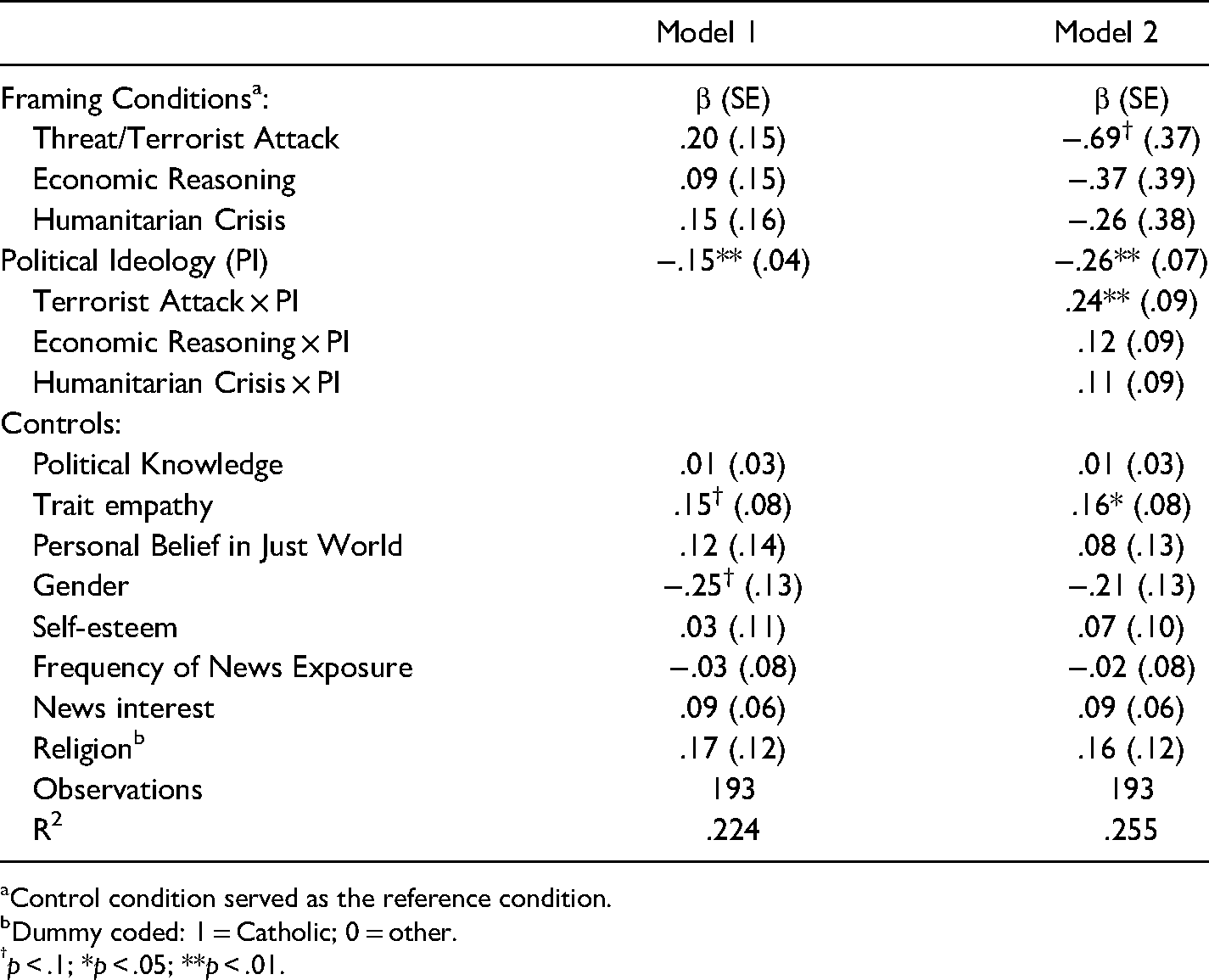
To test the impact of ideology on attitudes toward MHI broadly, we first estimated a linear regression model with intervention as a product of message conditions (dummy coded) and political ideology, while controlling for several other influential factors (see Table 1, Model 1). Results suggested that none of the framing conditions, by itself, led to significant changes in the outcome variable. Political ideology, as expected, was found to be a significant predictor (β = −.15, p < .001).
Predicting Support of Intervention by Framing Condition (Study 1).
Control condition served as the reference condition.
Dummy coded: 1 = Catholic; 0 = other.
p < .1; *p < .05; **p < .01.
Next, we considered whether political ideology moderates participants’ reactions to the news stories (H4 and H5). We tested a model with political ideology as the moderator using Hayes’ PROCESS macro for SPSS (bootstrap estimation 5,000 samples; Table 1, Model 2). Results indicated that, among all three framing conditions, the coefficient of the terrorist attack condition approached statistical significance at.06 level. 5 Moreover, the interaction between political ideology and the terrorism threat condition was significant, indicating an effect of the terrorism threat message was indeed contingent upon one's political ideology (see Figure 1).
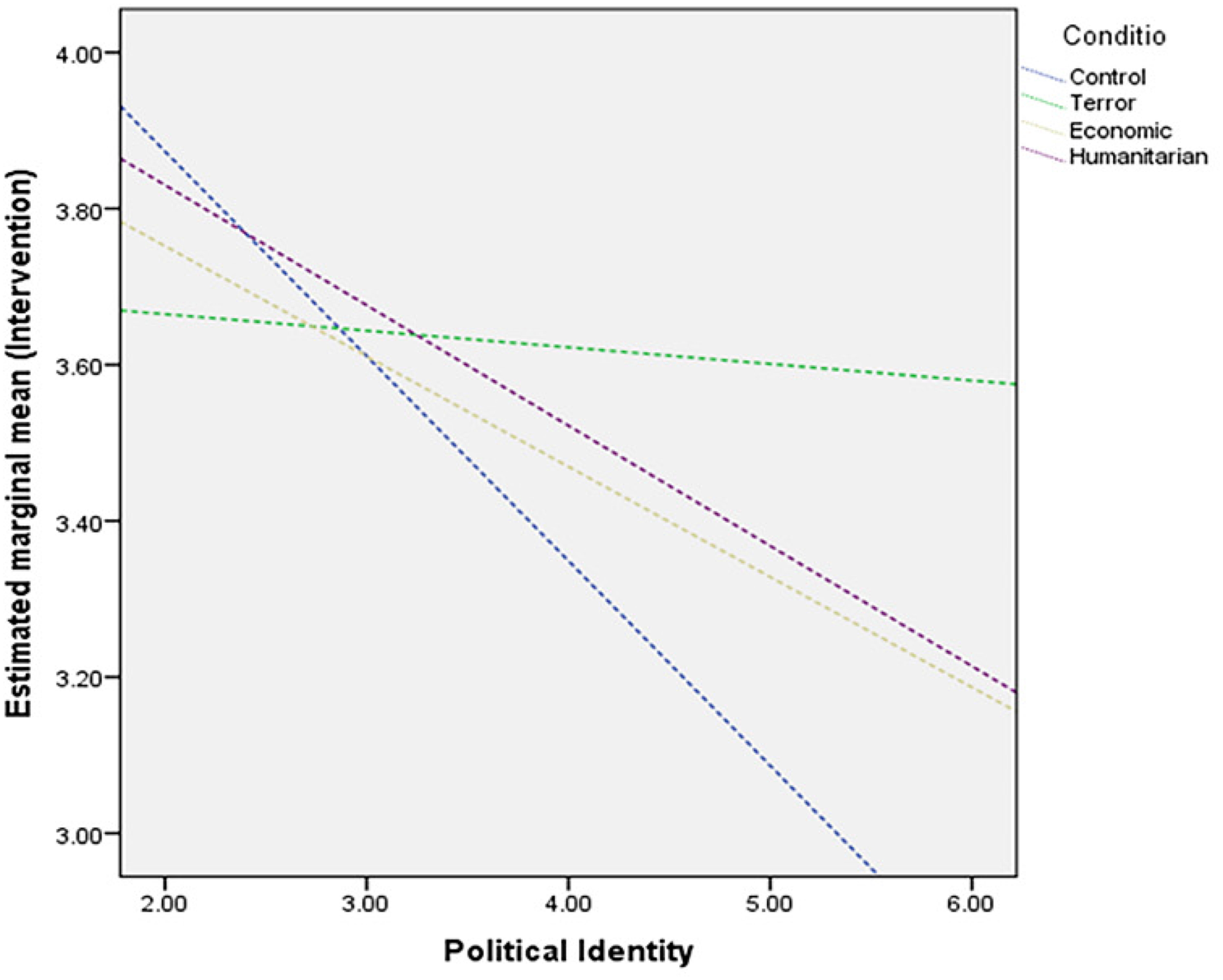
Interaction effect of political identity and terrorism threat on framing of support for intervention (study 1).
Summary of Study 1
Overall, study 1 did not find support for conventional IR wisdom, suggesting that mainstream framing strategies—namely the emphasis on national security/terrorism concerns, economic reasoning, and worsening humanitarian suffering—do not influence support for MHI directly. Instead, the results highlight the importance of interactions between treatments and ideology. When individuals’ political ideology and various relevant psychological factors were considered, nuanced effects were observed. Specifically, conservative-minded students exposed to the terrorist attack framing reported stronger support for military intervention than those in the control condition.
Study 2
Overview
Study 2 addressed the effects of news framing and political ideology by replicating the design of Study 1 using a non-student sample. To that end, we aimed to reach the general US adult population not confined to the same region of the US. Moreover, in light of Chong and Druckman’s (2007, 2010) argument about the ubiquity and diversity of news information on various social and political issues, we added a secondary frame to the design so that participants were presented with two news framing tactics (see Figure 2 for illustration).
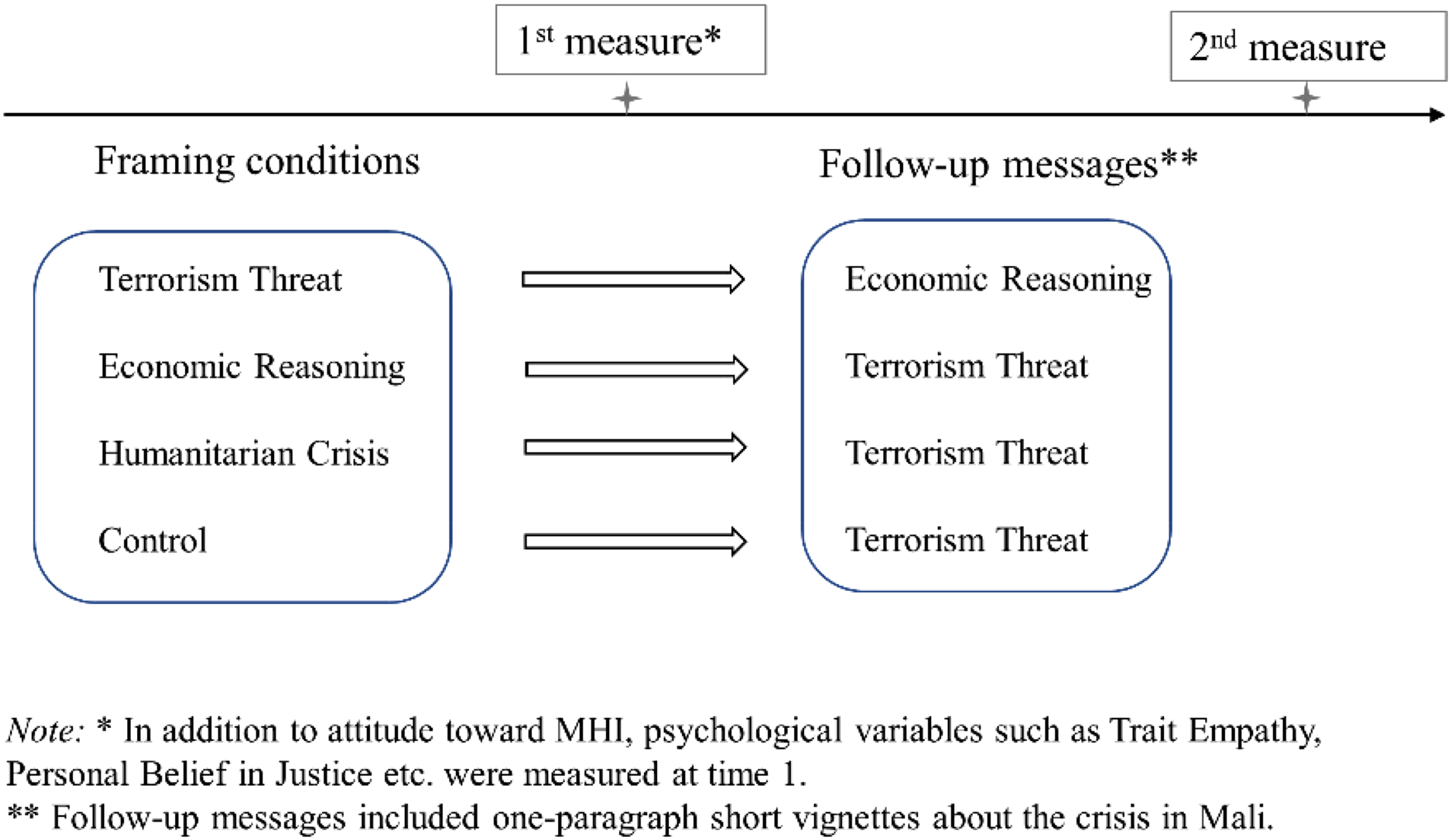
Research design of study 2.
Participants, Procedure, and Materials
Study 2 (conducted Janurary 2020) included 466 US adults recruited via Amazon's Mechanical Turk (MTurk). Among them, 56.7% self-identified as male. The mean age was 36.77 (SD = 12.25), and most participants were non-Hispanic White (74%), followed by Hispanic/Latinos (8.4%). In terms of political ideology, the sample was mostly conservative-leaning (47.6%), followed by liberal-leaning (35%), and moderate (17.4%). More than half (60.5%) of the sample indicated some college-level education, followed by completion of high school (16.1%) and postgraduate degree (15.5%). Regarding religious beliefs, Catholics constituted the largest group (35.6%), followed by Protestants (14.2%).
The procedure was mostly similar to that employed in Study 1. We recruited 600 respondents through MTurk. Participants were reimbursed in exchange for 15 min of their time. Before starting the survey experiment, participants were given detailed instructions about what to expect from the study and were told to pay attention to the story that they were about to read. Participants who failed the manipulation check were thanked and dismissed from the study. Four hundred sixty-six individuals passed the manipulation check and were assigned to read one of the four mock stories, as in Study 1. They were then prompted to indicate their intention to support various forms of interventions. Subsequently, participants were exposed to a short vignette written in either the security threat or economic concern frame. The questionnaire ended with a survey assessing participants’ opinions of interventions, their demographic information, and a measure of their political ideology. Other measures in the survey were the same as in study 1. However, considering the length of our survey and Study 1 results, we omitted the measures of political knowledge.
As noted earlier, participants in Study 2 were exposed to two different perspectives in a particular sequence. In the pre-intervention scenario, they were randomly assigned to one of the three conditions, the same as in Study 1, or the control group. Subsequently, in the post-intervention scenario, they were assigned to read a one-paragraph vignette describing the crisis in Mali as either threatening the US security or demanding a large economic input from the US. Participants who were assigned to the threat condition in the pre-intervention scenario were exposed to the short vignette expressing economic concern, while participants who were assigned to the other three conditions were shown a short vignette on the security threat in the post-intervention scenario. Because Study 1 highlighted the unique effect of threat framing, we intended to examine whether presenting it either as the main message or as an alternative perspective affects individuals’ views on intervention. In terms of the content, the threat vignette stressed that Al-Qaeda-linked extremists had infiltrated Mali, potentially representing a threat to US domestic security. On the other hand, the economic concern vignette stated that despite the ongoing external aid, the distressed country requested more aid to alleviate the suffering at home and fight against extremism (see Appendix B for the follow-up vignettes).
Results
We estimated a moderation model to examine the effects of the message manipulations and political ideology on attitudes toward MHI in Mali. 6 As in Study 1, we controlled for an array of demographic and psychological variables. Results (Table 2, Model 1) indicated a statistically significant effect of the economic concern message (β = .48, p < .05). Moreover, the interaction between political ideology and the economic concern condition was also significant (β = −.11, p < .05), suggesting that under the economic concern framing, people with stronger conservative ideology were less likely to favor interventions than those under the control condition. Meanwhile, liberals were more likely to support it under all conditions (Figure 3). In short, the interaction effect of message framing and political ideology on the adult sample appeared to be distinct from that on the college student sample.
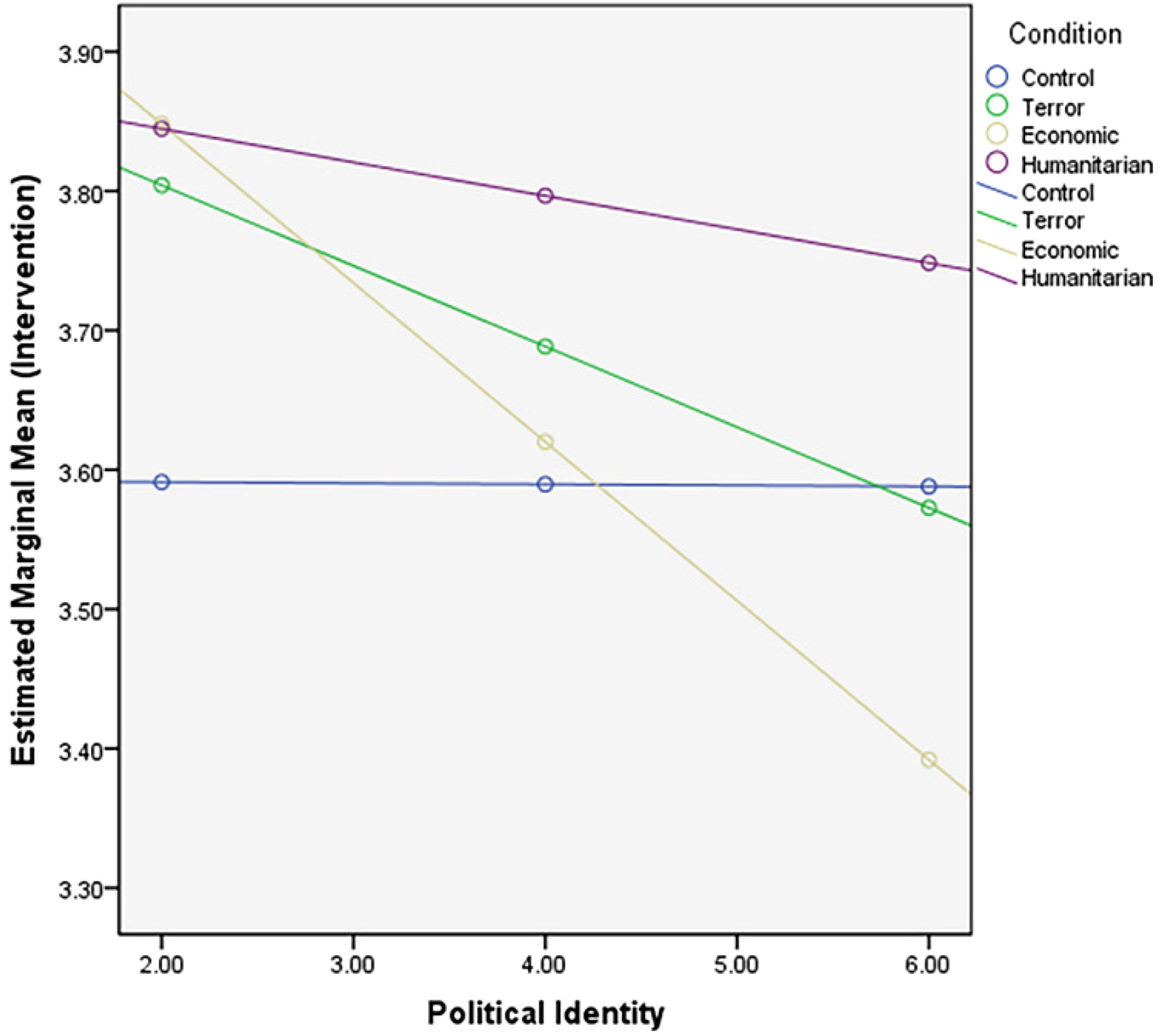
Interaction effect of political identity and economic cost frame on (initial) support for intervention (study 2).
Predicting Support of Intervention by Framing Condition (Study 2).
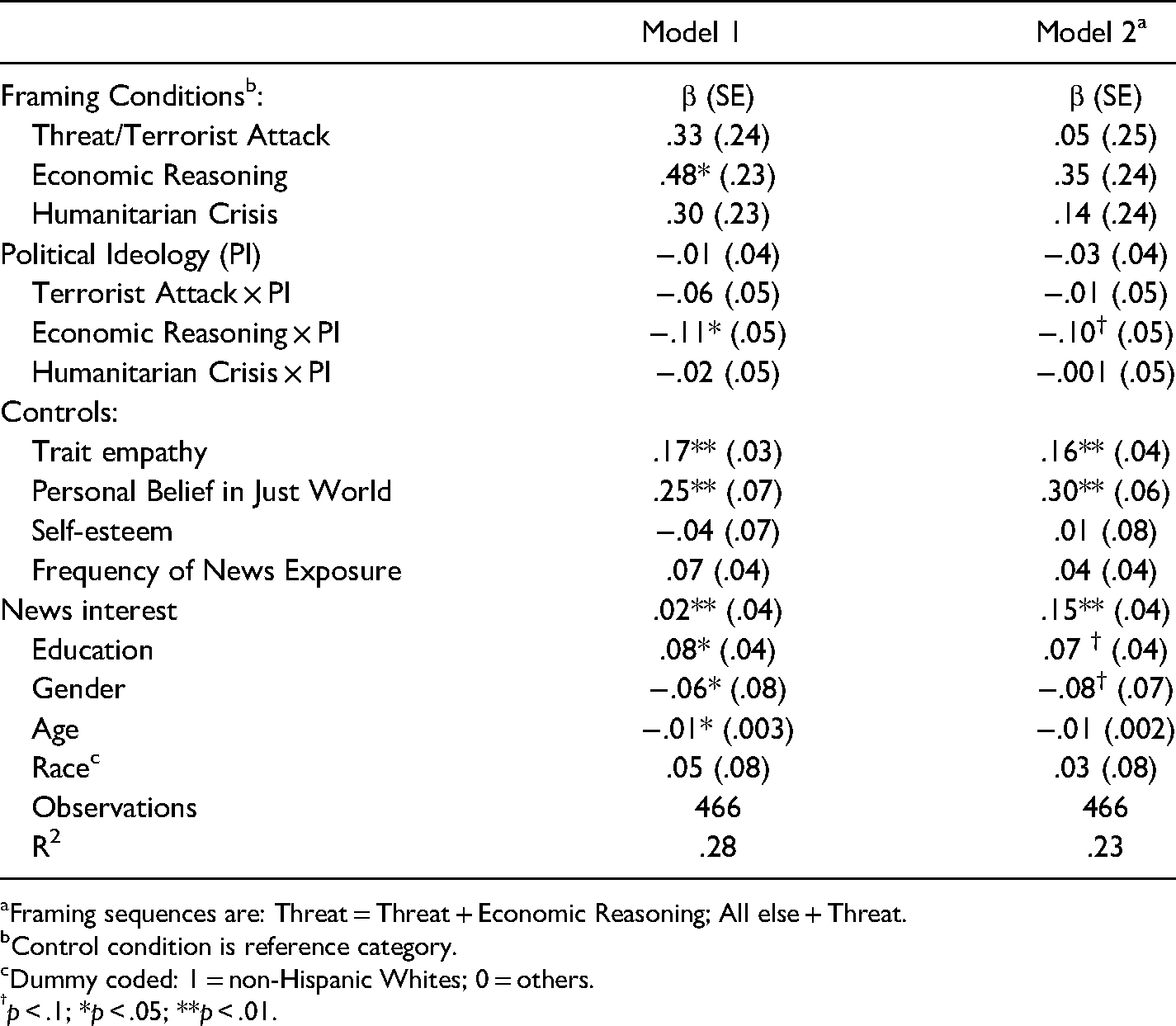
Framing sequences are: Threat = Threat + Economic Reasoning; All else + Threat.
Control condition is reference category.
Dummy coded: 1 = non-Hispanic Whites; 0 = others.
p < .1; *p < .05; **p < .01.
To probe the effects of the follow-up messages, we estimated a moderation model with support for intervention (measured at the second time) as the dependent variable. As shown in Table 2, Model 2, none of the message framing sequences were significant. However, both interaction terms for political ideology and economic concern, as well as ideology and the threat vignette, were significant at the.10 level (β = −.10, p < .063). Further examination of the interaction effect shows an identical pattern with the results of single message framing in Study 1 (Figure 4), suggesting a possible message sequencing effect and a unique impact of the economic cost frame on the adult population (more on this in the discussion).
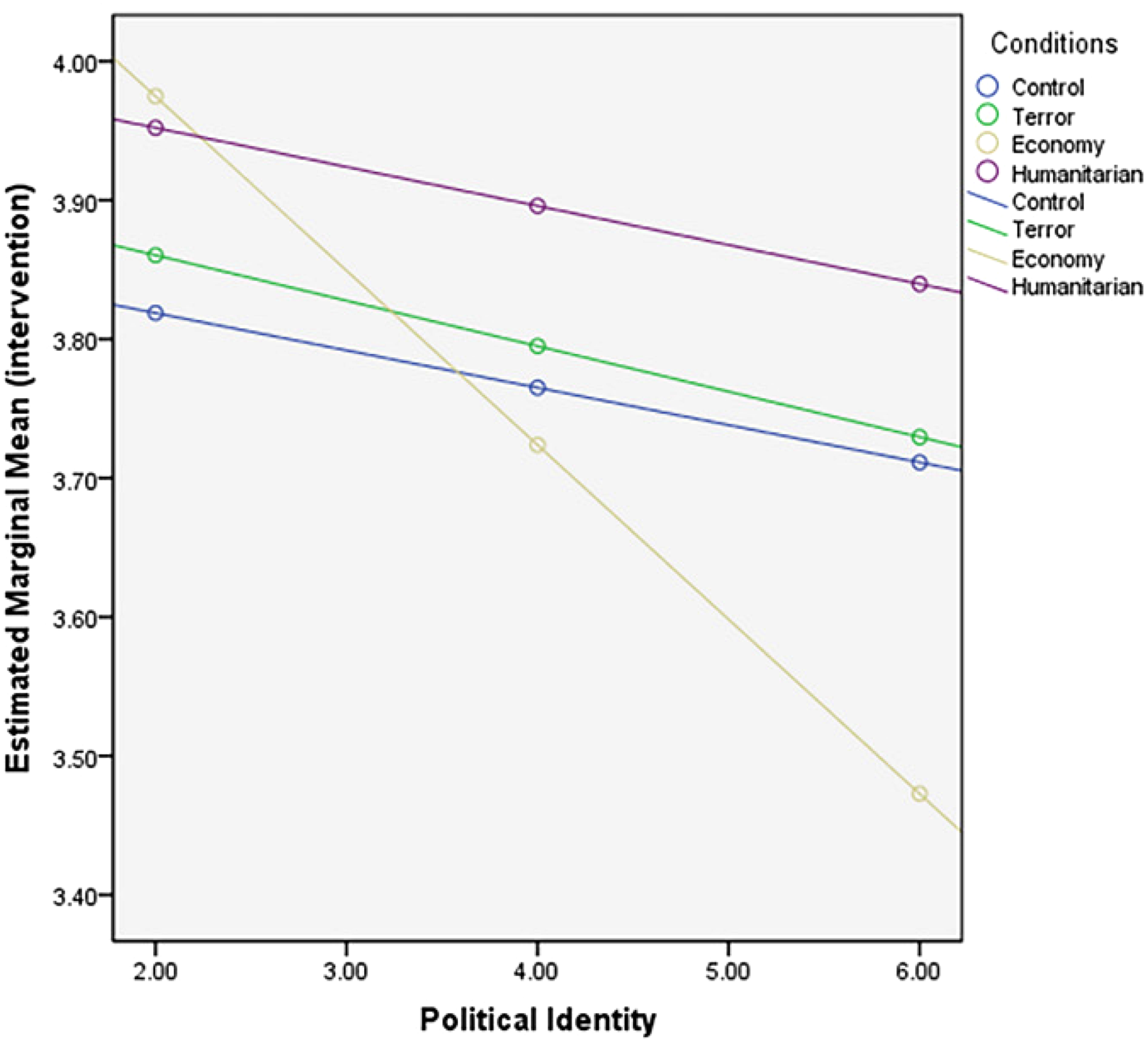
Interaction effect of political identity and economic cost frame on (post follow-up message) support for intervention (study 2).
Discussion
Scholarship in journalism and mass communication underscores the importance of public opinion in shaping states’ foreign policy decisions (i.e., MHI). The current project contributes to the interdisciplinary inquiry by examining the effects of certain media framing strategies on Americans’ support for MHI. Accordingly, we conducted two survey experiments using a college student sample and a general adult sample. Among various critical findings, we found that public support for MHI does not vary based on framing strategies of the humanitarian crisis alone. Rather, the evidence pointed to an intricate interaction between an individual's ideology and media framing techniques.
To begin with, our studies found that a stronger liberal orientation positively correlated with college students’ and general adults’ support for MHI, mirroring prior literature emphasizing the role of party identification as a critical determinant of foreign policy attitudes (Busby and Monten 2012; Jeong and Quirk 2019). More importantly, our research showed that political ideology interacts with various media framing techniques to affect public views on MHI. First, among the college student sample (Study 1), the security threat framing effectively invoked significantly stronger support for MHI among conservative-leaning students, while liberal-leaning students reacted to all frames equally. This corroborates prior evidence that conservatives in the US tend to favor military actions when confronted with issues threatening their core interests (Busby and Monten 2012; Dueck 2010), while liberals tend to support military actions to alleviate perceived grave human rights violations (Jeong and Quirk 2019). In addition, Study 2 indicated that adult conservatives were less inclined to support military intervention when subjected to the economic frame, whereas adult liberals were particularly willing to support intervention despite knowing that additional economic assistance was needed to address the ongoing humanitarian turmoil. This suggests that adult conservatives in the US are sensitive to the potential monetary costs of military actions abroad, which seems in line with the finding that Republicans tend to be skeptical of US military intervention solely for humanitarian purposes (Dueck 2010). Given both studies were conducted during the Trump era, when the administration prioritized domestic affairs over international matters and considered withdrawing from NATO, Iraq, and Afghanistan, we suspect that the public opinion towards military interventions abroad would regress to its ordinary ideological divide (rendering our results even more robust) during other periods when the rhetoric of withdrawing from the international stage was less salient from the governing administration.
Notably, the non-significant effect of framing strategies supporting MHI, in general, should not be disregarded easily. A recent meta-analysis (O’Keefe and Hoeken 2021) suggests that when it comes to the persuasiveness of message design, the uses of framing, rhetorical, or various other techniques do not produce consistent changes among the audience across various contexts. As such, the non-significant findings conveyed through both studies further underscores the intricacies and difficulties of winning the public's support on foreign policy issues. It can be concluded that there is simply no “one-size-fits-all” strategy when presenting information about MHI. To obtain adequate domestic support for MHI, intervening states and policymakers would be well advised to communicate with the public about the pragmatic interests at stake while considering the organization's target audience. For the highly educated and relatively younger population (i.e., college students), associating MHI with the security threat would likely enhance conservatives’ level of support. However, for the general adult population, the economic framing of MHI would likely hamper conservatives’ favorable attitude on this issue.
With a few exceptions (e.g., Chong and Druckman 2007), much of the existing research on political framing has not considered that people are often exposed to multiple and sometimes competing frames on a given issue. In an attempt to fill this scholarly gap, we carried out a second study in which participants were given a secondary message framed in terms of either economic cost or terrorism threat, after exposed to one of the three main framing messages. This allowed us to examine whether multiple framings would alter people's attitude toward MHI. Results showed that the adult participants’ reactions to the secondary frame were somewhat similar to the main frame: adult conservative-leaning individuals reported less support for MHI when exposed to the economic frame followed by the terrorism threat frame (as compared to the control frame followed by the terrorism threat frame). Thus, presenting a secondary frame in Study 2 generally did not have a meaningful effect on support for MHI. Because terrorism threat framing was effective in Study 1, this finding is particularly noteworthy as it suggests that the initial message (the economic issue frame) was very impactful and that providing additional information did not significantly sway the opinions.
Previous research involving multiple framing techniques showed that some frames could have carryover effects, such that exposing to a loss frame first, followed by a gain frame, exerted more potent effects on people's judgment than vice versa (Ledgerwood and Boydstun 2014). Along a similar vein, one might expect a similar framing order effect to be uncovered in other contexts. Interestingly, however, the unique design of Study 2 ostensibly provided us a chance to observe the potential impact of sequentially encountered frames by reversing the framing orders of economic reasoning frame and terrorism attack frame in two specific conditions (see Figure 2: condition one vs. condition two). Our findings suggested that exposing participants to the economic reasoning frame first and terrorism threat frame later—but not vice versa—had a significant interaction effect with political ideology on support for MHI. In that regard, our project extended Chong and Druckman’s (2007) investigation of competing or complementary framing effects in a complex message environment by introducing framing orders as a new factor of concern. Future studies are encouraged to explore the potential psychological mechanisms through which the sequential frames might impact political attitudes and behaviors. Nevertheless, it is worth noting that across all conditions, the magnitude of support for direct US involvement (as measured in three of the four MHI items) only increased marginally (between 1% and 5%), indicating limited potency of exposure to a secondary message as compared to a single message.
Finally, to further explain the percentage of variance in the outcome variable, this study also included a set of psychological and demographic factors that may affect public views. We found that trait empathy, personal belief in a just world, news interest, education, gender, and age significantly influenced the dependent variable. Because the effects of these factors are well-established in political psychology and mass communication literature, future experimental research on MHI and conflict resolution should consider these factors to establish more comprehensive and accurate models.
This research had some limitations that need to be acknowledged. Like many other studies, we designed online experiments with voluntary respondents; therefore, the results are likely limited by the features of our samples. Methodologically, our experimental messages covered only a single incidence, a humanitarian crisis in Mali. Given that geographical proximity is a significant factor influencing public opinion on foreign policy issues, presenting a humanitarian crisis in other parts of the world, especially in a nearby country (e.g., Mexico) or in a country closely allied with the US (e.g., Italy or the Philippines), might produce different outcomes. Moreover, our manipulation checks may not be ideal, as they forced participants to identify the most salient framing technique manifested in each stimulus. In reality, a news story may simultaneously contain multiple frames at varying strengths, future studies could measure the strength of all perceived framing strategies with continuous scales so that subjects are not constrained to select one frame over the others. Finally, the vignettes which contain the secondary frame in Study 2 bear the risk of not being as potent as the initial full-length news stories. Future research should consider testing the effects of follow-up messages created in similar length and style as the initial stimuli.
Footnotes
Appendix A
Appendix B
Both authors contributed equally to this project. The authors thank the Editor-in-Chief, Dr. Cristian Vaccari, the managing associate editor, and the two anonymous reviewers for their guidance in the review process.
Declaration of Conflicting Interests
The author(s) declared no potential conflicts of interest with respect to the research, authorship, and/or publication of this article.
Funding
The author(s) received no financial support for the research, authorship and/or publication of this article.
