




Abstract
Political discussion is a key mechanism for the development of reasoned opinions and political knowledge, but online political discussion has been characterized as uncivil, intolerant, and/or ideologically homogeneous, which is detrimental to this development. In this paper, we examine the role of personality in various forms of political talk—online and offline—as well as like-minded discussion. Based on a 2017 survey conducted in the United Kingdom, United States, and France, we find that people who are open-minded and extraverted are more likely to engage in political talk but less likely to engage in like-minded discussion. Individuals who are older, less educated, introverted, and conscientious are more likely to find themselves in like-minded discussions, both online and on social media. Like-minded discussion is rare; personality, rather than ideology, predicts whether people engage in this form of political talk in online and offline modes. Our findings challenge the role of social media in the creation of like-minded discussion. Instead, we should look to the role of individual attributes, such as personality traits, which create a disposition that motivates the use of social media (and offline networks) to cultivate like-minded discussion.
Keywords
Political discussion is a key mechanism for the development of reasoned opinions and political knowledge (Emsalem and Nir 2019). Digital media were expected to offer new opportunities for more equity and diversity in political discussion (Brundidge 2010; Wojcieszak and Mutz 2009). Instead, online political discussion has been characterized as uncivil, intolerant, and/or ideologically homogeneous (see Boulianne et al. 2020; Rossini 2020; Theocharis et al. 2016; Vaccari et al. 2016), which could lead to attitude polarization (Grönlund et al. 2015; Mutz 2006) or reduce political tolerance (Nir 2017). This paper examines the role of personality in online and offline modes of political discussion as well as in like-minded discussion.
Using survey data from 2017 gathered in the United States, United Kingdom, and France, we examine political discussion and then dig into a specific type of political discussion: engaging in like-minded or homogeneous political talk. While like-minded discussion could occur offline, the bulk of the research has focused on the potential of online media, specifically social media, to cultivate like-minded discussion networks. The reason for this focus is partly theoretical, that is the role of algorithms and self-directed opportunities to personalize information flows (Dubois and Blank 2018; Vaccari et al. 2016), and partly due to data availability, that is social media trace data enable an analysis of people's social interactions online (Barberá et al. 2015).
In this study, we use survey data to help understand the extent to which like-minded discussion is a feature of social media, as opposed to a characteristic of political talk more generally. The value of using survey data is that we can examine online and offline patterns of interaction with like-minded people. The survey data enable us to evaluate the filtering processes. First, how does personality correlate with the likelihood of engaging in political discussion? How do these dispositions influence talking via social media? Finally, how do personality traits influence political talk in like-minded networks?
In Figure 1, we describe a filtering process related to political discussion. Political discussion is synonymous with interpersonal political communication, which is defined as “episodes of political conversation and discussion that take place between the non-elite members of a political community” (Kaid and Holtz-Bacha 2008: 341). This filtering process has been described in other works. For example, Wojcieszak and Mutz (2009) describe how, at the time of their data collection in 2006, 51 percent of the American population used the Internet and 11 percent of that subset had participated in online discussions. They then examine the types of groups in which these people participated, and finally whether politics was discussed in these groups. We offer a similar filtering process but focused on social media and the role of personality. Personality can influence the many layers of this filtering process, from political discussion offline to social media use, to social media use for political discussion, and finally to like-minded discussion on social media. We use this framework to guide our review of the literature and our theoretical claims about how personality influences this filtering process. Figure 1 foreshadows our research questions (RQs) and hypotheses. We do not examine all of the connections between these variables and instead encourage readers to read published meta-analysis work about social media and political participation (Boulianne 2019).
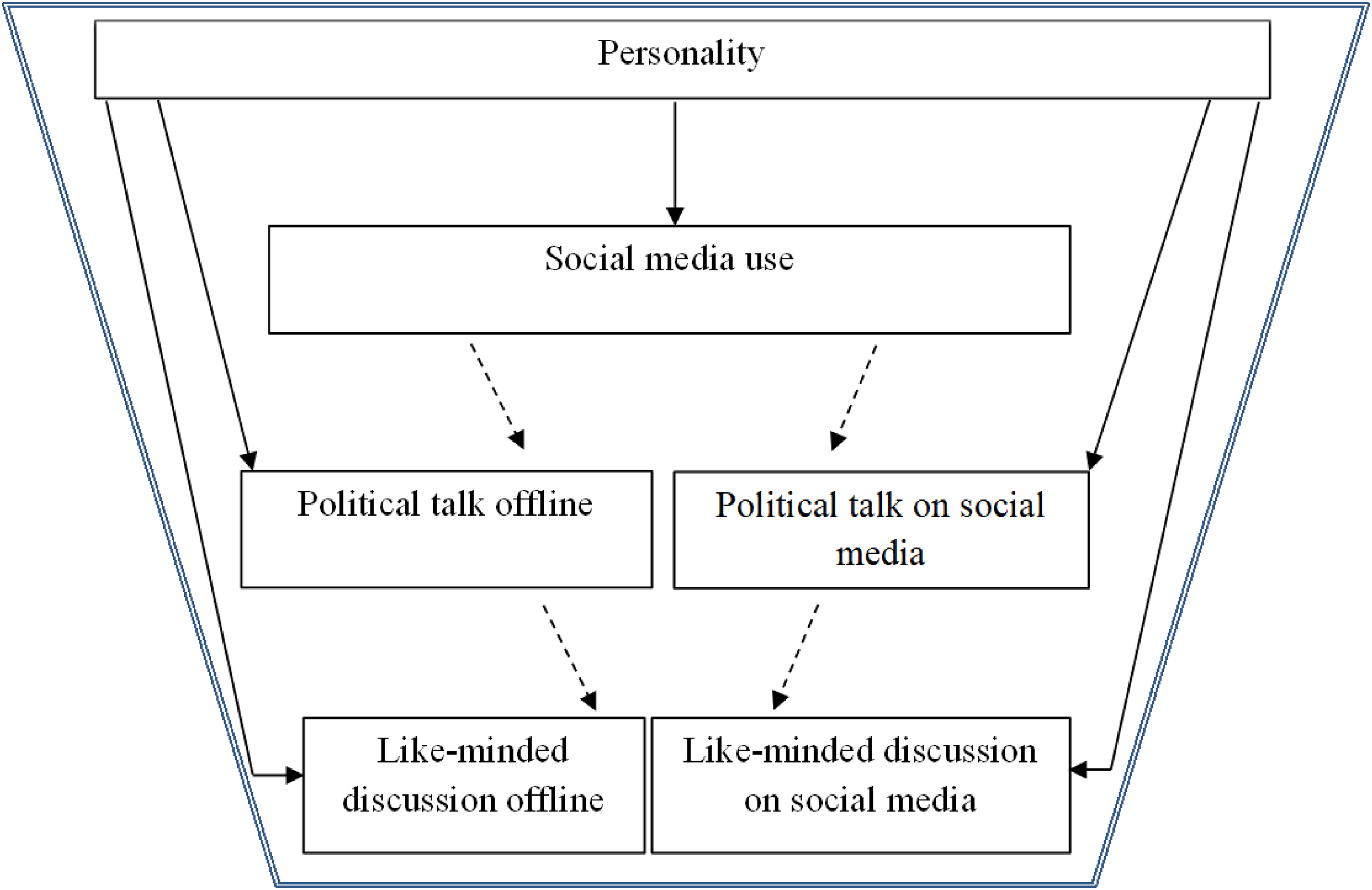
Filtering process for personality, political discussion, and like-minded discussion.
Personality and Political Talk
Scholarly interest in personality and politics has surged over the last decade, as the Big Five construct spreads in popularity and provides common concepts and measures for social scientists (Mondak 2010). The Big Five construct focuses on five distinct personality traits: openness to experience, conscientiousness, extraversion, agreeableness, and emotional stability (or the inverse, neuroticism). These personality traits have been tested in relation to a variety of measures of political discussion, but mainly in an offline context (Table 1). The research has not coalesced around any specific findings. For each of the Big Five personality traits, studies show the existence of relationships and null findings. This is characteristic of the larger body of literature on personality and political behavior.
Literature Summary of Personality and Political Discussion.
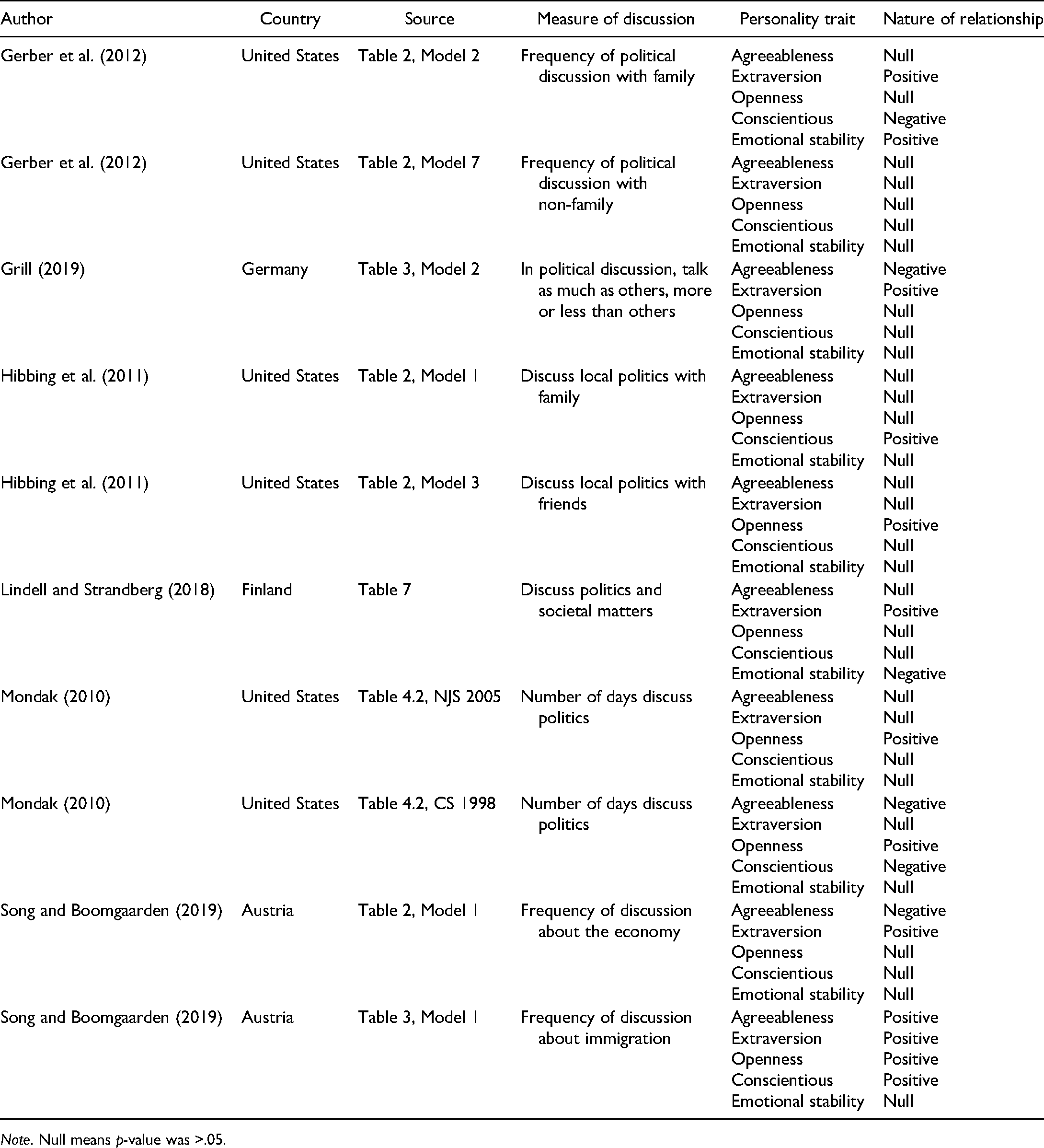
Note. Null means p-value was >.05.
Openness. The personality trait of openness is expected to relate to political talk because open-minded people tend to exhibit intellectual curiosity (Grill 2019) and may seek out opportunities to learn from their discussants. These people learn from political discussions and welcome “the cognitive stimulation produced from hearing new ideas and perspectives” (Lindell and Strandberg 2018: 243). People who score high on openness may have a broad set of interests that includes politics (Gerber et al. 2012). They may also have larger networks, creating more opportunities for political discussion (Mondak 2010), or be more likely to discuss more sensitive issues (such as immigration, see Song and Boomgaarden 2019). Of the existing research outlined in Table 1, four of the ten tests are positive and significant, demonstrating some support for the role of openness in political discussion, but hardly a consensus.
Extraversion. Extraverts are more sociable and assertive, which increases the propensity to talk politics (Grill 2019; Hibbing et al. 2011; Lindell and Strandberg 2018). They may prefer political discussion as a form of political participation because it is a sociable and interactive activity, as opposed to individualized activities such as signing petitions (Evans and Ulbig 2012; Lindell and Strandberg 2018). Extraverted people are also more likely to have larger social networks and a greater number of interactions within these networks (Hibbing et al. 2011; Mondak 2010). They are also believed to be more opinionated and outgoing and, thus, less likely to be deterred by potential conflict arising from political talk (Song and Boomgaarden 2019). Of the existing research outlined in Table 1, five of the ten tests are positive and significant (Table 1), demonstrating the relevance of extraversion in predicting political discussion.
Agreeableness. This trait is associated with altruism and modesty, which could lead to avoiding political talk in favor of more harmonious interactions (Grill 2019). People who score “high on agreeableness tend to be compassionate, good-natured, and eager to cooperate, while those scoring low on agreeableness are hardheaded and skeptical” (Gerber et al. 2012: 853). People who are agreeable are more eager to cooperate and shy away from the conflict that might arise in political discussions (Gerber et al. 2012; Lindell and Strandberg 2018). Grill (2019) and Mondak (2010) found a negative relationship between agreeableness and political discussion. Song and Boomgaarden (2019) found the relationship is negative for agreeableness and discussions about the economy, but positive for discussions about immigration. As such, the nature of the relationship may depend on the topic or the degree to which views are controversial.
Agreeableness presents another challenge in measurement. Agreeableness is correlated with extraversion (Song and Boomgaarden 2019, correlation of .41). Because these traits are expected to operate in the opposite ways in relation to political discussion, this correlation may be problematic. In three countries, Mondak et al. (2010) observe that agreeableness correlates with conscientiousness (.41 in the United States, .43 in Uruguay, and .40 in Venezuela). This could also be a problem as agreeableness and conscientiousness may not operate in a similar fashion in relation to political discussion (see the section below). In sum, the agreeableness measures are highly correlated with other personality measures, making it difficult to isolate the distinct role of this trait.
Conscientiousness. Conscientious people are more likely to comply with rules and standards; they are more organized and goal oriented (Gerber et al. 2012). Gerber et al. (2012) do not specify an expected relationship between conscientiousness and political discussion but suggest that, if political discussion is a social norm, conscientious people may participate as part of adherence to this norm. However, the counterpart to conscientiousness is being easygoing, which may also be reflective of a willingness to engage in political discussion (Gerber et al. 2012). The findings affirm these possibilities. In the U.S. context, Gerber et al. (2012) and Mondak (2010) found a negative relationship between frequency of discussion and conscientiousness, whereas Hibbing et al. (2011) found a positive relationship (Table 1). Additionally, in a European context (study on Austrians) conscientiousness had a positive impact on the frequency of discussion about a more sensitive issue—immigration (Song and Boomgaarden 2019). Using Finnish data, Lindell and Strandberg (2018) found no relationship between conscientiousness and political discussion. Following Gerber et al. (2012) and Lindell and Strandberg (2018), and in light of those contradictory results, we do not state an expected hypothesis related to conscientiousness.
Emotional stability. The final personality trait is emotional stability (or the inverse, neuroticism). Those who score high on emotional stability are “secure, hardy, and relaxed under stressful conditions, while their counterparts, the more neurotic, tend to be anxious, sensitive, and easily upset” (Gerber et al. 2012: 853). Those who are neurotic might find political discussion threatening and thus avoid it (Gerber et al. 2012). Gerber et al. (2012) found a positive and significant relationship between emotional stability and political discussion. In contrast, Lindell and Strandberg (2018) found a negative relationship between emotional stability and political discussion. The remaining studies found no relationship.
In light of the existing research, we offer hypotheses focused on three personality traits and how these influence political discussion. We offer research questions about conscientiousness and emotional stability because the theory is unclear and existing research does not find solid evidence of any kind of relationship. While existing research focuses on the offline context, we believe these personality traits and related theories apply to the online context that is social media—based political discussion (see further details later in this paper).
Personality and Like-minded Discussion
Few studies examine personality traits as predictors of like-minded discussion. Hibbing et al. (2011) test all five personality traits and find that only emotional stability (positively) impacts having conversations with a discussant who holds a different viewpoint. In other words, emotional stability negatively correlates with like-minded discussion. They explain these findings by stating that neurotic people have “heightened psychological need for social reassurance, and thus they should be relatively likely to seek out conversations with close relations who are unlikely to challenge their views” (Hibbing et al. 2011: 613). Focusing on only two personality traits, openness and extraversion, Kim et al. (2013) found that both traits positively predict heterogeneous discussion networks. In relation to like-minded discussion, the findings indicate openness and extraversion decrease the likelihood of being in a homogeneous discussion network. Finally, Mondak and colleagues test all five personality traits. In the baseline model, none of the traits are statistically significant (Mondak 2010; Mondak et al. 2010). However, when these traits are conditioned on network size, extraversion decreases and agreeableness increases heterogeneous discussion (Mondak 2010; Mondak et al. 2010). In sum, there is little consensus about personality traits and heterogeneous (or the inverse, like-minded) discussion.
Theoretically, we expect that agreeable dispositions likely favor and even cultivate discussion networks that emphasize consensus, rejecting, or avoiding conversations that might lead to conflict. As mentioned, agreeable people may avoid or shy away from the conflict inherent in discussions with people of differing viewpoints (Gerber et al. 2012; Lindell and Strandberg 2018). People who are low in agreeableness may be more antagonistic and might enjoy political debate with people holding differing views (Bakker et al. 2016). Sydnor (2019) suggests that those with a conflict-oriented disposition are apt to engage in high-conflict forms of political participation, such as posting on social media, and enjoy the uncivil discussions that can occur online. Conflict avoiders, in contrast, will avoid activities that could lead to disagreement and incivility (Sydnor 2019).
Extraverts may be more motivated and confident in engaging in conversation and, thus, may enjoy the stimulation caused by differences of opinion (Song and Boomgaarden 2019). They may seek out conversation partners with differences in opinions as these conversations may be lengthier. For these people, the lively debate-style conversation is more interactive and thus, more enjoyable.
Openness, again, arises as an important variable. As mentioned, openness is attached to intellectual curiosity, which is fulfilled in discussions with people of differing viewpoints (Grill 2019). More may be learned in these types of conversations where people are drawing upon different information and values. Furthermore, open-minded people may be less likely to be offended when presented with differing viewpoints (Lindell and Strandberg 2018). In terms of emotional stability and conscientiousness, the existing findings do not offer support for theories about these personality traits. As such, we do not propose hypotheses on these traits, but instead propose research questions.
Dubois and Blank (2018: 731) claim that “social psychology has long shown this tendency to associate with like-minded others is common cross-culturally.” In contrast, some people like to hear about new ideas and learn new things; this inclination is attached to personality and may or may not be attached to culture and thus differ cross-nationally. People who are open-minded may seek out discussion partners who are different from themselves and may seek out information sources that present a diverse set of viewpoints. As such, the role of personality is worth testing and, in particular, worth testing using cross-national data to examine whether there are any cultural variations in these dispositions as well as in the propensity to talk about politics. In terms of conscientiousness, Gerber et al. (2012) point out that if political discussion is a social norm, people may participate as part of adherence to this norm. These norms would be culturally specific, suggesting cross-national differences.
Studies show that the propensity to engage in political discussion varies across countries (Nir 2012; Vaccari and Valeriani 2018). Nir (2012) explains cross-national differences in political discussion in terms of structural characteristics. The competitiveness of elections increases political discussion because it generates more interest in the election and consequently more discussion (Nir 2012). France is distinctive from the United Kingdom because the elections are more competitive and thus, we would expect to see more political discussion (see Nir 2012, Table 1). In relation to online discussion, Vaccari and Valeriani (2018) found that respondents from the United Kingdom and the United States talk politics on social media more so than those from France. However, the explanation of these cross-national differences has not considered personality and personality differences that may be attached to culture. As such, we propose a research question:
Personality, Social Media, and Political Discussion
As mentioned, Kim et al. (2013) found openness and extraversion predict heterogeneous discussion networks; they also find social media use predicts having a heterogeneous discussion network. Indeed, the size of the social media use effect is comparable with the effect of openness on heterogeneous discussion networks. Even if they do not distinguish between online and offline forms of discussion, their findings affirm the importance of the mode of communication in understanding the relationship between personality and political discussion.
Like-minded discussion networks could exist offline, but the bulk of the research has focused on the potential of online media, specifically social media, to create these homogeneous networks (Barberá et al. 2015; Bountyline and Willer 2017; Karlsen et al. 2017; Vaccari et al. 2016). For example, using Twitter trace data, Barberá et al. (2015) found that the patterns of interaction depend on the topic of discussion. Specifically, for “the government shutdown and marriage equality, the vast majority of retweets occurred within ideological groups…liberals tended to retweet tweets from other liberals, and conservatives were especially likely to retweet tweets from other conservatives” (p. 1537). These patterns are not as strong for topics such as the Boston Marathon bombing, the 2014 Super Bowl, and the 2014 Winter Olympics (Barberá et al. 2015). Nonetheless, the evidence of like-minded discussion on digital/social media is far from conclusive. While online media have the potential to cultivate like-minded discussion networks, in practice, they may not. Indeed, arguments and evidence support the notion that online discussion networks are more diverse than offline networks (Groshek and Koc-Michalska 2017; Karlsen et al. 2017).
To understand political discussion on social media, we must consider the line of evidence suggesting social media use in and of itself is predicted by personality. Early research on social media adoption highlights the importance of personality (Correa et al. 2010). Quite simply, the propensity to adopt “social” media depends on being a sociable person as well as being open to new experiences because this was, at the time, new technology. Correa et al. (2010) found that emotional stability negatively predicts social media use and openness to new experiences positively predicts social media adoption. Extraversion also matters for social media adoption (Correa et al. 2010; Jenkins-Guarnieri et al. 2012; Ryan and Xenos 2011). Such findings set the stage for understanding social media-based discussion networks; the same factors that influence the likelihood of talking politics also impact the likelihood of adopting social media. While the predictors of social media use are not core to our analysis, they are considered part of the filtering process through which personality influences political talk on social media, particularly like-minded discussion (Figure 1).
Lindell and Strandberg (2018) examined online and offline discussion but did not consider the filtering process related to social media use when examining online discussion. They find that openness is positively related to online discussion, whereas agreeableness is negatively related to online discussion on newspaper pages, blogs, and social media (Lindell and Strandberg 2018). They do not find extraversion to be a significant predictor for online or offline discussion, which deviates from reports in the existing literature (Table 1).
Methods
In April and May 2017, we conducted a survey in the United States, United Kingdom, and France. The survey was conducted in English and French. The survey was administered by Lightspeed Kantar Group using an online panel matched to the gender and age distribution for each country (see Supplementary Information file). Lightspeed Kantar reports on weighting efficiency, rather than response rate. This metric assesses the match between the sample and the demographic profile of the country. The weighting efficiency was 99.1 percent, which is very high. Approximately 1,500 respondents completed the survey in each country, leading to a total of 4,500 responses. However, as outlined by the filtering process, the sample size gets smaller as we look at the subset of people who use social media, then the subset who engage in political discussion. This research was reviewed and approved by MacEwan's Research Ethics Board. The data files and analysis syntax are available at https://doi.org/10.6084/m9.figshare.13617383.
Measures
Political talk. For political talk, we asked about offline political discussion: “In the past 12 months, how often have you talked about politics with people around you, not taking into account discussions online or through social media?”; and subsequently about online political discussion: “In the past 12 months, how often have you talked about politics with people via social media?” Respondents who answered rarely, from time to time, or often were coded as 1 and all others coded as 0. In the United States, 80.41 percent of respondents talk politics offline and 53.87 percent of social media users talk politics on social media. In the United Kingdom, 78.32 percent of people talk politics offline and 43.99 percent of social media users talk politics on social media. Similarly, in France, people are more likely to talk politics offline than on social media (85.90 percent versus 33.65 percent). Country-level differences are evident in the propensity to talk politics, with a 20 percentage point difference between the United States and France with respect to talking politics on social media (see Table 2). The English and French wordings of all survey questions are included in the Supplementary Information file.
Descriptive Statistics.
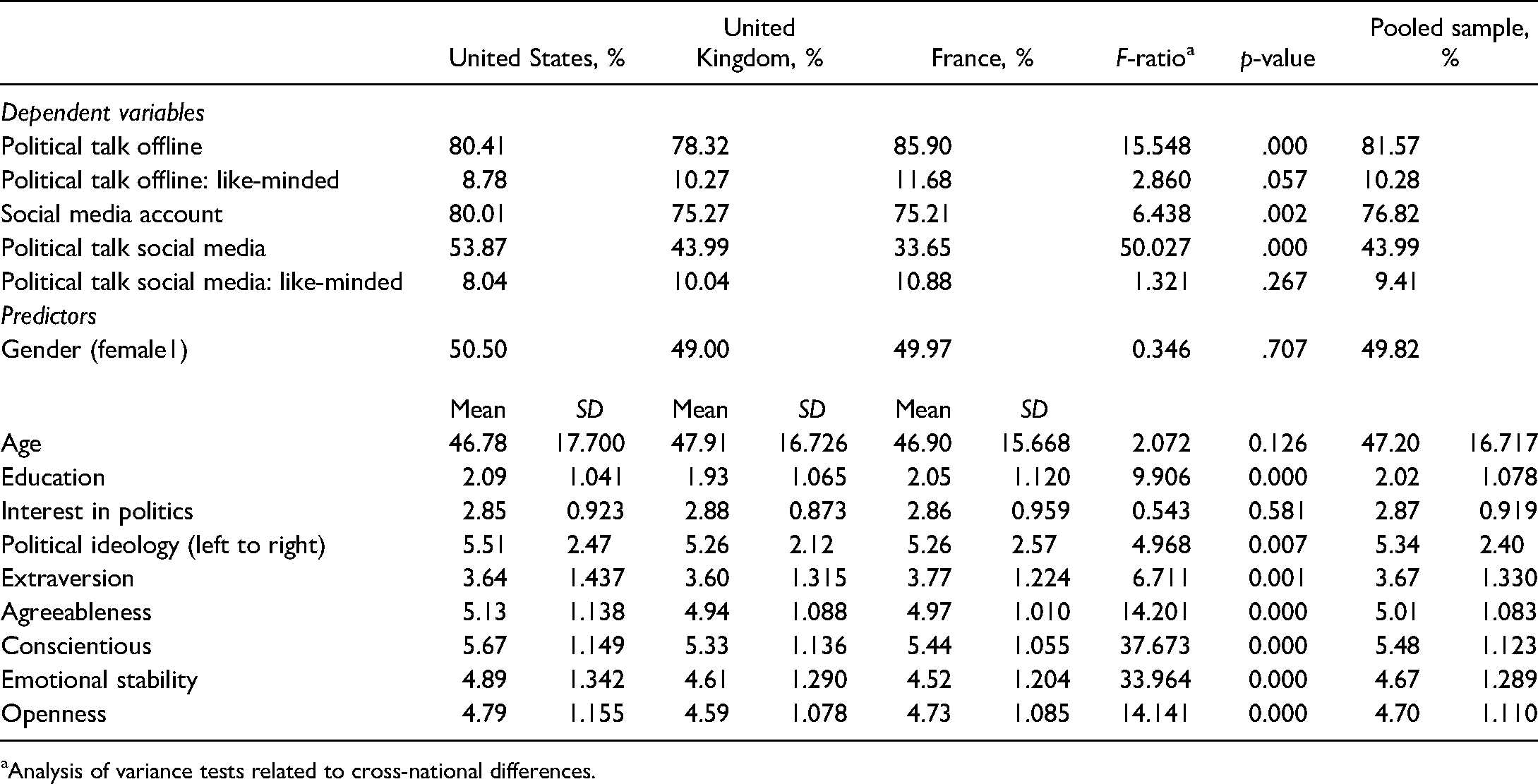
Analysis of variance tests related to cross-national differences.
Like-minded discussion. We filtered this question based on whether the respondent reported any political talk. Then, we asked those who did talk politics about who these discussions were with: “In the past 12 months, how often have you talked about politics with…people whose political views are different from yours and who generally disagree with you.” We asked about the frequency of this type of talk offline but recoded the variable so that 1 refers to those who “never” engage in discussion with those with differing viewpoints. All other responses were coded as 0. This variable is a measure of like-minded discussion. For a review of other ways to measure disagreement in political discussion, see Nir (2017).
Social media use. We asked respondents if they have a Facebook account. We also asked about a Twitter account. If they said yes to either question, they were coded as being a social media user.
We asked all social media users if they had engaged in like-minded discussion by talking about politics “via social media” with “people whose political views are different from yours and who generally disagree with you.” As mentioned, the responses were reverse coded, so that people who engaged in discussion but not with people holding differing viewpoints were coded as 1 (like-minded discussion). All other responses were coded as 0. If people did not use Facebook or Twitter, their responses were coded as missing. This reduced our total sample size.
Within each country, the proportion of people who engage in like-minded discussion online versus offline is within one percentage point. We do not find strong cross-national differences in the likelihood of like-minded discussion (Table 2).
Personality. We measured personality using the Big Five scale originating from the ten-item personality measure (Gosling et al. 2003; for the French version see Storme et al. 2016). Respondents were asked to respond whether they agree or disagree that the trait applies to them (see Supplementary Information for details). The responses to the two personality survey questions were added together and then the sum was divided by two.
Extraversion ((a) extraverted, enthusiastic and (b) reserved, quiet (reversed coding)). Agreeableness ((a) critical, quarrelsome (reverse coding) and (b) sympathetic, warm). Conscientiousness ((a) dependable, self-disciplined and (b) disorganized, careless (reversed coding)). Emotional stability ((a) anxious, easily upset (reversed coding) and (b) calm, emotionally stable). Openness to experience ((a) open to new experiences, complex and (b) conventional, uncreative (reversed coding)).
While this measurement approach has been widely used, some scholars have found longer personality scales offer better predictive value (Bakker and Lelkes 2018).
In terms of personality traits, we find differences by country (see Table 2). The largest differences are related to conscientiousness and emotional stability. The American sample reported slightly higher, on average, levels than the European respondents. For these traits, we propose research questions, rather than hypotheses, which allows some explorations into the nuances around country, conscientiousness, emotional stability, and political discussion.
Ideology. For political ideology, we asked, “In politics, people sometimes talk of left and right. Where would you place YOURSELF on this scale?” Political ideology is measured on a scale from 0 (extreme left) to 10 (extreme right). Respondents were offered an option to say “neither left nor right.” These respondents were coded in the middle of the left–right scale.
Control variables. We included gender, age, education, and political interest as control variables, which are also summarized in Table 2. These statistical controls are important as predictors of online and offline discussion. However, not all studies find that these variables matter. Within the subfield of personality and political discussion, the findings are as follows. Political interest is a consistent predictor of online (Lindell and Strandberg 2018) and offline discussion (Grill 2019; Lindell and Strandberg 2018). Lindell and Strandberg (2018) found that age matters for online discussion, but not offline discussion; gender does not predict either mode of discussion. Other studies find that gender predicts political discussion (Grill 2019; Song and Boomgaarden 2019) and like-minded discussion (Mondak 2010; Mondak et al. 2010). Hibbing et al. (2011) and Gerber et al. (2012) found that the effects of age and education on political discussion depend on the context (family versus non-family). In terms of like-minded discussion, Kim et al. (2013) and Hibbing et al. (2011) do not find that age, gender, and education predict participation in this type of discussion, but the strength of partisanship predicts like-minded discussion (Kim et al. 2013).
Beyond the field of personality and political discussion, research shows that online discussion is predicted by age (Brundidge 2010; Evans and Ulbig 2012; Huber et al. 2019; Kim and Baek 2018; Stromer-Galley 2002) and gender (Huber et al. 2019; Evans and Ulbig 2012; Stromer-Galley 2002). Political interest is a predictor of political discussion online and offline (Evans and Ulbig, 2012; Stromer-Galley, 2002).
Results
Our first hypothesis relates to agreeableness being negatively related to political discussion. We find that agreeableness does not relate to the frequency of engaging in political discussion (H1) nor does it influence like-minded discussion offline (H4). Agreeableness affects the likelihood of having a Twitter or Facebook account (b = 0.100, Exp(B) = 1.11), but does not impact the likelihood of talking politics on social media or engaging in like-minded discussion on social media. Agreeableness does not relate to any mode or type of political talk.
The next hypothesis relates to extraversion, which we find has an explanatory role. It does not relate to offline political talk but does relate to political talk on social media (b = 0.155, Exp(B) = 1.17). Extraversion increases the likelihood of talking politics via social media (H2). It also relates to like-minded discussion, both offline (b = −0.282, Exp(B) = 0.75) and on social media (b = −0.305, Exp(B) = 0.74). Extraversion is negatively related to like-minded discussion (H5).
Finally, our next hypothesis relates to openness. Consistent with our expectation, openness positively relates to political talk (H3). Open-minded people are more likely to talk politics offline (b = 0.193, Exp(B) = 1.21) and/or on social media (b = 0.107, Exp(B) = 1.11). However, in terms of like-minded discussion on social media and offline, the effect is small and does not reach the .05 level of significance (H6). However, the relationship is negative, as expected.
Of the other personality traits (emotional stability and conscientiousness), existing theory and research do not offer a strong set of expectations related to the effects on political talk. In addition, these traits are complicated due to cross-national differences. As such, we propose research questions. Conscientious people are more likely to engage in like-minded discussion, both offline (b = 0.153, Exp(B) = 1.17) and on social media (b = 0.244, Exp(B) = 1.28) (RQ3). Emotional stability does not predict discussion in any mode (RQ2) nor does it predict like-minded discussion (RQ4).
Existing theory and research suggest social media use is predicted by extraversion, emotional stability, and openness. We are interested in these relationships to the extent that they contribute toward a filtering effect for social media-based political talk. As mentioned, openness positively relates to social media adoption. The personality trait of emotional stability also predicts social media adoption. People who are more emotionally stable are less likely to use social media (b = −0.079, Exp(B) = 0.92), as observed in the existing literature. Furthermore, we find that conscientiousness also relates to social media adoption (b = −0.125, Exp(B) = 0.88) (Table 3).
Logistic Regression of Political Talk, Pooled Countries.
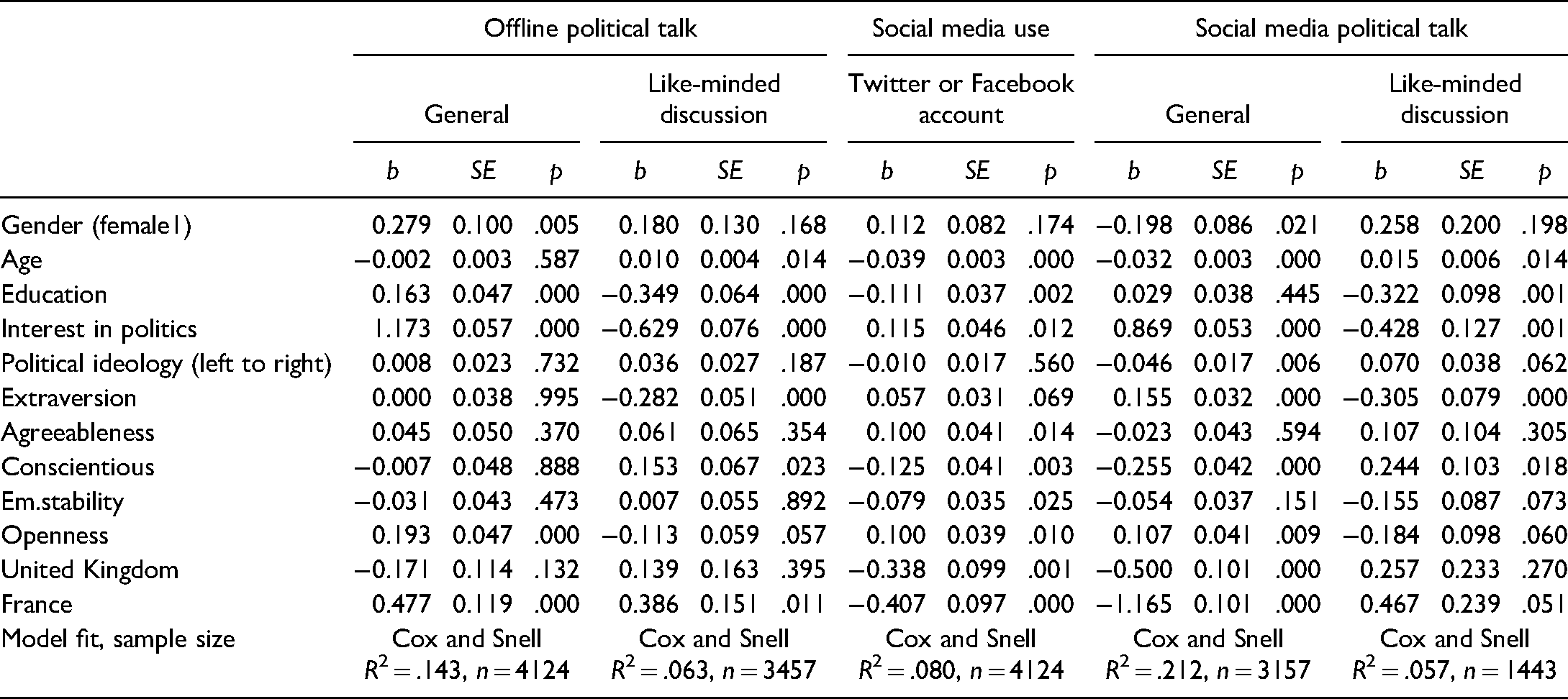
We do not find that left–right ideology relates to the likelihood of engaging in political talk or like-minded political talk in the offline environment but does influence talk on social media (Table 3). Those who identify as right-wing are, in general, less likely to discuss political issues on social media (Table 3). Ideology does not factor into the filtering process, because ideology does not influence social media use.
We also find age, education, and political interest predict patterns of political discussion. Older people are less likely to talk about politics on social media in general (Table 3) but are more likely to engage in like-minded discussion, both offline and on social media. Older people are also less likely to use social media. Those with higher levels of education are more likely to engage in political talk offline and less likely to engage in like-minded discussion both offline and on social media. Education does not influence the likelihood of talking politics on social media. Finally, political interest is strongly correlated with all forms of political discussion: those who are interested in politics are more likely to engage in political talk both offline and on social media and less likely to engage in like-minded discussion both offline and on social media. In sum, individuals who are older, less educated, introverted, and conscientious are more likely to find themselves in like-minded discussion, both online and on social media.
In the Methods section, we outlined some cross-national differences in the likelihood of engaging in different forms of political discussion. In the multivariate models, respondents from France are more likely to talk politics offline, including like-minded offline discussion, compared to respondents from the United States (Table 3). However, they are less likely to use social media and talk politics on social media compared to American respondents. Compared to the U.S. respondents, U.K. respondents are less likely to use social media, including for political talk.
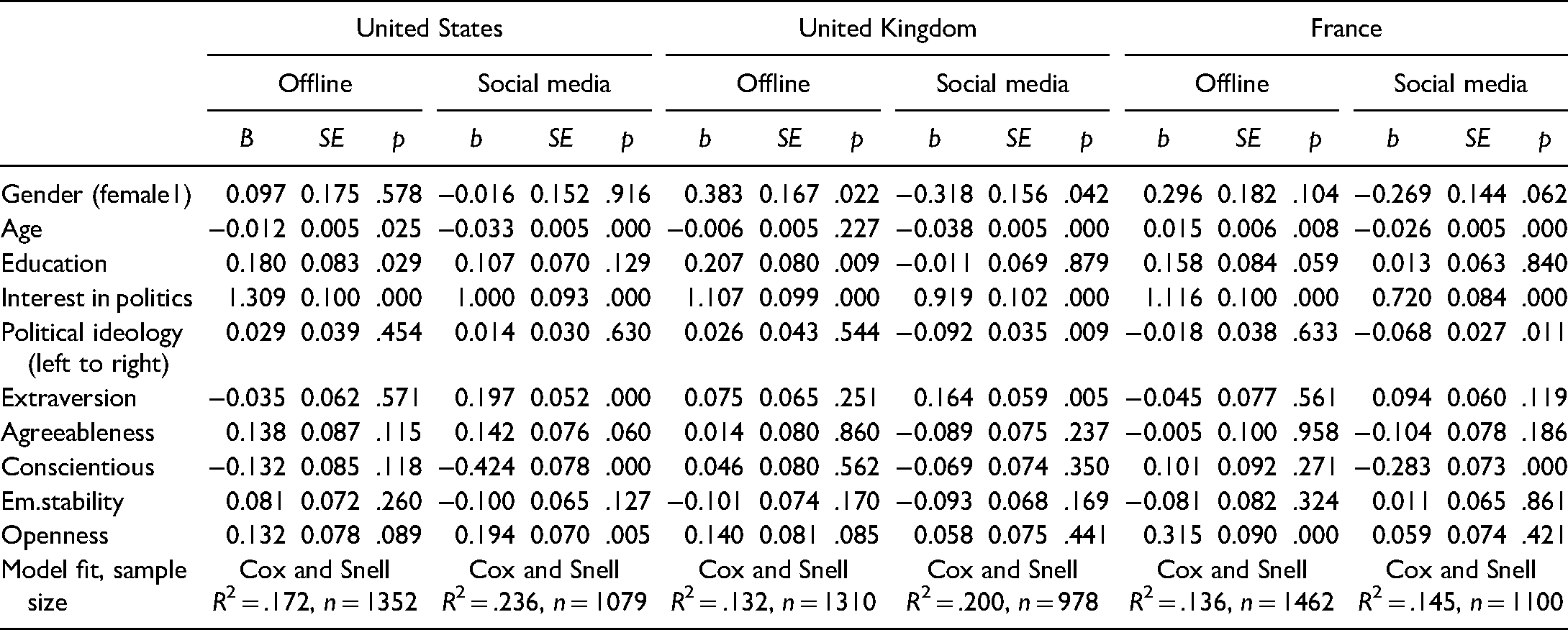
As for our final research question (RQ5), we examine country-specific results related to personality and political discussion hypotheses. In the pooled sample, we find that openness and extraversion correlate with political discussion. In the country-specific analysis, we find the strength of these relationships depends on the country and mode. However, overall, extraversion and openness increase the likelihood of engaging in political discussion (Table 4). In the pooled sample, we do not find that agreeableness is a predictor of political discussion. This pattern is replicated for the most part in the country-specific analysis. While conscientiousness is a predictor in the pooled sample, the relationships differ in the country-specific analysis but seem particularly relevant to social media-based discussion. As observed in the pooled sample, emotional stability is not a predictor of political discussion.
Logistic Regression of Political Talk (General) by Country.
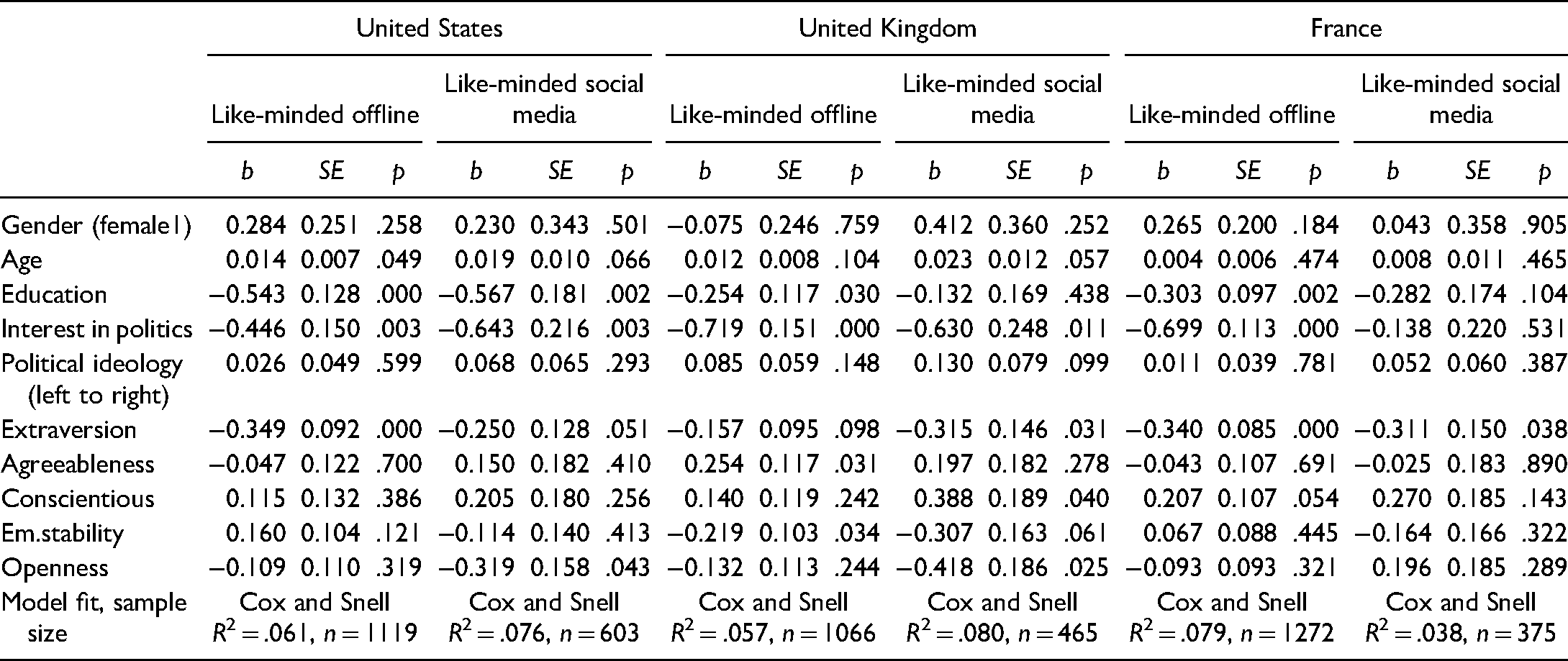
In the pooled sample, we find that extraversion correlates with both modes of like-minded discussion. In the country-specific analysis, we replicate the finding that extraversion decreases engagement in like-minded discussion, online and offline (Table 5). Openness decreases the likelihood of engaging in like-minded discussion on social media in the United States and the United Kingdom, but not in France. The results for France should be interpreted with some caution given the small sample size (n = 375). As for the other personality traits, they do not have consistent relationships with like-minded discussion in the different countries.
Logistic Regression of Like-minded Discussion Political Talk by Country.
Discussion
This paper examines how personality affects the filtering process related to political discussion. Personality impacts the propensity to discuss politics, use social media, and engage in like-minded discussion on social media. Several steps are required to understand like-minded discussion on social media: (1) consider the biases in who talks politics (81.57 percent of our pooled sample, as per Table 2), (2) consider the filtering of social media adoption (76.82 percent of our pooled sample), (3) consider the subset of people who talk politics on social media (43.99 percent of our pooled sample of social media users), and (4) consider the few people who engage in like-minded discussion (9.41 percent of a pooled sample of social media talkers). Approximately one in ten respondents engages in like-minded discussion; this incidence rate is consistent for offline and online forms. So we ask, what is the role of personality throughout this filtering process? This question is answered with our annotation of Figure 2.
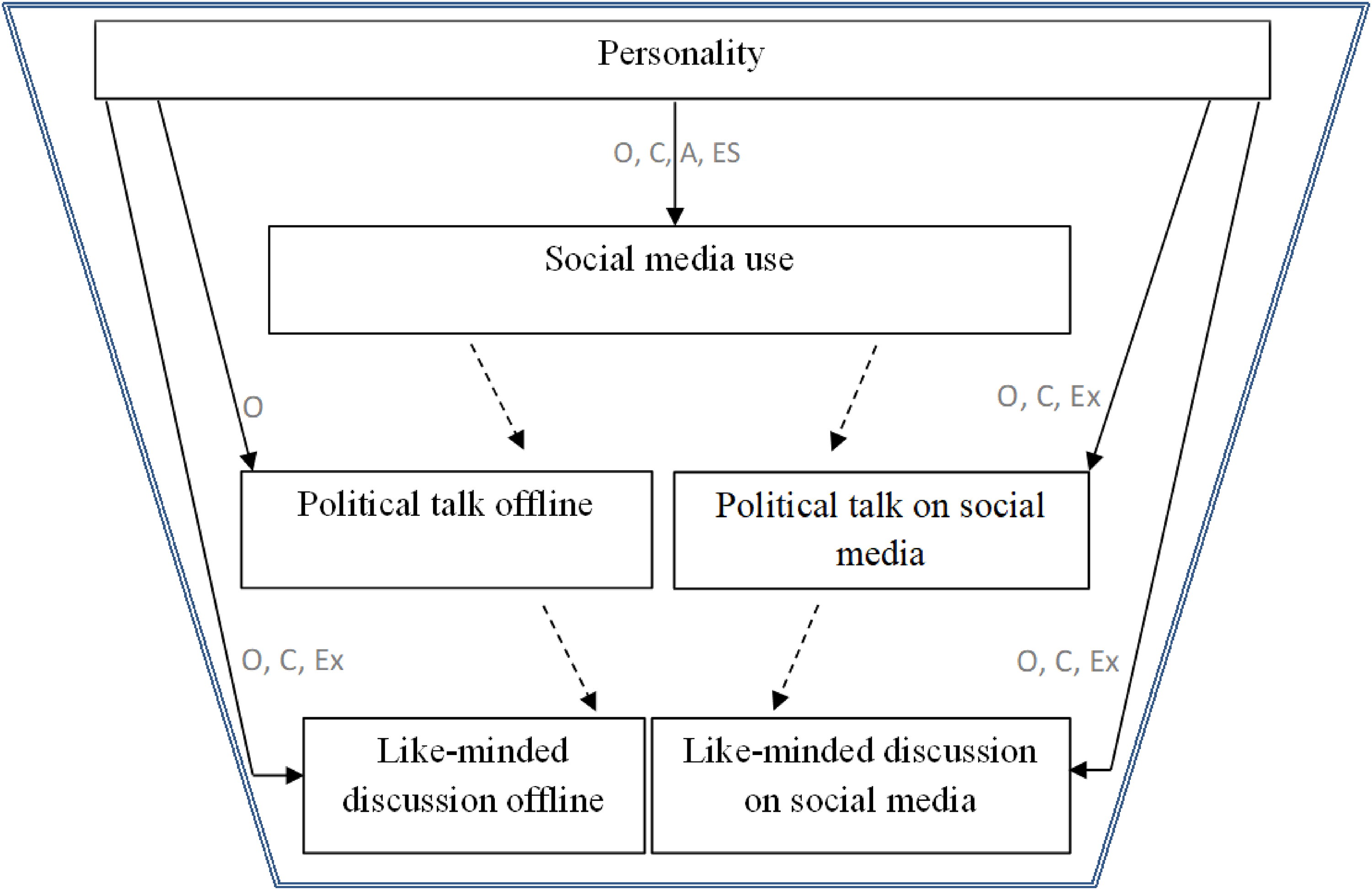
Summary of findings about personality and political discussion.
Openness impacts whether an individual talks politics online and offline and whether they use social media. The filtering process has three stages. In the first stage, people who are open-minded are more likely to talk politics (any mode). In the second stage, people who are open-minded adopt social media use. In the third stage, people who are open-minded are less likely to engage in like-minded discussion. The coefficient did not reach statistical significance at the p < .05 level. Openness has a stronger and more consistent impact than ideology. The existing literature (Table 1) features ten tests of the relationship between openness and political discussion. Of these, four tests for openness on political discussion are significant, which suggests a relationship but hardly offers conclusive results (Table 1). These other studies from the existing literature do not consider the mode of discussion and few consider personality and like-minded discussion. Yet, we offer consistent findings about the importance of openness using our pooled cross-national sample.
We find that extraversion is also important. As mentioned, the existing research features ten tests of the relationship between extraversion and political discussion of which five are significant (Table 1). Extraversion has mixed support related to political discussion in general; extraversion influences talk on social media, but not offline. However, extraversion is a strong and consistent predictor of like-minded discussion on social media and offline. In terms of understanding like-minded discussion on social media, extraversion seems to be the strongest and most consistent personality trait. We replicate this finding in the country-specific results.
Existing research (Table 1) suggests that agreeableness is important (four of ten tests are significant), yet the findings are not consistently positive or negative but rather highly divergent. In our study, agreeableness matters for social media adoption but does not offer direct effects on the likelihood of talking politics. However, as mentioned, assessing agreeableness poses challenges because this trait is strongly correlated with conscientiousness and extraversion (see prior literature review and Supplementary Information file). Correlation issues with these personality traits may pose a challenge when trying to determine their independent effects. We included all traits in our models to reflect existing research (Table 1).
Our paper distinguishes between offline discussion and online discussion through social media. Openness predicts both modes of discussion, suggesting the two modes might be combined into a single, hybrid discussion measure (Chadwick 2013). However, combining these modes would blur some important findings about social media and the role of personality in filtering social media-based discussion. In particular, extraversion and conscientiousness predict social media use, then social media-based discussion, then like-minded discussion on social media. The effects of these personality traits might disappear if the modes are combined into a single measure of political discussion as these measures do not have the same predictive value in relation to offline discussion (general). Also, age and political ideology predict online but not offline forms of discussion. Combining these modes would hide these ideological and age differences in patterns of participation. Age is a consistent predictor of online political discussion (Brundidge 2010; Evans and Ulbig 2012; Huber et al. 2019; Kim and Baek 2018; Stromer-Galley 2002). Finally, females are more likely to participate in offline political talk, but less likely to talk on social media (also see: Evans and Ulbig 2012; Huber et al. 2019; Stromer-Galley 2002). These gender differences would be missed in a combined measure of political discussion. All of these differences have implications with respect to the quality and representativeness of online discussion. We still have more research to do on this topic, given the low explained variance in our models as well as those models summarized in Table 1.
Like-minded discussion may have both positive and negative impacts. Mondak (2010: 115) explains that “conversations with like-minded others may offer reassurance and support, but such conversations do nothing to broaden the person's perspectives.” Discussions with people of differing viewpoints are expected to increase political tolerance (Nir 2017) and perhaps decrease attitude polarization (Grönlund et al. 2015; Mutz 2006). Personality shapes the propensity to engage in homogeneous discussion networks (Hibbing et al. 2011; Kim et al. 2013; Mondak et al. 2010). We have contributed to scholarship by testing the role of personality in an online discussion. Our findings suggest that like-minded discussion networks cannot be solely attributed to social media use. An individual's personality affects whether they use social media (Correa et al. 2010; Jenkins-Guarnieri et al. 2012; Ryan and Xenos 2011) and how they use social media. People who are introverted, close-minded, and conscientious will use social media to form discussion networks where their ideas will not be challenged. Indeed, when it comes to like-minded discussion, we find that personality matters more than political ideology.
As a final note, our data are limited to self-reports about political discussion—an issue that this field of research has addressed (Wojcieszak and Mutz 2009). We do not know if people truly abstain from political discussion, nor do we have an independently verified approach to measure the frequency of political discussion. Social media trace data would help to validate the estimates about frequency. However, social media data are limited for assessing like-minded discussion, as it is difficult to determine whether two discussion partners agree or disagree with each other's social media posts. For example, on Twitter, there is a “like” button but no “dislike” button. Facebook offers more nuances, albeit the “like” button is still the most popular response and does not suggest agreement so much as acknowledgment. Ideology is sometimes used as a proxy for this disagreement, but even ideological leanings are difficult to decipher in relation to the discussion of complex policy issues, such as immigration or the economy. Surveys are a valuable tool to supplement social media trace data as people can be asked about their agreement or disagreement with the topic. Future research should consider using a mixed-methods approach with a record of political discussion (such as social media trace data) as well as a survey of personality traits, policy positions, and reports about (dis)agreement. Our survey is an important contribution to the field, which has examined self-reports of offline discussion based on surveys or online discussion using social media trace data. We bridge these two modes but come to similar conclusions. Like-minded discussion is rare; personality, rather than ideology, predicts whether people engage in this form of political talk in online and offline modes.
Prior to proposing our research hypothesis and questions, we presented the findings of existing research. Research to date is based largely on American samples, yet international scholars have used the same theoretical claims for tests based on non-U.S. samples. Existing scholarship has not addressed whether we should expect cross-national differences in the relationship between personality and political discussion. As such, we proposed a research question, rather than a hypothesis. We find consistency in the importance of extraversion predicting like-minded discussion. Extraverts are less likely to engage in like-minded discussion. We replicate existing research about cross-national differences in political talk (Nir 2012; Vaccari and Valeriani 2018), but we offer new evidence about the importance of personality and perhaps culture in political discussion.
Supplemental Material
sj-docx-1-hij-10.1177_1940161221994096 - Supplemental material for The Role of Personality in Political Talk and Like-Minded Discussion
Supplemental material, sj-docx-1-hij-10.1177_1940161221994096 for The Role of Personality in Political Talk and Like-Minded Discussion by Shelley Boulianne and Karolina Koc-Michalska in The International Journal of Press/Politics
Footnotes
Acknowledgments
This project was funded by the Audencia Foundation and MacEwan University. The authors thank Bruce Bimber for his input on this project.
Declaration of Conflicting Interests
The authors declared no potential conflicts of interest with respect to the research, authorship, and/or publication of this article.
Funding
The authors received no financial support for the research, authorship, and/or publication of this article.
Supplemental Material
Supplemental material for this article is available online.

Author Biographies
References
Supplementary Material
Please find the following supplemental material available below.
For Open Access articles published under a Creative Commons License, all supplemental material carries the same license as the article it is associated with.
For non-Open Access articles published, all supplemental material carries a non-exclusive license, and permission requests for re-use of supplemental material or any part of supplemental material shall be sent directly to the copyright owner as specified in the copyright notice associated with the article.
