



Abstract
Democratic politics builds on both clear differences and shared common ground. While the rise of digital media may have enabled more differences to be articulated, common ground is often seen as threatened by fragmentation of political debate, which some see as driven by news media. The relative importance of political actors (parties and politicians) in driving fragmentation has received less attention. In this paper, we compare how news media and political actors contribute to the fragmentation of online political debate on the basis of analysis of almost half a million election-related tweets collected during the 2017 French, German, and U.K. national elections. We employ a structural topic model to reduce online political debate to networks of topic overlap. Across the three countries with different political and media systems, we find news media are by far the most important actors in terms of creating and maintaining a common space of online political debate on Twitter. Our results also show that political actors, with some variation from country to country, contribute more to fragmentation as they focus on different topics while articulating clear differences. These findings underline the importance of complementing structural analysis of the rise of digital and social media with analysis of how important elite actors like news media and political parties/candidates use these media in different ways. Overall, we show how at least on Twitter, across three different countries with different media systems and political systems, news media create connection that contributes to commonality while political actors lay out clear differences that drive fragmentation.
Keywords
Introduction
Democratic politics builds on both clear differences and shared common ground. Deliberative democrats have often stressed the importance of consensus, commonality, and shared institutions, even as others have underlined that political debate also requires what Mill (2002) called “the rough process of a struggle among combatants fighting under hostile banners.” In high-income democracies, different institutions have to various degrees contributed to both sides of this. Katz (1996) has highlighted how twentieth-century mass media often played an integrative role, as an institution that “gathers together” the public by providing a form of shared common ground, while Rosenblum (2008) argues political actors have played a similarly important, indeed constitutive, role in democratic politics by drawing up “politically relevant lines of division” that create clear differences and provide citizens with choices on the big important issues of the day, thus “staging the battle” and animating political debate.
The rise of digital media may have enabled more differences to be articulated and common ground is often seen as threatened by fragmentation of political debate (Mutz and Young 2011). Some see these changes as driven by how news media operate and compete for attention, sometimes in part by trying to attract partisan audiences in a more competitive situation (Katz 1996). The continual move from a relatively low-choice to a much more high-choice media environment exacerbates these concerns (Carpini and Keeter 1997), as does the growing role of social media (Newman et al. 2020). In an increasingly digital, mobile, and platform-dominated media environment, researchers have found that news media cannot always provide the “core” they offered in the past (Moeller et al. 2016). As a result, some suggest that the so-called “social glue” (Sunstein 2001) is disintegrating and democratic societies risk fragmenting to a degree where they lose the ability to build consensus on the basis of shared political debate.
The relative importance of political actors (parties and politicians) in driving fragmentation of political debate, however, has received less attention than the role of news media. This is despite of there have been a growing number of calls for more comparative and systematic investigation on how different kinds of actors shape online political debate (Jungherr et al. 2019). In this paper, we respond to that call and analyze the relative importance of, respectively, news media and political actors in contributing to the fragmentation of political debate. As we will see below, the term fragmentation has been deployed in the literature in many ways, but in this study, we use fragmentation to refer to the extent to which news media and politicians lead people's attention to the same set of issues. The basis of our analysis is election-related tweets collected during the 2017 French, German, and U.K. national elections. We employ a recently developed variety of probabilistic topic models—referred to as a structural topic model or STM (Roberts et al. 2014; Roberts et al. 2016)—to reduce almost half a million tweets to networks of topic overlap. These networks map the topic space in each country, that is, the structure of online political debate involving news media, parties, and politicians, and help us understand their relationship through the topics they touched upon. Then, we look at which topics are emphasized by political actors with different ideological leanings (i.e., leftists versus rightists) and by different media types (i.e., tabloids, digital-born, legacy, and public service). We follow by employing a percolation process to assess the level of fragmentation of said networks for each country. Finally, we examine the role that media outlets, politicians, and political parties played in fragmenting the electoral debate through a series of simulations, where we measure the fragmentation of the networks when any of them are excluded.
Across the three countries with different political and media systems, we find news media are the most important actors in terms of creating and maintaining a common space of online political debate, and that political actors, with some variation from country to country, contribute more to fragmentation. These substantially important findings suggest that debates over the fragmentation of the online political domain often misunderstand the actual role of news media, in large part because they ignore the role played by political actors. News media clearly no longer perform the twentieth-century role imagined by Katz in a very different twenty-first-century media environment. Where political actors lay out clear differences that drive fragmentation, news media create connections that help maintain some element of commonality. Our findings thus underline the importance of complementing the structural analysis of the rise of digital and social media with analysis of how important elite actors like news outlets and political parties/candidates use these media in different ways, an empirical contribution illustrating the important theoretical point made by Jungherr et al. (2019).
Methodologically, our contribution is demonstrating how STM can add to the analysis of political fragmentation in the online domain. STM has been increasingly used within the field of political communication (Nicholls and Culpepper 2020; Puschmann et al. 2020). We show how STM can be applied, in combination with tools borrowed from network science, to investigate topic overlaps between media outlets and political actors and thereby assess the levels of political fragmentation in the online domain.
Our research design allows us to draw conclusions about both the generalizability and context dependency of our findings. We investigate the same type of event in different settings. By focusing on highly contested elections in a retrospective manner, we take advantage of the ideological variance between political actors and media outlets and relate observed differences to the electoral and national contexts in which they emerged and provide a comparative perspective that is absent in most studies on political and media fragmentation (among the exception being [Bright 2018; Fletcher and Nielsen 2017; Majo-Vazquez et al. 2018]).
In the remainder of the paper, we proceed as follows. We first review the literature on political fragmentation and highlight how this concept's operationalization and measurement still remain elusive. Then, we describe our data and methods and finally, present the main results of our analyses. We conclude by discussing the importance of our findings for an increasingly digital, mobile, and platform-dominated media environment.
Literature Review
While democratic politics builds on both clear differences and shared common ground, recent developments have led to considerable scholar focus on how differences can grow to a state where they undermine common ground and lead to a level of fragmentation that can have negative effects on citizens’ involvement in political debate and societies’ ability to maintain a sense of shared public concerns (Katz 1996). Fragmentation is in part related to limited exposure to diverse perspectives, something that can have negative effects on forming opinions and appreciating other perspectives (Mutz and Martin 2001). Hence, fragmentation is often seen as a threat to social cohesion and something that amplifies political polarization (Castro-Herrero et al. 2018; Chaffee and Metzger 2001; Nir 2012).
Concerns over fragmentation have been further fueled by the rise of digital media and social media, where political debate is often far more antagonistic and divided than the subset of political debate mediated by mass media like television used to be. While there is a growing body of work on online political fragmentation, however, there is still no consensus on definitions, operationalizations, and measurements, and thus no consensus on the scale and scope of online fragmentation.
The empirical work looking at the role of mass media in driving political fragmentation is relevant for our purposes here. This strand of research has highlighted the importance of media's ability to transfer the salience of small preselected current issues to the public agenda. By setting the public agenda and therefore, by influencing the policy issues that citizens care about (McCombs and Shaw 1972), media shape their priorities and facilitate a common space for public debate. However, the “end of mass communication” (Chaffee and Metzger 2001) has questioned the gatekeeping role of the news media and ultimately, their agenda-setting function and the rise of new gatekeepers, including widely used platforms such as Facebook, Google, and Twitter (Nielsen 2016; Singer 2014). This has led to equate the multiplication of media sources to the increase in political fragmentation. Despite the evidence being still contentious in this regard (Cardenal et al. 2019; Gilardi et al. 2020; Langer and Gruber 2021; Valenzuela et al. 2017), there is agreement on that in the current “hybrid media system” (Chadwick 2013), how topics get at the center of public attention and hence, who has the power to amplify them has to be revisited.
Some other relevant approaches to the study of fragmentation include research looking at the extent to which different types of outlets set the media agenda (Lee 2007; McCombs 2005); studies of how audiences navigate the online news domain as compared to the offline domain or across platforms and devices (Majo-Vazquez et al. 2018; Webster and Ksiazek 2012; Yang et al. 2020); work on how frequently citizens with different ideological leanings exchange information on political events in social platforms (Barberá et al. 2015; Rivero 2019); and on the degree to which news use via social media leads people's attention and concerns to policy issues channeled by mainstream media (Feezell 2018; McCombs and Zhu 1995; Moeller et al. 2016). Yet, because the evidence yielded by these studies is mixed and more importantly, they do not look at the comparative role of news media relative to political actors, it is difficult to form expectations about the so-called “discursive power” of these actors in the online domain and compare their ability to lay the ground for public discussion (Jungherr et al. 2019).
With a few notable exceptions mentioned above, most of these studies looking at political fragmentation from different angles do not offer cross-country evidence either, which further complicates generalizations about how fragmentation is developing in different contexts, many of whom are seeing broadly similar moves toward a more digital, mobile, and platform-dominated media environment (Newman et al. 2020) but differ in other important ways, including their media systems (Hallin and Mancini 2004) and political systems (Lijphart 1968).
Precisely because of the lack of previous research, there has been a call to systematically study the relationships and interdependencies among those who contribute to “introduce, amplify, and maintain topics,” in the current political communication space (Jungherr et al. 2019: 411). As Jungherr et al. (2019) argue, the extent to which news media organizations, and also parties and political elites are able to introduce topics in the public agenda is an indicator of their discursive power and ability to shape political discourse that ultimately determine citizens’ political preferences and vote decisions. These arguments, just like the work of Chadwick (2013), warn against the tendency to analyze different actors in relative isolation, but empirical analyses still often focus on either news media or political actors, and rarely on both.
Political actors have flocked to social media platforms, where they in some ways compete directly with news media for users’ time and attention. Parties and candidates across the ideological spectrum use social media platforms to distribute campaign messages and calls to actions among other various activities (Jungherr 2016). They have embraced social media in a manner that has led some to argue that news media’s power over politics is broken (Margetts 2017) because the former can circumvent media editorial gatekeepers by relying on platforms (where they in turn encounter both algorithmic and user-driven forms of gatekeeping).
Undoubtably, social media platforms have changed the field for political information distribution between media and political actors. To the same extent that established media are losing their importance, the traditional way in which political debates were conducted in Western democracies is also being challenged. Traditionally, the mass media have been ascribed the function of providing shared knowledge on the basis of common topics, which served—at least in theory—citizens as a basis for mutual discussion and understanding as well as for a shared conception of social reality (Vlasic 2004). As political actors gain discursive power through the rise of the platforms (Nielsen and Vaccari 2013), they are able to base their approach to topics even more strongly on election success and use agenda setting, priming, and framing purely strategically, also by means of de-thematization, counter-framing, and attacking opponents (Strömbäck and Esser 2017).
How media and political actors deal with topics today reveals a lot about the state of political debates in Western democracies. Yet, based on the reviewed literature, we cannot have clear expectations on how they do that; therefore, we explore this using the following research question (RQ).
RQ: How do media, politicians, and political parties contribute to the fragmentation of the electoral debate on social media?
Data and Methods
To address our research question, we traced the topic space that emerged among news media and political actors in the national elections in France, the United Kingdom, and Germany in 2017 by using Twitter data collected between April 2, 2017 and May 8, 2017 in France, August 21, 2017 and September 25, 2017 in Germany, and May 5, 2017 to June 9, 2017 in the United Kingdom. We used the Twitter Streaming Application Programming Interface (API) to collect all tweets sent by news media and political actors that touched on the country elections. The final samples are Germany N = 83,261, the United Kingdom N = 257,718, and France N = 154,362. 1
As previous research has argued, Twitter data provide two main advantages to address the questions at hand (Barberá et al. 2019). First, we use the same source of data to measure the level of fragmentation in media and political discourses and the relationship among them and second, the high granularity of the data, hardly found on other types of text content, for example, news pieces or congress interventions, allows us to account for the high volatility of political debate during election campaigns.
We defined our sample of news media outlets based on their overall audience reach according to the Comscore audience meter. We obtained the ranking of the most visited news sites with at least a percentage reach of 0.03 percent averaged over the last 3 months before the elections in each country. This threshold allowed us to included not only large legacy media outlets but also local ones. 2 We strategically added recently founded news sites that were not indexed in Comscore yet. This is the case of Brut (France) or popular news sites that fall at the extremes of the ideological spectrum (Égalité and Récontiliation or Fdesouche). In total, we studied ninety-eight outlets and eleven presidential candidates and their parties in France; 160 and nine in Germany; and 129 and thirteen, respectively, in the United Kingdom. For each country, only the leading candidates of each party, who concurred to the elections are included in the analysis.
To reduce the corpus space of the election conversations in each country to a set of relevant topics, we apply STM (Roberts et al. 2014, 2016). 3 Topics are directly derived from tweets by probabilistic algorithms and rely on the notion that words co-occurring in and across tweets describe meaningful themes (or topics). The more often words co-occur in documents (i.e., tweets), the higher the probability that they constitute a topic. All words are thereby assigned to all topics in each country election, but dependent on their context with different association strength.
Although still limited, the application of STM in political communication studies has recently seen an increasing popularity. For instance, Nicholls and Culpepper (2020) show how STM performs to identify frames based upon the content of articles. Also, Puschmann et al. (2020) use STM to study the evolving agendas of right-wing movements and parties on Facebook.
Compared to standard topic models (Jordan and Mitchell 2015), STM allows improving the estimation of topics by using document metadata as covariates 4 . STM does not assume that the distribution of words is the same for all documents, but words in documents with the same covariates (e.g., year, source, etc.) have a higher likelihood to be clustered together and used to form a topic. It has been shown that the inclusion of covariates improves the quality of topic selection substantially (Roberts et al. 2014, 2016), and including the date of documents in a topic, estimations are especially useful for time periods and changing discourses (Farrell and Drezner 2008). In our model, we use the day of each tweet as a covariate to account for the volatility of the tweeting activity of each actor during the campaign. The day of each tweet has been used in previous research to discriminate issue frequencies in tweets during electoral campaigns (Conway et al. 2015).
The improvements of STM notwithstanding, it remains a central task for researchers to decide whether the derived topics are meaningful or whether one is “reading tea leaves” (Chang et al. 2009). After carefully selecting quantitative metrics and qualitative judgment our choice for the number of topics is seventy for the United Kingdom and France, and ninety for Germany. We elaborate in detail on those choices in Appendix I.
Once the topics are inferred, we construct topic overlap networks between actors (Shugars 2019; Yang and González-Bailón 2017). To build them, we calculate for each actor its use of topics or topic load, that is, on which topic they score high or low. This results in an N (number of actors) * M (number of topics) matrix, from which we can derive a correlation matrix by actors. The resulting networks are composed of nodes representing the actors and ties measuring the relationship among them based on correlations of topic distributions. Thus, these networks measure the extent to which media, parties, and politicians share the same topics of interest. The more frequently they talk about similar topics, the more closely connected they are in the network as measured by the strength of their ties.
We then assess the number of communities that exist in each network by running a community analysis (Girvan and Newman 2002; Newman 2012), which is a technique for the reduction of networks that classifies nodes into modules according to the density of connections: nodes in the same module, that is, a subgroup have denser connections among each other than with nodes in other modules. We can interpret that media, parties, and politicians classified in the same subgroup converge on topics they amplify for online debate. Finally, and more importantly, we use a fragmentation measure as defined by Borgatti (2006) to identify the most important actors to ensure the information flowing in the network structure. In our case, this analysis detects the type of actors having more common interests with most other actors in the same network.
Results
Topic Ownership
We first describe the topic ownership of different types of news media outlets (digital-born, legacy media, 5 tabloids, and public service broadcasters) and political actors (parties and candidates). This analysis allows us to measure the extent that the actors converged in tweeting about the same most popular topics. Then, we proceed to test the fragmentation of the political debate in each country by running a community analysis and applying a network percolation technique to the networks of topic overlap. Finally, we assess the role of media outlets relative to political actors, in fragmenting the political debate.
In our first analysis, that is, topic ownership, we look also at the differences across the ideological spectrum. We measure topic ownership by calculating the relative frequency of topic usage based on how often a topic has the highest loading per day by actor. We find that most often one topic is dominating a day's tweets of an actor. We aggregate the results at the actor type level and show the most popular topics per actor type in Figure 1.
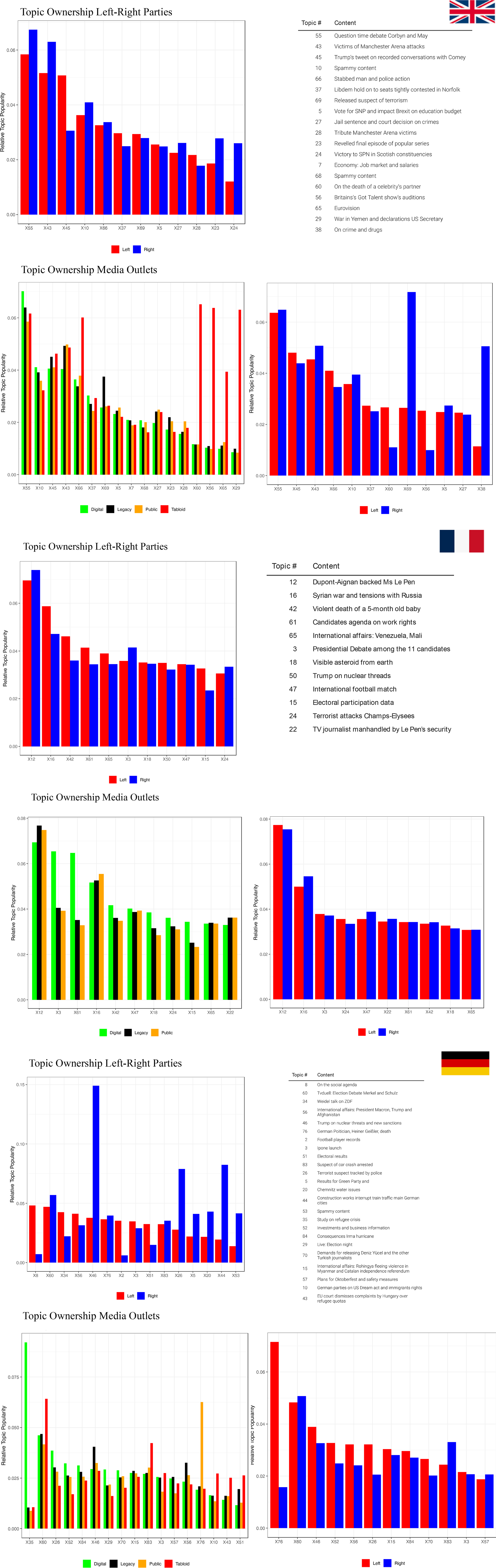
Topic ownership analysis by country.
To proxy the ideological leaning of news media outlets, we rely on data from the Digital News Report (Newman et al. 2017) and average the self-reported left–right self-placement of the audience of each outlet (7-point scale). Higher values of this variable indicate a more right-wing outlet (for similar approaches see Gentzkow and Shapiro 2011). To infer the ideological position of political parties and candidates we use data from the Manifesto Project Database (MPD) 2017 6 (Volkens et al. 2017), which provides a left–right placement for parties based on the content analysis of the party programs. Previous research comparing this classification approach to others based, for instance, on expert assessments, shows the robustness of the categorization method (see, for instance, Castro-Herrero et al. 2016) 7 . Using the MPD data, we classify all the parties except for the Alliance Party of Northern Ireland. For this, we calculated the average ideological leaning of its voters by relying on data from the European Social Survey (ESS), 2016. Comparisons between measures built with the MDP and the ESS database show strong and significant Spearman's ρ coefficients (ρ = 0.826, N = 22).
Figure 1 shows the result of the topic ownership analysis for the United Kingdom, France, and Germany. The y-axis depicts the importance of a topic for each type of actor. To measure it, we calculate the percentage of tweets on a specific topic out of all the tweets in a single day by actor. For example, looking at the United Kingdom, we see that about 6 percent of all tweets by the left-wing parties on a single day were, on average, dedicated to the main debate between the British candidates. Figure 1 depicts only the topics with the top percentages (x-axis).
Across countries, results show that public discourse in France converged on a narrower set of topics whereas, in Germany, there was a wider range of topics discussed. This may in part reflect different political systems, one centralized and presidential, the other federal and multiparty. Looking at differences within each country and focusing on the political topics, we see that in the U.K. legacy media as well as political actors and media outlets on the right side of the ideological spectrum gave more importance to home security issues. In France, political actors and media converge on most of the most tweeted topics. Among the few exceptions is the coverage of the international agenda, which received more attention by the left-wing parties in comparison to the right-wing counterparts. Finally, results for Germany show there was less agreement on the topmost salient topics during the campaign. Notably, right-wing parties talked more frequently about key infrastructures and the nuclear threads by the U.S. President.
Networks of Topic Overlap
To measure the extent to which actors converge on all topics discussed—beyond the most popular ones, which we analyzed above—, we build a network of topic overlap for each country. For this, we rely on distribution of topic use per individual actor and correlate this distribution, that is, a vector of topic usage, to other actors’ topic distributions. If, for example, Media A is highly correlated to Party A, both parties will have high loads on Topic 1, and low loads on Topic 2 and similarly with any other pair of actors in the network.
Based on these correlations, we measure the relationship between individual news media, parties, and politicians through the topics they simultaneously amplified. The networks shown in Figure 2 represent these relations. There, the ties measure the extent that two actors are connected by a common interest in the same topics. The nodes in these networks represent all media outlets, parties, and politicians. They are sized in proportion to their betweenness centrality. In network theory, betweenness centrality measures the extent that a node plays a role as a bridge among the other nodes in the network (Newman 2010). Nodes with higher betweenness centrality lie on the shortest path between other nodes and connect parts of the network that would be unconnected otherwise. This means that the biggest nodes represent actors connecting other actors from separate communities, which would remain otherwise unrelated. In our case, these nodes operate as hubs from where most of the electoral topics, discussed elsewhere, are amplified for public discussion.
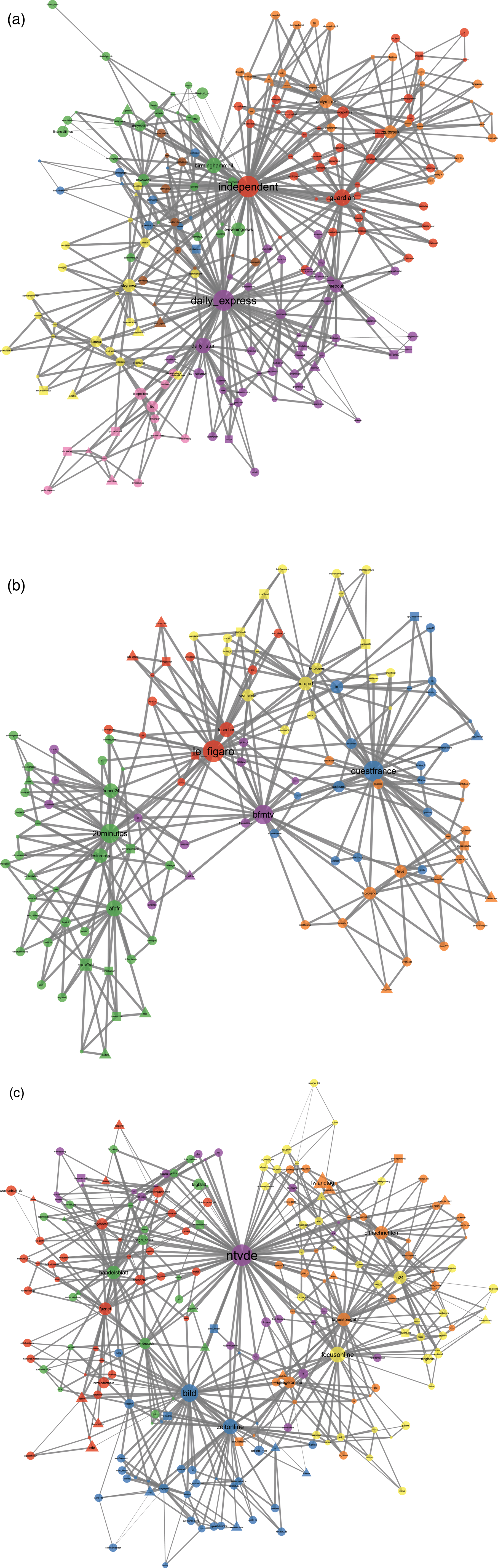
Networks of topic overlap of (a) the United Kingdom, (b) France, and (c) Germany. Note: Round nodes represent media outlets, squared nodes represent politicians, and triangles represent parties. To improve visualization, the networks have been constructed using the planar maximally filtered graph (PMFG) approach (Tumminello et al. 2005).
In the networks below, the color of the nodes represents actors belonging to the same group amplifying similar topics for discussion. 8 We have grouped the actors by running a community analysis, 9 which allows us to detect the extent that the network is organized around subgroups and which actors are more closely connected by converging on pushing similar topics in the public debate.
A visual inspection of the network maps shows a pattern that persists across the three countries. The biggest nodes, those with higher betweenness centrality scores, represent media outlets, mainly up-market newspapers, regional outlets, and tabloids, emphasizing the central role of legacy media in front digital-born outlets, as previous research has shown (Majó-Vázquez et al. 2020; Majo-Vazquez et al. 2018) (see the full ranking in Table A1, Appendix III). 10 This supports the visual intuition that while political actors focus on very different topics, driving debate toward fragmentation, many news media connect different topics across different communities, contributing to commonality.
Fragmentation Analysis
Table 1 shows the results of the modularity analysis of the topic overlap networks. This analysis returns a score ranging from 0 to 1; values closer to 1 indicate that the modularity of the network is considered to be stronger (Newman and Girvan 2004), which is a proxy to measure the level of fragmentation of the structure into subgroups. Our results consistently show that, independently of the community algorithm used, France is the less fragmented topic space relative to the United Kingdom and Germany. While this may reflect a more centralized and presidential politics in France, in contrast to a multiparty political system and a more regional media system in the United Kingdom and Germany, modularity scores are similar. To further test the level of fragmentation of the networks, we apply a network percolation technique (Borge-Holthoefer and Gonzalez-Bailon 2015). This method relies on the intuition that networks with higher levels of fragmentation break up quicker when the most central nodes are removed. We gradually remove the core nodes of each network and measure their degree of fragmentation at each step. Thus, this approach does not rest on subgroups (as the modularity approach does) but on the removal of singular nodes. We use different strategies to remove nodes, but they all follow the same idea: ranking nodes according to different measures of centrality, that is, degree, betweenness, and neighbor and remove the most central ones.
Community Analysis Results.
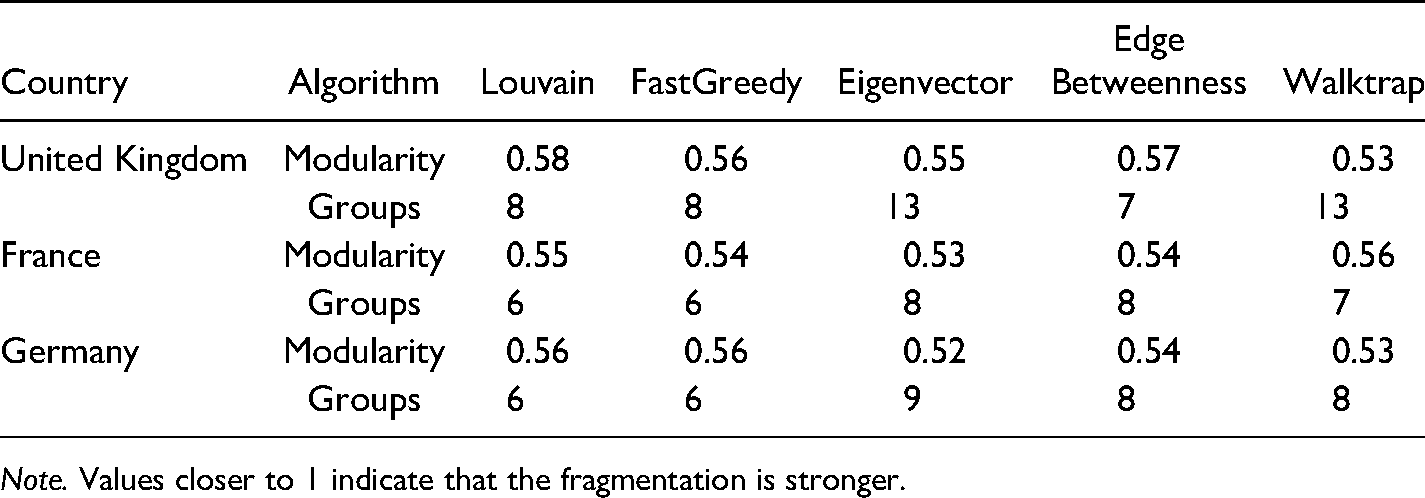
Note. Values closer to 1 indicate that the fragmentation is stronger.
Figure 3 shows the results of the percolation process and confirms the most resilient network corresponds to France. This is the network that kept showing lower levels of fragmentation for a longer time when removing its most central nodes. In our case, this result can be interpreted as a higher level of convergence among all actors on the topics discussed during the elections and hence, a less fragmented political debate that does not rely on a few bridging actors. On the opposite side, Germany shows a lower resilience to the percolation process and therefore, higher levels of fragmentation after the most central nodes are removed. This result signals the fragility of the network structure in Germany (at least at the national level) and that, in this country, there is a lower level convergence on topics discussed. Again, this might reflect a more regional political and media system. The United Kingdom with mostly London-based, yet diverse media, and two main parties in England, lies close to the German case as in the previous results.
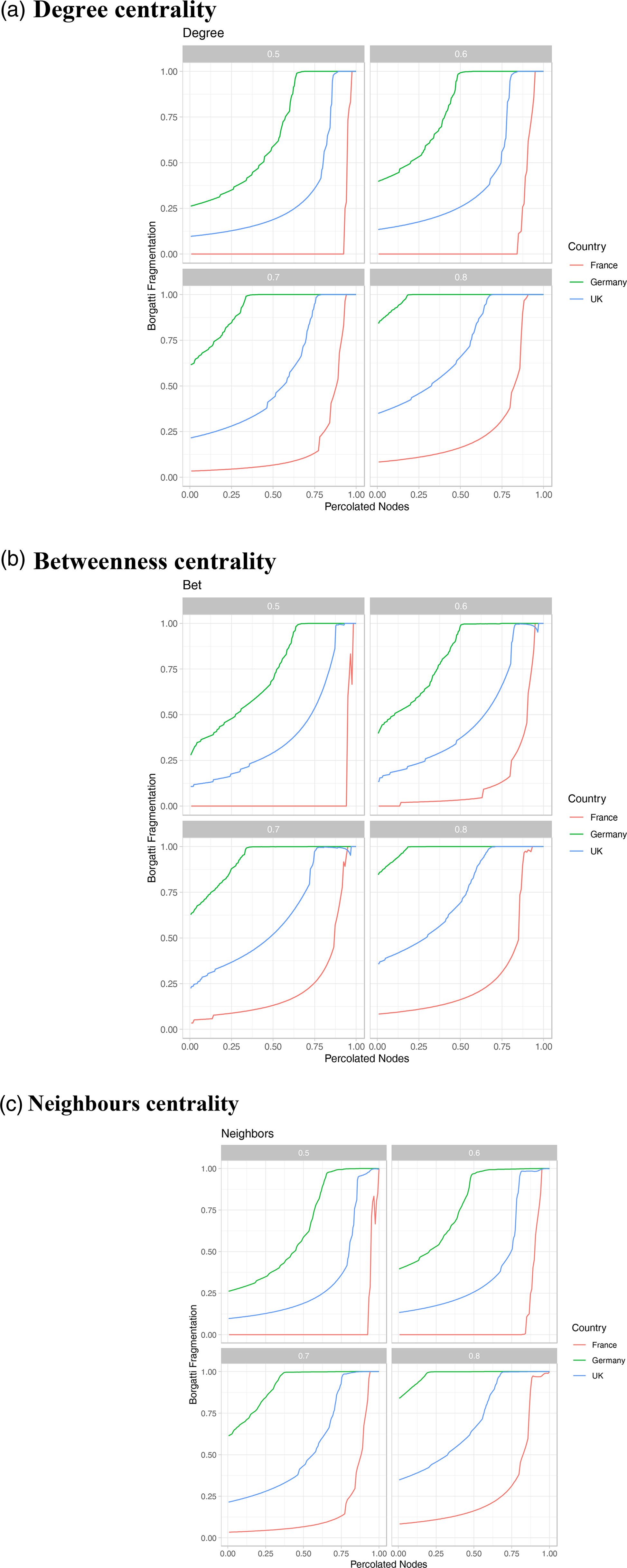
Network percolation analysis: (a) degree centrality, (b) betweenness centrality, and (c) neighbors centrality. Note: The x-axis measures the percentage of nodes removed. The y-axis measures the level of fragmentation as indicated by Borgatti’s (2006) fragmentation score. The higher the F-score, the higher the network's fragmentation. The graphs show the same analyses with four instances of the same network with different levels of thresholds for ties. Degree centrality identifies the most central actors as measured by the highest number of connections. The actors with higher betweenness centrality lie on most of the shortest paths between other actors. Neighbors select nodes with the highest degree, that is, closest neighbors, connected to randomly selected nodes of the network (Chami et al. 2017). For the latter, the average fragmentation of fifty simulations is used.
Finally, to reveal the differences between the role of media, parties, and politicians in fragmenting the networks, we first measure the fragmentation of the network if media nodes are excluded. Then, we calculate the difference between those scores and the fragmentation when parties and politicians are removed from the network. Figure 4 shows the results with four instances of the same network at different levels ties thresholded. For Germany and the United Kingdom, removing parties and politicians from the networks, in almost all instances, results in a less fragmented network than when news media outlets are removed. However, the case of France is again different. In this country, differences only arise at the highest level of ties thresholding. Then, political actors would fragment only slightly more the network than media outlets. We have reproduced the same analyses with a higher and lower number of nodes removed yielding similar results for all countries (see Figure A4 in Appendix II).
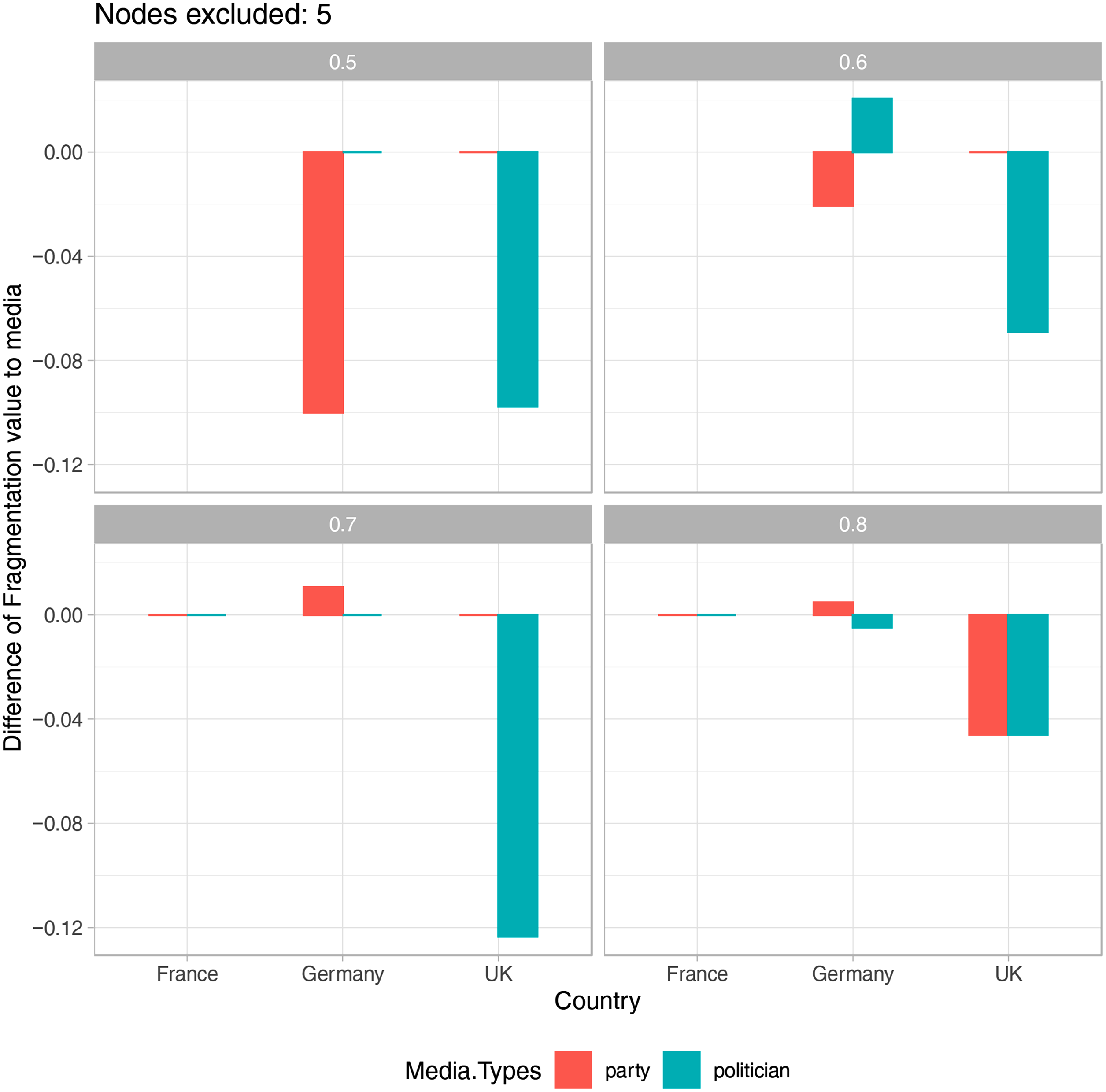
Relative fragmentation analysis. Note: The y-axis measures the difference in fragmentation values when parties and politicians are removed from the network with respect to the values obtained when media outlets are removed.
Conclusion and Discussion
Across the three countries, we find the news media are the most important actors to create a common public space for discussion on Twitter. Among them, legacy media but also a few important broadcasters occupy relevant positions to bring together the diverse topics in political debate generated in different parts of the online domain.
There is still much to know about the relative importance of different actors in driving the fragmentation of online political debate, but our study has advanced our knowledge of these mechanisms by showing how, at least on Twitter, across three different countries with different media systems and political systems, news media create a connection that contributes to commonality while political actors lay out clear differences that drive fragmentation.
We hope that further research will build on the approach we have developed and deployed here by examining whether our findings hold up (a) across different national contexts and (b) on different platforms. First, France, Germany, and the United Kingdom have different media systems and different political systems, and in that sense, the overall similarities in our findings are important grounds for hypothesizing that they might be generalizable to other settings, but clearly, media systems and political systems elsewhere may mean that news media and political actors operate differently from those we have studied here. Second, our analysis while cross-nationally comparative and including both news media and political actors is limited to Twitter, an important platform for political debate, but structurally distinct and far less widely used than larger competitors such as Facebook, just as it is a platform with different affordances and a different user base than newer entrants like SnapChat or TikTok. While it is possible that the dynamics we identify here recur across different platforms, this is an empirical question. Different platforms are structurally different in their affordances, algorithmic systems, and content moderation practices, just as their user base often differs, and only empirical research can establish whether the dynamics identified here are general across platforms or specific to Twitter. Methodologically, we hope that such future studies of more countries and more platforms will build on the approach developed here where we have provided a way to measure online political fragmentation, which can be directly transferred to other media and political contexts using also alternative sources of text data.
We also hope the substantial findings can inform thinking around the current state and likely future direction of democratic politics. As noted from the outset, democracy arguably builds on both differences and commonality, but in light of growing concern that fragmentation may be reaching dangerous levels, and the fact that some blame news media for this, it is important to recognize the different role played by news media versus political actors. As we have shown, independently of the thresholds and selection strategy applied, at least on Twitter and in these three countries, news media are the most important actors in terms of maintaining networks of topic overlap and countering fragmentation.
Our study provides several starting points and building blocks for future theory building. First, our findings suggest that the currently dominant media- and audience-centered approach of fragmentation research should be rapidly complemented by a political actor-centered approach. In many processes of political communication, political actors have a causal function (Van Aelst et al. 2017: 3–4), and this function must now also be more strongly recognized in fragmentation research. Second, the growing importance of social platform media has not yet led to the elimination of the integration function of traditional mass media, and this integration function focused traditionally mainly on providing common topics. The mass media in the countries studied here continue to contribute, with their topic choices, to the networking of knowledge resources that can help members of the respective societies to reach an understanding. Ultimately, according to Katz (1996), this role of the media counteracts the disintegration of the public sphere, since common topics can offer citizens orientation as well as “common ground” for talking about politics with others. To what extent these processes take place under the new communication conditions should be explored in more detail and more countries in follow-up studies. Likewise, our third finding, the higher level of topic fragmentation in Germany, deserves more attention. So far, findings from Germany indicate that it is precisely the traditional mass media that ensure that the compatibility of topics is maintained and relationships among users are enhanced (Geiss et al. 2018).
Finally, the normative evaluation of higher and lower thematic fragmentation is not easy. One person's worrying about “cyberbalkanization” can be another's long overdue cyber-independence, one person's comfortably binding “social glue” can be another's unwelcome and stifling status quo. What we have tried to do here is not to pass judgment on whether the online political debate is excessively fragmented, but to understand the relative importance and different roles of news media and political actors in shaping the online political debate we actually have, and our findings suggest we should not blame news media for fragmentation.
Supplemental Material
sj-docx-1-hij-10.1177_19401612211015122 - Supplemental material for Do Not Blame the Media! The Role of Politicians and Parties in Fragmenting Online Political Debate
Supplemental material, sj-docx-1-hij-10.1177_19401612211015122 for Do Not Blame the Media! The Role of Politicians and Parties in Fragmenting Online Political Debate by Raphael Heiberger, Silvia Majó-Vázquez, Laia Castro Herrero, Rasmus K. Nielsen and Frank Esser in The International Journal of Press/Politics
Footnotes
Appendix I
Appendix II
Appendix III
See Table A1 and Figure A5.
Acknowledgments
The authors would like to thank Mariluz Congosto for her valuable help to process the data for this study. They would like to thank Felix Simon for his collaboration as a Research Assistant. They are also grateful for the helpful comments of the Research Team of the Reuters Institute for the Study of Journalism and the insightful comments of several anonymous reviewers.
Declaration of Conflicting Interests
The author(s) declared no potential conflicts of interest with respect to the research, authorship, and/or publication of this article.
Funding
The author(s) disclosed receipt of the following financial support for the research, authorship, and/or publication of this article: This work was supported by Google (grant no. Google Digital News Initiative).

Supplemental Material
Supplemental material for this article is available online.
Notes
Author Biographies
References
Supplementary Material
Please find the following supplemental material available below.
For Open Access articles published under a Creative Commons License, all supplemental material carries the same license as the article it is associated with.
For non-Open Access articles published, all supplemental material carries a non-exclusive license, and permission requests for re-use of supplemental material or any part of supplemental material shall be sent directly to the copyright owner as specified in the copyright notice associated with the article.
