




Abstract
Despite great volume of research into press–state relations, we know little about how journalists use information that has been generated through independent bureaucratic processes. The present study addresses this gap by investigating the role of freedom of information (FOI) laws in journalism practice. By surveying journalists (n = 164), interviewing activists and civil servants (n = 7) and submitting FOI requests to twenty-one ministerial departments in the United Kingdom, this study explores press-state interactions and the limits of Freedom of Information Act (FOIA) application to advance the media’s monitorial function. The results show that journalists perceive FOIA as an essential tool for their work. However, they often described their experience as negative. They reported refusals lacking legal ground, delays, not responding at all or differential treatment. In response to gating access, journalists might also adopt tactics that use loopholes in the law. The press-state interactions, already marked by suspicion, thus, continue to perpetuate distrust. These findings might have implications for journalism practices, FOIAs’ potential for government oversight and democracy. In particular, the differential treatment of requests undermines equality under the law, one of the fundamental democratic principles. The study concludes with several policy recommendations for FOIA reform to meet journalists’ needs better.
Keywords
Speaking truth to power has become the key normative attribute of journalism in democracies. In their endeavors to provide the public with information representing reality, journalists have to use various sources to corroborate information and justify their narratives. Tips-offs they receive from their sources or whistle blowers require verification against facts. In most democracies, journalists can benefit from freedom of information (FOI) laws, which enable them to ask public authorities for information or documents they hold. In theory, FOI requests are managed by legally prescribed bureaucratic procedures independent of partisan politics and government interference and, thus, generate information that should uphold high journalistic standards. Therefore, FOI laws potentially represent an important journalistic source that enhances the media's watchdog function. Yet, the research into their use in journalism practice is scarce (Fink 2018; Hamilton 2018; Kwoka 2018; Relly and Schwalbe 2013).
This study discusses FOI laws and practices in the context of the media's monitorial function and the typology of journalistic sources. By surveying journalists (n = 164), interviewing civic activists and civil servants (n = 7) and submitting FOI requests to twenty-one ministerial departments, this study contributes to a better understanding of the FOI laws’ role in journalism practice and press–state relations. It explores how journalists interact with bureaucracies in their search for information and shows that FOI laws have the potential to contribute to influential investigative reports. However, their impact can be diminished by long time frames or loopholes allowing public authorities to withhold the information. By considering the potential ramifications of the cat and mouse game journalists and bureaucracy play, the study also contributes to the discussion about trust and its erosion in the absence of equality under the law. It concludes with recommendations on how FOI legislation can be reformed to address journalists’ needs better.
Truth-seeking and Media's Monitorial Role
The idea that the exposure to plain facts about how our societies are governed can strengthen accountability and adherence to moral and social norms has its origin in the Enlightenment's political thought. Bentham (1999: 37), one of the notable philosophers of the era and free press proponent, argued that people behave better if watched. In his famous Political Tactics, he stated that “without publicity, no good is permanent”. Other philosophers of that era, such as Thomas Carlyle, also perceived monitoring the actions of political representatives, exposing when they misuse their position of power, defending public interests, and enabling deliberations as crucial functions of the Fourth Estate (Habermas 1989).
These principles remain at the heart of contemporary journalism and safeguard collective values (Soysal 2019). Although this study speaks about democratic societies, truth seeking plays an essential role across different political regimes, as Roudakova (2017) demonstrated in her excellent book—Losing Pravda. She argued (Roudakova 2017: 8) that “the ability (and the need) to seek truth and justice and to do so publicly is fundamental to the maintenance of most social and political orders.” Legal scholar Blasi (1977) further explained how, owing to the press, truth seeking and freedom to express learned truths help preserve (democratic) societies. He argued that the press’ main goal is to keep political representatives honest by constantly keeping an eye on them. In his view, this checking value is one of the press’ greatest assets, as it allows to raise the alarm with the public if and when those in power transgress the rules.
By scrutinizing the government's actions, investigative journalists serve as “custodians of public conscience” (Ettema and Glasser 1999: 3) or as “guardians of institutions” (Lippmann 1997: 363). In the past, there were many instances when the media carrying out its watchdog role challenged the political order and clashed with political institutions. For example, in the late 1960s, they reported on the Pentagon Papers in the United States or on the plot to spy on the United Nations during the push for the 2003 Iraq invasion or MPs’ expenses scandal in the United Kingdom in 2009. 1 The first two stories became public thanks to courageous whistle blowers. The third was an outcome of journalists’ persistent and systematic efforts to exercise the right of access to government information under a recently adopted Freedom of Information Act (FOIA) 2000.
FOI Laws as Enterprise Sources
In journalism practice, the selection of a specific source is consequential. It affects the journalistic outcome in practical terms—how resource intensive it will be to produce it, but it also has an impact on its credibility, informational richness, societal value, and journalist's prestige (Hansen 1990). I discuss below where FOI laws stand in the typology of journalistic sources (Sigal 1973; Wheatley 2020).
According to Sigal (1973), journalism relies primarily on informal and enterprise sources, which require proactivity from journalists. These sources stand in contrast to routine sources, such as press releases that are usually provided to journalists by third parties and cover predictable events. A large proportion of press releases comes from the government. However, given that the government's goal is to maintain its visibility and highlight its successes to improve its reelection chances, its press releases are unlikely to enhance the media's monitorial function on their own. Schudson (2008) argued that overdependence on such sources in journalism could be problematic for democracy, as it could lead to the uniformity of views and shrinkage of space for genuine public debate.
On the contrary, informal and enterprise sources have the potential to create influential investigative reports and reinforce the journalists’ image of those who uphold shared values by addressing wrongs. While informal sources are whistle blowers or anonymous leakers, enterprise sources often have a form of documents that require further research or analysis. As FOI laws allow journalists to legally obtain government documents and data, they meet an enterprise source's definition. Their relevance has been on the rise with an increasing volume of official documents enabled by the digital revolution.
However, the use of FOI laws does not come without drawbacks. Like any other enterprise source, the use of FOI laws is time demanding. With an increasing insistence on timeliness in journalism (Zelizer 2018), submitting an FOI request and waiting for more than a month to obtain information might not be an option for every journalist. FOI laws can also come with high costs to political actors who are well aware of these. As chances of reverting FOI legislation after its adoption are minimal, governments try to curb its disruptive effects otherwise. Available evidence from India shows that political actors exert their power over bureaucrats by appointing allies to high-level bureaucratic posts (Iyer and Mani 2012). The FOI-specific research suggests that public authorities are more vigilant towards requests from journalists (Kwoka 2018). In Brazil (Michener et al. 2019), FOI bureaucrats treated institutional requesters differently and in Canada (Roberts 2005), they were instructed to identify politically sensitive requests that could cause reputation harm and treat these requests separately. Strategies to avoid disclosure can discourage journalists from using FOIA. The available research on the journalistic use of FOI laws in the United States suggests that journalists represent a small fraction of all FOI requesters, and their use, in particular among local newspapers, has been on the further decline (Fink 2018; Hamilton 2018; Kwoka 2018). By investigating how journalists and bureaucracy interact in FOI procedures in the United Kingdom, the present study further contributes to the literature on press–state relations and government transparency.
FOI Laws in Europe
Before proceeding to the empirical part of the study, I discuss the origins of FOI laws, why the governments pass them and locate the UK case study in these developments.
As Worthy (2020) writes, FOI laws are symbolic. By adopting them, governments want to signal to their voters, opposition, and international partners that they do not tolerate secrecy. This transition to new progressive values, such as openness, was at the core of the passage of the predecessor of modern FOI laws in the eighteenth century in Sweden, as is now. In many countries, the press was a driving force behind these changes. Its central argument for legislating the right of access to information was government oversight. Civil society strongly supported the press in these efforts. As they both represent the underpinnings of democracy, the spread of FOI laws occurred initially in democratic countries (see Figure 1). The highest rate of diffusion of FOI laws occurred in the late 1990s and early 2000s due to the collapse of the Communist bloc. The postcommunist regimes in Central and Eastern Europe hastened to pass FOI laws to meet the EU's conditions to increase their chances of joining and set high standards of access to information for future governments. As a consequence, the design of their FOI laws is often more robust than that of long-established democracies. However, when it comes to implementing FOI laws, state capacity and the professionalization of bureaucracy play a crucial role (Scrollini 2015).
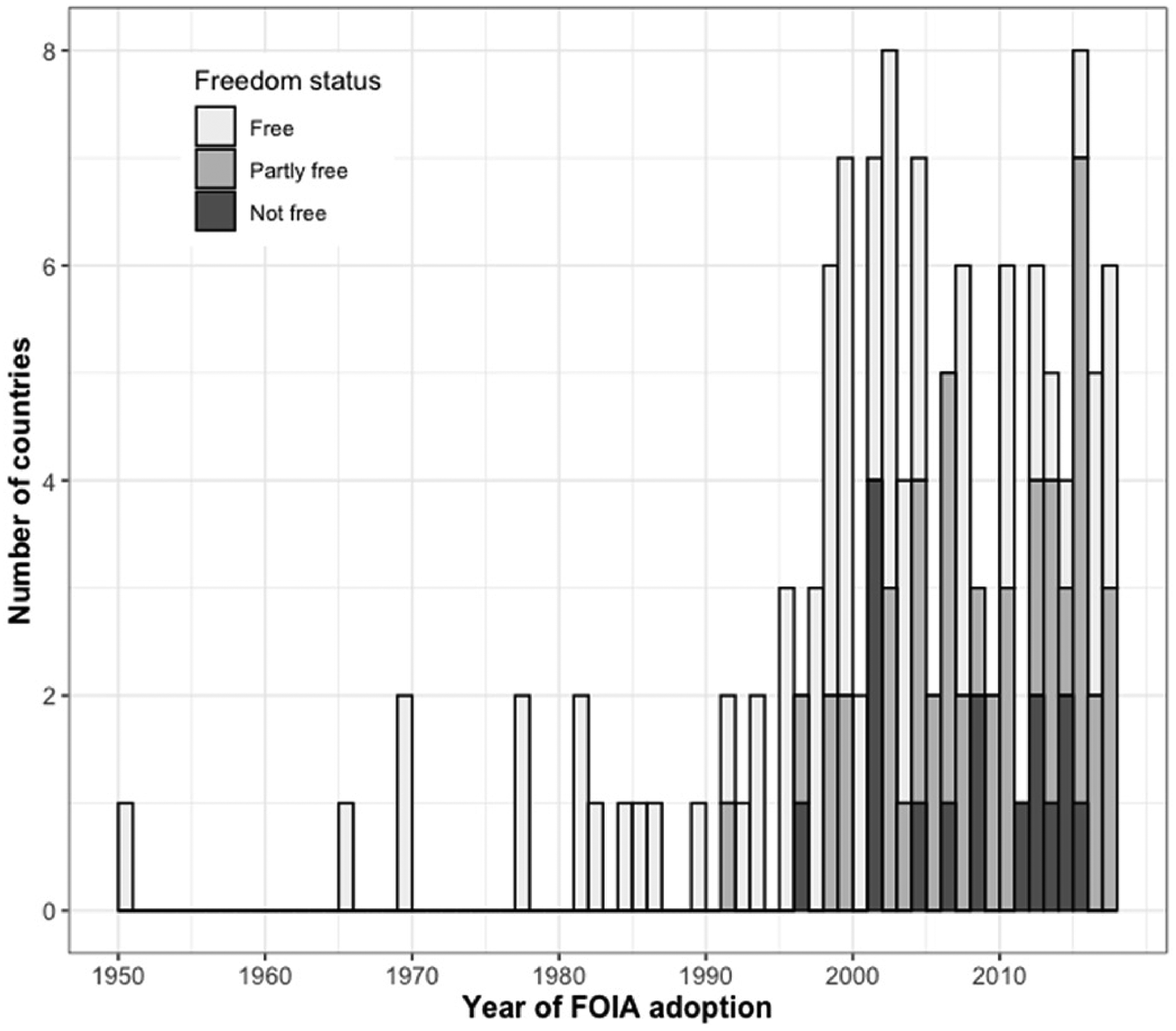
The adoption rate of FOI laws by countries’ freedom status (1950–2018).
The United Kingdom satisfies several essential conditions (on both the demand and supply side), which can turn FOI laws into powerful instruments for government oversight. The United Kingdom's media environment is characterized by professionalism, independent practice, and a long tradition of fact-based public service broadcasting (Hallin and Mancini 2004; Humphreys 2011). All of these factors contribute to the demand for access to information. The bureaucracy is equally equipped to supply information thanks to its professionalism (Weber 1946) and a high level of digitalization of public records and services (Dunleavy et al. 2006). Nevertheless, despite all these predispositions, the United Kingdom passed FOIA considerably later than other Western democracies. To place the findings of this study in a historical context and better understand why the United Kingdom delayed legislating the right of access to information, one has to recognize that secrecy and strict control over the distribution of information was a government's norm for decades.
One Step Forward, Two Steps Back: Towards FOIA Adoption in the United Kingdom
Secrecy, an inherent part of the British political tradition, was not abandoned overnight as the country transitioned to democracy at the beginning of the twentieth century. The negotiations of the equilibrium between secrecy and openness followed for decades and continue after the FOIA passage. These tensions make studying journalistic use of FOIA in the United Kingdom valuable in many aspects. It contributes to a better understanding of press–state relations more broadly. It explores if, in FOI practices, the information is approached as a public good and the journalists’ role as key information intermediaries is duly acknowledged. Studying FOIA use also sheds light on the government's tactics to gate access to certain information and how journalists counter them. The following section describes the underlying forces behind the decade-long process towards adopting FOIA in the United Kingdom, accompanied by balancing between different, often opposite interests.
The key piece of legislation that set the government's direction towards secrecy was the Official Secrets Act (OSA), adopted in 1889. Its amendment in 1911 introduced criminal sanctions, as sanctions under civil law proved to be inefficient in preventing the officials from selling government documents to the press. Section 2 was relevant for the future of FOIA due to its ambiguity and the catch-all quality about what represents an unauthorized disclosure (Ponting 1990). It took decades of unsuccessful Labour and Conservative governments’ attempts to repeal it. First, the 1976–79 Labour government made a case for greater openness in the White Paper on the OSA. Later, several Private Members’ Bills proposed repealing the OSA’s section 2 also to no success. OSA was finally amended in 1989, but this did not necessarily increase access to government information.
On the one hand, it was clear that the government's resistance against legislating the right of access to information cannot represent a long-term position, as domestic and international pressures 2 were increasing, and free information flows were gradually accepted as a norm for the functional democratic sphere. On the other hand, as Worthy (2017: 22) argues, FOIA was “simply too radical for a succession of governments wedded to the orthodoxies of information control.” The momentum for legislating FOIA came when the Labour Party formed the government in 1997 and occurred as a combination of different unrelated factors: international diffusion of FOI laws, the emergence of new information technologies and almost two decades out of power for the Labour Party. Worthy emphasized the last factor to be particularly crucial. FOIA helped Labourites to distinguish themselves from Conservatives as having a new radical approach to citizen–state interactions.
In 1997, the government published the White Paper Your right to know—the government's proposal for FOIA. 3 It continued to present FOIA as a radical policy and discussed the values behind the proposition—transparency, accountability, and modernization of public service. The paper also specified the rights and obligations of requesters and public authorities and technicalities of the planned legislation. However, the final version of the law that made it to the parliament fell short of its initial ambitions and included many blanket exemptions, which received criticism from the media and civil society organizations (CSOs). 4 Some were addressed, but the passed law was weaker than the one envisioned in the White Paper. The FOIA 2000 came into force in 2005 together with the Freedom of Information Scotland's Act 2002 (FOISA).
In the first five years of its existence, requesters sent to public authorities over half a million requests (Goodall and Gay 2010). However, the political interest in the topic faded away as the political capital that it carried was spent by the passage of the law. Neither Labour nor Conservative Party mentioned FOIA in their 2005 and 2010 election manifestos. The focus of both manifestos instead shifted to the proactive publication of public-sector data. The 2007–10 Labour government introduced reforms to increase access to data, and the 2010–15 Conservative and Liberal Democrat coalition government continued to advance this agenda. However, it framed open data as a modern substitution to FOIA. In one of his public speeches, Minister Francis Maude stated: “… [the government] should be proactively making public everything that is appropriate. You should make redundant the need for people to ask for access to information.” 5 The ambiguity of the language reminds constant negotiations of the balance between openness and secrecy. On the one hand, Maude said that there are limits to openness but was vague on what these limits are to leave the government room for maneuvering when needed.
Shortly after Maude's speech, the government announced an independent commission to review FOIA and its implementation. This motion raised concerns among CSOs 6 and media, 7 who argued for preserving the extent of requesters’ rights. The commission collected substantial written and oral evidence from organizations and individuals representing various sectors. 8 Its final report concluded that FOIA furthered openness and changed the culture of the public sector for the better. It strongly endorsed wider proactive publication but as a parallel complementing mechanism, not as a substitution of FOIA. Although the scope of the right of access to information was maintained, the rhetoric of political actors who backed the commission's establishment reflected yet again the force of political tradition of secrecy, which also FOIA performance statistics with increasing refusal rate confirm every year. 9 This shows that setting the boundaries of openness is fluid and continues even after adopting FOI laws. Although compared to the United Kingdom, the way toward legislating the right of access to government information was more straightforward and shorter in many other Western democracies, the struggle between the press demanding greater openness and governments opposing it is shared.
Data and Method
To investigate how journalists interact with British bureaucracy in their pursuit of information, I adopt a mixed-methods approach combining an online elite survey of journalists, qualitative semistructured interviews with CSO representatives and civil servants, and my experience with FOI requests.
Survey and Interviews
The anonymous survey was open for three months, from May to August 2019. It was realized through Qualtrics and distributed using personalized email invitations. I adopted a homogeneous purposive sampling strategy and preferably contacted journalists who focus on politics and investigative reporting as potential FOIA users. To identify them, I used the website www.FOIDirectory.com, affiliated with a Twitter feed, which highlights FOIA-generated journalistic stories. I collected information about articles that were featured on the feed from 2017 to 2019. If their authors had a Twitter account, I explored their networks to identify other investigative journalists. This snow-balling procedure generated additional contacts. When the survey was open, forty journalists from different Scottish media outlets had signed a letter to the Scottish Parliament's Public Audit and Post-legislative Scrutiny Committee, 10 calling attention to obstacles they experience when accessing information under FOISA and demanding improvements. I used this opportunity and invited them to participate in the survey. Journalists who were awarded or nominated for recognized prizes for investigative journalism in the United Kingdom, such as the Orwell Prize or Rory Peck News Award, were also added to the participants’ list. In total, the personalized email invitation to participate was sent to 1093 journalists. The survey was widely promoted on Twitter.
It was complemented by seven semistructured qualitative interviews with CSO representatives and civil servants. The interviews were realized in person and online throughout 2017–19. They lasted for about 40 min on average and were audio recorded. All transcripts were anonymized to minimize the risk of identifying interviewees who shared some examples under the condition of anonymity. The ethics committee approved the methods.
The findings from closed-ended survey questions were evaluated quantitatively, and those from open-ended questions and interviews were interpreted using thematic analysis. Concerning the topics discovered through open-ended questions, statisticians 11 found that recruiting more than 150 participants would unlikely significantly increase the number of identified topics. Therefore, the survey sample size (n = 164) likely safeguards data saturation and covers the major themes. The survey data included in the analysis and their detailed description are available in the Supplemental Information files.
FOI Requests
To corroborate the survey and interviews’ findings, I filed requests to twenty-one ministerial departments in December 2020. The full text of the request and the list of departments are also available in the Supplemental Information files. The request did not ask for any sensitive information. It asked for (1) statistics about requesters’ background in case departments collect it. In principle, this information should not be required and recorded, as one of the basic principles of FOIA is the requester-blind treatment. In addition, the request demanded (2) media monitoring outputs for a specific period and (3) records of FOI requests that developed into news stories. As the media outputs are already in the public domain (free of cost or available upon subscription to a specific media outlet), there is no ground to withhold the information based on a prejudice-based exemption (disclosures that could create potential harm) or a class-based exemption (related to a particular class of information, such as information important for national security or held for criminal investigations). In selected cases, when the initial request was refused, I sent a new narrowed-down request that asked for more specific information. For instance, I asked the Ministry of Justice (MoJ) to disclose one month of media monitoring outputs related to the COVID-19 and court hearings, Ministry of Housing, Communities and Local Government (MHCLG) to provide two weeks of media monitoring outputs related to the Grenfell Tower or Department for Environment, Food and Rural Affairs (Defra) to provide two weeks of media monitoring outputs related to animal welfare.
The outcomes of requests were assessed against quantitative performance indicators (e.g., time to a response). I also described my interactions with the departments qualitatively.
Findings From the Survey and Interviews
One hundred seventy-three participants started the survey, 164 granted consent to use their responses. Out of these, 101 (62 percent) were men and fifty-nine (36 percent) were women. One (1 percent) participant identified with the “other” category and one (1 percent) preferred not to disclose their gender. Two (1 percent) omitted the question altogether, which was technically possible, as no questions in the survey were obligatory to answer to complete the survey. Compared to the U.K. population of journalists, 12 women are underrepresented in this sample. There are further limitations with regards to the selected sampling strategy. Nonprobability sampling strategies “do not attempt to select a random sample from the population of interest” (Battaglia 2008: 523), and therefore, they can introduce bias if the sample estimates substantially differ from the population's true values. Thus, the findings do not have strong external validity.
FOIA's Pros and Cons for Journalism
Survey results show that FOIA is an important source for journalists in the United Kingdom. Out of 164 survey participants, 155 (94 percent) claimed that they submitted an FOI request at least once in their career. One hundred thirty-eight (84 percent) agreed that FOI legislation is instrumental for their work. Although journalists use FOIA widely, Figure 2 shows that a relatively small fraction of journalists submit a large proportion of requests. The majority of surveyed journalists (70 percent) submit less than fifty requests a year (half of them submit less than ten requests a year). Only twenty-four (17 percent) surveyed journalists are heavy users (submit over 100 original requests per year).
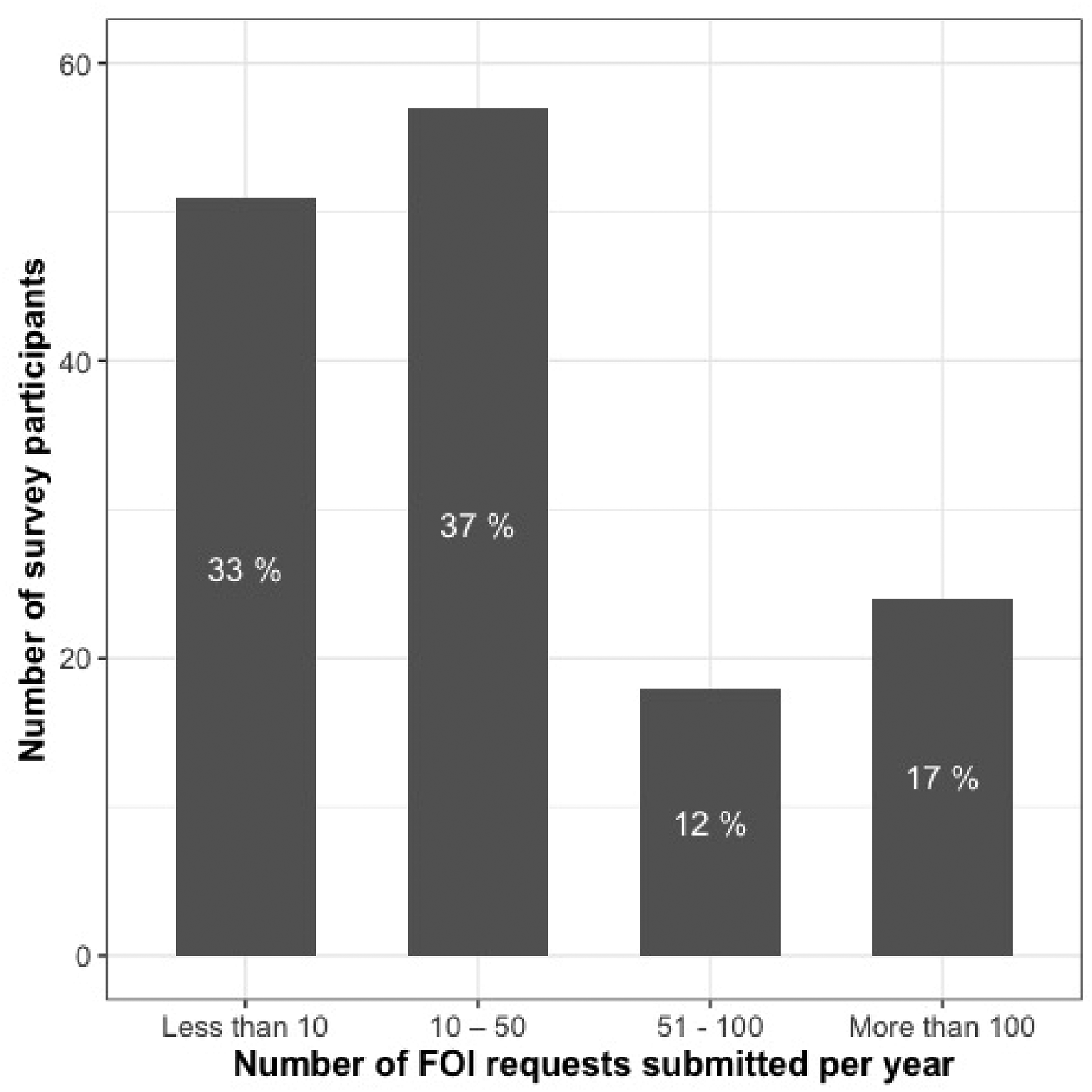
How frequently respondents submit freedom of information (FOI) requests.
As illustrated in Figure 3, equally ninety-four (57 percent) survey participants stated that their primary source is information obtained through FOI requests and available public-sector data. Sixty-two (38 percent) respondents claimed to rely on information from confidential sources and whistle blowers. Twenty-five (15 percent) participants stated that they use other sources, for example, data provided by CSOs, courts’ data, and companies’ annual reports. Only ten (6 percent) participants mentioned anonymous leakers as their source of information.
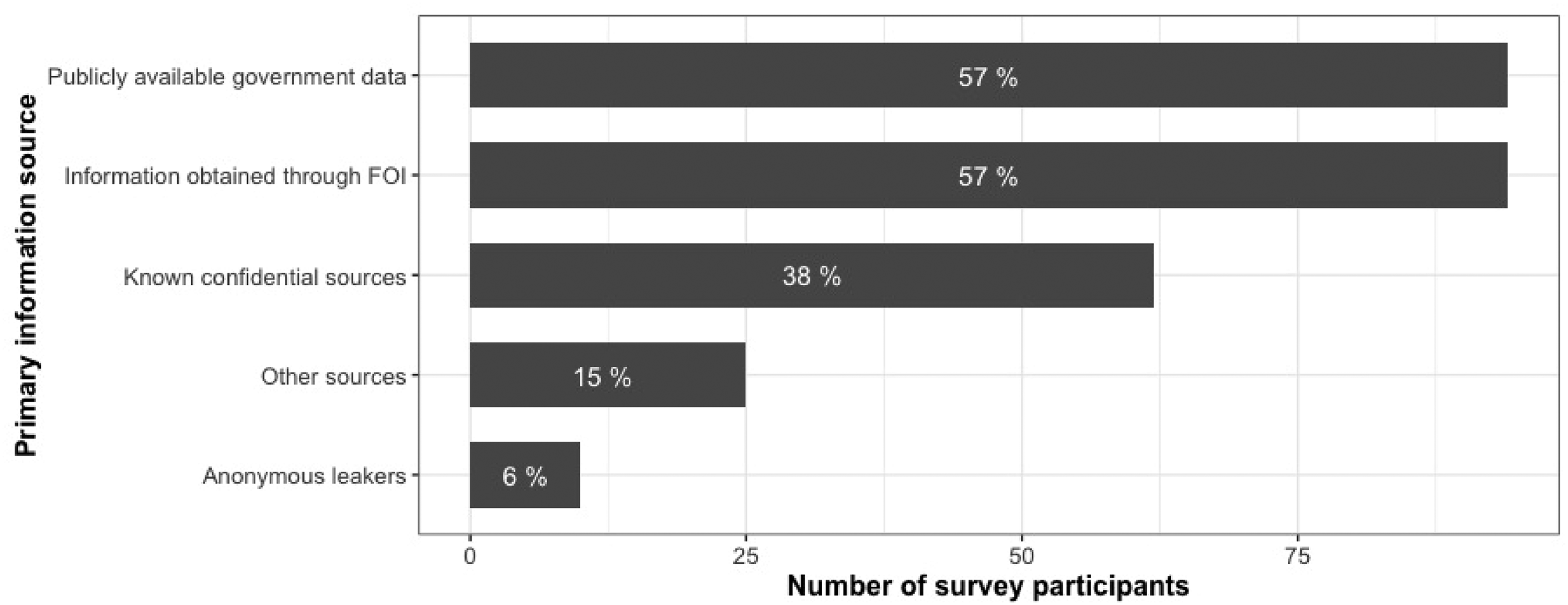
Respondents’ sources.
The main recurring themes around FOIA in journalism practice that have arisen from the survey responses and interviews are time efficiency, authority and accuracy of sources, and exclusivity. Several survey participants suggested that the main disadvantage of FOIA is the time it takes to receive the information. Proactively published public-sector data are available immediately (SP3, SP9, SP50, SP84, SP108, SP138, SP166). One participant summarized it: “waiting for FOI responses from various bodies can delay stories. Having the data readily available increases the speed at which I am able to report on things, which is in a stretched local newsroom at a premium” (SP108). For this reason, journalists search publicly available data first and use FOI requests to obtain further information only later, often as the last instance.
Journalists perceived both FOIA-generated information and public-sector data as reliable and accurate. At least, they recognized that the responsibility for reliability and accuracy lies with public authorities, not with them. While it is difficult to verify the credibility of anonymous sources, public authorities cannot “deny or spin away later” from the information they provided (SP50). 13 FOIA “generates documents, which can be cited as proof and are therefore more reliable than tip-offs or information provided off-the-record” (SP61). Another survey participant mentioned that using this information does not bring a “risk of a defamation suit” (SP92).
Moreover, the incentives to provide false or distorted information are low, as public authorities could successively face reputation repercussions. That said, many respondents were sceptical about the rigor of official information. Some even suggested that public authorities might manipulate it.
Journalists indicated exclusivity as the main advantage of FOIA for journalism practice. They claimed that FOIA helps them obtain information that other journalists do not possess and builds front-page stories. Respondents also argued that [FOIA] “gives a route to access [public-interest] information that would not otherwise be available” (SP15). It provides journalists with an opportunity to access information that is “not routinely public” (SP23), “underreported” (SP34), “off-limits” (SP47) or otherwise “hidden from view” (SP81). They also use FOIA to create new datasets. For example, the Bureau of Investigative Journalism's project, which exposed the extent of publicly owned property in England, sold due to austerity measures, collected the data for the story through FOI requests submitted to more than 300 local councils. This example illustrates a point that all interviewees made and emphasized—that FOIA and public-sector data are complementary and work well together. FOI requests, however, “cannot be ignored (unlike other press inquiries). Also, sometimes the reasons for which they are denied can be illuminating,” as another participant concluded (SP87). FOIA is indispensable for this reason, as it legally obliges authorities to disclose public-interest information.
A Cat and Mouse Game in the Pursuit of Information
In line with previous research, findings from the survey and interviews suggest that the press inevitably gets in conflict with the state when fulfilling its monitorial role. FOIA is a part of these complex press–state relations. On the one hand, governments pass FOI laws to signal that they are transparent and professional. However, when journalists start to use them to exercise government oversight, political actors are forced to mitigate their disruptive effects (Roberts 2005).
Over forty journalists stated in the answers to open-ended questions that they use FOIA to monitor the government's activities, expose wrongdoings (SP99), or uncover the government's ties with the private sector (SP79). They also claimed to use public-sector data to track money flows between the government and private sector, monitor government spending, and detect fraudulent behavior. All these uses can cost political actors a career. So, to prevent potential losses, they can try to limit access. The survey respondents and interviewees described practices of gating access.
Although journalists use FOI requests widely, they expressed dissatisfaction with how public authorities treat them. Previous negative experience with FOIA, mainly high refusal rate and unresponsiveness, discourage them from submitting new requests (Figure 4). Survey participants mentioned inconsistencies in how public authorities approach them, with the same questions receiving different answers. The Department for Exiting the EU, the Ministry of Defence (MoD) and the National Health Service was repeatedly raised as not adhering to time limits and being unresponsive (SP19). The Scottish Government was too perceived as opaque among respondents. Unresponsiveness is especially problematic, as it leaves requesters, who technically do not have the decision to appeal, in legal limbo (Amin 2020). Respondents also complained that the twenty working days’ time limit for complying with requests is too long for fast-paced work at newsrooms.
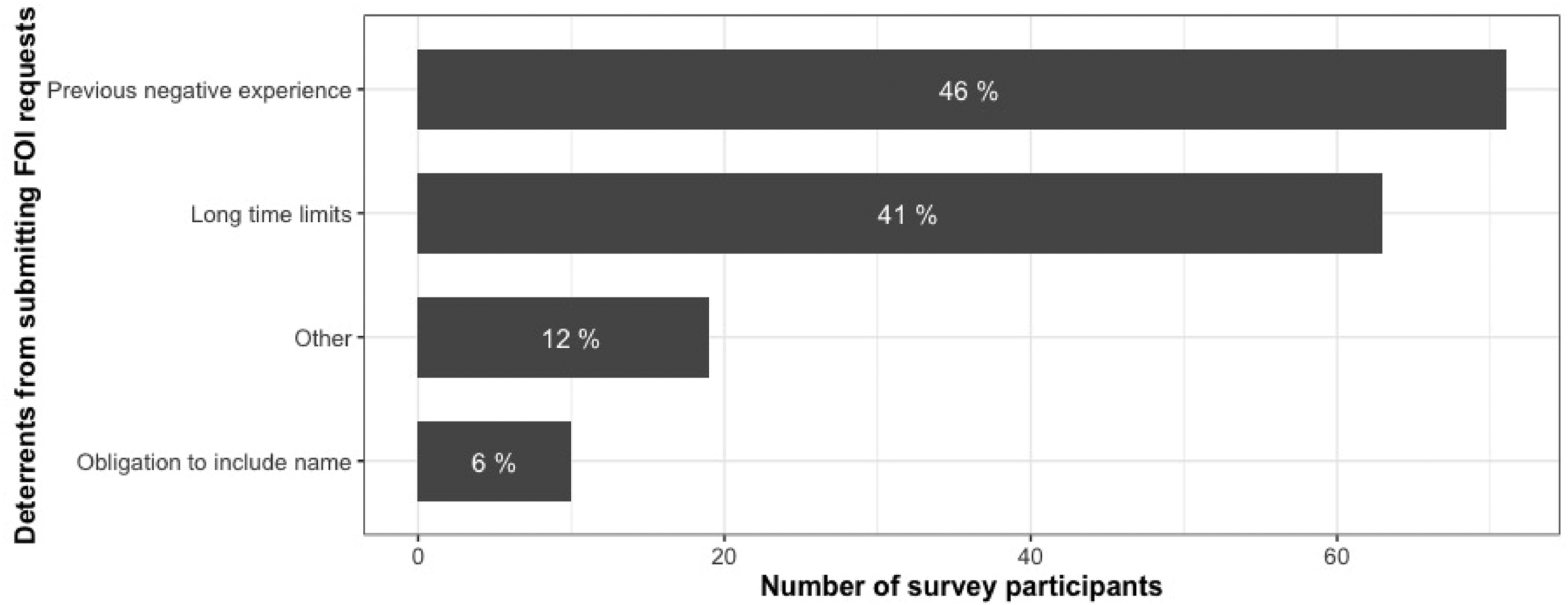
Deterrents from submitting freedom of information (FOI) requests.
Only ten (6 percent) survey participants mentioned the obligation to reveal their identity as a deterrent from filing a request. That said, they complained that their requests “are being treated differently than those of any ordinary member of the public” (SP106). The problem of differential treatment was brought up in the interviews as well. A CSO representative argued that whereas most requests are dealt with by the regular FOI team, sensitive requests get to senior civil servants in the departmental hierarchy. Because they deal only with requests that might represent a reputational risk to the department, they “see threats, not advantages of disclosure.” 14 The Scottish Information Commissioner also confirmed that some requests filed by journalists to the Scottish Government “went to a high-level decision-making process, so responses to journalists’ requests were essentially delayed.” 15 Journalists and civil society argued that on the central government level, the Clearing House was set up to detect and obfuscate their FOI requests that could represent a reputational risk. Amin (2020) suggested that the Clearing House keeps a list of journalists and activists who are frequent requesters. The Scottish Information Commissioner argued that “who you are should not dictate how your application is determined. The general principle [of FOIA] is that it is the applicant blind.” In the Scottish Government Intervention, he clearly stated that this practice has to stop.
Research from other jurisdictions (Kwoka 2018; Michener et al. 2019) is consistent with my findings and shows the differential treatment of journalists’ requests. From this perspective, using public-sector data might be less problematic for journalists than filing an FOI request. A survey participant argued that “[data] enables to explore a story idea without having to alert authorities to what is being looked at” (SP41). However, some government websites also require their users to register to be able to download the data. Although the majority of respondents did not express concerns, some journalists were worried about surveillance. The following statement best summarizes the experience that came up in responses repeatedly: “Requests for data are flagged to press offices who then contact you attempting to obtain information and, in some cases, warning off sources” (SP65). Some participants were convinced that these are common practices. All these views suggest that the lack of trust in the government is pervasive among journalists.
The main concern about the application of FOIA was the high refusal rate. One hundred thirty-three (86 percent) survey participants who had previously submitted a request claimed that it was refused at least once. It does not indicate a problem per se, as public authorities have several legitimate reasons for withholding requested information, but statistical data on the UK central government's FOI performance suggests a continuous trend toward opacity. The Institute for Government's analysis shows that the refusal rate has almost doubled since 2010. 16
As illustrated in Figure 5, the first most frequent justification for withholding information the respondents encountered was made on cost grounds. The second most frequently cited reason for refusals was time burden. Section 12 of the FOIA states that public authorities are not obliged to comply with a request for information if it estimates the cost of complying would exceed the appropriate limit, which is set at £600 for the central government. This is the estimated cost of one person spending 3.5 working days determining whether the department holds the requested information. The guidance provided by the United Kingdom's Information Commissioner also concludes that if “it would cost too much or take too much staff time to deal with the request,” public authorities can reject such request. 17
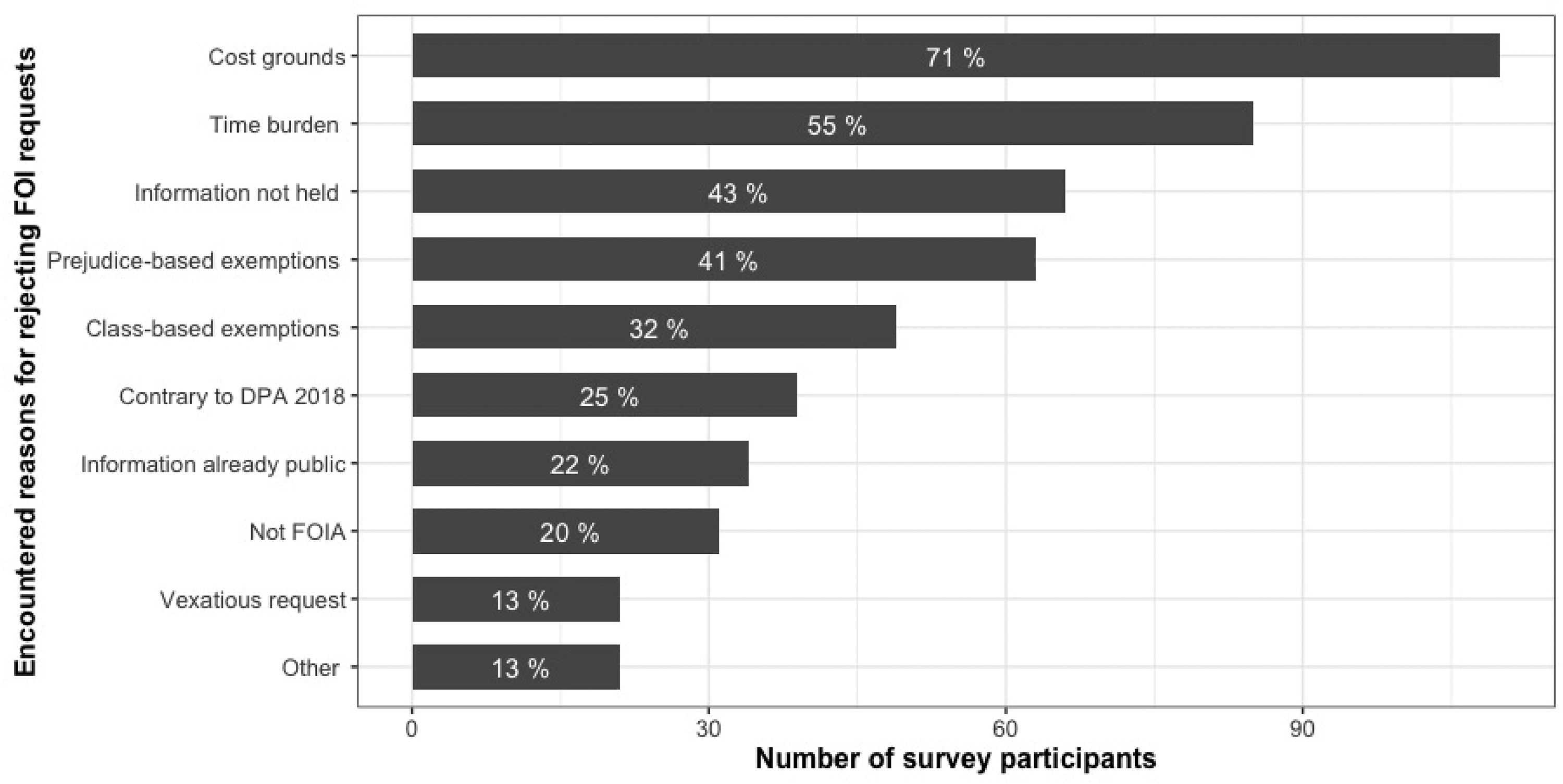
Most frequently cited reasons for freedom of information (FOI) refusals.
The third most frequently cited reason for withholding information was that information was not held. Other encountered justifications for refusals included prejudice-based and class-based exemptions. Only twenty-one (13 percent) survey participants who submitted a request at least once had it rejected as vexatious. Cherry and McMenemy (2013) argued the subjective character of the vexatious requests’ criteria makes it difficult for public authorities to interpret and apply these. The Scottish Information Commissioner seconded this and added that “authorities have to meet a high test to make the case of a request being vexatious.” 18 As they often do not manage, they resort to using an exemption on cost grounds. It is an easy way for public authorities to gate access to information because addressing refusals on cost ground is extremely difficult for requesters. As a requester, “you do not know how the authority holds the information, how it searches for it.” 19 Therefore, it is challenging to narrow the request down in a way to avoid being refused on cost grounds—however, journalists who work on investigations collaboratively developed strategies on how to address this. An interviewee mentioned that they split the amount of requested information between several people. Since public authorities in the United Kingdom can refuse requests if they represent a concerted effort, they send requests from their private email addresses to avoid being identified with the same organization.
Conclusions From FOI Requests
My experience with submitting FOI requests to the ministerial departments echoes that of surveyed journalists to some extent. Statutory time limits are not always respected, and public authorities’ responses are inconsistent due to human factors. As mentioned, my requests did not ask for any sensitive information and, thus, they are not representative of requests that journalists would often make. Therefore, my experience with FOI requests is likely more positive than journalists’ experience. It is reasonable to assume that the authorities would treat journalistic FOI requests more cautiously, in particular, if the disclosure could create reputational harm.
Section 10 of the FOIA states that public authorities must respond to FOI requests “promptly and in any event not later than the twentieth working day following the date of receipt.” Out of twenty-one ministerial departments, seventeen met the twenty working-day statutory time limit to respond to the request. Four—Department for Business, Energy and Industrial Strategy (BEIS), Department for Education (DfE), MoD, and UK Export Finance (UKEF)—did not reply promptly, as required by law. The UKEF responded eight working days after the deadline had passed, BEIS with ten working days, and DfE with thirty-eight working days delay. The MoD acknowledged the delay and indicated it would respond within the same week, but the response has not yet arrived. 20
The request asked for (1) departments’ statistics about requesters’ background, (2) media monitoring outputs for a specific period, and (3) records of FOI requests that developed into news stories.
Except for the UKEF, all departments who held the media monitoring outputs rejected the request partially or fully on cost grounds referring to section 12 of the FOIA. The UKEF was the only one that disclosed all media monitoring outputs for the year 2020. The material had over thirty pages and included chronologically ordered headlines of news stories where the UKEF was mentioned. The UKEF stated it had to extrapolate this information from different sources. Since we do not know how public authorities record and store information, we cannot assess why the UKEF was in the position to disclose the information while other departments employed the exemption on cost grounds to the identical request. The outcome of my requests is in line with the survey's findings, which showed that withholding requested information on cost grounds is common. While it is a legitimate reason for refusal (and probably was in this case), it is unfeasible to verify if this exemption is based on honest assessment from a requester's perspective. A wide application of this exemption creates a significant information asymmetry favoring public authorities.
However, some authorities, such as BEIS, Defra, Department for Digital, Culture, Media and Sport (DCMS), MHCLG, or MoJ, provided a detailed explanation for refusals and even offered guidance on how to increase chances for future disclosure. BEIS stated that “media monitoring is not held centrally and identifying and extracting [requested] information would require a manual search of all records.”
As for the other parts of requests, three authorities provided a breakdown of requesters’ background. All departments who provided this information suggested that the media is indeed among key FOI requesters. BEIS reported journalists as the second-largest group of requesters and DfE as the third-largest group after general public members where, however, is included everyone who does not provide background information. Attorney General's Office confirmed that 19 percent of requests received in 2020 came from journalists. None of the authorities systematically records news stories developed from FOI requests sent to them.
Although the response to my requests did not result in full disclosure (except for the UKEF), it took the departments eighteen working days to respond on average, which is a long time for a journalist to obtain information. However, it is important to acknowledge that the request was sent during the COVID-19 pandemic when the public authorities’ resources could have been under greater pressure than they normally are. The quickest response came after five working days from the DCMS. However, nearly half of the departments postponed the response until the very last days of the statutory time limit. If public authorities answer the requests on the last day and do not disclose the information, so journalists have to submit a new request or appeal the decision, a route to obtaining the requested information might take a couple of months. These time frames are inapt for news journalists. And although they might be feasible for investigative journalism, they prolong producing reports and make the process more expensive.
Discussion
FOI laws’ advocates often argued that their passage would improve government responsiveness and accountability, enabling journalists to fulfill their monitorial function better and indeed, there is evidence in this direction. Access to information facilitated by FOI laws coupled with free and pluralistic media has a powerful checking value and the potential to tackle mismanagement and corruption (Camaj 2013; Norris 2008; Žuffová 2020).
Nevertheless, we have limited knowledge about the intricacies of this process. This study contributes to a better understanding of the FOI laws’ role in journalism and press–state interactions in FOI procedures. Despite the specificities of the British case, the findings have implications for any democratic society. Media and civil society's call for information, government's reluctance, and continuous negotiations of boundaries between openness and secrecy are not unique to the British path towards FOIA adoption and its application in practice.
One of the questions the present study answers is, do FOI laws matter for journalism? The findings from the survey and interviews unambiguously show they do. Journalists submit FOI requests regularly and consider the ability to exercise their right of access to government information as vital for their work. Their (self-reported) FOIA use and many of their stories demonstrate FOIA's importance for government oversight. Through requests, journalists attempt to obtain information that helps them to expose when the government does not act in public interest and point at systemic injustices. FOIA is an important enterprise source that enables journalists to stick by their roles of “custodians of public conscience” (Ettema and Glasser 1999: 3) and “guardians of institutions” (Lippmann 1997: 363) also because, in principle, it is an autonomous bureaucratic procedure.
However, the findings also show that this principle is not always followed in practice. Many survey respondents described their experience with FOIA in negative terms. It included delayed responses or complete silence from the authorities and frequent refusals on cost grounds. These are hard to appeal to due to information asymmetry, as only the authority knows what information it possesses and in what format. Thus, the requester is poorly placed to estimate where the exemption threshold lies in terms of information volume. My FOI requests echo the study participants’ experiences to some extent. The described practices can obfuscate getting the desired information and eventually discourage journalists from using FOIA as their source.
Nonetheless, these practices could still be a sign of negligence rather than an intention, which cannot be said about the procedures put in place to identify requests coming from journalists and CSOs and minimize a reputational risk they could pose. These procedures reflect the political tradition of secrecy and control over information. In response to my own request, the Cabinet Office proactively mentioned the Clearing House, set up in 2004 to coordinate requests across the central government and ensure “requests are handled consistently, and sensitive material appropriately.” 21 Amin’s (2020) report suggested that this institution keeps a list of requesters from media and CSOs—a practice that goes against the FOIA's core principle—the equality of treatment. Should we worry about these practices? The findings suggest we should. In the survey, journalists expressed a reasoned concern that public authorities investigate their motives for submitting requests and manipulate what will be disclosed. These practices have ramifications for trust in the independence of institutions and bureaucratic procedures and willingness to participate in public life.
If we agree that the public needs accurate information to make the best possible decisions, and it is one of the most important goals of journalism to provide the public with such information, then the government should make access to information for journalists as efficient as possible. I want to conclude this study with some suggestions on how FOIA and its application can be reformed to become even more useful for journalists.
First, having cost limits which, when reached, allow authorities not to comply with FOI requests, contradicts the view of information as a public good and journalism's importance for an informed citizenry. I argue that the cost limits for requests should be increased, and in case the limits are exceeded, journalists still should have a choice to pay the excess costs but have their requests answered, as it is common in other jurisdictions. In the current state, requesters do not have a chance to verify if the refusals on cost grounds are genuine. Worthy (2021) argues that FOIA is “an essential democratic tool,” and as we accept that costs are attached to other democratic tools, such as running poll stations, we need to recognize that costs are also linked to FOIA. Moreover, FOIA provides sufficient protection against abuse by allowing public authorities to refuse vexatious requests.
Second, as briefly mentioned above, the time limits are too long to suit the nature of journalistic work. In this study's sample, investigative journalists significantly prevailed, and one of their main reservations against the FOI process was that it takes too much time. If they cannot afford to wait for FOI responses, then FOIA is out of the question for news journalists. For FOIA to become even more useful and used, time limits need to be shorter than the current twenty working days.
Third, public authorities should proactively publish any public-interest information in a systematic manner to free up FOI resources. Likewise, journalists should explore if the information has already been made available before requesting it through FOIA. To better understand public-interest information, public authorities should systematically audit FOI requests they receive and base their publication schemes on public demand. Last, study participants offered a useful recommendation for addressing differential treatment, that is, anonymizing all requests immediately after their receipt and before the first point of contact redistributes them further within the authority.
This study contributed to a better understanding of the FOI laws’ role in journalism practice and press–state relations from the journalists’ perspective. Further research is needed to explore the view of public servants in charge of FOIA.
Supplemental Material
sj-csv-1-hij-10.1177_19401612211006702 - Supplemental material for Fit for Purpose? Exploring the Role of Freedom of Information Laws and Their Application for Watchdog Journalism
Supplemental material, sj-csv-1-hij-10.1177_19401612211006702 for Fit for Purpose? Exploring the Role of Freedom of Information Laws and Their Application for Watchdog Journalism by Mária Žuffová in The International Journal of Press/Politics
Supplemental Material
sj-csv-2-hij-10.1177_19401612211006702 - Supplemental material for Fit for Purpose? Exploring the Role of Freedom of Information Laws and Their Application for Watchdog Journalism
Supplemental material, sj-csv-2-hij-10.1177_19401612211006702 for Fit for Purpose? Exploring the Role of Freedom of Information Laws and Their Application for Watchdog Journalism by Mária Žuffová in The International Journal of Press/Politics
Supplemental Material
sj-pdf-3-hij-10.1177_19401612211006702 - Supplemental material for Fit for Purpose? Exploring the Role of Freedom of Information Laws and Their Application for Watchdog Journalism
Supplemental material, sj-pdf-3-hij-10.1177_19401612211006702 for Fit for Purpose? Exploring the Role of Freedom of Information Laws and Their Application for Watchdog Journalism by Mária Žuffová in The International Journal of Press/Politics
Footnotes
Acknowledgments
I wish to thank all the survey participants and interviewees who contributed to this study and shared their experience using FOI laws. I am also grateful to civil servants who promptly responded to my FOI requests. I thank Heinz Brandenburg, Zac Greene, Tomas Zuffa, Associate Editor and three anonymous reviewers for excellent comments, which all immensely improved this manuscript.
Declaration of Conflicting Interests
The author declared no potential conflicts of interest with respect to the research, authorship, and/or publication of this article.
Funding
This study was in part supported by the University of Strathclyde through an International Public Policy Institute's PhD Studentship.

Supplemental material
Supplemental material for this article is available online.
Notes
Author Biography
References
Supplementary Material
Please find the following supplemental material available below.
For Open Access articles published under a Creative Commons License, all supplemental material carries the same license as the article it is associated with.
For non-Open Access articles published, all supplemental material carries a non-exclusive license, and permission requests for re-use of supplemental material or any part of supplemental material shall be sent directly to the copyright owner as specified in the copyright notice associated with the article.
