




Abstract
The effects of episodic and thematic framing on the attribution of responsibility for societal problems have previously been investigated with experimental methods and mostly tested general effects on the public. The current work, instead, investigates episodic framing’s effect by linking a large-scale content analysis to data of a panel survey (n = 3,270) and assesses the conditionality upon citizens’ individual political ideology. It does so with a focus on perceptions of responsibility for the 2009–2015 economic crisis and within the context of the Netherlands. Results demonstrate that exposure to episodically framed crisis news caused a decline in the attribution of responsibility to individual citizens, whereas thematic framing did not affect this. Framing effects on the attribution of political responsibility, instead, were conditional on political ideology: Episodic framing decreased the attribution of political responsibility, whereas thematic framing increased the attribution of responsibility to political actors, but both effects occurred primarily among citizens with a right-wing political-economic ideology. Accordingly, we add an explanation for the inconsistency of effect directions in previously published research on the effects that episodic and thematic framing may have on responsibility attributions.
Keywords
The European debt crisis (2009–2015) has been one of the most disruptive political events in the past decades. Conflicting views have been expressed about who was responsible for this crisis by specialists, citizens (Hobolt 2015) and journalists (Doudaki et al. 2016): Were it banks that sold unsolid mortgages, politicians failing to install sufficient checks on the financial system, or individual citizens who consumed too much with borrowed credit? The framing of news stories can influence such attributions of responsibility (Iyengar 1991); episodic and thematic framing, in particular, have been shown to shift these perceived responsibilities. The latter, thematic framing, has been defined as stories that place “public issues in some more general or abstract context and takes the form of a ‘take out,’ or ‘backgrounder,’ report directed at general outcomes or directions” (Iyengar 1991: 14). Episodic framing, in contrast, is a way of storytelling that takes “the form of a case study or event-oriented report and depicts public issues in terms of concrete instances” (Iyengar 1991: 14). Episodically framed news stories often focus on specific exemplars—most often human exemplars—to illustrate broader issues through the appearance of unknown and ordinary citizens (Peter and Zerback 2020).
Journalists employ episodic frames to illustrate wider issues in ways that humanize their topic, which is especially common in commercially oriented outlets (De Swert and Kuypers 2020). Ordinary citizens have accordingly become increasingly prominent in news coverage (De Keyser and Raeymaeckers 2012; Kleemans et al. 2017) for a variety of reasons: the urge for less costly content (Wheatley 2020); the commercial need to produce appealing stories (Skovsgaard and Hopmann 2020); and a movement toward public journalism (Ahva 2013). From a normative perspective, this increase in episodic framing is positive (Althaus 2012) when considering participatory-oriented theories of democracy: It sparks a more diverse “market place of ideas” and allows citizens to represent themselves by breaking through the hegemony of elite sources. From the perspective of competitive democracy, which emphasizes informed citizenship, however, episodic framing might be undesirable, because it could harm the ability of citizens to understand the relationships between abstract political topics (Iyengar 1991).
Economic news frequently includes dramatization and personalization (Gonzalo et al. 2015)—both aspects being obviously linked to the concept of episodic framing. Episodic frames have been found in one-third of the poverty stories (S.-H. Kim et al. 2012); more specifically, the frame that financial problems are a private concern rather than a societal issue has increasingly become prominent in journalistic descriptions of poverty (Rose and Baumgartner 2013) and political discourse (Guetzkow 2010). Episodic framing may be particularly influential in the context of economic news, because this genre is often perceived as too abstract or too complex to be comprehended by the general audience (Adoni and Cohen 1978).
We investigate the effects of episodic and thematic framing in economic news from the Netherlands; a country that faced severe economic downturn during the European debt crisis and is characterized by a multiparty political system, media landscape (unpolarized, high trust, see Boukes 2020), and social welfare systems that are relatively generalizable to other North-European countries. By employing a methodological approach that links panel survey data to content analysis data (i.e., linkage analysis, see De Vreese et al. 2017), this study examines the effects of episodic framing and thematic framing on their own merits rather than comparing them vis-à-vis each other. This is important, because episodic and thematic frames are not necessarily mutually exclusive, but often co-occur in the same news story (Iyengar 1991; Rucinski 1992) or neither of these frames may be present. Besides being methodologically innovative, this study fills an important theoretical caveat by demonstrating the moderating impact of political ideology at the individual level.
Framing and Its Effect on Attributions of Responsibility: A Mixed Picture
Episodic framing is a particularly strong form of communication (Bas and Grabe 2015) with a lasting impact through the recollection and transmission of information between people (Aarøe and Petersen 2018). The reason is that episodic frames reduce the complexity of social problems (Zillmann 2006). Aarøe and Petersen (2018) explain that the human mind is better suited to process, store, and recall vivid information that comes from concrete examples (i.e., episodic frames) compared with factual, abstract, or thematic kinds of information. Human exemplars help to structure citizens’ minds and, accordingly, influence thought processes by easing recall and functioning as availability heuristics (Schmierbach and Boyle 2020).
Several studies found that exposure to episodically framed news compared with thematically framed news causes attribution of responsibility to individuals rather than to society as a whole (Gross 2008; Hart 2011; Strange and Leung 1999). Reducing widely existing social problems to individual cases with episodic framing ignores the responsibilities on a higher societal level and emphasizes the individual responsibility (Iyengar 1991). Theoretically, this is explained as follows: When people are exposed to a news story focusing on one particular case (episodic framing) rather than an abstract story that presents broader societal/political patterns (thematic framing), cognitions that deal with “a bigger picture” become less readily available. Therefore, people will focus their thoughts—and the responsibility of the issue—on the portrayed individual. Hence, people do not identify the issue as a society-wide phenomenon but as a private concern (Iyengar 1991; Rucinski 1992).
Effects in the opposite direction, however, have also been found. Aarøe (2011) and Boukes et al. (2015) found that episodically framed news stories are more likely to cause support for governmental policies that benefit the exemplified persons in a news story than thematically framed news. Other studies found mixed or insignificant effects (Ben-Porath and Shaker 2010; Feezell et al. 2019; Hopmann et al. 2017; M. Kim et al. 2020; Krupnikov and Levine 2019; Ostfeld and Mutz 2014). Exemplification theory is often used to explain the contradictory findings (Krämer and Peter 2020): Exemplars—very similar to episodic frames, depicting public issues in terms of concrete, personal instances—cause people to generalize the presented case (Zillmann and Brosius 2000) and, hence, to overestimate the severity of social problems (Aust and Zillmann 1996). The latter would imply a wider societal problem. Moreover, a personalized focus in news stories increases narrative engagement (Oschatz et al. 2019) and, thereby, may evoke emotions (Ciuk and Rottman 2020) and empathy with involved individuals (Aarøe 2011; Gross 2008), which makes an issue appear as more important (Grabe et al. 2017). Perceiving a problem as more wide spread and feeling empathy for the exemplar, eventually, may cause interpretations of societal responsibility for solving the problem (Boukes et al. 2015; Oschatz et al. 2019).
Episodic Framing, Thematic Framing, and Responsibility for the Economic Crisis
It is important to consider cultural context when investigating framing effects, because strength and direction of framing effects depend on how strongly a news story resonates with the cognitive schemas of its audience (Scheufele and Iyengar 2012: 8). Relevant for the current study—conducted in the Netherlands—is that the evidence of episodic framing causing individual responsibility was found in the United States (Gross 2008; Hart 2011; Iyengar 1991; Springer and Harwood 2015; Strange and Leung 1999). Studies finding the opposite—episodic framing causing attribution of societal responsibility—were conducted in North-European countries (Aarøe 2011; Boukes et al. 2015; Hopmann et al. 2017).
North-European culture, generally, is less defined by individualism than American culture (Hofstede 2001; Trompenaars and Hampden-Turner 2012). This is also reflected in the strong social welfare systems with social insurance policy, high job security, and more income distribution (Aarøe and Petersen 2014). In episodically framed news, accordingly, North-Europeans may “see” an individual in need and they experience strong(er) feelings of empathy. This could be less likely for Americans for whom social welfare will not be on the top of their minds; so, they may be more inclined to attribute responsibility to the portrayed individual. As the current study relies on data from a single North-European country, it cannot give the definitive answer on how culture or context moderates the effect of episodic-versus-thematic framing, but it is important to be aware of this potential influence.
The current study investigates framing effects in the realm of the European debt crisis among Dutch citizens. The Netherlands is a country with a strong social welfare system. Hence, Dutch citizens will generally share the idea that the individual ought to be protected against major social issues by governmental institutions (Aarøe and Petersen 2014). The emotions and empathy evoked by episodically framed news (Aarøe 2011; Grabe et al. 2017; Gross 2008) may thus strengthen the perception that political actors, and not individual citizens, are responsible for causing the portrayed problem. The expectation is, therefore, that episodic framing of economic crisis news causes (1) less attribution of responsibility to individual citizens and (2) more attribution of responsibility to national politics. It is important to distinguish the two outcomes, because when perceptions of political responsibility are affected by framing, this does not necessarily imply that an opposite effect occurs for the attribution of individual responsibility, or vice versa (Ben-Porath and Shaker 2010; M. Kim et al. 2020). Therefore, these outcome variables should be investigated separately. Hence, two hypotheses are formulated:
The effect of episodic-versus-thematic framing has generally been explained through the vivid nature and individualized focus of episodic frames. Much less theory revolves around characteristics of the thematic frame, which usually has just been used as a base-line condition to compare episodic framing with. So, if episodic framing caused less individual attribution of responsibility, the thematic frame would in most experimental designs do the opposite and cause relatively more individual attribution of responsibility (because conditions are compared vis-à-vis each other). However, when both types of framing are studied on their own merits, this is not necessarily true: Both could, in principle, decrease the attribution of individual responsibility and spark political responsibility attributions compared with a situation without exposure to frames about this topic. Yet, the effects of episodic framing might be relatively stronger than those of thematic framing (Aarøe and Petersen 2018; Bas and Grabe 2015) and, thereby, explain the patterns found in previous studies. If both frames indeed are not mutually exclusive, thematic framing may still have an effect on itself. Following Iyengar’s (1991) reasoning and repeatedly verified explanation that thematic framing has the ability to place issues in a wider perspective by focusing on broader patterns and therefore causes attributions of political responsibility instead of individual responsibility, we expect the following:
Conditionality of Framing Effects upon Political Ideology
The literature on the effects of episodic and thematic framing is dominated by a mixture of findings (Krämer and Peter 2020). Recent studies pointed out message features (issue salience, see Ciuk and Rottman 2020; or topic, see Feezell et al. 2019) and exemplar characteristics (deservingness, see Hopmann et al. 2017; and similarity, see Ostfeld and Mutz 2014) that could moderate the effects, and thus explain opposite results. One aspect of Markus and Zajonc’s (1985) Orientations-Stimulus-Orientations-Response (O-S-O-R) model, however, requires more attention to understand the conditional nature of episodic and thematic framing effects (see, e.g., Ben-Porath and Shaker 2010; M. Kim et al. 2020): The differences between people (i.e., “Orientations”) consuming the news may determine with which cognitive schema a frame resonates on the individual level and, thus, how the message is interpreted and, eventually, what effects will occur.
For the current topic—responsibility for the economic crisis—especially individual political-economic ideology should matter: Just as with cultural differences, episodic frames will resonate with different cognitive schemas for those on the left side versus the right side of the political spectrum. For instance, citizens with a left-wing ideology perceived news with exemplars more appealing than those with a right-wing ideology (Skovsgaard and Hopmann 2020), and only people with high trait-empathy increase their collectivistic attribution of responsibility after exposure to episodically framed news (M. Kim et al. 2020).
In our case, this could mean that those who favor income distribution (economically left) see an individual in need or an extra argument for more governmental intervention when exposed to episodic framing. For those on the economically right, in contrast, this may strengthen their perception that individuals have their own responsibility for the matter at hand. Similarly, a thematically framed message could reinforce the perception of citizens with a left-wing ideology that society as a whole should be responsible for a problem, whereas among those with a right-wing ideology the idea might be evoked, instead, that there is already too much government intervention. Thus, we expect that moderation effects will occur in which people’s individual political ideology determines the direction of the framing effects. Specifically, the expectation is that episodically and thematically framed messages are open to contradictory interpretations and may, therefore, cause effects in opposite directions for those on the left side and right side of the political spectrum. Accordingly, we put forward the following subhypotheses:
Method
Content analysis data are linked to a panel survey data to estimate the amount of episodically and thematically framed news about the economic crisis that respondents had been exposed to and how this predicts developments in their responsibility attribution for this topic.
Content Analysis
A manual content analysis was conducted to identify the presence of news items about the economic crisis—and whether these carried an episodic or thematic frame. The most popular Dutch media outlets were analyzed for the period February 1 until July 31, 2015, by a team of 22 student assistants. This time interval overlaps with the panel survey (described below). Newspaper articles about the economy were retrieved from LexisNexis using an extensive search string (see Supplementary Information file). The same search string was used to select news website items that were first scraped and stored in INCA (Trilling et al. 2018). Relevant television news items were manually selected by watching all the news broadcasts aired in the period under investigation. Articles were analyzed from the most consumed news outlets in the country (TV programs, newspapers, websites): Table 1 presents an overview of outlets and their respective content and consumption characteristics. Altogether, this resulted in a dataset of 6,918 analyzed economic news item.
Overview of Included News Outlets and Their Respective Characteristics.
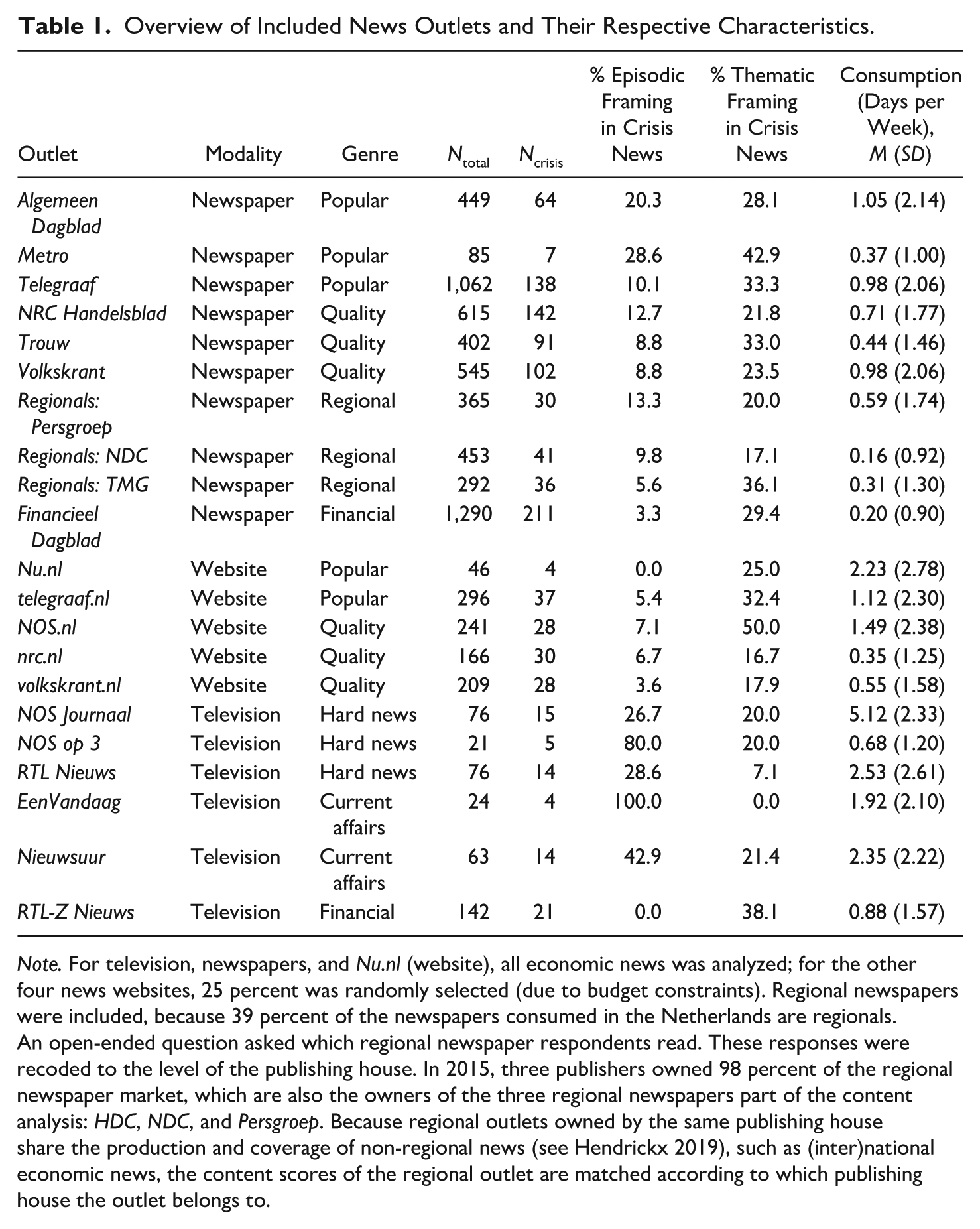
Note. For television, newspapers, and Nu.nl (website), all economic news was analyzed; for the other four news websites, 25 percent was randomly selected (due to budget constraints). Regional newspapers were included, because 39 percent of the newspapers consumed in the Netherlands are regionals. An open-ended question asked which regional newspaper respondents read. These responses were recoded to the level of the publishing house. In 2015, three publishers owned 98 percent of the regional newspaper market, which are also the owners of the three regional newspapers part of the content analysis: HDC, NDC, and Persgroep. Because regional outlets owned by the same publishing house share the production and coverage of non-regional news (see Hendrickx 2019), such as (inter)national economic news, the content scores of the regional outlet are matched according to which publishing house the outlet belongs to.
Measurements: Crisis news, episodic framing, thematic framing
For every economic news item, the coders answered this question in the codebook: “Is there an explicit reference to the (economic / financial) crisis? This means that the ‘crisis’ must be mentioned literally.” This was the case in 1,062 of the news items (i.e., 15 percent of the sample).
The presence of an episodic frame was measured with the following codebook question: “Does the news item include a personal example of a subject or problem to illustrate developments in the economy?” In total, 459 of such items were identified (7 percent of the sample). More specifically, 10.4 percent of all news items referring to the crisis were covered using an episodic frame (n = 110). This percentage is comparable to what is known about episodic framing generally (Wheatley 2020) and in economic news specifically (Beier et al. 2020). The use of episodic framing differs widely between media (see exact pattern in Table 1): In particular, popular and regional newspapers as well as television news framed news about the crisis episodically.
Thematic framing was detected through the topics of news stories. If the main economic topic of the news item was “general development or state of the economy,” “general economic growth or shrinkage,” or “general crisis news,” this was used as an indicator of thematic framing. Thematic framing was present in 27.6 percent news items that contained a crisis reference (n = 293). Thematic framing was less common in television news than in articles of the newspapers and news websites (see Table 1 for outlet details).
Although this happened rarely (n = 26), 8.9 percent of the articles with a thematic frame also carried an episodic frame, and 23.6 percent of the episodically framed articles also contained a thematic frame—confirming that episodic and thematic frames do indeed co-occur (Iyengar 1991; Rucinski 1992). This is possible in the definition that frames place “an emphasis in salience of certain aspects of a topic” (De Vreese 2002: 27); after all, multiple aspects might be emphasized in one article. Due to this operational definition of framing, there was also a share of news items (64.5 percent) that did not carry an episodic nor thematic frame regarding the economic crisis; these are articles that do not emphasize personal circumstances of exemplars (episodic) nor emphasize broader societal conditions (thematic), but highlight another aspect of the topic.
Intercoder reliability was assessed using a set of 137 news items that were identified as economic news by a minimum of three coders (on average 5.85, resulting in a total of 801 coded units). Reliability statistics were calculated requiring a minimum of two comparisons using Python-script Nogrod 1.1 (Wettstein 2018). Reliability scores are generally influenced downward for variables that are skewed and for larger numbers of coders. Nevertheless, the reliability scores of our content analysis variables were acceptable: presence of crisis news (Cohen’s Kappa = .86; Krippendorff’s α = .63), episodic frame (Cohen’s Kappa = 0.81; Krippendorff’s α = .60), and thematic frame (Cohen’s Kappa = 0.76; Krippendorff’s α = .70).
Panel Survey
A three-wave online panel survey was fielded by I&O Research on February 23 (Wave 1), April 20 (Wave 2), and June 15, 2015 (Wave 3). Reminders were sent after one and two weeks. A total of 9,112 respondents participated in Wave 1 of which 6,386 completed the survey (completion rate: 70.1 percent). Only respondents who participated in the previous wave were invited for the subsequent one. For Wave 2, 4,301 respondents completed the questionnaire (completion rate: 69.0 percent). In Wave 3, there were 3,270 completed surveys (completion rate: 77.0 percent). The original pool of respondents was recruited using random sampling from population registers. The final sample was not fully representative of the Dutch population: Respondents were older than average (18–91 years of age, M = 61.32, SD = 11.14), included an overrepresentation of males (66.2 percent) and more highly educated people (50.5 percent).
Independent variable
The frequency with which individual media outlets were consumed was asked on a scale from 0 (never) to 7 (all days in the week); all individual outlets that were part of the content analysis (see Table 1) were separately included in this survey battery. Values were recoded to range from 0 (i.e., no use, zero exposure) to 1 (i.e., maximal use, exposure to all items). Subsequently, the content features as revealed by the content analysis were multiplied by the consumption of specific outlets. Concretely, the frequency of consumption of a certain outlet (k) by an individual respondent (i) is multiplied by the summed amount of economic crisis news with episodic frame or with thematic frame present within this outlet k before every wave (j):
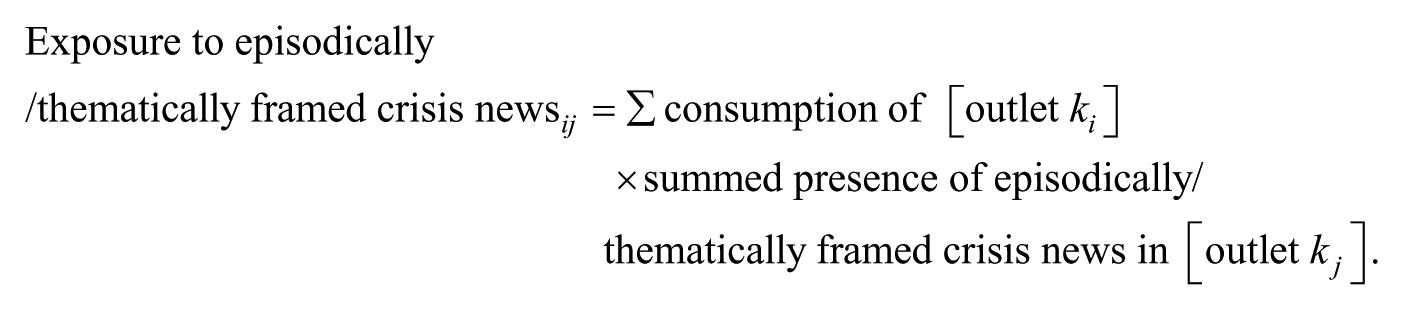
Thus, an index was created that measured the actual number of episodically framed and thematically framed news items to which individuals were exposed before the next survey wave. Without further rescaling, the minimum and maximum values of the independent variables ranged over time and across framing type. Respondents were, on average, exposed to 7.86 (SD = 4.84; min = 0; max = 32.85) episodically framed news items before Wave 2 and 8.88 (SD = 4.67; min = 0; max = 36.79) of such items before Wave 3. Exposure to thematic framing of the crisis occurred more frequently but was rather stable before Wave 2 (M = 15.00, SD = 11.90; min = 0; max = 92.42) and before Wave 3 (M = 14.93, SD = 11.93; min = 0; max = 91.42).
Dependent variable
Similar to previous studies (Ben-Porath and Shaker 2010; Feezell et al. 2019; Iyengar 1991; M. Kim et al. 2020), the attribution of causal responsibility was elicited with an open-ended survey question that was repeated in every survey wave: Who or what do you think is primarily responsible for causing the economic crisis? This open-ended question was asked in the beginning of the survey to avoid reactivity. An important divergence from previous (experimental) studies is that respondents were not asked to indicate responsibility for a particular story they had just been exposed to; responsibility attribution for the economic crisis was measured in general. This allows testing whether the effect of episodic/thematic framing also occurs outside of experimental circumstances, persists over longer periods of time, and applies to broader themes.
The open-ended answers of respondents that completed all the survey waves (n = 3,270 × 3 waves) were manually coded to detect the mentioning of responsible actors. Quality of coding was verified by testing the agreement between coder’s annotation and 327 randomly selected responses annotated by this paper’s lead author. Acceptable intercoder reliability scores were found for all the mentioned actors: national government and national politics (α = .89); European Union (α = .92); politics generally/unspecified (α = .83); banks (α = .90); and individual citizens and “the people” (α = .82). 1 Regarding the individual responsibility of citizens, respondents mentioned individual greed, naivety, stupidity, lack of discipline, and irresponsible financial decisions as reasons to attribute responsibility for the crisis to individual citizens. On average, people attributed responsibility to about one of these actors (M = 1.18, SD = 0.69, min = 0, max = 4).
In line with the theory, analyses focused on the first (societal responsibility of national government/politics) and last (individual responsibility of citizens) category of coded actors. Respondents attributed responsibility to individuals in 12.9 percent of the cases and in 20.3 percent to national politics. The relative predominance (i.e., percentage) of both these actor’s responsibility is calculated as the percentage of the total number of actors that were attributed responsibility to by the same respondent. Separate dependent variables were, therefore, created for individual responsibility (Wave 1: M = 10.88 percent, SD = 28.26; Wave 2: M = 8.69 percent, SD = 25.59; Wave 3: M = 8.89 percent, SD = 25.92) and societal responsibility (Wave 1: M = 14.35 percent, SD = 30.59; Wave 2: M = 13.07 percent, SD = 28.87; Wave 3: M = 13.37 percent, SD = 28.73). The relative responsibility of political actors and responsibility of individual citizens correlated weakly (r = −.14), implying that the two are mostly unrelated.
Moderator: Economic left-right ideology
Political ideology in West-European countries consists of two dimensions: economic and (multi-)cultural policy preferences (De Vries et al. 2013). For the current topic, only the first dimension matters. In the first survey wave, economic left-right ideology was measured with two survey items answered on 7-point disagree-agree Likert scales (α = .61): (1) the government must take measures to reduce income disparities and (2) it must be a priority for the government to ensure social security. Variables were recoded and centered, so higher scores implied a more right-wing ideological orientation (M = −1.21, SD = 1.35, min = −3, max = 3), indicative of preferring less economic state intervention.
Analysis
Data are analyzed in one pooled model, by reshaping the dataset such that every row reflects a unique respondent-wave combination. Clustered standard errors in a linear regression model are used to account for intra-individual correlation; these take into account that residuals are not independent but may correlate within respondents. In addition, analyses include a lagged dependent variable: By controlling for respondents’ previous score on the dependent variable (responsibility attribution at t − 1), we test whether any remaining variance is explained by the other independent variables (i.e., exposure to episodic/thematic frames). Hence, we examine how between-person variation in the independent variables (i.e., more or less exposure to episodic and thematic framing compared with other respondents) explains variation in change on the dependent variable (i.e., attributing more or less responsibility to individuals or political actors).
Control variables
To assure that it is frame exposure that causes the effect and not any confounding variables that are associated with both the independent and dependent variables, we include several control variables in the regression models. First, analyses control for Wave (coded as −1, 0, 1) to capture general overtime trends. Second, to assure that it is the amount of episodically or thematically framed crisis news that respondents were exposed to that caused the effect—and not news consumption as such—analyses control for the amount of news consumption (survey measurement).
Third, analyses control for time-invariant demographics (age, gender, education) and political variables that were measured once: internal efficacy; political economic knowledge (see Boukes and Vliegenthart 2019); frequency of talking about current affairs (see Boukes and Morey 2019). Fourth, five time-variant variables were measured in all three survey waves. Hence, we controlled for respondents’ score on these variables for the specific survey wave (full scales available on request): attention to economic news (three items, Cronbach’s α = .74); trust in economic media coverage (three items; α = .86); the consumer confidence index (five items per wave, α = .78, see Boukes et al. 2019); political trust (four items; α = .80); and mental well-being (five items, α = .86, see Boukes and Vliegenthart 2017).
To test Hypotheses 5 and 6, two interaction effects—that is, between economic left-right ideology and exposure to episodic framing and to thematic framing—are added to the models. It is necessary to simultaneously include these in the same model, because exposure to episodic framing and exposure to thematic framing correlate rather strongly (on average: r = .77). Hence, when testing one interaction effect, the other should be held constant in the model, to avoid that a confounding influence of the other content feature is detected.
Robustness
The Supplementary Information file demonstrates the robustness of the models and shows that substantively the same findings are yielded when two alternative analysis techniques are used. Findings are largely the same in a fixed-effects regression model with (but also without) the time-variant control variables (see Tables A1 and A2 in the Supplementary Information file). Moreover, similar findings are yielded when simply the mentioning of responsibility of individual citizens or national politics (constructed as dummy variable rather than as percentage) is used as a binary dependent variable in a pooled logistic regression model with clustered standard errors (see Tables A3 and A4 in the Supplementary Information file).
Results
Main Effects of Episodic and Thematic Framing
Table 2 shows the estimates for the effects of independent variables on the attribution of responsibility to individuals (Model 1) as well as to national politics (Model 2). The first regression model demonstrates a negative effect in the hypothesized direction for exposure to episodically framed crisis news (b* = –.05; p = .046): People who were exposed to more episodically framed news about the economic crisis than others attributed relatively less responsibility to individual citizens compared with other responsible actors. This finding supports Hypothesis 1.
Ordinary Least Squares Regression Models Predicting the Relative Predominance of Responsibility for the Crisis as Attributed to Individual Citizens (Model 1) or National Politics (Model 2).
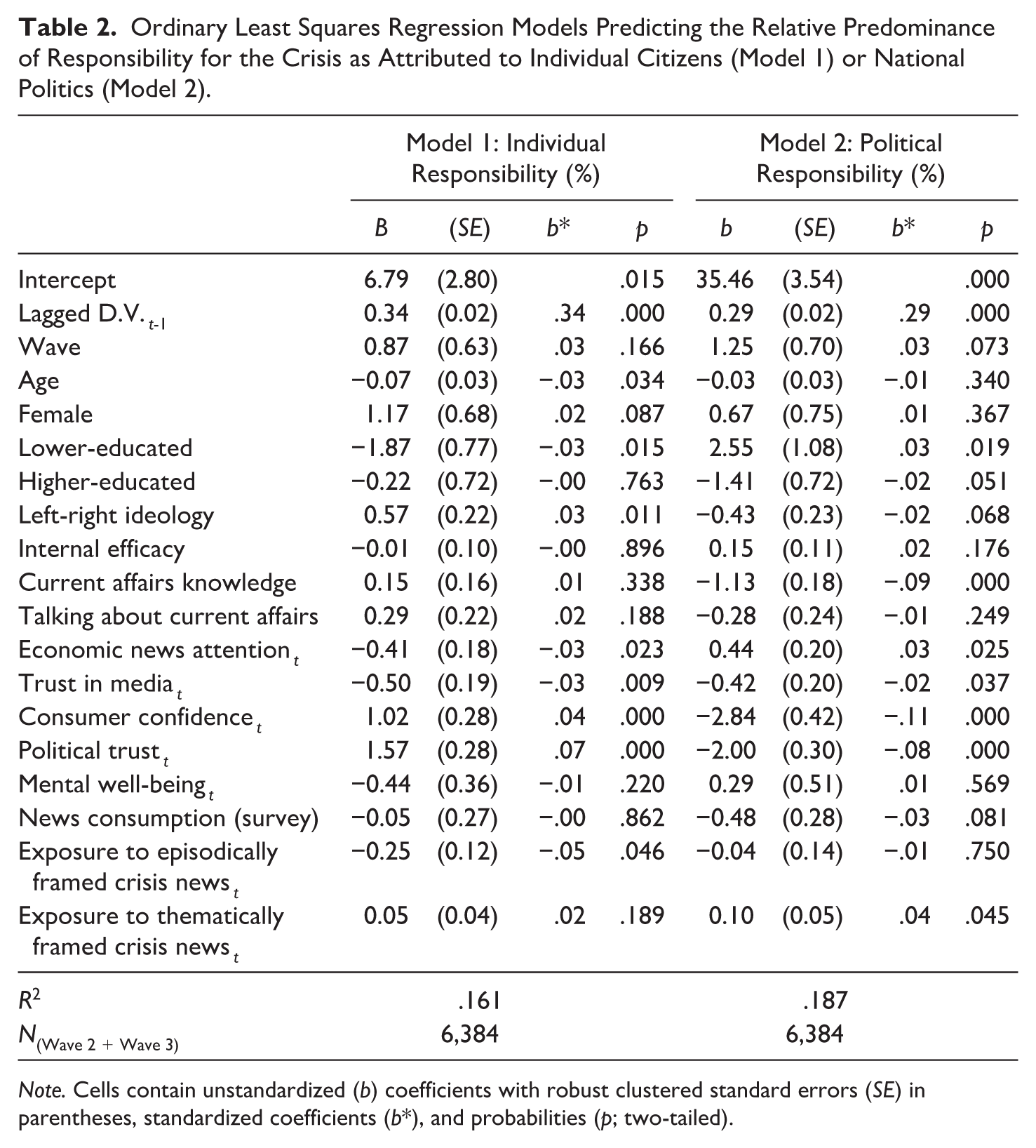
Note. Cells contain unstandardized (b) coefficients with robust clustered standard errors (SE) in parentheses, standardized coefficients (b*), and probabilities (p; two-tailed).
Attribution of responsibility to political actors for causing the economic crisis was, in contrast, not susceptible to episodic framing effects. This did not increase or decrease with more or less exposure to episodic framing of this topic (p = .750). Thus, Hypothesis 2 is rejected. No convincing main effects were found of exposure to thematically framed crisis news: More exposure to thematic frames in news about the financial crisis did not increase nor decrease the attribution of individual responsibility (p = .189) and the effect on the attribution of political responsibility was within the margins of significance (p = .045) but failed to replicate in the robustness checks (see Supplementary Information file). Hence, Hypotheses 3 and 4 are not supported. One interesting pattern—also confirmed in the robustness checks—is that the time-variant constructs of consumer confidence and political trust negatively influence political responsibility attributions. So, people who are more optimistic about the economy and have more trust in politics are less likely to blame political actors for causing the economic crisis.
Moderation by Left-Right Economic Ideology
Table 3 includes the interaction effects with political ideology in the regression models. No significant interaction effects were yielded on individual responsibility (Model 3). Rejecting Hypotheses 5a and 5c, the negative effect of episodic framing on individual responsibility was not conditional upon political ideology. Neither was thematic framing’s effect on individual responsibility conditional upon this factor, thus rejecting Hypotheses 6a and 6c. In sum, framing effects on individual responsibility—by episodic framing—occurred across-the-board.
Ordinary Least Squares Regression Models Predicting the Relative Predominance of Responsibility for the Crisis as Attributed to Individual Citizens (Model 3) or National Politics (Model 4) as Moderated by Political Ideology.
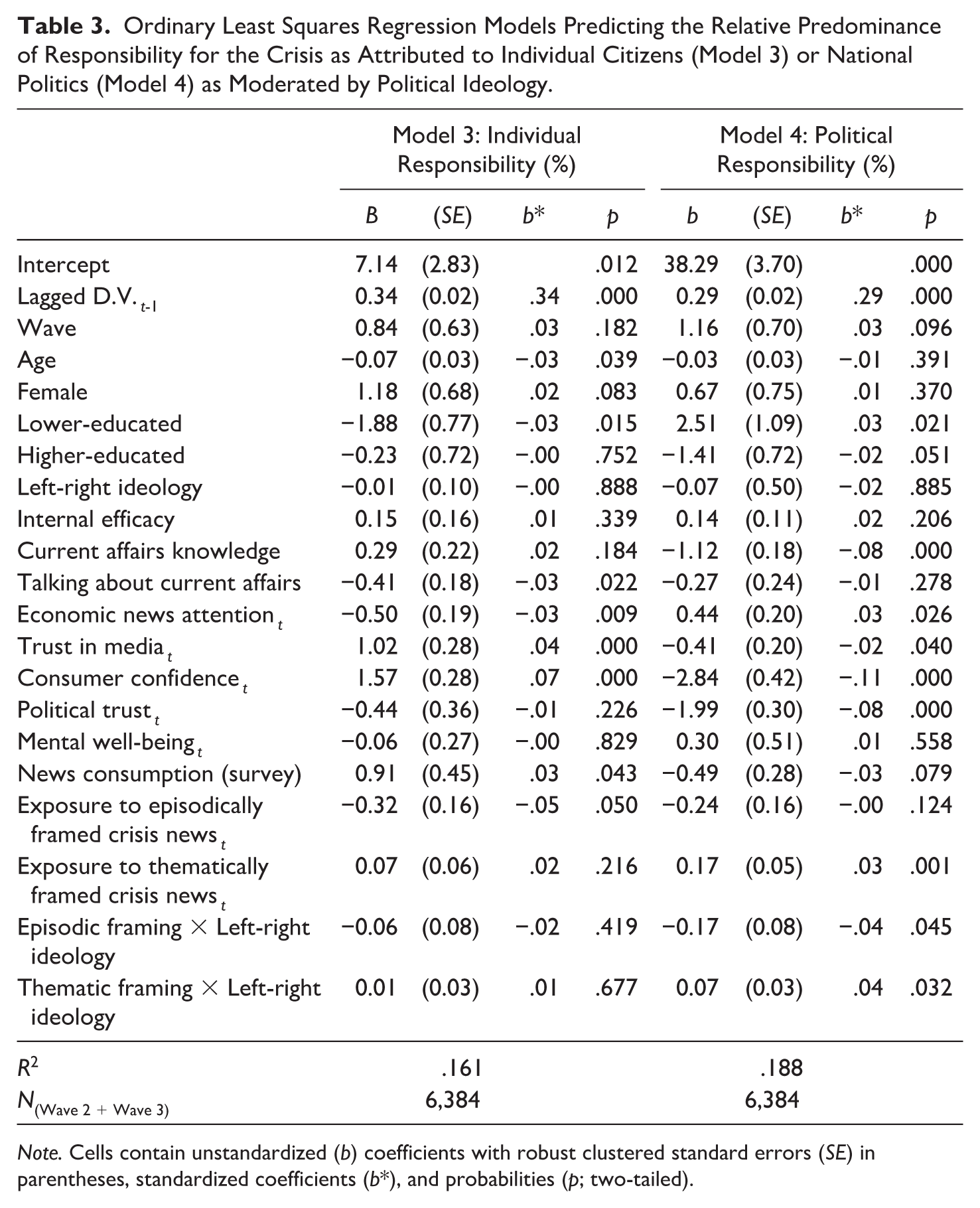
Note. Cells contain unstandardized (b) coefficients with robust clustered standard errors (SE) in parentheses, standardized coefficients (b*), and probabilities (p; two-tailed).
The interaction effects on political responsibility were both significant. Whereas no main effects of framing were yielded for this dependent variable, the effects were conditional upon political orientation. Regarding episodic framing, a negative interaction effect was found. Figure 1 shows that exposure to episodically framed news about the economic crisis did barely influence the attribution of political responsibility among people with an economically left-wing ideology. In contrast, the attribution of political responsibility of this issue considerably decreases among people with an economically right-wing ideology when they were exposed to more episodic framing. This pattern of findings provides evidence in support of Hypothesis 5d but not 5b.
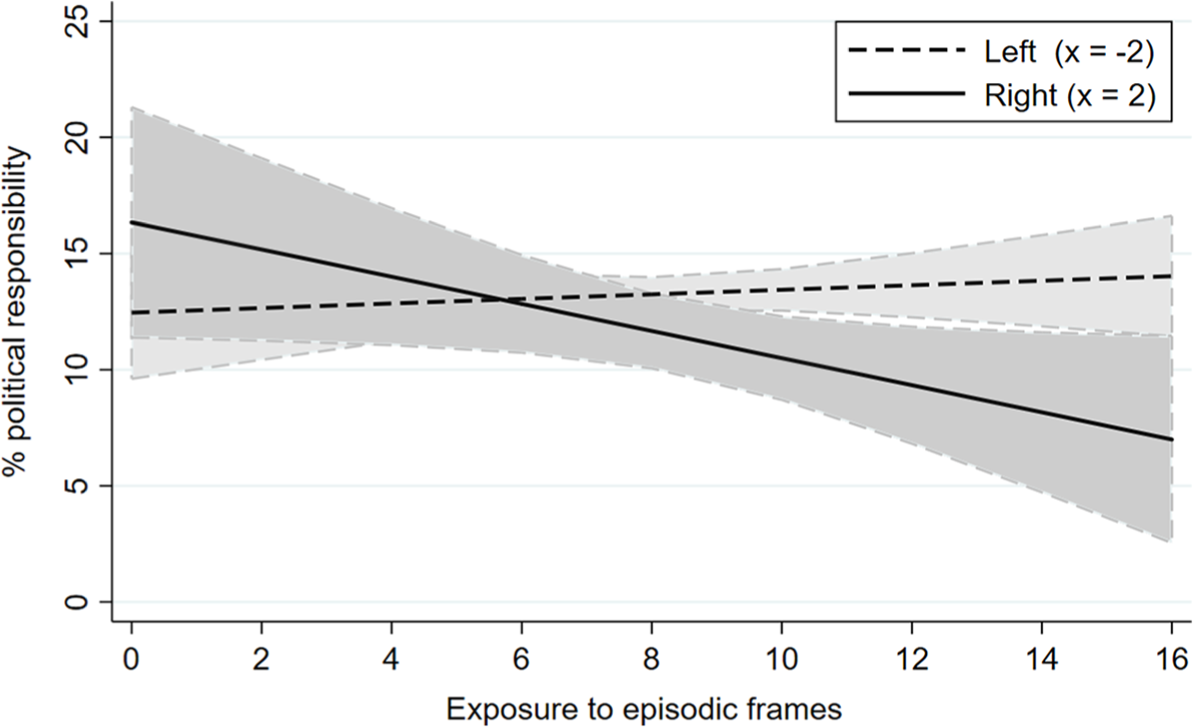
Effect of exposure to episodic framing on the attribution of political responsibility for citizens with a left- and right-wing political orientation regarding economic issues.
A positive interaction effect was found between thematic framing and political ideology. Figure 2 demonstrates that thematic framing only had an effect among people with a right-wing political orientation. Concretely, it demonstrates that a positive effect of thematic framing on political responsibility only occurred among right-wing citizens. People with a left-wing ideology were not affected. As exposure to thematic framing increased, right-wing citizens held a similar perception of political responsibility as left-wing people (see overlapping confidence intervals). Thus, Hypotheses 6b and 6b are rejected: Thematic framing narrows rather than amplifies the initial gap between citizens with a left-wing versus right-wing ideology.
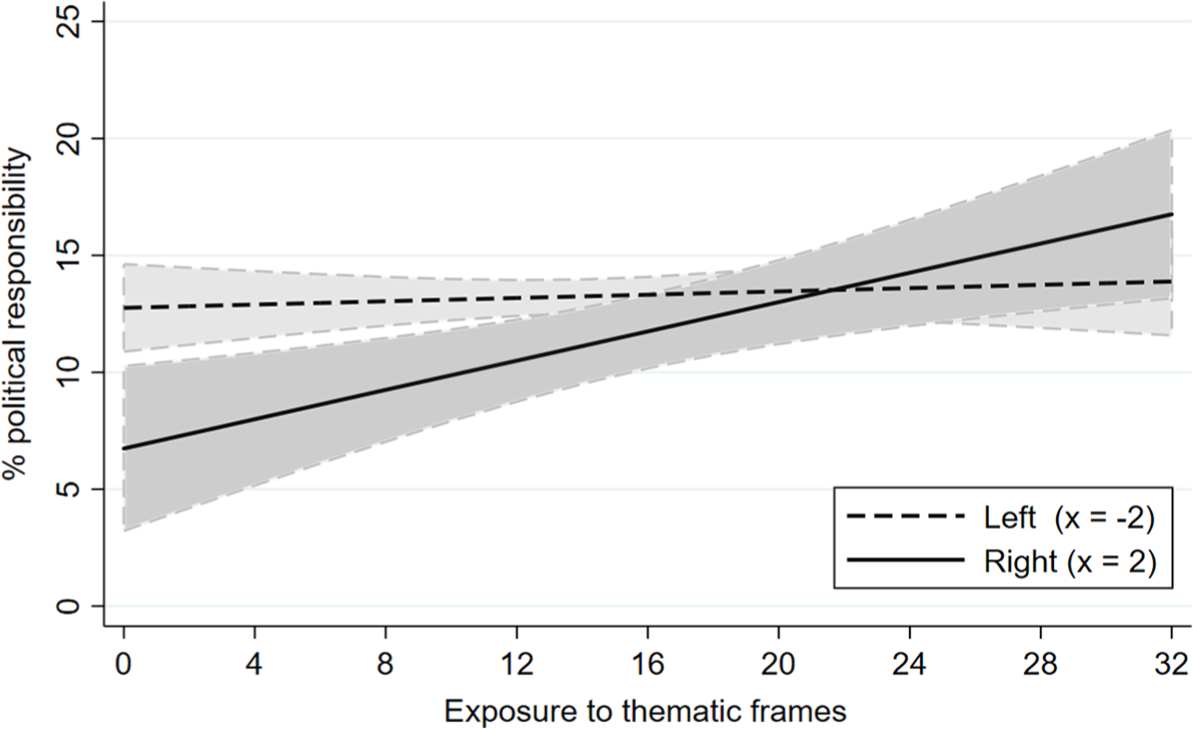
Effect of exposure to thematic framing on the attribution of political responsibility for citizens with a left- and right-wing political orientation regarding economic issues.
Discussion
The current study demonstrates that more exposure to episodically framed news about the economic crisis caused less attribution of responsibility to individual citizens for causing this crisis. The exposure to thematically framed crisis news did not affect the attribution of responsibility to individual citizens. Thus, it is especially episodic framing that may function as a counterweight to the increasingly dominant neoliberal discourse of elite policymakers who put blame on individual citizens rather than on system failure (Guetzkow 2010), whereas thematic framing on itself does not affect attributions of individual responsibility. A decreasing attribution of responsibility to individual citizens as the outcome of more exposure to episodic framing aligns with the conclusions of previous experiments in the North-European context (Aarøe 2011; Andersen et al. 2017; Boukes et al. 2015). However, it conflicts with U.S.-based studies and Iyengar’s (1991) prediction that episodic framing restricts citizens’ ability to place public issues in a more general or abstract context and, therefore, would make the individual a more likely target for responsibility attributions.
The question remains what would happen when both an episodic and thematic frame are present in one news story. Unfortunately, too few of such “mixed frames” stories were detected in the content analysis (n = 26) and citizens were, accordingly, too rarely exposed to them (M = 2.09, SD = 1.43) to test this in a statistically robust manner. However, exploratory analyses suggest that mixed-frames stories have a negative effect on individual responsibility attribution—just as was found for exposure to episodic framing. When combined, the effect of episodic framing may thus be dominant; this finding is in line with previous experimental research (Boukes et al. 2015) and can be explained by the strong and lasting impact of episodic framing (Aarøe and Petersen 2018; Bas and Grabe 2015). Further research is necessary to confirm this.
The responsibility that was attributed to political actors did not increase (nor decrease) across-the-board with more/less exposure to episodically or thematically framed crisis news. Framing effects on political responsibility, however, were conditional on economic ideology. Episodic framing’s effect reinforced citizens’ existing beliefs (left-wing people attributing slightly more responsibility to political actors, and right-wing people attributing considerably less responsibility to political actors). Thematic framing, in contrast, increased the attribution of political responsibility among people with a right-wing economic ideology. Right-wing citizens actually responded to thematic framing in the way that Iyengar (1991) predicted and what previous U.S.-based studies found. Arguably, North-European citizens with a right-wing ideology hold political-economic preferences that are more similar to the average American citizen—which explains why they respond similarly to this type of framing. These right-wing people may not feel more empathy after exposure to a personal narrative, but may be more persuaded that there is a political responsibility after a story is framed in abstract and general terms. After studies showing that the mixture of findings regarding effects of exemplars in the news are potentially explained by cultural context (Aarøe and Petersen 2014), news item topics (Feezell et al. 2019), or exemplar features (Ben-Porath and Shaker 2010; Hopmann et al. 2017; Ostfeld and Mutz 2014; Springer and Harwood 2015), the current study demonstrates that audience characteristics (i.e., ideological orientation) are an additional factor to explain why framing effects might run in opposite directions.
Compared with existing (experimental) research that demonstrated the one-shot, short-term effect of episodic framing, the current work revealed that this effect can also be detected on the long-term (e.g., Aarøe and Petersen 2018). The approach of linking content analysis data to panel survey data, thereby, stays close to the fundamentals of framing theory (see Chong and Druckman 2007), which states that framing effects are a learning outcome that benefits from repeated exposure (Chong and Druckman 2007: 111). Framing effects are “an accumulative and dynamic effect process” (Lecheler et al. 2015: 339), because people are not exposed to frames in a vacuum of alternative messages, but they consume multiple news stories in which different frames continuously compete with each other (Sniderman and Theriault 2004). The current study, by means of its repeated measurements, thus, contributes to the literature with the insight that episodic and thematic framing also have a cumulative and lasting effect in real-world conditions where the frames compete with alternative journalistic interpretations of this topic.
Although this study benefits from its unique methodological design, this simultaneously is also the cause of its main limitation (see, e.g., Fazekas and Larsen 2016; Schuck et al. 2016). Using the linkage approach rather than a clean experimental design, we cannot be 100 percent sure that the effects of episodic and thematic framing are not the outcome of associated content features that were not measured (e.g., exposure to other frames). Fortunately, our data allow including general media consumption (survey measurement) and frame exposure variables in one model: Because we included a rich variety of media outlets that differed considerably on the presence of these content features (see Table 1), multicollinearity was not problematic when all three independent variables are included in one model (VIFmax = 4.66). Hence, we could disentangle the effect of general news consumption from the impact of exposure to episodic and thematic framing. Nevertheless, the linkage approach inherently involves unreliability in linking content analysis to panel survey data (Scharkow and Bachl 2017). Both methods cope with measurement imprecision—either in the judgments of coders (Bachl and Scharkow 2017) or in respondents’ self-reports of news consumption (Prior 2009). The consequence is that when using this method, “most likely, the true effects are stronger than the observed effects” (Scharkow and Bachl 2017: 337). Thus, the effects found in this study could potentially be even more vigorous in reality.
Altogether, the current study employed a unique empirical approach and provides new evidence that episodic framing negatively affects the attribution of responsibility to individual citizens. Moreover, it fills an important caveat in the literature by showing that individual left-right ideology is a crucial moderator that determines the direction of framing effects on the attribution of political responsibility. Just as in previous studies on this topic, one important limitation is the ecological validity of findings. The only clean way to test whether and how the effects of episodic and thematic framing differ among European and American citizens (or any other geographic area) is a comparative experiment conducted in multiple countries on the same moment and with the same (translated) stimuli. This is a crucial next step to be taken by future research.
Supplemental Material
sj-pdf-1-hij-10.1177_1940161220985241 – Supplemental material for Episodic and Thematic Framing Effects on the Attribution of Responsibility: The Effects of Personalized and Contextualized News on Perceptions of Individual and Political Responsibility for Causing the Economic Crisis
Supplemental material, sj-pdf-1-hij-10.1177_1940161220985241 for Episodic and Thematic Framing Effects on the Attribution of Responsibility: The Effects of Personalized and Contextualized News on Perceptions of Individual and Political Responsibility for Causing the Economic Crisis by Mark Boukes in The International Journal of Press/Politics
Footnotes
Declaration of Conflicting Interests
The author declared no potential conflicts of interest with respect to the research, authorship, and/or publication of this article.
Funding
The author(s) disclosed receipt of the following financial support for the research, authorship, and/or publication of this article: This work was supported by the Netherlands Organisation for Scientific Research (NWO) with a VIDI grant under project number: 016.145.369.

Supplemental Material
Supplemental material for this article is available online.
Notes
Author Biography
References
Supplementary Material
Please find the following supplemental material available below.
For Open Access articles published under a Creative Commons License, all supplemental material carries the same license as the article it is associated with.
For non-Open Access articles published, all supplemental material carries a non-exclusive license, and permission requests for re-use of supplemental material or any part of supplemental material shall be sent directly to the copyright owner as specified in the copyright notice associated with the article.
