



Abstract
The recent rise of a more transnationally networked political right across Europe and the United States has been accompanied by an emerging alternative digital news infrastructure through which information circulates and shared epistemologies are established. This paper examines the extent to which digital news sites on the right are interconnected within and across countries. It further explores which additional sites serve as transnationally shared reference points of such news ecology on a transnational scale. To do so, we investigate hyperlink networks between alternative right-wing online news sites (RNS) in six western democracies (Austria, Germany, United States, United Kingdom, Denmark, Sweden). Our analysis draws on hyperlink data harvested from 65 RNS for three months in 2018. The results show that RNS do establish interlinked alternative right-wing news ecologies, as they connect to likeminded RNS within and across borders. Furthermore, we see substantial variation across countries, where RNS from countries with less established alternative right-wing news infrastructure are more likely to link transnationally to RNS. The United States represents an outlier in that it features the largest and domestically most integrated network of RNS, while U.S. sites function as hubs for transnational connections from European RNS. Apart from connections between RNS, we find that legacy news media are crucial transnationally shared reference points. We conclude that rather than presenting an insulated, alternative sphere, the emerging digital news ecology on the right seeks to link up to the broader information environment across borders.
Keywords
Introduction
Recent years have seen increasing levels of polarization, as well as the rise of right-wing populist parties and movements throughout Europe and the United States—a trendline some have described as “the end of the liberal world as we know it” (Zielonka 2018). Indeed, right-wing actors across these countries have profiled themselves as opposing longstanding democratic norms and have articulated their positions by critiquing liberal institutions and the perceived hegemony of the political mainstream (Galston 2018). The type of politics espoused by right-wing actors has traditionally focused on national politics and presented itself as skeptical of transnational cooperation. Yet recent scholarship on right-wing movements and parties has also pointed toward shifts away from protectionist or nationalistic perspectives and toward a form of pan-European and transatlantic discourse of “civilizationism” focusing on shared cultural values, which are purportedly under collective threat from progressive or outside forces (Brubaker 2017). Other studies observe transnational networking and institution-building among European right-wing parties to pursue common, supranational goals (Lefkofridi and Katsanidou 2018). To some degree, this network has expanded across the Atlantic, and scholarship has pointed toward internationally linked, coordinated action from right-wing actors, wherein networked framing efforts transcend the boundaries of a particular national context (Bob 2013).
Notably, the rise of a more transnationally networked political right across Europe and the United States has been accompanied by rapid shifts within the news media systems in which they operate and the rise of novel information dissemination methods. News audiences find themselves exposed to an increasingly abundant spectrum of sources for political information (Van Aelst et al. 2017). Most important, in the present case, is the rise of alternative news outlets, which cater to specific ideological segments of the news consuming public (Haller et al. 2019; Holt 2020). Here, too, recent developments in the media market have shown right-wing actors using digital platforms to build transnational media companies, such as the attempt to establish the AltRight Corporation as a U.S.–European media enterprise (Feder and Mannheimer 2017). These networking activities from right-wing political actors, intending to build ideological coalitions across borders, appear to go hand-in-hand with a new digital news infrastructure on the political right. Partisan online news sites provide an infrastructure for diffusing right-wing news (Heft et al. 2020). In this context, right-wing news sites in Western Europe and the United States have been described as part of ongoing attempts to establish counter-publics, which seek to push far-right agendas into the collective consciousness of broader publics (Kaiser and Rauchfleisch 2019). Part of this strategy depends on networked online communication to foster ideological cohesion and force multiplication within an integrated news ecology on the right.
Against this backdrop, our research examines whether transnational networking can be observed among new formations of right-wing news production in a digitally connected information environment. To do so, we investigate hyperlink networks between alternative right-wing online news sites (RNS) in six western, democratic countries. The selected sites describe themselves as alternatives to mainstream news sources and are marked by hyper-partisanship and a clear right-wing ideological stance. The countries included in the study represent cases featuring immediate geographical, cultural, or linguistic proximity and, hence, make a strong test for an emergent transnational news ecology on the right. In all sampled countries, RNS have—to varying degrees—increased in number and visibility over recent years (Heft et al. 2020). We draw on data collected via RNS domains to address the following research questions:
While this first question focuses on direct connections among the RNS included in the sample, we secondly approach RNS networks in relation to the larger information environment on the Internet. From this perspective, RNS are further, and indirectly, united through common reference points, which function as transnationally shared hubs for RNS attention and, thus, contribute to a common information environment for RNS across borders. Hence, we also ask
The paper is structured into three parts. First, we outline the theoretical considerations underlying the concepts of network structures established via hyperlinks. We draw on literature that understands hyperlinking as strategic practice and elaborate on the conditions that can explain specific patterns of linking behavior. Second, we describe the study’s design and methods. The third section introduces the results of the analysis of RNS hyperlinking practices. We report, first, our findings concerning the connections among the RNS (i.e., the primary network), both within and across countries and, second, our results on the key actors emerging as transnationally shared reference points between the national news ecologies. The paper’s final section discusses the findings and provides suggestions for future research.
Networking and Integration among Right-Wing Digital News Sites
Recent research has shown that RNS have established themselves in several countries and represent a new force in the broader media environment (Haller et al. 2019; Holt 2020). Although these sites may differ in some of their characteristics, such as their reach or funding structures, their rise may be considered as a transnational phenomenon because they share ideological foundations and occupy similar information niches across countries (Heft et al. 2020).
In the emergence of an integrated right-wing information ecology, digital technologies offer unique opportunities to build (trans-)national networks of mutual attention allocation, recognition, and support. Hyperlinks are one such technological capability, as they enable one website to link with another (Park 2003: 49). This capability to establish connections makes hyperlinks a key structuring feature of online communication. However, beyond hyperlinks’ technical functionality, we are interested in the social context of link creation and its social or communicative function. Following the extant literature on the subject, we understand hyperlinking as an intentional and strategically planned communicative act (Jackson 1997; Park 2003). Because “[. . .] the presence of a link reflects a communicative choice made by the designer [. . .]” (Jackson 1997: n.p.), hyperlink networks are defined as a “set of web-based connections that emerge from the strategic linking practices of organizational actors” (Young and Leonardi 2012: 233). Also, since hyperlinks expand individuals’ or organizations’ social or communicative relations, it may also be assumed that “the structural pattern of hyperlinks [. . .] serves a particular social or communicative function” (Park 2003: 53) and that those patterns represent networks of people or organizations, reflecting social and cultural structures (De Maeyer 2012: 739).
While motivations for linking can be manifold, links must be interpreted in context (De Maeyer 2012: 737). The institutional setting to which actors belong may condition their motivations for link formation, much as their overall institutional norms and conventions condition organizations’ linking practices within their organizational cultures (Young and Leonardi 2012: 236). That being said, research has also identified general functions of hyperlinks (and their underlying motives) (Ackland and Gibson 2013; De Maeyer 2012; De Maeyer and Holton 2016; Ryfe et al. 2016; Young and Leonardi 2012; for a recent overview see especially Maier 2018). 1 Based on this research, we can differentiate between hyperlinking as a professional journalistic strategy and hyperlinking as a political or movement strategy.
Hyperlinking as a Professional Journalistic Strategy
As a means of information provision, links supply additional material, sources, and facts for concision and depth. In this case, Ackland and Gibson (2013) argue, “the link is targeted toward a specific section or pages within a website, rather than the actor itself (e.g., party) that is behind the site” (p. 233, emphasis added). Placing links to background information enables journalists to focus on new information, while still providing context (De Maeyer and Holton 2016: 782f.). Karlsson et al. (2015) show that online news media primarily use internal links and that these are perceived as more important. Chang et al. (2012) and Coddington (2012) argue that financial considerations are the main constraints of news media’s linking behavior. News sites strive to keep users on their sites for as long as possible to generate advertising revenue and strengthen the brand. Therefore, directing readers to external websites—especially those of competing media—appears unlikely in this context. Bloggers, however, provide a much higher proportion of external links (Coddington 2012). In the news media context, it is more likely that external links—if present at all—point to the original material and the sources of reporting. Such “citational” links, as Ryfe et al. (2016) label them, demonstrate facticity and aim at strengthening the credibility and reputation of a website (Ching et al. 1996) and give credit to the original content producer (De Maeyer and Holton 2016; Ryfe et al. 2016).
Hyperlinking as a Political or Movement Strategy
While the research mentioned so far focuses on forms of journalistic news production in which hyperlinks stem from professional behavior to expand information and credibility, the hyper-partisan nature of RNS also suggests the possibility of other linking practices. A central question is to what extent RNS behave like media actors, which treat other media in their respective markets as competitors, or are they closer to the behavior of political and movement actors, which try to form coalitions among allies? Collaboration could be especially attractive for niche media with a political mission in a field where the boundaries between medium and political (movement) actors are blurred. Understood as a political or movement strategy, hyperlinking that aspires to and represents ideological cohesion and integration becomes more important. Among the main functions frequently described in party and movement research—also in the field of right-wing actors—are force multiplication, identity building and reinforcement, and opponent dismissal and issue control (Ackland and Gibson 2013). First, hyperlinks are resources that enable actors to reach out to likeminded organizations, thus enhancing the visibility of shared objectives and establishing legitimacy (Shumate and Lipp 2008). They provide an opportunity “to create and ‘cement’ political alliances” (Ackland and Gibson 2013: 232). This practice, called “force multiplication” (Ackland and Gibson 2013: 232), collectively elevates the importance of issues as a number of different sites draw attention to a subject. Closely related to the first function is the identity building and reinforcing role, in which links express support for a particular actor/group or encourage specific issues and views. Using hyperlinks to criticize other groups or other actors’ positions on an issue—opponent dismissal and issue control—can be a means of strengthening the boundaries between groups, thereby reinforcing the group identity of those using the hyperlinks (Ackland and Gibson 2013).
Hybrid Hyperlinking Practices of RNS
Although the two logics can be differentiated nicely on the analytical level, the hybrid nature of RNS, between media and movement actor, must be acknowledged, and these logics may be expected to be intertwined. Among parties and movements on the right, research has shown that linking to one another is used to coordinate action, amplify shared positions, foster a sense of community, and build an overarching group identity (Ackland and Gibson 2013; Burris et al. 2000; Caiani and Parenti 2013; Froio and Ganesh 2019; Pavan and Caiani 2017). That RNS are part of and profit from such community-building ties is exemplified by research showing that links from right-wing political actors, in this case PEGIDA pages, to alternative media of the same ideological stance are almost entirely affirmative (Haller and Holt 2019). Likewise, RNS may be expected to follow this political logic and link to one another.
To understand variations in the intensity and scope of this linking practice among ideologically close allies, it is paramount to consider context conditions in the national and transnational realm. Whether RNS establish digital networks on a national or transnational scale reflects their need to build such networks and coalitions. Generally, marginalized or extreme parties and groups have been shown to link more strongly amongst each other to disseminate their messages and gain followers when compensating for a disadvantageous stance in mainstream media coverage (Ackland and Gibson 2013). Research also suggests that transnational linking, to strengthen cross-country alliances, might be especially important for extreme groups, which face intranational pushback, as exemplified by the strong cross-country connections between white supremacist movements (Burris et al. 2000; Gerstenfeld et al. 2003). Following these considerations, we can assume that, in contexts where right-wing positions have less societal reverberation and little access to mass media and public debates, incentives to build connections among RNS—both domestically and transnationally—are higher, reflecting attempts at ideological integration and support among a cohesive group of likeminded outsiders. Yet, the less-developed right-wing alternative news infrastructures are at the national level, the more desirable integration into a transnational community becomes.
Beyond RNS’s integration into spheres of likeminded media within and across borders, their hybrid nature suggests additional linking practices. We can expect that the actors traditionally known to attract attention in online networks—legacy media and political elites—play a prominent role here (Heft 2019; Pfetsch et al. 2016). While linking out to political elites—and to political allies in particular—would speak for the prevalence of a political logic, linking to legacy media seems paradoxical at first glance, given that RNS more or less explicitly position themselves as a corrective to the so-called media establishment (Figenschou and Ihlebæk 2019; Holt 2020; Sandberg and Ihlebæk 2019). However, such a paradoxical propensity to link out to renowned mass media could be effective for various reasons (see Haller and Holt 2019 regarding political actors), not the least of which are professional journalistic reasons. Legacy media are prime sources for connecting to a broader news environment. The hybrid nature of RNS suggests that they may use legacy media as “opportune witnesses” (Hagen 1993), benefiting from their credibility where it fits the RNS agendas and positions. RNS may also engage in “recontextualization and reframing” (Ekman 2019: 552) of legacy media news content, aiming at opponent dismissal and issue control. As Ekman (2019: 552) notes, such recontextualization is common practice among RNS. Given those sites’ often limited resources, linking to existing content can also be a (professionally motivated) cost-saving strategy.
These hybrid linking practices apply to the transnational level, as well. The question here is, however, whether RNS from different countries are transnationally united in their attempt to either reap the same actors’ credibility or recontextualize or dismiss their communications. Instead of capturing the specific functions RNS links may carry in general, this research is interested in identifying the actors who attract RNS attention transnationally. By linking to the same transnationally shared reference points, especially beyond the inner RNS circle, RNS reach out and connect to broader transnational information environments.
Study Design and Method
Country Selection
This study considers RNS in six countries: Austria, Denmark, Germany, Sweden, the United Kingdom, and the United States. These countries provide three sets of pairs, which are geographically close and have been historically and culturally intertwined. Two of these pairs (Germany and Austria; the United States and the United Kingdom) also share a common language. In examining transnational ties, these factors make for a strong sample from which to expect at least some transnational connectivity.
Apart from existing ties between them, these countries vary in the establishment of a right-wing alternative digital news infrastructure. This infrastructure is more pronounced in Sweden and Germany, where RNS are more active and have a more established user base than in Denmark, Austria, and the United Kingdom. The United States is a particular case, which features an active right-wing news infrastructure in terms of supply of and demand for alternative right-wing news (Heft et al. 2020). To some extent, these patterns also reflect the countries’ variations concerning the overall acceptance of far-right positions in politics, media, and society. The acceptance of right-wing politics and actors is quite high in the United States and Austria. In the United Kingdom and Denmark, right-wing positions are fairly established in the political mainstream. In Denmark and Austria, the legacy media, at least indirectly, support actors and positions on the right, leaving room for those positions in mainstream media coverage (Bächler and Hopmann 2017; Schmuck et al. 2016). In the U.S. and U.K. media contexts, some legacy media directly support right-wing populist views (Esser et al. 2017; Mancini 2013). In Germany and Sweden, far-right parties have gained increasing electoral significance in the past years, but are, nevertheless, ostracized in the political sphere and are, to varying degrees shunned, by the more mainstream parties and the legacy media, who generally strive for demarcation from far-right and populist positions (Hellström and Hervik 2014; Reinemann 2017; Strömbäck et al. 2017).
Thus, RNS must position themselves differently in their respective societies and vis-à-vis the political mainstream. This might hold consequences for the interconnectedness of RNS in these societies, as well as their propensity to seek transnational connections. While close cultural or historical ties and geographic proximity would suggest at least some connectivity across countries, the country-specific national contexts may explain potential variations between the countries.
RNS Selection
To establish the RNS sample, we selected sites meeting the following four criteria (see Supplementary Information file for details and Heft et al. 2020): (1) The RNS were required to be classified as online news media, meaning they are characterized by some form of institutionalization—either by describing themselves as media or by giving information on editorial responsibility—and that they provide current, non-fictional, and text-based content with a given periodicity. (2) We only considered “alternative” media, understood as online news outlets that believe themselves to be correctives to a perceived political and media mainstream (Holt et al. 2019). (3) Sites were required to be classified as right-wing, meaning that their antihegemonic impetus comes together with positions and attitudes associated with right-wing ideology (Eatwell 1989; Rydgren 2018). We considered a broad spectrum of RNS, placed at the fringes of the right-wing political spectrum and ranging from right-wing populist sites to far right or even extreme right sites, without disentangling the nuances of their ideological stances in detail. (4) Sites were required to belong to one of the six countries under study, explicitly excluding genuinely transnational news offers.
A literature and online search was conducted to compile a list of potential RNS. We began with well-established, alternative online media of the extreme right, information provided by monitoring organizations, fact-checking websites and “watchdog” lists in each sampled country, studies in this field, and input from experts researching right-wing media or politics. This search resulted in a compilation of approximately 150 news sites. All sites were classified according to the inclusion criteria described above. Seventy sites fulfilled these criteria and, therefore, made up the RNS sample. For sixty-five of those sites, we were able to collect news content via the Media Cloud database (see below). Those sixty-five RNS are the source seeds for the hyperlink analysis (see Supplementary Information file, Table A1, for all source seeds).
Operationalization
We study the hyperlink networks of RNS based on the news sites’ article content. Transnationality, in general, can be understood as communication crossing and transcending the borders of nation-states and cultures, in the sense that those borders lose their relevance for communication processes (Wessler and Brüggemann 2012: 3). We operationalize transnationality in two ways.
First, we capture horizontal linkages between RNS from different countries (Benkler 2006: 212; Koopmans and Erbe 2004: 101) as follows: With respect to the content published on the sites, we use the Media Cloud database and consider all articles archived for each RNS between July 1 and October 1, 2018 (total: 102.379 articles). 2 We operationalize the RNS as sources and the websites to which they connected via a hyperlink as targets of communicative connection. The degree of transnationality is evaluated in relational terms: whether cross-border links between RNS of different countries prevail, or domestic links between RNS of the same country dominate.
To collect hyperlinks contained in the articles, we used the R package “rvest” (Wickham 2016b). Links from roughly 95,000 unique articles were obtained, resulting in approximately 12.5 million hyperlinks. We cleaned this collection by excluding structural, permanent links occurring on each article page of a domain—for example, permanent links to social media bars, navigational links to permanent subsections of a website and permanent commercial links. The remaining 725,450 hyperlinks are the basis for the following analyses.
Our second approach to measuring transnationality is similarity in the RNS’s propensity to link to, and, thus, devote attention to, common reference points, which may function as transnational hubs for RNS’s linking practices. We conceptualize the websites that attracted a substantial number of links from most of the national RNS sub-clusters as transnationally shared reference points. Those sites are crucial as they provide a transnationally shared information environment for the RNS. For this analysis, we consider all domains featured in hyperlinks by the RNS. To determine the importance of domains across the sampled RNS, we calculated a transnational reference score (TRS), which is defined as follows:
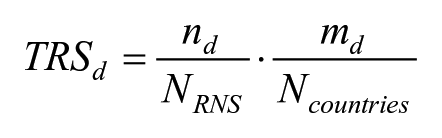
where
To classify the actors to which the seed RNS linked, a manual content analysis was conducted. We categorized the actor type, its scope, and the specific country to which the actor belonged. The coding reached intercoder reliability coefficients of 0.79 for the coding of the actors’ countries and 0.67 for actor types (n = 50, three coders, Krippendorff’s alpha). R (R Core Team 2013), and the packages igraph (Csari and Nepusz 2006), sna (Butts 2016), network (Butts 2008), and ggplot2 (Wickham 2016a) were used to analyze and visualize the networks.
Findings
Networked Right-Wing News Sites within and across Borders
Hyperlinking allows RNS to form a (trans-)nationally networked news ecology for spreading right-wing views. We therefore start by looking at the sites’ horizontal linkages to other RNS. In general, hyperlinking is a prominent feature of most RNS, given that this sample contained 725,450 hyperlinks relevant to this work. Among those, there were 23,806 connections between the RNS included in our study.
U.S. sites are the most active in using hyperlinks to connect to other RNS, showing by far the highest level of outlinking (average outdegree 647.3, n = 33). Hotair, The Gateway Pundit, and Townhall top the list (see Supplementary Information file, Table A1, Outdegree). The German, Danish, and Swedish sites rank next in outlinking to likeminded RNS (GER 149.3, n = 10; DNK 71.7, n = 3; SWE 66.9, n = 9). As for Germany, PI News and Journalistenwatch are especially active. 24nyt takes the lead in Denmark and Svegot in Sweden. However, the Austrian and U.K. sites are significantly less engaged in reaching out to other RNS (AUT 18.1, n = 7; GBR 2.7, n = 3).
Compared to the other national clusters, the U.S. RNS form by far the densest nationally interconnected community in the overall network (Figure 1). The United States is also well-connected to the less homogeneous, left-hand part of the network made up of all the other countries in our study. The Swedish RNS (bottom left corner of the graph) build a rather closed national community, which is, nevertheless, referenced by other countries’ RNS (e.g., Danish and German). In the top left corner, there is a cluster of German and Austrian RNS. The RNS in these countries are nationally interconnected but also display several connections to each other. An exceptionally strong connection exists between Journalistenwatch and Unzensuriert. While Danish RNS are interlinked, the British RNS are scattered across the graph.
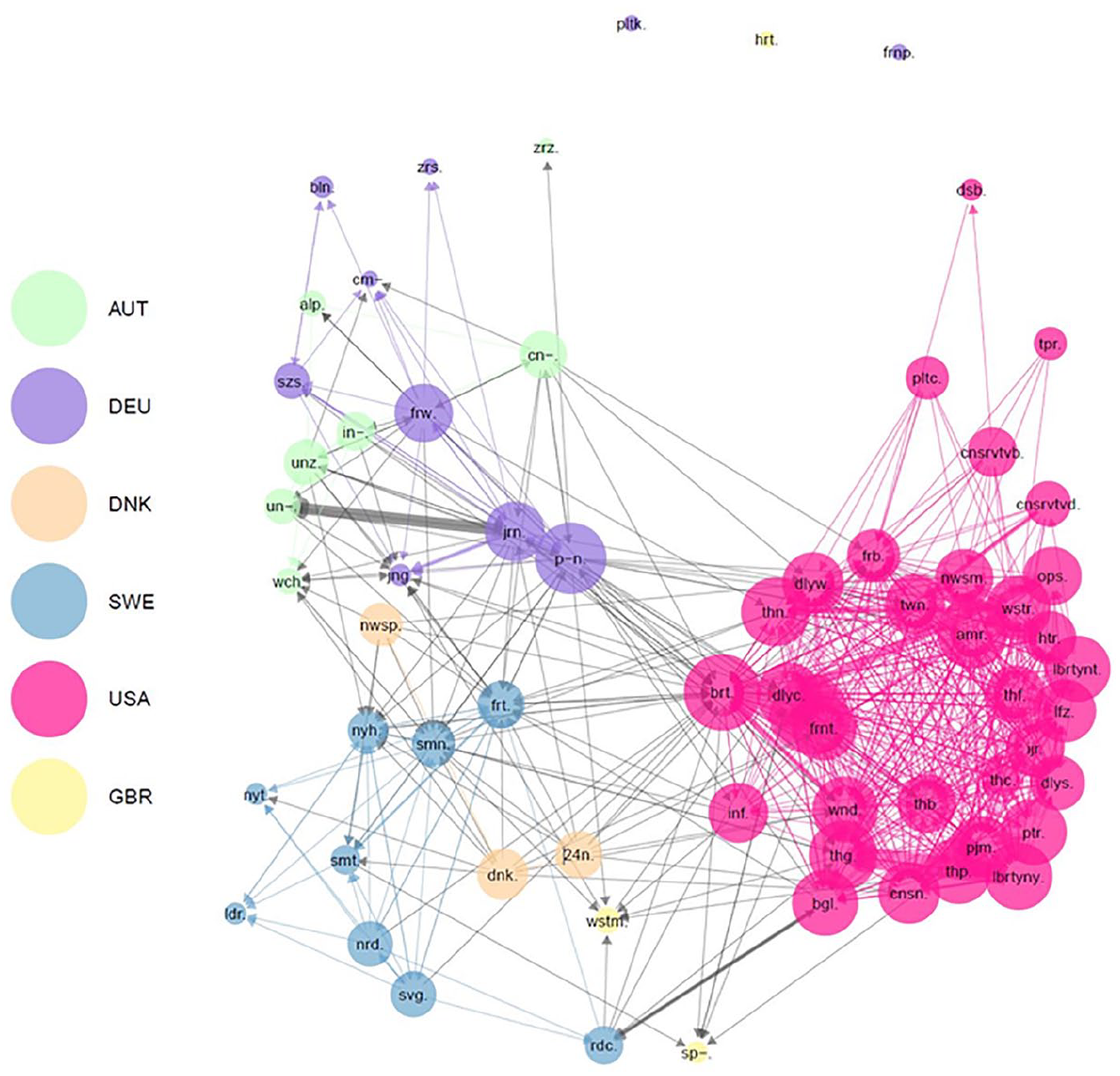
Hyperlink network among RNS (primary network).
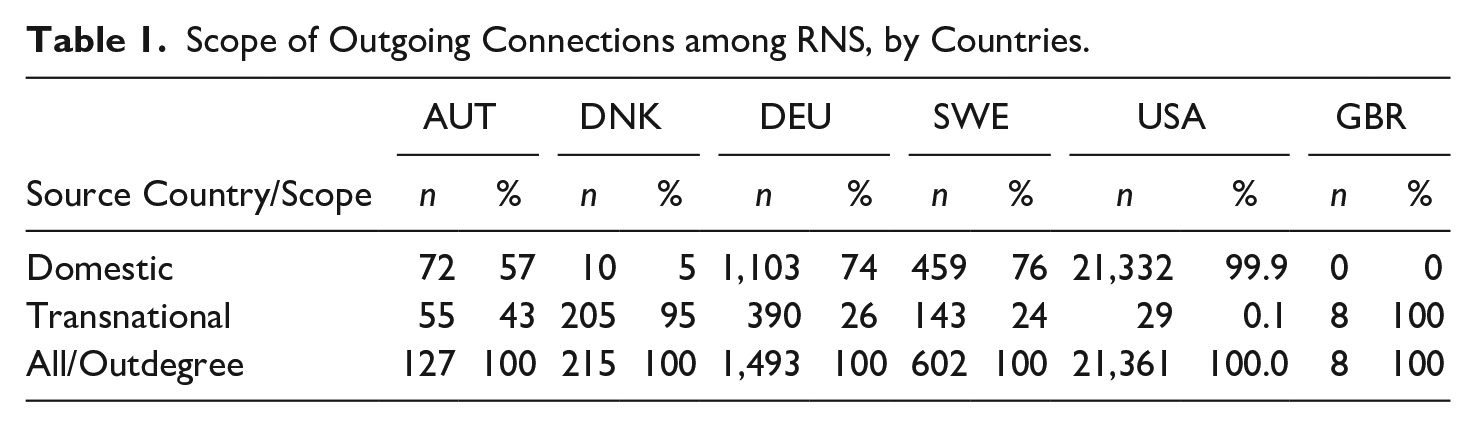
In the geographical distribution of this networked RNS news ecology, only 830 connections actually cross borders, and the countries differ significantly in the scope of their networking activities toward other RNS. Foremost in the United States, but also in Sweden and Germany, links to other domestic RNS clearly prevail. Austria has a more balanced distribution of outgoing links, with a tendency to internal linking. Danish RNS, in contrast, almost exclusively connect to RNS across borders, with 95 percent transnational links (Table 1). 3
Scope of Outgoing Connections among RNS, by Countries.
The external–internal (E-I) index is used to assess whether tendencies to establish domestic or transnational connections to other RNS apply more or less equally to all of a country’s RNS (Krackhardt and Stern 1988). The E-I index describes the relationship between external and internal connections among a network’s nodes or groups, which can be divided into mutually exclusive groups. 4
In some countries, the scopes of RNS linking behavior are scattered, while, in others, all RNS show the same overall tendency. RNS from Germany are the most heterogeneous, with sites having exclusively internal to exclusively external linking behaviors. Similarly, Swedish RNS are scattered but, overall, show a clear tendency toward domestic connections. Austrian and Danish RNS, however, homogeneously tend toward external, transnational linking, while U.S. RNS display a homogeneous, robust tendency toward internal linking to domestic sites. British sites link exclusively to RNS in other countries (Figure 2).
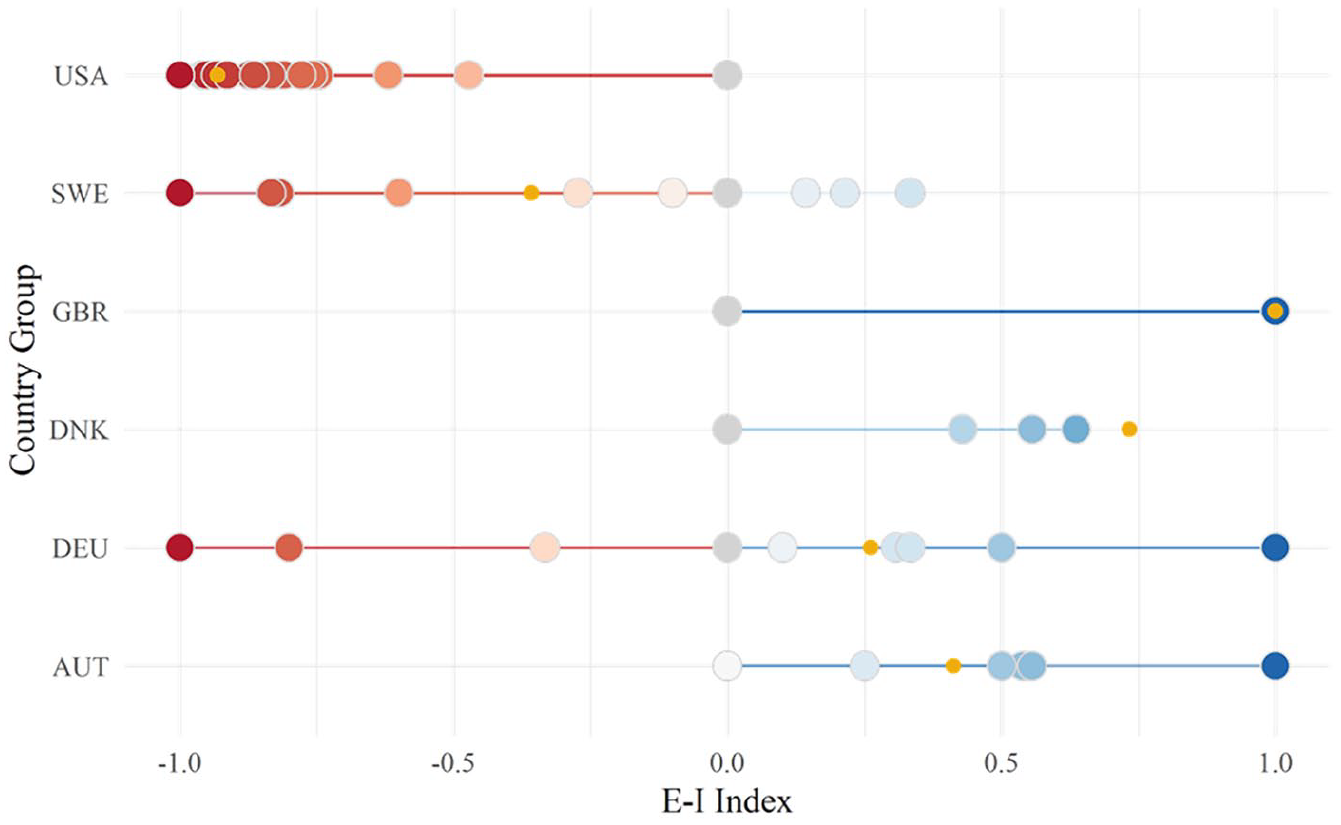
E-I Index by individual RNS and countries.
A closer look at the transnational connections (Table 2) shows that Austrian transnational links mainly connect to German sites and vice versa. Likewise, Danish RNS show a strong connection to Swedish RNS. However, in general, U.S. RNS are the main integrators of this networked news ecology, since U.S. sites, in aggregate, are the only ones to be addressed by RNS from all other countries. Danish and Swedish transnational links predominantly connect to U.S. sites, which further indicates the importance of this tightly integrated hub in other national contexts’ emerging right-wing news ecologies.
Connections among RNS, by Countries.
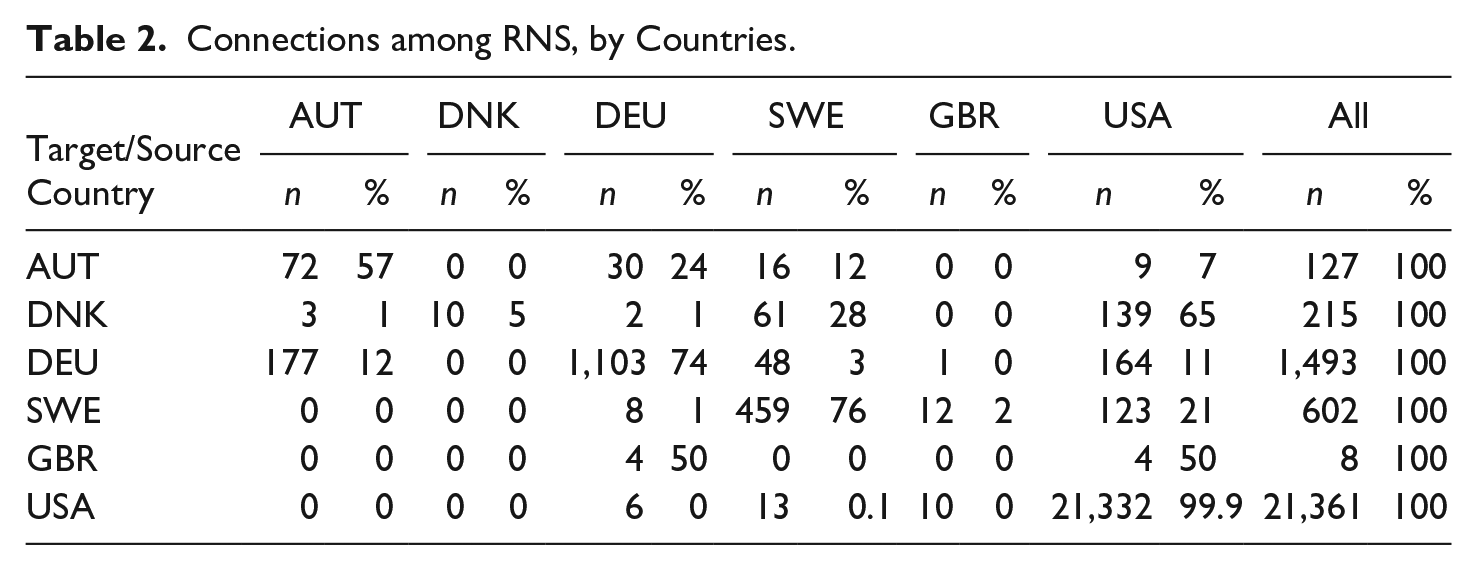
Concerning the first research question, we can conclude that RNS link to other RNS, which points toward an emerging alternative news ecology on the right. Those connections among RNS can be interpreted as a political strategy of reaching out to likeminded sites to join forces, foster the visibility of shared positions, integrate as a site, and bring audiences into the broader community of an interconnected right. Yet, the degree of RNS transnationality varies significantly by country and seems dependent on contextual factors, which may also account for the sheer number of RNS in the same media system. Swedish and German RNS operate in a context in which mainstream media and parties typically demarcate themselves from right-wing views. The alternative right-wing news ecologies in both countries display comparatively high levels of activity, primarily seeking to connect and integrate this news ecology on the national level. One interpretation for this pattern might be that the critical context unites the existing and quite well-established sites to strengthen the community and assign each other visibility and legitimation through mainly domestic cross-linking. A simpler interpretation can be derived from the quantity of RNS in a country. If there is a considerable number of alternative media with likeminded editorial policies on the national level, connecting to this news ecology might be the primary strategy before reaching out transnationally. Conversely, the size of the Danish right-wing news infrastructure is limited, but the existing RNS actively connect to other RNS. The Danish sites standing out as being most transnational in their connections indicates that integrating into a right-wing transnational news ecology could be the viable strategy in this context. U.S. RNS have been shown to almost exclusively connect to other American sites. Those results point toward a power dynamic in the gravitational pull of particularly integrated news ecologies. Thus, the most domestically networked and largest of the country clusters (the United States) draws the most transnational attention from other RNS country clusters, while practically not linking outwards at all. Meanwhile, and somewhat unsurprisingly, linguistic, cultural, or geospatial proximity is essential to determining where transnational linking structures are found, as evident in the examples of Austrian RNS linking primarily to German RNS or Danish and U.K.-based RNS transnational orientation.
However, considering overall RNS activity in establishing connections to external websites, the links to the RNS in our sample account for only a small fraction of the overall number of links set. We therefore turn to those additional sites, which attract RNS attention as transnationally shared reference points.
Transnationally Shared Reference Points
To expand from ideological news ecologies to the broader information environment in which they operate, RNS might link to transnationally shared reference points. Whether as citational links or attempts at issue control and opponent criticism, those reference points unite RNS attention on a transnational scale. Table 3 lists the top 100 domains identified by TRS. Domains that are part of the RNS sample we analyzed are marked in bold. In these instances, one of the sampled RNS featured among the top hundred transnationally shared reference points; this designation applies to only four RNS, all of which stem from the United States.
Top 100 “Transnational Shared Reference Points” in RNS’s Total Hyperlinks, Based on TRS Value.
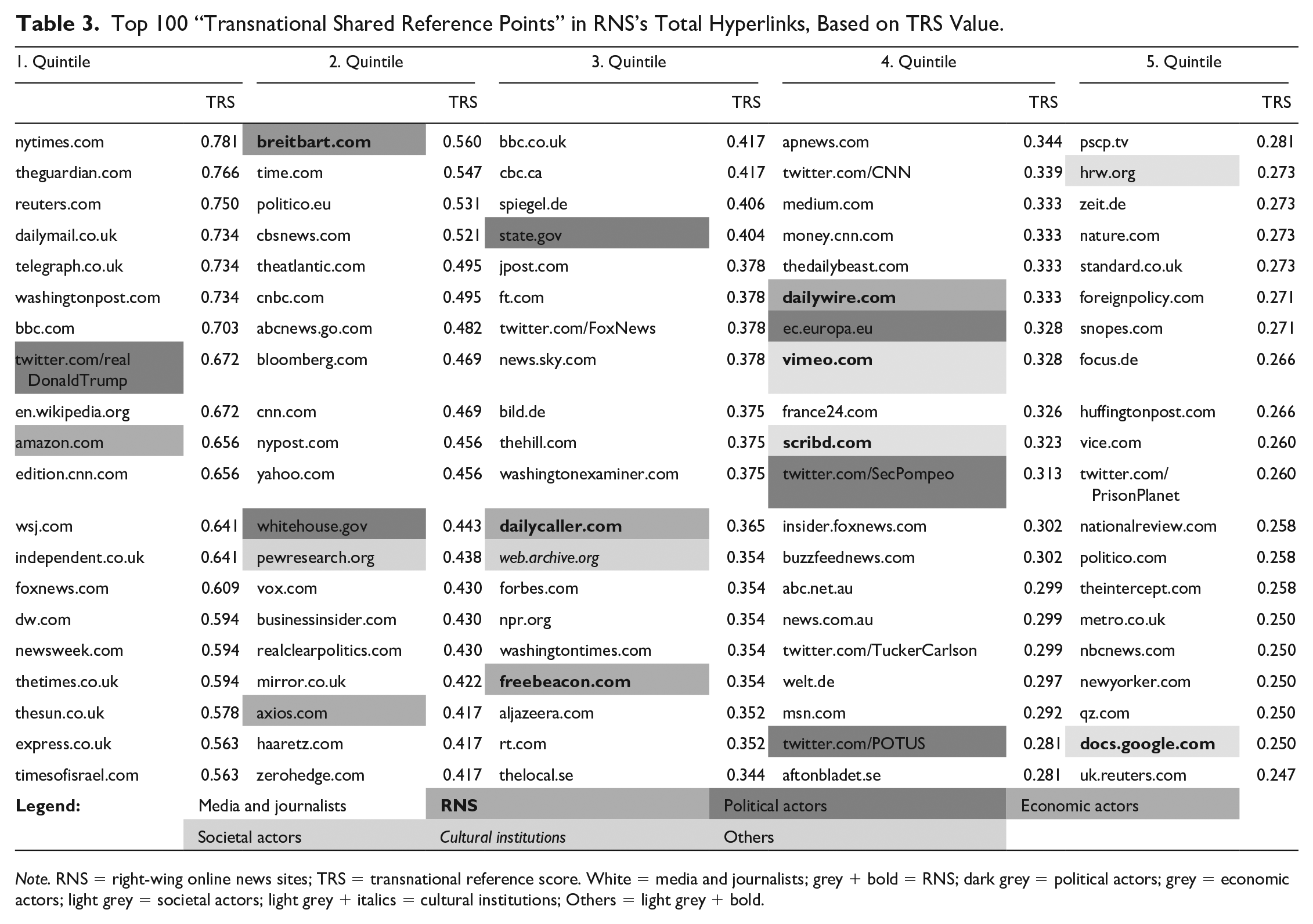
Note. RNS = right-wing online news sites; TRS = transnational reference score. White = media and journalists; grey + bold = RNS; dark grey = political actors; grey = economic actors; light grey = societal actors; light grey + italics = cultural institutions; Others = light grey + bold.
What stands out regarding the transnationally shared reference points is the striking number of legacy or “mainstream” media outlets featured across RNS: the New York Times, The Guardian, Reuters, and other such English language sites are ranked in the top ten. Also, further down the list, the top domains prominently feature other internationally renowned news outlets, ranging from The Times of Israel, Der Spiegel, or Aftonbladet to news aggregators or wire services like Reuters or AP News, tabloids like The Sun or Bild, and transnational media outlets like the BBC, CNN, Deutsche Welle, France24, Al Jazeera, or RT. Also included in the top transnationally shared reference points are U.S.-based sites that are ideologically aligned with the sampled RNS, such as Fox News, the Washington Examiner, or the German Welt. Overall, a rich mix of diverse sources attracts RNS attention across borders. Thus, the RNS are united in a strategic linking practice geared toward internationally renowned media sites from various countries. With this practice, RNS expand their spheres, connecting to the mainstream news environment. Apart from news sites, which clearly dominate, several Twitter profiles of policymakers and high-profile right-wing news pundits are in the top 100. Most notably, this includes Donald Trump, whose Twitter presence ranks at number eight, based on its TRS.
We also created a cut-off point at .1 for the
Conclusion
This paper investigated the existence and scope of digital news ecologies among RNS in six western democracies and the transnationally shared reference points to which RNS relate across borders. Given the affordances of digital media and the increasing emergence of RNS as platforms for spreading radical views, concerns have often been voiced that isolated counter-publics would emerge. These could increase the polarization of society by fragmenting news audiences into ideologically divided and hard-to-bridge audience clusters. Considering our findings from a macro perspective, such expectations must be qualified.
First, RNS do establish interlinked alternative right-wing news ecologies, as they connect to likeminded RNS within and across borders. We interpret this use of the affordances of the web to establish digital connections as a political strategy by hyper-partisan sites to create alliances among likeminded outsiders. In line with existing research on marginalized groups’ linking behavior, ideological cohesion and integration into a political community seem to be an avenue of identity- and community-building among the new alternative information disseminators on the right.
However, following this interpretation of an emerging information ecology, the data have also revealed that “relevant allies” obviously differ, as do the country-specific linking patterns among RNS. Thus, the second main finding of our analysis is that the scope of alternative networked spheres varies considerably, and the relevance of transnationality differs between RNS. In some countries, domestic RNS-links clearly dominate, while, in other countries, linking to—and, in our view, integrating—into a transnational community of ideologically close RNS is a preferred strategy. We started by arguing that hyperlink patterns reflect social and cultural structures (De Maeyer 2012) and are driven by the overall context conditions under which RNS operate. Thus, each country pattern requires an individual interpretation to do justice to the given context conditions. In the European countries, the German and Swedish RNS stood out for their nation-centered linking behavior to other RNS. Given their restrictive national contexts, which are prone to ostracizing right-wing actors and positions, this pattern could result from individual sites’ strategic attempts to integrate into a larger domestic right-wing news ecology. Collectively, this has the effect of stabilizing these networks and might, therefore, also be a strategy for enhancing the visibility of shared objectives and establishing an integrated community. Danish sites, in stark contrast, are the most transnational in their linking behavior to other RNS. This might point toward a strategy aimed at connecting to the broader transnational environment in cases where the domestic partisan news sphere is only marginally developed. Overall, the linking patterns among countries that are geographically, culturally, and linguistically close underline the persistent importance of those factors, which might also go hand-in-hand with longstanding organizational ties and a stronger sense of offline community.
The U.S. right-wing news ecology represents an outlier, both in its domestic integration and its transnational function. Not only are the U.S. RNS firmly and homogeneously domestically interconnected, but they also function as hubs drawing transnational connections from the other sampled countries. Although it might be objectively difficult to characterize U.S. RNS as ideological underdogs in the current climate under the Trump administration, their linking patterns can still be interpreted as indicating a strong sense of ideologically based community. This might reflect the high levels of polarization in the American media system overall and the developmental state of this news ecology, wherein close ties among the American right-wing often appear to be fostered by a shared perception of exclusion from an ostensibly “liberal” or even “leftist” mainstream. Furthermore, most U.S. RNS have been established institutions for a longer period than have many relatively new sites from the European countries. The United States might, therefore, point toward a potential future for the other countries’ news ecologies, where the digital right-wing is densely interconnected and, thereby, fosters a more insular alternative right-wing news ecology (Benkler et al. 2018). Further studies, however, should take newsroom practices and ownership structures explicitly into account as the differences in networking density might reflect different hyperlink cultures or intraorganizational ties in ownership consortia. As for transnationality, the U.S. sites functioning as a hub for European right-wing sites highlights the importance of transatlantic influences and reference points of the emerging news ecology among RNS.
Our analysis further revealed that RNS strive to link up to broader information environments and that the traditional mass media are crucial transnationally shared reference points for RNS. This high propensity to link to mainstream news sources questions the assumption that RNS are primarily engaged in building ideational networks, which, in turn, calls for further scrutinizing assumptions about echo chambers when describing the transnationally linked right-wing news sphere. While studies on partisanship and social media networks have shown how these exhibit strong signs of ideological coherence (Barberá 2015), research on digital counter-publics also highlights that those “cannot be thought without the mainstream public sphere that marginalises [sic] them” (Kaiser and Rauchfleisch 2019: 10). As the transnationally shared information environment emerging around the RNS ties very much in with the broader, more mainstream news environments online, the question for future studies is whether links are given for a “mainstream” domain to give credit to sources, in support of a particular narrative while using “opportune witnesses” to enhance legitimacy, or to criticize the mainstream sites’ content and control the framing of an issue. In fact, it is very likely to be a blend of those functions, and the new alternatives, in their linking behavior, likely combine outreach activities for right-wing ideational coherence with professional “citational” links (Ryfe et al. 2016) and other credibility enhancing references. How those different logics interact and how RNS with different stances on the spectrum between right-wing populist to extreme right may apply different strategies in this respect should be investigated further, accounting for the issue-based context in which links are embedded and the content to which they link. This would also reveal issue contexts, which might divide the right internally and would provide a better understanding of the structures and implications of those digitally networked alternative and mainstream media spheres across borders.
Supplemental Material
_online_supp_-_Heft_et_al_Transnat_Right_News_Ecologies_Supplementary_information_file – Supplemental material for Toward a Transnational Information Ecology on the Right? Hyperlink Networking among Right-Wing Digital News Sites in Europe and the United States
Supplemental material, _online_supp_-_Heft_et_al_Transnat_Right_News_Ecologies_Supplementary_information_file for Toward a Transnational Information Ecology on the Right? Hyperlink Networking among Right-Wing Digital News Sites in Europe and the United States by Annett Heft, Curd Knüpfer, Susanne Reinhardt and Eva Mayerhöffer in The International Journal of Press/Politics
Footnotes
Declaration of Conflicting Interests
The author(s) declared no potential conflicts of interest with respect to the research, authorship, and/or publication of this article.
Funding
The author(s) disclosed receipt of the following financial support for the research, authorship, and/or publication of this article: This work was supported by the German Federal Ministry of Education and Research, funding code 16DII114.

Supplemental Material
Supplemental material for this article is available online.
Notes
Author Biographies
References
Supplementary Material
Please find the following supplemental material available below.
For Open Access articles published under a Creative Commons License, all supplemental material carries the same license as the article it is associated with.
For non-Open Access articles published, all supplemental material carries a non-exclusive license, and permission requests for re-use of supplemental material or any part of supplemental material shall be sent directly to the copyright owner as specified in the copyright notice associated with the article.
