



Abstract
The idea that journalists make use of framing is widespread. However, systematic studies of the role of frame sponsors—that is, nonmedia actors who advocate a certain frame package—in influencing the patterns in frame package use by journalists are limited. Which characteristics make frame sponsors successful in frame building, and why? In this study, we propose a new way of understanding the relationship between journalists and frame sponsors, by studying to what extent high authority and having a strong stake in an issue are important predictors of frame coverage, and whether a bidirectional relationship between frame sponsors and journalists can be discerned in frame building. We examine the two court cases against Geert Wilders, leader of the Dutch Freedom Party (PVV), for alleged hate speech (2009–2020). Based on a content analysis of media input, such as statements, social media posts, and press releases (N = 220) of relevant frame sponsors as well as news stories about the court cases (N = 691), we demonstrate that there is a reciprocal relationship between frame sponsors and journalists in frame building. Frame sponsors influence journalists in the use of frame packages, but framing in news reports also stimulates frame sponsors to communicate similar frame packages in the future. Actors with high levels of authority and a strong stake in the issue are more successful in getting their preferred frame packages across. By acknowledging the bidirectional relationship and expanding knowledge on who benefits most from this relationship, this study advances literature on frame building.
In news reports, journalists often emphasize certain characteristics and perspectives, thereby making those views more salient than others (Entman 1993). While framing effects have been studied extensively, we know substantially less about the creation of frame packages (referred to as “packages”) (Hänggli 2012). Extant literature remains particularly inconclusive regarding the role of frame sponsors, that is, nonmedia actors advocating a package, in exerting power over the framing process (Hänggli 2012). 1 Which frame sponsors are successful in frame building, and why?
Prior research has commonly considered frame building as unidirectional; the outcomes are the packages that have “won” the contest between frame sponsors and are adopted by journalists (Scheufele and Scheufele 2010). We argue that the relationship between journalists and frame sponsors is, in fact, reciprocal, with success generating success: Journalists’ use of packages stimulates frame sponsors to communicate similar packages in the future. Certain characteristics make frame sponsors more successful in getting their packages across and, ultimately, benefit more from the reciprocal relationship with journalists.
Studying the interactions between frame sponsors and journalists in frame building requires substantial reduction of complexity. To accomplish this, we have to study an event with a clear starting date and a limited number of frame sponsors. The limited available literature primarily focuses on electoral or referendum campaigns, which often lack a clear starting date. Furthermore, the case should involve a small number of frame sponsors, each having a different stake in the issue and a strong incentive to achieve a favorable outcome. 2
The two court trials against Geert Wilders, leader of the Freedom Party (PVV), for hate speech in the Netherlands (2009–2020) meet these criteria. Court cases present a simplified and demarcated case of the battle between packages with a clear starting point and defined set of frame sponsors. The Wilders case started with the Amsterdam Court’s surprising 2009 ruling that he should be prosecuted for his statements about Islam. This decision was immediately mediatized, forcing involved actors (e.g., victims) to react. Other actors were hesitant in commenting, as they feared that media attention would benefit the party’s electoral success (Van Spanje and De Vreese 2015). 3
We advance understanding of frame building by acknowledging and studying its dynamic nature. As the three main frame sponsors were active on various (social) media platforms during the trials, this permits a study of both frame sponsors’ media input and news reporting about the issue. Autoregressive Integrated Moving Average (ARIMA) and Vector Autoregression (VAR) analyses allow us to disentangle the time order of effects and the reciprocal relationship between frame sponsors and journalists. Finally, adding to prior research, we include both institutional political actors (established parliamentarian and governmental) and nonpolitical actors. Our findings suggest a dynamic and reciprocal relationship between frame sponsors and journalists in frame building, and demonstrate that both authority and having something at stake are important characteristics determining frame sponsors’ success. We demonstrate this by adopting an innovative methodology for future research to replicate and extend.
Theory and Hypotheses
Packages and Frame Building
In Gamson and Modigliani’s (1989) conceptualization, frames are represented as a “package”, a “cluster of logical organized devices that function as an identity kit for a frame” (Van Gorp 2007: 64). A package’s core is represented by a central organizing idea, the “frame,” that gives meaning to events or issues and provides the package with a coherent structure. In addition, a package consists of manifest framing devices—word choices, metaphors, exemplars, descriptions, arguments, and visual images—and (manifest or latent) reasoning devices (Pan and Kosicki 1993). Reasoning devices deal with justifications, causes, and consequences of events and issues. In contrast to framing devices, reasoning devices have to be distilled from the context. Frame building, by extension, involves factors influencing the creation or change of packages, and represents the first stage of the framing process (Scheufele 1999).
Framing influences (political) attitudes, opinions, and behavior (Azrout et al. 2011; Vliegenthart and Roggeband 2007). How journalists report about issues is determined by a wide variety of factors as individual journalists are organizationally and ideologically constrained (cf. “Hierarchy of influences” model; Shoemaker and Reese 2013). Hence, journalists’ agency is shaped by—and shapes—their environment(s). This study focuses on interactions between (individual) media actors and frame sponsors by studying both media input and news reports (output). Frame sponsors may be (non)political and/or (non)institutional actors with varying levels of power, given that they are, to some extent, involved in the issue.
To gain attention and mobilize support for their viewpoint, frame sponsors have an incentive to strategically frame an issue. By emphasizing certain facets—for example, via quotes or more indirectly—they attempt to direct readers to their preferred aspects of the issue (Hänggli 2012). Furthermore, “winning the battle” does not only involve mobilizing actors’ own supporters, but also trying to “neutralize and discredit” opponents’ packages (Gamson 2004: 250).
Characteristics of Frame Sponsors
Even if all frame sponsors communicate their package accordingly, some packages are more likely to be picked up by journalists. Before examining the reciprocal relationship between frame sponsors and journalists, we first explore which characteristics influence frame sponsors’ success in getting their preferred package in the news. This offers a better understanding of which actors may ultimately benefit most from their relationship with journalists. Hence, Hypotheses 1 and 2 function as a stepping-stone to those about the reciprocal relationship between frame sponsors and journalists (Hypotheses 3 and 4).
Frame sponsors with a strong interest in a certain outcome—for example, obtaining an acquittal in our case—have higher incentives to use packages. Those with a strong stake in the issue often represent the most important sides of the debate, and journalists may consider their packages as more newsworthy. This corresponds to the “salience hypothesis” (Hänggli 2012): Based on a neutral-informational journalistic norm, journalists tend to cover messages of actors who are actively involved and, therefore, more influenced by the issue than other frame sponsors. Everything else being equal, this implies:
Even with similar stakes in an issue, powerful frame sponsors, such as politicians and government officials, generally have privileged media access; they are considered more authoritative, have access to key resources and maintain (in)formal contacts with journalists (e.g., Gerth and Siegert 2012). Noninstitutional frame sponsors, in contrast, are generally less often heard, due to less (perceived) (human) capital and lack of resources, or because journalists consider grassroots organizations, civil society actors, or ordinary citizens as less objective, professional, and relevant (Beckers and Van Aelst 2019; Wouters 2015). This aligns with the indexing hypothesis (Bennett 1990a) or the Range of Views Choice (Hänggli 2020): The greater the power of the actors presenting the arguments, the higher the chance that their argument will be covered; or the power hypothesis (Hänggli 2019): The policy-specific power of a political actor is crucial for the importance of an argument, in particular, for debates without a policy reform. We anticipate that similar dynamics apply to frame building:
The Interplay between Journalists and Frame Sponsors
Extant literature is inconclusive regarding the influence of frame sponsors on journalists in frame building. On one hand, there is support for the idea that frame sponsors take the lead, as they have the power to introduce packages to public discourse (Hänggli and Kriesi 2010; Wolfsfeld 1997). According to this view, journalistic output roughly mirrors frame sponsors’ packages. Frame sponsors and journalists are said to be involved in a “tango” (Gans 1979: 116), and frame sponsors are perceived as leading the dance. This view suggests that packages that are more frequently communicated by frame sponsors are also covered by journalists more often.
However, prior research verified that frame sponsors’ influence might be more limited, as journalists increasingly take up a critical and assertive role (McNair 2009), and sources have to resonate with the media (logic) and journalistic norms and values (Strömbäck and Nord 2006). Journalists may select and redefine packages, or construct new packages. Even when adopting packages, journalists independently choose when to use them. Journalists operate as gatekeepers who, to some degree, control the visibility of frame sponsors and packages (Soroka 2012).
By focusing on the power of frame sponsors over journalists, we may overlook the potential influence of journalists on frame sponsors. A growing body of literature suggests a reciprocal relationship in political agenda setting (e.g., Boydstun 2013; Vliegenthart et al. 2016). Political actors have an important impact on the media agenda, but journalists also have strong bearings on the political agenda. This is in line with findings by Hänggli (2020) and Hänggli and Van der Wurff (2019), who demonstrated that the media’s role is arguably more important in certain situations—for example, in the case of “scandals,” crises, or catastrophes (Dalmus et al. 2017) or campaigns different from direct-democratic campaigns. In cases like ours, frame building can be understood as a process leading to a continuous flow of packages back and forth between frame sponsors and journalists.
To increase our understanding of this process, we hypothesize about the different dynamics underlying this relationship. These relate to the general communication of a package as well as its promotion by the frame “owner.” First, frame sponsors’ general use of a package—that is, the media input of a package by all frame sponsors—is expected to increase news coverage of that package (Hänggli 2020). Both when a package is promoted and disproved by frame sponsors, or used neutrally, this likely increases the package’s saliency. Regardless of how a package is used or by whom, the communication implies a focus on certain arguments (De Vreese 2004). The increased saliency presumably increases the likelihood of journalists adopting and reporting about the package.
Most packages are associated with one specific frame sponsor, or with a limited group of frame sponsors representing a similar side. The frame sponsor promoting a package most frequently on its media channel is considered to “own” the package. This promotion strategy is related to issue-ownership theory (Petrocik 1996), which highlights the importance for actors to focus on the issue (attributes) for which they enjoy an advantage. Journalists may be particularly interested in the promotion of packages by the frame owner, and less in those without ownership of a particular argument. We expect a direct relationship between the frame owner and journalists:
The adoption of a package by journalists likely has a reciprocal influence on frame sponsors’ communication of packages. Again, we anticipate two different, but not mutually exclusive, dynamics. First, when journalists adopt a package, this likely increases the general use of that package by frame sponsors; frame sponsors will particularly communicate packages receiving news coverage, as these are the arguments the public is exposed to and may use in subsequent reasoning and behavior. Second, journalists may have a particularly strong influence on the frame owner, as they may perceive this as a countable confirmation of the strategy’s success and will feel reinforced in promoting this package:
Method
Context and Case
During the last decades, several Western European anti-immigration politicians have been prosecuted for hate speech (Van Spanje and De Vreese 2015). Article 1 of the Dutch constitution ensures equal treatment of everyone, prohibiting discrimination. Apart from politicians’ parliamentary immunity while speaking in the Dutch House of Representatives, they are not granted other advantages than citizens when it concerns spreading hateful messages. Hate speech prosecution of politicians is possible under Dutch law, and various politicians have been prosecuted in the past.
We study two court cases against Geert Wilders, leader of the PVV, for alleged hate speech. This allows us to study to what extent both trials follow a similar dynamic in frame building. Trial 1 (2010–2011) revolved around several controversial public statements of Wilders about Islam, and a brief movie stressing problematic aspects of the Koran. Trial 2 (2014–2020) revolved around statements of Wilders about Dutch citizens of Moroccan descent. Data collection started on the day the decision was made to prosecute Wilders. The data set for Trial 1 covers January 21, 2009, to June 30, 2011 (one additional week was included after the acquittal). The data set for Trial 2 covers December 14, 2014, to May 24, 2018. 4
Data Set
News reports
The data set encompasses the start of the trials and all key developments (e.g., decisions, rulings) and the public debate on hate speech prosecution. 5 To conduct time-series analysis, we created two separate data sets due to the three-year gap between both trials.
For traditional newspaper data, we selected the five most-read national Dutch newspapers, both popular (De Telegraaf, Algemeen Dagblad) and quality newspapers (De Volkskrant, NRC Handelsblad, Trouw). News stories were collected via the Nexis Uni data base. In addition, we included online news from NOS, NU.nl, Geenstijl, and The Post Online. These Web sites were included due to their wide daily reach (Bos et al. 2016; Newman et al. 2018) and use of varying news writing styles. 6 Online news stories were collected via Coosto, a commercial Web-monitoring tool, gathering and archiving online news and social media. Coosto is widely employed for online data analysis by political communication scholars and is considered a reliable tool (e.g., Kruikemeier et al. 2018). To study all available news stories about the two trials, we created a search string of relevant keywords based on prior research (Van Spanje and De Vreese 2015). To minimize noise and to avoid excluding relevant stories, several keywords were added following an exploratory analysis of a sample of news stories. All news stories that were left after manually excluding stories based on the decision rules were included (see Supplemental Material for keywords and decision rules). 7 In total, 350 traditional news stories and 341 online news stories were manually coded (Table 1).
Media Input and News Reports.
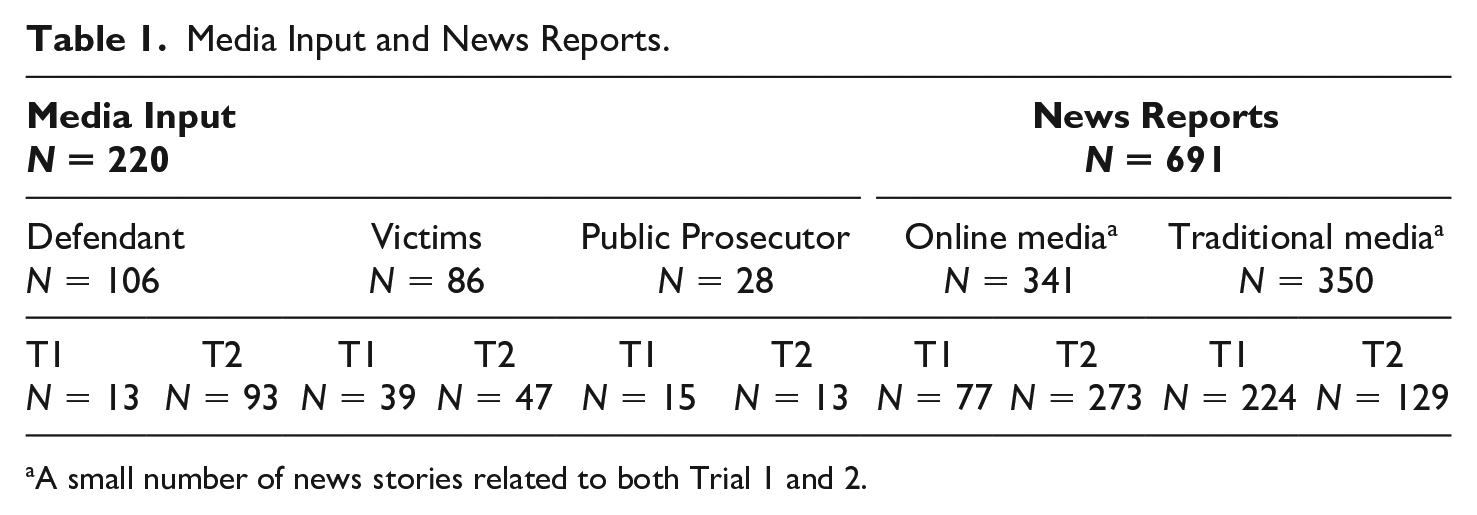
A small number of news stories related to both Trial 1 and 2.
Media input
Testing H3 and H4 requires media input from the frame sponsors involved. Because most actors refrained from using packages, we focused on the three main frame sponsors: the defendant (Wilders), victims, and Public Prosecutor. In terms of victims, we focused on the two most prominent antiracism organizations among them: Stichting Nederland Bekent Kleur (“The Netherlands shows its colours”) and Samenwerkingsverband Marokkanen Nederland (“Cooperation of Moroccans in the Netherlands”). Both organizations have claimed compensation following Wilders’s statements and, thus, played an important role in the court cases.
For the defendant’s media input, we included all tweets from his Twitter account. Twitter is one of the most popular platforms used by politicians to communicate with the electorate, journalists, and other members of civil society (Jacobs and Spierings 2019). Wilders is one of the most active Dutch politicians on Twitter and almost exclusively communicates via Twitter (Hameleers 2020). He is fully in charge of his account, implying that there is no interference of third persons. This aligns with his preference for direct communication with the people, which includes key “populist” elements (Vossen 2010). Tweets were collected by Coosto. The search string and decision rules were comparable to the one for news stories (see Supplemental Material). All relevant, original tweets (retweets from other accounts excluded) were included, yielding a total of 106 tweets (Table 1). 8 For victims’ media input, we included all eighty-six tweets, Facebook posts, and posts shared on their official websites. We used the same search string as for Wilders’s tweets. Finally, we analyzed all twenty-eight posts and public statements shared on the Public Prosecutor’s official website (www.OM.nl) during the trials. These include, among others, press releases and reports. Hence, we included all relevant messages in frame sponsors’ media input (i.e., the full population). All messages were taken into account regardless of whether they appeared in journalists’ media output.
Media input and news reporting were manually coded using the same codebook. We combined a deductive and inductive approach, by studying a set of identified packages based on literature on hate speech prosecution (“free speech,” “anti-discrimination,” “political trial,” and “unfair trial” package; cf. Barkow and George 2010; Bleich 2011; Fennema 2000; Minkenberg 2006), but new packages could result from these data. An example question is, “Does the news story explicitly suggest that the Wilders trial is an attack on free speech?”. For each package, we coded absence or presence, with presence being independent of the number of frame sponsors communicating the package, sources, and strategy (supporting/opposing/neutral/mixed). A frame sponsor was defined as an actor promoting a certain perspective or argument regarding the prosecution (e.g., in the form of a statement, or quote). The following sources were included: the journalist, defendant, victims (individuals or organizations who pressed charges against Wilders), witnesses, Public Prosecutor, (Amsterdam) court, political parties, politicians, government, organizations, citizens, academics, other media outlets, and “other” actors. Intercoder reliability between two experienced coders was high for the pre-identified packages (Krippendorff’s alpha coefficients between .74 and .95) and moderate for the extra packages (.65 to 1.00) (see Supplemental Material).
We identified seven packages in the data. 9 The “anti-discrimination” package was most often covered in news reports, followed by the “unfair trial,” “free speech,” and “political trial” packages (Figure 1). These packages are also most visible in input of the three main frame sponsors, particularly the “political trial” and “free speech” packages (Figure 2). The other three packages are the “obey laws on discrimination,” “societal debate,” and “platform defendant” packages. Furthermore, these frame sponsors substantially engaged more in frame building during the second trial than during the first (see Supplemental Material for a description of packages, packages identified per frame sponsor, and framing over time).
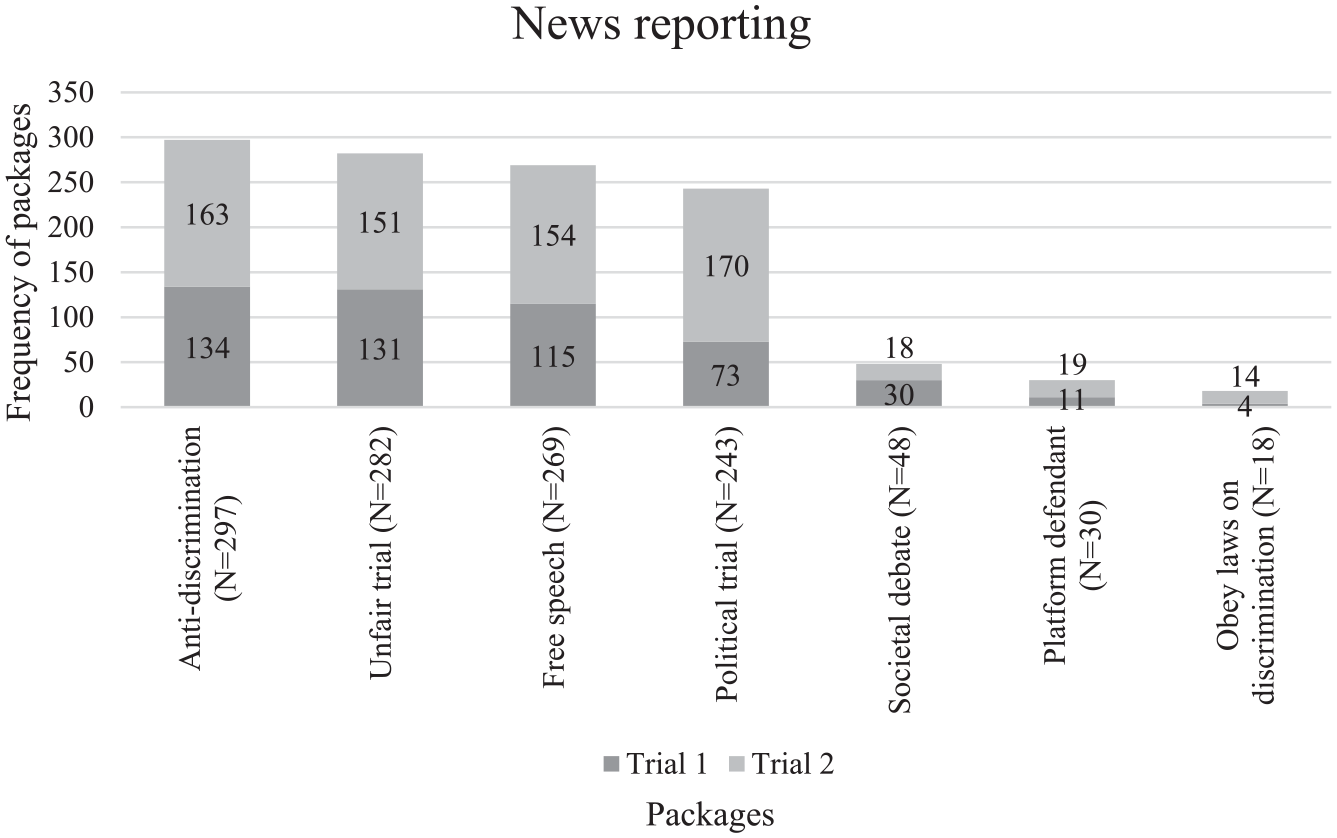
News reporting of packages (numbers representing the number of times a package was present in news reporting, per trial).
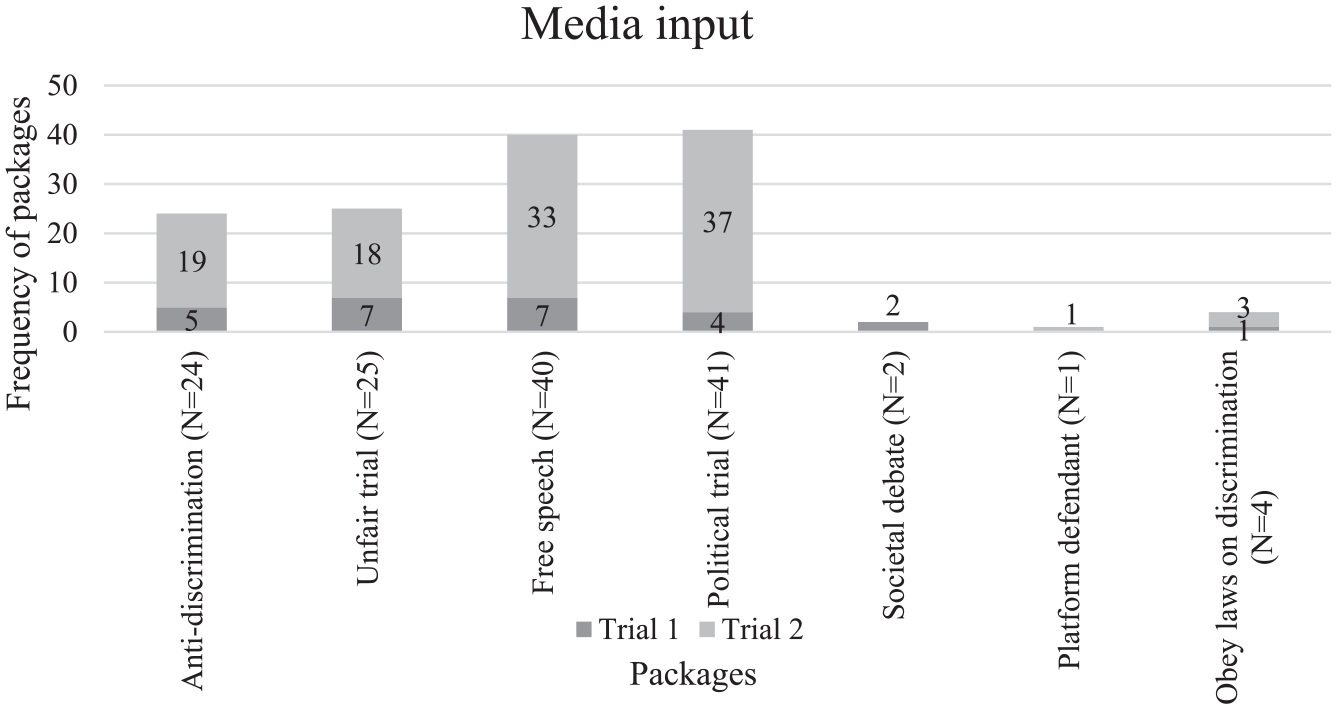
Media input of packages (numbers representing the number of times a package was present in media input, per trial).
Dependent Variables
For H1 and H2, the dependent variable (DV) is the daily news coverage of a package. We run the same model using the seven main packages separately. For H3, the DV is daily news reporting of the four most visible packages (“anti-discrimination,” “free speech,” “political trial,” “unfair trial”). For H4a, the DV is frame sponsors’ communication of these four packages, regardless of the frame sponsor and the strategy used (supporting/opposing/neutral/mixed). Finally, the DV for H4b is the promotion of each of the four main packages by their frame owner. The defendant is, by far, the strongest frame sponsor, promoting the “free speech,” “political trial,” and “unfair trial” packages. Both the victims and Public Prosecutor promote the “anti-discrimination” package, although to a more limited extent. Because the Public Prosecutor turns out to not be promoting any package, H4b excludes the Public Prosecutor from the analysis of Trial 1.
Independent Variables
For H1, the independent variable (IV) is having a strong stake in an issue. To determine this, we took into account three relevant subcriteria (based on theoretical considerations and prior literature, e.g., Hänggli 2012). These are (1) having an interest in the court case (being about a topic relevant for the actor); (2) being directly, formally, and closely involved in the court case; and (3) being directly impacted by the outcome of the trial (e.g., by experiencing a disadvantage or advantage resulting from the outcome). Actors meeting each of the three subcriteria were coded as having a strong stake in the issue (“1,” Table 2). Actors who do not meet all three criteria were coded as having no (or a smaller) stake in the issue (“0,” Table 2). The defendant (Wilders), victims, and Public Prosecutor meet each of these subcriteria, and are coded as having a strong stake in the issue (“1”).
Frame Sponsors’ Levels of “Stake in the Issue” and “Authority.”.
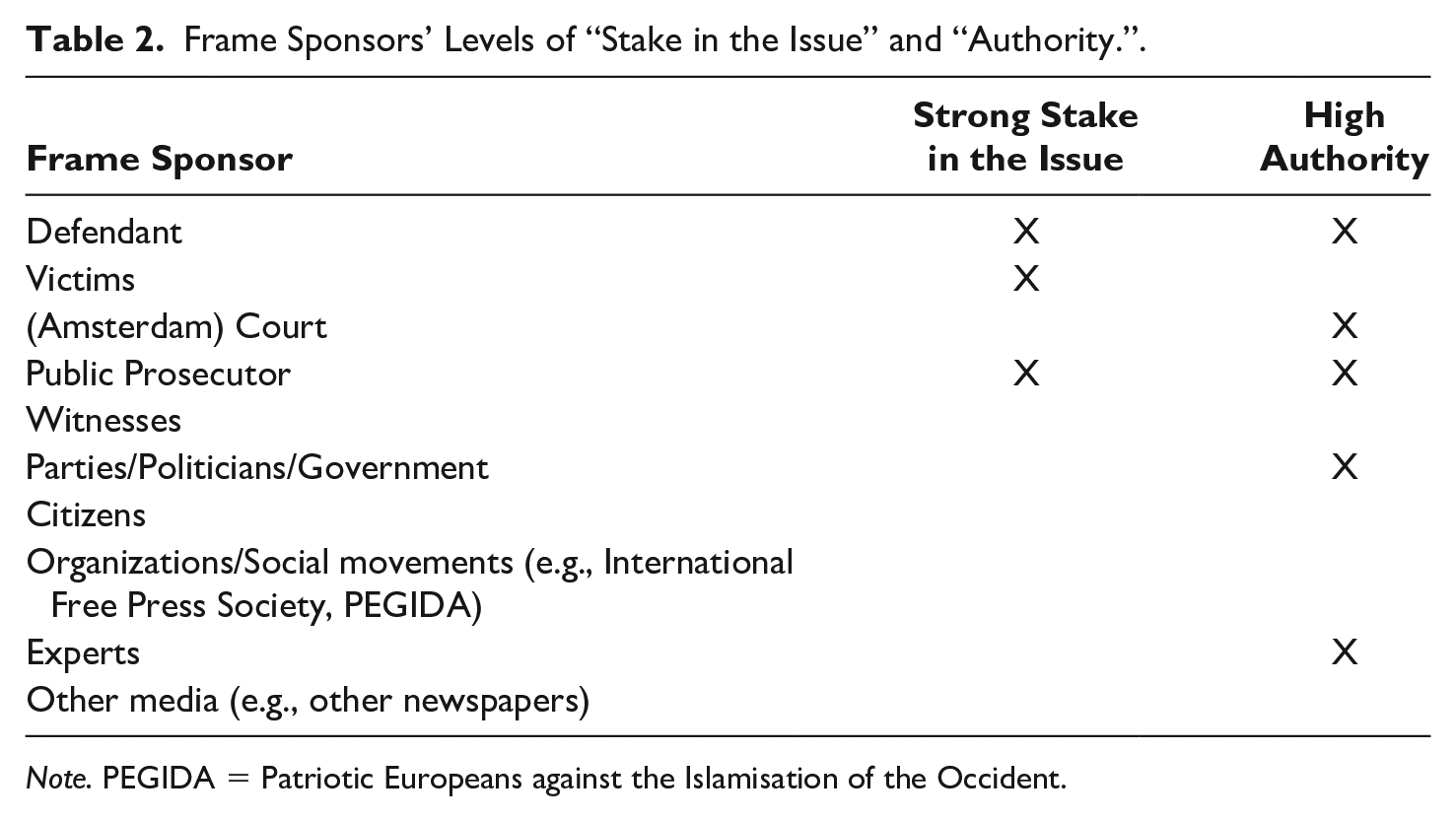
Note. PEGIDA = Patriotic Europeans against the Islamisation of the Occident.
Other frame sponsors were coded as having no or less stake in the issue (“0”). The court is assumed to take a neutral position and is involved, because legally commissioned to do so, but is not directly impacted by the trial outcome. This also applies to witnesses. The trial may present a relevant theme or issue for experts (e.g., academics), but they did not take up a formal position and are not impacted by the court decision. Dutch political parties, politicians, and government have deliberately refrained from being involved, because they feared that it would electorally benefit Wilders. Media outlets have demonstrated clear interests, but are not affected by a certain outcome and did not take up a formal position. Finally, although citizens (individuals who are not defined as victims) and organizations may have demonstrated an interest, and may be indirectly affected by the outcome, they are not directly and formally involved. The coding of “stake in the issue” was cross-validated by a panel of full professors from three prestigious law schools, with years of experience in public law. These experts are specialized in civil liberties controversies and have closely followed the Wilders trials. For each time a package was present in a news item, we measured the total score of stake in the issue, based on the frame sponsors communicating the package.
The independent variable for H2 is the level of authority. The operationalization relies on prior research about the influence of power and authority on media access showing that institutional political actors are attributed more expertise and considered as a preferred news source (e.g., Bennett 1990b; Gans 1979; Splendore 2020). In line with these findings, frame sponsors were coded as having high authority (“1”) when they are governmental and political actors (political parties, politicians, government officials, law enforcement officers) or experts (nonpolitical actors with a specific affiliation, such as experts and university professors). Other frame sponsors score “0” (Table 2). Again, the coding of “authority” was cross-validated by the panel of legal experts. 10 For each package, we measured the total score of authority, based on the frame sponsors communicating the package.
Because H3 and H4 use VAR modeling, the DVs discussed in the previous paragraphs also serve as IVs in these analyses.
Control Variables
Election times
Election times may influence frame building and are included as a control variable as we assess the prosecution of a politician. We included elections at all levels in the Netherlands: municipal, provincial, national, and European. Election time (“1”) was defined as the time frame between the presentation of the candidate list and Election Day, ranging from two to three months per election. All other months were coded as nonelection times (“0”).
Key moments
Because framing may be particularly strong during key moments in the trial, we include key moments as an additional variable. Key moments are events related to the court case deviating from regular court proceedings. They can be understood as “focusing events”: events that are rare, harmful, sudden, and become known to the public and policy elites virtually simultaneously (Birkland 1997). While the key moments in this study are not as harmful as prototypical focusing events, they happen suddenly and may not only set the agenda, but may affect frame building, too. In line with the “issue-attention cycle” (Downs 1972), attention is expected to gradually fade away. Key moments in Trial 1 include the defendant’s requests to have the judges replaced (October 4, 2010; October 22, 2011) and his acquittal (June 23, 2011). For Trial 2, key moments are the defendant’s requests to have the judges replaced (November 3, 2016; May 17, 2018) and his conviction (December 9, 2016).
Method: Time-Series Analysis
We use time-series analysis to test our hypotheses. This permits inferences about causal processes with over-time aggregated data (Vliegenthart 2014). As a DV’s past is modeled and controlled for, this prevents wrongly attributing effects to independent variables that are due to autocorrelations within the DV (i.e., correlations between an observation’s current and previous values). Because we expect interactions between frame sponsors and journalists occurring on a daily basis, data were aggregated on the daily level. The low contemporaneous correlations—correlations within the same day—between the series’ residuals support this decision. Furthermore, because count data often follow a Poisson distribution and are not always suitable for time-series analysis, we analyzed the residuals of the underlying ordinary least squares (OLS) regression model (see Supplemental Material). The residuals are normally distributed, implying that—if the remaining assumptions are met—time-series models can be used. Moreover, slight deviations would not have been problematic, because time-series models can handle limited deviations from standard normality by integration and the introduction of lags (Hopmann et al. 2010; Walgrave et al. 2017).
We applied two types of time-series analysis: ARIMA modeling (H1 and H2) and VAR modeling (H3 and H4). While the former is suitable to establish the size and delay of effects of preestablished independent variables on DVs (while controlling for the DV’s past), VAR is particularly useful to establish the direction of a causal relationship.
ARIMA Modeling
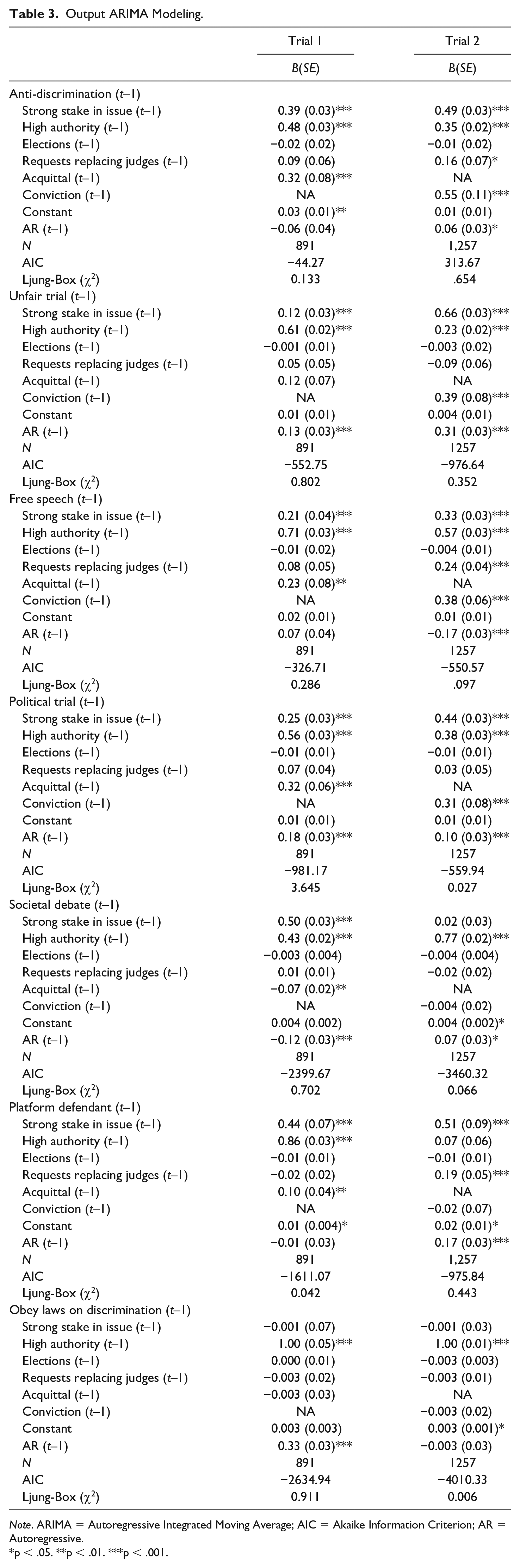
To test H1 and H2, we analyzed seven ARIMA models for each trial (fourteen in total), examining the influence on the seven packages separately. Dickey-Fuller tests confirmed that all DVs are stationary (p < .05), rendering differencing unnecessary. Next, we assessed autocorrelations within the DV. Ljung-Box tests suggested that the null hypothesis of no (first-order) autocorrelation in the residuals is rejected for each of the fourteen series (p < .05), indicating a time trend. We corrected for lagged values of the DVs by including autoregression terms in the model, grasping the effects of prior values of the series on the current value (Vliegenthart 2014). Fit statistics Akaike Information Criterion (AIC) were combined with the Autocorrelation Function (ACF) and Partial Autocorrelation Function (PACF) of the DVs to determine which (i.e., at which lag) autoregressive (AR) and moving average (MA) model to include. Ljung-Box tests showed that after including one AR (at lag–1) term, the residuals of all models resembled white noise (p > .05). For nine models, autocorrelations in the squared residuals were still present, meaning that we should interpret the results with caution. Because including different or more lags did not increase the model fit, we decided to keep the models at lag t–1. Finally, by cross-correlating the residuals of each IV with the DV, we determined how many lags had to be included for the IVs. For all models, including the IV at lag t–1 yielded the best fit (Table 3).
Output ARIMA Modeling.
Note. ARIMA = Autoregressive Integrated Moving Average; AIC = Akaike Information Criterion; AR = Autoregressive.
p < .05. **p < .01. ***p < .001.
VAR Modeling
VAR models were estimated to test the reciprocal influence between framing in media input and in news reporting (H3 and H4). We ran seventeen models: eight models for the relation between frame sponsors’ general communication and news reporting of the four main packages (anti-discrimination, free speech, political trial, unfair trial package: Trial 1 and 2), and nine models for the relation between the main packages promoted by their frame sponsor and news reporting of the same package (the Public Prosecutor was excluded for Trial 1). In each model, both variables serve as independent and dependent endogenous variables. All models included control variables.
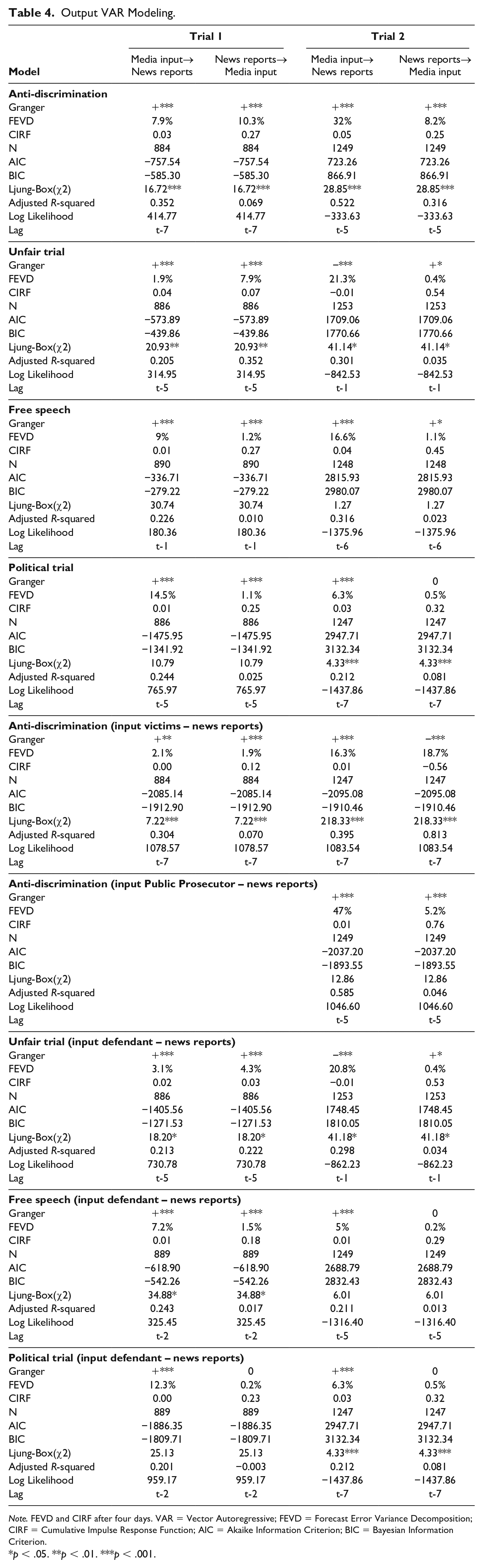
Augmented Dickey-Fuller tests demonstrated that all series were stationary (p < .05). Based on model comparison and fit statistics, most notably AIC, we determined the optimal lag length per model (Table 4)—the same number of lagged values for both the DVs and IVs. We limited the maximum number to seven days, as following news production dynamics, it seems reasonable that interactions between journalists and frame sponsors occur within this time frame.
Output VAR Modeling.
Note. FEVD and CIRF after four days. VAR = Vector Autoregressive; FEVD = Forecast Error Variance Decomposition; CIRF = Cumulative Impulse Response Function; AIC = Akaike Information Criterion; BIC = Bayesian Information Criterion.
p < .05. **p < .01. ***p < .001.
After estimating seventeen VAR models, Ljung-Box tests were performed to investigate the presence of autocorrelation. For six models, the null hypothesis of white noise was rejected. For eleven models, there was still slight autocorrelation in the residuals. This implies that the residuals, at some point in time, were significantly correlated with residuals from previous time points. One solution is to add additional lags (Vliegenthart 2014). However, overfitting the models can be problematic, especially with a small sample size; including more lags boosts the number of estimated parameters, thereby increasing standard errors. This negatively affects the model fit. We accepted that some autocorrelation remained in the residuals and that caution is warranted while interpreting the results. Still, adding additional lags resulted in largely similar results. To evaluate causality, we conducted Granger causality tests. If variable y is “Granger caused” by variable x, the prediction for y—based on its own past—improves by accounting for x’s past.
Results
Characteristics of Frame Sponsors (H1 and H2)
H1 states that journalists make more use of packages by frame sponsors with a strong stake in an issue. We perceived the defendant, victims, and Public Prosecutor as having the highest stake in the issue. Having a strong stake in an issue was a significant predictor of frame coverage (p < .001), except for the “obey laws on discrimination” package in Trials 1 and 2 and the “societal debate” package in Trial 2 (respectively, p = .991, p = .954, p = .448; see Supplemental Material for all results). Hence, H1 is supported for the most frequently communicated packages but not for all packages (Table 3).
H2 predicts journalists making more use of packages by frame sponsors who are seen as more authoritative. The defendant has a high level of authority, but the Public Prosecutor, court, institutional political actors (parties/politicians/government members), and experts, do, too. Victims’ lower level of authority is expected to make them a less frequently covered frame sponsor, which also applies to witnesses, citizens, organizations, and other media outlets. Findings demonstrate that having more authority was a significant predictor of frame coverage (p < .001 for each package, except for the “platform defendant” package in Trial 2: p = .267) (Table 3). H2 is confirmed for the most important and frequently communicated packages but not for all packages.
The Interplay between Journalists and Frame Sponsors (H3 and H4)
VAR models were estimated to test the reciprocal relationship between frame sponsors and journalists. First, we report effects of media input on news reporting (H3) and, subsequently, effects of news reporting on media input (H4). Outcomes of the Granger causality tests (direction and relative strength based on Cumulative Impulse Response Function [CIRF] and Forecast Error Variance Decomposition [FEVD]) are displayed in Table 4. CIRF plot the accumulation of the reaction of the one variable to the other variable at the time of the “shock” (the impulse). Full results are included in Supplemental Material.
Frame sponsors influencing journalists
Granger causality tests suggest that for each of the four main packages, general use of the package by frame sponsors significantly predicted news reporting of the package (p < .001) (H3a). CIRF suggested positive effects for both trials, except for the “unfair trial” package in Trial 2. The effects primarily took place in the subsequent days. For instance, after four days, 17 percent of the variation in the daily presence of the “free speech” package in news reporting could be attributed to the daily communication of this package by frame sponsors (FEVD). The input of one “free speech” package increased news reporting of this package with 0.04 packages after four days (95% confidence interval [CI] = [0.01, 0.07]) (Trial 2). H3a is confirmed.
H3b describes the effects of promotion of a package by the frame owner on news reporting of the same package. Promoting a package significantly impacted news reporting of each of the main packages (p < .001 for all packages in Trial 1 and 2, except for the “anti-discrimination” package by victims in Trial 1: p = .005). CIRF suggested positive effects for all relationships except for the “unfair trial” package in Trial 2. For example, after four days, 6 percent of the variation in the daily news reporting of the “political trial” package could be explained by the defendant’s daily promotion of this package (Trial 2). Promotion increased news reporting of the package by 0.03 packages after four days (95% CI = [0.01, 0.07]). H3b is confirmed, except for the “unfair trial” package in Trial 2.
Journalists influencing frame sponsors
News reporting of a package also significantly increased general use of the same package by frame sponsors (H4a) (all packages in Trial 1: p < .001; “anti-discrimination” package Trial 2: p < .001; “free speech” package Trial 2: p = .014; “unfair trial” package Trial 2: p = .014). Only the “political trial” package in Trial 2 was not significant (p = .179). CIRF suggested positive effects for the significant relationships. For instance, after four days, one increase in news reporting of the “anti-discrimination” package increased frame sponsors’ input of this package by 0.27 packages (95% CI = [0.02, 0.46]), which explains 10 percent of the variance in the general use of the package (Trial 1). H4a is confirmed, except for the “political trial” package in Trial 2.
The effects of news reporting of a package on the promotion of the package by its owner (H4b) varied between the trials. For Trial 1, news reporting of the “anti-discrimination,” “free speech,” and “unfair trial” package significantly increased promotion of the respective package by the frame owners (p < .001). News reporting of one “free speech” package increased promotion of this package by the defendant with 0.18 packages after four days (95% CI = [0.07, 0.27]), explaining 2 percent of the variance. Only news reporting of the “political trial” package did not significantly Granger-cause package promotion (p = .370).
Consistent with Trial 1, news reporting of the “unfair trial” package increased the defendant’s promotion of this package in Trial 2 (p = .014); the same holds for the Public Prosecutor’s promotion of the “anti-discrimination” package (p < .001). However, in contrast to Trial 1, news reporting of the “anti-discrimination” package significantly decreased promotion of this package by the victims (p < .001). A one-unit increase in news reporting of the “anti-discrimination” package decreased victims’ package promotion by 0.56 packages after four days (95% CI = [–0.75, –0.32]), explaining 19 percent of the variance. Furthermore, news reporting of the “free speech” package no longer significantly impacted promotion of this package by the defendant (p = .820), neither did the “political trial” package (p = .179). H4b can, thus, be confirmed for Trial 1, but not for Trial 2.
Discussion
Compared with the framing effects literature, extant research about frame building is less theoretically and empirically advanced. By studying a court case using time-series analysis, we demonstrate the power of frame sponsors over frame building—primarily of those with high authority and a strong stake in an issue. While frame building is still primarily understood as unidirectional, we show that frame building is a reciprocal, dynamic, and reinforcing process. Our findings corroborate recent findings by Hänggli (2020) and Hänggli and Van der Wurff (2019), who demonstrate that journalists’ role is more pro-active under certain circumstances.
Whereas the aforementioned scholars examined how event type influences frame building, we demonstrated how certain characteristics of frame sponsors affect the reciprocal relationship between journalists and frame sponsors. This relationship, primarily for new events without a history of framing, may lead to a spiral where packages by actors with high authority and/or a strong stake are more often covered. Subsequently, these actors will likely increase the use of these packages. Actors lacking these characteristics will be considerably less successful in having their packages covered in the news, and may reduce the communication of these packages. The combination of high authority and having a strong stake in the issue can partly explain why the defendant was considerably more successful in frame building, being a frame sponsor in news reports approximately five times as often as the victims. Moreover, the defendant’s acquittal (Trial 1) and his requests to have the judges replaced (Trial 2) and his conviction (Trial 2) also had significant positive effects on the news reporting of his promoted packages, underlining the importance of key moments.
Interestingly, our findings regarding the reciprocal relationship primarily applied to Trial 1, highlighting that dynamics may shift over time. In Trial 2, frame owners seemed less influenced by news reporting of their packages. Because the trials were comparable in terms of content and frame sponsors, an explanation may be that in Trial 1, frame owners were not familiar yet with the use and successes of potential packages. This suggests that the involved actors adapt to the new situation. In future studies, we aim to investigate when frame sponsors decide to shift packages or communicate additional packages. Furthermore, we plan to examine when and how frame sponsors respond to opponents’ packages. In the case under study, frame sponsors almost exclusively promoted their own packages and almost never challenged opponents’ packages—whereas this latter strategy was often visible in news reports. Future research could explore to what extent this is part of journalists’ strategy to present issues and events as a “battle.”
A methodological limitation is that we treated the defendant’s media input in the same way as input by the victims and Public Prosecutor. As the defendant is a well-known politician actively using Twitter, journalists are likely more attentive to his input. This may be an additional reason why the defendant was covered so frequently. Another potential explanation relates to the “two sides to every story” norm of professional journalism. Generally, news reports about court cases might pay much attention to “the one side,” that is, the charges, severity of the accusation, impact on victims, and perhaps the role of the Public Prosecutor. The extensive media attention for the defendant could be an indication of journalists’ objective to cover both sides of the story.
Another limitation is that some models still suffered from autocorrelations. A possible explanation is frame sponsors’ limited media input during Trial 1, particularly by the Public Prosecutor and victims. This may explain some of the (significant) effects being small. While more media input might have increased the robustness of the findings, the difference in provided input may mirror the dynamics of frame building, as media input and news reporting of packages mutually reinforce each other. This could also explain why the Public Prosecutor—with both high authority and a strong stake in the issue—still received less coverage as a frame sponsor than the defendant.
Although the court case presented a unique opportunity to examine the role of frame sponsors in frame building, testing the hypotheses in a different context—for example, when the issue at stake is international—would increase the robustness of the findings. Furthermore, we realize that our analyses of H1 and H2 are limited to actors who received news coverage, and that some actors may have been left out. Yet, we believe sufficient categories of actors were included, and a variety of individuals and parties within categories, to cover the most important packages they propagated. Finally, the analyses of H3 and H4 are limited to publicly available media input of frame sponsors, as we cannot analyze direct contacts between journalists and frame sponsors, and communication between journalists and press/public-relations organizations. However, particularly for populist politicians, traditional communication forms may be less prominent due to their low levels of trust in mainstream media (Bartlett et al. 2011).
Using advanced modeling techniques with a daily data set of media input and output, we demonstrated that frame building should not be understood as a unidirectional but a reciprocal relationship. Frame sponsors with high authority and a strong stake in an issue have more influence on this process. This might be undesirable from a democratic perspective. Packages can affect how citizens perceive political reality. However, not everybody gets to shape this mediated reality to the same extent. Attributing more space to arguments of some frame sponsors at the expense of others risks the danger of leading to biased news coverage of important (political) issues.
Supplemental Material
IJPP_WichgersJacobsVanSpanje_SupplementaryInformationFile – Supplemental material for The Battle of Frame Building: The Reciprocal Relationship between Journalists and Frame Sponsors
Supplemental material, IJPP_WichgersJacobsVanSpanje_SupplementaryInformationFile for The Battle of Frame Building: The Reciprocal Relationship between Journalists and Frame Sponsors by Lisanne Wichgers, Laura Jacobs and Joost van Spanje in The International Journal of Press/Politics
Footnotes
Declaration of Conflicting Interests
The author(s) declared no potential conflicts of interest with respect to the research, authorship, and/or publication of this article.
Funding
The author(s) disclosed receipt of the following financial support for the research, authorship, and/or publication of this article: This work was supported by the Netherlands Organisation for Scientific Research (NWO) with a VIDI grant awarded to Joost van Spanje (project number: 452-14-002).

Supplemental Material
Supplemental material for this article is available online.
Notes
Author Biographies
References
Supplementary Material
Please find the following supplemental material available below.
For Open Access articles published under a Creative Commons License, all supplemental material carries the same license as the article it is associated with.
For non-Open Access articles published, all supplemental material carries a non-exclusive license, and permission requests for re-use of supplemental material or any part of supplemental material shall be sent directly to the copyright owner as specified in the copyright notice associated with the article.
