




Abstract
Politicians’ reticence to communicate their views clearly increases the information asymmetry between them and the electorate. This study tested the potential of subtle ideological cues to redress the balance. By spotlighting visual rather than the already much-examined verbal cues, we sought to contribute to building theory on cue effects. Specifically, we aimed to determine whether the effects from the literature on verbal cues could also be shown for visual ones. We used an experiment (N = 361) to test the effects of subtle backdrop cues (SBCs), that is, of visual cues to ideology embedded in the background of political images. We manipulated photos of a fictitious politician to include liberal or conservative SBCs. We embedded these images in Twitter posts and tested whether they influenced perceptions of the politician’s ideology and the intention to vote for him. We analyzed the relationship between exposure to SBCs, the politician’s perceived political ideology, and voting intention—including the study of conditional effects elicited by cue awareness and ideological consistency between the depicted politician and participant. The conditional process analysis suggested that SBCs mattered, as they influenced citizens’ perceptions of a politician’s political ideology, and consequently, voting intention. These effects were moderated by cue awareness and ideological consistency. We concluded that SBCs can elicit substantial effects and that their use by politicians is paying off.
Politicians are often reproached for their predilection for cloaked language (Darmofal 2005). While there is much to dislike about this practice, its appeal is easily understood. Cues—defined here as tiny bits of information embedded by politicians in their communication—allow those using them to hint at their views in a subtle manner while maintaining sufficient latitude to backpedal in the case of public outcry (Darmofal 2005). Despite general agreement over the capacity of both verbal and visual cues to communicate political views unobtrusively (Baker 2009; Banda 2016), our empirical knowledge about cue effects is limited to those prompted by verbal cues (Heit and Nicholson 2016; Layman and Carsey 2002). As such, it remains unclear whether the effects described in the literature on verbal cues also occur when visual cues are employed. We sought to address this research gap. The study reported here assessed the effects of visual cues related to political ideology, termed subtle backdrop cues (SBCs).
SBCs are a key component of political images in our times. They are used strategically and frequently in election campaigns (Baker 2009; Dan et al. 2019; Grabe and Bucy 2009). Cues are embedded in political images with the aim of communicating ideology and signaling viability for office. Recent examples illustrate this (see Figure 1): At the peak of his 2016 presidential campaign in the United States, Donald Trump tweeted an image featuring Hillary Clinton in front of a pile of cash; the words “most corrupt candidate ever” appeared inside a 6-pointed star. Certainly, it is possible that the star represented a sheriff’s badge—as the Trump campaign later argued. However, it may also have been an allusion to the influence of Jewish money in U.S. politics, as some critics claimed. 1 In response to outcry over this image, the star shape was replaced with a circle and anti-Semitic views were denied. A similar phenomenon could be observed two years later in the case of Markus Wallner, a local politician belonging to the conservative Austrian party, ÖVP. Like his fellow party members, Wallner opposed the legalization of marijuana. 2 His team photoshopped an image showing him talking to Sebastian Kurz, the Austrian Chancellor, after having posted the original version on Facebook. In the revised version, the framed image on the wall behind them showed an alpine landscape instead of the original—an older woman smoking a supersized cigarette. The cigarette appeared to be hand-rolled and was cone-shaped; as such, it could have been a joint—a cigarette containing marijuana. Wallner’s team explained that the image was adjusted due to the politician’s “clear standpoint” on the issue of cannabis legalization for recreational use. 3 Thus, political strategists intentionally turned an image that was incompatible with the conservative ideology of the politician into one that was more consistent with it.
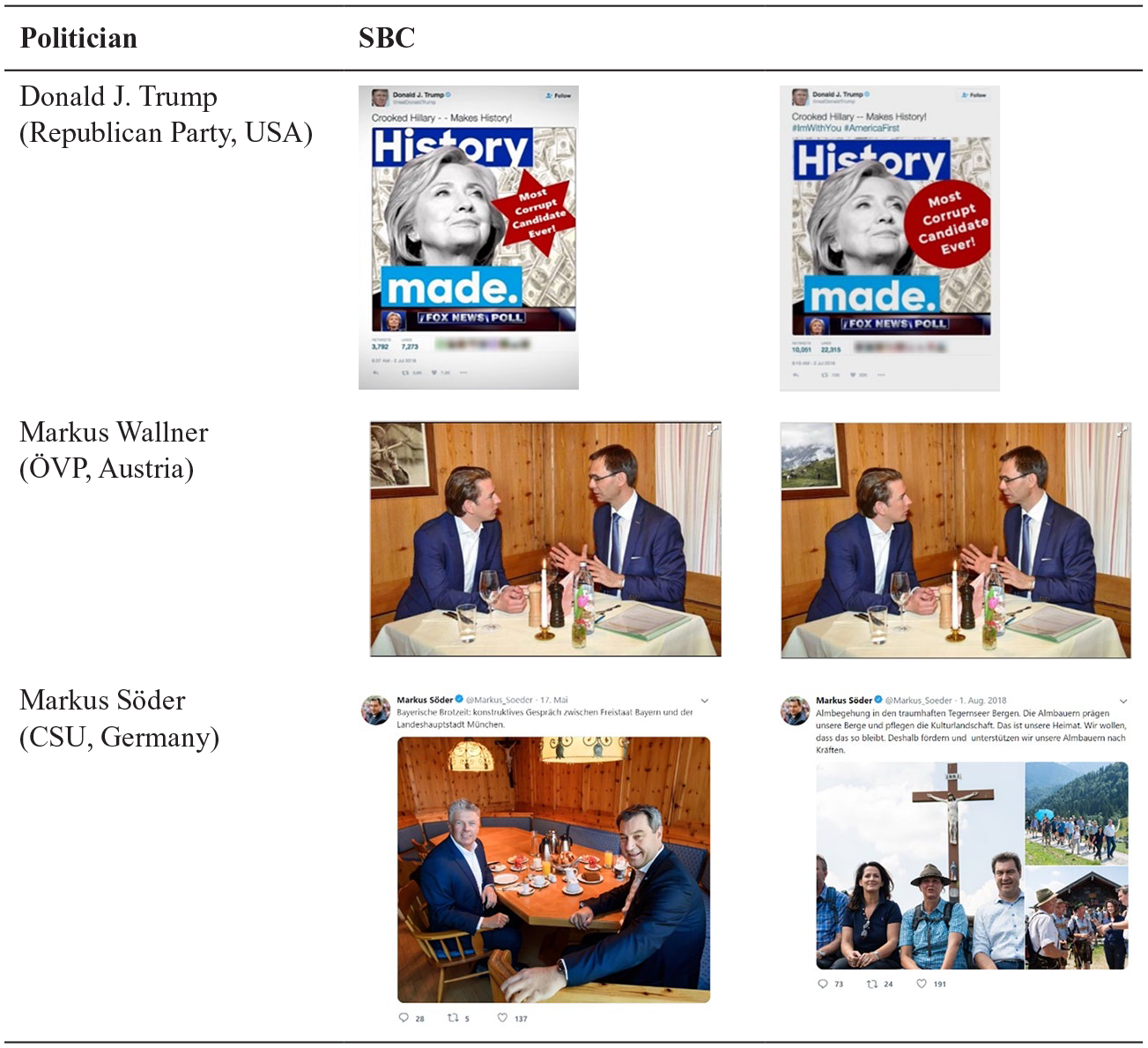
Recent examples of subtle backdrop cues (SBCs) in politics.
In Germany, the frequency with which the local politician Markus Söder (CSU, Bavaria) was depicted in front of crosses in photos posted on social media was striking, especially as this seemed unrelated to the topics addressed at the events in question. 4 This coincided with the 2015 increase in migration from Muslim-majority countries and represented the timid beginning of a tendency to re-emphasize Germany’s Christian heritage. It culminated in the so-called cross-decree (“Kreuzerlass”) initiated by Söder three years later, which stipulated that Bavarian authorities must display Christian crosses in their entrance halls.
SBCs like those described above are used in political communications in the conviction that they will yield intended effects (Grabe and Bucy 2009). Yet, although there are good theoretical arguments in favor of this position (see in the following), the veracity of this assumption awaits empirical testing. In the absence of empirical evidence, it remains uncertain whether, for instance, a framed picture of a woman smoking marijuana shown behind politicians can suggest that they hold a rather liberal political ideology.
The present study used a web-experimental design and manipulated photos of a fictitious politician to include subtle visual cues related to political ideology in the backdrop, with a similar appearance to the examples given in Figure 1. We embedded these images in Twitter posts and tested whether they influenced the ideology of the depicted politician as the participants perceived it and their intention to vote for him. We conducted a conditional process analysis studying the relationship between exposure to SBCs; perceived political ideology of the fictitious politician; voting intention, including the study of conditional effects elicited by cue awareness; and the ideological consistency between the depicted politician and participant.
Cues in Political Communication
Early work by Converse (1964), recent work by Banda (2016), and much scholarship in between have addressed the ways in which citizens cope with the information asymmetry intrinsic to politics—that is, politicians’ laconicism and vagueness. Scholars generally agree that citizens have the two following options at their disposal (Kuklinski and Hurley 1994; Lau and Redlawsk 2006): (1) devoting their time to learning more or (2) making inferences from the limited information that is available. While the first opportunity possesses great democratic appeal, it also seems idealized and unrealistic (see Darmofal 2005). Certainly, citizens could reach informed decisions—if they were willing to search for additional information, as well as able to navigate it. However, truly doing so is time consuming and thus occurs rather seldom. Instead, citizens are more likely to attempt mimicking informed decision making, for instance, by taking cues given by politicians and inferring the missing components. Such cues can be defined as tiny bits of information, presented either verbally or visually and embedded by politicians (or their strategists) in their communication (Baker 2009; Banda 2016). On average, there is evidence that citizens typically use only three to five cues when making judgments (Hastie and Dawes 2009). As described in the following, citizens’ exposure to cues was shown to elicit substantial effects on political outcomes.
People tend to rely on two types of cues when making low-effort decisions, namely, party cues and ideology cues (Banda 2016). Party cues assume the shape of labels (e.g., “the Republicans”) or logos (e.g., the Republican elephant). Voters with clear preferences for one party or another tend to rely on party cues to make up their minds about issues with which they lack experience. Party cues have been the focus of a large body of research (Banda 2016), generally suggesting that they are the most salient and efficient “perceptual screen[s]” (Campbell et al. 1960: 133) for inferring policy positions (Conover and Feldman 1989).
In contrast, despite their growing importance in politics (Baker 2009; Grabe and Bucy 2009), ideology cues are under-researched. They can be verbal or visual and point to a right-wing/conservative or left-wing/liberal ideology. For example, at least in most Western countries, a Christian cross or an image of a woman in a housewife role (e.g., pulling a roast out of the oven) is more indicative of a conservative political ideology than, for example, a Buddha statue or an image of a professional woman in her office.
To qualify as subtle, the cues must be featured in the background of an image and not its foreground. It should be noted that any type of content processed with the eye alone (Coleman 2010) can function as a visual cue to ideology. Examples include décor items, such as framed photos on a politician’s desk, religious symbols hanging on walls, and photo props like weapons and flags. In line with the examples given in the introduction, political strategists are said to master “the backdrop” of candidate images—for instance, Josh King, key strategist in the Clinton Administration, was dubbed “the father of the modern backdrop” (Baker 2009).
Ideology cues are especially useful when party cues prove futile (Ansolabehere et al. 2006). This applies, for instance, to novel parties where the members have yet to determine their stances on issues before communicating them to the electorate. Citizens considering voting for a candidate affiliated with an unknown party cannot infer issue positions (or assume that they must fit with their values) merely by discerning the party with which the candidate in question is affiliated. Rather, these citizens must rely on explicit verbal statements of ideology—or, pertinent to the present study, visual cues to ideology. Nevertheless, ideology cues are also used by candidates of established parties under certain circumstances (Ansolabehere et al. 2006). This is the case with provocative stances on hot-button issues, such as allegations that the Jewish elite has a corrupting influence on U.S. elections (see Figure 1). In fact, ideology cues are used primarily with partisan issues, and this is where they matter most (Darmofal 2005). Furthermore, politicians of established parties may use cues to pilot-trial various positions, for example, in times of change, for novel issues, or in local politics.
Theorizing on the Effects of Exposure to Subtle Visual Cues to Ideology (SBCs)
As already noted, the effects of visual cues presented in a subtle way related to political ideology deserve scholarly attention due to a lack of empirical evidence in this regard. We now present our theorizing on this topic; Figure 2 provides a visualization hereof.
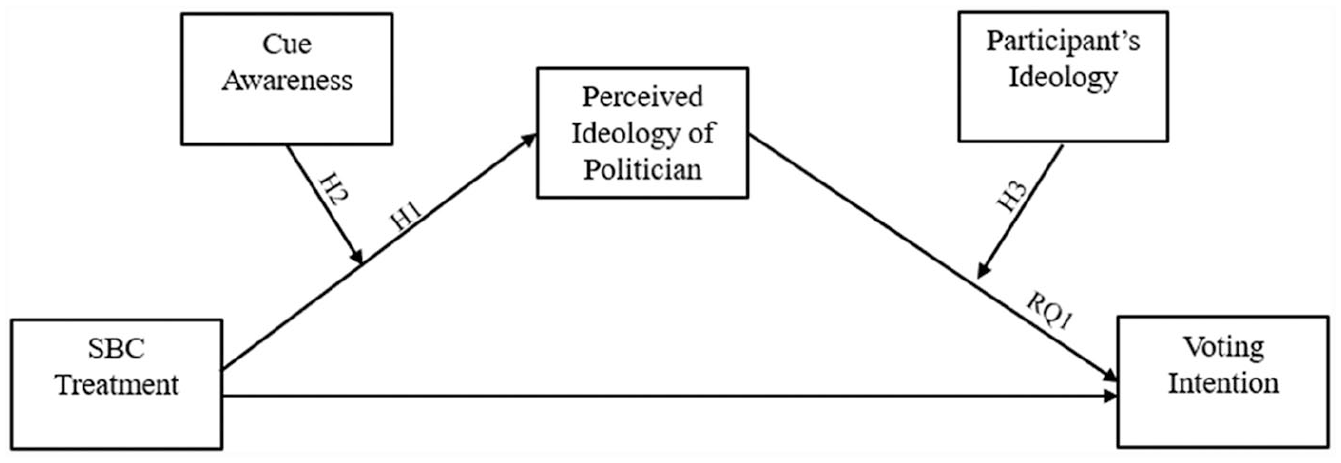
Conceptual path model.
We focus on two outcomes of highest relevance in the political process, namely, the politician’s political ideology as perceived by citizens and voting intention: Our quest for politically relevant outcomes brought us first to SBCs’ capacity to assist citizens in deciphering politicians’ ideology from the cues at their disposal. This ability is crucial in situations characterized by information scarcity (Darmofal 2005), and thus, it is of utmost importance for inquiries into SBC effects. Therefore, perceived political ideology is the primary outcome in our conceptual model; we see results on this variable as the main contribution of our study. Given that the goal of elections can be seen as associating the policy preferences of the electorate with the decisions of the elected representatives (Powell 2000), an adequately perceived political ideology is necessary. The idea is that SBCs influence perceived political ideology.
Second, our model accounts for SBCs’ ability to assist citizens in determining their voting intention. Voting is the primary form of political participation and a necessary act in the association of the policy preferences of the electorate with the decisions of the elected representatives. The idea was that SBCs influence voting intention via their influence on perceived political ideology.
Effects on Citizens’ Perceived Political Ideology of Politicians
As no studies to date have attempted to investigate how visual cues may affect people’s perceptions of political ideology, we draw on previous research on the effects of verbal cues and visual communication in general for developing a conceptual model on the effects of SBCs. Previous research has suggested that people can infer a politician’s ideology based on verbal cues—even when party cues are suppressed (Conover and Feldman 1989). For instance, participants in Heit and Nicholson’s (2016) study made correct assumptions about the party affiliation of politicians based on verbal cues to issue standpoints and sociodemographics. Other scholars found that citizens did not just understand politicians’ positions on the issues cued verbally, but instead, were also able to infer their positions on issues barely touched on and even those left unaddressed (Banda 2016; Layman and Carsey 2002).
SBCs might also yield substantial effects on political outcomes. It is important for our theoretical argument to point to the difference between a verbal and visual cue arising from the key distinctive property of visuals—their inability to make propositions about the specific relationship between two or more elements, such as “X happened because of Y” or “X occurred despite Y” (Messaris and Abraham 2001). As Messaris and Abraham (2001) explained, while verbal language abounds in devices that can be used to make such propositions, visuals lack a set of devices for signaling connections between units in unambiguous ways. As such, when actors make propositions by juxtaposing visual entities, they count on viewers to infer meaning from information that is not complete or entirely clear. In this way, viewers may be less aware of how a specific visual impression emerged, and thus, more susceptible to the message.
The ambiguity in interpretations may lead to the assumption that visuals have weaker effects than verbal cues do. However, there is evidence that visual cues may be even more powerful because they stand a better chance than their verbal counterparts of being processed effortlessly and automatically—even in situations of short exposure times and low motivation (for a review, see Dan 2018). Based on this evidence, we assumed that SBCs that are related to political ideology (e.g., a picture of a housewife vs. a picture of the same woman in an office) used by a given politician in his/her public communication will elicit an effect on citizens’ perception of this politician’s political ideology. We pose the following:
Previous research strongly suggested that a greater level of activation of a specific concept during reading/seeing improves processing, and thus, memorization of the concept (Yang and Roskos-Ewoldsen 2007). Similarly, associative learning studies in the field of evaluative conditioning have revealed stronger effects when participants are aware of a cue that has been paired with a target stimulus, such as a politician (Hofmann et al. 2010). Applied to the visual political communication domain, we assume that under the condition of a high cue awareness, citizens “learn” a given politician’s political ideology better than they do under the condition of a low cue awareness. This assumption has a high level of face validity: If citizens recognize SBCs, they place their attentional focus on them, which will likely facilitate memorization (see Lang 2006). Therefore, we assume that cue awareness strengthens the effect specified in H1:
Spillover Effects on Voting Intention
We already noted that the goal of elections can be seen as associating the electorate’s policy preferences with the preferences and decisions made by the elected representatives (Powell 2000). Voting intention is an important variable in this regard. Again, there is a large body of previous research suggesting that verbal cues can influence voting intention (Banda 2016; Heit and Nicholson 2016; Layman and Carsey 2002), but there is a lack of evidence for their visual counterparts. Verbal cues are “a big aid to voters” (Lau and Redlawsk 2006: 250) in the sense that they allow citizens to reach high-quality, low-effort decisions that resemble those formed when citizens truly become informed, weigh arguments, evaluate the credibility of sources, and so on (Lupia and McCubbins 1998). In Lau and Redlawsk’s (2006) study, verbal cues were especially helpful in complex contexts like those posed by having to decide between four unknown candidates. Here, the cues sent by the candidates exposed their political ideologies, which then identified each of them as friend or foe—and thus, more or less viable for office (Heit and Nicholson 2016). Such tendencies are often more pronounced in individuals with strong group identities (e.g., Kuklinski and Hurley 1994).
We contribute to the literature by studying the effects of SBCs on voting intention. As outlined above, we predicted that SBCs would influence the perceived political ideology espoused by politicians. Given that the perceived political ideology predicts voting intention (Heit and Nicholson 2016; Lau and Redlawsk 2006), we assume that perceived political ideology, altered by exposure to visual cues, influences citizens’ intentions to vote for a given political candidate. Of course, the strength of the influence of the citizen’s perception of the political ideology taken by the politician on voting intention could be moderated by the citizen’s personal political ideology: Individuals who think that a politician is conservative (e.g., based on exposure to SBCs) will decide whether to vote for the politician in question based on the extent to which he/she shares the politician’s ideology. If individuals also self-identify as conservative, their intention to vote for a politician whom they perceive to be conservative will likely increase. Conversely, voting intention will presumably decrease among individuals holding liberal views if the candidate is perceived as conservative. We posit the following:
Figure 2 presents the conceptual model of the theorizing outlined above. As this model guided our empirical research, its testing represents the primary contribution of the present study. In addition, as a secondary contribution, we now address another aspect related to the effects of SBCs that should enable a broader perspective on cue effects and allow a more thorough investigation hereof.
Additional Theorizing: Effect of SBCs’ Mere Presence
From the theorizing visualized in Figure 2, it should be clear at this point in our argument that we predicted that the ideological content of SBCs (conservative or liberal) influences the way in which politicians are perceived ideologically. Our primary focus on the content of SBCs is consistent with the fact that the content of SBCs is also of primary interest to political strategists. This focus can also be observed in previous studies on the effects of verbal cues (e.g., Lau and Redlawsk 2006). As a secondary contribution to the literature, however, we now theorize on the effects of the mere presence of ideology-related SBCs. As we outline now, irrespective of (conservative or liberal) content, their mere presence may also elicit relevant effects.
SBCs may bring the concept of political ideology into citizens’ minds. The underlying idea is that the simple existence of political ideology cues (regardless of their conservative or liberal connotation) may prime the concept of political ideology in citizens’ minds. Note that, in this context, priming describes a short-term effect—following exposure to political media content (i.e., SBCs hinting at ideology)—on the accessibility of the corresponding mental concept (i.e., the concept of political ideology in the participant’s mind; Ewoldsen and Rhodes 2020; Rokos-Ewoldsen et al. 2009). Thus, we assume that SBCs will reactivate (i.e., prime) the concept of political ideology. Consistent with media priming research, we assume that this reactivation increases the likelihood that political ideology will be used for decision making in a subsequent situation. Certainly, simply confronting people with a political message including a politician may prime mental concepts such as politics, politicians, or political ideology in a given citizen’s mind. However, exposure to political ideology SBCs may exacerbate this effect on the accessibility of the mental concept of political ideology.
We questioned whether the mere presence of ideology-related SBCs (bringing political ideology to the top of one’s mind) influences voting intention by increasing the judgmental weight of perceived political ideology when forming a voting-intention judgment. In fact, when being primed by ideology-related SBCs, a person may be more prone to think about political ideology when evaluating a politician. In other situations, in which the concept of political ideology had not been reactivated in a given citizen’s mind, this person could potentially evaluate a politician on widely different characteristics, such as sympathy or competence. However, when the concept of political ideology had been primed, this citizen could be more likely to use his/her perceptions of this politician’s political ideology in his/her overall judgment, indicated, for example, by altered voting intention.
Stated more technically, if exposure to SBCs primes the concept of political ideology in citizens’ minds, the correlation between perceived ideology and voting intention (see Figure 2) should grow stronger. Thus, citizens who are primed by the mere presence of SBCs may base their judgment regarding voting intention on the perceived political ideology to a higher extent. We ask the following:
Methods
We used a web-based experiment (N = 361) with one between-subjects factor, and we manipulated exposure to SBCs embedded in tweets attributed to a fictitious politician (see Banda 2016; Heit and Nicholson 2016). We assigned participants randomly to one of the three experimental conditions: liberal (n = 110), conservative (n = 112), and control (n = 139). We used a comparison between the liberal and conservative conditions to test the conceptual model outlined in Figure 2, the primary contribution of the present study. Furthermore, we used the control condition as a neutral baseline (i.e., tweets without cues related to political ideology) to test our additional theorizing on the effects of the mere presence of the SBCs (i.e., control group vs. both liberal/conservative political ideology groups).
Participants
We recruited 361 participants via a non-commercial online access panel (Leiner 2012). Our sample was diverse in terms of age (M = 47.81, SD = 17.33 years) and gender balanced (50.1% female, 49.6% male, 0.3% third gender). However, the participants in our study were somewhat better educated 5 than average (64.6% had at least a high school diploma). Also, liberals were somewhat overrepresented (see “Participant’s ideology” in the following).
Experimental Manipulation
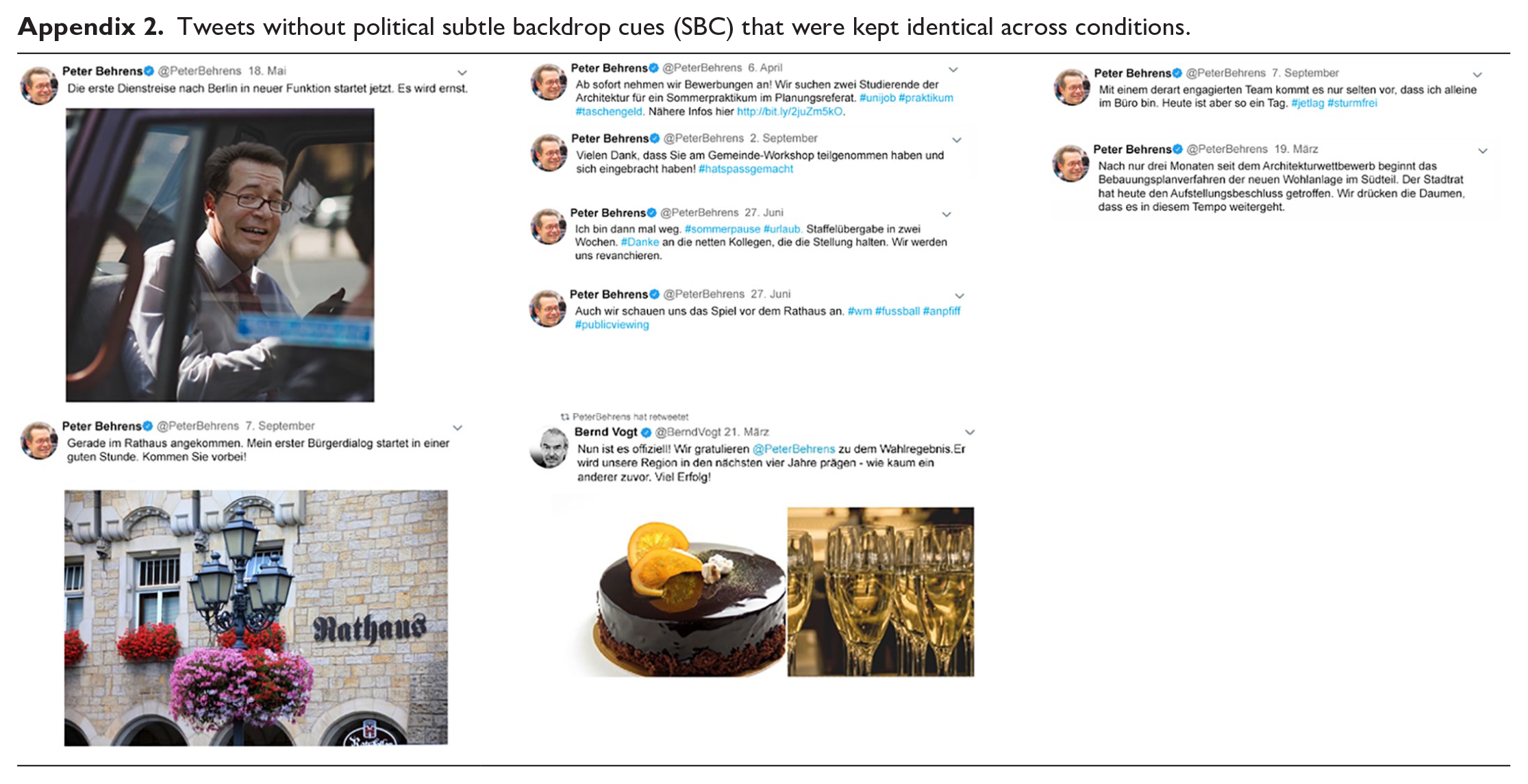
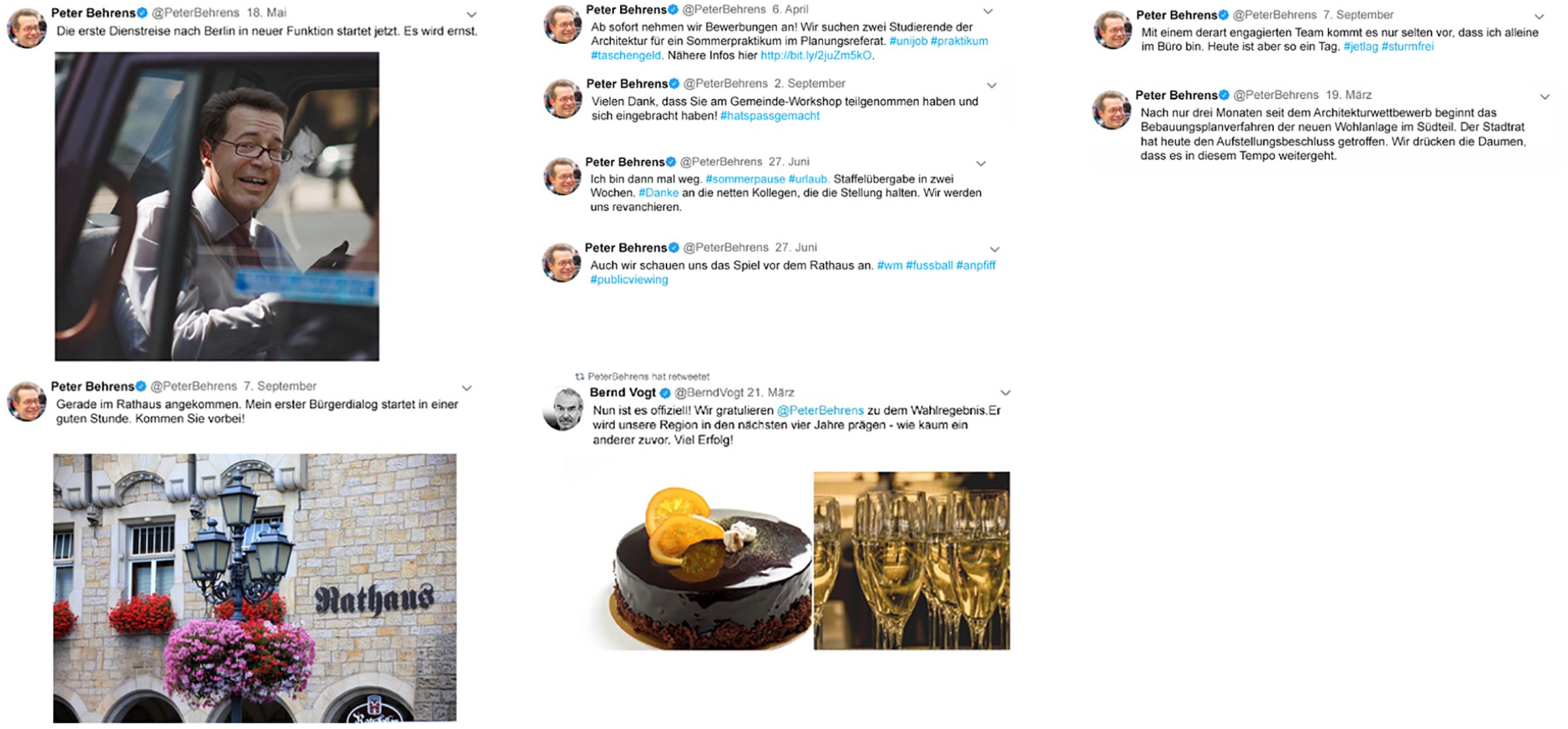
We used three experimental conditions. The participants who were randomly allocated to the conservative condition saw thirteen tweets attributed to a fictitious local politician named Peter Behrens. Six of the tweets were text only, while seven consisted of both text and an image. The verbal component of each tweet was vague. Four tweets 6 included images with SBCs (Appendix 1); they were interspersed among nine tweets without any cues to ideology (Appendix 2). The four photos manipulated to include SBCs were intended to suggest conservative stances on women’s rights, drug policy, secularism, and nationalism. (The pretests reported below confirmed that the four photos with SBCs used in the study accomplished this goal.) All the photos with SBCs showed Behrens in the foreground. In the background, we embedded the SBCs in a way that was consistent with the theorizing presented above, with the images showing the following: (1) a framed photo of a woman pulling a roast chicken out of the oven, (2) a mock portrait of the Mona Lisa holding a traditional beer mug, (3) a cross hanging on one of the walls of a conference room, and (4) attendees of a village fair holding German flags.
Participants allocated to the liberal condition saw the same number of tweets attributed to the same politician. The verbal component of all the tweets was identical to that used in the conservative condition, as were the nine tweets without SBCs. Four tweets (the same as in the conservative group) included images with SBCs intended to suggest a liberal ideology, which were as follows: (1) a framed photo of a woman working at the computer (the same woman as in the conservative condition, intended to be perceived as the politician’s wife), (2) a mock portrait of the Mona Lisa holding a marijuana joint, (3) a Buddha statue hanging on one of the walls of a conference room, and (4) attendees at a village fair holding EU flags.
Participants allocated to the control condition saw the same tweets as participants allocated to both SBC-treatment conditions. However, the SBCs were removed from the four images containing them (see Appendices A and B).
Pretest 1
The first pretest (N = 30) pursued two goals: To ensure that the characteristics of the fictitious politician and of the photos used elicit rather neutral ratings on perceived ideology. This was done in an attempt to account for the ambiguous nature of visuals and prevent ceiling effects: If the photographs and name already elicited a conservative (liberal) perceived ideology rating, then it would be more difficult for conservative (liberal) SBCs to alter ratings in a more conservative (liberal) direction.
The participants saw fourteen tweets attributed to the fictitious politician Peter Behrens. Then, they located Behrens on two 9-point bipolar scales measuring perceived ideology. Scores near the midpoint confirmed that the stimuli did not prompt participants to believe Behrens held a specific ideology (“extremely left wing” [coded as 1] to “extremely right wing” [coded as 9]: M = 4.95, SD = .67; “very liberal” [coded as 1] to “very conservative” [coded as 9]: M = 4.87, SD = 1.52).
Next, the participants saw fourteen images illustrating two opposing views on seven topics 7 and asked to state which of two images were most likely to decorate the office of a conservative politician. On four of the seven issues, the images were categorized as predicted by at least 90 percent of the participants. They pertained to women’s rights, secularism, nationalism, and drug policy. We chose these four issues for the main study.
Pretest 2
We recruited a convenience sample (N = 36) that was different from the one used in Pretest 1. The goal was ensuring that the final stimulus for the main study was perceived to be realistic. Three conditions were used: Each participant was exposed to four tweets containing liberal SBCs, conservative SBCs, or no SBCs at all (control). The tweets containing SBCs included the top-scoring images identified in Pretest 1—indicative of liberal or conservative stances on the same four issues. The tweets in the control condition were identical, except that no cues were embedded in the backgrounds of the images.
The participants were asked to rate the extent to which they perceived each of the tweets as constructed and/or photoshopped on a 7-point Likert scale. The analyses confirmed that that our insertion of SBCs had no significant effect on this. Nevertheless, following some participants’ suggestions, we removed artificial-looking balloons from the images containing nationalism-related SBCs and flipped the photos with secularism SBCs to correct a handshake using the left hand instead of the right hand. The revised stimuli were used in the main study (Appendix 1).
Procedure of the Main Study
The participants were told that the study aimed to elucidate the role played by Twitter in politics. We clarified that they were about to see selected posts from the Twitter feed of a local politician seeking re-election, and we would be asking a couple of questions regarding these tweets afterward. Upon exposure, we recorded the measures reported in the following. Items on cue awareness were placed toward the end, immediately before the standard sociodemographic items. Stimuli and questions were rotated to prevent order effects. After completing the questionnaire, the subjects were informed that the politician and stimuli were not real and we actually wanted to understand the effect of certain visual components of messages on the assessment of politicians (debriefing). The participants provided informed consent before taking part in the study. They were not remunerated.
Measures
Perceived ideology of politician
Perceived ideology was measured using a 9-point bipolar scale with two items ranging from “extremely left wing” to “extremely right wing” and “very liberal” to “very conservative.” Higher values denoted a more conservative ideology, M = 4.87, SD = 1.12, α = .67. For brevity, we merely use the terms “liberal” and “conservative” throughout the paper when referring to this measure.
Voting intention
Using a 7-point Likert scale ranging from “I totally disagree” (coded as 1) to “I totally agree” (coded as 7), the participants were asked for their agreement with five statements in an attempt to measure voting intention: “I would vote for Peter Behrens”; “I would most likely give him my vote”; “I tend toward voting for this local politician”; “I like Peter Behrens and will therefore vote for him”; and “This local politician seems competent to me, and for this reason, I would give him my vote.” The answers were averaged, with higher values indicating higher voting intention, M = 3.35, SD = 1.75, α = .97.
Cue awareness
We measured awareness of SBCs at the end of the questionnaire using multiple yes/no questions. We asked participants to try to recall if they had seen specific photo elements in Peter Behrens’ tweets shown to them at the beginning of the study. We presented images that we had shown to them and images that we had not shown to them and asked them to indicate “yes” (1) or “no” (0) for each item. In the experimental SBC conditions, four bogus images were interspersed among four images that were used as SBCs in the stimuli. The control group saw the four bogus images and eight images with SBCs used in the experimental conditions. We summed up the four dichotomous items to measure cue awareness. The higher the value (possible range: 0–4), the higher the cue awareness. The result for the liberal condition was M = 1.06, SD = 1.14, and that for the conservative condition was M = 1.10, SD = 1.05. Detailed analyses can be obtained upon request.
Participant’s ideology
We used the two 9-point items employed for the perceived politician ideology and adapted them for the participant’s ideology. Answer options ranged from “extremely left wing” to “extremely right wing” and “very liberal” to “very conservative.” Higher values indicated a more conservative ideology, M = 3.76, SD = 1.37, α = .72.
Data Analysis
Details on the data analysis are given in the Supplementary Information file available online. We used PROCESS (Model 21; see Hayes 2013) for the test of the conceptual model visualized in Figure 2. We dummy coded the SBC exposure variable (liberal condition = 0, conservative condition = 1; n = 222) for this regression-based approach.
RQ1 required a comparison of the SBC conditions with the non-SBC control condition for determining whether the mere presence of SBCs, regardless of content, primed political ideology. We assessed the strength of the statistical association between perceived politician ideology and voting intention using the structural equation software AMOS (multigroup analysis). We estimated the size of this correlation simultaneously for the control condition and SBC condition. The SBC condition consisted of both the liberal and conservative conditions. To formally test whether the size of the correlation was different in both conditions (i.e., with and without the mere presence of SBCs), we compared an unrestricted model with a model in which we restricted the strength of the correlation to be equal in both groups. The change in the χ² statistic was used to formally test whether the size of the correlation—the measure of the priming effect—differed depending on the mere presence of SBCs.
Results
Test of the Conceptual Model
The conditional process analysis testing the conceptual model, 8 visualized in Figure 2, suggested that the politically relevant content of SBCs influenced perceived political ideology (H1), but this only occurred when SBC awareness was moderate or high (H2), Coeff = 0.389, SE = 0.144, p = .008 (interaction effect). Importantly, exposure to ideology-relevant SBCs did not influence perceived politician ideology in those with low awareness (i.e., Johnson–Neyman value of cue awareness of less than 1.59). 9
We found that perceived politician ideology—influenced by the content of SBCs—affected voting intention, but as predicted, respondents’ personal political ideology moderated this effect, Coeff = 0.149, SE = 0.071, p = .036 (interaction effect; H3): 10 In extremely liberal participants (ideology = 1.00), a perceived conservative politician ideology substantially reduced voting intention, Coeff = −1.147, SE = 0.148, p < .001 (estimated conditional effect). The Johnson–Neyman significance region was estimated with a value of 5.13, meaning that a perceived conservative ideology of the politician substantially reduced voting intention in all participants with a moderate or liberal political ideology.
Conversely, for extremely conservative individuals (ideology = 8.50), the perceived conservative ideology of the politician was estimated to increase voting intention, Coeff = 0.520, SE = 0.276, p = .060 (estimated conditional effect). Table 1 presents the detailed effect estimates of the Johnson–Neyman analysis.
Conditional Effect of the Perceived Ideology of Politician on Voting Intention at Values of the Moderator (Participant’s Ideology).
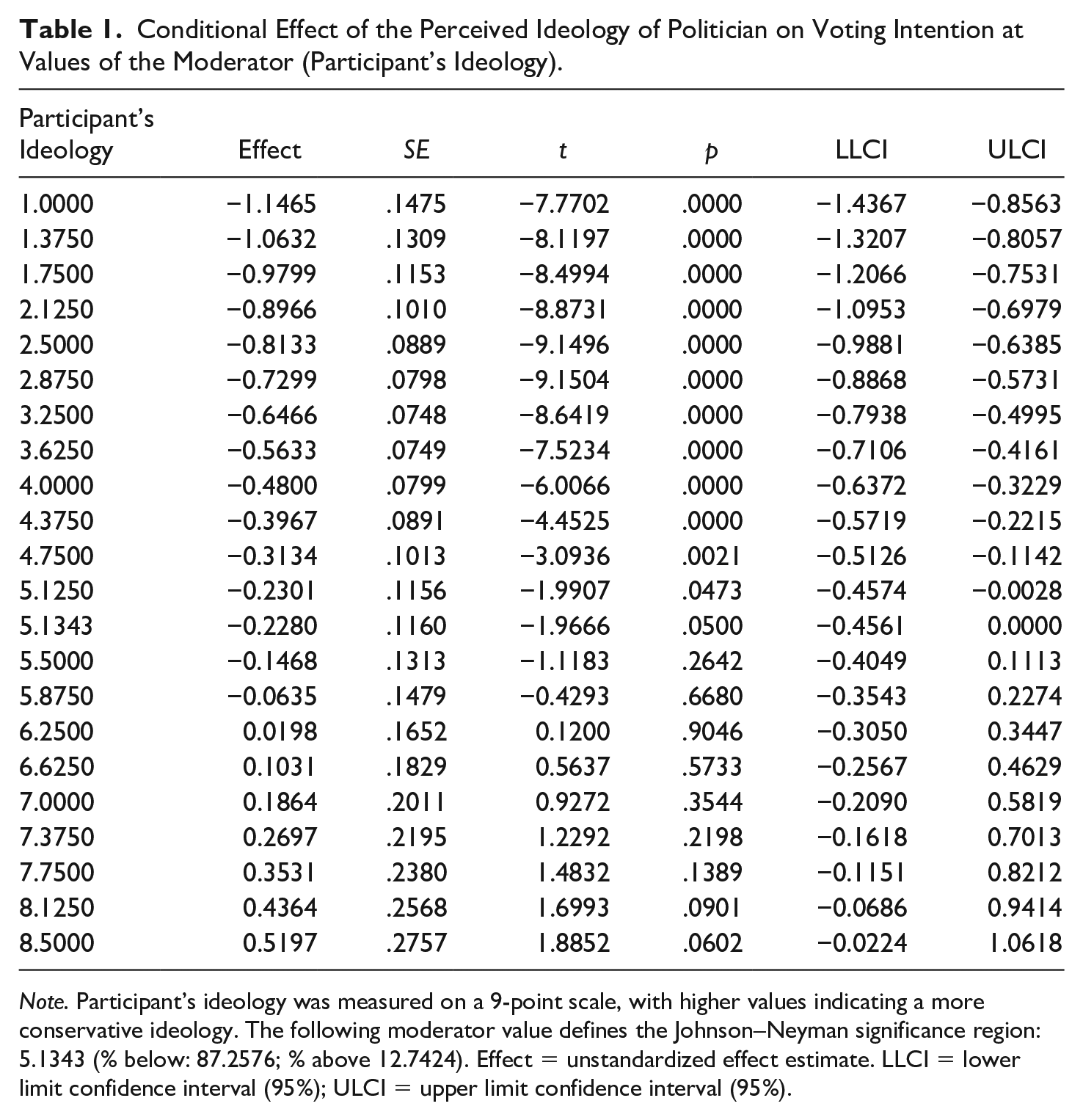
Note. Participant’s ideology was measured on a 9-point scale, with higher values indicating a more conservative ideology. The following moderator value defines the Johnson–Neyman significance region: 5.1343 (% below: 87.2576; % above 12.7424). Effect = unstandardized effect estimate. LLCI = lower limit confidence interval (95%); ULCI = upper limit confidence interval (95%).
Additional Analyses: Mere Presence of SBCs
The first research question asked whether the mere presence of SBCs primes the concept of political ideology in participants’ minds, which would be indicated by a stronger correlation between the perceived political ideology of the politician and voting intention. The fit of the unrestricted model was good, χ²(26) = 34.49, p = .123, root mean square error of approximation (RMSEA) = .030, comparative fit index (CFI) = .997. Most importantly, we obtained a significant finding when comparing the unrestricted and restricted models, χ²(1) = 34.61, p < .001. This indicates that the strength of the (unstandardized) statistical relationship between perceived political ideology and voting intention was different in participants with, Coeff = −1.385, SE = 0.210, p < .001, and without, Coeff = −0.963, SE = 0.339, p = .004, mere exposure to SBCs. This answers RQ1: Participants who were exposed to ideology-related SBCs used the concept of political ideology more strongly when forming a voting intention decision. Note that the coefficient showed a negative sign even in participants not exposed to SBCs. This indicates that our (largely liberal) sample showed reduced voting intention when they considered the politician to be conservative. Taken together, this finding is consistent with priming. It appears that participants relied on the primed concept (political ideology) more when SBCs were present.
Discussion
Citizens wanting to form an opinion about politicians often rely on subtle cues. Despite general agreement over the capacity of both verbal and visual cues to communicate political views unobtrusively, our empirical knowledge about cue effects is limited to those prompted by verbal cues. We focused on visual cues (SBCs) and report the findings of a web-based experiment that are consistent with the claim that SBCs mattered by influencing citizens’ perceptions of a politician’s political ideology, and from there, voting intention. These effects were moderated by cue awareness and ideological consistency. These insights confirm and expand the knowledge obtained in research on verbal cues (Banda 2016; Heit and Nicholson 2016; Kuklinski and Hurley 1994; Layman and Carsey 2002), contributing to political (visual) communication theory.
From a practical campaigner’s perspective, our study reaffirms the power of visuals as vessels of persuasion. The present study is the first to provide empirical evidence supporting the widely held belief that visual cues have substantial effects. Politicians can employ SBCs to determine which one (out of several) positions on new issues resonates most with their constituents or when wanting to maintain the option of backpedaling when taking a provocative stance on hot-button issues (see Ansolabehere et al. 2006). As visuals are more open to interpretation than words are, politicians may find it easy to backpedal and redeem themselves if SBCs prompt a public outcry (see Messaris and Abraham 2001). Future research should look into the effects of SBCs embedded in more complex contexts than still images, especially in audiovisual campaign ads.
From a normative standpoint, politicians’ use of SBCs is a mixed blessing. On one hand, SBCs can manipulate citizens when their guard is down, that is, when they do not anticipate persuasive attempts. As such, they raise ethical questions. On the other, SBCs can be used to cope with information asymmetry (see Darmofal 2005) and/or mimic informed decision making (see Lupia and McCubbins 1998). Indeed, in our study, voting intention increased with ideological consistency (conservatives) and decreased with ideological incongruity (liberals). It is quite remarkable that citizens could extract meaningful information from SBCs and use this to determine whether to support or oppose a candidate. Thus, when politicians use SBCs, citizens at least have the chance to know more than politicians divulge explicitly. However, in time, the strategic use of SBCs may push the boundaries of what constitutes responsible and socially acceptable discourse—especially when considering the wide availability of easy-to-use tools for altering still and moving images. Scholars and pundits alike will have to monitor potentially questionable practices such as these. It is up to future research to determine the turning point between the legitimate pursuit of interests by politicians and manipulation.
As a secondary contribution to the literature, we questioned whether the mere presence of SBCs could prime the concept of political ideology in people’s minds. Our analysis is consistent with the idea that, regardless of their content, SBCs prompt people to assign more weight to the concept of political ideology when deciding on their voting intention. Albeit tentative, this finding is consistent with a media priming effect (see Ewoldsen and Rhodes 2020) and deserves more attention in future research. Indeed, exposure to a political message containing ideology-related visual SBCs might exacerbate people’s tendency to rely on the primed concept (i.e., political ideology) more than a political message without such cues.
Limitations
As with every study, this one has some limitations. First, we studied the short-term effects of a predefined set of SBCs using a web-experimental design. Importantly, we acknowledge that politicians are likely to disseminate cues over a long time rather than all at once (Conover and Feldman 1989) and citizens’ assessments of politicians’ ideology may also evolve over time—as opposed to being the result of a set of SBCs shown simultaneously (Lodge et al. 1995). Nevertheless, we did accommodate the insights of Conover and Feldman (1989) and Lodge et al. (1995) by using a low number of cues (Hastie and Dawes 2009) embedded in tweets interspersed with tweets without SBCs. Future studies may consider using longitudinal designs.
Second, we have chosen a fictitious male politician for this initial study of SBC-induced effects. While this is typical of cue-taking research (Banda 2016; Heit and Nicholson 2016), we acknowledge that new inferences from SBCs are presumably less likely when voters have formed a well-established set of beliefs about a politician (Conover and Feldman 1989). Third, the overrepresentation of liberals in our sample limits the generalizability of our results. Future studies could attempt to replicate our findings in more ideologically balanced samples. Fourth, we did not test the strength of effects of visual against verbal cues. Scholars interested in cross-modal comparisons may want to assess whether one type of cue is more potent than another. Recent reviews of the literature may lead future studies to test the prediction that SBCs would have the edge over verbal cues (see Dan 2018).
Fifth, a study asking people for their ideology and voting intention may be marred by demand effects. While the possibility exists, we argue that the chances this happened here are rather low. After all, participants indicated that they were less likely to vote for an ideologically inconsistent candidate. Furthermore, our experiment was conducted online, reducing the chance that our political views were readily apparent, and that somebody would factor this into their responses. Furthermore, we would argue that none of the SBCs embedded in Tweets were offensive—as far-right symbols would have been, for instance—and stating one’s intention to vote for someone using them would probably not be considered to breach the bounds of acceptable discourse. As ideology played a role, this does not seem to be the case.
Sixth, the measurement of cue awareness has limitations. Having used a total of eight items (SBCs and bogus images), we were unable to account for the possibility that participants responded to the awareness questions by chance. Future studies may consider using more fine-grained measures such as those guided by signal detection theory (see Fox 2004). This would account for participants’ ability to distinguish between signals (targets) and noise (foils)—in our case, between SBCs and bogus images. Sensitivity can be computed by subtracting a standardized score of hits (recognized targets) from a standardized score of false alarms (erroneously identified foils). Certainly, this comes at a cost of participant fatigue, as such analyses require a relatively high number of target and foil items—on average, 15 each. For feasibility reasons, we used a less complex measurement procedure in the present study.
Finally, as we had not manipulated politician’s perceived ideology (the specified mediator) in addition to SBC exposure (the specified independent variable), not all links proposed in our model (Figure 2) can be interpreted causally with the same level of confidence. Specifically, we cannot know for sure if perceived ideology caused voting intention (the specified dependent variable). More certainty can be achieved by experimentally manipulating both the specified mediator in addition to the specified independent variable. Such a “double experiment” (Green et al. 2010: 204) can be attempted in future work. Nevertheless, analysis indicated that effects did not disappear when controlling for age, gender, and education.
Conclusion
This study got the ball rolling on a couple of questions that have not been answered in previous research on the relevance of visuals in political communication. We provided evidence suggesting that the content and mere presence of subtle visual cues embedded in the background of photos of politicians allow citizens to infer the ideology of the politician, which is related to voting intention. As scholars had so far focused exclusively on verbal cues, it was important to demonstrate that ideology can also be cued visually—and this is associated with variations in crucial political outcomes.
As more work is needed to improve our understanding of SBC effects, we end this paper with some ideas on areas of future exploration. First, the study of other mediators promises interesting results. From a normative perspective, for instance, it would be interesting to study if citizens are able to infer issue standpoints from SBCs and whether this inference impacts their intention to vote for that politician. Should this be the case, scholars could test whether perceived consistency on issue standpoints between a politician and a citizen has a similar effect on voting intention as shown here for ideological consistency. Second, other moderators could be tested. This includes but is not limited to cues’ perceptual fluency, the accessibility of people’s beliefs and attitudes toward the SBCs, the depth with which people process the message, the kind of perception, and people’s processing style. Perhaps effects are stronger when SBCs are easier to process; when they address matters toward which people hold chronically accessible beliefs and attitudes; when cues are processed centrally rather than peripherally; in the event of foveal rather than parafoveal processing; and among those with a visual rather than verbal processing style. Third, effects are also likely to depend on SBCs characteristics, most notably size and placement. Here, from a practical perspective, it would be interesting to determine the right “dose” of SBCs—that is, the threshold at which citizens mostly reliably pick up a politician’s ideology without the loss of subtlety (see Arendt 2013).
Supplemental Material
_online_supp_-_Dan_and_Arendt_Supplementary_Information_file_Subtle_Backdrop_Cues_IJPP – Supplemental material for Visual Cues to the Hidden Agenda: Investigating the Effects of Ideology-Related Visual Subtle Backdrop Cues in Political Communication
Supplemental material, _online_supp_-_Dan_and_Arendt_Supplementary_Information_file_Subtle_Backdrop_Cues_IJPP for Visual Cues to the Hidden Agenda: Investigating the Effects of Ideology-Related Visual Subtle Backdrop Cues in Political Communication by Viorela Dan and Florian Arendt in The International Journal of Press/Politics
Footnotes
Appendix
Tweets without political subtle backdrop cues (SBC) that were kept identical across conditions.
|
Declaration of Conflicting Interests
The author(s) declared no potential conflicts of interest with respect to the research, authorship, and/or publication of this article.
Funding
The author(s) disclosed receipt of the following financial support for the research, authorship, and/or publication of this article: This research was supported by the LMU Munich.

Supplemental Material
Supplemental material for this article is available online.
Notes
Author Biographies
References
Supplementary Material
Please find the following supplemental material available below.
For Open Access articles published under a Creative Commons License, all supplemental material carries the same license as the article it is associated with.
For non-Open Access articles published, all supplemental material carries a non-exclusive license, and permission requests for re-use of supplemental material or any part of supplemental material shall be sent directly to the copyright owner as specified in the copyright notice associated with the article.
