




Abstract
Research has shown that citizens with populist attitudes evaluate the news media more negatively, and there is also suggestive evidence that they rely less on established news sources like the legacy press. However, due to data limitations, there is still no solid evidence whether populist citizens have skewed news diets in the contemporary high-choice digital media environment. In this paper, we rely on the selective exposure framework and investigate the relationship between populist attitudes and the consumption of various types of online news. To test our theoretical assumptions, we link 150 million Web site visits by 7,729 Internet users in France, Germany, Italy, Spain, the United Kingdom, and the United States to their responses in an online survey. This design allows us to measure media exposure more precisely than previous studies while linking these data to demographic attributes and political attitudes of participants. The results show that populist attitudes leave pronounced marks in people’s news diets, but the evidence is heterogeneous and highly contingent on the supply side of a country’s media system. Most importantly, citizens with populist attitudes visit less Web sites from the legacy press, while consuming more hyperpartisan news. Despite these tendencies, the Web tracking data show that populist citizens still primarily get their news from established sources. We discuss the implications of these results for the current state of public spheres in democracies.
Introduction
Extant research has shown that people with populist attitudes evaluate the news media more negatively (Fawzi 2019; Pew Research 2018; Schulz et al. 2018). Moreover, there is some evidence that citizens with populist attitudes make less use of established news sources like legacy press outlets (Newman et al. 2019; Schulz 2019b). These political predispositions can be especially impactful given the increasing autonomy of citizens in contemporary high-choice digital media environments (Van Aelst et al. 2017). If people with populist attitudes tune out of legacy news and turn toward less politically balanced digital sources, this might embolden them in their negative views of political actors and processes, polarize public opinion on issues, and ultimately contribute to the fragmentation of democratic public spheres (Bennett and Pfetsch 2018).
In this paper, we investigate selective exposure to news among citizens with populist attitudes. The selective exposure literature is full of evidence showing pronounced effects of partisan predispositions on news selection (Stroud 2017). In light of recent developments on the supply side of politics such as the electoral successes of populist parties, populist attitudes might be a crucial factor guiding information selection. Whereas previous research has relied on survey-based self-reports of media exposure, we use digital behavioral data from the Web browsing histories of 7,729 study participants in France, Germany, Italy, Spain, the United Kingdom, and the United States. This has several advantages: First, such “Web tracking” data provide more reliable measures than commonly used self-reports on media exposure, which have several limitations (Prior 2009; Scharkow 2016). Behavioral data are particularly valuable for the study of sensitive issues like news consumption and visits to hyperpartisan sources. Second, Web tracking data have a unique granularity and therefore provide novel insights into the character and intensity of online media exposure. Third, our approach also captures domains in the long tail of news sources, whereas the list of news brands in surveys is naturally restricted. To classify online media exposure at a large scale, we coded the top five thousand visited domains per country into a typology that comprises the legacy press, tabloid press, public broadcasting, commercial broadcasting, digital-born outlets, and hyperpartisan news. Fourth, the research design allows us to link the behavioral measures to the individual level through a survey on demographic attributes and political attitudes (Stier et al. 2019). We further show that the study participants are similar to participants in external benchmark studies in their online and offline news consumption and in their privacy attitudes.
Our regression models show that citizens with populist attitudes visit the Web sites of the legacy press less often but obtain more contents from hyperpartisan sources. The findings with regard to selective exposure by populist citizens to tabloid news and public broadcasters are mixed. Taken together, populist attitudes leave pronounced marks on people’s media diets, but the evidence is heterogeneous and highly contingent on the supply side of a country’s media system. In the conclusion, we discuss the implications of these results for the current state of public spheres in democracies.
Populism and Selective Exposure
While there are ongoing debates whether populism is an ideology or a style (Rooduijn 2019), scholars agree that populism encompasses a specific set of ideas relying on two elements: a moral distinction between the “good people” and the “corrupt elites” (Canovan 1981; Moffitt 2016; Mudde 2007), and the idea that politics is about respecting the general will of the people (Hawkins et al. 2018; Mudde 2007). Recent studies have shown that a substantial share of citizens in established democracies holds populist attitudes (Akkerman et al. 2014; Schulz et al. 2017); which we conceptualize hereafter as a latent political worldview consisting of anti-elitist attitudes, a preference for popular sovereignty, and a belief in the homogeneity and virtuousness of the people (Schulz et al. 2017; Wettstein, Schulz, Steenbergen, Schemer, Müller, Wirz and Wirth, 2020).
Our paper aims to contribute to debates among researchers and journalists about the impact of populism on democracy and whether the media “play an important part in the political success and failure of populist forces” (Mudde and Kaltwasser 2017: 114; see also Mazzoleni 2008). Recent theoretical accounts of populism have pointed to digital media which provide an ever-increasing proliferation of sources of political information (Engesser et al. 2017; Krämer 2018; Moffitt 2016). In the high-choice digital media environment (Van Aelst et al. 2017), traditional media like the legacy press or public broadcasters are competing with a multitude of digital-born information sources (Bennett and Pfetsch 2018). At an aggregate level, the Web sites of traditional media with an established offline presence are still the most popular news sources on the Web (Fletcher and Nielsen 2017; Nelson and Webster 2017), yet the high-choice digital media environment provides ample opportunities to self-select into a highly individualized news diet structured along populist attitudes. This perspective combining “demand” and “supply” leads us to our first research question:
Demand Side: Populist Attitudes and Selective Exposure
Recently, populism studies have moved beyond supply side explanations that focus on political parties and politicians’ discourse to also investigate populism as an individual-level predisposition. While there are methodological debates on the measurement of populist attitudes (Castanho Silva, Jungkunz, Helbling and Littvay, 2019; Wuttke et al. 2020), such batteries can be used as an independent variable in cross-country research (Wettstein, Schulz, Steenbergen, Schemer, Müller, Wirz and Wirth, 2020). Most prominently, populist attitudes transcend existing political cleavages and predict voting for populist radical left and right parties in many Western democracies (Van Hauwaert and Van Kessel 2018; Wettstein et al. 2019).
In the following, we argue that populist attitudes are related to selective exposure, that is, the selection of information according to prior political beliefs (Stroud 2017). In his review, Krämer (2018) breaks down the relationship between populism and the media into various dimensions. Most important to our study is what he calls “anti-media populism” by “populist groups or members of the general population” who consider “mainstream (non-populist) media as a part of an elite conspiracy” (Krämer 2018: 453). We therefore assume that “source cues” matter, that is, the identity of the sender and its perceived trustworthiness influence content selection (Iyengar and Hahn 2009; Stroud 2010). While message and topic cues as well as other content features also drive selective exposure, a populist worldview should negatively affect evaluations of journalists and news organizations. This might not only decrease the likelihood of visiting particular pieces of content but also translate into a more general avoidance of sources that are perceived as conspiring against “the people.”
A survey of Western European citizens found that citizens with populist attitudes are less likely to trust mainstream news sources, especially public broadcasters (Pew Research 2018). Citizens with populist attitudes also tend to have hostile media perceptions and regard their own political opinions as more congruent with public opinion than the media’s reporting on political matters (Schulz et al. 2018). More specifically, populist citizens consider the legacy press and public service media as being hostile toward them, whereas commercial providers and the tabloid press are not regarded in this way, even though the latter are arguably also part of the mainstream media (Schulz 2019a). A disaggregated analysis of various dimensions of populism showed that anti-elitist attitudes are negatively related to trust in traditional media and to evaluations of the media’s performance and quality (Fawzi 2019). Interestingly, anti-elitism is also negatively correlated with trust in tabloid media, whereas beliefs in the homogeneity of the people and anti-outgroup feelings are positive predictors (Fawzi 2019). Citizens with populist attitudes also have an affinity for beliefs in conspiracies (Castanho Silva et al. 2017). In sum, the psychological processes revealed by these studies suggest that a populist worldview would also translate into skewed media consumption patterns.
Few empirical studies have so far investigated the relationship between populist attitudes and actual news consumption. The most comprehensive and in-depth analysis can be found in Schulz (2019a). She did not consistently find more tabloid use among those with populist attitudes across countries. There was, however, a positive relation between populist attitudes and use of “anti-elitist” media, at least for Germany. Other research revealed a positive relationship between populist attitudes and tabloid news consumption only for its exclusionist dimension (Hameleers et al. 2017). In contrast, quality newspapers were read less by populist citizens, whereas surprisingly, public TV news was similarly popular among populist citizens (Schulz 2019b).
While these studies have provided novel insights, it is noteworthy that they relied entirely on self-reported data on media consumption (see “Measuring online news consumption” section for the limitations of this approach). As the number of news sources that can be included in surveys is constrained, variation across news types might be concealed by survey instruments that are skewed toward the most popular news sources in a country. Moreover, related research almost exclusively focuses on news consumption via television and newspapers.
Supply Side: Populist Attitudes and Different News Types
Several scholars contend that tendencies in news coverage toward sensationalism and adherence to news values provide opportunity structures beneficial to populists (Krämer 2018; Mazzoleni 2008; Mudde 2007). A conventional way to account for the extent to which news coverage is affected by these structural changes in political communication is the distinction between several types of journalism (Esser 1999; Mazzoleni 2008). In the theoretical discussion and in the empirical analysis, we distinguish six news types: tabloid press, legacy press, public broadcasters, hyperpartisan news, commercial broadcasters, and digital-born outlets.
The tabloid press typically uses a more personalized and sensationalist style, focuses more on soft news (Esser 1999), and frames politics from a layperson’s perspective. This style of coverage seems to be attractive for people with populist attitudes (Fawzi 2019). Recent research shows that even though populist actors are not openly promoted or particularly salient in their coverage, tabloids still use populist frames extensively (Wettstein et al. 2019). At the same time, other findings suggest that tabloids do not contain higher levels of populist or anti-elitist coverage (Bos and Brants 2014). Findings from the “supply side” centered research about populism and the tabloid press can thus be regarded as mixed (see also Schulz 2019a).
The tabloid style of presenting the news stands in stark contrast to the mission of the legacy press (i.e., broadsheets, regional newspapers, and weekly current affairs magazines) and public broadcasters. Public service mandates and journalistic norms require representing a diversity of views. Ideally, the “legacy press could assess power balances among different political actors, introduce their positions proportionately, and, thus, set agendas, referee frame contests, and produce effects” (Bennett and Pfetsch 2018: 248). According to a populist worldview, however, “liberal journalism betrays the people and conspires with, or is instrumentalized by, the ruling elite to manipulate the people” (Krämer 2018: 454). 1 Public broadcasters also face accusations, particularly from populist parties, that their financing through public funds is a strain on citizens and makes them susceptible to interference by governments.
The contemporary high-choice media environment is characterized by a number of additional news types. In the digital age, social networking sites such as Facebook and Twitter and digital-born news Web sites have emerged as sources for political information (Bennett and Pfetsch 2018). While many online news providers have a professional staff, others lack journalistic quality. Outlets regarded as “fake news,” “junk news,” or “alternative media” in the literature are the most notorious sources of dubious political information (Allcott and Gentzkow 2017; Guess et al. 2018; Holt et al. 2019). At the same time, defining them is fraught with difficulty.
Several recent studies have used the term “hyperpartisan” (Benkler et al. 2018; Guess et al. 2019; Pennycook and Rand 2019), without providing a clear definition though. In our conceptualization, hyperpartisan sources purport to be news outlets while promoting a narrow and skewed political agenda without making an effort toward a balanced representation of major political issues, events, or political actors. 2 It should be noted that our definition does not encompass what is commonly regarded as “political slant.” Fox News, The Guardian, and the partisan press in Southern Europe present a broad agenda of newsworthy topics and feature, howsoever occasionally, diverse views. We also find “hyperpartisan” conceptually more useful than “alternative” news media as defined by Holt et al. (2019), because they define these media in opposition to hegemonic media, whereas we do not regard the public-mediated arena as necessarily hegemonic.
There is considerable diversity within the spectrum of hyperpartisan Web sites in terms of political ideology and the topical skew inherent to their coverage. Yet, there is a common tendency to frame political opponents as illegitimate groups (e.g., “globalists” on Breitbart), which we assume should align well with a populist worldview.
Taken together, we hypothesize that the relationship between populist attitudes and news consumption varies across different news types. Our analysis is thus guided by the following hypotheses:
We also classify commercial broadcasters and digital-born outlets such as the HuffPost without a clear hyperpartisan slant. While it is difficult to formulate concrete theoretical expectations for them, we still report results for these sources to get a holistic perspective of online news consumption.
Country Heterogeneity
We also expect to find differences across countries because contextual factors shape the opportunity structures for populist actors and citizens (Reinemann et al. 2016). First, various characteristics of political systems such as the electoral system, electoral results, the political culture, and societal polarization vary. Most importantly, the information ecology in each country differs significantly; some countries have an established tabloid press and public broadcasting system or a sprawling hyperpartisan media ecosphere, some not. Moreover, long-lasting macro-level factors like the economic environment, ownership structures, and political parallelism (Hallin and Mancini 2004) still affect news coverage, even in the digital age. Accordingly, studies have found that a strong public broadcasting presence mitigates selective exposure in a country (Bos et al. 2016). Schulz (2019b) also found cross-country variation in selective exposure by populist citizens to newspapers and television news.
The present study covers six Western democracies: France, Germany, Italy, Spain, the United Kingdom, and the United States. The countries selected differ with regard to the above-mentioned contextual factors, the role of populist parties in the political system and whether right and left wing populism (and sometimes both) is prevalent. The cases represent all three types of media systems according to the typology of Hallin and Mancini (2004): the polarized pluralist model (France, Italy, and Spain), the democratic corporatist model (Germany), and the liberal model (the United Kingdom and the United States). Hence, our second research question is as follows:
Measuring Online News Consumption
Most recent studies found few indications of selective exposure in news consumption on Web sites (Flaxman et al. 2016; Fletcher and Nielsen 2017; Nelson and Webster 2017). Although research on this topic relies on various research designs and data types, each of these approaches has drawbacks. First, survey-based studies rely on self-reports of media consumption which naturally restricts the number of Web sites covered as well as the granularity and precision of the measurement. For the approaches that use Web tracking data, the measurement of media consumption is much more precise and researchers know that user
It is particularly troublesome that self-reports on news consumption are affected by various politically motivated biases. People’s reporting on news use depends on the political cues provided by different types of content (Vraga and Tully 2018) and tends to overrepresent socially desirable activities like consumption of quality news (Prior 2009). Especially when studying a subject like populism and media use, this approach is therefore limited. Moreover, the state-of-the-art list-frequency technique (used, for example, by Newman et al. 2019; Schulz 2019b) covers only a limited number of news sources. This measurement approach is necessarily skewed toward the more prominent, most frequently used news sources and is prone to miss less popular sources which might be particularly popular among people critical of the mainstream media.
Improving upon previous measurement approaches, we are able to test our theoretical assumptions using a data set linking surveys with a passive tracking of the Web browsing behavior of participants. 3 This mitigates problems of recall and social desirability bias in surveys and further adds information on individual-level attributes, predispositions, and attitudes that are lacking in the highly aggregated Web tracking data used in audience research. Guess and colleagues (Guess et al. 2019; Guess et al. 2018) studied selective exposure during the 2016 U.S. presidential election campaign with a similar research design. However, they focused on “fake news” and partisan predispositions—not on populist attitudes—and only on one country. With our country-comparative design, we also aim to contribute to the question of how prevalent selective exposure is beyond the much-studied bipolar U.S. case.
At the same time, the large sets of unstructured data that Web tracking techniques produce are an analytical challenge for researchers. Conventional media formats like newspaper articles lend themselves more naturally to content analysis. Therefore, to make sense of the types of contents people see online, most news consumption studies relying on passive tracking data restrict themselves to the domain level (e.g., www.nytimes.com) instead of coding actual contents at the article level (Allcott and Gentzkow 2017; Guess et al. 2019; Guess et al. 2018, but see Budak et al. 2016; Flaxman et al. 2016). We follow this approach in our coding of domains but acknowledge the limitation that we cannot know which individual article, and hence which share of Web site visits, is related to politics. Visitors to commercial broadcasters, for instance, are infrequently exposed to political contents, in contrast to visitors of our main news types of interest—legacy press, tabloid press, public broadcasting, and hyperpartisan news. Because the actual share of political contents seen on Facebook and Twitter is impossible to measure for external researchers without access to the news feeds of people, we exclude social networking sites from our analysis.
Method
Our study relies on a combined data set of Web browsing histories and survey responses. In the following, we describe the data collection and the methods used in the empirical analysis.
Web Tracking
The collection of Web tracking data for this study was done by the survey company Netquest (an affiliate of GfK) in full compliance with EU GDPR (General Data Protection Regulation) regulations. 4 The company is the only one that maintains Web tracking panels in all of the countries under study. Loyal panelists in the regular online access panel are incentivized to also install tools for the tracking of Web site visits on desktop computers as well as Web site visits and app use on smartphones and tablets. Participants are informed about the nature of the data collection and asked for their explicit consent to participate in surveys and Web tracking. The data include the full URL, the name of the domain, the time of access, and the duration of a visit (on desktop computers, an active browser tab). In this paper, we use information about visited URLs aggregated to the domain level (in what follows, “visits”).
Attention is distributed very unequally on the Web, that is, a few (political) Web sites receive many visits while most Web sites in the long tail are visited only rarely (Hindman 2008). We use the skewed attention on the Web to our advantage by capturing most Web site visits through an extensive coding of domains. We first coded the five thousand most visited domains per country into the categories non-political/political. Among the Web sites which cover political issues and actors prominently, we then coded six different news types: legacy press, tabloid press, commercial broadcasters (TV and radio), public broadcasters (TV and radio), digital-born outlets, and hyperpartisan news. For a better understanding of the distinction between the two online only news types, an example is that we code the HuffPost as a digital-born outlet and Breitbart News as hyperpartisan news. Our coding approach covers 93 percent of all Web site visits. A codebook with definitions for each category and a flowchart for the coding can be found in Online Appendix Section 2. The list of coded news domains is shared in the Supplemental Material.
It could well be the case that the online behavior of panelists who agree to install tracking tools differs from the general population of Internet users. However, we validated that the visits of panelists to news domains are comparable with national benchmarks (Online Appendix Section 3). The popularity of news domains in our data corresponds strongly with Alexa data and another benchmark available for Germany, data from the “Informationsgemeinschaft zur Feststellung der Verbreitung von Werbeträgern” (IVW), a Joint Industry Committee to which media providers, advertisers, and advertising agencies submit their original visit data to evaluate their marketing value. Comparisons of tracking data with these external sources result in correlations ranging from
Following the approach of Guess et al. (2018), we conducted an additional survey on privacy attitudes in the regular online access panel of the survey company. This helps us to better understand to what extent the “opt in” to the more intrusive tracking components might bias the sample toward less privacy sensitive individuals. However, privacy attitudes of tracked online panelists differ only marginally from a demographically weighted sample of non-tracked online panelists (Online Appendix Section 5).
Survey
The survey company is still in the process of expanding their Web tracking panels in our target countries so that there is quite a bit of variation in the sample sizes as well as their demographic composition per country (Online Appendix Section 1). We addressed this issue in two ways. First, the sampling of panelists was determined by national census statistics as far as possible. As some of the quota cells were not fully available (e.g., lower education) and due to the overall limited number of tracked desktop users in some countries, we still have pronounced deviations from national census data for some demographic groups. Therefore, after the field period, we post-stratified our samples according to population weights based on census data (Online Appendix Section 1). We invited participants in the Web tracking panels to a survey on media and politics. The survey was in the field from April 23 to May 11, 2019.
In our survey, we used the scale by Schulz et al. (2017) that consists of 12 survey items to measure populist attitudes. For the aggregation of items into one scale we followed the advice by Wuttke et al. (2020) and treated the three subdimensions anti-elitism, beliefs in popular sovereignty and the homogeneity of the people as non-substitutable (what they call the “Goertz concept structure”). Concretely, the 12 original items were first standardized to a mean of zero and a standard deviation of one. Afterwards, the four items belonging to each of the three subdimensions were aggregated by calculating their mean value. Finally, the minimum value of each respondent on the three subdimensions was taken to determine the final populist attitudes score with a range from −3.21 to 0.93 (mean = −0.56; median = −0.53). This procedure ensures that all three theoretical subdimensions are treated as necessary conditions, whereas in compensatory operationalizations of populist attitudes (e.g., using factor analysis) low values on one subdimension can be compensated for by high values on another subdimension.
Analysis
We link the survey and Web tracking data via a unique anonymized panelist ID. The final analysis is based on the survey responses from 7,729 panelists and approximately 150 million desktop URL visits made by them between March 15 and June 16, 2019. 5 To construct our dependent variables, we aggregate all visits by a respondent to domains belonging to one of the six news types we distinguish. Because the dependent variables are heavily skewed, we use count models for the multivariate analysis. Likelihood ratio tests show that the over-dispersion parameter is significant in each of the models (each p < .001). Therefore, negative binomial regressions are preferable over Poisson models.
We include several control variables. Political interest was measured on a 4-point scale in all countries, ranging from “not at all interested” to “very interested.” We also include controls for age, gender, and education. Education was recoded into a country-comparative scale according to the International Standard Classification of Education (ISCED) 2011 classification. The resulting levels are “Low education,” “Intermediate education,” and “High education.” In line with theories of attitude polarization and selective exposure, people with more extreme ideological leanings might be more prone to engage in selective exposure (Fawzi 2019; Möller et al. 2019). Political extremism could also be correlated with populist attitudes, which are a phenomenon that goes beyond left and right ideological leanings (Van Hauwaert and Van Kessel 2018). Hence, we constructed a political extremism variable by calculating the distance of a respondent from the midpoint on an 11-point left/right scale. 6 Especially populist radical right parties and politicians like Donald Trump or Matteo Salvini criticize the mainstream media for political gains. As people with populist attitudes also have a higher likelihood of being a supporter of these parties (Van Hauwaert and Van Kessel 2018; Wettstein et al. 2019), their media preferences could be shaped by these anti-media party cues (Ladd 2011). We therefore included a dummy variable indicating that a respondent identifies with the Alternative for Germany (AfD), Brexit Party, Lega, Rassemblement National, the Republican Party, United Kingdom Independence Party (UKIP), or VOX. 7 We also include dummies that control for country differences, for example, in media and political systems or political culture. Finally, we control for the total number of Web site visits by participants. The more active a person is online, the more likely she will also visit news Web sites, not least due to incidental exposure to such contents via social networking sites (Flaxman et al. 2016).
The regression analyses are based on the Web tracking and survey data of all respondents who had no missing values for the variables included in the regression models. We conducted all analyses in R (R Core Team 2016). 8
Results
We first provide descriptive evidence on the number of visits to each news type. Figure 1 shows that most people still get their news from established sources, but that the mean number of visits per news type varies across countries. It is a plausible assumption that U.S. participants visited less news sites than European participants because the latter were mobilized to some extent by the EU election campaign. 9 Furthermore, well-known structural differences between media systems still leave a strong mark in online news consumption (RQ2). The legacy press which includes regional newspapers dominates news visits from continental European countries, whereas the BBC is the overwhelming market leader in online news in the United Kingdom with more than three hundred mean visits per panelist. Digital-born outlets and hyperpartisan news have their highest market shares in the United States.
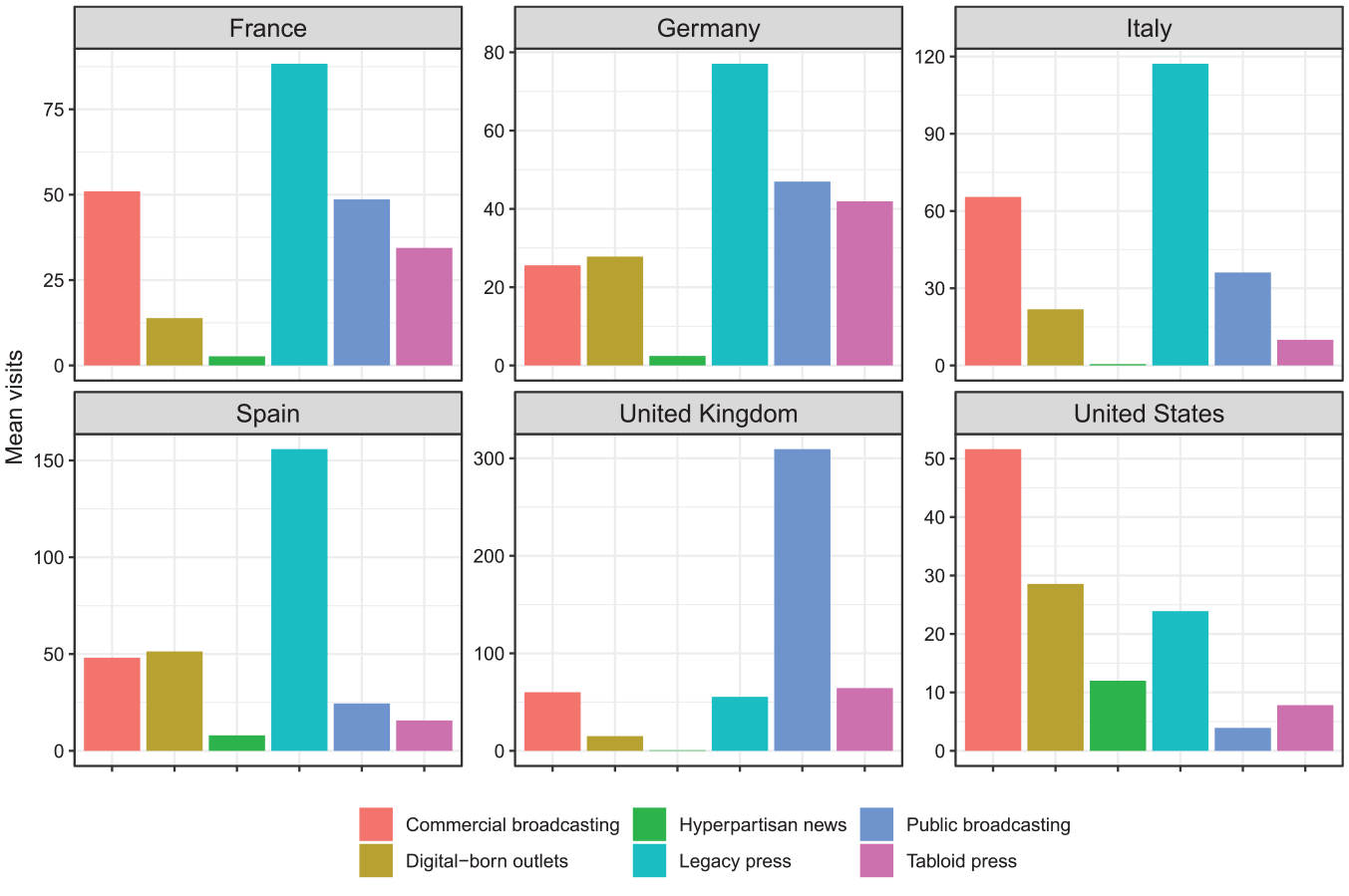
Mean visits by participant for each news type.
We next turn to RQ1 and investigate populist attitudes and selective exposure to different news types while controlling for alternative explanations. In Figure 2, we visualize the main findings from negative binomial regression models with all control variables included (Table A8 in the Online Appendix). 10 The data are weighted by population margins from census data so that the panel resembles the national population on core demographics. 11
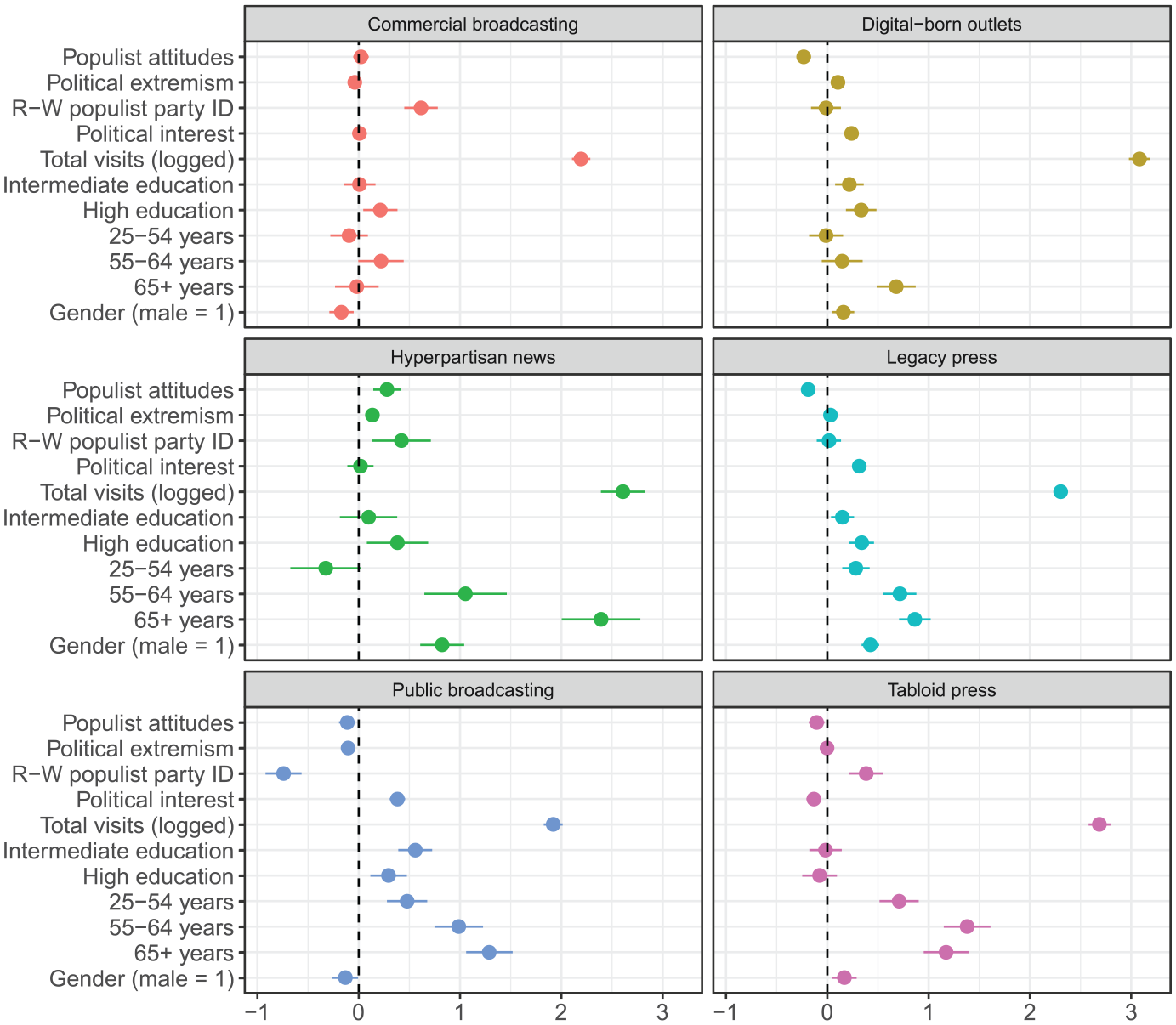
The relationship between populist attitudes and online news consumption.
In line with H1, populist citizens indeed visit domains of legacy press outlets such as the New York Times or Corriere della Sera less often. Populist citizens also seem to avoid public broadcasting websites. However, the coding of domains as news is particularly imprecise for broadcasting sites, which contain a significant share of entertainment contents and non-political videos. To investigate this, we coded the subdomains of public broadcasters whether they specifically refer to news (e.g., www.bbc.co.uk/news). The results in Table A15 show that citizens with populist attitudes do not avoid news on websites of public broadcasters (contradicting H2).
We find that people with stronger populist attitudes tend to consume less tabloid news (contradicting H3) and more hyperpartisan news (supporting H4). However, the results for these two news types have to be further contextualized, as differences in media systems are particularly relevant (see cross-country results below). Populist citizens visit digital-born outlets like the HuffPost less frequently, while coefficients are not significant in the case of commercial broadcasting websites.
But do the identified effects substantively matter? Figure 3 shows the marginal effects for hyperpartisan news and the legacy press, the two categories of primary theoretical interest. 12 The sizes of the effects are clearly contingent on the different market shares of each news type (see Figure 1). The effect sizes are small for hyperpartisan news as these domains are not very prominently visited overall. A shift from the weakest to the strongest populist attitudes would be associated with an increase of 0.056 hyperpartisan Web site visits (95 percent confidence interval [CI] = [0.036, 0.076]). On the contrary, a shift from the weak to the extreme end of the populist attitudes scale would be associated with a decrease of −24.56 legacy press Web site visits (95 percent CI = [−19.40, −29.72]). Given that we control for confounders—most importantly political interest and general online activity—we regard these effect sizes as substantively meaningful considering our research period of three months.
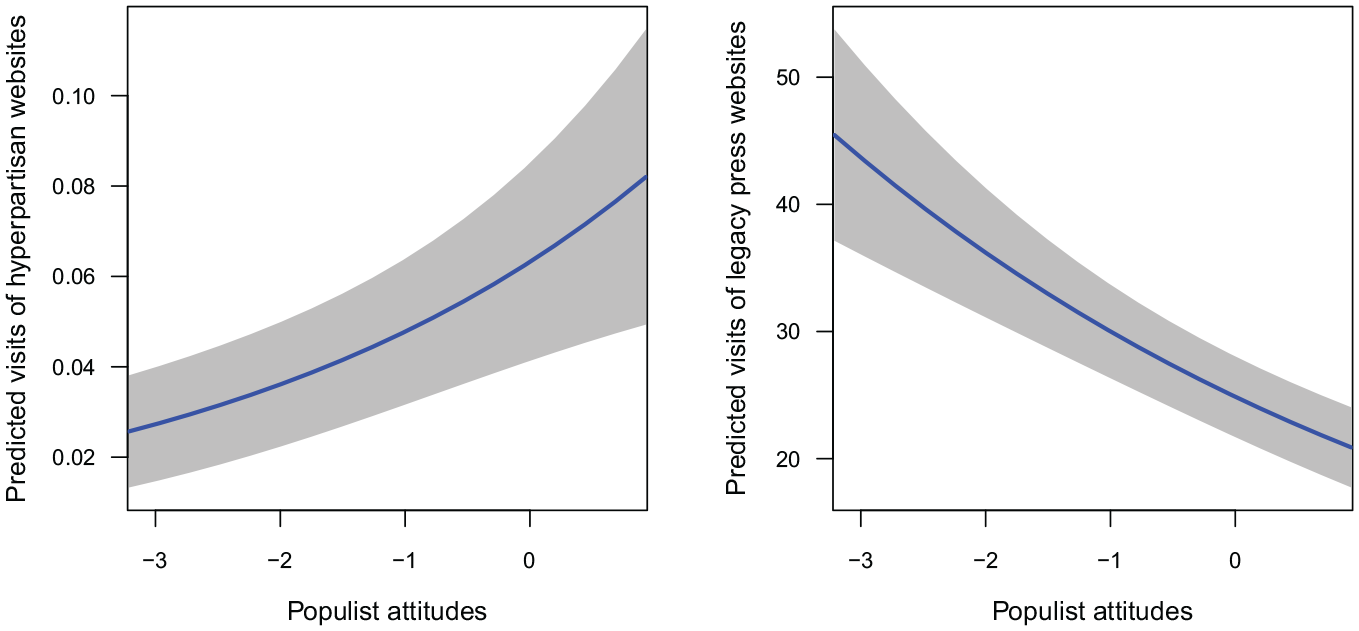
Average marginal effects for visits to hyperpartisan news and legacy press Web sites.
The control variables show quite a bit of variation across news types, but mostly in the expected directions. Even though there is evidence that populist attitudes, political extremism, and a right-wing populist party identification are independent constructs (Van Hauwaert and Van Kessel 2018), there might be concerns that multicollinearity distorts the findings. 13 In robustness tests, we excluded these variables step wise (Tables A10-A12), introduced media trust as a control variable (Table A13) and used the aggregated duration spent on websites as the dependent variable instead of the number of visits (Table A14). The findings for the legacy press, hyperpartisan news and the tabloid press remain mostly consistent, while the coefficient of populist attitudes on public broadcasting use becomes insignificant in various model specifications. 14
Whereas six cases are not sufficient to relate macro-level factors to individuals’ online behavior in multi-level regression models, we supplement our main results with separate regression models for each country and news type (see Online Appendix Section 8) to investigate RQ2. The main findings related to our main hypotheses are summarized in Table 1. The negative effect of populist attitudes on visits to legacy press outlets is significant in four countries, while the insignificant results for public broadcasters are consistent across all countries. The coefficients for populist attitudes are negatively significant for tabloid use in Germany and Italy. In the case of hyperpartisan news, the relationship is only significantly positive for Germany and the U.S.
Effects of populist attitudes on news consumption across countries.
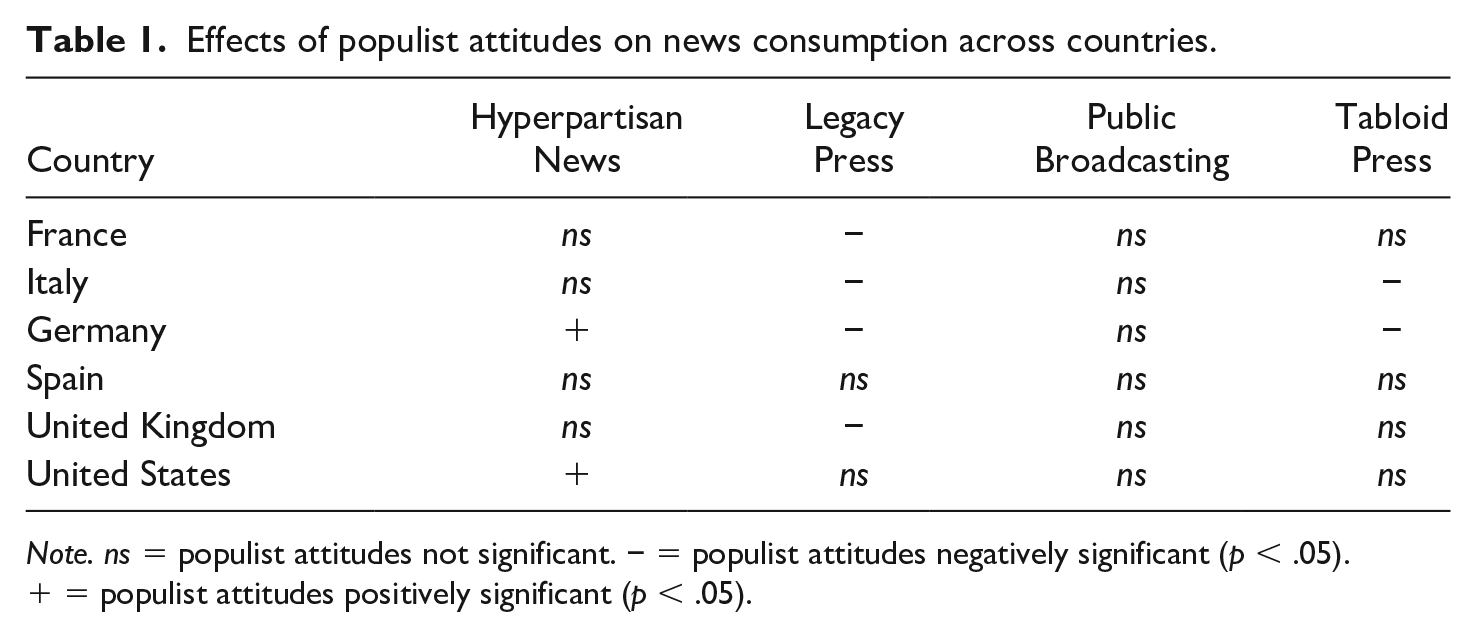
Note. ns = populist attitudes not significant. − = populist attitudes negatively significant (p < .05). + = populist attitudes positively significant (p < .05).
How can we make sense of these patterns? Only when there is a noteworthy hyperpartisan ecosystem do citizens with populist attitudes navigate to such sources. A point in case is the United Kingdom, where the tabloid press already saturates the market with sensationalist news. 15 It is also the only country where the tabloid press surpasses the audience share of the legacy press. Use of tabloids is widespread there, independent of populist or non-populist attitudes, and therefore one should not automatically conclude that the overall quality of information is higher in contexts where hyperpartisan news cannot gain a foothold. Also noteworthy is the negative relationship between populist attitudes and tabloid use in Germany, where the BILD Zeitung, the most popular tabloid online and offline, has always been critical of populist radical right parties even though its coverage focuses on similar topics (Mudde 2007: 249–250). In contrast, the effect of populist attitudes on hyperpartisan news is strongest in Germany, which hints at substitution effects between tabloids and hyperpartisan media. In the absence of tracking data for more countries that would allow for robust country-comparative statistical estimations, these conclusions are necessarily tentative. But it is evident that news consumption by citizens with populist attitudes is strongly related to the supply side of media systems.
Discussion and Conclusion
This is the most comprehensive analysis of online selective exposure by citizens with populist attitudes to date. A few findings are surprising but they do not necessarily contradict previous research. By focussing on just the news sections of public broadcasting Web sites, it became clear that populist citizens do not avoid public service news. Yet they might still process information differently. In line with the motivated reasoning paradigm (Taber and Lodge 2006), the underlying motive could be not to accurately inform oneself but rather to satisfy directional goals by occasionally hearing what the “fake news media” or “lying press” has to say and confirm that these sources are indeed biased.
The inconsistent cross-country findings with regard to the relationship between populist citizens and the consumption of tabloid news add to a still unresolved puzzle in the literature. While populist citizens should feel aligned with a tabloid style of coverage that pits the ordinary “people” against the elites (Mazzoleni 2008), empirical findings are conflicting (Bos and Brants 2014; Hameleers et al. 2017; Schulz 2019b; Wettstein et al. 2019).
The finding that citizens with populist attitudes consume less legacy news has potentially severe implications for democracy. This is a sign for the weakened role of the legacy press in times of “disrupted public spheres” (Bennett and Pfetsch 2018). At the same time, the concerns that digital media would drive citizens with populist attitudes to alternative sources at a large scale are unwarranted. Legacy press outlets were still consumed nineteen times as much as hyperpartisan news sources in our panel, and only 151 people (out of 7,729) had more visits to hyperpartisan than to legacy press sources. Moreover, the relationship between populist attitudes and visits to hyperpartisan news sites was not robust across countries. Like other problematic aspects of digital media such as self-segregation or exposure to disinformation, consumption of hyperpartisan news is still a fringe phenomenon.
We also acknowledge several limitations. We only measured media exposure at the domain level and did not take into account which individual articles participants visited. In further research, one could use machine learning to classify all articles from a given domain as political or not (Budak et al. 2016; Flaxman et al. 2016). We also could not directly measure exposure to news within social networking sites like Facebook. Our findings were based on a non-probability sample, as for such a sensitive data collection, the informed consent of participants is required. Despite the applied population weights and evidence that online and offline news consumption as well as privacy attitudes by tracking panelists closely resemble external benchmarks, unobserved confounders could still affect our results. Note, however, that we investigate relationships between variables and do not extrapolate from our sample to the general population (Baker et al. 2013). Finally, there is also evidence for the reverse causal mechanism that selective exposure to news emboldens people in their populist attitudes (Müller et al. 2017).
Several of our results mirror previous research on populist attitudes and offline news consumption (Schulz 2019b). This speaks for a profound audience duplication and deeply ingrained habits so that people stick to well-known sources (Fletcher and Nielsen 2017), despite their mistrust of the mainstream media. However, the finding that already disaffected citizens turn their back toward the legacy press is a troubling sign for democratic public spheres. It is clear that citizens with populist attitudes have a different orientation toward news media than their fellow citizens. This orientation may be an indication of a political shift in what some parts of “the people” want, in addition to who they vote for. Ultimately, selective exposure by populist citizens could exacerbate the tendency toward new fault lines in the politics of established democracies.
Supplemental Material
Domain_codes – Supplemental material for Populist Attitudes and Selective Exposure to Online News: A Cross-Country Analysis Combining Web Tracking and Surveys
Supplemental material, Domain_codes for Populist Attitudes and Selective Exposure to Online News: A Cross-Country Analysis Combining Web Tracking and Surveys by Sebastian Stier, Nora Kirkizh, Caterina Froio and Ralph Schroeder in The International Journal of Press/Politics
Supplemental Material
Online_Appendix – Supplemental material for Populist Attitudes and Selective Exposure to Online News: A Cross-Country Analysis Combining Web Tracking and Surveys
Supplemental material, Online_Appendix for Populist Attitudes and Selective Exposure to Online News: A Cross-Country Analysis Combining Web Tracking and Surveys by Sebastian Stier, Nora Kirkizh, Caterina Froio and Ralph Schroeder in The International Journal of Press/Politics
Footnotes
Acknowledgements
We thank four reviewers, Cristian Vaccari, Richard Fletcher, Anne Schulz, and participants at the European Consortium for Political Research (ECPR) General Conference 2019; the European Political Science Association (EPSA) Annual Conference 2019; the workshop “Digital Threats to Democracy”; the workshop “Linking Survey and Context Data”; and the Eurolab Conference for helpful comments. Excellent research assistance was provided by Céline Widera.
Declaration of Conflicting Interests
The author(s) declared no potential conflicts of interest with respect to the research, authorship, and/or publication of this article.
Funding
The author(s) disclosed receipt of the following financial support for the research, authorship, and/or publication of this article: This research has been supported by the Volkswagen Foundation, Grant No. 94758.

Supplemental Material
Supplemental material for this article is available online.
Notes
Author Biographies
References
Supplementary Material
Please find the following supplemental material available below.
For Open Access articles published under a Creative Commons License, all supplemental material carries the same license as the article it is associated with.
For non-Open Access articles published, all supplemental material carries a non-exclusive license, and permission requests for re-use of supplemental material or any part of supplemental material shall be sent directly to the copyright owner as specified in the copyright notice associated with the article.
