




Abstract
In this article, the introduction to a special International Journal of Press/Politics (IJPP) issue on populism, we articulate and define populism as a communication phenomenon. We provide an overview of populist political communication research and its current foci. We offer a framework for ongoing research and set the boundary conditions for a new generation of research on populist political communication, with an aim to push the research agendas and design toward a more interactive, systematic, and in particular, comparative approach to the study of populist political communication.
Introduction
About fifty years ago, in 1967, a conference was held at the London School of Economics on the meaning and characteristics of populism. The opening of the conference publication (Ionescu and Gellner 1969: 1, cited in Moffitt 2016) concluded, “[T]here can, at present, be no doubt about the importance of populism. But no one is clear what it is.” Five decades later and scholars have identified several aspects of populism that are analytically useful. Studies have shown the configuration and nature of populism in places like Hungary, Italy, Spain, France, Argentina, Venezuela, Mexico, Australia, and South Africa. Recent elections in 2016/2017/2018, including those in Britain, the United States, the Netherlands, France, India, Italy, Austria, and Norway remind us that populism today is a truly global phenomenon.
The electoral success of populist parties has increased over the past decades. The mean vote share for “populist right” parties doubled from less than 7 percent in the 1960s to almost 14 percent in the 2010s. On the left, populist party support went from less than 3 percent to almost 13 percent in the same period (Inglehart and Norris 2017: 23). From this perspective, the increase in the support for populism is unequivocal. The reasons for this are complex, but two broadly held interpretations point toward economic insecurity on the one hand and cultural backlash on the other (see also Mudde 2007; van Hauwaert and van Kessel 2018).
In the past decade, exogenous events and “external conditions” have been conducive to both: A significant part of the world went through the longest economic recession and crisis in a century. To this can be added transnational migrant flows and growing income inequalities, which economists have forcefully demonstrated both within and between countries (see also Fraser Institute 2017). Laclau (2005) considers such crises at the very root of populism, both historically and contemporarily. In this vein, Otjes et al. (2018) show how certain populist political parties presented a “unified nativist” response to the economic crisis. Indeed, Kübler and Kriesi (2017) note that globalization, which captures many of these trends, provides fertile ground for populism. In sum, the conditions for an even further populist surge are, thus, present.
Is populism per se a positive force for change or a threat to democracy? Populism might increase representation and give a voice to groups of citizens that do not feel heard by the current political elite. Populism might broaden the attention for issues that are not in the mainstream news. Populism might mobilize groups of people that have felt on the fringe of the political system. Populism might improve the responsiveness of the political system by making actors and parties align their policies more with the “wishes of the people.” Populism might be a refreshing wakeup call to power-holders, prompting periodic reflections on their conduct and elitism. That said, populism might also challenge or have outright negative consequences for liberal democracy (Mudde and Kaltwasser 2017). Populism might curb minority rights. Populism can use an electoral mandate to erode independent institutions that are considered corner stones of liberal democracies like the courts or the free media. Populism might lead to political tribalism, which impedes civil discourse and disencourages political compromise.
Most scholars tend to refrain from offering an absolute condemnation or celebration but, instead, dissect the different elements and expressions of populism and consider them in an appropriate contextual fashion. Mudde and Kaltwasser (2012) subscribe to this position and see populism as both a threat and a corrective for democratic politics. In countries with a consensual, parliamentary system; strong institutions of checks and balances; and a strong, autonomous, and publicly respected press, populism is much less likely to become an existential threat. In countries with a polarized majority voting system, weak institutions of checks and balances, and a weak press (subject to instrumentalization attempts and other attacks on their independence), however, the picture is different. In this Introduction, however, we are not so much concerned with a normative assessment of opportunity structures and challenges to democracy as with an improved understanding of the role of political communication in the process.
The starting point of our reflections is the recognition that populist ideas must be communicated discursively to achieve the communicator’s goals and the intended effects on the audience. We follow an approach that combines Mudde’s (2004) ideology-centered and Hawkin’s (2010) discourse-centered understanding of populism. Accordingly, populism can be understood as a discursive manifestation of a thin-centered ideology that is not only focused on the underlying “set of basic assumptions about the world” but in particular on “the language that unwittingly expresses them” (Hawkins, Riding, and Mudde 2012: 3). Put differently, the communicative tools used for spreading populist ideas are just as central as the populist ideas themselves. The growing realization among political scientists that the discourse is of crucial importance for the understanding of populism (Aslanidis 2016; Jagers and Walgrave 2007; Laclau 2005; Moffitt 2016; Pauwels 2011; Rooduijn et al. 2014) is taken up by the contributors to this Special Issue from the perspective of communication science. The articles gathered here are examples of a new generation of populism researchers. With this Introduction—made available to the authors in the early phase of the peer review process—we provide a conceptual basis for an understanding of populism as an expression of political communication content and political communication style.
Populism as a Communication Phenomenon
Conceiving populism as an ideology that is articulated discursively by political actors and media actors bridges existing literature from political science and communication science. From a distinct political communication point of view, the focus now shifts from what constitutes the ideology of populism to how it is communicated. From this communication-centered perspective, the emphasis is on populist messages as independent “phenomenon as such” and no longer on a particular party family or type of politician. With populism “as content,” we refer to the public communication of core components of populist ideology (such as people-centrism and anti-elitism) with a characteristic set of key messages or frames. With populism “as style,” we refer to the fact that these messages expressing populist ideology are often associated with the use of a characteristic set of presentational style elements. In this perspective, populism is understood as features of political communication rather than characteristics of the actor sending the message. Hence, the focus is on the unique contribution of communication processes to “construct” populist ideas, and at the communicative styles that systematically co-occur with it. Our understanding of, and approach to, populism, thus, centers around communication. We believe this offers a grounding definition of populism that is nuanced, concise about its constituent elements, and resonates theoretically with a more or less explicit popular use of the term.
By considering populism a communication phenomenon that can be operationalized by the frequent or infrequent use of characteristic content and style features, it becomes possible to determine degrees of populism. This makes it a gradual concept where the question of who is populist will be answered by empirical measures of an actor’s communicative output. The equivalent logic can be applied to the audience side where the relative strength of corresponding attitudes decides who is a populist and who is not.
Depending on the use of characteristic content and style features, one can distinguish different types of populism (Aalberg et al. 2017; Jagers and Walgrave 2007): Complete populism includes reference and appeals to the people, anti-elitism, and exclusion of out-groups. Excluding populism includes only references and appeals to the people and exclusion of out-groups, whereas anti-elitist populism includes reference and appeals to the people and anti-elitism. Finally, empty populism includes only reference and appeals to the people.
At the very core of this definition, you find communication and the media. How do voters make sense of politics? Given the centrality of the media as the key connector between political actors and the public, it is astonishing so little academic attention has been devoted to the intersection between media and populism. Much effort, in particular in political science, has gone into understanding why populist parties have gained electoral success. However, communication—a key element of this phenomenon—has mostly been overlooked. Even in the new Oxford Handbook of Populism, none of the chapters focuses on the effect of populist messages on citizens, and only one entry looks at populism and the media (Kaltwasser et al. 2017). In fact, systematic knowledge is sparse not only related to the role of the media but also on questions dealing with populist actors as communicators, and the impact of populist communication strategies on citizens (Aalberg et al. 2017). Moffitt (2016: 94) succinctly concludes that “media can no longer be treated as a ‘side issue’ when it comes to understanding contemporary populism. It must be put at the centre of our analysis . . . .” We could not agree more.
Below, we outline how communication needs to be considered both at the levels of political actors and parties, the media themselves, and citizens. It is important to stress, however, that for each of these central actors, ongoing developments shape the capacity, velocity, and meaning of their communication and expressions. Today’s political communication ecology is characterized by a hybrid, high choice media environment in which politics, media, technology, and citizens are all changing (van Aelst et al. 2017). To highlight a few key developments, we are experiencing a proliferation of news and information sources; an alteration of information formats; a convergence between mass and interpersonal communication; new alignments between consumer/citizen preferences and media use; and changing news consumption patterns with a simultaneous development toward both active, self-selected versus pre-determined, algorithmic information seeking and selection (see, for example, Shah et al. 2017; Stroud 2008; Zuiderveen Borghesius et al. 2016). Particularly worrisome in this context is the risk of increasing relativism in which factual information comes to be seen as a matter of opinion, evidence is neglected, and conspiracy theories thrive (Van Aelst et al. 2017). The current “disinformation” debate is a tribute to the prevalence of relativism.
Ceteris paribus, the proliferation of new media is conducive for populist communication. Empirical examples in recent years have demonstrated this in Switzerland (Ernst, Engesser and Esser 2017), the Netherlands (Hameleers, Bos and de Vreese 2016), Hungary, and Italy (Moffitt 2016). These studies stress the affordances and opportunities of new and social media as successful venues and platforms for populist political actors. As Keane (2013) succinctly put it, “populism is particularly suited to the contours of the ‘new media galaxy.’” The weaknesses of extant political-communication-centered approaches in the study of populism lie in a lack of systematic and comprehensive data, lack of cross-national evidence, and lack of clarity about the role of old/new/hybrid media. It is in recognition of this lacunae that we position this special issue: There is a strong need for a populist communication perspective, and there is a strong need for a comparative, systematic, and comprehensive perspective that takes us beyond the particularity of case studies.
Communication Matters
If we take the premise seriously that populism is a communication phenomenon, we can distinguish how three key actors—(1) political parties, (2) the media, and (3) citizens—relate to populism in their communication (see also Aalberg and de Vreese 2017). With populism as an expression of political communication content and style, we zoom in on the functions and expressions that come into play when crafting and distributing messages, the fora in which these appear, and their potential effects.
Political Actors
In populist communication that manifests itself in discourse, three elements are central: (1) reference to “the People,” (2) a battle against the “corrupt” elite, and with a possible extension of (3) the identification of an out-group. These defining elements have been emphasized by several scholars of populism (Aalberg et al. 2017; Jagers and Walgrave 2007; Kriesi 2014; Mudde 2004). The reference to the people is the first defining feature. It is at the very core, the minimal defining element, also dubbed the “empty populism” (Jagers and Walgrave 2007). People can take different meanings; this discursive vagueness allows populists to unite diverse audiences under one label. By appealing to the people, populists “are attempting to bring a subject called ‘the people’ into being: They produce what they claim to present” (Moffit and Tormey 2014: 389; see also Laclau 2005). The construction of an elite in opposition to the interests of the people is the second defining feature. It refers to communication that explicitly condemns the establishment, the current power-holders, the incumbents and proponents of the existing, malfunctioning system. This anti-elitism populism is rhetoric used in particular by outsiders, political actors who are trying to gain leverage in a political system and build up name recognition. The third defining feature includes reference and appeals to the people, and the exclusion of out-groups (excluding populism). A political communication perspective holds that constructing a specific sense of social identity is at the heart of populism. Communicative messages can prime aspects of social identity, define in-groups (the good people), and construct out-groups (problematic minorities, self-serving elites, scapegoats presented as threats). The identification of a clear out-group is not a defining feature of all kinds of populism, but out-group rhetoric is often used by populists on the left (against capitalists) and on the right (against immigrants).
A useful distinction is made between research that looks at political actors, a priori defined as populists, and investigates “factors that might explain their presence and clout as well as their communication strategies, tactics, and styles” (Stanyer et al. 2016). Another approach takes a starting point in key characteristics of populist communication and then analyzes the extent to which different actors make use of these, without an a priori classification of who is a populist or not. The specific communication of political actors may come in different forms. Earlier work has focused on speeches, rallies, manifestos, and campaign advertising (e.g., Bos et al. 2011; Rooduijn and Akkerman 2017; Schmuck and Matthes 2017). The relationship of populist political communicators with the media has traditionally been strained. On one hand, populist actors need the “oxygen of publicity,” which is often supplied by the (mass) media. On the other hand, populist actors often receive critical coverage in the “elite media” and favorable coverage in the popular press (Mazzoleni et al. 2003). At the same time, it has become evident that (legacy) media are often portrayed by the very same political actors as “corrupt” elite institutions, fitting into the above definition of anti-elitism. A recent example of this is U.S. President Trump’s attack on mainstream news media as “fake” and speculating about limiting their freedom and operations (Amanpour 2016; Dawes 2016). To use his own words on twitter, “The FAKE NEWS media (failing @nytimes, @NBCNews, @ABC, @CBS, @CNN) is not my enemy, it is the enemy of the American People!” (@realDonaldTrump 1:48 p.m.; February 17, 2017).
With the increasing popularity of social media, both as platforms for sharing news and as a communication ecology of their own, recent research has looked explicitly at populism communication in these areas. Engesser et al. (2017) concluded that the ability to communicate to and with “the people” in a direct manner while bypassing mainstream media has made social media popular with populist politicians. Social media provide direct access to the public without journalistic interference (but subject to new forms of algorithmic gatekeeping), offer the possibility of establishing a close and direct connection to the people, foster the potential for personalized forms of communication, and can create a feeling of community, belonging, and recognition among otherwise scattered groups. Across six Western democracies, Ernst et al. (2017) found that social media populism is most often used by those parties that are at the extreme left or extreme right of the political spectrum, or those holding an opposition or challenger status.
The Media
As a second actor, the media are key to analyze and understand. Populism research traditionally paid little attention or only lip service to the centrality of the media. This is changing. A useful distinction can be made by considering populism by the media or through the media (Esser et al. 2017). In the former, media organizations explicitly engage in their own kind of populism. This can be done by being pro-active advocates on behalf of the people, with a critical attitude toward power holders. To some degree, this coincides with journalistic norms and role conceptions (such as representing the “man in the street” and being the fourth estate, controlling and holding power accountable). However, in an exacerbated and activist form, this would build on some of the same principles as populist communication by some political actors.
In the latter, populism through the media, the attention is less on the media as actors themselves and more on the contents they carry. By providing a forum for actors using populist communication, the media help disseminate these messages and increase the visibility and legitimacy of these actors. As Mazzoleni (2008: 50) phrases it, “the media, intentionally or not, may serve as powerful mobilization tools for populist causes.” Indeed, in a recent cross-national synthesis of extant research, it was concluded that news coverage of populist actors has increased (Esser et al. 2017). Moreover, some issues (such as immigration) are closer aligned with populist actors, and the agenda of issues covered in the media should, therefore, also be part of considering populist media content (Reinemann et al. 2017). In some cases, it appears that political actors like Wilders in the Netherlands and Trump in the United States have been highly successful using social media, not only to bypass mainstream media but also, perhaps even more importantly, to set the agenda of mainstream media (see also Karpf 2017), thereby amplyfying the reach of their messages significantly and extending the duration of the impact of the message in the ongoing news cycle.
It remains an open question, however, whether some actors receive a disproportiate amount of coverage and some have raised the question whether the centrality of media coverage is unique to populist actors or a feature of politics more generally, applying to actors across the political spectrum (Bos et al. 2011). Regardless of the measureable effects of news reporting, the recent populist surge has sparked several rounds of self-reflections on the side of the media and journalism in the wake of, for example, the Brexit referendum, the Trump U.S. Presidential election, and the 2017 German election. These have led to disucssions of how to cover populist actors, how to represent the breadth of electoral preferences, and a revived discussion of the democratic role and responsiblities of journalism (e.g., Amanpour 2016; Carlson 2016; Dawes 2016; Lawrence and Boydstun 2017; Patterson 2016).
Beyond news media, social media and other digital platforms are increasingly important for how people find and access news and information and engage in politics and public life (Newman et al. 2017). As noted above, political actors have already embraced the opportunities these platforms offer, as have especially younger voters. The implications for different kinds of populism by or through media have not been subject to much reseach yet (though see, for example, Groshek and Koc-Michalska 2017) but will be an important topic as we move to an increasingly digital media environment.
Citizens
The third actor to look at is citizens. Extant approaches have focused extensively on election campaigns and the media’s impact on support for populist actors. In this context, well-documented trends in national electorates—such as party-voter de-alignment and exposure via different media—might make citizens more susceptible to populist appeals. On one hand, citizens are actors in the communicative interactions by, for example, expressing themselves in reaction to news coverage (see also Esser et al. 2017) or by initiating or engaging with populist messages on social media platform (see Shah et al. 2017 on expression effects more generally). Citizens are also consumers of media, and there is increasing attention to the selective mechanisms driving some individuals to certain types of news outlets, while neglecting others. There is some scattered evidence that citizens that vote for populist parties tend to prefer, for example, tabloid news outlets (the United Kingdom) or commercial news (Norway) (see Reinemann et al. 2017) and as such consume less news than voters for other parties (Bos et al. 2016).
On the other hand, citizens are also recipients of and audiences for populist messages from political actors and the media. However, as succinctly summarized by Reinemann et al. (2017: 382), up until recently, the study of populist communication effects was mostly a side note to studies of, in particular, right wing voting: “Most of the assumptions about who is affected, why they are affected and by what kinds of message elements do not come from systematic studies.” In this current special issue, we do not prioritize expanding the knowledge base on why some citizens are more or less likely to vote for populist parties but rather on the effects of populist communication, one of the largest lacunae in extant research. Reinemann et al. (2017) offer a useful process model as a heuristic to think about and locate populist communication effects research, with room for attention to drivers of selection, effects of mediated and direct populist communication, different processes and effects, and moderators of these.
Finally, recent research has even explored whether some citizens are more likely to hold populist attitudes themselves, that is, whether they also conceive of the elite as corrupt, the people being under-represented, and certain out-groups being culprits (Hameleers 2017; Schulz et al. 2017).
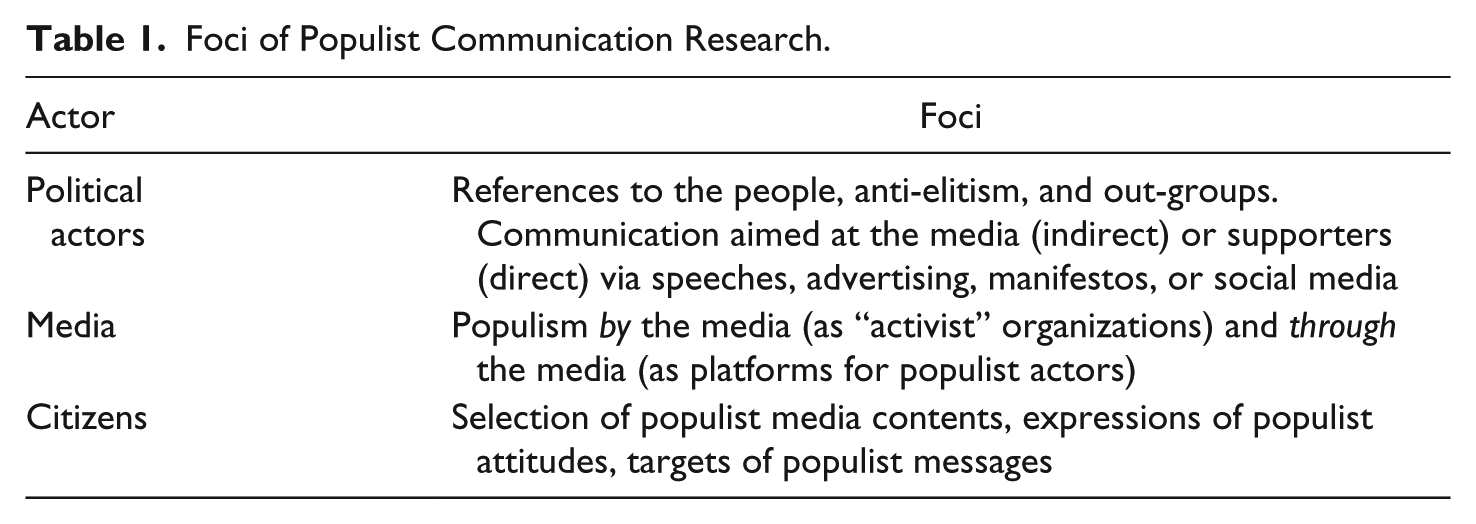
Table 1 summarizes the different foci that populist communication research can have at the level of each of the three elements. As outlined above, much of our current knowledge in each of these areas is scattered and too often based on single case studies rather than comparative analyses.
Foci of Populist Communication Research.
While more research on each of the three core actors—political actors, media, and citizens—is encouraged, it seems particularly pertinent to advance our understanding of the interactions between one or more of them, preferably in a comparative perspective so as to leverage insights beyond the limitations of specific cases. Such questions might center around the interaction between political actors and the media: When are some actors granted coverage and others not? Under which conditions can actors successfully bypass the media? When do the media neglect or amplify political actors’ social media communication? In the interaction between political actors and citizens, we would need to know more about how political actors build up and maintain channels of communication with their sympathizers. In the media–citizen interaction, more attention is needed to separate out which of the constitutive elements of populist communication have effects, and importantly on whom, and under what circumstances (Reinemann et al. 2017).
Conclusion
Our goal is to define populism as a communication phenomenon and set the boundary conditions for a new generation of research on this. It allows for easier empirical operationalization and more gradual measurement. As the contributions to this Special Issue demonstrate, a political communication perspective holds great potential for advancing populism research. In this sense, we believe that “not only including but focusing on the communicative aspects of populism will help us to better understand one of the hallmarks of contemporary politics” (Aalberg et al. 2017). The dissemination of populist communication and its widespread appeal can also not be fully understood unless it is investigated in a comparative context. While populism has been found to be a global phenomenon common to most democratic countries (Kaltwasser et al. 2017), the form, visibility, and success of populism varies considerably across cultures. Many contextual factors determine the amount of populist communication adopted by political actors, media actors, and citizens. Only comparative analysis can reveal and explain similarities and differences in the communicative aspects of populism across countries.
The timeliness of the topic and the vitality of the research community were evident in the response to the open call for proposals for the Special Issue. We received 70+ submissions from across the globe. These were often comparative in nature and focused on political actors, the media, and/or citizens. A subset of papers was developed in full and presented at a conference of the COST Action “Populist Political Communication in Europe” (IS1308), which took place in Madrid in March 2018. Based on blind peer review, the final selection of papers was made. The issue includes five articles. In the first article, Zulianello et al. (2018) analyze communication strategies of political leaders on Facebook with evidence from multiple continents. In the second article, Bobba et al. (2018) focus on the potential gender gap by comparing user engagement with populist and nonpopulist Facebook pages in three countries. In the third article, Wettstein et al. (2018) analyze more than nine thousand news stories from ten countries, identifying distinct roles the media can assume in their coverage of populist actors. In the fourth article, Wirz et al. (2018) combine panel survey data with media content data in four European metropolitan areas showing how media coverage affects immigrant attitudes and negative emotions. In the final article, Hameleers et al. (2018) report on an unprecedented sixteen-country experiment testing the effects of populist communication on political engagement. Collectively, the special issue launches a framework for a research agenda on populist communication and provides five empirical analyses focusing on political actors, media, and citizens, and the interaction between these groups. The contributions are comparative in nature and go well beyond the single case study description to identify and explicate the drivers of patterns of communication and the conditionalities of effects.
Despite the significant gaps bridged in this Special Issue, providing a clear framework for understanding populist political communication, providing comparative and systematic evidence, and advancing our theorizing, we still see considerable gaps for future populism research to fill. In pursuing this endeavor, we call for populism (communication) research to consider the following moving forward:
Avoid treating some political actors as populists and others as not. The construction and definition of the “people,” the articulation of the corrupt elite, and the choice of out-groups should be systematically analyzed. However, akin to the now established view that populism itself is not per se bad or good, if populism is in essence a communication phenomenon, we should treat it as a continuum, and analyze and assess the degree to which, and conditions under which, elements of populist communication are used;
Do not consider the media only as a platform for transmitting messages (i.e., not only populism through the media but also by the media). Do not just look at media content but also behind it. With new players in the field, ranging from Breitbart to Fox News, ownership structures, competition, and political affiliations, driving coverage should become center stage, not an add-on in analyses of the media;
Do not look at social media platforms and populism in isolation. Look at social media platforms in context, as platforms of sharing, disseminating, emphasizing, escalating, and expressing views as part of a larger information system. At the same time, expand the focus of (populism) social media research beyond the current descriptive studies: Social media are conducive to populism, but we still know little about key features such as the use of visuals (e.g., political memes), the patterns of sharing and liking (and the degree to which this is automated or troll-driven; see, for example, Howard et al. 2017), the extent to which social media offer personalized and tailored information, and the degree to which social media are platforms for sharing disinformation.
Do not only look at citizens’ partisan and ideologically driven selections of news and information. Ideological echo-chambers are important, but in a media and information landscape with an abundance of choice and in part algorithmic determinants of exposure, the gap between those exposed to news and those who are not is at least as pertinent, especially when looking at populism, where non-news exposure might amplify the effects of populist messages.
Do not look at the effects of populist communication in isolation. Consider the individual and contextual conditions that render some individuals more susceptible to populist messages than others. Be it individual partisan lenses, degree of political sophistication, prior held attitudes toward liberal democracy, or contexts of system and information differences. Look at effects that are direct and indirect, intended and unintended, fleeting and lasting, altering or stabilizing, conditional or across the board, as prescribed by Potter (2007) in his general framework on media effects. Particular attention should be devoted to “dosage effects” trying to disentangle the impact of a (algorithmically) personalized diet of information that might be repetitive and reinforcing.
Do not only look at the effects of news and information. A sizable part of the citizenry may not consume high degrees of news (e.g., Bos et al. 2016), some will gravitate toward attitudinally congenial news, but others might have a preference for other formats or genres all together (Prior 2007). It would seem relevant to expand the scope to, for example, the role of satire and political entertainment more broadly. There is some evidence to suggest that satirical formats can exacerbate confirmation biases, such that satirical information options lead to less counter-attitudinal exposure (compared with hard news), thus potentially reinforcing opinions and leading to further polarization (Stroud and Muddiman 2013). How such processes affect selection and effects vis-à-vis populism remain an open question.
As populism, for better and worse, is thriving (with an increase on both the political supply and demand side), research on populism is also likely to thrive. We hope with this Special Issue to reinforce the need for a communication perspective on populism. Populist communication is “wrapping that matters,” and while the mother ideologies and political ideas that different actors use to pair up with populist communication are truly important, the communication aspect is not only ubiquitous but also the way in which we can develop a language to talk about populism across its different configurations and across the different key actors. Thereby, we hope to have clarified what populism is from a communications perspective so that if any scholar would read this fifty years from now, we would be able to conclude that there is no doubt about the importance of populism and that, now, we have greater clarity on what it is. Finally, we hope to push our research agendas and design toward a more interactive, systematic, and in particular comparative approach to the study of populist political communication.
Footnotes
Author’s Note
The article was written within the framework of the COST Action on Populist Political Communication.
Declaration of Conflicting Interests
The authors declared no potential conflicts of interest with respect to the research, authorship, and/or publication of this article.
Funding
The authors received no financial support for the research, authorship, and/or publication of this article.