



Abstract
This study applies a qualitative comparative analysis (QCA) design to examine how configurations of quantitative and qualitative aspects of media coverage associate with changes on the policy agenda. We analyze media coverage of sixteen focusing events related to Dutch immigration policies—an intractable policy controversy that is regularly under media scrutiny. In addition to the quantity of media attention, we take into account whether dominant framing in media coverage is contesting the current policy frame and whether the framing in the media is consonant. Our analysis indicates that frame contestation is a necessary condition for media effects. Quantity of media attention and frame consonance are relevant indicators of changes on the policy agenda only when the majority of media coverage is contesting the current policy frame. Furthermore, we found that in the case of intractable policy controversies, media framing can create specific dynamics, such as “David versus Goliath” dynamics where human-interest framing of a single case challenges current policy, or “negotiation dynamics” where competing managerialist frames negotiate policy solutions. An integration of framing and agenda-setting literatures helps develop a better understanding of the occurrence of media effects on the policy agenda and how this effect takes shape in the case of intractable policy controversies.
Keywords
Introduction
Media attention for public policies is generally considered to be a key influence on the policy agenda. Various scholars of political communication and policy sciences have, indeed, found that there is a relation between the quantity of media attention for specific policy issues and prioritization of issues on the policy agenda (Baumgartner and Jones 1993; Melenhorst 2015; Soroka 2002; Tan and Weaver 2009; Yanovitzky 2002). Studies, however, come to different conclusions with regard to the strength of this effect (Nowak 2013). Recent studies suggest that the quantity of media attention does not fully account for changes on the policy agenda and that qualitative aspects of the media coverage are contingent factors (Walgrave and Van Aelst 2006; Wolfe et al. 2013). This entails taking into account the “issue framing.” Issue frames concern different interpretations of the issue at hand, leading to different implications with regard to policy consequences (Entman 1993: 52; Rein and Schön 1993: 146). Issue frames in the media can support current policies, but also be critical and push for policy change (Wolfe et al. 2013). We deem this contingent effect of issue attention and framing particularly likely in case of “intractable policy controversies.” These concern policy domains in which multiple frames compete for attention on the policy agenda (Rein and Schön 1993).
Studying contingent media effects on the policy agenda requires a change from traditional agenda-setting and framing research designs in three ways. First, by taking account of the issues frames that are communicated in media publications, in addition to quantitative measures of media attention. Both are likely to interact in creating a media effect. Besides quantity of media attention, we analyze whether the dominant framing in the media is contesting the current policy frame and the extent to which media framing is consonant or dissonant. Second, this requires a comprehensive view of media effects on the policy agenda. Regarding the political agenda, agenda-setting and framing effects are analytically distinguished as different effects (Scheufele and Tewksbury 2007). This is more difficult regarding the policy agenda as changes in issue attention and framing go hand-in-hand, and both can be considered policy change (Van Aelst et al. 2014: 204; Wolfe et al. 2013). This study, therefore, operationalizes a framing effect as the outcome condition while assuming that this incorporates an agenda-setting effect. Third, scholars argue that media effects on the policy agenda are not a linear process but entail complex causal interactions with feedback effects and multiple contingencies (Boydstun 2013; Wolfe et al. 2013). We adopt a methodology of Qualitative Comparative Analysis (QCA), which enables us to study configurational explanations of changes on the policy agenda and to go beyond linear notions of causality.
The following research question is addressed in this article:
We conducted an embedded case study of sixteen recent focusing events (cf. Birkland 2011) within a single case: the policy domain of immigration in the Netherlands. In the Netherlands, similar to many other Western European countries, immigration is an intractable policy controversy. Issues related to this policy domain often acquire extensive media coverage with a multiplicity of issue frames (Bonjour and Schrover 2015). Some policy actors argue in favor of generous policies while others propagate more restrictive immigration laws. We hypothesize that the higher the quantity of attention, the more consonant media framing and the more contested the relation between media frame and policy frame, the more likely policy would be to change. In addition, we hypothesize that frame contestation is a necessary condition for policy change.
The strength of QCA lies in not only summarizing the cases based on relevant configurations of conditions that correspond with changes on the policy agenda but also in reinterpreting these patterns in the context of the qualitative data on the cases. By doing this, we describe common patterns in which media coverage influences the policy agenda of an intractable policy controversy. Our findings contribute to the theory on media effects on the policy agenda in general and to framing dynamics related to contested policy problems specifically.
Media Effects on the Policy Agenda
Studies into political agenda setting show that media effects are more likely when media coverage communicates a frame that agrees with the political actor’s frame of the issue (Green-Pedersen and Stubager 2010; Thesen 2013; Van der Pas 2014; Vliegenthart and Walgrave 2011). Agenda-setting and framing effects are analytically distinguished. While quantity of media attention is assumed to correspond with issue salience on the political agenda based on “accessibility” or exposure, frames are assumed to correspond with changes on the political agenda based on “applicability” or the fit of media framing with the issue frame on the political agenda (Scheufele and Tewksbury 2007). Framing effects are explained by a mechanism of political strategy of using media coverage opportunistically (Vliegenthart et al. 2016; Yanovitzky 2002).
Concerning the policy agenda, issue framing is also expected to be an important condition besides quantitative measures of attention (Nowak 2013; Wolfe et al. 2013). This is expected to apply in particular to intractable policy controversies that are characterized by a multiplicity of frames, which involve different definitions of the problem situation as well as different suggested policy solutions. It is, however, yet unclear how issue framing plays a role concerning this type of agenda and what mechanisms cause this effect. The policy agenda is a subset of the political agenda, which is under the active and serious consideration of authoritative decision makers. Issues on the policy agenda are subject to substantive action on the part of policy makers, including the allocation and reallocation of government resources (cf. Cobb and Elder 1972: 85–86). Changes on this agenda have a very direct impact on, or are policy (Van Aelst et al. 2014: 204). This study analyzes framing effects on the policy agenda, while assuming that this incorporates an agenda-setting effect; policy frames will not change when the issue is not attributed salience. Accessibility and applicability are both considered as possible underlying mechanisms of media effects on the policy agenda.
Previous studies of the representation of immigration issues in the media and on the policy agenda identified various immigration-specific “master-frames” (Snow and Benford 1992). This includes a human-interest frame, a threat frame, an economic frame, and a managerialist frame (Benson 2013; d’Haenens and de Lange 2001; El Refaie 2001; Horsti 2003; Van Gorp 2006; Vliegenthart 2007). In a human-interest frame in favor of immigration, immigrants and refugees are portrayed as victims who require compassion and help (d’Haenens and de Lange 2001; Van Gorp 2006). Second, the threat frame frames immigration as an inherently negative phenomenon in which immigrants are perceived as a threat to receiving countries (Horsti 2003), and immigration is framed as irreconcilable with the host society (Baker and McEnery 2005). Third, the economic frame discusses immigration and asylum in terms of economic losses or gains for receiving countries of immigration (d’Haenens and de Lange 2001). There is attention for immigration putting welfare state arrangements under pressure but also for economic gains of immigration (often distinguishing between “wanted” and “unwanted” forms of migration). Last, the managerialist frame approaches immigration as a depoliticized governance challenge, focusing on how to best cope with the consequences of immigration beyond discussing whether this is a wanted phenomenon or not (d’Haenens and de Lange 2001).
This study qualitatively explores the contingent effects of issue attention and issue framing on the policy agenda. Based on agenda-setting and framing literature, we distinguish three factors related to media coverage of policy issues that may contribute to frame changes on the policy agenda. First is the quantity of media attention. This condition is central to agenda-setting studies. The more media attention and the longer it persists, the higher the likelihood of achieving a policy agenda-setting effect (Baumgartner and Jones 1993). Second, we take into account the relation between the framing in media coverage and the issue frame on the policy agenda. When the majority of framing in media coverage is similar to the issue frame on the policy agenda, we consider there to be “frame agreement.” When the majority of framing in media coverage is different from the issue frame on the policy agenda, we speak of “frame contestation.” In this case, media coverage is predominantly critical toward the current policy frame. Frame contestation is hypothesized to increase the likelihood of policy change (Boydstun et al. 2014: 178). Third, we study whether the framing of the issue in the media is consonant or dissonant (cf. Eilders 2000; Walgrave and Van Aelst 2006). The prevalence of frames in media coverage ranges from domination of one frame (frame consonance) to the coexistence of several frames that are given roughly equal attention (frame dissonance; Entman 2003: 418). In case of frame consonance, a frame is dominant throughout a broad selection of media outlets and publications. Van Aelst and Walgrave (2011: 303) hypothesize that while individual media outlets are not very influential as such, mass media are a tremendous force “when the coverage is consonant across outlets and when the mass media are in ‘stampede mode’.” We thus expect that the media coverage for a case is more likely to be associated with policy change when media coverage is characterized by frame consonance. When a variety of media outlets report on the same issue according to a singular frame over a relatively long time, then media coverage is more likely to influence policy decisions (Eilders 2000; Walgrave and Van Aelst 2006).
In correspondence with our QCA methodology, we formulate configurational hypotheses including the conditions outlined above. Firstly, we expect these three conditions to correspond positively with policy change and to be mutually reinforcing.
A second hypothesis is that we expect frame contestation to be a necessary but not sufficient condition for policy change. Media attention alone, even if it is very consonant, will not correspond with policy change when media attention is characterized by frame agreement with the policy frame. In contrast, we hypothesize that frame contestation in media coverage is not a sufficient condition for policy change. Frame contestation should gain substantial amounts of attention and/or be consonant throughout media coverage to correspond with policy change.
Method
Case
In the Netherlands, immigration is a highly contested policy domain (Scholten 2011). A variety of focusing events has gained media attention, and previous research has shown that various frames are competing (Bonjour and Schrover 2015). The Netherlands belongs to the North/Central European or Democratic Corporatist model of political and media systems, which is characterized by a large degree of press freedom and journalistic professionalism, high circulation, and large internal variety (Hallin and Mancini 2004). Based on characteristics of the policy domain of immigration and the Dutch media and political system, this makes a likely case for media effects on the policy agenda in general (Koch-Baumgartner and Voltmer 2010: 215–24) and a revelatory case for the contingency between issue attention and issue framing in creating this effect.
This study comparatively analyzes mass media coverage and the policy agenda related to sixteen focusing events that took place between 2011 and 2015. After establishing an elaborate list of immigration events that gained attention in the Dutch media over the past years, these cases were purposefully selected to be heterogeneous in terms of quantity of media attention and type of case. The appendix provides an overview of the cases, including short descriptions of each case. Our sample, for example, includes individual immigrants facing deportation, specific immigrant groups coming to the Netherlands, the building of asylum centers, and new policy initiatives. This heterogeneous selection of focusing events within one policy domain enables us to comparatively analyze cases with different amounts of media attention and generating different frame allocations in media coverage.
Data
For each case, we quantitatively mapped the media attention throughout a selection of Dutch national media outlets over a period of six months. In our sample of media outlets, we included the four main national newspapers (De Volkskrant, NRC Handelsblad, Telegraaf, and Algemeen Dagblad), three opinion magazines (De Groene Amsterdammer, Elsevier, and Vrij Nederland), and six television news and current affairs broadcasts of the public television channels (NOS 20:00 Journaal, Nieuwsuur, EenVandaag, Pauw (en Witteman)/Knevel en Van den Brink, De Wereld Draait Door, and Pownews). This selection includes a large proportion of the Dutch news media with a variety of political and ideological backgrounds. Relevant newspaper and opinion magazine articles were collected from the Lexis-Nexis database, including full-text publications. Video files of television items were collected from the database of the Netherlands Institute for Sound and Vision. Queries for relevant television items were made in a database with subtitles of Dutch public television programs. Boolean search strings were developed for queries in the different databases to collect relevant media publications for each case. Different search strings were developed to ensure sensitivity and specificity of the queries for each type of media. For the sixteen cases in total, we collected 1,455 media reports, including newspaper articles, opinion magazine articles, and television items.
Furthermore, we studied the national Dutch policy agenda of immigration and asylum issues. We analyzed continuity and change in policy framing by collecting policy memoranda from the government to parliament mentioning our cases. This operationalization of the substantive policy agenda enables us to study attention for specific focusing events. It is difficult to study media effects when operationalizing the policy agenda as legislative change. The “issue attention cycle” of the media (cf. Downs 1972) is much shorter than the workings of bureaucracy, and the legislation is not likely to respond to specific focusing events that are the subject of media coverage (Koch-Baumgartner and Voltmer 2010; Walgrave and Van Aelst 2006). In policy briefs or memoranda, ministers and state secretaries inform parliament about more incidental decisions related to specific issues that become policy.
Relevant policy documents were collected via a designated Web site by the Dutch government (zoek.officielebekendmakingen.nl). Based on similar Boolean queries, we collected data on developments on the policy agenda from the start of each case until one year after that date (N = 49). This extended time period in comparison with our collection of media coverage ensures taking into account later changes on the policy agenda due to a lag in time. A minimum six months to maximum one-year lag time is sufficient to follow changes in issue framing (Nowak 2013).
Method
We conducted frame analysis of the collected media content and policy memoranda. This frame analysis consisted of two rounds of coding. In a first round of coding in ATLAS.ti, we specified for each case what frames were present in the media coverage. The theory-based typology of four “master-frames” (Snow and Benford 1992) that we defined above informed this round of coding. The four frames were operationalized based on four elements (cf. Entman 1993; Rein and Schön 1993; Scholten 2011): (1) the problem definition that gives a certain interpretation of the issue at hand, (2) the causal narrative of how to explain why the issue arose, (3) the target groups that are involved, and (4) the strategy that is defined for solving the issue.
Furthermore, we elaborated for each case-specific frame “framing devices” such as metaphors, catchphrases, examples, visual images, and statistics (Gamson and Modigliani 1989; Van Gorp 2006: 83). These framing devices concisely communicate a frame by resonating with interpretive schemata among audiences. A well-known example is the metaphor of a tsunami of immigrants, appealing to a threat frame. Our analysis coded frame elements and framing devices referring to specific frames of each case. We established a maximum of four most prevalent frames in media coverage per case, and we defined them in relation to our typology of master frames. In some cases, multiple variations of one master frame exist.
In a second round of coding, we annotated each piece of media content based on the dominant framing of the message according to the operationalization of the case-specific frames. Likewise, the dominant issue framing in policy memoranda to parliament was coded. The validity of this step in the frame analysis was safeguarded by an intercoder reliability test of a sample of media publications. The intercoder reliability was established by having two coders assess all publications of a subset of four cases. In total, this subsample included 437 publications, making up 30 percent of the total number of 1,455 publications included in this study. The variable used to test the intercoder reliability was to code the dominant frame of the publication. For each of the publications, the coders could choose one of the frames identified per case or choose the options “multiple frames (no dominant frame),” “other dominant frame,” or “framing unclear.” Depending on the case, this meant that the variable had five to seven attributes. We calculated the Krippendorff’s alpha by use of the SPSS macro developed by Hayes and Krippendorff (2007). After a pilot test (Krippendorff’s α = 0.6) and further specification of the coding instructions, we obtained a Krippendorff’s α = 0.9.
To establish what conditions of media coverage were relevant in explaining changes on the policy agenda, we used QCA (Ragin 1987; Rihoux and Ragin 2009; Schneider and Wagemann 2012). This method allows us to systematically compare characteristics of cases and uncover patterns in these data. It is a suitable method to compare a relatively small number of cases, usually five to fifty. The aspects on which the cases are compared are named “conditions,” and combinations of conditions are “configurations.” Next to analyzing configurational explanations, an additional advantage is that the method goes beyond linear notions of causality by assuming equifinality and multifinality (Verweij and Gerrits 2012: 27). This entails the assumption that different conditions can produce similar outcomes, and that the same condition can produce different outcomes in different contexts (or configurations). This fits our theoretical assumption that policy agenda setting by the media is not a linear causal process but entails complex causal interactions (Boydstun 2013; Wolfe et al. 2013).
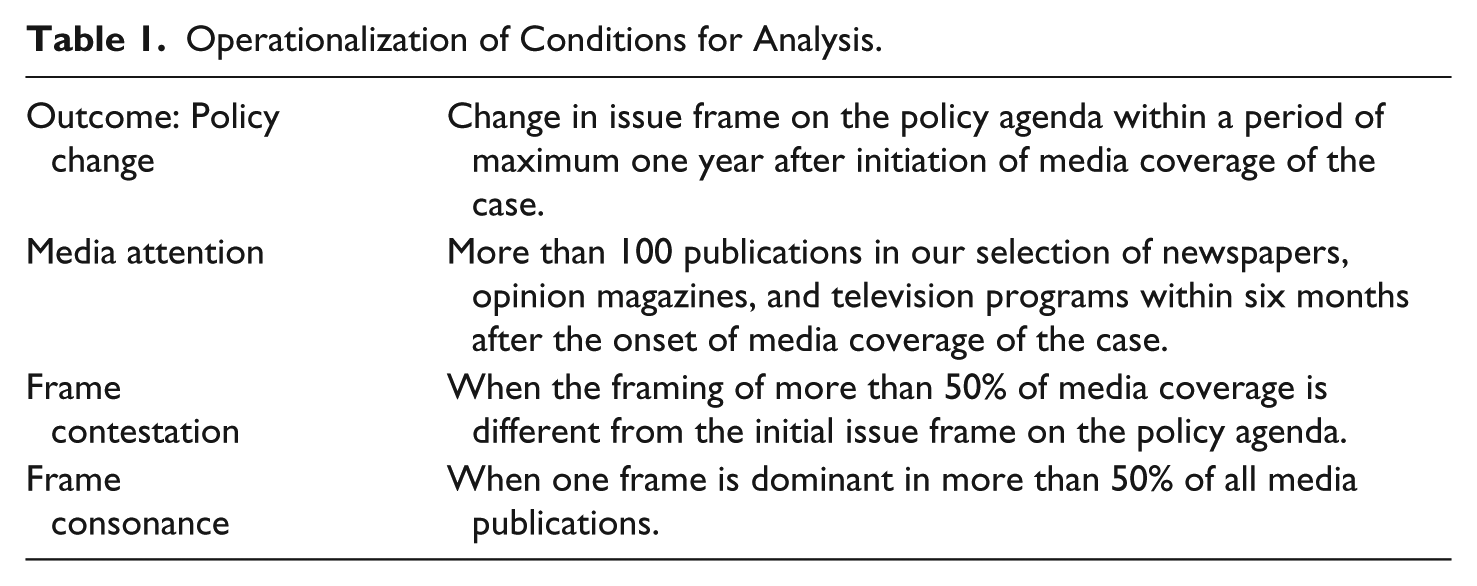
The outcome that is studied in this research is change in the issue frame on the policy agenda. We study such policy change in relation to three conditions related to media coverage: the quantity of media attention, frame consonance, and frame contestation (Table 1). We operationalized these conditions in terms of presence or absence of each condition in the case and conducted “crisp set” QCA. We used the specialized software package “Tosmana” for the analysis (Cronqvist 2011).
Operationalization of Conditions for Analysis.
The strength of QCA lies not only in simplifying the richness of cases in terms of conditions but also in reinterpreting the results of QCA in terms of specific case characteristics. The process of QCA can be visualized as an hourglass. First, in-depth qualitative analysis of the cases collects a large and rich body of data on each case. Second, QCA entails a reduction of the complexity by summarizing the cases on relevant conditions and the outcomes and looking for patterns of co-occurrences (configurations) that are compared with configurational hypotheses. Other than quantitative methodologies, QCA does not strive for full explanation and significant correlation of certain conditions with the outcome. Instead, residual complexity and exceptional “black swan” cases are assumed to be present and used for more in-depth interpretation of the findings.
Results
Correspondence between Immigration Frames on the Policy Agenda and in Media Coverage
The Dutch policy agenda initially frames the majority of cases as managerialist (eleven of sixteen cases). This policy frame is often explicitly communicated in cases concerning individual immigrants (Mauro Manuel: MAN, Abdul Ghafoor Ahmadzai: AHM, Dennis Butera: BUT), specific immigrant groups (protesting asylum seekers: HUN, rejected asylum seekers: AMS, asylum children: CHI), or new asylum locations (Oranje: ORA, IJsselhallen: IJS). This frame maintains a depoliticized and pragmatic approach toward immigration issues. It considers certain rules and regulations related to immigration as necessary and justified. The central argument is that to be able to accommodate immigrants, the government needs to be selective in who may enter and in the services that are provided. This frame furthermore argues that each rule creates cases that do not match the rules. This, however, does not mean that the rules should be bent in each case. “A rule is a rule” is the core of the argument. Pragmatic policy measures are proposed, which are judged based on effectiveness instead of moral implications.
In the remaining five cases, the policy agenda is initially characterized by a human-interest (three cases) or threat frame (two cases). These cases mostly concern policy initiatives by the government. A human-interest or threat frame is used to politically motivate the proposed policy change. This is, for example, the case with the influx of large numbers of European Union (EU) workers to the Netherlands (COD), the new regulation for au pairs (AUP), or the proposal for more lenient treatment of asylum requests of Ugandan gay immigrants (UGA). Immigration and asylum are framed as a threat in relation to proposals for stricter regulations and framed as issues of human interest in relation to proposals for more lenient immigration policies.
Media coverage of each case included a multiplicity of frames of which the dominant frame was different over various types of cases. In nine out of sixteen cases, mostly cases of individual immigrants or specific immigrant groups, a human-interest frame dominates in media coverage. In most cases, when a human-interest frame was dominant in media coverage, the government is faced with public attention and mobilization around issues that were not (high) on its agenda yet. The human-interest frame is propagated in the media by the lawyers of the immigrants, politicians, nongovernmental organizations (NGOs), or others supporting immigrants and pushing for policy attention and change. This frame asserts that in these specific cases, immigrants are treated unjustly as a result of restrictive immigration rules. The policies and government officials have no eye for unique circumstances of the case that requires attention. This frame calls for a special—more lenient—treatment in these cases or for more generous policies toward immigrants in general.
For example, in the case of the hunger strike in Rotterdam, asylum seekers in detention and organizations supporting them put current regulations up for debate by gathering media attention for the living situation of asylum seekers in detention. These actors promoted a human-interest frame of the situation, arguing that placing rejected asylum seekers under custody is inhumane. At the same time, the government met this critique with a managerialist response by stating that the current regulation is necessary, and the hunger strike is sabotaging the rules.
When a managerialist policy frame is contested by media coverage dominated by a human-interest frame, a “David versus Goliath” dynamic emerges (cf. Ihlen and Thorbjørnsrud 2014). This co-occurrence of frames reinforces the image of a powerless individual fighting a ruthless system and is in the disadvantage of the policy frame. In many cases, this led to changes on the policy agenda. For example, in the case of Dennis Butera, the state secretary initially decided that Dennis should leave the Netherlands for his family’s country of origin Kenya. The case gained media attention when this decision was challenged by local support from his school, friends, and neighbors. They framed the government’s decision as having no eye for individual circumstances, while Dennis himself was portrayed as a boy who deserves to stay in the Netherlands. Eventually, the policy decision changed, and the state secretary granted Dennis a residence permit.
When the cases were more abstract, entailing not specific individuals nor groups but anonymous categories or (policy) initiatives, a managerialist frame generally dominated in media coverage of cases (five of sixteen cases). In some cases, the managerialist frame was introduced in the media by government actors and gained broader support in media coverage. In other cases, a managerialist policy frame was met with a managerialist counterframe in the media by policy actors contesting the policy frame. In these latter cases, policy initiatives were not objected altogether based on moral reasons (e.g., by using a contesting human-interest or threat frame), but policy actors negotiated the policy frame on its own terms. A dynamic of “negotiation” emerged. This was, for example, the case with the asylum center in Oranje and with the new regulations for international au pairs. The managerialist counterframe put the feasibility of the initiatives up for discussion and proposed changes to the proposed regulation. An economic frame was an important side discussion in media coverage of a number of cases but was not dominant in media coverage of any of the cases, nor on the policy agenda.
In nine of the sixteen cases in total, the dominant frame in the media coverage was contesting the initial policy frame. This indicates that models of agenda - setting maintaining that media coverage primarily follows the government agenda do not hold when it comes to framing of specific issues. Alternative frames overshadowed the policy frame in media coverage of these cases. The following section describes the results of our QCA of when media attention for immigration and asylum cases is associated with policy change.
Conditionality of Media Effects on the Policy Agenda
In nine of sixteen cases, the policy frame remained the same over one year after the onset of media attention for the cases. We understand this as no media effect having taken place. In seven of the sixteen cases, the framing of the issue on the policy agenda changed within a period of one year after the onset of the issue and the first media coverage. This includes four cases of individual asylum seekers, one case of an asylum center, and two cases concerning policy proposals. We understand this as the occurrence of a media effect. However, this cannot be directly ascribed to media coverage of the case. In some cases, a media influence was evident because it was explicitly recognized, but in most cases the causes of agenda change remained implicit.
With the QCA method, we analyzed what configurations of media conditions correspond with policy frame shifts. We used the QCA configurations as a first step toward more in-depth comparative analysis of the cases. We hypothesized that three characteristics of media coverage of policy-related focusing events will play a mutually reinforcing role in stipulating a media effect. First, the quantity of media attention; second, whether or not the majority of media framing is contesting the current policy frame; and third, whether or not the framing of media attention is consonant. The data matrix below (Table 2) shows how our cases scored on these conditions.
Data Matrix “Policy Change” and Three Conditions (Crisp Set).
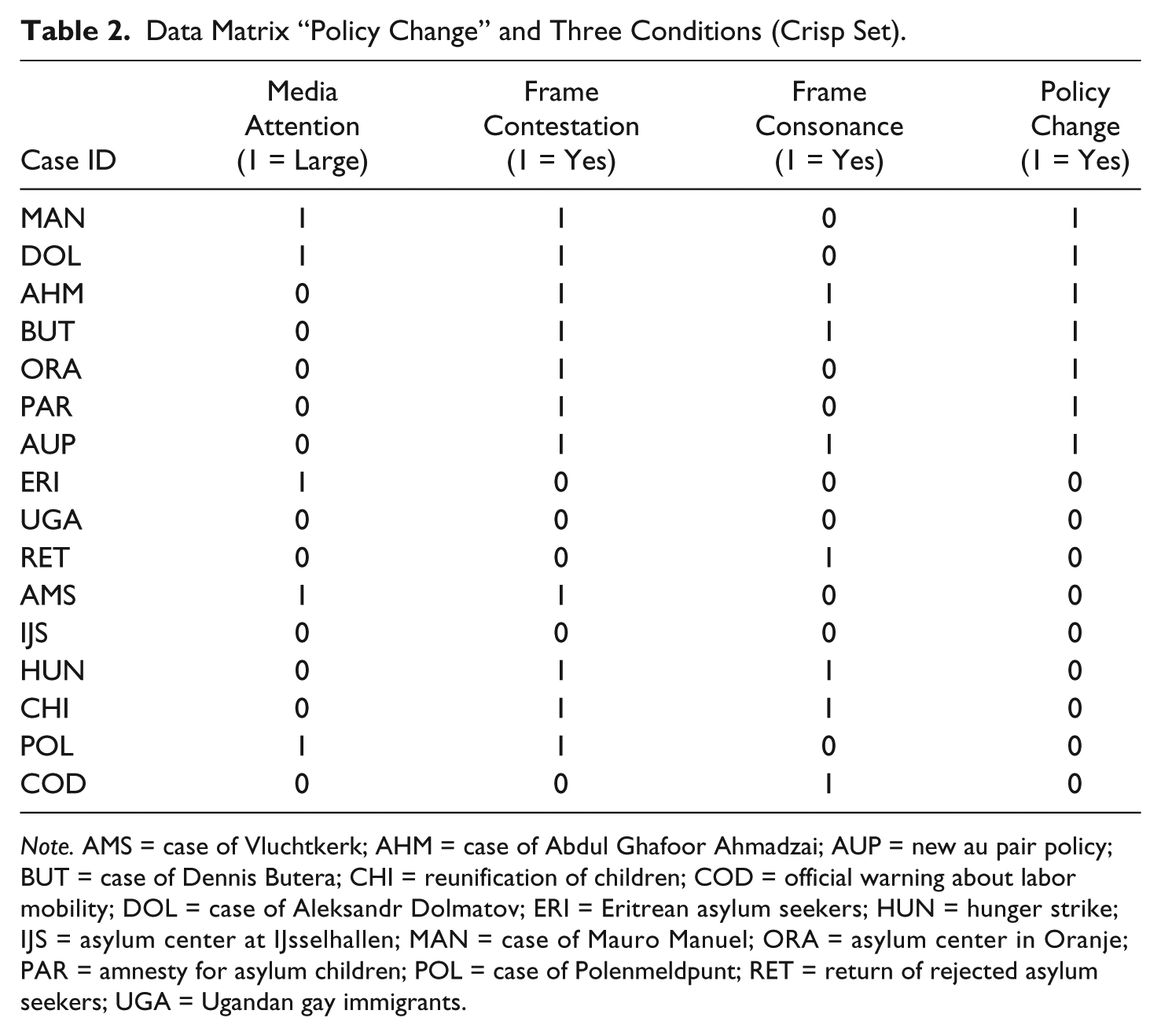
Note. AMS = case of Vluchtkerk; AHM = case of Abdul Ghafoor Ahmadzai; AUP = new au pair policy; BUT = case of Dennis Butera; CHI = reunification of children; COD = official warning about labor mobility; DOL = case of Aleksandr Dolmatov; ERI = Eritrean asylum seekers; HUN = hunger strike; IJS = asylum center at IJsselhallen; MAN = case of Mauro Manuel; ORA = asylum center in Oranje; PAR = amnesty for asylum children; POL = case of Polenmeldpunt; RET = return of rejected asylum seekers; UGA = Ugandan gay immigrants.
According to the QCA methodology, we organized these cases over the logically possible configurations in a so-called “truth table.” Our truth table has eight logically possible configurations (2^3). Each configuration is presented as a row (Table 3).
Truth Table Policy Change According to Conditions Media Attention, Frame Contestation, and Frame Consonance (C = Contradictory Row; R = Logical Remainder).
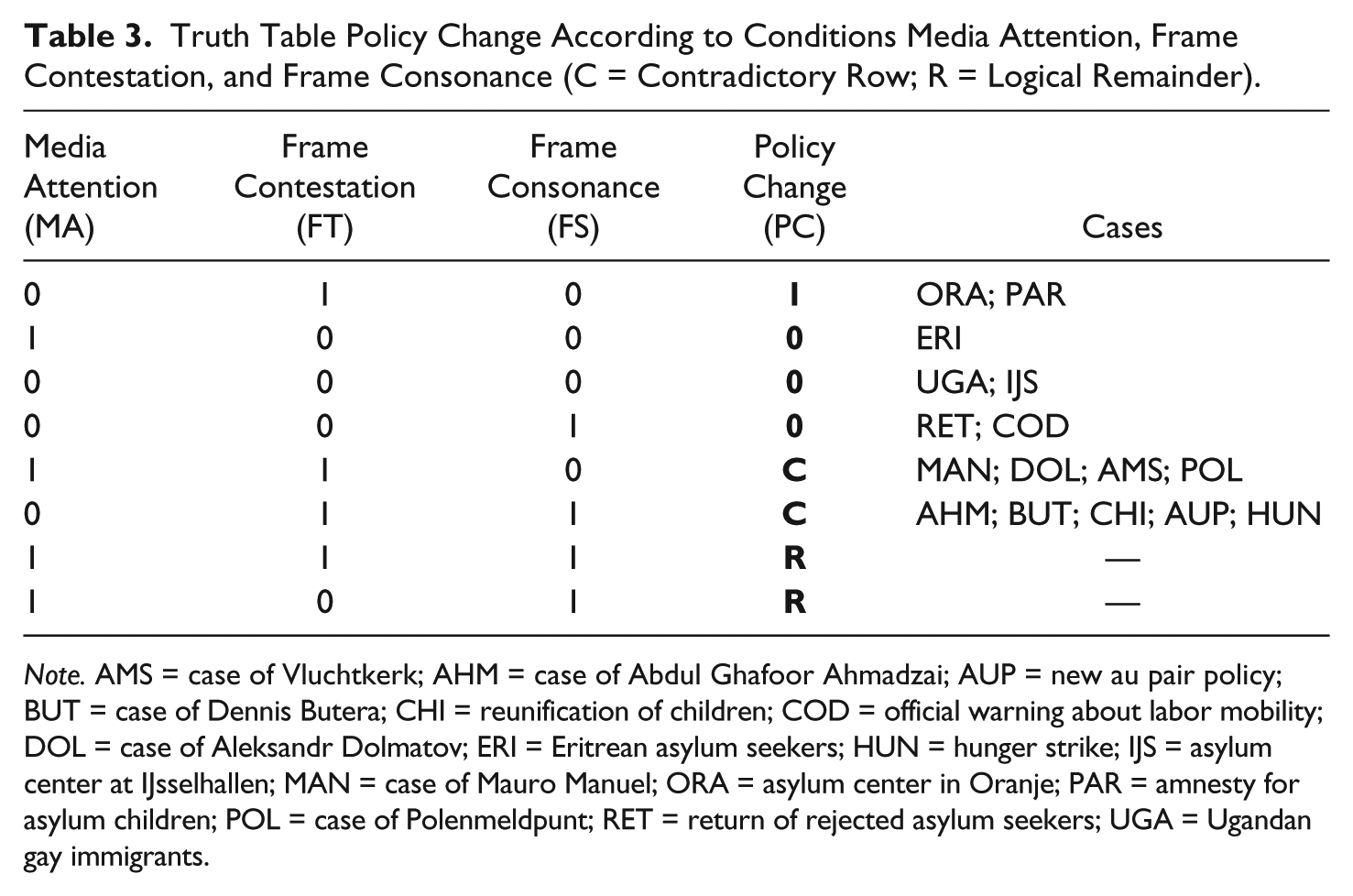
Note. AMS = case of Vluchtkerk; AHM = case of Abdul Ghafoor Ahmadzai; AUP = new au pair policy; BUT = case of Dennis Butera; CHI = reunification of children; COD = official warning about labor mobility; DOL = case of Aleksandr Dolmatov; ERI = Eritrean asylum seekers; HUN = hunger strike; IJS = asylum center at IJsselhallen; MAN = case of Mauro Manuel; ORA = asylum center in Oranje; PAR = amnesty for asylum children; POL = case of Polenmeldpunt; RET = return of rejected asylum seekers; UGA = Ugandan gay immigrants.
We minimized the truth table by pairwise comparison of the configurations that agree on the outcome and differ in but one other condition (Ragin 1987). This entails logically summarizing the information by restatement of information that is contained in the truth table as a set of propositions. The results are reported in Table 4. Contradictory configurations were not included in the minimization process, but are described as such. As assumed within QCA methodology, the configurations resulting from the analysis do not provide unanimous support for our hypotheses. Instead, they reflect the complexity of empirical reality and provide a first step toward more in-depth comparative analysis of the cases, reconnecting with the qualitative data.
QCA Minimization Results.
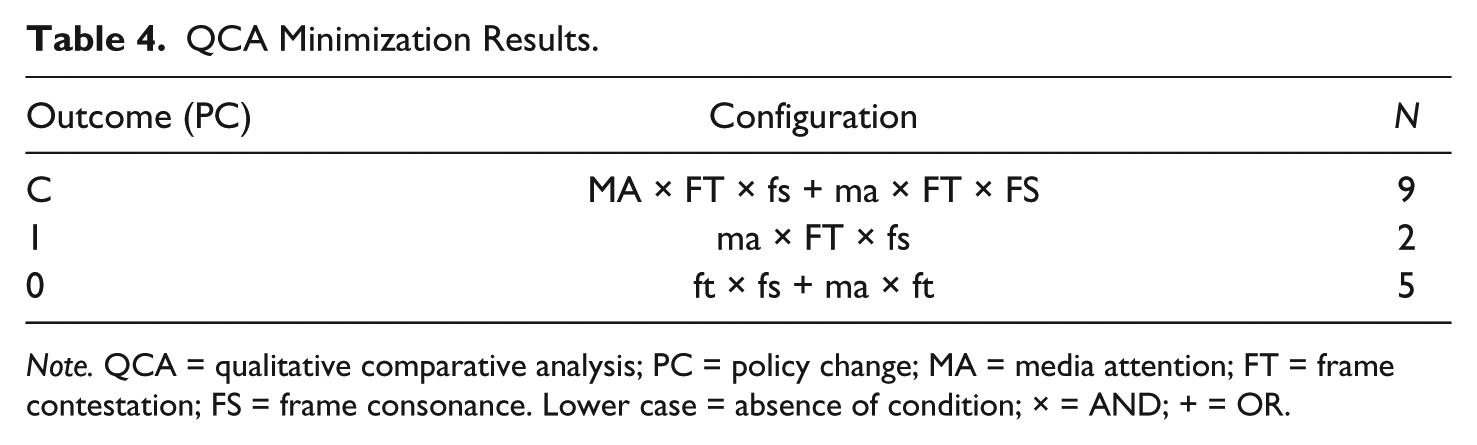
Note. QCA = qualitative comparative analysis; PC = policy change; MA = media attention; FT = frame contestation; FS = frame consonance. Lower case = absence of condition; × = AND; + = OR.
The configurations indicate that cases characterized by more than one of our media conditions are more likely to correspond with frame change on the policy agenda. This supports the first configurational hypothesis of our study. None of our cases scored 1 on all three conditions, but cases with two conditions present are more likely to correspond with policy change than cases in which zero or only one condition was present. The hypothesis that the three conditions are mutually reinforcing is not fully supported. The logically remaining configurations indicate an important exception: Frame consonance is unlikely to correspond with large amounts of media attention. This finding can be understood by literature on news values and media logic asserting that controversial issues are more likely to receive media attention as a focus on conflict is an important news value and media format (cf. Semetko and Valkenburg 2000). Controversy around the issue will be reflected in dissonant media framing and will usually gain large degrees of media attention.
The second hypothesis assumes frame contestation to be a necessary but not sufficient condition for policy change. This hypothesis is also partly confirmed by the analysis. In all cases corresponding with policy change, the condition of frame contestation was present. This coverage score indicates that frame contestation is a necessary condition in configurations associated with policy change. The cases of the asylum center in Oranje and the amnesty regulation for asylum children indicate that frame contestation alone is also associated with policy change. This suggests that frame contestation is a sufficient condition for policy change. However, unique to these cases is that policy change was motivated by related issues as well. For example, the amnesty regulation was already proposed in the earlier case of Mauro Manuel. In the case of the asylum center in Oranje, issue linkages were made with other small municipalities that were asked to host relatively large numbers of asylum seekers. These issue linkages created broader media coverage in support of policy change. Therefore, we do not conclude that frame contestation was a sufficient condition for policy in these cases. Due to issue linkages with related cases, the amounts of media attention are actually higher.
Reconnecting the QCA results to the findings of our in-depth case analyses, two types of cases can be distinguished that are usually associated with policy change and two types of cases that are usually not associated with policy change. First of all, there are cases with large quantities of media attention in combination with contestation of the policy frame (MAN, DOL). As explained in the previous paragraph, the cases of the asylum center in Oranje and the amnesty for asylum children (PAR) can also be considered to be part of this group. The two cases concerning individual immigrants were in the media for weeks with new developments in the case leading to extended coverage and alternative issue frames. The framing of the cases was not consonant. For example, in the case of Aleksandr Dolmatov, a research report was published that led to a shift in the prevalence of media frames. In the case of Mauro Manuel, political developments shed a new light on the case. Furthermore, the long duration of media attention for these cases required media to invite alternative opinions to the debate. As pointed out before, frame consonance in combination with large amounts of media attention was not encountered in any of the cases and does not seem to uphold within the media logic of striving for adversary coverage and looking to report on new information on the case.
A second type of cases that was distinguished gained less media attention, but frame contestation occurred in combination with a high degree of frame consonance (AHM, BUT, AUP). This configuration of conditions generally corresponds with policy change as well. In our research, there are two cases of individual immigrants and one case of a policy proposal characterized by this configuration. In these cases, powerful coalitions of stakeholders pushed for policy change. This contestation not only existed within the media but also other lobby channels were used. In the case of the individual immigrants Abdul Ghafoor Ahmadzai and Dennis Butera, public support in combination with civil society actors and political actors made for a strong opposing coalition. In the case of the proposal for a new regulation for international au pairs, families hosting au pairs next to an employers’ organization and political parties from the opposition shared a frame contesting the policy frame by which the new regulation was proposed. This group of cases indicates that large media attention for a case is not a necessary condition for policy change. A consonant counterframe, brought forward by a strong coalition of stakeholders in the media, can be effective—especially in combination with other lobby channels.
Third, we can distinguish a group of “black swan” cases that are characterized by similar conditions as the cases in groups 1 and 2, but are not associated with policy change. This first group includes the cases of Vluchtkerk and Polenmeldpunt (AMS, POL), which are characterized by high levels of media attention and frame contestation but are lacking consonance. Second, this includes the cases “hunger strike by asylum seekers in detention” and “family reunification of children of asylum seekers” (HUN, CHI). What sets these four cases apart is that—even when a human-interest frame was dominant—the subjects of discussion did not acquire a consistent image as victims in the debate. The absence of consonant media framing in combination with political support for current policies created a situation in which the policy frame became highly contested, but policy change eventually did not occur. The in-depth analysis of the cases suggests that the political playing field is an important intervening factor in policy agenda setting by the media. Political controversy around issues can prevent media framing from becoming consonant, and political actors need to be mobilized for policy change.
Fourth and last, we can distinguish a group of cases in which frame contestation was absent and which are not associated with policy change (ERI, COD, RET, UGA, IJS). All five cases concern policy proposals or public statements of ministers. Some proposals were legitimized with a human-interest or threat frame (COD, ERI, UGA) while others were presented as managerialist (IJS, RET). The cases have in common that the policy frames by which they were introduced in the media did not become contested and remained dominant throughout media coverage. The actor that is able to first frame the focusing event is often able to maintain the upper hand in the framing of the media coverage. This group of cases once more indicates that frame contestation is a necessary condition for policy change.
Discussion
Besides quantity of media attention, this study took into account two aspects of media framing to explain media effects on the policy agenda. This included whether media coverage predominantly promoted a frame that was different from the initial policy frame (frame contestation) and whether the media coverage was unitary in promoting a single issue frame (frame consonance). First, we hypothesized that media attention, frame contestation, and frame consonance of media coverage are mutually reinforcing determinants of policy change: The more conditions present, the more likely policy change becomes. Second, we hypothesized that frame contestation is a necessary condition for policy change: Without frame contestation, high levels of media attention and frame consonance will not correspond with policy change. Our findings support these hypotheses: In cases with two conditions present, changes of the issue frame on the policy agenda were more likely to occur, and especially frame contestation proved a necessary condition for policy change. An important additional finding is that in none of the cases were all three conditions of media coverage present. This is the case because large amounts of media attention and frame consonance are not likely to co-occur: Issues with a variety of competing frames are more likely to keep media engaged as a focus on conflict is an important news value and media format.
In a majority of cases, the dominant frame in media coverage was contesting the initial policy frame. Frame analysis demonstrates that there are specific dynamics by which policy frames and counterframes of immigration address each other. Related to cases of individual immigrants or specific immigrant groups, generally a human interest frame dominates in media coverage. When this frame opposes a managerialist policy frame, a “David versus Goliath” dynamic emerges. Related to more abstract cases, entailing not specific individuals or groups but abstract issues or (policy) initiatives, a managerialist frame generally dominates media coverage. This is often contesting a managerialist policy frame, initiating a dynamic of “negotiation.” The causal assumptions of the policy frame are accepted, but a different solution is negotiated in media coverage.
As usual in QCA, there were notable exceptions to the general patterns that we identified. The configurations resulting from QCA were used as a starting point for the reinterpretation of the patterns to uncover underlying causal mechanisms and to point at avenues for future research. First, frame promotion by a strong coalition of policy stakeholders in the media proved an important factor in creating a media effect. These stakeholders were using media besides other lobby channels to influence the policy agenda. Furthermore, the role of the political “vestibule” to policy change should not be underestimated. Political actors were often present as sources in contesting media coverage. They made issues public via the media to gain support for their policy alternatives. Parliamentary debate was often an intermediary step to policy change. Last, the stability of the government coalition behind the current policies was an important factor in explaining media effects.
We have to be aware of two limitations to this study. First, QCA is limited to a specific set of conditions that we included in our case analyses. However, many different forces are at play in the policy process, making it difficult to isolate a media effect. As discussed, the media effect is limited and likely to be mediated by other factors. Second, correspondence between the media agenda and policy agenda is not necessarily a result of agenda-setting. The policy agenda also influences the media and, in some cases, external factors cause variation on both agendas independently. Media sometimes lead and sometimes lag policy (Baumgartner and Jones 1993: 125; Wolfe et al. 2013).
Conclusion
This study demonstrates that framing of media coverage is important to take into account in future policy agenda-setting studies, and, most important, whether the dominant framing of the issue in the media is contesting the current policy frame. Our study demonstrates that the policy agenda only becomes responsive when media framing predominantly contests the current policy frame. The analysis points to a causal mechanism of democratic legitimacy, which is different from that of media effects on the political agenda. Apart from being an important source of information on policy issues, media coverage informs policy makers on how policy issues are perceived by the public. Media coverage is both formed by and formative of public opinion. Policy makers tend to be responsive to media coverage as they presume its representativeness of public opinion (Walgrave and Van Aelst 2006). When frames in media coverage—which is considered a representation of public opinion—are contesting the current policy frame, it forces the policy agenda to respond. Future studies should focus on further explicating this suggested underlying mechanism of media effects on the policy agenda.
Second, speaking more generally to the literature on intractable policy controversies, such as immigration, we found that such framing effects in agenda setting can take very particular forms. The dynamics of media framing can initiate a “David versus Goliath” logic where relatively small-scale incidents or focusing events that have a strong moral or normative character can trigger significant contestation to an established policy frame. By zooming in on the moral implications of a policy in a single case, making the case highly personal and sometimes dramatic, media framing can portray government policy as being impersonal and morally unjust. Especially with intractable policy controversies, there will often be ample opportunities to zoom in on moral indignation that can capture broad attention. This “David versus Goliath” logic will often also be supported by actors involved, with a mutually reinforcing logic between, on one hand, the actors in the “David” role who are seeking media attention for their case and, on the other hand, the media that often seek to personify abstract policies into concrete and dramatic events. We found various cases where a human-interest frame was mobilized around a concrete individual case, which then contested with a managerialist frame on behalf of government actors.
Besides this “David versus Goliath” logic, we found that in the context of intractable policy controversies, media coverage can also generate a “negotiation” logic. This applies, in particular, to situations involving more abstract policy ideas or proposals. In the public eye of the media, multiple managerialist frames compete in discussing and negotiating policy solutions. Especially in intractable policy controversies where many actors and frames are involved and where there is a high level of disagreement, this can fulfill an important function in generating support for new policy proposals. The various cases in which this dynamic occurred show that government actors are very aware of the role of media framing dynamics in agenda-setting; they do not only “follow” media coverage but also contribute to framing dynamics.
We believe that the conclusions on media coverage and policy agenda setting related to immigration issues can be generalized toward other intractable policy controversies, for example, environmental or health policies, within democratic systems with relatively autonomous media in which these issues are similarly contested. This may include other countries belonging to the North/Central European or Democratic Corporatist model of political and media systems, including Austria, Belgium, Denmark, Finland, Germany, Norway, Sweden, and Switzerland (cf. Hallin and Mancini 2004). Vice versa, in less contested policy domains and more closed political and media systems, media effects on the policy agenda are expected to be lessened.
However, we believe that further research is required as to the framing strategies that policy actors use to influence the policy agenda via media coverage. We know now that not only the quantity of, but also the framing of media attention, matters. Yet, we know less about how and why various policy actors may try to influence media framing to set a specific policy alternative on the agenda, or rather to prevent an issue or issue frame from emerging on the agenda. It would be valuable to learn what framing strategies lead to the “David versus Goliath” and the “negotiation” logics that were identified in this study. Furthermore, pursuing this research agenda requires a further integration of framing and agenda-setting theory in studying media effects on the policy agenda, as is advocated in this article.
Footnotes
Appendix
Overview of the Cases.
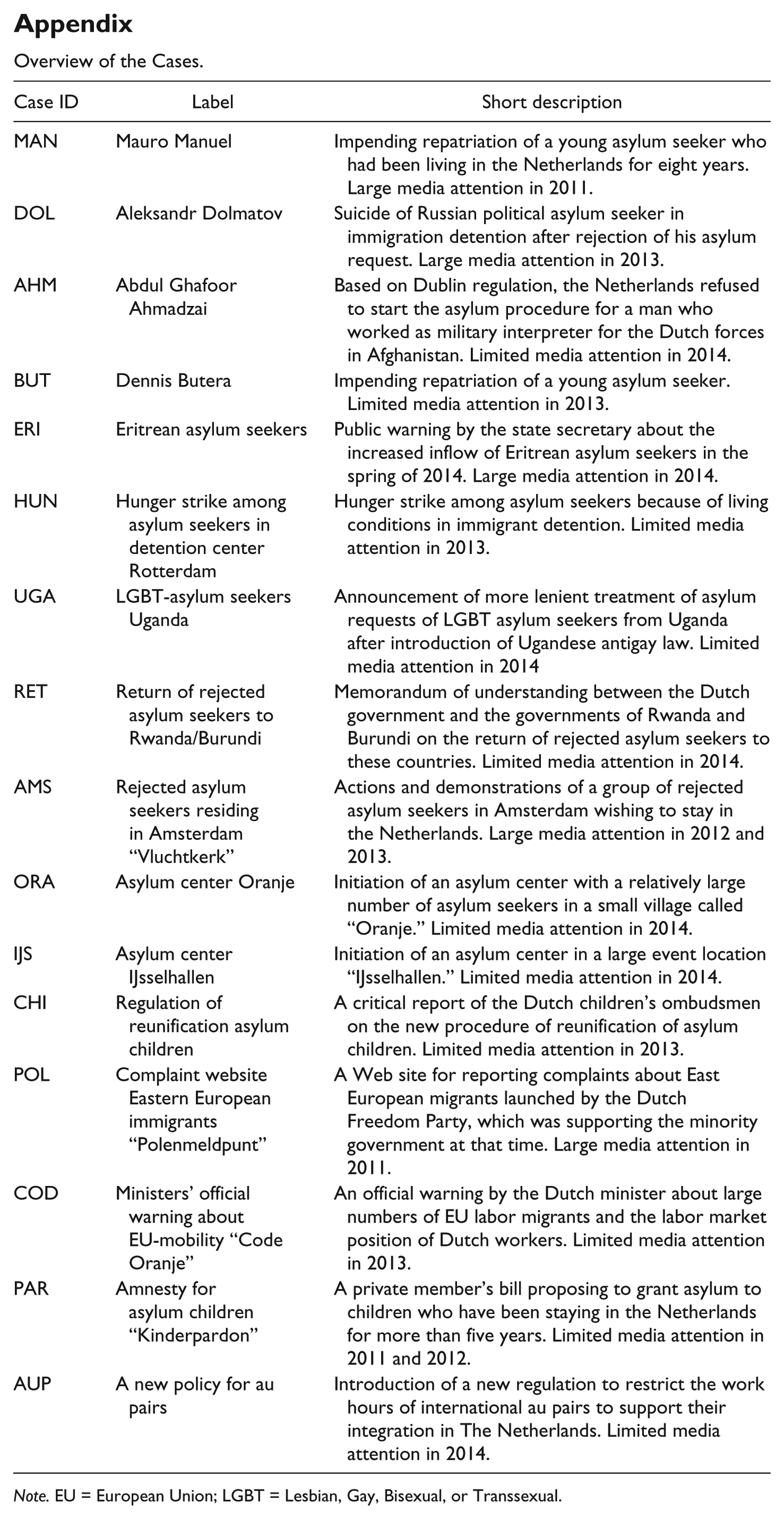
| Case ID | Label | Short description |
|---|---|---|
| MAN | Mauro Manuel | Impending repatriation of a young asylum seeker who had been living in the Netherlands for eight years. Large media attention in 2011. |
| DOL | Aleksandr Dolmatov | Suicide of Russian political asylum seeker in immigration detention after rejection of his asylum request. Large media attention in 2013. |
| AHM | Abdul Ghafoor Ahmadzai | Based on Dublin regulation, the Netherlands refused to start the asylum procedure for a man who worked as military interpreter for the Dutch forces in Afghanistan. Limited media attention in 2014. |
| BUT | Dennis Butera | Impending repatriation of a young asylum seeker. Limited media attention in 2013. |
| ERI | Eritrean asylum seekers | Public warning by the state secretary about the increased inflow of Eritrean asylum seekers in the spring of 2014. Large media attention in 2014. |
| HUN | Hunger strike among asylum seekers in detention center Rotterdam | Hunger strike among asylum seekers because of living conditions in immigrant detention. Limited media attention in 2013. |
| UGA | LGBT-asylum seekers Uganda | Announcement of more lenient treatment of asylum requests of LGBT asylum seekers from Uganda after introduction of Ugandese antigay law. Limited media attention in 2014 |
| RET | Return of rejected asylum seekers to Rwanda/Burundi | Memorandum of understanding between the Dutch government and the governments of Rwanda and Burundi on the return of rejected asylum seekers to these countries. Limited media attention in 2014. |
| AMS | Rejected asylum seekers residing in Amsterdam “Vluchtkerk” | Actions and demonstrations of a group of rejected asylum seekers in Amsterdam wishing to stay in the Netherlands. Large media attention in 2012 and 2013. |
| ORA | Asylum center Oranje | Initiation of an asylum center with a relatively large number of asylum seekers in a small village called “Oranje.” Limited media attention in 2014. |
| IJS | Asylum center IJsselhallen | Initiation of an asylum center in a large event location “IJsselhallen.” Limited media attention in 2014. |
| CHI | Regulation of reunification asylum children | A critical report of the Dutch children’s ombudsmen on the new procedure of reunification of asylum children. Limited media attention in 2013. |
| POL | Complaint website Eastern European immigrants “Polenmeldpunt” | A Web site for reporting complaints about East European migrants launched by the Dutch Freedom Party, which was supporting the minority government at that time. Large media attention in 2011. |
| COD | Ministers’ official warning about EU-mobility “Code Oranje” | An official warning by the Dutch minister about large numbers of EU labor migrants and the labor market position of Dutch workers. Limited media attention in 2013. |
| PAR | Amnesty for asylum children “Kinderpardon” | A private member’s bill proposing to grant asylum to children who have been staying in the Netherlands for more than five years. Limited media attention in 2011 and 2012. |
| AUP | A new policy for au pairs | Introduction of a new regulation to restrict the work hours of international au pairs to support their integration in The Netherlands. Limited media attention in 2014. |
Note. EU = European Union; LGBT = Lesbian, Gay, Bisexual, or Transsexual.
Author Note
Author Rianne Dekker is now affiliated with Utrecht University, the Netherlands. The claims and conclusions presented in this article represent the views of the joint authors and not necessarily those of WODC nor the Ministry of Security and Justice.
Declaration of Conflicting Interests
The author(s) declared no potential conflicts of interest with respect to the research, authorship, and/or publication of this article.
Funding
The author(s) disclosed receipt of the following financial support for the research, authorship, and/or publication of this article: This research was commissioned by the Research and Documentation Center of the Dutch Ministry of Security and Justice (WODC) under project number 2554. This research center conducts and commissions research on topics including security, criminal, civil and administrative justice, and immigration. The WODC aims to make a professional contribution to development and evaluation of policies developed by the Dutch Ministry of Security and Justice.