



Abstract
Introduction
The hippopotamus, Hippopotamus amphibious (hereafter hippo), is a semi-aquatic megaherbivore native to sub-Saharan Africa and can inhabit various habitats such as rivers, lakes, and wetlands. Hippos are essential to the stability and health of ecosystems because of the numerous ecological functions they perform, especially in aquatic environments (Voysey et al., 2023). For example, they influence aquatic biogeochemistry and food webs by transporting substantial amounts of nutrients and organic matter from grazing lands into aquatic ecosystems, thereby promoting diversity (McCauley et al., 2015; Mosepele et al., 2009; Shurin et al., 2020). Further, the depressions created in the environment by their wallowing behavior can serve as habitats for many species (McCarthy et al., 1998; Mosepele et al., 2009; Voysey et al., 2023). Structurally heterogeneous vegetation created by their grazing activities around water bodies can attract and support a diverse assemblage of herbivores (Kanga et al., 2013). Their unique and intriguing form provides economic advantages through tourism, which opens business potentials for local communities (Okello et al., 2008; Sheppard et al., 2010; Subalusky et al., 2021). Consequently, the multiple functions of hippos make them vital components of African aquatic ecosystems.
Despite the ecological importance of the hippo, recent studies suggest that it is at risk of extinction due to population declines across most of its African range (Fritsch et al., 2021; Zisadza et al., 2010). Records show that the native range of the hippo has contracted significantly, and the population declined by approximately 30% in the last decade, making it a vulnerable species based on the IUCN Red List assessment criteria (Lewison & Pluháček, 2017). For instance, the hippo was historically widespread on the continent, but is now locally extinct in some African countries, including Algeria, Egypt, Eritrea, Liberia, and Mauritania (Kingdon, 2015; Lewison & Pluháček, 2017). In Ghana, the Volta River System historically had large populations of hippos, but these populations and their range have drastically declined in recent years, with surviving populations' found only in the Black Volta River (Bennett et al., 2000; Eltringham, 1999). Although a systematic census in recent years has been lacking, the number of hippos in Ghana is suspected to be between 150 and 200 and distributed among two extant populations located at the Bui National Park and the Wechiau community hippo sanctuary within the Black Volta River System (Lewison & Pluháček, 2017). However, these two and other extant populations on the continent are at serious risk of further declines and possible local extinctions due to various anthropogenic threats (Lewison & Pluháček, 2017; Utete, 2020).
Habitat loss and degradation of aquatic ecosystems due to land use and climate change are significant contributors to biodiversity declines (Dudgeon et al., 2006; Reid et al., 2019). For example, the repurposing of rivers for hydropower and agriculture coupled with climate change (e.g., frequent or prolonged droughts and rising temperatures) can have negative implications on hippo populations due to their semi-aquatic lifestyle, i.e., submersion in water to prevent skin damage by the sun and to regulate body temperature (Eltringham, 1999). Thus, the availability and quality of native aquatic habitats for hippos are affected by agriculture, urbanization, and infrastructure development, which are intrinsically correlated to human population growth (Ahmed et al., 2022; Deng et al., 2015; Hughes & Vadas, 2021; Zhang et al., 2021). Further, human-hippo conflicts can threaten hippo conservation efforts because damage to crops or properties and the endangerment of human lives by hippos can result in retaliatory killings and disagreements among people over the species management (IUCN SSC HWCTF, 2020; Kingdon, 2015). In Ethiopia for example, about 28 hippos were recently killed in a national park due to human-hippo conflicts (Wondimu & Kebede, 2022). Hippo population losses are also caused by illicit hunting for their meat and ivory teeth (Lewison & Pluháček, 2017). Given the prohibition of commercial trade in elephant ivory, there is likely to be an increased demand for substitutes such as hippo ivory, thus further imperiling an already vulnerable species (Andersson & Gibson, 2018; Moneron & Drinkwater, 2021).
One way to safeguard biodiversity and, by extension, hippos is by protected area establishment. Protected areas can promote the sustainable utilization of resources through legal restrictions and other effective strategies (Dudley, 2008). However, a growing body of scientific data suggests that resource usage restrictions typically lead to unfavorable views among locals, causing issues with protected area management (Angwenyi et al., 2021). In particular, the level of dependence of residents on natural resources and the perceived benefits they derive can influence their attitudes and behaviors towards biodiversity conservation in protected areas (Ayivor et al., 2020; Dewu & Røskaft, 2018; Shahi et al., 2023). Hence, our attention should focus on gaining deeper insights of the relationship between local people, protected areas, and biodiversity to improve conservation efforts in protected areas.
In Ghana, the Forestry Commission is in charge, through its Wildlife Division, of managing its wildlife resource base. Bui National Park (BNP) is the only known protected area with significant hippo habitats that hosts one of two extant hippo populations in the country (Bennett et al., 2000). However, the construction of the hydropower plant in the BNP inundated much of its landscape, resulting in the destruction of terrestrial and aquatic ecosystems with potential negative impacts on hippos and other biodiversity (Bempah et al., 2022). In addition, resettlement of people in new areas within the BNP landscape happened without comprehensively addressing challenges related to resource access and livelihoods (Adovor Tsikudo, 2023; Yankson et al., 2018). Thus, the destruction of aquatic ecosystems and critical food resources of hippos, coupled with human resettlements and the distribution of farms, can increase human-hippo interactions in the landscape, resulting in actual or perceived conflict situations (Jumani et al., 2017; Mmbaga, 2023). These challenges can influence human behaviors in response to protected area restrictions, human-hippo conflicts, and poor living conditions in resettled communities, thus frustrating effective resource management (e.g., community anti-poaching initiatives and protection of critical habitats). Hence, further research of various threats (i.e., direct and indirect) to hippo populations is needed to enhance the conservation of the species.
To the best of our knowledge, there are some data gaps regarding the understanding of local people and their perceptions of and or interactions with hippos, especially in Ghana. Given the relevance of local communities to conservation, our study seeks to address the following research questions: 1) Do local people experience crop damage from hippos, and what are the common crops affected? 2) What are the perceptions of local people regarding hippo abundance? In particular, this question seeks to uncover the perceived historical and future population trend and the willingness of people to support hippo conservation efforts. 3) What factors influence local people’s knowledge of hippos? We expect that this study will help improve our understanding of people's knowledge and perceptions of hippos to help inform policy on how local communities can contribute to hippo conservation, a vulnerable species native to sub-Saharan Africa.
Methods
Study Area
Bui National Park (BNP) is located in the Bono and Savanna regions of Ghana and shares a boundary with Cote D’Ivoire to the west. It is the third largest wildlife protected area covering an estimated 1,821 km2 and experiences wet and dry season periods annually. It straddles two ecological zones (i.e., Guinea savanna and transitional zones) of the country with the vegetation being predominantly woodland savanna and interspersed with tall grasses and patches of riverine gallery forests along the Black Volta River, which bisects the park (Figure 1) (IUCN, 2010; Ntiamoa-Baidu et al., 2001). The hydropower station constructed in 2011 at the southern part of the park’s Black Volta River inundated nearly a quarter of the parks total area (Hausermann, 2018; Urban et al., 2015). The park is famous for harbouring the largest resident hippo population in the Black Volta River of Ghana. In addition, it hosts a reasonable variety of flora and fauna, including rare and threatened species such as the ursine colobus monkey (Colobus vellerosus), crocodile (Osteolaemus tetraspis), and the white-necked rockfowl (Picathartes gymnocephalus) (Ntiamoa-Baidu et al., 2001). Map of Ghana showing Bui National Park and study communities (coloured points) with sample sizes (sample size = 99). The pie chart shows the proportion of respondents sampled in each of the study communities.
About 45 communities (villages/settlements) belonging to various indigenous tribes (e.g., Banda, Gonja, and Mo) and settler groups occur around the park. These communities depend on the natural resources inside and around the park for their livelihood (e.g., farming, hunting, fishing, and charcoal burning), often leading to disagreements or conflicts with park staff and management (IUCN, 2010). Further, our checks indicate that the most recently reported human-hippo conflict was in 2018 when hippos destroyed the crops (∼1 hectare) of 5 small-holder farmers in a community within a 3km radius of the 4 O’clock hippo sanctuary. However, officials of the park indicated that the incidence of human-hippo conflicts was suspected to be higher since most cases are not reported to park authorities.
Data Collection
For this study, we purposively selected five communities that were relatively close to the park (within a 15km radius) and are known to have frequent hippo visitations or occurrences in the river based on information from BNP authorities. The selected communities were Dorkorkyina, Akayankrom, Aglekama, Bui, and Jama. Given the relatively small size of the communities and few houses present, we sampled all available household heads (i.e., at least ten) in each community who opted to participate in the interviews (Figure 1). We used a mixed-methods research approach to collect qualitative and quantitative data from respondents in these communities using questionnaires (Supplementary Material: Table S1). The questionnaire comprised three sections pertaining: (1) demographic and socioeconomic characteristics, (2) respondents knowledge of hippos, and (3) respondents perception of population patterns and willingness (‘attitude’) to support hippo conservation. We conducted interviews with the help of local research assistants trained on how questions should be translated and administered to respondents in local languages (Ewe and Twi). The research survey occurred between April and May 2023 during early mornings and late evenings when household heads were usually home.
Data Analysis
We used descriptive statistics such as frequencies, percentages, mean, and standard deviation to analyse socioeconomic and demography data of respondents in the study area. Chi-square test was employed to explore differences in responses among respondents on crop damage, their willingness to support hippo conservation and their perceptions regarding historical and future hippo populations in the BNP. To describe the reasons attributed to perceived population patterns, we pooled responses given by interview participants as follows; i.e., we focus and report on reasons for perceived past declines and perceived future increases, which in the latter case we interpret as potential sustainable benefits respondents can derive if hippo populations increase in future. To achieve this, we labelled and organized the qualitative data originating from questionnaire responses into different themes using a hybrid approach of deductive and inductive coding (Fereday & Muir-Cochrane, 2006; Proudfoot, 2023). Specifically, we grouped reasons for perceived hippo declines into exploitation (e.g., food and ivory trade), land use change (e.g., habitat loss and dam construction), human-hippo conflict and poor management, and others (e.g., hippo reproduction rates). Concerning reasons why respondents want populations to increase in the future, we grouped reasons into provisioning (e.g., food [meat]), regulation and maintenance (nutrient cycling [faeces for fertilization]), cultural (education, spiritual, recreation [and financial gains from tourism]) and others (ecological or conservation benefits). Thus, we developed a set of codes for the perceived causes of past hippo population trends (i.e., stability and decline), and the perceived importance of future hippo trends (i.e., increase) by integrating and adapting themes linked to species population threats (Westveer et al., 2022) and ecosystem services (Haines-Young & Potschin-Young, 2018).
To investigate the variables that influence knowledge, we fit a beta regression model (link = ‘logit’) using participant scores based on the proportion of correct answers out of 6 questions as the dependent variable and the following predictor variables: gender (male, female), age (young adults [18–47 years], middle-aged adults [48–63], older adults/elderly [≥64]), education (formal education or no formal education), ethnicity (Banda, Ewe, Mo, other), household size (small [<5 persons], medium [5–10], large [≥10]), occupation (artisan, farmer, fisherman, other, unemployed), exposure to or seen a hippo before (yes, no), and crop damage experience (yes or no). In addition to the results of the statistical hypothesis test based on our beta regression model (i.e., p-values), we report confidence intervals to assess the likely size of a true effect in our study due to our relatively small sample size and its possible implication on the power of our hypothesis test (Colegrave, 2003; Di Stefano, 2004; Steidl et al., 1997; Thomas, 1997). The beta regression model was implemented using the ‘betareg’ package (Cribari-Neto & Zeileis, 2010). Due to the high number of predictor variables to be investigated, the StepBeta package was used to implement a stepwise algorithm to define the best linear predictors based on Akaike information criterion. Other measures to assess model fit such as Bayesian information criterion, likelihood ratio test, and pseudo R2 were estimated using bbmle (Bolker & R Development Core Team, 2022), lmtest (Zeileis & Hothorn, 2002), and rcompanion (Mangiafico, 2023) packages. All analyses were conducted in R (R Core Team, 2023).
Results
Characteristics of Respondents and Crop Damage
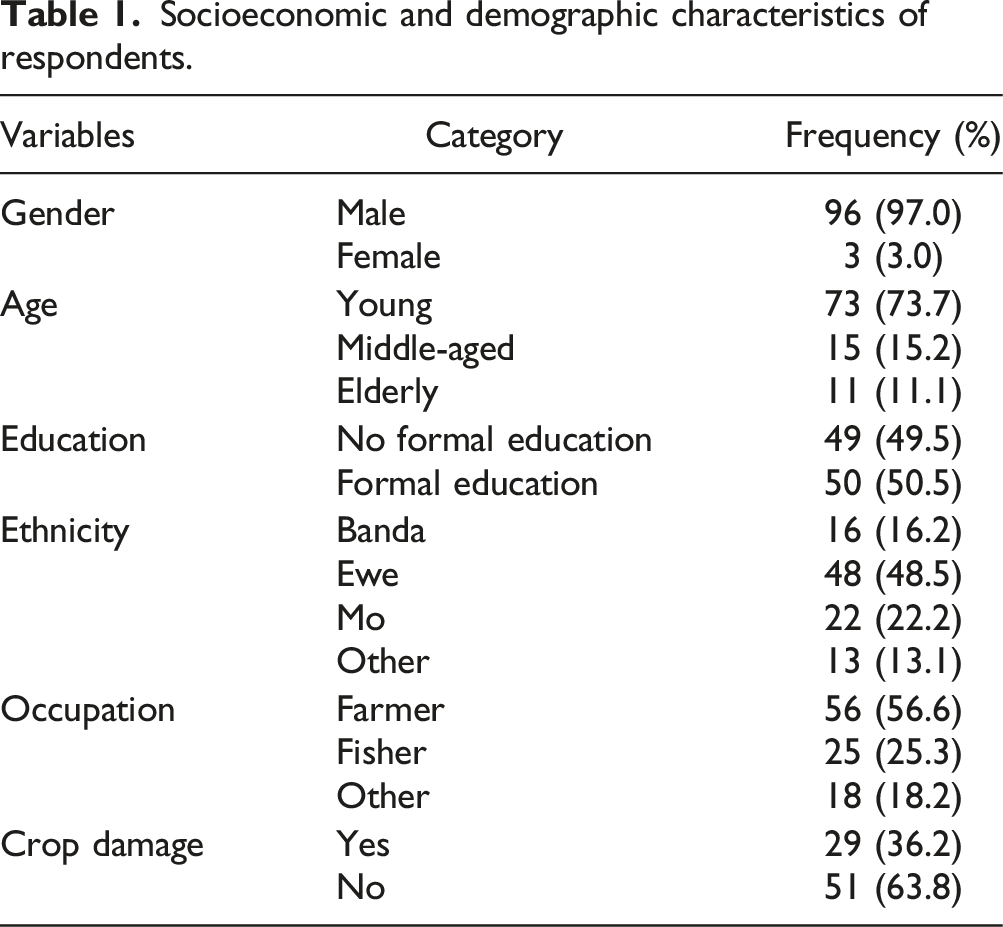
Socioeconomic and demographic characteristics of respondents.

Respondents report of crops damaged by hippos in the BNP.
Respondents’ Perceptions and Willingness to Support Hippo Conservation
Respondents’ responses (i.e., frequencies with percentages in parenthesis) to perception of hippo population in the study area.


Respondents reasons for perceived a) past decline and b) future increase in hippo population in the BNP. Where HHC-PAM refers to human-hippo conflict and protected area management challenges while LUC refers to land use change.
People’s perceptions of how they want hippo populations to look like in the future differed significantly among respondents (χ2 = 66.242, p < 0.001). Approximately 69.7% of respondents want the population to increase due to the potential tourism value it offers especially as a source of income generation for local residents. Also, respondents want the population to increase simply because they do not want it to be locally extinct in their communities given their uniqueness, endangered status, and associated benefits (e.g., revenue and education) (Figure 3b). The remaining 30.3% were against the possible population increase due to potential wildlife conflicts such as obstruction of fishing activities or capsizing of fishing boats.
Overall, the willingness to support hippo conservation differed significantly among respondents with majority of respondents expressing their enthusiasm to support hippo conservation efforts in the study area (willing = 91.9%, not willing = 8.1%, χ2 = 69.586, p < 0.001).
Factors Influencing Respondents’ Knowledge of Hippos
Full regression model with contrasts showing the effect of explanatory variables on knowledge scores. Where S.E. is standard error, CI is the 95% confidence interval, and OR is the odds ratio. Please see Table S5 for parameter estimates of the reduced model.

However, respondents’ education (e.g., full model anova: χ2 = 13.563, p < 0.001) and previous exposure or experience with hippos (i.e., whether they have ever seen a hippo or not) (χ2 = 25.485, p < 0.001) were significant predictors of respondents’ knowledge in the study area (Tables S2 and S3). Specifically, respondents who had never received formal education were less knowledgeable than those who had received some level of formal education (Table 3: β = -0.681, CI = [-1.043, -0.319], p < 0.001). In addition, respondents who have seen a hippo before recorded a higher knowledge score than those who had never seen a hippo in real life (Table 3: β = 1.374, CI = [0.840, 1.907], p < 0.001). Further exploration of the data using contingency tables revealed that the odds of a respondent correctly identifying a hippo as a mammal after having seen or encountered it in the past was 39 times the odds of a respondent identifying it correctly without ever seeing a hippo (Table S6). Although crop damage experience did not significantly influence respondents’ knowledge, exploratory results show that those who had experienced crop damage and were not supportive of hippo conservation had lower median scores than those who had experienced it and were supportive of conservation efforts in the study area (Figure 4). Boxplot of knowledge scores of respondents based on experience of crop damage by hippos and their willingness to support hippo conservation in the BNP (where ns implies not significant).
Discussion
This study describes the knowledge and perception of local people towards hippos and their willingness to participate in its conservation in the BNP of Ghana. Our results show that approximately 56% of the respondents perceived hippo populations to have stayed the same (stable) or declined in the last ten years in the study area. The perceived decline in the hippo population in the BNP is confirmed by recent studies suggesting a drastic decrease of about 69% between 2003 and 2021 (Bempah et al., 2022). The main reasons for the perceived population decline cited by respondents during the study were exploitation (i.e., poaching and retaliatory killings) followed by land use change (i.e., hydropower dam construction). There is evidence to suggest that retaliatory killings and poaching threaten hippo populations (Lewison & Pluháček, 2017; Wondimu & Kebede, 2022). In addition, alteration of natural ecosystems due to human population growth and the appropriation of land for anthropogenic activities, have resulted in biodiversity loss (DeFries et al., 2010; Lawer et al., 2021). In Africa, several studies have identified agriculture, dams, and urbanization as the biggest threats to hippo populations (Mmbaga, 2023; Smuts & Whyte, 1981; Utete, 2020). In particular, Bempah et al. (2022) revealed that Ghana’s hippo population was declining due to human settlement expansion and the construction of the Bui hydropower dam on the Black Volta River in the BNP. Thus, our findings, where respondents attributed declines to the inundation of large portions of the park and its associated impact of habitat destruction and hippo population displacement, corroborate theirs.
Conversely, we found that respondents’ perceptions of increasing hippo population patterns in the last decade were contrary to reported actual declines based on a recent study in the BNP (Bempah et al., 2022). We do not ignore the possibility that frequent hippo encounters by these respondents (i.e., majority of farmers and fishermen) influenced their perception, probably due to their activities within hippo habitats. However, when we explored our data further, we realised that respondents were somewhat misinformed about the reasons they believed led to this increase, irrespective of their educational status (i.e., this was not part of the knowledge questions we assessed). For instance, whereas hippos are known to have a low reproductive rate (Smuts & Whyte, 1981), a good proportion of these respondents who had received formal education (11/50) and those who never had (14/49) attributed perceived increases to its high birth rate. Such misinformation could frustrate conservation efforts due to conflicting stakeholder views. Hence, integrating local knowledge or perception data with scientific knowledge to generate effective evidence-based systems to inform conservation decision-making is critical to safeguarding the hippo (Ainsworth et al., 2020; Wheeler & Root-Bernstein, 2020).
Furthermore, the presence of communities in the BNP coupled with human population growth increases the level of human-hippo interactions, resulting in potential conflict situations (real or perceived) depending on the type and spatial patterns of activities conducted in the landscape (Jumani et al., 2017; Mmbaga, 2023). For example, respondents of this study mentioned cases of hippos capsizing fishing boats, resulting in human injuries and deaths similar to reports in Zimbabwe (Marowa et al., 2021). In addition, our findings suggest that about 36% of respondents engaged in farming had experienced crop damage by hippos in the study area, probably due to the proximity of farms near the Black Volta River. Bennett et al. (2000) indicated riverbank habitats outside the BNP, were used for agriculture which destroys hippo grazing lands and could in turn potentially result in undesirable consequences as observed in this study. Comparable to Mmbaga (2022), we identified maize as the most commonly depredated crop by hippos in the area. Although we did not test the effect of farm proximity statistically, our choice of sample locations and research findings appear to conform to a widely accepted assumption that crop damage by hippos is dominant in farm areas within riverbank/riverine habitats (Baker et al., 2020; Utete et al., 2017).
Human perceptions towards wildlife can influence their behaviours in response to human-wildlife conflict, such as tolerance or poaching (Kahler & Gore, 2015). Thus, the perceived severity of the threat of wildlife to human well-being is related to the likelihood of poaching or retaliatory killings, which can ultimately hinder conservation efforts. Surprisingly, we found that a significant majority of respondents were willing to support hippo conservation efforts despite the felt conflicts recorded in the study area though limited. We argue that respondent perceptions of the potential benefits of hippos may have outweighed the perceived risks, hence their tolerance or acceptance and support for hippo conservation. Further research using a comprehensive dataset is however needed to better understand the factors driving these observed patterns. Nevertheless, our findings are similar to Afriyie et al. (2022) who found that local people had positive attitudes towards protected areas and species conservation despite human-wildlife conflicts implying a good appreciation of the ecosystem services they provide. Overall, given the current decline of hippos in the BNP, most respondents want the population to increase because they attract tourists, thus providing income for local people (Sheppard et al., 2010; Subalusky et al., 2021).
Our regression analysis indicated a significant difference in the effect of education and hippo sighting experience (exposure to hippos) on respondent knowledge in the study area. Thus, a person’s past exposure or encounter with a hippo contributed to improving their knowledge of the species such as its proper identification and the awareness of the benefits it provides. Further, respondents who have received some level of formal education were much more knowledgeable about hippos than respondents without formal education, suggesting that the former group may have obtained some information or additional species knowledge from education. These results are consistent to Hooykaas et al. (2019), who revealed that species literacy (knowledge about a species) increased with educational level and exposure to biodiversity, among other factors. Consequently, local people’s misconceptions about the species and protected area management due to lack of knowledge may result in poor attitudes and practices hampering conservation efforts (Guzman et al., 2020).
We acknowledge the potential limitation of our small sample size, its likely impact on effect size estimates, and the statistical power of the hypothesis test applied in this study (Di Stefano, 2004; Steidl et al., 1997). In particular, the unbalanced representation of gender in our sample was due to the study’s target population criterion: i.e., the household head is a traditionally or socially male-dominated role in Ghana, especially in rural communities (Ghana Statistical Service, 2014; Nartey et al., 2023). Hence, increasing the sample size to capture more female household heads in the study landscape by adding more communities that meet the inclusion criteria may result in a similar or slightly higher female proportion or representation. Nevertheless, a broad or slightly refined target population (i.e., not limited to only household heads) could help improve female representation and survey sample size in the study landscape. We, therefore, encourage future studies to increase the sample size using either of these approaches to obtain more data for the estimation of effect sizes with greater precision and the verification of our findings.
Implications for Conservation
This study contributes to improving our understanding of the knowledge and perceptions of local people towards hippos in protected areas of sub-Saharan Africa. Our findings reveal declining hippo populations in the BNP due to anthropogenic factors as perceived by local people in the study area. In addition, knowledge of hippos among local people is influenced by education and exposure to the species. Evidence suggests that poor perceptions and lack of knowledge about a species may hinder local conservation efforts that aim to protect and restore populations or the environment (Härtel et al., 2023; Hooykaas et al., 2019; Kahler & Gore, 2015). In this study, local people, irrespective of their demography, socioeconomic status, human-hippo conflict risk, and knowledge of hippos, were willing to support hippo conservation efforts in the BNP. Nonetheless, we recommend that authentic and meaningful engagement among diverse stakeholders in the BNP landscape (e.g., farmers; fisher folks; traditional authorities [chiefs]; local government [district assemblies], and; protected area managers) is critical to ensuring hippo conservation now and in the future given the continuous decline of the species (Crowley et al., 2020). In particular, community-wide education may contribute to enhancing hippo literacy, the avoidance of farming along riverbank habitats, and the recognition of the potential role of the species in sustainable development and conservation programmes (Yadav et al., 2022; Zikargae et al., 2022), thus safeguarding the species and the ecosystem services they provide, especially to local people.
Supplemental Material
Supplemental Material - Knowledge and Perceptions of Local People Towards the Hippopotamus, Hippopotamus Amphibious and its Conservation: Insights from Ghana
Supplemental Material for Knowledge and Perceptions of Local People Towards the Hippopotamus, Hippopotamus Amphibious and its Conservation: Insights from Ghana by Eric Adjei Lawer and Mohammed Ishaq in Tropical Conservation Science
Footnotes
Acknowledgements
We would like to thank the staff of BNP, especially Gilbert Asiamah-Antwi for assistance during this research. To the respondents and residents of the study communities, we say thank you for your hospitality and cooperation. We are also grateful to the anonymous reviewers for their constructive comments on a previous version of the manuscript.
Authors Contribution
Declaration of Conflicting Interests
The author(s) declared no potential conflicts of interest with respect to the research, authorship, and/or publication of this article.
Funding
The author(s) received no financial support for the research, authorship, and/or publication of this article.
Ethical Statement

Data Availability Statement
Data used for the study is available from the corresponding author upon request.
Supplemental Material
Supplemental material for this article is available online.
References
Supplementary Material
Please find the following supplemental material available below.
For Open Access articles published under a Creative Commons License, all supplemental material carries the same license as the article it is associated with.
For non-Open Access articles published, all supplemental material carries a non-exclusive license, and permission requests for re-use of supplemental material or any part of supplemental material shall be sent directly to the copyright owner as specified in the copyright notice associated with the article.
