



Abstract
Understanding the interactions between local people and chimpanzees is crucial to develop sustainable wildlife conservation strategies and management policy in the Mbam-Djerem National Park (MDNP). The MDNP covers about 416,512 ha and shelters the Nigeria-Cameroon chimpanzee (Pan troglodytes ellioti) being the most endangered of all currently recognized chimpanzee subspecies. Close to 30,000 people live in the periphery of the MDNP and depend on the park’s resources for subsistence. We investigated the extent of, and factors leading to, the interactions between people and chimpanzees through a socio-economic survey focusing on households (124) and individual interviews (38) in 30% of villages around MDNP. About 95% of the respondents stated that human–wildlife conflict is an issue around MDNP. Access to resources (78.9%), crop damage (84%), and animal attack (11.3%) were the main sources of conflicts. The ground squirrel Xerus erythropus (59.7%), the green monkey Chlorocebus aethiops (20.2%), chimpanzees (7.3%) and baboons Papio anubis (5.6%) were identified as the main conflict animals and the destroyed crops included peanuts (70.2%), maize (15%) and cassava (5%). The population perceptions differed between the park’s
Keywords
Introduction
The Nigeria-Cameroon chimpanzee, is recognized as
Therefore, understanding the relationship between people and great ape populations
The coexistence of human and wildlife might generate various interactions including conflicts, ecotourism and ritual practices which have been reported around protected and conserved areas (Sillero-Zubiri & Laurenson, 2001; Sillero-Zubiri & Switzer, 2001; Tsakem et al., 2015). As shown in previous studies, human–wildlife interactions have intensified around protected areas, requiring rigorous management policy especially for a charismatic species like chimpanzee (Hill, 2004; Hill & Wallace, 2012; Littlewood et al., 2020; Teel et al., 2010). Some findings highlighted crop attacks as a major human–wildlife conflict in many countries of tropical ecosystems (Bukie et al., 2018; Tsakem et al., 2015; Weladji & Tchamba, 2003). Crop attacks by wildlife are considered a serious problem in most rural territories found at the periphery of protected and conserved areas in Central Africa. This may cause the loss of life, human injury, destruction of crops and agricultural infrastructure (Treves & Naughton-Treves, 2005; Treves et al., 2006).
However, human–chimpanzee interactions might generate socio-economic benefits through ecotourism, research, cultural belief and education, but also a conflict for the use of feeding resources considered as a priority by the IUCN/Primate Specialist Group (Hockings, 2009). Chimpanzees feeding on crops have been reported for many protected and conserved areas across Africa (Hockings et al., 2012; Hockings et al., 2017; McLennan et al., 2012). Given the actual anthropogenic threat on natural habitat,
The objectives of the present study were to establish the types of interactions between local populations and wildlife, to evaluate the importance of chimpanzees in human wildlife interactions, and to assess the extent of damages caused by wildlife to the livelihood of local farmers. Achieving these objectives is relevant for informing national parks managers for improving the current conservation policy at MDNP by focusing on more sustainable approaches with regards to human–wildlife interaction, livelihood creation and an understanding of the need for conservation action. An improved policy and adapted strategies will help to achieve acceptance of conservation practices by the local population and thus enhance the quality of great ape habitats and reduce threats to this endangered species.
Methods
Study Area
Created in 2000, the MDNP covers 4,165.2 km2 and lies between 5°30′N and 6°14′N, and 12°20′E and 13°15′E (Bobo et al., 2006; Mitchard et al., 2009) (Figure 3). A 1,662.34 km2 core zone is established at the

The Study Area Highlighting Villages and Roads Around MDNP.
Data Collection
We conducted two socio-economic surveys (Document S1) combining the approach used by other authors (Aharikundira & Tweheyo 2011b; Fetters et al., 2013): a questionnaire survey of households in villages surrounding the MDNP and individual interviews of resource persons (Hill & Wallace, 2012; Hill & Webber, 2010). The questionnaire survey was conducted in the four sectors of the MDNP (North, South, East and West) as defined in the National Park management plan.
The questionnaire survey was conducted in 30% (22) randomly selected villages out of the 74 found around MDNP. In each village, a household was considered as a sampling unit. Eight villages and 42 households were selected in the North, four villages and 18 households in the South, five villages and 28 households in the East and five villages and 36 households in the West. This provided for a total of 124 households surveyed around the MDNP. The questionnaires were administered to the head of household. The woman in a household was considered head of household when her husband was absent. Respondents represented various socio-economic backgrounds.
As the second part of the assessment, a total of 38 resource persons (experts leading conservation projects and traditional leaders in the study area) including park warden, ecoguards, NGO coordinators, and chiefs of the villages were interviewed in the selected villages with 11 resource persons in the North, 12 in the West, seven in the East and eight in the South. These 38 individuals represented one National Park warden, four forest officers, four heads of sectors (leader of the team protecting each of the four designed areas called sectors of the park to strengthen its management effectiveness), 22 traditional leaders and 11 heads of private organizations operating locally.
Data Analysis
The data collected (Document S2) were reviewed,
Results
Socio-Economic Background of the Respondents
Among the interviewed persons, 60.5% lived in the community for more than 15 years compared to 26.3% who lived there less than 5 years old, which allow to better address the problem of wildlife conservation in the study area. Of 124 respondents, 90% were men and only 10% were women, representing different age groups (Table 1).
Age Groups of the Respondents (years).

The level of education remained limited to primary (60.5%) and secondary school (29%) with only (0.8%) of the respondents having attended high school or university, while 9.7% had never been in school at all. Overall, the main livelihood activity was farming (87.1%) although it showed a significant difference between geographic sectors (Chi-square = 38.94, df = 9,

The Main Activity of the Responded According to Sectors.
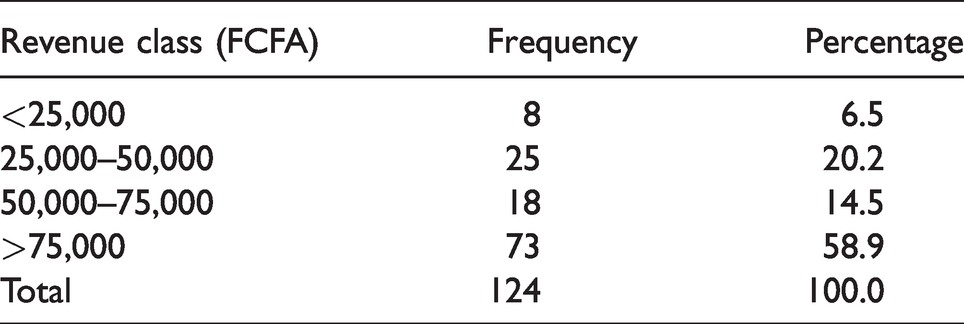
With the given activities, the annual income of respondents also differs according to the sectors (F1, 3 = 4.25, p = 0.007) and vary between 25,000 and 50,000 FCFA (20.2%) to more than 75,000 FCFA (58.9%) (Table 2).
Annual Income (FCFA, 1US $= 500 FCFA) of the Respondents.
Human–Wildlife Conflict
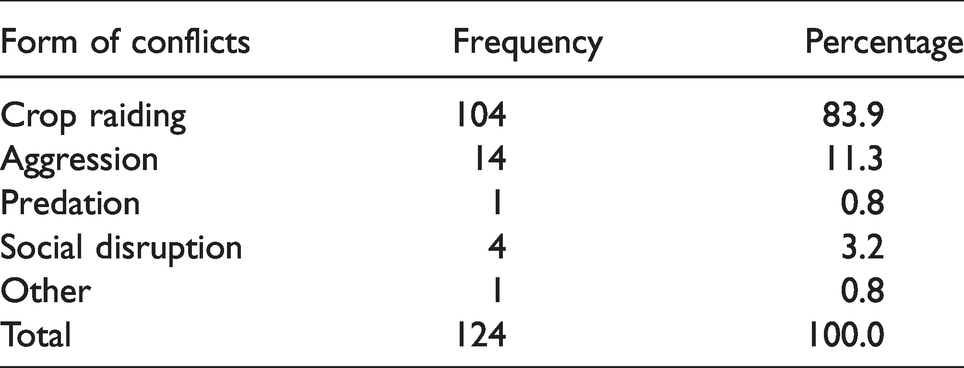
Human–wildlife conflict is an issue in the MDNP according to 94.73% of the respondents although no evidence of significant difference between sectors was found (Chi-square = 11,787 df = 9, p = 0.226). Responses indicated that crop raiding (83.9%) was the main form of conflict, followed by aggression (11.3%) and social disruption or disorder (3.2%), with the least reported being predation (0.8%) (Table 3).
Types of Conflict Found Around Mbam-Djerem National Park.
Crop Raiding Animal
Only 7.3% of respondents considered chimpanzees as crop raiding animals although we found differences between geographic sectors (Figure 3) (Chi-square = 19,385 df = 9, p = 0.022). Instead, the ground squirrel (59.7%) and the green monkey (20.2%) were identified as mainly being involved in crop raiding, followed by the baboon (5.6%) (Figure 4).
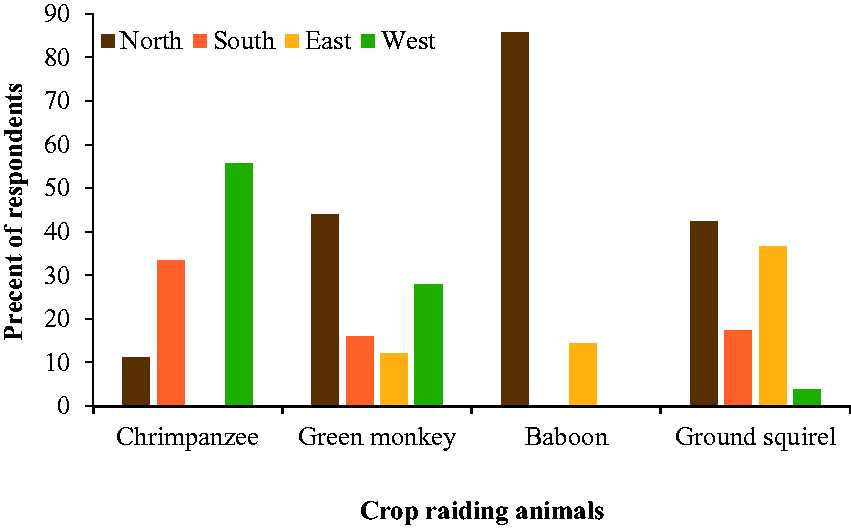
Animals Involved in Crop Raiding According to Four Sectors of the MDNP.
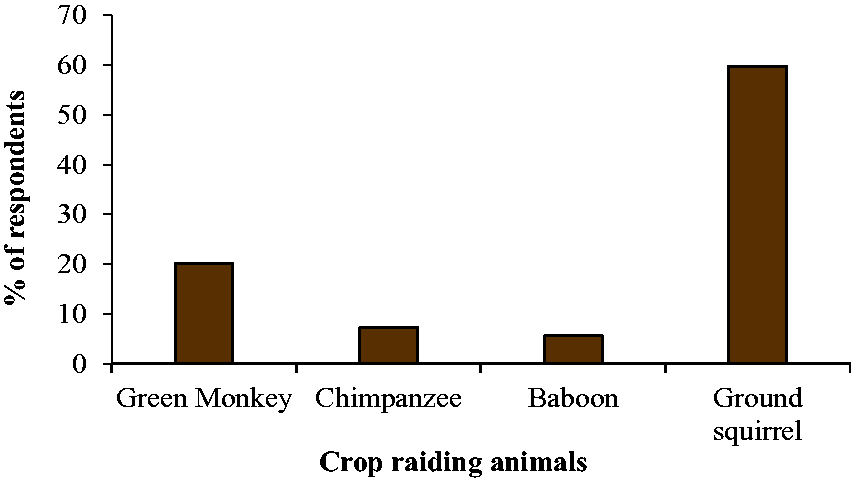
Animals Involved in Crop Raiding in the Study Area.
Crop Types Damaged by Wildlife
Crop species mostly raided by wildlife around MDNP are groundnut Arachis hypogea (70.2%), maize Zea mays (15%), cassava Manihot esculenta (4.8%) and banana Musa spp. (1.61%) as shown in Figure 5. We found significant differences between geographic sectors (Chi-square = 23,466 df = 9, p = 0.005). Damages for groundnut and maize were most recorded in the western and northern sectors, while cassava and banana were frequently destroyed in the southern and eastern sectors of the MDNP.

Crop Types Damaged in the Study Area.
The extent of crop damages was not different between geographic sectors (ANOVA: F1, 3 = 0.35, p = 0.787). Farmers reported extents as 0.5 to 1 ha (40.3%), more than 1 ha (39.5%) and less than 0.5 ha (12.1%).
Impacts of Human–Wildlife Conflict on Livelihoods
Based on a monetary evaluation of crop losses for farmers, we found no evidence of differences between geographic sectors (ANOVA: F1, 3 = 0.77, p = 0.5). In most occasions, losses were below 50,000 FCFA (41.5%), and only 7.3% of the respondents declared losses above 200,000 FCFA (Table 4).
Monetary Loss (FCFA, 1 US $= 500 FCFA) as the Consequence of Human–Wildlife Conflict.

Reactions of People against Crop Attacks
Among the respondents, 53.2% of famers used traps and dogs to protect their crops from crop-raiding animals, while 28.2% reported
Different Reaction of People Against Crop Attacks.


Reaction of People Against Crop Attacks According to the Four Sectors of MDNP.
Local Population Perception of Chimpanzees
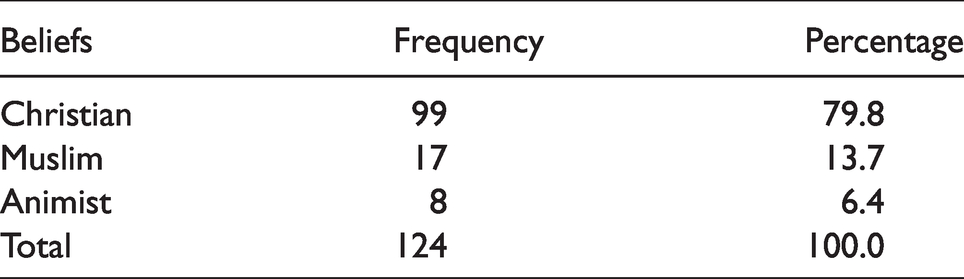
We assessed the local population perception of chimpanzee based on cultural beliefs (Table 6), tribes (Table 7) and geographic sectors. Around MDNP, 79.8% of the respondents were Christian while only 6.4% were animist. Chimpanzees were perceived as totem (68.2% of responses) according to geographic sectors (ANOVA: F1,3 = 3.778, p = 0.029), tribes (ANOVA: F1,3 = 6.173, p = 0.001), and religion (ANOVA: F1,3 = 1.346, p = 0.263). In the south and west sectors, peoples considered chimpanzee as the savior of their ancestor during the past. While according to the tribe,
Cultural Beliefs of People Around Mbam-Djerem National Park.
Different Tribes and Their Belief Around Mbam-Djerem National Park.
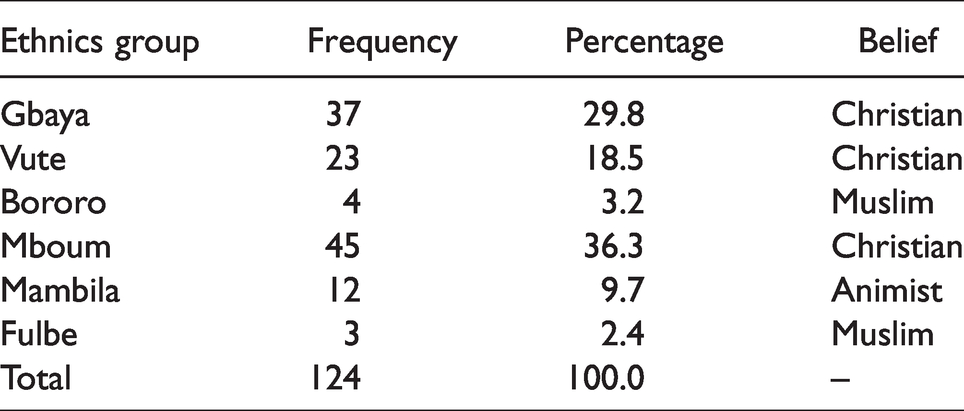
We also assessed the correlation between variables (Appendix A). The different variables have a high internal consistency (Cronbach's Alpha = 0.806). Thus, we find that the ethnic group is strongly correlated with
Discussion
Understanding interactions between the local population and chimpanzees is crucial for the development of sustainable conservation strategies in protected areas. The access to the natural resources often gives rise to various conflicts between human population and wildlife.
Human–Wildlife Conflicts
From our results, the main livelihood activity of the local population around the MDNP was farming. Mostly peanuts were destroyed, followed by other crops being maize, cassava and banana as stated by survey respondents. Similarly, in Kainji Lake National Park in Nigeria (Adeola et al., 2018; Ogunjobi & Adeola, 2016) and in Lobéké National Park in Cameroon (Tsakem et al., 2015), maize, groundnuts and cassava were the most widely grown crops, with maize and groundnuts mainly being raided by wildlife (Bukie et al., 2018; Sillero-Zubiri & Switzer, 2001).
The ground squirrel was the animal species mostly involved in crop raiding around MDNP. In other region such as Senegal and Nigeria, rodents have similarly been identified as being strongly involved in crop raiding around protected areas (Bukie et al., 2018). Several other animal species were involved in the conflicts around MDNP like the green monkey, the chimpanzee and the baboon. Baboons were involved in maize raiding in the north sector of the MDNP which ecologically is a savannah. This result is consistent with others authors who confirmed that baboon are known to favor maize crop around National Parks (Bobo & Weladji, 2011; Eniang et al., 2011; Warren, 2003), while chimpanzees were pointed as aggressive animal in the southern sector of the National Park. Chimpanzees were mainly found in this sector of the MDNP which is a forest, and people also using this sector for collecting non timber forest products. Interactions with chimpanzees here are then most frequent and they may be aggressive in order to defend their territory.
Around the MDNP, most people are famers and crop raiding causing monetary losses constitutes an economic risk for households. The extent of the conflict has hampered the subsistence system of the local population. The estimated annual losses was high
Monetary losses due to human–wildlife conflicts have been reported around most protected areas (Aharikundira & Tweheyo 2011b; Bukie et al., 2018; Marchal & Hill, 2009; Tsakem et al., 2015; Weladji et al., 2003) and conflict mitigation/compensation measures should be incorporated in the protected area management strategies. The choice of maize and groundnuts as main crops in farming around MDNP is explained by their short production period that sometimes allows for off-season production. In addition, these crops are the most popular food source for the population because their local transformation is simple and diversified.
Chimpanzees were less involved in crop raiding around MDNP. This is not the case for example at Budongo in Uganda, where chimpanzees spoil fruits in orchards (Dudley et al., 2002) and at Cantanhez in Guinea Bissau where they are perceived as the main pest of maize crops and sugar cane Saccharum officinarum (Hockings & Sousa, 2013). At MDNP, the local population received economic benefits only through research activities focused on chimpanzees although more income could be generated through ecotourism development (Tsakem et al., 2015).
Local people around protected areas generally use several approaches to protect crops against wildlife. These include day and nighttime guarding, noises to frighten animals as well as fences and traps (Hill, 2004; Mwakatobe et al., 2014; Sillero-Zubiri & Switzer, 2001). In our study area, people used different approaches to protect their crops which varied between geographic sectors and depended on the animal species involved in the conflict. To deter chimpanzees in the west sector, and baboons in the north sector,
Impacts of Human–Wildlife Conflict and Implication for Conservation
Wildlife conflicts can have negative consequences if they are not effectively apprehended (Houinato & Sinsin, 2000).
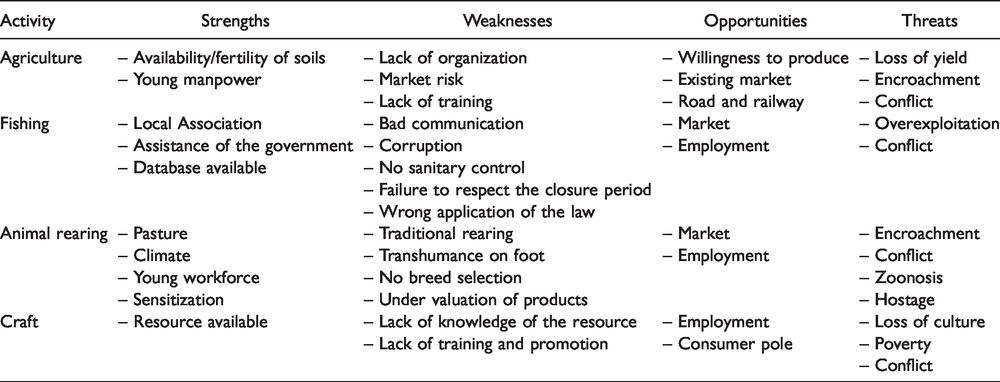
Around MDNP, local beliefs are a supporting asset for chimpanzee conservation (Appendix B), which is an opportunity to strengthen biodiversity management programs. For instance, we discovered that in MDNP, Muslim do not
Since human–wildlife conflicts are generally becoming more frequent (Eniang et al., 2011; Hockings & Sousa, 2013; Sillero-Zubiri & Laurenson, 2001), research should focus on them in order to gain new insights and suggest possible solutions according to geographic regions and species involved. Small rodents are more often causing damage than larger mammals, although the latter are the focus of most human–wildlife conflict studies (Eniang et al., 2011). Such future findings may further support the understanding and acceptance of conservation measures and foster the collaboration between protected area management and communities, as is needed in the case of MDNP.
Despite the damages not being of a great amplitude, it is advisable to anticipate the conflicts and to limit the monetary losses in order to gain the population’s incentive in favor of conservation. According to the tribes and religious attributes in the study area, most people do not hunt or eat chimpanzee meat, which is important information to be considered for reviewing the chimpanzee conservation policy in the MDNP as it may create opportunities for specific conservation action focused on these tribes.
One immediate approach needed is to reinvigorate relations between local communities and the conservation department. Conflict resolution strategies must take into account the specific context of each geographic sector of the National Park. For example, techniques to limit human–chimpanzee conflicts should be developed with priority in the southern sector where chimpanzee attacks have been recorded. Group farming is advisable and it should strongly be recommended for farmers to locate their farms in land use areas far from the border of the national park. Our results provide the baseline data on human–chimpanzee interaction at the MDNP. Although further studies on monetary losses from human–wildlife conflict around MDNP and other protected areas are recommended, cultural beliefs are an asset for chimpanzee conservation in MDNP. Therefore, it is important for partners and stakeholders to work together to strengthen the conservation strategies of P. t. ellioti in this forest-savannah transitional area in Cameroon.
Appendix A: Correlation Between Different Variables Which Influence the Conservation of Biodiversity in Mbam-Djerem National Park.

aMissing values were imputed to the mode of the quantified variable.
Appendix B: Strength, Weakness, Opportunity and Threats (SWOT) Analysis.
Supplemental Material
sj-xlsx-1-trc-10.1177_19400829211033504 - Supplemental material for Interactions Between People and Nigeria-Cameroon Chimpanzee (Pan troglodytes ellioti) Around Mbam-Djerem National Park, Central Cameroon
Supplemental material, sj-xlsx-1-trc-10.1177_19400829211033504 for Interactions Between People and Nigeria-Cameroon Chimpanzee (Pan troglodytes ellioti) Around Mbam-Djerem National Park, Central Cameroon by Serge Alexis Kamgang, Kadiri Serge Bobo, Mary Katherine Gonder, Bernard Fosso, Albert Mounga, Roger Corneille Fotso, Bertille Alix N. Ngougni Kenfack and Brice Sinsin in Tropical Conservation Science
Supplemental Material
sj-pdf-2-trc-10.1177_19400829211033504 - Supplemental material for Interactions Between People and Nigeria-Cameroon Chimpanzee (Pan troglodytes ellioti) Around Mbam-Djerem National Park, Central Cameroon
Supplemental material, sj-pdf-2-trc-10.1177_19400829211033504 for Interactions Between People and Nigeria-Cameroon Chimpanzee (Pan troglodytes ellioti) Around Mbam-Djerem National Park, Central Cameroon by Serge Alexis Kamgang, Kadiri Serge Bobo, Mary Katherine Gonder, Bernard Fosso, Albert Mounga, Roger Corneille Fotso, Bertille Alix N. Ngougni Kenfack and Brice Sinsin in Tropical Conservation Science
Footnotes
Acknowledgments
This research was implemented with the generous support of the RSG Foundation, the WWF Russell E. Train Education for Nature and the Garoua Wildlife School through its United States Fish and Wildlife Service capacity-building program to which we are grateful. We thank the Ministry of Forestry and Wildlife for providing the study leave agreement to carry out this study. We are grateful for logistical assistance from the Wildlife Conservation Society, and the Central African Biodiversity Alliance. We also express our gratitude to the local population for their hospitality. In the field, we had help from Eric Teguia, Ruffin Ambahe, Passy Cherelle, Thierry Ambas, and Cyrille Nyemga. Finally, we acknowledge all the anonymous reviewers for their helpful comments and contribution on the revised manuscript of this paper.
Declaration of Conflicting Interests
The author(s) declared there is no potential conflicts of interest with respect to the research, authorship, and/or publication of this article. And their relationship with World Wide Fund for Nature (WWF) and Rufford Small Grant (RSG) Foundation is purely a donor/grantee relation. This does not hinder their commitment to the editorial policies of Tropical Conservation Science on publishing findings, data, and materials.
Funding
The author(s) disclosed receipt of the following financial support for the research, authorship, and/or publication of this article: This research was funded by grants awarded to Serge Alexis Kamgang from WWF Russell E. Train Education for Nature (Agreement #ST62) and the RSG Foundation (RSG 13184–1). The founders had no role in study design, data collection, analysis and decision to publish the findings.

Supplemental Material
The datasets analyzed during the current study are available from the corresponding author on reasonable request although some data used are included in this published article as Supplementary Material.
References
Supplementary Material
Please find the following supplemental material available below.
For Open Access articles published under a Creative Commons License, all supplemental material carries the same license as the article it is associated with.
For non-Open Access articles published, all supplemental material carries a non-exclusive license, and permission requests for re-use of supplemental material or any part of supplemental material shall be sent directly to the copyright owner as specified in the copyright notice associated with the article.
