



Abstract
In recent years, there has been a trend for African states to delegate protected area management to private partners. Central Africa is confronted with rapidly declining wildlife populations, with scarce funding and poor incentives as root causes. This raises the question as to whether management delegation can counter this trend. However, our understanding of the efficiency of such partnerships and how they need to be handled is poor. Based on hands-on experiences and external evaluations, we developed best practices of delegated management partnerships in Central Africa. This triggered the development of the here presented Central African perspective, enriching a debate that is biased toward other parts of the continent and dominated by private conservation partners. In particular, we emphasize that in Central Africa, (a) protected areas with delegated management are among the most prestigious ones, albeit with serious management challenges; (b) it is the importance of the protected area that justifies its inclusion in formal development cooperation agreements—the dominant source of funding; (c) lack of legal provisions has been an obstacle to initiate delegated management partnerships for some countries and its wider use in others; (d) increasingly, foundations are being created as implementing national entities; and (e) raising national capacities in handling delegated management should be at the forefront of partnerships. We conclude by highlighting the importance of the new regional best practices that are based on the four stages: identification, preparation, negotiation, and implementation, of which the first three have often been neglected by Central African governments.
Keywords
Introduction
Wildlife populations in protected areas (PAs) have remained for long relatively stable in Central Africa, especially compared to West Africa (Scholte, 2011). This situation is changing and Central Africa is now confronted with rapidly declining wildlife populations. Since the late 1970s, some of the dry savanna PAs have lost 80% of their antelope populations, with declines in the subhumid savanna PAs occurring increasingly since the 1990s (Plumptre, Kujirakwinja, Treves, Owiunji, & Rainer, 2007; Scholte, 2013). The few available long-term surveys on forest wildlife show more recent rapid declines, for example, forest elephants that have dropped ca. 62% between 2002 and 2011 (Maisels et al., 2013). A variety of proximate drivers for these changes have been formulated among which (a) habitat loss and degradation by changes inside the PA, such as human encroachment, (b) land use and land cover changes outside the PA in the wider landscape, (c) overexploitation, especially for bushmeat and ivory, (d) diseases such as Ebola hemorrhagic fever among gorillas and Rinderpest among buffalo and antelopes, and (e) natural causes such as droughts (Scholte, 2011). Among the underlying drivers or root causes, which steer abovementioned mechanisms, we earlier identified (Scholte, 2011):
Increase in human pressure: as many PAs have been created, some 50 years ago, there has been a large increase in human population density around PA boundaries (Scholte & de Groot, 2010). Climate change, possibly already driving the recent observed changes in West Africa, is likely to become a main driver in the future. Poor incentives, including wildlife laws, regulations, conflicts, and corruption, which limit investing in wildlife conservation (Norton-Griffiths, 2007). Chronic underfunding, African PAs run on an estimated 10% of the necessary funds (Balmford, Gaston, Blyth, James, & Kapos, 2003).
The root causes, increase in human population and subsequent human pressure and climate change call for actions at the landscape level (e.g., Scholte, 2003) or at the regional and international levels, are beyond the scope of this contribution. Among various other instruments, PA management partnerships have been suggested to address the latter two root causes, poor incentives and underfunding (Hatchwell, 2014; Saporiti, 2006).
Since the mid-2000s, PA management authorities in at least 10 countries in sub-Saharan Africa have delegated park management to international nongovernmental partners. A decade after their start, reviews have started to appear (Lapeyre & Laurans, 2017; Nyirenda & Nkhata, 2013), although the Central African evaluations have remained unpublished (Table 1). Our understanding of the efficiency of such partnerships and how law enforcement—normally an exclusive governmental responsibility—needs to be handled, remains poor (Hatchwell, 2014). Baghai et al. (2018) provide a continent-wide overview of PA management partnerships. They make an important contribution by systematically categorizing and analyzing those providing financial–technical support, comanagement, and delegated management. A third of the cases from Baghai et al. (2018) are from Central Africa, predominantly in the category of delegated management (Table 1). Yet their orientation seems to us biased toward predominantly English-speaking southern and eastern Africa. With this contribution, we seek to provide a perspective from—predominantly French-speaking—Central Africa, tapping into delegated management experiences and evaluations. We provide new information on funding mechanisms and support programs, the base of the partnerships in Central Africa.
Protected Areas With Delegated and Co-management Agreements in Central Africa: Generalities, Management, and Governance Bodies and Evaluations Details.

Note. Partner: CAR = Central African Republic; APN = African Park Network; WWF = World Wildlife Fund; WCS = World Conservation Society; DRC = Democratic Republic of Congo; VF = Virunga Foundation. Management type: Co = co-management; Del = delegated management.
Indicated are all contracts, the newer ones superseding the older ones (Garamba, Odzala, and Zakouma).
Capitalizing Experiences From Central Africa
The Central African Forest Commission (COMIFAC) through its working group on PAs and wildlife, composed by the directors of PAs and wildlife of its 10 member countries (Burundi, Cameroon, Central African Republic (CAR), Chad, Congo, Democratic Republic of Congo (DRC), Equatorial Guinea, Gabon, Rwanda, Sao Tome, and Principe) and the Network of Protected Areas of Central Africa (RAPAC), met with delegated management partners from across Central Africa in December 2017 (See Figure 1). Based on evaluations and experiences with delegated management (Table 1), best practice guidelines have been developed that were rediscussed and subsequently adopted by the working group’s May 2018 session (COMIFAC, 2018). We use these results to build an understanding of delegated management partnerships in Central Africa. We focus on five topics that characterize Central African delegated management:
PAs with delegated management are among the most prestigious ones, albeit with serious management challenges. Generally, it is the importance of the PA that justifies its inclusion in formal development cooperation agreements, the dominant source of funding. The private partner plays a crucial role in assuring an appropriate administration but generally does not unlock funding. Legal aspects and delegated management agreements have been signed almost without exception and without legal provisions. There has been a trend toward the creation of (national) foundations, the national management entities. Raising national capacities, including in handling delegated management, remains an issue and should be at the forefront of partnerships. Seventh meeting of the Protected Areas & Wildlife Working Group of COMIFAC (photo by Paul Scholte, Libreville, December 2017).

Jewels in the Crown
The majority of collaborative management partnerships in Central Africa deal with World Heritage sites, widely seen as the most prestigious PAs or “jewels in the crown” (Table 1). While Central Africa has a comparable number of World Heritage sites as eastern and southern Africa, almost half of its delegated management partnerships deal with World Heritage sites, compared to none in eastern and southern Africa. Well-known examples are Virunga in the DRC, the oldest and most diverse national park (NP) in Africa (Plumptre et al., 2007); and two (Central African Republic, Congo) of the three NPs of the tri-Sangha complex, with forest elephants and lowland gorillas more easily seen by tourists than anywhere else (Doumenge, Palla, Scholte, Hiol Hiol, & Larzilliere, 2015) (See Figure 2, 3). Zakouma NP (Chad) has recently been proposed as World Heritage site and stands out because of its rich large mammal population and almost continuous external financial support, as well as high-level domestic support, for the last 30 years (See Figure 4).

Nouabalé-Ndoki National Park (Congo) Gorilla tourism program initiated by the private delegated management partner based on an earlier research program (photo by Paul Scholte, 2017).

Nouabalé-Ndoki National Park (Congo) Gorilla tourism program initiated by the private delegated management partner based on an earlier research program (photo by Paul Scholte, 2017).
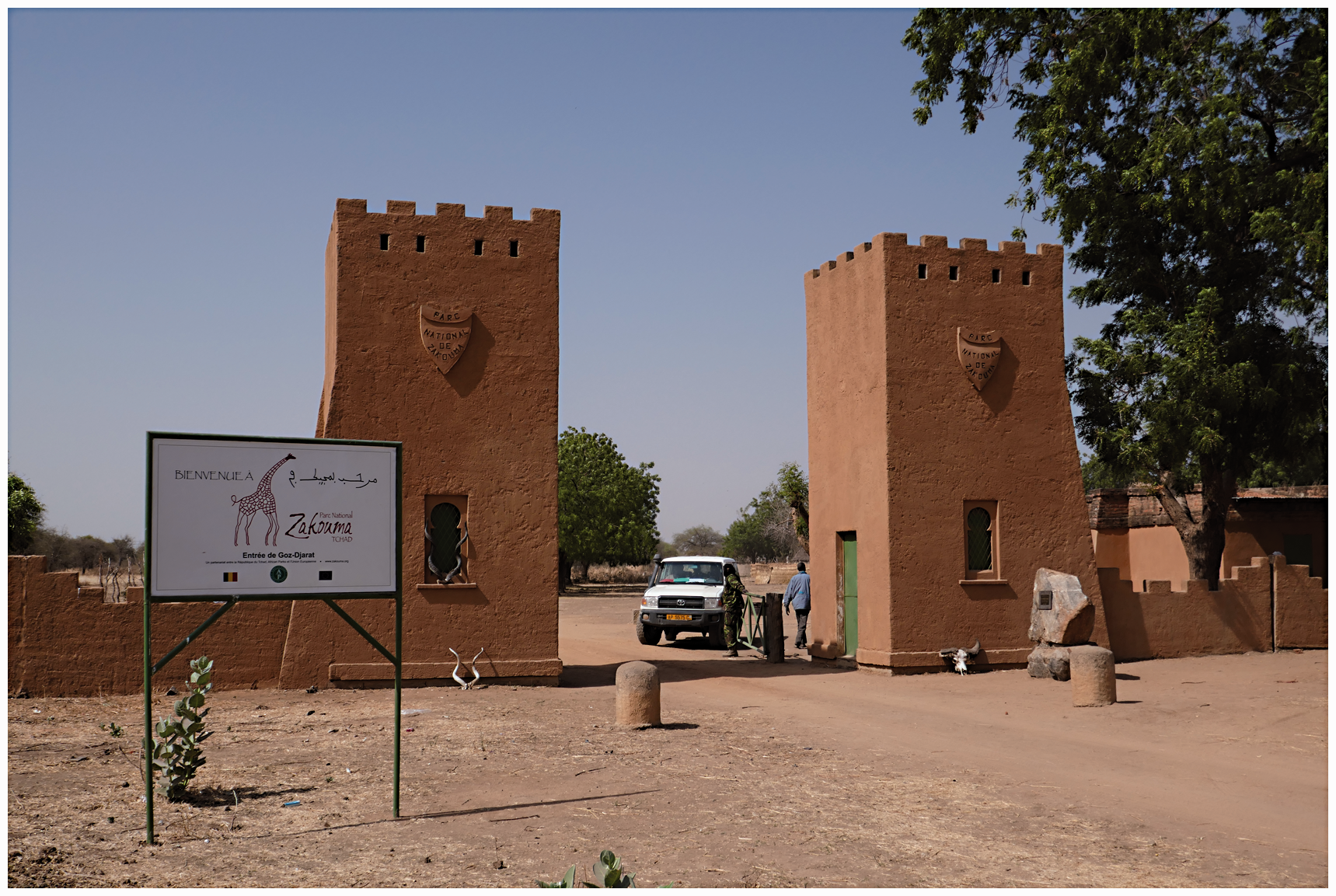
Entrance of Zakouma National Park (photo by Paul Scholte, 2017).
The conservation status of Central Africa’s PAs is highly problematic; not by coincidence, half of its World Heritage sites are on the Red List of sites in danger (Doumenge et al., 2015). This may explain why Central Africa—arguably the only region in the world to do so—delegates the management of its most prestigious PAs. It also highlights its political sensitivity, especially with the involvement of a private partner in law enforcement. It is important to emphasize the differences between management, governance, and sovereignty (Baghai et al., 2018). However, in the remoteness of many PAs where a delegated management structure is the only administration present, differences between them fade and the delegated management structure often seems to substitute the state. One further wonders if similar funding and subsequent management results can be expected when delegating the management of less prestigious PAs.
Crucial Role of Funding in Partnerships
Six of the 10 delegated management contracts in Central Africa explicitly mention financing on a par with management in their title, see Appendix, Unpublished References. In all but two contracts, the nonability to raise funds is among the main dissolution clauses, although they have not been applied so far. In half of the delegated management contracts (5 of the 10), raising funds is explicitly expected from the private partner, and its nonfulfilment, generally over 2 years, could be a reason for dissolution of the contract.
Table 2 quantifies the funding sources according to the following categories:
Development cooperation: allocated—from a donor country to a specific recipient country. Through a formal agreement, the recipient country has become the “owner” of the allocation funding and thereby is on the driving seat in terms of procedures of subcontracting and so on; Development cooperation: not allocated to specific countries, thereby reducing the role of the country to recipient and not as “owner”; Private: nonallocated to a specific country and raised through international nongovernmental organization networks; Private: from companies and foundations, unlocked by the private partner.
Funding to Protected Areas With Delegated and Co-management Arrangements in Central Africa: Sources and Estimated Annual Amounts.

Note. Partner: APN = African Park Network; WWF = World Wildlife Fund; WCS = World Conservation Society; VF = Virunga Foundation; Co = comanagement; Del = delegated management; GER = German public funds (through KfW); EU = European Union public funds; US = United States public funds (esp. US Fish and Wildlife Service); Nat = National public funds; CAR = Central African Republic; DRC = Democratic Republic of Congo.
Information sources: Amounts committed, recalculated to annual based on funding cycle of generally 5 years: EU: Action Plans 11th European Development Fund (2018–2022), Chad, DRC, Regional; US: US Fish and Wildlife Service, call for proposals 2018, see unpublished references for details. €/$ = 1.2 (January 2018).
Akagera: net income in 2017 (Source: Akagera News January 2018).
Funding sources, relative importance of funding sources: ++: dominant; +: important; +/−: medium; −: limited; −−: none.
The amounts mentioned here only concern Garamba NP (5,133 km²), although an unknown part of the budget is also used for the management of the three surrounding hunting zones (9,663 km²).
Akagera NP (Rwanda)-as the only park in Central Africa with delegated management-has substantial revenues, leading to 3 times the Central African funding mean (Table 2). Main revenue source is tourism that implies however considerable additional management expenditures, including running a lodge and tented camp. In addition, Akagera is the only fenced park in Central Africa, with a capital intensive reintroduction program of Lion and Black Rhino (See Figure 5). All other Central African PAs depend on international funding for more than 90% of their budget. In Table 2, we indicate the estimated amounts of PA management funding based on the major funding sources and annual reports, see Unpublished References. Mean funding per individual PA is $860 km−2 considerably lower than the $1,200 km−2 reported as mean funding of African delegated management (Baghai et al., 2018). The 2016 annual report of African Parks, the dominant delegated management organization (Table 1), suggests an overall mean of $520 km−2 (60,000 km−2 divided by funding available $31.2 mio). With the general lack of insight into funding sources, we can only speculate if Central Africa’s limited diversity of funding explains this difference.

Akagera National Park (Rwanda) Electric Fence, a 2.8 mio $ investment through Rwandan public funds at the start of the delegated management period. Its maintenance, with considerable annual costs, has been assured by the private delegated management partner. This has allowed the re-introduction of Lion and Black Rhino part of an intensified tourism program (photo by Paul Scholte, 2016).
A special case is the tri-Sangha Trust Fund, largely sourced from allocated development cooperation funds. Here, as well as with other prior investments (Table 2), taking up delegated management comes with an attractive “dowry.” In addition to the PA management funding (Table 2), community conservations activities in their periphery are funded, sometimes with considerable amounts. For example, the European Union finances community conservation activities with €1.1 mio (Zakouma NP) and even up to €6.3 mio annually (Virunga NP) (See Figure 6). We would further like to stress that it seems to be the importance of the PA that justifies its inclusion in formal development cooperation agreements—the dominant source of funding. The private partner plays a crucial role in assuring an appropriate administration but does not seem to unlock funding.

Community Development Programme around Virunga NP, developed by the delegated management partner (photo by Paul Scholte, 2011).
Legal Arrangements
A lack of legal provisions has been an obstacle for countries such as Cameroon to initiate delegated management partnerships but has not stopped five other countries in Central Africa to develop and implement them (Table 1). These partnerships were initiated based on mutual agreements, generally at the initiative of the private party. They were accompanied by lobbying from the private party, often supported by their donors, at the highest political levels as various testimonies of participants during the working group meetings showed. As somewhat an exception, Rwanda proactively entered, through a process of identification of qualified organizations, in contact with African Parks Network (APN) for the management of Akagera NP. APN developed a business plan, an integral part of the contract that prior to signing was approved by the cabinet.
As only country in Central Africa, Rwanda recently adopted a Public Private Partnership (PPP) law (Government of Rwanda, 2016). This allows Rwanda to move toward a commercialization of its delegated management model, a true PPP. Rwanda is currently preparing a public tendering process to delegate management of Nyungwe NP, although in the new law the possibility of mutual agreements is not excluded.
Management and Governance Structures
Increasingly, delegated management partnerships in Central Africa are based on the existence of intermediate organizations, generally foundations with a national status (Table 1). An executive board assures the governance of the partnership and thereby the PA. The number and background of its members varies widely, but the relative weight of the public and private partners is generally in equilibrium. Recent experience from Congo, DRC, and Rwanda highlights the importance of having as president of the board a widely respected national who is not affiliated with the governmental structure overseeing PAs nor by the private party. The management unit, directed by the board, is without exception headed by a professional employed by and representing the private partner, the director of the PA. The director leads a team of heads of management units, such as administration, infrastructures, community relations, ecological management, and law enforcement. Several PAs, such as Nouabale-Ndoki, Akagera, and Zakouma have a law enforcement officer headed by the park director, who also remains within the hierarchical system of the responsible governmental structure and thereby has the right of drawing up certified reports and wearing arms. This allows the necessarily functioning of law enforcement in a delegated management setup.
Capacity Building
Does delegated management supplant the state or build its capacities? The evaluation by the European Commission (2014) of delegated management initiatives in the DRC concluded that, apart from undeniable strengths, weaknesses include the limited ownership by the PA authority. The private partner is expected to provide administrative and technical capacities to access and use the funding according to required standards. Raising capacities of national personnel and institutions hereby critical (See Figure 7, 8). Although the recent delegated management contracts (Table 1) pay generally more attention to capacity building, the described expected efforts of the private party remain vague and difficult to monitor and measure. An exception is Rwanda that has set a ceiling on the number of expatriate staff: four for the management of Akagera NP and three for each lodge.

Control room Zakouma National Park, heart of the protection system, developed during the delegated management period (photo by Paul Scholte, 2017).

Camp nomade a tented camp that is moved approximately every month, extending the touristic offer of Zakouma NP (photo by Paul Scholte, 2017).
At present, there exists a monopoly for delegated management. This may be understandable where private partners have initiated conservation activities in the area, as with the WWF (World Wildlife Fund) in Dzangha-Sangha PA (Central African Republic) and the WCS (Wildlife Conservation Society) in Nouabale-Ndoki NP (Congo). However, we question if this should be automatically continued with maturing partnerships and more developed PAs. In this respect, Garamba NP is an example where its first delegated management contract in 2005 totaled seven pages, which tripled to 24 in 2016, with increased expectations within the DRC.
The Way Forward
The challenges in handling delegated management in Central Africa described above show the need for developing regional guidelines for developing and implementing collaborative management partnerships (Baghai et al., 2018). Inspired by commercial partnerships (European PPP Expertise Centre, 2015), we identified best delegated management practice in each of the key phases: identification, preparation, negotiation, and implementation, the latter including ex-post evaluation (COMIFAC, 2018). The first three phases have often been neglected by Central African governments who, contrary to private parties, often enter poorly prepared into negotiations. We propose exploring procurement procedures for allocated funding sources, diversifying the hitherto limited number of private partners (Table 1), and raising much needed national capacities. The example of Rwanda, publicly tendering the delegated management of one of its NPs, will be highly interesting in this regard. With improved capacities and a more conducive legal framework, Central Africa should be able to draw upon a diversified set of management models and access funding beyond the presently dominant development cooperation sources.
Appendix: Unpublished References
Evaluations Delegated Management Partnerships
BRLI Ingénierie. (2016). Evaluation 2011–2015 de l’Accord de Partenariat pour la Gestion du Parc National d’Odzala-Kokoua, Republique du Congo.
d’Huart, J.P. (2013). Avancement des partenariats public-prive existants dans les Parcs Nationaux de la Garamba et des Virunga (R.D. Congo), d’Odzala-Kokoua (Rép. du Congo) et de Zakouma (Rép. du Tchad). Analyses des forces et des faiblesses des PPP et piste d’amélioration et de renforcement. Rapport AGRECO, funded by the European Union.
European Commission. (2014). Evaluation de la coopération de l’Union Européenne avec la République Démocratique du Congo 2008–2013.
Goodman, P. S. (2016). Akagera National Park Management Performance Review for the period 2010 to 2015.
Particip. (2017). Evaluation à mi-parcours externe de l’Accord décennal de Partenariat Public-Privé (PPP) entre le Gouvernement de la République du Tchad et African Parks Network (APN) au titre de la délégation de gestion du Parc national de Zakouma (PNZ) et de sa périphérie. Unpublished Report of Particip Gmbh et ETI Consulting Consulting to the European Commission.
Funding Sources
African Parks Network. (2017). Annual report 2016. https://www.africanparks.org/sites/default/files/uploads/resources/2017–05/2016_African_Parks_Annual_Report_Impact_Defined.pdf
Akagera National Park. (2018). January 2018 monthly report.
Fondation Tri-Sangha. (2018). Annual Report 2017. http://www.fondationtns.org/dev/wp-content/uploads/2018/05/RAPPORT-ANNUEL-FTNS-2017-ENG-LD-print.pdf
UE. (2016). Annexe relative au programme d’action annuel 2016 en faveur de la région Afrique centrale à financer sur le 11 Fonds Européen de Développement. Document relatif à l’action pour Programme d’Appui pour la préservation de la biodiversité et les écosystèmes fragiles—phase 6 (ECOFAC6). https://ec.europa.eu/europeaid/sites/devco/files/ad-3-central-africa-2016_fr.pdf
UE. (2015). Annexe de la décision de la Commission relative au programme d’action annuel 2015 en faveur de la République Démocratique du Congo à financer sur le 11e Fonds Européen de développement. Document relatif à l’action pour le programme <<Environnement et agriculture durable pour la sauvegarde des sites biologiques prioritaires de la République démocratique du Congo>>. http://ec.europa.eu/transparency/regdoc/rep/3/2015/FR/3–2015-6758-FR-F1-1-ANNEX-2.PDF
UE. (2016). Annexe 2 de la décision de la Commission relative au programme d’action annuel 2016 en faveur de la République du Tchad à financer sur le 11e Fonds Européen de développement. Document relatif à l’action pour le programme d’appui à la gestion concertée des aires protégées et écosystèmes fragiles du Tchad (APEF) https://ec.europa.eu/europeaid/sites/devco/files/ad-2-aap-chad-2016_fr.pdf
U.S. Fish and Wildlife Service. (2018). Central Africa Regional Program Catalog of Federal Domestic Assistance (CFDA) Number: 15–651 Funding Opportunity Number: F18AS00060. Notice of Funding Opportunity and Application Instructions https://www.fws.gov/international/pdf/FY18-AFR-NOFO.pdf
Zakouma National Park. (2018). January 2018 monthly report.
Delegated and Co-management Contracts
Central African Republic
Accord de partenariat entre le Ministère de l’Economie Forestière, Environnement et Tourisme et le Projet Chinko pour la gestion et le financement de la Zone de protection du Chinko République Centrafricaine. (2014). Signed: Pour le Gouvernement de la république Centrafricaine: le Ministre de l’Economie Forestière, de l’Environnement et du Tourisme Hyancinthe Touhouye Pour le Projet Chinko, Le Directeur Exécutif David Simpson.
Chad
Accord de Partenariat entre le Gouvernement de la République du Tchad et African Parks Network (APN) pour la gestion et le financement du Parc National de Zakouma. (2010). Signed: Pour le Gouvernement de la République du Tchad, Le Ministre de l’Environnement et des Ressources Halieutiques Mr. Hassan Terap; Pour African Parks Network Countries Director Mr. Jean Marc Froment.
Accord de Partenariat entre le Gouvernement de la République du Tchad et African Parks Network (APN) pour la gestion et le financement du Parc National de Zakouma et son Grand Ecosysteme Fonctionnel. (2017). Signed: Pour le Gouvernement de la République du Tchad, représenté par le Ministre en charge des Aires Protégées dénommé ci-après <<l’Administration de tutelle>> Monsieur Ahmat Mbodou Mahamat et Pour African Parks Network, dénommé ci-après <<APN>> représenté par Monsieur Peter Fernhead, President-Directeur General.
Congo
Accord de Partenariat pour la gestion durable et le financement du Parc National de Nouabale Ndoko, République du Congo. (2013, Avril). Signed: James Deutsch (Directeur Programme Afrique WCS) et Le Ministre de l’Economie Forestière et du développement Durable, Henri Djombo.
Accord de Partenariat pour la gestion et le financement du Parc National d’Odzala-Kokoua Republique du Congo. (2010). Signed: Pour African Parks Network, le Directeur Exécutif Peter Fearnhead et pour la République du Congo le Ministre du Développement durable de de l’Economie Forestière et de l’Environnement, Henri Djombo.
Avenant no. 1. Accord de Partenariat entre le Gouvernement de la République du Congo et African Parks Network du 14 November 2010 Relatif à la gestion du Parc National d’Odzala-Kokoua en mode partenariat public-privé. (2017). Signed: Pour African Parks Network Peter Fearnhead, Directeur Exécutif et Pour la République du Congo Rosalie Matondo Ministre de l’Economie Forestière, du Développement Durable et de l’Environnement.
Democratic Republic of Congo
Contrat de Gestion entre l’Institut Congolais pour la Conservation de la Nature et African Parks Network, Kinshasa. (2005). Signed: Pour l’African Parks Foundation <<AP>> Paul van Vlissingen. Pour l’Institution Congolais pour la Conservation de la Nature <<ICCN>>. Pasteur Cosma Wilungula Balongelwa.
Contrat de Gestion du Parc National de la Garamba entre l’Institut Congolais pour la Conservation de la Nature <<ICCN> et African Parks Network <<APN>> ( 2016). Signed: Pour APN Peter Fearnhead et ICCN Pasteur Dr. Cosma Wilungula Balongelwa.
Protocole d’Accord specifique definissant les modalites de Cogestion du Parc National de la Salonga entre l’Institution Congolais pour la Conservation de la Nature <<ICCN>> et le World Wide Fund for Nature <<WWF>> (2015). Signed: Pour le WWF Jean Claude Muhindo, pour l’ICCN Pasteur Cosma Wilungula Balongelwa.
Rwanda
Public Private Partnership Agreement between The Rwanda Development Board and the African Parks Network relating to the Management and Financing of Akagera National Park (2010). Signed between: African Parks Network, Peter Fearnhead and Rwanda Development Board, John Gara.
Footnotes
Authors’ Note
The views expressed in this paper remain the sole responsibility of the authors.
Acknowledgments
The authors would like to thank the participants of the seventh and eighth meetings of the Protected Areas & Wildlife Working Group of COMIFAC for sharing their experiences and comments. Baudouin Michel (APN) kindly provided several delegated management partnership contracts. David Brugière (BRLI) oriented the authors by organizing an earlier delegated management workshop in Cameroon.
Declaration of Conflicting Interests
The author(s) declared no potential conflicts of interest with respect to the research, authorship, and/or publication of this article.
Funding
The author(s) disclosed receipt of the following financial support for the research, authorship, and/or publication of this article: The German Technical Cooperation (GIZ) funded the two working group sessions as well as the elaboration of the best practices guide.