



Abstract
With the extant of tropical forest degradation, primates increasingly inhabit forest patches embedded in anthropogenic matrices. Such matrices are composed of different land cover types (e.g., agricultural lands and cattle pastures), but large uncertainty remains about the ability of primates to use these land covers. Here, we assessed the use of the landscape matrix by spider monkeys (Ateles geoffroyi) in 13 forest sites from three countries (Mexico, Costa Rica, and El Salvador). Based on ad libitum records from >212 months of field observations, we found that spider monkeys used four types of land covers for feeding or traveling: secondary vegetation, isolated trees, tree crops, and vegetation corridors. Secondary vegetation was more frequently used than the other land covers. The number of land covers present in the matrix was positively related to the number of land covers used for traveling and feeding. Monkeys consumed 53 plant species in the matrix, mostly native and old-growth or late-successional forest species, although they also used three cultivated tree species. Most species were trees, especially from preferred food species, although monkeys also used palms, lianas, and shrubs. Monkeys fed principally from fruits, but they also used leaves, wood, and flowers. Most species were used from secondary vegetation and isolated trees. These findings suggest that the landscape matrix can provide supplementary food sources for this endangered primate and opportunities for traveling (i.e., spatial connectivity) in human-modified landscapes—information that can be used to improve conservation strategies, especially under the context of land-sharing management strategies (e.g., agroforestry).
Keywords
Introduction
With increasing land-use change across the tropics (Achard et al., 2014), a large proportion of global biodiversity is found in human-modified tropical landscapes (HMTLs; Melo, Arroyo-Rodríguez, Fahrig, Martínez-Ramos, & Tabarelli, 2013). Such landscapes are highly heterogeneous, as they are usually composed of forest patches surrounded by different types of human-created land covers, including human settlements, agricultural lands, cattle pastures, secondary forests, live fences, and isolated trees (hereafter, anthropogenic matrix). Because forest patches in these landscapes may support a limited availability of food resources (e.g., Arroyo-Rodríguez & Mandujano, 2006; Chaves, Stoner, & Arroyo-Rodríguez, 2012), forest animals, including most primates, can supplement their food intake by using resources from the surrounding matrix, a process named “landscape supplementation” (Dunning, Danielson, & Pulliam, 1992). The matrix can also be used by forest animals to move among forest patches (Franklin & Lindenmayer, 2009), but different land covers show different resistance to interpatch movements (da Silva, Ribeiro, Hasui, da Costa, & da Cunha, 2015; Ricketts, 2001). Unfortunately, large uncertainty remains about the ability of most animal species to use the matrix, the land cover types more frequently used for feeding and traveling, and the food resources used in each land cover. Such knowledge is urgently needed to understand biodiversity patterns in HMTLs, and thus for the construction of informed conservation planning (Franklin & Lindenmayer, 2009; Prevedello & Vieira, 2010; Watling, Nowakowski, Donnelly, & Orrock, 2011), specially for threatened species such as most primates (Estrada et al., 2017).
Primates are often found in HMTLs (Marsh et al., 2013), where a large number of patterns and processes may threaten their survival (Arroyo-Rodríguez & Mandujano, 2009; Estrada et al., 2017; Graham, Matthews, & Turner, 2016). Yet, because most studies in HMTLs assess the impact of forest patch characteristics (e.g., patch size, isolation) on the diet, behavior, and demography of primates (Arroyo-Rodríguez et al., 2013; Carretero-Pinzón, Defler, McAlpine, & Rhodes, 2016), our understanding of the importance of the landscape matrix for primates is incipient. This gap of information may be related, at least partially, to the fact that forest animals may perceive the matrix as a dangerous place where they are more exposed to predation and hunting, and thus, they avoid the use of this landscape element. However, there is evidence that primates are able to use different land covers in the matrix (Estrada et al., 2017), including agroecosystems (Estrada, Raboy, & Oliveira, 2012), and other land covers, such as secondary forests, live fences, subsistence orchards, and isolated trees; but the available information is limited to only a few folivorous (Colobus guereza: Harris & Chapman, 2007; Colobus angolensis: Anderson, Rowcliffe, & Cowlishaw, 2007; Alouatta palliata: Asensio, Arroyo-Rodríguez, Dunn, & Cristóbal-Azkarate, 2009; Alouatta pigra: Pozo-Montuy, Serio-Silva, Chapman, & Bonilla-Sánchez, 2013; Alouatta guariba: Bicca-Marques & Calegaro-Marques, 1995; Chaves & Bicca-Marques, 2017), omnivorous (Pan troglodytes schweinfurthii: Reynolds, Wallis, & Kyamanywa, 2003), and frugivorous/insectivorous monkeys (Callicebus negrifrons: Trevelin, Port-Carvalho, Silveira, & Morell, 2007; Cercopithecus ascanius: Baranga, Basuta, Teichroeb, & Chapman, 2012). The available information for frugivorous primates, such as the spider monkey (genus Ateles), is very scarce.
The Geoffroy’s spider monkey (Ateles geoffroyi) is distributed from southeastern Mexico to northwestern Colombia (Di Fiore, Link, & Campbell, 2011). Given its large body size (6–9.4 kg; Ford & Davis, 1992) and mostly frugivorous diet (González-Zamora et al., 2009), A. geoffroyi uses large home ranges (95–900 ha; Wallace, 2008). These ecological features make this species particularly sensitive to forest loss and fragmentation (Boyle & Smith, 2010; Garber, Estrada, & Pavelka, 2006; Michalski & Peres, 2005; Ramos-Fernández & Wallace, 2008). Although there are some published reports of spider monkeys using food resources from the matrix, mostly in agricultural lands (Chaves et al., 2012; Estrada et al., 2006, 2012) and secondary forests (Ramos-Fernández & Ayala-Orozco, 2003; Ramos-Fernández, Smith-Aguilar, Schaffner, Vick, & Aureli, 2013), we lack information concerning the land cover types that are frequently used by this species for feeding and traveling in the matrix. Such information is needed to design biodiversity-friendly landscapes (sensu Melo et al., 2013); for example, increasing resource availability and landscape connectivity for endangered species such as A. geoffroyi.
Here, we compiled ad libitum observations from 10 studies of spider monkeys carried out in 13 forest patches surrounded by different land cover types in three countries (Mexico, Costa Rica, and El Salvador) to document, for the first time: (a) the general patterns of land cover types used for feeding and traveling in the matrix; and (b) the life forms, plant species, and food items used as food resources in each land cover. Because spider monkeys are considered forest-specialist primates, we hypothesized that monkeys can use the matrix for feeding and traveling, but mainly use those land cover types that are structurally and compositionally more similar to the forest patches in which they reside. Spider monkeys in fragmented forests are known to increase their consumption of leaves (e.g., González-Zamora et al., 2009)—a plant item with lower energetic content and higher levels of secondary compounds and structural material than other plant items, such as fruits (Felton, Felton, Lindenmayer, & Foley, 2009a; Felton et al., 2009b; Milton, 1981). Therefore, we hypothesized that monkeys in the matrix will use primarily fruits (especially from preferred tree species) to supplement their diet, and thus increase the quality of their diet (Asensio et al., 2009; Dunning et al., 1992). This hypothesis is particularly plausible considering that the matrix can be experienced by primates as a relatively hostile place, and thus, they are not expected to leave forest patches to feed from plant items such as leaves, which are readily available within their home patches (Asensio et al., 2009; although note that leaf quality is highly variable: Snaith & Chapman, 2005).
Methods
Data Base
Characteristics of Forest Sites (n = 13) Where Spider Monkeys (Ateles geoffroyi) Have Been Observed Using Different Land Cover Types for Feeding and Traveling in the Anthropogenic Matrix Surrounding Their Home Forest Patches.
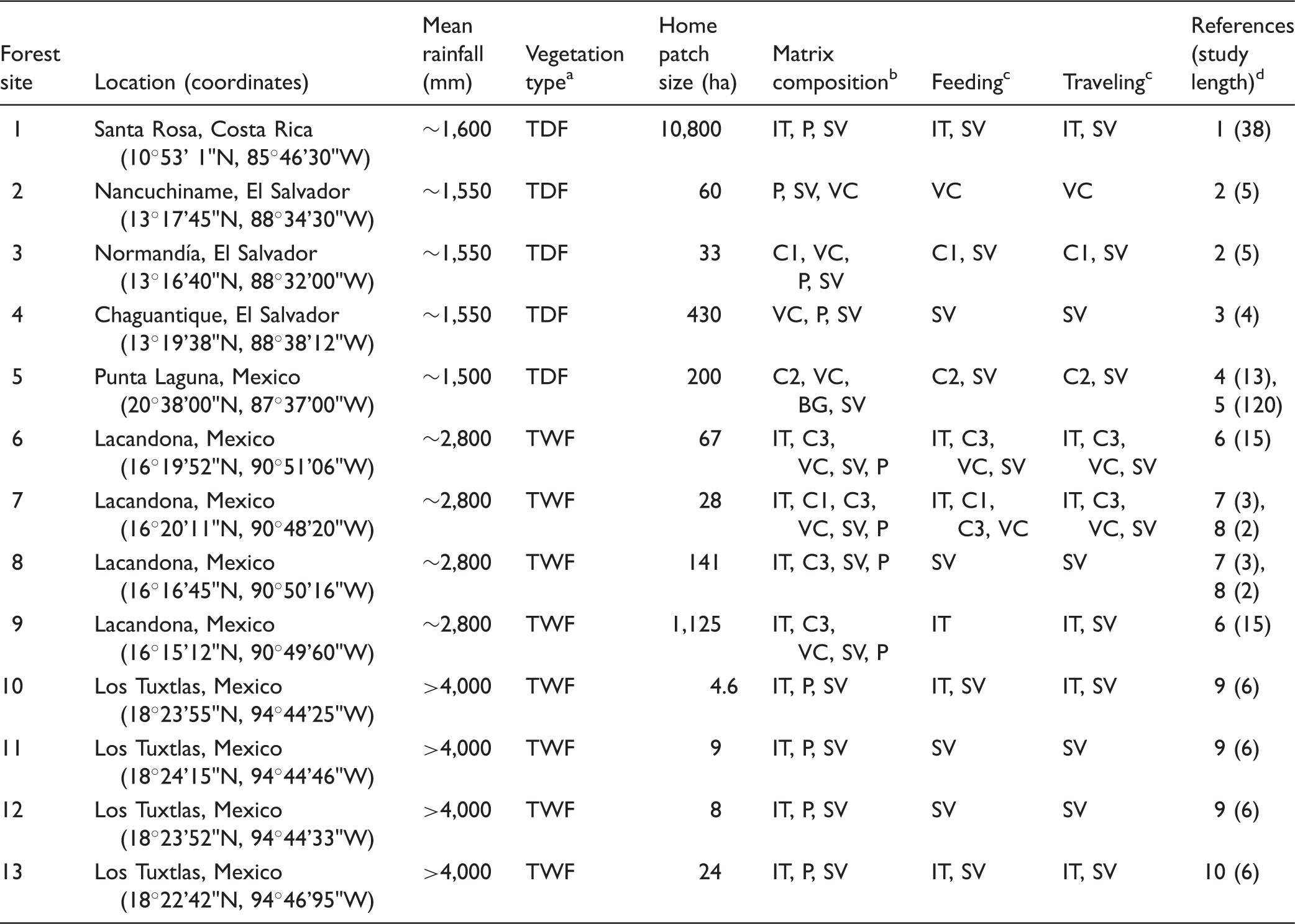
Vegetation types following Gentry (1982): TDF = tropical dry forest; TWF = tropical wet forest.
Land cover types surrounding each forest site: BG = backyard garden; C = tree crops (C1: Mangifera indica; C2: Manilkara zapota; C3: Theobroma cacao); IT = isolated tree; P = cattle pasture; SV = secondary vegetation; VC = vegetation corridor (i.e., live fences and riparian corridors).
Land cover types used for feeding and traveling in the landscape matrix (abbreviations correspond to those showed in the footnote b).
References and study length (i.e., number of months) = 1. C. A. Chapman (unpublished data); 2. K. Morales-Hernández (unpublished data); 3. Argueta and Rivera (2004); 4. M. Pablo-Rodríguez (unpublished data); 5. G. Ramos-Fernández (unpublished data); 6. Chaves, Stoner, and Arroyo-Rodríguez (2012); 7. J. D. Ordóñez-Gómez (unpublished data); 8. G. K. Pérez-Elissetche (unpublished data); 9. A. González-Zamora (unpublished data); 10. S. Sánchez-López (unpublished data).
Data Analyses
Each forest site was considered as an independent record. We first calculated the proportion of forest sites that presented each land cover type (based on a total of 13 forest sites). This proportion indicates the distribution of each land cover type across forest sites, and can be considered a proxy of availability (e.g., secondary vegetation occurred in all forest sites, but isolated trees were found in 9 out of 13 sites; Table 1). We also calculated the proportion of forest sites where monkeys were observed feeding or traveling in each land cover type. As monkeys cannot use land covers that are not present in a given site, in this case, proportions are calculated considering the distribution of each land cover across forest types, and not based on the total number of forest sites (e.g., monkeys fed from isolated trees in 6 sites, but as this land cover type was only present in 9 sites, they used isolated trees for feeding in 67% of sites, and not 46% if we would consider 13 sites; Table 1). We then assessed whether the observed proportions differed from the proportions expected based on the distribution of each land cover type across forest sites with a χ2 test. Using a simple linear regression, we also tested if the number of land cover types used in each forest site were related to the number of land cover types present in the surrounding matrix. Finally, as there was a wide variation in the length of studies and forest patch size (Table 1), and such variation can affect our results and conclusions, we also used linear regressions to assess the effect of study length and patch size on the number of plant species used in the matrix and the number of land covers used for feeding and traveling. All statistical analyses were done with R software (R Core Team 2017) assuming a statistical threshold (alpha) of .05.
Results
Spider monkeys fed and traveled in four different matrix types: secondary vegetation, isolated trees, tree crops (i.e., Mangifera indica, Manilkara zapota, and Theobroma cacao) and vegetation corridors (i.e., live fences and riparian corridors; Table 1). In general, secondary vegetation was more frequently used than the other land covers, both for feeding and traveling (Figure 1). This pattern may be related to the fact that all forest sites showed secondary vegetation in their surrounding matrix, whereas the rest of land covers were present in six to nine forest sites (Table 1; Figure 1). In fact, the proportion of sites where monkeys were observed feeding (χ2 = 0.81, df = 3, p = .85) or traveling (χ2 = 1.85, df = 3, p = .60) within each land cover type did not differ from what we can expect based on the distribution of such land covers across forests sites (Figure 1). In this sense, we found a positive association between the number of land covers in the matrix and the number of land covers used for traveling (r = .66, p = .02) and feeding (r = .54, p = .059; Figure 2).
Proportion (and total numbers above each column) of forest sites where spider monkeys (Ateles geoffroyi) fed or traveled in different land cover types present in the anthropogenic matrix. The proportion of forest sites surrounded by each land cover is added as a proxy of the availability of each land cover, and are calculated based on the total number of study sites (n = 13). Yet, the proportion of forest sites used for feeding and traveling are calculated considering the availability of each land cover across the sites. Association between the number of land covers in the matrix (x-axis) and the number of land covers used by spider monkeys (Ateles geoffroyi) for feeding and traveling in 13 forest sites from Mexico, El Salvador, and Costa Rica. Note that each point represents a different forest site.

Plant Species and Food Items Used by Spider Monkeys (Ateles geoffroyi) for Feeding in Different Land Cover Types Surrounding 13 Forest Sites Distributed in Three Countries (Costa Rica, El Salvador, and Mexico).

The plant species marked with asterisk (*) are exotic species (the rest are native species) and those with (‡) represent top food species (i.e., species corresponding to ≥80% of total feeding time) within a review of spider monkeys’ diet through their geographic range (González-Zamora et al., 2009).
Ecological groups: early colonizers or pioneer species (P), nonsecondary light demanding or late-successional species (LS), shade-tolerant or old-growth forest species (OG), and cultivated species (C).
(Used plant items: fruits (F), flowers (Fl), leaves (L), and wood (W); -) unavailable information.
Land cover types where each plant species was used: tree crops (TC), isolated tree (IT), secondary vegetation (SV), and vegetation corridor (VC).
We indicate the proportion of sites where monkeys were observed feeding from each species (n = 13 sites).
References correspond to those showed in Table 1.
Regarding the frequency of use of each species, most species (72%) were used in one single site (Table 1), and nine species (17%) were used in two forest sites (i.e., Mangifera indica, Tapirira mexicana, Bursera simaruba, Heliocarpus donnellsmithii, Theobroma cacao, Miconia argentea, Brosimum sp., Ficus aurea, and Ficus yoponensis). The species most frequently used were Brosimum alicastrum, Spondias mombin, and Ficus sp., which were used in 3 out of 13 forest sites.
Regarding the plant items eaten, monkeys fed from fruits of 29 species (55% of species) and leaves of 19 species (36%). Five species (Licania platypus, Swietenia macrophylla, Ficus sp., Ficus aurea, and Ficus insipida) were also used as a source of wood and two species (Dussia mexicana and Luehea seemannii) as a source of flowers (Table 2). In fact, Ficus spp. were used for their fruits, leaves, and wood, and monkeys used two plant items of seven species: Bursera simaruba, Enterolobium cyclocarpum, Miconia argentea, Brosimum sp., Ficus aurea, Ficus yoponensis, and Maclura tinctoria.
Most plant species (26 species, 49%) were used in secondary vegetation, and a large number of species (22 species, 42%) were also used as isolated trees (Table 2; Figure 3). Monkeys fed from a lower number of plant species in tree crops (11 species) and vegetation corridors (8 species). Because most species (40 species) were used in one single land cover, the species turnover (β-diversity) between land covers was very high (only 13 plant species were used in two land covers, and no species was used in three or more land covers; Table 2).
Number of plant species (and percentages from a total of 53 species) used by spider monkeys (Ateles geoffroyi) as a food source in different land cover types within the anthropogenic matrix surrounding their home forest patches.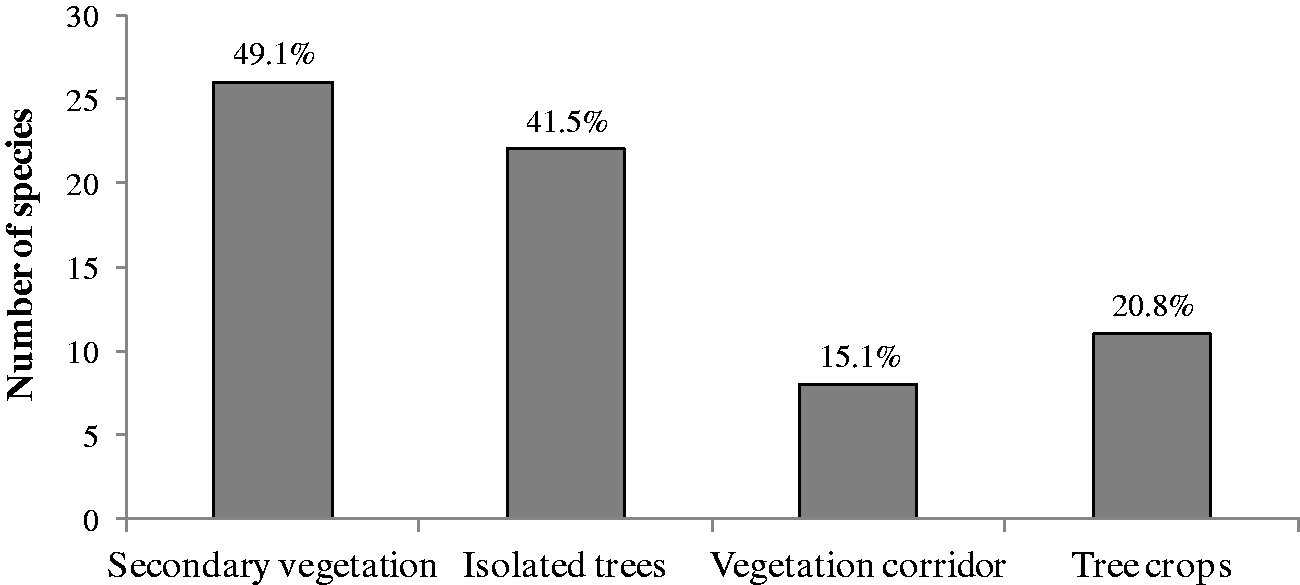
Differences in patch size and study length across studies were not related to the number of food species (Figure 4(a) and (b)) and the number of land covers used by spider monkeys for feeding and traveling (Figure 4(c) and (d)). This suggests that matrix use by spider monkeys was largely independent of patch size and study length.
Effect of home patch size and study length on the number of plant species used by spider monkeys (Ateles geoffroyi) as food resources in the matrix (a to b), and the number of land covers used for feeding and traveling in 13 forest sites from Mexico, El Salvador, and Costa Rica. All R2 values were not significant (p > .7, in all cases).
Discussion
This study shows that spider monkeys use different land cover types from the anthropogenic matrix for feeding and traveling in HMTLs. We observed monkeys feeding from 53 plant species—a significant figure considering that 16 groups of spider monkeys in five countries (Mexico, Guatemala, El Salvador, Costa Rica, and Panama) fed from 364 plant species (González-Zamora et al., 2009). In fact, most of the plant species are native and old-growth or late-successional forest species considered top food species for spider monkeys (González-Zamora et al., 2009). They consumed different life forms (trees, lianas, palms, and shrubs) and plant items (fruits, leaves, flowers, and wood), but as expected, fruits were the most frequently plant item eaten. Although we cannot quantify the importance of these feeding and traveling events for the fitness of these monkeys in HMTLs, our findings demonstrate that some human-created land covers in the matrix are not entirely hostile to this primate, but rather contain usable resources, not only to supplement their diet but also to move within and between land cover types (Arroyo-Rodríguez & Mandujano, 2009; Dunning et al., 1992; Franklin & Lindenmayer, 2009; Tscharntke et al., 2012). Thus, our study adds to an increasing line of evidence suggesting that forest edges do not represent home range boundaries for different species in fragmented forests (Dunning et al., 1992; Fahrig, 2013; Mendenhall et al., 2014; Tscharntke et al., 2012; Watling et al., 2011).
Although we have no information on the time spent within each land cover outside their home forest patches, we observed monkeys feeding and traveling in patches of secondary vegetation, different types of tree crops, vegetation corridors, and isolated trees, including records from both tropical wet forests and tropical dry forests in Mexico, El Salvador, and Costa Rica. Such behaviors can allow primates to supplement their diet in HMTLs (Dunning et al., 1992). As increasingly demonstrated in studies of primates (Anderson et al., 2007; Asensio et al., 2009; Chaves & Bicca-Marques, 2017; Estrada et al., 2012; Pozo-Montuy et al., 2013), supplementation dynamics are likely of critical relevance for species persistence in fragmented landscapes (Dunning et al., 1992), especially because the availability of food resources can be limited in forest patches, or because patches can be too small to sustain viable populations (e.g., Arroyo-Rodríguez & Mandujano, 2006, 2009).
Supporting the idea that monkeys are supplementing their diet with resources obtained from the matrix, we found that, as predicted, fruits were the most frequently eaten plant item, followed by leaves, wood, and flowers. Because fruits are expected to be scarce within forest patches (e.g., Chaves et al., 2012; González-Zamora et al., 2009, 2012), and have high concentrations of soluble carbohydrates (and energetic content), but low levels of secondary compounds and structural material (Felton et al., 2009a, 2009b; Milton, 1981), the consumption of this food item in the matrix probably improved the quality of spider monkeys’ diet. The consumption of leaves, wood, and flowers was also common in most forest sites, probably as a strategy of protein, lipid, and mineral supplementation (Chaves, Stoner, Ángeles-Campos, & Arroyo-Rodríguez, 2011a; Felton et al., 2009a, 2009b; Rothman, Van Soest, & Pell, 2006). Yet, additional studies comparing the nutritional value of the diet within their home forest patches versus the diet in the matrix are needed to better understand the effect of these feeding events in the matrix on primate’s diet and nutrition.
As expected, secondary vegetation was more frequently used than other land covers. Yet, when comparing the frequency of use of each land cover with their distribution in the sites, our findings suggest that the use of each land cover was directly proportional to their availability, suggesting no selection of particular land covers. In fact, the number of land covers in the matrix was positively related to the number of land covers used for feeding and traveling. Thus, although spider monkeys are strongly threatened by forest loss and disturbance (Garber et al., 2006; Ramos-Fernández & Wallace, 2008), this finding highlights the behavioral flexibility of spider monkeys (Amici, Aureli, & Call, 2008; González-Zamora et al., 2009; Schaffner, Rebecchini, Ramos-Fernandez, Vick, & Aureli, 2012; Wallace, 2008), and the importance of matrix heterogeneity for species conservation in HMTLs (Revilla, Wiegand, Palomares, Ferreras, & Delibes, 2004; Ricketts, 2001; Tubelis, Cowling, & Donnelly, 2004). Each land cover patch can support different resources, thus providing higher resilience and stability in ecological processes, such as feeding and dispersal (see the “landscape–moderated insurance hypothesis”; Tscharntke et al., 2012). The fact that monkeys used different plant species in each land cover suggests that vegetation composition differs widely between land covers (high beta diversity). Thus, for arboreal species such as spider monkeys, the presence of different types of tree covers in the matrix can provide opportunities for traveling (landscape connectivity) and feeding from different food resources (Revilla et al., 2004; Ricketts, 2001; Tubelis et al., 2004). This is probably important in severely deforested/degraded landscapes where increasing interpatch isolation distances can limit species persistence (Fahrig, 2013; Tubelis et al., 2004).
Implications for Conservation
Old-growth tropical forests are the main habitat of spider monkeys, and thus, the preservation of this species-rich ecosystem should be considered of highest priority for the conservation of this endangered primate. The great value of large forest remnants for primate conservation is incontrovertible (Estrada et al., 2017), but what is questionable is the exclusion of the anthropogenic matrix from conservation initiatives (Chapman, Chapman, & Glander 1989; Hockings, Yamakoshi, & Matsuzawa, 2017; Nekaris et al., 2017; Perfecto & Vandermeer, 2010).
In this sense, the maintenance of native and some cultivated trees in the anthropogenic matrix is of critical importance for spider monkeys, as all land cover types used by this primate were composed of trees (both native and cultivated). We refer to agroforests, such as shade cacao plantations (Theobroma cacao), mango (Mangifera indica), and guava (Psidium guajava; e.g., Estrada et al., 2012; Hockings et al., 2017), and other important landscape elements, such as vegetation corridors and isolated trees of native species (Asensio et al., 2009). Overall, the maintenance of these trees in the matrix has numerous benefits for both primates and humans. The benefits for primates go beyond their importance as supplementary food sources, as they are also critical to increase landscape connectivity, favoring interpatch dispersal movements (Pozo-Montuy et al., 2013). The benefits for humans include key ecosystem services, such as carbon sequestration, climate regulation, and water quantity (Díaz, Fargione, Chapin, & Tilman 2006). Furthermore, there are many cobenefits for humans of having both higher tree cover and primates in the landscape, including the soil nutrient enrichment through primates’ defecations, seed dispersal and rapid forest recovery (see below), education/inspiration, and esthetic values (e.g., Díaz et al., 2006; Feeley, 2005; Hockings et al., 2017). Related to the education/inspiration and esthetic values, local people can also obtain important economic resources from ecotourism associated with visits to primate groups, which is known to be an economically significant activity in many locations worldwide (Serio-Silva, 2006; Wolfe, 1991).
The fact that secondary vegetation was more frequently used by spider monkeys than other land covers supports an increasing number of studies underlining the importance of secondary forests for biodiversity conservation (Arroyo-Rodríguez et al., 2017; Martínez-Ramos et al., 2016; Melo et al., 2013; Omeja et al., 2016; Wright & Muller-Landau, 2006). Secondary forest does not only serve as supplementary habitat for forest species (Martínez-Ramos et al., 2016), but it also enhances landscape connectivity (Arroyo-Rodríguez et al., 2017), and provides key ecosystem services (e.g., carbon sequestration; Martínez-Ramos et al., 2016). Here, we show that secondary forests can be used by spider monkeys for feeding and traveling. Although additional studies are needed to better understand the role of these behaviors on primates’ survival and well-being in HMTLs, some long-term studies demonstrate that spider monkeys can actually live and even reproduce successfully in secondary forests, at least when located next to old-growth forests (Ramos-Fernandez & Ayala-Orozco, 2003; Ramos-Fernández et al., 2013). Of course, this does not mean that secondary forests alone are enough for the maintenance of primate populations in the long term, but that they can be used to improve the quality of the anthropogenic matrix, and accelerate forest recovery through secondary succession (see below). Tree crops, vegetation corridors, and isolated trees can also contribute to improve the quality of the matrix, as they can provide important food resources for spider monkeys (note that most plant species consumed from these land covers are classified as top food species for this primate; González-Zamora et al., 2009).
A topic that merits particular attention is the fact that spider monkeys are effective seed dispersers of a large number of plant species (Chaves, Stoner, Arroyo-Rodríguez, & Estrada, 2011b; González-Zamora et al., 2012). Thus, the use of all these land cover patches in the matrix likely contributes to forest recovery in HMTLs. Therefore, maintaining different types of tree covers in the vicinity of occupied forest patches is not only needed to conserve the remaining populations of this endangered primate species in HMTLs but also to preserve important ecological services, such as forest regeneration.
Our results present a straightforward message for conservation biologists and managers, especially when conservation strategies involve the retention of habitat patches in agricultural mosaics (land-sharing approach; Perfecto & Vandermeer, 2010); namely, some land covers in the landscape matrix contain food tree species for primates and other taxa (Dunning et al., 1992), and thus some matrix types can be beneficial to conserve and expand spider monkey populations in fragmented forests. Secondary forest cover is increasing across the Neotropics due to migration of people to urban areas and the abandonment of productive lands (Aide et al., 2013). This represents good news for the conservation of spider monkeys, and puts a priority on taking advantage of this changing situation and managing regenerating landscapes and investigations into primate restoration ecology (Jacob, Vaccaro, Sengupta, Hartter, & Chapman, 2008; Wright & Muller-Landau, 2006; Melo et al., 2013).
Footnotes
Acknowledgments
GKPE thanks Prof. A. Estrada for his useful advice during the development of her MSc thesis. Such advice contributed to improve the present manuscript. We also gratefully acknowledge three anonymous reviewers for their valuable and constructive comments and suggestions.
Author Contributions
Víctor Arroyo-Rodríguez and Gloria K. Pérez-Elissetche planned the research and designed methodology with the advice of G. Ramos-Fernandez. Gloria K. Pérez-Elissetche organized the data and Víctor Arroyo-Rodríguez analyzed the data. Víctor Arroyo-Rodríguez and Gloria K. Pérez-Elissetche wrote the first draft of the manuscript. All authors provided data and contributed critically to the drafts.
Declaration of Conflicting Interests
The author(s) declared no potential conflicts of interest with respect to the research, authorship, and/or publication of this article.
Funding
The author(s) disclosed receipt of the following support for the research, authorship, and/or publication of this article: This research was supported by the American Society of Primatologist (2012 ASP Conservation Grant). GKPE obtained a scholarship from CONACyT, Mexico. The Instituto de Investigaciones en Ecosistemas y Sustentabilidad (UNAM) provided logistical support.