




Abstract
In this paper, I offer a reading of Genesis 1–11 through the lens of Kelly Kapic’s theological reflections on the themes of creation, anthropology, embodiment, time, and limits. I attempt to integrate the discipline of textual exegesis with the discipline of Christian theology and to apprehend a biblical theology of time, incarnation, and weakness as it relates to progressive sanctification. First, I explore the goodness of time and limits in Genesis 1–11. God creates time and timekeepers in the ordered cosmos. God creates the weekly sabbath for humans. God reveals that humans are mortals who die when disconnected from God. God reveals human finitude through generations, genealogies, and limiting lifespans and initiatives. God reveals a plan to limit himself by entering his finite creation and by committing to relationships. Second, I explore the goodness of time and limits in Christian practice through my personal experience with illness and “creaturely finitude.”
Introduction
In this study, I offer a reading of Genesis 1–11 through the lens of Kelly Kapic’s theological reflections on the themes of creation, anthropology, embodiment, time, and limits. 1 I attempt to integrate the discipline of textual exegesis with the discipline of Christian theology and to apprehend a biblical theology of time, incarnation, and weakness as it relates to progressive sanctification. 2
First, I explore the goodness of time and limits in Genesis 1–11. In Genesis 1, God creates time and timekeepers in the ordered cosmos. In Genesis 2, God creates the weekly Sabbath for humans. In Genesis 2–3, God reveals that humans are mortals who die when disconnected from God. In Genesis 4–11, God reveals human finitude through generations, genealogies, limiting lifespans, and limiting initiatives. In Genesis 1–11, God reveals a plan to limit himself by entering his finite creation and by committing to a relationship with people.
Second, I explore the goodness of time and limits in Christian practice. My personal experience with illness is a perpetual reminder of my “creaturely finitude.” 3 God made me finite and limited, and I am learning to accept my human experience as an essential part of God’s “good” (i.e., purposefully ordered) creation. I am learning that my physical weakness, pain, and disability are catalysts which cultivate a sense of personal insufficiency and desperate dependence on God. I suggest, therefore, that creaturely finitude is a gift that God designed to facilitate progressive sanctification.
Time and Limits in Genesis 1–11
In the beginning, God created limitations! The infinite deity created a finite environment with finite inhabitants. Then God saw that all of it was “good” and “very good” (see Gen 1:4, 10, 12, 18, 21, 25, 31 where Hebrew ṭôv occurs seven times), signifying both the Creator’s goodness and the purposeful order of his cosmic temple with his human image. 4
In Genesis 1, God Creates Time and Timekeepers in the Ordered Cosmos
On the first day (Gen 1:3–5), God creates time. Of course, he initially diffuses his good light, and he divides the light from the darkness (Gen 1:3–4). But it’s important to notice what God names on the first day. 5 He does not call light “Light,” nor does he call darkness “Darkness.” By naming the light “Day,” we observe that God refers to the period of light. By naming the darkness “Night,” we observe that God refers to the period of darkness. 6 So, God creates daytime and nighttime. We experience these two equal periods as “evening” and “morning” (Gen 1:5), or sunset and sunrise. 7 So, the first day of creation is about the reality of sacred time. Cosmic finitude is God’s invention.
In the literary structure of Genesis 1:1–2:3, the first day is parallel with the fourth day. God creates functions on days 1–3 and he creates functionaries on days 4–6. 8 So, God establishes the function of time on day one, and he installs the functionaries of time on day four.
On the fourth day (Gen 1:14–19), God installs the timekeepers. He puts “lamps” (me’orot; Gen 1:14–16) 9 in the ceiling of his home to separate day from night and to mark the calendar. These celestial lamps serve as timekeepers “for revelations (‘otot), for feasts (mo’adim), and for days and years” (Gen 1:14), and they shine God’s light on the terrestrial zone (Gen 1:15, 17). 10 God also made the greater lamp and the lesser lamp, along with the stars, for regulating the day and the night respectively (Gen 1:16). So, the fourth day of creation is about the reality of the sacred clock and calendar, which are human concerns. The cosmos is right on schedule, and humans live in God’s time.
In Genesis 2, God Creates the Weekly Sabbath for Humans
On the seventh day (Gen 2:1–3), God inaugurates his temple in time. 11 In Hebrew, each clause mentioning “the seventh day” is exactly seven words, and Genesis 2:1–3 has a total of thirty-five words (7 × 5 = 35). Patterns and multiples of seven are found throughout the creation account, 12 expressing the order (ṭôv) of God’s cosmic temple. In the ancient Near East and in the Hebrew Bible, temples were conventionally constructed in seven building stages. 13 In Genesis 1:1–2:3, the same pattern (viz. the seven-day week) is adapted to reveal that creation is God’s temple. He made everything—temporal, physical, and metaphysical—so that he could enter it and remain in it (cf. Col 1:15–17). Also, patterns of seven teach us about sacred time. Time is sacred/holy because God consecrated the seventh day (Gen 2:3). And seven days comprise the week—a pattern of working for six days and resting for the sacred seventh day (viz. the Sabbath).
What does it mean that God “rested” (Gen 2:2–3)? Was he exhausted after a long workweek? The Hebrew verb shavat (intransitive, with preposition min; “he rested from”) simply denotes that God “paused” (traditionally, “ceased/stopped/rested”). 14 But in the context, it connotes that God was enthroned—seated as king of the cosmos. This language about God resting is royal language. In ancient Near Eastern texts, kings rest on their thrones in their palaces. 15 Also, this language about deity resting is temple language. The gods of the ancient Near East are imagined as divine kings who are enthroned in their divine palaces which we call temples.
And the same is true here in Genesis 2:1–3. On the seventh day God takes his position in his palace of creation and he reigns in it. He rules from it. He actively sustains the cosmos—he upholds it. Colossians 1:17 says of Jesus: “in him all things hold together” (ESV, NIV, NRSV). That’s what the Sabbath is about—Christ sustaining creation from his temple “headquarters.” 16 The Sabbath is about God’s presence in the cosmic control room, and it remains the reality not just once per week, but it is also the reality on day 8, day 9, day 10, etc. The point is that humans perpetually live in the seventh day which is not limited to evening and morning (cf. Heb 4:1–11). 17 The Sabbath is a reality of the past, present, and future.
At first glance it may be surprising to observe that there is a significant amount of divine activity in Genesis 2:2–3. God “rested,” “blessed,” and “made it holy.” Why these three actions of resting, blessing, and consecrating? I would suggest that God did these things for us—for our benefit/good (cf. Deut 6:24; 10:13; 30:9). God “paused” so that we might rest. He “blessed” the day so that our lives might flourish. He “made it holy” so that we would enjoy a holiday every week. God’s Sabbath-works answer the questions “Why?” or “What for?” about creation (see Mark 2:27–28; John 5:17). 18 God created everything for humanity’s good—that is, he created with providential order.
In Genesis 2–3, God Reveals That Humans Are Mortals Who Die When Disconnected from God
When God creates humanity, he identifies them as his physical image and likeness, and he installs them collectively as finite functionaries in his cosmic temple (Gen 1:26–2:25). Human finitude is clarified in Genesis 2:4–7 where the “generations [toledoth] of everything” begin and God forms the archetypal (or representational) human. 19 Genesis 2:7 says: “Then YHWH-God formed the human—dust from the ground, and he blew into his nostrils a breath of life. So, the human became a living person.” Notice how the nouns “human” and “dust” are juxtaposed. “Dust from the ground” modifies “the human” as there is no preposition connecting these appositional terms. 20 The human is identified as “dust from the ground,” signifying that the archetypal human is mortal. 21 So, in Genesis 1–2, humans are identified both as God’s physical image and as finite mortals enlivened by God.
Humans are identified as mortals before the fall-story, and the same reality is reaffirmed after the fall-story when YHWH-God said to Adam “you are dust, and to dust you will return” (Gen 3:19; cf. Job 10:9; 34:15; Ps 103:14; 104:29; Eccl 3:20; 12:7). 22 The reason why physical death narratively occurs after the fall is because the archetypal humans are exiled from the sacred space (viz. the garden of Eden). Finite physical life was sustained while the priestly functionaries were presumably eating from the tree of life (Gen 2:9). But when they chose the alternate tree, severing themselves from God’s living word/presence, their mortal bodies eventually succumbed to physical death (Gen 3:22–24).
Physical death is implicit in Genesis 1–2 where time commences (Gen 1:3–5, 14–19), plants are consumed (Gen 1:29–30; 2:16, 18–19), trees of life and death are provided (Gen 2:9, 16–17; 3:1–6, 8, 11–12, 17, 22, 24), and cellular death is seemingly operative (plant growth, embryogenesis [Gen 1:11–12, 29; 2:9], apoptosis; cf. epidermis, hair, nails, etc.). In Genesis 1–3, we should also notice the presence of darkness, deep waters, non-order, dragons, predation/danger, disorder, lack/negation, serpent, temptation, and pain/angst, all which seem to exist in God’s “good” creation (Gen 1:1–3:1). 23 These realities suggest that the text of Genesis 1–3 presupposes “some forms of danger and suffering as a part of the world as created, as a provocation to human maturing.” 24 That is, “Various forms of suffering” are “occasions for the development of a fullness of life.” 25 Based on Genesis 1–3, it appears that God’s “good” plan, which entails some danger, suffering, and death, is a purposefully ordered creation in time and space that facilitates human sanctification. The psalmist captures this concept well when he says, “It was good [ṭôv] for me to be afflicted so that I might learn your decrees” (Ps 119:71 NIV). 26
In Genesis 4–11, God Reveals Human Finitude Through Generations, Genealogies, Limiting Lifespans, and Limiting Initiatives
The Hebrew term for “generations” (toledoth) is used strategically to structure the whole book of Genesis. Toledoth is used five times in the first half of the narrative (Gen 1:1–11:26), which is paralleled by the five occurrences in the second half of the narrative (Gen 25:12–50:26). These ten “generations” (toledoth) therefore symmetrically frame the literary centerpiece of Genesis which is the Abraham story (Gen 11:27–25:11), bringing the total number of toledoth to eleven (Table 1).
The Toledoth Structure of Genesis.
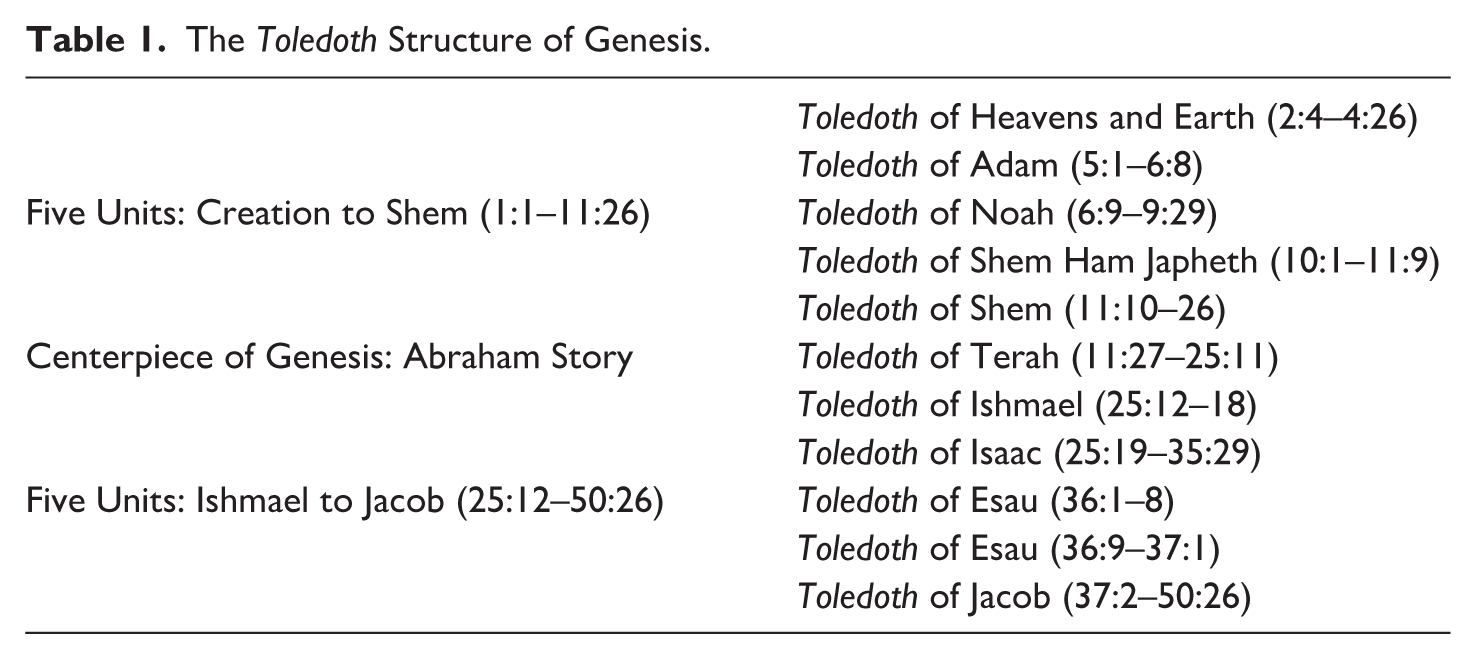
On literary grounds, one might suggest that finite “generations” (or “birth accounts” [toledoth]) are the most prominent theme in the book of Genesis. The emphasis on historical generations may be interpreted as the result of God’s blessing on humanity that they may “Be fruitful, be numerous, and fill the land” (Gen 1:28; 9:1, 7; cf. Gen 35:11; 47:27; 48:3–4; Exod 1:7). This theme shows that God wants humans to flourish in time and space.
The human genealogies are also strategically employed to structure the whole book of Genesis. 27 There are seven story-units in the book of Genesis. Each one consists of narrative + genealogy (or genealogy + narrative), and the literary centerpiece—story-unit #4 (of seven)—is once again the Abraham story (Gen 11:27–25:11; Table 2).
The Genealogical Structure of Genesis.
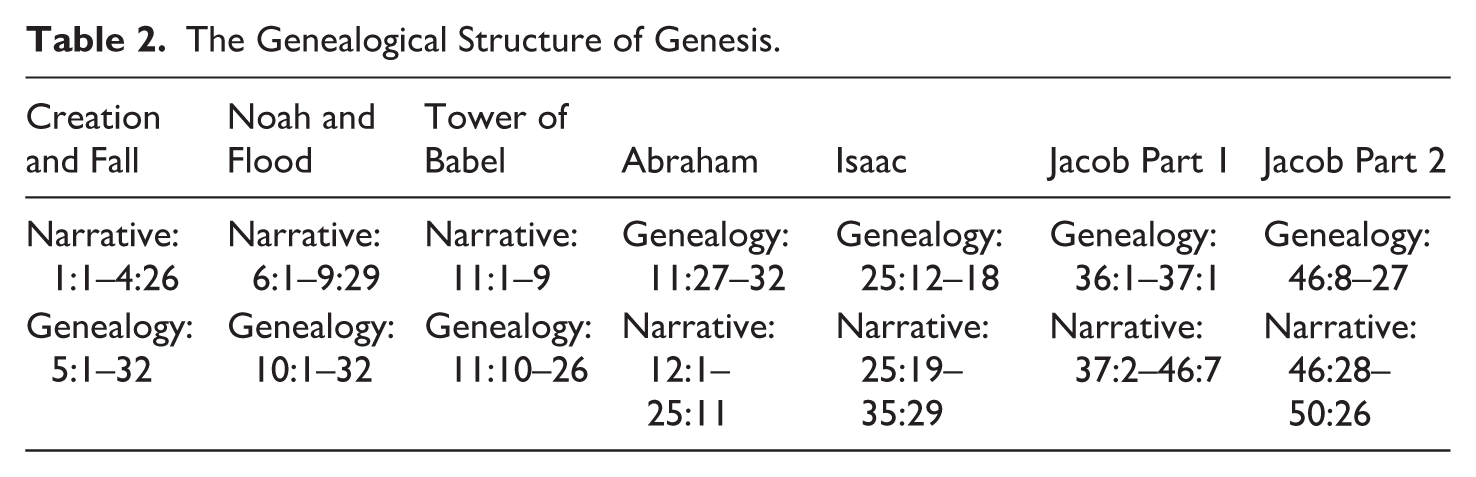
The genealogies prominently feature the verbal root yld, “to beget/birth/bear,” which is the basis for the noun toledoth (“generations”). Along with generations, genealogies may also be interpreted as the result of God’s blessing on humanity in Genesis 1:28; 9:1, 7. Humans are blessed to beget in history (see Gen 5:2–3). But begetting is complicated by pain, toil, and the abuse of power (see Gen 3:16; 4:23–24; 5:28–29; 6:1–4; etc.) because human flourishing is fraught with human sin.
As humanity multiplied, they began to think of themselves as divine kings, acting as though they are gods and exchanging good for evil (Gen 6:1–5). 28 Echoing the creative acts of God (in Gen 1:4, 10, 12, 18, 21, 25, 31) and the sinful acts of humans (in Gen 3:6), “the [so-called] ‘divine sons’ ‘saw’ the daughters of humanity ‘that’ they were ‘good.’ Then they ‘took’ for themselves wives from anyone they had chosen” (Gen 6:2). 29 So, YHWH curbs human hubris and he disciplines them by limiting their lifespans, saying “My Spirit will not strive with humanity forever, since it is flesh. So, its days are one hundred and twenty years” (Gen 6:3). The early kings in both Egypt and Mesopotamia were thought to be divinized, and they supposedly ruled for tens of thousands of years. 30 In response to this human trend, God reinforces that humans are finite flesh with God-given limits. One hundred and twenty years is henceforth the ideal lifespan (like Moses; see Deut 31:2; 34:7). 31
But the human problems persist after the flood, and God continues to limit human initiatives in the tower of Babel story (Gen 11:1–9). People attempt to control the divine presence on their own terms (Gen 11:1–4). 32 They also act like God by making and naming (Gen 11:4; cf. Gen 1:26). Then YHWH comes down, ironically accommodating their manipulative endeavors, only to humble them by confusing their language and by dispersing them throughout the land (Gen 11:5–9). This account demonstrates the human need for divine revelation and relationship.
In Genesis 1–11, God Reveals a Plan to Limit Himself by Entering His Finite Creation and by Committing to a Relationship with People
In the first half of the Genesis narrative, God creates a limited cosmos in space and time. Then he ostensibly chooses to enter it, occupying it as his palace/temple where he reigns/rests. God’s sustaining presence blesses and consecrates the finite space of creation. And God designs humanity to be his physical image so that they can mediate his presence in creation, and they can flourish in their holy status as a royal priesthood.
The problems come when mortal creatures circumvent their creator, and they choose alternate sources of life or revelation. When they reject God, they experience their limitations more acutely (see Gen 3:14–19). They must live with consequences like pain, angst, exile, shame, injustice, danger, and death (both physical and spiritual). The sin problem persists in human history (see Gen 4:7; 6:5), even after the flood (see 8:21; 9:20–28; 11:1–9).
But God has compassion and love for his vulnerable image. God engages in dialogue with humans especially when they fail (e.g., Gen 3:8–19; 4:6–16). God blesses, nourishes, helps, and protects humans in ways that run contrary to ancient Near Eastern thought (e.g., Gen 1:28–30; 2:9; 3:21; 4:15; 6:8; 8:1; 9:1–3). 33 God disciplines humanity to teach them about himself (e.g., Gen 6–8; 11:5–9). The biggest surprise is how God limits himself, not only by entering his finite creation, but by making promises to people as he reveals his plans for human history (see Gen 8:21–22; 9:9–17).
God chooses to limit himself by raising up a covenant between himself and all fleshy creatures (Gen 9:9–11, 15–17). He promises never again to curse the ground because of humanity or to destroy everything (people, animals, and land) as he did by floodwaters (Gen 8:21; 9:11, 15). He promises that time—specifically the calendar, seasons, and days—will not cease (Gen 8:22). He even gives a revelation (‘ot) of the covenant for perpetual generations of humans (Gen 9:12). This revelation is the gift of his weapon—the bow—in the clouds, signaling the covenant between himself and the land along with all flesh (Gen 9:13, 17). When the divine bow appears in the clouds, God remembers his perpetual covenant between himself and all creation (Gen 9:14–16).
This covenant with creation-at-large is the first installment of God’s program to reveal himself in physical space and time for the goal of enjoying a relationship with humanity. 34 It is God’s personal initiative which continues in the patriarchal narratives (Gen 12ff) where he reveals more and more about himself. Through God’s covenant program, people can flourish again in God’s presence (Gen 3:8; Lev 26:9–12; 2 Cor 6:16; Rev 2:1; 21:3).
God’s self-revelation in the New Covenant continues making relationship possible, especially through the incarnation of Jesus Christ. The incarnation is God’s ultimate accommodation by which he limits himself by entering physical space and time, becoming a fleshy human—the very image of God—who experiences birth, pain, suffering, temptation, weakness, aging, bleeding, injustice, death, and resurrection (see Isa 53; John 1:1–18; Phil 2:5–11; Col 1:15–20; Heb 1:1–4; 4:14–16; 5:7–10).
Time and Limits in Christian Practice
The Christ-hymn in Colossians 1:15–20 speaks about time and limits related to Christology and creation. Rick Langer explains that (1) “The God of creation is the God of redemption is the incarnate Christ our King,” and Jesus “created and entered the [limited] material world. He owns, sustains and redeems the material world. He created the world in the past, sustains it in the present, and will redeem it in the future. From the distant past to the eternal future, the incarnate Christ reigns supreme over a material universe;” 35 (2) “Christ is immediate King over all of the created order;” 36 and (3) “Christ is the only and ultimate Redeemer of all that will be redeemed. . . Paul not only wants us to understand that the creation of the material world was God’s intention but also that the redemption of the material world was God’s intention.” 37
Colossians 1:16 affirms that everything in time and space was “created through him and for him” (ESV, NIV, NRSV), and these three points from Colossians 1:15–20 are foundational for the “task of theological integration,” which Langer defines as “the enthroning of Christ as King in every sphere of human endeavor and every aspect of the created order.”
38
In Colossians 3:5–11, Paul applies these creational concepts to our progressive sanctification: Put to death, therefore, whatever belongs to your earthly nature . . . You used to walk in these ways, in the life you once lived. But now you must also rid yourselves of all such things as these . . . since you have taken off your old self with its practices and have put on the new self, which is being renewed in knowledge in the image of its Creator. Here there is no Gentile or Jew, circumcised or uncircumcised, barbarian, Scythian, slave or free, but Christ is all, and is in all (NIV).
39
Paul’s language about clothing and image is about human identity, and human identity is realized by knowledge of the incarnate Creator who is God’s visible and physical image.
Personally speaking, I am interested in the biblical theology of time and limits because I keep running into the reality of “creaturely finitude.” 40 As I experience increasing corporal limitations, I think more about my mortality as physical death feels closer during times of illness. Six years ago, at age forty-four, I was diagnosed with blood cancer (acute myeloid leukemia [AML], now in remission), but I now suffer from chronic pain with a condition known as graft versus host disease (GvHD). My physical body is damaged from cancer treatments (viz. chemotherapies and total body irradiation [TBI]), and it is weak because of my bone marrow transplant (BMT). My transplant was a “curative” procedure by which donor stem cells (graft DNA from my biological brother) were engrafted in my body and produced a new blood type and immune system which often conflicts with my old body (host DNA). My current social experience is one that is often invisible to others (because my body is intact, and I may look “normal”) but is affected by erratic, chronic pain.
Through my study of Genesis 1–11, I am learning that my time and limits are God-given, and they are not necessarily sin/bad. I am learning that I am only human and that my time and limits are essentially “good” because God says so. 41 As God’s finite creature, I am learning that I am not enough, and that is exactly why I am enough. 42
As for sin, I am realizing that sinful practices may enter my embodied experience as my will relates to time, limits, and death. My relationship to time is often fraught with fear, frustration, anxiety, control, and independence (cf. Gen 3:17–19). 43 The problem is that I want to be a superhero—almighty, indestructible, self-sufficient, and immortal. When I experience limitations (injury, fatigue, illness, aging, circumstances, resources, etc.), I tend to get frustrated. Honestly, I am tempted sometimes to try being the infinite Creator instead of the finite creature, especially when I wish to control what is not given to me. 44 But Scripture reminds me to number my days that I “may gain a heart of wisdom” (Ps 90:12 NIV), and Scripture reminds me to accept my human finitude, like Paul who delights in weaknesses, hardships, and difficulties, saying “For when I am weak, then I am strong” (2 Cor 12:10 NIV). I should not strive to be Superman, avoid all pain, turn back time, or dodge my inevitable death. I am learning to accept my physical body with its temporal limitations. I am learning to accept the clock and the calendar because God made them, and they are essentially “good.” I am learning “to embrace a pedagogy of suffering, the process of learning to be [a creature].” 45
I am comforted by the theological themes of Scripture—especially the theology of time, incarnation, and weakness—when I receive them as good gifts from God. In the theology of time, God is the Ancient of Days (Dan 7:9, 13, 22), 46 the First and the Last (Isa 44:6; 48:12; cf. Rev 1:8, 17; 21:6; 22:13), the Lord of the Sabbath (Matt 12:8; Mark 2:28; Luke 6:5), Planner of his “Day” (e.g., Joel 2:31 [Hebr. 3:4]; Acts 2:20), and Jesus said he is “with” us in time—”always, to the end of the age” (Matt 28:20 ESV, NRSV).
In the theology of the incarnation, God chose to limit himself by becoming human—the physical “image of the invisible God” (Col 1:15 NIV, ESV, NRSV; cf. Gen 1:26–27; 5:1, 3; 9:6; 2 Cor 4:4; Col 3:10). 47 In Christ, “the whole fullness of deity dwells bodily” (Col 2:9 ESV, NRSV; cf. Col 1:18–19; Heb 1:2–3). God was born in a human body. He grew up, suffered, and died. He also rose again in a physical body, and he is returning for us. And we the church get to be God’s body through union with Jesus Christ: our new self “is being renewed in knowledge in the image of its Creator” (Col 3:10 NIV). 48
I am also comforted by the theology of weakness. I can view human weakness as a good limitation. I can view pain as a divine gift.
49
In Christ, I can be content with calamities and hardships. God’s grace is sufficient when my pain persists, and God’s power is perfected when I am weak (see 2 Cor 12:7–10). Physical weakness, pain, or disability can be effective catalysts which cultivate a sense of personal insufficiency and desperate dependence on God. C. S. Lewis famously described human pain as “God’s megaphone” which gives people an “opportunity,” warns about their “insufficiency” and “need,” and shatters their “illusion of self-sufficiency.”
50
Our corporal experience of weakness can work like a vacuum that makes us ready to receive God’s strength (cf. Col 1:24, 29).
51
In Weakness is the Way, J. I. Packer explains: We need to be aware of our limitations and to let this awareness work in us humility and self-distrust, and a realization of our helplessness on our own. Thus we may learn our need to depend on Christ, our Savior and Lord, at every turn of the road, to practice that dependence as one of the constant habits of our heart, and hereby to discover what Paul discovered before us: “when I am weak, then I am strong” (2 Cor. 12:10).
52
Prayerfully, I am reconsidering my habits and practices. I am learning that accepting my limits means doing less by saying “no” more often and by delegating tasks to others. Embracing my mortality gives me clarity about decisions and helps me to value what matters most in life (viz. people). 53 I am learning to listen to my finite body by resting more, going to bed earlier, and observing the life-giving principles of the Sabbath. Professionally, I am learning to cut back on tasks that others can do—even if that means taking a pay cut—and to focus on the work that I am specially wired to do (viz. teaching Bible students). I am learning to lament well, holding together goodness and suffering, and recognizing that my troubles can be “oriented towards God.” 54
In conclusion, I encourage the body of Christ to honor sacred time by celebrating the Sabbath in some way. I also encourage the body of Christ to embrace weakness, dependence, and human limitations. We can take off the superhero cape and put on the suffering cross. We don’t need to fear aging, illness, or physical death. We can practice saying “no” when asked to do more. When we are burdened, we can breathe. When we are in pain, we can pray. When we are ill, we can lament to God. Finally, when we are dying, we can hope in Jesus.
Jesus is gentle and humble, his yoke is “good” (Greek chrēstos, not “easy”), and he can give us rest (see Matt 11:28–30). 55 When we are feeling stretched and burdened with the realities of creaturely finitude, we can come to the good king of the cosmos and we can enthrone him “in every sphere of human endeavor and every aspect of the created order.” 56 This is how we can enter God’s promise of Sabbath rest and realize the hope of integration with Christ (see Rom 8:11; 1 Cor 15:20–22; Col 1:9–12; 3:10–11; Heb 4:1–11).
Footnotes

Funding
The author received no financial support for the research, authorship, and/or publication of this article.
Declaration of Conflicting Interests
The author declared no potential conflicts of interest with respect to the research, authorship, and/or publication of this article.